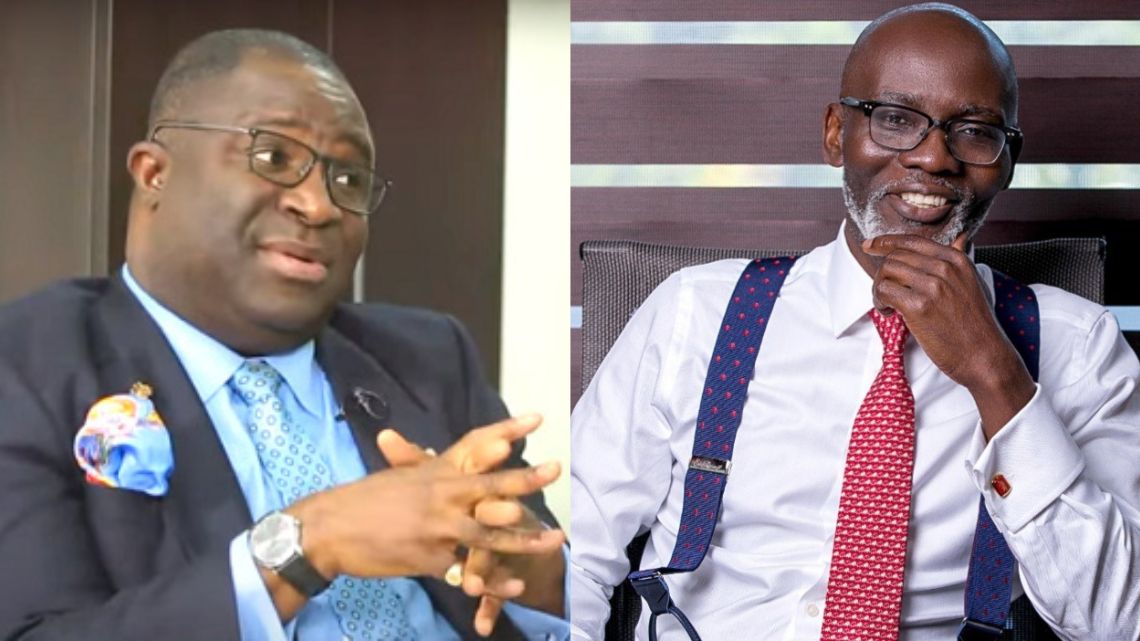
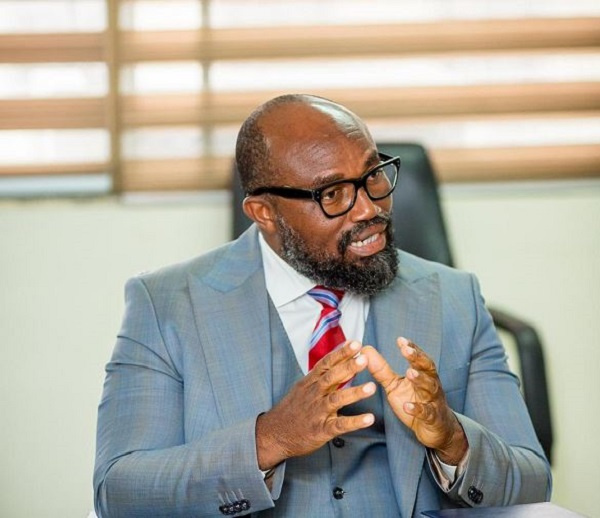
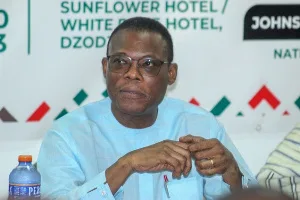
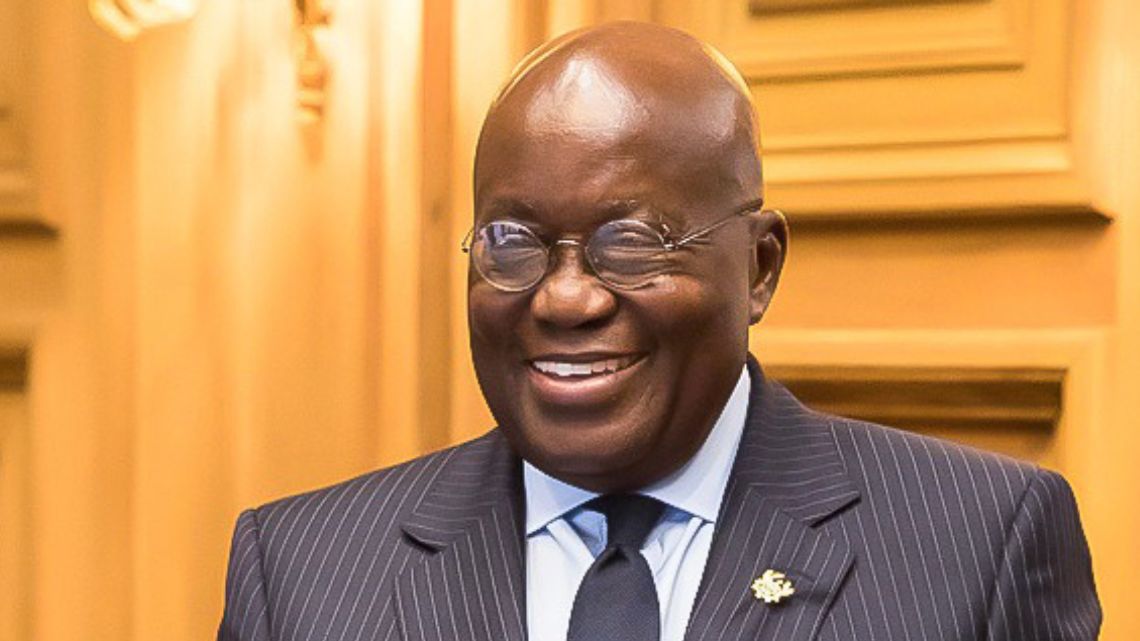
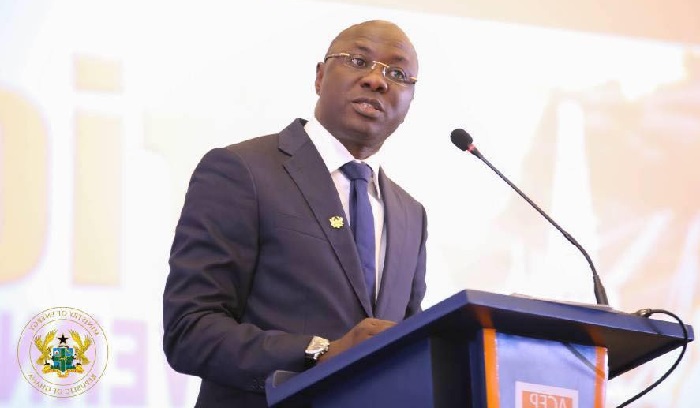
IMANI Africa’s President, Franklin Cudjoe, has expressed a stronger belief in John Mahama’s commitment to combating corruption than in President Akufo-Addo’s.
Mr Cudjoe argues that while both leaders have faced scrutiny over their efforts to tackle corruption, Mahama’s recent pledges inspire more confidence.
Speaking at a town hall meeting in Accra on Monday, August 12, Mahama promised to hold all public officials accountable if he is re-elected as president, emphasizing that his approach to corruption would be more comprehensive than his predecessor’s. He vowed not to limit the fight to political adversaries but to address it within his own administration.
Despite the criticisms Mahama faced during his previous term, Franklin Cudjoe believes that Mahama has an advantage over President Akufo-Addo when it comes to fighting corruption.
Citing various instances where Akufo-Addo has backtracked on his promises, Cudjoe highlighted the president’s inconsistent stance on issues like illegal mining, commonly known as “galamsey,” and his controversial handling of the recent economic crisis.
“I can understand the caution, but [President] Akufo-Addo is not John Mahama. At least we tested both. As I understand, [President] Akufo-Addo has walked back on some of his words many, many times. No haircut, he gave us a dubious haircut,” Cudjoe remarked in an interview with Citi News.
He added, “Galamsey [Illegal mining], he said he would put his presidency on the line and nothing has happened because the rivers are worse off now than ever before. I should be cautious, but I think I will trust John Dramani Mahama a bit more than [President] Akufo-Addo because unfortunately, [President] Akufo-Addo has proven not to be trustworthy on these things.”
In contrast, Mahama’s recent pledges suggest a renewed determination to tackle the issue head-on if given the chance.
The World Bank has raised concerns that Ghana’s tax system is underperforming due to excessive tax exemptions and reliefs that significantly reduce the corporate income tax (CIT) base.
According to the institution, these generous tax breaks are hindering the country from maximizing its revenue potential.
From 2015 to 2020, Ghana missed out on an average of about 1.3% of its Gross Domestic Product (GDP) in corporate tax revenue each year.
The World Bank highlighted that the existence of over two dozen different types of tax breaks for companies is a major contributor to this shortfall.
The World Bank estimates that these tax breaks are costing Ghana around 0.5% of its GDP in lost revenue annually.
“By reducing or eliminating some of these generous tax breaks, Ghana could improve its tax system and collect more revenue from corporate taxes,” the institution noted in its 8th Ghana Economic Update.
The Exemptions Act, 2022 (Act 1083), was presented to Parliament by the former Minister for Finance, Ken Ofori-Atta, in 2022.
In 2021, the Ministry of Finance initiated processes to secure approximately $335,072,712.13 in tax exemptions for 42 companies under the government’s One District One Factory (1D1F) initiative.
Parliament in July 2024, approved the first of numerous tax waivers before the House, which the Finance Committee was previously blocking.
The approved tax waiver amounts to €1.5 million for the supply and installation of e-learning laboratories in Senior High Schools across the country.
Ghana’s personal income tax (PIT) accounts for approximately 15% of the country’s total tax revenues, which is below the Sub-Saharan Africa (SSA) average of 18%. As of 2020, the country’s PIT revenue was equivalent to 2% of GDP, compared to the SSA average of 3.5%, highlighting a gap between actual and potential PIT revenue of more than 2% of GDP.
Payroll taxes constitute over 99% of total PIT proceeds, with other forms of PIT, such as taxes on capital gains, investment income, and business income of the self-employed, making up less than 1% of the total—a stark contrast to more than 30% in some lower-middle-income countries (LMICs) like India.
In 2022, fewer than 25% of Ghanaians of voting age (18 and older) paid payroll taxes under the Pay-As-You-Earn (PAYE) scheme, and less than 0.2% declared any business income. This is in sharp contrast to countries with high PIT productivity, such as Norway, Sweden, and Canada, where almost 100% of the voting population files PIT returns.
The Ghana Health Service (GHS) has ramped up its surveillance efforts following the declaration of a Public Health Emergency of International Concern by the Africa CDC, due to a significant surge in Mpox cases across 15 African countries.
The GHS is taking proactive measures to minimize Ghana’s exposure to the disease, which, though rare, can be fatal.
This move comes as the World Health Organisation (WHO) reported 2,030 cases and 13 deaths so far this year, a sharp increase compared to the 1,145 cases and seven deaths recorded in 2023.
Notably, four countries—Burundi, Kenya, Rwanda, and Uganda—have reported their first-ever Mpox cases since mid-July 2024.
Director of Public Health at GHS, Dr. Franklin Asiedu Bekoe,emphasized the importance of heightened vigilance among Ghanaians, particularly regarding unusual skin rashes.
“We are going to activate our surveillance system. We aim to raise awareness so that people do not mistake Mpox for chickenpox. We will also enhance our coordination efforts,” Dr. Bekoe stressed.
He further clarified that Ghana should not have been listed on the Africa CDC website as one of the 15 African countries with confirmed Mpox cases, noting that the last recorded case in Ghana was in April 2023.
“In Ghana, our last case was in April 2023. Since we have had cases in the past, we are activating our system to manage any potential cases,” he added.
Mpox, which can cause severe lesions across the body, spreads from animals to humans and between people through close contact, including skin-to-skin interaction and respiratory transmission. Symptoms include fever, muscle aches, and body-wide lesions, and the disease can be deadly if left untreated.
Two main strains of the virus exist, with the milder one responsible for the global outbreak in 2022 that spread primarily through sexual contact. The more deadly strain, endemic to Central Africa, is the cause of the recent variant detected in DR Congo.
There are three available vaccines for Mpox, but they are typically reserved for individuals at high risk or those who have been in close contact with an infected person.
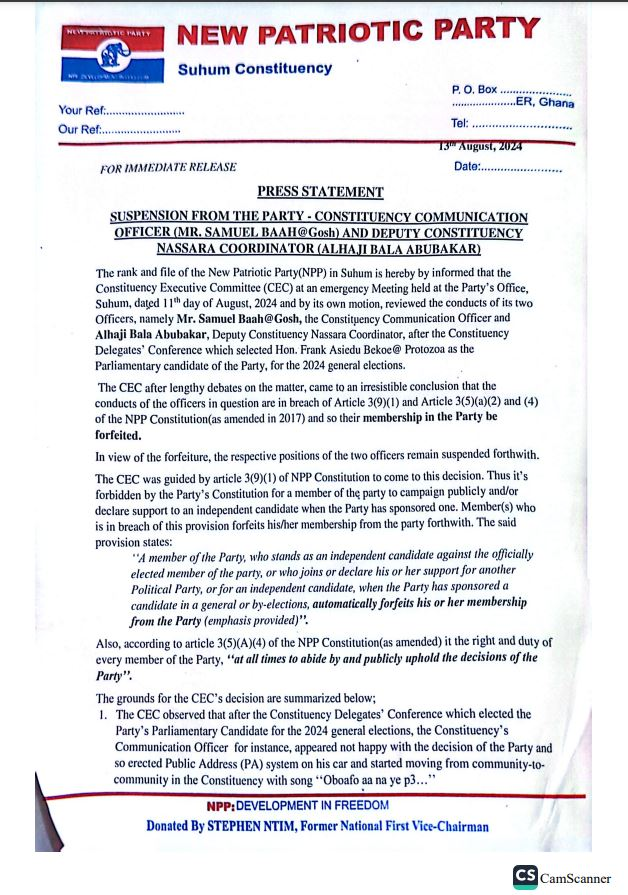
The New Patriotic Party (NPP) has taken disciplinary action against two of its executives in the Suhum Constituency, suspending them for engaging in activities that go against the party’s principles.
The suspended executives are Samuel Baah, the Constituency Communication Officer, and Alhaji Bala Abubakar, the Deputy Constituency Nasara Coordinator.
The decision, made by the Constituency Executive Committee (CEC), was communicated in letters handed to the affected members.
According to a statement signed by Constituency Secretary Stephen A. Odame on Tuesday, August 13, the two executives were found guilty of actions that breached the NPP’s constitution, resulting in their suspension. These actions were described as divisive and harmful to the party’s unity.
The CEC outlined a series of misconducts, including the duo’s involvement in campaigning against the party’s officially chosen parliamentary candidate and organizing processions with anti-party messages.
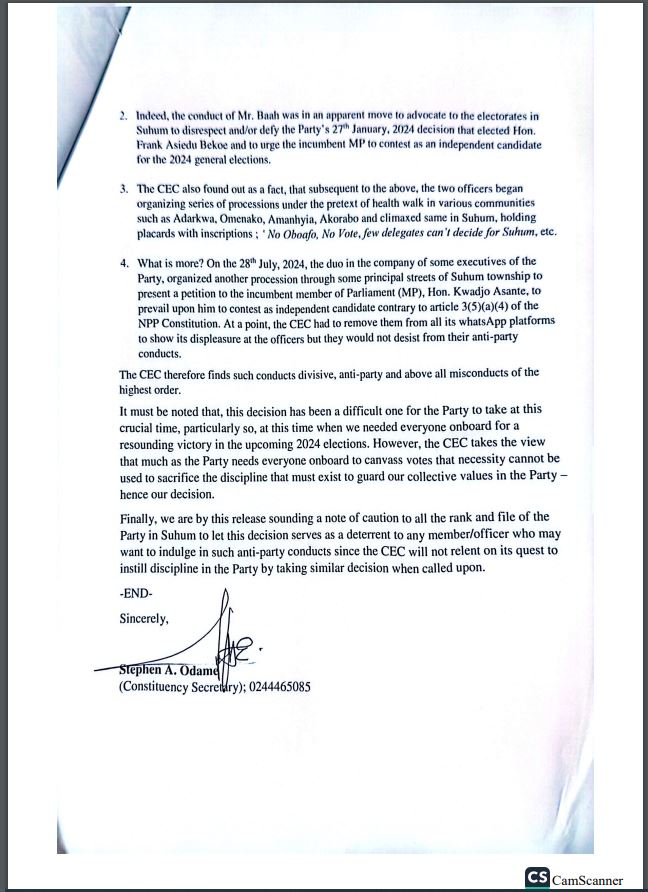
They were also accused of presenting a petition to the incumbent Member of Parliament, urging him to run as an independent candidate, a move that directly contradicts the party’s rules.
In one instance, it was noted that after the Constituency Delegates’ Conference, which confirmed the party’s parliamentary candidate for the 2024 elections, Samuel Baah expressed dissatisfaction with the outcome. He reportedly set up a Public Address system on his car and travelled through various communities in the constituency, playing a song that implied opposition to the party’s decision.
Additionally, the CEC discovered that the two executives were behind a series of processions disguised as health walks, during which participants displayed placards with slogans like “No Oboafo, No Vote” and “Few delegates can’t decide for Suhum.”
These activities took place in multiple communities, culminating in a procession through the streets of Suhum on July 28, 2024. The procession ended with the delivery of a petition to the incumbent MP, Hon. Kwadjo Asante, urging him to run as an independent candidate in the upcoming election.
The CEC’s decision to suspend Baah and Abubakar was also influenced by their continued defiance, despite being removed from the party’s WhatsApp platforms as a sign of disapproval.
Their actions were ultimately deemed to violate key articles of the NPP Constitution, leading to their suspension from their positions and forfeiture of party membership.
The CEC was guided by Article 3(9)(1) of the NPP Constitution to come to this decision.
The said provision states: “A member of the Party, who stands as an independent candidate against the officially elected member of the party, or who joins or declares his or her support for another Political Party, or for an independent candidate, when the Party has sponsored a candidate in a general or by-elections, automatically forfeits his or her membership from the Party (emphasis provided)”.
Also, according to article 3(5)(A)(4) of the NPP Constitution (as amended) it is the right and duty of every member of the Party, “at all times to abide by and publicly uphold the decisions of the Party”.
The NPP has stressed the importance of discipline and unity as the 2024 elections approach, warning that any similar behaviour will not be tolerated within the party.
Subin Member of Parliament, Eugene Boakye Antwi, has launched a scathing attack on Gabby Asare Otchere-Darko, accusing him of being the mastermind behind the removal of Osei Kyei-Mensah-Bonsu as Majority Leader.
In a blunt statement, Antwi labelled Gabby as “a liar who doesn’t fear God” and claimed that his falsehoods were responsible for the downfall of the veteran politician.
According to Antwi, Gabby and other members of the President’s inner circle mistakenly believed that Kyei-Mensah-Bonsu was behind the calls from a faction of Majority MPs demanding the dismissal of Finance Minister Ken Ofori-Atta.
“They thought Kyei-Mensah-Bonsu was the one behind us calling for Ken Ofori-Atta to be removed. Kyei-Mensah-Bonsu was also not even aware until we did our press conference. Where in this world did you hear him say that he wanted to be a finance minister?” Antwi questioned.
Antwi recounted an incident where Gabby invited him to a meeting, which he attended only under the condition that it be recorded to prevent any misrepresentation.
“You called me to come to your house, and I asked you to record me because I didn’t want him to misquote me to the president. I shouldn’t have even gone there, but I went and asked that he record me so that he does not misquote me to the President,” Antwi explained.
He further accused Gabby of leading the charge to oust Kyei-Mensah-Bonsu, a move that Antwi believes was a critical mistake ahead of upcoming elections.
“Gabby was the leader of the people who saw to the removal of the Majority Leader. But if you are going into an election as critical as this and you decide to take out the experienced Leader in Osei Kyei-Mensah-Bonsu, then you clearly are not ready to make history,” Antwi said during an interview with Oyerepa FM.
The Suame legislator in February of this year formally announced his resignation as Majority Leader, a position he held for over seven years.
In April 2024, Osei Kyei-Mensah Bonsu said he was not pushed to resign from his position as leader of government business in parliament, as speculated.
“I was resigning to save the party; I was resigning to prevent any chaos in the party. That’s all that I can say. But I think ever since I did, I have refused to speak to any station.“
Member of Parliament for Subin, Eugene Boakye Antwi, has alleged that Gabby Asare Otchere-Darko played a pivotal role in the removal of Osei Kyei-Mensah-Bonsu from his position as Majority Leader.
The Suame legislator in February of this year formally announced his resignation as Majority Leader, a position he held for over seven years.
According to Mr Antwi, Gabby Otchere-Darko, along with other members of the President’s family, wrongly believed that Kyei-Mensah-Bonsu was orchestrating the calls from Majority Members of Parliament for the dismissal of Finance Minister Ken Ofori-Atta.
Antwi described Gabby Otchere-Darko as “Ghana’s Prime Minister” and accused him of spreading falsehoods to create discord against the Majority Leader, who he insists had no involvement in the MPs’ demands.
“They thought Kyei-Mensah-Bonsu was the one behind us calling for Ken Ofori-Atta to be removed. Kyei-Mensah-Bonsu was also not even aware until we did our press conference. Where in this world did you hear him say that he wanted to be a finance minister?” Antwi questioned in an interview on Oyerepa TV.
The Subin MP further criticized Gabby, labeling him as a liar who lacks the fear of God. He recounted an incident where he was invited to Gabby Otchere-Darko’s house.
“You called me to come to your house, and I asked you to record me because I didn’t want him to misquote me to the president. I shouldn’t have even gone there, but I went and asked that he record me so that he does not misquote me to the President,” Antwi explained.
He emphasized that Gabby Otchere-Darko was instrumental in the campaign to remove Kyei-Mensah-Bonsu. “Gabby was the leader of the people who saw to the removal of the Majority Leader. But if you are going into an election as critical as this and you decide to take out the experienced Leader in Osei Kyei-Mensah-Bonsu, then you clearly are not ready to make history,” Mr Antwi.
In April 2024, Osei Kyei-Mensah Bonsu said he was not pushed to resign from his position as leader of government business in parliament, as speculated.
“I was resigning to save the party; I was resigning to prevent any chaos in the party. That’s all that I can say. But I think ever since I did, I have refused to speak to any station.“
Ghana is on the path to launching a rocket into space, according to an announcement by the Ghana Space Science and Technology Institute.
However, this ambitious goal will necessitate partnerships with other member states of the International Astronomical Union (IAU).
This announcement comes on the sidelines of the 2024 IAU General Assembly, which is being held in Cape Town, South Africa.
This marks a historic moment as it is the first time in the Union’s 105-year history that this prestigious event is being hosted on African soil, symbolizing a major milestone for both the IAU and South Africa.
The IAU General Assembly is recognized as the world’s largest platform for astronomers, scientists, and researchers to engage in discussions on the latest developments in astronomical research and to strengthen international collaborations.
The event is expected to draw over 2,000 experts from 82 countries, further establishing Cape Town as a significant hub for scientific innovation and discourse.
During an interview with JoyNews’ Blessed Sogah at the event, Dr. Naomi Asabre Frimpong, a Research Scientist at the Ghana Space Science and Technology Institute, confirmed Ghana’s plans for space exploration.
“Ghana does plan to go to space,” she stated. “However, we will need a lot of investment in space technology, space engineering, communication, and research because our current infrastructure does not support space missions as far as the international space station.”
Addressing concerns regarding the perceived lack of advanced satellite technology in Ghana and other African countries, Dr. Asabre Frimpong emphasized the capabilities of Ghanaian scientists.
“Ghanaians are really brilliant; we have a lot of potential and are able to achieve a lot with the limited infrastructure we have. With support from the government, the public, and our own research institutions and universities, Ghanaians can contribute significantly to the international scientific community. Therefore, we should not underestimate our scientists. We can achieve more with additional support.”
South Africa, the host of the 2024 IAU General Assembly, has expressed its eagerness to collaborate with countries like Ghana to enhance their contributions to global astronomy.
General Manager for Communications at Brand South Africa, Thoko Modise, the official marketing agency of South Africa, shared her enthusiasm for such partnerships.
“We are thrilled to collaborate with the International Astronomical Union for the 2024 General Assembly,” Modise said.
“Hosting this prestigious event in Cape Town not only highlights South Africa’s role as a significant player in the global astronomy community but also reflects our commitment to supporting international collaboration and innovation. This assembly underscores our country’s growing prominence in the field and our capability to host world-class events.”
The 2024 IAU General Assembly presents a vital opportunity for South African scientists to showcase their contributions to astronomy, particularly through their involvement in the Square Kilometre Array (SKA) project.
This massive international initiative aims to build the world’s largest and most sensitive radio telescope, with components situated in South Africa’s Karoo desert and Australia’s Murchison region.
The SKA project is poised to revolutionize our understanding of the universe with its unmatched sensitivity and scale. Recent achievements include the successful installation of the first phase of dishes and the deployment of advanced technology, setting the stage for groundbreaking discoveries in radio astronomy and deeper exploration of cosmic phenomena.
The assembly will also feature presentations on topics such as the influence of the James Webb Space Telescope on our comprehension of the universe, cutting-edge techniques for discovering exoplanets, efforts to combat light pollution, and the role of astronomy in global development.
Notable participants include Dr. Sian Proctor, who made history as the first African American woman to pilot a spacecraft during the all-civilian Inspiration4 mission, and Dr. Brian Schmidt, a Nobel laureate in Physics for his work on the accelerating expansion of the universe.
Additionally, former NASA astronaut Mae Jemison, the first African American woman in space, will be featured in public events, along with a live radio link between ten Cape Town students and NASA astronaut Sunitha Williams aboard the International Space Station.
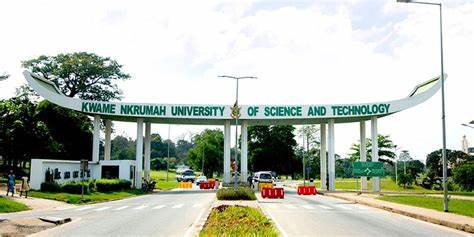
The Kwame Nkrumah University of Science and Technology (KNUST) is taking action to recover a debt of GH₵1.2 million owed by the Electricity Company of Ghana (ECG), the Social Security and National Insurance Trust (SSNIT), and three other organizations.
The debt arises from unpaid rent for office spaces and private hostel operations over several years, according to the Auditor-General.
During her appearance before the Public Accounts Committee, KNUST Vice-Chancellor, Professor Rita Akosua Dickson, disclosed that only one of the debtors has made a partial payment of GH₵25,000, leaving the majority of the debt unpaid.
“With the Electricity Company of Ghana, we’ve arranged a barter trade settlement plan. We owe ECG a significant amount, so we’ve proposed that they offset the debt by deducting the amount they owe us. We’ve already communicated this plan to ECG,” Professor Dickson explained.
She added that other entities, like UBA, have settled their debts in full, including the premiums they owed.
However, Professor Dickson acknowledged the challenges KNUST has faced in recovering these outstanding debts, despite sending multiple demand notices and following up with the entities involved.
In a related issue, the Public Accounts Committee also expressed concern over Akenten Appiah-Menka University of Skills Training and Entrepreneurial Development (AAMUSTED) for procuring medical supplies from two unlicensed entities. The Auditor-General’s report indicated that the university purchased GH₵414,000 worth of drugs from these unregistered suppliers in 2022.
“This is a serious violation. Selling drugs requires a license, and purchasing from unlicensed suppliers is risky. It is essential to ensure that all entities involved in procurement have the proper certifications from regulatory bodies like the FDA and the Pharmacy Council,” the Committee warned.
The Committee advised AAMUSTED to prioritize obtaining necessary certifications in future procurements, especially when it concerns health-related items, to ensure compliance and protect public safety.
Managing Director of Appointed Time Printing Press, Jacqueline Afful, has made a heartfelt appeal to Ghana’s two major political parties, the National Democratic Congress (NDC) and New Patriotic Party (NPP), urging them to reconsider their decision to outsource the printing of their campaign materials to China.
Speaking during an interview with Bernard Avle on the Citi Breakfast Show, Madam Afful expressed concern over reports that both parties are allegedly producing their paraphernalia overseas.
She criticized this practice, highlighting the negative impact it has on the local printing industry and the missed opportunities for job creation in Ghana.
“If I were at Channel One TV, I would have knelt down to plead with them. The capacity is here, and the quality is something we can match. By keeping this work local, we could also provide employment to some Ghanaians, especially during this critical time,” Afful emphasized.
She further explained the potential benefits of awarding such contracts to local companies like hers.
“At Appointed Time, when we get these contracts, we not only fulfill them, but we also train people in the printing process. Many of them go on to establish their own small printing businesses.”
Madam Afful used the platform to make a direct appeal to political leaders and their sponsors.
“I want to appeal to parliamentarians, political parties, and businesses that support politicians. At Appointed Time Printing, we have the capacity, and we are competitive enough to deliver the political paraphernalia you need,” she stated passionately.
She believes that by choosing local printing firms, Ghana’s political parties can support the domestic industry and contribute to reducing unemployment, rather than sending valuable jobs overseas.
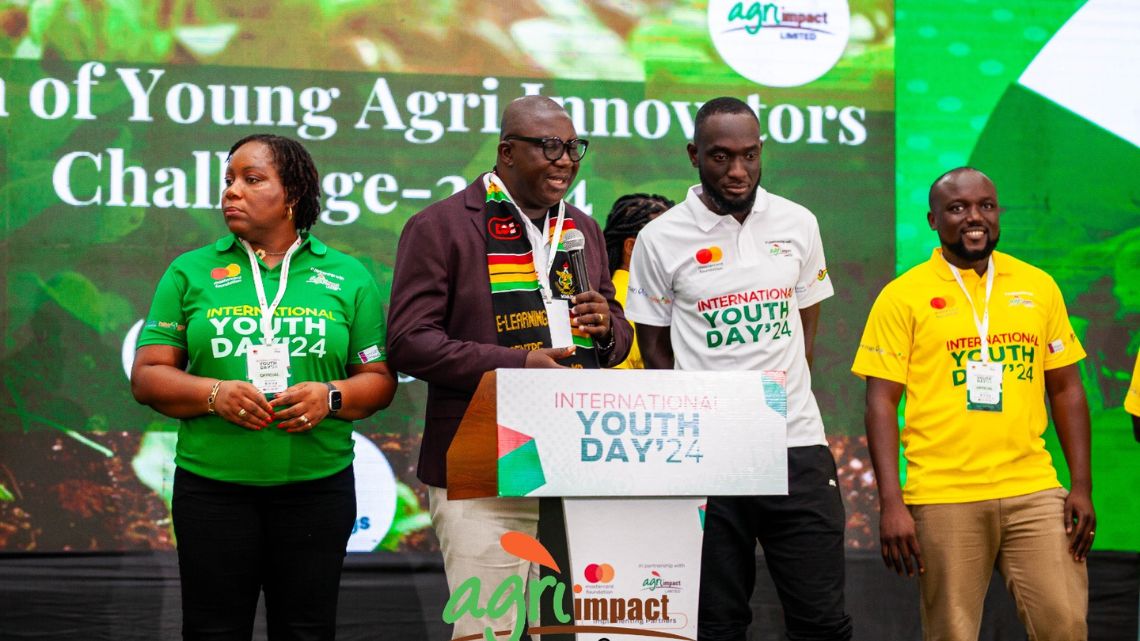
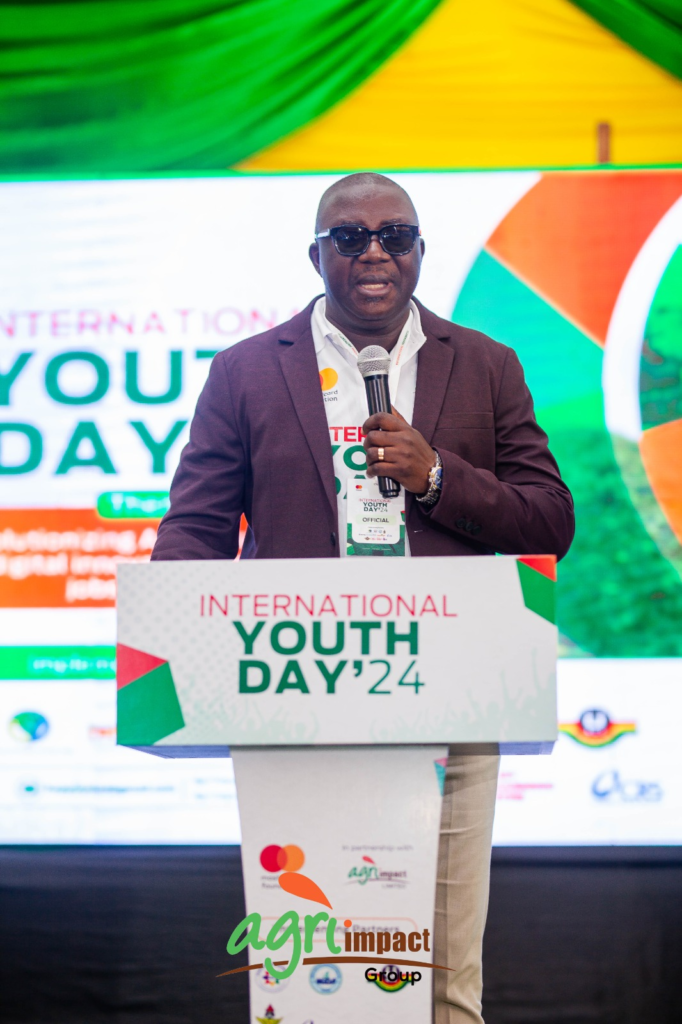
The Chief Executive Officer (CEO) of Agri-Impact Limited, Daniel Fahene Acquaye, has strongly advocated for increased investment in Ghana’s youth to unlock their full potential and drive national development.
Speaking on the theme, “Revolutionizing Agriculture through Digital Innovations to Create Jobs for Youth,” Mr. Acquaye emphasized the importance of empowering young people through substantial investments.
“Let us remember that the power of youth is unparalleled,” he stated. “They are not just the leaders of tomorrow; they are the change-makers of today, and we must make the necessary investments to fully unearth their potential.”
He urged the youth to seize opportunities in the agricultural sector, highlighting their role as Ghana’s greatest resource. “Investment in their creative minds, innovation, energy, boldness, determination, and resilience will undoubtedly lead to economic transformation,” Mr. Acquaye added.
He also called on the youth to pursue their passions and use their talents to contribute to the nation’s progress.
“To all the young people, this day is for you. It is an opportunity to celebrate your achievements, share your stories, ideas, and connect with one another. Be inspired by today’s event, pursue your passion, use your talents to build a better world,” he encouraged.
The event, attended by over 700 youth from various educational institutions, also saw the launch of the Young Agri-Innovators Challenge, a $20,000 competition aimed at supporting young people aged 15 to 25 in launching businesses or solutions within Ghana’s agricultural sector.
In addition to Mr. Acquaye’s remarks, the event featured a keynote address by Nana Owusu-Achau, Chief Farmer at AgroKings, who highlighted the dominance of foreign companies in Ghana’s food systems.
“We have a real issue at hand. In this country, our food systems are controlled by foreigners, and that is a problem,” he stated, urging Ghanaians, particularly the youth, to take control of the nation’s food production.
Nana Yaw Sarpong Otuo Siriboe I, Akyempimhene of the Juaben Traditional Area and CEO of Siriboe Farms, also addressed the youth, encouraging them to consider agriculture as a sustainable means of livelihood. He urged them to think big but start small, sharing his own experience of success through farming.
The Vice Chancellor of KNUST, Prof. Rita Akosua Dickson, commended the efforts of Agri-Impact and the Mastercard Foundation in supporting youth initiatives.
She emphasized the need to focus on agriculture and agribusiness, coupled with digital innovation, to address the challenge of youth unemployment in Ghana.
“Unemployment remains a challenge across the globe,” Prof. Dickson noted. “It therefore calls for an all-hands-on-deck approach to solving the problem.”
Prof. Dickson further suggested that school farms should be seen as opportunities for students to explore their creativity and develop skills that could lead to future startups, rather than as a form of punishment.
The event highlighted the critical role of youth in shaping Ghana’s future and underscored the need for targeted investments to harness their potential for the nation’s economic transformation.
IMANI Africa’s Honorary Vice President, Bright Simons, has exposed serious concerns regarding the Royal Ghana Gold Refinery, a project recently celebrated as a milestone in Ghana’s quest to add value to its mineral resources.
According to Simons, the Indian company Rosy Royal Minerals, which is purportedly a key investor in the refinery, lacks the financial capacity to fulfill this role, casting doubt on the entire venture’s credibility.
The Royal Ghana Gold Refinery, a joint venture between Rosy Royal Minerals and the Bank of Ghana, with the latter holding a 20% stake, is said to have the capacity to refine 400 kilograms of gold per day.
However, Simons has questioned whether Rosy Royal Minerals is truly the investor behind this project.
During an interview with JoyNews’ Kwaku Asante, Simons revealed alarming details about the company’s financial standing, which he argues disqualifies it from being a legitimate partner in such a significant national enterprise.
“The company that it says is coming to partner with the Bank of Ghana to do this refinery work does not have the capacity at all. They run some quarries in a few states in India. It is a pretty small company,” Simons disclosed. He pointed out that Rosy Royal Minerals is not even a gold mining company, let alone a gold refinery, and has been struggling financially for some time.
IMANI Africa’s investigations into the company’s financial health uncovered that Rosy Royal Minerals’ last audited financial statement showed a meagre $3,000 in revenue while recording $250,000 in losses.
“We examined the company’s books in great detail. The company has never made any investment overseas worth any amount to be interesting,” Simons stated.
This raises significant doubts about the claim that Rosy Royal Minerals could invest the $20 million or $25 million allegedly needed to establish and operate the refinery.
Simons further revealed that the actual technical work for the refinery is being carried out not by Rosy Royal Minerals but by a small consultancy in New York, Rare Tech.
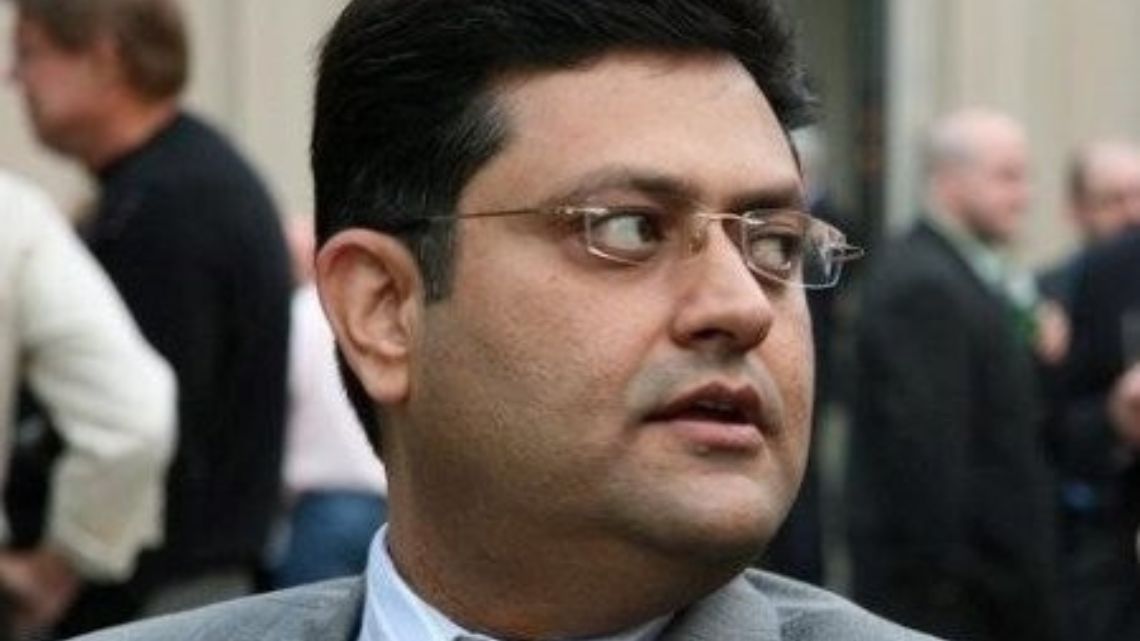
“It turns out it is a small consultancy…in India based in New York calledRare Tech. This is basically a one-man shop, owned by Sandeep Chadha,” he said, highlighting that the company’s involvement in the project is minimal at best.
The discovery that Rosy Royal Minerals lacks the financial capacity and that a one-man consultancy is managing the technical aspects of the refinery raises serious concerns about the project’s legitimacy.
“This is beginning to look like a scandal now,” Simons warned, suggesting that the real motive behind the refinery might be to capture control of the Bank of Ghana’s Domestic Gold Purchase Programme, rather than to genuinely add value to Ghana’s gold resources.
IMANI Africa’s findings indicate that Rosy Royal Minerals is not the investor it is claimed to be, raising questions about the true nature of the Royal Ghana Gold Refinery and the intentions behind its establishment.
Simons has called for greater scrutiny and transparency regarding the project to ensure that Ghana’s mineral wealth is not compromised by dubious partnerships and questionable business practices.
Find the full interview below.
I spoke to Bright Simons (@BBSimons) earlier about IMANI's concerns about the new refinery, earlier falsely touted as the only in the country. Interesting revelations and claims that this is Agyapa through the backdoor.
Bright Simons, Honorary Vice President of IMANI Africa, has claimed that the Royal Ghana Gold Refinery celebrated as a significant milestone in Ghana’s efforts to add value to its mineral resources, is a “hoax” designed to revive the controversial Agyapa royalties deal, which was previously shelved due to public outcry.
The refinery, a joint venture between Rosy Royal Minerals of India and the Bank of Ghana—with the latter holding a 20% stake—boasts the capacity to refine 400 kilograms of gold per day. Initially, it will source gold dore from small-scale and artisanal miners, with plans to secure licenses for processing gold from large-scale mining operations in the future.
However, Simons has raised significant concerns, questioning the financial capacity and expertise of Rosy Royal Minerals, the supposed investor partnering with the Bank of Ghana.
Simons revealed that Rosy Royal Minerals, a company that operates small quarries in a few states in India, is financially unstable and not equipped for such an ambitious venture.
He pointed out that the company’s latest financial statements show meagre revenues of just $3,000, alongside losses amounting to $250,000. Given this financial backdrop, Simons questioned how such a company could afford to invest the $20 million claimed to be involved in the refinery.
Moreover, Simons alleged that the Bank of Ghana, rather than the investor, would likely bear the financial burden for the refinery, as Rosy Royal Minerals lacks the necessary capacity.
He also expressed suspicion that the Royal Ghana Gold Refinery could be a front to control Ghana’s gold resources through the Bank of Ghana’s Domestic Gold Purchase Programme.
According to him, this program might be unfairly channelled through the new refinery, despite the existence of other established facilities in the country, which raises further questions.
Drawing a connection to the Agyapa deal, Simons warned that the government might be using this new venture to indirectly capture a significant portion of Ghana’s gold resources.
In an interview on JoyNews, he explained: “Initially, it was supposed to be a PPMC refinery through a public-private partnership. The refinery actually based in Diamond House. What we subsequently learnt is that Bank of Ghana is picking up PPMC’s role and they are linking the whole programme to the Gold Purchasing Programme.
Initially, it was all about this PR doesn’t make sense. There are existing refineries. Why are you step-siding all of those refineries to go for this new one?
That made me pause and think. If you have all these refineries in Ghana, why select this specific new one which is not even the biggest or sophisticated one in Ghana? That got us digging. We learnt that the Bank of Ghana is going to shift the Gold Purchasing Programme to this…that is a huge advantage to be given to a brand new refinery with no track record when there are others who have been trying to make this work in this country for a while.
We then realised that the company that it says is coming to partner with the Bank for Ghana to do this refinery work does not have the capacity at all. They run some quarries in a few states in India. It is a pretty small country. We also find out that they actually don’t have any personnel at the Royal Ghana Gold refinery.
Who has that? It turns out it is a small consultancy…in India based in New York called Rare Tech. This is basically a one-man shop, owned by Sandeep Chadha. Sandeep Chadha is the technical person actually doing it but he has nothing to do with the company said to be handling this since we are partnering with the government.
That raises a lot of fascinating issues. Some independent consultant running this. As you know, PPMC is chaired by the Eastern Region Chairman of the ruling party and he chairs this new venture. So we said let’s find out more about Rosy. So we commissioned an inquiry by IMANI and we got huge amount of information.
Apart from what is publicly known which is, it is a quarry and not even a gold mining company or even talk of a gold refinery. It is also a company struggling financially and given that all our refineries are struggling. The smaller ones are doing well and the bigger ones are struggling.
Its last audited financial statement The company made 3,000 dollars in revenue and made 250,000 dollars in losses. How would such a company want to invest 20 million dollars? We examined the company’s book in grid details. The company has never made any investment overseas, worth any amount to be interesting. And because as you know, you cannot lie to your auditors if you are investing money overseas, either in a joint venture or subsidiary, you have to tell your auditors.
We searched all the audited books for the last 6 years in which this refinery has been under reconstruction. This refinery started reconstruction in 2018. So during that period if this company had made any investment in this local refinery, it would be in its books. It is not. We are confident to say Rosy Royal is not the investor.
In what way does it get the 80 per cent? We did a forensic audit, commissioned by the government to explain two things. One is how did Rosy Royal come to own 80 per cent and number 2, to audit the actual investment. We have inside reports saying the 20 million or 25 million dollars is not true. So that means that far less has been invested in this upfront refinery.
This is beginning to look a bit scandal now. It looks like somebody had an intention to position this refinery as grand so they can put the Ghana Gold programme under it and use this as a mechanism to control the Purchasing Programme.
If all of a sudden, every Gold miner has to now sell, I mean the small scale refinery as the beginning and the large-scale refineries are being asked to sell 20 per cent to the Bank of Ghana. If all of it is to go to this refinery and they take delivery of it, that is capturing Ghana’s Gold.
So the first question to ask is why not the other refineries? Then you begin to fear this refinery could be the front through which somebody captures mandatory of a portion of Ghana’s Gold when we have been fighting a battle against Agyapa for several years now. It looks like this is a back door to create another Agyapa.”
According to him, since the company does not have the financial capacity, the onus will lie on the Bank of Ghana to engage in the necessary investment for the mining and refining of the Gold.
I spoke to Bright Simons (@BBSimons) earlier about IMANI's concerns about the new refinery, earlier falsely touted as the only in the country. Interesting revelations and claims that this is Agyapa through the backdoor.
Asap Vasa, Sahara Royal Gold Refinery, and Gold Coast Refinery are the known gold refineries existent in the country.
During the commissioning ceremony of the Royal Ghana Gold Refinery, Vice President Bawumia emphasized the potential of the refinery to boost local job creation, retain more economic value within Ghana, and strengthen the national currency.
He also highlighted the Bank of Ghana’s Domestic Gold Purchase Programme (DGPP), launched in 2021, as part of the government’s broader strategy to position Ghana as Africa’s gold hub.
In June 2022, the Deputy Minister for Lands and Natural Resources, responsible for Mines, George Mireku Duker disclosed that Ghana’s newly constructed Gold Refinery, Royal Gold Ghana is set and ready to be commissioned by August 2022 by the President of the Republic, Nana Addo Dankwa Akufo-Addo.
The Deputy Minister made this known when he paid a working visit on behalf of the Sector Minister, Hon. Samuel A. Jinapor to inspect the Refinery at the Precious Minerals Marketing Company (PMMC) premises in Accra, on Tuesday, 28th June, 2022.
The reason for the two-year delay is yet to be made public.
The Agyapa royalties deal
The government deemed this as an “innovative financing solution” to help ease the country’s debt crisis, but it valued the gold rights at far less than they could be worth. The opposition party and civil society groups criticised the deal.
In November 2020, the special prosecutor publicly released a report outlining suspected incidences of rigging and corruption, including opening doors for illicit financial flows and money laundering. Furthermore, the report found that millions of dollars were already paid out to companies without legally required approvals.
Later that month, in response to the special prosecutor’s report, Ghana’s President Nana Akufo-Addo instructed authorities to review the transaction documents and return the proposal back to the parliament for approval. After this, the Agyapa deal stalled as the public turned against the deal in the lead-up to the December 2020 general elections, and the incumbent government then lost their majority. The current government alluded to a reconsideration of the Agyapa deal in its 2022 budget presentation to the parliament. Without any public consultation to date, it’s not clear if concerns will be addressed in the next iteration of the deal.
In December 2020, the Ghana Integrity Initiative, the Ghana Anti-Corruption Coalition and Transparency International brought the case before the ECOWAS Court of Justice, arguing that the deal is in violation of Article 21 of the African Charter on Human and Peoples’ Rights, which states that all peoples are entitled to determine how their wealth and natural resources are disposed. Co-applicants also argued that the process disregarded the rights of the people of Ghana to consult and have their concerns addressed prior to execution.
President Akufo-Addo ordered the suspension of the Agyapa deal following a public outcry in 2021.
After more than a year since first hearing the case brought by the Ghana Integrity Initiative, the Ghana Anti-Corruption Coalition and Transparency International, the judges in 2023 ruled in favour of the government of Ghana.
Despite the ECOWAS court’s ruling, the deal remains suspended.
In February 2024, it emerged that the government spent $12 million on the suspended Agyapa royalties deal. The CEO of the Minerals Income Investment Fund, Edward Nana Yaw Koranteng, disclosed this at a Public Accounts Committee (PAC) Sitting.
The CEO of the Minerals Income Investment Fund said the money was expended on the processes to issue the initial public offering on the London Stock Exchange before the suspension.
Earlier on, Bright Simons raised critical concerns about the recently commissioned Royal Ghana Gold Refinery in Accra, arguing that refining gold into 24-carat bars does not constitute true value addition, contrary to claims by Vice President Dr. Mahamudu Bawumia.
Mr Simons asserts that the real value addition in the gold industry lies in creating finished products like jewelry, rather than simply refining raw gold into bullion.
In a post on X, Simons expressed skepticism about the promises made by the government regarding the economic benefits of the new refinery.
“I was surprised to read in the international press news that Ghana was launching its ‘first commercial gold refinery.’ I was even more surprised to hear the Vice President argue that this new refinery will enable ‘value addition,’ which in turn will lead to hundreds of jobs, and the strengthening of the Cedi,” Simons wrote.
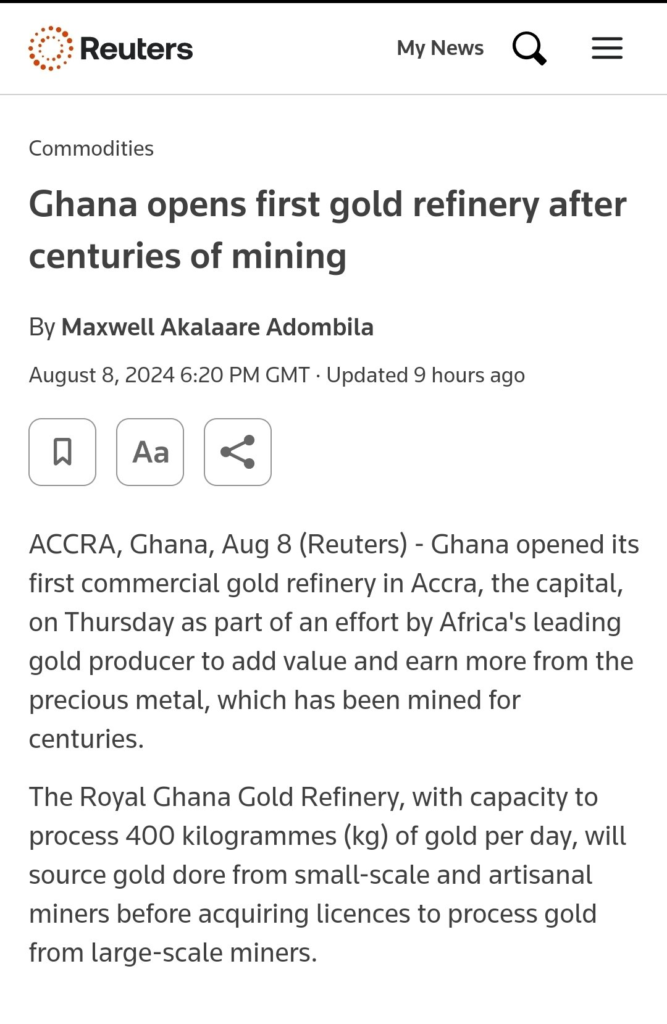
Reuters reported that Ghana has launched its first commercial gold refinery in Accra, marking a significant step in the country’s effort to add value to its gold production and increase national revenue.
Simons pointed out that this is not the first time such promises have been made. He recalled similar claims made when other gold refineries were launched in Ghana, including Asap Vasa in 2013, Sahara Royal Gold Refinery in 2015, and Gold Coast Refinery in 2016. Despite these earlier initiatives, the country continues to grapple with the same challenges in achieving real value addition in the gold sector.
He emphasized that gold refining, as it is currently practiced in Ghana, is a low-margin and high-volume business, which is inherently unprofitable when confined to converting mined gold into bullion.
Citing the example of one of the world’s largest refineries in Perth, Australia, Mr Simons noted that such operations make a margin of just 0.17%. In Ghana, where the cost of capital is high, even achieving a 10% operating profit margin is difficult.
Moreover, he highlighted the structural challenges facing Ghana’s gold refining industry, such as the long-standing relationships between large-scale miners and international refineries, which make it difficult for local refineries to secure significant volumes of raw gold. As a result, these refineries often rely on small-scale miners, leading to lower-quality dore (raw) gold that requires additional processing.
He also warned about the environmental and financial pitfalls associated with refining operations in Ghana. Citing the example of Sahara Royal Gold Refinery, Mr Simons mentioned the environmental disputes it faced with nearby residents and the financial difficulties it encountered, which led to the issuance of dud cheques.
Another significant hurdle for Ghana’s refineries is the lack of certification from bodies like the London Bullion Market Association (LBMA). Without such certification, the refined gold must be sold at a discount to less rigorous buyers, further squeezing profit margins. Simons explained that achieving and maintaining LBMA certification is a costly and time-consuming process, with insurance and security costs further eroding profitability.
Bright Simons, Honorary Vice President of IMANI Africa, has raised alarming concerns that the recently commissioned Royal Ghana Gold Refinery may be a reincarnation of the controversial Agyapa royalties deal, which was suspended in 2021 following widespread public outcry.
According to Simons, the refinery, which is being touted as a major achievement in Ghana’s efforts to add value to its mineral resources, could be a front for reviving the contentious deal under a different guise.
The Royal Ghana Gold Refinery, a joint venture between Rosy Royal Minerals of India and the Bank of Ghana—with the latter holding a 20% stake—has the capacity to refine 400 kilograms of gold per day.
However, Simons has cast serious doubts on the legitimacy of the project, questioning both the financial stability of the involved partners and the underlying motives behind its establishment.
In an interview with JoyNews’ Kwaku Asante, Simons revealed that Rosy Royal Minerals, the company allegedly responsible for partnering with the Bank of Ghana on the refinery, lacks the capacity to undertake such a significant venture.
“The company that it says is coming to partner with the Bank of Ghana to do this refinery work does not have the capacity at all. They run some quarries in a few states in India. It is a pretty small company,” he noted.
I spoke to Bright Simons (@BBSimons) earlier about IMANI's concerns about the new refinery, earlier falsely touted as the only in the country. Interesting revelations and claims that this is Agyapa through the backdoor.
Simons further pointed out that Rosy Royal Minerals’ last audited financial statement showed minimal revenue and significant losses, raising questions about its ability to invest in the project.
Simons’ investigation also uncovered that the actual technical work for the refinery is being managed by a small consultancy based in New York, rather than Rosy Royal Minerals itself.
“It turns out it is a small consultancy in India based in New York called Rare Tech. This is basically a one-man shop, owned by Sandeep Chadha,” Simons explained. This revelation suggests that the refinery’s operations might not be as robust or credible as initially presented.
Beyond the technical and financial concerns, Simons warned that the refinery could be a mechanism to exert control over the Bank of Ghana’s Domestic Gold Purchase Programme, echoing the issues that plagued the Agyapa deal.
“This is beginning to look like a scandal now. It looks like somebody had an intention to position this refinery as grand so they can put the Ghana Gold programme under it and use this as a mechanism to control the Purchasing Programme,” he asserted.
Simons emphasized that the refinery’s establishment could be a strategic move to reintroduce the Agyapa deal through the backdoor, potentially allowing certain entities to gain undue control over Ghana’s gold resources.
“If all of a sudden, every gold miner has to now sell… If all of it is to go to this refinery and they take delivery of it, that is capturing Ghana’s gold,” he said.
He drew parallels between the current situation and the battle fought against the original Agyapa deal, suggesting that this new development might be an attempt to bypass the resistance faced previously.
In light of these revelations, Simons urged the public and relevant stakeholders to scrutinize the Royal Ghana Gold Refinery project more closely, given the potential for it to undermine Ghana’s sovereignty over its mineral wealth.
The parallels with the Agyapa deal, coupled with the questionable nature of the refinery’s operations and partnerships, suggest that this project may not be as beneficial to Ghana as it is being portrayed.
Bright Simons, Honorary Vice President of IMANI Africa, has revealed startling details about the Royal Ghana Gold Refinery, a project touted as a major step in Ghana’s efforts to add value to its mineral resources.
Simons claims that the technical aspects of the refinery are being managed by a small, independent consultancy, Rare Tech, owned by Dr Sandeep Chadha, rather than the primary partner, Rosy Royal Minerals of India, raising significant concerns about the project’s legitimacy and operational capacity.
The Royal Ghana Gold Refinery, a joint venture between Rosy Royal Minerals and the Bank of Ghana—with the latter holding a 20% stake—has the capacity to refine 400 kilograms of gold per day.
However, in an interview with JoyNews’ Kwaku Asante, Simons disclosed that the company allegedly responsible for partnering with the Ghanaian government does not have the technical or financial capacity to run such an operation.
According to Simons, “The company that it says is coming to partner with the Bank of Ghana to do this refinery work does not have the capacity at all. They run some quarries in a few states in India. It is a pretty small company.”
Upon further investigation, Simons and his team at IMANI discovered that the actual technical work for the refinery is being conducted by a small consultancy based in New York and not by Rosy Royal Minerals itself.
“It turns out it is a small consultancy in India based in New York called Rare Tech. This is basically a one-man shop, owned by Sandeep Chadha,” Simons explained.
This revelation suggests that the core technical operations of the refinery are in the hands of a single individual, raising concerns about the project’s sustainability and the expertise being brought to the table.
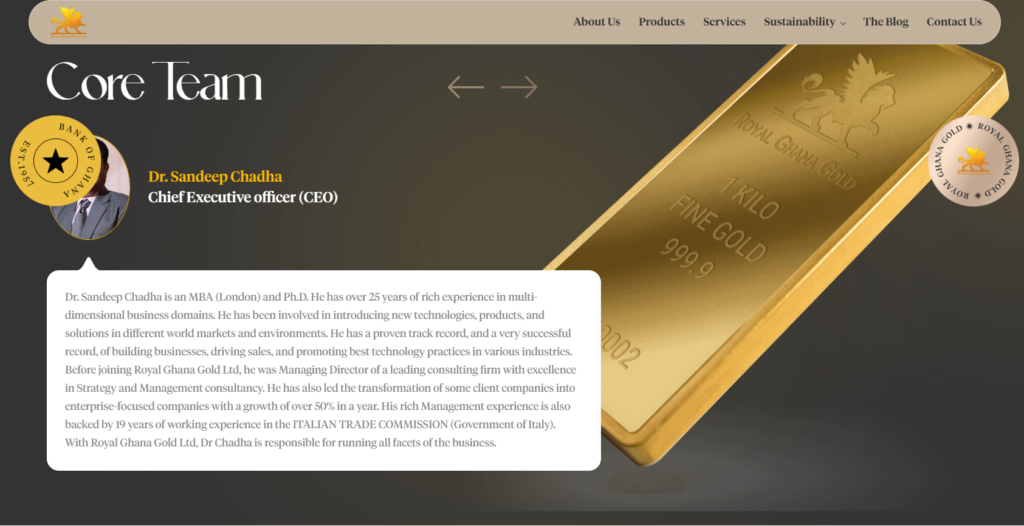
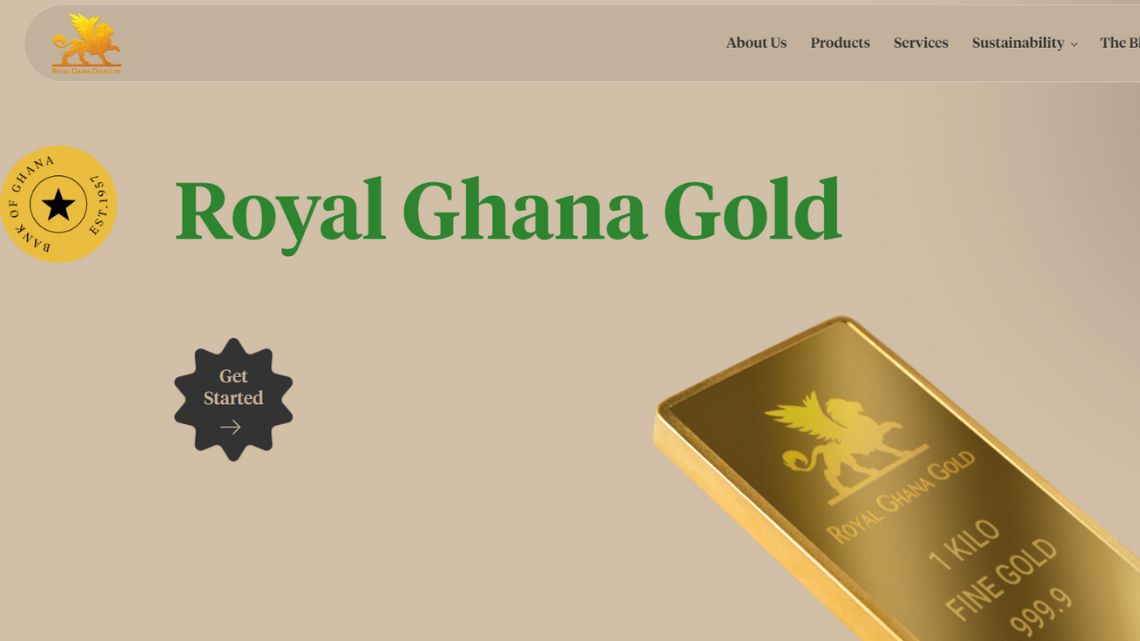
On its website, the Royal Ghana Gold Limited says Dr Chadha is “responsible for running all facets of the business” and not Rare Tech. Dr Sandeep is referred to as the Chief Executive Officer (CEO) of the company.
Simons also pointed out that Rosy Royal Minerals, the supposed main partner in the venture, has no personnel directly involved in the operations of the refinery.
This further supports the notion that the actual technical and operational work is outsourced to an external party with minimal resources.
“We also find out that they actually don’t have any personnel at the Royal Ghana Gold refinery,” Simons said, highlighting the disconnect between the company’s supposed role and its actual involvement.
The implications of this arrangement are troubling, particularly given the high stakes involved in managing Ghana’s gold resources.
Simons expressed concern that this setup could be part of a larger scheme to exert control over the Bank of Ghana’s Domestic Gold Purchase Programme.
“This is beginning to look like a scandal now. It looks like somebody had an intention to position this refinery as grand so they can put the Ghana Gold programme under it and use this as a mechanism to control the Purchasing Programme,” he warned.
In light of these revelations, Simons urged the public and relevant stakeholders to scrutinize the Royal Ghana Gold Refinery project more closely. He emphasized the need for transparency and accountability, especially given the questionable nature of the technical and operational arrangements surrounding the refinery.
In conclusion, Simons’ revelations cast significant doubt on the legitimacy and effectiveness of the Royal Ghana Gold Refinery, calling into question whether the project can truly deliver on its promises of adding value to Ghana’s mineral resources and boosting the national economy.
I spoke to Bright Simons (@BBSimons) earlier about IMANI's concerns about the new refinery, earlier falsely touted as the only in the country. Interesting revelations and claims that this is Agyapa through the backdoor.
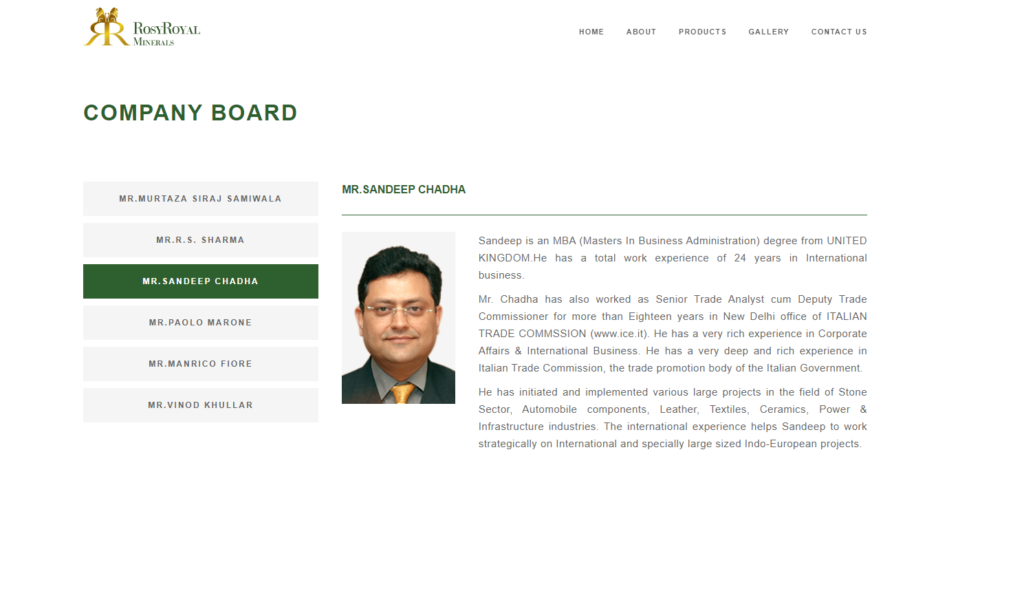
Per checks by The Independent Ghana, Sandeep Chadha is a member of the Rosy Royal Company Board, per the company’s website, indicating some connection to Rosy Royal Minerals.
It is imperative to note that Sandeep Chadha has a tie with the Rosy Royal Company Board and not Rare Tech.
Profile of Sandeep per Rosy Royal Minerals
Sandeep is an MBA (Masters In Business Administration) degree from UNITED KINGDOM. He has a total work experience of 24 years in International business.
Mr. Chadha has also worked as Senior Trade Analyst cum Deputy Trade Commissioner for more than Eighteen years in New Delhi office of the ITALIAN TRADE COMMISSION (www.ice.it). He has a very rich experience in Corporate Affairs & International Business. He has a very deep and rich experience in the Italian Trade Commission, the trade promotion body of the Italian Government.
He has initiated and implemented various large projects in the field of Stone Sector, Automobile components, Leather, Textiles, Ceramics, Power & Infrastructure industries. The international experience helps Sandeep to work strategically on International and specially large sized Indo-European projects.
Rare Tech
Rare Tech, per its website, is one of India’s leading consulting firms with 28 years of excellence in strategy and management Consulting. We serve clients across India, Europe and Africa. We are a dynamic group of 15+ professionals led by Mr. Sandeep Chadha (MD) who has been with firm since inception, making it the India’s boutique consulting practice.
“Our sector expertise spans Precious metals (Gold Refineries); Mechanical Engineering, Automobiles, Pharmaceuticals/Chemicals, Consumer Goods and Retail, Infrastructure, Engineering, Metals, Building Industry (including Ceramics & Stone sector) and Healthcare.”
A click on the latest update however shows a dead link.
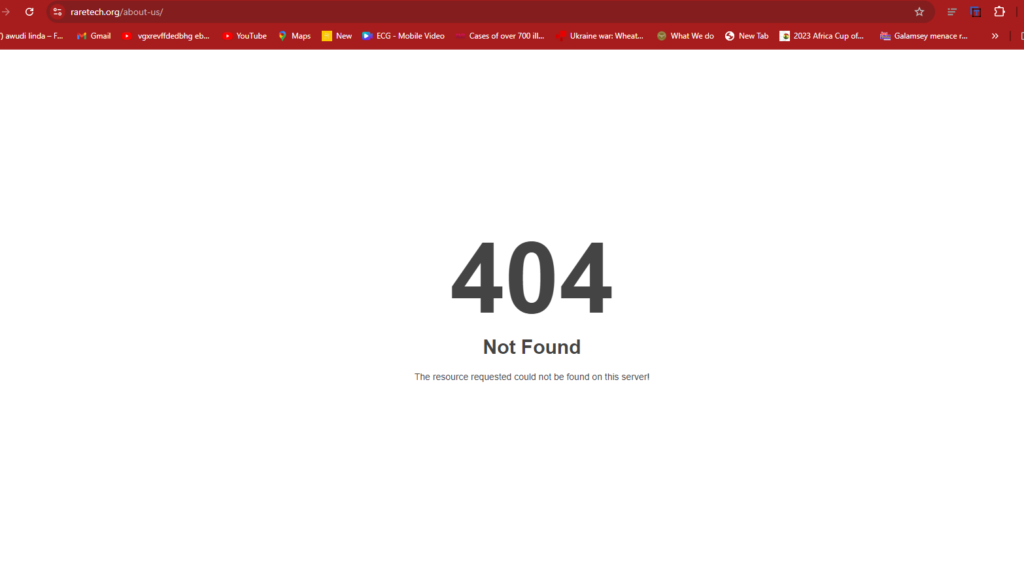
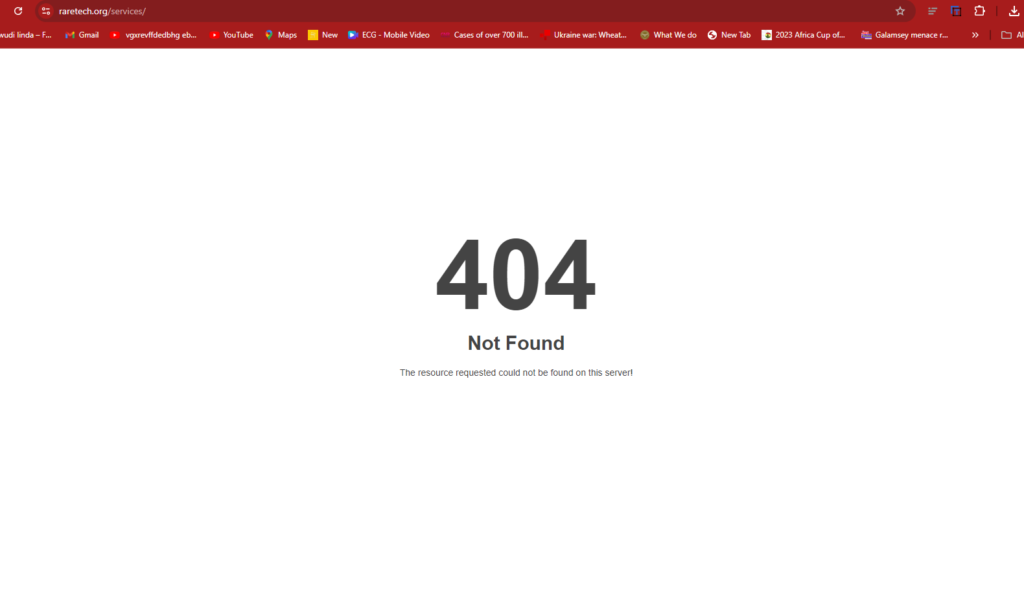
Also, clicks on “About Us”, “Services”, “Consultancy“, show dead links.
The Honorary Vice President of IMANI Africa, Bright Simons, has raised serious concerns about the financial stability of Rosy Royal Minerals, the Indian company partnering with the Ghanaian government on the newly commissioned Royal Ghana Gold Refinery.
The refinery, which is being hailed as a significant step forward in Ghana’s efforts to add value to its mineral resources, may be built on shaky financial foundations, according to Simons.
The Royal Ghana Gold Refinery is a joint venture between Rosy Royal Mineralsand the Bank of Ghana, with the latter holding a 20% stake.
The refinery, located in Accra, has the capacity to refine 400 kilograms of gold per day and plans to source its gold dore from small-scale and artisanal miners initially, with future expansion plans to process gold from large-scale mining operations.
However, Bright Simons has cast doubt on the viability of this partnership, revealing that Rosy Royal Minerals is financially unstable and lacks the capacity to invest in such a significant project.
“The company that it says is coming to partner with the Bank of Ghana to do this refinery work does not have the capacity at all. They run some quarries in a few states in India. It is a pretty small company,” Simons said in an interview with JoyNews’ Kwaku Asante.
Simons further detailed his concerns by pointing to Rosy Royal’s most recent financial statements. “Its last audited financial statement showed the company made $3,000 in revenue and $250,000 in losses. How would such a company want to invest $20 million?” he questioned.
This discrepancy led IMANI Africa to investigate further, uncovering that Rosy Royal Minerals has never made any significant overseas investments, which casts doubt on their ability to finance the refinery.
The investigation also revealed that Rosy Royal Minerals does not have any personnel at the Royal Ghana Gold Refinery, raising further questions about the legitimacy of the partnership.
“Who has that? It turns out it is a small consultancy in India based in New York called Rare Tech. This is basically a one-man shop, owned by Sandeep Chadha,” Simons explained.
He expressed concern that the technical aspects of the refinery are being handled by an independent consultant with no direct ties to Rosy Royal Minerals.
Simons also highlighted the broader implications of this partnership, suggesting that the Bank of Ghana might be left to shoulder the financial burden due to Rosy Royal’s lack of capacity. He speculated that the refinery could be used as a mechanism to control the Bank of Ghana’s Domestic Gold Purchase Programme.
“This is beginning to look like a scandal now. It looks like somebody had an intention to position this refinery as grand so they can put the Ghana Gold programme under it and use this as a mechanism to control the Purchasing Programme,” he warned.
In his analysis, Simons drew a link between the refinery project and the controversial Agyapa royalties deal, which was suspended in 2021 following public outcry.
He cautioned that the Royal Ghana Gold Refinery might be a backdoor method to reintroduce the Agyapa deal, potentially allowing certain entities to gain undue control over Ghana’s gold resources.
“This refinery could be the front through which somebody captures mandatory control of a portion of Ghana’s gold when we have been fighting a battle against Agyapa for several years now,” Simons asserted.
In conclusion, Simons urged the public to critically assess the viability and intentions behind the Royal Ghana Gold Refinery, given the questionable financial stability of Rosy Royal Minerals and the potential for the project to undermine Ghana’s control over its valuable mineral resources.
Find the full interview below:
I spoke to Bright Simons (@BBSimons) earlier about IMANI's concerns about the new refinery, earlier falsely touted as the only in the country. Interesting revelations and claims that this is Agyapa through the backdoor.
On August 8, 2024, the government celebrated the opening of the Royal Ghana Gold Refinery as a significant milestone in its efforts to add value to the country’s mineral resources.
The refinery, which can process 400 kilograms of gold per day, is a joint venture between Rosy Royal Minerals of India and Ghana’s central bank, which holds a 20% stake.
During the commissioning ceremony, Vice President Bawumia emphasized the potential of the refinery to boost local job creation, retain more economic value within Ghana, and strengthen the national currency.
He also highlighted the Bank of Ghana’s Domestic Gold Purchase Programme (DGPP), launched in 2021, as part of the government’s broader strategy to position Ghana as Africa’s gold hub.
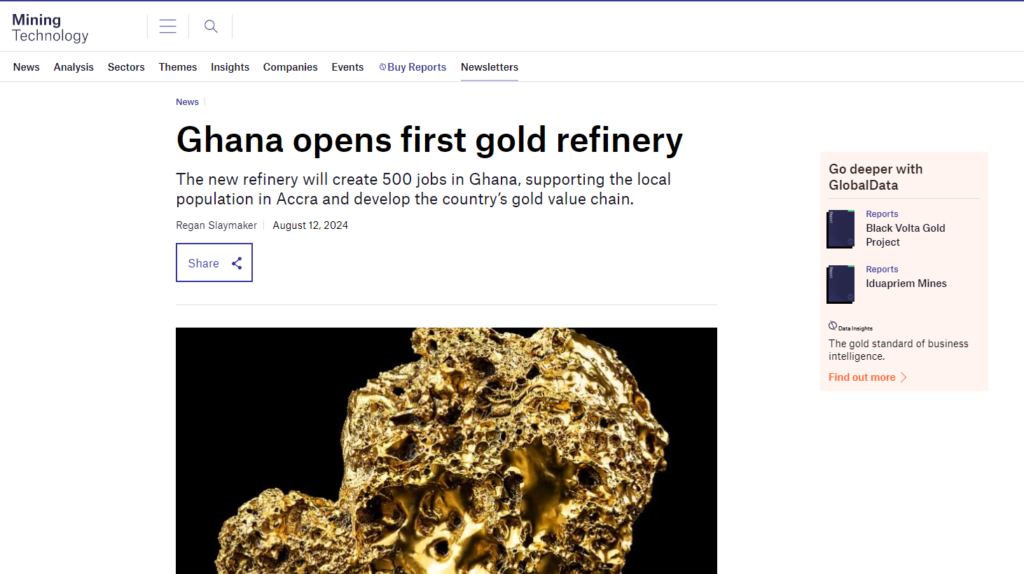
Reuters earlier reported that Ghana has launched its first commercial gold refinery in Accra, marking a significant step in the country’s effort to add value to its gold production and increase national revenue.
Reuters later amended its story with the headline “Ghana opens new gold refinery with 20% government stake.”
Ventures Africa reported the story with the headline “Ghana’s first gold refinery has been a long time coming”.
Vice President of IMANI Africa, Bright Simons, has raised critical concerns about the recently commissioned Royal Ghana Gold Refinery in Accra
Simons pointed out that this is not the first time Ghana has commissioned a gold refinery, contrary to international reports. He also pointed out that the Precious Minerals Marketing Company (PMMC) was originally established in Ghana to lead such initiatives and suggested that government policy should focus on helping PMMC succeed in this area.
I was surprised to read in the international press news that Ghana was launching its "first commercial gold refinery".
I was even more surprised to hear the Vice President (Veep) argue that this new refinery will enable "value addition", which in turn will lead to hundreds of… pic.twitter.com/303yEzNBH0
Gold refineries existent in Ghana, he said included Asap Vasa, Sahara Royal Gold Refinery, and Gold Coast Refinery in 2016.
Following his remarks in a post on X dated August 9, 2024, The Independent Ghana (TIGPost) carried out some checks to validate the remarks made by Mr Simons.
Our findings corroborate the comments made by Mr Simons. A number of gold refineries existed before Royal Ghana Gold Refinery.
A brief look at some of these refineries.
Sahara Royal Gold Refinery (2012)
Established in August 2012, Sahara Royal Gold Refinery is a limited liability company with the purpose of setting up gold and silver refinery and manufacturing jewellery. Primarily to refine gold and silver produced in Ghana for sale to the local and international markets.
On its website, the profile reads “We are a renowned and innovative company devoted to helping gold miners, prospectors, jewellers, and refiners of all sizes to refine gold, silver and other precious metals safely, efficiently, and with ease. Our company is establishing high standards in the precious metals refining industry for safety, pollution control and efficiency within 3 years of establishment.”
Asap Vasa Co. Ltd. (Gold Refinery)
Asap Vasa is a Government of Ghana licensed Gold Refinery registered in Ghana with registration ID CA-13,017. It operates as a limited liability company limited by shares.
The company, located at Mataheko, refines gold for the local and international gold markets. Asap Vasa has an initial installed refining capacity of 500 kgs of gold per month.
The company purchases gold primarily from the small-scale mining sector.
B&FT reported that as of January 2015, Asap Vasa Company Limited — a multi-million dollar high-capacity refinery plant — is the only major gold refinery plant in the country, operating and refining 100 kilogrammes of gold daily into granules, coins and bars, and it is owned by four young Ghanaian entrepreneurs.
Gold Coast Refinery (2016)
Gold Coast Refinery, on its website, says it is the first state-of-the-art Gold Refinery in West Africa and the second largest in Africa, with the capacity of refining up to 480 Kg of gold a day .
Gold Coast Refinery was established in 2016 as a subsidiary of the well-established Euroget Group.
The company’s profile further reads, “Gold Coast Refinery deems it a strategic responsibility to ensure its support for legal and sound extractive practices to promote sustainable development. The company takes into consideration the importance of the environment, making use of every raw material and operating under very friendly, safe and healthy conditions. The company has engaged the services of an international firm to develop environmentally sustainable models for skilled craft miners (Small and medium enterprises)”.
The findings prove that the Royal Ghana Gold Refinery is not Ghana’s first gold refinery.
Despite these earlier initiatives, the country continues to grapple with the same challenges in achieving real value addition in the gold sector.
Further investigations carried out by our media house revealed that the Akufo-Addo-led government had earmarked August 2022 for the commissioning of the recently commissioned refinery.
In June 2022, the Deputy Minister for Lands and Natural Resources, responsible for Mines, George Mireku Duker disclosed that Ghana’s newly constructed Gold Refinery, Royal Gold Ghana is set and ready to be commissioned by August 2022 by the President of the Republic, Nana Addo Dankwa Akufo-Addo.
The Deputy Minister made this known when he paid a working visit on behalf of the Sector Minister, Hon. Samuel A. Jinapor to inspect the Refinery at the Precious Minerals Marketing Company (PMMC) premises in Accra, on Tuesday, 28th June, 2022.
The reason for the two-year delay is yet to be made public.
Royal Ghana Gold Refinery
Found in 2018, Royal Ghana Gold Limited (RGG) in a joint venture with PMMC (Government of Ghana) commences operations of the state-of-the-art Gold refinery in Accra (Ghana) to produce Gold Bullion bars. Launching the ‘first-ever’ Public-Private Partnership in the Gold refining ecosystem globally, RGG finds approval and support from the Ministry of Trade and Industry, Ghana.
On its website, the company says “RGG refinery comes with the latest high-end technology in line to offer the world bullion market the LBMA-standard gold and silver bullion. With an array of custom-made products and service portfolio to choose from, RGG stands tall with its state-of-art precious metal refinery, offering its customers a world-class facility to bank upon.”
Source: The Independent Ghana | Andy Ogbarmey-Tettey
Ghanaian business mogul Daniel McKorley, popularly known as McDan, has firmly dispelled rumors that he is paralyzed or, worse, deceased.
In a viral video, McDan, appearing fit and healthy, reassured the public that he is “strong and alive” by the grace of God.
Addressing the speculations, McDan emphasized his good health, stating, “Let me tell Ghanaians that they shouldn’t be worried. I’m alive, and I’m strong. It’s just a rumour.”
He added, “It’s only God who takes care of us. No man has power over us, so I’m strong. You can see I just finished playing tennis. I played one hour of tennis this morning. I’m looking okay.”
The business mogul urged Ghanaians to ignore the ongoing rumors about his health and assured them that he would continue to serve the nation.
“So, Ghanaians shouldn’t worry. I know how much Ghanaians love me, and my love also goes out to them. Those who heard it and got worried shouldn’t be worried. I’m alive and very strong, and I’m still continuing the good things I’m doing for this country.”
These clarifications come in response to recent allegations made by Ghanaian presenter Blakk Rasta, who claimed that McDan had been paralyzed due to actions by a deity in Ada. According to Blakk Rasta, some locals accused McDan of wrongfully acquiring salt land, which they believe led to the curse.
Despite these claims, McDan’s public appearance and statements make it clear that he is in good health and continuing his work as usual.
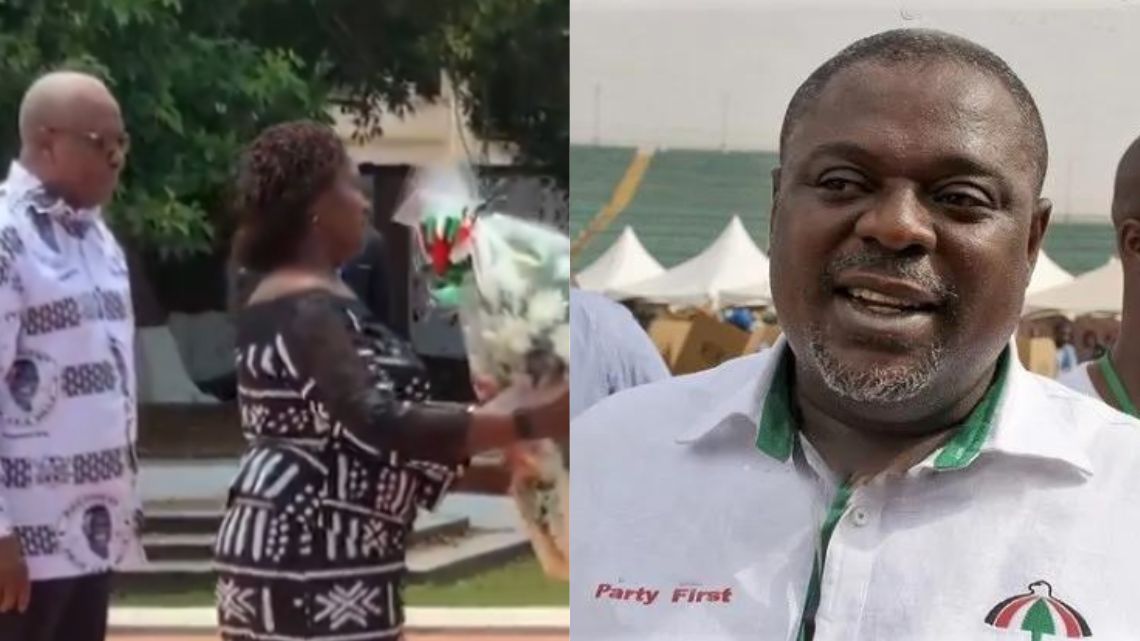
Former Deputy Secretary for the National Democratic Congress (NDC), Koku Anyidoho, has faulted the party’s flagbearer, John Mahama for not laying a wreath for his late boss, John Evans Atta Mills during the party’s memorial service to celebrate the late President
The event held at the Asomdwee Park in Accra took place on Wednesday, July 24.
In a post on X, Mr Anyidoho shared a visual where the running mate of the NDC flagbearer, Professor Jane Naana Opoku Agyemang, laid a wreath on behalf of her boss.
Peeved by this move, Mr Anyidoho asked the statesman why he did so. He accused Mr Mahama of pretending to love the late Atta Mills when he was alive.
“So, after the noise and filibustering to create unnecessary heat – pretending to love his late boss, why did he run away from laying the wreath and made grandma do it on his behalf? I thought he would be bold enough to do it himself and dare his fate! God is alive,” he wrote on August 12, 2024.
The confusion erupted after Koku Anyidoho overran his scheduled time, delaying the second NDC event at the venue to mark 12 years since President Mills’ passing.
Two wreath-laying ceremonies were planned for the day to commemorate the late former President, who died at the 37 Military Hospital in 2012.
The first event, organized by Mr. Anyidoho, ran over its scheduled time, causing delays for the second event organized by the NDC and the JEA Mills Memorial Heritage.
According to the late President’s brother, Samuel Atta-Mills, Koku Anyidoho bused in individuals he labeled as fake family members and instructed them to remain, preventing the NDC from starting its program on time.
Addressing the incident, the sister of former President Atta Mills, Mercy Araba Ahema Quarshie, described the situation as ugly and disgusting. She insisted that the persons at the earlier ceremony were not their relatives.
“I want to make it clear to everyone that Koku Anyidoho has stepped on the wrong foot by tampering with our brother’s grave without our knowledge. That is unacceptable, and now we are going to deal with him because it is a taboo in our family to do that,” Quarshie stated.
The family of the late president emphasized the importance of consulting them before making any decisions related to the late president’s resting place, condemning Mr. Anyidoho’s actions as disrespectful and unacceptable.
So, after the noise and filibustering to create unnecessary heat – pretending to love his late boss, why did he run away from laying the wreath and made grandma do it on his behalf? I thought he would be bold enough to do it himself and dare his fate! God is alive🙏🙏🙏 pic.twitter.com/95p5uTbq0j
General Secretary of the opposition National Democratic Congress (NDC), Fifii Fiavi Kwetey, has sharply criticized the Nation Builders Corps (NABCO) program initiated by the ruling New Patriotic Party (NPP), labelling it as a “scam” designed to win votes rather than create real jobs.
Speaking at the launch of the NDC’s Youth Manifesto on Monday, August 12, at the UPSA Auditorium in Accra, Mr Kwetey argued that the NABCO initiative was a deceptive policy meant to manipulate citizens rather than foster genuine progress in the country.
“Over the last eight years, we have seen a number of policies that have been unveiled like NABCO. What has happened to it? Because it was nothing but a scam and a 419 policy. It was a policy designed for votes. The difference between us and them is that we think about policies first for progress before votes,” Kwetey stated.
He emphasized that while any party can propose policies, the NDC is committed to developing initiatives that prioritize national progress over political gain.
Mr. Kwetey also assured that the NDC’s forthcoming policies would aim to restore hope, particularly among the youth, who have faced significant economic challenges in recent years.
“Today, the flagbearer of our party will take time to unveil the policies of this party whose heartbeat is after the destiny of the young people to elaborate plans which will set this country back towards giving hope and prosperity to our young people again,” he added.
The National Builder’s Corps (NABCo) programme will end by September 1, 2022.
NABCo was initially supposed to run for three years and extended for an additional year.
The Programme was aimed at engaging 100,000 young graduates.
Though the government invested approximately GH¢2.2 billion into the policy, a number of the corps complained about the non-payment of allowances by the government.
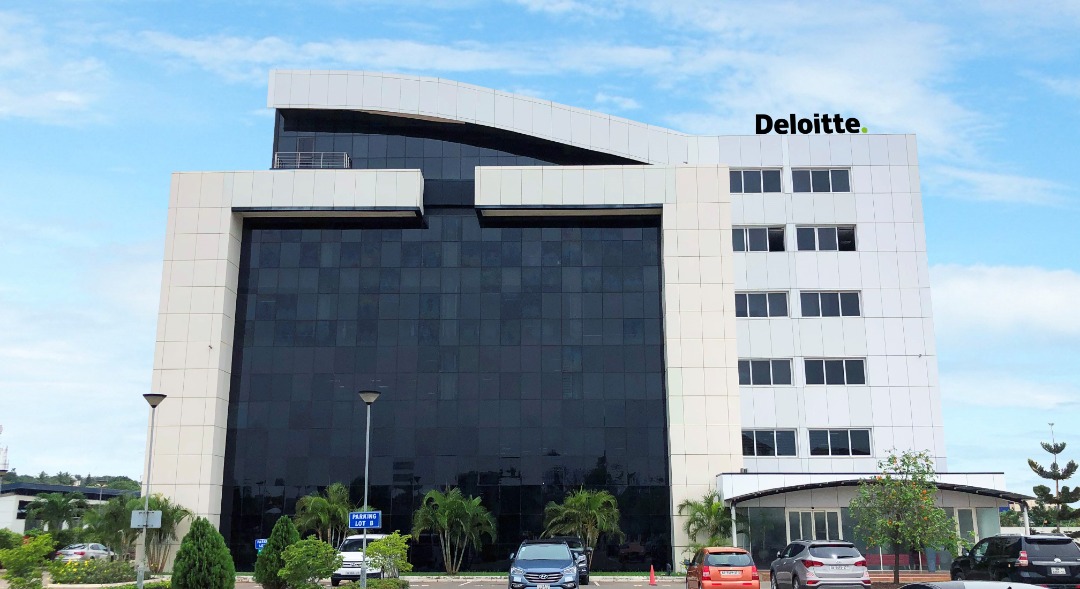
Deloitte Ghana has indicated that despite recent economic challenges, Ghana’s economy continues to show signs of recovery.
This observation was made in Deloitte’s review of the 2024 Mid-Year Budget, based on information provided by Finance Minister Dr. Mohammed Amin-Adam.
The review highlighted that the 2024 mid-year budget statement did not include a request for additional allocations from Parliament, unlike in previous years.
Instead, the focus was on tracking the progress of the 2024 budget’s implementation and revising key economic indicators. According to Deloitte, the data shared by the Finance Minister underscores the resilience of the economy, noting, “The information shared by the finance minister suggests the economy is recovering despite economic challenges in recent years.”
Deloitte also pointed out that the improved economic performance in the first half of 2024 has bolstered the government’s confidence, which is expected to positively influence investor sentiment.
A significant highlight in the review was the strong performance of the industry sector, which expanded by 6.8% in the first quarter of 2024.
This marks a notable rebound following a contraction in 2023 and only marginal growth in the years preceding it. The mining and quarrying subsectors were identified as the primary drivers of this growth, registering a 12.9% increase, attributed to a rise in global commodity prices.
Deloitte noted, “We expect to see a positive impact on the economy as jobs, wages, and community infrastructure are all expected to increase.”
For 2024, overall Gross Domestic Product (GDP) growth is now projected at 3.1%, slightly higher than the initial forecast of 2.8%. Non-oil GDP growth has also been revised upward to 2.8% from the earlier estimate of 2.1%. Looking ahead, overall GDP is expected to grow at an average rate of 4.4% per annum between 2024 and 2027. In 2023, Ghana’s economy grew by 2.9%, surpassing the revised target of 2.3%, with non-oil GDP expanding by 3.3% compared to the revised target of 2.8%.
The growth in 2023 was largely driven by the services sector, which grew by 5.5%, and the agriculture sector, which expanded by 4.5%, while the industry sector saw a contraction of 1.2%.
Greater Accra Regional Minister, Daniel Titus-Glover, has responded to legal threats from the Chief of Anum-Asamankese, Osabarimah Essah Kwasi Mensah Bediako III, over the recent demolition of structures near the Dodowa Forest.
In a firm rebuttal, Titus-Glover, who led the demolition, has dismissed accusations of engaging in landguard activities and expressed his willingness to defend his actions in court.
The demolition, carried out last Friday by the Greater Accra Regional Security Council (REGSEC), was prompted by escalating concerns from the Greater Accra Regional House of Chiefs about encroachment by private developers.
Osabarimah Bediako III, a principal member of the Odoi Kese family at Obosomase, has criticized the Minister’s actions and threatened legal action against him.
However, Titus-Glover, speaking on Adom FM’s morning show Dwaso Nsem on Monday, defended the demolition as a necessary measure to protect the land, which he considers part of his heritage.
He stated that all involved parties were given an opportunity to present their documentation regarding the land before the demolition on July 9, 2024.
“If they want to go to court, I’m ready. Let’s all go to court, but I am not a land guard. I am the Chairman of REGSEC. I’m not REGSEC, and we went there together. We will also bring our lawyers to court. If they claim the land was for them, why were soldiers guarding it?” Titus-Glover questioned, emphasizing his readiness to face any legal challenge.
The New Patriotic Party (NPP) has officially commenced the verification process for its 276 parliamentary aspirants ahead of the 2024 elections.
The verification exercise, taking place from August 12 to August 16, 2024, is being conducted at the Agyemin-Boateng Conference Room in Kokomlemle.
A nine-member Parliamentary Verification Committee, chaired by Frank Davies, has been set up by the party to ensure that the documentation of all aspirants is thoroughly scrutinized.
The committee, which includes notable members such as Gary Nimako, Ben Abdallah, and O.B. Amoah, will work daily from 9 a.m. to 6 p.m., with Evans Nimako, Director of Research and Elections, serving as the committee’s secretary.
The verification process is organized regionally, beginning with aspirants from 53 constituencies in the Ashanti and Ahafo regions on the first day. It will continue with aspirants from the Eastern and Central regions on August 13, covering 56 constituencies.
The Greater Accra and Volta regions follow on August 14, involving 52 constituencies, and the Northern, North East, Savannah, Upper East, and Upper West regions will be attended to on August 15, covering 57 constituencies. The process concludes on August 16 with aspirants from the Oti, Western, Western North, Bono, and Bono East regions.
Speaking to Daily Graphic, Mr. Nimako outlined the committee’s primary objective of ensuring that all candidates meet the constitutional requirements as stipulated in Article 94 of the 1992 Constitution.
He emphasized that the committee would meticulously verify that each document aligns with the regulations of the Electoral Commission (EC) and would compile a comprehensive report on each candidate’s compliance status. Candidates will be notified of any issues identified during the screening process.
“As it is the responsibility of the Committee to recommend to the National Executive Committee (NEC) of the party on the suitability of a candidate, the Committee still bears that onerous burden of seeing to it that all available and useful information is relied upon as the basis for their recommendations,” Mr. Nimako explained.
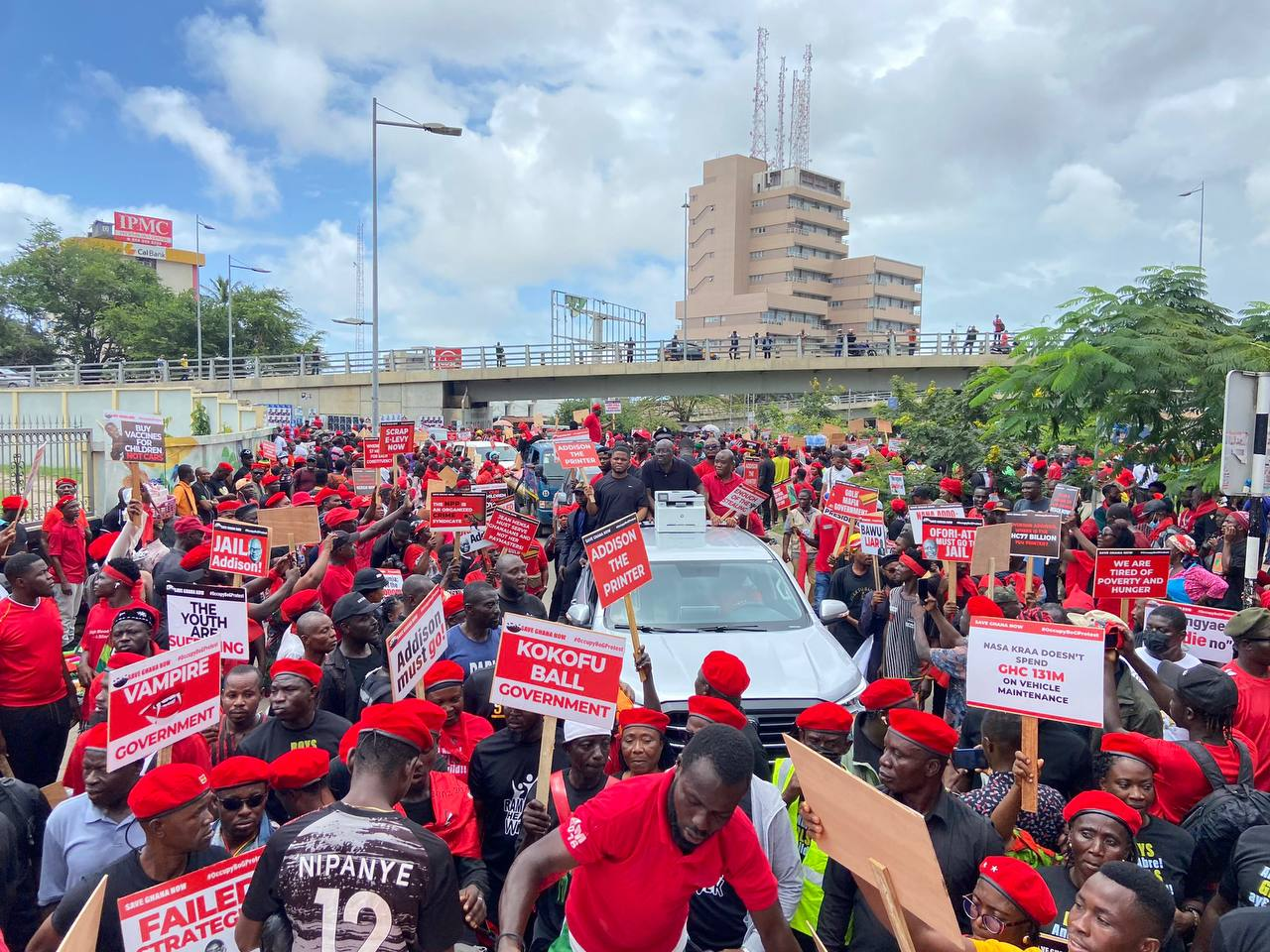
The Minority in Parliament is set to meet with the Ghana Police Service in preparation for a second #OccupyBoG demonstration, aimed at demanding the resignation of the Bank of Ghana’s Governor and his deputies.
The planned protest, scheduled to take place in the coming weeks, has prompted the Minority to engage with law enforcement to ensure a peaceful and orderly event.
In a formal petition submitted on Monday, August 12, Minority Leader Dr. Cassiel Ato Forson emphasized the importance of maintaining the same peaceful conduct as during the previous #OccupyBoG protest. The Minority is seeking the cooperation of the police to guarantee the safety of all participants.
Dr. Forson highlighted that the protest is a direct response to what he described as the “gross mismanagement” of Ghana’s economy under the current leadership of the Bank of Ghana. He reiterated calls for accountability and transparency, insisting on the immediate resignation of the central bank’s officials, who he believes are undermining public confidence in the financial system.
To avoid any disruptions to public order, the Minority has requested an early meeting with the police to discuss the modalities of the demonstration and agree on a suitable date.
“In view of the foregoing, the Minority kindly requests a meeting with the Police at a venue and time of your choice, to consider the modalities for our demonstration against the Governor of the Bank of Ghana and his deputies,” the letter stated.
A user on the X platform, @_GhChronicles, has sparked a debate by sharing information that appears to detail the history of Togbe Tsali, a well-known traditional priest of Ewe descent.
According to GHChronicles, Togbe Tsali who was a great Anlo had supernatural powers and was a member of the Tsiame royal clan of the present-day Volta Region.
The narration, further said that he lived during the reign of the wicked king called King Agorkoli at Notsie. As a result of the wicked treatment the people received from their king, he (Togbe Tsali) decided to run away to a new location(Eweland) with some of the people.
The page further recounted as follows:
“He transformed himself into a flying spirit and surveyed the Eweland. On his return, Tsali convinced the people that the land was good; hence, they should run at night and possess it.
“Late in the night, they poured water on the land to make it dust-free in order to escape without being detected. When King Agorkoli realized the next day that most of his people had fled, he organized his army to chase them and bring them back.
“However, on their way, Togbe Tsali asked the people to move backwards. This confused the soldiers because they could not determine the direction the people moved.
“Other account has it that he changed into a mouse and changed the direction of their footprints in order to confuse the soldiers of King Agorkoli.
“When they arrived at the Eweland, he took to farming and hunting. He cleared a large portion of land in a day, caused rain to fall on the land. He planted maize which matured and was harvested on the same day.
“Since there was no rain on the other farm lands, the people were forced to buy food from him alone. This made the people unhappy because he had used his supernatural power to satisfy his selfish ends.
“Due to the disaffection among the people against Tsali, they decided to kill him. They captured him and buried him. But three days after the burial, he was seen walking around his compound going about his chores.
“The people were surprised. They recaptured him, cut him into two pieces and tied stones on the body and dumped it into the River Volta.
“Three days later, he was seen riding on the back of a crocodile on the river. He told his people that no person born of a woman could kill him. This improved the relationships between him and his people. He then used his supernatural powers to the benefit of the people.
“When he was about to die, he asked the people to erect two shrines in his memory. They should call him at the shrines when they needed his assistance. The two shrines still exist in the Volta region today where faithful worship calls on him during times of difficulty.”
Reacting to the history, some X users claim that Togbe Tsali has a blood relation with Komfo Anokye.
They stated per the story told them, the Ashanti’s Komfo Anokye, known for conjuring a golden school from the sky, is a brother to Togbe Tsali. To be precise, his twin.
“Ok so growing up in Tsiame in the palace because my uncle Togbey Shikabli in the Paramount chief of the town, I was told this story and more. A part of which includes Akomfo Anokye ( Anlortse) being his blood brother. I want to dive deep into it,” a user wrote.
Another said, “His brother is okomfo anokye”. A user used, “I was told this narrative by one teacher but anytime I bring this up in convos I get the weird look, so I stopped. That the name Okomfo Anokye was really ‘Okomfo from Notse.’ And almost every Akan by the name Anokye somehow has ewe ties.”
The ewe leader who was thrown into a river but came back riding on a crocodile pic.twitter.com/pcEhsuBBjI
X platform user, @_GhChronicles, has stirred a debate after it released information believed to be the history of Togbe Tsali, a renowned traditional priest of Ewe descent.
According to GHChronicles, Togbe Tsali who was a great Anlo had supernatural powers and was a member of the Tsiame royal clan of the present-day Volta Region.
The narration, further said that he lived during the reign of the wicked king called King Agorkoli at Notsie. As a result of the wicked treatment the people received from their king, he (Togbe Tsali) decided to run away to a new location(Eweland) with some of the people.
The page further recounted as follows:
“He transformed himself into a flying spirit and surveyed the Eweland. On his return, Tsali convinced the people that the land was good; hence, they should run at night and possess it.
“Late in the night, they poured water on the land to make it dust-free in order to escape without being detected. When King Agorkoli realized the next day that most of his people had fled, he organized his army to chase them and bring them back.
“However, on their way, Togbe Tsali asked the people to move backwards. This confused the soldiers because they could not determine the direction the people moved.
“Other account has it that he changed into a mouse and changed the direction of their footprints in order to confuse the soldiers of King Agorkoli.
“When they arrived at the Eweland, he took to farming and hunting. He cleared a large portion of land in a day, caused rain to fall on the land. He planted maize which matured and was harvested on the same day.
“Since there was no rain on the other farm lands, the people were forced to buy food from him alone. This made the people unhappy because he had used his supernatural power to satisfy his selfish ends.
“Due to the disaffection among the people against Tsali, they decided to kill him. They captured him and buried him. But three days after the burial, he was seen walking around his compound going about his chores.
“The people were surprised. They recaptured him, cut him into two pieces and tied stones on the body and dumped it into the River Volta.
“Three days later, he was seen riding on the back of a crocodile on the river. He told his people that no person born of a woman could kill him. This improved the relationships between him and his people. He then used his supernatural powers to the benefit of the people.
“When he was about to die, he asked the people to erect two shrines in his memory. They should call him at the shrines when they needed his assistance. The two shrines still exist in the Volta region today where faithful worship calls on him during times of difficulty.”
Reacting to the history, some X users claim that Togbe Tsali never died, but vanished.
“Later died?” a user wrote. Another said, “Tsali didn’t die bro, he left his jaw bones for his people before riding away on a crocodile and never returned which was there for so many decades.”
“Tsali didn’t die, he rather vanished, sir,” another added.
The people were surprised. They recaptured him, cut him into two pieces and tied stones on the body and dumped it into the River Volta. Three days later, he was seen riding on the back of a crocodile on the river. He told his people that no person born of a woman could kill him.…
Former General Secretary of the Convention People’s Party (CPP), Nana Yaa Jantuah, has called on the Electoral Commission (EC) to reconsider labelling certain political parties as “smaller” when they all pay the same filing fees as the larger ones like the New Patriotic Party (NPP) and the National Democratic Congress (NDC).
Madam Jantuah argued that it is unfair to categorize some parties as “small” when the EC charges all parties identical fees—GH₵100,000 for presidential candidates and GH₵10,000 for parliamentary candidates.
She used an analogy to emphasize her point, stating, “If one is small at home, one does not pay the same amount as the elder brother.”
Speaking on the JoyNews AM Show, Jantuah further stressed, “So if you people think we are small, all of us, then the fees should be reduced so that the bigger ones would pay and we would pay less. As long as we pay the same, as long as we have the same requirements in law, we are not small.”
She also voiced her concern that electoral performance should not be the sole factor in determining whether a party is classified as “small” or “big.” Reflecting on the CPP’s history, she noted that the party’s decline began around 2008.
Additionally, Jantuah criticized the media for its disproportionate focus on the NPP and NDC, often overlooking other parties.
She pointed out that even prominent figures like Alan Kyerematen receive limited attention compared to other politicians, despite their significant contributions to the political landscape.
An unverified report circulating on the social media platform X claims to list several healthcare facilities inherited by the Akufo-Addo administration from the previous Mahama government.
The report also includes the names of hospitals that are said to have been built by the current government.
This list has emerged following recent comments by former President John Mahama, the National Democratic Congress’ presidential candidate, during his campaign tour.
Mahama vowed to complete unfinished hospitals and expand the nation’s healthcare infrastructure, aiming to ensure automatic placement for trained nurses.
Mahama emphasized his commitment to investing in healthcare, noting that, as a former President, he recognizes the crucial role of well-developed healthcare facilities in serving the needs of Ghanaians.
He also highlighted that with adequate investment and support, these abandoned hospitals could be revitalized into fully operational healthcare centers.
HOSPITALS INHERITED, STARTED AND COMPLETED BY THE AKUFO-ADDO/BAWUMIA GOVERNMENT
The Concerned Citizens of the Komenda Traditional Area have announced that their planned protest against the lease of the Komenda Sugar Factory to an Indian firm will now be held in Accra on Tuesday, August 13, 2024, instead of Komenda.
The protest, initially set to take place in Komenda, has been relocated to the capital to “amplify our voices, escalate our demands, and ensure that our concerns receive the attention they deserve at the highest levels of government,” the group stated in a release dated Sunday, August 11, 2024.
The protesters are demanding the reversal of the lease agreement, insisting that the factory should return to its original purpose of processing locally-grown sugarcane rather than importing raw sugar.
They argue that the lease was finalized without proper adherence to procedures and lacked sufficient consultation with key stakeholders.
The group is currently coordinating with relevant authorities to finalize the details of the demonstration in Accra, which they believe will “galvanize support, foster greater solidarity, and ultimately contribute to a more effective and impactful advocacy campaign.”
Read below the statement
FOR IMMEDIATE RELEASE CALL TO ACTION As Concerned Citizens of Komenda Traditional Area, we welcome investment agreements, including those with foreign investors that benefit local stakeholders and protect the interests of local sugarcane outgrower farmers, with government assurance that farmers’ concerns will be addressed and their benefits ensured.
We are compelled to express our deep concern and disappointment regarding the government’s handling of investment agreements, particularly the lack of transparency and consultation with local stakeholders.
Commitments have been made to introduce new sugarcane varieties, develop new farmland, and support outgrowers, which we have sought clarification on directly with investor representatives. However, we remain vigilant and demand direct government assurance and transparency to guarantee these commitments and ensure local sugarcane farmers benefit equitably.
DEMONSTRATION UPDATE
Following careful consideration and consultation with stakeholders, we have resolved to relocate our demonstration from Komenda to Accra. This strategic decision aims to amplify our voices, escalate our demands, and ensure that our concerns receive the attention they deserve at the highest level of government.
A new date for the demonstration will be announced shortly, pending further engagement with relevant stakeholders and authorities. We are confident that this move will galvanize support, foster greater solidarity, and ultimately contribute to a more effective and impactful advocacy campaign.
The 2024 Presidential Candidate for the New Patriotic Party (NPP), Dr. Mahamudu Bawumia, has criticized the current system of renewing driver’s licenses every two years, stating that it doesn’t make sense and needs to be changed.
Currently, the Driver and Vehicle Licensing Authority (DVLA) requires all driver’s license holders to renew or validate their licenses every two years.
This process, however, has led to considerable frustration among motorists, who often face harassment from DVLA officials and the police over non-renewed licenses.
Addressing chiefs and stakeholders at Boadua in the Akwatia Constituency of the Eastern Region, Dr. Bawumia emphasized the need for an overhaul.
“Drivers are here. Today, the driver’s license expires every two years. Let us extend it, be it 8 years or 10 years. Let us make sure you can have a driver’s license without having to renew it every year. It does not make sense, and so by the grace of God, we would make changes,” he stated.
Bawumia’s remarks signal a potential shift towards a more convenient system, with longer renewal intervals, possibly up to ten years, similar to the passport system.
Ghana’s Vice President and 2024 Presidential Candidate of the ruling New Patriotic Party (NPP), Dr. Mahamudu Bawumia, is pushing for a significant overhaul of the country’s driver’s license renewal process.
The Driver and Vehicle Licensing Authority (DVLA), responsible for promoting good driving standards and ensuring the roadworthiness of vehicles, mandates that all driver’s license holders renew or validate their licenses every two years.
This frequent renewal process has led to frustrations among motorists, who often face harassment from both DVLA officials and the police over non-renewed licenses.
Dr. Bawumia, speaking to chiefs and stakeholders at Boadua in the Akwatia Constituency of the Eastern Region, expressed his dissatisfaction with the current system.
“Drivers are here. Today, the driver’s license expires every two years. Let us extend it, be it 8 years or 10 years. Let us make sure you can have a driver’s license without having to renew it every year. It does not make sense, and so by the grace of God, we would make changes,” he stated.
Unlike Ghanaian passports, which are renewed every ten years, driver’s licenses currently require renewal every two years—a system that Bawumia views as inconvenient for motorists.
This proposed change aims to reduce the inconvenience faced by drivers and align the renewal process more closely with other identification systems, such as passports.
SIB Liberia Limited (SIBL), a financial institution owned by a prominent Ghanaian billionaire, is teetering on the brink of insolvency, as reported by FrontPage Africa.
The bank’s financial troubles have escalated due to the burdensome liabilities it inherited from the now-defunct First International Bank Liberia Limited (FIBLL), severely hampering its operations.
The crisis traces back to 2020 when SIBL took on approximately US$23 million in liabilities from FIBLL. While the bank managed to settle US$14.7 million of these legacy debts, it has struggled to clear the remaining US$8.5 million, creating significant financial strain.
In a bid to resolve the crisis, SIBL requested assistance from the Central Bank of Liberia (CBL), arguing that the outstanding debt should be covered by the Liberian government and the central bank.
Following a two-year review, the CBL’s board of governors approved a payment of US$8 million on May 17, 2024. However, this payment had not been disbursed at the time of the report, leaving the bank in a precarious position.
The uncertainty surrounding the bailout has led to a surge in customer withdrawals, further destabilizing the bank’s financial position. Despite efforts by the central bank to restore stability, public confidence remains low, with many customers rushing to withdraw their funds.
SIBL’s management has sought intervention from the Liberian presidency, warning of severe repercussions for the country’s financial sector if the situation remains unresolved.
The bank’s leadership is focused on maintaining public trust and keeping operations afloat during this crisis.
Concerns about SIBL’s liquidity were amplified by the Green Revolution of Liberia, a pro-democracy group, which highlighted the bank’s staggered payment of withdrawals as a sign of deeper financial troubles. The group uncovered documentation of an US$8 million bailout, but customers reportedly continue to face difficulties in accessing their funds.
SIBL is not alone in its struggles; International Bank Liberia Limited (IBLL) is also reportedly facing significant financial challenges.
The growing turmoil has raised alarm among government officials and economic experts, who fear a potential collapse of the broader banking sector.
With pressure mounting, the Central Bank of Liberia is being urged to take decisive action to prevent further instability and restore confidence in the banking industry. The future of SIB Liberia Limited and IBLL now hangs in the balance, depending on the effectiveness of the measures taken by the central bank and other financial stakeholders.
The Ghana Cocoa Board (COCOBOD) is projecting a significant boost in cocoa production for the 2024/25 season, anticipating over 800,000 metric tons, following a substantial GHC943 million investment aimed at rehabilitating aged and disease-ridden cocoa farms.
This effort is part of a broader strategy to revive the cocoa sector and support the livelihoods of farmers.
COCOBOD’s Chief Executive Officer, Joseph Boahen Aidoo, revealed that the nearly billion-cedi investment made last year was crucial to restoring cocoa farms affected by the devastating swollen shoot virus disease (CSSVD) and aging trees.
These initiatives, he explained, are essential to sustaining the country’s cocoa output and ensuring the welfare of farmers.
In an interview, Mr. Aidoo and his Deputy CEO in charge of Finance and Administration, Ray Ankrah, addressed concerns raised in the media regarding COCOBOD’s rising administrative expenses, which reportedly hit GH¢3.4 billion last year.
The CEO clarified that this figure includes the substantial funds allocated to rehabilitate cocoa farms, countering claims that the money was solely spent on administrative overhead.
“The money was used to fund the cutting down of diseased and aged farms, nurse, and plant seedlings as well as maintain the rehabilitated farms before handing them over to farmers across the country,” Mr. Aidoo stated. He stressed that these strategic investments were necessary and justified the increase in administrative costs.
Mr. Ankrah further elaborated that a significant portion of the administrative costs was related to the GHC943 million expenditure on productivity enhancement programs (PEPs).
He noted that this expenditure, which was supported by a loan from the African Development Bank (AfDB), was a one-time cost that played a pivotal role in sustaining the livelihoods of affected farmers and boosting future cocoa production.
The Deputy CEO dismissed claims that the administrative expenses were excessive, stating, “The GH¢943 million was actually used to rehabilitate diseased and moribund farms to sustain the livelihood of the affected farmers and increase cocoa production, starting with the 2024/25 season.”
He added that, excluding this one-off expenditure, COCOBOD’s administrative costs had actually decreased in 2023.
Addressing the broader impact of the swollen shoot virus disease, Mr. Aidoo emphasized that the rehabilitation of cocoa farms is critical for maintaining the sector’s viability. The disease, which significantly reduces cocoa yields before killing the trees, has been a major factor in the recent decline in national cocoa production.
COCOBOD’s efforts, he said, are vital to preventing further loss of productive land and ensuring the continued benefits derived from cocoa farming.
Mr. Aidoo also highlighted the board’s commitment to supporting farmers with adequate and timely inputs for the upcoming season, including hand pollination, pruning, and irrigation initiatives.
These efforts are not only aimed at increasing production but also at making cocoa farming more appealing to the younger generation, encouraging more youth to enter the sector.
On the financial front, Mr. Ankrah pointed to COCOBOD’s successful turnaround in 2023, where the board recorded a profit of GH¢2.3 billion, a significant recovery from the GH¢4.2 billion loss in 2022.
He attributed this to prudent financial management and ongoing efforts to enhance cocoa production and profitability, despite the challenges posed by the COVID-19 pandemic.
In conclusion, Mr. Aidoo assured farmers of COCOBOD’s continued commitment to implementing better policies and programs in the upcoming season, in line with the government’s goals of improving farmer livelihoods and sustaining the country’s cocoa production.
Chairperson of the National Commission for Civic Education (NCCE), Ms. Kathleen Addy, has called on Ghanaians to be particularly cautious about the information they consume and share as the nation approaches the December elections.
She emphasized the need to address misinformation and disinformation to preserve the nation’s peace and democratic integrity before, during, and after the elections.
Ms. Addy made these comments during a media interview on the sidelines of an event with Senior High Schools’ Civic Education Clubs, called “Civic Fest,” which took place in Accra over the weekend.
The event, organized by the NCCE with support from the European Union (EU), aimed to raise awareness among the youth about their civic duties and responsibilities while preparing them for a peaceful election.
This event was part of the Women and Youth in Democracy initiative, a collaboration between the EU and the NCCE, and was held under the theme: “Together We Can Build Ghana, So Get Involved.”
Ms. Addy emphasized that controlling the spread of misinformation and disinformation, especially leading up to the elections, is essential for maintaining the peace Ghana has enjoyed for the past thirty years.
She stated that achieving this goal would necessitate dedication, self-discipline, and deliberate efforts from all citizens to avoid sharing information that could incite chaos.
“The thing with misinformation, and fake news and all of those things is that it starts and stops with us,” she noted.
“When something falls in your inbox or you see something on your timeline that you know is probably false, that you can see is deliberately put there to cause chaos, to cause people to be angry, to incite others to violence and misbehavior, when you see those things, let it end with you, don’t you also go ahead and forward it.
“If all of us commit to that action alone, the misinformation and fake news problem will go down significantly,” Ms Addy stressed.
The Ghana Integrity Initiative (GII) is calling for a shift in the fight against corruption, urging citizens to take the lead in driving change to achieve meaningful progress.
Fund Raising Manager of GII, Michael Boadi, emphasized the need to move away from the traditional top-down approach, which has delivered limited results over the years.
Instead, he proposed building citizens’ capacity to understand the severe impacts of corruption, enabling them to hold political leaders accountable and educate their communities on behaviors that fuel corruption.
Boadi made these remarks at a two-day anti-corruption workshop held in Juaso, within the Asante-Akim South Municipality. The event was organized by GII in collaboration with the National Commission for Civic Education (NCCE).
It brought together representatives from various local civil society organizations, community-based groups, social auditing clubs, women’s associations, youth groups, and individuals with disabilities.
The workshop is part of a broader initiative titled “Strengthening Accountability, Rule of Law, and Institutions,” which is being executed by GII in partnership with the Centre for Democratic Development (CDD) and the Ghana Anti-Corruption Coalition (GACC).
Supported by funding from the European Union (EU), the project is being rolled out across 24 districts with the aim of empowering citizens to take an active role in combating corruption.
Boadi highlighted the importance of collaborative efforts among the three organizations, which previously operated separately in their anti-corruption initiatives.
He stressed the need to raise public awareness about corruption, not only to empower citizens to demand accountability from those in authority but also to encourage them to refrain from engaging in corrupt practices themselves.
“If there is a responsibility to guard the resources of the State then that responsibility lies squarely with the people, and therefore we designed this project to equip the citizens with the capacity to hold office holders accountable and also lead the campaign against corruption in the communities,” Boadi stated.
He also expressed concern over the significant financial losses Ghana has sustained due to corruption, as highlighted in reports by the Auditor General.
Mr Boadi underscored the necessity of a united effort to combat this ongoing problem, pointing out that every government under the Fourth Republic has faced accusations of financial misconduct despite the existence of anti-corruption laws.
Mr Boadi argued that it is time to adopt a different approach, advocating for a bottom-up strategy where citizens are empowered to take an active role in the fight against corruption.
Patrick Asare, a representative from the NCCE, echoed this sentiment, stating that the battle against corruption must start at the individual level. He urged participants to avoid corrupt practices in their daily lives and challenged the misconception that only public officeholders are corrupt, noting that corruption affects all sectors of society.
The government, through the Ministry of Finance, is struggling to settle GH₵75 billion in arrears owed to contractors for approximately 10,000 ongoing road projects across the country.
Despite ongoing efforts to manage public sector finances effectively, these projects, which are collectively valued at GH₵135 billion, continue to face significant financial challenges.
The Ministry of Finance has so far disbursed GH₵60 billion to address outstanding payments, with GH₵10 billion of this amount paid just this year. However, a substantial portion of the arrears remains unsettled.
During a high-level expert panel discussion titled “Closing the Financing Gap in Road Infrastructure Development in Ghana,” Chief Director at the Ministry of Finance, Madam Eva Mends, highlighted the challenges in securing sustainable financing for road infrastructure development.
The event was organized by the Ghana Highway Authority in collaboration with the Ministry of Finance and the Ministry of Roads and Highways as part of the Authority’s 50th-anniversary celebrations.
Madam Mends pointed out that despite measures like the certificate of commencement policy and the Government Integrated Financial Management System (GIFMIS) to enhance financial management, some road projects were initiated without the Ministry’s knowledge or proper budgetary allocations.
“Ministry of Roads and Highways will go ahead and make a commitment, sign a contract. Most of the time, we are not even privy to the contract. And that’s something; a systemic issue we will need to address,” she remarked.
She also noted that many contracts lacked clear spending limits, allowing contractors to extend projects beyond the agreed budget, leading to delayed payments and accrued interest, which ultimately undermines value for money.
“There’s no way we can pay for all those projects in three years, even if we don’t award any contract this year. If we don’t award any contract for the next three years, we still will not be able to pay on time all the contracts that we currently have on our books,” she added.
Former Chief Executive Officer (CEO) of Stanbic Bank and the Paramount Chief of Pishigu, Naa Dr. Alhassan Andani, commended the government for acknowledging its limitations in financing all road projects.
He called for policy sustainability and payment prioritization to encourage private sector involvement in road infrastructure. Dr. Andani emphasized the importance of developing a master plan for classifying roads based on their viability to aid in prioritization and appropriate financing.
Meanwhile, Member of Parliament for Obuasi West, Mr. Kwaku Kwarteng, urged politicians and the media to manage public expectations regarding road projects, especially during election periods.
A 40-year-old trader, Anastasia Ekudi, has been sentenced to six months in prison by the Hohoe Circuit Court after being found guilty of stealing an ‘Infinix Smart 6 Plus’ mobile phone worth GH₵1,200.
The court, presided over by Mr. Michael Johnson Abbey, delivered the verdict on December 15, 2023, after a full trial in which Ekudi, who initially pleaded not guilty, was convicted.
The prosecution, led by Chief Inspector Charles Aziati, provided details of the case, revealing that both the complainant and the convict were traders in the same area. The complainant operated a shop in front of her residence, selling provisions, and Ekudi was a regular customer at the shop.
According to Chief Inspector Aziati, the incident occurred on December 14, 2023. On that day, Ekudi visited the complainant’s house to purchase soap worth GH₵2.
The complainant escorted her to the shop, completed the transaction, and Ekudi then left. Shortly after, the complainant realized that her Infinix Smart 6 Plus phone, which had been placed on a table in front of the shop, was missing.
Suspecting that Ekudi might have stolen the phone, the complainant asked a nearby neighbor to call her phone number in an attempt to locate it. Although the call went through, there was no response. Shortly afterward, a mobile money merchant named Godsway, who is also a witness in the case, returned the call using his personal phone.
Chief Inspector Aziati explained that Godsway informed the complainant that a woman, later identified as the convict, had brought a mobile phone to him, requesting that he remove the SIM card. It was during this process that the complainant’s phone rang, confirming their suspicions.
Ekudi was subsequently arrested, tried, and found guilty of theft. She has been sentenced to serve six months in prison for her crime.
The Chief of Anum-Asamankese and a key figure in the Odoi Kese family of Obosomase, Osabarimah Essah Kwasi Mensah Bediako III, has strongly criticized the Greater Accra Regional Minister, Daniel Titus-Glover, following the demolition of several structures near the Dodowa Forest on Friday, August 9.
Osabarimah Bediako III accused the Minister of engaging in actions akin to those of land guards, condemning the unauthorized demolition led by a joint military and police team. He expressed deep concern that the Minister had overstepped legal boundaries by demolishing both family and private properties at Dodowa without adherence to the rule of law.
Describing the Minister’s actions as a “reckless disregard of the law,” Osabarimah Bediako III argued that such behavior should not be tolerated in a country governed by democratic principles.
He revealed that the demolition targeted a four-acre land, resulting in the destruction of a protective fence wall, the confiscation of about 5 tons of iron rods, Poly tanks, and thousands of cement blocks. Additionally, around two hundred cattle grazing on the land have gone missing since the incident.
The Chief maintained that the land in question does not fall within the Dodowa Forest nor is it state-owned. He asserted that the Odoi Kese family holds legal ownership of significant portions of land in Dodowa, backed by proper documentation, including a court declaration.
Osabarimah Bediako III further criticized Mr. Titus-Glover for declaring the land a security zone without any legal basis and condemned the subsequent demolition as both “unlawful and despicable” under Ghana’s democratic system.
He pointed out that two days before the demolition, the Minister held a press conference demanding proof of ownership from those with interests in the Dodowa enclave.
However, before the Odoi Kese family could present their documents, the Minister allegedly ordered the destruction of the property on the land.
The Chief is now calling on the government to compensate for the damages or face legal action.
He emphasized that the ownership of the disputed land could be easily verified through a search at the Lands Commission and suggested that the current tension could have been avoided if the Minister had acted lawfully.
Rice farmers in Adzoatsi, situated in the Ketu North Municipality of the Volta Region, are grappling with crippling financial challenges due to exorbitant interest rates on loans.
Despite producing high-quality rice, which they believe could rival imported varieties, these farmers are finding it increasingly difficult to sustain their operations.
The farmers argue that the rice they cultivate is not only of superior quality but could also play a significant role in reducing Ghana’s dependence on imported rice. However, they are hindered by a lack of market access and support from the government and financial institutions.
During a visit by the Ghana News Agency to their farms, the farmers expressed frustration over the heavy financial burden imposed by local moneylenders. These lenders charge interest rates as high as 50%, making it nearly impossible for the farmers to repay loans and reinvest in their farms.
“For every GHC 1,000 we borrow, we are expected to repay GHC 1,500 after four months, which is after the harvest,” explained Mr. Wonder Nutekpor, the Secretary of Section 1, CDE Water Users Association. “Even if you take the loan just a month before the harvest, the 50% interest rate still applies. It’s killing us.”
The farmers also highlighted the lack of proper infrastructure, such as drying facilities, which exacerbates their challenges. Forced to dry their rice in open areas, they often suffer significant losses due to flooding from rain or water from the nearby Kplikpa Dam.
“We don’t have proper places to dry our rice. We end up using areas where the rain and dam water wash away our hard work,” lamented Madam Mary Avuworda, another farmer. “After all that labour, if you’re lucky to get something, it all goes to repay loans.”
Despite these obstacles, the farmers remain confident in the quality and quantity of their rice, which they produce every four months. They believe their output, combined with rice from other regions, could feed the entire nation and even create a surplus for export. However, without immediate intervention, their businesses are at risk.
The farmers are calling on the government, NGOs, and other stakeholders to address the pressing issues they face, including the poor state of access roads, inadequate drainage systems, and the lack of affordable financing options.
They emphasize that improving these conditions would not only enhance their productivity but also make their rice more competitive in the market, reducing Ghana’s reliance on imports and boosting the local economy.
The government, through the Ministry of Finance, is still grappling with the settlement of GH₵75 billion in arrears for approximately 10,000 ongoing road projects across the country.
These projects, collectively valued at GH₵135 billion, have faced significant financial challenges, despite efforts to manage public sector finances effectively.
The Ministry of Finance has so far disbursed GH₵60 billion to address outstanding payments, with GH₵10 billion of this amount paid just this year. However, a substantial portion of the arrears remains unsettled.
Chief Director at the Ministry of Finance, Madam Eva Mends, highlighted these challenges during a high-level expert panel discussion themed “Closing the Financing Gap in Road Infrastructure Development in Ghana.”
The event, organized by the Ghana Highway Authority in collaboration with the Ministry of Finance and the Ministry of Roads and Highways, was part of the activities marking the Authority’s 50th anniversary.
The event sought to tackle the ongoing difficulties in securing sustainable financing for road infrastructure development and maintenance.
Madam Mends revealed that despite implementing measures like the certificate of commencement policy and the Government Integrated Financial Management System (GIFMIS) to enhance financial management, some road projects were initiated without the Ministry’s knowledge or proper budgetary allocations.
“Ministry of Roads and Highways will go ahead and make a commitment, sign a contract. Most of the time, we are not even privy to the contract. And that’s something; a systemic issue we will need to address,” Madam Mends remarked.
She further observed that many contracts lacked clear spending limits, enabling contractors to extend projects beyond the agreed budget, which has led to delayed payments and accrued interest, undermining value for money.
“There’s no way we can pay for all those projects in three years, even if we don’t award any contract this year. If we don’t award any contract for the next three years, we still will not be able to pay on time all the contracts that we currently have on our books,” she added.
Former Chief Executive Officer (CEO) of Stanbic Bank and the Paramount Chief of Pishigu, Naa Dr. Alhassan Andani, commended the government for acknowledging its limitations in financing all the road projects and called for policy sustainability and payment prioritization to encourage private sector involvement in road infrastructure.
Dr. Andani also emphasized the importance of developing a master plan for classifying roads based on their viability to aid in prioritization and appropriate financing. These classifications, he suggested, should include social roads, which could be financed by citizens, financial roads that attract private sector interest, and economic roads with long-term benefits.
Meanwhile, Member of Parliament for Obuasi West, Mr. Kwaku Kwarteng, urged politicians and the media to manage public expectations regarding road projects, especially during election periods.
The President Ghana Never Got, a book authored by investigative journalist Manasseh Azure Awuni discloses that Dr. Matthew Opoku Prempeh, known as NAPO, stepped aside to support Dr. Mahamudu Bawumia’s bid for the New Patriotic Party (NPP) flagbearer position.
This pivotal move influenced Bawumia’s decision to choose NAPO as his running mate.
Awuni explains that NAPO had expressed his intent to contest for the position but withdrew his candidacy to back Bawumia.
“When Bawumia reared his head, NAPO told Bawumia that he had been preparing for a long time to contest, but since Bawumia was contesting, he would step back and support his candidacy. Bawumia was touched by that gesture and earmarked NAPO for the running mate position,” the book reveals.
The book also highlights that President Nana Addo Dankwa Akufo-Addo was taken aback to learn about Bawumia’s decision from external sources rather than from his own advisors. Notably, Asantehene Otumfuo Osei Tutu II had been aware of the choice two months prior to the official announcement to the President.
“The Asantehene had mentioned it to the President. Akufo-Addo was shocked to hear the news at his next door from someone about 250 kilometres away. But this was not accidental,” the book quotes.
Before formally informing the President, Bawumia had already discussed his choice with former President John Agyekum Kufuor.
The book reveals that although President Akufo-Addo and his family had hoped for Dr. Yaw Osei Adutwum to be selected as the running mate, Bawumia preferred Apostle Professor Opoku Onyinah initially.
However, NAPO’s strong political standing, particularly his connection to the Ashanti Region, made him the final choice.
Ghanaian investigative journalist Manasseh Azure Awuni has in his recent book, The President Ghana Never Got, unveiled the reasons behind Dr. Mahamudu Bawumia’s choice of Dr. Matthew Opoku Prempeh, known as NAPO, as his running mate.
According to Awuni, NAPO played a crucial role in Bawumia’s decision to select him for the position.
Awuni reveals that NAPO, initially preparing to contest for the NPP flagbearer position himself, decided to step aside to support Bawumia’s candidacy.
“When Bawumia reared his head, NAPO told Bawumia that he had been preparing for a long time to contest, but since Bawumia was contesting, he would step back and support his candidacy. Bawumia was touched by that gesture and earmarked NAPO for the running mate position,” the book states.
The book also notes that Bawumia’s choice was influenced by NAPO’s strong political standing and connection to the Ashanti Region, despite concerns about his perceived arrogance.
Awuni further highlights that President Nana Addo Dankwa Akufo-Addo was surprised to learn about Bawumia’s decision from external sources rather than from his own advisors.
The Asantehene, Otumfuo Osei Tutu II, had been aware of the choice two months before the official announcement to the President.
Additionally, Bawumia had discussed his decision with former President John Agyekum Kufuor before informing President Akufo-Addo.
While Akufo-Addo and his family had hoped for Dr. Yaw Osei Adutwum, Bawumia initially preferred Apostle Professor Opoku Onyinah. Ultimately, NAPO’s political connections and his significance in the Ashanti Region made him the preferred choice.
Investigative journalist Manasseh Azure Awuni, in his latest book, The President Ghana Never Got, reveals intriguing details about how Dr. Matthew Opoku Prempeh, also known as NAPO, was chosen as the running mate for Dr. Mahamudu Bawumia.
The book uncovers that Asantehene Otumfuo Osei Tutu II was privy to this decision a full two months before President Nana Addo Dankwa Akufo-Addo was officially informed.
According to Awuni, President Akufo-Addo was surprised to learn about Bawumia’s selection from external sources rather than his own advisors. The revelation that Otumfuo knew of Bawumia’s decision weeks before it reached the President underscores the complexity of the situation.
“The Asantehene had mentioned it to the President. Akufo-Addo was shocked to hear the news at his next door from someone about 250 kilometres away. But this was not accidental,” the book quotes, according to MyJoyOnline.com.
Three weeks prior to Bawumia’s formal communication with the President, the Asantehene had already disclosed the choice during a conversation, leaving Akufo-Addo taken aback. Manasseh Azure Awuni notes that Bawumia had also consulted former President John Agyekum Kufuor before informing the President.
“The information about Bawumia’s choice of running mate was more secure with the Asantehene at the Manhyia Palace than in Akufo-Addo’s Jubilee House and the state intelligence agency he trusted to conduct the research,” the book further reveals.
Manasseh recounts how NAPO had initially expressed his intentions to contest but stepped aside to support Bawumia when he learned of his candidacy. This gesture left a significant impression on Bawumia, who then earmarked NAPO for the running mate position.
Although NAPO was not considered the ideal candidate due to perceptions of arrogance, he was ultimately chosen because of his strong political ties, especially his connection to the Ashanti Region, which was seen as a crucial factor.
Interestingly, the book also notes that President Akufo-Addo and his family had hoped for Dr. Yaw Osei Adutwum to be selected as the running mate. Initially, Bawumia preferred Apostle Professor Opoku Onyinah, the former Chairman of the Church of Pentecost, for the role, but NAPO’s political standing made him the final choice.
Former Auditor General and prominent anti-corruption advocate, Daniel Yaw Domelevo, has praised the Office of the Special Prosecutor (OSP) for its commendable handling of the Airbus bribery scandal.
Speaking on The Big Issue on Channel One TV, Domelevo lauded the OSP for conducting an independent and thorough investigation into the matter.
Domelevo highlighted the courage and integrity displayed by the OSP, particularly in maintaining its independence despite potential pressures.
He noted that it is common for public officials to feel compelled to align their actions with perceived preferences of the president when cases are referred by the presidency. However, Domelevo commended the OSP for resisting such pressures and delivering an impartial report.
“I was full of commendations for him [the Special Prosecutor] because especially when a request comes from the office of the president, public servants are likely to read between the lines in order to toe the line of the president or what they think the president wants or wanted, but I think he independently did his assessments or his investigations and came out with his report,” Domelevo remarked.
He acknowledged that while opinions on the report may vary among Ghanaians, the most important outcome is the OSP’s commitment to transparency and independence.
“Some aspects of the report I think did not sit well with Ghanaians, some Ghanaians are very happy about the report but be it as it may, my happiness is that he has done his work independently and boldly come out with his findings…I think the OSP has done a good job,” Domelevo added.
The Airbus scandal, which came to light on January 31, 2020, involved allegations of bribery by the global aerospace company in multiple countries, including Ghana.
The scandal led to a historic £3 billion settlement by Airbus with France, the United Kingdom, and the United States to avoid corporate criminal charges.
In Ghana, President Akufo-Addo referred the matter to the OSP for investigation. The former Special Prosecutor, Martin Amidu, had earlier identified John Mahama as “Government Official 1” in connection with the scandal, a claim Mahama denied, and no conclusive evidence was provided at that time.
Recently, the current Special Prosecutor, Kissi Agyebeng, confirmed Mahama as “Government Official 1” in the ongoing investigation. Agyebeng also identified Samuel Mahama, the former president’s brother, as “Intermediary 5” involved in the transactions.
The OSP however cleared Mr Mahama of any wrong doing due to lack of evidence.
The Minister for Gender, Children and Social Protection, Dakoa Newman has disclosed that the government is ready to use Artificial Intelligence (AI) tools to check the quality of food under the Ghana School Feeding Programme (GSFP).
The minister made the disclosure at a press briefing in Accra on August 8, 2024.
Darkoa Newman also announced that the GSFP will soon shift from manual to digital operations.
This upgrade is intended to boost transparency, minimize delays, and optimize resource distribution within the programme.
With the new digital system, prospective caterers will need to apply online and submit a non-refundable fee of GH¢200. The revamped information management system will oversee caterer selection, data collection, and payment processing.
“This process is opening it up to every prospective caterer to apply online. They will have to pay GH¢ 200.00 Ghana. They’ll create a profile, they make payments, then they can work on the form,” she said at the Minister’s Press Briefing organised by the Ministry of Information to provide updates on the GSFP and Affirmative Action (Gender Equity) Act, 2024.
“We’re going to be running an information management system to manage the entire process. To manage the caterer selection module, the data collection module, and to manage the payments section of it. Everything will be run online going forward,” she elaborated.
Minister of Gender, Children and Social Protection, Darkoa Newman
The system will undergo a pilot phase in the New Juaben South and Krachi East districts before being implemented nationwide for the 2024/2025 academic year.
“Immediately, the pilot starts so that the rolling out of the national process will also start. You will see another publication for all 16 regions this time, not just for the two districts that have been advertised at this point,” she explained.
Mrs. Newman emphasised that the digital platform will help to eliminate discrepancies and leakages that have plagued the programme in the past.
However, she advised prospective caterers to ensure they meet certain criteria, such as having at least GH¢5,000 in their accounts for pre-financing their operations and possessing a valid health certificate, before submitting their applications.
Flagbearer of the National Democratic Congress (NDC), John Dramani Mahama, has urged Ghanaians to support one another in the face of the current economic challenges, highlighting the need for compassion and solidarity during these difficult times.
Speaking as the Special Guest of Honor at the 31st Biennial General Council meeting of the Assemblies of God, Ghana, held at the CK Tedam University of Technology and Applied Sciences (CKT-UTAS) in Navrongo, Upper East Region, Mahama emphasized the depth of the economic crisis affecting the nation.
As a member of the Assemblies of God Church, Mahama acknowledged the growing hardships many Ghanaians are enduring. He pointed to recent data from the Ghana Statistical Service, which has highlighted a troubling rise in multidimensional poverty across the country.
“We’ve seen an increase in multidimensional poverty from the Ghana Statistical Service’s recent statistics. It says that 8 million of our people in 2023 went one day without food because they couldn’t afford it. It means that people are hungrier, and the hardship is real,” Mahama said.
He urged the public to embrace a spirit of compassion, especially in these trying times. “This is the time for us to show compassion to each other because, in times of poverty, we must be our fellow’s keepers,” he advised.
Mahama’s call comes at a moment when many Ghanaians are grappling with rising inflation, unemployment, and the high cost of living.
The former president stressed that these challenges require a collective effort, urging those who are more fortunate to extend help to the less privileged in society.
The Ghana High Commission in the United Kingdom and Ireland has refuted claims that it has neglected the Ghanaian community amid the recent unrest across the UK.
In a statement, the High Commission asserted that despite the sporadic nature of the nationwide disturbances, it has remained vigilant, closely monitoring the situation, and keeping consistent communication with leaders of registered Ghanaian associations throughout the UK.
The Commission highlighted the proactive steps it has taken to ensure the safety of Ghanaians, including advising community leaders to caution their members against venturing into areas of unrest. They also provided real-time updates on the locations of riots in London and other cities, ensuring that Ghanaians could avoid these dangerous areas.
Moreover, the Commission has been working to verify reports of alleged attacks on Ghanaians, though ongoing investigations have not confirmed any harm to Ghanaian nationals.
“Among some measures which may not be fully disclosed for now, through these interactions, the Mission has requested the aforementioned leaders to communicate to their constituents the need to be cautious in their daily activities and to avoid areas where groups were gathering to protest.
“Indeed, while doing so, the Mission also shared locations of rioting both in London and across the UK with them and advised that our nationals remain vigilant in those towns and cities.
“The Mission additionally reached out to some of the leaders of the associations to assist it in verifying reports of Ghanaians who have allegedly been attacked. The ongoing checks are, however, yet to reveal that any Ghanaian has been harmed,” the High Commission stated.
The statement also assured all nationals, including those with dual citizenship, that the High Commission remains committed to fulfilling its responsibilities under the Geneva Convention to protect civilians, and will continue to defend the lives of all Ghanaians and people of Ghanaian descent in the UK.
The fatal stabbing of three young girls at a dance class in the seaside town of Southport, in the north of England, has been followed by the worst unrest the UK has seen in more than a decade.
The violence, in towns and cities across England and in Northern Ireland, has been fuelled by misinformation online, the far-right and anti-immigration sentiment.
Communities have responded with a series of rallies against the riots, with thousands gathering on Wednesday 7 August.
The secondary bond market in Ghana showed improvement in the first half of 2024 compared to the same period in the previous year, although it remains below the levels seen before the Domestic Debt Exchange Programme (DDEP), according to Databank research.
Despite this progress, investors continue to focus primarily on the money market.
Trading results indicate that market activity for Government of Ghana securities has increased, driven in part by growing participation from offshore investors.
The market has also benefited from significant improvements and transparency in sell-buyback trades, contributing to the overall turnover of GH¢19.18 billion.
Looking ahead, the completion of external debt restructuring could provide a further boost to the Ghanaian secondary bond market. Ghana’s debt restructuring has been largely influenced by conditions set by the International Monetary Fund (IMF), as the country grappled with unsustainable debt levels while seeking a US$3 billion bailout from the Fund.
Databank Research suggests that a successful restructuring of external debts could offer the government additional fiscal flexibility, allowing it to prioritize economic growth while meeting other commitments under the IMF program.
Furthermore, a positive outcome in restructuring external debts, coupled with the already completed DDEP, may help reset investor confidence in Government of Ghana securities, as concerns about debt sustainability are alleviated.
These factors are expected to have a favorable impact on trading activity in the secondary bond market, particularly in light of declining Treasury bill yields.
The Chamber for Independent Power Generators is calling on the Minister of Finance, Dr. Mohammed Amin-Adam, to urgently expedite the disbursement of funds from the International Monetary Fund (IMF) to the Independent Power Producers (IPPs).
In a statement signed by the Chamber’s Chief Executive Officer, Dr. Elikplim Apetorgbor, the Chamber expressed concern that, despite the announcement of the IMF funds being released over a month ago, there has been no visible action or commitment towards allocating these funds to the IPPs.
The Chamber highlighted that this delay has greatly impeded the ongoing, extended re-negotiations with the IPPs concerning the settlement of legacy arrears.
“Despite your announcement of the IMF cash release over a month ago, there has been no demonstrable commitment or action taken towards disbursing these funds to the IPPs. Your continuous delay is becoming unbearable and frustrating,” the statement read.
It further emphasized the need to resolve these financial obligations promptly to ensure a stable and reliable power supply, noting that the government currently owes its members approximately $2.0 billion.
The Chamber underscored that the timely release of the funds is essential for maintaining the trust and cooperation of the IPPs.
It concluded by urging the Minister of Finance to take immediate steps to settle the debt and finalize negotiations with the IPPs, stressing the importance of this action for the continuity and stability of the nation’s power supply.
Sha’Carri Richardson delivered a sensational anchor leg to propel the United States to gold with a time of 41.78 seconds in a thrilling women’s 4x100m relay at the Paris Olympics on Friday, August 9.
The US team was in fourth place when Richardson received the baton, but her blistering speed secured the victory in dramatic fashion.
Gabby Thomas, the US third leg and 200m champion, praised Richardson’s performance, saying, “She is so fast. We know we’re in good hands as soon as she gets her hands on the baton.”
The race, which took place under rainy conditions that began just before the start, saw Great Britain, featuring Dina Asher-Smith, Imani Lansiquot, Amy Hunt, and Daryll Neita, finish in 41.85 seconds to claim silver—Great Britain’s best result in this event since 1956. Germany took bronze with a time of 41.97, marking the first time a unified German team medaled in this event since 1960. Defending champions Jamaica finished a surprising fifth, clocking 42.29 seconds.
Initially, there was some confusion as the scoreboard at Stade de France incorrectly showed Great Britain as the winners. Richardson, appearing perplexed by the order of finish, watched as the result was quickly corrected, confirming the US victory.
The American team had to battle through the race, with Melissa Jefferson handing off the baton in third, Twanisha Terry moving them up to second, and Richardson starting her anchor leg in fourth after receiving the baton from Thomas.
Despite a challenging final handoff that caused Richardson to momentarily lose momentum, she delivered a stunning 10.09-second leg to overtake the competition. Neita, running the final leg for Great Britain, clocked 10.33 seconds, while Germany’s Rebekka Haase finished her anchor leg in 10.46 seconds.
Reflecting on her race, Richardson said, “I just remember trusting my third leg, trusting Gabby, and knowing that she’s gonna put that stick in my hand no matter what, and to leave my best on the track.”
Great Britain, although slowed by a handoff between their second and third runners, celebrated their achievement of winning a third consecutive Olympic medal in the event.
Lansiquot, who ran Great Britain’s fastest leg in 10.13 seconds, expressed her pride, saying, “It’s been not just one year in the making, it’s been eight years in the making and it’s been bronze, bronze and we finally upgraded to silver. I can’t express how proud I am of these women. We came together. We got the job done. And when the heavens opened up, we still kept our heads and did it.”
The United States had shown strong form in the preliminaries, recording the fastest time of 41.94 seconds despite a challenging second handoff.
Great Britain also impressed in the heats, with a time of 42.03 seconds, the second-fastest in qualifying, bolstered by the same sprinters who had previously set the world-leading time of 41.55 in July.
Spain‘s remarkable run in international football continued as they narrowly defeated France in a dramatic Olympic men’s final at Paris 2024, securing the gold medal.
Despite France’s valiant comeback from a 3-1 deficit to force extra time, Spain ultimately emerged victorious.
The hosts initially took an early lead, but Spain quickly turned the tide, scoring twice before the break. France, led by Thierry Henry, staged an impressive second-half rally to draw level and push the match into extra time. However, it was Spain’s substitute, Sergio Camello, who held his nerve during the tense moments, scoring twice in extra time to seal the victory.
Camello’s goals set off wild celebrations among the Spanish team, who surrounded the Rayo Vallecano forward as they clinched their first Olympic gold since 1992. This victory adds to Spain’s growing list of achievements, coming just over a month after their men’s team triumphed in the European Championship against England.
In addition to their Olympic success, Spain’s dominance extends to youth and women’s football, with the men’s under-19 team winning the European Championship last month and the women’s team claiming the World Cup title last year.
For France, the loss was bittersweet. Although they initially felt the sting of defeat, the mood shifted to one of celebration as the squad received their silver medals. Reflecting on the journey, Henry expressed pride in his team’s efforts, saying, “It wasn’t easy to build this team up, but I’m proud of the work we did.”
With France unable to secure the gold, Great Britain maintained fifth place in the Paris 2024 medal standings. Both nations have won 14 gold medals, but Team GB edges ahead with a total of 57 medals, just one more than France.