Tag: Central Bank of Nigeria

  • Nigeria’s apex bank endorses first banking merger under revised capital requirement

    Nigeria’s apex bank endorses first banking merger under revised capital requirement

    The Central Bank of Nigeria has given the green light for the merger between Providus and Unity Bank, with both institutions now awaiting the go-ahead from the Securities and Exchange Commission.

    This approval from the CBN marks the first merger endorsed following the apex bank’s directive for financial institutions to bolster their minimum capital reserves. According to the CBN’s recapitalization guidelines, international commercial banks are required to raise their capital base to N500 billion, national banks to N200 billion, and regional banks to N50 billion.

    The letter, titled “Re: Request for Merger Approval and Financial Support,” was a response to a previous correspondence dated June 19, 2024, in which permission for a merger and financial aid had been requested.

    In addition to granting approval for the merger, the central bank also authorized a financial package of N700 billion for the newly formed entity, to be repaid at an interest rate of six percent.

    According to the CBN, this financial support will be provided as a 20-year term loan, with repayment starting after a five-year grace period, though the source of the funds was not disclosed.

    The letter obtained by our correspondent on Tuesday read, “Following a review of your letter, we write to inform you that the Central Bank of Nigeria has approved your request as follows:

    “A financial accommodation totalling N700bn to the new entity, structured as a 20-year term loan. The loan will be priced at an interest rate of MPR minus 11 per cent, subject to a minimum of six per cent. Payments are to be made semi-annually, with a principal moratorium of five years. Beginning in the sixth year, the new entity will commence repayment in 15 equal instalments until maturity.

    “Total obligation of Unity Bank amounting to N303.7bn (comprising N92.00bn of First Bank of Nigeria exposure on clearing obligation, N51.70bn financial accommodation of the CBN, N25.00bn Anchor Borrowers programme obligation and N135.00 billion NIRSAL obligation) will be deducted from the N700bn financial accommodation. The obligations to the CBN and NIRSAL will be settled accordingly.

    “The balance of N396.30bn from the financial accommodation is to be invested in a 20-year Federal Government of Nigeria bond. The N396.30bn invested in the 20-year FGN bond will qualify as a Tier 2 capital instrument and component of the shareholders’ fund.

    “Unity Bank’s current Cash Reserve Ratio shortfall of N117.90bn is hereby waived from being debited. Providus Bank’s CRR balance, post-merger, will serve as the opening balance of the new entity.”

    The letter, however, noted that “These terms are subject to your acceptance and full compliance. Kindly confirm your acceptance of the outlined terms.”

    Verifying the correspondence, the interim Director of Corporate Communications at the CBN, Hakama Sidi, in a release on Tuesday, noted that the central bank had approved the merger to enhance the resilience of Nigeria’s financial sector, prevent potential systemic threats, and avoid an outcome similar to the recent collapse of Heritage Bank.

    The director, however, refrained from disclosing the financial support amount provided to the bank.
  • Monetary reforms showing positive outcomes – CBN

    Monetary reforms showing positive outcomes – CBN

    The Central Bank of Nigeria has announced that its monetary policy reforms are starting to yield positive results for the country’s economy.

    In response to the recently published inflation rate for October, the apex bank, through a statement from the Director of the Corporate Communications Department, Isa AbdulMumin, pledged to revert to an evidence-based monetary policy approach to rebuild stakeholders’ confidence in Nigeria’s financial system.

     In October the CBN Governor, Dr Yemi Cardoso, said there was an urgent need for “discontinuation of unorthodox monetary policies and foreign currency management and unorthodox use of ways and means spending”.

    Cardoso added: “The economic policy proposals of the administration identify a set of fiscal reforms and growth targets that will achieve $1trn GDP within eight years.”

    According to data released by the National Bureau of Statistics on Wednesday, inflation increased to 27.33 percent in October, a slight uptick from September’s 26.72 percent.

    The central bank emphasized that the current inflation rate reflects the gradual impact of the CBN’s money market reforms on the economy.

    It was pointed out that the marginal increase in the average price level for October demonstrates the effectiveness of the CBN’s monetary policy stance and money market reforms in achieving the desired results.

    AbdulMumin highlighted the commitment of the apex bank’s leadership, stating that efforts are underway to fulfill its core mandate of stabilizing the naira and reducing inflation.

  • Former Central Bank boss in Nigeria challenges detention

    Former Central Bank boss in Nigeria challenges detention

    Godwin Emefiele, recently suspended as head of Nigeria’s central bank, has sued the Department of State Services (DSS), the nation’s secret police, over his incarceration.

    The newly elected President Bola Tinubu suspended the 61-year-old on June 10; a day later, he was arrested. The man has not yet been officially charged.

    At the time the president’s office said it was part of an “ongoing investigation of his office and the planned reforms in the financial sector”.

    When Mr. Emefiele was absent from the Abuja High Court on Tuesday for the hearing, his attorney claimed that the continued imprisonment of the politician violated his constitutional rights.

    According to DSS lawyers, a lower court had authorized the agency to keep the banker while inquiries are made.

    It was decided to adjourn the case until July 13th.

  • Johann Rupert displaces Dangote as Africa’s richest man – Forbes

    Johann Rupert displaces Dangote as Africa’s richest man – Forbes

    A disclosure made by Forbes Magazine, says South African Johann Rupert has surpassed Nigerian billionaire businessman Aliko Dangote to become the wealthiest person in Africa.

    Rupert’s net worth is currently $12 billion according to Forbes Real-time Global Billionaires Ranking, while Dangote trails behind him with a net worth of $10.8 billion as of Friday.

    Dangote’s net worth dropped due to the recent operational charges on the foreign exchange market carried out by the Central Bank of Nigeria, which led to the depreciation of the Naira against the US dollar.

    Consequently, Forbes and Bloomberg had to recalculate the fortunes of all Nigerian billionaires leading to the significant drop in the wealth of Dangote, Abdul Samad Rabiu, the founder of BUA cement, and Mike Adenuga, the Chairman of telecommunications giant Globacom Limited.

    Meanwhile, with the expected kickoff of the $20 billion Dangote refinery commissioned last Month, Aliko Dangote is expected to bounce back.

  • Nigeria Elections :We are all set  – INEC

    Nigeria Elections :We are all set – INEC

     The Independent National Electoral Commission (INEC), says all is set for the conduct of the general elections in the Federal Capital Territory (FCT), .

    Ms Agnes Akpe, Head of Voter Education and Publicity Department INEC FCT, told the Newsmen that the non-sensitive materials were distributed weeks ago.

    Akpe said that the distribution of sensitive materials began on Feb. 23 and the last batch was distributed to the Abuja Municipal Area Council (AMAC) on Feb. 24.

    She said that on Feb. 23, the sensitive materials were collected from the Central Bank of Nigeria (CBN ).

    She said that the materials were brought to the six area councils so that stakeholders such as the media, political parties, IPAC and other agents could witness the distribution.

    “So, we brought the materials for the six area councils here , the reason for bringing them here was that the media could be a witness and the political parties, IPAC was also present and other agents.

    “Aside from that, we also needed to add the Bimodal Voter Accreditation System (BVAS) that was with us because we had to configure them for each of the polling units.

    “So, when they brought the ballot papers, we now added the BVAS for each of the area council and sent them under heavy security.

    “So far we have concluded that by this morning ,so we are pretty much ready. ”

    Akpe, therefore, advised FCT residents to come out and vote for the change they want to see.

    “Your prayer points will not count , it is your vote that will count,” she said.

    Akpe debunked the notion that people without their vote cards could vote with just the last six digits of their cards.

    She said that the electoral Act stipulated that people must be present with their PVCs before voting, “without your PVC, there is no voting,” she said.

    She called on residents to come out with their PVCs, locate their polling units ahead of time and vote.

  • Naira scarcity: Three APC Governors sue Nigeria’s Buhari over new Naira notes

    Naira scarcity: Three APC Governors sue Nigeria’s Buhari over new Naira notes

    Governors Nasir El-Rufai of Kaduna, Yahaya Bello of Kogi, and Bello Matawalle of Zamfara have filed lawsuits against the federal government over the Central Bank of Nigeria’s (CBN) naira redesign policy.

    Due to a shortage of Naira notes, the Governors have filed a law suit against the Federal government in the Supreme Court.

    The states are asking for a declaration that the CBN’s current implementation of the Federation’s Demonetisation Policy does not adhere to the provisions of the Federal Republic of Nigeria’s 1999 Constitution (as amended), the Central Bank of Nigeria Act of 2007, or any other applicable laws.

    They also want the court to declare that the three-month notice given by the FGN and the CBN under the directive of President Buhari, the expiration of which will render the old bank notes inadmissible as legal tender, is in gross violation of the provisions of Section 20(3) of the Central Bank of Nigeria Act 2007 – which specifies that reasonable notice must be given before such a policy and that the limit cannot be outside that provided under Section Section 22(1) of the CBN Act 2007.

    The Attorney General and Commissioner for Justice, Kaduna State, Aisha Dikko, stated in an affidavit that while the naira redesign policy was introduced to improve the cashless policy of the federal government, several transactions cannot be conveniently carried out through electronic means.

    Dikko also averred that the federal government has embarked on the policy within a narrow and unworkable time frame, and this has adversely affected Nigerian citizens within Kaduna, Kogi and Zamfara states as well as their governments, especially as the newly redesigned naira notes are not available for use by the people as well as the state governments.

    “That the majority of the indigenes of the plaintiffs’ states who reside in the rural areas have been unable to exchange or deposit their old naira notes as there are no banks in the rural areas where the majority of the population of the states reside,” she averred.

    Governors of the ruling party had met with the President last week and pleaded with him to allow old notes and the new ones co-exist.

    The president told them to give him seven days to look into the challenges arising from naira redesign.

    Following a recent meeting, CBN Governor Godwin Emefiele warned that the bank was not considering moving the February 10 deadline for the old notes to cease being legal tender.

  • Nigerians complain about lack of new naira notes in banks

    Nigerians complain about lack of new naira notes in banks

    A cross-section of Nigerians across the nation have bemoaned the lack of new naira notes in the Central Bank of Nigeria (CBN).

    Meanwhile the institution has set a deadline for the usage of the old naira notes which is fast approaching.

    They lambasted President Muhammadu Buhari’s administration for spending a huge amount of money on redesigning naira notes despite Nigerians’ objections.

    The CBN stipulated January 31, 2023, as the deadline for issuance and circulation of the old N200, N500 and N1,000 denominations of the country’s currency following the introduction of new banknotes.

    However, as of January 4, 2023, speaking with SaharaReporters, some Nigerians across the country lamented the scarcity of the new naira notes, with some calling it a scam, especially as they reportedly fade if touched by water.

    A jewellery seller in Sokoto Central Market, Muneer Yauza, told SaharaReporters that he has only come in contact with one piece of the new N1,000 note, adding that most banks and galleries with Automated Teller Machines (ATMs) in his area do not issue the new notes to customers.

    “I only saw the new note –N1,000 like twice when a customer brought it to my shop. But all attempts to get it from banks were not successful. At least, I visit banks weekly but they still give out old notes.

    “Most of the ATM galleries in my area do not issue the new notes,” Yauza said.

    Another concerned Nigerian in Anambra State who simply identified herself as Adaorah told SaharaReporters, “My bank is not giving out the new notes. I asked them if they were available and they responded in the negative.”

    Also, Mr. Verdict in Awka, the Anambra State capital, said he has only touched one piece of the new N500 note since it was unveiled, adding, “It wasn’t even my money, but my wife’s.”

    Speaking further, he said, “I have had transactions in banks and withdrawn from ATMs since the introduction, but I have not had the privilege of being paid with it.

    “I hear it is sold at ‘black market’ to holidaymakers who want to attend events and spray them on celebrants. A certain guy even said to get N20,000 worth of new naira notes, you have to pay as much as N26,000. God forbid! Nothing, absolutely nothing works in this shithole of a country. Shame.”

    Another person who identified himself as Patrick said that to date, he has not received payment with or been given the new naira notes at the banks.

    Another Nigerian who did not disclose his identity told SaharaReporters that no ATM in Awka, Anambra State pays the new notes.

    “They keep recycling the old notes. Believe me, there will be a serious cash shortage when the deadline comes. Too bad.”

    “I have not even physically seen or touched the new notes. Only online. Everything in President Muhammadu Buhari’s Nigeria bụ ọgụ na mgba (is a struggle).

    “I mean, Godwin Emefiele (Central Bank governor) is reportedly on the run, maybe them no print currency finish before DSS (Department of State Services) start dey pursue him. In summary, Buhari, DSS, Emefiele and even the new notes are all mad.”

    Uncle Jay in Lagos said, “I have seen the new notes and even spent them, but yet no ATM is dispensing the new notes in our region, I think politicians have already luggage away the new naira notes against election, that’s why they haven’t circulated more.”

    Israel in Ikorodu in Lagos State said, “I have only seen (physically) the new notes just once. ATMs and banks in Ikorodu are still issuing the old notes.

    “I even heard from a few persons that the new notes now have the fake ones too. And that is why you find some people, especially the market women, rejecting the new notes as it’s pretty difficult to distinguish the original from the fake.

    “Not even up to 15% of the population has started using the new notes. That deadline may not work. More sensitization is imperative.”

    Oluchi, who lives in Abuja, said, “The fake is more in circulation than the real ones. Even the real one, if you mistakenly wash it alongside your clothes, na old paper you go see.”

    The current development has frustrated many depositors whose hope of getting the new notes has been dashed.

    SaharaReporters also learnt that angry customers have been harassing bank teller officers, asking why old notes were still being dispensed when the deadline was close.

    Also, Point of Sale (POS) operators have also lamented the scarcity of the new notes.

    For instance, Wole Adebiyi said he was not comfortable having the old notes with him as he may not have the time to deposit them once full academic programmes resume.

    He said, “I’m here to get the new notes but they said they’re not available. They said I should use alternative electronic banking channels but network issues won’t let me have that. Besides, many of the traders in Ede, where my school is located, don’t even have the POS machines. They deal with cash. No cash, no deal. I’m in a dilemma.”

    A bank customer, Clara Nwachukwu, who is also a POS operator said, “My customers are on my neck and itching for new notes but the banks say it’s not available. They said we should exercise patience. We’re waiting. The entire banking system is in disarray.”

    One Mr Raphael who lives in Enugu also told SaharaReporters that he went to three banks in the metropolis but none of them had the new naira banknotes.

    Source: Sahara Reporters

  • What a waste of time and resources … what is the difference? Nigerians unimpressed with redesigned banknotes

    Nigerians have challenged the central bank’s proposal to “redesign” the local currency of the nation in order to stop money laundering and large-scale hoarding outside of the banking system.

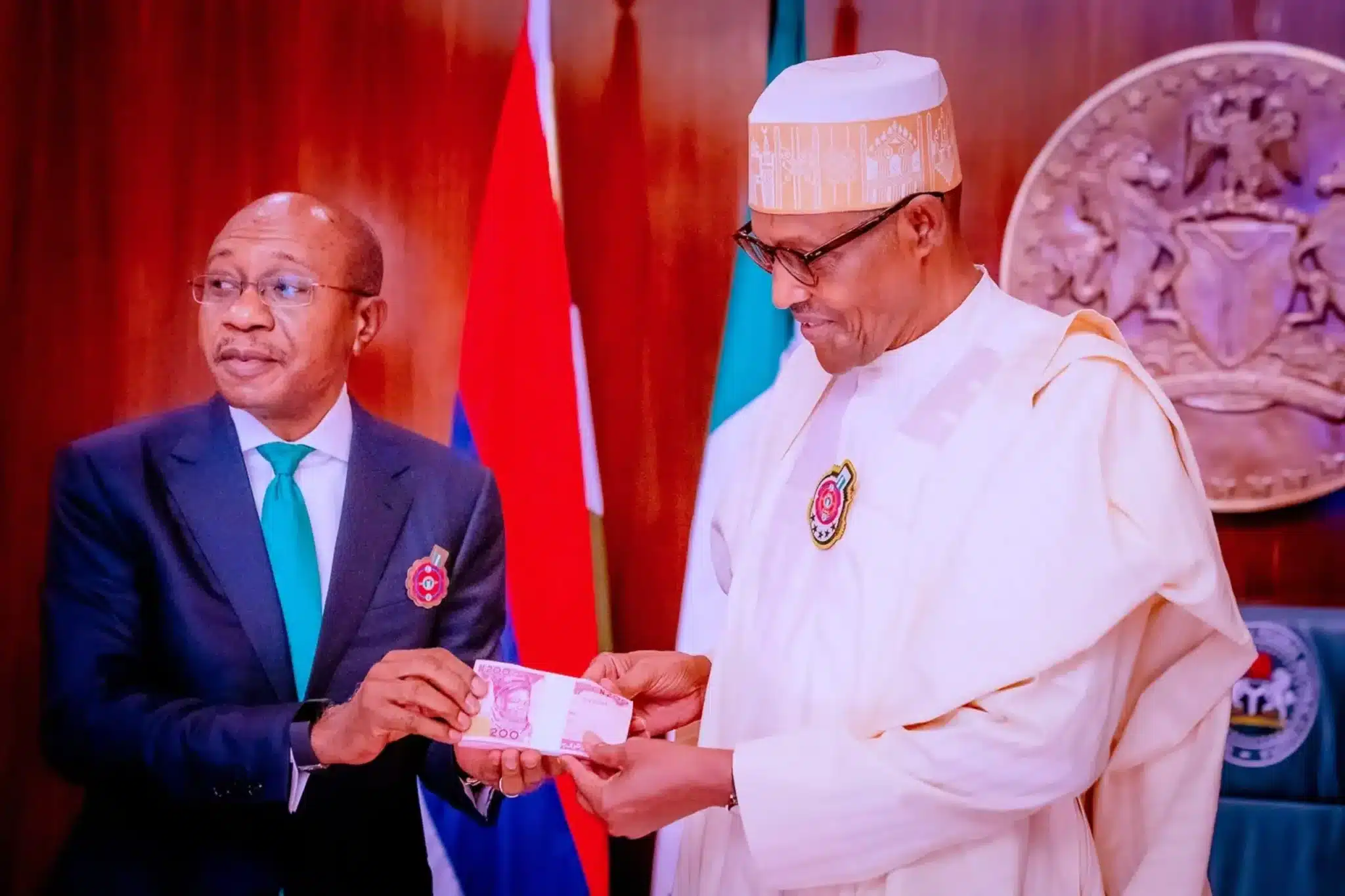
    The new 200, 500, and 1,000 naira notes were unveiled by President Muhammadu Buhari on Wednesday. He said that “the new Naira banknotes have been fortified with security elements that make them harder to counterfeit.”

    The new notes resemble the ones that are already in use quite a bit. The Central Bank of Nigeria’s headquarters and the nation’s coat of arms are still prominently displayed on the highest-value 1,000-naira note’s design. The color has changed from a primarily brown underprint to blue, which is the only discernible difference.

    The Central Bank of Nigeria (CBN) says that the redesigned notes will replace notes currently in circulation by Jan. 2023.

    But many locals are not impressed, describing the supposedly redesigned banknotes as a mere color revamp, given their similarities to the old notes.

    “Snapchat filter, a waste of time and resources, so a whole CBN cannot employ experts to redesign the naira notes. This is a revamp not a redesign,” one Nigerian tweeted.

    “What a waste of time and resources … what is the difference?” another questioned.

    CNN has asked the CBN for comment.

    Leading economist Bismarck Rewane tells CNN that changing the currency’s look adds nothing to its value and is insignificant in curbing counterfeiting.

    The government says new security features were added to the new notes, but Rewane says the changes to the currency are not significant enough to curb counterfeiting.

    Nigerian naira has been in a decline in recent years, falling to a record low on the black market where it traded at nearly 800 to the US dollar as of Friday.

    “It doesn’t change anything,” Rewane says of the redesigning of the naira. “It doesn’t increase the value,” he also says, adding: “There was no redesign. The color of the currency changed that’s all. The change is not significant enough to stop counterfeiting.”

    Nigeria’s 1000- and 500-naira denominations are the most counterfeited, according to the CBN’s annual report last year.

    News of redesigning the naira — first announced last month — generated mixed feelings among Nigerians, some of whom questioned the cost of printing new banknotes at a time the country is grappling with dwindling oil revenues, its main source of income.

    Central Bank Governor Godwin Emefiele expects the introduction of the new banknotes to help control inflation, which recently rose to its highest level in 17 years, and also fight corruption.

    “It’s just a change in color. I cannot see the correlation between the color of the currency and the desired goals. If the goal is to reduce inflation, it will not achieve that. [Changing the look of the currency] has no macroeconomic impact whatsoever,” he tells CNN.

    ‘Overdue for a new look’

    At the unveiling of the new notes on Wednesday President Buhari said it had been nearly 20 years since the country did a major redesign of its banknotes.

    The Nigerian leader added that replacing the current currency with the redesigned notes will help to combat the hoarding of funds outside of the banking system.

    “It is on this basis that I gave my approval for the redesign of the 200, ‎500, and 1,000 banknotes,” he said.

    Old naira notes will be completely phased away by the end of January next year, the CBN says, as locals scramble to deposit their old notes at commercial banks.


  • Ghana, Nigeria contest world’s worst currencies – Report

    The naira of Nigeria and the cedi of Ghana are currently the two worst-performing currencies in the world, with the naira losing 37% and 55%, respectively, of its value against the dollar.

    Bloomberg reports that while the naira was performing admirably versus the dollar on the official market, it had declined by 37% on the black market, placing it second only to the Ghana cedi in terms of performance.

    Despite the fact that Nigeria’s official exchange rate is strictly controlled, the value of the country’s money on the black market is largely determined by the level of demand for the dollar, which has been very high as a result of the country’s strict regulatory policies against the circulation of the dollar in the country.

    The naira’s depreciation has continued in the wake of the Central Bank of Nigeria’s decision to redesign the currency and the long-standing ban on Bureau De Change operations.

    Godwin Emefiele, the governor of the central bank, declared in October that new naira notes would be released by December 15.

    However, experts have predicted that the currency’s depreciation is likely to continue in the short term given the CBN’s announcement of plans to restructure the country’s currency, the prolonged ban against BDC operators, the low oil revenue, and the increased outflows due to uncertainty surrounding the upcoming presidential election.

    In order to halt the country’s currency’s rapid depreciation, the CBN in 2021 outlawed the sale of foreign exchange to BDC operators. The central bank accused the BDCs of making illegal foreign exchange sales above the market they were authorised to serve.

    Before the ban, BDC operators were an important part of the black market, assisting people who couldn’t lawfully get foreign currencies directly from the CBN to maintain their exchange rates.

    Peoples Gazette reported that the naira traded at N890 against the dollar on Saturday, an unprecedented rise from the N700 mark which it traded between September and early October.

    With the rate at which the value of the currency is falling, experts have also predicted that before the end of the year, the naira will exchange at N1000 to the dollar.

    In October, the Ghanaian cedi was rated as the worst-performing currency in the world after it lost 45.1 percent of its value to the U.S. dollar this year.

  • CBN, NIBSS, set to introduce national card scheme

    The Central Bank of Nigeria (CBN) and Nigeria Inter-Bank Settlement Systems (NIBSS) Plc, in conjunction with Bankers’ Committee will soon float a national card scheme to improve the payment system in Nigeria.

    Mr Premier Oiwoh, Managing Director, NIBSS, said this at a Bankers’ Committee press briefing on Thursday.

    He said the scheme, which had been approved, was the brain work of the apex bank.

    “Part of the proposition of the bank is that this National Domestic Card scheme will be created to help drive acceptance and efficiency and reduce operating cost of cards in the country.

    “This card will be configured to address the unique eco-system that we have, to help improve payment across the nation.

    “We also expect the card to provide affordable pricing; on this card the charges will be lower because it’s expected to be charged for in Naira as against foreign currency.

    “We also expect to customise local content uniquely for the Nigerian landscape, which will support micro payment and credit, e-government, identity management, transportation, health sector and agriculture in terms of payment,” he said.

    He explained that the card was expected to reduce the dependence on cash across the landscape and help promote the cashless initiative of the CBN.

    “The operational effectiveness of this card is expected to be robust and it should drive a lot of innovation, standardisation, then full end-to-end visibility to improve fraud management and better dispute resolution process around the card operating system.

    “Local competence for the card and payment scheme will also be deepened within the eco-system,” said Oiwoh.

    He said the card would incorporate products ranging from debit card, credit card, and non interest card, among others.

    The News Agency of Nigeria (NAN) reports that the committee also discussed the outcome of the last meeting of the Monetary Policy Committee meeting, particularly some of the key decisions that were taken to rein in inflation.

    The meeting also discussed the ongoing implementation of the RT200 FX policy and the key initiatives of the CBN in collaboration with the Bankers’ Committee to set up a National Fusion Centre.

    The centre is an industry response aimed to address Cyber Security and safeguard the critical information infrastructure.

    Source: Vanguardngr.com