President Nana Addo Dankwa Akufo-Addo is to address the 58th Annual General Conference of Nigerian Bar Association’s (NBA) in Abuja, Nigeria on Monday.
He would be the keynote speaker at the meeting which would also feature other speakers including the Nigerian Vice President, Professor Yemi Osinbajo and former Nigerian leader, General Abdulsalami Abubakar.
“Transition, transformation and sustainable institutions” is the theme chosen for event.
President Akufo-Addo would be speaking on building and sustaining institutions in Africa, the importance of peaceful elections (democratic transitions) in Nigeria, and impact on attracting investment in Nigeria and Africa as a whole.
He would also touch on economic transformation for Africa, the Africa Continental Free Trade Area Agreement, promoting intra-Africa trade and job creation for Africa’s growing population.
The President is expected to return to Ghana later on Monday.
President Nana Addo Dankwa Akufo-Addo is to address the 58th Annual General Conference of Nigerian Bar Association’s (NBA) in Abuja, Nigeria on Monday.
He would be the keynote speaker at the meeting which would also feature other speakers including the Nigerian Vice President, Professor Yemi Osinbajo and former Nigerian leader, General Abdulsalami Abubakar.
“Transition, transformation and sustainable institutions” is the theme chosen for event.
President Akufo-Addo would be speaking on building and sustaining institutions in Africa, the importance of peaceful elections (democratic transitions) in Nigeria, and impact on attracting investment in Nigeria and Africa as a whole.
He would also touch on economic transformation for Africa, the Africa Continental Free Trade Area Agreement, promoting intra-Africa trade and job creation for Africa’s growing population.
The President is expected to return to Ghana later on Monday.
Apostle Prof. Opoku Onyinah, the immediate-past Chairman of The Church of Pentecost, on Sunday, August 26, 2018 officially bowed out of active service after 42 years of successful ministry.
The colourful event which took place at the Pentecost Convention Centre (PCC) at Gomoa Fetteh, near Kasoa in the Central Region, was attended by high profile personalities from all over the world, including former President John Dramani Mahama, ministers of state, parliamentarians, chiefs and heads of churches and para-church organisations.
The ceremony which was greeted with grandeur was officiated by the new Chairman, Apostle Eric Kwabena Nyamekye, who was inducted into office on Saturday, August 25, 2018 in Accra.
The former President praised Apostle Prof. Opoku for impacting lives through his long years of service in ministry and also serving the nation in various capacities including the National Peace Council.
According to former President Mahama, Apostle Prof. Opoku Onyinah has lived an exemplary Christian life throughout his 42-years in ministry, and called on Christians in general to emulate his humble character.
The General Council of The Church of Pentecost in a testimony described the outgone Chairman as a man of integrity and contentment whose words match his actions and lives in a way that is true to God, true to self, and true to others.
“Apostle Prof. Opoku Onyinah displayed tremendous qualities of wisdom, judgement and discretion as a leader. Listening to him, one would easily pick out nuggets of wisdom that could only come from the Lord,†it said.
According to the testimony, Apostle Prof. Opoku Onyinah is a man of prayer, teacher of the Word and an astute theologian who stays intimately close to the Lord through prayers and a daily devotional life, saying, “…his disciplined devotional lifestyle has helped him to receive great insight from the Lord which has developed him into a great teacher of the Word.â€
Under his ten-year leadership, the Church has grown to 3,037,068 members worldwide in 100 nations including two autonomous nations from 1,695,412 members and 70 nations ten years ago.
In Ghana, the membership of the Church now stands at 2,566,818 compared to 1,468,726 when he assumed office. “This means that, there has been a 75% growth in membership during his tenure of office. Currently, the Church membership constitutes about 9.1% of the total population of Ghana and is very visible across the length and breadth of the country,†the General Council stated.
Born 64 years ago, Apostle Prof. Opoku Onyinah was called into the full-time ministry of The Church of Pentecost at the tender age of 22 in 1976. He rose from Probationary Overseer to Apostle, and held many positions in the Church, including District Minister, Area/Regional Head, the first International Missions Director (1991-1996), pioneer Rector of Pentecost University College (2004-2008), and as Chairman of The Church of Pentecost (2008-2018). He is also the President of the Ghana Pentecostal and Charismatic Council (GPCC) from 2011 to date, Chairman of the Ghana Evangelism Committee from 2010 to date, Co-Chairman of Empowered21 Africa from 2013 to date, Advisory Board Member of International Review of Mission from 2013 to date, Member of the Committee of World Pentecostal Theologians in Dialogue with the Catholic Church, since 2011, Member of a Standing Committee of Health and Healing of World Council of Churches/DIFAM, 2005-2010, Member of the Commission on World Mission and Evangelism of World Council of Churches from 2007 to date, Member of the Editorial Board of the Journal of Pentecostal Theology from 2007 to date.
He holds a PhD in Theology from the University of Birmingham and MTh in Applied Theology from the Regents Theological College (offered by the University of Manchester). He has published 18 books and 32 articles in journals and chapters of books on diverse subjects.
Apostle Prof. Opoku Onyinah is married to Grace and are blessed with six children.
Apostle Prof. Opoku Onyinah, the immediate-past Chairman of The Church of Pentecost, on Sunday, August 26, 2018 officially bowed out of active service after 42 years of successful ministry.
The colourful event which took place at the Pentecost Convention Centre (PCC) at Gomoa Fetteh, near Kasoa in the Central Region, was attended by high profile personalities from all over the world, including former President John Dramani Mahama, ministers of state, parliamentarians, chiefs and heads of churches and para-church organisations.
The ceremony which was greeted with grandeur was officiated by the new Chairman, Apostle Eric Kwabena Nyamekye, who was inducted into office on Saturday, August 25, 2018 in Accra.
The former President praised Apostle Prof. Opoku for impacting lives through his long years of service in ministry and also serving the nation in various capacities including the National Peace Council.
According to former President Mahama, Apostle Prof. Opoku Onyinah has lived an exemplary Christian life throughout his 42-years in ministry, and called on Christians in general to emulate his humble character.
The General Council of The Church of Pentecost in a testimony described the outgone Chairman as a man of integrity and contentment whose words match his actions and lives in a way that is true to God, true to self, and true to others.
“Apostle Prof. Opoku Onyinah displayed tremendous qualities of wisdom, judgement and discretion as a leader. Listening to him, one would easily pick out nuggets of wisdom that could only come from the Lord,†it said.
According to the testimony, Apostle Prof. Opoku Onyinah is a man of prayer, teacher of the Word and an astute theologian who stays intimately close to the Lord through prayers and a daily devotional life, saying, “…his disciplined devotional lifestyle has helped him to receive great insight from the Lord which has developed him into a great teacher of the Word.â€
Under his ten-year leadership, the Church has grown to 3,037,068 members worldwide in 100 nations including two autonomous nations from 1,695,412 members and 70 nations ten years ago.
In Ghana, the membership of the Church now stands at 2,566,818 compared to 1,468,726 when he assumed office. “This means that, there has been a 75% growth in membership during his tenure of office. Currently, the Church membership constitutes about 9.1% of the total population of Ghana and is very visible across the length and breadth of the country,†the General Council stated.
Born 64 years ago, Apostle Prof. Opoku Onyinah was called into the full-time ministry of The Church of Pentecost at the tender age of 22 in 1976. He rose from Probationary Overseer to Apostle, and held many positions in the Church, including District Minister, Area/Regional Head, the first International Missions Director (1991-1996), pioneer Rector of Pentecost University College (2004-2008), and as Chairman of The Church of Pentecost (2008-2018). He is also the President of the Ghana Pentecostal and Charismatic Council (GPCC) from 2011 to date, Chairman of the Ghana Evangelism Committee from 2010 to date, Co-Chairman of Empowered21 Africa from 2013 to date, Advisory Board Member of International Review of Mission from 2013 to date, Member of the Committee of World Pentecostal Theologians in Dialogue with the Catholic Church, since 2011, Member of a Standing Committee of Health and Healing of World Council of Churches/DIFAM, 2005-2010, Member of the Commission on World Mission and Evangelism of World Council of Churches from 2007 to date, Member of the Editorial Board of the Journal of Pentecostal Theology from 2007 to date.
He holds a PhD in Theology from the University of Birmingham and MTh in Applied Theology from the Regents Theological College (offered by the University of Manchester). He has published 18 books and 32 articles in journals and chapters of books on diverse subjects.
Apostle Prof. Opoku Onyinah is married to Grace and are blessed with six children.
Some staffs say they have already received communication from their bosses that subsidiaries are going to be closed down soon.
One of the biggest savings and loans company [name withheld], is also considering reviewing the salaries of its workers in other subsidiaries.
According to some of them, their situation has been compounded by the fact that funds borrowed are also not being paid by most businesses. Also, recent panic withdrawals are worsening the situation.
The development is not only limited to financial institutions and savings and loans companies but macro finance companies.
Status of panic withdrawals
According to sources, some of the withdrawals are running into millions of cedis but it is not clear where the funds are going.
Some staffs say they have already received communication from their bosses that subsidiaries are going to be closed down soon.
One of the biggest savings and loans company [name withheld], is also considering reviewing the salaries of its workers in other subsidiaries.
According to some of them, their situation has been compounded by the fact that funds borrowed are also not being paid by most businesses. Also, recent panic withdrawals are worsening the situation.
The development is not only limited to financial institutions and savings and loans companies but macro finance companies.
Status of panic withdrawals
According to sources, some of the withdrawals are running into millions of cedis but it is not clear where the funds are going.
The dismissed Vice Chancellor of the University of Education Winneba and some other staff of the institution are fighting back following the action taken by the governing council of the UEW.
In a statement released Monday morning, the dismissed staff say they feel the need to speak up now following “misinformation in the social, print and electronic media on the subject.â€
The dismissed staff also maintain that their silence on the dismissals appears to have given a section of the public the notion that they may be guilty of the several ills they have been accused of, hence, their decision to set the records straight.
“Some people have also misconstrued our silence on the subject as an admission of guilt. We have therefore decided to provide these clarifications to the public,†extracts of the statement reads.
The governing council of the University of Education, Winneba, dismissed five principal officers of the institution following an emergency meeting on Monday, August 13, 2018.
The appointment of one other official was also terminated.
The five are the Vice-Chancellor who was serving a suspension, Professor Mawutor Avoke, Finance Officer, Dr. Theophilus Senyo Ackorlie, Daniel Tetteh, Mary Dzimey and Frank Owusu Boateng.
They were interdicted in July 2017 by the UEW governing council to allow for investigations after it emerged that some vital documents at some offices at the centre of an ongoing investigation had gone missing.
Subsequently, in January 2018, lawyers of the five wrote to the University Council, demanding their immediate reinstatement.
But the dismissed staff are fighting back.
Read below the full press release by the dismissed Vice Chancellor of UEW and four others.
PRESS RELEASE BY PROFESSOR MAWUTOR AVOKE AND OTHER PURPORTEDLY DISMISSED OFFICERS OF UNIVERSITY OF EDUCATION, WINNEBA
Following our purported dismissal by the Governing Council of University of Education, Winneba (UEW) last week, we have tried very hard not to publicly comment or say anything about the subject in spite of the huge demand from families, relatives, colleagues and friends and to do so. We decided not to publicly comment on the subject for two main reasons:
The issues are in the Superior Courts of judicature: The Supreme Court in Accra and High Court in Cape Coast. We have very high respect for the courts and shall continue to do so.
Our Press Release, published on pages 88, 89 & 90 of Wednesday, 20th December, 2017 Edition of the Daily Graphic, extensively explained all the issues and established very clearly that we followed every single step and procedure required by the Laws/ Rules/ Regulations of Ghana and the University of Education, Winneba in the award of all procurement contracts that we signed.
However, we noticed that there is a lot of misinformation in the social, print and electronic media on the subject. Some people have also misconstrued our silence on the subject as an admission of guilt. We have therefore decided to provide these clarifications to the public.
No court has found us guilty of any procurement or financial malfeasance. As individuals, we have not been taken to any court and no charges have been brought against us. We have also not appeared before any court or been heard by any court on any charges. It is not true that the Vice-Chancellor, Professor Mawutor Avoke and the Finance Officer, Dr. Theophilus Senyo Ackorlie were found guilty of procurement or financial malfeasance by any court.
In its 14th December, 2017 ruling on Suit Number E12/40/17, the Winneba High Court ruled that the Vice-Chancellor and the Finance Officer were implicated in the North Campus Road Contract.
In the Civil Motion Number J5/65/2017, the Supreme Court on 20th December, 2017 unanimously quashed the 14th December, 2017 ruling by the Winneba High Court. To this effect, the Winneba High Court ruling ceased to exist by 20th December, 2017 and cannot be referred to in any commentary or write up or report or article on the current UEW issues affecting us.
We wish to state emphatically that the said North Campus Road Contract was not awarded by Professor Mawutor Avoke. The North Campus Road Contract was awarded by the then Vice-Chancellor, Professor Akwasi Asabere-Ameyaw through an MOU between UEW and the Ghana Highway Authority (GHA) in Winneba.
The first phase of this contract was done in 2012/2013 academic year when the current Chairman of the University Council, Professor Emmanuel Nicholas Abakah was the Pro Vice-Chancellor and he approved all the payment vouchers (PVs) for the payments. The second phase started in March 2015 when the current Ag. Vice-Chancellor, Rev. Fr. Professor Anthony Afful-Broni was the Pro Vice-Chancellor. Most of the payment vouchers for the second phase were approved by Rev. Fr. Prof Anthony Afful-Broni. The payment vouchers are all there to confirm their full participation especially in the approval of payments.
After the Supreme Court had quashed the 14th December, 2017 ruling by the Winneba High Court, the plaintiff (Supi Kofi Kwayera supported by Hon. Afenyo-Markins) went back to the Winneba High Court in February 2018 to file a new suit on only the tenure of the UEW Council: Suit Number E12/30/18.
This new suit did not make any reference to procurement or procurement contracts. The Winneba High Court ruled on this new suit on 2nd May, 2018 declaring that the President of the Republic of Ghana has no power to extend the tenure of the UEW Council after its term expired in November 2013 and that all decisions (including appointments) made by the UEW Council after November 2013 to June 2016 were null and void. This is the only court ruling currently standing against UEW. There is an application currently at the Supreme Court, Civil Motion Number J5/45/2018, contesting this 2nd May 2018 ruling by the Winneba High Court. The Supreme Court has fixed 31st October 2018 for ruling on this case.
It must be noted that this ruling does not only affect the appointment of Professor Mawutor Avoke as Vice-Chancellor. The then Council took a lot of decisions and made a lot of appointments between December 2013 and June 2016 including promotion of the then Rev. Fr. Associate Professor Anthony Afful-Broni to Professor and his appointment as a Pro Vice- Chancellor for a second term in 2015 among others.
The publications by a former member of the UEW Council on page 59 of the Daily Graphic of 25th October 2017 and by VCG on page 49 of the Daily Graphic of 16th July 2017, explained the issue of the tenure of UEW Council very clearly and in detail.
We filed a suit (Suit Number E10/4/2018) at the Cape Coast High Court in February 2018 for a judicial review, challenging our interdiction, on-going disciplinary procedures by the University Council against us and other breaches of the University Act and the University Statutes. The University has since February 2018 caused adjournments of this case using various strategies including avoiding services, submission of medical reports to excuse their lawyers from attending to court and other counter applications. The University has as at the last court sitting not filed their defense to our application for judicial review.
In the face of these adjournments in hearing our application for judicial review, the University Management continued to perpetuate the breaches that we sought to prevent in Court. We therefore filed Suit Number E10/159/2018 for contempt. The affected University officials cited for contempt, avoided services on many occasions so we went back to court for substituted service, which enabled us to publish the service in the 30th May, 2018 Edition of the Daily Graphic.
These two suits: E10/4/2018 and E10/159/2018, which are fundamental to this subject are all pending at the Cape Coast High Court. At the last hearing on 14th and 15th August, 2018, the cases were adjourned to 17th and 22nd October, 2018 respectively.
We were very surprised that in spite of the pendency of these suits at both the Supreme Court and the High Court in Cape Coast, the Council could still go ahead and dismiss us using the very same procedures and citing the very same reasons which are pending in the courts.
In our dismissal letters, the Council gave two reasons: “You did not observe due diligence and you occasioned breaches and irregularities in the performance of your functions relative to the laws and regulations in the governance of the Universityâ€
“Your failure to appear before the Disciplinary Board constituted disrespect of the first magnitude to the Governing Council and the University as a wholeâ€
We wish to clearly state as follows:
1. We did not and never breached any laws or regulations in Ghana or in the University. We demonstrated this very clearly and explicitly in our publication of 20th December, 2017 in the Daily Graphic, pages 88, 89 and 90.
2. We informed the Disciplinary Board through our Lawyers, Atuguba & Associates, that we were unable to honour their invitation at that time because there were pending suits at the High Court in Cape Coast concerning the very thing they were seeking to invite us to participate in. We requested that the Board allow the High Court in Cape Coast to complete its work then we could appear before them so as not to interfere with the administration of justice. How can this be termed as disrespect of the “first magnitude†to the Governing Council and the University as a whole?
3. If it is true that we occasioned breaches and irregularities in the award of contracts, why were these contracts not terminated by the Council and Management after they assume office for more than one year? Any contract which is signed in breach of laws and regulations of Ghana and the University is null and void and should be terminated by the Council immediately. Why are all the contractors at site and working under these same contracts that we signed? Why are all the contractors being paid using the same contracts that we signed?
4. In October 2017, the Council alleged that vital documents and files were missing from our offices while we were at home under Court injunction. It is over 10 months since the allegation was made and the Council is yet to mention the names of the said documents and files that were alleged to have gone missing. Why is it difficult to mention the names of these so-called missing documents and files? We wish to state that we did not take any document from our offices. It is also important to state that by law copies of all procurement documents at the thresholds in question must be submitted to the Public Procurement Authority (PPA) and the Central Tender Review Board (CTRB). We submitted copies of all documents relating to all contracts we signed to both the PPA and CTRB and these state institutions can be contacted for copies.
5. The Council announced that there were three separate bodies investigating the allegations by Supi Kofi Kwayera/Hon. Afenyo-Markins. These were EOCO, BNI and Council Fact-Finding Committee (CFFC). Why is the Council depending only on the report of CFFC and ignoring reports by the BNI and EOCO? Why has the Council made available to us only the report of CFFC and not those of BNI and EOCO? Why should the Council ignore or refuse to wait for the reports of BNI and EOCO? We wish to state that the report of CFFC is very inaccurate and baseless as it is based on misinformation or lack of information or lack of understanding of the procurement processes and university governance. Even in its current inaccurate form, the report of CFFC does not implicate us in any way or show that we have breached any law or regulation to warrant our dismissal.
6. We wish to assure our families, relatives, colleagues and friends that we are innocent of all the allegations against us and will wait for the verdict of the courts. We completely disagree with our purported dismissal as was communicated to us and reported to the media. We shall use lawful means to seek justice. We believe that the truth shall be established and known to all one day no matter how long it takes.
The dismissed Vice Chancellor of the University of Education Winneba and some other staff of the institution are fighting back following the action taken by the governing council of the UEW.
In a statement released Monday morning, the dismissed staff say they feel the need to speak up now following “misinformation in the social, print and electronic media on the subject.â€
The dismissed staff also maintain that their silence on the dismissals appears to have given a section of the public the notion that they may be guilty of the several ills they have been accused of, hence, their decision to set the records straight.
“Some people have also misconstrued our silence on the subject as an admission of guilt. We have therefore decided to provide these clarifications to the public,†extracts of the statement reads.
The governing council of the University of Education, Winneba, dismissed five principal officers of the institution following an emergency meeting on Monday, August 13, 2018.
The appointment of one other official was also terminated.
The five are the Vice-Chancellor who was serving a suspension, Professor Mawutor Avoke, Finance Officer, Dr. Theophilus Senyo Ackorlie, Daniel Tetteh, Mary Dzimey and Frank Owusu Boateng.
They were interdicted in July 2017 by the UEW governing council to allow for investigations after it emerged that some vital documents at some offices at the centre of an ongoing investigation had gone missing.
Subsequently, in January 2018, lawyers of the five wrote to the University Council, demanding their immediate reinstatement.
But the dismissed staff are fighting back.
Read below the full press release by the dismissed Vice Chancellor of UEW and four others.
PRESS RELEASE BY PROFESSOR MAWUTOR AVOKE AND OTHER PURPORTEDLY DISMISSED OFFICERS OF UNIVERSITY OF EDUCATION, WINNEBA
Following our purported dismissal by the Governing Council of University of Education, Winneba (UEW) last week, we have tried very hard not to publicly comment or say anything about the subject in spite of the huge demand from families, relatives, colleagues and friends and to do so. We decided not to publicly comment on the subject for two main reasons:
The issues are in the Superior Courts of judicature: The Supreme Court in Accra and High Court in Cape Coast. We have very high respect for the courts and shall continue to do so.
Our Press Release, published on pages 88, 89 & 90 of Wednesday, 20th December, 2017 Edition of the Daily Graphic, extensively explained all the issues and established very clearly that we followed every single step and procedure required by the Laws/ Rules/ Regulations of Ghana and the University of Education, Winneba in the award of all procurement contracts that we signed.
However, we noticed that there is a lot of misinformation in the social, print and electronic media on the subject. Some people have also misconstrued our silence on the subject as an admission of guilt. We have therefore decided to provide these clarifications to the public.
No court has found us guilty of any procurement or financial malfeasance. As individuals, we have not been taken to any court and no charges have been brought against us. We have also not appeared before any court or been heard by any court on any charges. It is not true that the Vice-Chancellor, Professor Mawutor Avoke and the Finance Officer, Dr. Theophilus Senyo Ackorlie were found guilty of procurement or financial malfeasance by any court.
In its 14th December, 2017 ruling on Suit Number E12/40/17, the Winneba High Court ruled that the Vice-Chancellor and the Finance Officer were implicated in the North Campus Road Contract.
In the Civil Motion Number J5/65/2017, the Supreme Court on 20th December, 2017 unanimously quashed the 14th December, 2017 ruling by the Winneba High Court. To this effect, the Winneba High Court ruling ceased to exist by 20th December, 2017 and cannot be referred to in any commentary or write up or report or article on the current UEW issues affecting us.
We wish to state emphatically that the said North Campus Road Contract was not awarded by Professor Mawutor Avoke. The North Campus Road Contract was awarded by the then Vice-Chancellor, Professor Akwasi Asabere-Ameyaw through an MOU between UEW and the Ghana Highway Authority (GHA) in Winneba.
The first phase of this contract was done in 2012/2013 academic year when the current Chairman of the University Council, Professor Emmanuel Nicholas Abakah was the Pro Vice-Chancellor and he approved all the payment vouchers (PVs) for the payments. The second phase started in March 2015 when the current Ag. Vice-Chancellor, Rev. Fr. Professor Anthony Afful-Broni was the Pro Vice-Chancellor. Most of the payment vouchers for the second phase were approved by Rev. Fr. Prof Anthony Afful-Broni. The payment vouchers are all there to confirm their full participation especially in the approval of payments.
After the Supreme Court had quashed the 14th December, 2017 ruling by the Winneba High Court, the plaintiff (Supi Kofi Kwayera supported by Hon. Afenyo-Markins) went back to the Winneba High Court in February 2018 to file a new suit on only the tenure of the UEW Council: Suit Number E12/30/18.
This new suit did not make any reference to procurement or procurement contracts. The Winneba High Court ruled on this new suit on 2nd May, 2018 declaring that the President of the Republic of Ghana has no power to extend the tenure of the UEW Council after its term expired in November 2013 and that all decisions (including appointments) made by the UEW Council after November 2013 to June 2016 were null and void. This is the only court ruling currently standing against UEW. There is an application currently at the Supreme Court, Civil Motion Number J5/45/2018, contesting this 2nd May 2018 ruling by the Winneba High Court. The Supreme Court has fixed 31st October 2018 for ruling on this case.
It must be noted that this ruling does not only affect the appointment of Professor Mawutor Avoke as Vice-Chancellor. The then Council took a lot of decisions and made a lot of appointments between December 2013 and June 2016 including promotion of the then Rev. Fr. Associate Professor Anthony Afful-Broni to Professor and his appointment as a Pro Vice- Chancellor for a second term in 2015 among others.
The publications by a former member of the UEW Council on page 59 of the Daily Graphic of 25th October 2017 and by VCG on page 49 of the Daily Graphic of 16th July 2017, explained the issue of the tenure of UEW Council very clearly and in detail.
We filed a suit (Suit Number E10/4/2018) at the Cape Coast High Court in February 2018 for a judicial review, challenging our interdiction, on-going disciplinary procedures by the University Council against us and other breaches of the University Act and the University Statutes. The University has since February 2018 caused adjournments of this case using various strategies including avoiding services, submission of medical reports to excuse their lawyers from attending to court and other counter applications. The University has as at the last court sitting not filed their defense to our application for judicial review.
In the face of these adjournments in hearing our application for judicial review, the University Management continued to perpetuate the breaches that we sought to prevent in Court. We therefore filed Suit Number E10/159/2018 for contempt. The affected University officials cited for contempt, avoided services on many occasions so we went back to court for substituted service, which enabled us to publish the service in the 30th May, 2018 Edition of the Daily Graphic.
These two suits: E10/4/2018 and E10/159/2018, which are fundamental to this subject are all pending at the Cape Coast High Court. At the last hearing on 14th and 15th August, 2018, the cases were adjourned to 17th and 22nd October, 2018 respectively.
We were very surprised that in spite of the pendency of these suits at both the Supreme Court and the High Court in Cape Coast, the Council could still go ahead and dismiss us using the very same procedures and citing the very same reasons which are pending in the courts.
In our dismissal letters, the Council gave two reasons: “You did not observe due diligence and you occasioned breaches and irregularities in the performance of your functions relative to the laws and regulations in the governance of the Universityâ€
“Your failure to appear before the Disciplinary Board constituted disrespect of the first magnitude to the Governing Council and the University as a wholeâ€
We wish to clearly state as follows:
1. We did not and never breached any laws or regulations in Ghana or in the University. We demonstrated this very clearly and explicitly in our publication of 20th December, 2017 in the Daily Graphic, pages 88, 89 and 90.
2. We informed the Disciplinary Board through our Lawyers, Atuguba & Associates, that we were unable to honour their invitation at that time because there were pending suits at the High Court in Cape Coast concerning the very thing they were seeking to invite us to participate in. We requested that the Board allow the High Court in Cape Coast to complete its work then we could appear before them so as not to interfere with the administration of justice. How can this be termed as disrespect of the “first magnitude†to the Governing Council and the University as a whole?
3. If it is true that we occasioned breaches and irregularities in the award of contracts, why were these contracts not terminated by the Council and Management after they assume office for more than one year? Any contract which is signed in breach of laws and regulations of Ghana and the University is null and void and should be terminated by the Council immediately. Why are all the contractors at site and working under these same contracts that we signed? Why are all the contractors being paid using the same contracts that we signed?
4. In October 2017, the Council alleged that vital documents and files were missing from our offices while we were at home under Court injunction. It is over 10 months since the allegation was made and the Council is yet to mention the names of the said documents and files that were alleged to have gone missing. Why is it difficult to mention the names of these so-called missing documents and files? We wish to state that we did not take any document from our offices. It is also important to state that by law copies of all procurement documents at the thresholds in question must be submitted to the Public Procurement Authority (PPA) and the Central Tender Review Board (CTRB). We submitted copies of all documents relating to all contracts we signed to both the PPA and CTRB and these state institutions can be contacted for copies.
5. The Council announced that there were three separate bodies investigating the allegations by Supi Kofi Kwayera/Hon. Afenyo-Markins. These were EOCO, BNI and Council Fact-Finding Committee (CFFC). Why is the Council depending only on the report of CFFC and ignoring reports by the BNI and EOCO? Why has the Council made available to us only the report of CFFC and not those of BNI and EOCO? Why should the Council ignore or refuse to wait for the reports of BNI and EOCO? We wish to state that the report of CFFC is very inaccurate and baseless as it is based on misinformation or lack of information or lack of understanding of the procurement processes and university governance. Even in its current inaccurate form, the report of CFFC does not implicate us in any way or show that we have breached any law or regulation to warrant our dismissal.
6. We wish to assure our families, relatives, colleagues and friends that we are innocent of all the allegations against us and will wait for the verdict of the courts. We completely disagree with our purported dismissal as was communicated to us and reported to the media. We shall use lawful means to seek justice. We believe that the truth shall be established and known to all one day no matter how long it takes.
Serena Williams has played down the news that her superhero-like ‘catsuit’ will be banned for the 2019 French Open.
Bernard Giudicelli, the French Tennis Federation president, said in an interview with Tennis Magazine that Roland Garros, one of the four grand slams, is introducing a dress code.
He insisted the new rules at the French Open — a tournament Williams has won on three occasions — won’t be as strict as Wimbledon’s all-white policy, but are being implemented because he thinks “that sometimes we’ve gone too far.”
“It will no longer be accepted,” he said of the catsuit. “One must respect the game and the place.”
Serena Williams has played down the news that her superhero-like ‘catsuit’ will be banned for the 2019 French Open.
Bernard Giudicelli, the French Tennis Federation president, said in an interview with Tennis Magazine that Roland Garros, one of the four grand slams, is introducing a dress code.
He insisted the new rules at the French Open — a tournament Williams has won on three occasions — won’t be as strict as Wimbledon’s all-white policy, but are being implemented because he thinks “that sometimes we’ve gone too far.”
“It will no longer be accepted,” he said of the catsuit. “One must respect the game and the place.”
Iranian lawyers will ask the International Court of Justice (ICJ) to order the US to lift sanctions ordered by the Trump administration against Tehran.
The lawsuit says the US sanctions, which are damaging its already weak economy, violate terms of a little-known 1955 friendship treaty between the two countries.
Tehran filed its case before the ICJ in late July, calling on the Hague-based tribunal’s judges to order the immediate lifting of sanctions, which it said would cause “irreparable prejudice”.
The US, which will respond formally in oral arguments on Tuesday, has yet to issue a public response.
US lawyers are expected to argue that the UN court should not have jurisdiction in the dispute, that the friendship treaty is no longer valid and that the sanctions Washington has levied against Tehran do not violate it.
The oral hearings, essentially a request by Iran for a provisional ruling, will last for four days, with a decision to follow within a month.
The ICJ is the United Nations tribunal for resolving international disputes. Its rulings are binding, but it has no power to enforce them and on rare occasions they have been ignored by some countries, including the US.
US President Donald Trump pulled out of a 2015 nuclear pact between Iran and the five permanent members of the UN Security Council, with his administration then announcing unilateral plans to restore sanctions against Tehran.
Under the 2015 deal, which Trump sees as flawed, Iran reined in its disputed nuclear program under UN monitoring and won a removal of international sanctions in return.
Iran’s Foreign Minister Mohammad Javad Zarif accused the US this week of waging a “psychological war” against Tehran and its business partners.
Although the US’ European allies have protested against Trump’s move, most Western companies intend to adhere to the sanctions, preferring to lose business in Iran than be punished by the US or barred from doing business there.
The ICJ has so far ruled that the 1955 treaty is still valid, even though it was signed long before the 1979 Islamic Revolution that triggered decades of hostile relations with Washington.
Iranian lawyers will ask the International Court of Justice (ICJ) to order the US to lift sanctions ordered by the Trump administration against Tehran.
The lawsuit says the US sanctions, which are damaging its already weak economy, violate terms of a little-known 1955 friendship treaty between the two countries.
Tehran filed its case before the ICJ in late July, calling on the Hague-based tribunal’s judges to order the immediate lifting of sanctions, which it said would cause “irreparable prejudice”.
The US, which will respond formally in oral arguments on Tuesday, has yet to issue a public response.
US lawyers are expected to argue that the UN court should not have jurisdiction in the dispute, that the friendship treaty is no longer valid and that the sanctions Washington has levied against Tehran do not violate it.
The oral hearings, essentially a request by Iran for a provisional ruling, will last for four days, with a decision to follow within a month.
The ICJ is the United Nations tribunal for resolving international disputes. Its rulings are binding, but it has no power to enforce them and on rare occasions they have been ignored by some countries, including the US.
US President Donald Trump pulled out of a 2015 nuclear pact between Iran and the five permanent members of the UN Security Council, with his administration then announcing unilateral plans to restore sanctions against Tehran.
Under the 2015 deal, which Trump sees as flawed, Iran reined in its disputed nuclear program under UN monitoring and won a removal of international sanctions in return.
Iran’s Foreign Minister Mohammad Javad Zarif accused the US this week of waging a “psychological war” against Tehran and its business partners.
Although the US’ European allies have protested against Trump’s move, most Western companies intend to adhere to the sanctions, preferring to lose business in Iran than be punished by the US or barred from doing business there.
The ICJ has so far ruled that the 1955 treaty is still valid, even though it was signed long before the 1979 Islamic Revolution that triggered decades of hostile relations with Washington.
Italia Serie giants, AC Milan has celebrated former Black Stars midfield dynamo Sulley Muntari celebrates on his birthday as he turns 35 years old today.
Muntari joined the former European giants on loan from Inter Milan on January 2012 but the deal was made permanent on 2014 following the expiration of his contract at Inter Milan on 1 July 2012.
Italia Serie giants, AC Milan has celebrated former Black Stars midfield dynamo Sulley Muntari celebrates on his birthday as he turns 35 years old today.
Muntari joined the former European giants on loan from Inter Milan on January 2012 but the deal was made permanent on 2014 following the expiration of his contract at Inter Milan on 1 July 2012.
Nigerian artists Flavour, Tekno, comedian Gordons, and others skipped death by a hair’s breath when their plane developed a fault and nearly crashed.
The Nigerian entertainers were billed to perform in Ghana and on board the plane that nearly crashed were Flavour, Tekno, Godsons, their band boys and other colleagues.
Comedian Gordsons who was elated to survive the plane crash posted a video on his social media page to share his ordeal with his fans.
According to him, 8 minutes after departing from the Murtala Muhammed International Airport, there was an announcement that the plane had developed a fault so they had to fly back to Lagos.
He added that he was struck with fear and thought that would have been his last day on earth but God being so good, they landed safely.
” So people, please help me praise God and thank Him today. God delivered me, Flavour, Tekno and all their band boys together with other people who flew with us from Lagos to Accra today.G od delivered all of us from air accident.”
Nigerian artists Flavour, Tekno, comedian Gordons, and others skipped death by a hair’s breath when their plane developed a fault and nearly crashed.
The Nigerian entertainers were billed to perform in Ghana and on board the plane that nearly crashed were Flavour, Tekno, Godsons, their band boys and other colleagues.
Comedian Gordsons who was elated to survive the plane crash posted a video on his social media page to share his ordeal with his fans.
According to him, 8 minutes after departing from the Murtala Muhammed International Airport, there was an announcement that the plane had developed a fault so they had to fly back to Lagos.
He added that he was struck with fear and thought that would have been his last day on earth but God being so good, they landed safely.
” So people, please help me praise God and thank Him today. God delivered me, Flavour, Tekno and all their band boys together with other people who flew with us from Lagos to Accra today.G od delivered all of us from air accident.”
The Chairman of the Ghana League Clubs Association (GHALCA) Mr. Kudjoe Fianoo has called on members to form a united front with the view of making the association more vibrant to serve as the rallying point for the various clubs in Ghana.
“GHALCA has its clear cut roles, but over the years, those roles were eroded to a point that they were rendered irrelevant to the development of football in the country†Mr. Fianoo explained during an interview with Graphic Sports Online.
“ It is now time for the clubs to come together to make GHALCA much more formidable to serve as the rallying point for the clubs.
“By coming together, GHALCA can also play a role of an advocacy for the clubs and players of the industry to improve the standard of the game†he declared
The GHALCA boss was also of the view that the time had come for members to accept that “the association is our property, hence the need to accept opposing views from members and avoid all forms of dictatorship.With that, the welfare and well-being of the clubs would be ensured and protected at all timesâ€.
On why the powers of the association were eroded,causing it to be irrelevant to the development of football in Ghana, Mr. Fianoo noted:Before 2005, GHALCA was electing the Vice President of the FA, Executive committee members (EXco) and the management committee of the FA, but all these elections are now done at the auspices of the FA .
“Those who are elected directly by the FA are no more accountable to the GHALCA, which in a way, weakened the body. I am not saying that we should replicate it now, but we need to modernise it to make the association work as it used to beâ€.
Mr. Fianoo was also of the view that it was important “for members appointed to serve the FA to be more accountable to their members”. This, he said, would make the association more vibrant, formidable and relevant to serve the interest of member clubs.
.†It is the responsibility for all of us to make the body more vibrant to ensure that it serves as a rallying point for the various clubs in Ghana†he advised.
“We have representatives on the Exco of the GFA who formulate plans and agenda for the FA, so we must also have a way to promoting our interest to make us more relevant in the administration of football in Ghanaâ€he advocated.
The Chairman of the Ghana League Clubs Association (GHALCA) Mr. Kudjoe Fianoo has called on members to form a united front with the view of making the association more vibrant to serve as the rallying point for the various clubs in Ghana.
“GHALCA has its clear cut roles, but over the years, those roles were eroded to a point that they were rendered irrelevant to the development of football in the country†Mr. Fianoo explained during an interview with Graphic Sports Online.
“ It is now time for the clubs to come together to make GHALCA much more formidable to serve as the rallying point for the clubs.
“By coming together, GHALCA can also play a role of an advocacy for the clubs and players of the industry to improve the standard of the game†he declared
The GHALCA boss was also of the view that the time had come for members to accept that “the association is our property, hence the need to accept opposing views from members and avoid all forms of dictatorship.With that, the welfare and well-being of the clubs would be ensured and protected at all timesâ€.
On why the powers of the association were eroded,causing it to be irrelevant to the development of football in Ghana, Mr. Fianoo noted:Before 2005, GHALCA was electing the Vice President of the FA, Executive committee members (EXco) and the management committee of the FA, but all these elections are now done at the auspices of the FA .
“Those who are elected directly by the FA are no more accountable to the GHALCA, which in a way, weakened the body. I am not saying that we should replicate it now, but we need to modernise it to make the association work as it used to beâ€.
Mr. Fianoo was also of the view that it was important “for members appointed to serve the FA to be more accountable to their members”. This, he said, would make the association more vibrant, formidable and relevant to serve the interest of member clubs.
.†It is the responsibility for all of us to make the body more vibrant to ensure that it serves as a rallying point for the various clubs in Ghana†he advised.
“We have representatives on the Exco of the GFA who formulate plans and agenda for the FA, so we must also have a way to promoting our interest to make us more relevant in the administration of football in Ghanaâ€he advocated.
Hiplife musician Mzbel joins the list of celebrities who have paid a visit to the church of Rev. Obofour who is the leader and head of Anointed Palace Chapel.
The songstress made this revelation when she took her turn on Celebrity Ride With Zionfelix show for the second time.
Mzbel on the program revealed that she performed her hit song, 16 years at the Anointed Palace Chapel when she visited the pastor some days earlier.
According to her, she was given she was given the microphone to perform the song because she never thought that would happen at a church auditorium.
She also revealed that she stopped the bandsmen when they started playing the instruments to support her performance because she felt uncomfortable singing a secular song at church.
Speaking on why she went to see Rev. Obofour, Mzbel disclosed that she received an information that the man of God wanted to see her but she initially ignored it because it was not a serious matter to her at the time she was told. The award-winning musician continued that she decided to visit him when she was in Kumasi for a charity program.
Hiplife musician Mzbel joins the list of celebrities who have paid a visit to the church of Rev. Obofour who is the leader and head of Anointed Palace Chapel.
The songstress made this revelation when she took her turn on Celebrity Ride With Zionfelix show for the second time.
Mzbel on the program revealed that she performed her hit song, 16 years at the Anointed Palace Chapel when she visited the pastor some days earlier.
According to her, she was given she was given the microphone to perform the song because she never thought that would happen at a church auditorium.
She also revealed that she stopped the bandsmen when they started playing the instruments to support her performance because she felt uncomfortable singing a secular song at church.
Speaking on why she went to see Rev. Obofour, Mzbel disclosed that she received an information that the man of God wanted to see her but she initially ignored it because it was not a serious matter to her at the time she was told. The award-winning musician continued that she decided to visit him when she was in Kumasi for a charity program.
Uber says it plans to focus more on its electric scooter and bike business, and less on cars, despite the fact it could hurt profits.
Boss Dara Khosrowshahi said that individual modes of transport were better suited to inner city travel.
He also forecast users would make more frequent shorter journeys in future.
“During rush hour, it is very inefficient for a one-tonne hulk of metal to take one person 10 blocks,” he told the Financial Times.
“Short-term financially, maybe it’s not a win for us, but strategically long term we think that is exactly where we want to head.”
The ride-sharing firm has invested in a number of bike firms in the last year.
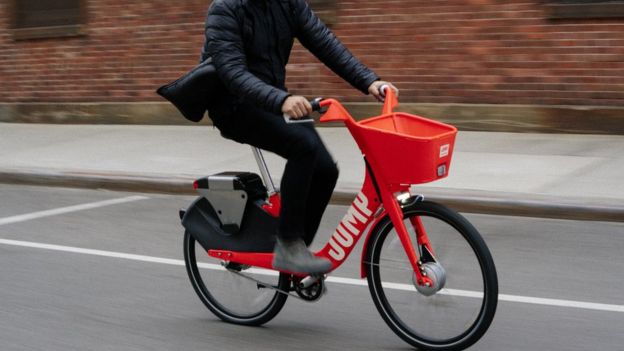
Its Jump electric bikes are now available in eight US cities, including New York and Washington, and are soon launching in Berlin.
Image copyright:Â JUMP BIKES
It also teamed up with Lime, an electric scooter company, while forging deals in other areas such as public transit and freight.
Mr Khosrowshahi admitted that Uber makes less money from a bike ride than from the same trip in a car, but said this would be offset as customers used the app more frequently for shorter journeys.
“We are willing to trade off short-term per-unit economics for long-term higher engagement,” he told the FT.
He also acknowledged that Uber drivers could lose out from the plan, but said over the longer term drivers would benefit from more lucrative longer journeys.
Under pressure
Uber, which lost $4.5bn (£3.5bn) last year, is under pressure to improve its finances ahead of an anticipated public listing.
Revenue from its taxi business is rising but the cost of expansion into new areas such as bike sharing and food delivery has meant losses have grown rapidly.
Regulatory pressure is also threatening growth in some markets.
This month New York voted to impose a temporary cap on new licences for ride-hailing vehicles to tackle congestion, while the mayor of London has said he will seek similar restrictions.
Uber says it plans to focus more on its electric scooter and bike business, and less on cars, despite the fact it could hurt profits.
Boss Dara Khosrowshahi said that individual modes of transport were better suited to inner city travel.
He also forecast users would make more frequent shorter journeys in future.
“During rush hour, it is very inefficient for a one-tonne hulk of metal to take one person 10 blocks,” he told the Financial Times.
“Short-term financially, maybe it’s not a win for us, but strategically long term we think that is exactly where we want to head.”
The ride-sharing firm has invested in a number of bike firms in the last year.
Its Jump electric bikes are now available in eight US cities, including New York and Washington, and are soon launching in Berlin.
Image copyright:Â JUMP BIKES
It also teamed up with Lime, an electric scooter company, while forging deals in other areas such as public transit and freight.
Mr Khosrowshahi admitted that Uber makes less money from a bike ride than from the same trip in a car, but said this would be offset as customers used the app more frequently for shorter journeys.
“We are willing to trade off short-term per-unit economics for long-term higher engagement,” he told the FT.
He also acknowledged that Uber drivers could lose out from the plan, but said over the longer term drivers would benefit from more lucrative longer journeys.
Under pressure
Uber, which lost $4.5bn (£3.5bn) last year, is under pressure to improve its finances ahead of an anticipated public listing.
Revenue from its taxi business is rising but the cost of expansion into new areas such as bike sharing and food delivery has meant losses have grown rapidly.
Regulatory pressure is also threatening growth in some markets.
This month New York voted to impose a temporary cap on new licences for ride-hailing vehicles to tackle congestion, while the mayor of London has said he will seek similar restrictions.
Government is expected to file a motion today [Monday] at the Accra High Court to officially withdraw its liquidation petition against the Ghana Football Association.
This is in fulfillment of an agreement signed with FIFA on August 16, 2018.
Per the agreement, FIFA in consultation with government and CAF will establish a Normalization Committee to replace the current executive committee of the Ghana Football Association.
Their mandate will be to work out a timetable and a roadmap to get new executives elected to form a new Executive Committee of the FA.
The government initiated processes to dissolve the GFA in June after investigative journalist Anas Aremeyaw Anas uncovered widespread rot in all facets of Ghana football.
The government and FIFA have also established a joint task force to oversee auditing mechanism and ensure persons found culpable in the corruption scandal are punished.
“Satisfied with the above measures, the GoG shall take steps to discontinue the process for winding up of the Ghana Football Association,†a release from FIFA stated.
The meeting was called after FIFA threatened to ban Ghana over the lawsuit against the GFA.
FIFA held that the government was interfering with the GFA.
But the government argued that GFA was perpetrating illegalities.
Background
On June 7, investigative journalist, Anas Aremeyaw Anas, aired a documentary “Number 12†on corruption in football in Ghana, and some leading figures including FA boss, Kwesi Nyantakyi, were seen allegedly taking part in some corrupt acts.
As a response, the Ghana government asked for the arrest of Kwesi Nyantakyi on the charge of defrauding by false pretense based on utterances he made on the tape.
Kwesi Nyantakyi then resigned from his position as Ghana FA boss and also from CAF.
FIFA also provisionally suspended Nyantakyi for 90 days as a result of the tape.
The Ghana government went ahead to secure a court injunction on the Ghana FA as the first step of a process that was to lead to the eventual liquidation of the Ghana FA under the Companies Act since the FA was registered as such.
As all of that happened, a freeze was put on Ghana football and that has not changed until present.
Government is expected to file a motion today [Monday] at the Accra High Court to officially withdraw its liquidation petition against the Ghana Football Association.
This is in fulfillment of an agreement signed with FIFA on August 16, 2018.
Per the agreement, FIFA in consultation with government and CAF will establish a Normalization Committee to replace the current executive committee of the Ghana Football Association.
Their mandate will be to work out a timetable and a roadmap to get new executives elected to form a new Executive Committee of the FA.
The government initiated processes to dissolve the GFA in June after investigative journalist Anas Aremeyaw Anas uncovered widespread rot in all facets of Ghana football.
The government and FIFA have also established a joint task force to oversee auditing mechanism and ensure persons found culpable in the corruption scandal are punished.
“Satisfied with the above measures, the GoG shall take steps to discontinue the process for winding up of the Ghana Football Association,†a release from FIFA stated.
The meeting was called after FIFA threatened to ban Ghana over the lawsuit against the GFA.
FIFA held that the government was interfering with the GFA.
But the government argued that GFA was perpetrating illegalities.
Background
On June 7, investigative journalist, Anas Aremeyaw Anas, aired a documentary “Number 12†on corruption in football in Ghana, and some leading figures including FA boss, Kwesi Nyantakyi, were seen allegedly taking part in some corrupt acts.
As a response, the Ghana government asked for the arrest of Kwesi Nyantakyi on the charge of defrauding by false pretense based on utterances he made on the tape.
Kwesi Nyantakyi then resigned from his position as Ghana FA boss and also from CAF.
FIFA also provisionally suspended Nyantakyi for 90 days as a result of the tape.
The Ghana government went ahead to secure a court injunction on the Ghana FA as the first step of a process that was to lead to the eventual liquidation of the Ghana FA under the Companies Act since the FA was registered as such.
As all of that happened, a freeze was put on Ghana football and that has not changed until present.
The Confederation of African Football (CAF) is looking for new hosts for the 2018 African Women Cup of Nations (AWCON) after stripping Ghana of the hosting rights.
CAF President Ahmad Ahmad has revealed that they are talking to some countries to take over as hosts of the two-week competition after the highly expected decision to dump Ghana.
A new host will be announced next month during the CAF Extraordinary General Assembly in Egypt.
Africa’s governing body CAF took the decision after Ghana’s disastrous preparation for the competition left the the Egypt-based body with no option.
The eight-team tournament is scheduled to take place between 17 November to 1 December 2018 but the dodgy pace of preparation look to have led to the decision.
With just three months left for the start of the tournament and the unimpressive progress of work, Ahmad says they are looking for new hosts of the competition.
Cameroon, Equatorial Guinea, Algeria, South Africa, Zambia, Mali and Nigeria have already qualified for the tournament, and will be joined by the hosts.
The Confederation of African Football (CAF) is looking for new hosts for the 2018 African Women Cup of Nations (AWCON) after stripping Ghana of the hosting rights.
CAF President Ahmad Ahmad has revealed that they are talking to some countries to take over as hosts of the two-week competition after the highly expected decision to dump Ghana.
A new host will be announced next month during the CAF Extraordinary General Assembly in Egypt.
Africa’s governing body CAF took the decision after Ghana’s disastrous preparation for the competition left the the Egypt-based body with no option.
The eight-team tournament is scheduled to take place between 17 November to 1 December 2018 but the dodgy pace of preparation look to have led to the decision.
With just three months left for the start of the tournament and the unimpressive progress of work, Ahmad says they are looking for new hosts of the competition.
Cameroon, Equatorial Guinea, Algeria, South Africa, Zambia, Mali and Nigeria have already qualified for the tournament, and will be joined by the hosts.
Ghana forward Kevin-Prince Boateng scored at the death to earn a point for Sassuolo in their 2-2 draw with Cagliari in the Italian Serie A on Sunday evening.
Boateng stepped forward to bury the last kick of the game to snatch a draw on matchday two of the league for the Neroverdi at the at Sardegna Arena.
Boateng alongside Alfred Duncan played 90 minutes for Roberto De Zerbi’s side while Claud Adjapong warmed the bench.
The result has left the Mapei Stadium outfit fourth on the table, the position largely helped by their opening day win over Inter Milan. Cagliari sit 15th on the log.
Ghana forward Kevin-Prince Boateng scored at the death to earn a point for Sassuolo in their 2-2 draw with Cagliari in the Italian Serie A on Sunday evening.
Boateng stepped forward to bury the last kick of the game to snatch a draw on matchday two of the league for the Neroverdi at the at Sardegna Arena.
Boateng alongside Alfred Duncan played 90 minutes for Roberto De Zerbi’s side while Claud Adjapong warmed the bench.
The result has left the Mapei Stadium outfit fourth on the table, the position largely helped by their opening day win over Inter Milan. Cagliari sit 15th on the log.
Ghana has been stripped of the right to host the 2018 African Women Cup of Nations (AWCON) after a decision by the Confederation of African Football (Caf), Ghanasoccernet.com can reveal.
With just three months before the start of the competition CAF has been left unimpressed with the progress work at venues for the competition which led to the decision to axe Ghana.
CAF Presdient Ahmad Ahmad has revealed that they are talking to some countries to take over as hosts of the two-week competition.
A new host will be announced next month during the CAF Extraordinary General Assembly in Egypt.
Africa’s governing body CAF took the decision after the country’s disastrous preparation for the competition left the the Egypt-based body with no option.
The eight-team tournament is scheduled to take place between 17 November to 1 December 2018 but the dodgy pace of preparation look to have led to the decision.
A high powered government delegation led by the Sports Minister Isaac Asiamah visited CAF President in Madagascar two weeks ago in a bid to assuage the fear of the governing body but it looks the meeting made no impact.
A Caf inspection team visited Ghana last month and found that one of the two venues (Cape Coast and Accra) penciled to host the event – is not ready to stage the event.
Construction work at the Accra Sports Stadium won’t be completed before the competition starts while the confidence in the other parts of the Cape Coast Stadium is not up to scratch.
A decision by the Local Organising Committee (LOC) to move the tournament to Cape Coast or Kumasi and Tamale was also rejected which led to the CAF decision to look elsewhere.
“We are engaging several countries and should be able to announce a host during the CAF Extraordinary General Assembly in Egypt next month,” CAF Ahmad said on Sunday.
The decision to take the competition away from the the West African country is a massive blow to the Ministry of Youth and Sports who went bent on hosting despite initial doubts.
It is also a disastrous blow for the ruling NPP government as the opposition NDC are bound to take advantage of the situation to drive home the point that government botched preparations.
Cameroon, Equatorial Guinea, Algeria, South Africa, Zambia, Mali and Nigeria have already qualified for the tournament, and will be joined by the hosts.
The latest development indicates that Ghana football is not out of the woods yet after a recent reprieve by FIFA to prevent the country from being banned from international football
Ghana football has been in turmoil since the FA president Kwesi Nyantakyi resigned over damning corruption allegations against him.
The government had been trying to dissolve the FA through the courts but FIFA has given them up-to 27 August to stop the proceedings or they face a ban.
Government agreed to stop the process of dissolving the local federation and the latest development is a new setback as opponents would chance upon it as another sign of incompetence.
Ghana has been stripped of the right to host the 2018 African Women Cup of Nations (AWCON) after a decision by the Confederation of African Football (Caf), Ghanasoccernet.com can reveal.
With just three months before the start of the competition CAF has been left unimpressed with the progress work at venues for the competition which led to the decision to axe Ghana.
CAF Presdient Ahmad Ahmad has revealed that they are talking to some countries to take over as hosts of the two-week competition.
A new host will be announced next month during the CAF Extraordinary General Assembly in Egypt.
Africa’s governing body CAF took the decision after the country’s disastrous preparation for the competition left the the Egypt-based body with no option.
The eight-team tournament is scheduled to take place between 17 November to 1 December 2018 but the dodgy pace of preparation look to have led to the decision.
A high powered government delegation led by the Sports Minister Isaac Asiamah visited CAF President in Madagascar two weeks ago in a bid to assuage the fear of the governing body but it looks the meeting made no impact.
A Caf inspection team visited Ghana last month and found that one of the two venues (Cape Coast and Accra) penciled to host the event – is not ready to stage the event.
Construction work at the Accra Sports Stadium won’t be completed before the competition starts while the confidence in the other parts of the Cape Coast Stadium is not up to scratch.
A decision by the Local Organising Committee (LOC) to move the tournament to Cape Coast or Kumasi and Tamale was also rejected which led to the CAF decision to look elsewhere.
“We are engaging several countries and should be able to announce a host during the CAF Extraordinary General Assembly in Egypt next month,” CAF Ahmad said on Sunday.
The decision to take the competition away from the the West African country is a massive blow to the Ministry of Youth and Sports who went bent on hosting despite initial doubts.
It is also a disastrous blow for the ruling NPP government as the opposition NDC are bound to take advantage of the situation to drive home the point that government botched preparations.
Cameroon, Equatorial Guinea, Algeria, South Africa, Zambia, Mali and Nigeria have already qualified for the tournament, and will be joined by the hosts.
The latest development indicates that Ghana football is not out of the woods yet after a recent reprieve by FIFA to prevent the country from being banned from international football
Ghana football has been in turmoil since the FA president Kwesi Nyantakyi resigned over damning corruption allegations against him.
The government had been trying to dissolve the FA through the courts but FIFA has given them up-to 27 August to stop the proceedings or they face a ban.
Government agreed to stop the process of dissolving the local federation and the latest development is a new setback as opponents would chance upon it as another sign of incompetence.
A 17-year-old Junior High School student, Emmanuel Owusu, has been caught sleeping with a pregnant sheep at Asante Agogo in the Ashanti region.
The JHS student was caught by a friend he visited, having sex with the sheep in a bathroom. Narrating the incident to Nyankonton Mu Nsem on Rainbow Radio 87.5Fm, our Reporter, Sir Fresh said, Emmanuel Owusu could not even realise his friend had caught him in the act until he finished with his act.
According to him, Emmanuel Owusu pleaded with him to keep the information to his chest and not disclose it to any other person. His friend, pledged to keep the information to his chest.
However, his body movement and behaviour when he joined his brothers on their farm, raised questions and when he was asked why he had kept mute, he disclosed to them he caught his friend sleeping with a pregnant sheep.
Based on the information, Emmanuel Owusu became a talk of town with residents making mockery of him. They started calling him a sheep until his mother intervened and quizzed why they were laughing at his son.
They then disclosed he had slept with a pregnant sheep belonging to a Muslim in the community. The case has been referred to the traditional authority in the area. They have scheduled tomorrow (Monday) to preside over the matter.
A 17-year-old Junior High School student, Emmanuel Owusu, has been caught sleeping with a pregnant sheep at Asante Agogo in the Ashanti region.
The JHS student was caught by a friend he visited, having sex with the sheep in a bathroom. Narrating the incident to Nyankonton Mu Nsem on Rainbow Radio 87.5Fm, our Reporter, Sir Fresh said, Emmanuel Owusu could not even realise his friend had caught him in the act until he finished with his act.
According to him, Emmanuel Owusu pleaded with him to keep the information to his chest and not disclose it to any other person. His friend, pledged to keep the information to his chest.
However, his body movement and behaviour when he joined his brothers on their farm, raised questions and when he was asked why he had kept mute, he disclosed to them he caught his friend sleeping with a pregnant sheep.
Based on the information, Emmanuel Owusu became a talk of town with residents making mockery of him. They started calling him a sheep until his mother intervened and quizzed why they were laughing at his son.
They then disclosed he had slept with a pregnant sheep belonging to a Muslim in the community. The case has been referred to the traditional authority in the area. They have scheduled tomorrow (Monday) to preside over the matter.
Born on the eve of World War Two, John McCain came of age with the dawn of the US as a global superpower.
His lifetime spanned an arc across what Henry Luce once predicted would be the American Century – a time when US political, military and cultural power was unrivalled across the globe.
He fought in Vietnam and suffered the ravages of captivity as the US itself was wracked by doubt and anger over an inability to achieve victory in South-East Asia.
He became a rising star in US politics, only to nearly succumb to the temptations and corruptions of money and influence in American democracy.
He mounted an anti-establishment presidential campaign that presaged the anger and longing for authenticity that would later sweep through US politics.
He won the Republican presidential nomination as that fervour began to curdle, turning against him and the established order in his party.
In McCain’s last days, he offered a full-throated defence of the idea that an internationalist, engaged American nation could serve as a guide to friends and a bulwark against foes – and railed against the man, Donald Trump, who campaigned against this world view.
McCain exits the stage at what is, perhaps, the twilight of the American century, when the nation has focused inward, concerned about potential dangers of immigration, the entanglements of multilateralism and the challenges of a global economy.
Here are six moments of McCain’s life that reflect the American history he lived through.
Released from prisoner of war camp 14 March 1973
The image is striking. A gaunt McCain, aged 36, dressed in rumpled civilian clothes, marching along with fellow American prisoners of war to a US military transport plane that would take them to freedom.
More than five years of captivity in a Vietnam prison had aged him. McCain’s hair had been dark when his jet was shot down by a surface-to-air missile during a mission over Hanoi. Now it was grey and white.
He walked with a limp – the product of injuries sustained from ejecting from his damaged plane, as well as torture at the hands of his Vietnamese captors. At a White House reception a month later with President Richard Nixon, McCain relied on crutches to walk.
He never fully recovered from his wounds. The limp would mostly disappear, but for the rest of his life he was unable to raise his arms above his head.
Political consultant Mark McKinnon, who advised McCain during his 2008 presidential run, describes helping brush the candidate’s hair while they were waiting behind a van together before a public event in New Hampshire.
“It was just a vulnerable moment of this proud soldier,” he said. “And so I combed his hair, and he left to walk into the crowd. I turned away and just wept.”
Although McCain would remain in the military for eight years after his return to the US, the day of his release from Vietnam marked the pivotal moment of a military career that was seemingly ordained from birth.
Both his father and his grandfather were Navy admirals, the latter commanding a carrier group that fought against Japan in World War Two
McCain followed in their footsteps, attending the US Naval Academy, where friends said he sometimes struggled with the military tradition he was expected to follow.
“He felt like he didn’t have a choice,” says Frank Gamboa, one of McCain’s roommates when the two men were midshipmen at the US Naval Academy. “One of the burdens of having a family legacy is you can’t be your own self.”
Throughout his time at the academy, McCain rebelled. He earned the nickname “John Wayne” McCain for his attitude and popularity with the opposite sex. He collected demerits the way some people collect stamps. He seemed perennially on the verge of failing out of school, and graduated near the bottom of his class.
McCain did occasionally use his family background as a shield. Gamboa describes one instance where McCain upbraided a senior classmate for being abusive to a Filipino steward during dinner – a bit of insubordination that could have landed him with a disciplinary report.
When the man asked for his name, McCain replied: “John S McCain III. What’s yours?” Upon hearing the name, according to Gamboa, the man skulked off.
As a prisoner of war McCain had another opportunity to use his family name to avoid trouble – and declined. When his captors learned he was the son of an admiral, he was offered early release. McCain refused – insisting that those who were captured before him should go first.
“The interrogator told McCain things certainly are going to go very bad for you,” Gamboa says. “And that’s when they started torturing him. It was a momentous and courageous decision to literally turn down freedom for the sake of his fellow POWs.”
McCain would spend years in solitary confinement, being tortured by the Vietnamese. He would eventually relent and sign a “confession” he had committed war crimes. He never sought or received special treatment because of his parentage, however, and when he left Vietnam he did so with his fellow prisoners.
Elected to Congress 2 November 1982
McCain made his entry into politics by winning an open seat in a reliably Republican Phoenix-area US congressional district. He had moved to Arizona shortly after marrying his second wife, Cindy, and spent some time working for her father, a wealthy Phoenix businessman, where he made the kind of influential connections that would help support his congressional bid.
“I was not at all surprised that he went into politics,” Gamboa says. “He had no more career left in the Navy. He wasn’t going to get the assignments that he would need to make admiral, so remaining as a captain until retirement was not in his interests.”
The highlight of his first campaign was a Republican primary debate, when one of his opponents questioned McCain’s ties to his newly adopted home state.
McCain, his temper flashing, shot back.
“Listen, pal, I spent 22 years in the Navy,” he said. “My grandfather was in the Navy. We in the military service tend to move a lot. We have to live in all parts of the country, all parts of the world. I wish I could have had the luxury, like you, of growing up and living and spending my entire life in a nice place like the first district of Arizona, but I was doing other things. As a matter of fact, when I think about it now, the place I lived longest in my life was Hanoi.”
McCain would go on to win the primary by 6% over his nearest competitor. He would win more than double the votes of his Democratic opponent in the November general election.
In his 2002 memoir, McCain said that he thought his debate performance won the election – although it wasn’t part of a grand campaign strategy.
“I was just mad and had taken a swing,” he wrote.
McCain arrived as a freshman congressman in Washington with strong connections already in place. Prior to leaving the armed forces, he had served as Navy liaison to Congress and had forged ties with politicians and staffers in the Capitol. It was the same position McCain’s father held when McCain was a teenager.
But McCain “was always different,” says biographer Elizabeth Drew. “He was different in the prison camp and different in Congress.”
While his record in the House was fairly conventional, “he was never was just one of the boys,” Drew says. “There were pictures all over the place of this man, bedridden in a prison camp, so he always stood out from your run-of-the-mill politicians.”
McCain was elected president of his congressional class. On one of his first high-profile votes, he broke with his party and president, Ronald Reagan, in opposing a US military deployment to Lebanon – a position that would be vindicated just a month later, when 241 US Marines and 58 French soldiers were killed in a suicide attack on their military compound.
In his second term, he landed a plum position on the House Foreign Affairs Committee. In 1985 he would return to Vietnam with legendary CBS television presenter Walter Cronkite, where he posed for photographs by a monument to the anti-aircraft battery that shot down his plane.
A US political magazine labelled him a “Republican on the rise”.
A year later, he would run for, and win, a seat in the US Senate from Arizona. He replaced Barry Goldwater, the godfather of the US conservative movement and the Republican presidential nominee in 1964.
It was an office he held for the remaining 31 years of his life.
Cleared in corruption scandal 20 November 1991
One of the realities of American politics is that candidates and officeholders have to engage in a nearly endless effort to raise the funds necessary to run for office and win re-election.
It was a lesson McCain learned as he was courting Phoenix-area businessmen and wealthy donors prior to his first run for Congress. And it was one of those businessmen, banker and real-estate developer Charles Keating, who nearly destroyed McCain’s political career.
The scandal that engulfed him grew out of the savings and loan crisis of the late 1980s, when a combination of lax financial regulation and business corruption led to the collapse of more than a thousand financial institutions. Keating feared his firm, Lincoln Savings and Loan, was being targeted for increased scrutiny from government regulators and in danger of failing.
He urged his friends in the US Senate – men whose campaigns he had supported – to convince federal officials to go easy on Lincoln. One of those men was McCain, who in addition to taking campaign contributions from Keating, had gone on several vacations to the Bahamas courtesy of the businessman.
McCain sat in on two meetings between senators and regulators to review the matter. The five senators, simply by their presence, showed regulators that Keating had powerful friends. McCain said he only wanted to make sure Lincoln was being treated fairly.
In the second gathering, McCain learned that Lincoln was being referred to the justice department for criminal prosecution. At that point, the Arizona senator dropped the matter – but he had held his hand close to the flame. It wasn’t long before the whole matter went public, and McCain felt the heat.
Lincoln collapsed, US taxpayers were out more than $2bn in deposit insurance payments, and Keating was indicted and convicted of fraud. McCain and the other four senators in the meetings became the face of corrupt political influence and the corrosive effects of campaign contributions.
They were given a nickname, the Keating Five, and the Senate Ethics Committee opened an investigation into the matter.
After originally bristling at the scrutiny – snapping at reporters who questioned his actions – McCain changed tactics, holding press conferences and openly admitting he acted improperly. In the end, the Senate investigation largely exonerated McCain, finding only that he had shown “poor judgement” in the matter.
McCain would later call the Keating scandal a “hell of a mess” and an “asterisk” that would haunt his political career.
“This stayed by his name,” says Drew, “and it bothered him a lot.”
The senator would go on to make campaign finance reform one of his central legislative goals. His work would eventually lead to passage of a landmark bill in 2002 that curtailed the influence of unregulated donations to political party committees as well as limited political speech by independent groups. The latter provision would eventually be struck down by the Supreme Court.
Brooke Buchanan, who worked on McCain’s 2008 presidential campaign and later served as communications director in his Senate office, says fund-raising was the part of politics McCain found particularly distasteful.
“That was something throughout his career, his view of money in politics and the corrosive aspect of it,” she says. “He did not keep those opinions to himself.”
South Carolina defeat 19 February 2000
In 2000, George W Bush was the establishment pick for the Republican presidential nomination – back when that actually meant something.
McCain almost won anyway.
The Arizona senator ran a low-budget, media-friendly campaign best known for the candidate’s free-wheeling style, as he toured New Hampshire – a key early primary state – on a bus nicknamed the “Straight-Talk Express”.
He won the state by 18 points, a stunning victory that sent the Bush campaign scrambling and set up an electoral showdown two weeks later in the South Carolina primary.
If McCain could post a win there, the veneer of inevitability that had insulated Bush would crumble, and ease McCain’s path to the nomination. An earlier 50-point Bush national lead had vanished in the New England snow, and South Carolina was now a dead heat.
McKinnon, who worked on the Bush team in 2000, says McCain “just kicked our butts in New Hampshire”.
It wasn’t a mortal blow, however, and the Bush team made the decision to go negative on McCain and go hard. If their man was going to lose, he’d do it swinging.
On the record, Bush’s supporters began criticising McCain’s Senate voting record and attempting to undermine his reformer credentials. Their candidate adopted the slogan: “A reformer with results”.
Off the record, things turned ugly. Rumours started spreading – fuelled by anonymously delivered pamphlets, emails and automated phone calls – that McCain had fathered an illegitimate, interracial child. (McCain and his wife had adopted a girl from Bangladesh, and her photograph was used in some of the material).
There were other elements of the whisper campaign – hushed questions about McCain’s mental health, wild claims he was a “Manchurian candidate” programmed by his North Vietnamese captors, and rumours that he slept with prostitutes.
“It got really nasty,” McKinnon says, admitting the Bush campaign knew there were third parties “doing all sorts of crazy stuff” but had no part in it. “It would have been a crime if we had co-ordinated.”
McCain didn’t help himself with South Carolina conservatives either, saying at one point that he believed the Confederate battle flag, which at the time flew over the state’s capitol, was a “symbol of racism and slavery”.
He later backed off that statement, calling the flag part of the South’s “heritage”, managing to disappoint both sides on a divisive topic.
He also criticised Bob Jones University, the South Carolina Christian college that prohibited interracial dating, where Bush had recently given a speech.
“McCain was not very good at cultivating evangelical support, and he thought they were intolerant,” Drew says.
“He denounced them and their role in politics, which might have been correct, but it wasn’t the political thing to do.”
When the Bush fusillade began, McCain’s first response was to hit back. His campaign aired a television spot comparing Bush to then-President Bill Clinton – a move the then-Texas governor called “as low a blow as you can give”. McCain would later order an end to his negative adverts after a woman at a town hall forum told him her son had become distraught after receiving a Bush campaign call that labelled the Arizona senator a liar and a cheat.
Bush ended up taking the South Carolina primary by 11 points. The Arizona senator would win a few more contests, but the well-financed and organised Bush machine regrouped and ground him down.
Those heady days after New Hampshire in 2000 were probably as close to the presidency as McCain came in his life. Bush, with a strong conservative tailwind, went on to defeat Al Gore later that year.
“If the campaign had ended in South Carolina a day or two earlier, McCain would have won,” McKinnon says. “And he would have won the presidency.”
McCain went back to the Senate and focused on passing campaign finance reform, biding his time until 2008, and making the kind of establishment connections to ensure his next bid for the presidency would begin from a position of strength.
Rejects Obama conspiracy theories 10 October 2008
By the time of McCain’s trip to Lakeville, Minnesota, for the kind of town hall forum he’d been doing throughout the campaign, his 2008 presidential bid was in trouble. He was trailing in the polls, and the stock market was in freefall.
McCain’s surprise pick for vice-president, little-known Alaska Governor Sarah Palin, was “going rogue” – lashing out at Democrats, questioning Obama’s patriotism and accusing him of “palling around with terrorists”.
She was giving voice to a Republican base growing increasingly unsettled and angry at the prospect of an Obama presidency after eight years of Republican rule. Some conservative talking heads and grassroots fringe groups were questioning Obama’s citizenship, religious affiliation and eligibility to run for president.
It all came to a head at a high school gymnasium in Lakeville.
When one supporter said he was “scared” of an Obama presidency, McCain replied that the then-senator from Illinois was a decent person. The audience booed, as members of the crowd shouted that the Democratic nominee was a liar and a terrorist.
Then an older woman with frazzled white hair said she could not trust Obama, adding she had “read about him” and “he’s an Arab”. McCain shook his head and took the microphone back.
“No, ma’am,” McCain said. “He’s a decent family man, citizen, that I just happen to have disagreements with on fundamental issues, and that’s what this campaign is all about.”
Brooke Buchanan, McCain’s campaign press secretary, was standing by him at the Lakeland event and says she could tell it was a fiery atmosphere in the high school gym that day – and that McCain would probably pay a political price for his answer.
“We dealt with that the entire campaign because there is a Republican base who believed in that,” Buchanan says. “But at that point it didn’t matter. It wasn’t the right thing, and it wasn’t the way that Senator McCain wanted to run his campaign.”
Over the course of the Obama presidency, the anger and resentment within portions of the Republican base that McCain had tried to confront in Minnesota grew more prominent. The party started to look more like Palin – a harbinger of Mr Trump’s unvarnished conservative populism – and less like the Arizona senator.
“McCain was trying to carve out a new kind of Republican party, trying to move it to be a more centrist, forgiving kind of party,” Drew says. “He was leading a movement to do it. But in the end, there were forces bigger than them.”
‘No’ on Obamacare repeal 28 July 2017
It was the middle of the night when Brooke Buchanan’s phone rang. It was McCain. She no longer worked for the senator, but the two still talked almost daily.
“Get up,” he said. “Turn on your TV. We’re going to be making some news.”
The US Senate was considering whether to repeal portions of the Affordable Care Act, a comprehensive health-insurance regulation law that was Obama’s signature legislative achievement.
The fate of the bill hung in the balance, as only one more “no” vote would kill the legislation and McCain was one of the few remaining undecideds. It was almost 1:30 in the morning.
As Buchanan watched on her television, McCain walked out on to the Senate floor and turned to the clerk tabulating votes. He held out his right arm – the one that hadn’t been repeatedly broken in Vietnam – and gave a quick thumbs-down.
“No,” McCain said quietly, then sat down at his desk in the Senate chamber, as Republicans gasped and Democrats erupted in cheers. McCain – who had flown back from Arizona for the vote after undergoing emergency surgery for his recently diagnosed brain tumour – had bucked his party’s leadership one last time.
He had defied President Trump, the man who had stunned Washington when he questioned McCain’s heroism as a prisoner of war.
“I just had a huge grin on my face,” Buchanan says. “I was proud of him for it. It was a tough decision to take, but again it was one of those times when the true McCain shined.”
Buchanan says McCain voted no, in part, to allow other Republican senators who had misgivings about the repeal legislation, including his friend Lindsey Graham of South Carolina, to vote in favour and avoid angering the pro-repeal Republican base.
“He figured he had nothing to lose,” she says.
It was McCain’s most direct break with Mr Trump, but since then he stepped up his criticism. He denounced the president for striking a deferential tone with Russian President Vladimir Putin in Helsinki and the senator has condemned Mr Trump’s attacks on the FBI and US intelligence services.
He also took swipes at him in a memoir released shortly before his death.
“The appearance of toughness, or a reality show facsimile of toughness, seems to matter more than any of our values,” he wrote. “Flattery secures his friendship, criticism his enmity.”
He also, according to the New York Times, told friends he did not want the president at his funeral – a final rebuke of the man who won the office McCain sought twice, but never achieved.
“I don’t know if they’ve ever made them like McCain or they ever will,” McKinnon says.
“He was great, but also vulnerable. He was not perfect, but he was the first one to admit that.
“He had low moments when he was a prisoner of war and low moments when he was in the Senate, but he never shied away from saying he was an imperfect human being, but at the end of the day it’s my job to serve this country, and that’s what he did.”
Born on the eve of World War Two, John McCain came of age with the dawn of the US as a global superpower.
His lifetime spanned an arc across what Henry Luce once predicted would be the American Century – a time when US political, military and cultural power was unrivalled across the globe.
He fought in Vietnam and suffered the ravages of captivity as the US itself was wracked by doubt and anger over an inability to achieve victory in South-East Asia.
He became a rising star in US politics, only to nearly succumb to the temptations and corruptions of money and influence in American democracy.
He mounted an anti-establishment presidential campaign that presaged the anger and longing for authenticity that would later sweep through US politics.
He won the Republican presidential nomination as that fervour began to curdle, turning against him and the established order in his party.
In McCain’s last days, he offered a full-throated defence of the idea that an internationalist, engaged American nation could serve as a guide to friends and a bulwark against foes – and railed against the man, Donald Trump, who campaigned against this world view.
McCain exits the stage at what is, perhaps, the twilight of the American century, when the nation has focused inward, concerned about potential dangers of immigration, the entanglements of multilateralism and the challenges of a global economy.
Here are six moments of McCain’s life that reflect the American history he lived through.
Released from prisoner of war camp 14 March 1973
The image is striking. A gaunt McCain, aged 36, dressed in rumpled civilian clothes, marching along with fellow American prisoners of war to a US military transport plane that would take them to freedom.
More than five years of captivity in a Vietnam prison had aged him. McCain’s hair had been dark when his jet was shot down by a surface-to-air missile during a mission over Hanoi. Now it was grey and white.
He walked with a limp – the product of injuries sustained from ejecting from his damaged plane, as well as torture at the hands of his Vietnamese captors. At a White House reception a month later with President Richard Nixon, McCain relied on crutches to walk.
He never fully recovered from his wounds. The limp would mostly disappear, but for the rest of his life he was unable to raise his arms above his head.
Political consultant Mark McKinnon, who advised McCain during his 2008 presidential run, describes helping brush the candidate’s hair while they were waiting behind a van together before a public event in New Hampshire.
“It was just a vulnerable moment of this proud soldier,” he said. “And so I combed his hair, and he left to walk into the crowd. I turned away and just wept.”
Although McCain would remain in the military for eight years after his return to the US, the day of his release from Vietnam marked the pivotal moment of a military career that was seemingly ordained from birth.
Both his father and his grandfather were Navy admirals, the latter commanding a carrier group that fought against Japan in World War Two
McCain followed in their footsteps, attending the US Naval Academy, where friends said he sometimes struggled with the military tradition he was expected to follow.
“He felt like he didn’t have a choice,” says Frank Gamboa, one of McCain’s roommates when the two men were midshipmen at the US Naval Academy. “One of the burdens of having a family legacy is you can’t be your own self.”
Throughout his time at the academy, McCain rebelled. He earned the nickname “John Wayne” McCain for his attitude and popularity with the opposite sex. He collected demerits the way some people collect stamps. He seemed perennially on the verge of failing out of school, and graduated near the bottom of his class.
McCain did occasionally use his family background as a shield. Gamboa describes one instance where McCain upbraided a senior classmate for being abusive to a Filipino steward during dinner – a bit of insubordination that could have landed him with a disciplinary report.
When the man asked for his name, McCain replied: “John S McCain III. What’s yours?” Upon hearing the name, according to Gamboa, the man skulked off.
As a prisoner of war McCain had another opportunity to use his family name to avoid trouble – and declined. When his captors learned he was the son of an admiral, he was offered early release. McCain refused – insisting that those who were captured before him should go first.
“The interrogator told McCain things certainly are going to go very bad for you,” Gamboa says. “And that’s when they started torturing him. It was a momentous and courageous decision to literally turn down freedom for the sake of his fellow POWs.”
McCain would spend years in solitary confinement, being tortured by the Vietnamese. He would eventually relent and sign a “confession” he had committed war crimes. He never sought or received special treatment because of his parentage, however, and when he left Vietnam he did so with his fellow prisoners.
Elected to Congress 2 November 1982
McCain made his entry into politics by winning an open seat in a reliably Republican Phoenix-area US congressional district. He had moved to Arizona shortly after marrying his second wife, Cindy, and spent some time working for her father, a wealthy Phoenix businessman, where he made the kind of influential connections that would help support his congressional bid.
“I was not at all surprised that he went into politics,” Gamboa says. “He had no more career left in the Navy. He wasn’t going to get the assignments that he would need to make admiral, so remaining as a captain until retirement was not in his interests.”
The highlight of his first campaign was a Republican primary debate, when one of his opponents questioned McCain’s ties to his newly adopted home state.
McCain, his temper flashing, shot back.
“Listen, pal, I spent 22 years in the Navy,” he said. “My grandfather was in the Navy. We in the military service tend to move a lot. We have to live in all parts of the country, all parts of the world. I wish I could have had the luxury, like you, of growing up and living and spending my entire life in a nice place like the first district of Arizona, but I was doing other things. As a matter of fact, when I think about it now, the place I lived longest in my life was Hanoi.”
McCain would go on to win the primary by 6% over his nearest competitor. He would win more than double the votes of his Democratic opponent in the November general election.
In his 2002 memoir, McCain said that he thought his debate performance won the election – although it wasn’t part of a grand campaign strategy.
“I was just mad and had taken a swing,” he wrote.
McCain arrived as a freshman congressman in Washington with strong connections already in place. Prior to leaving the armed forces, he had served as Navy liaison to Congress and had forged ties with politicians and staffers in the Capitol. It was the same position McCain’s father held when McCain was a teenager.
But McCain “was always different,” says biographer Elizabeth Drew. “He was different in the prison camp and different in Congress.”
While his record in the House was fairly conventional, “he was never was just one of the boys,” Drew says. “There were pictures all over the place of this man, bedridden in a prison camp, so he always stood out from your run-of-the-mill politicians.”
McCain was elected president of his congressional class. On one of his first high-profile votes, he broke with his party and president, Ronald Reagan, in opposing a US military deployment to Lebanon – a position that would be vindicated just a month later, when 241 US Marines and 58 French soldiers were killed in a suicide attack on their military compound.
In his second term, he landed a plum position on the House Foreign Affairs Committee. In 1985 he would return to Vietnam with legendary CBS television presenter Walter Cronkite, where he posed for photographs by a monument to the anti-aircraft battery that shot down his plane.
A US political magazine labelled him a “Republican on the rise”.
A year later, he would run for, and win, a seat in the US Senate from Arizona. He replaced Barry Goldwater, the godfather of the US conservative movement and the Republican presidential nominee in 1964.
It was an office he held for the remaining 31 years of his life.
Cleared in corruption scandal 20 November 1991
One of the realities of American politics is that candidates and officeholders have to engage in a nearly endless effort to raise the funds necessary to run for office and win re-election.
It was a lesson McCain learned as he was courting Phoenix-area businessmen and wealthy donors prior to his first run for Congress. And it was one of those businessmen, banker and real-estate developer Charles Keating, who nearly destroyed McCain’s political career.
The scandal that engulfed him grew out of the savings and loan crisis of the late 1980s, when a combination of lax financial regulation and business corruption led to the collapse of more than a thousand financial institutions. Keating feared his firm, Lincoln Savings and Loan, was being targeted for increased scrutiny from government regulators and in danger of failing.
He urged his friends in the US Senate – men whose campaigns he had supported – to convince federal officials to go easy on Lincoln. One of those men was McCain, who in addition to taking campaign contributions from Keating, had gone on several vacations to the Bahamas courtesy of the businessman.
McCain sat in on two meetings between senators and regulators to review the matter. The five senators, simply by their presence, showed regulators that Keating had powerful friends. McCain said he only wanted to make sure Lincoln was being treated fairly.
In the second gathering, McCain learned that Lincoln was being referred to the justice department for criminal prosecution. At that point, the Arizona senator dropped the matter – but he had held his hand close to the flame. It wasn’t long before the whole matter went public, and McCain felt the heat.
Lincoln collapsed, US taxpayers were out more than $2bn in deposit insurance payments, and Keating was indicted and convicted of fraud. McCain and the other four senators in the meetings became the face of corrupt political influence and the corrosive effects of campaign contributions.
They were given a nickname, the Keating Five, and the Senate Ethics Committee opened an investigation into the matter.
After originally bristling at the scrutiny – snapping at reporters who questioned his actions – McCain changed tactics, holding press conferences and openly admitting he acted improperly. In the end, the Senate investigation largely exonerated McCain, finding only that he had shown “poor judgement” in the matter.
McCain would later call the Keating scandal a “hell of a mess” and an “asterisk” that would haunt his political career.
“This stayed by his name,” says Drew, “and it bothered him a lot.”
The senator would go on to make campaign finance reform one of his central legislative goals. His work would eventually lead to passage of a landmark bill in 2002 that curtailed the influence of unregulated donations to political party committees as well as limited political speech by independent groups. The latter provision would eventually be struck down by the Supreme Court.
Brooke Buchanan, who worked on McCain’s 2008 presidential campaign and later served as communications director in his Senate office, says fund-raising was the part of politics McCain found particularly distasteful.
“That was something throughout his career, his view of money in politics and the corrosive aspect of it,” she says. “He did not keep those opinions to himself.”
South Carolina defeat 19 February 2000
In 2000, George W Bush was the establishment pick for the Republican presidential nomination – back when that actually meant something.
McCain almost won anyway.
The Arizona senator ran a low-budget, media-friendly campaign best known for the candidate’s free-wheeling style, as he toured New Hampshire – a key early primary state – on a bus nicknamed the “Straight-Talk Express”.
He won the state by 18 points, a stunning victory that sent the Bush campaign scrambling and set up an electoral showdown two weeks later in the South Carolina primary.
If McCain could post a win there, the veneer of inevitability that had insulated Bush would crumble, and ease McCain’s path to the nomination. An earlier 50-point Bush national lead had vanished in the New England snow, and South Carolina was now a dead heat.
McKinnon, who worked on the Bush team in 2000, says McCain “just kicked our butts in New Hampshire”.
It wasn’t a mortal blow, however, and the Bush team made the decision to go negative on McCain and go hard. If their man was going to lose, he’d do it swinging.
On the record, Bush’s supporters began criticising McCain’s Senate voting record and attempting to undermine his reformer credentials. Their candidate adopted the slogan: “A reformer with results”.
Off the record, things turned ugly. Rumours started spreading – fuelled by anonymously delivered pamphlets, emails and automated phone calls – that McCain had fathered an illegitimate, interracial child. (McCain and his wife had adopted a girl from Bangladesh, and her photograph was used in some of the material).
There were other elements of the whisper campaign – hushed questions about McCain’s mental health, wild claims he was a “Manchurian candidate” programmed by his North Vietnamese captors, and rumours that he slept with prostitutes.
“It got really nasty,” McKinnon says, admitting the Bush campaign knew there were third parties “doing all sorts of crazy stuff” but had no part in it. “It would have been a crime if we had co-ordinated.”
McCain didn’t help himself with South Carolina conservatives either, saying at one point that he believed the Confederate battle flag, which at the time flew over the state’s capitol, was a “symbol of racism and slavery”.
He later backed off that statement, calling the flag part of the South’s “heritage”, managing to disappoint both sides on a divisive topic.
He also criticised Bob Jones University, the South Carolina Christian college that prohibited interracial dating, where Bush had recently given a speech.
“McCain was not very good at cultivating evangelical support, and he thought they were intolerant,” Drew says.
“He denounced them and their role in politics, which might have been correct, but it wasn’t the political thing to do.”
When the Bush fusillade began, McCain’s first response was to hit back. His campaign aired a television spot comparing Bush to then-President Bill Clinton – a move the then-Texas governor called “as low a blow as you can give”. McCain would later order an end to his negative adverts after a woman at a town hall forum told him her son had become distraught after receiving a Bush campaign call that labelled the Arizona senator a liar and a cheat.
Bush ended up taking the South Carolina primary by 11 points. The Arizona senator would win a few more contests, but the well-financed and organised Bush machine regrouped and ground him down.
Those heady days after New Hampshire in 2000 were probably as close to the presidency as McCain came in his life. Bush, with a strong conservative tailwind, went on to defeat Al Gore later that year.
“If the campaign had ended in South Carolina a day or two earlier, McCain would have won,” McKinnon says. “And he would have won the presidency.”
McCain went back to the Senate and focused on passing campaign finance reform, biding his time until 2008, and making the kind of establishment connections to ensure his next bid for the presidency would begin from a position of strength.
Rejects Obama conspiracy theories 10 October 2008
By the time of McCain’s trip to Lakeville, Minnesota, for the kind of town hall forum he’d been doing throughout the campaign, his 2008 presidential bid was in trouble. He was trailing in the polls, and the stock market was in freefall.
McCain’s surprise pick for vice-president, little-known Alaska Governor Sarah Palin, was “going rogue” – lashing out at Democrats, questioning Obama’s patriotism and accusing him of “palling around with terrorists”.
She was giving voice to a Republican base growing increasingly unsettled and angry at the prospect of an Obama presidency after eight years of Republican rule. Some conservative talking heads and grassroots fringe groups were questioning Obama’s citizenship, religious affiliation and eligibility to run for president.
It all came to a head at a high school gymnasium in Lakeville.
When one supporter said he was “scared” of an Obama presidency, McCain replied that the then-senator from Illinois was a decent person. The audience booed, as members of the crowd shouted that the Democratic nominee was a liar and a terrorist.
Then an older woman with frazzled white hair said she could not trust Obama, adding she had “read about him” and “he’s an Arab”. McCain shook his head and took the microphone back.
“No, ma’am,” McCain said. “He’s a decent family man, citizen, that I just happen to have disagreements with on fundamental issues, and that’s what this campaign is all about.”
Brooke Buchanan, McCain’s campaign press secretary, was standing by him at the Lakeland event and says she could tell it was a fiery atmosphere in the high school gym that day – and that McCain would probably pay a political price for his answer.
“We dealt with that the entire campaign because there is a Republican base who believed in that,” Buchanan says. “But at that point it didn’t matter. It wasn’t the right thing, and it wasn’t the way that Senator McCain wanted to run his campaign.”
Over the course of the Obama presidency, the anger and resentment within portions of the Republican base that McCain had tried to confront in Minnesota grew more prominent. The party started to look more like Palin – a harbinger of Mr Trump’s unvarnished conservative populism – and less like the Arizona senator.
“McCain was trying to carve out a new kind of Republican party, trying to move it to be a more centrist, forgiving kind of party,” Drew says. “He was leading a movement to do it. But in the end, there were forces bigger than them.”
‘No’ on Obamacare repeal 28 July 2017
It was the middle of the night when Brooke Buchanan’s phone rang. It was McCain. She no longer worked for the senator, but the two still talked almost daily.
“Get up,” he said. “Turn on your TV. We’re going to be making some news.”
The US Senate was considering whether to repeal portions of the Affordable Care Act, a comprehensive health-insurance regulation law that was Obama’s signature legislative achievement.
The fate of the bill hung in the balance, as only one more “no” vote would kill the legislation and McCain was one of the few remaining undecideds. It was almost 1:30 in the morning.
As Buchanan watched on her television, McCain walked out on to the Senate floor and turned to the clerk tabulating votes. He held out his right arm – the one that hadn’t been repeatedly broken in Vietnam – and gave a quick thumbs-down.
“No,” McCain said quietly, then sat down at his desk in the Senate chamber, as Republicans gasped and Democrats erupted in cheers. McCain – who had flown back from Arizona for the vote after undergoing emergency surgery for his recently diagnosed brain tumour – had bucked his party’s leadership one last time.
He had defied President Trump, the man who had stunned Washington when he questioned McCain’s heroism as a prisoner of war.
“I just had a huge grin on my face,” Buchanan says. “I was proud of him for it. It was a tough decision to take, but again it was one of those times when the true McCain shined.”
Buchanan says McCain voted no, in part, to allow other Republican senators who had misgivings about the repeal legislation, including his friend Lindsey Graham of South Carolina, to vote in favour and avoid angering the pro-repeal Republican base.
“He figured he had nothing to lose,” she says.
It was McCain’s most direct break with Mr Trump, but since then he stepped up his criticism. He denounced the president for striking a deferential tone with Russian President Vladimir Putin in Helsinki and the senator has condemned Mr Trump’s attacks on the FBI and US intelligence services.
He also took swipes at him in a memoir released shortly before his death.
“The appearance of toughness, or a reality show facsimile of toughness, seems to matter more than any of our values,” he wrote. “Flattery secures his friendship, criticism his enmity.”
He also, according to the New York Times, told friends he did not want the president at his funeral – a final rebuke of the man who won the office McCain sought twice, but never achieved.
“I don’t know if they’ve ever made them like McCain or they ever will,” McKinnon says.
“He was great, but also vulnerable. He was not perfect, but he was the first one to admit that.
“He had low moments when he was a prisoner of war and low moments when he was in the Senate, but he never shied away from saying he was an imperfect human being, but at the end of the day it’s my job to serve this country, and that’s what he did.”
Senator John McCain, the Vietnam war hero turned senator and presidential candidate, has died aged 81.
Mr McCain died on Saturday surrounded by his family, according to a short statement released by his office.
He was diagnosed with an aggressive brain tumour in July 2017 and had been undergoing medical treatment.
His family announced Mr McCain, who left Washington in December, had decided to stop treatment on Friday.
Mr McCain’s daughter Meghan said the task of her lifetime would now be “to live up to his example, his expectations, and his love”.
“The days and years to come will not be the same without my dad – but they will be good days, filled with life and love, because of the example he lived for us,” she wrote in a statement shared on Twitter.
The six-term senator and 2008 Republican presidential nominee was diagnosed after doctors discovered his tumour during surgery to remove a blood clot from above his left eye last July.
The son and grandson of Navy admirals, Mr McCain was a fighter pilot during the Vietnam War. When his plane was shot down, he spent more than five years as a prisoner of war.
While in the custody of his captors, he suffered torture that left him with lasting disabilities.
Tributes began to pour in for Mr McCain as soon as the news of his death was announced.
Donald Trump, whom Mr McCain has strongly criticised, tweeted: “My deepest sympathies and respect go out to the family of Senator John McCain. Our hearts and prayers are with you!”
Fellow Republican Senator Lindsey Graham also tweeted, saying: “America and Freedom have lost one of her greatest champions …. and I’ve lost one of my dearest friends and mentor.”
Senator John McCain, the Vietnam war hero turned senator and presidential candidate, has died aged 81.
Mr McCain died on Saturday surrounded by his family, according to a short statement released by his office.
He was diagnosed with an aggressive brain tumour in July 2017 and had been undergoing medical treatment.
His family announced Mr McCain, who left Washington in December, had decided to stop treatment on Friday.
Mr McCain’s daughter Meghan said the task of her lifetime would now be “to live up to his example, his expectations, and his love”.
“The days and years to come will not be the same without my dad – but they will be good days, filled with life and love, because of the example he lived for us,” she wrote in a statement shared on Twitter.
The six-term senator and 2008 Republican presidential nominee was diagnosed after doctors discovered his tumour during surgery to remove a blood clot from above his left eye last July.
The son and grandson of Navy admirals, Mr McCain was a fighter pilot during the Vietnam War. When his plane was shot down, he spent more than five years as a prisoner of war.
While in the custody of his captors, he suffered torture that left him with lasting disabilities.
Tributes began to pour in for Mr McCain as soon as the news of his death was announced.
Donald Trump, whom Mr McCain has strongly criticised, tweeted: “My deepest sympathies and respect go out to the family of Senator John McCain. Our hearts and prayers are with you!”
Fellow Republican Senator Lindsey Graham also tweeted, saying: “America and Freedom have lost one of her greatest champions …. and I’ve lost one of my dearest friends and mentor.”
Ghana’s newly constituted election management body, the Electoral Commission (EC), is on my mind this morning…for a GOOD reason: the Jean Mensa-led EC NEEDS our prayers urgently!
When His Excellency President Nana Addo Dankwa Akufo-Addo decided to unilaterally appoint Madam Jean Mensa and (3) others to constitute the “new” EC, many were those who expressed various concerns, and legitimately too. Among the concerns raised was a reference to the President’s disregard for his own principles, in that, a few years back, when former President MAHAMA had to make a similar appointment of an EC Chair following the retirement of the legendary Dr Afari Gyan, the indefatigable former EC Boss, it was then-candidate Nana Addo who cried the loudest about the need for wide consultations to be made by the then President in determining who the new EC Chairperson should be. Naturally, therefore, it was expected that having had the opportunity (or “created” one?), the good old politician would have done what is right and principled. But our President did not. And some may want to call that “equalisation” but I call it lack of integrity and principle, as far as our governance is concerned.
But beyond the appointment of the (4) new members of the EC, there was another equally important concern, which is that, if this precedent is anything to go by, then it is likely that before the 2020 elections, the same President may have to appoint 3 more “new” EC members due to the fact that 3 of the current members of the EC will have reached retirement age and would naturally have to go or be sent away. This simply means that by December 2020 when our dear country goes for the next Presidential and General elections, we would have a President Nana Addo-led NPP government having appointed a Jean Mensa-led 7-member Electoral Commission, whether by design or default.
Hmmmmm, any political watcher of African governance and politics since independence in most of our countries about 60 years now, should know that in our governance arena, PERCEPTION IS EVERYTHING…from corruption to (the existence of) infrastracture to (provision the provision of) potable water, among many other societal issues. Indeed, a renowned law professor in Ghana even dared recently to suggest from a research he conducted that, even the appointment of judges to the superior courts, especially the apex court of the land (ie. the Supreme Court) has been known to “affect” judgements made by those judges vis-a-vis the governments that appointed them, etc. (Of course, it is now public information that this “research finding” did not sit down well with many of the men and women on the prestigious apex bench, not least the Chief Justice herself. So I am not going to make any further comments or references to this matter. Because, despite everything we all complain about, I love to enjoy my TZ “in freedom”).
In short, the EC as it is currently constituted, will be in dire need of all our prayers in the weeks and months ahead, especially as we inch closer and closer to Election 2020. And if I had the power to amend the Liturgical proceedings of the Holy Mass of the Catholic Church of which I am a proud and unrepentant member, I would have included Ghana’s new Electoral Commission in the section where the Church usually prays for the Holy Father – the Pope – the Bishop(s), Clergy, etc. so that immediately after praying for the number 1, 2 and 3 in the hierarchy of the Church, we would go on to pray for the EC.
At least, this can be a proposed amendment to affect only the “local” Church in Ghana. Because, my brother, my sister, if you have been around for a while now and also had the opportunity to visit other African countries, you will understand how DANGEROUS it can be for the POLITICAL UMPIRE (in this case, our EC) to be perceived as bias right from the outset. So we must all pray and continue to pray for Jean Mensa (the EC Chairperson) and her colleagues, on whose hands NOT we the people but His Excellency the President has placed the political destiny of our dear nation, Ghana. (Sounds a bit like a prophecy of doom, right?)
Well, if anyone thinks that this is a prophecy of doom, just throw your mind back at the events of last week, when the new EC had the first opportunity to meet representatives of our political parties via their platform, known as IPAC (Inter-Party Advisory Committee). First of all, the meeting was supposed to be an “emergency” IPAC meeting, which turned out not to have any “emergency” on the table, as has been reported. Then, there were issues about the manner in which the political parties were summoned for the meeting, to wit, the short notice given to them, etc. And most curiously, the inability or refusal by the main opposition party – the NDC – to attend the said meeting.
(Remember that prior to the 2016 elections, the same NDC party – then in government- had severed its relationship with the IEA, the governance think tank hitherto headed by the new EC Chairperson, Mrs. Jean Mensa. And indeed, when the President first gave the indication that it was the same Jean Mensa of the IEA who would be heading the “new” EC, many were those who questioned the prudence in the President’s decision, even if the “JM” in in this case had the needed qualifications, competence, etc). Not only that, the new EC Chairperson herself was absent from the very first meeting to be held between her institution and one of the key stakeholders her Commission will be dealing with in many years to come.
But we have a Constitution which virtually empowers our President to virtually do as he/she wishes, especially when it comes to appointing people into all manner of public offices. Ironically, not too long ago, the institution that Madam Jean Mensa had been heading until her recent appointment (ie. the IEA), was at the forefront of championing what became known as the advocacy AGAINST “winner takes all” politics.
In fact, the IEA went as far as establishing a platform known as the Advisory Committee on Winner-Takes-All (WTA) or WTA AC, and the Committee was made up of eminent Ghanaians from all walks of life, including former Commissioner of CHRAJ, Justice Emile Short, Dr. Rose Mensah-Kutin, a well known gender activist and governance practitioner, His Excellency Kabral Blay Amihere, a former diplomat during the Kufuor administration and the person who helped me personally to cut my journalistic teeth in the mid “90s at “The Independent” newspaper, and our own Most Reverend Archbishop Gabriel Charles Palmee-Buckle, just to mention a few.
I must also mention that I had the singular honour in my capacity as Governance Advisor to former President MAHAMA to meet this highly respected Advisory Committee of the IEA to discuss the specific issue of winner takes all (WTA) and how the government of the day could assist in addressing it. And by way of context, the IEA had been conducting consultations across the length and breath of our country soliciting views on how to deal with the “albatross” provisions in the 1992 Constitution that give so much unfettered power to the Executive President to appoint so many thousands and thousands of public servants, including heads of public agencies that should otherwise be “independent” of Executive control or influence.
(Don’t ask me where the Winner-Takes-All Advisory Committee – WTAAC – has been since the change of government after the 2016 elections. For, I can only hazard a guess that maybe the WTAAC or its sponsor (the IEA) has run out of funds for its advocacy programmes; or that many of its members have become too busy in government or simply “lost interest” in this “boring” subject matter; Or, who even knows, it is possible that the problem of Winner-Takes-All has actually “disappeared” with the disappearance of the NDC from government and/or the coming into office of the NPP administration?!?)
I can only propose that some political science student(s) perhaps take interest in this matter and pursue it from where the IEA and its WTA Advisory Committee left off!!! Or, maybe when a “new crop of journalists” emerge in the years to come (perhaps after the NPP leaves office whenever this might be….), they may also find it necessary to delve “deeper” again into this otherwise important subject matter relating to our Constitutional democratic governance?!?
I would leave further details of the matter of my personal encounter with the IEA’s Advisory Committee on WTA for another day. But suffice it to say for now that it is this my encounter with the IEA and this Advisory Committee in particular, that left me with many unanswered questions about the genuineness of some of the “advocacy projects” being intermittently undertaken by some of our CSOs or governance think tanks, as they are sometimes called. Indeed, a recall of what transpired between the erstwhile MAHAMA-led administration and the IEA on this particular WTA matter, only brings back memories and some amount of “evidence” that may go a long way to support some of the concerns about the possible NEUTRALITY (or lack of it) on the part of the new EC Chairperson in particular.
I am also tempted to even raise questions bordering on her COMPETENCY for the job based on the personal experience I had over the WTA project in particular and its “delayed” report that was released much later than expected after the nationwide consultations, at least from where I sat at the time acting as interlocutor between the IEA and the government of the day.
My question from that experience would be, what can happen to our dear country if national election results ever got “delayed” by the returning officer for the Presidential election (which is usually the EC Chairperson himself or herself)?!? Your guess is as good as mine…
But again, I can only urge that WE ALL PRAY that the new EC Chairperson does not go about her job in the public governance institution the same way as she did with her privately owned NGO in time past.
A word to the wise is still enough, I believe. More so, on a solemn Sunday after the first IPAC meeting to be organised by the new EC during which at least 2 of the critical actors – the opposite NDC and the new EC Chairperson – were both missing in action.
Ghana’s newly constituted election management body, the Electoral Commission (EC), is on my mind this morning…for a GOOD reason: the Jean Mensa-led EC NEEDS our prayers urgently!
When His Excellency President Nana Addo Dankwa Akufo-Addo decided to unilaterally appoint Madam Jean Mensa and (3) others to constitute the “new” EC, many were those who expressed various concerns, and legitimately too. Among the concerns raised was a reference to the President’s disregard for his own principles, in that, a few years back, when former President MAHAMA had to make a similar appointment of an EC Chair following the retirement of the legendary Dr Afari Gyan, the indefatigable former EC Boss, it was then-candidate Nana Addo who cried the loudest about the need for wide consultations to be made by the then President in determining who the new EC Chairperson should be. Naturally, therefore, it was expected that having had the opportunity (or “created” one?), the good old politician would have done what is right and principled. But our President did not. And some may want to call that “equalisation” but I call it lack of integrity and principle, as far as our governance is concerned.
But beyond the appointment of the (4) new members of the EC, there was another equally important concern, which is that, if this precedent is anything to go by, then it is likely that before the 2020 elections, the same President may have to appoint 3 more “new” EC members due to the fact that 3 of the current members of the EC will have reached retirement age and would naturally have to go or be sent away. This simply means that by December 2020 when our dear country goes for the next Presidential and General elections, we would have a President Nana Addo-led NPP government having appointed a Jean Mensa-led 7-member Electoral Commission, whether by design or default.
Hmmmmm, any political watcher of African governance and politics since independence in most of our countries about 60 years now, should know that in our governance arena, PERCEPTION IS EVERYTHING…from corruption to (the existence of) infrastracture to (provision the provision of) potable water, among many other societal issues. Indeed, a renowned law professor in Ghana even dared recently to suggest from a research he conducted that, even the appointment of judges to the superior courts, especially the apex court of the land (ie. the Supreme Court) has been known to “affect” judgements made by those judges vis-a-vis the governments that appointed them, etc. (Of course, it is now public information that this “research finding” did not sit down well with many of the men and women on the prestigious apex bench, not least the Chief Justice herself. So I am not going to make any further comments or references to this matter. Because, despite everything we all complain about, I love to enjoy my TZ “in freedom”).
In short, the EC as it is currently constituted, will be in dire need of all our prayers in the weeks and months ahead, especially as we inch closer and closer to Election 2020. And if I had the power to amend the Liturgical proceedings of the Holy Mass of the Catholic Church of which I am a proud and unrepentant member, I would have included Ghana’s new Electoral Commission in the section where the Church usually prays for the Holy Father – the Pope – the Bishop(s), Clergy, etc. so that immediately after praying for the number 1, 2 and 3 in the hierarchy of the Church, we would go on to pray for the EC.
At least, this can be a proposed amendment to affect only the “local” Church in Ghana. Because, my brother, my sister, if you have been around for a while now and also had the opportunity to visit other African countries, you will understand how DANGEROUS it can be for the POLITICAL UMPIRE (in this case, our EC) to be perceived as bias right from the outset. So we must all pray and continue to pray for Jean Mensa (the EC Chairperson) and her colleagues, on whose hands NOT we the people but His Excellency the President has placed the political destiny of our dear nation, Ghana. (Sounds a bit like a prophecy of doom, right?)
Well, if anyone thinks that this is a prophecy of doom, just throw your mind back at the events of last week, when the new EC had the first opportunity to meet representatives of our political parties via their platform, known as IPAC (Inter-Party Advisory Committee). First of all, the meeting was supposed to be an “emergency” IPAC meeting, which turned out not to have any “emergency” on the table, as has been reported. Then, there were issues about the manner in which the political parties were summoned for the meeting, to wit, the short notice given to them, etc. And most curiously, the inability or refusal by the main opposition party – the NDC – to attend the said meeting.
(Remember that prior to the 2016 elections, the same NDC party – then in government- had severed its relationship with the IEA, the governance think tank hitherto headed by the new EC Chairperson, Mrs. Jean Mensa. And indeed, when the President first gave the indication that it was the same Jean Mensa of the IEA who would be heading the “new” EC, many were those who questioned the prudence in the President’s decision, even if the “JM” in in this case had the needed qualifications, competence, etc). Not only that, the new EC Chairperson herself was absent from the very first meeting to be held between her institution and one of the key stakeholders her Commission will be dealing with in many years to come.
But we have a Constitution which virtually empowers our President to virtually do as he/she wishes, especially when it comes to appointing people into all manner of public offices. Ironically, not too long ago, the institution that Madam Jean Mensa had been heading until her recent appointment (ie. the IEA), was at the forefront of championing what became known as the advocacy AGAINST “winner takes all” politics.
In fact, the IEA went as far as establishing a platform known as the Advisory Committee on Winner-Takes-All (WTA) or WTA AC, and the Committee was made up of eminent Ghanaians from all walks of life, including former Commissioner of CHRAJ, Justice Emile Short, Dr. Rose Mensah-Kutin, a well known gender activist and governance practitioner, His Excellency Kabral Blay Amihere, a former diplomat during the Kufuor administration and the person who helped me personally to cut my journalistic teeth in the mid “90s at “The Independent” newspaper, and our own Most Reverend Archbishop Gabriel Charles Palmee-Buckle, just to mention a few.
I must also mention that I had the singular honour in my capacity as Governance Advisor to former President MAHAMA to meet this highly respected Advisory Committee of the IEA to discuss the specific issue of winner takes all (WTA) and how the government of the day could assist in addressing it. And by way of context, the IEA had been conducting consultations across the length and breath of our country soliciting views on how to deal with the “albatross” provisions in the 1992 Constitution that give so much unfettered power to the Executive President to appoint so many thousands and thousands of public servants, including heads of public agencies that should otherwise be “independent” of Executive control or influence.
(Don’t ask me where the Winner-Takes-All Advisory Committee – WTAAC – has been since the change of government after the 2016 elections. For, I can only hazard a guess that maybe the WTAAC or its sponsor (the IEA) has run out of funds for its advocacy programmes; or that many of its members have become too busy in government or simply “lost interest” in this “boring” subject matter; Or, who even knows, it is possible that the problem of Winner-Takes-All has actually “disappeared” with the disappearance of the NDC from government and/or the coming into office of the NPP administration?!?)
I can only propose that some political science student(s) perhaps take interest in this matter and pursue it from where the IEA and its WTA Advisory Committee left off!!! Or, maybe when a “new crop of journalists” emerge in the years to come (perhaps after the NPP leaves office whenever this might be….), they may also find it necessary to delve “deeper” again into this otherwise important subject matter relating to our Constitutional democratic governance?!?
I would leave further details of the matter of my personal encounter with the IEA’s Advisory Committee on WTA for another day. But suffice it to say for now that it is this my encounter with the IEA and this Advisory Committee in particular, that left me with many unanswered questions about the genuineness of some of the “advocacy projects” being intermittently undertaken by some of our CSOs or governance think tanks, as they are sometimes called. Indeed, a recall of what transpired between the erstwhile MAHAMA-led administration and the IEA on this particular WTA matter, only brings back memories and some amount of “evidence” that may go a long way to support some of the concerns about the possible NEUTRALITY (or lack of it) on the part of the new EC Chairperson in particular.
I am also tempted to even raise questions bordering on her COMPETENCY for the job based on the personal experience I had over the WTA project in particular and its “delayed” report that was released much later than expected after the nationwide consultations, at least from where I sat at the time acting as interlocutor between the IEA and the government of the day.
My question from that experience would be, what can happen to our dear country if national election results ever got “delayed” by the returning officer for the Presidential election (which is usually the EC Chairperson himself or herself)?!? Your guess is as good as mine…
But again, I can only urge that WE ALL PRAY that the new EC Chairperson does not go about her job in the public governance institution the same way as she did with her privately owned NGO in time past.
A word to the wise is still enough, I believe. More so, on a solemn Sunday after the first IPAC meeting to be organised by the new EC during which at least 2 of the critical actors – the opposite NDC and the new EC Chairperson – were both missing in action.
One out seven deceased Zongo youth, suspected to be victims of police brutality at Asawase in the Ashanti Region has been laid to rest.
Relatives of the deceased, Abdul-Hanan Bashir, say they have decided to go ahead with the burial.
They have indicated that they are still awaiting the outcome of a report by the independent committee investigating the matter.
Relatives of the deceased could not hold back their tears when the Ashanti Regional Chief Imam, Sheik Abdul-Moomin Harun led the final prayer for the deceased.
The leadership of the Zongo community, including chiefs, imams and other community members gathered at the Kumasi Central mosque to observe prayers for the deceased.
A military contingent led the ambulance which drove the body to the Tafo cemetery for burial.
Armed police officers were also stationed at various police posts within the Asawase community.
Background
Tension heightened in the area in the days following the killing of seven residents the police claimed were armed robbers.
The seven were believed to be part of eight suspected robbers whose attack led to the death of a Police Officer with the SWAT Unit of the Ashanti Regional Police Command at Ayirebikrom near Manso Nkwanta.
The angry residents who denied that the seven were armed robbers burned cars tyres in the middle of the roads after the killings.
The youth also blocked all roads leading to area from the Kumasi Central mosque.
Several attempts by the police and opinion leaders to restore calm failed.
Relatives of the seven men killed by police say the Kumasi police allegedly framed the deceased persons by planting weapons on them after murdering them.
They insist the seven men were not robbers but were instead killed in cold blood.
The tensions reemerged when Police officers stationed within various communities in the Asawase constituency in the Ashanti Region, withdrew their services.
The officers said they fear reprisal attacks following the killing of the seven men.
One out seven deceased Zongo youth, suspected to be victims of police brutality at Asawase in the Ashanti Region has been laid to rest.
Relatives of the deceased, Abdul-Hanan Bashir, say they have decided to go ahead with the burial.
They have indicated that they are still awaiting the outcome of a report by the independent committee investigating the matter.
Relatives of the deceased could not hold back their tears when the Ashanti Regional Chief Imam, Sheik Abdul-Moomin Harun led the final prayer for the deceased.
The leadership of the Zongo community, including chiefs, imams and other community members gathered at the Kumasi Central mosque to observe prayers for the deceased.
A military contingent led the ambulance which drove the body to the Tafo cemetery for burial.
Armed police officers were also stationed at various police posts within the Asawase community.
Background
Tension heightened in the area in the days following the killing of seven residents the police claimed were armed robbers.
The seven were believed to be part of eight suspected robbers whose attack led to the death of a Police Officer with the SWAT Unit of the Ashanti Regional Police Command at Ayirebikrom near Manso Nkwanta.
The angry residents who denied that the seven were armed robbers burned cars tyres in the middle of the roads after the killings.
The youth also blocked all roads leading to area from the Kumasi Central mosque.
Several attempts by the police and opinion leaders to restore calm failed.
Relatives of the seven men killed by police say the Kumasi police allegedly framed the deceased persons by planting weapons on them after murdering them.
They insist the seven men were not robbers but were instead killed in cold blood.
The tensions reemerged when Police officers stationed within various communities in the Asawase constituency in the Ashanti Region, withdrew their services.
The officers said they fear reprisal attacks following the killing of the seven men.
The Ministry of Tourism, Arts and Culture has supported the 2018 Chale Wote Street Arts Festival with GHc300,000.
This was confirmed by a communique from the Information Ministry.
The 8th annual CHALE WOTE Street Art Festival has been ongoing in Accra and is set to end today [Sunday].
Over 125 Ghanaian artists, community activists and international collectives have passed through exhibiting works in James Town and venues across the city.
Otublohum Square has been hosting all the performance art work at the festival.
The 2018 edition of the festival has been themed “PARA OTHERâ€.
“Para-Other is a transatlantic shortwave that transcends language and geography. Para-Other requires new knowledge fractals, codes, symbols, and sounds that transmit our core creative intent where imperial languages fail us. This order is an embracing of a black labyrinth and establishment of an aesthetic that captures our cessation of flight and transit into a noncontested existence,†the organisers have explained.
The CHALE WOTE Street Art Festival is an alternative art platform that brings art, music, dance, and performance out into the streets.
The festival is produced by ACCRA [dot] ALT and REDD KAT Pictures.
The Ministry of Tourism, Arts and Culture has supported the 2018 Chale Wote Street Arts Festival with GHc300,000.
This was confirmed by a communique from the Information Ministry.
The 8th annual CHALE WOTE Street Art Festival has been ongoing in Accra and is set to end today [Sunday].
Over 125 Ghanaian artists, community activists and international collectives have passed through exhibiting works in James Town and venues across the city.
Otublohum Square has been hosting all the performance art work at the festival.
The 2018 edition of the festival has been themed “PARA OTHERâ€.
“Para-Other is a transatlantic shortwave that transcends language and geography. Para-Other requires new knowledge fractals, codes, symbols, and sounds that transmit our core creative intent where imperial languages fail us. This order is an embracing of a black labyrinth and establishment of an aesthetic that captures our cessation of flight and transit into a noncontested existence,†the organisers have explained.
The CHALE WOTE Street Art Festival is an alternative art platform that brings art, music, dance, and performance out into the streets.
The festival is produced by ACCRA [dot] ALT and REDD KAT Pictures.
CEO of Lynx Entertainment, Richie Mensah known in showbiz as Richie, has waded into the Bullet and Mr. Kwarteng brouhaha playing out in the media over the last couple of weeks.
Speaking to Joy News who caught up with him at an event, the producer and artiste manager revealed that he was surprised at the manner in which the public has been bashing Bullet for some reasons.
According to him, if anything at all, Bullet deserves praise for all the great things he has done and keeps doing in the industry, especially with regards to unearthing talents.
He jokingly said that we should rather be thinking about building a Statue of Bullet rather than chastising him.
When questioned on the recent media banter between Bullet and father of late songstress Ebony, Richie insisted he could not comment on it because he prefers such sensitive matters are resolved amicably behind closed doors.
He then went ahead to plead with both parties to resolve their differences behind closed doors and put the matter to rest as both parties are needed to preserve the legacy of the late Ebony Reigns.
While Richie has not been the first person to plead with Bullet and Mr. Kwarteng to resolve their differences amicably, these pleas are yet to be heeded by the two men as they keep attacking each other in the media on a daily basis.
CEO of Lynx Entertainment, Richie Mensah known in showbiz as Richie, has waded into the Bullet and Mr. Kwarteng brouhaha playing out in the media over the last couple of weeks.
Speaking to Joy News who caught up with him at an event, the producer and artiste manager revealed that he was surprised at the manner in which the public has been bashing Bullet for some reasons.
According to him, if anything at all, Bullet deserves praise for all the great things he has done and keeps doing in the industry, especially with regards to unearthing talents.
He jokingly said that we should rather be thinking about building a Statue of Bullet rather than chastising him.
When questioned on the recent media banter between Bullet and father of late songstress Ebony, Richie insisted he could not comment on it because he prefers such sensitive matters are resolved amicably behind closed doors.
He then went ahead to plead with both parties to resolve their differences behind closed doors and put the matter to rest as both parties are needed to preserve the legacy of the late Ebony Reigns.
While Richie has not been the first person to plead with Bullet and Mr. Kwarteng to resolve their differences amicably, these pleas are yet to be heeded by the two men as they keep attacking each other in the media on a daily basis.
Minister for Food and Agriculture has tasked Ghanaian Universities to be in the forefront of producing improved seeds to help farmers increase their farm yields.
The Hon Minister noted that with the Universities producing enough improved seeds, the country will also save nearly 6 million dollars spent each year to import seeds.
Speaking at the University for Develpment Studies last Tuesday at Nyankpala, Tamale where he launched the participation of Universities in the Planting for Food and Jobs campaign.
Dr Owusu Afriyie pledged the support of his Ministry for the agricultural activities f the Universities. He noted, ‘if we focus our resources on the universities, they will be able to produce our seed requirements.’
Earlier, the Vice Chancellor, Prof Sobriet Ayam Teye had stated that the University had acquired 4000 acres of land at Sor near Damongo to cultivate maize, soybeans and groundnuts.
He announced that 100 acres have been developed this year with the supply of subsidised seeds and fertiliser from the Planting for Food and Jobs campaign.
He pleaded with the Minister to provide them with tractors and accessories for ploghing and removal of tree stumps to enable them to fully utilise their vast land.
Present at the launch were representatives of the Universities of Cape Coast and Science and Technology, Kumasi.
Other public Universities which have submitted proposals to be supported under the Planting for Food and Jobs campaign are University of Education, Winneba, Uivetsty of Ghana, Legon and University of Energy and Natural Resources, Sunyani.
Minister for Food and Agriculture has tasked Ghanaian Universities to be in the forefront of producing improved seeds to help farmers increase their farm yields.
The Hon Minister noted that with the Universities producing enough improved seeds, the country will also save nearly 6 million dollars spent each year to import seeds.
Speaking at the University for Develpment Studies last Tuesday at Nyankpala, Tamale where he launched the participation of Universities in the Planting for Food and Jobs campaign.
Dr Owusu Afriyie pledged the support of his Ministry for the agricultural activities f the Universities. He noted, ‘if we focus our resources on the universities, they will be able to produce our seed requirements.’
Earlier, the Vice Chancellor, Prof Sobriet Ayam Teye had stated that the University had acquired 4000 acres of land at Sor near Damongo to cultivate maize, soybeans and groundnuts.
He announced that 100 acres have been developed this year with the supply of subsidised seeds and fertiliser from the Planting for Food and Jobs campaign.
He pleaded with the Minister to provide them with tractors and accessories for ploghing and removal of tree stumps to enable them to fully utilise their vast land.
Present at the launch were representatives of the Universities of Cape Coast and Science and Technology, Kumasi.
Other public Universities which have submitted proposals to be supported under the Planting for Food and Jobs campaign are University of Education, Winneba, Uivetsty of Ghana, Legon and University of Energy and Natural Resources, Sunyani.
Ghana forward Kwadwo Poku scored a consolation for Tampa Bay Rowdies in their 2-1 defeat against FC Cincinnati in the American United Soccer League on Saturday evening.
Tampa Bay, who have failed to record a win in any of their last six games, was hoping to end that unwanted run when they welcomed Cincinnati to the Al Lang Stadium.
FC Cincinnati attempted to steal the win at 1-0 after Emmanuel Ledesma’s successful second-minute spot-kick that came via Jimmy McLaughlin’s drawn foul in the Tampa penalty area.
Ghana forward Kwadwo Poku scored a consolation for Tampa Bay Rowdies in their 2-1 defeat against FC Cincinnati in the American United Soccer League on Saturday evening.
Tampa Bay, who have failed to record a win in any of their last six games, was hoping to end that unwanted run when they welcomed Cincinnati to the Al Lang Stadium.
FC Cincinnati attempted to steal the win at 1-0 after Emmanuel Ledesma’s successful second-minute spot-kick that came via Jimmy McLaughlin’s drawn foul in the Tampa penalty area.