Author: Andy Ogbarmey-Tettey

  • Coup plotters case: Court adjourns case on health grounds

    The High Court hearing the alleged coup plotters case was on Monday, June 20, 2022, compelled to adjourn on health grounds.

    Midway into the cross-examination of the 12th prosecution witness, Detective Chief Inspector Michael Nkrumah of the National Intelligence Bureau (NIB), one of the defense lawyers, brought to the attention of the court, the medical situation.

    Warrant Officer (WO) II, Esther Saan Dekuwmine alias Mama Gee, was throwing up.

    She was immediately taken down to the court clinic where she was attended to, and the courtroom sanitised.

    Lawyers later informed the court that doctors at the clinic were still administering laboratory tests on the accused person, and that it did not appear she would be fit enough to immediately resume the trial.

    This is notwithstanding that the Court Warrant Officer had already informed the Court that the vomiting was as a result of the accused person taking medication on an empty stomach.

    The court, upon being persuaded by the Bar, adjourned to Wednesday, June 22, 2022, to allow for a conclusion of the cross-examination and for subsequent directions.

    This was not without caution from the President of the three-member panel, Her Ladyship, Afia Serwaa Asare-Botwe, that the court will by all means meet its July 4 timeline for submissions of no case (where any) and would thus not countenance calculated delays.

    The trial court was initially scheduled to hear the last of the cross-examinations on Monday and to allow the prosecution to close its case on the matter.

    This would have been followed with directions on submissions of no case, presumably to be made by the defense lawyers.

    But this was not to be the case, as the day took an unexpected turn.

    It is, however, expected that this process would be followed through with on Wednesday to allow for the next phase of the trial to begin.

    Source: Citinewsroom

  • Work begins on Junkwa bridge destroyed by floods

    The Ministry of Roads and Highways says it has commenced work to fix portions of a bridge on the Junkwa road which was washed away by floodwaters on Saturday, June 18, 2022.

    The bridge’s destruction has left parts of the Cape Coast-Twifo Road inaccessible to commuters.

    However, in a related development, the Ministry of Roads and Highways says it has since commenced work to repair the damaged bridge and open the road to traffic.

    Pictures of the site shared by the ministry show Roads and Highways Ministry officials busily working to fix the broken bridge.

    Heavy-duty machines, including an excavator, are on site aiding in the repairs.

    The Ministry, in a statement earlier on Saturday, urged motorists travelling between Cape Coast and Twifo Praso to use alternate routes.

    “The Ghana Highway Authority kindly wishes to bring to the notice of the general public that a washout of bridge approaches at Jukwa has rendered the Cape Coast-Twifo Praso Road inaccessible. The road has been cut off by the rains at Jukwa.

    “Motorists travelling between Cape Coast and Twifo Praso are therefore advised to use Cape Coast – Yamoransa (N1)- Assin Fosu – Twifo Praso (N81) road as the Authority mobilizes to solve the problem as soon as possible,” the Ministry said in a notice shared on its Facebook page.

    There have been reports of heavy flooding in the Central Region following days of torrential rains.

    Several communities have been inundated with floodwaters leading to the loss of various properties.

    A prison officer stationed at the Ankaful Prison Camp is said to have been carried away by rushing floodwater while he was assisting some affected community members.

    The body of the officer who is feared dead has not been retrieved yet.

    Source: Ghanaweb

  • Major Mahama case: Court to rule on submission of no case on July 4

    The High Court will on July 4, 2022, rule on a submission of no case made by lawyers of the alleged killers of Major Mahama.

    The prosecution today, June 20, 2022, filed its responses to the submissions made by some of the defense lawyers in the matter.

    This was after an initial delay the prosecution says was occasioned by the failure of some of the defense lawyers to file their submissions within a court-stipulated time.

    The ruling of the court on the submissions of no case by the 14 accused persons in the trial will determine the future of the case.

    Where submissions are upheld by court, it would mean that the 14 accused persons have no criminal charges to answer as far as the killing of Major Maxwell Adam Mahama is concerned.

    They would consequently be discharged.

    On the other hand, if the submissions are dismissed, the accused persons would be moved to open their defense in the murder trial.

    The accused persons are; William Baah, then-Assemblyman for Denkyira Obuasi, Bernard Asamoah alias Daddy, Kofi Nyarko alias Abortion, and Akwasi Baah. Others include; Kwame Tuffour, Joseph Appiah Kubi, Michael Anim and Bismarck Donkor.

    The rest are; John Bosie, Charles Kwaning, Emmanuel Badu, Bismarck Abanga and Kwadwo Anima. They are facing the charges of murder and conspiracy to commit murder.

    Source: Citinewsroom

  • Chelsea: Bruce Buck to step down after 19 years as chairman

    Chelsea have announced that Bruce Buck will be stepping down from his role as chairman on 30 June.

    The American, who had been in the role since Roman Abramovich became owner in 2003, will continue to support the club as a “senior adviser”.

    It had been thought that Buck, 76, would remain chairman after Todd Boehly completed his takeover in May.

    “Now is the right time to step down and let new ownership build on the strong foundations we have in place,” he said.

    “The owners have a compelling vision for Chelsea’s future, and I look forward to helping them achieve it in this new role alongside our incredible staff, players, coaches and supporters.”

    Buck added: “I am proud to have helped Chelsea realise great success on the pitch and make a positive impact in the community.”

    During Buck’s chairmanship, the Chelsea men’s team claimed 18 major honours and the women’s team won 12.

    Co-controlling owner Boehly said that Buck had “led Chelsea Football Club to the highest levels of international and domestic football” and thanked him for “his service and his commitment to the club”.

    Source: BBC

  • Australia v England: Eddie Jones names squad for three-Test series in July

    Billy Vunipola and Danny Care have been named alongside eight uncapped players in England’s squad for their three-Test tour in Australia next month.

    Harlequins number eight Alex Dombrandt is injured so Vunipola, who last played in the 2021 Six Nations, returns.

    Scrum-half Care is named but England’s most capped male player, Ben Youngs, does not travel with the squad.

    The first Test is in Perth on 2 July, followed by matches in Brisbane on 9 July and Sydney on 16 July.

    Care, 35, won the last of his 84 caps in 2018, but featured for England in the non-cap game against the Barbarians at Twickenham yesterday.

    England were comfortably beaten 52-21 by 14-man Barbarians at Twickenham on Sunday in their final game before touring Australia this summer.

    In 2016, with Eddie Jones in charge, England won all three matches in Australia to complete a series whitewash. It was the first 3-0 series win by a touring side in Australia since South Africa in 1971.

    More to follow.

    Source: BBC

  • Raheem Sterling: Chelsea target Manchester City winger

    Chelsea are targeting Manchester City winger Raheem Sterling as their major summer signing.

    Sterling’s Manchester City future is in doubt as he enters the final 12 months of his contract.

    The England forward, 27, has attracted interest from major clubs overseas but Chelsea believe they can persuade him to remain in the Premier League.

    The Blues have the obvious attraction of being in the Champions League for the London-born player.

    Sterling scored 13 goals in 30 Premier League appearances as he won his fourth title last term.

    However, he was on the bench for both legs of the Champions League semi-final defeat by Real Madrid and the epic final game of the season against Aston Villa.

    Sterling did spark that memorable last-day comeback by setting up Ilkay Gundogan’s crucial first goal as Pep Guardiola’s side came back from 2-0 down to win 3-2 and pip Liverpool to the Premier League.

    Source: BBC

  • Many killed, homes burnt in Ethiopia – Witnesses

    Many people have reportedly been killed in western Ethiopia following an outbreak of ethnic violence.

    Eyewitnesses in Gimbi district in the Oromia region say the rebel Oromo Liberation Army (OLA) attacked remote villages where ethnic Amharas live.

    They say homes were set ablaze during the violence on Saturday.

    The regional government also blames the OLA.

    But a spokesman for the group issued a denial and said a militia set up by the authorities in charge of the Oromia region was behind the killings.

    Mass burials have been taking place.

    Although the scale of the violence is not yet clear, some people in the area say many dozens of civilians were killed.

    Ethiopia has seen an unprecedented rise in ethnic violence in the past three years with thousands killed and millions uprooted from their lives.

    Source: BBC

  • At least 20 killed in Mali jihadist attacks

    At least 20 civilians have been killed in attacks blamed on jihadist fighters in northern Mali, a regional official there says.

    The violence on Saturday was near the city of Gao.

    The official told the French news agency that the situation was very worrying with many civilians fleeing as the Islamist militants carried out atrocities.

    The UN says the security situation in the Gao and Ménaka regions has deteriorated sharply.

    Earlier on Sunday a UN peacekeeper was killed by a mine in Kidal in the north.

    Source: BBC

  • Xenophobic attacks across DR Congo denounced

    Congolese Nobel Peace Prize winner Dénis Mukwege and Interior Minister Daniel Aselo have called for an end to reported attacks targeting ethnic Tutsis living in the Democratic Republic of Congo.

    Scenes of people carrying machetes while hunting for Tutsis in the capital, Kinshasa, and other major towns circulated on social media over the weekend.

    Audio and video clips were also shared that identified the whereabouts of Tutsis.

    The attacks come amid rising tensions between DR Congo and neighbouring Rwanda.

    DR Congo accuses Rwanda of backing Congolese rebels and has halted all trade and co-operation agreements.

    Rwanda has denied supporting the M23 rebel group – a Tutsi-led group.

    Last week, an anti-Rwanda demonstration resulted in the looting of Rwandan-owned shops in the eastern town of Goma.

    Source: BBC

  • Dozens killed and millions stranded by India and Bangladesh floods

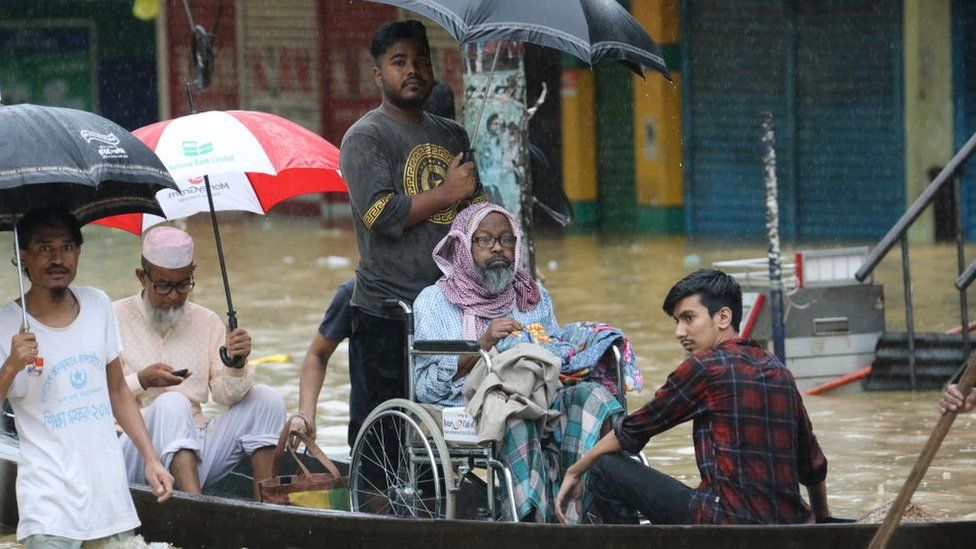
    At least 59 people are known to have died in lightning strikes and landslides triggered by severe monsoon storms in India and Bangladesh.

    Millions of people have been stranded while emergency workers have struggled to reach those affected.

    Forecasters are warning that the flooding is expected to get worse over the next few days.

    Bangladesh government officials have described the recent flooding as the country’s worst since 2004.

    Unrelenting rains over the last week have inundated vast swathes of the country’s north-east region, exacerbated by runoff from heavy downpours across mountains in neighbouring India.

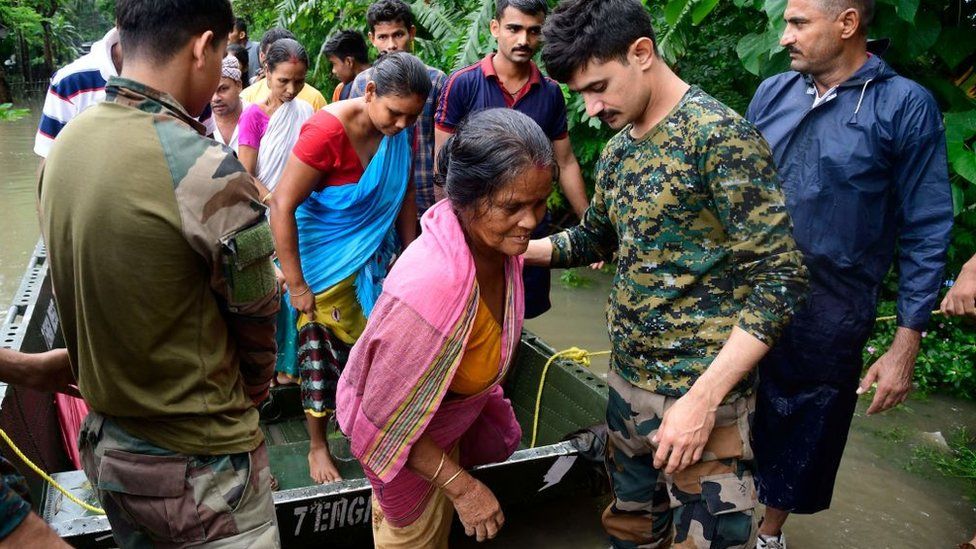
    Schools have been converted into makeshift shelters and troops have been deployed to evacuate households cut off from neighbouring communities as a result of rising waters.

    People try to survive as monsoon rains swamped huge areas of the country, leaving millions of homes underwater in Sylhet, Bangladesh on June 18, 2022.
    IMAGE SOURCE,GETTY IMAGES Image caption, Bangladesh government officials have described the floods as the country’s worst since 2004

    “The whole village went under water by early Friday and we all got stranded,” Lokman, whose family lives in Companiganj village in Bangladesh, told AFP news agency.

    “After waiting a whole day on the roof of our home, a neighbour rescued us with a makeshift boat. My mother said she has never seen such floods in her entire life,” the 23-year-old added.

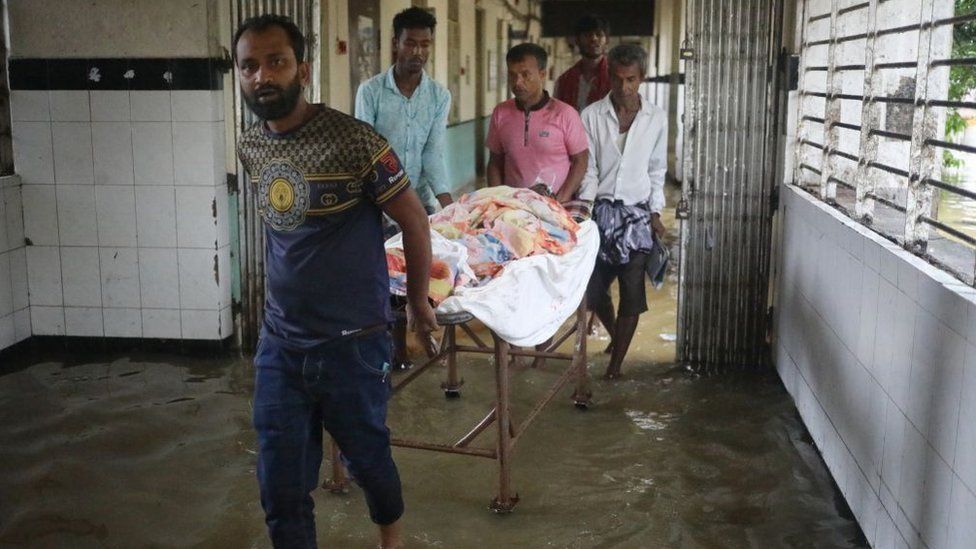
    A patient is taken to upstairs as flood water enter inside Sylhet Osmani Medical College Hospital in Sylhet, Bangladesh on June 18, 2022.
    IMAGE SOURCE,GETTY IMAGES Image caption, A patient is moved to a higher floor as flood waters enter a hospital in Sylhet, Bangladesh

    In Assam state in neighbouring India, more than 1.8 million people have been affected by floods after five days of incessant downpours.

    Assam Chief Minister Himanta Biswa Sarma told reporters he had instructed district officials to provide “all necessary help and relief” to those caught in the flooding.

    “Our house is submerged in water. I’ve never seen such huge floods in my life,” Husna Begum, a resident of Udiana village in Assam, told the BBC.

    The 28-year-old has been living in a rickety plastic tent with her children since Thursday. “There is no drinking water in the camp here. My son has a fever but I am unable to take him to the doctor,” she said.

    Ronju Chaudhary, who lives in the same village, described the scale of the flooding. “We are surrounded by water on all sides. There’s water inside our homes too,” he said.

    Army soldiers evacuate flood-affected villagers following heavy monsoon rainfalls in Rangia of Kamrup district, in India's Assam state on June 18, 2022.
    IMAGE SOURCE,GETTY IMAGES Image caption, Army soldiers evacuated flood victims following heavy monsoon rainfall in India’s Assam state

    This week’s rains come as Bangladesh’s Sylhet region was still recovering from its worst floods in nearly two decades in late May, when at least 10 people were killed and four million others were affected.

    Syed Rafiqul Haque, a former lawmaker, said Bangladesh was at risk of a humanitarian crisis with “almost the entire Sylhet-Sunamganj belt.. under water and millions of people… stranded”.

    Some 3.1 million people were displaced in the region, officials said, with 200,000 of them now being housed in makeshift shelters on higher ground.

    Seasonal monsoon rains represent a lifeline for farmers across South Asia, but typically cause deaths and destruction to property every year. Bangladesh and India have both experienced increasingly extreme weather in recent years.

    Environmentalists – while not ascribing single weather events to climate change – do warn it could lead to more disasters, especially in countries that are low-lying and densely populated.

    Source: BBC

  • Ukraine war: Russia becomes China’s biggest oil supplier

    Russia has become China’s biggest supplier of oil as the country sold discounted crude to Beijing amid sanctions over the Ukraine war.

    Imports of Russian oil rose by 55% from a year earlier to a record level in May, displacing Saudi Arabia as China’s biggest provider.

    China has ramped up purchases of Russian oil despite demand dampened by Covid curbs and a slowing economy.

    In February, China and Russia declared their friendship had “no limits”.

    And Chinese companies, including state refining giant Sinopec and state-run Zhenhua Oil, have increased their purchases of Russian crude in recent months after being offered heavy discounts as buyers in Europe and the US shunned Russian energy in line with sanctions over its war on Ukraine.

    The imports into China, which include supplies pumped through the East Siberia Pacific Ocean pipeline and shipments by sea, totalled nearly 8.42m tonnes last month, according to data from the Chinese General Administration of Customs.

    That pushed Saudi Arabia – formerly China’s biggest source of crude oil – into second place with 7.82m tonnes.

    In March, the US and UK said they would ban Russian oil, while the European Union has been working towards ending its reliance on Russian gas, as the West steps up the economic response to the invasion of Ukraine.

    At the time, US President Joe Biden said the move targeted “the main artery of Russia’s economy”.

    Energy exports are a vital source of revenue for Russia but the move is also likely to impact Western consumers.

    Last week, a report by the Centre for Research on Energy and Clean Air think tank said Russia earned almost $100bn (£82bn) in revenue from fossil fuel exports in the first 100 days of the country’s invasion of Ukraine, despite a fall in exports in May.

    The European Union made up 61% of these imports, worth approximately $59bn.

    Overall, exports of Russian oil and gas are falling and Moscow’s revenue from energy sales has also declined from a peak of well over $1bn a day in March.

    But revenues still exceeded the cost of the Ukraine war during the first 100 days – with the CREA estimating that Russia is spending around $876m per day on the invasion.

    Monday’s figures also showed that China imported 260,000 tonnes of Iranian crude oil last month, its third shipment of Iran oil since last December.

    China has continued to buy Iranian oil despite US sanctions on Tehran.

    Source: BBC

  • French elections: Macron loses majority as French vote fragments

    Less than two months after he was re-elected president, Emmanuel Macron has lost control of the French National Assembly following a strong performance by a left alliance and the far right.

    He had called on voters to deliver a solid majority.

    But his centrist coalition lost dozens of seats in an election that has left French politics fragmented.

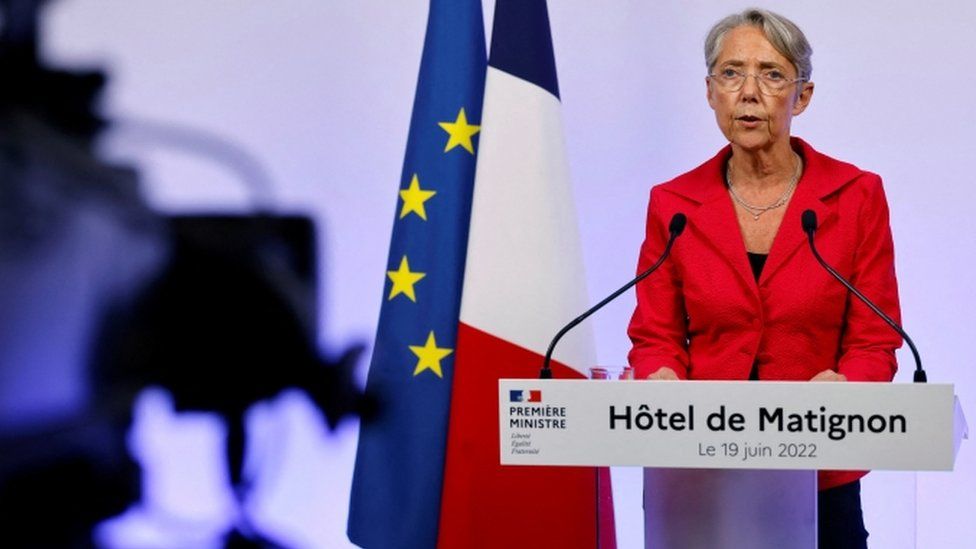
    The prime minister he had only recently appointed, Elisabeth Borne, said the situation was unprecedented.

    A storm broke over Paris as she returned to her Matignon residence from a long meeting at the presidential Élysée palace to say that modern France had never seen a National Assembly like this one.

    “This situation represents a risk for our country, given the risks we’re facing nationally and internationally,” she said. “We will work as of tomorrow to build a working majority.”

    That seems a stretch when the two other biggest groups in the Assembly are not remotely interested in collaboration. Economy Minister Bruno Le Maire was adamant that France was not ungovernable, but said it was going to require a lot of imagination.

    France"s Prime Minister Elisabeth Borne gives a speech after the first results on Sunday
    IMAGE SOURCE,REUTERS Image caption, The French prime minister said her government would draw the consequences from the result

    Far-left leader Jean-Luc Mélenchon was enjoying his success in bringing together mainstream parties from the left with Communists and Greens into an alliance called Nupes.

    He told supporters that the presidential party had suffered a total rout and every possibility was now in their hands. His alliance now becomes the biggest opposition force in France, although opinion polls had indicated they could have performed even better.

    Meanwhile, Marine Le Pen and her far-right National Rally party were also in jubilant mood after turning eight seats into 89. The people had spoken, she said: Emmanuel’s Macron’s adventure was over and he had been consigned to a minority government. Spokeswoman Laure Lavalette said the National Assembly now better reflected the views of French voters and her party would engage in “constructive opposition”.

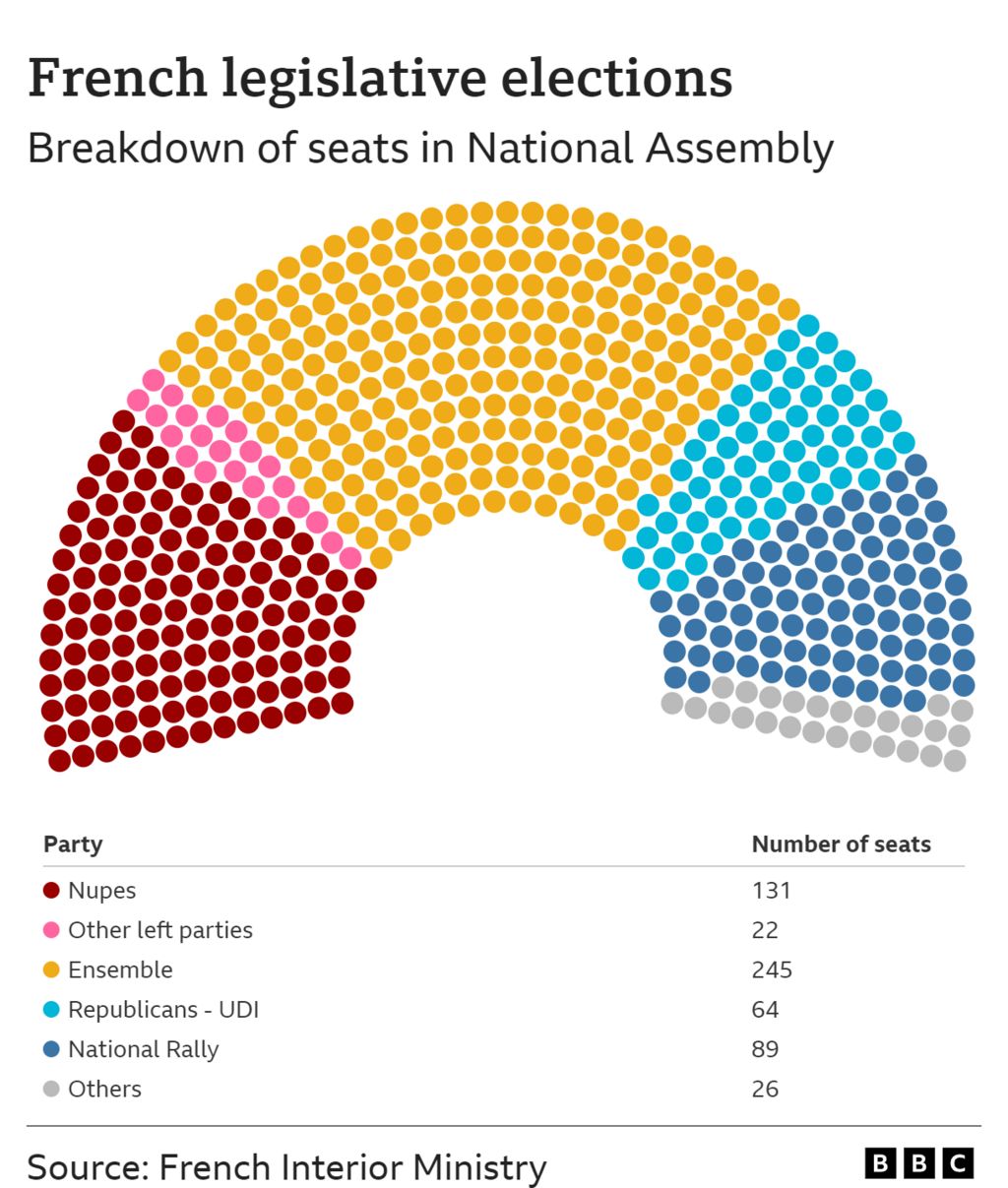
    French election result
    1px transparent line

    If the prime minister was looking to the right-wing Republicans to help build a working majority, their message was not immediately encouraging. Party chairman Christian Jacob said the result was a “stinging failure” for a president now paying for cynically weaponising France’s extremes.

    He’s not Jupiter any more, said Dominique Rousseau, professor of constitutional law, referring to an earlier nickname ridiculing Mr Macron’s supposed desire for power.

    “For Mr Macron these five years will be all about negotiations and parliamentary compromise,” he told AFP.

    Monday’s newspaper headlines ranged from a “slap” for Macron to a political “earthquake”, with fears of political paralysis and of France being “ungovernable”.

    It was all so different in April, when he defeated Marine Le Pen convincingly and won a second term as president. He had more than 300 seats, but to maintain his outright majority he needed 289 – and fell well short with 245.

    More than half of voters abstained, with a turnout of 46.23%. Young voters in particular were turned off by France’s fourth round of national elections since April.

    Among the ministers to lose their seats was Health Minister Brigitte Bourguignon, who lost to her far-right opponent by just 56 votes. Green Transition Minister Amélie de Montchalin was also defeated, but another key figure, Europe Minister Clément Beaune, survived despite losing in the first round.

    One of Mr Macron’s closest allies, the president of the Assembly Richard Ferrand, conceded victory to his Nupes rival Mélanie Thomin. Another casualty came on the Caribbean island of Guadeloupe, where a secretary of state, Justine Benin, lost her seat.

    In a rousing speech to his supporters, Mr Mélenchon said the result marked the moral failure of “Macronie”, accusing the ruling party of enabling the far right by refusing to give clear guidance in seats where the left was running head to head with Marine Le Pen’s party.

    In a tacit admission that he was unlikely to achieve his ambition of prime minister, the far-left leader said he was now changing his role in battle: “My commitment is and will remain at the front of your ranks until my final breath if you want.”

    But as he was not running for a seat, he will not feature in the National Assembly.

    Five years ago, Emmanuel Macron harnessed a wave of optimism, bringing in a fresh cohort of MPs from civil society. The new faces this time have emerged from Nupes and the National Rally.

    Among the MPs elected for Nupes, which stands for New Ecological and Social Popular Union, is a hotel chambermaid who led her colleagues in a fight for better pay and conditions.

    Rachel Keke had vowed to dance in the Assembly if she succeeded in defeating a former sports minister. “This will give other chamber-maids the confidence not to undervalue themselves,” she told French radio.

    Which reforms are at risk?

    President Macron has promised to tackle the cost of living crisis, but his rivals have very different ideas on how to go about it. His big-ticket proposals were reforming benefits, cutting taxes and raising the retirement age gradually from 62 to 65.

    His pension age reform will be particularly hard to get through, although he will attract support from the Republicans.

    Then there are proposals to move towards carbon neutrality and full employment. And he recently offered a “new method” of governing with greater involvement from civil society, proposing a National Council for Refoundation made up of local people to make France more democratic.

    Source: BBC

  • Government withdraws Tax Exemptions Bill from Parliament

    The government has withdrawn the Tax Exemptions Bill 2021 laid in Parliament in November last year, according to the Ghana News Agency.

    Although the Bill has been withdrawn, Deputy Finance Minister, John Kumah, will in the coming days re-lay it before the House for approval.

    The Tax Exemptions Bill was announced by the government in the 2017 Budget Statement and Economic Policy. 

    Attempts to have it approved in 2020 were unsuccessful as the 7th Parliament got dissolved before the approval processes were concluded.

    On November 16, 2021, the Tax Exemption Bill 2021 was laid in Parliament by Minister for Parliamentary Affairs and Majority leader, Osei Kyei-Mensah-Bonsu, on behalf of Finance Minister Ken Ofori-Atta.

    Second Deputy Speaker, Andrew Amoako Asiamah, then referred the bill to the Finance Committee for consideration and report.

    The Bill is to regulate government approval of tax exemption for companies and related matters.

    To encourage private investment, a number of tax exemptions are provided to foreign and national companies by the government after the companies first apply to the Finance Ministry.

    But it is reported that the state loses huge amounts of money doing so.

    The Deputy Finance Minister revealed that in 2011, tax exemption cost the country about US$ 2.4 billion, 6.13 percent of Gross Domestic Product (GDP).

    “Failure to take action on exemptions is therefore costing the nation dearly and prompting the resort to tax hikes to plug revenue shortfalls,” he said.

    GNA reports that the International Monetary Fund indicated that Ghana,  in 2013, lost 5.2 percent of its GDP to tax expenditures amounting to USD$ 2.5 billion.

    The bill when approved is expected to address these challenges being faced by the country.

    Meanwhile, a senior lecturer at the University of Ghana Business School, Prof Godfred Bokpin, has urged the government to speed up the passage of the tax exemptions bill.

    “The biggest threat to our revenue mobilisation is tax exemption. In less than 15 years… Ghana has given away about half of its revenue base through exemptions; for me, it is the biggest leak in our economic structures,” he was quoted by asaaseradio.com.

    Source: The Independent Ghana

  • Why a Rwandan sports reporter fled his home

    Covering sports in Rwanda, which is hosting the Commonwealth heads of state gathering this week, is normally considered one of the safest beats for journalists, but for Prudence Nsengumukiza the constant fear of displeasing someone in power became too much.

    After finishing a one-month journalism residency with the Royal Museum for Central Africa in Belgium last year, the 33-year-old stayed on as an asylum seeker in the former colonial power.

    It was not a decision he took lightly – as he is now afraid he will be hunted down by agents of President Paul Kagame’s government, which has been known to target critics abroad.

    When we speak, he does not want to reveal too much about his location.

    “You know how security services from Kigali work. They have people everywhere. I can tell you where I am now and the same day they can get to me,” he laughs nervously.

    He now works for a diaspora-run website critical of the government, one of about a dozen websites blocked in Rwanda.

    A local site linked to the government has since accused him of “cowardice” and “making a living by tarnishing the country that gave you milk”, warning “it is also a betrayal and nobody betrays Rwanda and gets lucky”.

    The sports presenter had worked at a pro-government media firm, one of whose shareholders, staff believe, is the military.

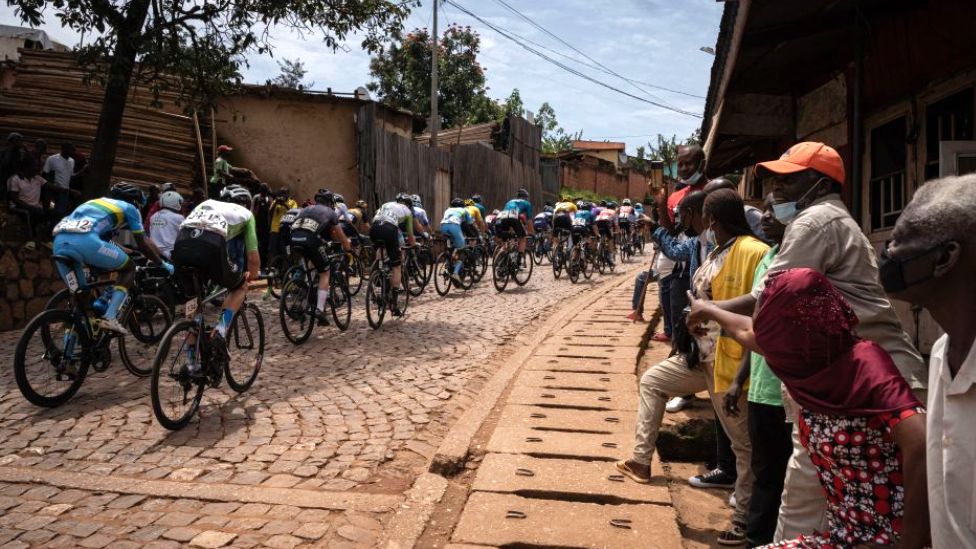
    Residents gather to watch cyclists competing during the final stage of the 14th Tour du Rwanda on 27 February 2022 in Kigali, Rwanda
    IMAGE SOURCE,AFP Image caption, Sports coverage dominates the airwaves in Rwanda – this is the last stage of the Tour du Rwanda in February

    He gave an example of how even a football story could get you into trouble.

    In 2019 the army-owned APR FC, record title-holders in the country’s premier league, sacked 16 players over poor performance – something Nsengumukiza wanted to investigate using his legal background as a law graduate.

    “I had intended to interview a lawyer and explore law provisions [for the players]… But the idea was dismissed in the morning editorial meeting, with editors arguing it would not be well received.”

    Campaign group Human Rights Watch has documented how little free speech is tolerated in Rwanda, citing in a recent report that at least eight YouTubers considered to be critical of the government had been prosecuted over the last year.

    This includes a seven-year prison sentence for Dieudonné Niyonsenga, popularly known as “Cyuma Hassan”, who filmed residents as soldiers forcefully expelled them during a slum clearance. One of the charges he faced was the “humiliation of national authorities and persons in charge of public service”.

    His channel Ishema TV, which is no longer available on YouTube, became popular when he covered the funeral in 2020 of gospel singer Kizito Mihigo and noted facial injuries on the corpse.

    This appeared to contradict the official version of the peace and reconciliation activist’s death – that he had taken his own life while in a police cell a few days after being arrested trying to flee the country.

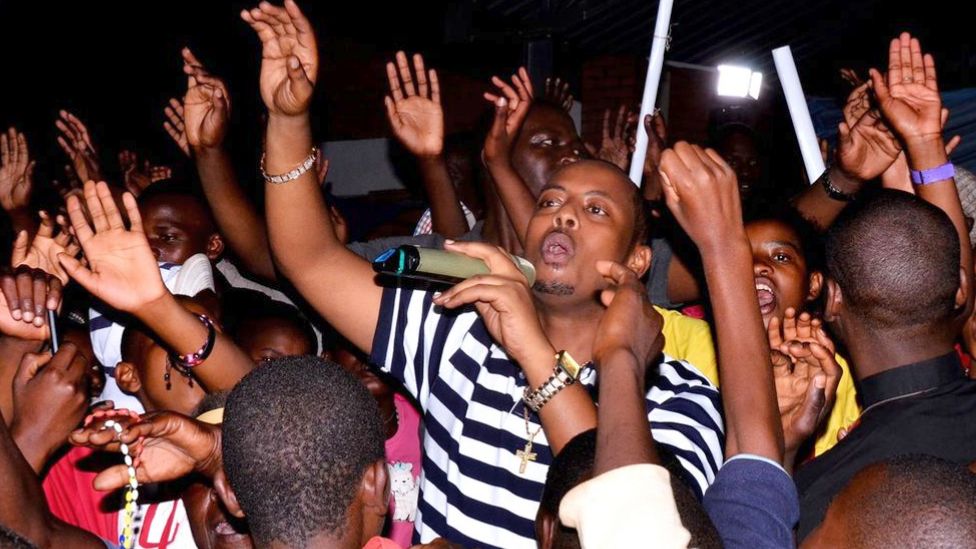
    Kizito Mihigo surrounded by fans
    IMAGE SOURCE,KIZITO MIHIGO PEACE FOUNDATION Image caption, Gospel singer Kizito Mihigo (C) was one of Rwanda’s most popular performers

    Anjan Sundaram’s acclaimed book Bad News reflects this repression, listing some 60 journalists who were physically assaulted, arrested, killed or forced to flee after criticising Rwanda’s government between 1995 and 2014.

    One such journalist is 39-year-old Eleneus Akanga, who used to work for the pro-government New Times newspaper and also filed for the Associated Press and Reuters.

    His journey to becoming a refugee in the UK started in 2007 after some local reporters were roughed up.

    “I sat down with my editor and I said: ‘We need to find out who is beating these people because these journalists were claiming that it was government agents hitting them,’” he told the BBC.

    It was agreed he could report this – but afterwards, the president’s office demanded his dismissal “for apparently authoring a story that sought to put Rwanda in disrepute with its development partners”.

    After getting the sack, Akanga tried to set up a regional newspaper, the Weekly Post, but its maiden issue was confiscated and its licence revoked. A friend tipped him off that his arrest was imminent – on suspicion of being a spy – and he managed to flee. Fifteen years on, he is now a British national and lawyer.

    “To be fair I haven’t had any specific threats in the UK. But I still take precautions if I have to and… avoid some of the areas that I feel have been taken over by some Rwandan agents.”

    And he fails to grasp why the UK – the country that took him in as an asylum seeker – is sending those in need of support to a place with a noted poor human rights record, under the controversial Rwanda asylum plan.

    “I think it’s a bizarre policy. I know how scary it can be when you are really fleeing somewhere and hoping to get some sort of refuge in a country that you’ve selected.”

    The Rwandan government insists the agreement with the UK offers a solution to illegal migration, giving people safety and opportunities.

    It also consistently dismisses concerns over its human rights record, saying no-one can lecture Rwanda on the topic, adding it has fair and transparent systems – and has never officially commented on the cases of Nsengumukiza and Akanga.

    Commonwealth urged to act

    For Belgian political scientist Prof Filip Reyntjens, one of the leading experts on the Great Lakes region, Nsengumukiza and Akanga’s experiences reflect what he calls the “two Rwandas”.

    One is good at managing foreign aid, cracks down on corruption and performs well on a technocratic level compared with other African nations.

    “But on the other hand… you are faced with unlevel playing fields, [a] de facto one-party state, huge restrictions to freedom of expression and freedom of the press, illegal and arbitrary arrests, disappearances and even persecutions of opponents across Rwandan borders,” he told the BBC.

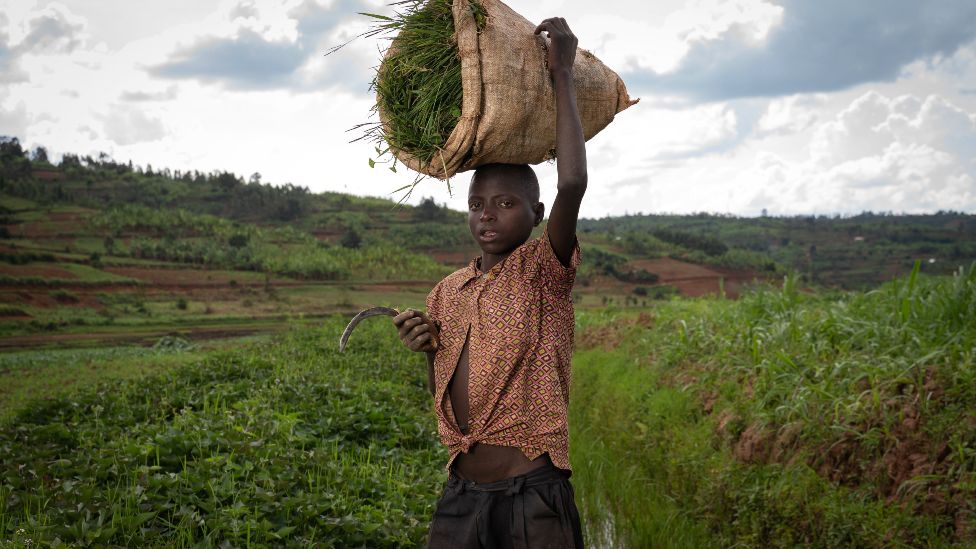
    A 13-year-old boy cutting grass to feed the cows of his parents ,in Rulindo district, northern province of Rwanda - November 2020
    IMAGE SOURCE,AFP Image caption, Agriculture remains the mainstay of Rwanda’s economy

    The first Rwanda is what impresses donor nations, which see it as a success story for its 13 million inhabitants, even though it remains one of the 25 poorest countries in the world.

    Rwanda was allowed to join the Commonwealth in 2009, despite a group set up to defend human rights in member countries voicing concern. It was hoped its membership would bring change.

    “But it has certainly not improved over time. If anything it’s worse today than when Rwanda joined the Commonwealth,” Prof Reyntjens says, citing this year’s report by US-based rights group Freedom House that classifies Rwanda as “not free”, with an overall mark of 22/100.

    In 2014, even BBC Kinyarwanda – which was initially set up in the aftermath of the 1994 genocide as a lifeline service - was banned (and remains off air) on FM following a BBC Two documentary challenging the government’s official version of the genocide.

    The UN refugee agency says there are currently 287,000 Rwandans registered as refugees around the world – though it points out this is just a fraction of those living outside the country.

    Ahead of the Commonwealth Heads of Government Meeting (Chogm), 24 international civil society groups wrote an open letter warning that the Commonwealth’s silence on Rwanda’s human rights record risked undermining the organisation’s human rights mandate.

    The Commonwealth has not commented on this – or responded to BBC requests for comment on why it decided to hold its meeting in Rwanda’s capital, Kigali.

    Prof Reyntjens suggests the international community’s failure to put a stop to the 100-day genocide, when an estimated 800,000 people died, plays a role in this reticence.

    “This feeling of guilt is exploited fully by the regime in Kigali. Each time there is criticism of what is happening in Rwanda, they will say: ‘Where were you in 1994?’”

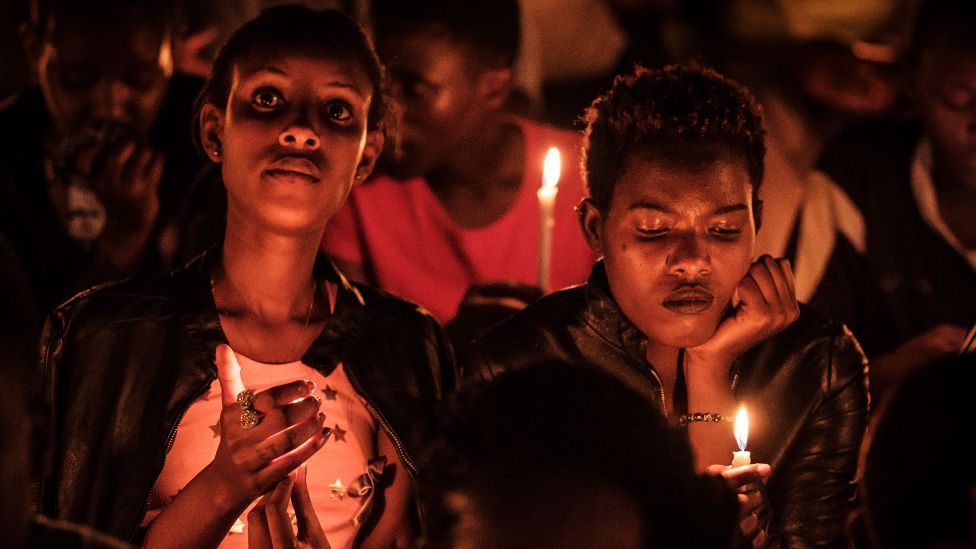
    Women hold candles during a night vigil and prayer at the Amahoro Stadium as part of the 25th commemoration of the 1994 genocide, in Kigali, Rwanda - 7 April 2019
    IMAGE SOURCE,AFP Image caption, Events are held every April to remember those who died in the genocide

    And while the country seems peaceful now, the academic warns that resentment and underlying frustration have slowly been building over the past 25 years.

    According to last week’s Africa Youth Survey, people in Rwanda had the most positive overall view of the 15 countries polled, with 60% of people expressing confidence in the future. However, this still leaves 40% of those interviewed feeling the country was heading in the wrong direction, and more may have felt reluctant to openly criticise the government.

    That is something that Nsengumukiza could not agree with more.

    “I don’t intend to keep silent,” he says. For him Belgium is not home and he would like to return to Rwanda one day – if it becomes safe to do so.

    Source: BBC

  • Moroccans accuse French tycoon Jacques Bouthier of sexual harassment

    Four women in Morocco have filed complaints of sexual harassment against French insurance tycoon Jacques Bouthier.

    Now aged between 26 and 28, they had been employed by his firm in Tangier.

    The women said they had been sacked after refusing to give in to harassment and intimidation.

    The 75-year-old is under formal investigation in France for raping a minor and trafficking. He reportedly says he is the victim of blackmail.

    Considered to be one of France’s richest men, Mr Bouthier resigned as CEO of insurance brokers Vilavi, formerly known as Assu 2000, last month.

    On Friday, the Moroccan Association for the Rights of Victims held a news conference about the allegations alleged to have occurred in Tangier between 2018 until April 2022.

    Some of Mr Bouthier’s alleged victims appeared, wearing face masks and dark glasses to hide their identities, to tell journalists about their experiences.

    “He asked to sleep with me and when I said no, he asked me to introduce him to a sister, a female cousin or a friend, saying he would give me a nice present in exchange,” one is quoted by AFP news agency as saying.

    The women also accused other French and Moroccan executives of involvement.

    “Jacques on his own is not scary, but with his accomplices, above all in Tangier, that’s when he’s scary. So they started to harass me morally, real harassment once again, they pushed me to resign,” another said.

    French police suspect the businessman of keeping up to seven teenagers in a flat over a number of years.

    The French investigation began earlier this year when a 22-year-old woman went to a police station in the capital, Paris, saying she had been held captive by him for five years – forced to provide sex in return for food and lodging.

    Source: BBC

  • French National Assembly vote decides battle between Macron and left

    It’s not even two months since Emmanuel Macron was convincingly re-elected as president but he is already in a crunch election that could prevent him pushing through his reforms.

    French voters are going to the polls to decide who will control their National Assembly.

    Mr Macron beat the far right in April, but this time the challenge is harder.

    Far-left Jean-Luc Mélenchon leads a left-green alliance that finished neck and neck with Macron only a week ago.

    They call themselves Nupes, which stands for New Ecological and Social Popular Union, and the polls suggest they could stop the president winning the 289 seats he needs for an outright majority.

    The centrist Macron alliance, Ensemble, portrays them as a “marriage of convenience” of Communists, Socialists, far-left Mélenchonists and Greens.

    But Nupes have galvanised voters with a promise to fight spiralling prices, bring down the retirement age and tackle climate change.

    Green leaders and many green voters back them, accusing President Macron of doing little in the past five years.

    Sunday’s second round is almost entirely made up of run-off duels between two candidates, and almost half involve the two big alliances.

    Several ministers in the Macron government are battling to keep their seats and hold on to their jobs, and two of the toughest fights involve Europe Minister Clément Beaune and Green Transition Minister Amélie de Montchalin.

    Without an outright majority of 289 seats, Mr Macron will need the support of other parties to push through his big-ticket reforms, such as raising the retirement age, cutting taxes and reforming benefits.

    Pollsters suggest Ensemble will win 255-305 seats and Nupes 140-200.

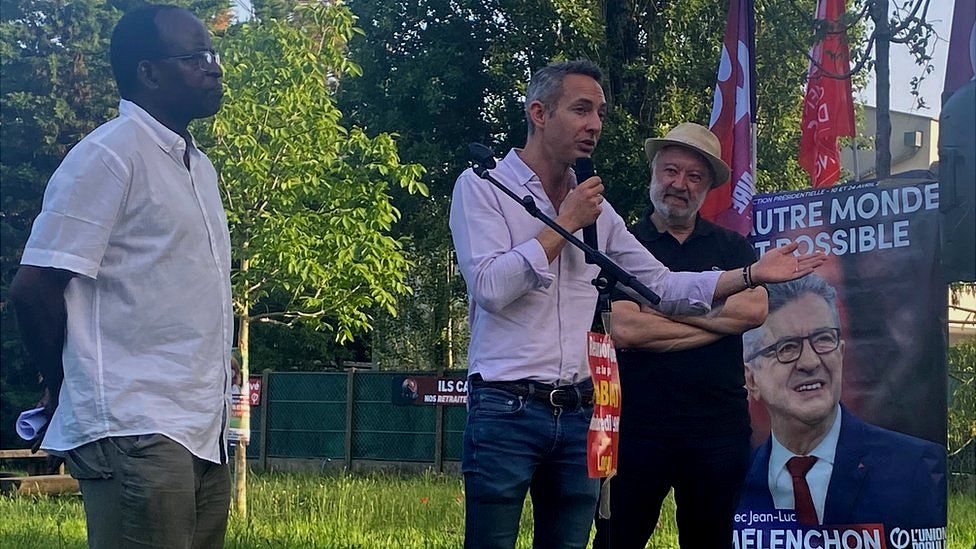
    As the sun went down on the campaign on Friday night, Nupes spokesman Ian Brossat told supporters in Longjumeau south of Paris: “They didn’t think the left and Greens could get together – it would be chaos and catastrophe; but the chaos today is economic, with food prices going up. We’ve got 10 million people in poverty.”

    Ian Brossat in Longjumeau
    Image caption, Ian Brossat (C) said some had tried to paint Nupes as extremist, but there was nothing extreme about their policies
    While fighting for the presidency, Mr Macron rallied voters across the spectrum by presenting his main rival Marine Le Pen as an extremist and contrary to the republic’s values.

    With mainstream parties joining the Mélenchon alliance it has become harder to do that with this rival. President Macron has appealed to voters to give him a solid majority in the “superior interest of the nation”, while Russia’s war rages at the gates of Europe.

    Former Marxist Jean-Luc Mélenchon has long wanted France to leave Nato but says that is now not a priority.

    However, he remains controversial, tweeting that “the police kill” and promising to naturalise Wikileaks founder Julian Assange as French if he wins the election.

    Mr Macron’s recently appointed prime minister, Elisabeth Borne, has painted Mr Mélenchon’s policies as dangerous because he is “ambiguous on republican values”.

    In Longjumeau, first-time voter Clara said she had backed Mr Macron against the far right in April, but this time preferred the left-green alliance.

    The local candidate is only a few points behind the ruling party rival. But in the next-door constituency Amélie de Montchalin trailed in the first round and defeat would mean losing her job as minister.

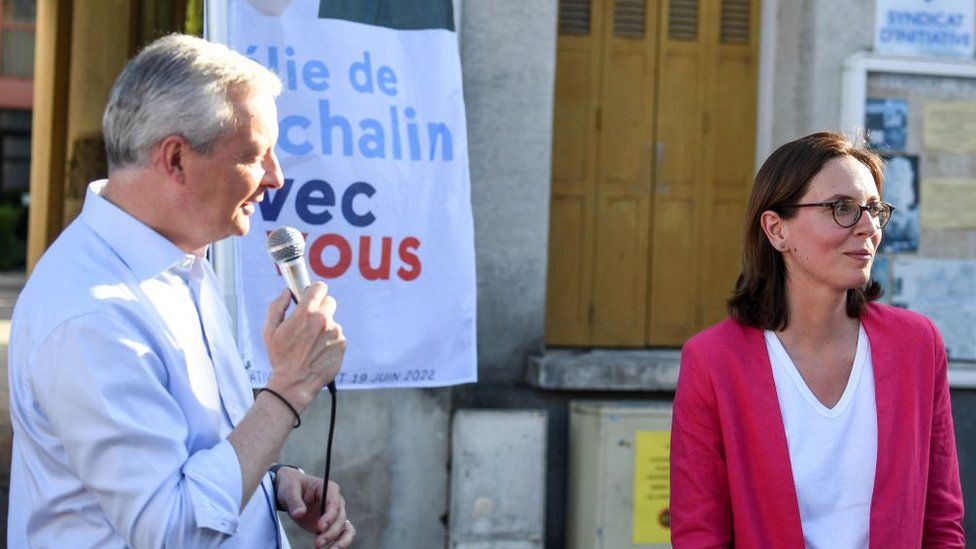
    Bruno Le Maire with Amélie de Montchalin
    IMAGE SOURCE,GETTY IMAGES Image caption, Economy Minister Bruno Le Maire joined the campaign trail to help Amélie de Montchalin ahead of the vote

    The same is true for Clément Beaune, whose opponent in one of the Paris seats is Caroline Mécary, an experienced LGBT rights lawyer.

    Both candidates visited the Aligre market near the Gare de Lyon several times in the run-up to Sunday’s vote, says market vendor Ichem. “People can’t afford much now; they buy less than before,” he observes.

    Visiting the market, Grégoire said he backed the president because he did not want to return to the days of “cohabitation”, when president and government came from different parties: “Yes it used to work before but they weren’t good years.” Jean-Baptiste agreed the president needed a strong mandate: “Without a majority he won’t be able to do anything he needs to do.”

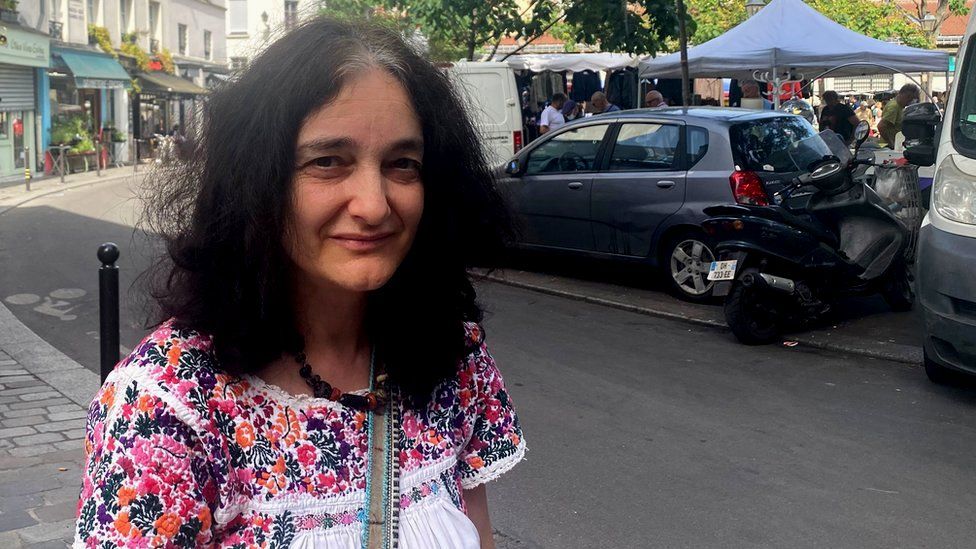
    But Christine believed handing the president an absolute majority was bad for democracy. She backed Emmanuel Macron to keep the far right from the Élysée Palace, but felt having another party in government was good for debate.

    Christine - voter in Paris
    Image caption, Christine wants to see active debate in the National Assembly rather an absolute majority
    Source: BBC
  • Ukraine war could last for years, warns Nato chief

    The West must prepare to continue supporting Ukraine in a war lasting for years, Nato’s chief has warned.

    Secretary-General Jens Stoltenberg said the costs of war were high, but the price of letting Moscow achieve its military goals was even greater.

    His comments came as UK Prime Minister Boris Johnson also warned of the need to brace for a longer-term conflict.

    Both Mr Stoltenberg and Mr Johnson said sending more weapons would make a victory for Ukraine more likely.

    “We must prepare for the fact that it could take years. We must not let up in supporting Ukraine,” the Nato chief said in an interview with German newspaper Bild.

    “Even if the costs are high, not only for military support, also because of rising energy and food prices.”

    The Western military alliance chief said that supplying Ukraine with more modern weapons would increase its chances of being able to liberate the country’s eastern Donbas region, much of which is currently under Russian control.

    For the last few months Russian and Ukrainian forces have battled for control of territory in the country’s east – with Moscow making slow advances in recent weeks.

    Writing in the Sunday Times, British Prime Minister Boris Johnson accused Russia’s Vladimir Putin of resorting to a “campaign of attrition” and “trying to grind down Ukraine by sheer brutality.”

    “I’m afraid we need to steel ourselves for a long war,” he wrote. “Time is the vital factor. Everything will depend on whether Ukraine can strengthen its ability to defend its soil faster than Russia can renew its capacity to attack.”

    The prime minister, who visited Ukraine’s capital on Friday, said supplies of weapons, equipment, ammunition, and training to Kyiv needed to outpace Moscow’s efforts to rearm itself.

    Ukrainian officials have spoken bluntly in recent days about the need to boost the supply of heavy weapons to the country if Russian forces there are to be defeated.

    On Wednesday the country’s Defence Minister, Oleksiy Resnikov, met some 50 countries in the Ukraine Defence Contact Group in Brussels to ask for more arms and ammunition.

    The country’s Western allies have so far offered it major weapons supplies but Ukraine says it has only received a fraction of what it needs to defend itself and is asking for heavier arms.

    Russian officials often criticise Nato military support for Ukraine and in an interview last week with the BBC the country’s Foreign Minister, Sergei Lavrov, cited the prospect of Ukraine joining the Western alliance as a reason for the invasion in the first place.

    “We declared a special military operation because we had absolutely no other way of explaining to the West that dragging Ukraine into Nato was a criminal act,” Mr Lavrov told the BBC.

    Ukraine is not a member of Nato and although it has expressed a wish to join there is no timeframe for this.

    Source: BBC

  • Cape Coast-Twifo Praso road inaccessible Ghana Highways Authority

    The Ministry of Roads and Highways through the Ghana Highway Authority has informed the general public that a section of the Cape Coast-Twifo Praso road can no longer be accessed for the time being.

    This comes after a bridge that links the Cape Coast -Twifo Praso road in the Central region caved in on Saturday.

    In a press release dated June 18, the Authority indicated that the “recent heavy downpour resulted in a bridge washout that led to a cut off at Jukwa.”

    According to the Ghana Highway Authority, it has taken the necessary steps to ensure that the part of the road will be “reinstated as soon as practicable.”

    http://backend.theindependentghana.com/2022/06/bridge-connecting-cape-coast-twifo-praso-road-caves-in/

    In the meantime, motorists have been advised to ply the Cape Coast-Yamoransa (N1) -Assin Fosu-Twifo Praso (N8) Road.

    “We apologize sincerely for any inconvenience caused”, the Authority wrote to affected persons.

    It is reported that after the bridge caved in, buildings close to the site were flooded and vehicles were washed away.

    Officials of the National Disaster Management Organization (NADMO) have also been at the scene to assess the extent of the damage caused.

    So far, no casualties have been recorded. 

    Cape Coast-Twifo Praso road inaccessible - Ghana Highways Authority


    Source: The Independent Ghana

  • GACL confirms death of male passenger who arrived from the US on Friday

    The Management of the Ghana Airports Company Limited (GACL) has confirmed that a middle-aged male passenger who arrived from the US has passed on.

    The deceased arrived at the Kotoka International Airport on board United Airlines from Dulles International Airport, Washington in the company of relations.

    In a statement dated June 18, 2022, the GACL said “the passenger was reported to have complained of tiredness and had difficulty in breathing. He was subsequently offered a wheelchair by the ground handler.

    The passenger became unconscious at the arrival hall and received medical attention, but was unresponsive. He was conveyed to the Airport Clinic for attention and he subsequently passed on. In line with protocols, the Airport Police Station was immediately informed.”

    GACL confirms death of male passenger who arrived from the US on Friday

    The statement noted that, “Ghana Airports company limited has commenced an investigation into the incident.”

    The GACL, extended “its deepest condolences to the bereaved family.”

    Source: MyJoyOnline

  • Afghanistan: Deadly explosion rocks Sikh site in Kabul

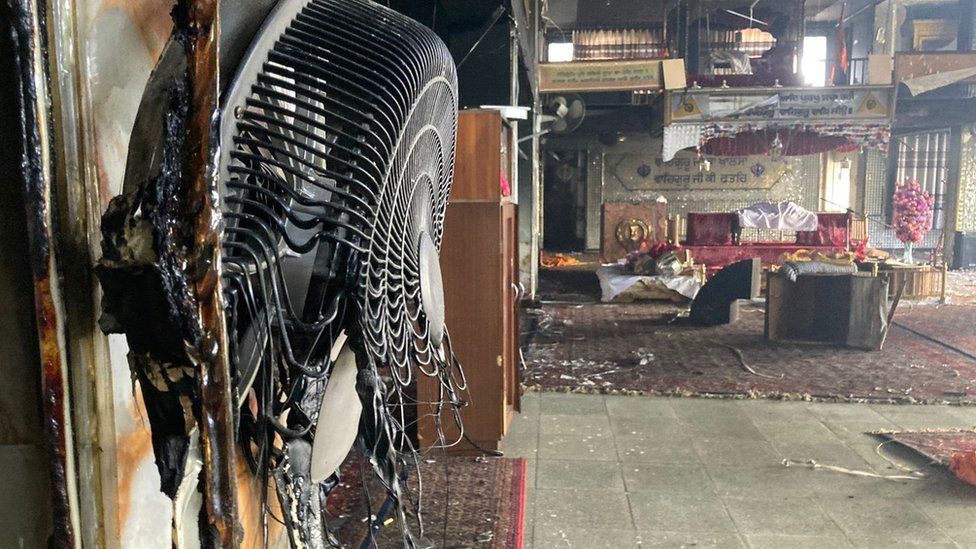
    An assault on a Sikh prayer site in Afghanistan has left one worshipper and a Taliban member dead as well as the unidentified attackers.

    The site in the capital Kabul was hit by a bomb early in the morning when up to 30 people were inside.

    It is the last remaining Sikh place of worship, or Gurdwara, in the capital.

    Community leaders recently estimated that just 140 Sikhs remained in predominantly Muslim Afghanistan, down from 100,000 in the 1970s.

    India, which is home to most of the world’s Sikh population, said it was “deeply concerned” at news of the attack.

    A local official at the scene, Gornam Singh, told Reuters news agency that the Taliban were not allowing Sikhs to enter the site after the attack.

    Scene inside the Gurdwara in Kabul after the attack
    IMAGE SOURCE,MALIK MUDASSIR/BBC Image caption, The attackers reportedly initially used hand grenades to try and enter the compound of the Gurdwara

    TV footage showed grey plumes of smoke rising from the area.

    A Taliban spokesman told Reuters news agency the attackers had attempted to drive a car laden with explosives into the area but they detonated before they reached their target.

    The Taliban, which took control of Afghanistan last year, said a clearance operation was still under way although the attack had ended.

    The BBC’s Secunder Kermani was interviewing relatives of victims outside a hospital when two Taliban militants stopped his crew, trying to delete their footage.

    Since the Taliban took power, the country has seen continuing attacks by rival Sunni Muslim militant group Islamic State:

    • In April, a bomb attack killed 31 people and injured 87 at a Shia Muslim mosque in the city of Mazar-i-Sharif
    • In December, an assault on a military hospital in Kabul killed more than 20 people and injured 16

    Source: BBC

  • UK asylum plan defended by Rwandan Anglican archbishop

    Rwanda’s Anglican Archbishop says he disagrees with senior Church of England leaders over the UK’s asylum plan.

    Earlier this week, they had said the policy to remove asylum seekers to Rwanda “shames Britain”.

    But Archbishop Laurent Mbanda said it was not immoral and Rwanda was ready to welcome people needing a home.

    He said many Rwandans had lived in exile because of the genocide in the 1990s, so they understood the issues faced by people fleeing their homes.

    Under the terms of the five-year deal, Rwanda becomes responsible for the asylum seekers who had travelled to the UK. They will be accommodated and supported while their claim is processed – and if granted permanent refugee status, will remain in Rwanda.

    If unsuccessful, they will be offered the chance to apply for other immigration routes, but could face removal from the country.

    So far no-one has been sent to Rwanda from the UK. A flight that was due to take asylum seekers was cancelled before take-off, following a last-minute intervention by the European Court of Human Rights (ECHR).

    The Anglican Churches in Africa have an increasingly tense relationship with their mother church over Biblical interpretations of issues like same-sex marriage.

    Archbishop Mbanda says he believes that as colonial days are over, the African churches have to think and speak for themselves.

    The Anglican Church, the cleric says, is led by one among equals, and that it is time for the African churches to challenge their mother church, not waiting for the Archbishop of Canterbury to tell them what to do.

    During his Easter sermon at Canterbury Cathedral, the Most Reverend Justin Welby had suggested the UK’s asylum plan was “ungodly”.

    This was followed by a joint letter signed by the UK Anglican bishops, which said the country could not outsource its ethical responsibilities.

    It was published in the UK’s Times newspaper on Tuesday – the day the first flight to Rwanda was cancelled.

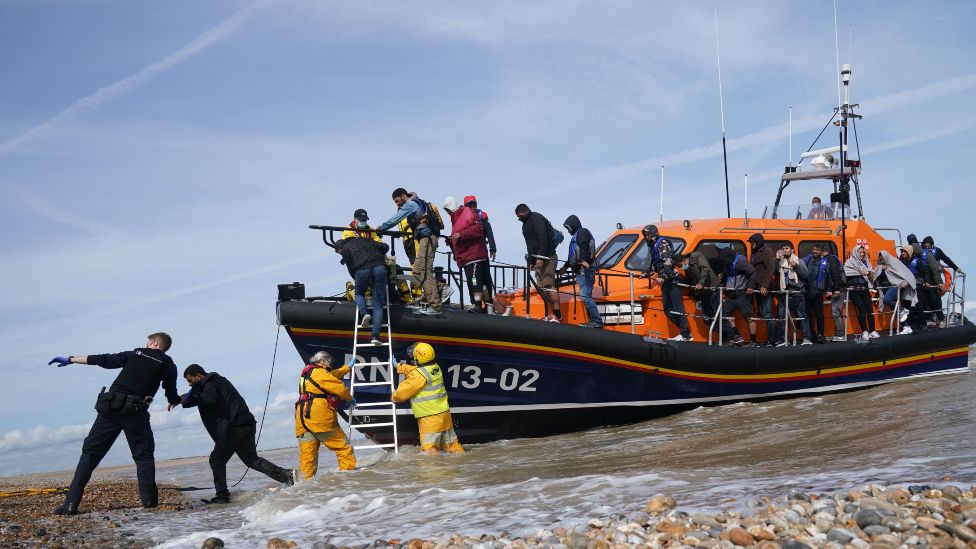
    Migrants helped off a lifeboat by RNLI crew and UK Immigration Enforcement officers in Kent - 2021
    IMAGE SOURCE,PA MEDIA Image caption, The bishops said those to be removed to Rwanda have had no chance to appeal, or reunite with family in the UK

    But Archbishop Mbanda says accepting the asylum seekers in Rwanda will help alleviate a global crisis and the whole issue of migration and people without a home.

    He said that was not a burden of one person but a burden that countries should share.

    Having spent most of his life as a refugee before returning to Rwanda to live, the archbishop says he knows what it is like to be without a home.

    The asylum plan has also been privately criticised by Prince Charles, according to reports last week in the Times and Daily Mail.

    The heir to the British throne is to travel to Rwanda’s capital, Kigali, next week for a big Commonwealth gathering.

    Ahead of the meeting, Amnesty International has urged the Commonwealth leaders to remind the UK about its international responsibility under the Refugee Convention.

    “Commonwealth leaders must take a firm and clear stance to force the UK government to rescind its misguided, cruel and racist policy that shifts its responsibility towards refugees and asylum seekers to Rwanda,” the rights group said.

    Source: BBC

  • Europe heatwave: Outdoor events banned in parts of France

    Outdoor public events have been banned in an area of France as a record breaking heatwave sweeps across Europe.

    Concerts and large public gatherings have been called off in the Gironde department around Bordeaux.

    On Thursday, parts of France hit 40C earlier in the year than ever before, with temperatures expected to peak on Saturday.

    Scientists say periods of intense heat are becoming more frequent and longer lasting as a result of global warming.

    Spain, Italy and the UK are also experiencing high temperatures.

    In Gironde, officials said public events, including some of the official 18 June Resistance celebrations, will be prohibited from Friday at 14:00 (12:00 GMT) “until the end of the heat wave”. Indoor events at venues without air-conditioning are also banned.

    Private celebrations, such as weddings, will still be allowed.

    “Everyone now faces a health risk”, local official Fabienne Buccio told France Bleu radio.

    The French interior ministry warned people to be extremely careful and not expose themselves to the weather.

    State forecaster Meteo France said it was the earliest hot spell ever to hit the country, which has been caused by a mass of hot air moving from north Africa.

    A festival goer cools down with fresh water while taking part in the Hellfest metal music festival on June 17, 2022 in Clisson
    IMAGE SOURCE,GETTY IMAGES Image caption, Outdoor events continued in other areas of France – this man cooled down at a music festival in Clisson
    This photograph taken on June 17, 2022 shows a pharmacy sign displays the temperature of 44 Celsius degrees in the city of Montpellier in France
    IMAGE SOURCE,GETTY IMAGES Image caption, Temperatures have reached 44C in Montpellier in France

    Temperatures could hit 39C in Paris and droughts have also raised the risk of wildfires, the forecaster said.

    “I’m 86 years old, I was born here, but I think this is the worst heatwave I’ve ever seen,” Jacqueline Bonnaud told the AFP news agency in the southern city of Toulouse.

    The increased use of air-conditioners and fans was forcing France to import electricity from neighbouring countries, grid operator RTE said.

    Forest fires in Catalonia
    IMAGE SOURCE,AFP VIA GETTY IMAGES Image caption, There have been forest fires in Catalonia

    In Spain, which has just experienced its hottest May since the beginning of the century, temperatures are forecast to hit highs of 43C this weekend, the Aemet weather service said.

    There have been forest fires in Catalonia, including one which could grow to 20,000 hectares before it’s contained, the regional government said.

    Water is so low in large stretches of Italy’s largest river, the Po, that locals can walk through the middle of the expanse of sand and wartime shipwrecks are resurfacing.

    In the UK, temperatures are expected to reach 33C in southern England, while a level three heat-health alert has been issued for London.

    The river bed of the Po in Boretto, Italy, has dried up
    IMAGE SOURCE,AFP VIA GETTY IMAGES Image caption, The river bed of the Po in Italy has dried up

    Extreme heat isn’t confined to Europe this week.

    On Wednesday a third of the entire population of the United States were advised to stay indoors due to record temperatures. In India, Delhi has recorded a maximum temperature of at least 42C on 25 days this summer, the India Meteorological Department reported.

    Climate change is causing global temperatures to rise. Greenhouse gases, like carbon dioxide, released into Earth’s atmosphere in large volumes are trapping the sun’s heat, causing the planet to warm.

    This has brought more extreme weather, including record-breaking high temperatures across the world.

    Source: BBC

  • National Cathedral now a state-owned project – National Cathedral Director

    The Executive Director of the National Cathedral, Dr. Paul Opoku-Mensah, says the national cathedral can no longer be classified as a private project.

    According to Dr. Paul Opoku-Mensah, the national cathedral project is currently a state-owned project as it has now been incorporated under Ghana’s Companies Act, 1963 (Act 179).

    The project was incorporated under Ghana’s Companies Act, 1963 (Act 179) on Thursday, July 18, 2019.

    He made the revelation in a press statement dated Friday, June 17.

    “For the avoidance of doubt, the National Cathedral is a National Monument, and thus public, not private, project. Legally, the National Cathedral of Ghana is a state-owned company limited by guarantee and was incorporated under the Companies Act, 1963 (Act 179) on July 18, 2019.

    “We hope this brings to a closure the seemingly vexatious issue of whether the National Cathedral is a private or public initiative. The National Cathedral is a National Monument and Asset, and not a Private project.”

    The Executive Director, however, stated that the project is being developed in partnership between the state and the church.

    http://backend.theindependentghana.com/2022/06/mensa-otabil-hasnt-been-a-member-of-board-of-trustees-since-2019-executive-director-of-national-cathedral/

    Earlier, President Akufo-Addo stated that the national cathedral was a private project he was undertaking in fulfilment of a promise he made to God Almighty while in opposition.

    Recent revelations by the Member of Parliament for North Tongu, Samuel Okudzeto Ablakwa indicated that state funds have been used by the current government to construct the cathedral.

    Mr Ablakwa stated that close to GH¢200 million from state coffers has been spent by the government.

    But Dr. Paul Opoku-Mensah explained that Ghana will in the long run benefit from the project therefore the need to have it as a state facility despite it serving as “gesture of thanksgiving, symbol of the Christian presence and contributions to the nation, and a personal pledge to God.”

    He indicated that the project presents a model that would help in managing the country’s monuments.

    “The Cathedral and Museum will also serve as a convening platform for National, African, and Global conversations on the role of faith and national transformation. The addition of an economic engine to this national monument consisting of multiple revenue sources, including multipurpose rental spaces, 1000+ seater banquet hall. A 350-seater restaurant Cafe, shop, theaters, conference hall, etc, introduces a sustainable model for managing our national monuments.”

    Mensa Otabil excused himself, he did not resign  Executive Director of National Cathedral

    Mensa Otabil excused himself, he did not resign  Executive Director of National Cathedral

    Source: The Independent Ghana

  • UK PM warns of ‘Ukraine fatigue’

    UK Prime Minister Boris Johnson has been speaking after returning from a surprise visit to Kyiv on Friday.

    He says it is important Britain continues to show it is supporting Ukraine, while warning of a risk of “Ukraine fatigue” setting in around the world as the war drags on.

    “The Russians are grinding forward inch by inch and it’s vital for us to show what we know to be true which is that Ukraine can win and will win,” Johnson tells reporters.

    “When Ukraine fatigue is setting in, it’s very important to show that we are with them for the long haul and we are giving them the strategic resilience that they need,” Johnson says.

    It would be a “catastrophe” if Russian President Vladimir Putin was able to secure cities in the south of Ukraine and the Donbas, he adds.

    The prime minister also says he wants to make it clear that the UK is supporting the Ukrainians in their ambition to expel the Russians from everything that Putin has obtained since 24 February.

    Source: BBC

  • Ukrainian medic freed from Russian captivity – Zelensky

    On Friday, Ukrainian President Volodymyr Zelensky announced that prominent paramedic Yuliya Payevska, aka Tayra, had been freed from Russian captivity.

    In a video posted on Telegram, he said: “I can announce today that we managed to free from captivity Tayra – Ukrainian paramedic Yuliya Payevska. I am grateful to all who worked to achieve this result. Tayra is already home. We will go on working to bring everybody back.”

    Payevska was captured by Russian forces together with her driver in Mariupol in mid-March, where she’d been working as a paramedic, helping to evacuate injured soldiers and civilians.

    Her husband believes she was taken to Russia. A propaganda video featuring her was carried by some pro-Kremlin Russian TV channels.

    News of her release was welcomed by many Ukrainian commentators:

    “It’s hard to imagine what Tayra has been through, but it’s so great that she is alive and home!” film director Iryna Tsilyk said.

    Source: BBC

  • Monkeypox to get a new name, says WHO

    The World Health Organization says it is working with experts to come up with a new name for monkeypox.

    It comes after more than 30 scientists wrote last week about the “urgent need for a non-discriminatory and non-stigmatising” name for the virus and the disease it causes.

    Continued reference to the virus as African is both inaccurate and discriminatory, they said.

    Some 1,600 cases of the disease have been recorded globally in recent weeks.

    While 72 deaths have been reported in countries where monkeypox was already endemic, none have been seen in the newly affected 32 countries, such as the UK.

    At the latest count, as of 12 June, there were 452 confirmed cases in England, 12 in Scotland, 2 in Northern Ireland and 4 in Wales.

    The World Health Organization says it will hold an emergency meeting next week to determine whether to classify the outbreak as a public health emergency of international concern – the highest alarm the UN agency can sound.

    The only other diseases this has happened for in the past are Swine flu, polio, Ebola, Zika and Covid.

    World Health Organization chief Tedros Adhanom Ghebreyesus said: “The outbreak of monkeypox is unusual and concerning.

    “For that reason I have decided to convene the Emergency Committee under the international health regulations next week, to assess whether this outbreak represents a public health emergency of international concern.”

    What is monkeypox?

    Monkeypox is caused by the monkeypox virus, a member of the same family of viruses as smallpox, although it is much less severe.

    One new name for it that’s been suggested by scientists is hMPXV, but we’ll need to wait to hear what the WHO thinks of that.

    Infections are usually mild and the risk to the general population is low, but the UK government has bought stocks of smallpox vaccine to guard against more cases.

    The virus has been spreading in an unusual manner around the world in recent months. Previous outbreaks have been mainly confined to parts of Africa where rodents – not monkeys – are thought to be the main animal host.

    The infection causes a rash that looks a bit like chickenpox. The virus can be spread when someone is in close contact with an infected person.

    It has not previously been described as a sexually transmitted infection, but it can be passed on by close contact.

    Anyone with the virus should abstain from sex while they have symptoms.

    Source: BBC

  • Cases of rain and thunderstorms to be expected on Saturday – GMet

    The Ghana Meteorological Agency (GMet) says it would be cloudy this morning with cases of rain and thunderstorm.

    Most areas in the northern and western part of the country are likely to experience rainfall during the day, GMet announced in a press statement dated June 18.

    The south eastern part of the country will however see rains and thunderstorm late in the afternoon into the evening.

    Below is the weather report for Saturday, June 18, 2022:

    Source: The Independent Ghana

  • Lawyer pushes for prosecution at BoG over management of cedi

    A lawyer, Dr. John Baiden, is pushing for the Attorney General to cause prosecutions at the Bank of Ghana (BoG) over the perceived mismanagement of the Ghana cedi, which continues to lose value against the dollar.

    He has petitioned the Attorney General and said, “the Bank of Ghana has compromised the Ghana Cedi. It is out of line and must be brought back in line, as our laws demand.”

    “It is our hope that you explore the said probable cause to initiate prosecution against those behind the BoG cooperate veil for the unlawful damage they have caused to our cedis earned, gifted, invested and saved,” his petition added.

    Speaking on Eyewitness News, Dr. Baiden said the BoG was guilty of “causing unlawful damage to our monetary properties.”

    He said, “a lot of suffering on the land” prompted his petition.

    Dr. Baiden also feels the BoG has not justified its independence and deserves more scrutiny.

    “The doctor of every economy is the central bank and here the mandate is clear; give the people a stable currency,” the lawyer said.

    The Ghana cedi depreciated by 15.8 percent against the US dollar as of May 2022, compared to an appreciation of 0.5 percent in the same period of 2021.

    He noted the Attorney General and the BoG have not responded to his petition.

    Source: Citinews

  • 2021/22 Ghana Premier League: Week 34 Match Preview Elmina Sharks v Great Olympics

    Elmina Sharks will host Accra Great Olympics in a match week 34 encounter on Sunday afternoon at the Paa Kwesi Nduom Sports Stadium in Elmina on Sunday.

    The Green and Whites lost 3-0 against champions Asante Kotoko in their last game in the Ghana Premier League which was played at the Baba Yara Stadium in Kumasi.

    Cameroonian import Georges Mfegue scored twice for Kotoko and Ibrahim Moro scored a wonderful free kick.

    Elmina Sharks are 18th on the Ghana Premier League table with 22 points after 33 games. They have already been relegated from the top flight.

    On the other hand, Accra Great Olympics also whipped city rivals Accra Hearts of Oak 3-0 at the Accra Sports Stadium in their last game in the league. Amos Acheampong scored in the 20th minute and Yussif Abdul Razak scored twice.

    Accra Great Olympics are 6th on the Ghana Premier League table with 47 points after 33 games.

    Elmina Sharks last five games: one draw, four defeats.

    Accra Great Olympics last five games: one draw, three defeats, one win.

    Source: Football Ghana

  • FA Cup Committee pay courtesy call on Otumfuo Osei Tutu II ahead of Grand final

    Members of the FA Cup Organising Committee paid a courtesy call on His Royal Highness Asantehene Otumfuo Osei Tutu II on Friday, June 17, 2022.

    The delegation which was led by Committee Chairman Hon. Wilson Arthur were at the Manhyia Palace to officially inform the Asantehene about the upcoming MTN FA Cup Grand finale which is scheduled for the Baba Yara Stadium on Sunday, June 26, 2022.

    The visit was also to seek the blessings of the King ahead of the match between Accra Hearts of Oak SC vs Bechem United FC.

    Next, the FA Cup Committee paid a courtesy calls on the Ashanti Regional Minister Hon. Simon Osei Mensah and the Chief Executive Officer of the Kumasi Metropolitan Assembly Hon. Samuel Pyne.

    The Committee is set to announce a line up of activities in the build up to final match on June 26.

    Below are photos of the visits:

    Source: Football Ghana

  • Protests in Senegal leave at least one dead

    Clashes between police and protesters in Dakar left at least one dead on Friday, according to humanitarian aid charity La Croix Rouge.

    Senegal’s main opposition coalition supporting Ousmane Sonko had maintained calls for this rally despite its ban by authorities.

    The movement rejects the invalidation of a national list of candidates (“Yewwi Askan Wi” or “Free our people”) for the legislative elections on July 31st.

    “It is just because we are outraged in this country that we went out to express our anger. I have two wives, children, and work, but I am protesting for Senegal, which does not belong to President Macky Sall.

    “As an opponent, we supported him because he was suffering injustice and now he is the one who is imposing injustice- this cannot go on!”, says demonstrator Bala Mbaye in Dakar.

    A party spokesperson says three opposition figures were arrested and Ousmane Sonko and Dakar’s mayor were prevented from leaving their homes by security forces.

    Tensions between the leading party and the opposition have reached other parts of Senegal. Some media in Casamance claim two other protesters were killed in the region.

    Source: Africanews

  • The scandal engulfing South Africa’s president

    South African President Cyril Ramaphosa facing calls to step down over claims that he tried to cover up the theft of millions of dollars in U.S. currency that was hidden inside furniture at his game farm.

    The allegations made by the former head of South Africa’s intelligence agency also include that the suspects in the robbery two years ago were tracked down and kidnapped by Ramaphosa’s presidential protection unit, interrogated on his property, and bribed to keep quiet about the existence of the cash, and nothing was reported to the police.

    The accusations badly undermine Ramaphosa’s reputation as a leader dedicated to fighting corruption.

    The scandal, dubbed “farmgate” by the South African press, threatens to end Ramaphosa’s presidency and destabilize Africa’s most developed economy.

    -the cash-

    Former State Security Agency director Arthur Fraser walked into a Johannesburg police station on June 1 and laid a criminal complaint against Ramaphosa over the theft of what Fraser says was more than $4 million in cash that was concealed on the ranch.

    Fraser also claimed that the suspects in the robbery were kidnapped and bribed to stay silent, and Ramaphosa hid the incident from the police and tax authorities.

    Fraser said he submitted “supporting evidence” to the police that included photographs, video footage and bank account details. He said the robbery happened in February 2020.

    -the spy boss-

    The fact that it was Fraser who made the allegations against Ramaphosa suggests they are politically motivated. Fraser is a well-known loyalist to former President Jacob Zuma and a faction of the ANC that wants Ramaphosa out. Zuma, Ramaphosa’s predecessor, was forced to resign as president in 2018 and is now on trial for corruption.

    That trial is seen as an indicator of Ramaphosa’s commitment to confront corruption at the highest level.

    Fraser was also in the news headlines last year when, as head of the department of corrections, he granted Zuma medical parole from prison against the recommendation of a parole board which advised that Zuma should not be released early after he was convicted of contempt of court. Fraser was South Africa’s spy boss under Zuma from 2016 to 2018.

    -the president-

    The allegations have forced the 69-year-old Ramaphosa to fight for his political life. He has admitted the robbery did happen at his Phala Phala ranch in the northern province of Limpopo but said it was reported to the head of his protection unit, which falls under the South African Police Services. He said the money came from the sale of game animals at the farm and he was “not involved in any criminal conduct.”

    Those answers have been seen as woefully inadequate, though. Ramaphosa has refused to say how much money was involved, why it was stashed at his ranch, and if the foreign currency was declared to authorities. He sidestepped a plethora of questions over the scandal at a 90-minute press conference at Parliament last week, where he cut an exhausted, under-pressure figure. He said he wouldn’t comment before a police investigation.

    “I’d like the due process to unfold in this matter,” Ramaphosa said.

    -the fallout-

    Ramaphosa was shouted down in Parliament on two consecutive days last week by lawmakers from the Economic Freedom Fighters, the second biggest opposition party. The EFF has since upped its criticism by demanding Ramaphosa resign over the scandal.

    Two other opposition parties applied this week for Parliament to put Ramaphosa on “sabbatical leave” and start a parliamentary investigation. That was rejected by the speaker of Parliament.

    No criminal charges against Ramaphosa have been announced by the police, although a unit that deals with serious and high-profile crimes is investigating Fraser’s allegations.

    Source: Africanews


  • Porto agree to sell Fabio Vieira to Arsenal in £34m deal

    Porto say they have agreed to sell midfielder Fabio Vieira to Arsenal in a 40m euro (£34.2m) deal.

    The Portuguese club released a statement saying Arsenal would pay an initial 35m euros (£29.9m) for Vieira with the rest in potential add-ons.

    Vieira, 22, has yet to win a senior cap for Portugal but was voted player of the tournament at last year’s European Under-21 Championship.

    He provided a league-high 14 assists in the Primeira Liga last season.

    Vieira also scored six goals in 27 league outings as he helped Porto claim the top-flight title in Portugal.

    He has been capped 21 times by Portugal Under-21s and will become the Gunners’ third summer arrival, following USA goalkeeper Matt Turner and teenage Brazilian forward Marquinhos.

    Source: BBC

  • IS behind attack on Australian mine in Mozambique

    The Islamic State group has said it was behind an attack on a graphite mining project run by an Australian firm in Mozambique’s northern Cabo Delgado province, saying it beheaded two security guards at the site.

    Triton Minerals Ltd confirmed the attack on its premises which took place on 8 June in the Ancuabe district, saying two members of its security and caretaker staff were killed, according to the Club of Mozambique news site.

    The district is in the south of Cabo Delgado and IS has only recently started targeting it.

    Previously the militants operated further north in the province, namely in the districts of Macomia, Mocimboa da Praia and Meluco.

    Cabo Delgado has been at the centre of a jihadist insurgency since 2017 that has forced hundreds of thousands people from their homes.

    Source: BBC

  • Tunisian president’s rival given one-year jail term

    A military appeal court in Tunisia has sentenced a prominent political opponent of President Kais Saied to one year in prison and banned him from practising law for five years.

    A lawyer for Seifeddine Makhlouf said his client had been charged with insulting a judge, and that the verdict was a real farce.

    He said President Saied had created a judiciary that he could control and use against opponents.

    Makhlouf heads the conservative Karama party, which is allied to the Islamist Ennadha party.

    He has been one of the strongest critics of Mr Saied’s moves to establish what is effectively one-man rule.

    Earlier this month, Mr Saied sacked dozens of judges, accusing them of protecting Islamists.

    Source: BBC

  • Russia’s Putin condemns ‘mad and thoughtless’ Western sanctions

    The sanctions imposed by the West on Russia after its invasion of Ukraine are “mad and thoughtless”, President Vladimir Putin has said.

    Speaking at a forum in St Petersburg, he said “the economic blitzkrieg against Russia had no chance of succeeding from the very beginning”.

    He said the restrictions were “more harmful” to those who imposed them.

    Western nations have been seeking to strike a balance between punishing Russia and protecting their economies.

    But speaking at the annual St Petersburg International Economic Forum, President Putin claimed the EU could lose more than $400bn (£326bn) because of its sanctions against Russia.

    He said inflation was increasing across the 27-member bloc and the real interests of people in Europe were being sidelined – but did not explain what that meant.

    However, Mr Putin’s own officials have warned that the Russian economy is suffering serious damage from the sanctions. Central Bank Governor Elvira Nabiullina said on Thursday that “15% of the country’s GDP” was threatened by the international response.

    Ms Nabiullina also seemed gloomy about the prospects of any imminent recovery, telling delegates at a conference in St Petersburg that “it’s obvious to everyone that it won’t be as it was before”.

    “External conditions have changed for a long time indeed, if not forever,” she said.

    On Friday, the head of the country’s largest lender, Sberbank, warned that it could take more than a decade for Russia’s economy to return to 2021 levels.

    But Mr Putin sought to strike an optimistic tone and also implored Russia’s major businesses to keep working in the country, amid reports that an increasing number of business owners were refocusing their efforts on overseas operations.

    “Invest here. It’s safer in your own house. Those who didn’t want to listen to this have lost millions abroad,” Mr Putin said.

    The 69-year-old leader also addressed fears of a global food crisis triggered by the continuing war in Ukraine, claiming that Russia was capable of significantly increasing its exports of grain and fertilisers. Grain exports alone could rise to some 50 million tonnes, he said.

    Ukraine is one of the world’s top grain producers along with Russia, but has been unable to send supplies abroad because of a blockade of its Black Sea ports.

    On Friday, fierce fighting continued in Ukraine’s eastern city of Severodonetsk.

    Capturing Severodonetsk – and its twin city of Lysychansk – has for weeks been the key target for Russian troops.

    Source: BBC

  • Terrorist Attacks: Eastern border is well protected – 66 Artillery

    The Commanding Officer (CO) of the 66 Artillery Regiment in the Volta region, Lieutenant Colonel, Edward Sarpong Appiah has said the unit is well-armed against any possible terrorist attacks.

    Volta region serves as Ghana’s eastern entry point and according to the CO, the Military is working hand in hand with other security agencies, especially the Ghana Immigration Service (GIS) and National Investigation Bureau (NIB) in order to prevent any terrorists from having access to the country through Volta.

    He commended sister security agencies in the region for “doing a great job” as far as protecting the borders is concerned and mentioned that, the unit shall not be reluctant.

    Lt. Col. Appiah reiterated that fighting terrorism is a collaborative work hence the locals should always be able to “identify” and report suspected terrorists.

    He said “civilian relationship” with the unit is very solid in the region and he is optimistic about winning the fight against terrorism and other unruly activities.

    The Commanding Officer cautioned persons that will involve themselves in terrorism to desist from it and advised the general public to be more vigilant.

    Volta region has about three busy entry points, Aflao, Kpoglu-Segbe, and ECOWAS border at Akanu all in Ketu South and Ketu North Municipalities respectively.

    The region has numerous smaller borders, however, unapproved entry points continue to remain a challenge.

    Source: Ghanaweb via Albert Gooddays

  • CONMEBOL condemns Arsene Wenger over criticism of African football development

    CONMEBOL has condemned ex-Arsenal manager Arsene Wenger over his criticism of African football development.

    Wenger recently said at coaching conference in Germany, that if PSG and France forward Kylian Mbappe “had been born in Cameroon, he wouldn’t have become the striker he is today. Mbappe’s father, Wilfried, is originally from the African country.

    CONMEBOL said Wenger’s comments as FIFA’s head of global development go “beyond showing an unusual ignorance about the valuable input of African players in world soccer, and particularly in Europe, show a denigrating twist that hides the effort of footballers and sporting institutions that are not in Europe”.

    “Just like Africans, we South Americans know first hand that kind of behaviour that comes from the belief that the world begins and ends in Europe.”

    CONMEBOL is responsible for the organization and governance of South American football’s major international tournaments.

    Mbappe signed a new lucrative three-year contract at Paris St-Germain (PSG) instead of moving to La Liga club, Real Madrid despite agreeing a financial package with Real months ago for a potential switch to Spain prior to opting to stay with PSG.

    Source: Football Ghana

  • Togbe Afede XIV visits Hearts of Oak at training grounds

    Togbe Afede XIV visited Hearts of Oak at the training grounds on Thursday alongside Hon Vincent Sowah Odotei,Dr Nyaho Tamakloe and Alhaji Akambi.

    The Board chairman is expected to have dinner with the playing body and coaching staff on Friday evening.

    Togbe Afede has promised the team he’ll come and watch the MTN FA cup in Kumasi next week Sunday.

    According to reports, the Phobians have neglected defender Robert Addo Sowah after failing to send him to South Africa as promised when he got ankle injury in the Super 2 clash with Kotoko in Kumasi.

    There were players from Burkina Faso who came to do trials with Hearts without the knowledge of Samuel Boadu.

    TSG 1899 Hoffenheim Directors visited club as part of the partnership with Hearts, on Friday, Cincinnati FC officials will do same.

    Hearts of Oak are 5th on the league standings with 48 points.

    Coach Samuel Boadu’s side will host Real Tamale United (RTU) in their final Premier League game on Sunday.

    Source: Football Ghana

  • Mane excites fans after playing on muddy surface in hometown

    Mane joined Senegalese legends Papiss Cisse, the by former Newcastle striker, as well as ex-Liverpool forward El-Hadji Diouf, alongside international team-mate Mbaye Diagne in the kickabout with some locals from the village.

    “Back to the source with a gala match on the Bambaly pitch where it all started!!! A big thank you to my brothers @papissdembacisse @mbayediagne909 @desire.segbe and without forgetting my lifelong idol, sacred @elhadji_diouf11_officiel,” Mane wrote in a post online.


    View this post on Instagram


    A post shared by Sadio Mane (@sadiomaneofficiel)

    The 30-year-old is known for his numerous charities in Bambali where he has helped build a hospital, a school as well as a mosque, and fans were in awe at his humility for trading the well-manicured pitches he is used to for the rough, muddy surface.

    Source: Goal.com 

  • SPFL fixtures 2022-23: Champions Celtic start against Aberdeen, Rangers visit Livingston

    Celtic will start their Scottish Premiership title defence at home to Aberdeen on Sunday, 31 July, with Livingston v Rangers launching the season the previous day at 12:00 BST.

    Promoted Kilmarnock return to the top flight by hosting Dundee United, with Lee Johnson’s league debut as Hibernian manager a trip to face St Johnstone.

    Hibs entertain Edinburgh rivals Hearts on the second weekend of the season.

    The first Old Firm derby is on 3 September with Rangers at Celtic Park.

    The Premiership has a five-week break for the World Cup after the 16th round of matches on 12 November and resumes on 17 December – the day before the final in Qatar. The lower leagues continue during the shutdown.

    Cove Rangers, having secured a third promotion in four years, play their first-ever Championship game when they welcome Raith Rovers on the opening weekend.

    Queen’s Park – back in the second tier for the first time since 1983 – begin away to Inverness Caledonian Thistle, while relegated Dundee face visitors Partick Thistle.

    In League 1, newcomers Kelty Hearts welcome fellow promotion winners, the rebranded Edinburgh FC, and Dunfermline Athletic begin their bid to bounce back from relegation at home to Alloa Athletic.

    Pyramid play-off winners Bonnyrigg Rose make their SPFL debut with a League 2 home match against Forfar Athletic.

    opening weekend

    Why is the World Cup causing a fixture headache?

    Given Scotland have not qualified for the Qatar showpiece in November and December, the upheaval might seem a touch unnecessary now, but the Premiership shutdown will remain in effect for a variety of logistical and commercial reasons.

    Chief among those is that the group stages of the European club competitions must be completed a month earlier than normal and that Celtic, Rangers and Hearts are all guaranteed to be involved.

    The latter will play on Thursday evenings, so must have six Premiership matches on Sundays. Fine. But what if their domestic opponents are one of the Old Firm, who might have a European engagement the following Tuesday? It’ll be the end of August before that is known – far too late to wait and see.

    “Having five teams in Europe is fantastic but presents additional fixturing challenges,” says SPFL company secretary Calum Beattie. “We’ve had to build that in, trying to avoid certain matches on certain weekends, which gets quite complicated.

    “We know they will play each other at some point so there’s no competition integrity issues – it just means you’ve got to bake that constraint into the recipe. But if you add more constraints, it throws up other things you don’t like…”

    Source: BBC

  • Mass funeral due for Nigeria church victims

    A mass funeral service is to take place in south-western Nigeria later for victims of the shooting earlier this month at a Catholic church in the district of Owo.

    At least 40 worshippers were killed and dozens of others wounded when gunmen opened fire at the church.

    Most of the dead were the bread winners for their families. Four were children.

    The Nigerian government said the extremist group known as Islamic State West Africa Province carried out the attack.

    A grieving community is struggling to understand what happened, and with no arrests, questions remain about whether the perpetrators will be brought to justice.

    The funeral service will take place in a nearby hotel, with increased security, as the church is still not operational.

    After the service, the families will collect the bodies and finally lay them to rest.

    Nigerian security forces are struggling to contain deadly attacks across the country by jihadists, kidnappers and suspected secessionists.

    Source: BBC

  • Uganda finds jihadist bomb-training facility – army

    Uganda’s military says it has discovered bomb-making material at what it called a training facility west of the capital, Kampala.

    It said it belonged to the rebel Allied Democratic Forces – a Ugandan militia that has pledged allegiance to the Islamic State group.

    The authorities recovered nails, wires and bullets from a tunnel dug in one of the rooms of a house.

    Three people have been detained – police say they had already bought a car and were planning an attack.

    The ADF has been blamed for a series of bomb attacks in Uganda late last year.

    Source: BBC

  • Protester killed in latest anti-coup rally in Sudan

    Doctors in Sudan say the security forces have shot dead a protester during the latest rally against last year’s military coup.

    The pro-democracy group, the Central Committee of Sudan Doctors, said the demonstrator died after taking shots to the chest and stomach during a protest in Omdurman, the twin city of the capital, Khartoum.

    The committee says more than 100 people have been killed in such rallies since the military takeover in October.

    Since then Sudan has descended into deepening unrest together with rising prices, food shortages and ethnic clashes.

    The United Nations, the African Union and regional bloc Igad have been trying to facilitate talks to resolve the crisis.

    Source: BBC

  • Yen falls as Bank of Japan bucks rate rise trend

    The yen has fallen sharply after Japan’s central bank kept its ultra-low interest rates on hold as policy makers around the world hike the cost of borrowing to tackle rising prices.

    The Bank of Japan (BOJ) also says it will continue its programme of buying huge amounts of government bonds.

    This week central banks in the US, UK and Switzerland have put up interest rates as they try to curb inflation.

    The moves come as consumers struggle with the rising cost of living.

    The BOJ held its target for short-term interest rates at minus 0.1% and said it expected to keep borrowing costs at “present or lower” levels.

    It has been seen as a signal that the bank will continue to focus on supporting the economy’s slow recovery from the pandemic, even as Japanese consumers start to see prices rise.

    After the announcement, the US dollar climbed as high as 134.64 yen, not far from the 24-year peak of 135.6 it hit earlier this week.

    So far this year the dollar has climbed by 15% against the yen, as the gap between interest rates in Japan and much of the rest of the world continues to grow.

    The yen has fallen in value against other major currencies because higher interest rates tend to attract foreign investment. That increases demand for and the value of currencies of countries that have higher interest rates.

    “I expect financial markets to continue to put pressure on the yen, potentially pushing it to well over 140 against the dollar, as the Bank of Japan insists on capping interest rates at near zero, while the rest of the world hastily embarks on tightening to get on top of surging, non-transitory inflation globally,” Jeffrey Halley, Senior Market Analyst, Asia Pacific, OANDA told the BBC.

    On Thursday, the Bank of England raised its main interest rate from 1% to 1.25%, pushing it to the highest level in 13 years.

    That came after the US Federal Reserve on Wednesday announced its biggest rate rise in nearly 30 years as it increased rates by three-quarters of a percentage point to a range of 1.5% to 1.75%.

    Source: BBC

  • Bagbin puts Finance Ministry business on hold over Ofori-Atta no-show in Parliament

    The Speaker of Parliament, Alban Bagbin, has put all business from the Ministry of Finance on ice until all pending questions are answered, and a COVID-19 Expenditure statement is delivered by sector to the Minister, Ken Ofori-Atta.

    Already, a 75 million Euro facility for a COVID-19 response program has been suspended pending the delivery of the account statement to the house.

    “Until we go through the accountability process, we will not take that motion… Today, he has another request before us. That will also be affected.”

    “Until he comes to respond to the questions and to submit the statement giving an explanation as to how the money has been applied, we will not entertain any business from that Ministry,” Mr. Bagbin said.

    The Minister was scheduled to answer questions and deliver an important statement on the floor on Thursday before he put in a late request for the session to be postponed.

    The Minister has 16 questions to answer on a number of issues, including the utilization of COVID-19 funds.

    The Majority Leader, Osei Kyei-Mensah-Bonsu came to the defence of the Minister following the postponement of the session.

    According to Mr. Kyei-Mensah-Bonsu, Mr. Ofori-Atta was yet to go over the responses to the question he was expected to deliver in Parliament.

    “He pleaded that he should see them [the questions] first, read them and appreciate what the technical people have brought  and if there are any other matters to be added on he does so becomes to this House so that he will be able to give a comprehensive response.”

    The Majority Leader also stressed that Mr. Ofori-Atta was not running away from the questions.

    “For anybody to jump to the conclusion that the minister is running away from responsibility, I shudder to think of how that is coming about.”

    Mr. Kyei-Mensah-Bonsu said it has been recommended that the Finance Minister appear before Parliament on Wednesday, June 22.

    Source: Citinewsroom

  • FIFA President congratulates 32 participating nations for Qatar 2022

    FIFA President Gianni Infantino has congratulated all 32 nations on their qualification for the FIFA World Cup Qatar 2022.

    President Infantino was on hand in Doha this week for the two intercontinental playoffs and the completion of qualifiers for Qatar 2022.

    The 32-strong field was finalized on Tuesday with Costa Rica defeating New Zealand at the Al Rayyan stadium.

    Twenty-four hours earlier Australia outlasted Peru with a penalty shoot-out victory at the same venue.

    “So now we know the 32 countries who qualified for the FIFA World Cup Qatar 2022,” said the FIFA President.

    “Congratulations to all of you and of course welcome to the fans of the 32 countries, but fans from all over the world to Doha in November and December of this year in a few months to celebrate football, to live together with the greatest show on earth and the best World Cup ever.”

    FIFA World Cup Qatar 2022 will kick off on 21 November, with four matches. Senegal and The Netherlands have the honor of playing in the opening game. Later the same day, England will take on IR Iran, hosts Qatar will face Ecuador, and USA’s match against Wales will conclude Day 1.

    The 64th and final match will be played at Lusail Stadium, on 18 December.

    Source: Football Ghana via FIFA

  • Kylian Mbappe must have changed dream – Real Madrid president Florentino Perez

    Real Madrid president Florentino Perez says Kylian Mbappe “must have changed his dream” after the France striker rejected a move to the Spanish club.

    Mbappe, 23, signed a new lucrative three-year contract at Paris St-Germain instead of moving to the La Liga club.

    “His dream was to play at Real Madrid,” Perez told El Chiringuito.

    “We wanted to do it last August and they didn’t let him leave, he kept saying he wanted to play at Madrid and 15 days before changed the situation.”

    According to Spanish football expert Guillem Balague, Mbappe had agreed a financial package with Real months ago for a potential switch to Spain prior to opting to stay with PSG.

    Spain’s La Liga reacted angrily to the news, calling the deal “scandalous” and has since filed a complaint to Uefa about what it believes to be Financial Fair Play breaches by PSG and Manchester City.

    “This is not the Mbappe I wanted to bring, he is another one, who must have changed his dream,” Perez was quoted as saying in Marca from the interview with El Chiringuito.

    “He changes, he is offered other things, he is pressured and he is already another footballer.

    “There is no-one at Real Madrid above the club. He is a great player, he can win more than others, but it is a collective sport and we have values and principles that we cannot change.”

    Mbappe has not ruled out moving to Real Madrid in the future, saying it is “never over” when asked about joining the Spanish champions.

    Perez added: “The Mbappe who was going to come here is not this one. If it is, I prefer him to stay at PSG. I want the one with the dream.”

    Real Madrid won La Liga and the Champions League last season with France striker Karim Benzema scoring 44 goals in 46 games.

    He is one of the favourites to win the Ballon d’Or and Perez suggested the 34-year-old’s exploits were behind them not signing striker Erling Haaland, who has joined Manchester City.

    “We have the best nine in the world and we weren’t going to bring in Haaland to have him on the bench, right?” said Perez.

    “We have no interest now other than to build the new team with the youngsters we have and some reinforcement.”

    In the interview, Perez also said the formation of a European Super League “is still alive”.

    Real Madrid were one of 12 clubs in a proposed European Super League when plans for the competition were announced last year.

    All of the sides, except for Juventus, Real Madrid and Barcelona, pulled out after widespread protests from fans, politicians and governing bodies.

    Source: BBC

  • European trio visit site of brutal Russian occupation

    The three European leaders are now visiting Irpin, a town near Kyiv which Russian troops brutally occupied at the beginning of the war.

    Emmanuel Macron, Olaf Scholz and Mario Draghi are being briefed on what went on in the city, and work being done to get life back to normal.

    “It’s a heroic city, marked by the stigmata of barbarism,” Macron tells reporters.

    Irpin is on the doorstep of Kyiv, and in early March Russian troops intent on conquering the capital took hold of the town.

    Its blown-up bridge and river crossing became known internationally as a risky escape route from next-door Bucha, the scene of many of Russia’s alleged war crimes.

    In Irpin itself, the bodies of 290 civilian victims were found.

    Source: BBC

  • Premier League fixtures: Man City away to West Ham, Liverpool at Fulham, Forest at Newcastle

    Champions Manchester City face West Ham away on the opening weekend of a 2022-23 Premier League campaign that will include a mid-season break for the World Cup in Qatar.

    There will be no top-flight games after the weekend of 12-13 November until 26 December because of the World Cup.

    The first fixture takes place on Friday, 5 August when Crystal Palace host Arsenal.

    Liverpool play at promoted Fulham, with Nottingham Forest at Newcastle.

    Forest are back in the Premier League for the first time since 1998-99.

    The World Cup, which will feature both England and Wales, starts on 21 November. The final is on 18 December, eight days before the Premier League season resumes.

    There are no meetings between the Premier League’s so-called ‘big six’ on weekend of 12-13 November – the one before the World Cup – following a request by the Football Association.

    England will meet up on 14 November before flying to Qatar the following day.

    Special arrangements have been made to allow more time between games played across the three festive match rounds.

    This will allow squads greater time to recover. Previously clubs were given a minimum of 48 hours between matches.

    After fixtures on 26-27 December, the following match round will be played across 29, 30 and 31 December. The New Year match round will be played on the 2, 3, 4 and 5 January.

    First round of fixtures in full

    Friday, 5 August

    Crystal Palace v Arsenal (20:00 BST)

    Saturday, 6 August

    Fulham v Liverpool (12:30)

    Bournemouth v Aston Villa (15:00)

    Leeds United v Wolverhampton (15:00)

    Leicester City v Brentford (15:00)

    Newcastle United v Nottingham Forest (15:00)

    Tottenham Hotspur v Southampton (15:00)

    Everton v Chelsea (17:30)

    Sunday, 7 August

    Manchester United v Brighton (14:00)

    West Ham United v Manchester City (16:30)

    Break of more than six weeks

    The 2022-23 season has been adjusted to accommodate the 2022 World Cup, which takes place in the middle of the domestic calendar.

    It starts a week earlier than normal – 75 days after the final day of the 2021-22 campaign – and finishes a week later than usual on 28 May.

    Fifa, world football’s governing body, has already stipulated that players must be released on 14 November for the World Cup.

    It means the mid-season break will last more than six weeks.

    There will be 16 matchdays before Qatar – five in August, three in September, six in October and two in November.

    Games on 12-13 November before World Cup

    Bournemouth v Everton

    Brighton v Aston Villa

    Fulham v Manchester United

    Liverpool v Southampton

    Manchester City v Brentford

    Newcastle United v Chelsea

    Nottingham Forest v Crystal Palace

    Tottenham Hotspur v Leeds United

    West Ham United v Leicester City

    Wolverhampton v Arsenal

    Liverpool host Man City on 15 October

    Manchester City, crowned 2021-22 champions after a dramatic final-day win over Aston Villa, are favourites to retain their title after signing forward Erling Haaland from Borussia Dortmund for £51.2m.

    Haaland, 21, is set to make his Premier League debut at West Ham before City host Bournemouth and then travel to Newcastle.

    Liverpool, who finished one point behind the champions in 2021-22, host City on 15 October, with the return fixture at Etihad Stadium on 1 April.

    After opening the season at Newcastle, Nottingham Forest host West Ham before travelling to Everton.

    The first Manchester derby of the season is on 1 October at Etihad Stadium, with United hosting their neighbours on 14 January.

    Arsenal host the first north London derby of the season on 1 October with the return at Tottenham also on 14 January.

    The first Merseyside derby of 2022-23 is at Everton on 3 September with Liverpool hosting the Toffees on 11 February.

    Opening weekend stats

    • With Arsenal launching the 2022-23 season at Crystal Palace, it will be the third-successive season the Gunners are starting the Premier League campaign with a London derby.
    • Promoted Bournemouth host Aston Villa on the opening weekend. The Cherries’ first-ever Premier League game in August 2015 was a 1-0 home defeat to Villa.
    • Everton are unbeaten in their opening Premier League match in the past 10 seasons (W4 D6).
    • Despite relegation in 2020-21, Fulham were unbeaten across both Premier League games against Liverpool that season, drawing 1-1 at home and winning 1-0 at Anfield.
    • Among current Premier League sides, Southampton are on the longest winless run in their opening Premier League matches of the season (P8 D4 L4).
    • Manchester United will be opening a top-flight season against Brighton and Hove Albion for the first time in their history.

    Source: BBC