Author: Chris Kodo

  • United States is world’s top destination for foreign direct investment

    Of all the economies worldwide, the United States saw the biggest gain in inbound foreign direct investment in 2021. According to the most recent Coordinated Direct Investment Survey report from the IMF, the US position improved by $506 billion (11.3%) last year.

    For the 112 economies that reported data, inward FDI positions rose by an average of 7.1 percent in national currencies. In dollar terms, this global growth figure translates to only 2.3 percent, due to the recent strengthening of the greenback.

    As the Chart of the Week shows, the United States is now the world’s top destination for FDI, while China has moved up to the third position. It also shows how smaller economies take prominent positions among the global top 10. The Netherlands, Luxembourg, Hong Kong SAR, Singapore, Ireland, and Switzerland all appear on this list even though none of these economies rank among the top 10 when it comes to gross domestic product.

    United States is world's top destination for foreign direct investment

    The apparent disconnect between FDI data and the real economy comes down to the fact that these numbers are fundamentally a set of financial statistics. They show cross-border financial flows and positions between entities tied to each other by a direct or indirect ownership share of at least 10 percent. Such flows can end up as investments into productive activities within a country, like funds going into new factories and machinery, but they can also be purely financial investments with little to no link to the real economy.

    For instance, many multinational companies set up special purpose entities in offshore financial centers where funds just flow through the economy, as an intermediate step towards their final destination. These entities are often established to obtain tax or regulatory benefits and can inflate FDI data considerably even though they have relatively little tangible impact on the host economy.

    Research by Damgaard, Elkjaer, and Johannesen and Lane and Milesi-Ferretti shows how offshore financial centers play an outsized role in global FDI statistics, which increased even further in the years following the 2008 global financial crisis. The latest data from the CDIS shows that offshore financial centers still account for a disproportionately high share of global FDI. However, their share has gradually declined since 2017, while that of the largest economies such as the United States and China has increased.

    The exact drivers of this development are hard to disentangle, but are likely linked to several policy initiatives. For example, the fall in the offshore financial centers’ share of global FDI comes after the US Tax Cuts and Jobs Act took effect in 2018.

    This legislation reduced incentives to keep profits in low-tax jurisdictions and led to a substantial US repatriation of funds from foreign subsidiaries. Additionally, sustained international efforts to reduce tax avoidance, like the OECD/G20 Base Erosion and Profit Shifting initiative, may have halted some flows to offshore financial centers.

    This highlights the continued need for comprehensive and timely statistics to better understand these developments and to guide policymakers in their decision-making on international investment and tax policies. In addition to the CDIS, the IMF has launched an initiative to collect data on special purpose entities and released the first set of SPE statistics earlier this year. Country reporting of comprehensive FDI statistics was also an important part of the second phase of the G20 Data Gaps Initiative, with 19 out of 20 member economies now reporting data.

    Even more policy-relevant data are in the pipeline. In close collaboration with its members and other international organizations, the IMF is updating the balance of payments manual to strengthen its relevance for surveillance and policy analysis.

    The CDIS is the only worldwide survey of FDI positions and is conducted annually by the IMF. The database presents detailed data on bilateral FDI relations among economies. It aims to provide a geographic distribution of inward and outward FDI worldwide, contribute to a better understanding of the extent of globalization, and support the analysis of cross-border linkages and spillovers in an increasingly interconnected world.

    Source: IMF

  • Debt Exchange: Government has not shown that the country is in crisis – Dr. Serebour

    President of the Ghana Medical Association, Dr. Frank Serebour, says the government has not demonstrated that the nation is in a crisis, so organized labor should not be forced to bear the weight of the economic downturn.

    He was speaking concerning the government’s debt exchange programme which has faced strong backlash from organized labour and civil society organsiations.

    According to him, the failure of government to drastically reduce its expenditure by internalizing the austerity measures it seeks to impose on the general public was enough evidence to prove that the country might really not be in dire straits as being reported.

    He noted that therefore, the government’s proposed application of the debt exchange programme on their pension funds is untenable and the Ghana Medical Association vehemently opposes it.

    “Pensions in this country is very bad…If you take a look at the budget itself we’re told that the cedi has depreciated almost about 53%. Essentially if you have 1000ghana cedis currently, what you have actually in terms of value is less than 53%.

    “And so if you look at our pensions that are already suffering and we’re going to go through this process of debt restructuring with even in terms of bonds yielding zero percentage points come 2023 and the 5% 2024 and then 10% and so forth and so on. It is quite a problem,” he said.

    He noted that while the government was imposing austerity measures on the rest of Ghanaians, it was, on the other hand, still pursuing its vanity projects and maintaining its mammoth size.

    “From all that we have heard this evening, even the cathedral, Evans, tell me what is it about the cathedral that we cannot decide that we have to do away with it for the meantime. What is it about it? What is it about the size of government that we can’t do anything about it?

    “My own Ministry, which is the Ministry of Health, as we speak, three ministers, that is a substantive Minister and two deputies. Is there no way we can cut? So essentially government has not shown that we are in crisis.

    “It is business as usual, and if you look at the budget as you indicated, everything else is increasing except the fact that the things that are supposed to affect worker and other citizens of Ghana they’re very happy to cut those things. Government flagship programmes, none of it has been affected.

    “So essentially we don’t think that this is the time to use pensions as a leverage. Pensions at this time when clearly government has not demonstrated the fact that we’re in trouble. Clearly, we are not in trouble as far as we’re concerned so why come and touch pensions,” he stated.

    Reacting to the Chamber of Corporate Trustees’ U-turn on the government’s debt exchange programme, Dr. Frank Serebour stressed that the GMA, as well as the rest of organized labour, will be sticking with the Chamber’s earlier stance.

    The Chamber of Corporate Trustees had earlier opposed the government’s debt exchange programme, however, it has since backtracked on its stance and has instead called for negotiation between government and organized labour.

    According to Dr. Serebour, any call for negotiation should be from the government and not from organized labour.

    He said, the Finance Minister, and by extension, the government, has shown gross disrespect to stakeholders in the matter following their failure to engage them in any negotiations before announcing the policy.

    As a result, the GMA and the rest of organized labour will continue to oppose the government’s planned debt exchange programme.

    “And so I beg to differ from the position held by the Chamber of Corporate Trustees at the moment as you’re announcing to me that they’re willing to negotiate, I think the position should be clear. In fact we should not be calling for negotiations.

    “Ideally it should have been the Finance Minister and I have said on several platforms that he doesn’t respect anyone that is the reason why he’s done what he has done. Otherwise how can you take this decision without involving the stakeholders and actually sitting at the table with them to at least pick their brains and find out how best we can resolve this issue and at least help this country?

    “So I don’t subscribe to that, I think that Ghana Medical Association stands by its position that we don’t accept this and I’m sure that the other labour unions would hold the same view as I am holding this evening,” he said.

    Source: myjoyonline

  • COVID-19: Three institutions partner to produce ventilator

    The Academic City University College on Monday held a medical technology fair to provide updates to stakeholders on the progress of a local ventilator developed by the school.

    The development of the ventilator is being funded by the German Federal Ministry of Economic Cooperation and Development.

    The fair, which was attended by medical device manufacturers, researchers, academia, students, health practitioners, policymakers, health service providers, regulators, and vendors, was supported by iSTEAM Academy Limited and the Deutsche Gesellschaft für Internationale Zusammenarbeit (GIZ).

    It was on the theme “Building Local Capacity in Medical Technology,” and provided a platform for the exhibition of products and services offered by the healthcare industry while highlighting Ghana’s innovation in medical technology.

    Prof. Fred McBagonluri, Founding President of Academic City University College and Co-Founder of iSTEAM, said ventilators became an essential commodity when the COVID-19 pandemic ravaged the world.

    “Ventilators became an essential commodity that saved many lives. Unfortunately, Ghana did not have enough of these lifesavers because, while some were available, they were prohibitively expensive,” he said.

    Prof McBagonluri said the situation necessitated him to collaborate with GIZ and to secure funding to develop a low-cost ventilator in Ghana.

    “The plan was for Ghana and Africa to develop their own version of low-cost ventilators tailored to its terrain, using off-the-shelf and locally available material under a project dubbed Locovent4Africa,” he said.

    The project, he said, aims to develop, manufacture, and distribute low-cost ventilators using locally available and off-the-shelf materials in developing countries to assist healthcare professionals in treating patients suffering from acute respiratory diseases because of COVID-19, as well as other respiratory infections.

    Prof McBagonluri said iSTEAM, an innovative STEAM-based education enterprise undertook the task to establish local production capabilities for the low-cost, locally adaptive, and non-invasive medical ventilator to serve, treat and save patients’ lives.

    Stakeholders who attended the fair stressed the need to scale up local inventions to meet the healthcare needs of the public.

    Source: Myjoyonline

  • It “doesn’t make sense” to reject the entire budget. – Adongo on “support” for the 2023 budget

    Isaac Adongo, a representative for Bolgatanga Central in the House of Representatives, explains why the Minority Caucus did not object to the budget and government policy’s first stage of ratification.

    After two weeks of discussion, the proposal was adopted on December 6, 2022. Finance Minister Ken Ofori-Atta delivered it on November 24.

    This year’s process went well because the Minority backed it, in contrast to 2021 when the Minority allegedly rejected the budget before the Majority overturned that rejection.

    Adongo, who is the deputy Ranking Member on the Finance Committee of Parliament explained on Citi FM’s Eyewitness News (December 7) that the support was borne out of lessons learnt from the 2021 fracas.

    “As a Caucus after the 2020 budget, there has been series of engagements and questions has been raised as to the rationale for rejecting entire policy package of government when indeed it is one or two items that we disagree and we do have an opportunity to deal with those items independently.

    “We have learnt lessons from that, and it really doesn’t make sense that we pursue an agenda to say that a complete package of policies by government should be rejected when the specifics that we disagree will be available for us to take a decision,” he explained.

    He stressed that at later stages of the budget consideration, the Minority will scrutinize specific laws, some of which they will oppose having announced same to the public.

    He assured that to the extent that the powers of the 136 National Democratic Congress (NDC) MPs can go, “I am sure Ghanaians will be very happy if we resist up to the limit of the powers that they have given us and the limit of the powers that they have given us is 136 at the moment.”

    He listed a number of the issues they will resist citing the Minority Leader’s concluding debate before the approval.

    Among others, the threshold of the E-Levy must remain, it is to be scrapped per the 2023 budget. He, however disclosed that they will go with the proposed 1% rate because rejecting it will mean that the old rate remains because that law is still subsisting and in force.

    They will also reject an amendment to increase VAT by 2.5%, reject allocation for the National Cathedral and also for the Contingency Vote, which he said had been abused after it emerged that government withdrew funds from the fund for the construction of the National Cathedral.

  • United States is world’s top destination for foreign direct investment

    The United States recorded the largest increase of inward foreign direct investment of all economies in 2021. The latest release of the IMF’s Coordinated Direct Investment Survey shows the US position increasing by $506 billion, or 11.3 percent, last year.

    For the 112 economies that reported data, inward FDI positions rose by an average of 7.1 percent in national currencies. In dollar terms, this global growth figure translates to only 2.3 percent, due to the recent strengthening of the greenback.

    As the Chart of the Week shows, the United States is now the world’s top destination for FDI, while China has moved up to the third position. It also shows how smaller economies take prominent positions among the global top 10. The Netherlands, Luxembourg, Hong Kong SAR, Singapore, Ireland, and Switzerland all appear on this list even though none of these economies rank among the top 10 when it comes to gross domestic product.

    United States is world's top destination for foreign direct investment

    The apparent disconnect between FDI data and the real economy comes down to the fact that these numbers are fundamentally a set of financial statistics. They show cross-border financial flows and positions between entities tied to each other by a direct or indirect ownership share of at least 10 percent. Such flows can end up as investments into productive activities within a country, like funds going into new factories and machinery, but they can also be purely financial investments with little to no link to the real economy.

    For instance, many multinational companies set up special purpose entities in offshore financial centers where funds just flow through the economy, as an intermediate step towards their final destination. These entities are often established to obtain tax or regulatory benefits and can inflate FDI data considerably even though they have relatively little tangible impact on the host economy.

    Research by Damgaard, Elkjaer, and Johannesen and Lane and Milesi-Ferretti shows how offshore financial centers play an outsized role in global FDI statistics, which increased even further in the years following the 2008 global financial crisis. The latest data from the CDIS shows that offshore financial centers still account for a disproportionately high share of global FDI. However, their share has gradually declined since 2017, while that of the largest economies such as the United States and China has increased.

    The exact drivers of this development are hard to disentangle, but are likely linked to several policy initiatives. For example, the fall in the offshore financial centers’ share of global FDI comes after the US Tax Cuts and Jobs Act took effect in 2018.

    This legislation reduced incentives to keep profits in low-tax jurisdictions and led to a substantial US repatriation of funds from foreign subsidiaries. Additionally, sustained international efforts to reduce tax avoidance, like the OECD/G20 Base Erosion and Profit Shifting initiative, may have halted some flows to offshore financial centers.

    This highlights the continued need for comprehensive and timely statistics to better understand these developments and to guide policymakers in their decision-making on international investment and tax policies. In addition to the CDIS, the IMF has launched an initiative to collect data on special purpose entities and released the first set of SPE statistics earlier this year. Country reporting of comprehensive FDI statistics was also an important part of the second phase of the G20 Data Gaps Initiative, with 19 out of 20 member economies now reporting data.

    Even more policy-relevant data are in the pipeline. In close collaboration with its members and other international organizations, the IMF is updating the balance of payments manual to strengthen its relevance for surveillance and policy analysis.

    The CDIS is the only worldwide survey of FDI positions and is conducted annually by the IMF. The database presents detailed data on bilateral FDI relations among economies. It aims to provide a geographic distribution of inward and outward FDI worldwide, contribute to a better understanding of the extent of globalization, and support the analysis of cross-border linkages and spillovers in an increasingly interconnected world.

    Source: IMF
  • Kojo Bonsu urges GFA to appoint Chris Hughton as Otto Addo successor

    Former mayor of Kumasi Metropolitan Assembly (KMA)Kojo Bonsu has pleaded with the Ghana Football Association to name Chris Hughton as the new Black Stars head coach.

    Borussia Dortmund’s talent coach Otto Addo, who served as Ghana’s interim coach, will leave his position at the end of December when his six-month contract expires.

    The 47-year-old led qualified the Black Stars to the 2022 World Cup but exited at the group stage following two defeats and one win to finish at the bottom of Group H with three points.

    “I’m in for either a local or expatriate, but also, a coach who is well committed to the team, and let’s pay him well. We like cheap labour and we need to avoid those stuff and allow the coach to make his own selections of players,” Kojo Bonsu told Akoma FM.

    “I will personally go in for Chris Hughton ahead of the current coaches we have if only the man is willing to do the job.”

    He added, “We have numerous players that are very good and with a great coach, the team will go further. We should scout for a better coach and allow him to appoint his own assistant coaches.”

  • IATA predicts that African Airlines will lose US$638 million in 2022

    African airlines are expected to post US$638 million losses in 2022, narrowing to a loss of $213 million in 2023, the latest International Air Transport Association (IATA) forecast shows.

    The African region, according to IATA, is particularly exposed to macro-economic headwinds which have increased the vulnerability of several economies and rendered connectivity more complex.

    Passenger demand is expected to grow at 27.4%, outpacing capacity growth of 21.9%.

    Over the 2023 year, the region is expected to serve 86.3% of pre-crisis demand levels with 83.9% of pre-crisis capacity.

    On the global level, the International Air Transport Association (IATA) expects a return to profitability for the global airline industry in 2023, as airlines continue to cut losses stemming from the effects of the COVID-19 pandemic to their business in 2022.

    Willie Walsh, IATA’s Director General, noted that: “Resilience has been the hallmark for airlines in the COVID-19 crisis. As we look to 2023, the financial recovery will take shape with a first industry profit since 2019. That is a great achievement considering the scale of the financial and economic damage caused by government imposed pandemic restrictions.  But a $4.7 billion profit on industry revenues of $779 billion also illustrates that there is much more ground to cover to put the global industry on a solid financial footing.

    Many airlines are sufficiently profitable to attract the capital needed to drive the industry forward as it decarbonizes. But many others are struggling for a variety of reasons. These include onerous regulation, high costs, inconsistent government policies, inefficient infrastructure and a value chain where the rewards of connecting the world are not equitably distributed.”

    Globally, in 2023, airlines are expected to post a small net profit of $4.7 billion—a 0.6% net profit margin. It is the first profit since 2019 when industry net profits were $26.4 billion (3.1% net profit margin).

    In 2022, airline net losses are expected to be $6.9 billion (an improvement on the $9.7 billion loss for 2022 in IATA’s June outlook). This is significantly better than the losses of $42.0 billion and $137.7 billion that were realized in 2021 and 2020 respectively.

  • New weather equipment to be installed at Kumasi International Airport in 2023

    A new Automatic Weather Observation System (AWOS) will be installed in 2023, just in time for the opening of the country’s second busiest domestic airport’s brand-new terminal.

    The Ghana Meteorological Agency (GMet) in Kumasi purchased and installed the Automatic Weather Observation System (AWOS) in accordance with international standards necessary for the airport to become the second international airport in the nation.

    “GMet refurbished the only working Automatic Weather Observation System (AWOS) at Kotoka International Airport (KIA). In 2023, the GMet will procure and install an AWOS at Kumasi Airport to ensure compliance with International Civil Aviation Organisation (ICAO) and World Meteorological Organisation standards and protocols,” the 2023 Budget Statement and Economic Policy of the Government of Ghana for the 2023 Financial Year noted.

    Once completed and operational, the Kumasi Airport will serve as an alternative to the Kotoka International Airport. At least three international airlines have expressed their readiness to operate directly to and from the Kumasi Airport when the new terminal building is inaugurated and opened for scheduled flights.

    Construction of a new terminal building and other ancillary works at the Kumasi Airport is nearing completion, a visit by AviationGhana to the facility has revealed. The facility is expected to be inaugurated next year.

    The project, valued at about US$300 million, comprised the extension of the runway from 1,981m to 2,300m to accommodate Boeing 737-800 series aircraft, construction of a new two-story ultra-modern terminal, construction of additional aprons, restaurants, shopping and parking areas, and a ring road around the airport.

    It’s expected that the new terminal will have the capacity to handle one million passengers per annum.

    The expansion project was part of the multi-modal transportation system being developed by the government to enhance tourism in the Ashanti Region.

    Kumasi, the Ashanti regional capital, is the busiest domestic destination and it is served by both PassionAir and Africa World Airlines (AWA).

  • Debt exchange: Our money shouldn’t be touched – UTAG tells government

    The University Teachers Association of Ghana (UTAG) has warned government not to touch their pension funds in the ongoing debt exchange programme.

    The Association said should government not heed their caution, it will not be taken it lightly.

    The National Secretary of the University Teachers Association of Ghana, Dr Asare Asante-Annor made this known in a media interview on Wednesday.

    According to him, it will not be right for pensioners to suffer for the financial irresponsibility of the government.

    “Our opinion is that our money should not be touched, pensions of our members and Ghanaians should not be affected as a result of the debt exchange programme because these are monies that they have legitimately contributed for their entire working lives, and they should be allowed to enjoy it while they are in pension,” Dr Asante-Annor said.

    Dr Asante-Annor however, urged the president to cut down the size of his government and save costs.

    According to him, that is where the first step of burden-sharing begins.

    “We also ask government to go ahead with measures which will also control their expenditure. We have a lot of local resources that we believe we should make use of it efficiently.

    “We have also talked about the size of government to be reduced significantly so that we know that we all share the burden.

    “Also, some of the flagship programmes will have to be looked at critically,” the National Secretary of UTAG advised.

    Government launched the Debt Exchange Programme on Monday as part of efforts to reduce the country’s debt burden.

    But since the announcement, a number of groups had publicly voiced their rejection of the programme.

    Groups such as the Trades Union Congress (TUC), the Ghana Medical Association (GMA) and others have openly rejected the idea.

    According to them, the move will not auger well for their members.

    Source: Myjoyonline

  • Roads Minister: “GH50p, GH1 period road tolls over, we will pay more in 2023”

    According to Kwasi Amoako-Atta, the Minister of Roads and Highways, this is the case.

    He said that the toll collection, when it is reinstated in 2023, will take place electronically rather than manually as it once did.

    Additionally, he stated that the government would be assisted in improving the nation’s roadways by the increase in road tolls.

    “While we want outstanding and good roads, we paid the lowest toll in the entire world.
    We must be willing to spend more if we want nice roads. The fifty pesewas and one cedi will no longer be paid.
    Away from home, tolls are even more expensive “Myjoyonline.com quotes him.

    He added: “We are going to build a modern expressway, which will come with tolling facilities, but those tolling facilities will be electronic tolling facilities. If it has to come, it will be done electronically.”

    Meanwhile, the finance minister announced the abolishment of road tolls in the 2022 budget. Despite opposition, road tolls were not collected for the entire 2022 financial year.

    Making a U-turn, the government told parliament that “the fiscal policy measures to underpin the 2023 Budget for consideration and approval by Parliament include the reintroduction of tolls on selected public roads and highways with a renewed focus on leveraging technology in the collection to address the inefficiencies characterized by the previous toll collection regime.”

    However, Amoako explained that “road tolls have not been cancelled or abolished since the law to collect tolls is still there.”

  • Wenchi Police arrest eight suspected Indian hemp smokers

    In a raid on the Municipality on Tuesday, the Wenchi Police in the Bono Region detained eight alleged Indian Hemp smokers and sellers.

    The Ghana News Agency (GNA) gathered the suspects, including a young lady, Nasiba Ubeida, 19 years, have since been placed in custody, as the Police continued with their investigations.

    The other suspects are Abdul Nashiru 28, Adama Abu, 57, Mohammed Siaka, 43, Yerifa Joe, 36, Adams Tijani, 26, Moses Fii, 80 and Sule Sumaila, 29.

    A source at the Wenchi Divisional Police Command that disclosed this in an interview with the GNA said the Police conducted the swoop around 1830 hours at the local popular “Kaamu ghetto”, arrested the suspects and set the ghetto ablaze.

    The GNA learnt the ghetto remained a den for criminals who robbed and terrorized residents in the Municipality.

    When contacted, the Assistant Commissioner of Police (ACP) Boakye Ansah, the Wenchi Divisional Police Commander confirmed but declined to comment further on the story.

    He, however, asked the GNA to follow up the story at the Bono Regional Police Command.

    Source: GNA

  • Franklin Cudjoe says government has not shown any seriousness in handling economic crisis

    The Chief Executive Officer of IMANI Africa, Franklin Cudjoe, claims that the Ghanaian government has not taken the current economic situation seriously.

    According to him, reports from meetings on the government’s planned debt exchange programme does not suggest in any way that the government is committed to tackling the economic crisis head-on.

    “I mean the reports that I’ve been hearing from the meetings that are going on doesn’t seem to suggest to me that the government seems to be quite serious at all in dealing with the urgent issues because we’re going to be in this quagmire for the next eight years if not 10, and I don’t see any ray of hope on the horizon given the way we’re behaving already,” he said on JoyNews’ PM Express.

    He further bemoaned the government’s lack of sincerity in how it is handling the entire debt exchange programme.

    “I mean, there was a bit of insincerity in the way the whole communication between the committee that was set up to look into this debt exchange and the way announcements were made almost immediately because some aspects of the deal had been leaked to the public. So it doesn’t evoke some sense of seriousness,” he said.

    Meanwhile, he has reiterated calls for the government to implement austerity measures on itself by drastically cutting expenditure and reducing the size of government.

    According to Franklin Cudjoe, the failure of government to even symbolically internalize these austerity measures is partly responsible for the pushback against the government’s debt operation policy.

    “Unfortunately, I’m not too sure that keeping things the way they are or should be will take us out of the doldrums. Something ought to give and it started with this so-called debt exchange programme. All we’re asking for is that you need to show some sincerity in asking everybody else to tighten their belts while you turn to loosen yours.

    “I think we need to start from that fundamental point that if you’re asking us who were not party to the debt iceberg that you have created, the only way to have a thawing of the iceberg is for you to also be seen to be melting, having sunshine over some parts of the iceberg really.

    “So I’m not too sure we’ve reached a point where you say you’re no longer going to listen. I think essentially what it is, is how you’re listening and how you’re going to practicalise what you’ve heard. And that’s where we’re at,” he said.

    Source: Myjoyonline

  • Trade Minister praises Free Zones Authority and urges industrialisation focused on exports

    On December 5, 2022, at the Third Annual Investment Week held in Accra, Ghana, Trade and Industry Minister Alan Kyerematen praised the Ghana Free Zones Authority (GFZA) for its historic accomplishments.

    He claims that the Authority has supported several investment opportunities and the establishment of the Africa Continental Free Trade Area over the course of the past year (AFCFTA).

    In his remarks at the occasion, Alan Kyerematen urged investors to fully utilize the AfCFTA.
    to enhance exports of goods made locally and to create additional jobs.

    The Trade and Industry Minister argued in favor of AfCFTA by pointing out how simple it is for member countries to exchange products and services under the AfCTA protocol.

    “The theme for the Investment Week celebration calls for championing export-led industrial growth; in the context of AfCFTA and World Trade. The Africa Continental Free Trade Agreement (AfCFTA) provides an opportunity for Ghana to increase its exports to other African countries through the creation of a single market, thus boosting intra-African trade. The AfCFTA is tasked to implement protocols to eliminate trade barriers and cooperate with member states on investment and competition policies, intellectual property rights, settlement of disputes and other trade-liberating strategies”, Alan Kyerematen told investors.

    He added, “There is therefore the need to promote exports as a nation now more than ever before. As a country, we have enough local capacity couple with abundant resource endowment to produce our basic needs, as well as have enough to export for foreign exchange.

    “Government agencies such as the Ghana Free Zones Authority will have to provide support to the private sector to among others, expand their productive capacity across all relevant value chains within the economy. This will not only promote exports, but greatly encourage value addition for import substitution.”

    The minister continued, “It is expected that through increased focus on the concept of Free Zones and Special Economic Zones, job creation will become one of the major benefits that the private sector will offer.

    “As we are all aware, enterprises that operate under the Free Zones and Special Economic Zones have the capacity to generate significant employment opportunities,” he concluded.

    Since its establishment, the Free Zones Authority has created avenues for multiple goods and services to be exchanged between member counties as part of Africa’s industrialization and exportation project.

  • How to let go of a married man, even if you still love him

    Are you wondering how to let go of a married man — someone you’re madly in love with but who’s hurting you, over and over and over?

    If you’ve been looking around online, you’ve probably discovered that there are millions of chat boards devoted to just this topic… and they don’t make you hopeful.

    The question at hand is this: Will your guy ever leave his wife? And, if he doesn’t, what to do about it and how to let go if you decide to leave?

    Knowing ahead of time how to let him go will help you take that big step to let go so that you can be happy and find love again.

    To learn how to let go of a married man, here are 5 steps you need to take to get over him.

    1. Be honest with yourself.

    Here you are, reading this article, so you must be thinking about leaving your guy. Why? Probably because of one or all of these reasons:

    • He keeps breaking his promises.
    • He couldn’t be there on your birthday.
    • You never get to go out anywhere.
    • He puts his family first.
    • You are lonely.
    • You feel horrible about yourself.

    Do any of these reasons sound familiar? You might have experienced some version of each of these almost daily since this whole thing began.

    It’s time for you to start really paying attention to these thoughts and truly be honest with yourself about the future of your relationship with this man.

    Yes, you love him, but do you truly see the happily ever after up ahead?

    Take a written stock of all of the hurts and broken promises. Seeing them in a list will make it even clearer to you why you must leave your guy, for once and for all.

    Be honest with yourself. It’s time.

    2. Cut him off.

    There’s only one way that you will be successful at letting go of him — cut him off, completely.

    Stop following him on social media, block him on your phone, absolutely no sex, no late-night supportive conversations, and no “just being friends” — nothing!

    You need to be confident that you can do this because it’s key!

    Your married guy isn’t going to want to let you go. Why would he with all the sex and support that you give him? And because of this, he will use every opportunity that he has to get back in with you.

    If you leave the door open a crack, he will get it fully open before you know it.

    So, if you want to succeed, be prepared to go “no contact.” And when you do so, try to take it one day at a time.

    Don’t think, “I will never talk to him again,” because that will be overwhelming. Just think, “I am not going to talk to him today.” That is way more manageable.

    It seems impossible right now, but you can do it. I did and you can, too.

    how to get over a married man

    3. Get to know yourself again.

    I was involved with a married man once. He was “getting separated,” but it took almost a year to make that happen. And in that time, I totally lost myself.

    When I met him, I was a single woman living in New York City running my own business and volunteering in the mental health field. I was healthy and happy and living the dream.

    When he re-entered my life (I was in love with him in college), I couldn’t have been more prepared for a healthy relationship, so I thought I would be just fine waiting for him to leave.

    Boy, was I wrong!

    Over the course of the next year and a half, I totally lost who I was. I was so distracted by the situation that I couldn’t focus on my business, my health failed, my depression soared, and it felt like my life was falling apart.

    The first thing that I did when I managed to finally go “no contact” with him was to do something that I used to love doing — I took a road trip! I packed up my car and drove down to North Carolina where I spent a few days with a friend.

    The adventure kept my mind busy and helped me remember the woman I had been before — the happy, hot, self-confident woman who could rule the world!

    Getting to know that person again made me strong enough to continue to go “no contact” with him and start to build my life again.

    4. Spend time with people who love you.

    Over the time you’ve been with your married man, you’ve probably separated yourself, at least to some degree, from those who love you.

    The time that you spent, waiting near your phone, in case he called you.

    The time that you didn’t schedule things to do with people because you wanted to be available in case he was.

    The time that you didn’t spend with your friends because they didn’t want to hear any more about your married guy.

    You need to spend time with people you love as often as possible. Not only will doing so keep your mind busy, so that you aren’t obsessing about him, but it will help you touch base again with the amazing person who you are.

    And your friends will be so thrilled that you have your head on straight that they will be happy to join you on all of those adventures that you are ready to take.

    5. Believe that you will love again.

    This is probably the number one thing that’s holding you back from letting go of your married guy — the fear that, if you do, you will never be loved again.

    You might no longer believe that he’s your soulmate — how could a soulmate hurt you so much? But, he’s someone you love and someone you’ve invested a lot of your precious time with.

    The idea of starting over may be daunting. But what I can promise you is this — if you stay with your married guy, how your life is right now is most likely how your life will be for the foreseeable future. Can you imagine?

    But, if you can extricate yourself from this relationship now, yes, you’ll have to put yourself out there but you are way more willing to meet a guy who will love you truly and who is ready to devote his life to you.

    You will love, again. Maybe even more than once. But you will love again, I promise!

    Knowing how to let go of a married man is the number one way to actually make it happen.

    Much like we must prepare for a test or a life event, knowing the steps that you will have to take to do the hard task will prepare you for doing it.

    Knowing what’s ahead might not make it all seem so daunting.

    With that in mind, be honest with yourself about the relationship. Be prepared to cut him off immediately. Renew your relationship with yourself, your friends, and your family. And know that you will love and be loved, again.

    I know it seems impossible, but you can do it! I did and I’m truly living happily ever after!

    Source: Your Tango

  • Marketing Officer granted bail for stealing from Duraplast Company 

    An Accra Circuit Court has granted bail to a 27-year-old Marketing Officer who is accused of stealing GHS107,798.31 from the Duraplast Company.

    Mr Samuel Allotey Annan, charged with nine counts of stealing pleaded not guilty.

    The Court presided over by Mr Samuel Bright Acquah admitted the accused person to bail in the sum of GHS100,000.00 with two sureties, who were civil servants earning not less than GHS2, 000.00 a month.

    The Court directed the prosecution to file and serve all disclosures and witness statements.

    The case has been adjourned to December 12, 2022.

    Deputy Superintendent of Police (DSP), Mr Augustus Yirenkyi told the Court that the complainant, Mr Emmanuel Ofori Antwi is the Head of Sales Department at Duraplast Company Industrial Area, Accra while the accused person doubles as a Marketing Officer and a driver.

    The prosecution said on May 5, 2022, the company’s accounts system detected some financial irregularities regarding to some unaccounted payments made by customers.

    It said it became known that Richard Ntim of Geon Great Enterprise had paid an amount of GHS5,543.00 into the system, but the money was not accounted for.

    The prosecution said the system also detected that Adjetey of King Payooyo Enterprise had also paid GHS12,730.00 and same was not accounted for.

    It said the accused person was queried and he admitted having appropriated those amounts.

    The prosecution said further probe also established that, the accused person falsely used names of some customers to obtain variety of polytank containers amounting to GHS89,525,31 and sold same without accounting for the proceeds.

    It said investigations revealed that the accused person obtained the said products and did not deliver same to those customers.

    Investigations concluded that GHS107,798.31 had been stolen by the accused person.

    The prosecution said a report was made to police and the accused person was arrested to assist investigation.

    During investigations, it was revealed that none of the companies made a request for the acquisition of any product from Duraplast Company.

    It said an amount of GHS13,500 was retrieved and same retained for evidential purpose.

    Source: GNA

  • Cedi Rates: Bureaus sell $1 at GH¢13.60, BoG at GH¢12.90 as of December 8

    The Interbank forex rates from the Bank of Ghana today, December 8, 2022, have shown that the Ghana Cedi is trading against the dollar at a buying price of 12.8936 and a selling price of 12.9065.

    As compared to yesterday’s trading of a buying price of 13.0968 and a selling price of 13.1100. At a forex bureau in Accra, the dollar is being bought at a rate of 12.70 and sold at a rate of 13.60.

    Against the Pound Sterling, the Cedi is trading at a buying price of 15.7404 and a selling price of 15.7588 as compared to yesterday’s trading of a buying price of 15.9926 and a selling price of 16.0112.

    At a forex bureau in Accra, the pound sterling is being bought at a rate of 15.75 and sold at a rate of 16.80.

    The Euro is trading at a buying price of 13.5565 and a selling price of 13.5711 as compared to yesterday’s trading of a buying price of 13.7974 and a selling price of 13.8123.

    At a forex bureau in Accra, Euro is being bought at a rate of 12.70 and sold at a rate of 13.80.

    The South African Rand is trading at a buying price of 0.7530 and a selling price of 0.7536 as compared to yesterday’s trading of a buying price of 0.7535 and a selling price of 0.7542.

    At a forex bureau in Accra, South African Rand is being bought at a rate of 0.65 and sold at a rate of 1.10.

    The Nigerian Naira is trading at a buying price of 34.4109 and a selling price of 34.5202 as compared to yesterday’s trading at a buying price of 33.8492 and a selling price of 33.9858.

    At a forex bureau in Accra, Nigerian Naira is being bought at a rate of 16.00 Naira for every 1 Cedi and sold at a rate of 20.50.

    For the CFA, it is trading at a buying price of 47.7192 and a selling price of 47.7706.

    At a forex bureau in Accra, CFA is being bought at a rate of 18.50 CFA for every 1 Cedi and sold at a rate of 23.50 CFA for every 1 Cedi.

  • Parliament to debate censure motion against Ofori-Atta today

    Today, December 8, 2022, Members of Parliament (MPs) will start debating the resolution of censure against the troubled Finance Minister, Ken Ofori-Atta.

    The motion of censure was brought by the Minority Caucus against the Finance Minister, who they charged with economic incompetence, financial irresponsibility, conflict of interest, and egregious economic mismanagement.

    The discussion will revolve on whether the House should vote to remove Mr Ofori-Atta from office or not. It was originally scheduled to take place on Wednesday but was moved to today.

    On November 25, 2022, the eight-person ad hoc committee that Speaker of the House Alban Bagbin appointed to look into the motion moved against the Finance Minister delivered its findings to the House.

    The Parliamentary Minority submitted a motion for censure against Ken Ofori-Atta on October 25, 2022.

    The President Nana Addo Dankwa Akufo-Addo has also been urged by certain members of the Majority caucus to fire Mr. Ofori-Atta.

    The New Patriotic Party (NPP) MPs were urged by the Parliamentary Minority caucus to work with their allies to depose Mr. Ofori-Atta.

    K. T. Hammond, an MP for the Adansi Asokwa seat of the New Patriotic Party (NPP), and Dr. Dominic Ayine, an MP for Bolgatanga East of the National Democratic Congress (NDC), co-chaired the ad hoc committee.


  • Government establishes ¢15bn Ghana Financial Stability Fund

    The Ghana Financial Stability Fund (GFSF) has been established by the government with a goal of GH15 billion to be contributed by the government and its development partners.

    The Fund will provide liquidity to financial institutions that participate fully in the Domestic Debt Exchange.

    A statement issued in Accra by the Financial Stability Council said all financial institutions (banks, SDIs, pension schemes, collective investment schemes, fund managers, broker/dealers, insurance firms) that fully participated in the Debt Exchange could access the Fund for augmented liquidity support, with effect from the date of completion of the Exchange.

    It said the Fund would be managed by the Bank of Ghana under unique operational guidelines being developed by the Council.

    The statement said the Council would provide ongoing advice and oversight for the use of the GFSF, including accounting treatment and regulatory Tools to Mitigate Financial Stability Risks from the Debt Operation.

    It said the regulators were already in discussions with external auditors of financial institutions and would provide guidance to ensure a standardized approach to the accounting treatment applied to the Debt Exchange.

    The statement said potential impacts on Debt Exchange on Financial Sector Stress tests have been conducted by the relevant financial sector regulators to estimate the potential impact of the Debt Exchange for banks, specialised deposit-taking institutions (SDIs), insurance

    firms, asset managers, collective investment schemes, pension fund trustees, and regulated pension schemes, that could result from their participation in the debt exchange.

    It said to help manage the potential impacts of the Debt Exchange on the financial sector, financial sector regulators would deploy all regulatory and supervisory tools to mitigate risks to financial stability.

    “Regulators will assess impacts on a regular basis, and quickly address evolving risks in order to safeguard financial stability,” it said.

    The statement said in keeping with its mandate, the Council would continue to closely monitor the impacts of the Debt Exchange on financial institutions and on the financial system, as well as the effectiveness of the measures outlined above.

    These measures will be reviewed continuously and recalibrated as needed to ensure maximum effectiveness to safeguard the stability of our financial system and the protection of deposits, pensions, policyholders’ funds, and investor funds/assets.

    On December 5, 2022, the Government of Ghana launched Ghana’s Domestic Debt Exchange programme, an invitation for the voluntary exchange of approximately GH ₵ 137 billion of the domestic notes and bonds of the Republic, including E.S.L.A. and Daakye bonds, for a package of New Bonds to be issued by the Republic.

    The Exchange excludes Treasury Bills in totality, and notes and bonds held by individuals.

    The Council was established in December 2018 Regulatory Forbearance on Liquidity and Solvency Financial sector regulators will temporarily reduce regulatory capital and liquidity requirements for regulated firms and schemes that voluntarily participate in the debt operation.

    Regulators will also suspend or delay any new rules that will have an adverse impact on liquidity or solvency. Each regulator will communicate more specific reliefs to its regulated firms/schemes in due course.

    Source: Myjoyonline

  • Newspaper Headlines: Thursday, December 8, 2022

    Here are the newspaper headlines for today, Thursday, December 8, 2022

  • Afriyie-Ankrah’s former students support campaign with billboards

    Some former students of Elvis Afriyie-Ankrah are supporting his dream of becoming the next general secretary of the NDC by raising funds to mount billboards across the country.

    Mr Afriyie-Ankrah lectured the students at the University of Professional Studies, Accra (UPSA), between 2005 and 2009.

    Their fundraising effort was led by Anthony Dodzi Dogbey, CEO of Blue Range Enterprises.

    He said Mr Afriyie-Ankrah helped to shape their lives and taught them lessons they are still applying to their businesses and everyday life.

    “Mr Afriyie-Ankrah has influenced our lives immensely and positively and so when we heard that he was vying for the position of General Secretary of the NDC, we felt we needed to support him in any way we could,” Mr Dogbey said.

    Afriyie-Ankrah’s former students support campaign with billboards

    “We know from that position he can make a very positive impact on the nation and help forge the development we all desire as citizens.

    “This is not about politics. It is about a group of former students of our great former lecturer pooling resources to help him achieve his ambitions and his vision for our country.”

    Mr Afriyie-Ankrah’s Campaign Manager, Prince Etornam Attipoe, thanked Mr Dogbey and his group for their generosity towards the mounting of the billboards in support of the campaign.

    “These are individuals who believe in our candidate and his vision for the NDC and Mother Ghana,” Mr Attipoe said.

    “We are running this campaign mostly on donations and we are very grateful to all those who are contributing in diverse ways with ideas, logistics, publicity materials and even in cash.”

    Mr Attipoe reiterated Mr Afriyie-Ankrah’s commitment to revamping the NDC to enable the opposition party to wrest power from the NPP in 2024.

    He said Mr Afriyie-Ankrah needs the support of all those who hold the interests of the nation and NDC at heart.

    “Whiles expressing gratitude for what we have received so far, we can’t help but ask for more,” Mr Attipoe said.

    “We are on the home stretch now and we know we are going to win. But we need all the support we can get to push our candidate over the finish line as the NDC’s choice for change.”

    The NDC is due to hold its national delegates congress in Accra on December 19, 2022.

    Delegates will elect new national executives to fill various positions such as that of National Chairman and General Secretary.

    Analysts believe Mr Afriyie-Ankrah will most likely be elected as the NDC’s next General Secretary.

    Source: myjoyonline

  • All hands on deck for economic transformation – Experts

    There is an urgent need for broad consensus building that takes into account every demographic group if the country is to enter a period of socioeconomic transition and sustained prosperity.

    This is the prevailing opinion of a group of professionals from academia and civil society who spoke during the Ghana Compact’s inauguration in Accra.

    They contended, among other things, that earlier development attempts had taken a top-down approach, essentially imposing presumed development goals on the public with hardly any direct input from the people who would be most impacted by the policies.

    Furthermore, they suggested that strong systems and institutions are necessary to break the hold of partisan politics and the clamour for hero figures on the national developmental agenda.

    The Director-General of the National Development Planning Commission (NDPC), Dr. Kodjo Esseim Mensah-Abrampa, said the Compact will not compete with, but will rather serve to complement and bolster existing policies within the development ecosystem.

    He cited the Compact’s inclusive and participatory framework as fundamental, saying its bottom-up approach is a departure from previous efforts, which emphasised the input of technical experts, often to the exclusion of the wider public.

    “Planning is a logic that begins with the people, and anything that comes along to enhance the participation of the people and getting them at the heart of it would be beneficial… The Compact is reversing the previous trend because it begins from the people,” the NDPC boss said.

    Dr. Mensah-Abrampa further stated that the communal nature of the Compact will enhance accountability, particularly in the public financial management system.

    “The lack of structures for accountability has allowed successive governments to deviate, not only from the national plan, but even from their own promises. The Compact will ensure that there are metrics decided by citizens for which the managers of the economy can be held accountable,” he noted.

    For his part, the Executive Director of the Institute for Democratic Governance (IDEG), Dr Emmanuel Akwetey, expressed concern over the nation’s inability to successfully implement home-grown developmental policies as opposed to those imposed by external parties, such as the International Monetary Fund (IMF). He suggested that reforms to the governance structure, with an emphasis on the local government architecture, are needed.

    Continuing on the theme of reforms, Senior Lecturer in Economics at the University of Ghana Business School (UGBS), Dr. Priscilla Twumasi Baffour, stated that the focus must shift toward strengthening institutions, which will ensure continuity irrespective of a change in government.

    “When we trace the trajectory of our development plans, we see that they are set aside whenever there is a change in government. So what are the systems that have been put in to ensure that leaders do not have the power to set these policies aside? This is why we need strong systems and not be about strong men,” she elaborated.

    Economist with the Institute of Fiscal Studies, Leslie Dwight Mensah, was especially delighted that the Compact highlighted reforms to the fiscal regime as essential for economic transformation.

    He added that the current economic crisis, which finds its roots firmly in fiscal indiscipline, best showcases the timely need for the Compact.

    “There could not have been a more profound of the importance of the Compact and fiscal transformation than the present crisis, which is fiscal in nature… The importance of sound public financial management for a sound economy is being clearly demonstrated as we speak,” he noted.

    He was optimistic that measures outlined in the Compact would result in better revenue generation from natural resources – which would see Ghana approach its peers, which receive, on average, 50 percent of the value added to their natural resources – up from the current level of approximately 20 percent.

    Describing it as the “perfect marriage between policy activism and democratic experience,” the Founding President and Chief Executive Officer of IMANI Centre for Policy and Education, Franklin Cudjoe, believes the Compact will, over time, yield “the Ghana we want”.

    President and founder of the African Centre for Economic Transformation (ACET), Dr. Kingsley Y. Amoako, in earlier remarks, said he was encouraged by the enthusiasm displayed – especially by young people – during stakeholder engagements.


  • List of candidates contesting various NDC national executive positions

    In preparation for its Congress on December 17, 2022, the opposition National Democratic Congress (NDC) has made public the list of candidates running for several executive positions.

    The elected candidates will represent the party in the elections of 2024.

    The hotly disputed national chairmanship will be held by the current chair, Samuel Ofosu Ampofo, the current general secretary, Johnson Asiedu Nketiah, a former member of parliament, Nii Armah Ashiety, and Samuel Yaw Adusei.

    According to a statement made by the NDC, Mr. Asiedu Nketiah will appear second on the ballot, while Mr. Ofosu Ampofo will appear third.

    Dr. Sherry Ayitey, a former minister of fisheries and aquaculture, will compete against seven other people for the role of vice chairman.

    =, the party’s current national communications officer, is the only candidate.

    The current National Women Organiser, Dr. Hanna Louisa Bisiw, will square off against Margaret Ansei in an effort to keep her position.

    Read below the list of candidates vying for various positions:

    CHAIRMAN

    SAMUEL YAW ADUSEI
    JOHNSON ASEIDU NKETIA
    SAMUEL OFOSU AMPOFO
    NII ARMAH ASHIETEY

    VICE CHAIRMAN

    SHERIF ABDUL-NASIRU
    ABANGA YAKUBU ALHASSAN
    DR. SHERRY AYITTEY
    SETH OFORI OHENE
    AWUDU SOFO AZOURKA
    ALHAJI AMADU B. SOROGHO
    ALHAJI HABIBU ADRAMANI
    EVELYN ENYONAM MENSAH

    GENERAL SECRETARY

    ELVIS AFRIYIE ANKRAH
    FIFI FIAVI KWETEY
    DR. PETER BOAMAH OTOKUNOR

    DEPUTY GENERAL SECRETARY

    FRANCIS LANME GURIBE
    CATHERINE DEYNU
    BARBARA SERWAA ASAMOAH
    GBANDE FOYO MUSTAPHA
    KWAME ZU
    BRADI PAUL OPATA
    EVANS AMOO

    NATIONAL ORGANIZER

    JOSHUA HAMIDU AKAMBA
    HENRY OSEI AKOTO
    MAHDI MOHAMMED GIBRILL
    SIDII ABUBAKARI
    SOLOMON YAW NKANSAH
    CHIEF HAMILTON BINEY NIXON
    JOSEPH YAMMIN

    DEPUTY NATIONAL ORGANIZER

    KOBBY BARLON
    HABIB MOHAMMED TAHIRU
    ELIKEM ERIC KEVIN KWAME KOTOKO
    ALHAJI YAW KUNDOW

    COMMUNICATION OFFICER

    SAMMY GYAMFI

    DEPUTY COMMUNICATION OFFICER

    GODWIN AKO GUNN

    ADONGO ATULE JACOB
    MALIK BASINTALE
    KWAKU BOAHEN ANTHONY
    MOHAMMED NAZIRU

    YOUTH ORGANIZER

    BROGYA GENFI
    GEORGE OPARE ADDO

    DEPUTY YOUTH ORGANIZER

    OSMAN ABDULAI AYARIGA
    RUTH DELA SEDDOH
    BRIGHT NUDOKPO HONU
    SULEMANA ABDUL KARIM
    MOHAMMED ABUBAKARI SADIQ GOMBILLA
    KABIRU AHMED
    ERIC DADSON
    PENDILOCK OWUSU ASARE
    OBED OPINTAN
    JUDE SEKLEY

    WOMEN ORGANIZER

    MARGARET ANSEI
    DR. HANNA LOUISA BISIW

    DEPUTY WOMEN ORGANIZER

    ABIGAIL AKWABEA ELORM MENSAH
    FELICIA DZIFA TEGAH
    JESSIE ADAMS
    HAJIA ALIJATA SULEMANA

    ZONGO CAUCUS CO-ORDINATOR- 

    ABASS ZULKARNAIN KAMBARI
    HON. ALHAJI BABANLAMIE ABU SADAT
    MAMAH MOHAMMED COLE YOUNGER
    ABDUL-AZIZ MOHAMMED
    YAKUBU MAHMUD MUDI

    NEC MEMBERS

    EPHRAIM NII TAN SACKEY
    PEREZ FERNANDEZ ARMAH LARYEA
    ISSAHAKU ISSAH ADEL
    REV. IRENE SENA AGBLEKE
    ABDULLAH FARRAKHAN ISHAQ
    MALIK ADAMA
    VICTORIA KUMA-MINTAH
    EMMANUEL EWOENAM YAO ADZOME-DZOKANDA
    CECILIA N. ASAGA
    EBENEZER EFFAH HACKMAN
    NAJAWA ALHAJI ISSAH
    STEPHEN LADZEDO
    ANITA ANNAN
    RANSFORD CHATMAN VANNI-AMOAH
    THOMAS AYISI KUMAH
    WONDER VICTOR KUTOR
    MOHAMMED MAMUDU
    ARABA TAGOE
    FAMOUS KWESI KUADUGAH


  • 2022 World Cup: High Court injunct Multimedia over broadcast rights

    All radio stations owned by Multimedia Group Ltd are prohibited from starting or continuing to broadcast the Qatar 2022 FIFA World Cup by an interlocutory order issued by the High Court of Accra

    The injunction will remain pending until the hearing and determination of the Motion On Notice.


    Ghana Broadcasting Corporation, GBC sued the Multimedia Group Ltd for running Radio Commentary on all its Radio Networks without obtaining proper authorization from GBC, which had acquired the broadcast right for the Qatar 2022 World Cup tournament.

    The injunction will last 10 days.

  • Wenchi Police arrest eight suspected Indian hemp smokers

    The Police at Wenchi in the Bono Region have arrested eight suspected Indian Hemp smokers and peddlers in a swoop conducted in the Municipality on Tuesday.

    The Ghana News Agency (GNA) gathered the suspects, including a young lady, Nasiba Ubeida, 19 years, have since been placed in custody, as the Police continued with their investigations.

    The other suspects are Abdul Nashiru 28, Adama Abu, 57, Mohammed Siaka, 43, Yerifa Joe, 36, Adams Tijani, 26, Moses Fii, 80 and Sule Sumaila, 29.

    A source at the Wenchi Divisional Police Command that disclosed this in an interview with the GNA said the Police conducted the swoop around 1830 hours at the local popular “Kaamu ghetto”, arrested the suspects and set the ghetto ablaze.

    The GNA learnt the ghetto remained a den for criminals who robbed and terrorized residents in the Municipality.

    When contacted, the Assistant Commissioner of Police (ACP) Boakye Ansah, the Wenchi Divisional Police Commander confirmed but declined to comment further on the story.

    He, however, asked the GNA to follow up the story at the Bono Regional Police Command.

    Source: GNA

  • World Cup 2022: Fifa ‘deeply saddened’ after reported migrant worker death

    Fifa expressed its sorrow over the alleged death of a migrant worker at a World Cup facility in Qatar.

    The organisation says it is “deeply saddened” following the reported death of a migrant worker at a World Cup facility in Qatar.

    The Filipino national fell to his death while carrying out repairs at a resort used as a training base by the Saudi Arabian team, The Athletic reported.

    Football’s world governing body said it had been made aware of an accident, without giving details of the incident.

    It added it was in touch with the local authorities to request more details.

    “Fifa is deeply saddened by this tragedy and our thoughts and sympathies are with the worker’s family,” it said.

    Fifa will be in a position to comment further once the relevant processes in relation to the worker’s passing have been completed.”

    Qatar’s treatment of migrant workers has been one of the main controversies overshadowing the build up to the World Cup.

    A report by the Guardian newspaper last year said 6,500 migrant workers had died in Qatar since the country was awarded the World Cup in 2010.

    That figure has been rejected by the Qatari authorities, who say there have been three work-related deaths in construction related directly to the tournament and a further 37 non work-related deaths.

    World Cup officials say a number of reforms to improve the health and safety standards for migrant workers have been implemented in recent years, and that they are “committed” to making more improvements as a legacy of the tournament.

    Human rights organisations and a number of football associations whose countries are involved in the tournament say they will “continue to press” Qatar and Fifa to establish a compensation fund for migrant workers and their families, as well as the establishment of a migrant worker centre in Doha.

    Source: Myjoyonline

  • Peasant Farmers Association: “PFJ market attests to policy’s failure.”

    According to Dr. Charles Nyaaba, executive director of the Peasant Farmers Association of Ghana (PFAG), the decision by the Ministry of Food and Agriculture (MoFA) to establish a PFJ market to sell staple commodities to the general population is evidence that the policy has failed.

    He noted that the PFJ market located on the MoFA grounds has not been able to address the nation’s worries about food security, particularly given that the items being supplied are not crops that are covered by the PFJ.

    At a recent PFAG stakeholder forum, Dr. Nyaaba discussed the situation of agriculture in the nation and how the 2023 Budget failed to address the sector’s most pressing problems.

    The association maintained that though government has spent close to GH¢3billion on the PFJ so far, these investments have unfortunately given very little returns to farmers and the general populace.

    PFAG called for a review and adjustment to the PFJ in collaboration with agriculture CSOs, policy-makers and stakeholders.

    Government has allocated a total of GH¢660.5million for the PFJ programme in 2023, of which GH¢53million (8.07 percent) has been earmarked for capital expenditure, with the remaining 90.3 percent allocated for goods and services which is expected to finance the subsidised seeds and fertiliser and other initiatives under the programme.

    While the PFAG commends government for increased investment in the PFJ, Dr. Nyaaba called for quick release of funds for service providers, such as fertiliser importers and seed suppliers, to avoid a situation of shortage of fertiliser as experienced in 2021 and 2022.

    PFAG noted that the trend in delay of funds and inputs in 2023 will have serious consequences on the sector’s development, and would further worsen the country’s food insecurity situation.

    The association said its monitoring of input distribution under the PFJ has revealed deep seated problems which should be addressed in 2023.

    “Our experience and monitoring of the PFJ over the past few years, have revealed deep issues including poor quality fertiliser and seeds being supplied under the programme. Also, credible companies which provide quality inputs have declined from participating in the PFJ, leading to farmers being short-changed with poor quality inputs,” Dr. Nyaaba said.

    This, according to PFAG, has led to a woeful loss of value for money for the Ghanaian taxpayer as many farmers prefer to buy quality inputs at open market than buying from PFJ input suppliers.

    “We called for proper evaluation of the procurement process as well as measures to ensure that quality seeds and fertiliser are supplied to farmers,” the association noted.

  • I had the ‘perfect’ body but I hated it

    Growing up, I was extremely thin. It’s not that I was starving myself; in fact, I loved to eat. But no matter how much food I consumed, I never was able to budge from a size zero.

    For much of my adolescence, my peers ridiculed me because of my size. As a teen, when everyone my age was starting to fill out and develop curves, I remained considerably thin. It took a toll on my confidence.

    The issue of my weight reached a boiling point one summer day when I decided to wear shorts, which I’d never dared before because I was too self-conscious.

    Two men yelled at me from across the street, “Take those shorts off; you’re too skinny for that!”

    I was humiliated. Sure, I tried to laugh it off, but nothing was remotely funny about how I had been made to feel. After that day, I made it a point to never don a pair of shorts or a short skirt again.

    Being “too thin” may sound like a problem most women would give anything to have, but my reality was different.

    As a woman of mixed heritage, my culture places a greater emphasis on being curvy. I’ve never held myself to the mainstream standard of beauty: being skinny. But I am. Back then, even more so — and it was a liability.

    I didn’t even realize the irony of my problem until a few years later when I started working in a predominantly white office. I was no longer a size zero, but I still wanted to gain more weight.

    Most of the women I worked with were obsessed with exercising and dieting. It was strange to me; all of these women were struggling for a body like mine, but when I looked at them, I secretly wished I were their size.

    Bear in mind, these women were no bigger than a size nine at best. I saw them as shapely and attractive; not too thick and not too small. We’d talk about weight, and I’d be astonished at our starkly different perceptions of what an “acceptable” dress size was.

    It was amazing how different our body goals were — and what we put ourselves through to achieve them.

    And it’s not even like we grew up in different countries. Here we were, American women who watched the same movies, read the same magazines, and even liked similar fashions. But we drew the line when it came to body image.

    It slowly dawned on me what a strong influence a person’s culture can have on her perception of beauty — and how, if I had been born into a different culture, I would never have experienced all of those body insecurities growing up.

    As you might have guessed, those guys who ridiculed me for looking too skinny in my shorts were men of color, like me. If it were a group of white men on the corner that day, odds are I would be telling a whole different story.

    That’s not to say every single person is a prisoner of the culture he or she grew up in, but it’s hard to argue the idea that heritage heavily influences what we find attractive. It’s funny how I could feel so out of place all those years just because I was someone else’s idea of beauty instead of my own.

    And while cultures vary in their ideals of beauty, they share one common flaw: the pressure to look perfect, whatever perfect may be, contributes to low self-esteem in women.

    The reality is that every woman should strive to be healthy, whether healthy is a size zero or a size twelve for her particular frame.

    Every woman is different and beautiful in her own way, so why should we all try to look the same?

    I didn’t become comfortable with my body until my late twenties, and I honestly regret that. I wish I’d learned to love my body sooner.

    Two children and a decade after I first became conscious of my body, I’ve finally realized just how beautiful I am — and how beautiful my body is.

    I may never have an ample derriere like J. Lo, and my coworkers may never reach a size two, but one thing we all can achieve is self-acceptance — and that’s the most beautiful trait of all.

    Source: Your Tango

  • Mohammed Kudus is the best player at the World Cup-Kevin Prince Boateng

    Kevin Prince Boateng, a former midfielder for Barcelona, thinks Ghana’s Mohammed Kudus is the finest player at the Qatar 2022 World Cup right now.

    The Ajax Amsterdam midfielder was the talk of the town after his electrifying performance in the competition’s initial matches, scoring twice and dishing out an assist.

    Kudus won the Budweiser Player of the match award against South Korea as he scored two goals to help Ghana to a 3-2 win against the Asian giants at the Education City stadium.


    “Kudus is currently the World Cup player. It’s incredible what he can do with the ball.”

    “For him, it’s only a matter of time before he moves on to a world-class club after his experience at Ajax.

    “In general, I really like Ghana, they believe in the coach and Otto Addo believes in them,” Prince Boateng told Sport1

    Despite his impressive display, he couldn’t prevent Ghana from losing 2-0 to Uruguay in their final group game last Friday.

    The Black Stars needed to avoid a defeat to stand a chance of progressing to the knockout stage of the 2022 FIFA World Cup but failed to seal a positive result.

  • KSM says he has been battling prostate cancer for a year

    Ghanaian satirist Kwaku Sintim-Misa has disclosed that he has been battling prostate cancer for a year.

    In an exclusive interview on the JoyNews’ AM Show, KSM, as he is popularly known, revealed his health condition.

    The satirist said he had to undergo surgery to have some relief.

    “I’ve been through a battle with prostate cancer in the last year. I was in the US and I had to go through prostatectomy. That’s a very radical surgery to get rid of your entire prostrate”, he said.

    Narrating circumstances leading to discovering that he had this condition, KSM who turned 66 two days ago, said he eventually decided to go check his testosterone level after failed attempts to persuade him. He said his friend who had started working at a health institution got him to check it finally and it turned out that his PSA (Prostate Specific Antigen) levels were high.

    “It started when a friend of mine told me he was now working with the American Rejuvenation centre, so he wants me to come and do a checkup; to come and check my PSA. I kept stalling. So at one point I said I’ll go, like I’m doing him a favor. And when I did the checkup, the guy said ‘actually your PSA levels are very high. And I’m not comfortable with your PSA level,” he added.

    The satirist shared that he knew his PSA levels were very high, but felt strong because he embarks on daily exercises.

    “I do at least 5 kilometer walk every morning,” he indicated.

    According to the TV personality, he did not experience any symptoms but found out his prostrate was cancerous upon further checkups.

    “I didn’t have any symptoms. I go for my walk, no tiredness, no loss of appetite, no blood in urine, no painful ejaculation,” he said.

    KSM therefore urged black men, especially from age 30 to “do your PSA checks. There’s a difference between being fit and being healthy”, he added.

    Noted for his satires, Kwaku Sintim-Misa has been the host of the popular KSM Show on which he entertains and educates the public by throwing light on issues in the country on a lighter note.

    The satirist has also been involved in the acting fraternity. He has featured in the popular American crime series Law and Order.

    When he staged Thoughts of a Confused Black Man, a hugely successful one-man show that presented riveting issues regarding race in the United States, KSM became the first African to stage an original Off-Broadway play.

    Source: Myjoyonline

  • Debt operation: Investors’ US$100bn being risked for IMF’s US$3bn– Adongo projects

    Isaac Adongo, a member of parliament for Bolgatanga Central, argued that while necessary, the government is not adequately pursuing the present debt restructuring.

    He asserts that the US$3 billion in assistance Ghana is requesting from the International Monetary Fund (IMF) will be significantly outweighed by investor capital destroyed by the local debt restructuring program outlined by Minister of Finance Ken Ofori-Atta.

    “We cannot ruin more than US$100 billion of Ghanaian resources in the quest for US$3 billion from the IMF; that will not happen.
    And I want to issue a caution that the Bank of Ghana is not their friend, warning investors, banks, pension funds, and fund managers, he remarked on December 7 during a news conference in Parliament.

    He stressed that other regulatory bodies like the Securities and Exchange Commission (SEC), the National Pensions Regulatory Commission (NPRA) and the National Insurance Commission (NIC) were all in bed in with government to destroy shareholders’ resources.

    He stated further that the Minority in Parliament was urging stakeholders to rise up and seek to reclaim their positions and their investments.

    “We agree that Ghana needs restructuring but not an illegal, unilateral and arrogant misappropriation of people’s resources. This is the time to call on those activist investment lawyers, those vigilante lawyers to step up and claim their place in the fight to rescue this country,” he stressed.

    Ghana is currently facing economic headwinds with a domestic debt programme facing opposition from stakeholders – largely from institutional bondholders.

    Government is hoping to close a deal on debt restructuring at home in order to be able to access an International Monetary Fund, IMF, facility to support the failing economy.

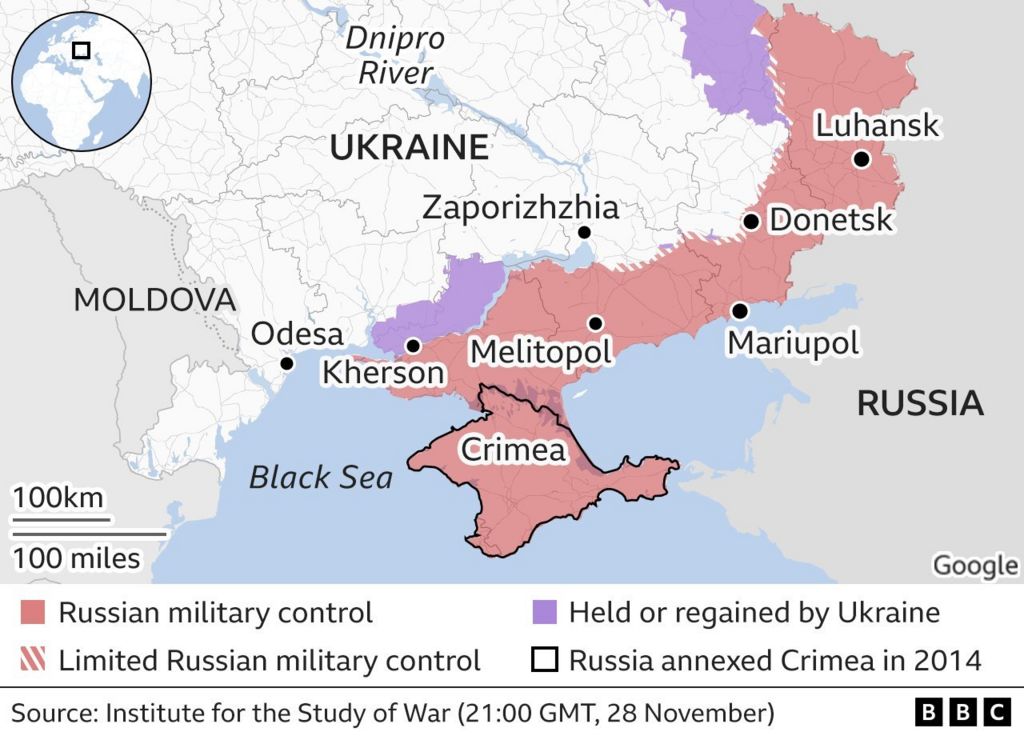
  • Putin: Nuclear risk is rising, but we are not mad

    Vladimir Putin has said the threat of a nuclear war was rising, but insisted Russia had not “gone mad” and would not use its nuclear weapons first.

    The Russian president insisted that his country would only use weapons of mass destruction in response to an attack.

    Speaking at Russia’s annual human rights council meeting, he also said the war in Ukraine could be a “lengthy process”.

    Western officials believe Putin initially planned for a rapid victory.

    Russia’s capacity to use nuclear weapons has come under increased scrutiny since it invaded Ukraine in February.

    “Such a threat is growing, it would be wrong to hide it,” Putin warned while talking about the prospect of nuclear war via video link from Moscow.

    But he asserted that Russia would “under no circumstances” use the weapons first, and would not threaten anyone with its nuclear arsenal.

    “We have not gone mad, we are aware of what nuclear weapons are,” he said, adding: “We aren’t about to run around the world brandishing this weapon like a razor.”

    Putin also boasted that Russia had the most modern and advanced nuclear weapons in the world, and contrasted its nuclear strategy to the US – who he said had gone further than Russia by locating its nuclear weapons on other territories.

    “We do not have nuclear weapons, including tactical ones, on the territory of other countries, but the Americans do – in Turkey, and in a number of other European countries,” he said.

    Putin has previously insisted that Russia’s nuclear doctrine only allowed for the defensive use of nuclear arms.

    Appearing to recognise that his plan to claim victory within days of invading Ukraine had failed, Putin admitted the war could be a “lengthy process”.

    However, he said the results had already been “significant” – for example, the new territories Russia has illegally claimed after sham-referendums in four regions of Ukraine.

    He boasted that the annexations had made the Sea of Azov – which is bordered by south-east Ukraine and south-west Russia – an “internal sea” of Russia, adding that this was an aspiration of Russian Tsar Peter the Great. President Putin has compared himself to the 17th and 18th Century ruler before.

    But – despite claiming the regions of Kherson, Zaporizhzhia, Luhansk and Donetsk as Russia’s new territory – Moscow does not fully control any of those areas.

    Last month, Russian forces were forced to retreat from Kherson city, the only regional capital they had seized since the February invasion.

    Control map of southern Ukraine
    The Sea of Azov is to the north-east of Crimea

    The setbacks on the frontline have led to Russia targeting Ukraine’s power grid by launching massive air strikes across the country.

    The airstrikes have caused widespread damage to Ukraine’s energy infrastructure, leaving millions without heating and electricity for hours, or even days, as temperatures dropped below zero.

    The Mayor of Kyiv, Vitali Klitschko, warned that Ukraine’s capital – which has been badly affected by power cuts – could face “apocalypse”.

    “Kyiv might lose power, water, and heat supply. The apocalypse might happen, like in Hollywood films, when it’s not possible to live in homes considering the low temperature,” Mr Klitschko told Reuters in an interview.

    Though heated shelters have been set up in the city, Mr Klitschko admitted there were not enough for all residents, and people should be ready to evacuate if the situation worsens.

    Back in Russia, any potential criticism of Putin’s invasion was stymied before the human rights council.

    In the run-up to Wednesday’s meeting, 10 members of the council who had expressed doubts about the war were removed. Pro-war replacements were brought in instead.

    Subjects to be discussed during the meeting were also heavily vetted beforehand, according to the independent Russian news outlet Verstka.

    In recent weeks, Russia’s nuclear doctrine has come under close scrutiny on when nuclear arms could be used, in particular a “tactical” weapon that might be unleashed on the battlefield in Ukraine.

    A tactical nuclear weapon is for use in combat, as opposed to the larger “strategic” weapons which are designed to cause massive destruction.

    Source: BBC


  • Before 2023, four African billionaires may cease to be billionaires

    As macroeconomic volatility, geopolitical tensions, and supply chain disruptions continue to have an impact on the performance and valuation of the companies they own, four of the 23 African billionaires tracked by BillionairesAfrica are on track to end 2022 as multimillionaires rather than billionaires.

    Many African billionaires’ net worths have drastically decreased as a result of the pressure on some African companies’ financial performance, which has resulted in a reduction in these companies’ valuations.
    The wealth estimates of billionaires who were worth less than $2 billion or $1.5 billion at the beginning of the year have come under more pressure as a result of this.

    Strive Masiyiwa, a leading billionaire who has seen his net worth decline from nearly $3 billion at the start of the year to $1.2 billion at the time of writing this report, is one of four billionaires on the verge of losing their billionaire status, despite having an exciting year with his appointment to the board of the Gates Foundation and the roll-out of several data centers across Africa through Africa Data Centers.

    While some of these African billionaires are currently worth only a billion dollars, others are worth nearly $1.2 billion; however, the threat remains that if the market value of the companies they own continues to fall, these four billionaires could lose their billion-dollar net worth in the new year or before the year ends.

    #1 Strive Masiyiwa

    Net worth: $1.2 billion

    Nationality: Zimbabwean

    Zimbabwe’s richest man Strive Masiyiwa, the world’s 2,257th richest man and one of Africa’s richest businessmen, is one of the African billionaires on the verge of losing their billionaire status.

    His net worth has dropped from $2.7 billion at the start of the year to $1.2 billion at the time of writing this report.

    The decline in his net worth can be attributed to the performance of his stakes in Econet Wireless Zimbabwe, which he founded in 1998, and EcoCash Holdings, a diverse smart technology group that uses digital and financial technologies to create shared economies, drive financial inclusion and promote economic empowerment.

    #2 Othman Benjelloun

    Net worth: $1.2 billion

    Nationality: Moroccan

    Othman Benjelloun is the world’s 2,212th richest man and one of Africa’s richest billionaires, according to Forbes. The Moroccan billionaire is best known for co-founding BMCE Bank of Africa, of which he is currently chairman and CEO.

    Benjelloun’s net worth has fallen by $300 million since the beginning of the year, from $1.5 billion at the start of the year to $1.2 billion at the time of writing this report, due to a decline in the market value of his holdings in multinational pan-African banking conglomerates, BMCE Group and O Capital Group, a leading investment group based in Casablanca, Morocco’s largest city.

    #3 Yasseen Mansour

    Net worth: $1.1 billion

    Nationality: Egyptian

    Yasseen Mansour, Egypt’s sixth-richest man and the world’s 2,334th wealthiest man, is currently worth $1.1 billion at the time of writing this report, down from $2.2 billion at the start of 2020.

    The leading billionaire has a stake in the Mansour Group, a family-owned conglomerate. Aside from his business interests in Mansour Group, Mansour is the chairman of Palm Hills Development, a leading Egyptian real estate group.

    #4 Samih Sawiris

    Net worth: $1 billion

    Nationality: Egyptian

    Samih Sawiris, the younger brother of Egyptian billionaires Naguib and Nassef Sawiris, derives the majority of his fortune from his family’s investments in OCI N.V., a global producer and distributor of nitrogen and methanol products, and Orascom Development, which builds and operates resorts in Egypt, Montenegro, and Switzerland.

    Unlike his brothers, who have both been able to maintain or increase their wealth figures, Samih Sawiris has seen his net worth drop by more than $100 million since the start of 2022, from $1.1 billion at the beginning of January to $1 billion at the time of writing this report.


  • ¢15bn Ghana Financial Stability Fund created

    The Ghana Financial Stability Fund (GFSF) was formed by the government with goal of GH15 billion to be contributed by the government and its development partners.
    Financial institutions who take part completely in the domestic debt exchange will get liquidity from the fund.
    All financial institutions (banks, SDIs, pension plans, collective investment schemes, fund managers, broker/dealers, insurance firms) that fully participated in the Debt Exchange were able to access the Fund for increased liquidity support as of the Exchange’s completion date, according to statement released in Accra by the Financial Stability Council.
    It said that the Bank of Ghana will manage the Fund in accordance with special operating standards being created by the Council.
    According to the statement, the Council will continue to offer guidance and oversight for the implementation of the GFSF, including accounting treatment and legal Tools to Reduce Financial Stability Risks from Debt Operation.

    In order to establish a uniform approach to the accounting treatment given to the Debt Exchange, it was said that the regulators were already in contact with external auditors of financial institutions.

    The key financial sector regulators, according to the statement, have performed stress tests to determine the possible impact of the Debt Exchange for banks, specialized deposit-taking institutions (SDIs), and insurers.

    Those who could be affected by their involvement in the debt exchange include businesses, asset managers, collective investment plans, pension fund trustees, and regulated pension plans.

    In order to reduce the risks to financial stability, it was stated that financial sector authorities will use all of their regulatory and supervisory instruments to assist manage any possible effects of the Debt Exchange on the financial system.

    “Regulators will assess impacts on a regular basis, and quickly address evolving risks in order to safeguard financial stability,” it said.

    In accordance with its mission, the statement stated that the Council will maintain a careful eye on the effects of the Debt Exchange on financial institutions and the financial system, as well as the efficiency of the measures mentioned above.

    To ensure that these safeguards are as successful as possible in preserving the stability of our financial system and safeguarding deposits, pensions, policyholder funds, and investor money and assets, they will be regularly evaluated and re-calibrated as necessary.

    The Ghanaian government introduced the Ghana Domestic Debt Swap Program on December 5, 2022, inviting citizens to voluntarily exchange a package of future Republic of Ghana bonds, including the E.S.L.A. and Daakye bonds, totaling roughly GH 137 billion.

    Total Treasury Bills, as well as notes and bonds held by private people, are not included in the Exchange.

    In December 2018, the Regulatory Forbearance on Liquidity and Solvency Council was created. Regulated companies and programs who voluntarily participate in the debt operation will temporarily have their regulatory capital and liquidity requirements reduced by the financial sector regulators.

    Any new regulations that may negatively affect liquidity or solvency will also be suspended or delayed by regulators. Each regulator will eventually inform its regulated firms/schemes of more detailed

  • NPA to request Cabinet approval to eliminate LPG taxation

    Dr. Mustapha Abdul-Hamid, the chief executive of the National Petroleum Authority, has stated that the authority’s objective in the energy sector is to assist in the eradication of energy poverty.

    In that regard, he stated that the NPA would work with Cabinet to abolish some LPG levies in order to increase the availability and affordability of LPG for Ghanaians, particularly the poor.

    Dr. Abdul-Hamid promised that in order for investors who planned to build cylinder bottling operations in the north to receive the greatest return on their investments, he would argue for tax breaks for a while.

    The NPA leader announced this on Tuesday in Accra at the beginning of a campaign to raise awareness and encourage the use of liquefied petroleum gas (LPG).

    The aim is to discourage the use of wood fuel – firewood and charcoal – and increase the LPG penetration for domestic, commercial and industrial activities from the current 37 percent to 50 percent by 2030.

    Dr. Abdul-Hamid said the launch of the LPG campaign was to make LPG affordable, available and accessible to the Ghanaian people.

    “We understand that, perhaps, the majority of the Ghanaian people are poor and most people cannot afford to buy cylinders and gas. So we, at NPA, in collaboration with our sector ministry, are trying very hard to make it easy for people to access LPG,” he said.

    The wife of the vice-president, Hajia Samira Bawumia, who launched the LPG Awareness and Sensitisation Campaign in Accra on Tuesday, urged the public, especially women, to adopt LPG as it is a cleaner, safer and healthier cooking fuel.

    She said the use of firewood and charcoal for cooking also contribute to climate change through the emissions of greenhouse gases and black carbon, as well as deforestation through the harvesting of wood and sometimes even economic trees like shea tree and oak tree.

    She noted that Ghana, like many other sub-Saharan African countries, relies heavily on solid biomass fuels for domestic and commercial cooking and heating.

    Hajia Samira said that women and children travel long distances to collect fuel in the form of firewood in most rural communities, and indicated that this time-consuming and exhausting task did not offer much time for other productive activities.

    In addition to being strenuous, she said there are many risks involved; including bites from venomous animals and increased risk of sexual assault.

    That, she said, limits access to education, which tends to restrict opportunities for economic growth in addition to the adverse health impact, adding that: “It is mostly women and children who bear the brunt of this”.

    Hajia Samira said LPG as an alternate cooking fuel is clean, safe and efficient; and expressed joy that the NPA was promoting the use of LPG for cooking to ensure the attainment of government’s goal to increase LPG usage to 50 percent by 2030.

    “Estimates indicate that cooking with LPG saves about four (4) productive hours daily. These extra hours gained daily can be used in productive areas like education, agriculture, and other income-generating activities.

    “By increasing access and use of LPG, we have an unprecedented opportunity to not only deliver significantly on gender equity, but also improve health, reduce poverty, protect the environment, and enhance livelihoods; all-in-one goal”, she said.

    Hajia Samira called for increased education on the safe use of LPG by including information on cylinder expiration dates and when to change or replace the various LPG accessories. “I am confident that this campaign will ensure awareness on these issues,” she said.

    Hajia Samira commended the Ministry of Energy and the NPA for their commitment toward driving awareness for the adoption and use of LPG in households and other areas of the economy.

    In his remarks, the Deputy Minister of Energy, Mr. Owuraku Aidoo, said the timing of the promotional drive was significant given the current debate about climate change with its associated environmental and health effects.

    He said climate change posed a greater responsibility on countries to adapt to and adopt more environmentally sound practices to save the environment from further deterioration.

    Mr. Aidoo said it was therefore crucial for Ghana to play a lead role in discouraging any activity that has an adverse effect on the environment, adding that: “My ministry is ready to support the NPA and other allied institutions to stem this tide for our collective good.

  • Armed robbers steals GH30k, shoot MoMo vendor at Gomoa Akotsi

    Ebenezer Amoaquandoh, a 31-year-old mobile money dealer, is fighting for his life after being shot by two armed men on a motorcycle in Gomoa Akotsi in the Gomoa East District of the Central Region.

    A total of GH30,000 was also taken by the thieves.

    According to Citi News’ Central Regional Correspondent Calvis Tetteh, the incident occurred on Tuesday night at approximately 9:00 p.m. at the Gomoa Akotsi Lorry station just as the seller was ready to close his store and go for his home.

    Amoaquandoh claimed the unidentified gunmen on the motorcycle fired a warning shot at him before demanding that he hand over the bag holding the money.

    Ebenezer said that after he refused to give the guys the money, one of them shot him in the left leg with a pump action gun while the other struck him in the head with sharp items.

    According to Ebenezer, who is presently undergoing care at the Winneba Trauma and Specialist hospital, the thieves were able to escape with the bag holding the specified sum.

    The Gomoa Ojobi District Police Command has launched an inquiry into the incident in the meanwhile and has advised locals to report any suspects to the police for further action.


  • Domestic gas can insulate economy against future shocks – Energy expert

    Dr. Joseph Essandoh-Yeddu, an energy specialist, has stated that by putting indigenous gas first, the nation may considerably increase its energy security and lessen its dependency on imports.

    The majority of domestic gas is currently utilized to generate electricity, but given the vast amounts of undeveloped gas resources, according to him, action should be made to encourage investments in gas’ other uses in the fertiliser, paint, and cosmetics industries.

    He pointed out that if prioritized, this as well as local liquefied petroleum gas processing might protect the economy from future external shocks caused by foreign fuels while also generating jobs.

    “Power generation is just one aspect of gas. There are many uses for gas, like paint, fertiliser and cosmetic production. If we can find a way to promote paint and fertiliser production, it will go a long way to cushion the economy against some of the external shocks we are seeing.

    “At the end of the day, we will also employ more people, along with many other benefits to the economy,” he said.

    Dr. Essandoh-Yeddu spoke at the Offshore Africa Energy Summit 2022 in Accra, and said it is high time the requisite infrastructure was put in place to process LPG locally.

    In 2021 alone, total LPG consumption was 345,478 metric tonnes, out of which over 85 percent was imported, according data by Institute for Energy Security.

    In monetary terms, the country spent US$190million on LPG, with about US$162million of the amount going into imports.

    The amount, Dr. Essandoh-Yeddu, who is Lead Technical Partner for UNEP Project on Electric Vehicles and Climate Smart Agriculture, lamented, could go a long way to strengthen the cedi and improve the country’s foreign reserves position if local processing of LPG can be prioritised.

    Infrastructure, ready market can accelerate investments in gas

    Asked what can be done to optimise domestic gas, Theophilus Ahwireng, Managing Director of MODEC Production Services Ghana, said the right infrastructure and a ready market can stimulate investments in the sector.

    “The infrastructure needs to be in place, the market needs to be there to be able to stimulate the right investments, typically long-term. If these things are not there, it makes it difficult for you to get the investments,” he added.

    Explaining further, he said: “When you find oil, it is transported easily, but gas is not transported that easily. You need a market for it; and so, the market for domestic gas is a very powerful enabler for investments in the industry, and as you know, it is a transition fuel – it is clean compared to heavy oil, and it is good for the environment. It also has multiple uses.

    “So, for us to continue having investments in oil and gas, we need to do all we can to monetise domestic gas.”

    Failure to do this, he warned, can stifle investments and growth of the industry.

    Offshore Africa Energy Summit 2022 was organised by Jurbert Communication Limited, publishers of Offshore Africa – an oil and gas magazine. It was themed: ‘Business Drivers and how they Are Shaping the Future of Energy Delivery and Investment Returns’.

  • National Cathedral project: Waterstone Realty Ltd sues government for $4.7m for demolishing its apartment

    Waterstone Realty Limited, a real estate firm, has sued the Lands Commission over the demolition of a two-storey-multifunctional structure that was formerly located at the present location of the National Cathedral project.

    According to the plaintiff’s summons, the defendant, the Lands Commission, compulsorily possessed and demolished its flat in 2018 for the development of the National Cathedral project.

    As a result, Waterstone Realty Limited has requested the following monetary damages.

    “An order directed at the defendants to pay the plaintiff of the sum of USD$4,721,000.00 being the market value of the two-storey multipurpose building complex at the time of compulsory possession and demolition by Defendants.”

    It also wants the court to ask “the defendants to pay the plaintiff the sum of USD$995,508.52 being the difference in terms of the established market value of the plaintiff’s property on the land being the sum USD$4,721,000.00 and the actual value of the property as of May 2018 when the defendant repossessed the property being the value of the two-storey multipurpose building”.

    The damages requested include a sum of $54,000 to be paid as rent loss.

    Furthermore, Waterstone desires interest in the aforementioned quantities beginning June 1, 2018.

    Waterstone Realty Ltd sues government for $4.7m over National Cathedral project

    Waterstone Realty Ltd sues government for $4.7m over National Cathedral project


  • “My sweetheart”: Salisu goes on luxury boat cruise; GH babes weak in the knees

    Ghanaian football star Mohammed Salisu, in a video, went on a luxury boat ride to unwind after a hectic World Cup campaign in Qatar.

    unfortunately beaten by Uruguay and knocked out of the tournament.

    Mohammed Salisu was one of the most outstanding players during the campaign and has won the hearts of many Ghanaians despite the Black Stars being kicked out of the tournament.

    The talented defender who plays for Southampton took a well-deserved break as he had a good time on his boat cruise.

    Salisu looked handsome, as always, in the video. He wore some fashionable see-through glasses and had on just shorts and a singlet as he recorded himself.

    Salisu smiled brightly and showed his perfect set of white teeth. His handsome looks left many Ghanaaina ladies weak in the knees as they fawned over him.

    Ghanaian Ladies Fawn Over Salisu

    Pri Pri admired him:

    As he should periodt. I love him ❤️❤️❤️❤️

    PRECIOUS AFIA ARTHUR commented:

    Damnhis smile only

    Pertual Esinulo also wrote:

    awwn my sweetheart

    Adwoa Banky also wrote:

    This boy is too handsome

    yaababy3031 wrote:

    My man

    mary love ❤️ also said:

    he’s handsome


  • Party scatters as Groom fights with man who sprayed money on wife

    A video that has gone viral and shared by @somalisnaps has shown a wedding that suddenly turned violent.

    While the bride and groom were dancing into their wedding venue, one of the seated guests stood up and sprayed money on the groom.

    Groom and guest fought

    The man who did not like that he plastered the currency on his forehead removed it. A closer look at the video showed the wedding guest spat a bit on the money before giving it out.

    Seeing that the man had removed it, the man made an energetic effort to return the money to the groom’s forehead and a fight broke lose between them.

    Watch the video below:


    View this post on Instagram


    A post shared by 👻Somalisnaps ✪ (@somalisnaps)

    Netizens react to video of groom fighting

    The video has sparked reactions from those who watched it. While some pointed out that the guest spat on the money first, others noted that it was a culture thing.

    _ibrahym_hassan_ said:

    “The cameraman had 1 job nd he failed.”

    tom_mogusu said:

    “That’s the local leadership forcing him to marry.”

    nkunimwellington said:

    “He spat on the money before putting it in his head, pay attention.”

    asiyo_fit_belema replied

    “@nkunimwellington it’s normal to reward bride and groom with money and they stick it by wetting the money by their saliva, this type of culture is common in Ethiopia and Eritrea but these 2 seems to have had beef from before as the groom appears to be annoyed instantly.”

    ehiglamoure said:

    “Y’all commenting didn’t even c what happened i nor sure say nah naija them for deal with that man well he must be his uncle.”

    arada_official525 said:

    “Feel bad the for wife, if he did that in room full of people, can’t imagine in the bedroom.”

  • Delay slays beautifully in video

    Veteran media personality and TV host, Delay, in a video confidently bragged about her pretty looks.

    Delay slayed in an elegant white gown and wore thick makeup that looked good on her. She was impressed with her outfit and makeup and made videos admiring herself.

    Delay was excited as she looked into the camera and spoke some Twi synonyms eulogising herself. Delay exclaimed that she looked beautiful and let out a bright smile. Delay’s outfit looked on point.

    She also wore a silky and quality-looking weavon. Her eyelashes looked well done and perfectly aligned. Her eyebrows were also shaped exquisitely, making her look like an exotic barbie doll.

    The heavy Twi synonyms and adjectives Delay showered herself with had peeps laughing as they marvelled at how good she was with words.

    @delayghana🥳🤩😎♬ original sound – The Man

    Fans Of Delay React To Her Words Of Affirmation

    Lampard Jr said:

    delay, wo ha adwene ooo

    B.kwabia Farms commented:

    kwahufo super star boss madam #nkawkawadoagyiri440

    Mr Namtech also said:

    aboozigi my amariya 2023 since it couldnt happpen in 2022

    Drkofi1 also wrote:

    Yeah sweetheart you are so beautiful

    nashvilleanang also reacted:

    Daley the big man in the business, I love you to the moon and back ❤️❤️❤️

    Afriyie Junior#FYM was impressed:

    Eiii mummy you get words o

    Tina_stone1 also wrote:

    Wanum mu nsem eiiii the pataku part alone

    kaakyire396 commented:

    s3 Adwoa oo, s3 Abena oo, s3 Akua oo,s3 Yaa oo,s3 Afia oo,s3 Ama oo,s3 Akosua ooyour punchlines go make someone go mad ooo eeeii

  • Soya sector players call on government to appoint new leaders along value chain

    The Soya Value Chain Association of Ghana is calling on government to appoint new leaders for the Ghana Commodities Exchange, Buffer Stock Company and the incoming Commodities Export Control Authority.

    According to the association, leaders at these institutions do not have the requisite skills to regulate the affairs of the soya value chain.

    Speaking at a press conference organized by the Soya Value Chain Association, Vice Chairman, Daniel Ahenkorah indicated that stakeholders along the value chain are usually overlooked in decision making.

    “We sincerely appreciate government’s move to regulate the export of this commodity, but based on the concerns raised by our members who are the main actors, we think further engagement is needed. In addition, we would have liked that at every stage of the negotiations leading to the final decision of this temporal ban, members of SVCAG should have been consulted as a body but unfortunately, this did not happen.,” he said.

    In a press statement sighted by Joy Business, the association stated their position on issues in the soya value chain.

    The statement said, “Government should increase effort to develop a national strategy to make soyabeans a cash crop, Replicate and expand the SAPIP project to increase soyabean production in Ghana and Revise the leadership of public institutions like Ghana Commodities Exchange, the Buffer Stock Company and the incoming Commodities Export Control Authority to give value chain actors control to lead these committees for effective operations on the ground.”

    This follows a recent directive from the government to regulate the export of these commodities.

    Soya sector players call on government to appoint new leaders along value chain
    Soya sector players call on government to appoint new leaders along value chain

    The Soya Value Chain Association of Ghana was established more than a decade ago with an aim of producing and making available high quality certified soya seeds for farmers in Ghana and to quadruple soya beans production figure each year.

    Source: Myjoyonline

  • Phones in the right hand, books in the left – WASSCE vs mobile phones

    It’s regular to witness young people with their heads buried in phones, jumping from one social media platform to the other.

    In search for fun activities or trends to hop on from TikTok to Instagram, then Facebook, to WhatsApp among others.

    Most often, these people get overwhelmed by online activities, which results in spending hours behind their devices.

    As rampant as is it, the individuals involved in this are second-cycle students, who per the standards of Ghana Education Service (GES), are not permitted to carry nor use phones on their premises.

    Phones in the right hand, books in the left - WASSCE vs mobile phones
    File photo

    Although there have been calls by various stakeholders for phones to be tolerated in schools, the GES maintains that phones will be a form of distraction among other things.

    Despite the stringent rule, some students have the courage to be seen pressing their smartphones whilst in uniforms at bus terminals in the mornings to school and afternoons after school.

    On a number of occasions, my encounters with such students got me worried as they kept giggling at their screens at the funny videos, they watched on their preferred social media platforms.

    It’s understandable if youngsters want to keep up with trends and be abreast of new technology. But their constant use of phones has created some kind of over-dependence on these devices for trivial information.

    Information like simple mathematical formulas, proper use of English expressions, basic science and social studies, which should be at their fingertips should they study.

    This dependence has translated into phones playing key roles in the preparations towards, during and after the West Africa Senior School Certificate Examination (WASSCE).

    Months before the exams, students make payments to be added to group chats where possible questions for various subjects will be sent for them to study.

    It’s no surprise reports from the education think tank, Africa Education Watch found that out of the 20 WASSCE papers monitored for the 2021 examination, 11 of them leaked.

    WAEC, head Mrs. Wendy E. Addy-Lamptey
    Heads of the WAEC Ghana National Office, Mrs. Wendy E. Addy-Lamptey

    The education think tank said its online monitoring team joined over 30 free WhatsApp and Telegram Pages to observe proceedings before and during the examinations.

    Most of these platforms have over 200,000 subscribers who pay between ¢30 and ¢100 each at the beginning of the examinations for the paper.

    For some papers whose answers are supposed to be sent the morning of that subject paper, students sneak foreign materials [phones] into the exam hall which has accounted for an increasing number of students who take phones to the exam hall each year.

    Statistics

    This phenomenon has translated into an upsurge in phone-related malpractices over the years.

    Reports by the West African Examination Council (WAEC) prove that the leading cause of malpractice is the smuggling of cell phones to examination centres.

    Phones in the right hand, books in the left - WASSCE vs mobile phones

    In 2018, it also led to cancellation of some papers of 1,339 candidates and 174 others having their entire results cancelled.

    A year after (2019), some 48,555 candidates had their entire results withheld by WAEC for investigations to be carried out for suspected involvement in cases of examination malpractice.

    In 2020 some 2,383 candidates saw subject results cancelled and the entire results of 480 candidates.

    Fortunately, in 2021 the figure dropped, as some 1,339 candidates had their subject results cancelled and for 174 candidates, an entire result cancelled.

    This year, however, the number of malpractices more than doubled from that of 2021 with some 3,845 candidates having a subject paper cancelled and the entire results of 518 candidates cancelled.

    Phones in the right hand, books in the left - WASSCE vs mobile phones
    2022 WASSCE in Ghana [Source: WAEC]

    Concerns

    This phenomenon has raised a lot of questions in the minds of stakeholders about the continuous rise in examination malpractices.

    In a recent interview on Joy News, the Executive Director of Africa Education Watch, Kofi Asare expressed worry about the apparent doubling of exam malpractices through the years.

    Phones in the right hand, books in the left - WASSCE vs mobile phones
    Kofi Asare is the Executive Director of Africa Education Watch

    He mentioned that the examination council sees an almost exponential rise in students involved in malpractice annually.

    But what is the driving force behind this disturbing trend despite the annual ‘scapegoating’ of candidates? Do candidates believe, for some unfathomable reason, that they will be able to evade the authorities with their hidden mobile phones and unapproved gadgets?

    I don’t think it is worth it. The risk of suffering penalties like inability to further their education, and suspension from writing WASSCE for the 3 to five years, is too expensive a price to pay.

    Phones in the right hand, books in the left - WASSCE vs mobile phones
    WASSCE performance in Ghana [Source: WAEC]

    The Problem

    Is it Generation Z’s desperation for quick ways to succeed, an addiction to phones, or parents’ failure to monitor the activities of their children?

    Whichever the cause may be, I believe the sooner this issue is addressed the better it will be for Ghana’s future leaders.

    Generally, teenagers have the propensity to quickly adopt new character traits. This is also the dominant age group in the country’s second-cycle institutions.

    So why do these same candidates, with all this cognitive ability, need to smuggle in mobile phones for an examination they had three years to prepare for?

    If the situation is not curbed, it could become a phenomenon where the number of students who passed their examination by dint of hard work will be equivalent to those involved in phone-related malpractices.

    The way forward

    Parents should make sure their children do not carry their phones to school. Teachers must inspect students to make sure they do not carry phones to the classroom.

    Teachers must let students know that they do not need leaked questions or ‘apor’ to pass their examination.

    Months before the WASSCE, there must be a forum for WAEC officials to answer questions on the minds of the students.

    This will sensitise them and get them mentally prepared for the examination.

    If possible, schools should invite old students who worked hard to get into universities to inspire students that hard work pays and that there is no simpler way to succeed.

    Source: Myjoyonline

  • ‘Expedite action on land digitalisation process – Akufo-Addo charges Lands Commission

    President Nana Addo Dankwa Akufo-Addo has charged the Lands Commission to expedite action on the digitisation process of land acquisition.

    Addressing the maiden National Land Conference, organised by the Lands Ministry on Wednesday President Akufo-Addo stated that in this technologically advanced age, it is unacceptable that many sectors of the economy still operate in a largely manual environment.

    “We cannot deliver an efficient land administration if documents on land have to be processed manually. We must, therefore, expedite action on the digitalisation process, and ensure that the Commission goes fully digital. As you go into technical discussions, it is my hope that this will be key on your agenda’’, he said.

    'Expedite action on land digitalisation process - Akufo-Addo charges Lands Commission

    Reiterating the significance of land to the socioeconomic development of the country, the President noted that a rapidly growing population, coupled with competing uses of land, continue to put immense pressure on our land resources.

    According to the President, it is for this reason that, “during the first term of my presidency, we prioritised the passage of the Land Bill, which had been in the draft stage for some 20 years.”

    The Land Act, 2020 (Act 1036), which he assented to on 23rd December 2020, the President explained, “revises, harmonises and consolidates laws on land to ensure sustainable land administration and management, as well as effective and efficient land tenure systems.”

    'Expedite action on land digitalisation process - Akufo-Addo charges Lands Commission

    Successive Governments have sought, through numerous initiatives, to improve Ghana’s land administration regime.

    The most significant intervention has been the Land Administration Project (LAP), Phases 1 and 2, which sought to lay the foundation and consolidate urban and rural land administration and management systems for efficient and transparent land service delivery.

    'Expedite action on land digitalisation process - Akufo-Addo charges Lands Commission
    Lands Minister, Samuel Abdulai Jinapor

    These interventions have yielded some results, such as the reform of the Lands Commission through the enactment of the Lands Commission Act, 2008 (Act 767), the establishment of five Client Service Access Units (CSAUs) at the Lands Commission to enhance service delivery, the establishment of Customary Land Secretariats, reforms in the Judiciary through the establishment of specialised land courts and the automation of some courts, the enactment of the Land Use and Spatial Planning Act, 2016 (Act 925), the introduction of a new three-tier Spatial Planning Model, and the development of a National Spatial Development Framework and two Regional Spatial Development Frameworks.

    'Expedite action on land digitalisation process - Akufo-Addo charges Lands Commission

    “But laws, in themselves, do not resolve problems. It is their application and effective implementation that yield the requisite results. That is why this conference, which brings together diverse people from different sectors to deliberate on the nexus between land and socio-economic development, is so crucial”, he emphasized.

    The President continued, “Fortunately, the Land Act, 2020 (Act 1036), provides a strong foundation for fashioning out a workable and efficient land administration. The Act has far-reaching provisions which, if implemented, will go a long way to build the effective land administration we desire’.’

    'Expedite action on land digitalisation process - Akufo-Addo charges Lands Commission

    Key amongst them, he said, is the establishment of Customary Land Secretariats to see to the management of stool, skin, family and clan lands, restrictions on large-scale disposal of family and clans lands without the concurrence of the Regional Lands Commission, the power of the Regional Commission to survey and demarcate land, the provision for electronic conveyancing, the detailed provisions for the compulsory acquisition of land including the payment of compensation, the management and use of public lands, and the provisions for divesting of vested lands.

    The Act “also addresses the challenges associated with boundary demarcation, and clarifies rights and interests in land, and persons with capacity to alienate land. It provides stringent jail terms for various offences related to lands, such as landguardism, falsification of records and fraudulent transactions in land administration”.

    President Akufo-Addo expressed his satisfaction with the Ministry of Lands and Natural Resources and the Lands Commission who are leading the sensitisation and education of this important piece of legislation.
    Source: Jublie House
  • College of Physicians and Surgeons to undertake fellowship training programmes in regional hospitals

    The Ghana College of Physicians and Surgeons (GhCoPS) has announced that beginning next year, fellowship training programmes for postgraduate doctors will be carried out in regional hospitals across the country.

    According to the Rector of the College, Professor Richard Adanu, the College has signed a memorandum of understanding with the Ghana Health Service for fellowship training programmes to be carried out in regional hospitals.

    Speaking at the induction ceremony and 19th Annual General Scientific Meeting of GhCoPS on Wednesday, December 7, he said this will bring fellowship training closer to doctors.

    “One thing that we are doing to bring Fellowship Training closer to our members is that we are working on developing Fellowship Training programmes that would primarily be housed in regional hospitals.

    “Such programmes when successfully launched, hopefully, next year, fellowship trainees for the general specialty areas can have their training in the regions where they practice and still provide service in their parent hospitals as part of the training. In such cases, there will be no need for study leave or a gap between membership qualification and the start of fellowship training,” he said.

    He lamented the low percentage of doctors who pursue postgraduate fellowship training to the highest level.

    This, he admitted has been a challenge in the health sector.

    “The rising population and health care needs are also going to lead to an increase in medical schools in the years ahead. So, if an overwhelming majority of our members do not take up fellowship training, these medical schools might end up being staffed and led by non-Ghanaians who have fellowship qualifications,” he added.

    Prof. Adanu noted that fellowship training enhances doctors’ practical knowledge in their specialty and makes them more competent in managing health problems, the reason more doctors should yearn to pursue postgraduate fellowship programmes.

    The Rector assured the new members and fellows that the College will work to resolve issues making fellowship training unattractive including minimal salary.

    A total of 294 doctors were inducted into the Ghana College of Physicians and Surgeons (GhCoPS) as new members and fellows at the 19th Annual General Scientific meeting.

    Out of the number, 212 of the doctors are new members while 40 of them are new fellows who have completed their training and passed the required examinations.

    The other 42 are new fellows who have been elected by different faculties based on their qualifications and contributions to training postgraduate doctors.

    This will result in 212 additional members and 82 additional fellows of the College.

    Addressing the audience on behalf of the Health Minister, Deputy Health Minister, Alhaji Mahama Asei Seini said cabinet has approved a policy document that would improve the rate at which the College produces fellows and the waiting time between the completion of house office rotations and the start of residency training.

    The policy, he noted will be implemented with the next intake of trainees.

    “I am happy to inform you that the policy document has been approved by cabinet and would start being implemented with the next intake of trainees.”

    He admitted that the current economic challenges have taken a toll on the government’s remuneration of postgraduate training at the College.

    However, Alhaji Seini assured that the Ministry will ensure some significant payment is made to the postgraduate trainees before the end of this financial year.

    British High Commissioner to Ghana and Special Guest of Honour at the ceremony, Harriet Thompson stated that the UK has partnered with the College of Physicians and Surgeons to address four areas in Ghana’s health sector.

    These include; the strengthening of postgraduate medical training through partnerships between the College and four UK Royal Colleges in Emergency Medicine, Anaesthesia, Pathology, Psychiatry and health workforce and governance leadership programmes.

    The rests are; a partnership between the Health Ministry and the UK hospitals to decentralise postgraduate medical education in Ghana by expanding the number of accredited medical teaching sites outside of Accra and the deepening of research capacity by the UK on Ghana’s postgraduate medical education training.

    The College held its membership and fellowship examinations in March and September this year with a total of 1,099 candidates sitting for the exams.

    A total of 850 candidates passed the exams with a pass rate of 81% at the membership level and 82% at the fellowship level.

    Source: myjoyonline.com

  • Close down betting companies around schools -Dr Adutwum to Gaming Commission

    The Education Minister, Dr Yaw Osei Adutwum, has urged the leadership of the Gaming Commission of Ghana, to intensify efforts to close down betting companies that flout laws guiding their operations in the country.

    He cited the siting of betting facilities close to educational institutions to entice children as something needs to stop.

    According to him, the move would help prevent children from patronising such facilities located close to their institutions, and control the influx of children into such gaming centres contrary to provisions of the Gaming Act 2006 (Act 721) which guides their operations.

    Dr. Adutwum made the call when he visited the headquarters of the Gaming Commission of Ghana on Tuesday.

    The meeting was meant to help the two institutions have a candid discussion on issues relating to siting of betting facilities near educational institutions across the country and efforts to address this problem.

    Law enforcement

    The Education Minister lauded the Commission for its role in controlling operators in the space but urged them to be firm in enforcing rules and regulations in relation to their operations to bring some sanity to the gaming space.

    Close down betting companies around schools -Dr Adutwum to Gaming Commission

    He appealed to the Commission to have a critical look at the location of betting centres in the country, especially near schools and see what can be done to halt this practice.

    Dr. Adutwum pledged his preparedness to liaise with the Commission in relation to how to prevent school children from storming betting centres, especially during school hours in their own interest.

    Addiction management

    Again, the Minister appealed to the Commission to consider assisting people with betting addiction to stop the practice.

    The Education Minister called on all stakeholders in the country to help protect the youth of the country who are preparing to take over the leadership of the country.

    This, he said, could be done by looking at the interest of the nation first and putting in place the right policies and measures meant to help make gains for the nation.

    The Games Commissioner, Mr. Peter Mireku, eulogised the Education Minister for the visit and the discussion which would go a long way to get the best for the nation.

    He recounted various advocacy and sensitization interventions put in place by the Commission towards sanitising the gaming space in the country.

    Age, a global challenge

    The Commissioner indicated that although there are rules and regulations guiding the operation of games of chance in the country, the issue of age verification remains a bit of a challenge since some adults open betting accounts for use by minors.

    Mr. Mireku indicated that the Commission would continue to liaise with the Education Ministry and other institutions to help educate and sensitise school children on the laws against minors engaging in gaming as well as the impact of gaming on their academic work.

    Background

    Pursuant to the Gaming Act 2006 (Act 721), betting centres are expected to operate 100 meters away from Schools, churches, mosques and other social facilities.

    But the current situation whereby some gaming centres are spotted around educational institutions across the country prompted the Education Minister to visit the Commission for a discussion on how to sanitize the space for the sake of under-aged children as well as siting of the centres and the near schools across the country.

    Source: myjoyonline

  • Close down betting companies around schools – Education Minister to Gaming Commission

    The Education Minister, Dr Yaw Osei Adutwum, has urged the leadership of the Gaming Commission of Ghana, to intensify efforts to close down betting companies that flout laws guiding their operations in the country.

    He cited the siting of betting facilities close to educational institutions to entice children as something needs to stop.

    According to him, the move would help prevent children from patronising such facilities located close to their institutions, and control the influx of children into such gaming centres contrary to provisions of the Gaming Act 2006 (Act 721) which guides their operations.

    Dr. Adutwum made the call when he visited the headquarters of the Gaming Commission of Ghana on Tuesday.

    The meeting was meant to help the two institutions have a candid discussion on issues relating to siting of betting facilities near educational institutions across the country and efforts to address this problem.

    Law enforcement

    The Education Minister lauded the Commission for its role in controlling operators in the space but urged them to be firm in enforcing rules and regulations in relation to their operations to bring some sanity to the gaming space.

    Close down betting companies around schools -Dr Adutwum to Gaming Commission

    He appealed to the Commission to have a critical look at the location of betting centres in the country, especially near schools and see what can be done to halt this practice.

    Dr. Adutwum pledged his preparedness to liaise with the Commission in relation to how to prevent school children from storming betting centres, especially during school hours in their own interest.

    Addiction management

    Again, the Minister appealed to the Commission to consider assisting people with betting addiction to stop the practice.

    The Education Minister called on all stakeholders in the country to help protect the youth of the country who are preparing to take over the leadership of the country.

    This, he said, could be done by looking at the interest of the nation first and putting in place the right policies and measures meant to help make gains for the nation.

    The Games Commissioner, Mr. Peter Mireku, eulogised the Education Minister for the visit and the discussion which would go a long way to get the best for the nation.

    He recounted various advocacy and sensitization interventions put in place by the Commission towards sanitising the gaming space in the country.

    Age, a global challenge

    The Commissioner indicated that although there are rules and regulations guiding the operation of games of chance in the country, the issue of age verification remains a bit of a challenge since some adults open betting accounts for use by minors.

    Mr. Mireku indicated that the Commission would continue to liaise with the Education Ministry and other institutions to help educate and sensitise school children on the laws against minors engaging in gaming as well as the impact of gaming on their academic work.

    Background

    Pursuant to the Gaming Act 2006 (Act 721), betting centres are expected to operate 100 meters away from Schools, churches, mosques and other social facilities.

    But the current situation whereby some gaming centres are spotted around educational institutions across the country prompted the Education Minister to visit the Commission for a discussion on how to sanitize the space for the sake of under-aged children as well as siting of the centres and the near schools across the country.

    Source: Myjoyonline
  • S&P downgrades Ghana’s long-term local currency bonds to “selective default”

    S&P Global downgraded Ghana’s long-term local currency bonds to “selective default” and cut the country’s foreign currency debt to “CC” from “CCC-plus,” with default a “virtual certainty,” the ratings agency said in a Tuesday statement.

    S&P said Ghana’s proposed local debt swap is a “distressed exchange offer,” earning those bonds the “selective default” rating, while the foreign currency bonds downgrade responds to the government’s announced plans to restructure that debt.

    Ghana’s parliament on Tuesday narrowly approved the proposed 2023 budget, overcoming resistance from opposition lawmakers over the inclusion of the debt exchange and a higher value-added tax.

    Source: myjoyonline

  • Arsenal to re-sign Yunus Musah ahead of January window

    Arsenal is thinking about re-signing outstanding teenager Yunus Musah.

    The child spent his teenage years at Arsenal, where he progressed through the levels of the youth team.

    In 2019, he was transferred to Spanish La Liga outfit Valencia where he has now become a top midfielder for the team.

    Yunus Musah, 20, has significantly improved his game in the last couple of seasons.


    Since last summer, he has been linked with a return to England after several clubs expressed interest in his services.

    After the exit of the USA from the 2022 FIFA World Cup, information gathered indicates that Arsenal have entered the frame.

    The London-based club is monitoring the midfielder and wants to bring him back to England next summer.

    Already, Yunus Musah is wanted by English clubs including Chelsea and Liverpool per sources.

    At the moment, the talented youngster has a release clause of €100 million at Valencia.

    While it will be difficult for any club to sign him, the player per checks is willing to move to England if the opportunity presents itself.

  • 796 flee Burkina Faso to Sissala West communities for fear of attack

    The Sissalla West District Chief Executive (DCE), Ayisha Batong Hor, has expressed worry about the Burkinabes fleeing into the Ghanaian community of Fielmuo and Nemoro over suspected jihadist attacks.

    Madam Hor told the Ghana News Agency (GNA) in an interview in Gwollu after the unusual movement of large numbers of people from Buro and other communities in Burkina-Faso bordering Ghana’s northern communities of Fielmuoh and Nemoro.

    The DCE said reports from the affected communities indicated that the National Disaster Management Organisation (NADMO) was providing support to the victims and had so far registered 796 people as refugees.

    Mr Halidu Yahaya, the Sissala West District Coordinator of the National Disaster Management Organisation also told the GNA that the movement of the people into the country started gradually and that normally they do so during the night.

    He said: “The whole of Fielmuo is full of women, children and some men who fled Burkina Faso are confined in the community”.

    The NADMO Coordinator said one of the migrants alleged that the suspected Jihadists burnt down a district assembly, a Police post, and a telephone pole in Burkina-Faso, which compelled them to start running toward Ghana as they did not know what could happen to them.

    “Just this evening, some people also came to Fiemuoh and we understand those that have relatives in Tiwii, Mossiyiri, Fatchu, Pune, Buo, and Chetu are coming in their numbers but the 796 is what we had been able to record”, Mr Yahaya said.

    He appealed to NGOs, and philanthropists, among others for food and shelter for the fleeing suspected refugees whom he said were running for their lives as women and children are the majority saying, “One of the fleeing women gave birth this morning.”

    The Ghana News Agency later spoke to Imam Kamil B -Nasibie, the Imam of Nemoro, who said about 200 fled Buro, Nyebro all in Burkina-Faso and were currently perching and being sheltered by their relatives and others in Nemoro as they were afraid to return home.  Several communities lying in Ghana’s Northern neighbour to Burkina Faso have ancestral relations with Sissala and the Dagaaba ethnic groups in both Ghana and Burkina Faso.


  • Elon Musk rejects concerns over beds at Twitter HQ

    Elon Musk has criticised San Francisco Mayor London Breed over an investigation into offices turned into bedrooms at Twitter’s headquarters.

    The city’s Department of Building Inspections is investigating potential violations of the building code, local reports say.

    Mr Musk accused the city of attacking companies providing bedrooms for “tired employees”.

    The new Twitter boss recently demanded staff committed to long hours or left.

    A Department of Building Inspection official told local public-radio station KQED: ‘We need to make sure the building is being used as intended.”

    In a reply to KQED journalist Ted Goldberg’s twitter thread, Mr Musk posted the city should prioritise protecting children from the consequences of opioid drug misuse.


    Last month, Mr Musk emailed all staff Twitter “will need to be extremely hardcore” to succeed.

    “This will mean working long hours at high intensity,” he said.

    “Only exceptional performance will constitute a passing grade.”

    And in a now deleted tweet, Mr Musk posted he would work and sleep in the office “until the org is fixed”.

    ‘Office armchairs’

    Forbes initially broke the story of “sad little conference-room sleeping quarters at the company’s recently depopulated headquarters”, noting it was an apparent improvement on the improvised sleeping-bag-on-the-floor arrangement posted on Twitter by one employee.

    A photo shared with the publication showed “bright orange carpeting, a wooden bedside table and what appears to be a queen bed, replete with a table lamp and two office armchairs”, it said.

    The bedrooms, Bloomberg reported, are also said to accommodate staff from Tesla and other Musk-owned businesses brought in to work at Twitter, “some of whom travel to Twitter for work meetings”, sources told the publication.

    Department of Building Inspection official Patrick Hannan told the San Francisco Chronicle it investigated all complaints and there were different rules for residential buildings, even those used for short-term stays.

    In May 2020, prior to Mr Musk’s takeover, Twitter told employees they could work from home “forever” if they wished to, because its remote-working measures during Covid lockdowns had been a success.

    But last month, Mr Musk said remote working would end.

    Source: BBC