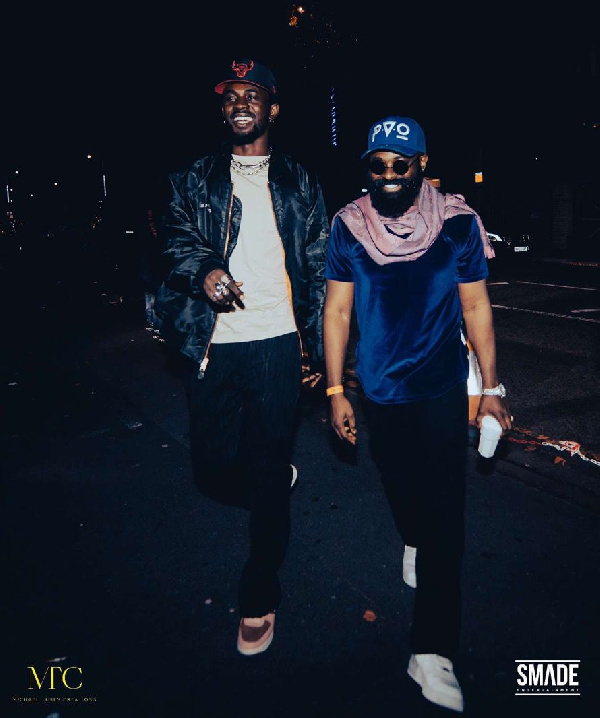
After delivering an electrifying performance at KOKO, in the United Kingdom, Black Sherif has received a rousing welcome from Afronation co-founder Adesegun Adeosun Jr, popularly known as SMADE.
In some pictures exclusively shared with GhanaWeb by the SMADE lounge Boss, Blacko was warmly received and showered with love and attention, by all who were present at SMADE lounge in the UK.
The ‘Oh Paradise’ artiste was beaming with smiles while interacting with the many fans that trooped into the lounge to grab a picture with him.
Blacko donned a pair of black jeans with a white t-shirt and a black jacket to match.
He paired the look with a pair of brown and white sneakers and a baseball cap to complete his look.
SMADE, on the other, was captured with Blacko while clad in a dark blue woven tufted fabric, a baseball cap, a pair of black pants and white sneakers.
The Afronation Boss joins the list of top A-listers to have received Blacko upon his arrival in the United Kingdom.
Apart from him, Burna Boy was also spotted with the artiste and also performed with him on stage, at KOKO.
Sarkodie threw a surprise visit to watch the artiste perform after they collaborated on his JAMZ album.
Scroll down for amazing pictures of Black spending time with SMADE and some fans in the UK:
Public sector workers, Municipal Metropolitans and District Assemblies (MMDAs) have been asked not to give out hampers to their stakeholders this Christmas.
Finance Minister, Ken Ofori-Atta announced this decision on Thursday while presenting the 2023 Budget in Parliament.
The decision forms part of the government’s measures to rationalise its expenditures in the wake of the prevailing economic hardship.
“There shall be no hampers for 2022,” the Minister stated.
Mr. Ofori-Atta further announced the ban on the printing of diaries, notepads and calendars by MMDAs and SOEs from 2024.
“There shall be no printing of diaries, notepads, calendars and other promotional merchandise by MDAs, MMDAs and SOEs for 2024,” he added.
“All non-critical projects must be suspended for the 2023 financial year.”
The Minister said the move is geared towards expenditure rationalisation, in the wake of the economic woes.
In addition to the reduction in expenditure, MDAs, MMDAs and SOEs have been directed to reduce fuel allocations by 50% to government appointees.
“All MDAs, MMDAs and SOEs are directed to reduce fuel allocations to Political Appointees and heads of MDAs, MMDAs and SOEs by 50%. This directive applies to all methods of fuel allocation including coupons, electronic cards, chit systems, and fuel depots. Accordingly, 50% of the previous year’s (2022) budget allocation for fuel shall be earmarked for official business pertaining to MDAs, MMDAs, and SOEs,” he directed.
Speaking on 3FM Drive, the ‘Fame Saa’ artiste acknowledges that Samini has earned the right to criticise any music, regardless of whether he agrees with him or not while adding that Samini is entitled to his own opinion.
“Yeah, that is his opinion. And he has every right to express his opinion. He’s a legend. He’s paid his dues as far as music is concerned.
“So if he criticizes, he has every right to criticise it. He has the locus and pedigree to criticise it,” he told Giovanni Caleb.
On November 19, 2022, Dancehall musician Samini posted on social media that he was unhappy with the official Black Stars World Cup song that was written.
The official Black Stars cheer song, titled “Osey,” was released not too long ago by the Kentos Music Band with the blessing of the Ministry of Youth and Sports but to most people, the song isn’t catchy enough to be a World Cup hit.
Wading into the discussion, Samini, in a Twitter post, threw shades at the writer and composer of the song saying he and a few other musicians could have done better.
In line with efforts to cut down on its expenditure, the government has placed a ban on the use of V8s and V6s by government officials except for cross country travels.
This was announced by the Finance Minister, Ken Ofori-Atta during the reading of the 2023 budget and economic policy.
The ban takes effect from January 2023, until further notice.
Additionally, there would be limited budgetary allocation for the purchase of vehicles. “All government vehicles would be registered with GV green number plates from January 2023,” the Minister added.
He also emphasised that “the purchase of new vehicles shall be restricted to locally assembled vehicles.”
Also, only essential official foreign travel across government including SOEs shall be allowed. No official foreign travel shall be allowed for board members, the Minister stressed.
All government institutions are therefore expected to submit a travel plan for the year 2023 by mid-December of all expected travels to the Chief of Staff.
The 2023 budget statement was dubbed “Nkabom budget.”
The Minister of Finance, Ken Ofori-Atta, presented the 2023 budget to parliament as part of his constitutional mandate. The budget was dubbed the Nkabom to with “togetherness.”
This budget according to the Minister “reflects the country’s resolve to reset the economy and restore macroeconomic stability. But, to do so, we need the support of the people of Ghana and the cooperation and approval of this Parliament.
“Our goal now is to significantly enhance revenues, significantly cut down the cost of running government, significantly expand local production, invest more to protect the poor and vulnerable, continue expanding access to good roads, education and health for every Ghanaian everywhere in Ghana and the diaspora,” he said.
Since old service delivery methods have been gradually replaced by more digitized ones, recent technological advances have greatly benefited consumers in most industries.
Because of the new formats that enable clients to access banking services via their personal computers and phones while on the go, these technologies have emerged as a significant source of competition and concern for RCBs.
Speaking at the 22nd Biennial General Meeting (BGM) and 4th Rural Banking Excellence Awards, Mr. Awuah, noted that customers of RCBs are looking for one-stop banking solutions that are convenient and can satisfy their needs.
However, the current operational set up, typically based on a physical branch network, makes it challenging to ensure maximum convenience for the customers.
“This makes it challenging to ensure maximum convenience for our customers, extend our services in a cost-effective way, and achieve the maximum potential of the rural banking sector in the country’s financial services space. This poses a clear and present danger to our operations if not resolved immediately,” he said.
Therefore, as part of efforts to set the pace for RCBS, Mr. Awuah hinted that ARB Apex Bank with support from the Bank of Ghana (BoG), Ministry of Finance and World Bank will soon launch the Agency Banking, Mobile Banking and Internet Banking Project.
Mr. Awuah has further hinted that in preparation toward implementing the digital platform, ARB Apex Bank has also set up a Digital Banking Unit to ensure proper focus and success for the project.
He further established that ARB Apex Bank has successfully upgraded the T-24 Banking Software, from the previous Release 16 (R16) to the much-awaited Release 20 (R20). He assured RCBs that R20 usage will be smooth and easy.
Mr. Awuah gave CEOs an assurance that they will not witness the scale of bitter experiences they went through after implementation of R16.
“We have a strong support team from all the implementing partners – ARB Apex Bank, Inlaks and Temenos – to respond adequately to all post implementation issues and enable our banks to experience the new features of the R20,” he said.
Mr Awuah advised RCBs to refine their governance systems by strengthening their risk management, compliance, and internal audit structures.
He urged CEOs to accept the new Corporate Governance Directive issued by the Bank of Ghana (BoG), since it has come to stay.
There has been much dedication to significant parts of RCB programmes through the collaboration of ARB Apex Bank, Bank of Ghana and Association of Rural Banks to governance education, and it is believed that this will lead to a significant improvement in the governance systems and overall performances of RCBs.
The Managing Director of ARB APEX Bank PLC looked at another critical challenge to the resilience of rural and community banks, which is the entangled issue of locked-up funds and distressed banks.
According to him, stringent provisioning requirements have led to technical erosion of some RCBs’ capital.
Mr. Awuah has once again called on government to intervene in the resolution of this matter, because it is believed that payment of the locked-up funds would unleash the rural banking sector’s full potential to support national economic development.
Mr. Awuah called for a high sense of professionalism and discipline on the part of RCB Chief Executive Officers (CEOs), who are the first line of contact at their various banks.
He reminded RCB CEOs to be conscious of the enormity of responsibilities conferred on them by the novel nomenclature of the title CEO, and see to it that their banks operate with maximum efficiency as well as living up to the expectations of stakeholders – and also exhibit tact, professionalism and grace which come with the high office.
The CEO is a team leader who must direct the team by charting a professional path to motivate and draw out the best from employees of rural and community banks.
He finally gave assurance that ARB Apex Bank will work with the Bank of Ghana and Association of Rural Banks to provide the needed refresher programmes so as to help sharpen the knowledge of RCBs’ staff and bridge the knowledge-gaps, which is the surest way to ensure productivity in all rural and community banks.
The Accra Criminal Court 5 Division of the High Court has remanded Huang Lei, the son of Aisha Huang, to the Nsawam Medium security prison.
This is pending Huang Lei’s trial for immigration offences.
He stands trial together with another Chinese national, Huang Haihua for remaining in Ghana after the expiration of permits, possession of ammunition without lawful authority and possession of forged official documents.
In court on Thursday, the lawyer for the accused persons, Frank Kumakoh, accused the prosecution of levelling charges unsustainable by the facts available. Consequent to this, he said his side will be presenting a bail application before the Court soon.
But the prosecution led by Hilda Craig prayed the Court to commit the accused persons to the Nsawam Medium security prison while the case proceeded.
Upon this prayer, the court ruled that Huang Lei and Huang Haihua, be remanded into the Nsawam prisons.
The Court also directed the Ghana Prison service to produce the accused persons to the Court on the appointed dates for their trial.
While orders have also been issued to both the prosecution and defence to file all relevant documents for the trial, the case has been adjourned to December 13, 2022, for management.
Rapper Edemon Thursday tagged his colleague Sarkodie in a tweet asking why he refused to shake hands with Nasty C as claimed by the South African rapper.
Nasty C in a rap verse explained why he turned down a feature with award-winning Ghanaian rapper Sarkodie on two separate occasions, a video that went viral and subsequently caused a debate on social media.
“See, when I first met Sarkodie, he wouldn’t shake my hand… Cool, I’m not too proud to say I’m still a fan but I held a grudge and told myself to wait till I’m the man…” Nasty rapped in a clip that some have termed as a ‘diss’ to Sarkodie, the man regarded as Ghana’s best rapper.
“Yo @sarkodie why u no shake Nasty C,” Edem quizzed in a tweet sighted by GhanaWeb on November 24.
Meanwhile, Sark, is yet to respond to Nasty C’s latest revelation although the latter has announced his preparedness to work with him now.
So this what Sarkodie did that made Nasty c reject doing a feature with him. I mean if I was Nasty c I would have done the same thing. guys humanity is everything there’s no need to see other people’s differently just because you think you are big at that time. pic.twitter.com/Y5klPfuP7n
This Nasty C thing we always dey go in circles. So naa them say Madina J Cole go Mia my man wey dem lash am for Brown Paper bag top everybody gyie eye. Edo a make you killas relax.
Nasty C still has some regrets after rejecting Sark’s request. He regrets this till date. read the lyrics carefully. Man is indirectly wishing for another verse pic.twitter.com/LezbcU71yG
NASTY C be emotional pass chale, you vex because Sarkodie refuse to shake you hand so you gotta pen down a whole song abt this smh wei pic.twitter.com/cY2m1ehkAr
Ghana legend, Asamoah Gyan has slammed Referee Ismael Elfath for his decision to award a penalty to Portugal.
After an impressive performance from Black Stars in the first half, the American referee awarded a penalty to Portugal after Mohammed Salisu challenged Ronaldo for a 50-50 ball in the 18-yard box of Ghana.
Although replays showed that the Ghanaian got a touch on the ball and despite calls for VAR review, Elfath stood by his decision.
Ronaldo beautifully converted the spot kick to break the deadlock as the Portuguese went ahead to record a 3-2 win over Ghana.
Speaking after the game, Gyan, who has played in three different World Cups criticized the decision of the referee.
“The penalty decision was poor and soft,” Gyan said on SuperSport.
“I am a striker but what we saw was soft and should not be a penalty,” he added.
The win takes Portugal top of the group but the 0-0 draw between South Korea and Uruguay earlier in the day means today’s loss might not prove to be too costly for the Black Stars.
Ghana will hope to secure their first win when they come up against South Korea on Monday at the Education City Stadium with kick-off scheduled at 13:00GMT.
She urged trade unions to take into account including gender equality, occupational safety and health provisions, and coverage for workers who engage in non-traditional forms of employment in CBAs. These provisions would help both younger and older workers in times of crisis.
She claimed in a lecture on the subject of “Changes in Employment and their Implications for Collective Agreements” that the COVID-19 pandemic had a minimal effect on employment and incomes thanks in large part to collective agreements.
She underscored the importance of CBAs and stated that the ratification of ILO Conventions 87 and 98 was to ensure that the instruments were domesticated into the national law.
Ms Chinyangarara encouraged the trade unions to reinforce CBAs to leverage the membership of non-standard workers, which had been on the rise in recent years, with dire consequences on workers’ rights, security, and livelihoods.
On issues of the climate crisis, she admonished the trade unions to consider the establishment of representative bodies with ecological competences in the CBAs to address the issues.
She urged the trade unions to leverage and embrace technology through teleworking and integrated skills development in the CBAs, to respond to changes in the world of work.
The Country Officer urged the leadership of the unions to review the CBAs on issues of gender to ensure that they were fit for purpose and addressed the needs of the workers since most of the agreements were obstinate.
She said the ILO Occupational Safety and Health clauses in collective agreements touched on participation in COVID-19 workplace safety, organization, and administrative measures, protecting frontline workers and personal protective equipment.
She said the ILO had made strides on its OSH measures during COVID-19, including the tailoring of public health measures at work places, paid sick leave, and healthcare benefits provided for in key services that enabled businesses to continue operating during the pandemic.
Dr Prince Asafu-Adjaye, a researcher, TUC Ghana, analysed nine collective agreements by five affiliates of the Congress from the Maritime and Dockworkers Union, the Timber and Woodworkers’ Union, the General Agricultural Workers’ Union the Union of Industry, Commerce and Finance Workers, and the Public Services Workers’ Union.
The findings of the analyses, he said, revealed that collective agreements were important in promoting decent work but limited in guaranteeing rights at work and extending social protection to workers in new forms of employment.
Dr Asafu-Adjaye recommended that the trade unions incorporated provisions that regulated working time for remote work into collective time and have a clause that addressed OSH issues related to working from home.
An arrest warrant has been issued in the mysterious passing of Shanquella Robinson, a 25-year-old North Carolina woman who died last month during a trip to Cabo, Mexico.
According to the Charlotte Observer, Mexican prosecutors confirmed the warrant Wednesday, less than four weeks after Robinson was found dead in her hotel room.
Authorities have not released the suspect’s name; however, Daniel de la Rosa Anaya, a prosecutor for the state of Baja California Sur, described the individual as Robinson’s “friend.”
“This case is fully clarified,” he told reporters. “We even have a court order, there is an arrest warrant issued for the crime of femicide to the detriment of the victim against an alleged perpetrator, a friend of her who is the direct aggressor.”
Femicide is widely considered an anti-woman hate crime that comprises acts like verbal harassment and assault. The World Health Organization states femicide is generally defined as the “intentional murder of women because they are women, but broader definitions include any killings of women or girl.”
Robinson’s death has made national headlines due to the suspicious details surrounding the case. The woman reportedly arrived in Mexico with a group of friends on Oct. 28, and was found dead a day later. Robinson’s family claims they were told Shanquella died from alcohol poisoning, but an official autopsy report listed her cause of death as “severe spinal cord injury and atlas luxation.” The findings have led investigators to believe Robinson was a victim of femicide.
Shortly after the death, a video surfaced on social media allegedly showing Robinson being attacked in a hotel room. The footage showed a woman beating Robinson, while another individual filmed.
“The United States State Department released a statement claiming ‘no clear evidence of foul play,’ yet there is a video circulating of a woman violently attacking Shanquella,” Robinson’s sister Quilla Long wrote on a GoFundMe page. “This statement is unacceptable, and we are beyond devastated. We continue to fight for the truth.”
The FBI said it launched investigation into Robinson’s death last month, but declined to provide more details.
Award-winning young musician, Emmanuel Amoah Donkor, musically known as Phaize has been listed alongside Edem, Epixode, and other musicians from across the country to perform at the much anticipated River Jamboree.
The Kumasi-based musician in a very short time has risen to become a great artiste after featuring on Shatta Wale’s ‘Ahodwo Las Vegas’ in 2020.
Phaize recently kickstarted his ‘Phaize High School Tour’ with a sterling performance at New Juaben Senior High School which saw him being mobbed by students in a video he posted on his social media platforms. The “Metu Afri Ghana” crooner is expected to continue his High School Tours as he seeks to encourage students to never give up on their dreams amidst all challenges.
River Jamboree is a 2-days musical experience scheduled for December 29th and 30th at Volo, a community seated beautifully at the mouth of the Volta river basin in the North Tongu district of the Volta region. Other activities include Bonfire, ‘Agbadza’, boat rides and many other fun activities aimed at bringing business from the urban to the rural areas.
Keeny Ice, Gadzisberg, Sinami, Jah Phinga, JJ Gonami, and others are expected to mount the stage to entertain the ravers.
Black Stars first group game at the 2022 World Cup ended in defeat on Thursday afternoon. The game at the Stadium 974 ended 3-2 after a fightback from Ghana.
The Black Stars of Ghana in the first half battled the Portuguese in all departments. After halftime, the entire encounter changed as both sides went for goal.
The Portuguese were the first to score through a dubious penalty given by the referee. Former Manchester United attacker Cristiano Ronaldo scored from the spot.
Ghana scored in the 72nd through skipper Andre Ayew. Rafael Leao and Joao Felix added the two goals for Portugal then winger Osman Bukari netted Ghana’s second goal.
Bilbao attacker Inaki Williams got a late opportunity to equalize for Ghana but slipped when he was about to shoot.
The Black Stars will now focus on beating South Korea and Uruguay.
Social media is buzzing with comments following Black Stars game with Portugal.
Although the team could not win the game, most of celebrities have commended the boys for playing a solid game. Their only concern was with the penalty in favor of Portugal. According to these celebrities Portugal did not deserve the penalty.
Below are some reactions.
Big up stars 🇬🇭 messed with my emotions but it’s part of it 🙏🏿🇬🇭🇬🇭🇬🇭
A variety of cost reduction measures put forth by the government will become effective in January 2023.
This was said by Finance Minister Ken Ofori-Atta when he stood before the legislature to submit the budget declaration for 2023.
As a first step toward rationalizing expenditures, the government has adopted the following guidelines, which will go into effect in January 2023, he stated.
The measures outlined are as follows:
● All MDAs, MMDAs, and SOEs are directed to reduce fuel allocations to Political Appointees and heads of MDAs, MMDAs, and SOEs by 50%. This directive applies to all methods of fuel allocation including coupons, electronic cards, chit systems, and fuel depots. Accordingly, 50% of the previous year’s (2022) budget allocation for fuel shall be earmarked for official business pertaining to MDAs, MMDAs, and SOEs.
● A ban on the use of V8s/V6s or its equivalent except for cross-country travel. All government vehicles would be registered with GV green number plates from January 2023.
● Only essential official foreign travel across government including SOEs shall be allowed. No official foreign travel shall be allowed for board members. Accordingly, all government institutions should submit a travel plan for the year 2023 by mid-December of all expected travels to the Chief of Staff.
● As far as possible, meetings and workshops should be done within the official environment or government facilities.
● Government-sponsored external training and Staff Development activities at the Office of the President, Ministries, and SOEs must be put on hold for 2023 financial year.
● A freeze on new tax waivers for foreign companies and a review of tax exemptions for the free zone, mining, oil, and gas companies;
● A hiring freeze for civil and public servants
● No new government agencies shall be established in 2023;
● There shall be no hampers for 2022;
● There shall be no printing of diaries, notepads, calendars, and other promotional merchandise by MDAs, MMDAs, and SOEs for 2024;
● All non-critical projects must be suspended for the 2023 Financial year.
The presentation of the budget in parliament is in pursuance of the Public Financial Management Act, 2016 (Act 921).
This allows the Finance Minister to review the budget statement and economic policy of the government and supplementary estimates for the 2023 financial year.
Black Stars of Ghana lost 3-2 to Portugal in their 2022 World Cup opener on Thursday at the Stadium 974 in Doha.
Here are five things we learned from the game:
Cristiano Ronaldo shows he’s not finished yet
All talks before the game was surrounded around one performance and that’s Cristiano Ronaldo. He parted ways with Manchester United prior to the game but he did not allow that to distract him. He scored from the spot to give his side the victory they’ve been looking for and they aim to go all the way to the finals and clinch the title.
Lawrence Ati-Zigi in possession of Ghana’s No.1 shirt
Who would have thought Lawrence Ati-Zigi will be in post for Ghana’s opener against Portugal and I’m assure he would think same. Lawrence kept his first clean for Ghana in their 2-0 win over Switzerland after conceding in all his appearances for the Black Stars. He displayed an impressive performance against Portugal but could not save Ronaldo’s penalty. He deserves to be Ghana’s No.1 for the forseeable future.
Andre Dede Ayew shines again at World stage
He showed why he’s the leader of the team. When hopes were all lost, Ayew stepped up and equalized for Ghana. The 32-year-old will go down as one of the greatest players of all time to ever represent Ghana. He may not be his father but has shone whenever he plays for the Black Stars
Mohammed Kudus shows he’s Ghana’s most in-form player
Ghana’s most in-form player at the moment, Kudus Mohammed will have several clubs chasing after his signature following an impressive showing. He assisted Ghana’s goal and was a difficult to play against. He was by far Ghana’s best player before he was substituted
Alidu Seidu solves Ghana’s right back problem for years
The young and energetic Seidu was a delight to watch on his competitive debut for Ghana. He was lively till he was booked for a foul. He was defensively sound and was effective when attacking on the right flank. Tariq Lamptey will have to wrestle hard to get an opportunity at the World Cup
On Thursday, November 24, 2022, the minister delivered the 2023 budget statement and economic strategy to parliament. He stated that the targeted goods make up roughly 45% of the country’s yearly imports, which puts pressure on the cedi.
“Mr. Speaker, as I have already indicated, Ghana’s heavy dependence on imports places tremendous pressure on the Cedi, creating an unfavourable balance of payments position. On average, Ghana’s import bill exceeds US$10 billion annually and is accounted for by a diverse range of items that include iron, steel, aluminium, sugar, rice, fish, poultry, palm oil, cement, fertilizers, pharmaceuticals, Toilet roll, toothpick, fruit juices, etc. ,” he said.
“We currently have the capacity as a country to locally produce items that account for about 45 percent of the value of our annual imports. These include rice, fish, sugar, poultry, cement, pharmaceuticals, jute bags, computers, etc. To this end, Government will target these products for import substitution by supporting the private sector, through partnerships with existing and prospective businesses to expand, rehabilitate and establish manufacturing plants targeted at producing these selected items,” the minister said.
The 2022 Budget Statement and Economic Policy has been referred to as a “ka mp dede budget” by the minority leader in parliament, Haruna Iddrisu.
The popular’sika mp dede’ that President Nana Addo Dankwa Akufo-Addo used in his final speech to the nation inspired the Akan expression, which literally translates to ‘debt does not like noise.’
The Minority Leader criticized the Minister of Finance, Ken Ofori-Atta, for excessive borrowing as he stood up to second the motion on the floor of parliament to adjourn the session.
He explained that, with the details of the budget as presented by the minister, and with his own admission that the country is highly-indebted, then the phrase Ɛka mpɛ dede best describes the budget.
“We have heard the honourable Minister of Finance, before this august House, declare Ghana a high-risk, distress debt country. So, Mr. Speaker, this budget is Ɛka mpɛ dede budget and therefore, he’s put the country on the path to debt restructuring, which he has announced as debt exchange program.
“So, Mr. Speaker, this budget is Ɛka mpɛ dede budget because he has announced debt restructuring in the name of a debt exchange program,” he said.
Haruna Iddrisu also appealed to the minister to ensure that he regularizes the government’s borrowing spree.
“Mr. Speaker, my greatest expectation of the minister is to regularize the borrowing under the amended Bank of Ghana act of 2016.
“You have to come back to this House to seek our mandate and authorization for your excessive borrowing from the Bank of Ghana, that needs to be regularized,” he said.
Compared to a goal of GH65.4 billion established in 2022, the prediction indicated an increase of 220 percent.
When he presented the 2023 Budget Statement and Economic Policy on Thursday in front of the whole House of Representatives, Minister of Finance Ken Ofori-Atta made this clear.
Government has inadvertently increased its expenditure projections by GH¢205,431 million (25.6% of GDP) compared to a target of GH¢104 billion, equivalent to 17.6 percent of GDP, representing a 197.5 percent.
Projected Expenditure, he said entailed compensation of employees projected at GH¢45 billion; Goods and Services at GH¢8.05 billion; Interest Payment at GH¢52.6 billion; Grants to other Government Units estimated at GH¢30.08 billion while Capital Expenditure (CAPEX) was projected at GH¢27.7 billion.
“Mr. Speaker, Other Expenditure, mainly comprising Energy Sector Levies (ESL) transfers and Energy Sector Payment Shortfalls is estimated at GH¢26.7 billion.
“This estimate shows a contraction of 0.3 percentage points of GDP in primary expenditures (commitment basis) compared to the projected outturn in 2022 and a demonstration of government’s resolve to consolidate its public finances,” the minister said.
These measures he said included review on electronic levy, reforms to income tax regime, a review of the upper limits for vehicle benefits and the introduction of an additional income tax bracket of 35 percent.
To achieve fiscal consolidation, he said government has proposed the reduction of threshold on earmarked funds from the current 25 percent of tax revenue to 17.5 percent of Tax Revenues and migrate all earmarked funds onto the GIFMIS platforms.
He said government intends to continue with 30 percent cut in the salaries of the President, Vice President, Ministers, Deputy Ministers, MMDCEs, and political office holders including those in State-Owned Enterprises.
“We will place a cap on salary adjustment of SOEs to be lower than negotiated base pay increase on Single Spine Salary Structure for each year,” he added.
On November 24, 2022, the Finance Minister revealed it while presenting the 2023 budget to the legislature.
He stated: “V8/V6 vehicles are not allowed to be used, with the exception of cross-country driving.From January 2023, all government vehicles would be registered with GV green license plates.”
“Only essential official foreign travel across government including SOEs shall be allowed. No official foreign travel shall be allowed for board members…Accordingly, all government institutions should submit a travel plan for the year 2023 in mid-December of all expected travels to the Chief of Staff,” he added.
The Minister of Finance, Ken Ofori-Atta, was in parliament to fulfill his constitutional mandate by presenting the government budget to the House.
The presentation was in accordance with Article 179 of the 1992 Constitution and section 21 of the Public Financial Management Act, 2016 (Act 921).
The minister presented the 2023 Budget Statement and Economic Policy to parliament in a year that has experienced perhaps, the worst forms of economic downturns in the fourth republic.
In an effort to increase economic growth and restore macroeconomic stability and debt sustainability, the government has launched a strategy to urgently mobilize domestic resources.
“Mr. Speaker, following COVID, we realized that we needed to step up our efforts to raise domestic revenue in order to keep up with our peers’ performance and fund our development goal.
We began with the E-Levy last year, but it did not produce the expected results in terms of funding, he said.
This, he explained is expected to see the country mobilise an amount of GH¢143,95 billion as revenues in the year under review.
The measures include an increase of the Value Added Tax (VAT) rate by 2.5 percent which is expected to yield GH¢2.7 billion which would be used to augment funding for road infrastructure development.
Mr Ofori-Atta said this would be complemented by a major compliance programme to ensure that the country derives the maximum yields from existing revenue handles.
He said the government also intends to fast-track the implementation of the Unified Property Rate Platform programme in 2023; and also review the E-Levy Act and more specifically, reduce the headline rate from 1.5 percent to one percent (1%) of the transaction value as well as the removal of the daily threshold.
Finance Minister, Ken Ofori Atta however said the goal of government was to significantly enhance revenues, significantly cut down the cost of running government, significantly expand local production, invest more to protect the poor and vulnerable, and continue expanding access to good roads, education and health for every Ghanaian everywhere in Ghana and the diaspora.
Unfortunately, the contents of this internal memorandum in the public space has erroneously been interpreted and discussed extensively without recourse to GPHA, which has led to a lot of misleading conclusions and total misinformation by the media.
Suffice it to say, a performance bonus to staff is a normal industry practice for organizations that are able to post positive results and their Management deems it worthy to motivate employees. Indeed, other organizations including public sector agencies also give out bonuses to their staff.
In the case of GPHA, this is captured in the staff Collective Agreement (CA), and its quantum is negotiated and agreed upon between Labour and Management at the end of every year before payment is made. Payment on pro-rata basis for retired staff in the year is equally a function of the existing Collective Agreement (CA).
Staff referenced in the letter are from the three main units, Headquarters, Port of Tema, and Port of Takoradi. However, the practice of information dissemination is to copy all directors, hence the Director of the Keta Port Project.
For the sake of emphasis and proper education, there are three dedicated staff for the Keta Port Project and all of them are under headquarters, while a couple of other projects component-specific supporting staff work with the Keta Port Project Director from other departments of Tema, Takoradi and the Headquarters.
It is therefore erroneous for the impression to be created as though a number of staff have been employed under the Keta Port project, and some have even already retired and have been earmarked to receive a bonus payment.
On the issue of the Keta Port Project, management wishes to remind the public that the Executive Instrument (EI) establishing the Project was issued in October 2018 which paved the way for GPHA to commence the process
So far, work by the Port Authority towards the development of the Keta Port is as follows:
1. Feasibility studies conducted and completed
2. National and international stakeholder engagement held to present the feasibility study findings
3. Notice for Expression of Interest (EOI) by potential investors published.
4. Evaluation of tenders to engage a consultant to conduct the Environmental and Social Impact Assessment studies is ongoing
The next step is to engage investors to a financial conclusion upon which construction can commence for the realization of a port in the Volta and Oti regions that will serve Ghana and her neighbors. Regrettably, the Keta Port Project has become fodder for a section of our compatriots to skew any discussion about GPHA.
The general public is once again informed that Port construction involves long-term deliberate planning, processes, and procedures to achieve full completion and not an event.
The Keta Port project is feasible, efforts by GPHA to build the port is ongoing, and the Director of the Keta Port Project is assiduously leading the team and coordinating the schedule of activities in this regard. It is a port for Ghana, and we humbly invite all well-meaning Ghanaians to support and be good ambassadors of this project.
Management would therefore like to take this opportunity to assure the public that the Authority will continue to work hard in developing Ghana’s Ports and protecting the Authority’s assets for the benefit of all Ghanaians.
SIGNED
ESTHER GYEBI-DONKOR (MRS.)
GENERAL MANAGER, MARKETING & CORPORATE AFFAIRS
The Vice President stated that the policy is anticipated to go into effect by the end of the first quarter of 2023 and is a part of an effort to address the cedi’s ongoing depreciation in a Facebook post on November 24, 2022.
The program, he said, “would radically alter our balance of payments and greatly lessen the continual devaluation of our currency with its corresponding hikes in fuel, power, water, transit, and food prices.”
“This is because the exchange rate (spot or forward) will no longer directly enter the formula for the determination of fuel or utility prices since all the domestic sellers of fuel will no longer need foreign exchange to import oil products,“ the Vice president said.
“The barter of gold for oil represents a major structural change. My thanks to the Ministers for Lands and Natural Resources, Energy, and Finance, Precious Minerals Marketing Company, and the Governor of the Bank of Ghana for their supportive work on this new policy. We expect this new framework to be fully operational by the end of the first quarter of 2023. God bless our homeland Ghana,” Dr. Bawumia wrote.
He has identified the attacking midfielder as extremely deadly, adding that the Stars should be on the lookout for him during the game.
Some fans are gripped with fear ahead of the Black Stars and Portugal game which has been scheduled for today November 24, 2022, in Doha, Qatar.
These individuals, filled with uncertainties, have tipped the Portuguese captain, Christiano Ronaldo as one who is likely to give the Black Stars a ‘run for their money’.
.
To them, the six times Ballon d’Or winner has got an impeccable record of smashing down much greater teams than the Black Stars.
However, Sonnie Badu has established that although Ronaldo has got a special interest in this game, the Black Stars should rather dread Bruno.
“Dear Blackstars, this is the man to keep an eye on … Don’t give him a chance, I love RONALDO and I know he wants to prove a point today; however, the one to fear is Bruno … I wish you all the best today.”
He claims that the pressures on the local currency and the rising cost of food justified the GhanaCARES Program’s current focus on enhancing the private sector’s export and productive capability.
He said that an economic enclave project was being pursued to this end, with the goal of supporting the cultivation of up to 110,000 acres of land in the Greater Accra, Ashanti, Central, Savannah, and Oti Regions.
Presenting the 2023 budget before parliament, Ken Ofori-Atta said the initiative seeks to expand production and productivity of rice, tomato, maize, vegetables and poultry and added that the move is being led and coordinated by the Millennium Development Authority (MiDA) in collaboration with other government institutions.
“Mr. Speaker, consistent with the private sector-led approach, the programme will engage interested private sector actors to expand and agricultural production and processing in the Asutuare-Tsopoli Economic Enclave area based on a Partnership Framework.
“The same approach will be adopted for the lands secured in the Ashanti, Central, Savannah and Oti regions,” he stated.
“It is envisaged that the imports of paper will be replaced, and more jobs created,” he said.
In addition to the Enclave Project, he said the GhanaCARES programme in 2023 would continue to offer catalytic support in some targeted areas.
To this end, he said the programme would work with DBG to provide funding to interested and targeted farmers, support MoFA to adopt and deploy the farmer registration database for the farmer input subsidy programme to enhance efficiency; and support the Ministry of Communication and Digitalisation (MoCD) to establish a tech hub to improve knowledge in Technology and innovation by the youth, in collaboration with the University of Ghana.
The Finance Minister said the GhanaCARES programme would also ensure the operationalisation of the Foundry under a sustainable private sector management framework; and provide interest rate subsidies and direct financing; including supporting prioritised sectors in the rural economy through the ARB Apex Bank and its network of banks as agreed under the AfDB-supported Post-COVID Skills and Productivity Enhancement Project.
On November 24, 2022, he announced it while presenting the budget for 2023.
Mr. Speaker, despite the elevated levels of debt, the government is still committed to making sure that debt is reduced to levels that are manageable in the medium to long term.
“To this end, we will implement a debt exchange programme to address the challenges identified in the portfolio in collaboration with all relevant stakeholders including the Ghanaian public, the investor community, and development partners,” he said.
The presentation is in accordance with Article 179 of the 1992 Constitution and section 21 of the Public Financial Management Act, 2016 (Act 921).
The minister is presenting the 2023 Budget Statement and Economic Policy to parliament in a year that has experienced perhaps, the worst forms of economic downturns in the fourth republic.
Ken Ofori-Atta has also come under a lot of backlash and pressure from both within and outside his party, the New Patriotic Party (NPP), to either resign or be sacked by President Nana Addo Dankwa Akufo-Addo.
Government has announced a 50% cut in fuel allocations to all Political Appointees and heads of MDAs, MMDAs and SOEs by 50%. This, according to the Finance Minister, Ken Ofori-Atta, forms part of measures “toward expenditure rationalisation.”
Addressing Parliament while presenting the 2023 budget statement and economy policy on November 24, 2022, the Minister announced that the directive takes effect from January 2023.
“Mr. Speaker, as a first step toward expenditure rationalisation, Government has approved the following directives which takes effect from January, 2023:All MDAs, MMDAs and SOEs are directed to reduce fuel allocations to Political Appointees and heads of MDAs, MMDAs and SOEs by 50%.
“This directive applies to all methods of fuel allocation including coupons, electronic cards, chit system, and fuel depots. Accordingly, 50% of the previous years (2022) budget allocation for fuel shall be earmarked for official business pertaining to MDAs, MMDAs and SOEs,” he said.
Additionally, measures toward expenditure rationalisation include a ban on the use of V8s and V6s by government officials (except for across country travels).
Government has also announced a limited budgetary allocation for the purchase of vehicles. “For the avoidance of doubt, purchase of new vehicles shall be restricted to locally assembled vehicles,” the Minister said.
“Only essential official foreign travel across government including SOEs shall be allowed,” he added.
These directives comes at a time when the country has been plunged into an economic crisis. Amidst the crisis, there have been calls on the government to cut down on its expenditure. An Associate Professor of Political Science and a former Director of the Centre for European Studies of the University of Ghana, Prof Ransford Gyampo was one of the active voices championing this course.
In line with the calls, government initially announced a 30% slash in the salaries of some of its appointees. Subsequently, it has announced the 50% slash in fuel allocations to all political appointees.
Meanwhile, the prices of goods and services continue to soar. Inflation currently stands at 40.4 % and the fuel prices continue to surge, making life unbearable for the ordinary Ghanaian. Nonetheless, government is confident that the measures outlined in the 2023 Budget will “redirect us on the path of macroeconomic stability and growth.”
On November 24, 2022, he announced it while delivering the 2023 budget.
Mr. Speaker, despite the elevated debt levels, the government is still committed to making sure that debt is reduced to manageable levels in the medium to long term, he said.
“To this end, we will implement a debt exchange programme to address the challenges identified in the portfolio in collaboration with all relevant stakeholders including the Ghanaian public, the investor community, and development partners,” he said.
The Minister of Finance, Ken Ofori-Atta, is in parliament to fulfill his constitutional mandate by presenting the government budget to the House.
The minister is presenting the 2023 Budget Statement and Economic Policy to parliament in a year that has experienced perhaps, the worst forms of economic downturns in the fourth republic.
Ken Ofori-Atta has also come under a lot of backlash and pressure from both within and outside his party, the New Patriotic Party (NPP), to either resign or be sacked by President Nana Addo Dankwa Akufo-Addo.
He claims that the government has also given recipients of the scheme GH1.98 million in support.
When Ken Ofori-Atta delivered the 2023 budget statement to the House of Representatives, he noted that the money was given to SMEs in the poultry, agro-processing, ICT, textiles, and food processing industries that were led by young people (under the age of 40).
“Mr Speaker, a launch for the District Entrepreneurship Programme (DEP) component of the programme was held on 14th November, 2022 and it is expected that the launch of the Commercial component of the Programme will occur by the end of 2022 to enable qualified beneficiaries access support,” he stated.
One District One Factory (1D1F).
To date, he said a total of 296 1D1F projects were at various stages of implementation, out of which 126 were currently operational, 143 were under construction, and 27 were pipeline projects.
He added that government would in 2023 intensify support to existing and new manufacturing enterprises with technical assistance, credit facilitation, and access to electricity and other infrastructure.
Former Attorney General, Martin Amidu has described investigative journalist, Anas Aremeyaw Anas as an “anti-corruptionpreneur.”
Martin Amidu also known as Citizen Vigilante made the comment in a recent piece he wrote in relation to the judicial corruption exposé carried out by Anas and his Tigereye PI team.
Anas captured some 34 judges and over 100 judicial service officials on video allegedly taking bribes to influence judgment.
Mr. Amidu explained that the investigation was supposed to be “a not-for profit anticorruption crusader” which was commissioned in 2009 adding that though the investigation covered the judiciary and legislature, government has suppressed that of Parliament.
“…What I did not know was that the method of exposing corruption in the judiciary and parliament was going to be through commissioning covert anti-corruptionpreneurs as government agents (to secretly collaborate with established security agencies) to allow for possible deniability. But I do not think that the late President Mills intended to suppress the results of the Parliamentary corruption investigation by compromising it and using only the results of the judicial corruption investigations to damnify the judiciary knowing quite well that whatever results to be obtained will only be the tip of the ice berg.”
He said “what nauseates me in the whole judicial corruption scandal as a not-for profit anticorruption crusader is the posture of the Government through the President and the Attorney General in using the results of its commissioned undercover investigations to detract attention from the Gargantuan political corruption that has engulfed not only the Government but the Legislature as well since 2009.”
Amidu accuses gov’t of shielding ‘corrupt’ MPs
Meanwhile, Martin Amidu is accusing government of suppressing parts of what he described as the ‘truth’ that indicts some Members of Parliament in the recent corruption exposé.
Martin Amidu further questioned government’s sincerity on the scandal whilst calling for full disclosure from Anas.
According to Martin Amidu “the Government ought to be congratulated for its ingenuity in being able to suppress parts of the truth and to turn the displeasure of public anger away from political corruption to only judicial corruption and to take all the credit.”
“The ingenuity, however, becomes farcical when the Attorney General grants immunity and protection to entrepreneurial Government Commissioned undercover agents who collaborate with established security agencies as independent whistleblowers under the Whistleblowers Act, 2006 (Act 720) and contrary to the prohibition of the Police Service (Private Security Organizations) Regulations, 1992 (L.I. 1571),” he added.
Below is the full statement:
THE GHANAIAN SENSE OF JUSTICE: CORRUPT JUDGES REMOVED, CORRUPT ATTORNEYS REWARDED AND CORRUPT POLITICIANS PROTECTED: BY MARTIN A. B. K. AMIDU
Genesis of the corruption undercover investigations
Judicial corruption or corruption by judicial officers is no news to any honest and respectable member of the legal profession and the judiciary itself. It is a subject of on-going discussions within lawyers and judges; sometimes names are mentioned privately but reports are not made for disciplinary action because witnesses refuse to testify.
The constitutional history of this nation shows collaborative efforts between the legal profession, some judges, and some governments, particularly military regimes, to cleanse the judiciary of people with low moral character and low integrity – the last time was when the PNDC dismissed over 12 judges for perceived corruption.
The years 2010 and 2011 were acrimonious ones in the relationship between the Government and the judiciary with accusations of corruption and partisanship made by Government and party supporters, and the judiciary calling for proof. When the Wereko Brobey and Mpiani acquittal and discharge and cleansing the judiciary (several ways of killing a cat) controversy sapped the energies of Government and Party on one side, and the Judiciary and its sympathizers on the other, I was the Minister for the Interior with a part to play.
In 2011 I was the Attorney General when statements at a National Commission for Civic Education (NCCE) symposium alleging that most judges take bribes, judicial corruption is not a perception and other allegations of bribery and corruption against the judiciary were made and met with demands from the judiciary for proof.
All the four speakers at the occasion were banned by the judiciary from appearing in any court as lawyers and a complaint made to the lawyers’disciplinary committee for action. I wondered alongside my Government what the judiciary would have done if the speakers were not also incidentally lawyers.
The last grievance against the judiciary was the acquittal of all the suspects in the Ya Na Murder case in 2011after a submission of no case to answer. But it was the judiciary unfortunately which always dared this Government and its predecessor for proof. Now they have it.
It is big news! This is so because catching judges or judicial officers in flagrante delicto, fili fili, discussing and taking bribes is evidence which the judiciary and its protagonist thought the Government was incapable of producing. There are many ways of killing a cat indeed!
Disclosure of the Judicial Corruption Scandal
I was elated when news broke out that 34 judges and about 180 other judicial officers were caught red handed on video tape discussing with third parties and taking bribes to sell justice. I became, like many Ghanaians, a staunch supporter of the Petitioner or Petitioners and their results.
I had complete empathy with the undercover investigators because of my own previous experiences as a lawyer, a Deputy Attorney General, and as Attorney General. As Attorney General I had suspected three of the judicial officers of having been compromised or about to be compromised in decisions they made or about to make against the Republic. I had gone to the Supreme Court to nullify two such decisions and also to take the sting out of a possible acquittal in one of the two cases should the suspect be acquitted at the end of the on-going trial against the preponderance of the evidence or on grounds of an alleged weakness of the prosecution’s case.
In the third case, I could only refer the Attorney to the disciplinary committee and to the police for further investigations. My animal nature reaffirmed by belief that those particular judges had never been fit to be on the bench, even though my suspicions still remain a conjuncture since I can offer no concrete proof of corruption in spite of the fact that the Supreme Court vindicated my position in the Woyome and Isofoton cases.
Support for the Chief Justice’s disciplinary actions
When contentions begun to surface first that the culprits could not be disciplined unless they were first convicted of a criminal offence and secondly that they could not be liable for disciplinary proceedings because the petitioners entrapped them into the misconduct I disagreed vehemently.
I am on the side of the Chief Justice on this. I contended that the argument that the judicial officers from circuit judges and below could only be removed after a conviction was based on an erroneous appreciation of Sections 16(d), 17(a), 18 and 19 of the Judicial Service Act, 1960 (CA 10) dealing with summary and formal disciplinary proceedings. In summary proceedings a conviction was enough to remove summarily from office. In all other cases a major penalty of removal from office could not be imposed unless after formal proceedings. The Chief Justice is proceeding formally and not summarily: she did not have to wait for a criminal conviction to remove a judge or judicial officer from office. In any case the governing disciplinary provision for junior judicial officers was not CA 10 but Article 151 of the Constitution.
It does not tie the hands of the Chief Justice to any conviction and does not state that proceedings be formal or summary but entitles the judicial officer to be heard in his defence by himself or lawyer or other expert of his choice which supposes a formal hearing. CA 10/60 cannot derogate from Article 151 which requires a 2/3 vote of the Judicial Council for removal. How the Judicial Council proceeds to reach the resolution by not less than 2/3 votes is not stated. The removal procedure for superior court justices is covered by Article 146 and not CA 10.
On the entrapment charge I contended that since the coming into force of the Evidence Act, 1975(NRCD 323) the evidential rule in relation to improperly obtained evidence is that relevant evidence was admissible notwithstanding that it was even obtained illegally subject only to any exclusionary rule of law or discretion. I took the view that the Evidence Act followed the exclusionary rules in Miranda v Arizona, and its derivative on custodial interrogation and confessions, and Mapp v Ohio 367 US 643 and its derivatives on unreasonable searches and seizures. But my position has been that the rule in Burdeau v Mcdowell 256 US 465 (1921) and its derivatives support the proposition that the exclusionary rules do not apply to the conduct and activities of private individuals in improperly obtaining evidence even though they might have obtained the evidence through the commission of crime. The rule in Burdeau v McDowell has, however been subjected to the qualification that the exclusionary rule applies when the private individual is acting as an agent of Government or other sovereign authority. On a third argument that the constitutional right to privacy might have been violated by the petitioners, I took the view that privacy cannot be invaded upon an invitation or permission to a private person by the complainant as he can be said to have voluntarily invited the person into his privacy. Secondly, consent by deception has been held to constitute valid consent for purposes of the invasion of privacy in the prosecution of crime.
In my considered opinion it was urgent for the Chief Justice to complete the disciplinary process first to restore the image of the system before releasing the judges and judicial officers to the police for investigation. The disciplinary standards are lower than prosecutions and the administrative removal will restore the image of the service even if no prosecution eventually succeeds. Some of the issues are now before the courts for a decision within the context of the respective facts of those cases and we have to abide those decisions.
I still think that the law in criminal trials is that relevant evidence, however, obtained is admissible to prove an event except when there is a rule of law or practice excluding it. The exclusionary rules seldom apply to disciplinary proceedings and in most civil cases. How the evidence was obtained is of no moment as long as it is available, it can be used. In spite of the fact that these undercover investigations were the results of challenges by the Judiciary to the Government to prove that there is corruption in the judiciary Her Ladyship the Chief Justice, Mrs. Georgina Wood, has since she received the petitions and complaints conducted herself with exemplary dignity, respect, and due process in her efforts to restore the integrity and dignity of the judiciary and public confidence in it. The fact that challenges to the disciplinary proceedings are being adjudicated by the courts resulting in postponement of some impeachment hearings and disciplinary proceedings in accordance with due process vindicates a commitment to the rule of law in these trying times. I am of course under no illusions that the problem of corruption in the judiciary will be uprooted through this documentary proof that the judiciary is corrupt. Some lawyers and other writers and commentators have already said that this is simply the tip of the ice berg. I agree with those observations in toto.
Other undisclosed culprits of the undercover Judicial Corruption investigations
Even as I write there is evidence that some judges who were also offered and accepted bribes by the commissioned undercover investigators are still working as judicial officers because the investigators have not yet submitted any petition to the President due to hitches with the video recordings but have notified the Chief Justice and the Judicial Council of these facts. It is my expectation that the petitioners will act accountably and transparently by making these facts public and pursue complaints against the affected persons to avoid the appearance of picking and choosing who to expose. I also think the undercover investigators have to be held accountable by being compelled to submit for public scrutiny all the unedited video recordings including those for the so called judges who allegedly refused to accept bribes and threatened to report the investigators to the police.
Making ex parte contacts with and discussing pending cases with the undercover investigators without reporting it to the Judicial Secretary, the Chief Justice, the Police or informing the real parties to the trial until the investigators made it public years after the event is suspected misconduct under Rules 2, 3(7), and 4(A) of the Code of Conduct of Judges and Magistrate of Ghana (CCJMG).
Now that they have disclosed to the public the names and pictures of the judges and judicial officers who allegedly refused to be bribed it is no longer within their province to be judge, jury, and prosecutor in determining that the failure of the judicial officers to report the ex parte discussions constitutes praise worthy conduct or misconduct for purposes of impeachment.
How sure are we that through the investigator’s selective method of reporting their edited findings some of the officers implicated are not being dishonestly protected from exposure by the anti-corruptionpreneurs? Come to think of it, Ghanaians and the culprits are as a matter of right entitled to view the whole unedited video tapes and not edited copies that gives the Government and its covert agents the power to control our perceptions and judgment in the government’s unconstitutional Orwellian Big Brother enterprise.
Nauseating Government diversion of public attention from GARGANTUAN political corruption
What nauseates me in the whole judicial corruption scandal as a not-for profit anticorruption crusader is the posture of the Government through the President and the Attorney General in using the results of its commissioned undercover investigations to detract attention from the Gargantuan political corruption that has engulfed not only the Government but the Legislature as well since 2009.
First, the Attorney General, an ex-officio member of the Judicial Council, hypocritically and opportunistically calls upon the Chief Justice to restore the integrity of the Judiciary and declares that the culprits will be investigated and prosecuted by her office.
The President plays holier than thou and chips in later to tell the whole world that his Government will ensure that those found culpable are dealt with. In the euphoria of emotions and public reaction to the judicial scandal expose the President and the Attorney General might have forgotten the saying that one must remove the moth in one’s eyes before removing the spec in another’s. The President and his Attorney General may be controlling the prosecutorial process of this nation for the time being but that does not make the saying that “justice is might” or “might is justice” right in purposefully using judicial corruption to hide political corruption in any form. This so called social democratic government has failed to retrieve the over GH₵51million and €47million corruptly paid to an NDC financier and other surrogate ordered by the Supreme Court to be refunded to the Republic but has shamelessly and unlawfully commissioned agents to divert attention from Gargantuan political corruption.
Firstly, is it right and just for the President and the Attorney General to reward and transfer a Chief State Attorney suspected of corruption involving the payment of a whooping amount of GHC400,000.00 by cheque into his wife’s account at the Agricultural Development Bank at the time he was the responsible officer in the Alfred Agbesi Woyome scandal in which an unconstitutional payment of over GHC51million was made by the Government to Woyome? The culprit has been rewarded with a transfer to head the Upper West office while a judge who takes less than GHC1000.00 is removed, debarred and prosecuted.
Paradoxically, Mr. Samuel Nerquaye-Tetteh, the Chief State Attorney, was on the list for consideration to the High Court bench at the time. Secondly, the Government has and is presiding over further rot in the critical office of the Attorney General which is the lead executive authority for the prosecution of all crimes including corruption. I refer to my press statement to the media on 15th September 2014entitled: “President John Mahama’s Government Cannot Lead The Fight Against Narcotic Drugs in the ECOWAS” in which I called attention to Nerquaye-Tetteh and his wife’s GHC400,000.00 golden handshake, and the rewards by transfer to head a region; the involvement of Chief State Attorney William Kpobi and his staff in the Attorney General’s office in Kumasi colluding to free a convicted drug trafficker imprisoned by a Regional Tribunal in Accra at a coordinate High Court in Kumasi in the case of Joe Owuuahene Achaempong v The Republic eventually disposed of by the Supreme Court on 4th June 2011; and the case of the Republic v Mohmmoud Mohammed & 5 Others (Suit No. ST52/2009) in which a Principal State Attorney, George Kwadwo Ofori, without approval from the Attorney General entered a nolle prosequi for the fourth and fifth accused who were accordingly discharged for drug offences by Mr. Justice Charles Quist now on the list of possibly corrupt High Court Judges.
There are also three Ghana Fire Service dockets one of which involved a now deceased Chief State Attorney demanding a bribe of 1% of various contract sums before awarding government contract to the contractors. My deputy at the time (currently the Honourable 1st Deputy Speaker of Parliament) took possession of the three dockets from the Director of Public Prosecution to prevent me from dealing with them upon instructions from the President because the Chief Fire Officer was an alleged relation of late President Mills from Cape Coast. The Chief State Attorney and the other fire officers were allowed to retire (most of them last year) without the dockets having been disposed off or closed under President Mahama’s tenure as President. The truth from the foregoing is that no Government can effectively fight bribery and corruption and restore integrity in the administration of justice when the Attorney General’s office with its massive powers under Article 88 is controlled by a President who appoints spineless persons who cannot be independent and impartial as quasi-judicial officers and is also riddled with corrupt officials or perceptions of it.
Commission by the Government of an anti-corruptionpreneur and abuse of the results
I have said that the undercover investigation that led to the judicial corruption expose was commissioned by the Government of Ghana and has its genesis in the acrimonious relationship between the Government and the Judiciary on the assumption of power in 2009 by the Government and the constant demand by the Judiciary for proof of judicial corruption from Government and its associates. I was Presidential Advisor on Legal Affairs in the second half of 2009, I was Minister for the Interior in 2010, and the Attorney General in 2011 before I left office in 2012. I therefore know what I am talking about. What I did not know was that the method of exposing corruption in the judiciary and parliament was going to be through commissioning covert anti-corruptionpreneurs as government agents (to secretly collaborate with established security agencies) to allow for possible deniability. But I do not think that the late President Mills intended to suppress the results of the Parliamentary corruption investigation by compromising it and using only the results of the judicial corruption investigations to damnify the judiciary knowing quite well that whatever results to be obtained will only be the tip of the ice berg. Unfortunately, Prof. Mills died before his commission could be fulfilled and his successor, John Dramani Mahama, has chosen to use the results selectively and to suppress other results, particularly the parliamentary one whose video is ready, available to the Government and has with its permission been viewed secretly by the leadership of one branch of Government which is pleased to participate in the criminal conspiracy and unconstitutional conduct of suppressing it from the public to protect its image. I refuse to condone such conduct and write in exercise of my right to freedom of speech and to defend the Constitution under Article 3 thereof.
The Government ought to be congratulated for its ingenuity in being able to suppress part of the truth and to turn the displeasure of public anger away from political corruption to only judicial corruption and to take all the credit. The ingenuity, however, becomes farcical when the Attorney General grants immunity and protection to entrepreneurial Government Commissioned undercover agents who collaborate with established security agencies as independent whistleblowers under the Whistleblowers Act, 2006 (Act 720) and contrary to the prohibition of the Police Service (Private Security Organizations) Regulations, 1992 (L.I. 1571). Truth willalways stand no matter how long it takes for it to come to light. Already tongues are wagging like mine because a secret ceases to be a secret when it is between more than two persons let alone when you announced it to a multitude at a closed door meeting. It is therefore in the interest of the integrity of the petitioners to ensure that the wishes of the late Prof. Mills are carried out to the full before providence reveals them as a for-profit anti-corruptionprenuers (collaborating with established security agencies) without any integrity themselves. “Caesar’s wife must be above suspicion”. An anticorruption activist or journalist must be a man of the highest integrity himself! He cannot be a government agent under any excuse!
I have been silent all this while because of what I know and have learnt from intelligence both closed and open sources but I cannot continue to be mute in spite of the propaganda intended to deceive Ghanaians and render nugatory our fight against all forms of corruption particularly political corruption which as the Woyome and Isofoton cases show runs into millions of dollars and cedis. Let the judiciary be exposed but it is unjust to hide the other evidence of corruption obtained by the same anti-corruptionpreneurs. He who comes to equity must come with clean hands.
Now, I have had my say and I am as usual ready for the intimidations, covert burglaries, and threatened assassinations or assassination. Truth stands!
He therefore urged Ghanaians to take a positive role in helping the country fully recover by never losing sight of their greatest strengths, which are their resiliency, entrepreneurial drive, faith, courage, and hope.
“Ours is a country with real prospects and the challenges notwithstanding, Ghana will rise again, and my faith is premised on the fact that a lot has already been achieved, especially over the course of the Fourth Republic and our policy, as outlined in this budget to reset the economy, if supported will ensure that, indeed, we have not wasted the current global crisis, but used it to make our economy stronger and the progress and prosperity of our people even more assured,” Mr. Ofori-Atta during the presentation of the 2023 budget statement on Thursday, November 24, 2022.
Assuring Ghanaians that the government is working hard to change this negative narrative, he said: “We have demonstrated this many times in our country, but more recently between 2017 and 2019. We are resolved that in the next two years, Government would work with you all, with a restless determination, to turn around this economy.”
“This budget reflects our resolve to reset the economy and restore macroeconomic stability. But, to do so, we need the support of the people of Ghana and the cooperation and approval of this Parliament. Our goal now is to significantly enhance revenues, significantly cut down the cost of running government, significantly expand local production, invest more to protect the poor and vulnerable, continue expanding access to good roads, education and health for every Ghanaian everywhere in Ghana and the diaspora,” he stated.
Budget anchored on seven-point agenda
The 2023 Budget is, therefore, anchored on a seven-point agenda aimed at restoring macro-economic stability and accelerating our economic transformation as articulated in the Post-COVID-19 Programme for Economic Growth (PC-PEG), observed the minister.
These comprise an agenda to:
Aggressively mobilize domestic revenue;
Streamline and rationalise expenditures;
Boost local productive capacity;
Promote and diversify exports;
Protect the poor and vulnerable;
Expand digital and climate-responsive physical infrastructure;
And Implement structural and public sector reforms.
To achieve these, there are three (3) critical imperatives, the minister said and they are; successfully negotiating a strong IMF programme; coordinating an equitable debt operation programme; and attracting significant green investments.
“This will enable us to generate substantial revenue, create needed fiscal space for the provision of essential public services and facilitate the implementation of the PC-PEG programme to revitalise and transform the economy,” he assured.
In a recent interview, Teni stated that Davido cancelled a huge deal to show support for her while they were on set to record her new song ‘For You’.
According to her, because of how good Davido is as a person when something happens to him, she usually feels like it is also happening to her.
Davido lost his son, Ifeanyi, who drowned in a swimming pool a few weeks ago. The whole of Nigeria and other parts of the world have joined him in mourning.
12-year-old Franca Drayi, a pupil of Levites Preparatory School in Madina, has emerged winner of the 3rd edition of the Accra spelling bee challenge, organised by Oasis Reading Network.
The competition witnessed 52 total participants between the ages of 9 and 13 years, commencing in the first round.
Three of the fifty-two contestants made it to the ninth and final round, where they each boldly spelled a supplementary list of words in an effort to win first place.
Students anxiously awaited the call of their names as they lined up to take the stage and receive their word to spell. Each student had 30 seconds to spell each word.
They spelled words such as Ibuprofen, Cantankerous, Catalyst, Bureau, Oligarchy, Nepotism, Weird, Divestiture, Surmountable, and Leviathan, which were taken from the Oxford Dictionary.
With each word spelled correctly, the children smiled in relief and pride as they walked back to rejoin their fellow competitors.
However, when a word was misspelt, the student was disqualified and had to return to their seat.
Franca Drayi won the contest and was recognised as the top speller at her school.
Franca couldn’t hide her excitement when she was announced the winner, as she received a Samsung tablet as the first prize and a whopping sum of 200 cedis.
Joan Nhyira Adjei ranked second, taking home an Oxford Dictionary, a story book, and 150 cedis.
Kevin Baiden, who earned third place, also went home with an Oxford dictionary, a story book, and 100 cedis.
The competition was organised by the Oasis Reading Network to promote literacy, encourage children to read, and boost their confidence.
Speaking to the Independent Ghana, Executive Director of Oasis Reading Network, Osei Kwame Evans revealed that this is the 3rd edition of the competition.
According to him, since the beginning of this initiative in the year 2020 in the Ahafo region, many children have developed the passion to read, and this has also helped improve their vocabulary.
“Reading and spelling is a good thing. As a child, if you want to be a leader, you must be a reader,” Mr. Osei noted.
Mr. Osei also urged parents to help their children develop the habit of reading.
He additionally called on individuals and corporate bodies to support the Oasis Reading Network since they have plans to organise a regional spelling bee competition.
The Oasis Reading Network is a nongovernmental organisation(NGO) that seeks to instil the habit of reading in children.
This is achieved through the organisation of reading and spelling competitions for children in Ghana.
He asserts that the implementation of the 2.5% rise in the value-added tax will result in a further increase in the price of products and services.
Ato Forson spoke with the media after presenting the 2023 budget “The people of Ghana will continue to experience agonising sufferings as a result of increased taxes.
Unfortunately, the Minister’s announcement of spending reductions did not outline their intended method.”
“The things he outlined there are nothing but empty. What we can see is that the government is shifting the adjustment programme to the ordinary Ghanaian where the taxpayer will be made to pay more,” he said.
Government has announced an increment in Value Added Tax (VAT) by 2.5 percent for consumers of goods and services.
“Mr. Speaker, we will undertake the following actions, initiatives, and interventions under the seven-point agenda. To aggressively mobilize domestic revenue, we will among others: Increase the VAT rate by 2.5 percent to directly support our roads and digitalization agenda; Fast-track the implementation of the Unified Property Rate Platform programme in 2023; and Review the E-Levy Act and more specifically, reduce the headline rate from 1.5% to one percent (1%) of the transaction value as well as the removal of the daily threshold,” he said.
The Minister of Finance, Ken Ofori-Atta, made this known in parliament when he delivered the 2023 budget before lawmakers on Thursday, November 24, 2022.
The decision will assist strengthen local industry and provide jobs for the nation’s teeming youth, according to Minister of Finance Ken Ofori-Atta, who was speaking to Parliament on Thursday, November 24, 2022, during the introduction of the 2023 Budget Statement and Economic Policy.
He claimed that the government would “extend the Bank of Ghana’s gold purchase program to assist forex reserve accumulation, promote a London Bullion Market Association (LBMA) certified gold refinery in Ghana, and promote local currency stability” as part of its economic vision for 2023.
Ghana, the second highest gold producing country in Africa after South Africa is home to major multinational mining companies who mine and export the precious metal to be refined in other countries, a development that leaves the country shortchanged in terms of revenues that the state makes from its mining sector.
With the substantial increment in gold prices on the world market in recent times, the establishment of a refinery for the production of gold in the country will set the country on a better standing as it is better for the country to add value to the precious metal to get real monetary value than to export it in its raw form.
This the Finance Minister said will help the country derive deserving amount from adding value to its gold than what currently accrues to the state from the sale of its raw gold.
He was optimistic that the gold refinery will diversify the country’s mineral economy from a predominantly export-driven to a value addition economy stressing that it will fetch the country enough foreign exchange to cushion the local currency.
According to the Finance Minister, Ken Ofori-Atta, the government will spend GH50 million through the Development Bank Ghana (DBG) in the agriculture sector as part of a larger strategy to revive the Ghanaian economy and return it to its pre-COVID-19 levels.
“Mr. Speaker, the government has established the DBG Emergency Economic Programme (DEEP), a GH500 million special credit program, to support companies in the agriculture value chain over the next five years.
Poultry, rice and cereals, pharmaceutical manufacture, tourism, textiles and apparel, and rice and cereals are the priority sectors for investments to assist strengthen economic resilience, he said.
He made this known when he addressed Parliament on Thursday, November 24, 2022, during his presentation of the 2023 Budget Statement and Economic Policy.
The contribution of the agricultural sector to the Gross Domestic Product (GDP) has increased from an average of 2.8 per cent over the four-year period ending 2016 to a four-year average of 5.8 per cent in 2020.
Last year, the sector contributed 8.4 per cent to the value of goods and services produced within the country.
This the Minister explained that the sector is the backbone of the Ghanaian economy hence, it is only prudent government channels enough resources towards it.
He said government over the years has chalked so many successes within the sector notably through the introduction of flagship programmes such as the Planting for Food and Jobs (PFJ) and the Rearing for Food and Jobs (RFJ) and will continue to roll out more interventions in the sector to boost food production and create jobs for the youth who want to venture into agriculture.
He called on farmers to take advantage of the intervention to make decent incomes from farming and improve their standard of living.
It is a global football season yet only 32 teams from across the world are in Qatar for the 2022 World Cup.
The spotlight is on the various teams – players, technical staff – the officiating department – referees, assistants, Video Assistant Referees, technical analysts – as well as the media covering the event.
Then there are the fans who are on ground or enjoying the tournament online. In all of this, there is also the weight that presidential diplomacy plays in the games.
Over twenty world leaders converged in the Al Bayt Stadium where the opening ceremony and first match between hosts Qatar and Ecuador took place, the hosts losing by a historic two – nil scoreline.
This article looks at the African Presidents who have had one reason or the other to be in Qatar specifically because of the tournament.
The most recent to arrive in Qatar is Nana Addo Dankwa Akufo-Addo of Ghana, who arrived on November 24, 2022 and is expected to meet the Ghana national team, the Black Stars to motivate them before watching their match against Portugal later.
Presidents Paul Kagame of Rwanda and Macky Sall of Senegal were officially invited by the Qatari government to be part of the opening ceremony on November 20.
Whereas Kagame returned to Kigali, Macky Sall stayed on and watched the November 21 game between Senegal and the Netherlands, which the African champions lost after conceding two late goals in the cagey encounter.
President George Manneh Weah of Liberia, had announced his trip to Qatar weeks ahead. He informed the Senate that he would spend some nine days in Qatar.
He was at the stadium on November 21 to watch the game between the United States and Wales. His interest being to watch his American son in action at a tournament he dreamed of but never had the pleasure of playing in despite being a one-time world best player.
In the said match, Timothy Weah grabbed the first goal for the US with Gareth Bale snatching a late equalizer for the Welsh.
Africa’s other reps aside Ghana and Senegal are Cameroon, Tunisia and Morocco.
Which other African president could likely travel to Qatar for the World Cup? GhanaWeb will keep tracking.
On Wednesday, November 23, 2022, while responding to inquiries from members of the public on behalf of Sector Minister Samuel A. Jinapor, the Deputy Minister delivered the aforementioned statement.
In response to a question on the efforts the ministry is taking to operationalize the mining of minerals found in the area, Mr. Owusu-Bio stated that the government is still in the exploratory stage of the mining value chain for iron ore.
“Currently, the Ghana Integrated Iron and Steel Development Corporation (GIISDEC), the statutory body responsible for the promotion and development of an integrated iron and steel industry in the country, is undertaking mineral resource estimation at one of the seven blocks in the Gyamurume and Wawaso areas,” he said.
In addition to iron ore, he alluded that the Ghana Geological Survey Authority (GGSA) is carrying out geological investigations into limestone deposits to define and quantify their economic potential for exploitation.
He assured the House that before any serious mining activities begin in the Region, the Ministry will ensure that all the necessary measures are put in place to forestall any illegalities that will negatively impact the environment as seen elsewhere.
“Government has implemented several policies and programmes aimed at coming to grips with this canker. We declared river bodies as red zones for mining, banned reconnaissance, prospecting and/or exploration in Forest Reserves, launched Operation Halt II to rid river bodies and forest reserves of illegal mining activities, introduced speed boats and river guards to patrol and protect our river bodies, banned the manufacture, sale and/or use of the floating platform, popularly referred to as changfan, enhanced the punishment regime for persons involved in illegal mining, revamped Community Mining Schemes and developed an Operational Manual to regulate their operations.”
Answering a question about the disposal of government lands, he reiterated that as has been the case in all governments under the Fourth Republic, the government has disposed of some landed properties since 2017.
He was, however, quick to add that as to the number of transactions, the beneficiaries, and the value of those transactions, he will rely wholly on previous answers given on 3 February, 7 June, and 28 June 2022, as captured in the Hansard for those days.
He also made it clear that when the Lands Commission, which is the repository of this information, finishes compiling the records, including those relating to previous years already requested by the house, he will furnish parliament with that information.
On the question of why the government issued an Executive Instrument (E.I. 144) to declassify 40% of Achimota Forest Reserve and how lands in the reserve area were already demarcated and sold out to individuals, the deputy minister gave a historic background to the matter and stressed that the Achimota Forest is an integral part of the government’s plan for the protection of Ghana’s forest cover and the country’s agenda for aggressive afforestation and reforestation, adding that the government of President Akufo-Addo remains fully committed to its protection and proper management.
He, therefore, gave an assurance to the House that Government will act on any improper acquisition of public lands, regardless of how it was procured, whether now or in the past, and the Achimota Forest Lands will not be an exception.
Mr Owusu-Bio stressed emphatically that Public lands are not for sale and for that matter the Akufo-Addo government has not sold lands to any institutions, groups of people or private individuals.
Speaking to the question of quantity and whereabouts of the confiscated rosewood which is said to have been donated to the National Cathedral, he said as announced on 30th July 2022 by the sector Minister that all Rosewood confiscated will be donated towards the construction of the National Cathedral, “since this date, twelve point five (12.5) containers, containing an estimated wood volume of Two Hundred and Fifty cubic metres (250m3) of Rosewood, have been confiscated and donated to the National Cathedral Project and this includes the five containers impounded on 17th June 2021 at Tema Port.
He implored the house that for security reasons, all rosewood donated to the National Cathedral Project is stored at the Forestry Commission Depot in Achimota, stating that as and when the Project requires wood, they will make use of the confiscated wood.
The Deputy Minister assured the House, and the good people of Ghana, that “our management of the natural resources of our country, including Rosewood, will continue to be anchored on the highest standards of transparency, integrity and candour for the benefit of the Ghanaian people, the owners of these resources”.
This, according to the government, will allow more Ghanaians to use the service.
However, the daily transaction threshold of ¢100 has also been removed.
This was announced by the Finance Minister, Ken Ofori-Atta on Thursday, November 24, during the 2023 budget presentation.
“Review the E-Levy Act and more specifically, reduce the headline rate from 1.5% to 1% of the transaction value as well as removal of the daily threshold,” Ken Ofori-Atta said.
The Electronic Transfer Levy Act, 2022 (Act 1075) was controversially passed in March 2022 and imposes a levy of 1.5% on electronic transfers.
The 1.5% rate was a downward revision from the initially proposed 1.75%.
Mobile money transactions between 2017 and 2021 increased from ¢1.55 billion to GH¢9.86 billion, but the figure has drastically reduced.
Right Honourable Speaker, Honourable Members of Parliament, on the authority of the President of the Republic of Ghana, and in accordance with the requirement under Article 179 of the 1992 Constitution of the Republic of Ghana, I present to you the 2023 Budget Statement and Economic Policy of His Excellency Nana Addo Dankwa Akufo- Addo.
Mr Speaker, I beg to move that this House approves the Budget Statement and Economic Policy of the Government of Ghana for the year ending December 31, 2023.
I also respectfully submit to this House the following statutory reports:
● The 2022 Annual Report on the Petroleum Funds, pursuant to Section 48 of the Petroleum Revenue Management Act, 2011 (Act 815), (as amended); and
● The 2022 Report on the Utilisation of the African Union Levies, pursuant to Section 7 of the African Union Import Levies Act, 2017 (Act 952).
Mr Speaker, this Budget Speech is an abridged version of the 2023 Budget Statement and Economic Policy of Government. I request the Hansard Department to capture the entire Budget Statement and Economic Policy of Government for the year ending December 31, 2023.
Mr Speaker, at the outset, permit me to thank you, personally, the leadership of Parliament, Honourable Members of this august House for your individual and collective support, understanding and cooperation over the past six years that I have had the honour and privilege to be the Minister responsible for Finance.
As we all are fully aware, a lot has happened this year in the economy and more so in recent weeks over my role in the management of the economy. These are very erratic times and, on behalf of the President of the Republic and, for myself, in particular, I am eternally grateful, first, to the leadership of the New Patriotic Party, and the majority leadership and caucus of this House. And, to the Minority caucus of the National Democratic Congress in Parliament, I thank you, for your decision yesterday to participate fully in the process of passing this budget and, to quote, you stressed how “also mindful” you are “of the timeliness regarding the IMF negotiations and the crucial role a timely presentation of the 2023 budget will play in the advancement” of Ghana’s case in the negotiations with the Fund.
I wish to assure this House of my strong commitment and unflinching cooperation in our collective efforts to secure a historic IMF programme very soon; a programme that will assist the country in its post-covid recovery efforts. Our disagreements notwithstanding, what should never be in doubt, especially in the eyes and ears of the general public, is our common desire to serve the Republic. Our democracy is richer for it. Let me quote Simón Bolíva; “In the unity of our nations rests the glorious future of our peoples.”.
8. But Mr. Speaker, The President of the Republic who is in Qatar enjoins us to remember Nehemiah when he said ‘Let us rebuilt the walls of Jerusalem and we will in disgrace. They replied “Let is start rebuilding”. So they began to work.
9. Mr. Speaker, the year 2022 will go down as one of the most difficult and eventful years in the economic history of our country. While we continue to deal with the devastating impact of the COVID-19 pandemic which led to significant reduction in our revenues and increased our expenditures enormously, we also have had to contend with the double jeopardy of the Russian-Ukraine war. What has resulted in unprecedented global crises ravaging all currencies and historic living and inflation levels
10. In the midst of these really challenging times, Parliament has in many, many instances supported Government’s programmes presented to this House. The eventual passage of the E-levy Act, the Fees and Charges Act, the Exemptions Act and the US$750 million Afrexim Loan, among others, attest to the support received from this august
House. At the same time, the exceptional challenges that the Electronic Levy bill encountered months before it was passed, also attest to the challenges that we must be mindful of going forward.
11. Mr. Speaker, I also wish to express the deep appreciation of Government to the various stakeholders, including Employers’ Associations, Labour Unions, Civil Society, Faith- Based Organizations, Association of Ghana Industries, Ghana Union of Traders Association, Bankers, Academia and Think-Tanks for the support we have received throughout the year, as well as the inputs that have informed and enriched our policy choices. It is, Mr Speaker, when God’s people live together in unity- the Lord bestows His blessings.
A CHALLENGING YEAR
12. Mr. Speaker, a year ago, I came to present a Budget with significant revenue measures to tackle our fiscal difficulties, finance the transformative agenda of Government and sustain the post COVID-19 recovery. However, what started as a political disagreement over revenue measures in this House, triggered a series of events that significantly undermined the credibility of our budget, consequently leading to serious economic challenges, as investor confidence hit a new low.
13. This manifested in credit rating downgrades which triggered the closure of Ghana’s access to the International Capital Market; tightening domestic financing conditions; and increasing cost of borrowing. The combined effects of the developments contributed to the rapid depreciation of the cedi and compounded the high debt service levels.
14. Mr. Speaker, our inability to access the International Capital Markets meant that, for the first time in our administration, we did not have the needed foreign currency to complement our forex earnings. We have had to make strenuous efforts to meet our import bill, which exceeds US$10.0 billion annually. Considering our low foreign
earnings, it has been difficult to meet our import requirements including crude oil and petroleum products of about US$400m (GHc4.80 billion) a month. At the same time, Ministry of Finance still needs to find about US$1.0 billion annually to keep our lights in our homes and workplaces.
15. Mr. Speaker, the demand for foreign exchange to support our unbridled demand for imports undermines and weakens the value of the cedi. This contributed to the depreciation of the cedi, which has lost about 53.8 percent of its value since the beginning of the year. Compared to the average 7 percent average annual depreciation of the Cedi between 2017 and 2021, the current year’s depreciation, which is driving the high costs of goods and services for everyone, is clearly an aberration – a very expensive one.
16. The increases in fuel prices (Diesel currently GHS20.5 and Petrol GHS16.8) has led to increases in prices of most goods and services. Inflation which we managed to bring down from 15.4 percent at the end of 2016 to 7.9 percent at the end of 2019 and remained in single digits till the pandemic hit in March 2020 is now 40.4 percent.
17. It is not only the individuals and households who are adversely affected by the depreciation of the cedi. For us at the Ministry of Finance, the depreciation of the cedi seriously affects our ability to effectively manage our debt. Indeed, our stock of debt has increased by GHc93 billion this year alone due to the depreciation of the cedi since the beginning of 2022. Even as the State struggles to raise sufficient revenues, high inflation rates continue to eat away the already meagre wages of the average Ghanaian. The lesson from this relapse in macro-economic stability makes us even more determined, as your government, to permanently restructure and transform this economy and build resilience.
18. Mr. Speaker, we have been honest with Ghanaians about the economic challenges that the country is facing. H.E. The President pointed out that, never have so many malevolent forces come together, in a perfect storm, to so dramatically impact our lives. The current challenges on the back of two difficult years, since March 2020, have really
tested our people and our resolve. We empathize greatly with all Ghanaians for the undue pressures this has placed on their livelihoods. We want to commend all of you for your forbearance during these difficult times. We are confident that together, and with God on our side, we will turn things around.
19. On behalf of His Excellency the President, let me assure all Ghanaians that Government is working to change this negative narrative and demonstrate our resilience as a people and our ability to rebuild for a better future. We have demonstrated this many times in our country, but more recently between 2017 and 2019. We are resolved that in the next two years, Government would work with you all, with a restless determination, to turn around this economy.
20. Mr. Speaker, in a few hours, the Black Stars will be playing their first game in the 2022 FIFA World Cup tournament in Qatar. It is clear that we stand united as a nation behind our Black Stars. A successful passage of the 2023 budget, a successful conclusion of negotiations with the IMF; and, making Ghana’s performance in Qatar 2022, the most successful that is winning the Cup not only for the country but for any African side on the World Cup stage, will, I dare say, bring this most challenging year to a very successful end. To this, Mr Speaker, we pray. As the bible says ‘behold How good and pleasant it is when God’s people live together in unity! ……… for there, the Lord commands the blessing” Psalm 133 verse 1-3
Resetting Our Economy
21. Mr. Speaker, events since March 2020 have taught us the pervasive volatility of our world today and the wisdom in the vision of President Akufo-Addo to reset our economy through industrialisation. This budget reflects our resolve to reset the economy and restore macroeconomic stability. But, to do so, we need the support of the people of Ghana and the cooperation and approval of this Parliament. Our goal now is to significantly enhance revenues, significantly cut down the cost of running government, significantly expand local production, invest more to protect the poor and vulnerable,
continue expanding access to good roads, education and health for every Ghanaian everywhere in Ghana and the diaspora.
22. Mr. Speaker, this Budget is, therefore, anchored on a seven-point agenda aimed at restoring macro-economic stability and accelerating our economic transformation as articulated in the Post-COVID-19 Programme for Economic Growth (PC-PEG). These comprise an agenda to:
i. Aggressively mobilize domestic revenue;
ii. Streamline and rationalise expenditures;
iii. Boost local productive capacity;
iv. Promote and diversify exports;
v. Protect the poor and vulnerable;
vi. Expand digital and climate-responsive physical infrastructure; and
vii. Implement structural and public sector reforms.
23. To achieve these, there are three (3) critical imperatives: successfully negotiating a strong IMF programme; coordinating an equitable debt operation programme; and attracting significant green investments. This will enable us to generate substantial revenue, create needed fiscal space for the provision of essential public services and facilitate the implementation of the PC-PEG programme to revitalise and transform the economy.
24. Mr. Speaker, we will undertake the following actions, initiatives, and interventions under the seven-point agenda.
● To aggressively mobilize domestic revenue, we will among others:
➢ Increase the VAT rate by 2.5 percent to directly support our roads and digitalization agenda;
➢ Fast-track the implementation of the Unified Property Rate Platform programme in 2023; and
➢ Review the E-Levy Act and more specifically, reduce the headline rate from 1.5% to one percent (1%) of the transaction value as well as the removal of the daily threshold.
● To boost local productive capacity, we will among others:
○ cut the imports of public sector institutions that rely on imports either for inputs or consumption by 50% and will work with the Ghana Audit Service and the Internal Audit Agency to ensure compliance;
○ support the aggressive production of strategic substitutes, including the list disclosed at the President’s last address to the nation;
○ Support large-scale agriculture and agribusinesses interventions through the Development Bank Ghana and ADB Bank;
○ introduce policies for the protection and incubation newly formed domestic industries to allow them to make the goods produced here competitive for local consumption and also for exports.
● To promote exports, we will among others:
○ expand our productive capacity in the real sector of the economy and actively encourage the consumption of locally produced rice, poultry, vegetable oil and fruit juices, ceramic tiles among others;
● To pursue efficiency in Government expenditures, we will among others:
○ Implement the Government directives on expenditure measures;
○ Integrate public procurement approval processes with GIFMIS to ensure that projects approved are aligned with budget allocation;
○ Review key government programmes to reflect relevance, promote efficiency, and ensure value for money; and
○ Review the efficiency of Statutory Funds
● To implement structural and public sector reform, we will among others:
○ Impose a debt limit on non-concessional financing;
○ Undertake major structural reforms in the Public Sector by reviewing the operations of 36 State-owned Enterprises, 8 Special Purpose Vehicles, 90 Joint Venture Companies, 38 Regulatory institutions, 68 Statutory Bodies and 6 Subvented Agencies;
○ Enforce compliance with legal and regulatory framework on foreign exchange;
○ Initiate measures to overhaul the tax structures in the extractive industry;
○ Expand the gold purchase programme by Bank of Ghana to support FX Reserve accumulation, promote an LBMA certified gold refinery in Ghana and promote local currency stability;
● To safeguard the social protection programmes, we will among others:
○ Expand social protection programmes such as LEAP, School Feeding, and NHIS for the vulnerable and socially excluded.
25. Mr. Speaker, last year, I presented our plan to get us back to pre-pandemic macro- stability and growth levels. More importantly, I shared the President’s strategy to improve the living standards of Ghanaians and address our central challenge – unemployment. The strategy was anchored on building a Sustainable Entrepreneurial Nation through fiscal consolidation and Job Creation. I am happy to report that we have piloted the YouStart Programme and launched the District Level programme.
26. Mr. Speaker, we now have the commitment of our banks and development partners and are confident that the GHS10 billion, 1 million jobs will be achieved in the next three (3) years.
27. We are now embarking on a journey to fundamentally reposition our economy with the Post-COVID-19 Programme for Economic Growth (PC-PEG), to be supported by the IMF, World Bank and other friendly sovereigns and the private sector (domestic and international), as our blueprint. We are mindful that it will require broad-based contributions and sacrifices. There will be costs to the fiscal adjustments we intend to make in the coming years to sustain our stability, recovery and eventual transformation. My pledge to this House is that there will be fiscal discipline. That every pesewa that we ask the Ghanaian people and businesses operating in Ghana to contribute will be spent well.
28. The challenges we face are daunting but we must not lose sight of the greatest strength of being Ghanaian: resilience, entrepreneurial zeal, faith, courage, solidarity and hope. I, therefore, ask all of us to play a constructive role in getting our nation fully back on track. Ours is a country with real prospects and the challenges notwithstanding, Ghana will rise again, and my faith is premised on the fact that a lot has already been achieved, especially over the course of the Fourth Republic and our policy, as outlined in this budget to reset the economy, if supported will ensure that, indeed, we have not wasted the current global crisis, but used it to make our economy stronger and the progress and prosperity of our people even more assured.
SECTION 2: GLOBAL ECONOMIC DEVELOPMENTS AND OUTLOOK
Economic Growth and Inflation
29. Mr. Speaker, the global environment is fragile, and the outlook remains uncertain. Global economic activity in 2022, has slowed down more broadly and sharply than anticipated. Economic growth in Emerging Markets and Developing Economies is expected to slow down from 6.7 percent in 2021 to 3.7 percent in 2022, with a similar pattern expected in 2023. In Sub-Saharan Africa, growth is expected to slow down to
3.6 percent in 2022 and 3.7 percent in 2023, from 4.7 percent in 2021 due to low investment and a worsening trade balance.
30. Overall, global inflation has risen, driven largely by increases in energy and food prices. Inflation in Emerging and Developing Economies has also risen from an average 5.9 percent in 2021 to 9.9 percent in 2022. The war in Ukraine has further heightened inflationary pressures.
31. The exchange rates across the major international currencies depreciated rapidly by the end of the third quarter of 2022. As at 23rd November, 2022, the Ghana cedi depreciated cumulatively by 54.2 percent against the US Dollar. Similarly, the Ghana cedi depreciated cumulatively by a 48.5 percent against the British Pound.
Overview of Macroeconomic Performance (Jan-Sep. 2022)
32. Mr. Speaker, I now present to this august House the provisional macroeconomic performance for the first three quarters of 2022 based on available data for the period.
33. To better assess the macroeconomic developments for the first three quarters of the year, permit me to restate the macroeconomic targets set for 2022 as presented in the 2022 Mid-Year Fiscal Policy Review:
• Overall Real GDP growth of 3.7 percent;
• Non-Oil Real GDP Growth rate of 4.3 percent;
• End-period inflation of 28.5 percent;
• Overall fiscal deficit of 6.6 percent of GDP;
• Primary surplus of 0.4 percent of GDP; and
• Gross International Reserves sufficient to cover at least three and half months of imports of goods and services.
34. Mr. Speaker, data on the performance of the economy at the end of the third quarter highlights the continued adverse impact of the challenging global and domestic environment on the economy. As I indicated earlier, these developments have manifested through rapid exchange rate depreciation, high inflation, unsustainable debt burden, fiscal stress and external sector shocks, among others, despite the monetary and fiscal policy interventions that were deployed in the first three quarters of the year.
35. Mr. Speaker, the economic performance for the first three quarters of the year is summarised as follows:
36. Mr. Speaker, provisional GDP data from Ghana Statistical Service (GSS) published in September 2022 indicate that overall Real GDP for the first half of 2022 recorded an average year-on-year growth of 4.0 percent (3.4 percent in Q1 2022 and 4.8 percent
in Q2 2022 respectively). Non-Oil GDP expanded by 4.1 percent and 6.2 percent in the first and second quarters in 2022, respectively.
• The latest data indicates that headline inflation accelerated to 40.4 percent in October 2022, from 37. 2 percent in September and 33.9 percent in August. The rise in the October inflation was broad-based, driven by both food and non- food prices.
• The Monetary Policy Rate has increased by 1,000 basis points (from 14.5% to 24.5%) since the beginning year as the Central Bank deployed its monetary policy tools to anchor inflation expectations;
• Developments on the money market broadly showed rising interest rates across the yield curve. For example, the discount rate on the 91-day instrument has increased to 32.5 percent as at today from 12.5 percent in December 2021;
• The Public Debt-to-GDP ratio stood at 75.9 percent at the end of September 2022, up from 76.7 percent at the end of December 2021.
• Gross International Reserves (GIR) stood at US$6,591.8 million, equivalent to
2.9 months of imports cover, at the end of September 2022 from a stock position of US$9,695.2 million (equivalent to 4.3 months imports cover) at the end of December 2021.
Fiscal Developments
Summary of Fiscal Performance Q1-Q3 2022
37. Mr. Speaker, the 2022 Mid-Year Fiscal Policy Review revised the 2022 fiscal framework against the backdrop of unfavourable global and domestic developments. The fiscal deficit target was revised to 6.6 percent of GDP down from the 7.4 percent set in the 2022 Budget. Similarly, the primary balance target was revised upwards to a surplus of 0.4 percent of GDP from a surplus of 0.1 percent.
38. This was on the back of revisions in GDP projections, adjustment in the expected yield from the 2022 revenue measures, adjustments to reflect the 30 percent
discretionary expenditure cuts, adjustment in interest payments, and adjustments in the allocation for compensation of employees to incorporate a 15 percent Cost of Living Allowance (COLA), adjustment in exchange rate on account of higher depreciation, and adjustment to the Benchmark Crude oil price.
39. Mr. Speaker, provisional data on Government fiscal operations for January – September 2022 shows a shortfall in revenue performance and a faster execution of expenditures. This resulted in an overall budget deficit of GH¢41,699 million (7.0% of GDP), against a programmed deficit target of GH¢36,684 million (6.2% of GDP). The corresponding primary balance for the period was a deficit of GH¢9,597 million (1.6% of GDP), against a deficit target of GH¢5,794 million (1.0% of GDP).
Revenue Performance
40. Mr. Speaker, Total Revenue and Grants amounted to GH¢65,399 million (11.0 percent of GDP), compared with a target of GH¢67,307 (11.4 percent of GDP) and the GH¢49,108 million (10.7 percent of GDP) recorded in the corresponding period in 2021. The outturn for Total Revenue and Grants represents a shortfall of 2.8 percent compared to the period’s target and year-on-year growth of 33.2 percent. The shortfall in revenue stemmed from the less robust performance recorded in all the revenue handles for the period.
41. Mr. Speaker, Domestic Revenue for the period amounted to GH¢64,601million (10.9 percent of GDP), falling below the target of GH¢66,503 million (11.2 percent of GDP) by 2.9 percent. The outturn, however, represents a year-on-year growth of 34.0 percent and constituted 98.8 percent of Total Revenue and Grants.
Expenditure Performance
42. Mr. Speaker, Total Expenditure (including arrears clearance and discrepancy) for the period amounted to GH¢109,421 million (18.5 percent of GDP), above the target
of GH¢103,992 million (17.6 percent of GDP) by 5.2 percent. Compensation of Employees amounted to GH¢27,146 million (4.6 percent of GDP), 2.9 percent below the budgetary provision of GH¢27,947 million (4.7 percent of GDP). The Wage bill constituted 91.3 percent of the total Compensation and amounted to GH¢24,734 million.
43. Interest Payments for the period amounted to GH¢32,101 million (5.4 percent of GDP), against the target of GH¢30,890 million (5.2 percent of GDP) reflecting the higher cost of borrowing and the adverse impact of the currency depreciation on external interest. Domestic Interest Payments constituted 78 percent of total Interest Payments for the period.
Financing Operations
44. Mr. Speaker, the fiscal operations for the period resulted in an overall budget deficit of GH¢44,022 million (7.4% of GDP), against a target of GH¢36,684 million (6.2% of GDP). The corresponding primary balance for the period was a deficit of GH¢11,921 million (2.0% of GDP), against a deficit target of GH¢5,794 (1.0% of GDP).
45. The fiscal deficit for the period was financed mainly from domestic sources amounting to GH¢37,491 million (6.3% of GDP), accounting for 85.2 percent of the total financing. Foreign financing for the period amounted to GH¢6,531 million (1.1% of GDP) and accounted for the remaining 14.8 percent of the financing.
Public Debt Developments for January – September 2022
46. Mr. Speaker, provisional debt data as at end September 2022 shows a significant increase in Ghana’s public debt largely due to exogeneous factors.
47. The end-September 2022 provisional figures indicate that total gross public debt stood at GH¢467,371.31 million (US$48,871.34 million), representing approximately
75.9 percent of GDP.
48. The domestic debt component is GH¢195,657.60 million, which is 31.79 percent of GDP, whilst external debt is GH¢271,713.71 million, representing 44.15 percent of GDP. The increase in the domestic debt is largely on account of rising interest costs. Domestic debt as a share of total public debt reduced from 51.6 percent in 2021 to
41.9 percent as at end September 2022.
49. Mr. Speaker, the external debt as a percentage of the total debt stock is 58.1 percent as at end September 2022. The sharp growth in the external debt stock is largely driven by the depreciation of the local currency. The depreciation of the Ghana cedi added GH¢93,855.15 million to the external debt stock.
50. Overall, debt accumulation increased from 20.7 percent in 2021 to 32.7 percent as at end September 2022, reflecting the impact of the depreciation of the Ghana cedi on the external debt side.
Outlook for External Sector in 2023 and the Medium Term
51. Mr. Speaker, the external sector performance in the outlook will depend largely on the quick resolution of the Russia-Ukraine war and the outcome of recession fears in advanced economies. The thrust of the external sector will focus on rebuilding external buffers enough to cover at least three and half months of imports of goods and services to cushion the economy against adverse external shocks. This will be underpinned by, among others, bilateral support, and strong remittance inflows.
Measures by BOG to address the Exchange Rate depreciation
52. Mr. Speaker, the Bank of Ghana will continue to monitor inflation developments and respond appropriately to contain price pressures. Monetary Policy will focus on using the monetary policy rate to, among others, contain inflationary pressures.
53. Since August 2022, the Bank of Ghana has successfully been working with the mining firms, international oil companies, and their bankers to purchase all foreign exchange arising from the voluntary repatriation.
UPDATE ON THE GHANA’S ENGAGEMENT WITH THE IMF FOR A FUND- SUPPORTED PROGRAMME
54. Mr. Speaker, since Government announced its engagement with the International Monetary Fund (IMF or the Fund) for a supported Programme on 1st July, 2022, we have made substantial progress. The Fund assured Government of its strong commitment and support in these difficult times.
55. Mr. Speaker, Government and the IMF have agreed on programme objectives, a preliminary fiscal adjustment path, debt strategy and financing required for the programme to be in line with the Government’s Post-COVID-19 Programme for Economic Growth (PC-PEG). The PC-PEG is Government’s blueprint to restore macroeconomic stability, promote debt sustainability, sustain economic recovery and support structural reforms.
2023 and Medium-Term Overall Macroeconomic Targets
56. Mr. Speaker, guided by the medium-term policy objectives, the following macroeconomic targets are set for the medium-term (2023-2026):
i. Overall Real GDP to grow at an average rate of 4.3 percent;
ii. Non-Oil Real GDP to grow at an average rate of 4.0 percent;
iii. Inflation to be within the target band of 8±2 percent;
iv. Primary Balance on Commitment basis to average 0.8 % of GDP in the 2023- 2026 period; and
v. Gross International Reserves to cover at least 4 months of imports.
57. Mr. Speaker, based on the overall macroeconomic objectives and the medium- term targets, the following macroeconomic targets are set for the 2023 fiscal year:
i. Overall Real GDP growth of 2.8 percent;
ii. Non-Oil Real GDP growth of 3.0 percent;
iii. End-December inflation rate of 18.9 percent
iv. Primary Balance on Commitment basis of 0.7% of GDP; and
v. Gross International Reserves to cover not less than 3.3 months of imports.
Resource Mobilisation and Allocation For 2023 Resource Mobilisation for 2023
58. Mr. Speaker, Total Revenue and Grants is projected at GH¢143,956 million (18.0% of GDP) and is underpinned by permanent revenue measures – largely Tax revenue measures – amounting to 1.35 percent of GDP as outlined in the revenue measures.
Resource Allocation for 2023
59. Mr. Speaker, Total Expenditure (including clearance of Arrears) is projected at GH¢205,431 million (25.6% of GDP). This estimate shows a contraction of 0.3 percentage points of GDP in primary expenditures (commitment basis) compared to the projected outturn in 2022 and a demonstration of Government’s resolve to consolidate its public finances.
60. Mr. Speaker, the following projections underpin the resource allocation for 2023:
• Compensation of Employees is projected at GH¢44,990 million (5.6% of GDP).
• Mr. Speaker, Use of Goods and Services is also projected at GH¢8,048 million (1.0% of GDP).
• Mr. Speaker, Interest Payment is projected at GH¢52,550 million (6.6% of GDP).
• Mr. Speaker, Grants to Other Government Units is estimated at GH¢30,079 million (3.8% of GDP).
• Mr. Speaker, Capital Expenditure (CAPEX) is projected at GH¢27,694 million (3.5% of GDP).
• Mr. Speaker, Other Expenditure, mainly comprising Energy Sector Levies (ESL) transfers and Energy Sector Payment Shortfalls is estimated at GH¢26,739 million.
Budget Balances and Financing Operations for 2023
61. Mr. Speaker, based on the estimates for Total Revenue & Grants and Total Expenditure (including arrears clearance), the overall Budget balance to be financed is a fiscal deficit of GH¢61,475 million, equivalent to 7.7 percent of GDP. The corresponding Primary balance is a deficit of GH¢8,925 million, equivalent to 1.1 percent of GDP.
62. Mr. Speaker, I wish to notify you that, Budget items such as Interest Payments, Amortisation and Financing will be adjusted accordingly once Government’s debt management strategy and financing to be provided by international partners in the context of the Fund-supported programme have been finalised.
Revenue Measures
63. Mr. Speaker, Government has consistently indicated its intention to improve the revenue collection effort by leveraging technology to enhance tax administration, identify and register taxable persons and improve tax compliance.
64. Mr. Speaker, Government has received several proposals for review of the Electronic Transfer Levy and is working closely with all stakeholders to evaluate the impact of the Levy in order to decide on the next line of action which will include revision of the various exclusions. As a first step, however, the headline rate will be reduced to one percent (1%) of the transaction value alongside the removal of the daily threshold.
65. To this end, the income tax regime will undergo reforms to among others, review the upper limits for vehicle benefits and introduce an additional income tax bracket of 35%.
Expenditure Measures
66. Mr. Speaker, key expenditure measures will also be pursued to support the fiscal consolidation process. In this regard, it is proposed that Government:
i. Reduce the threshold on earmarked funds from the current 25 percent of Tax Revenue to 17.5 percent of Tax Revenues;
ii. Migrate all earmarked funds onto the GIFMIS platforms and ensure they use the GIFMIS platform to process all their revenue and expenditures transactions.
v. Continue with 30% cut in the salaries of the President, Vice President, Ministers, Deputy Ministers, MMDCEs, and political office holders including those in State-Owned Enterprises;
vii. Place a cap on salary adjustment of SOEs to be lower than negotiated base pay increase on Single Spine Salary Structure for each year;
Fiscal Contingency Planning
67. Mr. Speaker, given the uncertainties about the macroeconomic environment, Government stands ready to deploy additional tools if fiscal outturns require further interventions. On the revenue side, some of the measures that will be identified for the Medium Term Revenue Strategy being designed by Government in the context of the IMF programme could be implemented early on. On the spending side, MDAs budget allocation for Goods and Services or Domestic CAPEX would be strictly controlled by the quarterly budget allotment system.
Key Government Interventions
68. Mr. Speaker, the present economic challenges have heightened the need to transform our economy through a renewed focus on boosting local capacity for increased export promotion, to expand job creation while protecting the vulnerable.
69. Government is therefore taking active steps to address the impact of these economic shocks on Ghanaians through the seven-point agenda to restore macro- economic stability and accelerate our economic transformation as articulated in the Post-COVID-19 Programme for Economic Growth.
DEVELOPING LOCAL CAPACITY FOR PRODUCTION
70. Mr. Speaker, as I have already indicated, Ghana’s heavy dependence on imports places tremendous pressure on the Cedi, creating an unfavourable balance of payments position. On average, Ghana’s import bill exceeds US$10 billion annually and is accounted for by a diverse range of items that include iron, steel, aluminum, sugar, rice, fish, poultry, palm oil, cement, fertilizers, pharmaceuticals, Toilet roll, toothpick, fruit juices, etc.
71. We currently have the capacity as a country to locally produce items that account for about 45 percent of the value of our annual imports. These include rice, fish, sugar, poultry, cement, pharmaceuticals, jute bags, computers, etc. To this end, Government will target these products for import substitution by supporting the private sector, through partnerships with existing and prospective businesses to expand, rehabilitate and establish manufacturing plants targeted at producing these selected items.
GhanaCARES “Obaatan pa” Programme
72. Mr. Speaker, it has been two years since the launch of the GhanaCARES programme to mitigate the severe impact of the COVID-19 pandemic on the economy. Significant achievement has been made with the implementation of agreed activities despite the current macroeconomic challenges.
73. Mr. Speaker, the high food prices and pressures on the local currency validates the current focus of the GhanaCARES Programme to bolster the productive and export capacity of the private sector. To this end, an Economic Enclave project with focus on
providing support for the cultivation of up to 110,000 acres of land in the Greater Accra, Ashanti, Central, Savannah and Oti Regions is being pursued.
74. Mr. Speaker, this initiative which seeks to expand our production and productivity in rice, tomato, maize, vegetables and poultry is being led and coordinated by the Millennium Development Authority (MiDA) in collaboration with other Government institutions such as the Ministry of Food and Agriculture (MoFA), Ministry of Energy, Ghana Irrigation Development Authority (GIDA), 48 Engineers Regiment of the Ghana Armed Forces (GAF) under the Ministry of Defence, the National Entrepreneurial and Innovation Programme (NEIP) and the National Service Secretariat (NSS).
75. Mr. Speaker, consistent with the private sector-led approach, the programme will engage interested private sector actors to expand and agricultural production and processing in the Asutuare-Tsopoli Economic Enclave area based on a Partnership Framework. The same approach will be adopted for the lands secured in the Ashanti, Central, Savannah and Oti regions.
76. Mr. Speaker, we have also initiated discussions with the Graphic Communication Group Limited to explore the feasibility of producing paper locally using the by-products of the cultivated rice in the Economic Enclave at Asutuare as raw material. It is envisaged that the imports of paper will be replaced, and more jobs created.
77. Mr. Speaker, in addition to the Enclave Project, GhanaCARES programme in 2023 will continue to offer catalytic support in the following targeted areas. To this end, the programme will:
● work with DBG to provide funding to interested and targeted farmers
● support MoFA to adopt and deploy the farmer registration database for the farmer input subsidy programme to enhance efficiency;
● support the Ministry of Communication and Digitalisation (MoCD) to establish a tech hub to improve knowledge in Technology and innovation by the youth, in collaboration with the University of Ghana;
● ensure the operationalisation of the Foundry under a sustainable private sector management framework;
● provide interest rate subsidies and direct financing; including supporting prioritised sectors in the rural economy through the ARB Apex Bank and its network of banks as agreed under the AfDB-supported Post-COVID Skills and Productivity Enhancement Project.
YouStart
78. Mr. Speaker, in fulfillment of our pledge of building an entrepreneurial state, the implementation of the YouStart programme began this year. The programme was successfully piloted with 70 beneficiaries and an amount of GH¢1.98 million was disbursed to support youth-led (below the age of 40 years) SMEs in poultry, agro processing, ICT, textiles, and food processing sectors.
79. Government has successfully signed an MoU with the Ghana Association of Banks (GAB) and eleven (11) other commercial Banks for the implementation of the commercial component of the programme.
80. Mr. Speaker, a launch for the District Entrepreneurship Programme (DEP) component of the programme was held on 14th November, 2022 and it is expected that the launch of the Commercial component of the Programme will occur by the end of 2022 to enable qualified beneficiaries access support.
One District One Factory (1D1F)
81. Mr. Speaker, the One-District-One-Factory (1D1F) Initiative continued to make remarkable progress in 2022. To date, a total of 296 1D1F projects are at various stages of implementation, out of which 126 are currently operational, 143 are under construction, and 27 are pipeline projects.
82. In 2023, Government will intensify support to existing and new manufacturing enterprises with technical assistance, credit facilitation, and access to electricity and other infrastructure.
Automotive Assembly Programme
83. Mr. Speaker, in addition to the Automotive Assembly Programme, Government has developed a new Components Manufacturing Policy which seeks to support the local production and supply of components and spare parts for the automotive industry. The Ministry of Trade and Industry will launch and commence implementation of the policy in 2023 which is expected to expand job creation.
Promotion of Organic Fertilizer
84. Mr. Speaker, the recent global crisis has severely disrupted inorganic fertilizer supply chains. This has resulted in sharp increases in prices making it difficult for farmers to access the commodity and thus threatening food security.
85. The Ministry of Food and Agriculture is intensifying efforts to promote the local production and use of organic fertilizers. Further to this, under the subsidy programme, the Ministry has increased the quota for organic fertilizer suppliers to cover the shortfall in supply of inorganic fertilisers.
86. Additionally, Government is facilitating the establishment and the expansion of local organic fertilizer production plants with support from the EXIM Bank.
African Continental Free Trade Agreement (AfCFTA)
87. Mr. Speaker, we will pursue strategically, opportunities that ensure that we take full advantage of the African Continental Free Trade Agreement (AfCFTA) as part of efforts to pursue an export-led economic recovery. The Ministry of Trade and Industry is working with over 200 Ghanaian companies to facilitate their entry into the African market including about 70 1D1F companies. Additionally, the AfCFTA Guided Trade Initiative (GTI) has been launched to start commercially meaningful trade. The products identified for the Initiative include batteries, tea, coffee, ceramic tiles, processed meat products, corn starch, sugar, and pasta, amongst others, in line with the AfCFTA focus on value chain development.
88. Mr. Speaker, the Ghana Export Promotion Authority will enhance its coordination role by facilitating support to key export-sector stakeholders. Export Trade Houses (ETHs) will be established in selected markets to promote made-in-Ghana products brands, including the completion of the first ETH in Kenya. Additionally, opportunities will be created for local Ghanaian businessmen and investors to invest in export product transformation and value addition at the district level in partnership with the Ministry of Local Government and Rural Development.
Development Bank Ghana
89. Mr. Speaker, Government through the Development Bank Ghana (DBG) has established a GH¢500 million special credit programme: the DBG Emergency Economic Programme (DEEP) to support businesses in the agribusiness value chain over the next five years. The priority sectors are Poultry, Rice & Cereals,
Pharmaceutical manufacturing, Tourism, Textiles & Garments for investments to help build economic resilience.
90. Mr. Speaker, to support SMEs with equity funding, DBG is also in the process of establishing a private equity fund with an initial capitalization of about GH¢400m (US$30m). DBG has fully on-boarded four Participating Financial Institutions (PFIs) and will engage other financial institutions to expand its loan channels. A total of seven loans amounting to GH¢ 245,322,000.00 was disbursed to SME’s saving over 1,000 jobs. DBG has partnered with a PFI to build a digital lending platform to shorten the processing time for lending to SMEs and increase its ability to reach a lot more businesses across the country.
Ghana Agricultural Insurance Pool (GAIP)
91. Mr. Speaker, the National Insurance Commission, is spearheading the development of agricultural insurance for farmers through the Ghana Agricultural Insurance Pool (GAIP). GAIP provides traditional agricultural insurance and index- based weather insurance products to commercial farmers and small-holder farmers. An estimated USD$400 million in agricultural insurance will be extended to eligible farmers in 2023.
EXPANDING INFRASTRUCTURE DEVELOPMENT
92. Mr. Speaker, as part of effort to ensure power is affordable for industrial, commercial and residential use, Government has substantially completed a renegotiation and restructuring exercise of Power Purchase Agreements (“PPAs”) with 6 operational Independent Power Producers (“IPPs”), namely, Karpower, Cenpower, Early Power, Twin City Energy (formerly Amandi), AKSA Energy and CENIT Energy.
93. Government has also pursued cost-cutting and green initiatives, including conversion to a tolling model, refinancing of expensive debt, profiling of tariffs and switching power plants from imported liquid fuel to locally produced natural gas as primary fuel.
94. On connectivity to the national grid, a total of 157 communities were linked to the national grid as of September 2022. The Ministry of Energy will further connect an additional 400 towns under the SHEP-4, SHEP-5 and Turnkey Projects in 2023.
The Coastal Fishing Ports And Landing Sites Redevelopment Project
95. Mr. Speaker, substantial progress has been made in the development of 12 coastal fish landing sites and 2 fishing ports along the coast of Ghana namely, Axim and Dixcove in the Western Region, Moree, Mfantsiman, Ekumfi, Mumford, Winneba, Senya Beraku, Gomoa Feteh and Elmina, in the Central Region, Teshie, Osu and James Town in the Greater Accra Regions and Keta in the Volta Region.
96. Mr. Speaker, overall, the project is about 95 percent complete and will ensure safe launching and landing of artisanal fishing canoes and promote hygienic environmental conditions.
Climate Change
97. Mr. Speaker, global warming poses major threats to the economies of climate vulnerable countries like Ghana. According to the Vulnerable Twenty (V20) Loss and Damage Report, Ghana lost US$15.20billion from 2000 to 2019 to climate change. According to the World Bank Group’s new Country Climate and Development Report (CCDR) for Ghana, incomes could reduce by up to 40% for poor households by 2050, if urgent climate actions are not taken.
98. At COP27, the Government took the opportunity to leverage its bilateral engagements to expand consultations on debt-for-nature swaps as well as increased private sector investments to accelerate our transition to low carbon growth and finance our climate action measures.
99. Mr. Speaker, I can report that Ghana has assumed the Presidency (from 2022 to 2024) of the Climate Vulnerable Forum (CVF) and Chair of the Vulnerable Twenty (V20) Group of Ministers of Finance. Government will leverage this opportunity to accelerate our climate agenda which is outlined in Ghana’s Climate Prosperity Plans.
SOCIAL PROTECTION
100. Mr. Speaker, even amidst the current difficulties, we remain committed to implementing Ghana’s social protection programmes. We will not renege on our responsibilities towards the vulnerable and socially excluded and the implementation of our various social protection programmes will be expanded.
Livelihood Empowerment Against Poverty (LEAP)
101. Mr. Speaker, the Livelihood Empowerment Against Poverty (LEAP) Programme has since its inception in 2008, supported extremely poor and vulnerable households; increasing beneficiary coverage from 143,552 in 2015 to 344,389 households comprising 1,827,035 individuals as of September 2022.
102. Government is committed to expanding coverage to all 2,500,000 extreme poor individuals as estimated by the Ghana Living Standards Survey (GLSS 7) by 2024. While improving efficiency through digitalisation and assessment, Government will, in 2023, increase the value of the LEAP grant from the average of GHC 41.75 per household to GH¢95.19 bi-monthly.
Ghana School Feeding Programme (GSFP)
103. Mr. Speaker, the Ghana School Feeding Programme (GSFP) which provides one hot nutritious meal each day for 3,448,065 beneficiary pupils in public basic schools as of December, 2021 will be sustained.
104. In 2023, the feeding grant will be increased to reflect the current cost of living. The programme will also strengthen domestic production by sourcing locally produced food from the National Buffer Stock company.
Capitation Grant
105. Mr. Speaker, Government abolished the charging and payments of all forms of fees/levies in all public basic schools and replaced them with the capitation grant in 2005. This has contributed to steady increases in enrollment over the years.
106. Mr. Speaker, Government will continue to strengthen monitoring to address teething challenges in the implementation of the policy which include; timely release of the grant, misuse of funds, transparency and poor book keeping and value of grant amount.
EXPANDING INFRASTRUCTURE
107. Mr. Speaker, in fulfillment of Government’s commitment to improve road infrastructure, the Ministry of Roads and Highways continued its Nationwide Road and Bridge Construction Programme.
108. Works on the La Beach Road Project and the construction of a 3-tier interchange at Nungua Barrier are progressing steadily. Works on the interchange currently stand at 62 percent. Construction of the Kumasi Lake Roads and Drainage Extension project is almost complete and stands at 97 percent.
109. Work is ongoing on the 17.85 km Ofankor Nsawam dual carriage road which is scheduled to be completed in May 2024
110. Mr. Speaker, dualisation on the Tema – Aflao and the Tema – Akosombo roads has commenced. Works are ongoing on the rehabilitation of Assin Fosu – Assin Praso road including the dualisation of 1.2km of Assin Fosu township roads into a 4-lane carriageway is at 53 percent. Additionally, works on the reconstruction of Bechem – Techimantia – Akomadan and Agona Nkwanta – Tarkwa roads are at 21 percent and 7 percent completion, respectively.
111. Works on Phase II of the Obetsebi Lamptey Circle Interchange and ancillary work is at 71 percent completion. Additionally, construction of the Flyover over the Accra- Tema Motorway from the Flower Pot roundabout is 56 percent complete.
112. Mr. Speaker, to improve connectivity within areas cut off by waterways, work on the construction of 50No. prefabricated bridges continued in 2022. Progress of the new bridge being constructed over River Pra to separate vehicular traffic from the rail along the Twifo Praso-Dunkwa road is at 87 percent completion.
113. Mr. Speaker, the Critical Regional and Inter-Regional Road Projects initiated in 2019 are at various stages of completion. Completed projects include:
● Upgrading of Golokwati-Wli Road;
● Upgrading of Nsuta – Beposo, Lot 3;
● Rehabilitation of Nkonya Wrumpong – Kwamikrom;
● Partial Reconstruction of Bawjiase – Adeiso; and
● Resealing of Tamale – Salaga Road – Lot.
114. Progress on the following roads, among other have achieved significant progress:
● Upgrading of Navrongo – Naga Road
● Upgrading of Wa-Bulenga-Yaala Road
● Upgrading of Salaga – Ekumdipe – Kpandai Road
● Kpandai – Nkanchina Road (10.8km)
● Rehabilitation of Atebubu – Kwame Danso Roads
● Upgrading of Anwiankwanta – Obuasi Road
● Rehabilitation Of New Abirem – Ofoasekuma Road
● Upgrading of Sefwi Wiawso – Akontombra Road
● Upgrading of Akrodie – Sayereso Road
● Rehabilitation of selected roads in Greater Accra.
115. Mr. Speaker, contract works under the Master Project Support Agreement (MPSA) with Sinohydro Corporation Limited are stages of completion:
● Tamale Interchange Project (100%)
● Western Region and Cape Coast Inner City Roads (100%)
● Upgrading of Selected Feeder Roads in Ashanti and Western Regions (100%)
● Construction of Hohoe-Jasikan–Dodi-Pepesu (100%)
116. Mr. Speaker, in 2023, a number of pipeline projects which are at various stages of preparation will be pursued. These include:
● Construction of Accra – Kumasi Road: Anyinam Bypass;
● Construction of Accra – Kumasi Road: Konongo Bypass;
● Construction of Adidome – Asikuma Junction and Asutsuare – Aveyime including 2No. interchanges at Dufor Adidome and Asikuma Junction;
● Kasoa – Cape Coast Dualisation;
● Dualization of Sekondi and Adiembra Roads;
● Takoradi -Agona-Nkwanta- Apemanim
● Construction of Bridge over the Volta River at Volivo;
● Buipe, Yapei and Daboya Bridges;
● Adawso-Ekyi Amanfrom Bridge; and
● Dikpe, Iture and Ankobra Bridges.
Road Financing
117. Mr. Speaker, Government is pursuing the strategic decision to procure the 27.7km of the Accra-Tema Motorway and Extensions Project through the Ghana Infrastructure Investment Fund (GIIF). A PPP Concession Agreement backed by an appropriate toll arrangement will be presented to Parliament for approval to facilitate its execution. Provision has also been made in the 2023 and the Medium-Term Budget for the Equity and Viability Gap Funding required by a GIIF Special Purpose Vehicle (SPV) to enable the project to start in earnest in 2023. The project will be delivered in phases.
118. Mr. Speaker, the iconic nature of the project is such that when completed, there will be five lanes each on both sides of the main Accra-Tema Motorway stretch,
and six lanes each on the Tetteh Quarshie – Apenkwa stretch of the road. The project will include the remodeling of Tetteh Quarshie Interchange, the reconstruction of the Apenkwa Interchange and the construction of new interchanges at the Fiesta Royale cross roads and Neoplan area.
Debt Exchange Programme
119. Mr. Speaker, the Debt Sustainability Analysis (DSA) based on the macroeconomic outlook has been conducted by the Ministry of Finance. It analyzes the country’s capacity to finance its policy objectives and service its debts. It covers public, publicly guaranteed debt of central government and partial non-guaranteed debt of SOEs.
120. The sustainability of our debt has been continuously affected by the negative impact of exchange rate depreciation, particularly on external debt, as well as the crystallization of significant contingent liabilities in recent years. The current debt sustainability analysis conducted reveals that Ghana is now considered to be in high risk of debt distress.
121. Mr. Speaker, despite the heightened debt levels, Government remains committed to ensuring that debt is brought to sustainable levels over the medium to long-term. To this end, we will implement a debt exchange programme to address the challenges identified in the portfolio in collaboration with all relevant stakeholders including the Ghanaian public, investor community and development partners.
122. Furthermore, Government will continue to strengthen its oversight of all SoEs, in particular, financial and energy sectors. The reforms and discipline at the SoEs will reduce potential fiscal risks from incidence of contingent liabilities.
123. Mr. Speaker, in line with our objective to restore debt sustainability, concessional loans will continue to be the preferred financing option for projects. We, however, recognize that there may be cases where non-concessional borrowing may be required to finance critical transformative projects. Such financing will be determined within limits that are consistent with our debt sustainability programme.
124. We will inform this House, at the Mid-Year Fiscal Policy Review, of projects that will be financed within our non-concessional borrowing limits. Accordingly, we will not publish any list of projects to be financed from external non-concessional loans in this budget, previously titled ‘Appendix 10C’.
Implementation of the Cabinet directives on expenditure measures
125. Mr. Speaker, as a first step toward expenditure rationalisation, Government has approved the following directives which takes effect from January, 2023:
● All MDAs, MMDAs and SOEs are directed to reduce fuel allocations to Political Appointees and heads of MDAs, MMDAs and SOEs by 50%. This directive applies to all methods of fuel allocation including coupons, electronic cards, chit system, and fuel depots. Accordingly, 50% of the previous years (2022) budget allocation for fuel shall be earmarked for official business pertaining to MDAs, MMDAs and SOEs;
● A ban on the use of V8s/V6s or its equivalent except for cross country travel. All government vehicles would be registered with GV green number plates from January 2023;
● Limited budgetary allocation for the purchase of vehicles. For the avoidance of doubt, purchase of new vehicles shall be restricted to locally assembled vehicles;
● Only essential official foreign travel across government including SOEs shall be allowed. No official foreign travel shall be allowed for board members. Accordingly, all government institutions should submit a travel plan for the year 2023 by mid-December of all expected travels to the Chief of Staff;
● As far as possible, meetings and workshops should be done within the official environment or government facilities;
● Government sponsored external training and Staff Development activities at the Office of the President, Ministries and SOEs must be put on hold for the 2023 financial year;
● Reduction of expenditure on appointments including salary freezes together with suspension of certain allowances like housing, utilities and clothing, etc.;
● A freeze on new tax waivers for foreign companies and review of tax exemptions for free zone, mining, oil and gas companies;
● A hiring freeze for civil and public servants
● No new government agencies shall be established in 2023;
● There shall be no hampers for 2022;
● There shall be no printing of diaries, notepads, calendars and other promotional merchandise by MDAs, MMDAs and SOEs for 2024;
● All non-critical project must be suspended for 2023 Financial year
CONCLUSION
126. Mr. Speaker, Government cares deeply about our people, and is very much concerned about their current plight and the future of our country. The 2023 Budget has been prepared with high consideration for the aspirations of Ghanaians and the brighter prospects of our economy to transition into Upper Middle Income within a decade. It reflects our determination and resolve to confront the current daunting economic challenges facing our nation head-on and reset the economy.
127. In the immediate term, we will work towards securing an agreement with the International Monetary Fund, execute the debt exchange programme, improve the
management of foreign exchange, and support our local productive capacity for food security. We are confident that the measures outlined in this 2023 Budget will redirect us on the path of macroeconomic stability and growth.
128. Mr. Speaker, the mission ahead is for the determined and not the pessimist. We acknowledge that our people have been severely impacted by the current economic challenges. As a responsive Government, we have acted swiftly and boldly by developing the PC-PEG and will work with local and international partners to implement it.
129. Mr. Speaker, the 2023 Budget, will focus on Government’s resolve to structurally transform the economy. We plan to:
● Aggressively mobilise domestic revenue;
● Boost local productive capacity;
● Promote a diversified and vibrant value-added export sector;
● Streamline expenditures;
● Protect the poor and vulnerable;
● Expand digital and physical infrastructure; and
● Implement structural and public sector reforms.
130. We will continue the implementation of key interventions like the YouStart, Economic Enclaves, 1D1F, and Tech Hubs with the limited resources that we have complemented with the support from Development Bank Ghana.
131. Specifically, on the YouStart, we intend to support 30,000 youth and under the Economic Enclaves, we intend to develop 110,000 acres of land for rice maize, soya bean as well as poultry. Funding will be sought from the GHc500 million DBG fund and
GoG sources. We will also be aligning support from our development partners to boost growth in the real-sector, focusing mainly on agriculture, entrepreneurship and value- addition.
132. Mr. Speaker, as I have indicated it has become even more urgent to mobilise domestic revenue especially in times like this when our access to the international capital market is largely closed. We urgently need to restore debt sustainability, macro- economic stability and grow the economy. As a responsible Government, we will take the hard, unpopular, but necessary decisions to build back better and emerge stronger.
133. Mr. Speaker, post-COVID, we identified the need to ramp-up our domestic revenue mobilisation efforts to match the performance of our peers and finance our development agenda. Last year, we started with the E-Levy which has not yielded the resources as expected.
134. Mr. Speaker, we know that we have to:
● Keep the lights on at the cost of US$1billion annually;
● keep the hospitals running and ensure that the over 15.5m Ghanaians on NHIS are properly catered for;
● Keep our schools running and pay the over 300,000 teachers every month;
● Keep our hospitals running and pay the over 119,000 nurses every month;
● Keep the law courts open and ensure timely access to justice; and
● Keep the local assemblies working to deliver essential social services to our people.
135. Mr. Speaker, it has also become clear that we cannot take the territorial integrity and internal cohesion of our country for granted. In the last couple of years, we have invested significantly in retooling the security sector to maintain territorial integrity and improve internal security (we have procured CCTV cameras, motor bicycles, vehicles,
Forward Operating Bases, and recruitment of security personnel among other interventions). We can all attest that police visibility has increased tremendously.
136. Mr. Speaker, our ability to continue to deliver all these critical public services will require significant resources and we believe that together we can raise the necessary revenues to implement them.
137. Mr. Speaker, the demand for roads has become the cry of many communities in the country. Unfortunately, with the current economic difficulties and the absence of dedicated source of funding for road construction, it is difficult to meet these demands. In that regard we are proposing the implementation of new revenue measures. The major one is an increase in the VAT rate by 2.5 percentage points.
138. This increase is expected to yield GHc2.70 billion which will be used to augment funding for our road infrastructure development. This will be complemented by a major compliance programme to ensure that we derive the maximum yields from existing revenue handles.
139. Mr. Speaker, in this Budget, we have highlighted the need for robust public sector reforms to complement the existing public financial management regime. Here, the focus is to introduce private sector participation in the retail sub-sector of the Energy Sector to reduce system losses and improve delivery of service for Ghanaians.
140. Mr. Speaker, this afternoon, the senior National Team, the Black Stars, will be representing our nation for the fourth time at the Football World Cup in Qatar. Let us continue to bear them in prayers and offer our support. Working together after missing the last tournament, we have risen again and taken our place on the world stage.
141. Mr. Speaker, we must be inspired by the re-emergence of the Black Stars on the world stage. We must work together to ensure that our economy rises again to the comfort of our people. This Budget offers us a better opportunity to jointly work towards
rebuilding the economy and rediscovering our providential way towards our manifest destiny.
142. Together let us arise!
143. Mr. Speaker, let us not squander the opportunity to turnaround, and reset our economy and create a bright medium-term for our country and its people. This is the time to rebuild, not to destroy and tear down. Let us work together for our collective benefit as is said in Nehemiah 2:18, with unity of purpose, service to the Republic, and the abiding grace of God
144. Mr. Speaker, I repeat, Mr. Speaker, N) fiaa n) baa hi!!
145. Mr. Speaker, let us go forward, believing in the assurance of the Psalmist that “For the sake of the house of the LORD our God, I will seek your prosperity”.
146. Mr. Speaker, I present to you the ‘NKABOM’ Budget.
This was announced by the Finance Minster, Ken Ofori-Atta, during the 2023 budget statement read in Parliament on Thursday, November 24, 2022.
The e-levywas formerly at a rate of 1.75% during its proposal stage. It was however, reduced to 1.5% when passed into law.
The GH100 daily threshold, which has been in effect since the tax measure’s adoption in May of this year, will also be eliminated, Mr Ofori-Atta continued.
“Mr. Speaker, we will undertake the following actions, initiatives, and interventions under the seven-point agenda. To aggressively mobilize domestic revenue, we will among others: Increase the VAT rate by 2.5 percent to directly support our roads and digitalization agenda; Fast-track the implementation of the Unified Property Rate Platform programme in 2023; and Review the E-Levy Act and more specifically, reduce the headline rate from 1.5% to one percent (1%) of the transaction value as well as the removal of the daily threshold,” he said.
The implementation of the e-levy commenced in May 2022. Since its presence, government has been unable to rake in the expected revenue due to opposition from some members of the public.
To remedy this challenge, experts called on the government to reduce the rate.
The presentation of the budget is in accordance with Article 179 of the 1992 Constitution and section 21 of the Public Financial Management Act, 2016 (Act 921).
The “Nkabom budget” has been delivered in a year that has experienced what can be called the worst economic downturns in the fourth republic.
Article 179 of the Constitution of 1992 and Section 21 of the Public Financial Management Act of 2016 both apply to the presentation (Act 921).
Of what has been perhaps one of the greatest economic downturns in the fourth republic, the minister is delivering the 2023 Budget Statement and Economic Policy to parliament.
Ken Ofori-Atta has also come under a lot of backlash and pressure from both within and outside his party, the New Patriotic Party (NPP), to either resign or be sacked by President Nana Addo Dankwa Akufo-Addo.
Some 14 suspects have been arrested by a joint police-military team in connection with the killing of the Borae Ahenfie Chief, Nana Meebo, and two others in the Krachi Nchumuru District in the Oti Region.
The arrested persons are currently in police custody at Kete Krachi, the capital of the Krachi West Municipality.
They were expected to appear before a court yesterday.
The District Chief Executive (DCE), Nkrumah Kwasi Ogyile, who is the Chairman of the District Security Committee (DISEC), confirmed the incident to the Ghana News Agency (GNA).
According to report, he said, the three were shot dead by unknown assailants whilst they worked on the contentious land on Saturday.
He said the late chief had a misunderstanding with some factions in the community over a piece of land; a case he won at the Krachi West District Court.
Mr Ogyile noted that the late chief later presented the judgement from the court to Deputy Commissioner of Police (DCOP), Charles Dormaban, the Oti Regional Police Commander, where the factions were advised to stick to the court order.
The Police Administration has also deployed more personnel to the area to beef up security.
He stated that a District Security Committee meeting had been held to, among others, discuss how to prevent possible counterattacks.
“The police are patrolling the district and they are pursuing the rest of the criminals who committed this act on Nana and his subjects.
The security authorities are putting in place additional measures to ensure that those who have fled from the community to neighbouring communities, we will share intelligence with the neighbouring communities to enable them to pick them up and make them face the law,” he added.
According to the DCE, the three persons who litigated the land to the Chief were on the run and were being pursued by the police.
In his testimony before the legislature on November 24, 2022, he stated that Ghana imports a variety of goods, including fruit juices, toilet paper, toothpicks, fish, chicken, fish oil, rice, fish, and fertilizer.
According to Ken Ofori-Atta, Ghana’s strong reliance on imports puts pressure on the cedi, making it vulnerable to other major trading currencies.
” Mr. Speaker, as I have already indicated, Ghana’s heavy dependence on imports places tremendous pressure on the Cedi, creating an unfavourable balance of payments position. On average, Ghana’s import bill exceeds US$10 billion annually and is accounted for by a diverse range of items that include iron, steel, aluminium, sugar, rice, fish, poultry, palm oil, cement, fertilizers, pharmaceuticals, Toilet roll, toothpick, fruit juices, etc,” he said.
According to him, Ghana has the capacity to locally produce the aforementioned items that account for about 45 percent of the value of the country’s annual imports.
He said government will support the price sector through partnerships with existing and prospective businesses to expand, rehabilitate and establish manufacturing plants targeted at producing these selected items.
The Executive Director for Shaip Africa Foundation, Mr. Clement Clinton Blay has appealed to the government to as a matter of urgency, establish a fund for public health and medical emergencies to support medical treatment of worrying situations such as childhood cancers, Kidney dialysis, cancer Chemotherapy, major surgeries, and many medical emergencies.
He complained that sometimes it is very hazardous and worrying to see parents with their sick children on radio, television, and under the scorching sun on the streets begging for money to foot their medical bills.
Speaking to journalists on Tuesday, 22nd November 2022, Mr. Blay bemoaned these children are anticipated to live under particularly difficult circumstances that subject them to violence and lack of quality health care.
According to him, caring for a child with a severe illness can be emotionally and physically draining for parents and siblings.
“The physical challenges, medical needs and financial implications are some of the concerns these stranded parents face along with dealing with their financial needs and the effect a prolonged illness can have on the whole family,” he stated.
The Human Right Advocacy group said the devastating effect of such illness had made it a critical necessity to establish the fund, counting the critical health implications it had on the child well being.
Mr. Clement Clinton Blay says it is long overdue for government to set up a dedicated emergency fund for emergency response issues among many others as lack of such emergency funds have been the cause of many inadequacies in Ghana’s emergency response service and untimely deaths as well.
Clement C. Blay explained that many patients in Ghana die in various hospitals because they find it difficult to raise money to pay for head and spinal injuries as well as cancer treatments because of the high cost involved in their treatment.
He stated that such incidents could have been entirely avoided if the country had a dedicated emergency response fund dedicated to resourcing the emergency response service.
“It’s important the National Health Insurance Scheme (NHIS) reforms to cover diseases that required major medical surgery rather than inconsequential diseases such as malaria, which many of the patients could afford to pay for its treatment”.
“So I think that this is the time for the country to rally behind the ministry of health and the government to really come out with proper reforms on the health insurance scheme to pay for all or some percentage for emergency health finances,” he told journalists.
He added that “Charging Ghc1 per at least 2 million tax payers can raise GHc2 million every month, in addition, to support by donor agencies and corporate entities”.
He finally called on child right advocacy groups such as Child Right International, UNESCO, and all other Child Right activists to support his call to ensure government established the health emergency fund.
It is the special football season which comes around every 4 years with 32 countries competing for the ultimate World Cup trophy.
As a sign of great patriotism, Ghanaian musician Knii Lantehas released ‘Another Goal’, a song in support of the Black Stars to urge them on after each goal scored.
‘Another Goal is a mid-tempo High-Life song with a hybrid of Amapiano produced by Knii’s favorite producer DatBeatGod Kniiannounced this special song with a social media post.
“This one is for your #WorldCup and December chilling all in one!” he posted on his Facebook timeline.
The Black Stars will kick off their World Cup journey on Thursday, November 24th as they come against Cristiano Ronaldo’s Portugal.
Ghana is in Group H alongside Portugal, Uruguay, and South Korea.
The applicants used the High Court’s supervisory jurisdiction to ask the court to overturn the Minister of Communications’ choice to make the Ghana Card the only form of registration.
Additionally, the applicants asked the court to overturn a Ministry order requiring everyone to register within a particular time frame or face having their SIM cards disabled.
However, in a judgment, the court, presided over by Justice Charles Ekow Baiden, held that the applicants failed to prove that the National Communications Authority acted arbitrarily or in excess of its powers.
As part of the ruling, the court held that:
1. The NCA has the full legal mandate to conduct the SIM registration exercise
2. That the NCA has not exceeded its powers or breached the natural justice principle as there have been sufficient extensions of the deadlines for the registration exercise.
3. The National Identity Register, 2021. Regulation 7 of L.I.2111 gives the NCA power to limit the National Identity document for the purpose of SIM registration to the Ghana card only.
4. Dictates of national security and the need to prevent crime make it imperative that the NCA undertakes the SIM registration exercise
Akufo Addo left the shores of the country on Wednesday night and arrived in Doha early hours of Thursday morning.
He headed straight to the camp of the team to motivate them ahead of the much-anticipated clash later this afternoon.
Ghana, who are making their fourth appearance at the Mundial will face the European country at the 974 Stadium.
Kick-off has been scheduled at 16:00GMT.\
Otto Addo, who is the head coach for the side, and the playing body are determined to make a strong start at the global showpiece.
Ghana will hope to rewrite their story at the Mundial after exiting at the group phase in Brazil in 2014. The West African side also failed to qualify for the last edition hosted in Russia in 2018.
The best performance of the team was in 2010 in South Africa where they played in the quarterfinal.
The Black Stars after the Portugal clash today will face South Korea at the Education City Stadium in Al Rayyan.
Ghana will wrap up their group stage adventure with their much-anticipated encounter with Uruguay at Al Janoub Stadium in Al Wakrah.
He explained the increase as the result of the local currency’s decline versus the main trading currencies at the beginning of this year.
He added that the cedi’s depreciation has had a serious impact on how the Finance Ministry manages economic matters.
“For us at the Ministry of Finance, the depreciation of the cedi seriously affects our ability to effectively manage our debt. Indeed, our stock of debt has increased by GH¢93 billion this year alone due to the depreciation of the cedi at the beginning of 2022,” the Finance Minister said.
The presentation of the budget in parliament is in pursuance of the Public Financial Management Act, 2016 (Act 921).
This allows the Finance Minister to review the budget statement and economic policy of the government and supplementary estimates for the 2023 financial year.
According to the famous musician, the team will score two goals and emerge victorious in their first match at the ongoing FIFA World Cup.
In a viral Facebook post, Shatta, charged his followers to share their predictions under his post and also promised to give away GH₵1,000 to a fan who can guess the scoreline correctly.
“Who go bet tomorrow. Today Ghana go score 2 again. If you win me 1000ghc,” he wrote in a post dated November 23.
The Black Stars in their last match against the Portuguese side lost in a 2-1 game that witnessed both sides being eliminated from the 2014 World Cup.