Funny Face alias ‘Children President’ seems to be back to show-business as he delivered a nostalgic rib-cracking comedy performance at Lekzy DeComic’s ‘Too Cute to Be Mute 2’ stand-up comedy special.
The comedian used humour to educate patrons about mental health crises by sharing his personal experience. While discussing his battle with suicidal thoughts during his mental health crises, he advised patrons to dismiss any thoughts of suicide no matter the circumstance.
Alongside prominent humorists such as Clemento Suarez, OB Mensah and Jeneral Ntatia, Funny Face performed to the delight of patrons who were present on the night of September 30, 2022, at the National Theatre.
Funny Face’s most memorable stand-up comedy was his performance at the Night of 1010 laughs in 2010. Unfortunately, Funny Face has been away from active comic work due to his discussed mental health crises.
Burkina Faso military leader Paul-Henri Damiba, who was overthrown a day ago, is planning a counter-coup, Burkina Faso’s self-declared leader Col Ibrahim Traoré has disclosed.
He has also accused the French army of harbouring Lt Col Paul-Henri Damiba at one of their bases – which French diplomats have denied.
Gunshots have been heard in Burkina Faso‘s capital city Ouagadougou and helicopters are circling overhead.
Witnesses say troops have blocked main roads around the city and shops that had opened earlier are now shut.
Friday’s apparent takeover had been announced on national TV and was the second time this year that the country’s army had seized power.
On both occasions the coup leaders said they had to step in because national security was so dire.
Burkina Faso controls as little as 60% of its territory, experts say, and Islamist violence is worsening. Since 2020 more than a million people have been displaced in the country due to the violence.
The African Union has demanded the return of constitutional order by July 2023 at the latest, agreeing with the regional group ECOWAS that the ousting of leader Lt Col Damiba was “unconstitutional”.
ECOWAS earlier said it was “inappropriate” for army rebels to seize power when the country was working towards civilian rule.
The latest international criticism has come from the UN, whose chief António Guterres says he “strongly condemns” the coup.
For the second time in under 24 hours the coup leaders have issued a statement on national TV, signed by their leader Col Ibrahim Traoré.
This time they claimed Lt Damiba was planning a counter-attack because of their own willingness to work with new partners in their fight against the Islamists. The statement did not name these potential new partners, but rights groups say troops in neighbouring Mali have been working closely with Russian mercenaries from the Wagner group – although both nations deny this.
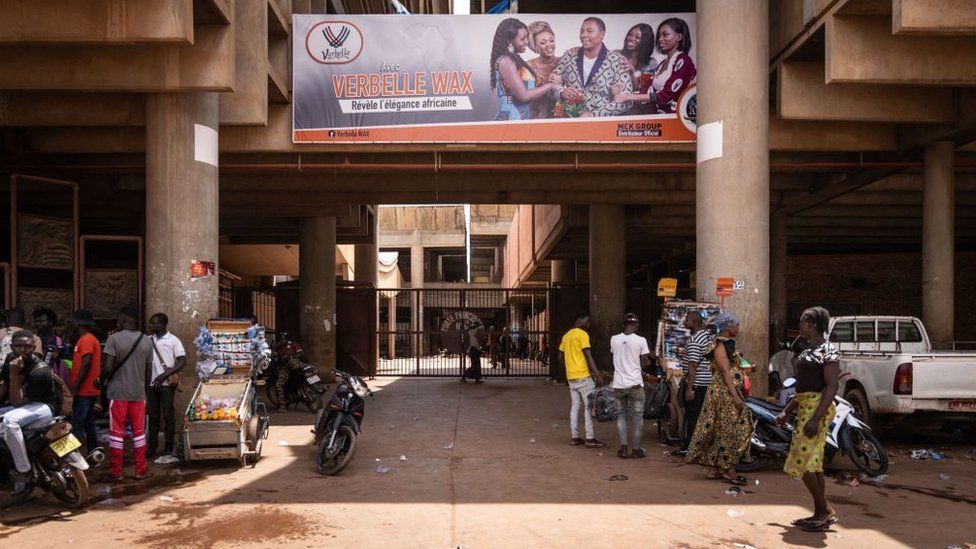
IMAGE SOURCE,AFP, Image caption, The gates to Ouagadougou’s main market have been shut and many roads are blocked off.
On Friday evening flanked by rebel soldiers in fatigues and black facemasks, an officer had read an announcement on national TV stating that they were kicking out Lt Damiba, dissolving the government and suspending the constitution.
That statement was also read on behalf of an army captain called Col Traoré, who said Lt Col Damiba’s inability to deal with an Islamist insurgency was to blame.
“Our people have suffered enough, and are still suffering”, he said.
Little is known about Col Traoré, the 34-year-old soldier who led an anti-jihadist unit in the north called Cobra.
His statement effectively declared himself the interim leader of Burkina Faso. But in Friday’s announcement came the promise that the “driving forces of the nation” would in time be brought together to appoint a new civilian or military president and a new “transitional charter”.
Lt Col Damiba’s junta overthrew an elected government in January citing a failure to halt Islamist attacks, and he himself told citizens “we have more than what it takes to win this war.”
But his administration has also not been able to quell the jihadist violence. Analysts told the BBC recently that Islamist insurgents were encroaching on territory, and military leaders had failed in their attempts to bring the military under a single unit of command.
On Monday, 11 soldiers were killed when they were escorting a convoy of civilian vehicles in Djibo in the north of the country.
The African Union has urged the military to “immediately and totally refrain from any acts of violence or threats to the civilian population, civil liberties, human rights”.
The Economic Community of West African States (Ecowas) earlier condemned the move too, stating it “reaffirms its unreserved opposition to any taking or maintaining of the power by unconstitutional means”.
The United States said it was “deeply concerned” by events in Burkina Faso and encouraged its citizens to limit movements in the country. France issued a similar warning to its more than 4,000 citizens living in the capital city Ouagadougou.
“We call for a return to calm and restraint by all actors,” a US State Department spokesperson said.
In January, Lt Col Damiba ousted President Roch Kaboré, saying that he had failed to deal with growing militant Islamist violence.
But many citizens do not feel any safer and there have been protests in different parts of the country this week.
On Friday afternoon, some protesters took to the capital’s streets calling for the removal of Lt Col Damiba.
The Islamist insurgency broke out in Burkina Faso in 2015, leaving thousands dead and forcing an estimated two million people from their homes.
The country has experienced eight successful coups since independence in 1960.
It comes after a meeting in Conakry yesterday between Guinea’s transition president, colonel Mamady Doumbouya, and the president of African football’s governing body, Dr. Patrice Motsepe, to discuss the withdrawal.
“I visited Guinea out of respect to the people of Guinea to discuss CAF’s willingness to advise and work together with the football stakeholders to construct and build football infrastructure and facilities in this country, in the light of the decision by CAF not to proceed with the 2025 Afcon in Guinea,” Motsepe said in a statement.
Cameroon hosted the 33rd edition which was won by Senegal. The 34th tournament will be hosted by Ivory Coast.
Ghana’s Thomas Partey is in Arsenal’s starting XI to face Antonio Conte’s Tottenham in the Premier League on Saturday morning.
Granit Xhaka will partner the Black Stars play in midfield while Brazil attacker Gabriel Jesus leads the attack.
Partey was ruled out of the Black Stars friendlies against Brazil and Nicaragua due to injury.
The midfielder who recently recovered from a thigh problem, was in the starting lineup for the Brazil tie last Friday but was withdrawn after he felt uncomfortable during warmup.
The former Atletico Madrid star was granted permission to leave Ghana camp in France for further assessment.
The 29-year-old has played four games in the Premier League this season.
Friday, September, 30 was a historical day in Ghana’s comedy history because of the number of people who attended the most anticipated comedy show “Too Cute To Be Mute” by one of the best stand-up comedians in Ghana Lekzy DeComic.
Cute Entertainment boss Emmanuel Nkansah Ansong professionally known as Lekzy DeComic announced Mr. Drew as the headline performing artiste for this year’s Too Cute To Be Mute comedy special.
As the organisers lined up the crème de la crème of Ghana’s top comedians and musicians, Chapter 2 of Too Cute To Be Mute promised to be bigger and more entertaining than the first edition, which was staged successfully at the Snap Cinemas last year and indeed it was better with four hours of rib cracking and laughing all night
Too Cute To Be Mute comedy night which was slated for September 30, 2022, at the National Theatre came off with Clemento Suarez as the official MC for the event and he really controlled the show from the beginning to the end,
Comedian Alo Wess was the first comedian to perform on the night with rib-cracking jokes which made everyone laugh to the core. He was followed by Papayaw, Jerry Ashinyo, Comedian Waris, and many others.
Kobi Rana and his dancers took over the stage with a top-notch performance.
Most people were waiting for Mr. Drew to show up and he finally arrived with his hype man, and both of the thrilled the fans for 10 minutes.
Comedy actors Jeneral Ntatia and Kojo Pjay, as well as fellow comedian and co-host of the Half Serious Show OB Amponsah, came through to support.
The biggest surprise of the evening was Benson Nana Yaw Oduro, also known as Funny Face, performing on stage for the first time in 10 years.
His performance was funny, emotional, inspirational, and educative, everybody was happy to see him back again.
Heavenly Jewels Chorale, a non-denominational orchestra group is set to host the fifth edition of its annual concert, Ayeyi Ndwom on Sunday, October 23, 2022, at the National Theatre.
The concert-themed, Great Is Thy Faithfulness, promises to give patrons a swell time as the choir renders popular local hymns at the 5pm show.
In a chat with Graphic Showbiz, Mr. Simon Adjei, Head of Publicity for Ayeyi Ndwom assured patrons of a beautiful time enjoying renditions of local hymns from the host group.
“The choir is more than prepared to make the evening a lovely one with renditions of common local hymns. However, our main focus is propagating the gospel of Jesus Christ through choral music.
“The first three editions were done in the church but last year’s was held at the National Theatre and it was super. This year’s will be at the same venue and I’m confident it will go well too,” he said.
He also disclosed that composer, Professor Yaw Sakyi Baidoo who is behind some of the popular local hymns in Ghana has partnered this year’s event and will be on stage.
Heavenly Jewels Chorale has over the years performed at national events and their creative performances have attracted the admiration of high-profile members and guests.
Famous Ghanaian musician, Black Sherif, has been spotted hanging out with Nigerian female vocalist, Tiwa Savage, in a video that was circulated on social media.
In a post shared by a social media user; ‘One blog stop’, the pair wowed people with a lovely interpretation of the famous legwork dance that goes with the vigorous shoulder dance moves.
It is uncertain where the two vocalists met, yet they appear to have had a decent bond while having fun together displaying different dance moves.
This video comes shortly after Ghana witnessed one of the biggest shows, the Global Citizen Festival a week ago at Independence Square where ten and thousands of people trooped in the watch American artistes, Usher and SZA perform.
Tiwa who was not billed to perform at the event shocked fans when she was invited on stage by Usher in the middle of his performance.
Tiwa jumped onto the stage barefooted with so much energy while performing her famous song, ‘Somebody’s Son’ among a few hit tracks to her credit.
The mother of one mounted the stage wearing a short sparkly skirt she matched with a stylish short-sleeved top that exposed her full-arm tattoos.
Other artistes who performed at the show were, Sarkodie, Stormzy, Stonebwoy, and Gyakie among others.
Black Sherif and Tiwa Savage display dance moves during a hangout
Elon Musk’s father felt like Clint Eastwood while taking out a mob of intruders in 1998.
In an interview with The Sun, Errol Musk recalled the 1998 incident, which took place at a rental property he owned in Johannesburg, South Africa. Errol with his daughter, Ali, who was six years old at the time, checking in on a property in the financial district of Sandton.
While painters were finishing up work on the property, a mob of intruders broke into the house. As the gunmen opened fire on Errol, he retreated to the bedroom to retrieve his .357 Magnum. Musk subsequently killed three of the men as he fought off the mob.
“As soon as they saw me, they started shooting at me,” he explained. “They opened up on me. I killed three. One bullet went through two of them.”
Errol continued, “I took the first guy out through the head. The police found him with the top of his head missing. I was using hollow point ammunition, so the round broke up, and the shrapnel hit the guy behind him in the chest. They ran as soon as I fired my first shot.”
Musk survived thanks to an expandable door, which the intruders’ gunfire hit instead of Errol. “The bullet hit it dead center; otherwise, it would have hit me square in the chest,” he said.
When asked if he felt like Clint Eastwood during the shootout, Errol replied, “Well, you can say so. Yeah, why not?”
Famous female comedienne, Jacinta Ocansey, has opined that several people are comedians but do not like the brand because of the classification of comedy as an unserious profession.
According to her, personalities like President Akufo Addo, Bawumia, and Shatta Wale can be classified as comedians because of their humorous personalities.
“There are so many comedians in this country today, it’s just that they have not called themselves comedians, but they are comedians, we know them”, she said.
“Shatta Wale is one of them, Abeiku Santana is one of them, Nana Addo is one of them, Bawumia is one of them”, Jacinta Ocansey explained to Akwasi Aboagye on entertainment review show on Peace FM.
In her opinion, comedy is one of the most respected professions in the world, however, it is unfortunate some people only look at it in a myopic manner.
“My profession is one of the most respected professions in the world,” she added.
She lamented the lack of support comedians receive.
Jacinta also used the platform to call on government and corporate bodies to sponsor stand-up comedy in Ghana.
Grammy-nominated Reggae musician Rocky Dawuni has waded into the ongoing Kirani Ayat’s copyright case against the Ghana Tourism Authority (GTA).
According to the celebrated Ghanaian Reggae star, most artistes in Ghana depend primarily on their investments to push their craft. Due to this phenomenon, he believes most artistes stop pursuing their careers during the process.
“Most artistes in Ghana do not have anything apart from their own investments that they put into the art.”
“In a lot of times, most of them even along the way, will stop their careers because they cannot sustain it,” Rocky Dawuni explained to Doreen Avio in an interview on Day Break.
Rocky Dawuni further indicated that if intellectual property rights laws are appropriately structured, an artiste will receive returns on their investments.
“If we have the laws and we make them better, then at least certain places that their works are used, they can be able to get some sort of returns for their work,” he indicated.
He further stated the ‘Sarki’ rapper had the legitimate right to protest because his (Ayat) intellectual property right was infringed.
Kirani Ayat called out GTA after President Nana Akufo-Addo posted a video on Twitter that contained contents of the rapper’s music video, ‘GUDA,’ without permission from the artiste.
The video was created and sanctioned by the Ghana Tourism Authority to promote the president’s ‘Visit Ghana’ campaign.
The midfielder for the Black Stars scored from outside the box with a stunning strike into the top right corner.
This goal was his first league goal for Arsenal FC in the 2022–23 English Premier League season.
Party passed a late fitness test after getting injured during warm up a few minutes to kick off against Brazil. The injury forced him to miss Ghana’s game against Nicaragua.
He was given permission to return to Arsenal to recover by the Ghana Football Association.
The 29-year-old has played four games in the league this season.
Morocco joins race to host the Afcon in 2025 after CAF stripped Guinea of the right to host the 2025 African Nations Cup (Afcon) tournament.
The Confederation of African Football (CAF) stated yesterday that bidding for the finals will reopen.
It comes after a meeting in Conakry yesterday between Guinea’s transition president, colonel Mamady Doumbouya, and the president of African football’s governing body, Dr. Patrice Motsepe, to discuss the withdrawal.
“I visited Guinea out of respect to the people of Guinea to discuss CAF’s willingness to advise and work together with the football stakeholders to construct and build football infrastructure and facilities in this country, in the light of the decision by CAF not to proceed with the 2025 Afcon in Guinea,” Motsepe said in a statement.
Historically, Morocco participated in the AFCON much later than other North African states. However, once Morocco made debut in 1972, Morocco emerged and became a fearsome power of the tournament, becoming the second North African side to win the AFCON at 1976. Ever since the victory, Morocco’s best performance was only runners-up in 2004.
Black Stars coach Otto Addo has received a stern warning from Ghanaian broadcaster Abeiku Santana to be careful with how he runs the national team.
Football, in the opinion of Abeiku Santana, is the lifeblood of the country, and as a result, many Ghanaians have put their trust in coach Otto Addo. For this reason, he cannot afford to manage the Black Stars team carelessly.
Abeiku Santana commented on the Black Stars’ recent 1-0 victory over Nicaragua and said that Otto Addo should hang his head in shame for failing to defeat the Americans convincingly.
“Otto Addo should lower his rattling. We have entrusted millions of hearts in your hands and football is something you don’t joke with.
“As Ghanaians, we don’t joke with our music, funeral, football and songs, so I don’t expect you to be happy scoring 1-0 against Nicaragua. Otto be serious,” Abeiku Santana stated.
The Black Stars would play at the 2022 FIFA World Cup where they would come up against South Korea, Uruguay and Portugal.
Party passed a late fitness test after getting injured during warm up a few minutes to kick off against Brazil. The injury forced him to miss Ghana’s game against Nicaragua.
Fakhruddin Azizi, the UNIDO representative in Ghana and Liberia, has urged the government to pay close attention to the mango and cassava sectors because they have a significant potential to draw investments that will spur inclusive and sustainable growth and generate jobs in Ghana and the wider Economic Community of West African States (ECOWAS) region.
At a press conference held last Tuesday during the 2022 edition of the West Africa Connect in Accra, Mr. Azizi responded to a question from the Business and Financial Times (B&FT) by saying that the development of new and long-lasting business relationships and increased trade between mango and cassava actors will significantly support the resilience and recovery of West African countries from the COVID-19 pandemic.
Mango is a popular tropical fruit of which consumption is rising. About 1.5 million tonnes of mango are produced in West Africa annually. Burkina Faso, the Ivory Coast, Gambia, Ghana, Guinea and Mali are major contributors in the production of mangoes in the sub-region.
Nigeria holds the leading position in the market, representing the largest cassava producer around the globe – Ghana ranking among the top-five cassava producers in Africa with an annual average production of sixteen million metric tonnes.
This second edition in Accra targetted mango, cassava and ICT suppliers, and facilitated linkages between more than 100 West African suppliers and regional and international buyers.
Touching on the importance of WAC to the sectors and their ability to lead the sub-region’s economic recovery, Mr. Azizi said the event will contribute actively in ongoing efforts to support the development of these two priority value chains.
“The United Nations Industrial Development Organisation, UNIDO, recognises the key role of this programme to strengthen the competitiveness of West African countries by improving the business environment and contributing to increasing the quantity and quality of products sold and exported from the region – while complying with the increasingly stringent market requirements on product quality, safety, health and environmental impact.
“In the current geopolitical context, the programme is also key for improving food security in the region – by modernising the agribusiness sector and supporting agri-food SMEs to meet the vital needs of local populations,” he added.
For him, WAC will be strategic in raising awareness about the key role of new digital technologies – including those associated with the fourth industrial revolution, in order to support the development of competitive, inclusive and sustainable agribusiness value chains in the region.
Acting Director of Trade-ECOWAS Commission, Kolawole Sofola, said the event’s main objective is to connect suppliers from the region with buyers inside and outside the region, in order to promote access to market opportunities and linkages with global value chains.
“These local firms have untapped potential, and this event will allow them to demonstrate the quality of their products and services – which we believe will lead to promising businesses and partnerships during these B2B sessions,” he stated.
Ruben Poolchund, Chief Officer for Africa, International Trade Centres (ITC), reiterated the Centres’ commitment to support the ECOWAS Agenda on trade and private sector development.
“We will continue to foster our collaboration with UNIDO, our sister agency, and with all UN partners in view of the UN Sustainable Development Goals (SDGs),” he stated.
As there is a rising global market for fruit, the Ghana Sale Promotion Authority (GEPA) has stated that it is targeting an annual revenue of US$2.8 billion from the export of semi-processed and processed coconut.
At the second International Coconut Festival in Accra, Deputy CEO of GEPA Samuel Dentu said the Authority has given the coconut business priority over the past five years while speaking to dignitaries on behalf of GEPA CEO Dr. Afua Asabea Asare.
“In 2017, GEPA started the coconut revitalization intervention with the obvious goal of reviving the at-the-time-ailing coconut business to increase the value chain’s supply capacity.
Since then, the crop’s potential for profit has increased,” he stated.
According to GEPA’s 2021 non-traditional export statistics, coconut raked in US$11.44million while coconut oil earned Ghana some US$6.99million. These figures represent an increase of 132 percent and 33 percent respectively over the 2020 figures.
“With these potentials, our goal is to work toward achieving an annual revenue of US$2.8billion in the very near future,” Mr. Dentu indicated.
“This tells us that with more strategic aggression in promoting more derivatives of coconut, we can gain a lot more ground”, he said, adding, “GEPA’s collaborative effort with the African Coconut Group, the Trade Ministry, MoFA, Ghana EXIM Bank and the Tree Crops Development Authority has contributed to the growing gains of the sector.”
The Minister of Food and Agriculture (MoFA), Dr. Owusu Afriyie Akoto, said coconut is one of the tree crops that the ministry is promoting under its Food and Agriculture Development Policy.
He said the sector had been identified by government as a major driver of the economy into the next decades based on the economic potential of the crop – including food security, environmental protection and poverty alleviation.
He indicated that growing interest in the health benefits of coconut and its value-added products has resulted in a growing demand for its consumption, alongside its various industrial uses.
“Global emerging trends in the coconut industry point toward value addition, and taking advantage of this countries such as Indonesia, Philippines, India and others have either transformed or are transforming their economies through value addition to coconut,” he added.
The Chairman of African Coconut Group, Davies Narh Korboe, expressed the Group’s continuous collaboration to stimulate trade and investment in the agri-food sector of Ghana in order to improve productivity and value as well as job creation.
It is estimated that about 500,000 people are currently employed in the coconut value chain across the country.
About the International Coconut Festival
Organised by Africa Coconut Group in collaboration with GEPA, the event’s second edition was on the theme ‘Repositioning Ghana’s Coconut Sector for Accelerated Industrialisation’, and called on industry players to help promote and develop the coconut industry while making it a significant and reliable revenue source.
With its maiden event in 2019, the festival’s objective is to bring investors from across the world to export coconut from Ghana.
The event was characterised by exhibitions of high and low-level technologies in the coconut industry, business seminars, financial support platforms, networking, talks and field visits.
Since the university’s transformation into a technical university a few years ago, he will be the first Chancellor.
The former Manhyia Member of Parliament (MP) for the New Patriotic Party (NPP) and educated physician will bring to the job a wealth of administrative, educational, clinical, and political economic knowledge to the university.
His main charge as a Chancellor is to help the university council to achieve the vision of the university, which is to “be a world-class technical university devoted to science, technology and entrepreneurship education,” through the provision of quality teaching, learning and research in engineering, science, technology and entrepreneurship to promote industrial development in Ghana.
Who is Dr Addo-Kufuor?
The immediate past Chairman of the Social Security and National Insurance Trust (SSNIT) is a fellow of the Royal College of Physicians, London and West African College of Physicians and the founder of Kufuor Clinic at Adum, Kumasi.
He has taught at the School of Medicine of the Kwame Nkrumah University of Science and Technology (KNUST) and has served as an Inspector of Examinations at the University of Ghana Medical School, Department of Medicine, and is a Member of the Court of Examiners responsible for assessing foreign-trained doctors wishing to practice in Ghana by the Ghana Medical and Dental Council.
He is also a three-time MP for Manhyia from 1996 to 2008 before it was divided into Manhyia North and Manhyia South.
While serving as MP, he was made Minister of Defence under the Fourth Republic.
Achievements
As an MP, he is credited for the Buokrom Estate Water Project, which brought a huge relief to the residents who had for years been faced with water problems.
His biggest project for the constituency was perhaps the Ash Town Community Centre. The centre has a library, computer laboratory, canteen, indoor games room, offices for the Manhyia Sub-Metro, a 300-seater capacity facility and a football field.
As a Minister of Defence, it was during Dr Addo-Kufur’s tenure that the Phase II of the 37 Military Hospital was constructed. The hospital was elevated to a Postgraduate Teaching Hospital.
The project consisted of a Polyclinic, an IT Centre, a Physiotherapy Department, a Male Surgical Ward, a Public Health Division, an Out-patient Clinic for Surgical Obstetrics and Gynaecology, Ear, Nose and Throat, Dermatology, and Medical Departments.
Other significant achievements of Dr Addo-Kufuor as a Minister of Defence included the construction of the New Burma Hall and Library, the Kofi Annan International Peacekeeping Training Centre, the Computer and Commercial Centre at Burma Camp, the Beijing Barracks, and the rehabilitation of the Nicholson Stadium.
It was during his tenure that the Postgraduate degree programme was introduced at the Armed Forces Staff and Command College.
Dr Addo-Kufuor also introduced the “Armed Forces Open Day” which was meant to improve relations between the military and the civilians, where civilians were encouraged to visit the barracks, interact with the service personnel and have a look at some of the military hardware.
The first chancellor of KsTU is expected to bring all these credentials to bear on the management and administration of the university and make it one of the best in the country.
About KsTU
Formerly known as the Kumasi Technical Institute (KTI), KsTU was established in 1954 to offer craft courses. It was converted into a non-tertiary Polytechnic status in 1963 under the Ghana Education Service (GES) to start offering, in addition, technician diploma and sub-professional courses.
The Polytechnic Law, 1992 (PNDC L.321) elevated the polytechnic to a tertiary institution to provide high calibre skilled manpower with reference to manufacturing, commerce, science and technology to act as a catalyst for technological development.
The Technical University Act 2016, (Act 922) converted Kumasi Polytechnic to the present Kumasi Technical University with the aim of providing higher education in engineering, applied arts, science technology-based disciplines, technical and vocational training.
In order to assist the nation’s housing shortage, the National Pensions Regulatory Authority (NPRA) has urged pension contributors to fully utilize the Pensions Act, 2008 (Act 766) to get a mortgage for the purchase of homes.
This is due to the fact that, notwithstanding the Act’s provision that accrued benefits may be utilized to secure a mortgage for the purchase of a principal dwelling, this provision has remained unused for more than ten years.
The call was made by David Tetteh-Amey Abbey, the authority’s deputy chief executive officer. He explained that sections 103 and 144 of the Act allowed contributors to use accrued Tier Two and Tier Three benefits to obtain mortgages for the purchase of their primary residence through a mortgage agreement without tax repercussions.
At the first edition of the Ghana Pension and Alternative Investment Summit in Accra yesterday, he said the implementation of the new pensions regime had accumulated GH¢40 billion in 12 years.
Out of that asset value, the private pension funds hold GH¢29.6 billion as of the first quarter of the year.
“One of these long-term productive investments is mortgage financing which has the potential of reducing Ghana’s housing deficit whiles offering appreciable value to the contributors of the pension schemes,” Mr Abbey said.
Globally, he added, it had been the practice that pension funds targeted and participated in long-term productive investment for the purposes of creating value and real impact on the economies of nations.
Section 103 (1) states that “A contributor may pledge or create a charge in respect of a part or all of the contributor’s accrued benefits”.
Summit
Yesterday’s summit in Accra was dedicated to exploring the country’s pensions and investment opportunities.
Held on the theme: Leveraging on pensions for mortgage financing, the summit brought together the senior executives and trustees from leading corporate and government pension schemes and corporate trustees, workers and union leaders to discuss opportunities around the country’s pension ecosystem.
Pension Act
Speaking on the topic ‘Perspectives on policy implications: Pension and Mortgage financing,’ Mr Abbey explained the benefits of Act 766 and what the various contributions meant.
He said contrary to the perception that pensions were only beneficial to contributors only after retirement, the Act had also made it beneficial for contributors in their active working period.
“For instance, sections 103 and 144 of the Act provide for contributors to use accrued Tier Two and Three benefits respectively, to secure mortgages for the acquisition of their primary residence through a mortgage agreement without tax implications.
“Additionally, Tier Two benefits could also be used as security for the acquisition of a primary mortgage. Unfortunately, that aspect of the act remains largely unutilised in spite of it being a laudable innovation,” the NPRA Deputy CEO said.
Legal framework
Mr Abbey said the Ghana Statistical Service reported a housing deficit of about 1.8 million in its recent report.
Thus to help resolve this dire challenge, the NPRA as a pensions industry regulator, has put together, a favourable and conducive legal framework through the Investment Guidelines for private pension schemes in line with the government’s objective of reducing the deficit further.
“The National Pensions Act 2008, Act 766 has the potential to transform primary mortgage ownership in the country. The opportunities presented by the act are enormous.
“Pension contributors can take full advantage of the act to facilitate the acquisition of a property through a mortgage.
“Pension Fund Managers can take advantage of the investment guidelines to enhance the returns on their assets under management,” Mr Abbey explained.
Pension act background
Giving a background to the act, the NPRA Deputy CEO said in 2004, the government established the Presidential Commission on Pension (PCP) to evaluate the existing pension system at the time and to propose reforms.
The PCP, he said, did extensive consultations both locally and internationally, resulting in the promulgation of the current National Pensions Act, and the establishment of the NPRA, among others.
Housing deficit
The Chief Financial Officer of Metropolitan Pensions Trust Ghana Ltd, Daisy Adjei-Boadi, stated that the housing situation in the country was still alarming in spite of efforts by successive political regimes to improve it.
The GSS, she said, had projected the current 1.8 million deficit to further escalate to two million, with an annual requirement of about 170,000 housing units.
Ms Adjei-Boadi said the country’s rapid growth in population was, therefore, not supported by a corresponding increase in the supply of housing units and the situation was further aggravated by a myriad of challenges, chief among them being mortgage financing.
She said pensions and mortgages had an intrinsic interrelationship.
“Not only do they both provide long-term financing, but essentially, they have a connection with human survival,” Ms Adjei-Boadi added.
Good idea but…
Some of the participants lauded the Pensions Act 766 which supports home ownership using one’s pension, describing it as a brilliant innovation.
However, they said it required some unorthodox financial engineering due to the issues with land ownership, the present financial and economic situation.
They said it called for strategic partnerships between the relevant service providers, including land owners with the support of the NPRA, to come up with workable plans to help workers, given the important link between safety, security of homes and productivity.
Pension Act 766 Tier Two
Section 103(1) of Act 766, allows the worker to assign the lump-sum benefit under any occupational pension scheme to secure a mortgage for the acquisition of a primary residence with the operative word being “assign” not transfer.
Any mortgage product should be based on the fact that the worker, the mortgagee, will still have the investment with the pension trustee but assigned to the bank, the mortgagor.
Tier Three linked Mortgage
Tier 3 is mainly the contributions for provident fund and personal pension schemes, to secure mortgages for primary residence.
Section 103 (2) states that “A beneficiary who enforces a pledge or charge created by a contributor is liable for any tax applicable to withdrawals under a scheme”.
Section 114 (2) states that “Despite subsection (1) a scheme may allow a member to use that member’s benefit to secure a mortgage for the acquisition of a primary residence but a member is not liable to pay tax on any withdrawal under this section.
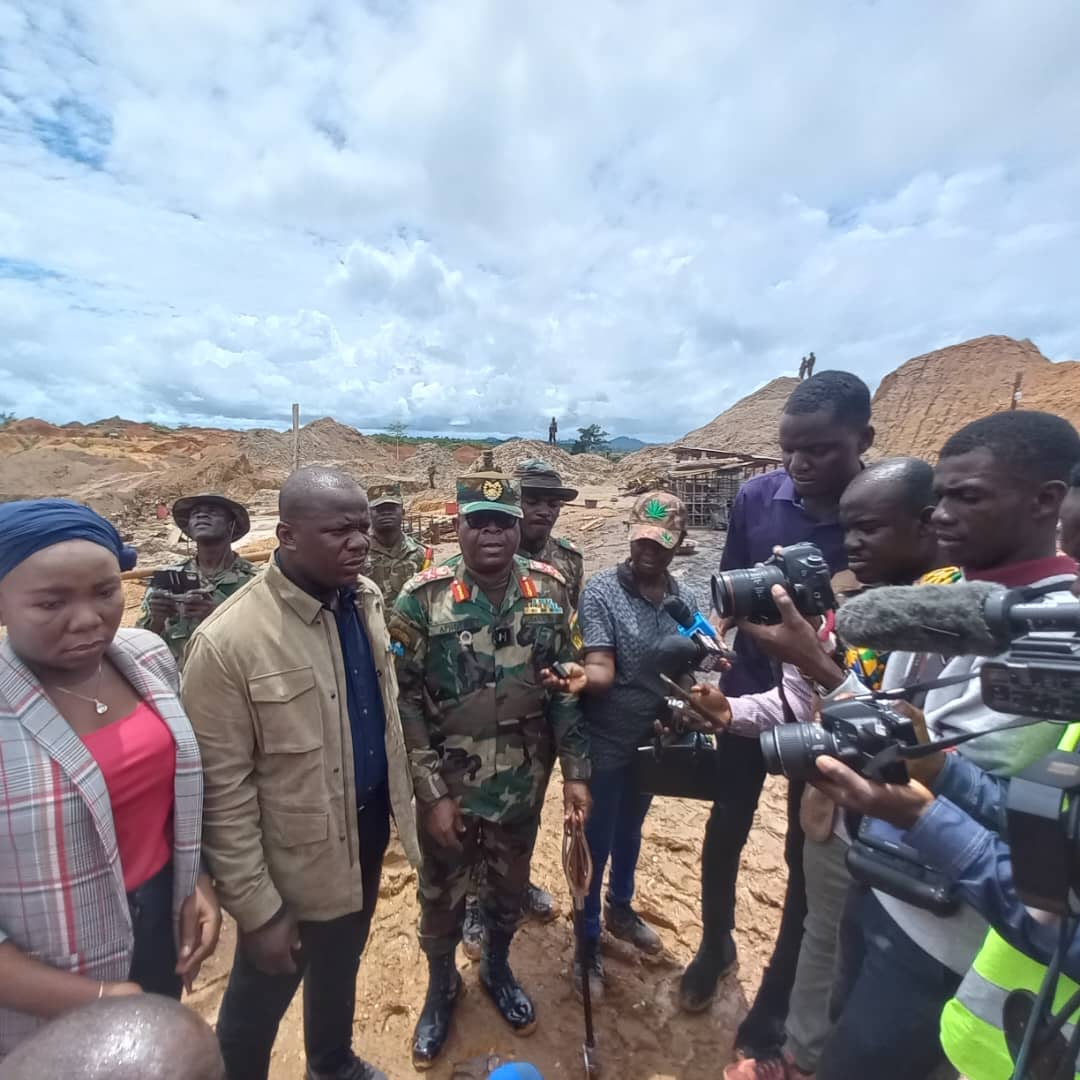
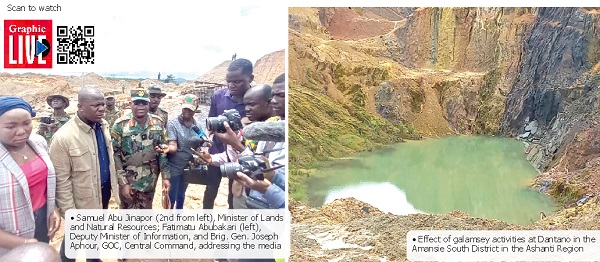
Samuel Abu Jinapor, the minister for lands and natural resources, was completely astounded yesterday when he saw the extensive destruction that unlicensed gold miners (galamsey operators) had wrought at Dantano in the Amansie South District of the Ashanti Region.
When he saw farmlands the size of four football fields (approximately eight acres) being destroyed by illegal miners and left with massive pits, he shook his head in disbelief.
Mr. Jinapor, who traveled to the region to assess the extent of environmental harm inflicted by galamsey operators, announced that he would be opening an investigation into the devastation.
Mr Jinapor visited the ‘Operation Halt II’ team that undertook a major operation in the area last Monday.
Questions
Mr JInapor wondered whether such vast devastation by illegal miners took place without the knowledge of the district assembly, chiefs, the police and the Minerals Commission.
He said he would be seeking answers from the Inspectorate office of the Minerals Commission.
The minister stated that the depth of the pits showed that such activities had been ongoing for years, and expressed the belief that the traditional and political leaders in the district decided to turn a blind eye to them.
Stakeholders
He said there was no way all the stakeholders in the community could feign ignorance of what went on.
Mr Jinapor urged all Ghanaians to get involved in the fight against illegal mining to protect the environment.
He said the fight should not be left only to the government.
He commended the General Officer Commanding the Central Command of the Ghana Armed Forces, Brigadier General Joseph Aphour, and his men for leading the fight against illegal mining in the region.
He assured them of the government’s support and told the team that they had the full support of the President to clamp down on all illegal mining activities in.the region.
Operations
Briefing the minister, Brig Gen Aphour said on Monday, September 26, 2022 at Datano and at Atwma Mponua, the team seized 11 excavators and burnt those that could not be moved.
He said the personnel were unable to make any arrest as the operators had left the sites before their arrival.
However, he said all their equipment had been destroyed and the excavators sent to some police stations.
International non-governmental organization Engage Now Africa (ENA) has encouraged the government to create specific regulations to safeguard the lives of people with albinism.
Although the constitution guarantees that every citizen will be protected from discrimination, stigmatization, and other forms of abuse, according to Kwame Andrews Daklo, the program coordinator for the organization’s albinism project, there is still a need for specific laws to protect the rights of particular groups.
“You need to establish what their requirements are if you want to take care of a particular set of individuals, and then you need to create the law that protects them,” he said.
The programme forms part of the organisations nationwide tour to sensitise the populace on albinism to promote inclusivity.
Mr Daklo, therefore, called on the government to adopt the African Union’s (AU) Action Plan on the rights of persons with albinism in Africa, which spans from 2021 to 2031.
Misconceptions
The Education Director for the organisation, Bishop Francis Ansah, who took patrons through some myths, dispelled a popular misconception that persons with albinism do not die but disappeared.
He explained that this was because persons with albinism were usually abducted and killed by people who use their body parts for rituals.
Bishop Ansah also stated that persons with albinism die of natural causes common of them being skin cancer as a result of sun rays affecting their skin.
“Persons with albinism do have vision problems due to the lack of pigment on their eyelids to protect their eyes from the ultraviolet sun rays,” he added.
He explained that marrying a person with albinism did not necessarily mean one would have children with the condition, adding that it depended on the genetics.
Furthermore, he made it clear that it was equally possible for dark skinned couples to give birth to a child with albinism if both parents carried the genes.
“We are one people. They breathe, eat, sleep and talk just like we do so we need to embrace them as brothers and sisters and not stigmatise them,” Bishop Ansah added.
Dan Botwe, the Minister of Local Government, Decentralization, and Rural Development, who made this claim, noted that the eight years of GSAM implementation with support from USAID had been advantageous for the nation, particularly the lessons learned to strengthen democracy and good governance at the local level.
Mr Botwe, in a speech read on his behalf at public accountability conference in Accra last Wednesday, said the GSAM had strengthened the capacity of civil society to advocate, monitor and investigate efforts of primary actors, particularly metropolitan, municipal, district assemblies (MMDAs) to ensure sustainable, accountable and inclusive delivery of quality services to citizens.
The rationale for GSAM activity was to address inadequate citizens’ engagement in local governance processes, increase access to information on MMDAs development processes, deal with real or perceived corruption due to weak oversight and poor service delivery.
The interventions from GSAM, the minister said, had contributed to improving the responsiveness of MMDAs to citizens’ demands and efficiency in the management and implementation of development projects in communities, working in close collaboration with key stakeholders.
Commendation
Commending USAID for the initiative, Mr Botwe said: “We are, therefore, interested in consolidating the gains made with regard to the management interventions that have generated positive results relating to accountability and transparency practices in the MMDAs.”
The Deputy Chief of Party for GSAM, Samuel Boateng, said key lessons learnt from the project included the fact that there was a need for mixed communication methods to reach citizens with needed information.
He noted that prior to the GSAM activity, MMDAs relied mainly on assembly and unit committee members, traditional authorities and some opinion leaders to provide information to citizens on capital projects.
However, many citizens remained poorly informed about capital projects because these leaders mostly did not relay such information to citizens.
Other lessons were that the MMDAs had less control of centrally-funded projects. He explained that MMDAs had little control over projects that were implemented by the central government and as a result exercise weak oversight of these projects.
He said the impact of GSAM had been positive, revealing that 51 per cent of 880 community priority needs identified with GSAM support were integrated and budgeted for in the 2022-2025 Medium-Term Development Plans (MTDPs) in 50 districts.
Setbacks
The Chairperson for Star Ghana Foundation, Dr Esther Ofei Aboagye, said interventions such as the GSAM provided civil society organisations (CSOs) opportunities to initiate action, collect data, build capacities, engage district-level authorities and back communities to exact accountability.
The mission director of USAID, Kimberly Rosen, said a USAID-commissioned impact evaluation of the GSAM activity revealed that citizen action with the support of local CSOs had improved consultation between citizens and their respective local governments on infrastructure development.
The treatment meted out to some employees of the regional health service who applied for the position of district directors of the health service in the most recent hiring process by the Ghana Health Service has been referred to as “unfair” by the Upper West Region National Democratic Congress (NDC) Caucus in Parliament (GHS).
The eight applicants from the region who received the highest national score of 75.5% were all allegedly excluded for unjustified reasons, according to the complaint, and the procedure was not transparent.
The Secretary of the Upper West NDC Caucus in Parliament, Dr Sebastian N. Sandaare, made the call at a press conference in Parliament yesterday.
Discrimination
Dr Sandaare, who is also the Member of Parliament (MP) for Daffiama-Bussie-Issa, said before November 2021 the GHS commenced internal recruitment to fill vacant district-director positions across the country.
It said the process, which involved an initial shortlisting of candidates, a written examinations and a face-to-face assessment interview, saw eight staff in the Upper West Region being shortlisted for the written exam and the subsequent assessment interview.
“It is worthy of note that all eight applicants were successful at the written exam. In fact, the highest national score of 77.5 per cent came from the region with a regional average score of 50.7 per cent,” he said.
“However, and curiously, in the next stage which consisted of the face-to-face interview, results of which were not made public, none of the applicants was deemed to be successful,” he said.
Dr Sandaare said the GHS went ahead to make appointments without any form of notification to the applicants, some of them were currently acting as district directors in the UWR, on the outcome of the interview.
Unjustified excuses
However, he said following a persistent request for the results of the interview and a justification for the failure to appoint anyone from the region, a letter dated August 26, 2022, from the office of the Director-General of the GHS indicated that six out of the eight applicants did not have the requisite knowledge and understanding of the management of district health directorates.
Per the letter, he said the other two applicants were disqualified because they had not served the required number of years to qualify them for the position.
“We consider the recruitment process as unjust, unfair, discriminatory and an abuse of the rights of the applicants,” he said.
Ensure regional balance
Given the treatment meted out to the applicants from the region, Dr Sandaare expressed worry that the conduct of the GHS could be “a big disincentive” to staff who had dedicated themselves to serve in one of the most deprived regions of the country”.
“It also communicates the unfortunate impression that the staff in the region are undeserving of such appointments and can thus negatively affect the staff turnover in a region that is already struggling with staffing deficit,” he said.
25 finalists teams have been accepted to begin their work on the Greater Accra Edition of the Ghana Science and Tech Explorer Prize (GSTEP) Challenge.
After being inducted, the teams of junior high school (JHS) students have two months to design and develop their prototype (project for the competition), which is scheduled for December of this year. The team with the most completed prototypes will receive the grand prize.
Another set of 25 teams will be selected from the Ashanti Region soon to compete with the Greater Accra teams during the finals, bringing the finalists for the ultimate to 50 groups nationwide.
The Director for International Development at Challenge Works UK, Ms Constance Agyemang, said a total of 800 entries were submitted for the Greater Accra Edition and after a thorough assessment by independent assessors, the 25 teams were selected.
“This is a lifetime opportunity hence, it is essential that you take advantage of it, and give out your best in building your prototypes,” she said.
The Director of Science Resource Centre of the Ghana Education Service (GES), Olivia Opare, enumerated the importance of STEM education and urged the participants to take the competition seriously.
She inspired them to use critical thinking, research and innovative ideas to bring up solutions to issues threatening their communities and the country as a whole.
Future leaders
Artificial Intelligence (AI) and Digital Innovation Manager of Fondation Botnar, Siddhartha Jha, for his part, indicated that the programme was designed to prepare the leaders of tomorrow who could address societal challenges effectively by putting technology and critical problem-solving to good use.
As part of the event, the finalists participated in a series of workshops aimed at providing them with skills to enable them to carry out their activities effectively during the programme.
The workshops were focused on STEM-based education, team building and collaboration, entrepreneurial skills, business plan development, prototyping and project development.
The finalists also participated in a drone flying experience led by Ghana Flying Labs and have also been assigned mentors who would be taking them through a series of mentorship sessions for two months.
Funding source
GSTEP is funded by Fondation Botnar, a Swiss philanthropic foundation working to improve the health and well-being of young people living in cities around the world.
The programme is also supported by some institutions in Ghana to advance the course of practical learning across the two participating regions (Ashanti and Greater Accra). Other institutions which are collaborating towards the success of the project are the Graphic Communications Group Ltd, Fidelity Bank, Stanbic Bank and Multimedia Group.
Alban S.K. Bagbin, Speaker of Parliament, has emphasized the need for more money and investment to support WASH (water, sanitation, and hygiene) access in slum areas.
Furthermore, he added, more money must be allocated fairly to guarantee that all communities in need of WASH facilities are taken care of.
Over 31% of rural regions still practice open defecation, a practice that is harmful to one’s health and well-being, he asked. How, he asked, can Ghana advance in its development agenda?
Parliamentary dialogue
Mr Bagbin said this in a speech read on his behalf by his counsel, Magnus Kofi Amoatey, at a parliamentary dialogue in Accra yesterday[September 29, 2022] on ways of enhancing WASH services delivery in the northern part of the country.
Organised by World Vision Ghana, a non-governmental organisation, the event brought together 12 Members of Parliament (MPs), mostly from the northern part of the country, policy makers on WASH and other civil society organisations.
It was on the theme “Prioritising WASH in Northern Ghana for accelerated socio-economic wellbeing.”
The National Director of World Vision Ghana, Dickens Thunde, said MPs as direct representatives of people played a key role in the quest to improve access to water, sanitation and hygiene facilities as part of the sustainable development goals.
Statistics
Statistics from the 2021 population and housing census (PHC) revealed that the five northern regions did not have adequate access to WASH services and facilities as compared to other regions.
The PHC indicates that although averagely 87 per cent of Ghanaians have access to some form of safe drinking water, the five regions in the north fell below the national average to about 60 per cent.
For instance, while Greater Accra and Ashanti Region had 97.7 and 94.5 per cent respectively, North-East had 54.5 per cent.
Again, while the PHC indicated that the national average for open defecation was 17.7 per cent, the five northern regions had more than 50 per cent of its population practicing open defecation.
Savannah Region and Upper East Region recorded open defecation rates of 68.5 per cent and 68.4 respectively as against the national of 17.7 per cent.
MPs comments
Commenting on the issue, the MP for Garu in the Upper East Region, Albert Akuka Alalzuuga, said there was inequality in the distribution of resources with the five northern regions at a disadvantage.
“People in certain areas due to influence and political expediency are able to attract development projects, but others are not able to do that and this should not be the case, he said.
The MP for Ahafo –Ano North, Suleman Adamu Sanid, said the country would not be able to effectively address the problem of lack of WASH facilities without tackling the problem of settlement.
According to him, people tend to create new settlements without taking into consideration the availability of social amenities.
“A borehole is drilled in one community and in a short time another person has created another settlement not far and is calling for water. We should not allow people to settle anywhere where access to amenities does not exist,” he said.
The MP for Tempane, Lydia Lamisi Akanvariba, said apart from providing WASH facilities in deprived communities, there was the need for increased education to encourage people to have attitudinal change on how to promote hygiene.
“Some people have washroom facilities in their house but they feel it is good to do open defecation. We must educate people about the negative effects of open defecation,” she said.
Noble Agbenorto, the headteacher of Tsrukpe-Zanukorpe Primary School in the Volta Region, has been charged with growing marijuana on his property. The charges were brought before the Ho Circuit Court.
His pleading was ignored.
Chief Inspector Noah Amuzu presented the case’s facts to the court, which was presided over by Mr. Felix Datsomor. He explained how members of the Drug Law Enforcement Unit had detained the Tsrukpe-Zanukorpe headteacher after receiving a tip.
The court was informed that the accused then took the police to his farm, where it was discovered that he had planted cannabis-related plants among other crops.
During interrogation, Agbenorto, 43, admitted the offence and told the police that he was only cultivating the narcotic plant on a very small scale for health purposes and not for commercial purpose, the prosecution added.
The accused was granted bail in the sum of GH¢30,000, with two sureties.
However, he was unable to fulfil the bail conditions and was, subsequently, led into police custody.
Hearing continues on October 12.
In July this year, a joint security agencies operation led to the destruction of farmland cultivated with marijuana at Dodi-Asuboe in the Kadjebi District in the Oti Region.
The security team comprised the Kadjebi and Jasikan Districts Division of the Ghana Police Service and the Drug Law Enforcement at the Narcotic Control Commission of the Regional Headquarters in Oti.
People utilizing other structures, like as containers, kiosks, and some buildings, were compelled to leave and stay with friends and family because they were similarly and partially inundated.
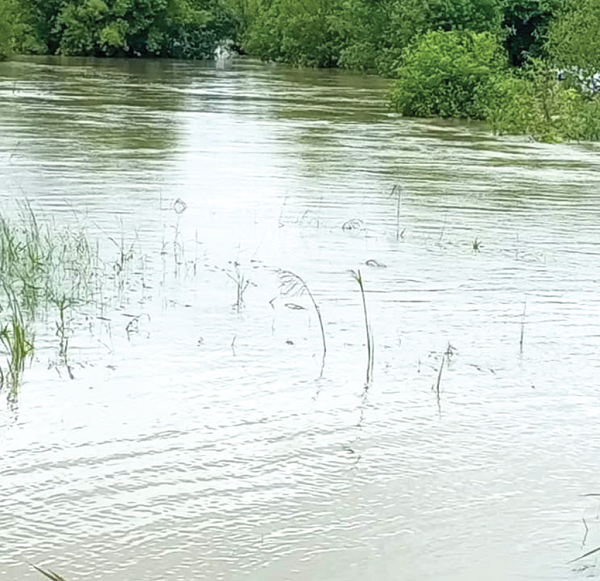
This is the first time in over 50 years that Kyebi has witnessed flooding of this magnitude and it is being attributed to the impact of illegal mining that has impacted the Birim River in Akyem Abuakwa area.
An eyewitness, Francis Kodua, told the Daily Graphic that the rains partially submerged about 37 buildings forcing the dwellers to move out to stay temporarily with friends and relatives at more safe and higher areas.
He said although some houses were submerged, areas seriously affected by the torrential rains were the Kyebi Court, Kyebi Presbyterian College of Education and the Abuakwa State
College
No casualty was recorded, but according to the eye witness, a number of animals such as goats, sheep and fowls were drowned.
He indicated that those affected were living in fear of the rains recurring and therefore, appealed to the National Disaster Management Organisation (NADMO) for assistance.
The eyewitness said the Abuakwa South Municipal NADMO Coordinator, Police Commander and the Fire Service Commander were all at the scene to assess the situation.
Deputy Ranking Member on the Mines and Energy Committee of Parliament has said that mining company, Akonta Mining Limited breached the law when they move their activities into the Tano Nimiri Forest Reserve in the Amenfi West Municipality in the Western Region.
According to John Jinapor, the fact that the company, which is owned by NPP’s Ashanti Regional chairman, Chairman Wontumi, has a prospecting license does not give it the right to move into forest reserves.
Speaking on Newsfile, he explained that mining firms need other permits including environmental permits aside from their prospecting licenses; adding that forest reserves have been excluded from mining activities.
“So clearly there is some blatant disregard for the law by some people who feel untouchable. Let’s face it, but for the fact that Chairman Wontumi was the Ashanti Regional Chairman of the NPP, could he have moved into the forest and start degrading it the way he was doing?” he quizzed.
Mr Jinapor added that “what Akonta mining was doing there (Tano Miniri Forest Reserve) is illegal so his firm has breached the law. This Akonta Mining has been there for a long time, it is not yesterday. I have seen videos…the chiefs have been complaining but the man feels that he is big, he is above the law, he has some political wit and so he can do what he wants.”
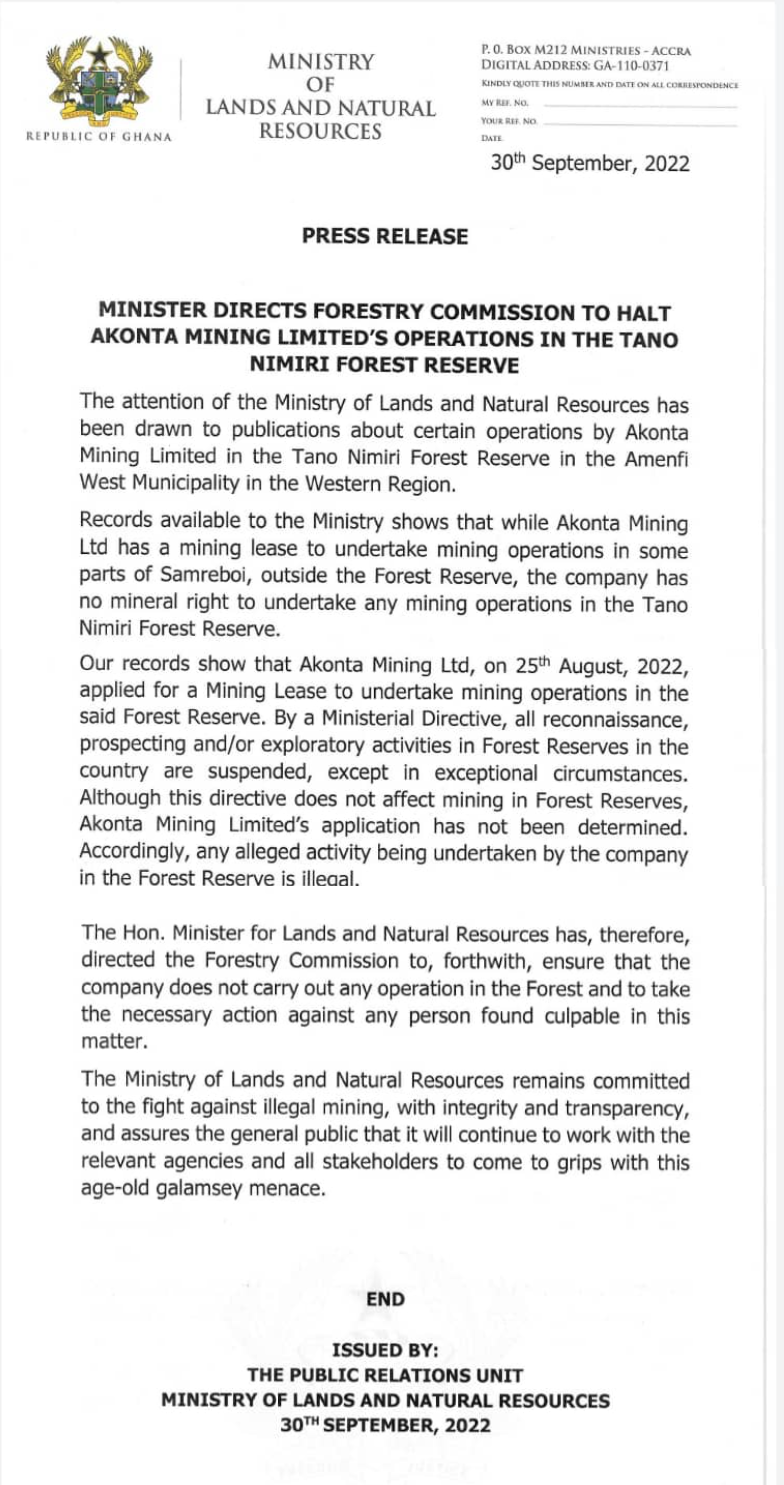
His comment follows a directive from the Lands Ministry to Akonta Mining Limited to stop operations in the Tano Nimiri Forest.
In a statement issued on September 30, the Ministry said even though Akonta Mining Limited has a mining lease to undertake mining operations in some parts of Samreboi, outside the Forest Reserve, “the company has no mineral right to undertake any mining operations in the Tano Nimiri Forest Reserve”.
The statement said the sector minister, Samuel Abu Jinapor, has therefore directed the Forestry Ministry to, “forthwith, ensure that the company does not carry out any operation in the Forest and to take the necessary action against any person found culpable in this matter”.
The directive came after two persons sustained gunshot wounds at the Akonta Mining firm in Samreboi in the Western Region.
This happened after a section of the youth reportedly prevented personnel of Akonta Mining Limited from sending more mining equipment into the Tano Nimri Forest reserve on Thursday.
The company is said to have been mining in the reserve despite a declaration by the government that it has not granted any entry permit into the forest reserve.
Meanwhile, Mr Jinapor stated that the President and government must show their commitment to dealing with galamsey by prosecuting “their own people”.
“If they go arresting the small fishes while their men are blatantly disregarding the law and moving into forest reserves and degrading the forest, they’re sending the wrong signal. There is evidence that what this company has done is illegal, they moved into the forest, degraded it, without authority,” he said.
He added that “I expect that this government and their ministers will take this on and use this as a test case, and prosecute them, so that we would know the government is indeed committed to fighting illegal mining.”
For the fourth year running, Prudential Bank Limited, a renowned local bank, gave a Nissan pick-up truck to the Ghana Teaching Council’s annual awards ceremony for teachers.
The automobile serves as the prize for the first runner-up in this year’s Ghana Teacher Prize, which was introduced in Accra in August.
Thomas Broni, the bank’s Executive Head of Operations, who gave the presentation, stated that the bank’s support for education was compatible with its commitment to making sure that society benefited from the bank’s economic operations.
He said the bank was honoured to partner with the Ministry of Education, the National Teaching Council, the Ghana Education Service (GES), the Ghana Teacher Prize brand and allied institutions to motivate teachers.
Mr Broni further stated that quality education for the citizenry was critical for the growth and development of the nation and the teacher was at the centre of the realisation or otherwise of that aspiration.
As the theme for the 2022 World Teachers’ Day celebration states: “the transformation of education begins with teachers”.
“Educational transformation requires making deliberate positive systemic changes to the prevailing educational model. Clearly, if teachers do not play their role in the educational transformation process, there would be no transformation in the country’s educational system,
“The bank’s support for the Teacher Prize Award over the years is thus aimed at motivating teachers to continuously play their vital role in Ghana’s educational transformation agenda and to continue to inspire teachers to give off their best,” he stressed.
NTC
The Registrar of the National Teaching Council (NTC), Dr Christian Addai-Poku, who received the vehicle on behalf of the Ghana Teacher Prize, commended the bank for its contribution towards motivating teachers to work efficiently and effectively.
He said teachers had contributed to the quality of education in the country and should be awarded, to help instil competition among them for effective delivery. He congratulated the teachers, who would emerge as award winners at the upcoming ceremony, on their hard work and dedication and urged other teachers to work hard to be winners next year.
Dr Addai-Poku said recognising teachers who had exceptionally executed their mandate was in the right direction and he was glad that Prudential Bank Ltd was associated with this good call. He further reiterated that other corporate bodies should emulate what the bank was doing in the educational space. The awards scheme is in recognition of hardworking teachers and their contribution to the improvement of teacher ethics and education outcomes in the country.
Ghana Teacher Prize
The Ghana Teacher Prize started 27 years ago as “Best Teacher Awards” but it was rebranded in 2018 as “Ghana Teacher Prize” (GTP) which mimics the global standards in rewarding hardworking teachers across the country. Over the years, deserving teachers have won several prizes such as houses, cars, as well as other financial rewards to inspire other teachers to follow suit.
This year’s ceremony comes off in Tamale.
The event will commence with a two-day symposium and exhibition at the Modern City Hotel, Tamale from Monday, October 3 to Tuesday, October 4 2022, and climax with a grand durbar at the Multipurpose Hall of the University of Development Studies, UDS Tamale Campus on the World Teachers’ Day slated for Wednesday, October 5, 2022.
President Nana Addo Dankwa Akufo-Addo will be the Special Guest of Honour at this year’s celebrations.
Isaac Bampoe Addo, the executive secretary of the Civil and Local Government Staff Association of Ghana (CLOGSAG), has urged the Public Services Commission (PSC) to assist in protecting the civil and local government services from political meddling and abuse.
He said the commission might create regulations by constitutional instrument for the effective and efficient discharge of its duties under this Constitution or any other law, subject to the approval of the President, as stated in Article 197 of the 1992 Constitution.
According to Mr. Addo, when the Constitution is changed, it will ensure that no parallel institutions are established to suit the narrow interests of politicians and, to a considerable part, will also avoid duplication of civil and local government tasks.
He was speaking at the Fifth Nathan Anang Quao Lectures in Accra yesterday on the theme: “Abuse of political power in the Ghana Civil Service: the bane of national development”.
It was attended by staff of CLOGSAG, the media and the general public.
Neglect
According to Mr Addo “we are where we are because we have neglected the development of the civil and local government services for political expediency”.
He, however, said no government could achieve its objectives without a well-motivated, properly structured and well-resourced administrative machinery.
The executive secretary further cautioned politicians to avoid the temptation of “creating avenues of employment for their teeming supporters to prevent unnecessary duplication of efforts and wanton dissipation of scarce government resources”.
He also alleged that the situation had led to the phenomenon of “goro boys” where cohorts of politicians interfered with the work of established government institutions.
Mr Addo, however, acknowledged that there had always been a fine blend of politics and administration in the work of the civil service to achieve the purpose of governance, adding that civil service administration could not be divorced from political influence.
Fourth Republic
The executive secretary also claimed that political interference in their work had intensified in the Fourth Republic due to a number of factors which included the winner-takes-all system, creation of jobs for “the boys,” campaign resources and loyalty, ‘moneycracy’ associated with political campaigning, patronage and clientelism, as well as involvement of bureaucrats in politics.
“Although strengthening of our existing laws will help curb this phenomenon, it is recommended, among others, that a review of the President’s power of appointment would help minimise politicisation in the country’s bureaucratic set-up” Mr Addo said.
He said the difficulties in civil and local government services now was how to “navigate” the thin line of being professional and implementing programmes of succeeding regimes to enhance the welfare of the polity without necessarily eliciting political tags.
“In our quest to be professional in our work and stick to the principles underpinning the service, we end up courting disaffection from the political divide,” Mr Addo said.
Also, he said compliance of policies of a particular government or politician also created a delicate situation for most civil servants, particularly the senior ones due to the fact that “work ethics are misconstrued as allegiance to the government of the day”.
The executive secretary cited instances of intrusion to include “tinkering” with institutional arrangements without recourse to their respective governing councils and the recruitment of “party apparatchiks” as consultants to perform routine civil service functions and paying them higher unearned salaries.
He alleged that it was such practices that had led to the ballooning of the civil service wage bill as reported in the 2020 Auditor-General’s report of ministries, departments and agencies, as well as metropolitan, municipal and district assemblies.
Dr. Caroline Reindorf Amissah, Deputy Chief Executive, Mental Health Authority, and Dr. Olivia Agyekumwaa Boateng, Head of Tobacco & Substance Abuse Department, Food & Drugs Authority, are pictured with Mahama Asei Seina, Deputy Minister of Health, who is seated third from the left.
They are accompanied by other dignitaries and attendees.
Illustration: ERNEST KODZI
A five-year strategy plan has been unveiled by a coalition of public health experts and members of civil society organizations (CSOs) to address alcohol misuse and other alcohol-related problems.
The strategy, which spans September, 2022, to August, 2027, is aimed at preventing and reducing alcohol intake to help attain goals and targets as contained in the sustainable development goals (SDGs), particularly Goal 3.5 which states that “strengthen the prevention and treatment of substance abuse, including narcotics drug abuse and harmful use of alcohol”.
The coalition, also known as the West African Alcohol Policy Alliance (WAAPA), plans to ensure a professional network of alcohol relevant evidence-based research and reporting to influence alcohol policy in the sub-region and increase universal, equitable and affordable access to rehabilitation of people with prolonged alcohol issues.
It will also mainstream mental health in alcohol harm reduction strategies and ensure high visibility on policy engagement with development partners and governments.
Commitment
A Deputy Minister of Health, Mahama Asei Seini, said the government was committed to ensuring the successful implementation of the strategic plan.
“The Health Ministry will continue to commit funds and expertise through its departments and agencies to ensure the implementation of the alcohol policy and its related legislations and action plans towards the attainment of a global alcohol action plan,” he added.
The deputy minister, therefore, urged the World Health Organisation and other partners to support the implementation of the new plan to make the sub-region alcohol-harm-free.
Intervention
The Director of the Tobacco and Substance Abuse Directorate of the Food and Drugs Authority (FDA), Dr Olivia Boateng, also said the plan was a welcome intervention in the agency’s fight against the harmful use of alcohol, particularly in the sub-region where alcohol use accounted for 7.1 per cent and 2.2 per cent of the global burden of disease for males and females respectively, according to WHO.
She highlighted some of the steps taken by the authority over the years to combat the harmful use of alcohol and said it was also drafting and reviewing the Harmful Use of Alcohol Regulations Act, 2021.
“The regulations, among other things, criminalise the creation of conditions favourable to the use of alcoholic drinks.
“It also provides for the procedure to apply for licenses and the power to close down premises if the FDA considers it necessary in the public interest,” Dr Boateng added.
The separation of aggregates from the binding substances, roughening of the surface, depressions, mesh-like fissures known as “alligator cracks,” potholes, and enormous excavations commonly referred to as “craters” are examples of road flaws.
The situation has resulted in the slow movement of vehicles on the 10-lane highway, leading to the build-up of heavy traffic in the area, especially during rush hours.
There is another crater on the side road on the Mallam-Odorkor side of the road as well as potholes on the opposite side travelling from Kaneshie towards Mallam, as well as on the inverse flow of traffic from Mallam towards Kaneshie.
Upon reaching the craters from either end of the road, the drivers are compelled to slow down to pass through the craters.
Other dangerous spots on the stretch are near Accra Academy, Dansoman Junction, Darkuman Junction, Odorkor and Sakaman.
The situation is worse at night when there is poor visibility. At Odorkor, some motorists meander their way around the craters so that they do not damage their vehicles and in order to move a little faster.
However, in the course of meandering, they sometimes come close to grazing the sides of vehicles, creating panic.
Drivers using the inner lane from the Busia Junction, turning towards Odorkor are also affected by the problem.
Observations
The Daily Graphic team witnessed several incidents during a visit to the traffic lights area last Tuesday to observe the situation.
For instance, in the morning, while the traffic congestions stretched as far as to the Sakaman Junction for vehicles coming from the Mallam, the traffic jam stretches from the Darkuman Junction towards the Odorkor traffic lights for those coming from Kaneshie going to the opposite end in the evening, about 500 metres long.
Motorists’ concerns
In separate interviews, motorists who ply the Dr Busia Highway expressed concern about the situation in view of the precious hours they spent in traffic to go through the area.
They said the situation required urgent attention to ensure the free flow of vehicles so as to boost productivity.
One of such motorists, Yaw Ansah, said driving through the Odorkor traffic intersection had been ‘hellish’ as a result of the time spent in traffic.
“This place used to be one of the free flowing traffic areas on the Dr Busia Highway but unfortunately, that has changed,” he said.
Another motorist, Moses Arthur, said the situation was serious, especially with the prices of petroleum products, adding that “we end up burning all the fuel we buy with our money. Look at fuel prices nowadays, master, something must be done now,” he said.
A resident at Odorkor, Uncle Sam, said the craters could have been stopped from expanding given that they started very small.
“The craters here started very small but because we left them unattended, they have expanded, now see the problem we are having. These must be patched immediately to ease the travelling on the road,” he said.
A resident of Kasoa, Efo Kwaku, who uses the road daily, said the entire stretch needed some work but in the short-term, the Odorkor traffic area needed urgent attention before the unexpected happened.
‘’I have seen some drivers escape accidents by the skin of the teeth when they attempted meandering round those gaping holes.
“Let us not wait for an accident to happen before we set up a committee to, as usual, investigate a problem whose solution we all know,’’ he said.
Road profile
The Dr Busia Highway, previously known the Kaneshie-Mallam High Street, was constructed in 1991 by Construction Pioneers (CP).
The road links the Kaneshie to Odorkor and joins the National Road One (N1) at Mallam.
It was named the Dr Busia Highway after Dr Kofi Abrefa Busia, the Prime Minister of the Second Republic who had his private residence along the road at Odorkor (Busia Junction).
Notable places on the stretch include the Kaneshie First Light, Police Quarters, Atico Junction, Dansoman Junction (Hansonic), Darkuman Junction, Odorkor, Sakaman Junction and the Mallam Junction.
During a courtesy call on Alhaji Abubakari Inusah, the Chief Director of the Upper East Regional Coordinating Council, COP Maame Yaa Tiwaa Addo-Danquah (center) makes a remark.
Nana Antwi, the Deputy Executive Director in charge of Operations at EOCO, is watching.
She claimed that because criminals were well-organized, it was crucial for all law enforcement organizations to be similarly organized in order to deal with them.
“We can only be better organised when we effectively collaborate and cooperate with another and provide the needed assistance to each other in our quest to efficiently tackle crime in the country,” she said.
The visit formed part of a familiarisation tour, the first since she assumed office as the head of EOCO.
She was accompanied by the Deputy Executive Director in charge of Operations at EOCO, Nana Antwi and the Director of Administration, Edward Cudjoe.
Firstly, she paid a courtesy call on the Chief Director of the Upper East Regional Coordinating Council (RCC), Alhaji Abubakari Inusah, and also visited offices of the Bolgatanga Taxpayer Services Centre of the Ghana Revenue Authority (GRA) and the regional office of the National Intelligence Bureau (NIB).
COP Addo-Danquah noted that EOCO could not discharge its mandate alone, and as such would need the collaborative support of other security and law enforcement agencies .
“Although the already existing collaboration between EOCO and other security agencies is very good, there is the need for the scaling up of the partnership for our mutual benefit.
“The essence of my visit since assuming office is to meet with key stakeholders like the Ghana Police Service, GRA, Ghana Immigration Service (GIS), NIB whose work directly impact on the work of the EOCO too” she said.
She stated, for instance, that combating anti human trafficking which was part of EOCO’s mandate, always called for the support of the immigration service to be able to arrest perpetrators and bring them to book.
“As law enforcement agencies, none of us can work in isolation and as such there is the need for us to build a mutually beneficial relationship so that we can assist each other in the discharge of our respective mandates,” she said.
Raking more revenue
The Executive Director indicated that her outfit would offer the needed support to the GRA to rake in more revenue for the government to drive the development of the country.
She noted that EOCO would continue to go after private businesses who operated on the blind side of the GRA to evade tax as well as others who under-declared their profits in order not to pay the appropriate tax to the state.
In protecting the public purse, COP Addo-Danquah said EOCO would continue to recover funds from persons indicted in the Auditor General’s report and monies paid back into the consolidated fund.
“Those indicted in the AG’s report that we think are prosecutable will be thoroughly investigated and dockets forwarded to the Attorney General’s office for possible prosecution,” she stated.
The Deputy Office Manager of the Taxpayer Services Centre of the GRA, Bolgatanga, Alexander Nyarko, in a brief remark, commended EOCO for its support to the GRA in meeting its revenue targets.
For his part, Alhaji Inusah appealed to EOCO to assist the Regional Coordinating Council to deal with absenteeism among some staff of the 15 Municipal and District Assemblies (MDAs) in the region who did not go to work but drew their salaries on a monthly basis.
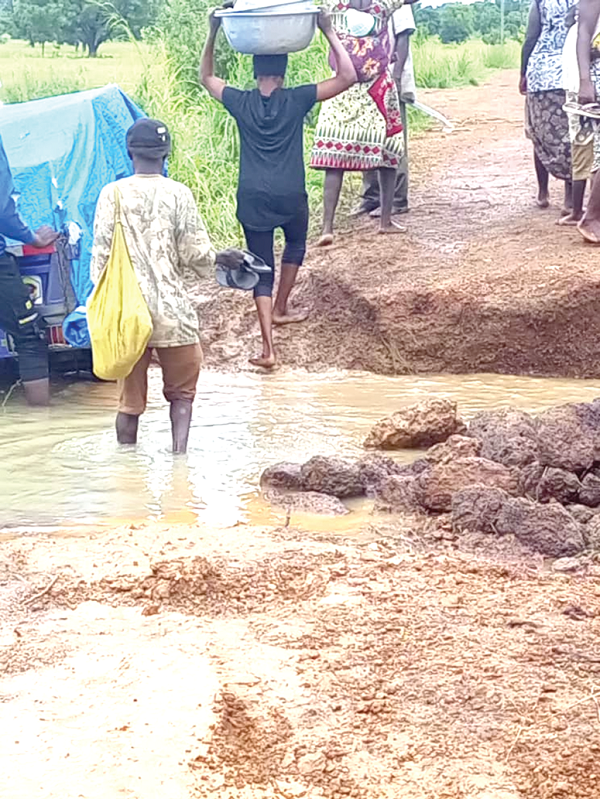
The issue has to do with local illegal mining operations.
16 of the 24 individuals that were detained are currently being held in Koforidua by the police.
The eight were released after a police screening procedure revealed they were farmers who had been detained as part of the swoop.
Efforts are underway to grant them police enquiry bail.
A team from the Eastern Regional Police Command, led by the Regional Commander, DCOP Anderson Fosu Ackaah Friday morning visited the Asamang Tamfoe community to engage the people.
What happened?
There was some disagreement with community members of Asamang Tamfoe when an anti illegal mining taskforce and the police from Kyebi went to the area to arrest suspects and seize illegal mining equipment.
The police and the task force had gone into a bush in the area to stop a suspected illegal mining activity.
However, the community members insisted, their operations were approved as it was part of an approved community mining activity.
The police and task force seized some mining equipment including excavators.
On their way out in a convoy transporting the arrested suspects and the equipment to Kyebi where the District Police Command headquarters is located, the community members blocked the road.
Even though Akonta Mining Limited holds a mining lease to conduct mining activities outside of the Tano Nimiri Forest Reserve in some portions of Samreboi, the Ministry claims that “the firm has no mineral right to conduct any mining operations” there.
The Forestry Ministry has been told to “immediately ensure that the company does not carry out any operations in the Forest and to take the required punishment against any person found culpable in this case,” according to a statement from the Ministry on Friday, September 30, 2022.
“Our records show that Akonta Mining Ltd, on August 25, 2022, applied for a Mining Lease to undertake mining operations in the said Forest Reserve. By a Ministerial Directive, all reconnaissance, prospecting, and/or exploratory activities in Forest Reserves in the country are suspended, except in exceptional circumstances.
“Although this directive does not affect mining in Forest Reserves, Akonta Mining Limited’s application has not been determined. Accordingly, any alleged activity being undertaken by the company in the Forest Reserve is illegal”, it stated.
The Ghana Armed Forces (GAF) have denied claims made in the media that military personnel are guarding mining companies in several forest areas throughout Ghana.
The GAF claims that on September 26, 2022, Joy News aired a clip from a documentary that claimed military were guarding mining companies in forest reserves.
The GAF claims that this was untrue.
The GAF explained in a press release on Friday, September 30, 2022, that a patrol team from the 4 Infantry Battalion and the Central Command Headquarters in Kumasi was sent to conduct an operation in the general area on September 28 in response to reports of the presence of some security personnel in uniform within the Aprampramah Forest and Kobro Forest Reserve stretch in Amansie Central.
Findings by deployed patrol team
It said from the operation, “the military patrol team picked up some individuals dressed in US military-pattern camouflage uniforms working for a private security firm, which has been contracted by a registered small-scale mining company named ‘Elvis and Co Mining Ltd.
“These private security guards should not be misconstrued as GAF personnel because their camouflage pattern uniforms are even totally distinct from GAF”.
Attached below is a copy of the statement
REPORTS OF SOLDIERS PROVIDING SECURITY FOR MINING FIRMS IN FOREST RESERVES ARE FALSE – GAF
The Ghana Armed Forces (GAF) has monitored with deep concern, a misleading report and excerpt from a documentary aired on Joy News on 26 September 2022, alleging that Soldiers are providing security for mining firms in forest reserves. In a video with some recycled content of past unsubstantiated allegations which have since gone viral, Mentiahene of Bekwai, Nana Kusi Frempong Kotobre, alleges that military personnel are providing security for an illegal mining firm operating in the Kobro Forest in Amansie Central. GAF wishes to state categorically that there are no military personnel deployed for such activities and no Soldier is providing security for any mining company in any forest reserve in any part of the country.
GAF further wishes to disclose that following reports of the presence of some security persons in uniform within the Aprampramah Forest and Kobro Forest Reserve stretch in Amansie Central, a patrol team from 4 Infantry Battalion and the Central Command Headquarters in Kumasi, conducted an operation in the general area on 28 September 2022. The military patrol team picked up some individuals dressed in US military-pattern camouflage uniforms working for a private security firm, which has been contracted by a registered small-scale mining company named ‘Elvis and Co Mining Ltd. These private security guards should not be misconstrued as GAF personnel because their camouflage pattern uniforms are even totally distinct from GAF. (Pictures of some of the private security guards have been attached for ease of reference.)
In respect of the unauthorised use of military pattern uniforms by private security firms and individuals, it would be recalled that a few months back personnel of the 4 Infantry Battalion rounded up some members of a District Assembly Taskforce wearing different shades of military camouflage uniforms, captured in a viral video manhandling some civilians in the Kwabre South District. Considering that they were dressed in military pattern camouflage uniforms, they were wrongly perceived to be GAF personnel thereby drawing GAF into disrepute. Aside this, GAF has also picked up several impersonators in recent times and handed them over to the Police for prosecution.
In the same vein, the Ghana Armed Forces reiterates that it does not condone any such acts of personnel engaging in illegal and unauthorised activities especially illegal mining and wishes to assure the public that it will not shield any Soldier engaged in any illegal, unauthorised or criminal activity either in military uniform or not.
It must be specifically placed on record that in the fight against illegal mining, GAF is at the forefront and remains resolute and will therefore not countenance any conduct that will derail the progress being made. Accordingly, GAF has revamped Operation Halt II in order to intensify its surgical operations to curb the destruction of the forest reserves and pollution of the river bodies. The recent reports of the numerous arrests made, excavators seized and immobilised, and other equipment destroyed, attests to this renewed and sustained effort.
The Ghana Armed Forces therefore wishes to once again refute the allegations made and to state that its personnel are not providing security for any mining firm in any forest reserve. However, it is prudent that the media and other stakeholders verify claims to ensure accurate information is published. GAF therefore wishes to urge Joy News and other media partners that its doors are open for the necessary clarifications to be made to ensure a balanced reportage at all times.
GAF will continue to count on the support of all Ghanaians especially the media and major stakeholders, in curbing the illegal mining in our forest reserves and water bodies and also in the clamp down on the use of military pattern uniforms by private security guards and other unauthorised persons.
SIGNED MA LARBI Naval Captain Director Public Relations
Ms. Doreen Bogdan-Martin and Mr. Tomas Lamanauskas have been chosen by the International Telecommunications Union (ITU) to serve as the organization’s Secretary-General and Deputy Secretary-General, respectively.
The ITU Plenipotentiary Conference 2022 (PP-22), which takes place in Bucharest, Romania, from September 25 to October 14, 2022, has the elections as one of its goals.
The Minister for Communication and Digitalization (MoCD), Ursula Owusu-Ekuful, congratulated the individuals who had just been elected to prominent posts in the ITU body and promised the incoming Secretary-General of Ghana’s unwavering support and collaboration at all times.
Commenting on their individual profiles, she said that, Ms. Bogdan-Martin has over the years championed gender digital inclusion and youth empowerment, and that it was a fitting tribute to her tireless efforts that she becomes the first woman to lead the 157-year-old organization.
She added that she was yet another the first female elected for the position of Director of the ITU in 2018, noting therefore that she was confident that Ms. Bogdan-Martin would bring her experience to bear.
Also expressing the best wishes to Mr. Tomas Lamanauskas, the Deputy Secretary-General-Elect of the ITU, the Minister said she believes that he would work hard to assist the General Secretary to ensure the ITU achieves inclusive global connectivity and digital transformation for the benefit of all member-states.
Mrs. Owusu-Ekuful also assured him of getting the full support of Ghana to enable him to discharge his duties.
“Mr. Tomas Lamanauskas, Deputy Secretary-General-Elect is the youngest to take this position. Indeed, the ITU resolutions on gender and youth inclusion come to bear that we have already had a team of elected Secretary General and Deputy as a lady and a youth. This has so far been a truly historic ITU Plenipot, the most gender-responsive and youth inclusive ever. To our friends Gisa Fuatai Purcell and Dr. Chaesub Lee, we look forward to your continued support to the ITU,” the Minister stated.
She said that Ghana and all Member States were grateful for the leadership of the out-going Secretary-General of the ITU, Houlin Zhou, and his Deputy, Mr. Malcolm Johnson for the years of service to the ITU, adding that “we wish you a well-earned retirement”.
The Minister used the opportunity to encourage the other competitors who stood for the positions and lost.
She said: “Well fought and better luck next time and we hope to count on your rich experience for the benefit of all ITU Member States”
This year’s ITU Plenipotentiary Conference 2022 (PP-22) was the first gender-responsive Plenipotentiary. The ITU aims to reach the target of at least 35% of women participants, up from to 22% of women participants at PP-2014, and 29% at PP-2018.
Tulsi, a small village in India’s Chhattisgarh state, has become known as ‘YouTube Village” because a third of its population makes videos for a living.
Online video content is more popular than ever, and it’s no wonder that millions of people around the world are working hard trying to build careers as video creators. But nowhere is the concentration of would-be YouTubers than in Tulsi Village, a small rural settlement in Chhattisgarh, where over a third of the 3,000-strong local population is actively making videos and posting them on YouTube for profit. Many of these creators used to be farmers, but after hearing that some of their peers had doubled, even tripled their income making YouTube videos, they decided that it was time for a career change.
The story of India’s YouTube Village began with two friends, Gyanendra Shukla and Jai Verma, who left their jobs as network engineer and teacher, respectively, to make video content. Before long they started earning a pretty penny from their new endeavor, and word of their success spread throughout the village, inspiring others to follow in their footsteps.
“I worked in SBI earlier, as a network engineer. My office had high-speed internet and I used to watch YouTube videos there,” Shukla told the ANI news agency. “I was already fond of movies. In 2011-12, a new version of YouTube was launched. At that time, there were very few channels on youtube. I was not satisfied with my 9 to 5 job. So I left the job and started with YouTube.”
Around 40 percent of the village population is now engaged in making video content for platforms like YouTube, TikTok or Instagram, with the youngest being 15 and the oldest being an 85-year-old grandmother. The 40 or so major channels based in Tulsi village range from comedy and music to education and DIY, with the most popular numbering over 100,000 subscribers on YouTube alone.
Throughout October, Mövenpick is asking guests, visitors, and community members to donate at least one kilo of food, clothing, or school supplies as part of the program, which is in its fifth year.
From October 1–31, visitors and guests are welcome to leave donations at the Mövenpick Ambassador Hotel Accra’s lobby.
“At the heart of Mövenpick is the belief that indulgence is something that should be both good for you and good for the world, which it hopes will inspire people to donate,” the company said in a statement.
“The hotel joins 65 Mövenpick properties across Africa, Asia, Europe and the Middle East, participating in the initiative with a global goal to gather 25,000 kilos of donations”.
“While guests and local neighbours are encouraged to donate a kilo of goods, all contributions are welcome and gratefully received no matter how big or small. High-priority items include books, notebooks and stationery such as pens, pencils, rulers and erasers; canned foods such as tuna, soup, fruit, vegetables and concentrated milk; dry foods like rice, beans, oats, pasta, cereals, flour, powdered milk, baby formula, tea and coffee; and clothing for adults and children”.
Mövenpick’s new program slogan “nothing tastes sweeter than a Kilo of Kindness,” aims to remind the public that giving back brings joy to all involved.
Reminiscent of Mövenpick’s culinary heritage, the play on words encapsulates the idea that kind-hearted, generous actions are often rewarded back in happiness.
“Through uncertain times, it’s important to come together to spread kindness to where it is needed most; that’s the core premise behind Kilo of Kindness,” said Deborah Lee-Ann Sivertsen, General Manager, Movenpick Ambassador Hotel Accra.
“Building on our culinary heritage, we know food has the power to do good and be a medium for positive change. With our annual Kilo of Kindness program, we believe in indulging in heartfelt moments and finding the goodness in the social change we can make by giving back.”
Since 2015 approximately 71,457 kilograms of supplies have been donated and distributed to disadvantaged communities around the world.
Mövenpick hopes to make its 2022 campaign the most successful to date by surpassing its current donation record of 21,921 kilograms and aiming to secure 25,000.
According to a dependable source familiar with the SIM registration procedure, a new date and the details would be announced early next week. However, the source also indicated that the punitive measures from earlier in September will be reinstituted.
The NCA, Friday morning, met with all telcos to finalise the modalities and they expressed their readiness to go ahead with the exercise to block the unregistered SIMs as per the expiration of the deadline Friday, September 30, 2022.
Meanwhile, it said those who have done stage one (linked their Ghana Cards to their SIM cards via *404#) will have up to end of year [2022] to complete stage two of their registration.
Again, those who have not registered their SIMs at all, will be blocked from receiving calls, making calls, using data services, among other things.
It said such subscribers will however have access to initiate *404# to start their registration, and also be able to receive their Unique codes via SMS.
It said for Telesol, Busy and Surfline which are grouped under Broadband Wireless Access (BWA) providers, subscribers started registration late so they will be given additional time to complete registration of their customers.
Graphic Online can confirm that the sector Minister is currently leading a Ghana delegation to the International Telecommunication Union (ITU) plenipotentiary conference in Bucharest, Romania where Ghana is seeking to retain her seat on the ITU Council.
Consider how different life would be in Ghana in 2030 compared to how it is now, with regard to the rate of destruction of water resources, deforestation, destruction of cocoa farms for illegal mining, the citizenry’s desire for self-aggrandizement and wealth accumulation by legal or illegal means, even to the point of (allegedly) using other people in money rituals and the quest for power to rule over others.
Think about what Malaysians and Singaporeans envision their nations to look like in 2030.
It is to be anticipated that the thoughts and actions in these two instances will differ significantly.
Ghanaians, unlike Malaysians and Singaporeans, must reframe their unfavorable attitudes and behaviors to advance
Following Ghana’s independence in 1957, what tangibles can the citizenry identify as achievements? Comparatively, Malaysia and Singapore, which gained independence later than Ghana, are better developed. These two countries have sustained their developments with higher per capita incomes.
Reflecting on Anna Sewell’s assertion that, “it is good people who make good places,” can one conclude that the continuous development of Malaysia and Singapore be attributed to how good their citizens are? What specific attitudes does the Ghanaian citizenry lack that have retarded Ghana’s development? This article provides insight into the role that good attitudes in citizens play in achieving sustainable development for posterity.
Attitude
Jerald Greenberg defines attitude as a combination of relatively stable beliefs, feelings, and intentions that influence a person’s behaviour towards an object. The attitude object within the context of this article may be persons, families, establishments, societies and nations.
Attitude formation passes through three main stages – one’s thoughts about the attitude object, one’s feelings because of the thoughts, and one’s attitude based on the outcome of one’s feelings and thoughts.
Greenberg explained that the relatively stable nature of formed attitudes made them difficult to change. What are the thoughts of the Ghanaian citizenry? How do these thoughts affect the citizenry’s feelings to form and display undesirable attitudes that bedevil the nation and as a result, inhibit sustainable progress?
Undesirable Attitude
From observations, the thoughts of the Ghanaian citizenry may be attributed to the upbringing of most children, which are influenced by the colonial mentality and the local culture. Children are made to learn to be seen but not heard in their homes. This kind of upbringing falls short of developing traits such as self-efficacy, assertiveness, creativity, innovativeness, and external locus of control in children.
Also, it lacks progressive voluntary acts and citizenship, boldness to take calculated risks that promote economic independence, hard work, and commitment to safeguarding national property.
More so, formal education has not been able to train students to have an independent mindset. These shortfalls in formal and informal education among others have influenced the citizenry to develop negative attitudes that inhibit individual successes and overburden the few who strive to be successful through ethical means.
Another negative attitude is the easy generalisation of issues without authentic facts leading to prejudice and stereotyping acts without basis. For instance, an individual’s inability to achieve great success means nobody in their social group can. As such, anyone who can do so is judged and condemned as using foul means. Indeed, bad people are doing bad things, and likewise are there very good people who stick to their good values and keep doing good things.
These undesirable attitudes can be changed to create a better future for posterity as attested by Marie Osmond in her statement: “the greatest discovery of all times is that a person can change his future by merely changing his attitude”.
In the case of Malaysia and Singapore, some of the identified positive attitudes that have contributed to their rapid development are their disciplined nature, independent mindsets for survival, diligence, time consciousness, adherence to existing laws, innovation and creativity, and environmental protection attitude, among others. They are also responsible citizens who have their nation’s progress at heart.
Given the above and the realisation that each geopolitical arena is unique, it is recommended that Ghana embrace its unique local attitudes that can lead to its positive development as well as the best practices of Malaysia and Singapore. The nation needs to inculcate positive attitudes in children by adults setting good examples for emulation. Propagating positive attitudes through continuous adult education in the traditional media, as well as local communities in the nation can lead to a chain of positive outcomes as opined by Wade Boggs in his statement —
“A positive attitude causes a chain reaction of positive thoughts, events, and outcomes. It is a catalyst, and it sparks extraordinary results.” The fact that attitudes are relatively difficult to change does not mean they cannot be changed; surely, they can be altered. Conscious efforts with constant reminders will yield needed results. Let us develop good attitudes towards building a good Ghana for future generations.
Vice Admiral Seth Amoama, the Chief of Defence Staff, has urged officers in the Ghana Armed Forces (GAF) to exercise caution, take responsibility, and adopt cybersecurity best practices into their daily routines and online behavior.
He claimed that for some time, cyberspace had been threatened by hacking, data leaks, social engineering techniques, and cyberfraud.
He claimed that there had been a sharp increase in cybersecurity attacks recently, and the GAF was not exempt.
Vice Admiral Amoama, therefore, said it had become imperative for the officers to enrich their knowledge in Cybersecurity to ensure force’s data was safe from attacks from both internal and external bad actors.
He made the call in Accra yesterday during the launch of this year’s GAF Cybersecurity Awareness Month.
Ghana is one of the countries in the world that observe the month of October as National Cybersecurity Awareness Month.
The month-long event seeks to intensify the capacity building and awareness creation efforts on cybersecurity, cybercrime, and educate citizens on the importance of good cyber hygiene and cyber best practices.
This year’s occasion will comprise workshops, lectures, demonstrations and training sessions on essentials of cybersecurity and the implications of the use of the social media by all ranks within the GAF.
Weakest link
The CDS said new technology and system would incorporate cybersecurity to guarantee and ensure system integrity, resilience and robustness.
However, he said research had established that the user, which is the human element, was the weakest link in computer security.
He said people were known to be more vulnerable than computers and smart devices. Sequel to that, Vice Admiral Amoama said the issues of data protection, security of information, misuse of social media platforms, secret recording of confidential or sensitive events and their subsequent leakages to the media had become great concern to the military high command.
To this end, I urge All Ranks to desist from unprofessional acts that seeks to tarnish the image of our noble profession.
I have also directed that regular reminders of extracts on communications and information systems policy and cybersecurity titbits be published in the unit routine orders to guide all ranks on the use of the internet and social media engagements,” the CDS said.
Ghana’s cybersecurity development
On his part, the acting Director General of the National Cybersecurity Authority, Dr. Albert Antwi-Boasiako said Ghana’s cybersecurity development was rated at 32.6 per cent according to the Global Cybersecurity Index in 2017.
As at the end of 2020, he said the country’s readiness level was rated at 86.69 per cent, thus, becoming the third highest ranked country in Africa after Tanzania and Mauritius and the 43rd ranked country in the world.
He said authority, therefore, recognised the contribution of the GAF to that development and hoped to build upon that success through the work of the Joint Cybersecurity Committee which had three senior officers of the GAF representing.
The GSS published data from the 2021 Population and Housing Census on buildings, housing conditions, and facilities revealed a 33% reduction in the housing shortfall.
On Tuesday, September 13, 2022 the Minister of Works and Housing, Francis Asenso-Boakye (FAB), granted an exclusive interview to the Daily Graphic Reporter, Vincent Amenuveve (VA), on a wide range of issues in the housing sector.
The minister also used the opportunity to explain in detail a National Revised Affordable Housing Programme to be rolled out by the ruling government in November this year barring any hitches.
Below are excerpts of the interview:
Vincent Amenuveve (VA): When we talk about affordable housing, what exactly do we mean?
Francis Asenso-Boakye (FAB): I think it is a fair question that everybody will ask. The United Nations (UN) defines affordable housing as a situation where the prospective owner is able to spend up to 30 per cent of his or her income, either in the payment of mortgages or rent and anything above that percentage is not deemed to be affordable.
When you spend 30 per cent of your income, there are other commitments that your income will have to take care of; your food, school fees and other commitments, including household needs.
VA: Research has shown that affordability remains an issue because of the prevalent low household incomes restricting access to shelter, be it ownership or rental. What are the interventions put in place by the government to ensure affordable housing for the ordinary Ghanaian?
FAB: Affordable housing programmes have been part and parcel of many administrations in this country, dating back to the era of Ghana’s first President, Dr Kwame Nkrumah, through to Jerry John Rawlings, John Agyekum Kufuor, John Evans Atta Mills and also John Dramani Mahama.
But most of the time, they’ve all been depending on government’s direct funding.
Even in the second term of President Nana Addo Dankwa Akufo-Addo, where he has prioritised the provision of mass affordable housing for the Ghanaian people, the programme has also relied on government financing.
There were some challenges, even though efforts were made to source private capital with the signing of Memorandums of Understanding (MoUs). This was to ensure that the government served as an off-taker. But it didn’t work because we didn’t have the funds for that.
So when I assumed office, I realised that it was not possible to make the housing policy an entirely government programme and that you have to adopt a programme that can leverage on private sector investment coupled with government support.
The main thrust of our affordable housing programme now is centred on available statistics, which says that 60 per cent of Ghanaians can only access housing with government support and that there is 35 per cent of Ghanaians who cannot access housing even if the government provides some support.
It is only five per cent of Ghanaians who can actually access their own housing without the support of government.
So our strategy is to address the needs of that 60 per cent of Ghanaians who need government support. We, therefore, looked at various components of housing costs, land, infrastructure, financing from the demand side, mortgage arrangements and all that.
We figured out what government can do to support these 60 per cent of Ghanaians.
So we decided that government can absorb the cost of land and provide tax incentives for the private sector developers who want to partner government to provide affordable housing. It also involves import duty reliefs to make it affordable for companies bringing raw materials for the construction of housing units.
That is the current framework the government, under President Akufo-Addo, has adopted and we are about to start a new housing programme – one would be sited in Pokuase near Accra and the other one would be located in Dedesua in the Ashanti Region.
VA: What is the target group for the housing package?
FAB: We are targeting public sector workers who are on payroll.
We have put in place a system whereby these workers can pay by instalments because there is an arrangement for the banks to act as off-takers.
VA: Are workers in the informal sector also included in this package?
FAB: We also have them in mind and as long as you are able to prove to your banks that you have a dedicated source of income, and at the end of the month you can contribute GH¢1,000, or GH¢500, based on the requirements of the banks, you should be able to qualify for the package.
VA: How many housing units are to be provided or for that matter, how many people are benefitting from the package?
FAB: For the one at Pokuase, we are providing 8,000 housing units and about 4,000 units for Dedesua – that is the estimated number of units we are providing.
VA: When is this initiative taking off?
FAB: If we are able to expedite action on the processes, by November this year, we should be able to start construction because a lot of companies have expressed interest and they are embracing this new concept that the ministry is introducing.
We are going through the approval processes, which I believe is going rather too slow; I wish that the process was expeditiously executed because this housing programme is more important for Ghanaians.
VA: How do you call the new initiative?
FAB: It is known as the National Revised Affordable Housing Programme, christened “Mi fie”.
Breakdown, challenges
VA: Can you give us a breakdown of the major affordable housing units provided in the past and their various stages of completion?
FAB: Recent affordable housing programmes can be traced to the period of President Kufuor, where about six affordable housing projects across the country in Borteyman, Kpone, Asokore-Mampong, Koforidua, Tamale and Wa were undertaken.
As I pointed out earlier, most of the housing programmes suffered and stalled for some time because they were solely funded by government.
We are looking at various financial arrangements to be able to, for instance complete them.
We are considering roping these projects also into our revised Housing Programme. In fact, the last time I visited Tamale, I encouraged contractors and developers to show interest and partner government to complete the project.
VA: What are some of the challenges facing the government in affordable housing delivery in the country?
FAB: One of the challenges we are facing in the housing space is actually from the demand side. I have travelled a lot and I know how people access housing in advanced countries and as long as you are working and earning salaries, you can get a bank that can actually say let me buy this house for you and you pay it over time, say up to 40 years.
Saglemi
VA: Although the Saglemi project is in court, are there plans by the current government to complete it?
FAB: We will do our best to complete the project, and what I know is that we have technical people who have been meeting regularly to figure out the issue and come out with effective measures for the government to implement, to ensure value for money in order not to waste the tax payers’ money.
VA: Does the government have any plans of refurbishing the old, dilapidated government bungalows in the various regions of the country?
FAB: The government has a redevelopment programme, which has to do with rehabilitation of the old government bungalows in prime areas like Accra, which has been ongoing for some time now.
Many of these bungalows are old and dilapidated, so the programme is to help rehabilitate them. Others are small bungalows sitting on big lands, so part of the redevelopment programme is to optimise the available land space by building more of the housing units and beautifying the land.
Ghana Housing Authority
VA: To what extent has the ministry’s plan to establish the Ghana Housing Authority been successful?
FAB: Over the years, one of the reasons why our public housing programmes have failed is because we don’t have an implementing agency whose responsibility is to plan and manage housing developments in Ghana. It has always been at the ministry level. But the core functions of a ministry is to formulate policies and guide its implementation.
Look at this Saglemi Housing Project. If there were to be an implementing agency, they would have done feasibility studies and then we will know that providing 5,000 housing units required a certain level of infrastructure.
I have had the opportunity to travel to many countries. I have been to South Africa, Morocco, Cote d’Ivoire and I have also studied other regimes. I have seen that one of the best examples of housing development is in Singapore. They have set up the National Housing Board.
In Korea, and in Malaysia, they all have implementing agencies and we haven’t had one, and for me, I believe that it is the single most important reason why we have lagged behind in the provision of public housing in this country.
Therefore, since I assumed office, I have put in place the necessary steps to ensure that we set up a Ghana Housing Authority. I am glad to mention that Cabinet has already approved a policy for a set-up of the authority.
We have done a lot of stakeholder consultations and we even had a colloquium on it in Kumasi recently.
VA: There are public concerns that establishing such authorities would further bloat public wage bill, how do you react to that?
FAB: That is a genuine concern, but it is a very important institution if you look at the challenges it will address in the housing sector.
Rental housing
VA: Tell us a bit about rental housing.
FAB: One key aspect of housing is rental. I mean, at the end of the day, it is not everybody who can own a home. You have to rent and we have policies and laws that guide the rental market in Ghana.
We have the rent law that has existed for about 60 years and since then, a lot of things have happened. Urbanisation, population growth and economic circumstances have changed. It has affected the rental market, which has necessitated a review of our existing Rent Act 220 of 1963.
The law is against the collection of advance rent for more than six months but you know today people are collecting two to three years’ advance rent, which makes it difficult for the ordinary Ghanaian to pay. It is so because there are limited houses as against the demand.
I am happy to say that Cabinet has given the approval for the Rent Act to be reviewed and we are currently holding stakeholder engagements and we are working with the Ministry of Justice and Attorney General to facilitate the necessary legal framework to ensure the passage of a new rent law to address the challenges in the rent regime.
VA: How is the current performance and state of the Department of Rent Control?
FAB: The Rent Department is in a very bad shape and they use very rudimentary methods to collect data, to process claims and all that and we are working with the Ministry of Finance to digitise the operations of the department.
I have had the opportunity to visit the department and even though they have their issues regarding the usage of rudimentary methods to process claims, they are still able to settle rent issues.
Sea defence projects
VA: Finally, minister let us look at the Sea defence projects in the country. How far has the ministry gone with those projects around the coastal belt?
FAB: Evidence shows that our beaches are quite narrow and the tidal waves are very strong and violent. So it has been destroying lives and property in the coastal areas. That is why the government is implementing this Coastal Protection Programme under which the sea defence project falls. The project enhances economic activities. In other areas, their major source of occupation is fishing.
The project enables us to stabilise the water so that people can do fishing, while it also ensures that people’s lives and property are protected from tidal waves.
99,187 people call the Wa West home, with an average household size of six people and 50,926 females.
The National Disaster Management Organisation (NADMO) which is overwhelmed by the situation has appealed to individuals and philanthropic organisations for relief support such as food, shelter and clothing.
Briefing
The Regional Director of NADMO, Ahmed Mustapha, said the situation had been exacerbated by the broken down walls of the Balawa dam leading to the swelling of streams that crisscross the district and the Black Volta which form the Western boundary of the district, making it difficult for people to cross to other areas.
“The main road from the community of Balawa to Veiri has also been cut-off by the floods due to the volume of water from the spillway of the Balawa dam,” he said.
He, therefore, advised farmers in the area to temporarily stay away from their farms to avoid any further disaster.
“Over three-quarters of the region’s poor depend on farming for their livelihoods. It is difficult to stay away from the farms given that it is the mainstay of the people, but it is better to be safe than to risk your lives in the prevailing circumstances,” Mr Mustapha said.
The Member of Parliament for the Wa West Constituency, Lanchene Toobu, who visited some of the affected communities to ascertain the extent of damage, yesterday lamented the fact that water which was scarce during the dry season in the north now posed a threat to the people.
He commended the Inter Agency Group for the assistance offered to the victims so far.
The MP further expressed concern about the poor road network in the area, some of which were washed away by the massive floods that hit the region in August last year, and had since not been reconstructed.
He also called for concerted efforts to deal with the perennial issue of flooding in the north to help save lives and property.
“Things cannot continue like this. This issue has been there for many years, we need to find a concerted solution to it and break the cycle.
“It is necessary we do that to save lives and property and importantly, preserve the psychological sanctity of the people who have to go through it each year,” Mr Lanchene Toobu added.
Geospiza difficilis septentrionalis, aka the Vampire Finch, is a small bird with a very unusual diet – other bird’s blood.
Found on only two small islands in the Galapagos Archipelago – Darwin and Wolf – the vampire finch is a subspecies of the sharp-beaked ground finch, a relatively small and harmless-looking bird. However, as the specie’s name suggests, it has a very sharp beak, which it sometimes uses to break through more than just fruits and nuts. The vampire finch got its name from its bizarre habit of pecking at larger birds’ skin and feeding on their blood whenever other food sources are scarce.
The Nazca and blue-footed booby are the two primary victims of the vampire finch. Interestingly, these two seabirds are much larger than their assailant, but rarely put up any resistance. Experts believe that is because this unusual diet evolved from a much more common behavior that finches are known for – pecking at parasites on the plumage and skin of larger birds. Basically, Nazca and boobies don’t perceive the finch’s pecking as a threat.
In case the vampire finch’s behavior needs explanation, the small bird lands on the back of its victim and uses its small, sharp beak to peck at the skin until it pierces it and starts feeding on the blood.
Although no one knows exactly how the vampire finch developed a taste for blood, it is believed that, through the ages, it occasionally pecked too hard at the skin of seabirds while feeding on their parasites and over time adapted to consuming blood as a dietary supplement.
Blood feeding is exceedingly rare among birds, and the behavior of the vampire finch is considered an adaptation unique to Darwin and Wolf islands.
It’s worth pointing out that as gruesome as the vampire finch’s feeding habit may seem, its primary diet is made up of seeds and invertebrates. Blood is something it only turns to when such food is scarce.
Russian trolls have come up with a new way of triggering Europeans dealing with inflated gas prices – broadcasting cheap Russian gas burning 24/7 on video streaming platforms like Twitch.
It all started on September 11, when a new Twitch channel aptly named “russiangas1” started broadcasting. The premise was simple – a phone aimed at a stove top with all four burners turned on broadcasting gas being burned 24/7. And if that wasn’t enough, the streamer decided it would be a good idea to show just how cheap burning all that gas would be for them – 1.44 euros per month ($1.35) – at a time when gas prices in Europe are higher than they’ve ever been. A thermometer constantly showed the audience how nice and warm it was in the room, and a digital clock showed that the video was live and not on a loop.
For the first three days, the russiangas1 Twitch channel had no viewers at all, but then someone found it, spread the word and by September 17, it had already gone viral, getting mixed reactions from the general public. However, its fame would turn out to be its downfall, as on the morning of September 21, the channel had already become inaccessible, apparently as a result of a Twitch ban.
Apparently, Twitch considered the content “inflammatory”, and that the broadcast was intended as a provocation to show how cheap gas is in Russia at a time when most Europeans are still trying to figure out how they’ll stay warm this winter.
But it turns out that russiangas1 was only the start of this troll operation. After its ban, at least two other Twitch channels broadcasting the exact same thing appeared on Twitch, and they have yet to be banned by the streaming platform. And even if they do, the cat’s out of the bag now, other channels will probably take their place.
Measuring around 10 cm, with a diameter comparable to that of a cooked spaghetti, the Barbados Threadsnake (Tetracheilostoma carlae) is by far the smallest snake in the world.
Spotting a Barbados threadsnake for the first time, you could swear it was an earthworm. They are actually comparable in size and diameter, with the largest specimen ever found measuring only 10.4 centimeters, and are also blind. They also typically weigh under one gram and are small enough to coil on an American quarter. The species was officially discovered slithering beneath a rock near a patch of Barbadian forest in 2008 by evolutionary biologist S. Blair Hedges, but little has been discovered about its ecology and behavior since.
The Barbados threadsnake is one of the many animal species endemic to the Caribbean island, and confirms an observation scientists have made ever since the days of Charles Darwin – islands are often home to oversized and miniaturized creatures.
This tiny snake is reportedly difficult to study because, like the earthworm is so strongly resembles, it typically lives in the soil under rocks and logs so little is known about it. It is thought to feed mostly on termites and ant larvae, and depend on forested habitat to survive.
Unfortunately, it is the threadsnake’s dependence on forests that could render it extinct in the near future. With only about 10 percent of Barbados’ forests still standing, the survival of this mysterious species is uncertain.
A Japanese man obsessed with women’s raincoats has been dubbed ‘Raincoat Man’ after stealing a total of 360 raincoats over a period of 13 years.
A 51-year-old man was recently arrested in Osaka, Japan, after being identified as the locally-famous ‘Raincoat Man’, a mysterious thief who authorities had been trying to identify for over a decade. Yoshido Yoda, who worked as a newspaper delivery man, was apparently obsessed with a garment known as ‘kappa’, a plastic or vinyl poncho worn over one’s clothes to protect them from rain. Upon searching his home, police found a staggering number of kappas -360 in total – with the oldest ones having been stolen in 2009.
Sources from Osaka police revealed that Yoda’s modus operandi had him following women whom he saw riding bicycles, or simply checking parked bicycles painted in feminine colors and looking for unattended kappas. If he found one, he would snatch it for his collection and then make himself scarce.
Yoshido Yoda started stealing women’s raincoats in 2009, but investigators believe that at least 320 of the garments found in his possession were stolen in the last 9 years. He was so good at stealing kappas that he became known as ‘Raincoat Man’ among those trying to catch him.
Asked why he went for raincoats of all female garments he could have stolen, Yoda said that he got as excited seeing women in raincoats as he did seeing women in lingerie. Police estimate that he caused 1.12 million yen ($7,800) in damages over his 13-year-long criminal career.
The National Lotteries Authority (NLA) has launched its 60th anniversary celebration with a colourful event at its headquarters in Accra.
The event which took place on September 29, 2022, saw in attendance dignitaries from within and without the authority, including the NLA’s Director-General, Sammy Awuku, the Attorney-General and Minister of Justice, Godfred Yeboah Dame, the Deputy Finance Minister, John Kumah, among others.
During the event Director-General, Sammy Awuku, highlighted a series of activities that would characterise the celebration of the event which has been scheduled to span three months.
He noted that “the month of October has been dedicated to our cherished customers whom we recognize as our most valued assets. The month of November is slated for our Good Causes project,” and December will be the climax of the events.
He emphasised that November will be a month the Authority will give back to society by commissioning some Projects, in various parts of the country.
“These will be climaxed with a Grand Durbar of the Anniversary Celebration in December, held concurrently with a Conference on Responsible Gaming as we host the African Lotteries Association (ALA),” he said.
History of the NLA
Lottery over the years has immensely contributed to national growth and development. Established in 1962 as the Department of National Lotteries, invited a young man Mr Brennan from Malta to help set up the DNL, which now operates as the National Lottery Authority(NLA), after Act 722 was enacted in 2006.
NLA remains the leader in the lottery business in the sense that it has the legal mandate to regulate the industry. In addition to this autonomous role, the main objective of NLA is to raise revenue to run its affairs, and to pay whatever is left to the government to support developmental needs or projects in the country.
Against this background, NLA undoubtedly is a national asset, but this feat did not come with ease.The NLA brand was built with solid integrity as its core value while other values such as respect, excellence, accountability, leadership, and teamwork equally complemented the success story.
The NLA has its spread across the sixteen regions in Ghana, and continues to expand its tentacles to every nook and cranny. The expansion project is duly on course under the current leadership of Mr Samuel Awuku, the Director General of the authority.
Mr Awuku at the launch of the 60th anniversary celebration noted that after the establishment of the NLA some years ago, NLA can confidently boast of exemplifying its mandate to make all stakeholders ultimate winners.
“It has been 60 Years of generating revenue for national development, 60 years of touching lives, communities, and institutions and 60 years of making our patrons millionaires.”
Although he acknowledged that there are still challenges of his outfit that need to be addressed, he noted that the reforms, policies, and decisions taken by successive Boards and Director-Generals have significantly transformed the institution.
Board Chairman of NLA, Togbe Francis Nyonyo Agboada, was also at the event.
Addressing the gathering at the event, he touted the achievements of the NLA over the years, indicating that “we have successfully licensed some Private Lotto Operators, (PLOs) and look forward to welcoming more on board. The security services together with the NLA task force will continue to clamp down on defaulters to sanitize the lottery industry.
“We are also in the process of signing on some more Collaborators who will introduce some exciting new games for our cherished patrons. By the end of the year, we should take delivery of our modern machines, which purchase was done in accordance with the standards of the World Lottery Association (WLA).”
A Singapore man who installed no less than 9 air conditioning in a rented apartment has been hit with complaints from neighbors struggling with condensation and mold.
Summers can get pretty hot and humid in Singapore, so air conditioning is essential for comfort. One or two units are usually enough for a standard apartment, but one local man used a whopping nine air conditioners to stay nice and cool, and started getting complaints from neighbors. The temperature in the man’s home apparently dropped to a chilly 18 degrees Celsius (64.4 Fahrenheit), which reportedly caused condensation and black mold to form on the walls of neighboring apartments.
“We have to mop the floor three times a day. It’s a headache,” Liu, the man’s upstairs neighbor told Shin Min Daily News. He and his wife said that they had also been struggling with mold on their walls because of their humidity, as well as floor tiles cracking due to the difference in temperature.
The “villain” of this story, a 63-year-old retiree who rented the four-room flat in Sengkang, told journalists that setting the temperature as low as 18 degrees Celsius helped him live comfortably in Singapore’s hot climate. The man, surnamed Huang, added that he had been diagnosed with liver cancer, and the cool temperature helped strengthen his immunity.
“There are five air-conditioners in the living room, two in the master bedroom, and one each in the remaining two rooms”, Huang admitted, saying that he paid 10,300 Singapore dollars ($7,200) just to have the nine units installed.
This story originally made news headlines in Asia last month. At the time, Huang’s neighbors had started filing complaints about his air conditioners and the trouble they were causing. Authorities tried to bring everyone together to reach a compromise, but that apparently didn’t turn out very well, considering that Asia One recently reported that Huang decided to move out of the apartment.
“My neighbors ganged up against me. They also went to the authorities and the press,” Huang told Shin Min Daily News, adding that he had left on September 17. However, he will not be giving up on his comfort, saying that he took eight of the air conditioners with him.
Re-installing all the units at a new location will most likely cost the man a pretty penny, but he said that “as long as I get to live comfortably, it doesn’t matter.”
Huang’s neighbors said that they were relieved to hear that the old man was moving out, but claimed that they still had to spend a few hundred dollars repainting their walls and ceilings.