The Government of Ghana and the International Monetary Fund are expected to commence official negotiations for an economic support programme for the country.
Ghana is said to be targeting an amount of $3 billion over three years from the Fund once an agreement on a programme is reached. The new amount requested as a loan was double the government’s initial target of $1.5 billion.
According to a Joy Business report, the negotiations between IMF officials and Ghanaian authorities will start on Monday September 26, 2022.
Managing Director of the IMF, Kristalina Georgina, has recently attributed Ghana’s current economic conditions to external shocks emanating from the COVID-19 pandemic and Russia’s invasion of Ukraine.
According to her, these two factors have significantly impacted other economies hence Ghana’s economic challenges cannot be blamed on bad policies implemented by the Ghanaian government.
“Like everybody on this planet, Ghana has been hurt by exogenous shocks, first the pandemic, then Russia’s war in Ukraine, and we need to realize that Ghana’s challenge is not because of bad policies, but the combination of external shocks,” she indicated.
The IMF boss also speaking on Ghana’s possible programme said her outfit is determined to reach an agreement with the Government of Ghana by the end of this year.
She added that constructive discussions have so far been held with Ghanaian authorities for a possible economic support programme.
On July 1, 2022, President Nana Addo Dankwa Akufo-Addo ordered Finance Minister, Ken Ofori-Atta to present an economic rescue programme to the IMF following the current economic conditions in the country.
Subsequently, a team from the Fund led by Carlo Sdralevich visited Ghana between July 6 – 13, to gather relevant data and met with relevant stakeholders.
He said that the suspects abducted him on Sunday night when he was having dinner in his school.
The victim claimed that the suspects punched him on the neck, knocking him out cold, in an interview with Rebecca Nantomah of Adom News.
When he awoke, he discovered himself at the Bole royal cemetery, where the two men were asking for a phone number they could use to demand a ransom.
When the victim (the student) decided to notify his schoolmates about the incident, one of the suspects (kidnappers) got a tip that the victim might have been calling for assistance and went to see who it might be.
This gave him the chance to flee for his life, which resulted in a struggle with the second suspect, whom he was able to subdue and escape back to his school.
In response to the incident, Alhassan Salifu, the principal of Bole NVTI, stated that pupils now live in fear and occasionally leave the school’s grounds in search of water.
He has thus urged the government to increase security and police patrols near the school.
Obi John Mikel
The Nigeria great twice played under a ‘false’ name during his career, first taking the name ‘Mikel’ despite his given name being Michael, due to a clerical error.
During his peak years at Chelsea, he played under the name John Obi Mikel, despite later clarifying that Mikel ought to be regarded as his first name, with John Obi as his second names.
This meant a second name change for the Africa Cup of Nations-winning midfielder.
Silas Katompa Mvumpa
VfB Stuttgart forward Silas made headlines when it was revealed that he had been played under a false identity and with a falsified age.
Formerly known as Silas Wamangituka, the entertaining forward netted 11 goals in the German topflight last term, only for his season to be curtailed due to injury.
Subsequently, he admitted—with the support of his club—that his former agent changed his age and name in order to help his career prospects.
“I have lived in constant fear in recent years and I was also very worried about my family in the Congo. It was a difficult step for me to reveal my story,” Silas told journalists.
“I only dared to do this with the support of my new consultants,” he added. “I realised that I no longer have to be afraid and that we can put everything on the table together.”
Amad Diallo
A similar story to Silas, Manchester United wonderkid Diallo was also penalised for fabricating an identity in order to facilitate a move to Europe.
Earlier this year, the starlet was found guilty of violating the Italian Sports Justice Code by falsifying documents to present himself as ‘Diallo Amad Traore’ in order to suggest a relationship with an Ivorian resident in Italy.
He was ultimately fined €48,000, and later changed his Facebook name from Amad Traore to his birth name Amad Diallo.
Guelor Kanga
Currently the subject of an allegation by the Congolese Football Federation, the DRC have filed a lawsuit suggesting that Gabon are guilty of falsifying Kanga’s true identity.
While the player has been a Gabon international since 2012, Congo claim that he is actually four years older than his stated age of 30, and that his real name is Kiaku-Kiaku Kianga.
Their allegation is that Gabon gave the player—who was originally born in Congo—Gabonese citizenship and a fake birth certificate in order to represent the Panthers, and that his mother died four years before his registered date of birth.
Jay-Jay Okocha
So good, they named him twice—according to Bolton Wanderers fans—but Okocha actually took on another name earlier in his career.
During his time in Turkish football with Fenerbahce, the playmaker acquired Turkish citizenship and opted for a different name while playing in the Super Lig.
Muhammed Yavuz was the attacker’s name when he was in the Turkish topflight, although it doesn’t quite lend itself to terrace chants in the same way as his original moniker!
Jabu Pule
Former South African wonderkid Pule changed his name in 2006, when he dropped the surname upon which he built his career and altered his name to Jabu Mahlangu.
According to reports, the decision was taken by the player in order to honour his late father, who was named Mahlangu.
The 40-year-old was a sensation during the early part of his career at Kaizer Chiefs but struggled to adapt to a move to SV Mattersburg in Germany, with controversial issues and disciplinary problems ultimately engulfing his carer.
Born Abedi Ayew—the surname still carried by his sons Jordan and Andre—the legendary Ghana forward is better known by the name ‘Abedi Pele’.
The attacker was given the nickname Pele while at school in Ghana—a reference to the Brazil great—and ‘Abedi Pele’ became the name upon which he built his career.
Ali Dia
Widely considered as the worst player ever to play in the Premier League, Dia featured for 53 minutes of Southampton’s defeat by Leeds United in November 1996, and his cameo was described by Matt Le Tissier as “like Bambi on ice.”
Subbed on his Saints debut, Dia was so terribly he never featured for the club again and was released two weeks into his contract.
‘How’, you may ask, ‘did a player so hapless manage to play in the Premier League?’
Well, this is where the assumed identity comes in, with Dia only getting a contract with Southampton after a man claiming to be George Weah—he later turned out to be Dia’s agent—called then-Saints boss Graeme Souness offering the Scottish coach the chance to sign Weah’s cousin.
One can understand why Souness took the bait, but Weah, Ali Dia was not, and he was later named—by The Times—as the worst Prem footballer ever.
Ghana midfielder Mohammed Kudus has explained how he recovered from a failed transfer to Everton to become one of the in-form players in the world currently.
Kudus has scored a career-best six goals in his last five matches, including a stunner against Liverpool in the Champions League last week, but things could have been different had he got his wish last month.
The Ajax star had an impressive pre-season for the Eredivisie giants, scoring three goals in as many games, but coach Alfred Schreuder only gave him a combined 28 minutes in the first four games of the season, leading to agitation for a move away due to frustration.
“Everton offered me a great opportunity and I wanted to try it,” Kudus told NOS.
“No footballer wants to sit on the bench and neither do I. Although I understood that not everyone can play all the time, Everton seemed like a good option at the time.”
Kudus did not get his wish and the failed transfer took its toll on him. He failed to turn up for training in the days just after the transfer window shut with reports suggesting that he had been on a go-slow after seeing teammate Antony employ the same strategy to force a move to Manchester United.
“It wasn’t that I didn’t want to train, but I’m human and had a lot to deal with in a very short time. The chapter is now over and I’m still here,” he explained.
He has turned the adversity into triumph, scoring in the last five straight matches, including in the Champions League against Rangers and Liverpool, to become Ajax’s main man.
The goal against Liverpool, when he picked up a Steven Berghuis pass just on the edge of the box and fired an unstoppable rocket in off the underside of the crossbar to beat Alisson with his left foot, saw him hailed as the next jewel from the Ajax school.
He, however, remains humble, choosing the ‘Wakanda Forever’ celebration, a salute from the Marvel superhero movie Black Panther, whenever he scores.
“There is negative opinion that comes into our work. To me, that gesture [Wakanda Forever] represents blocking negative things from coming your way,” explained Kudus.
“I’m picturing that I’m crossing two swords, forming a wall that holds back obstacles and problems.”
“Such a moment goes much deeper than just celebrating a goal. For me, it is also about my personal life: that I am strong and stay true to myself.”
After fearing he could miss out on a ticket to the World Cup by staying on the bench at Ajax, Kudus has turned into one of the ‘undroppable’ for Ghana and he cannot wait for the trip to Qatar.
“My mission is far from complete. There is much more I can show you. The marathon continues: it never ends.”
In order to gain the seats they now have in Parliament, he claimed that the NPP had outspent the NDC by a ratio of almost 1:1,000 during the parliamentary elections.
Elvis claimed that the NPP had turned to force and vigilantism in places where money was insufficient to increase voter turnout; hence, those seats are still being litigated in court.
Speaking on JoyNews’ PM Express on why he is the perfect man to succeed the current NDC General Secretary, Johnson Asiedu Nketiah, Afriyie Ankrah noted that while the NDC lost the 2020 General Elections, the statistics bode well for the party.
“I believe we won 142 seats, five of them are in court now, and it was through violence. You saw what happened in Techiman, Tarkwa Nsuaem, Sefwi Wiawso and all those other places because of the violence that was deployed.
“And then again the NPP outspent us by a ratio of maybe about one to a thousand, because we know the money we made available to our parliamentary candidates for example. It’s not up to 100,000. It’s not even up to 50,000, but you heard an NPP Vice Chairperson saying that she was given 1 million, just her alone.
“So they outspent us absolutely. They had so much cash, and that is why we’re in this crisis. They spent money, they opened the vaults. You’d be surprised to know that in some of the Northern, Savannah regions on the eve of elections bullion vans actually came to pack and money was being disbursed,” he said.
According to him, the election statistics show that even despite an NPP win, the NDC has gained more grounds among the Ghanaian electorates and is poised to take power in the upcoming 2024 General Elections.
“So with all that spending, if we’re to go by the official declaration of the EC, we have 137-137. Don’t forget that when we were in government, we had 106 seats, we lost by 44.3% and we recovered. And when I say this I say this very carefully so that nobody will think that we’re happy that we lost.
“We did not go in to lose, okay, but when you’re doing analysis, the statistics they speak. The statistics show that from a deficit of 106 seats, we now have 137. And if you look at the numbers, we had a deficit of 1 million votes which we clawed back so President Mahama’s votes went up by 6.2 million.
“So there were contentions over the Presidential votes which we went to court and all that. So I believe we’ve built a certain momentum,” he said.
The Minister for Information, Kojo Oppong Nkrumah, has rallied investors at the just ended Ghana-Canada Investment Summit (GCIS) to consider the huge opportunities in the country and direct their investment here for higher returns.
Addressing the diaspora investor community at the 6-day summit organised by the Ghana Investment Promotion (GIPC) in Toronto, Canada on Thursday September 15, 2022, the Minister said the stable political atmosphere, coupled with the vast investment opportunities in the country, makes Ghana an investment destination of choice than its counterparts on the continent.
“As the host of the African Continental Free Trade Agreement (AfCFTA), Ghana has been placed in pole position to lead Africa’s economic and financial renaissance. This means that when you come back and do business in Ghana, and with Ghana, you are only opening your own door to access the entire African continent. I want to encourage you to come and invest in Ghana. We look forward to seeing you soon,” he said.
Mr Oppong Nkrumah, who is also Member of Parliament for Ofoase/Ayirebi, described the country as a fertile ground for investment where businesses thrive due to its stable economic atmosphere urging prospective investors, especially from Canada, to consider Ghana as the gateway to a wider African market.
He said Ghana has a wide range of investment vehicles available for every investor class which offer higher returns than other African countries. Citing the high returns in investment in equity markets and the high yields on Government of Ghana bonds, the Minister assured the diaspora investor community of guaranteed returns should they choose Ghana as their investment destination.
Further, Mr Oppong Nkrumah called on the diaspora investors to invest in the Ghanaian economy because as Ghanaians in the diaspora, they have a crucial role to play towards the growth and development of the country.
The Ghana-Canada Investment Summit brought together delegates from the international investor community especially from Canada, venture capitalists and private equity fund managers amongst others for in-depth discussions and exploration of viable investment opportunities within various sectors of the Ghanaian economy. It was also aimed at matching diaspora, Canadian investors and local entrepreneurs and create awareness of the potential of Diaspora Direct Investment while increasing trade between Ghana and Canada.
Also present at the Summit were a number of state officials, including the Ministers of Foreign Affairs and Regional Integration, Shelly Ayorkor Botcwey, Minister of Communication and Digitalisation, Ursula Owusu-Ekuful, the Minister for Tourism and Culture, Dr Awal Ibrahim Mohammed, GIPC boss, Yofi Grant and other well-known dignitaries.
As part of activities of the Right to Information (RTI) Commission week celebrations 2022, the commission organised a health walk and medical screening on Saturday in Accra.
The celebration, on the theme “Artificial Intelligence, E-Governance and Access to Information” aimed at empowering all persons to have access to information from public institutions in order to promote a culture of transparency and accountability.
The celebration started with the health walk from the RTI office- Dzorwulu at 7:00 a.m. through Accra Mall, all the way to Legon and finally to the Presbyterian Boys Secondary School around Madina.
During the walk, staff members, students and a section of the public around the areas, covered in multi-coloured Lacoste shirts and jerseys, were seen holding placards and reciting the inscriptions on the cards.
Again, aerobic sessions and soccer games were organised at the premises of the Odadee Alumni and Mentorship Centre in the Presbyterian Boys Secondary School, coinciding with the medical screening.
Participants were seen seated in a queue around 10:00 a.m. being refreshed while waiting for their turn to be attended to.
The health screenings covered Hepatitis B, Lab tests, blood pressure, eye test, breast examination and medical consultation.
In an interview with the Executive Secretary of RTI commission, Mr Yaw Sarpong Boateng, said keeping fit was very important which was why their celebration was planned to remind people of being healthy.
“We are also using this opportunity to sensitise, create the awareness and interest in the citizenry towards the right to information,” he said.
Mr Boateng encouraged everyone to access their service whenever they needed any information, especially because it was free.
“The law has come for us all not for a few people to use, we must activate the use of the laws so we all see the loopholes to make some amendments hopefully, also our office our open to all as well as our phone numbers,” he added.
A Medical Laboratory Scientist at MDS-Lancet laboratory, Bright Kumi, who supported in the screening exercise said with about 97 people who tested for Hepatitis B, a few tested positive.
“Those who tested positive have been advised on the way forward and others who tested negative have been asked to get vaccinated and take care of themselves to prevent them from any exposure,” he stated.
He advised the general public to be very alert on their health, know their status and not overlook the Hepatitis B infection because it was more dangerous and could easily kill than HIV/AIDS.
He claims that the argument over whether or not the nation’s economy is strong enough to support aid from abroad is pointless and should not be promoted.
Kweku Kwarteng’s remarks are in response to the Minority’s worries on the IMF’s assertion that the Russia-Ukraine war and the COVID-19 pandemic have severely harmed Ghana’s economy.
“Is this a point worth responding to? This whole discussion about Ghana subscribing to the IMF for the 17th time because of COVID-19 and Russia-Ukraine war – do we genuinely believe that for the sake of our country, this is a question we should be addressing? Won’t it be brilliant to be debating who has a better strategy to make this 17th appearance at the IMF the last for the country”, he quizzed on Eyewitness News.
Responding to criticisms of the IMF’s assessment of Ghana’s economy, Director of the Communications Department at the IMF, Mr. Gerry Rice re-emphasized that Ghana’s plight has been worsened by the Russia-Ukraine war as it had already injected a lot of fiscal power into the pandemic.
This is a point Kweku Kwarteng corroborates, and called for a rather more healthy discussion on the development to find a lasting solution to the country’s heavy dependence on the IMF.
“Why are we preoccupied with this? What kind of discussions do we want to have about the economy right now? I believe that our economy has been challenged but as we grow, we should learn and begin to have discussions that will make this 17th appearance, the last one. Why can’t we put those fundamental issues taking us to the IMF on the table? Why turn the debate into a blame game? Let’s correct things and focus on having helpful debates”.
Ghana is before the IMF to help the country navigate the economic crisis it finds itself in, which was worsened by the coronavirus pandemic and the ongoing conflict between Russia and Ukraine.
The country is seeking a $3 billion package from the fund.
The Chief Director of the Ministry for the Interior, Mrs Adelaide Anno-Kumi, has advocated the need for women to take up leadership positions to help in the decision making process.
She said women had to work extra hard to get the recognition they needed.
“Women should take their work and every opportunity given seriously while upgrading their educational level and not been comfortable where they are,” she added.
Mrs Anno-Kumi gave the advice in an interview with the Ghanaian Times at the 59th International Association of Women Police (IAWP) conference at Niagara Falls in Ontario, Canada last Friday.
The five-day event which was on the theme “Connect, Empower, Lead” sought to strengthen, unite and raise the capacity of women in police around the world.
It was being hosted by the Ontario Women in Law Enforcement (OWLE), the Niagara Regional Police Service and Hamilton Police.
It was attended by hundreds of policewomen from 46 countries, including Ghana comprising of 28 police and 25 immigration officers led by Commissioner of Police (COP) Nathan Kofi Boakye, Director General of Legal and Prosecutions of the Ghana Police Service.
Mrs Anno-Kumi stated that women in policing had attained 70 years.
She stated that there was currently a total of 43,546 police officers comprising of 31,092 males, 12,454 females representing a percentage of 28.60.
“This is good especially in a male dominated organisation, I think women have been given some effective positions that has encouraged them and yielded the increase, “she said.
The Chief Director assured of the government’s continuous support to ensure more women were involved in policing and decision making process of the country.
She urged the men to accept the positions of women and support them to contribute to decision making process of the country.
“One of the challenges is that since it is a male dominated organisation we are still pulling the men to accept the positions of women,” she added.
The Minister of Food and Agriculture says the government has spent GHC 2.6 billion on subsidies on cocoa seed and fertilizer, which generated GHC 50 billion worth of farm produce for the country.
Dr. Owusu Afriyie Akoto stated that Ghana’s agricultural industry had performed exceptionally when compared to other sectors because of the assistance provided to farmers and the mutual benefit.
According to the Minister, the agriculture industry in Ghana experienced an increased rise of 8.4% in 2021 as opposed to the 7.4% seen in 2020.
Dr. Akoto emphasized that farmers should be praised for their accomplishments while speaking at the 38th annual Farmers’ Day celebration’s opening ceremony in Accra.
“The dedication of our farmers has caused the expansion to accelerate. Therefore, we must congratulate our farmers for producing under such trying global conditions.
Ms Mavis Hawa Koomson,Minister of Fisheries and Aquaculture Development, in a speech read on her behalf, noted that the concept of value addition in agriculture, especially fisheries and aquaculture presented an exceptionally good opportunity for additional revenue generation, job creation, foreign exchange earnings and effective post-harvest management.
Ms Koomson disclosed that in 2021 total fish production stood at some 658,617.53 tonnes estimated at 11.04 billion Ghana cedis, which contributed to about 1.04 per cent of GDP and 20.99 per cent of agriculture, adding that the benefit would have been more if the value additions were included.
She said the Ministry was promoting new products such as fish powder, fish khebab and fish sausage in collaboration with the council for scientific and industrial research, food research institute specifically, products such as fish balls have been developed while up takers are being encouraged to commercialise such products.
She said the ministry had taken a keen interest in pursuing various activities to improve value addition, which included strengthening the capacities of actors in the fish value chain to ensure the production of safe and quality fish products.
To this effect, 994 fish farmers have so far been trained in hygienic fish handling, fish processing and marketing strategies, while 200 fish processors have been also trained in best practices.
The 2022 National Farmers’ Day celebration would be held in the Eastern Region on the theme: Accelerating Agricultural Development through value addition.
He said: ” Our basic survival and progress as a nation depends on the produce this sector provides. The contribution of this sector to our GDP continues to remain significant and the employment opportunities that exist in this sector cannot be overemphasized”.
He said the Eastern Region was endowed with a unique diversity in terms of culture, ethnicity, and vegetation and contributed to the food basket of the nation.
He commended the National Organizing Committee for the honour bestowed on them to host this year’s National Farmers’ Day celebration and affirmed an effective collaboration to make the celebration a success.
“Let me assure all of you that we will collaborate effectively with the organisers and stakeholders to ensure this year’s celebration will be one of the greatest ever held, if not the best”.
Major sponsors for this year’s farmers’ day celebration include Agricultural Development Bank (ADB), Stanbic Bank and Exim Bank.
Persons in police or prison custody can report to the Commission on Human Rights and Administrative Justice (CHRAJ) for inhuman and degrading treatment.
Apart from torture or maltreatment, persons in custody can also complain to the CHRAJ about lack of basic amenities such as lack of toilet, beds or even quality food for redress.
According to Dr Isaac Annan, former Director of Human Rights at CHRAJ and a Consultant, Law and Governance Consult, provision of such amenities bordered on human rights of which many Ghanaians did not know about.
He was speaking to the Ghanaian Times during a meeting on “Strengthening Ghana Police Service and Civil Society Cooperation Towards Effective Case Management and Improved
Accountability”.
It was organised by CHRAJ in collaboration with the German Development Organisation (GIZ).
The overall objective of the two-day meeting aimed at enhancing police service accountability and improving cooperation between the Police Service and Civil Society Organisations(CSOs) leading to a more efficient and effective complaints management system.
Participants, mainly Police and CSOs, were also familiarised with quantitative and qualitative data collected by CHRAJ, CSOs and the media to improve Police Professional Standard Bureau’s (PPSB) complaints handling and management system.
Dr Annan indicated that CHRAJ would investigate any torture or maltreatment cases brought to it and ensure offending officers were dealt with for justice to prevail.
Stressing the need for the empowerment of the average Ghanaian with knowledge about human rights, he urged the CHRAJ to go out there with such education.
Commissioner of CHRAJ, Jospeh Whittal, earlier in a presentation, indicated “if we able to understand the bottlenecks to complaints handling against police misconducts, we would achieve a lot of progress”.
He said CHRAJ as a constitutional body “has oversight responsibility over the Police Service”.
Realising that sometimes there seemed to be a discord between the Police, the CSOs and the Media stemming from misunderstanding of each other’s role, he said, the purpose of the engagement was to ensure how critical accountability institutions could understand each other’s role, point out misunderstandings in order to forge democratic relations together.
Among the topics treated were principles of good administration and accountability (internal and external), human rights-based approach to complaints management, legal and policy framework for ensuring police accountability in Ghana, roles of civil society and the media in ensuring police accountability.
Seth Acheampong, the Eastern Regional Minister, claims that the government is still committed to the fight against illegal mining in spite of the many failures experienced so far.
He believes that the determination to put a stop to all types of unlawful small-scale mining, often known as “galamsey,” is still on track and still within the bounds of the law.
“Commentators claim that using the whip to discipline people is highhanded, but our government is resolute and determined. We are not moaning and flinging our hands in despair”, he remarked on The Point of View on Citi TV.
He refuted criticism that the government has never been devoted to the struggle against the threat.
The Minister mentioned that government losing out in the last election is somehow proof that state actions are yielding results.
“The president, in putting his office on the line, the party suffered heavily in the 2020 election in areas that had illegal mining. They voted against us. That is the risk we took”.
Mr. Acheampong emphasized that, “as we face this issue humanly and squarely, unfortunately, it is being made a matter of politics and it’s so depressing when you try to put your life on the line. This administration is poised to be responsible”.
His declaration was amidst new measures such as the deployment of police and military personnel to arrest illegal miners across the country and the introduction of a community mining programme aimed at regulating small-scale mining in communities in an environmentally sustainable manner.
There have been complaints that the water bodies that were regaining their natural state at the height of the fight against galamsey are becoming polluted again due to the increasing activities of illegal miners in various parts of the country.
President Akufo-Addoagain made public statements on the development, saying that there is a need for an open discussion on the subject.
The government, through the Ministry for Lands and Natural Resources, subsequently held a two-day National Consultative Dialogue on Small-Scale Mining that, among other things, urged the government to firmly enforce the country’s laws on mining.
Recently, the debate on whether the government is in control of the fight has been renewed following controversies surrounding the re-arrest of galamsey kingpin, Aisha Huang.
The National Identification Authority (NIA) has so far issued 15,826,148 Ghana Cards out of the 16,627,325 printed cards from 17,109,627 registrations as of the end of August this year.
A total of 1,283,479 cards are still waiting to be picked up for a variety of reasons, including some that require upgrades, people who can’t find their collection locations, and people who “feel they have no need for them currently.”
Professor Kenneth Agyeman Attafuah, Executive Secretary of the NIA, said during a press conference last Friday in Accra that while his organization acknowledges that there were some difficulties with the issuance of the cards, it could not be held solely responsible if some people did not yet have their cards.
He said some Ghanaians had failed to take advantage of the various opportunities for them to go for their cards at the decentralised levels.
“We still have some cards issued during the mass registration exercises in 2020. I was in Koforidua about three months ago on a monitoring exercise. I called someone whose card was ready to come for it. That person said it was not time for the collection of cards and that he would come for it when he had need for it.
“Some Ghanaians are even making demand to be given money before they will go for their cards,” he said, and cited an incident that happened at Akim Oda where a woman had asked for money before she would go for her card.
Those challenges notwithstanding, Prof. Attafuah gave an assurance that the NIA would ensure that all people who had registered were able to go for their cards, since the cards had already been printed at a cost.
Deadlines, data harmonisation
Prof. Attafuah said the NIA was working around the clock to ensure that the cards were issued, noting that at the moment people who had registered but did not have their Ghana cards yet could still be verified, when need be, as remarkable progress had been made with the data harmonisation effort.
He explained that with a memorandum of understanding (MoU) signed between the NIA and the various outfits over data harmonisation and use, all the agencies requiring the Ghana Card as the only means of ID for business transaction — the Bank of Ghana (BoG) and 24 universal banks, as well as mobile network operators — had been successfully connected to the NIA’s verification system platform following the process, so once they had that system, verification was possible and easy.
“Between 2018 and 2022, the NIA has executed an MoU for the delivery of data harmonisation and integration services with the National Health Insurance Authority (NHIA), the Social Security and National Insurance Trust (SSNIT), the Ghana Revenue Authority (GRA), the Students Loan Trust, the Driver and Vehicle Licensing Authority, the BoG, the ARB Apex Bank, the 24 universal or commercial banks in the country, as well as Airtel/Tigo, MTN, Vodafone and GLO.
“The NIA has completed data harmonisation and transfer of data sets to the following institutions following the execution of MoUs with them — the GRA: 15,797,860 data sets transferred; SSNIT: 15,412,055 data sets transferred; NHIA: 15,317,256 data sets transferred; Airtel/Tigo: 1,766,546 data sets transferred; MTN: 11,524,584 data sets transferred; Vodafone: 10,340,802 data sets transferred, and GLO: 142,215 data sets transferred.
“It must, therefore, be appreciated that Ghanaians who have registeredbut have not yet been issued their Ghana cards can still be verified by the banks and the telecommunication companies if the verification devices specified by the NIA are available at these facilities,” he said.
Single source of truth
Unlike the initial identity card that was issued between 2008 and 2017, the Ghana Card currently being issued, Prof. Attafuah said, was a digitalised source of identity, aimed at ensuring that the country had a single source of truth in identity management activities.
That, he indicated, would help sanitise the ecosystem when it came to self-identification and group identification.
“Our robust national identification system will ensure that there are no debates, arguments and contestations about who you are in terms of your age and citizenship.
“So questions about electoral conflicts, issues about disputes, voting rights and entitlements and all those things will and should soon become things of the past,” he said.
He said the card was a dual interface smart biometric ID card with multiple functionalities.
“The security features are legendary, and it is one of the best cards you can find anywhere in the world,” he said.
Registration, appointment
Prof. Attafuah advised citizens who wished to register for the card to book appointments before visiting the registration centres to facilitate fast and easy registration processes.
“Those who show up without appointment, no matter how willing they are to pay and show up without appointment at 4 a.m., may encounter people who have appointments from eight o’clock and, therefore, may spend hours at the office,” he said.
Non-citizens’ cards
With regard to the non-citizen national identity cards issued to foreigners legally resident in Ghana, Prof. Attafuah said so far 161,007 had been issued to people from 202 countries.
Of the number, Chinese residents had the highest number of 34,712 cards being issued to them, representing 22 per cent of the total number of foreigners who had been issued with the cards, he said.
The NIA Executive Secretary said Nigerians were second, with 25,873 cards, followed by Indians with 20,110 cards.
“Germans constitute 4,329; Lebanese, 4,324; United Kingdom, 4,133; South Africans, 3,194; Ivorians, 2,150, and Gabonese, 1,958 cards,” he said.
Xenophobia
He could, however, not tell why Chinese topped the list of non-citizens registration, as reasons for being in the country and applying for the Ghana Card were not a criteria for registration.
He was quick to add that in dealing with matters like that, it was important to be careful not to single out a particular country and interrogate its citizens, as it could end in xenophobia.
“It wouldn’t be pleasant if you’re interrogated and treated differently from other countries because of the country you come from and some things some of your citizens have done,” he said.
Robust verification
The NIA Executive Secretary gave an assurance that the authority had a robust system to verify all cards of citizens for the purpose of transacting businesses with banks and verify non-citizens who would use the card to apply for or renew their residence permits, open or run bank accounts.
“We will continue to provide, as we have done since 2012, for all foreigners lawfully resident in this country to register under the foreigner identification management system project for the non-citizen identity card which, by law, they are required to register for,” Prof. Attafuah said.
“Germans constitute 4,329; Lebanese, 4,324; United Kingdom, 4,133; South Africans, 3,194; Ivorians, 2,150, and Gabonese, 1,958 cards,” he said.
Xenophobia
He could, however, not tell why Chinese topped the list of non-citizens registration, as reasons for being in the country and applying for the Ghana Card were not a criteria for registration.
He was quick to add that in dealing with matters like that, it was important to be careful not to single out a particular country and interrogate its citizens, as it could end in xenophobia.
“It wouldn’t be pleasant if you’re interrogated and treated differently from other countries because of the country you come from and some things some of your citizens have done,” he said.
Robust verification
The NIA Executive Secretary gave an assurance that the authority had a robust system to verify all cards of citizens for the purpose of transacting businesses with banks and verify non-citizens who would use the card to apply for or renew their residence permits, open or run bank accounts.
“We will continue to provide, as we have done since 2012, for all foreigners lawfully resident in this country to register under the foreigner identification management system project for the non-citizen identity card which, by law, they are required to register for,” Prof. Attafuah said.
In a statement, Mr. Victus Dzareh Dzah, the Executive Secretary of the Association, said that despite the “euphoria around the pricing of cocoa for this season,” the Committee, which had the authority to handle concerns connected to the crop’s pricing, should be let to work.
“Much as we agree that the cost of doing any kind of business at this time is extremely high, we believe that a scientific approach must be taken in the price review exercise,” he said.
“Before cocoa is valued, it must first be purchased, graded, sealed, evacuated, and shipped from the farmer lest it be worthless.
The sharing mechanism is determined by the size of the “cake,” which is the world market price (f.o.b. price), and fairness is essential for this exercise to avoid the industry’s demise.
“To help us all make decisions, we should all look objectively at what is happening in the market.
This indicates that in order to distribute the “cake” fairly, we must all follow the facts from the figures.
To establish healthy stakeholder relationships, we anticipate constructive contributions to this discussion, according to the statement.
Jay Hover was a guest on the 3FM Drive and narrated how his song ‘One Leg’ changed his life for the better.
“Before I came to America, my mum and I lived in another person’s uncompleted house without electricity as caretakers. With this song, I have been able to move my mother out of that place. Life is set like I’m okay,“ he ended.
Speaking on how his song went viral, Jay Hover said he was contacted by an entertainment page in France that hit him up and offered to promote the song.
Later on, Sony Music contacted him, and they signed a deal via zoom and joined labels, likewise Epic.
Jackline Mensah rose to fame on Tik Tok during the COVID pandemic. She has become a permanent figure on the app, entertaining her audience whilst earning a sustainable income.
She responded with a video saying, “It’s almost 3 am in the morning, and I haven’t slept. The main reason is that there’s fake news circulating that I said I wouldn’t date who uses public transport. Fine. Let’s even say I said that, what can you do about it? Nothing, because it’s my opinion.”
She pointed out that the reason for the malicious lies was to post engagement on blogs and Twitter handles.
“If you will quote me, quote me right. Why would you go around making fake headlines so people would come on your page and engage, throw shades and insult me? So picking on somebody who is relevant to society. Somebody who is trying to make it to the top, you just want to use a day to bring that person down. God is watching you all.
“Let me tell you something, you are not God. You didn’t make me. God knew the plans he had for me. That is why I’m where I’m today.”
Jackline Mensah also challenged those who want to belittle her profession to join if they think it’s easy to attain her professionalism.
“If it’s just Tik Tok star keke, do it and let’s see. You wish I was your sister. You even wish you were from my family. So do it, and let’s see. We are trying to put Ghana on the map. I don’t even know you all. You are so full of pain and hatred,” she concluded.
The weakening of the cedi versus international currencies, according to the Ghana Plastic Manufacturers Association (GPMA), is to blame for the rise in bottled water and sachet water costs.
Ebo Botwe, President of the Ghana Plastic Manufacturers Association, said during an interview on Morning Starr with Francis Abban that the depreciation of the Cedi has caused a slight increase in the price of their raw materials of between 20 and 30 percent.
“We import all of our raw materials, and this has somewhat increased. The dollar exchange rate is ultimately important.
We may purchase the raw materials regardless of how high the dollar price rises because of the exchange rate. Aside from that, the expense of local content has also skyrocketed. Actually, it has gotten out of hand.
He continued: “The prices of plastic have gone up marginally but the dollar a few months ago, where we were and where are we now with the dollar. It has to do much more with the foreign exchange.”
The National Association of Sachet and Packaged Water Producers (Naspawap) in a statement said the adjustment is to help producers cover their production costs, on the back of the increasing cost of raw materials, fuel, and the cedi’s depreciation.
Iced sachet water will cost 50 pesewas, iced bottled water in quantities of 500ml or smaller will be offered for 2ghc, and iced bottled water in quantities of 750ml or larger will cost 3ghc.
Additionally, a bag of 500ml by 30 sachet water will now be sold from the retail trucks for 7ghc.
A bag of sachets will now be sold at mini stores for 9GHC each bag.
“We recognize the struggles that our customers face in dealing with these struggles.
We want everyone to be patient with us, the statement said.
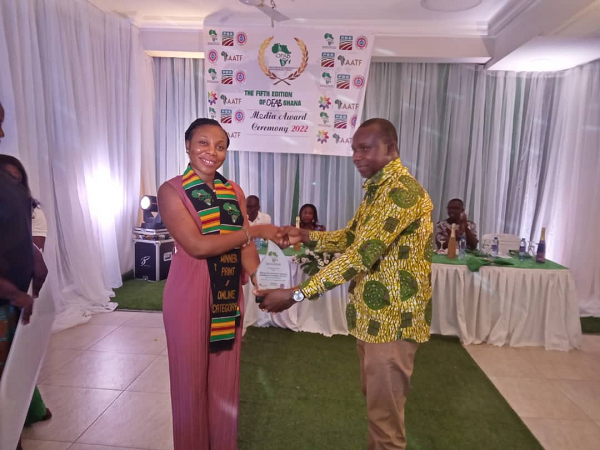
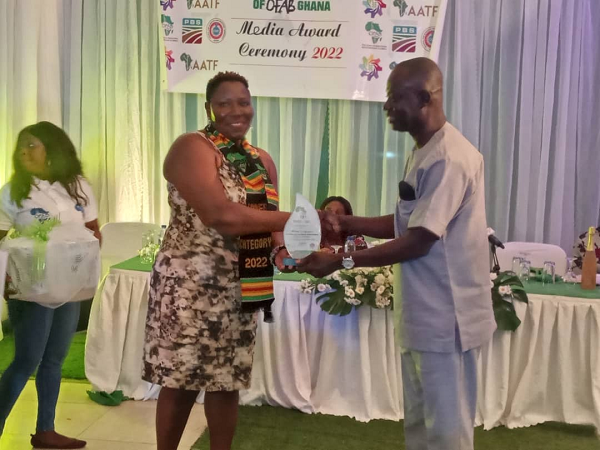
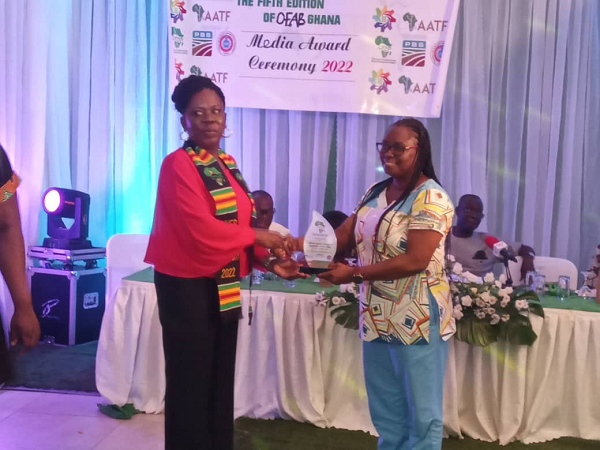
Three Ghanaian female journalists were honoured at the Open Forum Agricultural Biotechnology (OFAB) media awards for their dedication to science reporting, particularly on emerging technologies in agriculture.
They are Benedicta Gyimaah Folley of the Ghanaian Times; Gloria Anderson of GTV, and Joyce Gyekye of Radio Ghana. This happened on Thursday, September 15, 2022.
Folley won the print category of the contest whereas Anderson and Gyekye won the TV and Radio categories respectively.
They were awarded with plaques, cash prices and hampers.
Their reportage focused on agricultural biotechnology, particularly on genetically modified organisms (GMOs) and how it could contribute to Ghana’s food security strategies.
The award scheme is aimed at recognising exemplary journalism that stimulates best practices in the adoption of agricultural technologies.
The awards, which is in its 5th edition and organised by OFAB-Ghana chapter, was on the theme: “Credible and balanced Science Reporting in Readiness for Biotech Seed Development”.
OFAB Awards
The OFAB Media Awards, an initiative of the African Agricultural Technology Foundation (AATF), provide an opportunity to enhance knowledge-sharing and awareness creation of agricultural biotechnology that will raise understanding and appreciation of the technology and contribute to building an enabling environment for informed and timely decision making.
Underreporting
Speaking at the event, a former awardee of the contest, Mrs Ama Amankwah Baafi, a Staff Writer with the Graphic Communications Group Limited, encouraged Ghanaian journalists to prioritise science-based agricultural reporting.
“Agriculture, needs to be given the necessary attention as it is often touted as the bedrock of the economy,” she said.
In addition, she noted, “As Ghanaian journalists, we have a serious and a big role to play in correcting the misconceptions about the use of science and bio-technology in agriculture in Ghana.”
For Mrs Baafi, many countries had achieved a lot with agricultural biotechnology and that it was about time Ghanaian journalists “put out the facts on its (biotechnology) importance so people will appreciate it better.”
She expressed the concern that agricultural biotechnology reporting had received less media attention, hence many people had taken advantage of the situation to peddle falsehood about the technology.
“The topic seems to have been been relegated to the background or given limited attention and it is, therefore, time to change the narrative by reporting the facts and not rumors about what pertains within the sector,” Mrs Baafi, the multiple award winning journalist noted.
Collaboration
She further encouraged journalists to use their platform to facilitate dialogue on sustainable agricultural practices in Ghana, saying “it is only by creating the platform for dialogues on agric Biotechnology that we could effect policy changes.”
She also appealed to agricultural scientists not to shy away from journalists but to collaborate with them in order to make information on agricultural technologies more understandable to the public.
“Our dear agric scientists, I will also appeal to you not to shy away from the media but open up to us so we can understand the issues better and report on them,” Mrs Baafi appealed.
Credible Science Reporting
For his part, a former Director General of the CSIR, Professor Kenneth Danso, charged Ghanaian journalists to be more interested in science reporting.
He said it was only through the delivery of accurate science reporting that people will come to appreciate and understand the work of scientists, particularly when it comes to agricultural biotechnology.
For him, when journalists teamed up with scientists, it will help to address food security threats in the country and beyond.
“Biotechnology are there to solve human problems,” Prof. Danso noted, pointing out that information on the technology could only be make understandable to the public by journalists.
OFAB-Ghana’s dedication
The National Coordinator for OFAB-Ghana, Dr Richard Ampadu-Ameyaw, said the establishment of OFAB-Ghana has helped to publish credible information on agricultural biotechnology in the country.
He added that OFAB-Ghana only engages with various stakeholders during conferences, workshops, and stakeholder meetings, to bridge the gap between scientists, policy makers and the public.
Dr Ampadu-Ameyaw said considering the threats posed by Climate Change, it was necessary to find innovative solutions such as agricultural biotechnology to address the issues of agriculture in the world, particularly in Africa.
He said OFAB-Ghana will continue to provide information on agricultural technologies, particularly genetically modified organisms to enable people to discard the various misconceptions they have about the technology.
According to GWCL, the region was utilizing 20 gallons of alums per day to treat water, but that number has now increased to 60 gallons per day due to the region’s water bodies’ poor quality as a result of galamsey activities.
The Central and Western Regional Communications Manager for GWCL, Nana Yaw Baanie, said on the Morning Starr with Francis Abban on Monday that “the situation is really getting worse” and that “urgent steps must be taken to salvage the situation.” She also added that the government is losing the battle against galamsey in the region.
According to him, if the operation of illegal mining had really stopped the water bodies should be clear by now but that is not the case in the region.
“The color is over 9,000NTU and then the turbidity is 3,000 so this is what Ghana Water will have to deal with. We are supposed to reduce these figures to five (5) in order to make the water potable. That is the guideline we have been given. So this is our story in Takoradi Daboase to be specific where we get water from the Pra.
“If there should be anything that can be done it must be done now and it must be drastic. Recently, my boss Stanley Mantey said a time will come when Ghana Water Company will cease operation, yes. It may be coming very soon but we don’t know when,” Mr. Baanie stated.
Because what do we do if the water becomes untreatable at some point, he continued?
Can you image what will happen in Sekondi Takoradi if we cease operating for even one day?
We have a sizable hospital in Effia Nkwantan; where will they receive water if we have to suspend operations?
What will happen to the universities and the second cycle schools if we cease operations?
He claimed that before the ban on galamsey was declared, the galamseyers were active at the GWCL operation site at Daboase.
He asserted that, despite a nationwide campaign to combat the threat, their investigation demonstrates that the galamsey activities are still taking place.
The much-anticipated Heroes of Africa concert will be launched in New Jersey on October 9.
The event which is to honour and expose Ghanaian and other African acts to the world through music will see evergreen musicians like Dada KD and Natty Borax as well as younger music sensations Fameye, Akwaboah, Mr Drew and King Jerry.
Other musicians from the continent have also been billed to perform.
These artistes will be mounting the stage in Ohio for the Concert to thrill fans.
As part of efforts to promote the concert, organisers Abofrem Area Foundation will be having the official launch to outdoor the artistes and give more details about the concert.
The concert is scheduled to come off on October 29 at the King’s Hall in Columbus, Ohio.
The Centre for Democratic Development (CDD-Ghana) has launched a trans-national democracy solidarity network to mobilise, coordinate and leverage the collective power of civil society and other pro-democracy actors to defend and advance inclusive democracy in the West African region.
Named the West Africa Democracy Solidarity Network (WADEMOS), it is in response to signs of democratic backsliding and a reversion to autocracy in the region.
The network was launched in Accra last Thursday on the theme “Countering Threats to Democracy in West Africa”.
WADEMOS
It seeks to, among other things, build solidarity, mobilise and facilitate collective action among West Africa’s diverse pro-democracy civil society organisations and other civic actors.
It will also produce and disseminate data and analyses to support evidence-driven pro-democracy advocacy and activism in the region.
Democratic backslide
The Executive Director of CDD-Ghana, Prof. H. Kwasi Prempeh, who also doubles as the Project Director for the WADEMOS, noted that democratic backsliding in West Africa represents a major setback for the region and was a source of grave concern for its peoples. Already, he said, the region was faced with severe security and national cohesion challenges from the activities of jihadists and other violent extremists, notably in Mali, Niger, Burkina Faso and Nigeria.
He indicated that continuing democratic decline, with the risk of democratic breakdown in a few more countries, would spell disaster for the region.
Prof. Prempeh said stemming the democratic backsliding and reviving the region’s leadership in advancing democratic norms would require determined and sustained effort and commitment, not only by national and regional authorities, but importantly by civil society actors.
He, therefore, indicated that the network would engage the Economic Community of West African States (ECOWAS) to address emerging and current challenges and threats to democracy in the region.
Timely and appropriate
For his part, the Deputy Minister of Foreign Affairs and Regional Integration, Thomas Mbomba, said the launch of the network was timely and appropriate in the light of recent developments in West Africa, which involved the breach of constitutional rule in some countries within the region.
He said Ghana, as an active member of ECOWAS and a member of the United Nations Security Council, was committed to the principles of democracy, peace and security, rule of law and economic development.
Those shared values, he said, were prerequisites for equitable and inclusive development.
With such an initiative, Mr Mbomba expressed optimism that the members had capacity and the resources to mobilise, coordinate and leverage on the collective power of pro-democracy actors including engagements with organisations within the region in the hope and expectation that democracy could be defended, reinvigorated and enhanced.
He, therefore, commended the CDD-Ghana for taking the bold step in bringing the initiative into fruition.
He claimed that because of its stable political climate and abundance of investment opportunities, Ghana is a superior investment destination than its peers on the continent.
The Minister said as the host of the African Continental Free Trade Agreement (AfCFTA), Ghana has been placed in a pivotal position to lead Africa’s economic and financial renaissance.
“This means that when you come back and do business in Ghana, and with Ghana, you are only opening your door to access the entire African continent. I want to encourage you to come and invest in Ghana,” he added.
He assured the diaspora investor communities of guaranteed returns should they choose Ghana as their investment destination, citing the high returns in investment in equity markets and the high yields on Government of Ghana bonds as salient reasons for investors to focus on Ghana.
For in-depth discussions and the exploration of viable investment opportunities across the Ghanaian economy, the Ghana-Canada Investment Summit brought together delegates from the international investor community, particularly from Canada, venture capitalists, and private equity fund managers, among others.
Additionally, it was designed to increase trade between Ghana and Canada by bringing together local entrepreneurs, Canadian investors, and members of the diaspora.
It has emerged that about 300,000 of the Ghanaian populace is epileptic.
This was revealed by an epileptologist at the University of Ghana, Legon, Prof. Patrick Adjei, at an intersectoral global action plan on epilepsy, neurological disorders and strengthening public health approach to epilepsy in the country.
According to Professor Patrick Adjei, victims of the disorder are oblivious to the condition due to a lack of proper diagnosis.
What is epilepsy?
Epilepsy is a brain disorder in which nerve cell activity in the brain is disturbed, causing seizures.
During a seizure, a person experiences abnormal behaviour, symptoms and sensations, sometimes including loss of consciousness.
It occurs as a result of a genetic disorder or an acquired brain injury, such as a trauma or stroke. Symptoms of the disorder include uncontrollable jerking and shaking, called a “fit”, losing awareness and staring blankly into space, among others.
It is estimated that, globally, about 50 million people suffer from the disorder. The World Health Organisation (WHO) has indicated that 80 percent of this number live in low and middle-income countries.
Meanwhile, WHO Representative in Ghana, Dr Francis Kasolo, has revealed that efforts are being put in place to reduce the gap in epilepsy treatment in the country.
According to him, over 2,700 people have been provided with care and treatment since the ‘Fight against epilepsy’ initiative was rolled out in the country between 2012 and 2016.
Focus
According to Prof. Adjei, although health authorities were focusing on convulsive epilepsy, there were other forms of epilepsy which were non-convulsive, including staring, repetitive blinking, chewing, swallowing and automatism.
Others were coma, prolonged apnea, cardiac arrest, dementia and higher brain dysfunction he said.
Non-convulsive epilepsy, he added, represented a considerable burden in prevalence which, if not treated, interfered significantly with a person’s functioning.
He said there were two principal deficits in the knowledge of the burden of the disease in the country — seizures, because they were easy to detect, and no data on the prevalence of the disease in the urban environment.
He said those placed a huge burden on the country which had little capacity to care for people with mental health and neurological disorders.
Pro. Adjei is also a team member of the country’s Epilepsy Pathway Innovation in Africa (EPInA) project which aims to improve the quality of life of people with epilepsy in sub-Saharan Africa by addressing all aspects of treatment pathway: prevention, diagnosis, treatment and awareness.
Between 2019 and 2024, the EPInA team is working in Accra, Nairobi, Kilifi and Mahenge to improve prevention, diagnosis, treatment and awareness of epilepsy.
He said so far there had been some awareness creation and diagnosis programmes in the Shai-Osudoku and the Ningo-Prampram districts in the Greater Accra Region.
He added that they were also working at improving care and the reduction of stigma of people with epilepsy within the two districts.
The WHO Regional Advisor on Mental Health and Substance Abuse, Dr Florence Baingana, said 85 per cent of the epilepsy burden in the world was in sub-Saharan Africa.
She said stroke was the largest contributor to neurological disability-adjusted life year (DALY) globally and in all African regions where meningitis ranked second in three out of four countries.
She said access to service and support, including essential, cost-effective medicines for neurological disorders, was insufficient, especially in low and middle-income countries.
The Head of the Health Unit of the WHO, Dr Tarun Dua Brain, said neurological disorders were the leading cause of DALY and also the second leading cause of death — 16·5 per cent or nine million deaths annually.
She said one in three persons worldwide had a neurological disorder at some point in his lifetime, while 78.5 per cent of deaths and 77.3 per cent of DALY due to neurological disorders were also in low and middle-income countries.
WHO Ghana
The WHO Representative in Ghana, Dr Francis Kasolo, said the organisation would continue to partner the government to work towards reducing the epilepsy treatment gap in the country.
He said a ‘Fight against epilepsy’ initiative rolled out in the country between 2012 and 2016 provided treatment and care for more than 2,700 people.
According to him, the WHO had expanded its work on epilepsy treatment and care with the introduction of a flagship programme, the Health Gap Action Programme (mhGAP), which he said was aimed at training non-specialist health workers to diagnose and manage mental, neurological and substance use conditions.
Information Minister, Kojo Oppong Nkrumah, has urged investors to consider the huge opportunities that exist in Ghana and direct their investment into the country for higher returns.
He said the stable political atmosphere, coupled with the prevailing peace, made Ghana a better investment destination of choice than its counterparts on the continent.
“As the host of the African Continental Free Trade Area (AfCFTA), Ghana has been placed in pole position to lead Africa’s economic and financial renaissance.
“This means that when you come to do business in Ghana, you are only opening your own door to access the entire African continent. We look forward to seeing you soon,” Mr Nkrumah added.
The minister was addressing the Diaspora investor community at the end of the six-day Ghana-Canada Investment Summit (GCIS) organised by the Ghana Investment Promotion Centre (GIPC) in Toronto, Canada.
Investment haven
Mr Nkrumah, who is also the Member of Parliament for Ofoase/Ayirebi, described Ghana as a fertile ground for investment where businesses thrived due to its stable economic atmosphere, and, therefore, urged prospective investors, especially those from Canada, to consider Ghana as the gateway to a wider African market.
He said Ghana had a variety of investment vehicles available for every investor class which offered higher returns than other African countries, and cited the high returns in investment on equity markets and the high yields of Government of Ghana bonds as examples.
He further called for the support of Ghanaians in the Diaspora, saying they had a crucial role to play towards the growth and development of the country.
Summit
The GCIS brought together delegates from the international investor community, especially from Canada, venture capitalists, private equity fund managers, among others.
The participants discussed and explored viable investment opportunities within various sectors of the Ghanaian economy.
There were also collaborations with the Diaspora, Canadian investors and local entrepreneurs and the creation of awareness of the potential of Diaspora Direct Investment and the need to increase trade between Ghana and Canada.
Present at the summit were some state officials, including the Minister of Foreign Affairs and Regional Integration, Shirley Ayorkor Botcwhey; the Minister of Communications and Digitalisation, Ursula Owusu-Ekuful; the Minister of Tourism and Culture, Dr Mohammed Ibrahim Awal; the Chief Executive Officer of the GIPC, Yofi Grant, among others.
US-based nine-year-old model, actress and founder of Shyv Beauty, Mylah Gyimah, is the latest to step onto the fashion scene as the next beauty mogul with her top affiliations with ace fashion brands worldwide.
Having modelled for some of the world’s top brands at such a young age, Mylah is already well-versed in skincare best practices and routines, remembering her grandmother’s tips and tricks for moisture retention.
Mylah Gyimah on set with Crew Cuts
Born as Mylah Shyvonne Maame Yaa Agyiwah Gyimah, her name signifies the mercy of God and traces her back to her family roots in Ghana, West Africa.
As a proud Ghanaian-American model, she began her modelling career as a means of building her self-esteem and understanding the different shades and textures of beauty in the world.
She began to acknowledge the beauty in herself and continued to bloom as a confident little girl that knows she is beautiful and had something to contribute to the world.
Mylah Gyimah models for Ralph Lauren
In an interview with her mother, who is also her manager, she described Mylah as an adventurous little model who is always exploring and learning.
“Who is she? We do not know yet. She is growing each and every day, soaking up so much knowledge, trying and learning new things.
“She is watching new movies and reading new books. She is meeting and interacting with a diverse group of people each and every day and gain so much experience as a model. She has also created a skincare brand made for kids that is storming through the market. She is only nine.”
Climaxing the interview, she said, “One thing we know for sure is whoever she becomes in this world or whatever she decides to do in this world, she will do it as a beautiful and smart Ghanaian-American female that will inspire people and contribute to the visions of beauty for years to come.”
SHYV Beauty, the skincare brand made for kids, by a kid, is now sold in Janie and Jack, and Maisonette, with plans to expand into additional stores and markets.
Mylah Gyimah shows off her natural kid’s skincare product, Shyv
This exclusive line features soaps, body butter, and accessories designed and formulated by Mylah – implementing her grandmother’s century-old recipe for body butter.
All Ingredients to make this exclusive recipe is purchased from Ghana, West Africa in honour of Mylah’s Great Great Grandmother and her Ghanaian Heritage.
The Minister of Transport, Kwaku Ofori Asiamah has eulogised President Akufo-Addo, describing him as “a promise keeper.”
According to the Minister, his boss has always delivered on promises made to Ghanaians.
He noted that although Ghanaians still treat the promises of politicians with suspicion, President Akufo-Addo had shown that he was a man of his word by delivering on his key policies.
Mr Asiamah made this known on Monday during a ceremony to herald Ghanaian airline, Passion Air’s maiden flight to the recently renovated Sunyani Airport in the Bono Region.
He said the President had kept his word to the people of Bono after he assured them that commercial flights would soon operate from the airport.
Mr Asiamah further urged Ghanaians to always say a prayer for the President so that he will be able to surmount all challenges.
“You will recall that on 3rd August this year, I accompanied President Akufo-Addo to commission this airport following certification by the Ghana Civil Aviation Authority for the airport to resume flight operations,” Mr Asiamah said.
“At the commissioning. I did inform you that, Passion Air, one of the domestic carriers was finalising modalities for the commencement of flight operations to this airport. It is my pleasure to announce that today’s inaugural flight by Passion Air is a clear demonstration of the government’s commitment to improving air connectivity across the country and beyond to boost trade and tourism”.
Maiden flight
The Minister was speaking at an event to welcome Passion Air’s maiden commercial domestic flight to the Bono region.
Onboard the flight which lasted 45 minutes from the Kotoka International Airport to the Sunyani Airport were Members of Parliament; members of the Ghana Airports Company Limited Board; management and staff of Passion Air; pressmen and other passengers.
Ghanaian musician, Kofi Jamar has come under criticism for a tweet he made regarding the effects of colonisation.
The artiste, who has been very vocal about his conscious stance regarding black empowerment, took it to another level today.
In a post on Monday, he eulogised the impact Africans have had on music genres on the international front.
In justifying the role of blacks in these spaces, Kofi Jamar explained that “our ancestors really knew what they were doing when they sold Most Africans into slavery.”
“This is a great impact on the world as we see today,” he continued in the post on Twitter earlier today.
He added that “Blacks have benefited and impacted the world a lot in so many ways due to that migration. Shhh we wouldn’t have had the likes of Jay z, Lebron, Michael Jackson, Kanye West, Virgil abloh and a whole lot you can mention.”
Some social media users did not take this lightly.
So our ancestors sacrificed themselves for Kofi Jamar to come and tweet this nonsense.
But the artiste, following the tirade of reactions, seems to have gone back on his words.
He has since deleted the post apologised for the comment.
“I apologize for my tweet. My great grandfather, Prempeh the 1st was captured as a result of the colonial regime, I’ve been affected by what happened in many ways. Although the deed of slavery is wrong I can’t deny the impact blacks have had on the world today because of that.”
Meanwhile, the apology seems to have done very little to cure the outrage sparked by the original post.
That Kofi Jamar ein apology be worse pass the main tweet he deleted
So is Kofi Jamar trying to tell we Ghanaians that he has more sense than Kwame Nkrumah and the Big six or what? That tweet on slave trade wasn’t needed.
The 38th edition of the National Farmers Day has been launched in Accra to reward farmers for their hard work and commitment to ensure food sufficiency in the country over the year.
The event, which will be held in Koforidua, the Eastern Regional capital, on December 2, 2022, is on the theme: “Accelerating agricultural development through value addition”.
The Minister of Food and Agriculture, Dr Owusu Afriyie Akoto, who launched the day in Accra last Friday, said “we need to commend our farmers for standing with us to produce food in very difficult global circumstances”.
Recognition
Dr Akoto said farmers deserved commendation and encouragement, particularly over the last two years when the country performed well in the agricultural sector in the midst of difficulties arising from the COVID-19 pandemic.
He said the sector stood tall as a result of the support given to farmers by the government and described the performance of farmers as “extraordinary”, compared to other sectors, particularly in the wake of the pandemic.
According to him, there was a significant growth of 8.4 per cent of Gross Domestic Product (GDP) in the sector last year, as against 7.4 per cent in 2020 and 4.5 per cent in 2019.
He said since the introduction of the Planting for Food and Jobs initiative, the government had invested about GHC 2.6 billion to subsidise improved seeds and fertiliser.
According to him, the programme led to the cultivation of GHC 50 billion worth of farm produce, about 14,973,000 tonnes.
Value addition
The Minister of Fisheries and Aquaculture Development, Mavis Hawa Koomson, in a speech read on her behalf, said the concept of value addition in agriculture, especially in fisheries and aquaculture, would lead to additional revenue generation, job creation, foreign exchange earnings and effective post-harvest management.
According to her, in 2021, fish production stood at 628,617 tonnes, amounting to about GHC 11.04 billion, contributing about 1.04 per cent to GDP, adding: “I am sure that if there had been value addition, the revenue would have been more.”
Ms Koomson said her outfit had taken some measures to improve value addition and mentioned, for instance, the building of the capacity of actors in the fish value chain to ensure the production of safe and quality fish products.
Appreciation
The Eastern Regional Minister, Seth Kwame Acheampong, expressed appreciation to the National Planning Committee for selecting his region to host the event.
He gave an assurance that “this year’s celebration will be one of the greatest ever held, if not the best”.
The Chairman of the National Planning Committee, Yaw Frimpong Addo, said in the entire 38-year history of the celebration, the private sector had contributed significantly.
Mr Addo, who is a Deputy Minister of Food and Agriculture, entreated the private sector to, as usual, “come to the table with their sponsorship package”.
As part of the celebration of his 45th birthday, gospel singer, Nii Okai, has launched an 8-track album, titled ‘Revealing Jesus.’
The new album (his 8th) comes exactly 19 years after his maiden ‘Moko Be’ album was released.
Produced by Koda, the album features MOGmusic, Eugene Zuta and Pastor Isaiah Fosu-Kwakye among others.
Nii Okai Ministries has announced a weekend of activities to celebrate the milestone, including courtesy calls on media business owners, stakeholders and associates premiere meet, thanksgiving service, and high school outreach to Akosombo International School.
The new album will be released via Boomplay and all other digital platforms and streaming sites.
Four of the songs namely, Moko Be (Praise), Breaking Seals, Kron (Holy), Naano Lala are already enjoying rotation on Apple Music and on key radio stations in the country.
“I have come to appreciate that our raison d’être is for Jesus to be revealed to and through us. This album marks a new beginning in my ministry as I look forward to what is to come,” Nii Okai comments.
Pastor Nii Okai, who recently clocked over a million views on YouTube for his Praise Remix collaboration with Joe Mettle, has released the visuals of Naano lala (Eternal Chorus), his latest single off the upcoming album.
“This is awesome! My jam for the day. Simple, filled with subtle shows of brilliance, and I just love it. Sweet, no unnecessary complex stuff and beautifully done. Fills my heart with joy and I bless God for your unvarnished talent,” Comments Ace Anan Ankomah, a mentor, composer and music hobbyist.
Nii Okai Ministries is currently hosting a global #naanolalachallenge across social media and it seeks to showcase the dexterity and versatility among music directors and their choirs, using the refrain of his latest single – Naano Lala (Eternal Chorus).
Nii Okai’s Saving Hearts Foundation continues to fund-save open-heart surgeries for needy children in collaboration with select Paediatric Intensive Care Units. This year, with support from Citi TV & Citi97.3FM, the Foundation hopes to touch more lives by World Hearts Day on September 29.
The highly rated artist’s much-awaited introductory EP gets the basics right while sharing ambitions of his ultimate purpose in the game as a culture-shifter.
In an interview back in December 2021, Nova Blaq spilled the beans on his debut album-now-turned-EP Crime of Passion and used it as a metaphor to express his desire for music. But January came along and diehard fans were left with nothing from the exciting MC, not even a song as he promised. It seemed the march to his much-anticipated debut was going to be an indefinite one, at least until September 6 when he got the final and official word out.
And indeed, as promised, ‘’Crime of Passion’’ EP is finally out for fan consumption – a 9-track project that touches new grounds sonically while sharing ambitions of Nova Blaq’s ultimate purpose in the game as a culture-shifter, next to guest stars E.L, Blackway, Medikal, Haeven and Mr Drew who all lend their varying styles to complete this partly produced multi-genre soundscape, wonderfully, atop some words of encouragement from some of the rapper’s biggest fans; his mother and a close friend.
Ending in an unexpected but oddly fitting fashion, ‘Just The Way I Feel’, the EP’s penultimate track may be its biggest surprise. It’s Nova Blaq’s farthermost from Hip-Hop yet and has the Bronx-native tap into 80s pop over what sounds like a sample of Bonnie Tyler’s classic 1980s hit ‘Holding Out for a Hero’.
His artistic versatility is really flexed on this feel-good record that sums up the EP. There are six other songs of the nine that present Nova Blaq in his familiar essence; like the E.L-assisted ‘Roses’ – a song that follows his mother’s prayer in the EP’s opener, ‘Josephine’s Prayer’ (Intro). It’s straight fire and has a good dose of classy bragging that sees the two artists mull over their contributions to the game while demanding their flowers – power and respect – all the same.
These subtle elements of braggadocio trickle more boldly into the menacing trap cut, ‘Pull Up’ with Blackway. Here, Nova Blaq delivers an overdose of energy; boasting of all the luxury he can afford using his ambition as the driving force before his guest instills some flavorful vibes into the bass-driven production.
APMWORLD helps put this terrific collaboration on display in a series of wild shots that trail the MC around Brooklyn, New York in his red 2022 Corvette.
And of course, it wouldn’t be a complete debut without one of the artist’s best songs aboard – the self-produced, Ghana Music Awards USA-nominated ‘Dark Knight’ being that song. Fans are treated to the rapper’s classic murderous flow once again, which may raise questions as to why the equally nominated and Medikal-assisted ‘Pressure’ didn’t make the EP’s final cut. The answers to these questions are made obvious in ‘Nkwasiasem’ – a hard-hitting street anthem from Nova Blaq and Medikal that boasts similar levels of allure, one that is sure to be ringing off on the streets.
As if to quell his tones of aggression halfway into the project, the Kumasi-raised New Yorker sidesteps to the vulnerable side with ‘Late Night’. Made splendid by singer Haeven, the R&B song airs the two artist’s motivations behind quitting their failed relationship. Even with such delicate topics, Nova Blaq manages to stay grounded in his style, offering a calm and reflective hook that is brilliantly contrasted by the soulful hook he lends to the captivating and self-produced follow-up, ‘4give Dem.’
Done with Mr Drew, there’s a hint of autotune to the rapper’s vocals. Revenge is the mindset at play on the Afrobeat banger, a meal both stars plan on serving cold to critics, prayer-style and as expected, their execution couldn’t have been any better.
The ultimate purpose of what Nova Blaq is shooting for though lies in the EP’s closer, ‘Janet’s Message’ (Outro). Perhaps the project’s most personal, listeners are bid farewell with a voicemail from the rapper’s close friend by name of Janet, who goes on to tell Nova Blaq how important what he doing is in the bigger order of things – just as he shared himself in a recent interview: “From here it’s only going to get more progressive with my sound because I feel my role as an artist is to take risks that push the culture forward and inspire others. I’d rather fail as myself than succeed trying to mimic others”.
Although relatively a newcomer in the game, Nova Blaq’s passion runs back to when he was only 16, placing Janet’s message at the crux of his goal. He knows he has a lot more to do, and it’s on that note that ‘’Crime of Passion’’ ushers Nova Blaq out of the first stage of his musical journey. It’s all trailblazing for the Ghanaian culture now and inspiring the younger generation of African kids to follow their dreams, all while he ascends to the top of the game as one of its exciting MCs (and in case it isn’t yet obvious enough), producers.
Minister of Food and Agriculture, Dr. Owusu Afriyie Akoto, says the government has spent GHC 2.6 billion on subsidies on cocoa seed and fertilizer, which generated GHC 50 billion worth of farm produce for the country.
He said Ghana’s agriculture had risen tall due to the support given to farmers and the reciprocal benefit adding, that it had made the sector perform extraordinarily as compared to other sectors.
Ghana’s agricultural sector recorded an accelerated growth of 8.4 per cent in 2021, as compared to the 7.4 per cent recorded in 2020, the Minister stated.
Speaking at the launch of the 38th edition of the farmers’ day celebration in Accra, Dr Akoto said farmers needed to be commended for the achievement.
“The growth has been accelerating due to the commitment of our farmers. So, we need to commend our farmers for producing in these very difficult global circumstances.”
Ms Mavis Hawa Koomson, Minister of Fisheries and Aquaculture Development, in a speech read on her behalf, noted that the concept of value addition in agriculture, especially fisheries and aquaculture presented an exceptionally good opportunity for additional revenue generation, job creation, foreign exchange earnings and effective post-harvest management.
Ms Koomson disclosed that in 2021 total fish production stood at some 658,617.53 tonnes estimated at 11.04 billion Ghana cedis, which contributed to about 1.04 per cent of GDP and 20.99 per cent of agriculture, adding that the benefit would have been more if the value additions were included.
She said the Ministry was promoting new products such as fish powder, fish khebab and fish sausage in collaboration with the council for scientific and industrial research, food research institute specifically, products such as fish balls have been developed while up takers are being encouraged to commercialise such products.
She said the ministry had taken a keen interest in pursuing various activities to improve value addition, which included strengthening the capacities of actors in the fish value chain to ensure the production of safe and quality fish products.
To this effect, 994 fish farmers have so far been trained in hygienic fish handling, fish processing and marketing strategies, while 200 fish processors have been also trained in best practices.
The 2022 National Farmers’ Day celebration would be held in the Eastern Region on the theme: Accelerating Agricultural Development through value addition.
Mr Seth Kwame Acheampong, Eastern Regional Minister, acknowledged that agriculture could not be left out of the nation’s developmental agenda.
He said: ” Our basic survival and progress as a nation depends on the produce this sector provides. The contribution of this sector to our GDP continues to remain significant and the employment opportunities that exist in this sector cannot be overemphasized”.
He said the Eastern Region was endowed with a unique diversity in terms of culture, ethnicity, and vegetation and contributed to the food basket of the nation.
He commended the National Organizing Committee for the honour bestowed on them to host this year’s National Farmers’ Day celebration and affirmed an effective collaboration to make the celebration a success.
“Let me assure all of you that we will collaborate effectively with the organisers and stakeholders to ensure this year’s celebration will be one of the greatest ever held, if not the best”.
Major sponsors for this year’s farmers’ day celebration include Agricultural Development Bank (ADB), Stanbic Bank and Exim Bank.
Addi Self, a former SM Militant, has disclosed that he had a friendly bond with Shatta Wale until the dancehall musician signed him onto his label.
The Self Nation leader in an interview with GhanaWeb’s Paula Amma Broni disclosed that he was more like a younger brother to Shatta.
Their friendship birthed collaborations including their 2017 single titled ‘Ghetto Star’.
Commenting on the circumstances that led to their sour separation and his exit from Shatt Movement, Addi Self blamed it on the ‘contract’ he signed to officially join Shatta’s camp.
“It was a great relationship until I was signed on that label. When I met Shatta at first, it was like a brother and sister relationship. We met on Facebook and then we met in real life and started to work things out like a family.
“We did a whole lot of singles; we have ‘Ghetto Star’. It was a great one featuring Shatta Wale, that was one of the best singles I recorded with him. From there we had the chance to record ‘Taking Over’. It was a great vibe and a learning process for me when I was in the Movement,” Addi Self told GhanaWeb.
The dancehall singer, speaking on Talkertainment, credited Shatta Wale for providing him with a bigger platform to sell his music, adding that he left Shatta’s camp when his contract expired.
“So after ‘Taking Over’, Shatta Movement decided to sign me even though I had my own Self Nation Record Label I was doing. They decided to sign me on their label and so, I had to join Shatta Movement as an SM Militant…we worked together and signed a contract for three years and when it was over, Addi Self had to move on,” the ‘Loyalty’ singer added.
The Institute stated that specific inflation-causing variables should be targeted in a statement on September 19, 2022.
“The cost and supply issues, especially those relating to food, fuel, transportation, and the exchange rate, are a major contributor to the current inflation.
Breaking down the 33.9% headline inflation for August into its component parts shows the effects of these factors: “Diesel inflation was 116.9%; petrol inflation, 80.5%; transport inflation, which includes fuel costs, was 45.7%; imported inflation, which reflects the effect of the exchange rate, was 35.2%; and food inflation, 34.4%.
The IEA stated that among measures that can be adopted to reduce inflation, these four should be looked at by the government.
1. Regarding food, we call for reinforcement of measures to ensure that food stocks are easily transported from farm gates to markets. We call for subsidies on basic staples like maize, rice, cooking oil, and bread.
2. With regard to fuel, we advocate for the elimination of some fuel taxes and levies as well as the use of a portion of the government’s windfall profits from rising oil prices to reduce the cost of gasoline at the pump.
3. In terms of transportation, we demand the development of public transportation and the subsidization of fare prices to assist the general population.
4. With regard to the exchange rate, we urge the Bank of Ghana to implement foreign exchange legislation, such as those that deal with traveler carry-on baggage restrictions, forex trading, the pricing of products and services in forex, and bank-to-bank currency transfers.
In order to lessen pressure on the currency rate, we also urge the Bank to work with overseas businesses to stagger the repatriation of their earnings and profits.
In an effort to critique certain celebrities, certain radio hosts and entertainment experts have recently come under fire from the public for “verbally abusing” those individuals.
They were accused of being overly sentimental due to their word choice and the apparent sarcasm with which these experts presented their thoughts.
A portion of the public also thinks that they haven’t done their homework when it comes to investigating and presenting facts about subjects.
Recently, some of these radio hosts and entertainment commentators have not been kind to artists like Shatta Wale and Sarkodie.
In the case of Shatta Wale, he has faced constant criticisms by a popular outspoken pundit, Sally Mann, who labeled him a local champion, an inconsistent, and a confused artiste.
Sarkodie wasn’t also spared by the likes of DJ slim, Socrate Safo, and others for stating that radio presenters who haven’t attained the trajectory of working with the BBC have no moral right to criticize his works or question his growth.
However, analyzing all these, Andy Dosty thinks that his colleagues need to remain absolutely professional when carrying out their duties.
While admitting that some pundits or journalists overreact in delivering their judgments, the ‘Daybreak Hitz’ host in an interview with Graphic Showbiz said;
“Radio presenters have always had their opinions on topics just as Graphic Showbiz has columnists who share their opinions on issues but I admit that sometimes, we overdo it. The question I want to ask is concerning those criticizing, are they doing it wrongly or are they being objective?
“As long as we are objective in our criticisms, I don’t have any problem with that but if not, then we are obviously not doing the right thing and we are not being professional. We must strive to be objective at all times. Radio presenters have their say, they have an opinion just like editorials but if they have to say something they must say it well and also be objective.
Otherwise it is like saying that Kwaku Sakyi-Addo or Francis Doku or Arnold Asamoah-Baidoo shouldn’t have an opinion, there must be such people who come out to share their opinions.”
Ghanaians are dissatisfied with the increase in sachet water ((popularly known as pure water) prices that is scheduled to go into effect today, September 19, 2022.
On Wednesday, September 14, 2022, National Association of Sachet and Packaged Water Producers (NASPAWAP) announced that the commodity will sell at 50 pesewas per sachet from today.
A section of the public who spoke to the Independent Ghana expressed shock over the news.
Kwame Ofori, a concerned Ghanaian, couldn’t fathom how the commodity, which was previously old at 20 pesewas and was subsequently increased to 30 and 40 pesewas, will now be sold at 50 pesewas.
“I was very worried when I heard the news because we are in difficult times. There are no jobs for us to earn an income and the price of water that we have to drink to
improve our living conditions has been increased. This is very bad for us. Our leaders are not helping and the entire citizenry are suffering,” he said.
Another citizen, David Addo, found the price increment outrageous.
He explained that: “I think it is quite outrageous because water is a bit outrageous because water is a basic commodity and everybody should be able to have access to it. Even if it’s not free, it should be affordable.
“So with the increment of prices I don’t think it’s a step in the right direction,” he added.
He, however, entreated the government to immediately take steps to forestall the said increment.
“Even if they can influence the prices of the duties on the raw materials water production companies so that at least the price could be reduced because some people cannot afford it,” he said.
Nana Poku, another citizen, who disclosed that he consumes about 10 sachets a day was not also happy about the development.
He noted that “increasing the price of the commodity is not the best, especially at this time, since water is a very basic commodity which should be accessible for all and very affordable.”
“You know, water is life and no one can do without it. So something must be done immediately about the prices,” he added.
Jonathan Mensah on the other hand, empathised with the National Association of Sachet and Packaged Water Producers over the decision.
According to him, the increment is justified, considering the high cost of living. He believes the Russia- Ukraine war is a major contributing factor to this development.
“The price of everything has increased and this is the result of the Russia Ukraine war which is having a toll on the whole world. So to me, it’s not surprising,” he said.
Pure sachet water is now 50 pesewas
The increase of pure water from 40 to 50 pesewas stems from a directive from the National Association of Sachet and Packaged Water Producers.
According to the Association, the cost of production is at an all time high due to the hike in fuel prices and the depreciation of the Ghana cedi.
In the last pricing window (which ended on August 31, 2022), the national average price per litre of petrol stood at GHC10.95, up from GHC10.58 in the previous window, representing a 3.50 per cent increase.
Diesel national average price per litre also stood at GHC 13.42 from a previous average of GHC 13.28, representing a 1.05 percent increase, according to data compiled by the Institute for Energy Security (IES).
Pure water, a basic commodity, has witnessed a 125% increase in price as a result of two upward adjustments within 10 months.
Before mid-December 2021, a sachet of water went for 20 pesewas. The price was increased by 100% to 40 pesewas by the
National Association of Sachet and Packaged.
Water Producers
In a statement dated December 24, 2021, the Association revealed that the review was due to “rising cost of inputs such as fuel, vehicle, spare parts and packaging materials which are mainly imported.”
“At our previous review, the Ghana Cedi to the dollar was in the region of GHC 4.50. Currently, it is inching up to GHC 6.50,” the statement added.
As mentioned by the Association, there was a slight variation in prices across the regions due to haulage to remote and distant areas across the country.
Some retail shops sold a sachet of pure water for 30 pesewas to have an urge over their competitors.
After 10 months, the Association has increased the price of a pure water sachet by 25%.
Henceforth, a bag of 500ml sachet water will now be sold at GHC 7 from the retail trucks, however, mini shops will retail the basic commodity at GHC 9 per bag.
A 500ml bottled water will be retailed at GHC 2, while a bottled water of 750ml or medium size, will be sold at GHC 3.00.
Meanwhile, the Association has once again cautioned members of the general public that there might be slight variations in prices across the regions due to haulage to remote and distant areas.
The upward adjustment comes at a time when the Public Utilities Regulatory Commission (PURC) has increased utility tariffs.
Electricity and water tariffs have risen by 27.15%, 21.55% respectively.
Executive Secretary of the National Identification Authority (NIA), Professor Kenneth Attafuah, has warned Ghanaians not to develop hatred for foreign nationals, particularly Chinese, following reports of their involvement in illegal mining.
According to him, engaging in xenophobia and hurting innocent lives in the process will be hypocritical on the part of Ghanaians as compatriots in other countries, especially South Africa, have been victims of such prejudice.
Addressing the press last Friday on the non-citizen Ghana Card issued to Aisha Huang, a galamsey kingpin, he said “Jingoism is dangerous. Excessive nationalism but one that also targets others, that is xenophobia.”
“We have to be careful not to drift into xenophobia because Chinese numbers are large in our country or a woman called Aisha Huang is said to be dangerous or any of the considerations that dominate public discourse about Chinese, Nigerians,” he added.
It recently emerged that Aisha Huang, who is currently in police custody for allegedly engaging in illegal mining and the sale and purchase of minerals, had been issued a Ghana Card but on a false pretence. She used the name Huang En instead of Aisha Huang.
In a statement, the NIA explained that on February 26, 2014, a Chinese woman named HUANG EN registered as a first-time applicant for a foreigner identity card at the Foreigner Identification Management System (FIMS) registration centre at Nhyiaeso, Kumasi, in the Ashanti Region.
Her biometrics were captured and she was issued a non-citizen Ghana Card.
She subsequently did two more renewals on 31st August 2016 and 8th January 2018, using the same details and Chinese passport number G39575625- Forename:
En, Surname: Huang, Date of Birth: 07-Jul-86, Personal ID Number: CHN-010039480-J, Passport Number: G39575625.
The statement continued that “On August 25, 2022, at 10:35 am, an incident occurred at the FIMS Registration Centre in Tamale, Northern Region, involving a Chinese national who visited the centre as a first-time applicant with the following details: Forename: RUIXIA, Surname: HUANG, Date of Birth: 07-Nov-75, Passport Number: EJ5891162.”
The registration, however, went into a technical state known as ‘RejectedDueAFIS’, which meant that the biometrics of RUIXIA HUANG possibly matched that of an already existing person in the NIS database.
The registration officer, therefore, sent a request to the technical support team for further investigations.
This revealed that, based on the biometrics provided, “RUIXIA HUANG” had previously registered as EN HUANG in the FIMS record under the NIS database.
Per the NIA, when confronted by the registration officer with this information, she claimed to have changed her name.
This information and the fact that the Chinese are the foreign nationals with the highest number of non-citizen Ghana Cards have caused citizens to worry.
Professor Kenneth Agyemang revealed that 34,712 non-citizen Ghana Cards have been issued to Chinese nationals.
According to him, the NIA is unable to determine the ulterior motives held by such foreign nationals because they are not under any law or obligation to provide the Authority as to why they are in Ghana.
“Do Chinese tell why they are in Ghana? They are not required by the laws of NIA. Nobody is required, whether they are Chinese or British. We have to be careful not to be selective about this,” he said.
He, however, added that “It is the profession that is required to be stated with respect to NIA.”
“We have to hasten slowly,” he reiterated, on the need to avoid any form of xenophobia.
South Africa has a history of xenophobia against Africans.
Foreign Africans have been blamed for economic insecurity, crimes, and government failures and have therefore been targets of nationwide protests and shutdowns characterised by mob violence, looting, and torching of their businesses.
Attacks on foreign Africans, including Ghanaians, in the country resurfaced at the beginning of September this year.
In view of this, the Ghanaian High Commission in South Africa has entreated Ghanaian compatriots “be vigilant to any such incidents, restrict their movements to safe areas, avoid mass gatherings and refrain from engaging in activities that could result in conflict, brawls or deterioration in their safety.”
Bayern Leverkusen winger, Callum Hudson-Odoi has opened up on how he got frustrated by the lack of game time at Chelsea.
The winger disclosed he was frustrated with Thomas Tuchel’s decision to leave him out of the squad for the opening day of the Premier League.
He narrates that the move by the coach got him thinking deeply about the future of his football career.
Callum Hudson-Odoi who is thriving on loan at Bayern Leverkusen noted with happiness the chance to play football and get more minutes.
The British -born of Ghanaian descent said that playing regularly gives players confidence and helps them improve.
“It was one of those difficult moments when you look at yourself and say, ‘What am I doing wrong? Have I done anything wrong to not even be in the squad?” he said of his opening day snub.
“I would never say anything bad about Thomas, he was a good guy, a good manager. [But] the first game of the season, it was frustrating. Any footballer that isn’t in the squad would understand how frustrating it is. Regular football gives you consistency and the more games you play, the more consistent you become, the more form starts to kick in.
“You feel fresher, you feel better, you feel like…not that you’re getting treated fairly but that you’ve got the trust from the manager to push you and kick you on. You don’t want to be on the bench thinking, ‘Why am I not playing?’ And then it becomes weeks and weeks and the legs are rusty when you do play. The most important thing is consistent football. That’s what I’m getting here and it’s making me feel better.
“Right now, playing games, momentum is kicking on and you feel refreshed: new country, brand-new experience. It’s definitely refreshing to know I get an opportunity to play games week in, week out, enjoying it and smiling!”
Hudson-Odoi is one of a number of players being courted by the Ghana Football Association to represent Ghana at the World Cup.
“There is a pressing need for Ghana to address these issues quickly.
According to reports from 3news, he added, “What is occurring in the last few months is that inflation has gone up partially because of what is happening upside but also partly because the currency has weakened.
A further decline in the economy’s capital adequacy will have serious consequences for the nation, he added, as banks depend on government bonds and securities.
“From my vantage point, domestic debt structuring is exceedingly tough, making it very difficult for Ghana to find another way out if nothing changes.
Why?
Because banks often invest in government securities and bonds, he explained that when you ask them to handle such matters, it impacts their capital adequacy and puts these banks at risk. International debt is simpler to reschedule or restructure.
Asante Kotoko goalkeeper, Danlad Ibrahim has said the Porcupines will bounce back after they were stunned by RC Kadiogo in the CAF Champions League preliminary round.
Kotoko were kicked out of the Africa’s tier one football competition on penalties after the tie ended one-all on aggregate.
Reacting to the surprising exit, Danlad wrote on his Twitter page that they might be out but the season is not over.
“Not the best results in the CAF champions league game yesterday but we promise to do our best this season. We are out but the season is not over. We shall be back,” he tweeted.
Kotoko, who won the first leg 1-0, lost the second leg 1-0 at home and were eliminated from the competition after a 3-1 loss on penalties.
Asante Kotoko could have faced AS Vita if they had gone past Kadiogo. After exiting the first round, the Reds will not play in the CAF Confederations Cup
The Ghana Journalists Association (GJA) will launch one of its flagship programmes, the Journalists Support Fund, in the first week of October 2022.
President of the Association, Mr Kwabena Dwumfour, disclosed this during a courtesy call to the Managing Director of the Agricultural Development Bank (ADB) on Thursday, September 15, 2022, in Accra.
He explained that the Fund’s main goal is to aid in the pursuit of justice for journalists who have been assaulted in some way while on the job.
“In the past, we realized that when journalists are attacked and assaulted, or when their security and safety are threatened, and whenever they are attacked, all we (GJA) do is issue press statements and hold press conferences but we always leave it there,” Mr Dwumfour said.
“There are numerous situations that have now gained disrepute because we are unaware of them and because we don’t appear to have finished our investigations into assault cases, particularly those involving journalists,” he added.
According to the GJA President, resources will be drawn from the fund to assemble a legal team to defend journalists when necessary.
Assaulted Journalists
Ahmed Hussein-Suale, a Ghanaian investigative journalist who had worked with the BBC, was shot dead near his family home in Accra on January 16, 2019. Authorities believe he was assassinated because of his work.
Caleb Kudah was arrested and physically assaulted for filming abandoned vehicles obtained by MASLOC and parked at the Ministry for several years. On March 27, 2018, one of Ghana’s budding and fearless journalists, Latif Idris, was brutally beaten to near death at the headquarters of the Ghana Police Service. Meanwhile, the GJA is embarking on a rebranding agenda. As part of measures put in place, the Association will change the look and feel of the secretariat, which is the Ghana Press Centre.
After her outstanding performance, the “something” hitmaker became a VEVO’s DSCVR alumna, joining artists like Sam Smith and Billie Eilish.
Fans can get a close-up feel for her song “Far Away” off her “Seed EP” in this exclusive performance, which was filmed in the UK.
Jackline Acheampong is the daughter of a highlife singer who has channeled her pent-up energy into music, recording an EP under the signature Gyakie (pronounced “Jackie”).
“Forever” a song that stood out from the EP had the soothing and sensual hallmarks of many contemporary Afropop hits.
According to the 22-year-old, she has emphasized that she aims to reveal her range across not only Afrobeats, but also R&B, pop, rock, reggae and jazz.
Vevo is the world’s leading music video network, connecting an ever-growing global audience to high quality music video content for more than a decade.
Vevo offers fans worldwide a vast array of premium content to choose from, showcasing official music videos alongside a constantly developing lineup of live performances and innovative original programming.
From top superstars to rising new talents, Vevo brings incomparable cross-promotional support to artists across the musical spectrum, at every stage of their careers.
Vevo has consistently evolved over the past decade to lead within today’s ever-changing media landscape, embracing partnerships with a number of leading distribution platforms to deliver extraordinary content within ad-supported environments.
With more than 26B views across television, desktop and mobile devices each month, Vevo brings music videos to the world – when, where, and how fans want them.
Vevo is available on YouTube, Samsung, Samsung TV Plus, Amazon Fire TV, Amazon Echo Show, PlutoTV, Apple TV, Roku, Comcast (Xfinity X1 and Xfinity Flex), VIZIO, Sky (NowTV and SkyQ), Foxxum, XITE, NetRange, Redbox, T-Mobile Play, Virgin Media, Xumo, Telstra, Foxtel, Fetch, Rogers, Shaw, Local Now, Google TV, Android TV and Vewd.
Hearts of Oak defender, Konadu Yiadom believe the club could have ‘done better’ in their one-all draw with Accra Great Olympics on Sunday, September 18, 2022.
In the Ga Mashie derby played at the Accra Sports Stadium, Great Olympics had their early lead canceled out by Konadu Yiadom whose goal climaxed what was an impressive debut for him.
In a Twitter reaction, Konadu Yiadom was full of praise for the Hearts of Oak fans for turning up in their numbers to support the club.
He urged the supporters to continue trusting the players to perform well in their subsequent matches.
Great atmosphere…happy for my debut goal but we believe we could have done better. Thank you for the love….keep believing in us” he tweeted.
Hearts of Oak have lost and drawn each of their opening two games in the 2022/2023 Ghana Premier League.
The Phobians were pipped 1-0 by Aduana Stars on matchday one before managing a 1-1 draw with Great Olympics.
The place which had been set as one of the examination centres for the artisans was visited by Dr. Eduah and his team on the final day of the examination.
The Executive Director of the foundation who expressed joy over how the beneficiaries had been co-operating in the various aspects commended
the government for doing massive investments in the various NVTI centers he had so far visited.
505 artisans across the various districts within the Ashanti region were sponsored by the foundation to undertake NVTI certification exams.
The GNPC’s Skilled Artisan Project (SAP) which enrolled various artisans from various fields seeks to equip them with upgraded skills and earn them credible certificates to move their status from informal to semi-formal.
Beneficiary artisans who were placed at several centres across the region such as Ofinso, Mampong, Kumasi, Bekwai, Suame, etc had their capabilities tested in various vocational skills.
The vocational skills, according to Dr. Eduah, were categorised under the ‘Domestic Module’ which include cookery, bakery, dressmaking, tailoring, hairdressing, interior designing & decoration, and make-up artistry,
and ‘Technical Module’, which also include plumbing, carpentry, auto-mechanics, general electrical, and aluminium fabrication.
According to the executive director, one thing that had helped the project succeed was how easily they got access to the needed resources at the various NVTI centres.
“I want to thank the government for doing that.
Everywhere we go, we use NVTI centers, and I must say that the government did well by providing the numerous NV centers with the necessary funding.
If we’re talking about current machines, I have to admit that everything is still in working order.
Now, I can claim that this location serves as an oven center for sprayers because of how nicely outfitted it is “. However, he urged everyone, particularly the media, to inform the public about it so that everyone would recognize the government for such a tremendous investment.
AUS-based Ghanaian mining consultant, Dr Solomon Owusu, has condemned the use of the military to clamp down on illegal mining activities, popularly known as galamsey, in the country.
Dr Owusu asserted that this approach, adopted by the government, is flawed.
In his view, the country needs a stringent approach backed by Ghana’s Mineral Act to rid the country of the menace.
Speaking to the media on Saturday, September 18, 2022, he said, “using the military approach will not solve the problem. They need technical inputs, and after getting the technical inputs to ensure that the right standard operating procedures have been developed for them to follow, then monitoring and law enforcement follow.”
The digging of small working pits and tunnels by miners in search of gold has in the long run destroyed Ghana’s water bodies and farmlands.
A chilling revelation by the Water Resources Commission (WRC) disclosed that about 60 percent of Ghana’s water bodies had been polluted as a result of galamsey.
The persistent canker has been heavily criticized by citizens due to its detrimental environmental effects.
However, the US-based Ghanaian mining consultant mentioned that the continuous degradation of Ghana’s water bodies and lands should not only be blamed on illegal miners.
Dr Owusu stated that some small-scale miners are also part of Ghana’s woes.
He pointed out that both small-scale and illegal miners use arbitrary means of mineral extraction leading to the associated damage to the environment.
In order to fight the canker, he urged industry players to strengthen the law regarding unlawful mining rather than using military force.
Accra Great Olympics manager, Yaw Preko was not satisfied with his side’s draw with Accra Hearts of Oak as he believes his side displayed superior footballing quality.
Preko believes his side was the better side and deserved more than the one-all draw recorded in the local derby.
Speaking after the draw, the former Hearts of Oak manager said the draw feels like a defeat.
“A 1-1 draw personally looks like a defeat. Because after holding them from the first whistle to the last minute feels like a defeat,” he noted.
“But we are playing away and we played against Hearts of Oak in a local derby, anything at all can happen. We take it like that, it’s a draw and we go back to work on where we fell short because this is our away match.
He concluded that, his side will dwell on the positives and hope to come good in their next fixture against King Faisal.
“We still have another match next week against King Faisal at home so we will build on the positives and we meet King Faisal.”
Great Olympics following the draw sit 3rd on the log with 4 points after two matches.
According to William Mensah, Executive Director in charge of retail and wealth management at Bora Capital Advisors, lowering the cost of operating Collective Investment Schemes in the nation by reducing management and administrative fees will enable the industry’s growth and have a larger impact on the economy.
Collective Investment Schemes (CIS) are the traditional method for directing retail investors’ funds into the capital markets, but the costs of maintaining the vehicle have impeded the sector’s planned expansion.
“Cost is one of the things that take away from a return. Any expense that the Fund incurs is going to be charged against the Fund, which is going to reduce returns the investor is receiving,” he said.
Highlighting the strategy adopted by the Bora Capital Advisors, the Market Analyst said the management fee applied remains the lowest investors can get on the market.
“Right from the beginning, we are saying with our management fee that we are coming in at one of the lowest you can find in the market at 1.25 percent. Then besides that, we are ensuring all other administrative expenses will not exceed 1 percent. So, our target is to ensure that the total expense ratio won’t exceed 2.5 percent at any time,” he said.
By contrast, the prevailing industry-wide range of management fees alone for CIS is between 2 and 2.5 percent, with an additional 1 to 1.5 in administrative fees amounting to as high as 4 percent.
“Mutual funds remain excellent tools; however, by opting for Unit Trusts we will be subjected to more active and rigorous oversight by our Trustees – and without the need for a separate Board, we can keep the fees and overall cost down,” he explained.
Mr. Mensah also highlighted transparency as another key requirement to grow the CIS market. This, he said, is especially necessary following the investing public’s erosion of confidence due to developments in the financial sector over the past half-decade.
“In addition to reducing the cost, much emphasis must be placed on transparency. We are striving to provide as much information about our investment philosophy and decisions as possible, and also as much disclosure as possible on the state of affairs,” he noted.
Regulator’s take
In a similar vein, Director-General of the Securities and Exchange Commission (SEC), Daniel Ogbarmey-Tetteh, in a speech read on his behalf by his deputy Paul Ababio said the regulator remains committed to positioning CIS as the default investment vehicle for regular retail investors.
He added that the industry is expected to expand faster, as fund managers are continuing to place emphasis on structured schemes which give transparency in the asset management space.
“With the growth of collective investment schemes, we will continue to witness a decline in single entity exposure; and this will boost our efforts to build a robust and sustainable market to accelerate the growth of Ghana’s economy,” he said.
The regulator commended Bora Capital, and by extension other fund managers, for expanding the number of products available to the investing public.
“With the growth of product offerings, investors can say these are the products and their respective characteristics; and here is how we choose this product versus that product… we have come a long way, as I have had a hard time in the past explaining to regulators from other jurisdictions that we had more fund managers than products. Thankfully, we are seeing a reversal of this trend,” he remarked.
Growth
The nation’s Asset Management industry has experienced significant growth over the past decade, with cumulative Assets Under Management (AUM) rising from GH¢2.17billion in 2017, to GH¢7.78billion as of June 2022.
By the end of June 2022, there were 80 mutual funds and unit trusts, up from 53 at the beginning of the period.
Retail clients are now able to indirectly participate in investment instruments, such as long-term investments, that were previously beyond of their price range because to the collective investment schemes’ comparatively low investment minimums.
With a compound annual growth rate (CAGR) of 51%, the value of collective investment schemes climbed from roughly GH0.7 billion in 2015 to GH3.8 billion in 2019.
As of August 2022, the market’s estimated value is GHC 7.07 billion.
A former Black Stars management committee chairman, Wilfred Kwaku Osei, affectionately called Palmer has accused the Kurt Okraku administration of engaging in illegal deals at the FA, citing the Mara sponsorship for the senior national team as an example.
According to him, the football governing body’s decision to sign an agreement with a cryptocurrency company, Mara, to sponsor the senior national team ahead of the World Cup in Qatar is a testament of their illegalities.
“Mara Metarvese sponsorship?” he quizzed in a Joy Sports conversation.
“You go and sign an illegality and you say you have signed a sponsorship; it is an illegality. SEC has pronounced, Bank of Ghana’s position on cryptocurrency is clear, why would you do that? That every sponsorship that is coming to the FA, there is a question mark on it.
“The laws of Ghana are clear on certain things, so why would engage in such?”
He added that, there are several deals signed by Mr Okraku and his team which shows that, they are not forthright with their members and that’s a sign of a bad leader.
“The same happened to the Macron deal, then it metamorphosed into Tempo. Some of us knew for a fact that we were buying our own balls, the FA was using our money to buy balls for us yet, they said Macron was giving us balls, how is it possible?
“Before you sign a deal, proper due diligence is required. The quality of a leader is dependent on his decision, and those surrounding him. You are managing people so if you have bad people following you, the kind of decision or information that you give will show.
“The quality around Kurt is low otherwise why will you go and be dealing with cryptocurrency and say that I have brought sponsorship?” he quizzed.
According to a post by AJ+, a social media publication run by Al Jazeera Media Network, the sum will now be added to the projected $116 million annual cost of supporting the royal family that UK taxpayers are expected to foot.
“Queen Elizabeth’s funeral is estimated to have cost $9 million, adding to the estimated $116 million annual cost of supporting the royal family for UK taxpayers.
According to a tweet published on Twitter, hospitals had to cancel “non-urgent” services like cancer treatment because of the event, and many food banks had to close “out of respect.”
Numerous people from all across the world attended the burial of Queen Elizabeth II, who passed away on September 8, 2022, on Monday, September 19.
With a last ceremony held at Westminster Abbey, where her final burial rituals were performed in front of an anticipated gathering of roughly 2,000 people, the British Monarch has been laying in state from Edinburgh in Scotland all the way to Westminster Hall in London.
The Queen will be led in a procession across London to Windsor Castle following the service.
After a committal service, she will be buried at St. George’s Chapel inside Windsor Castle.
“Right now, the market is basing its concerns about what will happen due to sharply higher energy prices in Europe, slowing demand in Europe, and interest rates rising,” she said.
However, Ghana may not benefit from the reduction in global fuel prices due to the depreciation.
According to him as quoted by citinewsroom.com, “Pricing on the global market have decreased, but our consumers may not profit from that because our local currency, the cedi, which is a crucial factor in determining local market prices, keeps weakening against the world currency, the dollar.
“If the cedi keeps going in this direction, Ghanaian consumers might not benefit from any price decreases on the global market.
If we’re unlucky and prices keep going up, we’ll notice a rise in our prices.
We might begin selling a litre for 17 cedis,” said Nana Amoasi III.
Renowned Ghanaian scout, Ebenezer Sefa has alleged that he was verbally abused by the Chief Executive Officer of Asante Kotoko, Nana Yaw Amponsah after he criticized the club.
Ebenezer Sefa claimed in a panel discussion on Original TV that after delivering an assessment of a performance by Asante Kotoko whiles serving as a panel on television show, Nana Yaw Amponsah called to insult him.
According to him, the management of Asante Kotoko are not opened criticism and often tag people who criticize the team as enemies of the club.
“Nana Yaw Amponsah has called to insult me before. One night after I did an analysis of a Kotoko match on TV, he called to insult me. I’m saying this buttresses the point that they don’t like the truth. That was the last time he spoke to me. I informed some big men at Kotoko about his actions. When you tell them the truth, they assume you have something against them.”
Ebenezer Sefa referenced the incident to validate his position that some persons at Kotoko do not take criticism well.
He noted that honesty and truthfulness are not virtues entertained by these influential persons at Asante Kotoko.
“People at the club don’t like the truth. The players Nana Yaw Amponsah brought as replacements for Mudasiru, Ganiu, Gama, and others were sub-standard” he noted.
Ebenezer Sefa’s comments come on the back of Asante kotoko’s exit from the CAF Champions League.
The Porcupines were bandied out of the tournament after they lost 3-1 on penalties to Burkinabe side Kadiogo FC at the Baba Yara Stadium in the opening rounds of the Champions League.
Fans are calling for the head of Nana Yaw Amponsah and his management over what they consider to be a catastrophic failure.