He left the scene before the emergency services arrived, but was arrested the next day at about 13:00 at Huntingdon railway station, having bought a single ticket to Norwich, police said.
Police said he had £700 worth of cocaine on him.
Image source, Cambridgeshire PoliceImage caption, Det Insp Dale Mepstead said it was “clear McFarlane didn’t intend to kill Mr Clitheroe, but his actions did just that”
McFarlane pleaded guilty and was jailed at Peterborough Crown Court in April.
He was sentenced to two years for manslaughter, and a further 21 months for possessing class A drugs with intent to supply, resulting in a total prison term of three years and nine months.
The victim’s family expressed disbelief at the length of the sentence and the Attorney General’s office was asked to look at whether it was too lenient.
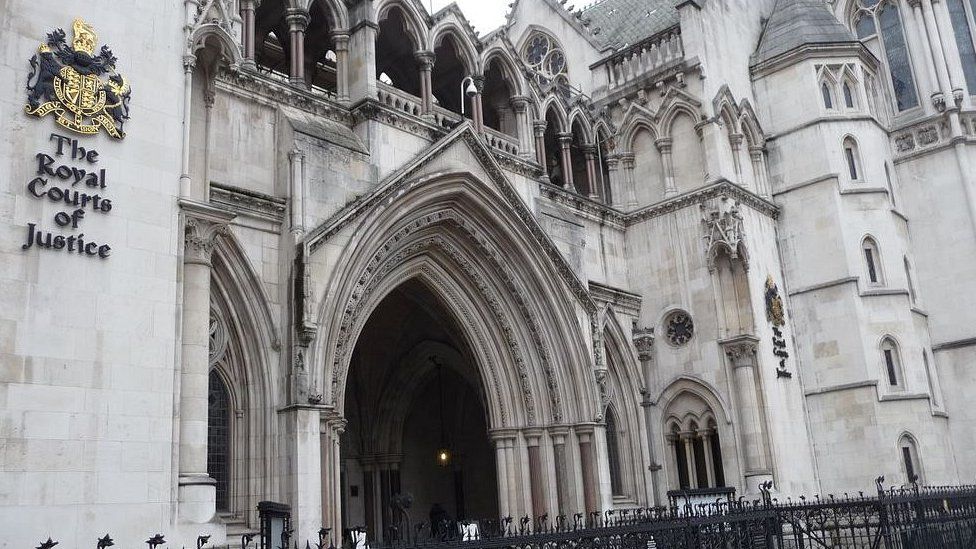
The jail term for the killing was increased to 44 months after a hearing at the Court of Appeal in London.
Mr Clitheroe’s family previously said “the impact and tragic, senseless manner of his death resonates with us every day”.
The Attorney General Suella Braverman QC MP said: “I welcome the decision of the court to impose a sentence which more accurately reflects the gravity of the offending that has taken place.”
Wollacott lasted the entire duration of the game as Charlton was held to a 2-2 draw and denied a fairytale finish at Accrington Stanley on the opening day of the 2022/23 campaign.
Scott Fraser opened the scoring on 36 minutes with his first goal for the Addicks, before Accrington levelled through captain Sean McConville in the second half.
The Addicks thought they had won it through debutant Miles Leaburn, who nodded home fellow debutant Jack Payne’s cross four minutes into injury time, only for Korede Adedoyin to rescue a point for the hosts with virtually the last kick of the game.
Wollacott joined the club on a three-year deal as a free agent following the expiration of his contract at Swindon where he made 39 appearances last season and helped them to the League Two play-offs.
The 25-year-old has 10 caps for Ghana after making his international debut last year.
North Korea is ready to mobilise its nuclear war deterrent, its leader Kim Jong-un has claimed.
Speaking at a Korean War anniversary event, Mr Kim added that the country was “fully ready for any military confrontation” with the US, state news agency KCNA reported.
The comments come amid concern that North Korea could be preparing a seventh nuclear test.
The US warned last month that Pyongyang could conduct such a test at any time.
North Korea’s most recent nuclear test was in 2017. However, tensions have been rising on the Korean peninsula.
The US special representative to North Korea Sung Kim says it has tested an unprecedented number of missiles this year – 31 compared to 25 during the whole of its last record-breaking year, 2019.
In June South Korea responded by launching eight missiles of its own.
Although the 1950-53 Korean War ended in a truce, North Korea claims it as a victory against the US. The annual “Victory Day” celebrations are marked by military parades, fireworks and dancing.
In his speech to mark the event, Mr Kim said nuclear threats from the US required North Korea to achieve the “urgent historical task” of beefing up its self-defence.
The US had misrepresented North Korea’s regular military exercises as provocations, he added.
Mr Kim also appeared to address reports that South Korea is moving to revive a plan to counter the North Korean nuclear threat by mounting precautionary strikes in the event of an imminent attack.
The so-called “Kill Chain” strategy, first elaborated a decade ago, calls for pre-emptive strikes against Pyongyang’s missiles and possibly its senior leadership.
Some analysts have warned it carries its own risks and could fuel an arms race.
At the Victory Day celebration Mr Kim said that South Korean president Yoon Suk-yeol’s government and military would be “obliterated” if he carried out pre-emptive strikes.
Is North Korea ‘on the brink of war’?
Rupert Wingfield-Hayes, BBC News
Kim Jong-Un’s warning that the Korean peninsula is “on the brink of war” sounds extremely scary. But North Korean rhetoric is often fiery, especially on significant anniversaries.
What it indicates is just how angry the North Korean regime is about South Korea’s new President Yoon Suk-yeol.
Since taking office in May, President Yoon has laid out a new, more aggressive defence policy. It would allow South Korean forces to pre-emptively strike the North, if Seoul believes it is under imminent threat of a nuclear attack from Pyongyang.
This so-called “Kill Chain” strategy would allow South Korea to launch ballistic missiles and air strikes on North Korean targets, including taking out the North Korean command and control structures. In other words, attempting to kill Kim Jong-Un himself.
Pyongyang is also quite unhappy with the lack of engagement from Washington since President Biden replaced Donald Trump.
All of this could suggest we are headed towards some sort of deliberate escalation by the North.
Everyone now expects that Pyongyang will carry out a seventh underground nuclear test. Preparations have been underway at the Punggye-ri test site since March.
The grain issue also loomed large in talks on Friday between US Secretary of State Anthony Blinken and Russian Foreign Minister Sergei Lavrov – the first time the men have spoken since the war began.
Mr Blinken said he had a “frank and direct” conversation with his counterpart, telling him that Russia must honour its commitment to allow grain exports from Ukraine and that the world would not accept Russian annexation of Ukrainian territory.
Earlier, President Zelensky joined ambassadors from the G7 industrialised nations on the Black Sea coast, standing in front of the Turkish-registered ship Polarnet.
Chornomorsk, south of Odesa, has seen the first shipping activity in weeks, with tugboats manoeuvring and a single vessel changing position.
It is one of three Black Sea ports waiting for the green light. Officials say 17 ships are now waiting with 600,000 tonnes of cargo.
UN aid chief Martin Griffiths made clear exports could only resume safely when the route through the Black Sea was finalised. By the admission of global shipping insurers and the UN, “crucial” details still had to be ironed out and nothing was expected to happen before the weekend.
An added risk to the operation is that the biggest port of Odesa has been mined by Ukraine’s military.
If and when the first ship does finally leave, convoys of grain will not immediately follow.
Under the agreement signed by Russia and Ukraine, the sea corridor, convoy and inspection of the cargo are all being organised by a joint co-ordination centre (JCC) in Turkey and final preparations were reportedly still not in place.
The suspension of grain exports, now into a sixth month, has led to food shortages across Africa.
The destination of the first ship was not yet clear, but the UN aid chief said Somalia was a priority. Eight areas of the country are at risk of famine.
Seven ambassadors from the G7 joined the Ukrainian president to reflect the political will to get exports going again. “While someone, blocking the Black Sea, takes the lives of other countries, we are giving them opportunity to survive,” Mr Zelensky said.
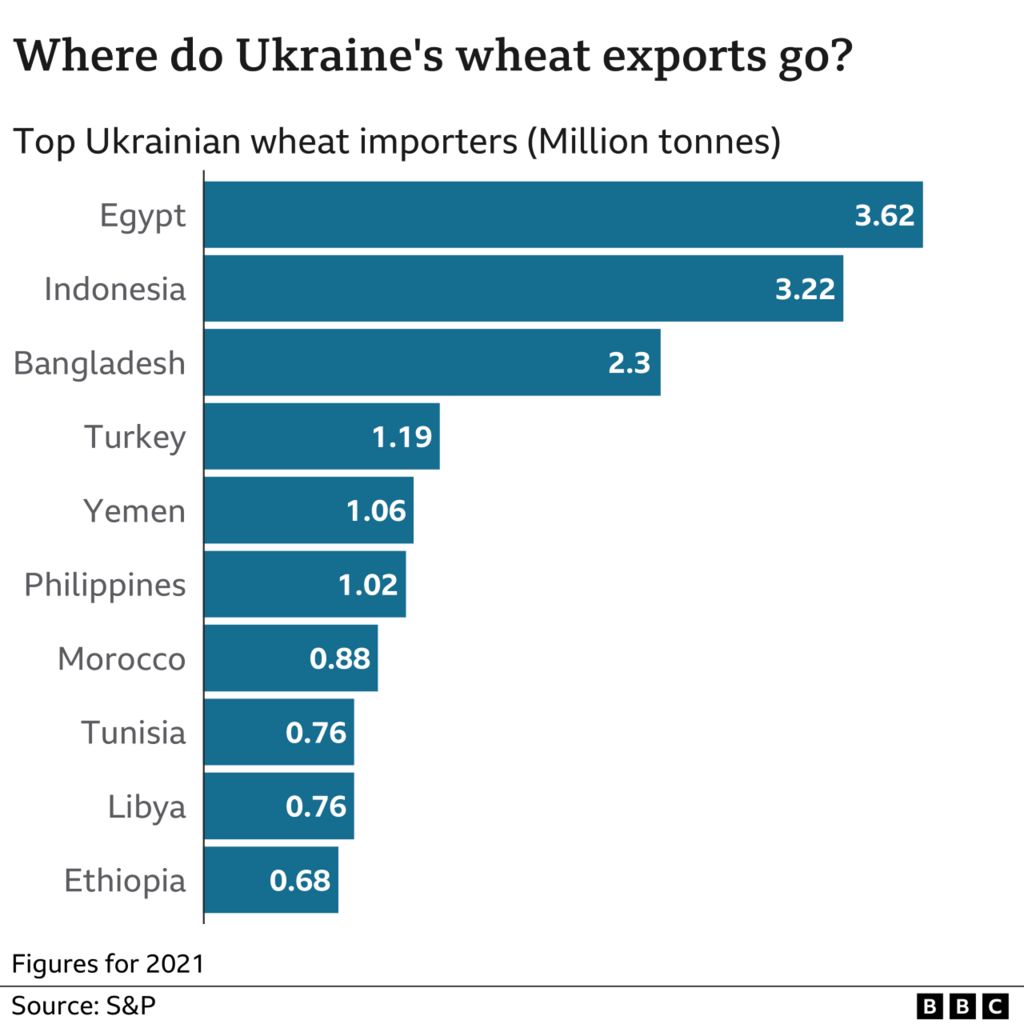
Russian naval forces control most of the Black Sea, leaving some 20 million tonnes of grain stored in Ukraine, waiting for export.
Before Russia’s invasion, the two countries accounted for a third of the world’s exports of wheat and barley. There is optimism that the deal, set for an initial 120 days, may work. Russia is also keen to resume its own exports of grain and fertiliser.
The regional head in Odesa, Serhiy Bratchuk, posted a map showing how the grain corridor to and from Odesa might operate, with an area for inspection near the port and a route following the Ukrainian coast to the mouth of the River Danube.
Ukrainian officials said Chornomorsk and Odesa were ready for ships to leave, while a third port, Pivdennyi, would be prepared by the end of the week.
Foreign Minister Dmytro Kuleba said all the details of the first shipment had to be calculated and everything “checked once more, twice, three times”.
The UN aid chief said it could only take place safely when the parties working at the co-ordination centre in Istanbul had agreed to the precise location of the corridor as well as the movements.
But he believed any problems would be settled very quickly, with the aim of returning to pre-war export levels of some five million metric tonnes a month.
Soldiers on the front lines in eastern Ukraine say sophisticated Western weaponry has stalled Russia’s furious bombardment. But is this merely a brief lull, or a sign that the tide is turning in the conflict?
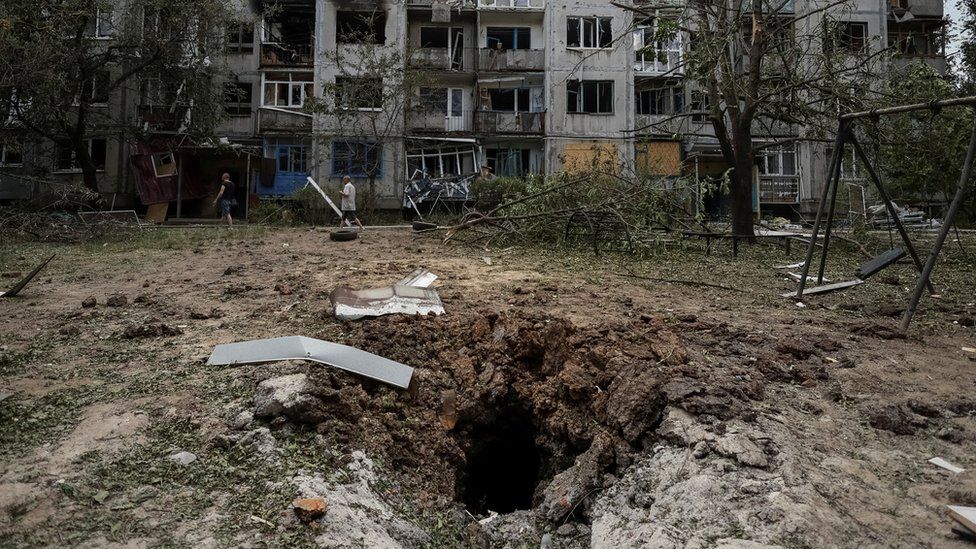
Five plumes of smoke pierced a clear blue sky on a hillside just north of Bakhmut, an almost deserted farming town that has been under sustained Russian bombardment for weeks.
“This is no life for us. Nowhere is safe. I honestly wish my life was over,” said 86-year-old Anna Ivanova, bending low, with the help of a walking stick, to pull weeds from her garden, as two Ukrainian jets roared low overhead.
Ten minutes later, a succession of five or more loud booms rolled over the brilliant yellow sunflower fields to the west.
Image source, ReutersImage caption, Bakhmut has come under sustained Russian attack for weeks
For anyone driving close to the meandering front lines of Ukraine’s eastern Donbas region – from the shattered city of Slovyansk in the north, to the abandoned farming villages near Donetsk in the south – it can feel as if Russia’s grinding, seemingly indiscriminate bombardments remain as frenzied as ever.
But in the corner of a wheat field outside Donetsk, the commander of a Ukrainian artillery unit who asked to be known only by his first name, Dmitro, was adamant. “They’re not firing as often. The rate of artillery fire [from Russian forces] has dropped by half. Maybe even more, maybe by two-thirds,” he said, patting the side of a large green vehicle beside him.
The vehicle – a self-propelled artillery piece with a huge barrel pointing south towards Russian-held territory – is a French manufactured Caesar, one of the growing number of sophisticated Western weapons that can now be spotted moving along country lanes throughout Donbas. Dmitro, and many others here, believe they are helping to turn the tide against Russia.
With a deafening blast, the Caesar fired the first of three shells at what Dmitro said was a Russian infantry unit and several artillery pieces 27km (16 miles) away.
“We’re much more accurate now. And we can hit them much further away,” he said, with a grin. Within a minute, the artillery team had fired two more shells, and the vehicle was already moving away, fast, before Russian artillery had a chance to track its position and return fire.
In recent weeks Ukrainian civilians and soldiers have watched, often gleefully, as drone footage and other videos uploaded on to the internet appear to have shown a series of massive explosions in Russian-held territory.
It is widely reported that these are large ammunition stores, kept far behind the frontlines, but now within reach of the newly arrived Western weaponry, including American Himars and Polish Krab howitzers.
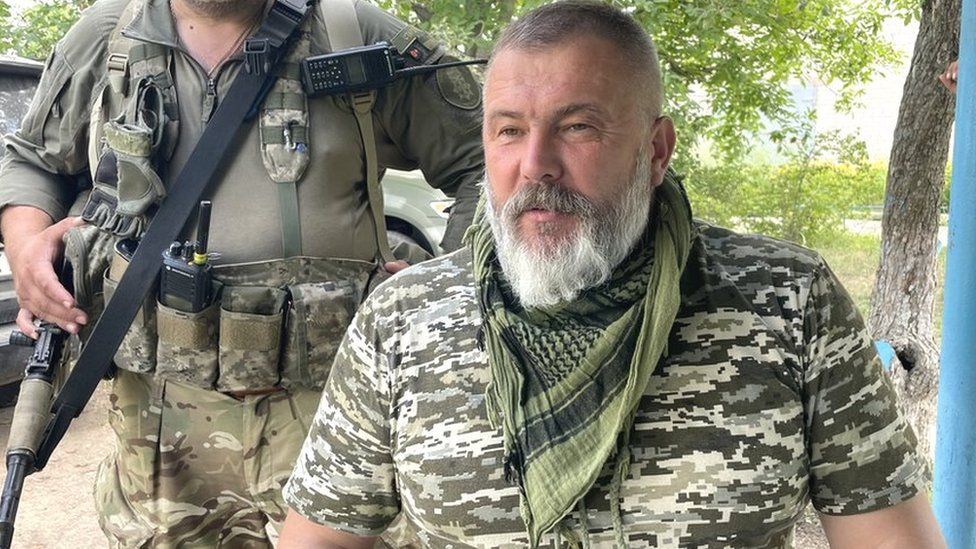
“Listen to that silence,” said Yuri Bereza, a bearded 52-year-old commanding a volunteer unit tasked with defending Slovyansk. For well over an hour one recent morning, on a visit to a network of defensive trenches east of the city, not a single explosion could be heard.
“That’s all because of the artillery you’ve given us – because of its accuracy,” said Bereza. “Before, Russia had 50 gun barrels for every one we had. Now it’s more like five to one. Their advantage is now insignificant. You could call it parity.”
But Bereza, like Dmitro, emphasised that Ukraine needed far more Western weaponry in order to launch an effective counter-offensive.
Image caption, Yuri Bereza says Western arms have almost enabled Ukrainian forces to match Russian firepower
“They can’t beat us, and we can’t beat them here. We need more equipment, especially armour, tanks, aviation. Without these things there will be enormous loss of life. That’s the way Russia is used to waging war. They throw lives away,” said Bereza.
“Ideally, we’d like three times as many [Western weapons] as they’ve already sent us. And quickly,” confirmed Dmitro.
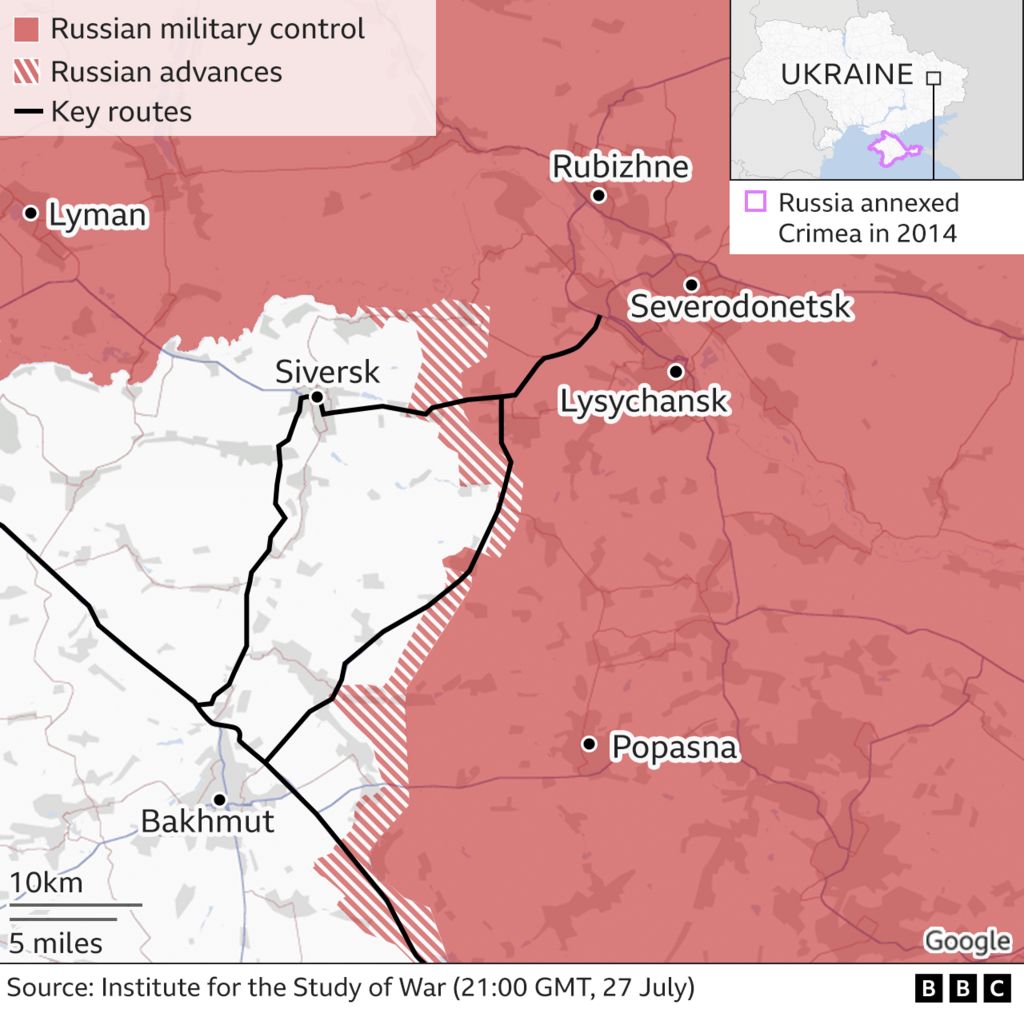
But a lack of weaponry is not the only thing potentially thwarting Ukraine’s determination to liberate captured territory. Despite the reduced Russian bombardment, the Kremlin’s forces continue to push closer to the strategic town of Bakhmut, raising concerns among Ukrainian forces about a lack of manpower and training.
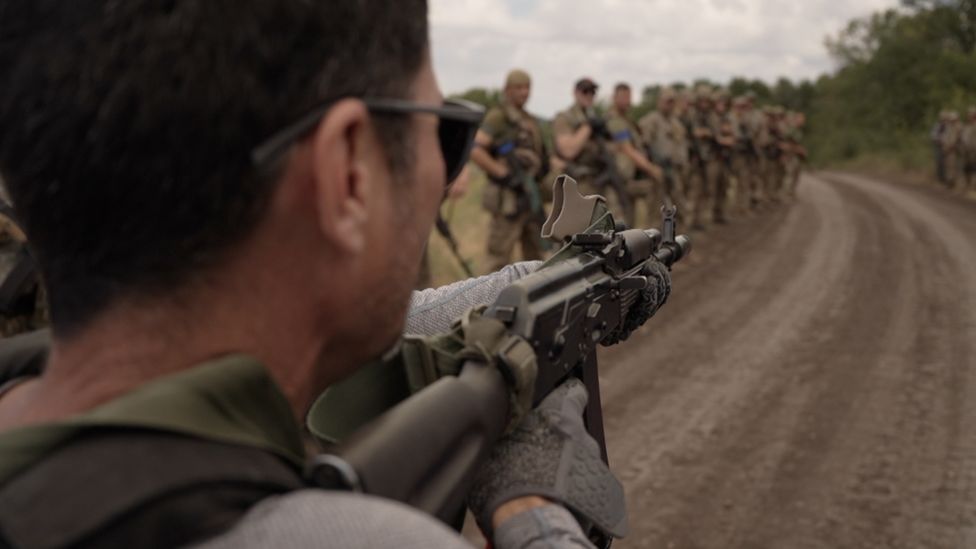
“Here’s a simple trick,” shouted a burly figure, lying on a dirt track and aiming his rifle, surrounded by forty attentive Ukrainian soldiers.
“Bring your leg up like this,” said the man, a former British paratrooper, who was part of a private group offering support to a Ukrainian brigade that had recently arrived to reinforce the frontlines.
The Ukrainians were all volunteers, and had only had a couple of months basic training. Their commanders had reached an informal agreement with the Western trainers, for a five-day course.
“Of course, it’s scary. I’ve not seen war before,” said the unit’s 22-year-old commander, a lawyer, who asked that we not use his name.
“Worrying is the fact that these guys… lack the basic soldiering skills that the West is used to,” said another trainer, Rob, a former US marine.
Image caption, Private organisations are operating independently in eastern Ukraine, including the Mozart group
For now, Western governments have refused to send officials, or contractors, into Ukraine to help with military recruitment and training efforts. A handful of private organisations are operating here, independently.
“It’s a drop in the ocean. But it makes a difference, on a small scale,” said Andy Milburn, a retired US Marine colonel, as he watched a training session.
He stressed that his Mozart group had “zero” contact with, or support from, the US government, but he criticised Western nations for a “squeamish” and “short-sighted” refusal to engage more directly.
“It’s ridiculous. But these guys have lost so many people that they just don’t have [enough Ukrainian instructors],” he said. “The West needs to plan for that now.”
The funeral of Northern Ireland’s former First Minister Lord Trimble – one of the key people involved with the Good Friday agreement – takes place on Monday.
The historic peace deal has been in the spotlight because of the UK’s departure from the European Union (EU).
What is the Good Friday Agreement?
The Good Friday Agreement, also known as the Belfast Agreement, was a political deal designed to bring an end to 30 years of violent conflict in Northern Ireland, known as the Troubles.
It was signed on 10 April 1998 and approved by public votes in Northern Ireland and the Republic of Ireland.
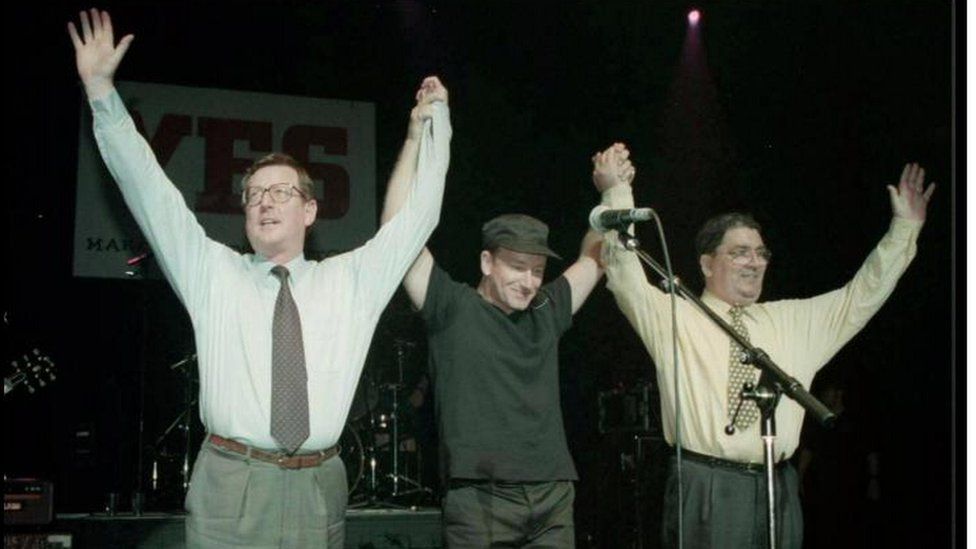
Image caption, U2’s Bono endorsed Lord Trimble and SDLP leader John Hume’s calls for peace ahead of the Good Friday Agreement
What were the Troubles?
Northern Ireland was created in 1921 and remained part of the UK when the rest of Ireland became an independent state.
This created a split in the population between unionists, who wish to see Northern Ireland stay within the UK, and nationalists, who want it to become part of the Republic of Ireland.
From the late 1960s, armed groups from both sides, such as the Irish Republican Army (IRA) and Ulster Volunteer Force (UVF), carried out bombings and shootings – and British troops were sent to Northern Ireland.
The Troubles lasted almost 30 years and cost the lives of more than 3,500 people.
What does the Good Friday Agreement say?
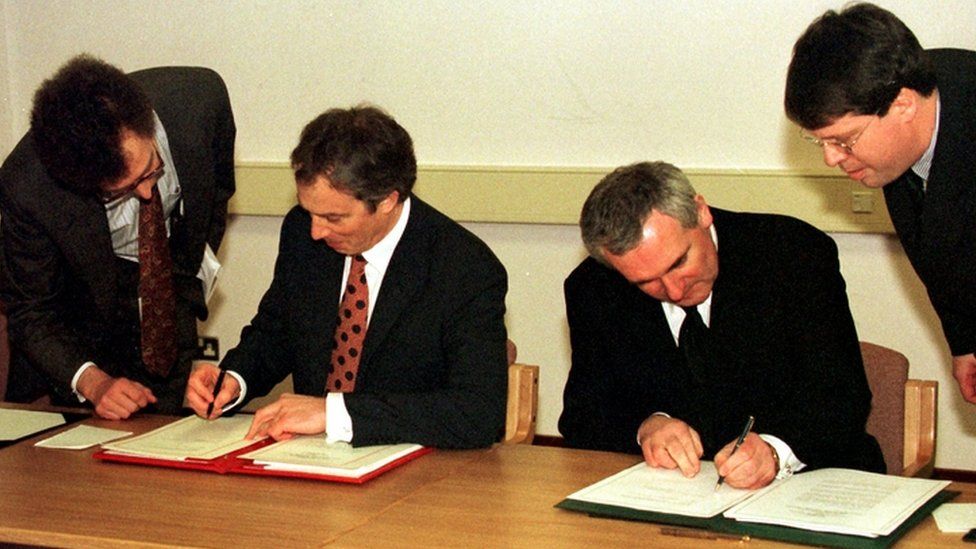
Image caption, The prime minister at the time, Tony Blair, and then Taoiseach (Irish Prime Minister) Bertie Ahern sign the Good Friday Agreement
The Good Friday Agreement is based on the idea of co-operation between communities.
It set up a new government for Northern Ireland, representing both nationalists and unionists.
The Westminster government gave this government control over key areas such as health and education – a process known as devolution.
A new parliament, the Northern Ireland Assembly, was set up and sits in Stormont, in Belfast.
Other parts of the agreement are about respect for people’s rights, whichever part of the community they come from.
Northern Ireland is part of the UK and this can change only through a referendum – if most people in Northern Ireland want it to
People born in Northern Ireland can have Irish or British nationality or both
As part of the agreement:
Armed groups agreed to dispose of their weapons
People who had been involved in violence were released from prison
The UK government agreed to aim for “normal security arrangements” – including the scaling back of the British military presence
What does the Good Friday Agreement have to do with Brexit?
After Brexit, Northern Ireland became the only part of the UK with a land border with an EU country – the Republic of Ireland.
Checks are required on goods transported between the UK and the EU’s markets.
But both sides agreed this should not happen on the Irish border, to protect the Good Friday Agreement, because it was feared the cross-border co-operation could be threatened if new checkpoints were set up.
During the Troubles, people crossing the border were subject to British army security checks – and surveillance watchtowers were placed on hilltops.
And although the agreement does not specifically refer to the border, it does mention removing all security installations.
What has been proposed?
To keep the border clear, the UK and EU agreed the Northern Ireland protocol. Goods are checked to ensure they comply with EU rules when they arrive in Northern Ireland from the rest of the UK (England, Scotland and Wales).
Supporters of this plan, including the nationalist Sinn Fein party, say it is necessary to protect the Good Friday Agreement.
But unionist parties, including the Democratic Unionist Party (DUP), say this actually undermines the agreement because it separates them from the rest of the UK.
The DUP has refused to take part in power-sharing until its concerns are addressed.
This means the devolved government set up by the Good Friday Agreement is not currently functioning.
The UK government has also criticised the protocol, saying it has been “upsetting the balance of the Good Friday Agreement”.
It is trying to ditch parts of the agreement, with new legislation.
This has led to the current stand-off with the EU, which says the protocol is the “one and only solution” to protecting the peace process in Northern Ireland.
Osei Boateng named Orlando Pirates goalkeeper, Richard Ofori as his number one for the Black Stars at the World Cup ahead of Jojo Wollacott.
Ghana has had a number of goalkeepers going in and out of the national team in recent times. However, Charlton Athletic goalkeeper, Jojo Wollacott appears to be the current number one for the Black Stars currently.
Speaking in an interview with Dan Kwaku Yeboah, Osei Boateng who was asked to name his top four Ghanaian goalkeepers for the World Cup, said, “firstly, I will choose Richard Ofori. He has been tried and tested in all departments of the game in Ghana.â€
He added “Manaf is good at club level and the recent match we played is evidence. Jojo has already proved himself. So I think the 4th one I will choose Razak Abalorah. These are my four goalkeepers currently but maybe there may be others who will come through the line.â€
For Osei Boateng, Ghana needs to structure the goalkeeping department to aid in the transitioning of goalkeepers into the senior national team.
“I think we have to observe their ages so they can understudy the seniors to that we can have a smooth transitioning,†the former Ghana goalkeeper who is based in the United States said.
“I’m tired and frustrated that we’re having this conversation again so soon after we got such a meaningful and progressive response from Lizzo,” she tells the BBC.
“It’s so annoying because it’s so catchy,” says BBC disability correspondent Nikki Fox. “But it’s a horrible word.
“It’s a word we would never, ever use in the UK – although we recognise it’s sometimes used differently in the US.”
“If you think of how many people that song will go through and not one of them thought, ‘Hang on a minute’, and not one person was not aware of the hoo-hah when Lizzo used the same word. It’s very disappointing.”
“Language is such a complex thing and words can validly mean different things to different people, but I don’t see why any artist would use a word in their song that causes so much upset to millions worldwide.”
“As a disabled [person] who grew up being called a sp@z… to diminish my NeuroDivergent experiences, belittle me, and bully me, I am beyond words hurt you have chosen to use this word in your song,” she wrote.
“You’ve hurt the community, apologise and change.”
In June, Lizzo faced a similar outcry over her song, GRRRLS. Within days, she apologised and re-recorded the song, removing the offensive lyric.
“Let me make one thing clear: I never want to promote derogatory language,” she wrote in a statement posted to social media.
“As a fat black woman in America, I’ve had many hurtful words used against me so I understand the power words can have (whether intentionally or in my case, unintentionally).”
Heated is not the only song on Beyonce’s seventh studio album to attract criticism.
Last week, R&B star Kelis accused the star of “theft” after learning her anthem Milkshake had been interpolated on a song called Energy (interpolation is when one song references another, without directly sampling it).
Kelis said she had not been informed in advance, and that her “mind is blown” by the “level of disrespect”.
“It’s not hard. She can contact me, right?” Kelis said on Instagram. “It’s common decency.”
Instead, permission would have been sought from writer/producers Pharrell Williams and Chad Hugo – who duly receive a share of the royalties from Energy.
It appears that the basis of Kelis’s disagreement lies with them. She has previously accused the duo, professionally known as the Neptunes, of “lying and tricking” her into a bad deal, which gave them the rights to her music instead of splitting the royalties three ways.
“Pharrell knows better,” she added. “This is a direct hit at me [and] he does this stuff all the time. The reason I’m annoyed is because I know it was on purpose.”
Neither Pharrell Williams nor Chad Hugo could be reached for comment.
Mohammad Eslami’s comments echo a similar recent statement by a senior adviser to Iran’s supreme leader.
Such public claims by top officials are rare and are likely to intensify concerns over the nature of Iran’s nuclear programme.
It has advanced its nuclear activities since a deal limiting them faltered.
The 2015 agreement began to unravel when the US pulled out and reinstated crippling economic sanctions.
Iran has repeatedly claimed its nuclear programme is for purely peaceful purposes but Western powers and the global nuclear watchdog say they are not convinced.
Western officials have warned time is running out to restore the deal before Iran’s programme reaches such a point where it cannot be reversed.
“As Mr Kharrazi mentioned, Iran has the technical ability to build an atomic bomb, but such a programme is not on the agenda,” Mr Eslami said.
In his own remarks made to Al Jazeera news channel on 17 July, Mr Kharrazi said: “Iran has the technical means to produce a nuclear bomb but there has been no decision by Iran to build one.”
There have been growing concerns over the so-called breakout time, or the amount of time it will take Iran to amass enough highly enriched uranium for a nuclear weapon.
Media caption, Iran’s nuclear programme: What’s been happening at its key nuclear sites?
In June, the head of the global atomic energy agency, Rafael Grossi, said Iran could acquire such a quantity in a matter of weeks. The US put the breakout time at about a year during the period in which the nuclear deal was intact.
However Mr Grossi said possessing enough material did not mean Iran could manufacture a nuclear bomb.
In its latest report in May, the IAEA said Iran had 43.1kg (95lb) of uranium enriched to 60% purity. About 25kg of uranium enriched to 90% is needed for a nuclear weapon.
The claims from Iran that it has the technical know-how to develop a bomb come at a time when Iran and world powers are at loggerheads over reviving the 2015 deal.
Months-long on-off-talks in Vienna have stalled, and rare indirect negotiations between the US and Iran on the issue which took place in Qatar in June ended without agreement.
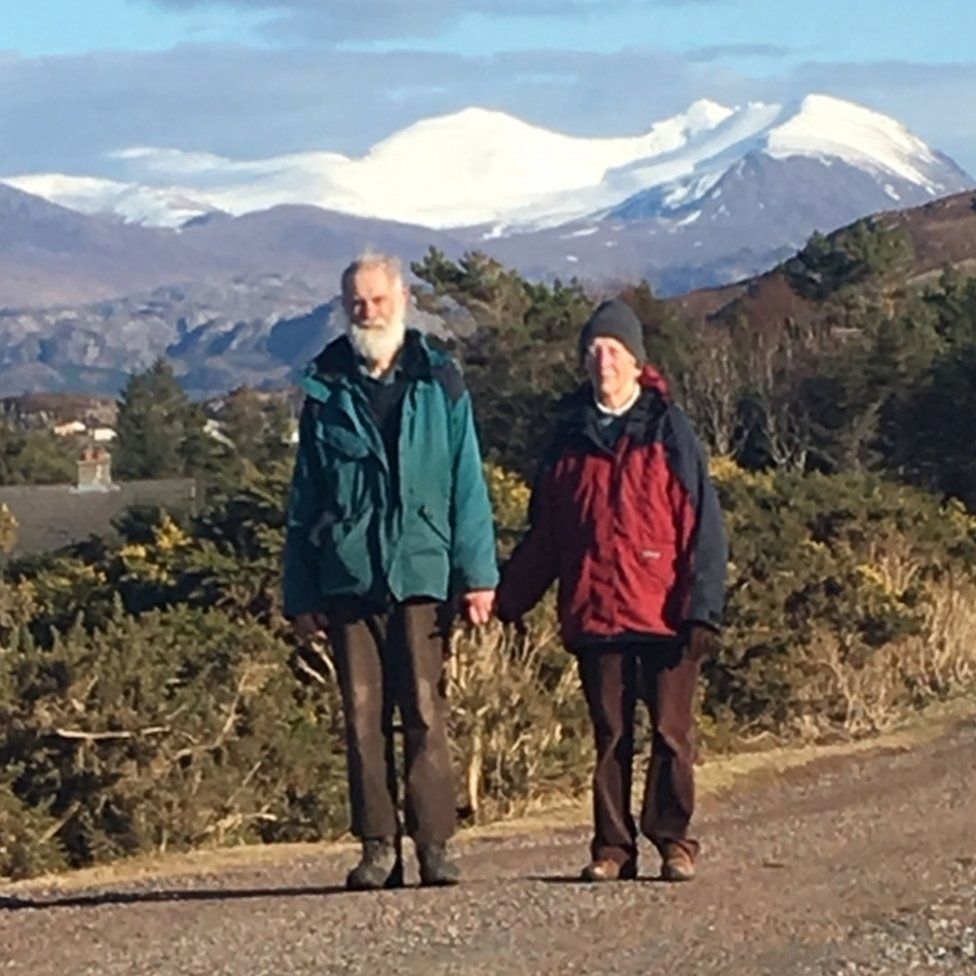
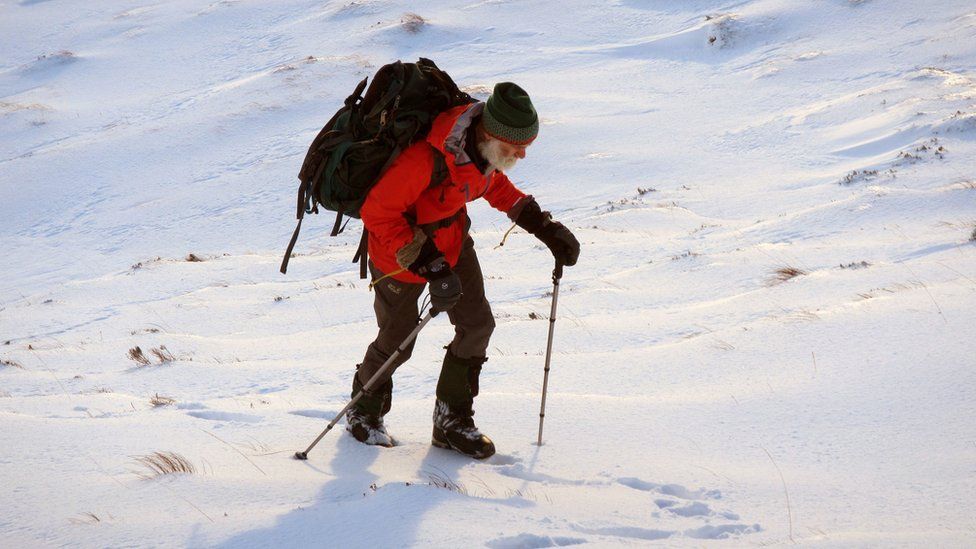
An 82-year-old man who set himself a challenge to climb Scotland’s 282 Munros after his wife went into full-time care is just days from reaching the final summit.
Nick Gardner, from Gairloch, in the Highlands, was devastated when Janet developed Alzheimer’s and osteoporosis.
The grandfather-of-four said he wanted something to keep him going.
He set off on his epic quest in July 2020, three months after his 80th birthday.
Two years on Mr Gardner only has eight Munros left to bag.
He said: “When Janet went into care it absolutely shattered me.
“We were incredibly close as a couple, she was the most wonderful and caring wife, mother and grandmother possible, and now she doesn’t recognise me.
“I was heading into some mental condition, so I thought I have to get myself a challenge, to pull me out.”
Image source, Nick GardnerImage caption, Nick Gardner said he was shattered when his wife went into care
The former physics teacher had never climbed a Munro – a Scottish mountain that reaches a minimum of 3,000ft (914.4m).
And he gave himself 1,200 days, to complete the challenge while raising money for Alzheimer Scotland and the Royal Osteoporosis Society (ROS).
But, with his final summit planned for mid August, Mr Gardner is on track to finish in under 800 days.
He said: “I am so close to completing it, I really feel like a child in the run-up to Christmas. I have butterflies.”
Once he makes it to the finish line, Mr Gardner will have climbed more than 500,000ft (152,000m), the equivalent of scaling Mount Everest (8,848m) about 17 times.
He will also have walked 2,000 miles (3,218 km), a similar distance to hiking from Edinburgh to Greece.
Image source, PA MediaImage caption, Mr Gardner has taken in some spectacular views
One of his two daughters, Sally McKenzie, has nominated him to the Guinness Book of World Records for the oldest person to climb the Munros.
Mr Gardener joked: “I’ll probably cry when I make it to the end”.
With a compass in one hand and a map in the other, Mr Gardner said he loved the feeling of being on the hillside.
But he added that he was never truly on his own.
He said: “I am over 80, and I think it would be irresponsible to climb on my own at this age, so I always have people with me.
“I don’t climb in a rush, and after the first two or three Munros I just started stopping people on the hill to tell them what I was doing.
“People couldn’t believe it, and they started joining me and donating money.
“Now, when I am walking, I regularly hear, ‘Nick’ shouted.”
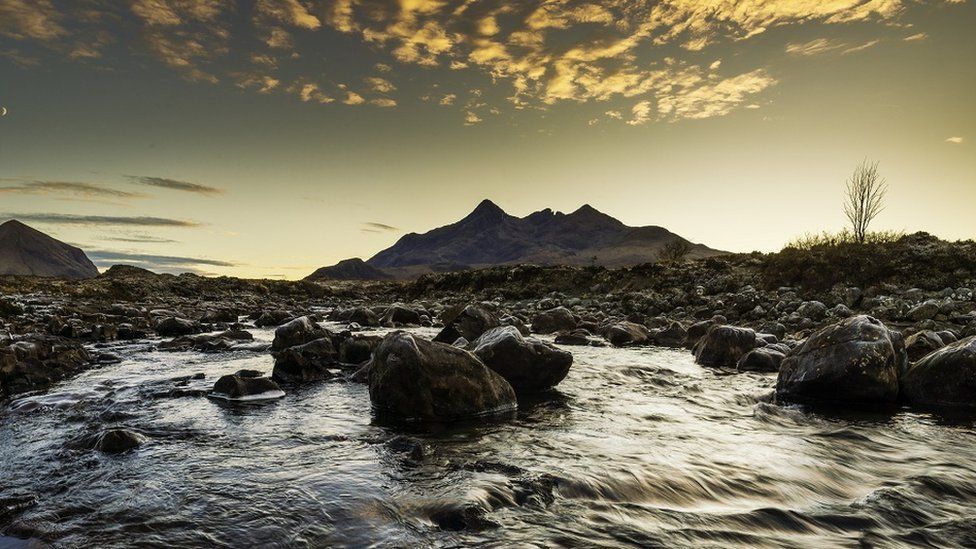
Image source, Getty ImagesImage caption, The Black Cuillin is a range of high mountains, ridges and rocky pinnacles
Mr Gardner has developed immense respect for mountains.
“I have never conquered or beaten a mountain, I have climbed them,” he said. “If you start trying to conquer them, they will get their own back.”
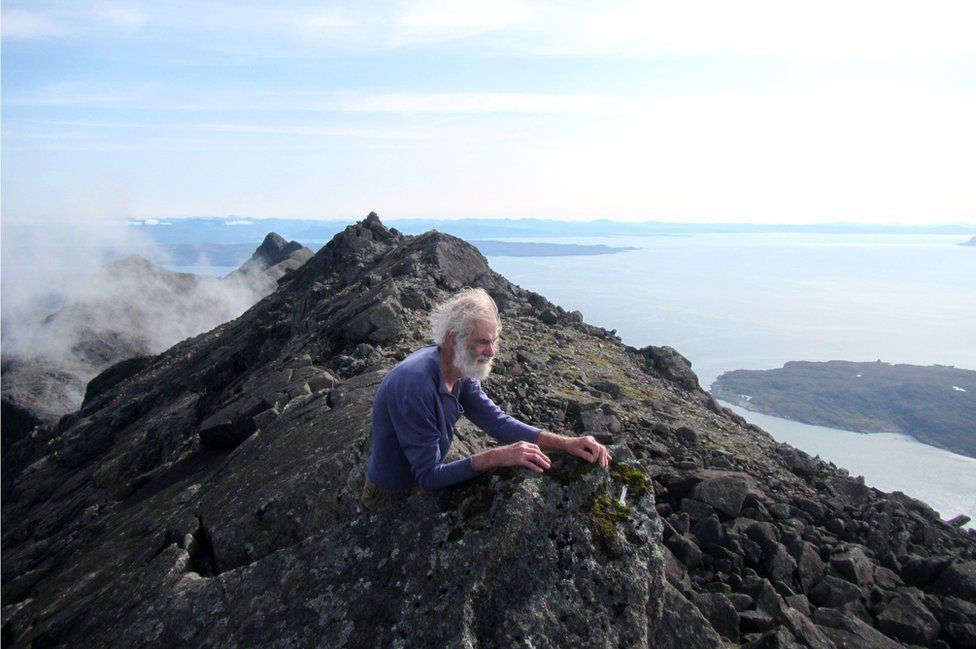
Out of the 274 peaks he has scaled so far, Mr Gardner said completing the Cuillin Ridge on the Isle of Skye about a month ago stuck out as his most physically challenging moment.
He said: “It’s hard for people to do in their 40s, let alone 80s. It was incredibly rewarding,” he said.
“I am not a religious person, but there is something almost biblical about it, certainly spiritual.”
Mr Gardner’s checklist for reaching Scotland’s highest peaks includes a head torch, waterproof clothing, a down jacket and a spare warm garment. But he said a map and compass were his essentials.
Image source, PA MediaImage caption, Mr Gardner has endured all sorts of conditions during his quest
The remaining peaks for the intrepid grandfather are three in Knoydart: Ladhar, Mell Buidhe and Luinne Bheinn; four in Glen Dessary: Sgurr na ciche, Garbh chioche mhor, Sgurr nan coireachan and Sgurr Mor; and lastly, the 282nd summit at Cairn Gorm in the Highlands where he will be joined by friends and family for the final climb.
Mr Gardner’s target was initially to raise £10,000, but he is now on track to reaching £50,000.
He added: “I will keep walking when I’ve finished this challenge, as long as my legs can carry me.”
Craig Jones, chief executive of the ROS, will be joining Mr Gardner on the final climb and said the charity was “extremely grateful” for the fundraiser.
Kirsty Stewart, of Alzheimer Scotland, added: “His tremendous effort will help us continue to be there for people living with dementia, their families and their carers.”
Some notable names who featured in the game include former Hearts of Oak and Asante Kotoko skipper, Emmanuel Osei Kuffuor, former Asante Kotoko midfielder, Stephen Oduro, and former Asante Kotoko and Ashanti Gold player, Samed Oppong.
Osei Kuffuor was on the scoresheet as he netted the Ghanaian community’s second goal of the afternoon.
Former Asante Kotoko and Ashanti Gold striker, Nana Arhin Duah was the coach for the Ghanaian Community as he steered his lads to a win.
A man who raped a vulnerable woman who was found dead just hours later has been given a life sentence.
Lars Pedersen, 38, attacked Alison McAllister at the Forth and Clyde Canal in the Maryhill area of Glasgow.
The 56-year-old victim had been sitting alone and was said to be in a distressed and intoxicated state when Pederson approached her.
Her body was found near the canal on 20 March, 2018, about 19 hours after she was last seen.
A judge told Pedersen at the High Court in Edinburgh that the circumstances of the offence were “extremely concerning”.
Lord Doherty imposed an Order for Lifelong Restriction on him, saying he was in no doubt that he posed a serious risk of harm to members of the public, particularly women.
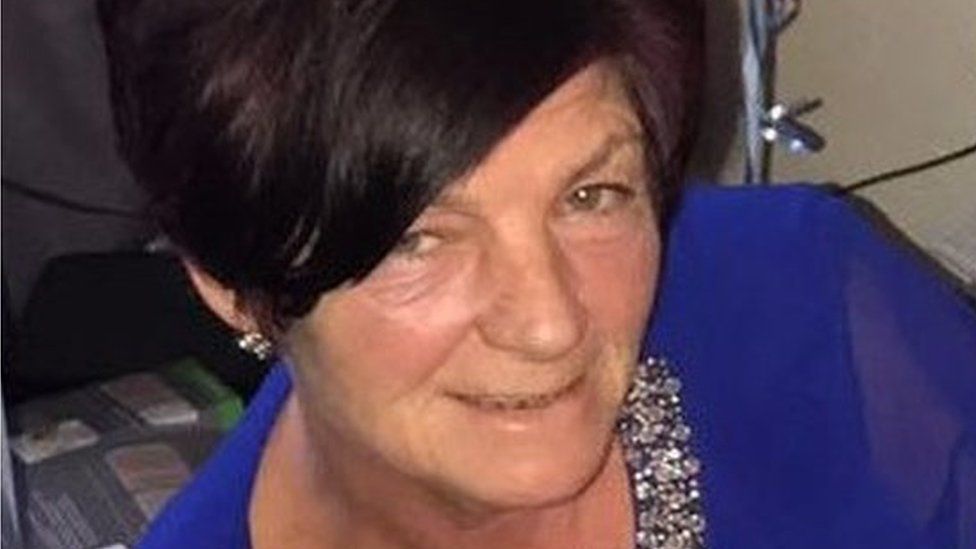
Image source, Police ScotlandImage caption, Alison McAllister was last seen a day before her body was found
He ordered that Pedersen, from Hampshire, must serve a minimum of three years and two months before he can seek release.
Pedersen has already served longer than that on remand, but parole authorities will consider the issue of public safety before there is any chance of his release in the future.
He had admitted assaulting and raping care home worker Ms McAllister when he appeared at an earlier hearing at the High Court in Glasgow, but did not face a charge over her death.
Pedersen, who has previous convictions in England, was placed on the sex offenders register for life.
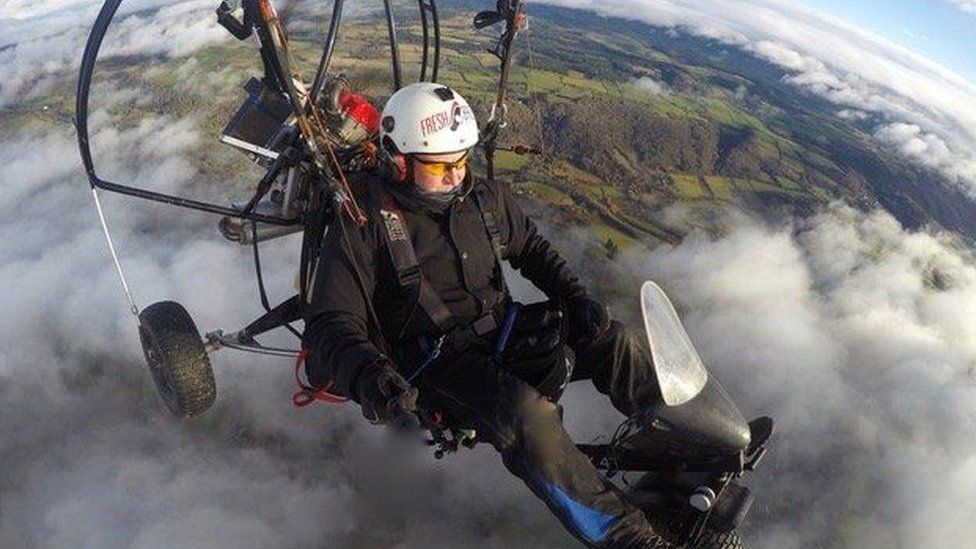
Conservationist Sacha Dench says her cameraman will be with her “in spirit”on her first expedition since his death in an air crash.
Dan Burton, 54, died when their paramotors collided over the north west Highlands in September last year.
Ms Dench, dubbed the Human Swan for a previous expedition tracking Bewick’s swans, still has one of her legs in a metal brace and uses crutches.
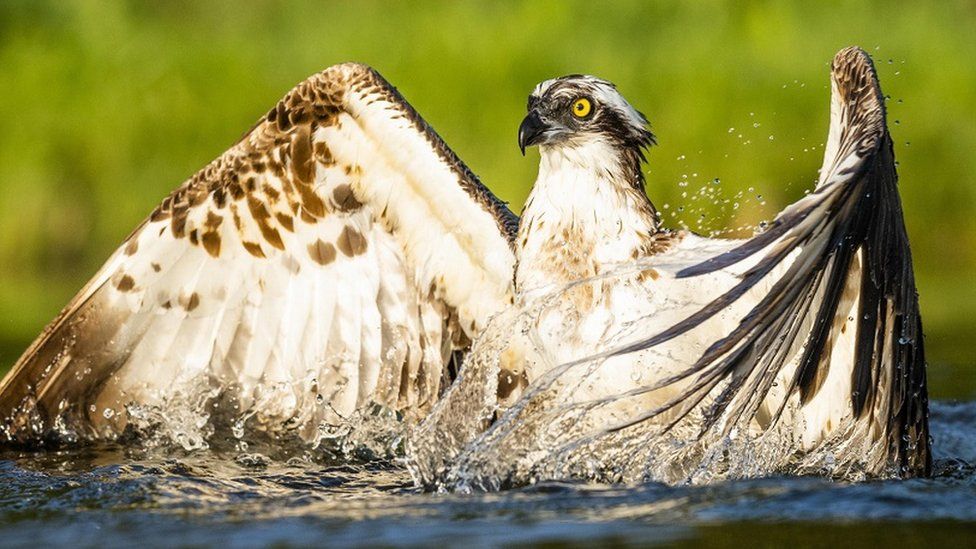
She will lead a team of nine following migrating ospreys, but is not flying.
“I can’t say thoughts of flying aren’t on my mind,” she said.
“But for now I need to focus on getting stronger and walking comfortably.”
The expedition – called Flight of the Osprey – will track the birds of prey as they travel 6,213 miles – almost 10,000km – from the Moray coast in north east Scotland to Ghana through 14 countries.
Image source, Conservation Without BordersImage caption, Dan Burton was Ms Dench’s cameraman during an expedition to raise awareness about climate change
Australian-born Ms Dench told BBC Scotland that it would honour Mr Burton’s memory.
She said: “Dan will be sorely missed and he was an important part of the project.
“He is with us in spirit. I feel like I am doing this as much for him and his legacy, as I am for the osprey and all the people along the way.”
The conservationist added: “As well as looking at osprey we will be looking at the big issues of our time – climate change, the use of resources and how we fix them. We just don’t have time to waste.”
The Flight of the Osprey crew are travelling in three vehicles, including a converted army ambulance which has been fitted with a shower and kitchen and painted white with a map of the route and ospreys on it.
The project run by Conservation Without Borders, which has its UK office in Chagford, Devon, involves a journey lasting about four months.
Image source, Getty ImagesImage caption, An osprey hunting for fish in Scotland
The aim of the mission is to gather data and highlight the impacts of climate change and human activities on ospreys and other wildlife, after the original trip in 2020 was postponed due to Covid.
Ospreys migrate on their own, which means the young ones make the epic and often perilous feat of endurance without adults birds.
Ms Dench said only 70% of juveniles return for breeding, and the team wants to know more about why.
The conservationist and Mr Burton were in the final stages of a challenge to circumnavigate Britain to raise awareness of climate change when their accident happened.
Their paramotors collided close to Loch Na Gainmhich near Lochinver in Sutherland.
The pair were flying the battery-powered paramotors to mark UN climate change conference, COP26, which was being held later in 2021 in Glasgow.
Ms Dench was nicknamed the Human Swan for flying 4,300 miles (7,000km) on a paramotor across Russia and Europe in 2016 to track Bewick’s swans.
Flight of the Osprey is a conservation project in collaboration with UN agencies, scientists, media and governments.
 Ukraine’s military steps up its strikes on Kherson, hinting at a new offensive to recapture the region, there is another force working alongside. They are Ukraine’s shadow army, a network of agents and informers who operate behind enemy lines.
Our journey to meet the resistance fighters takes us through a landscape of sunflower yellow and sky blue to Mykolaiv. The first major town on Ukrainian-controlled territory west of Kherson, it has become the partisans’ headquarters on the southern front.
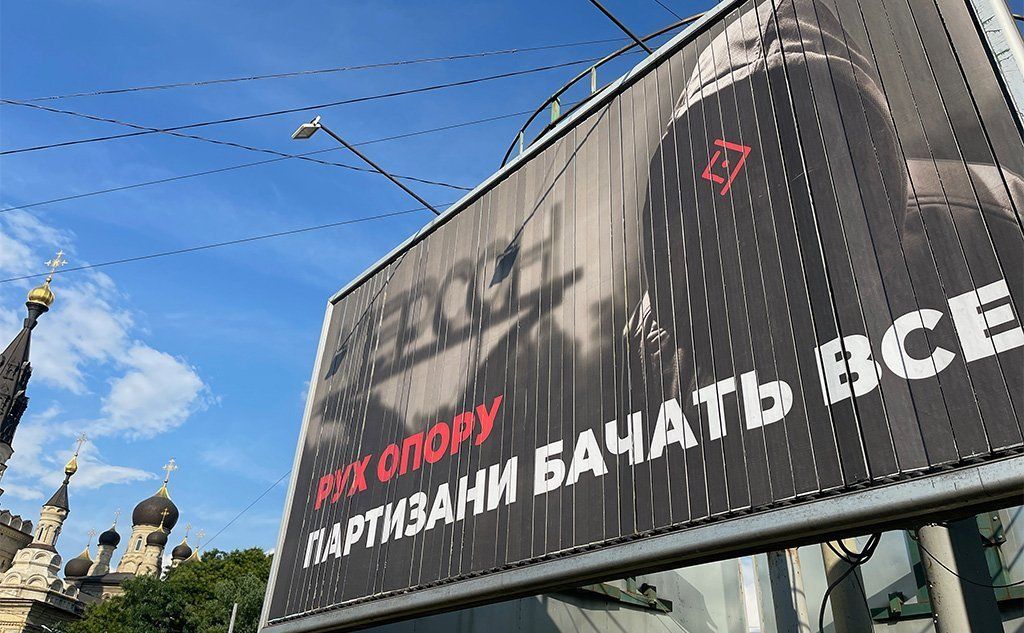
Driving through military checkpoints, we pass giant billboards showing a faceless, hooded figure alongside a warning: “Kherson: The partisans see everything.” The image is designed to make the region’s Russian occupiers nervous and boost the morale of those trapped under their rule.
Image caption, A billboard warns collaborators “Kherson: The partisans see everything.”
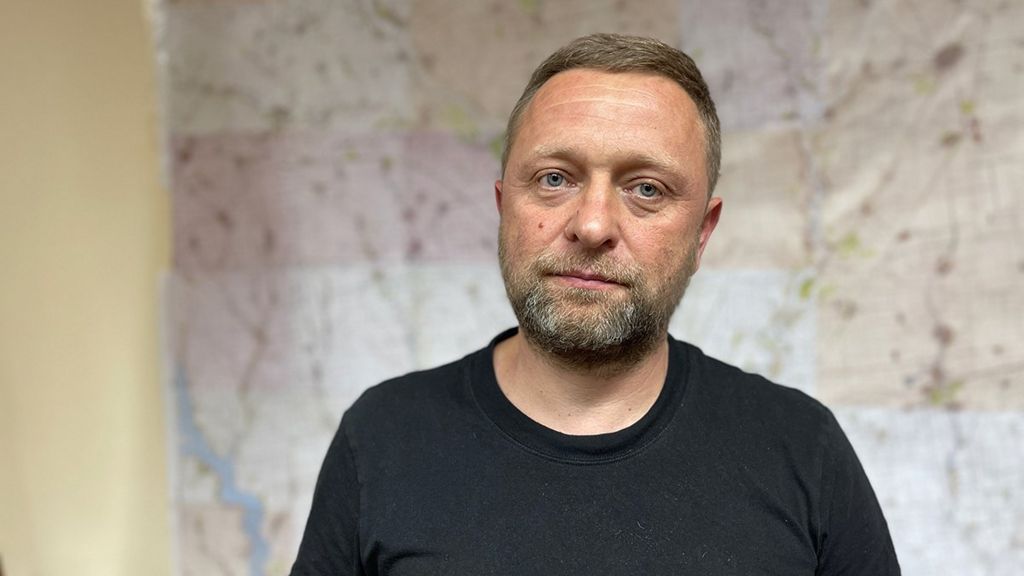
“The resistance is not one group, it’s total resistance,” the man standing in front of me insists, his voice slightly muffled by a black mask he’s pulled up from his neck so I can’t see his face as we film him, in a room I can’t describe so that neither can be found.
Shortly before this war, Ukraine bolstered its Special Forces in part to build and manage a resistance movement. It even published a PDF booklet on how to be a good partisan, with instructions on such subversive acts as slashing the tyres of the occupier, adding sugar to petrol tanks or refusing to follow orders at work. “Be grumpy,” is one suggestion.
But Sasha’s team of informers have a more active role: tracking Russian troop movements inside Kherson.
“Say yesterday we saw a new target, then we send that to the military and in a day or two it’s gone,” he says, as we scroll through some of the many videos he’s sent from the neighbouring region each day. One is from a man who drove past a military base and filmed Russian vehicles, another is from CCTV footage as Russian trucks pass by, daubed with their giant Z war-marks.
Sasha describes his “agents” as Ukrainians “who have not lost hope in victory and want our country to be freed”.
“Of course they’re afraid,” he says. “But serving their country is more important.”
Working alongside Sasha are a team who fly drones into Kherson to spot targets for the military. Civilians, not soldiers, all are volunteers and they fundraise on social media to pay for their expensive kit.
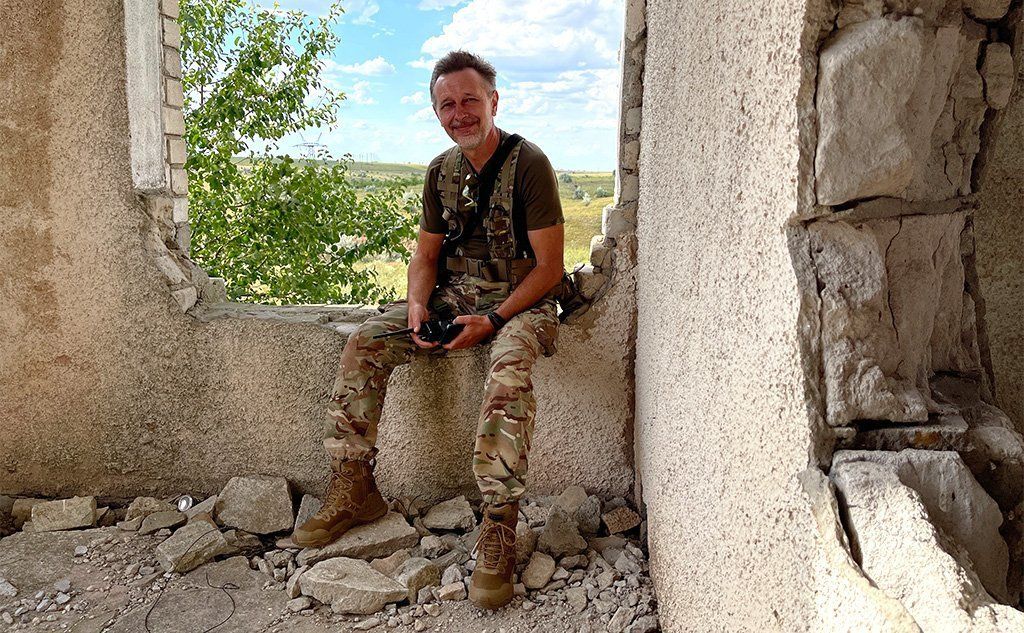
The man in charge cultivated decorative plants before the war, but Serhii tells me he joined the fight to free the south after seeing the bodies of civilians executed in Bucha during the Russian occupation there. “I couldn’t just stay at home after that,” he says. “I didn’t know what else I could do or think of, while this war is going on.”
The task he chose instead is extremely dangerous. His team of four get shelled by the Russians every single time they go out, though no-one has been killed. “I know to some extent it’s a matter of chance,” Serhii shrugs, and breaks into a soft smile. “But at least if it happens to me, then I will know it was for a cause.”
Image caption, Serhii joined the resistance in the south after the massacre in Bucha
The partisans are fighting to prevent Russia’s hold over Kherson becoming permanent: to block a referendum that Moscow appears to be planning to stage. Russia has already introduced the rouble and its own mobile phone networks to the region and is pumping its propaganda from state-run TV channels into Ukrainian homes. Local journalists have either fled, or gone to ground.
The acting head of the region, Dmytro Butrii, now exiled to Mykolaiv and a small back office protected by sandbags, insists that a vote on joining Russia would be a sham, a “total fake” and unrecognised by any “civilised” government.
These days, that wouldn’t matter much to Moscow.
For Russia, the region is strategic: it’s the source of water for Crimea, which it annexed illegally in 2014, and the last section of a much-discussed ‘land bridge’, or stretch of territory that links Russia-proper to the peninsula.
Image caption, The exiled head of the region, Dmytro Butrii, says a referendum would be a sham
Some locals have switched sides to help the Russians. So Sasha’s team are building a database of those “collaborators”, using information from the inside. “It’s so that no one can claim later that they were with the resistance,” he explains.
But it’s also for intimidation. Partisans are encouraged to stick threatening posters outside the collaborators’ homes with designs that include the person’s face and a coffin, or a “Wanted” poster offering big rewards for their death. The activists then photograph the results to send to Sasha.
“There’s a lot of graffiti. People write things like ‘stuff your referendum’ as well as sticking up their posters,” Sasha describes his latest reports from Kherson. “It shows how many people are not afraid: in a city with military patrols everywhere, they manage to print leaflets then walk round with glue when they could be stopped at any moment and things would end very badly.”
There has been a spate of assassination attempts against those who’ve joined the Russians. A blogger was shot, an official in the Russian-installed administration was killed and others have been injured in car bombs. The most prominent figures to switch sides now wear body armour as a matter of course. The men I meet all say they have nothing to do with the attacks, but they have no sympathy either.
“Other than the word traitor and scum, I have no other words for them,” Sasha shrugs. “They’re our enemy.”
Vladimir Putin still claims his invasion of Ukraine is a “liberation” operation but in Kherson, his troops rule through force and fear.
Since Russian forces occupied the region in March, hundreds of people have been detained, many of them tortured. Some have disappeared, unheard of for weeks. Others have been discovered dead or returned to their relatives from Russian custody in body bags.
Sources inside the city describe soldiers patrolling the streets and buses stopped at random for everyone inside to be checked. The slightest hint of support for Ukrainian rule, as little as a message or photo on your phone, can get you arrested.
Every time Oleh smiles in the mirror, the gaps in place of his teeth are a reminder of the beatings he endured by his Russian interrogators. He tells me they also broke seven ribs – three still haven’t mended. His name is not really Oleh, but he’s asked me not to reveal his identity.
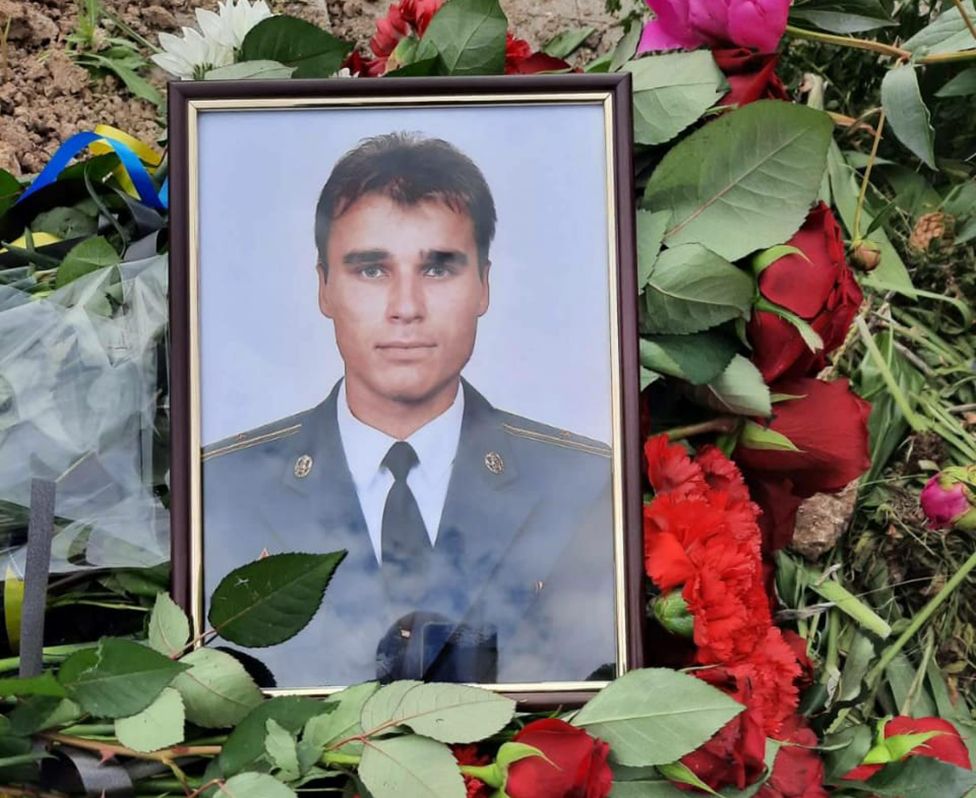
A member of the resistance, he witnessed the torture of another prisoner, Denys Mironov, who then died in Russian custody.
Image source, Family handoutImage caption, Denys Mironov
Oleh talks in chilling detail about what happened after 27 March when he and Denys were snatched from the street: he describes constant beatings in the first hours involving electric shock, suffocation and death threats. He’s sure his interrogators were from the FSB security service.
At some point, his spirits fell so low that he contemplated ending his life, even attacking a guard so they would shoot him.
“They were looking for Nazis, so they beat me because I was bald. They reckoned they’d caught a damn Nazi,” he answers, when I ask what information his captors had wanted. “When they stripped me, they saw I had Simpsons underpants so they said I was an American agent and punished me for that.”
A month earlier, when the Russians invaded, Oleh and Denys had joined the territorial defence, Ukraine’s volunteer army. But much of the military melted away with the first explosions and Kherson’s remaining forces were quickly overwhelmed. So the men became partisans, working against the Russians from the inside.
“We got information on where their forces were based, and when they were on the move, and we passed that on to the military,” Oleh explains, adding that he was involved in a lot more activity that he can’t talk about.
Another partisan I met described helping Ukrainian forces escape in boats across the Dnipro when they were surrounded – and stealing weapons from the Russians. “I’ll tell you the rest when we win,” he laughs when I press him for more.
Denys, a 43-year-old with a wife and son – and a fruit and veg business before the war – began driving a bread van around Kherson, handing out food and scouting for intelligence as he went. He and Oleh were also collecting weapons, preparing to join the battle to liberate Kherson as soon as Ukraine launched the counter-offensive that everyone expected.
Instead, the two men were detained and tortured.
I asked Russia’s FSB to explain what happened to these men and others. They didn’t respond.
It was the middle of the first night before Oleh saw Denys again, and by then he could barely walk and was struggling for breath. Even so, the guards beat him some more. “They hit him in the groin, then the face, then two men with batons took down his trousers and started to beat him near his kidneys,” Oleh says, recalling how the tape holding a bag over his own head had worked loose enough for him to see.
“It was clear his lungs had been punctured and he’d been really badly hurt,” he says. “But if he’d been helped in time, his death could have been avoided. It’s awful.”
On 18 April the men were transferred to a facility in Crimea and the next day, Denys was finally taken to a military hospital where Oleh was sure he would recover.
The first Denys Mironov’s family knew of his death was over a month later, when he was returned to Ukraine as part of a body swap.
Many people left Kherson for safety soon after the Russians seized control. The government in Kyiv recently urged others to evacuate, warning that a military operation to retake the region was imminent.
But getting out isn’t easy.
Russian officials limit the number of vehicles crossing the frontline and only permit one route into Ukrainian-controlled areas, the road that heads north to Zaporizhzhia. Multiple military checkpoints on the way make it a no-go for Ukrainian men of fighting age. Even women and children face waiting weeks for places on free evacuation buses, or an exorbitant fee for a place in a private car.
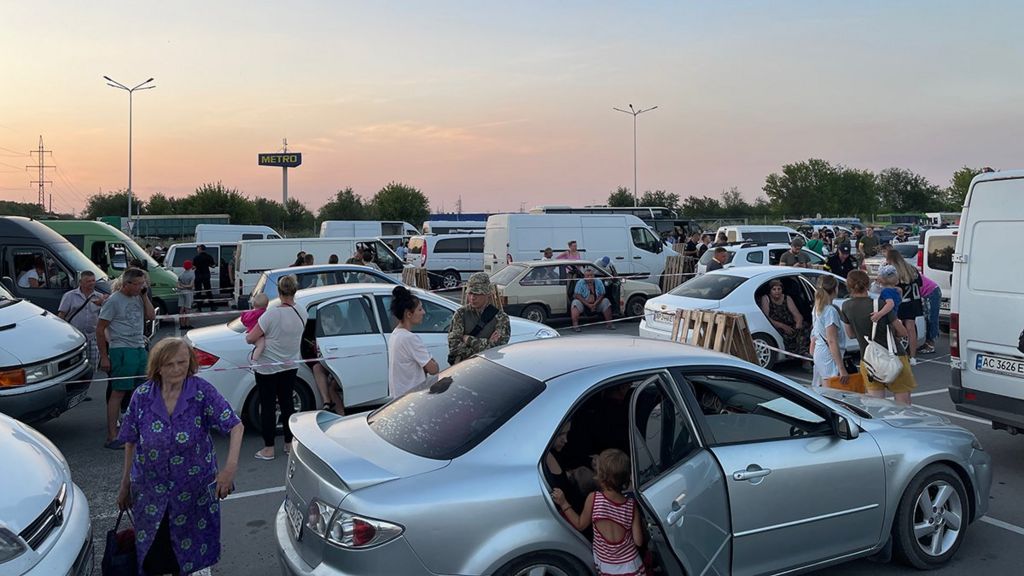
But hundreds still flee each day, tumbling off buses or unfolding themselves from crowded, stuffy cars just before dusk into a supermarket car park that doubles as a reception area for those forced into exile in their own country. The adults look exhausted, the children’s smiles are timid, as if they’re not quite sure whether they’re safe yet. Steam gushes from beneath the bonnet of a blue Lada like it’s about to explode. After security checks, volunteers offer food and clothes and, for some, there are tearful reunions with waiting relatives.
Image caption, People fleeing Russian-occupied territory arrive in Zaporizhzhia
We can’t travel into Kherson now it’s occupied, but the mood in this crowd reveals plenty about life there. Even on Ukrainian-controlled soil, people are wary of what they say. “Will the Russians see this?” some of the new arrivals want to know before I film or even record them speaking. Others shake their heads as I approach, and turn away from my microphone.
“It’s tough there, the Russians are everywhere,” Alexandra tells me, bouncing baby Nastya on her knee in the back of a car. Inside the aid tent an older woman is standing with two carrier bags at her feet looking lost and lonely. Struggling with tears, Svitlana tells me she’s fled Kherson because her nerves are in shreds but her husband has refused to come with her. “He said he’s waiting for the Ukrainian army to come and liberate us,” she says.
As night begins to fall, and more vehicles pull in, a man admits that his own family are running from more than the missiles. “We know people are disappearing, it’s true,” he tells me, without giving his name. “In Kherson, you don’t go out in the evening.”
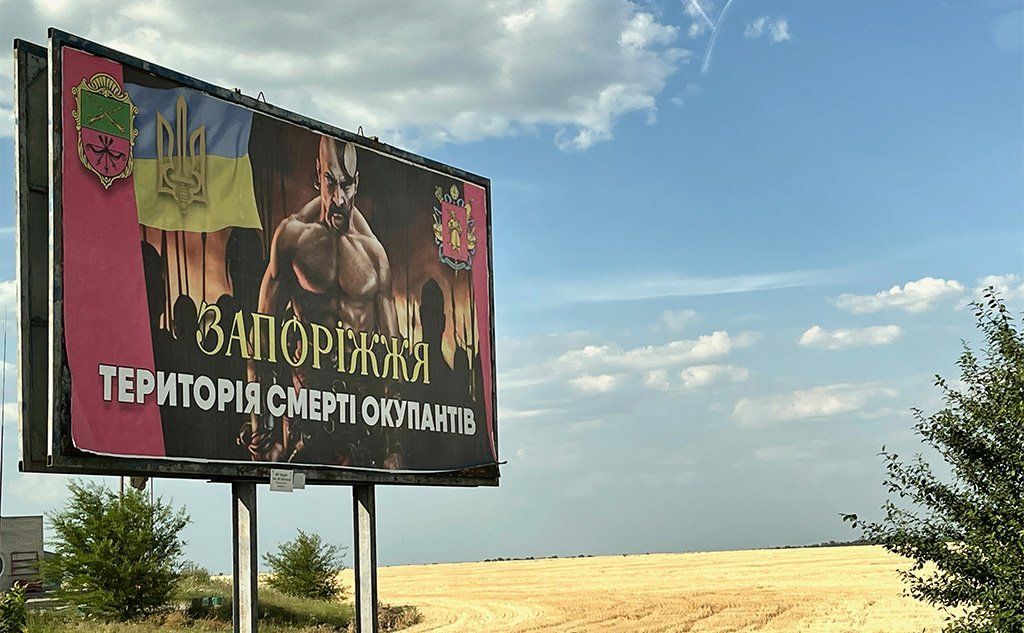
Image caption, A resistance poster reads: Zaporizhzhia, land of death to the occupiers
The danger from shelling has increased in recent days, on both sides of the southern frontline.
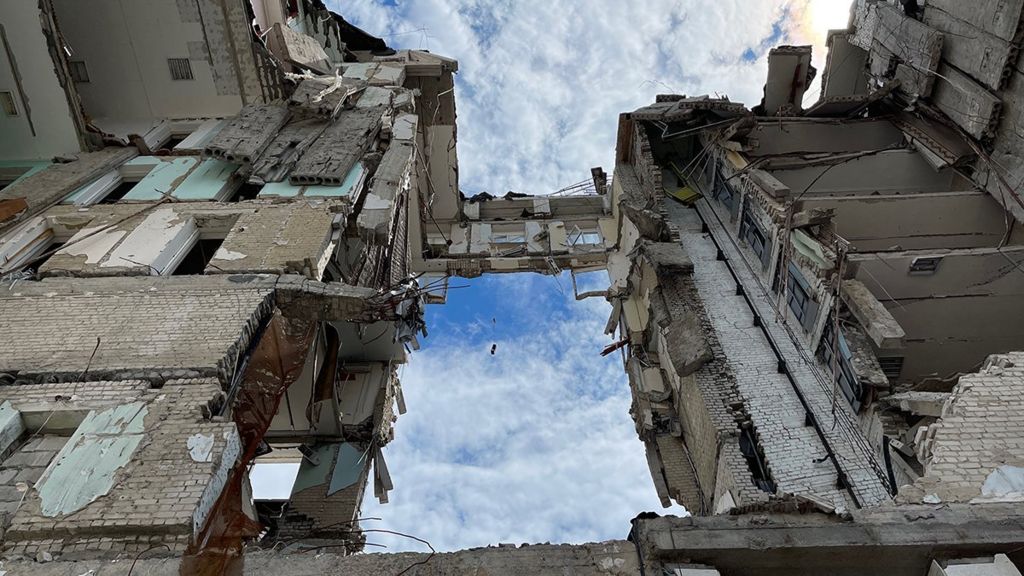
In Mykolaiv the days usually start with explosions from 4am: down south, the Russian launch sites are so close that the warning siren only goes off after the first missile hits. One morning, sheltering in our hotel basement, I counted at least 20 explosions in the city, some close enough to shake the building. Once the curfew lifted, we found a nearby school in ruins, the playground swings blanketed in the thick grey dust of the collapsed sports hall.
Image caption, The ruined regional administration building in Mykolaiv
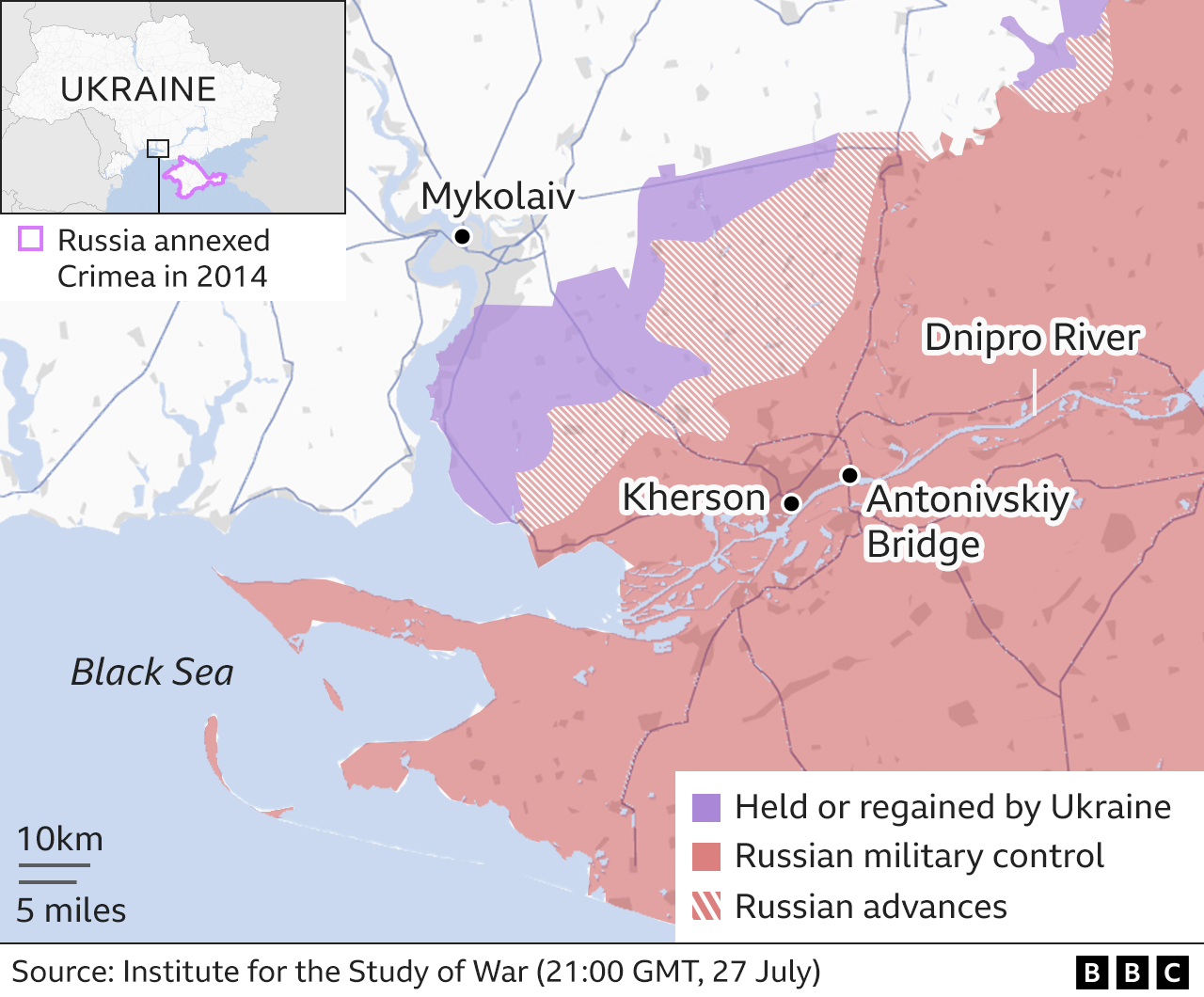
But Ukrainian attacks have also increased, both in number and impact, as more powerful weapons supplied by the West have made it to the region and are making a difference. Residents in Kherson city have recorded multiple strikes on Russian ammunition depots. Bridges across the Dnipro, including the Antonivskiy, have also been hit multiple times, disrupting Russian supply lines.
The push to retake Kherson could be approaching.
Sasha believes many of those who have remained in the city are ready to stay and fight; those I’ve spoken to say support for Russian rule is minimal and the searches, detentions and beatings in recent months have shrunk that still further.
“When the army starts to invade, then people will be ready and will help,” Sasha says.
After his own brutal experience in Russian custody, Oleh is already back on the southern front to fight for his hometown, alongside Ukraine’s partisan army.
“They can take the land, but they can’t take the people,” is how he puts it. “The Russians will never be safe in Kherson, because the people didn’t want them there. They don’t like them. They won’t accept them.”
The duo join a long list of players who have been deemed surplus to requirements and made to leave the club, including Fredrick Ansah Botchway and Patrick Razak.
Agyenim-Boateng joined the Phobians last season from Medeama, but struggled to command a starting role and scored only one goal in the Ghana Premier League.
Meanwhile, Enoch Addo, whose contract expires this month has been shipped out on loan twice, first at Berekum Chelsea and then Elmina Sharks. And despite efforts to break into the first, the youngster has found it difficult to compete.
Kofi Kordzi, Frederick Ansah Botchway, Patrick Razak, Manaf Umar, Larry Sumaila and William Dankyi have all left the club.
Hearts of Oak have signed Cameroonian forward Junior Kaaba and are in talks with Konadu Yiadom from WAFA, goalkeeper Eric Ofori Antwi, Francis Twene of Bechem United and Swedru All Blacks’ center-back Zakaria Yakubu.
The 24-year-old who hails from the Wisdom Boxing Gym in Accra took to the ring in the Men’s Light Middleweight on Sunday evening with just one ambition- victory!
From the first bell, he launched a blistering onslaught against his 22-year-old South Pacific opponent from Fiji Elia Robobuli.
Considering the high stakes of a place in the Quarterfinals, much more was expected from the boxer from Fiji but he was stunned into submission in the first round before he could even settle into a rhythm.
Three consecutive stoppage counts by the referee meant that the fight had to be stopped.
It was a devastating finish by Omar and it means Ghana has one out of the remaining 6 fighters in the boxing quarterfinals to look forward to this week.
This was the perfect response by the Black Bombers after one disqualification, two defeats, and increased media attention following the doping setback 72 hours earlier.
A car wash owner plotted to smuggle people into the UK inside lorries – and planned to drug children to keep them quiet.
Luan Braha, of Boss car wash in Silverdale, Newcastle-under-Lyme, has been jailed for eight years for his bid to traffic Albanians from Belgium.
He was found guilty at Stoke Crown Court on Thursday for conspiracy to assist unlawful immigration to the UK.
Police said Braha used group chats to devise his plans.
The 38-year-old, originally from North Macedonia, planned to charge migrants more than £5,000 each.
Police said he also discussed with other counterparts drugging people, including children, to keep them quiet during the journey from Ghent.
The car wash owner used his business “to make acquaintances and generate support for his plan,” police said.
Braha was arrested in July 2021 and claimed he had no intention of ever carrying out his plans and that it was “a flight of fancy”.
Julie Woods, from West Midlands’ Regional Organised Crime Units, said: “It was clear Braha was the lead conspirator and was quite openly making arrangements to smuggle people into the UK for payment with no regard for their safety.”
Ukraine’s campaign to retake the occupied Kherson region is “gathering pace”, Western military sources say.
A key bridge into the city of Kherson is now out of action after Ukrainian forces struck it with long-range rockets supplied by the US.
UK defence officials say the city is now “virtually cut off from other occupied territories”.
However, senior Ukrainian figures warned that Russia was now shifting its forces to defend the southern area.
Strategically located west of the Dnipro river, the city was the first in the war to fall to Moscow’s forces.
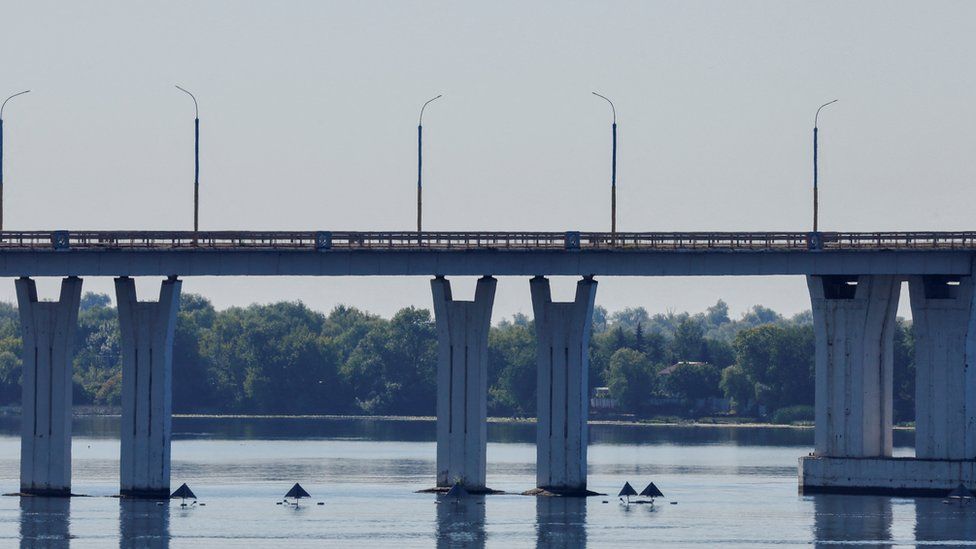
Ukrainian forces fired at Kherson’s Antonivskiy Bridge using a Himars artillery rocket system on Tuesday which, according to Western military sources, has left the crossing “completely unusable”.
Only a pockmarked wreck is said to remain of the half-mile long bridge, one of two key routes spanning the Dnipro river which have both now been hit.
Moscow relies on the crossings to resupply their troops stationed west of the river, and are now at risk of becoming isolated from the rest of Russia’s occupying forces. A third bridge, over the Inhulets river to the north-east of Kherson city, has also been hit.
Military sources described Kherson as “politically the nearest Russia has to a jewel in the crown of its occupation” – and its loss, they say, “would severely undermine Russia’s attempts to paint the occupation as a success”.
In a daily intelligence update, UK defence officials said the Ukrainian counter-offensive in the region was “gathering momentum”, adding that Kyiv’s forces had likely established a bridgehead south of the Inhulets river, “which forms the northern boundary of Russian occupied Kherson”.
Moscow was now “moving the maximum number of troops in the Kherson direction”, said Oleksiy Danilov, who is secretary of Ukraine’s National Security Council, on Wednesday evening.
The BBC has not been able to independently verify his remarks, however Ukrainian presidential adviser Oleksiy Arestovych agreed Russian forces were shifting their forces to the south in anticipation of a counter-offensive and changing their focus to strategic defence.
Meanwhile, Russian forces in the east said they had captured Ukraine’s second largest power station – the Vuhlehirsk coal-fired plant. Mr Arestovych described it as a “tiny, tactical advantage”.
Russian-installed officials in Kherson confirmed that a Ukrainian artillery strike had seriously damaged the Antonivskiy Bridge, forcing its closure to traffic.
Speaking to Ria news agency, deputy city leader Kirill Stremousov said ferries and pontoon bridges would now be used instead to maintain links across the Dnipro River with the rest of Russian-occupied territory.
For days the Ukrainian military has targeted the bridges using highly effective rocket systems supplied by the US.
According to Western military sources, the attack is part of a Ukrainian counter effort to isolate Russian troops, with the ultimate goal of recapturing the entire region.
If it proves successful the ambitious campaign would provide a much-needed boost for Kyiv by retaking from Russia the most significant population centre it has so far captured since the invasion began – the city of Kherson.
Image source, ReutersImage caption, Despite still standing, Russian-backed local officials confirmed that the Antonivskiy Bridge is now impassable due to damage from Ukrainian rocket attacks
The southern city, which had a population of 290,000 before the war, is administered by Moscow-backed officials since falling early on in the war.
Last week, Russian Foreign Minister Sergei Lavrov said Russia’s military focus was no longer only on eastern Ukraine but on its southern regions of Kherson and Zaporizhzhia too.
The US has accused Russia of preparing to annex parts of occupied Ukraine illegally.
In his nightly Wednesday address President Volodymyr Zelensky vowed that Ukraine would eventually rebuild the Antonivskiy Bridge as well as other crossings in the Kherson region.
“We are doing everything to ensure that the occupying forces do not have any logistical opportunities in the country,” he said.
Russia captured Kherson with relatively little resistance in the war’s early days – and the failure of Ukraine’s security service to destroy crossing points over the Dnipro river at the time is believed to have last week led to Mr Zelensky’s dismissal of the agency’s director Ivan Bakanov.
On the night of the attack 35 years ago, Ellis, now of Eastville in Bristol, hit the teenager over the head as she walked home after a night out.
He then dragged her along a nearby alleyway towards fields at the rear of Skinnerthorpe Road, where he tied her up and sexually assaulted her..
‘A shell of herself’
DNA breakthroughs meant that decades later police were able to get a sample from the jacket the victim was wearing on the night she was attacked.
On Friday, the Attorney General argued the original punishment handed out to Ellis at Bristol Crown Court in May 2022 had been unduly lenient.
The Court of Appeal was told the attack had been “brutal” and had “blighted” the life of Ellis’s victim.
Image source, Geograph/Lewis Clarke
Image caption, The Court of Appeal heard the victim was now “a shell of herself”
Lady Justice Carr said “the conduct here was at the very highest level” for an indecent assault, as it was a sustained attack involving both the use and threat of violence.
The court was also told Ellis had previously attacked another girl in an alleyway and had been on probation for a burglary offence in 1986.
The victim had said the attack had “ruined her chances in life” and she was “now a shell of herself”.
The original sentence was quashed and extended to seven and a half years
Ellis must also sign the sex offenders register for life.
Spanish prosecutors are seeking eight years in prison and a €24m (£20m) fine for Shakira over alleged tax fraud.
The Colombian singer is accused of failing to pay €14.5m (£12m) in tax between 2012 and 2014.
Earlier this week Shakira refused an offer to settle and close the case. A trial date has not yet been set.
A statement from representatives of Shakira said she is “fully confident of her innocence” and sees the case as a “violation of her rights”.
The star was accused of tax evasion in 2018. Prosecutors said she was living in Spain between 2012 and 2014 while listing her official residence elsewhere.
People who spend more than six months in the country are considered residents for tax purposes. But Shakira says she did not mainly live in Spain at the time.
Scientistssay there is “compelling evidence” that Wuhan’s Huanan seafood and wildlife market was at the centre of the Covid-19 outbreak.
Two peer-reviewed studies published on Tuesday re-examine information from the initial outbreak in the Chinese city.
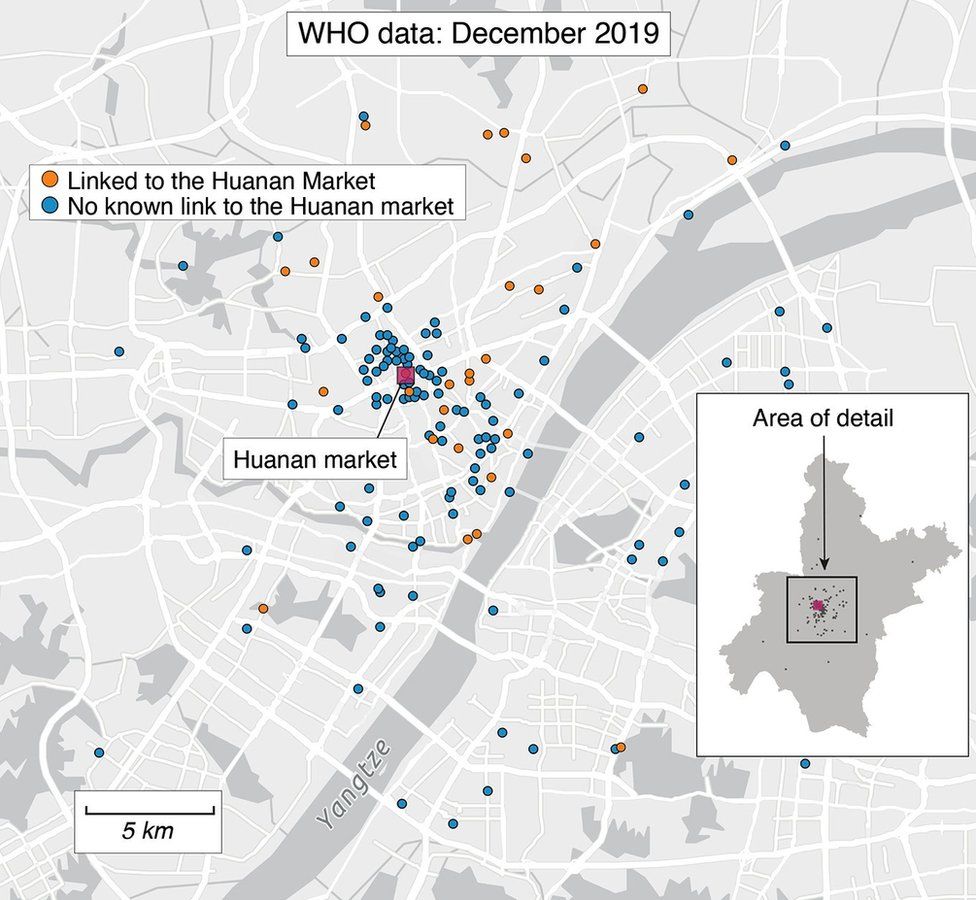
One of the studies shows that the earliest known cases were clustered around that market.
The other uses genetic information to track the timing of the outbreak.
It suggests there were two variants introduced into humans in November or early December 2019.
Together, the researchers say this evidence paints a picture that Sars-Cov-2 was present in live mammals that were sold at Huanan market in late 2019. They say it was transmitted into people who were working or shopping there in two separate “spillover events”, where a human contracted the virus from an animal.
One of the researchers involved, virologist Prof David Robertson from the University of Glasgow, told BBC News that he hoped the studies would “correct the false record that the virus came from a lab”.
Pandemic epicentre
Two years of scientific effort to understand the virus that causes Covid-19 have provided these researchers with a more informed perspective.
This has enabled them to address a key conundrum in the earliest patient data: That out of hundreds of people who were hospitalised with Covid-19 in Wuhan, only about 50 had a direct, traceable link to the market.
Image source, Science
Image caption, Early cases clustered around the Huanan market (c) Science
“That was really puzzling that most cases could not be linked to the market,” said Prof Robertson. “But knowing what we know about the virus now, it’s exactly what we would expect – because many people only get very mildly ill, so they would be out in the community transmitting the virus to others and the severe cases would be hard to link to each other.”
This Covid-19 case-mapping research found that a large percentage of early patients – with no known connection to the market, meaning they neither worked nor shopped there – did turn out to live near it.
This supports the idea that the market was the epicentre of the epidemic, said Prof Michael Worobey, lead author and biologist from the University of Arizona, with sellers getting infected first and setting off a “chain of infections among community members in the surrounding area”.
“In a city covering more than 3,000 sq miles (7,770 sq km), the area with the highest probability of containing the home of someone who had one of the earliest Covid-19 cases in the world was an area of a few city blocks, with the Huanan market smack dab inside it,” said Prof Worobey.
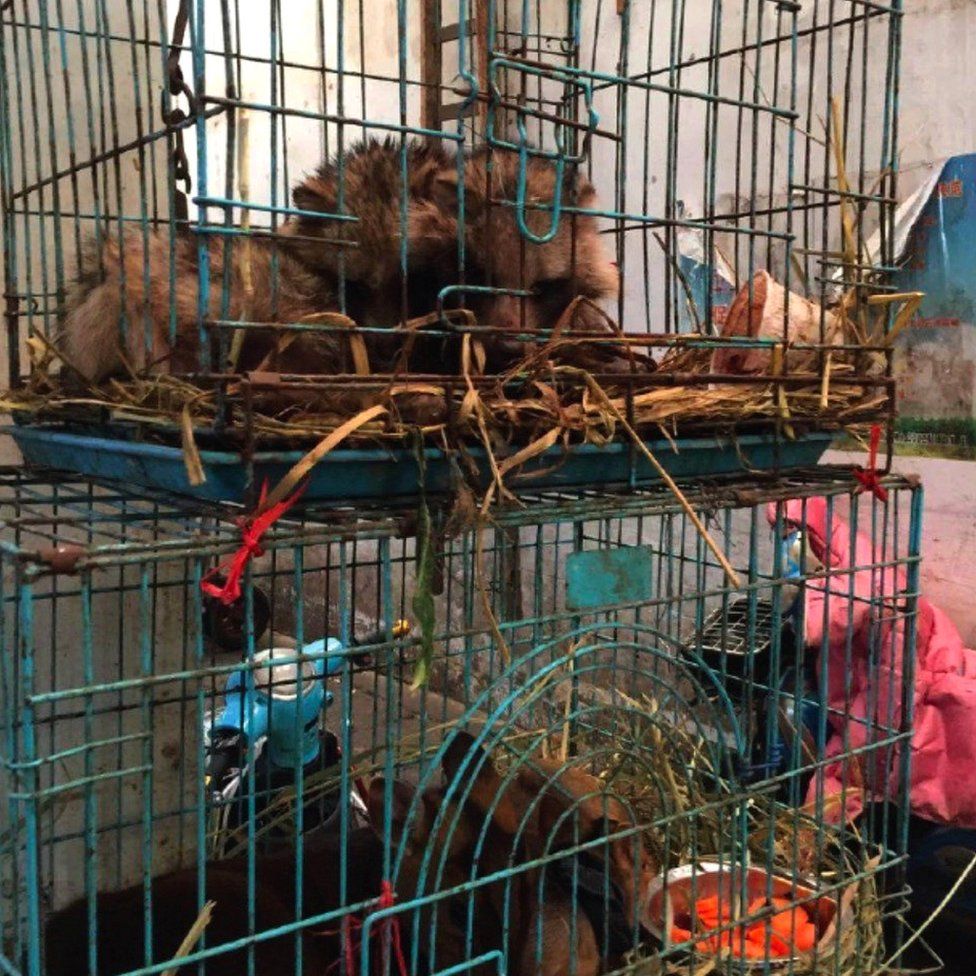
Image source, Worobey et alImage caption, Live animals, including species now known to be susceptible to Covid-19, were sold in Huanan market
That study also zoomed in on the market itself. The scientists created a map of the samples – swabs of fluid from drains and on market stalls – that tested positive for the virus.
“Most of the positive samples clustered around the south-western side of the market,” explained Prof Robertson. “And that’s the location where we report species like raccoon dogs being sold.
“So we have confirmation of animals we now know are susceptible [to Sars-Cov-2, the virus that causes Covid-19] were sold there in late 2019.”
The lab leak theory
Over the last two years, the search for the origin of the deadly pandemic turned from a scientific investigation into a toxic political row.
Viewers in the UK can watch this BBC documentary on the hunt for Covid-19’s origins.
One of the subjects of a fierce international blame game – primarily between politicians in the US and China – was a theory that the virus could have been leaked from a Wuhan laboratory, the Wuhan Institute of Virology.
But that hypothesis, said Prof Stuart Neil from Kings College, “can’t explain the data”.
“We’re now as sure as we can be, based on the fragmentary evidence we do have, that this was a spillover event that happened in the market.”
Crowded, live animal markets, many scientists agree, provide an ideal transmission hotspot for new diseases to “spill over” from animals. And in the 18 months up to the beginning of the pandemic, a separate study showed that nearly 50,000 animals – of 38 different species – were sold at markets in Wuhan.
Prof Neil said the pandemic was very likely to have been a consequence of an “unhealthy, cruel and unhygienic practice that Chinese authorities had been warned about”.
The major risk of being distracted by looking for someone in a laboratory to blame for all this, he added, “is that we run the risk of letting this happen again because we’ve focused on the wrong problem.”
After weeks of anticipation, the much-talked-about event at the West Hills Mall came off on Saturday, July 30. The Lynx @ 15 Experience Concert featuring all stars was fun and packed with electrifying performances.
Games and exciting family activities at daytime preceded the musical event.
Media personalities Dr. Pounds & Sheldon The Turn Up as well as DJ Texas & Mc Nana King steered affairs on the night. DJ Vyrusky, DJ Wallpaper, DJ Shiwaawa and DJ Cartoon provided great music rotation throughout the event.
The night saw up-and-coming artistes from Kasoa and all over the capital showing off their best as curtain-raiser.
Lynx Entertainment new signees; BoiJake, St. Lennon, DSL and Maya Blu were a delight to watch at the West Hills Mall.
Kwame Yogot, Malcom Nuna, Lil Win, Mr. Drew, were on stage to support and didn’t disappoint with their performances.
Adina took over and performed some of her great tunes including ‘Why’, ‘Killing Me Softly’, ‘Hallelujah’ and ‘Too Late’.
The Rockstar lived up to his name. Kuami Eugene‘s energetic live band delivery of every song got the crowd reacting with cheers. From ‘Obiaato’ to the last song; ‘Abodie’, there was no dulling at the concert.
Ghana’s Golden Boy, KiDi, wrapped the excitement up with back-to-back bangers with the band. He ‘Blessed’ the crowd to ‘Say Cheese’, gave them ‘Enjoyment’ without forgetting to ‘Touch It’.
The Lynx @ 15 Experience Concert was put together by Lynx Entertainment and West Hills Mall with sponsorship from itel Mobile, Tigmoo, SkyNet, powered by Fidelity Bank & TicTok and Joy Entertainment as media partner.
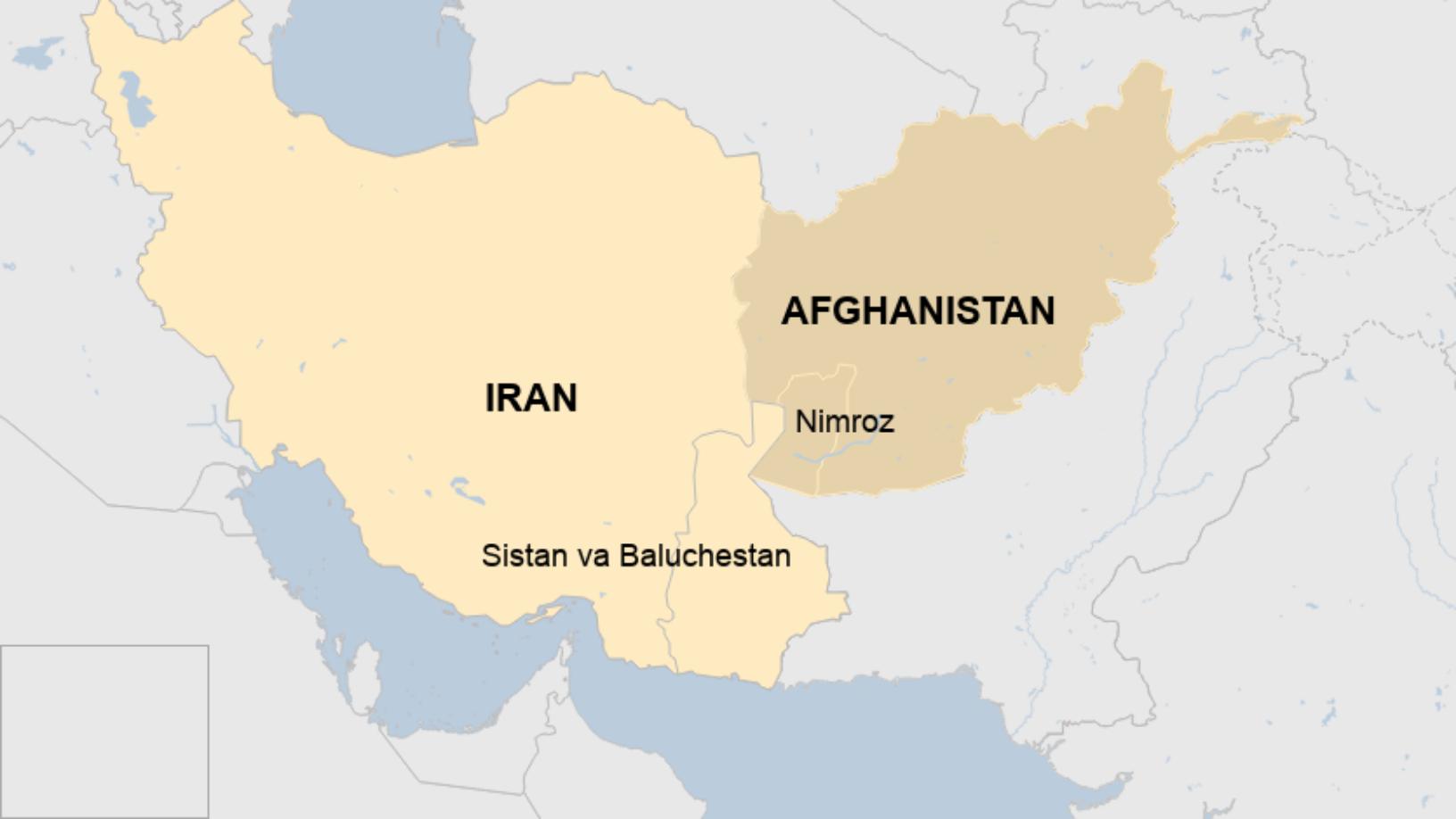
The militants say one of their fighters was killed in Sunday’s fighting in the border area between Nimroz province in Afghanistan and Hirmand in Iran.
Each country blamed the other for the incident, the latest since the Taliban overran Afghanistan a year ago.
Last month Iran reported the death of one of its guards in an incident in the same area.
The exact circumstances of the latest skirmish are unclear but one Iranian report says shooting started when Taliban forces tried to raise their flag on non-Afghan territory.
There were reportedly no casualties on the Iranian side.
According to Kuffuor, the management and the players put pen to paper and agreed on a $25,000 bonus for each player if they win the Champions League.
Speaking in an interview with Dan Kwaku Yeboah TV, the former Black Stars player said he got between $8,000 to $10,000 of the bonus.
“Yeah, we had money but they (Hearts of Oak) did not give us the money they promised us…$25,000 and I got about $8,000 to $10,000. They have not paid the balance. I heard that Charles Allottey raised this issue and they insulted him, they are lucky. They did not just promise us, we signed documents on it. Everyone was given a paper to sign,” he said.
He continued that, the mount he received came in bits and not in full.
“It came in instalments. You’ll be there and unexpectedly they come and share $2000 each to every player. It is disheartening. I have some files and I know that will find that paper there.”
Kuffuor, who is now based in the United States, added that management made excuses at the time, but when he returns to Ghana, he will storm the club’s office and seize everything.
“We went and told them we need our monies, they said they were yet to receive money from CAF. Every they haven’t received money from CAF. There are certain things I don’t want to say in this interview but the day I’ll get to Ghana they will see. That day I will let you follow me with your camera. If they fail to give me my money I’ll seize their things.”
Hearts of Oak won their first continental trophy in 2000 after defeating Esperance de Tunis 5-2 on aggregate. Emmanuel Osei Kuffuor scored three of the five goals, including one in the 2-1 first-leg victory and a brace in the 3-1 second-leg win in Accra.
He spent seven years with the Phobians, winning every trophy available to the club.
Relationship Consultant and Family Advocate Kelly Daniels has mentioned some mistakes men make and how they affect their relationships.
According to him, the average man’s major mistake is always thinking his woman is below him. To him, that line of thought is false and grossly wrong.
He explained that in no capacity is it true that a man’s wife is beneath him.
Speaking to Nana Yaw Odame on e.TV Ghana’s ‘Men’s Lounge’ show, he said, “When a man thinks and lives the mental consciousness that the woman is beneath him, the woman’s capacity to be a helper diminishes by the day.”
Talking as a Christian counsellor, he stated that everyone needs a helper, especially men, and this is why God, after creating man, created woman as a helper to him.
“This is why in the Bible, God said it’s not good for Adam to be alone, so he made him a helper suitable for him, who is Eve. So, it means there’s a kind of woman that best fits the kind of man you’ve been wired to be,” he explained.
He emphasised that men are yet to understand it from this perspective because if they did, some would not rant about not needing women.
“Why would God say you need a helper if you’re that strong? As long as you need a helper, you’re not as strong as you claim. So, a helper cannot be under you; a helper is your support system and a go-to person. Most of the time, they know you more than you know yourself, and this does not happen only when the woman does not know her role,” he said.
Kelly added that another mistake men make to destroy their relationships is to think that the male is not wired for domestic chores.
“That’s also another wrong opinion if you want to have a woman in your life and you put them beneath you. Doing that means they’re not up to who you are, and that’s wrong. Men should work in these if they want their relationships to work,” he advised
The Lowdown returns for the next season of the show for 2022 with a bang!
And in its first episode, Ismail Akwei interacts with the Grandpapa of Hiplife in Ghana, Reggie Rockstone.
With both British and Ghanaian backgrounds, the legend talks about life in the United Kingdom before he came down to Ghana to settle.
Reggie Rockstone also takes us through the business aspect of his life, the criticisms that met his waakye brand in a glass, Rockdoms, among others.
Produced differently from past episodes, this interview is raw, uncut and untouched, letting you right into the home of the Grandpapa himself.
Stay tuned and stay glued to your screens for this interactive and intriguing conversation between Ismail Akwei and Reggie Rockstone on The Lowdown on GhanaWeb TV.
Clarence House said it had been assured by PWCF that “thorough due diligence” had been conducted, and the decision to accept the money lay with the trustees.
“Any attempt to characterise it otherwise is false,” it told the BBC.
Clarence House also said it disputed a number of points made in the newspaper’s article.
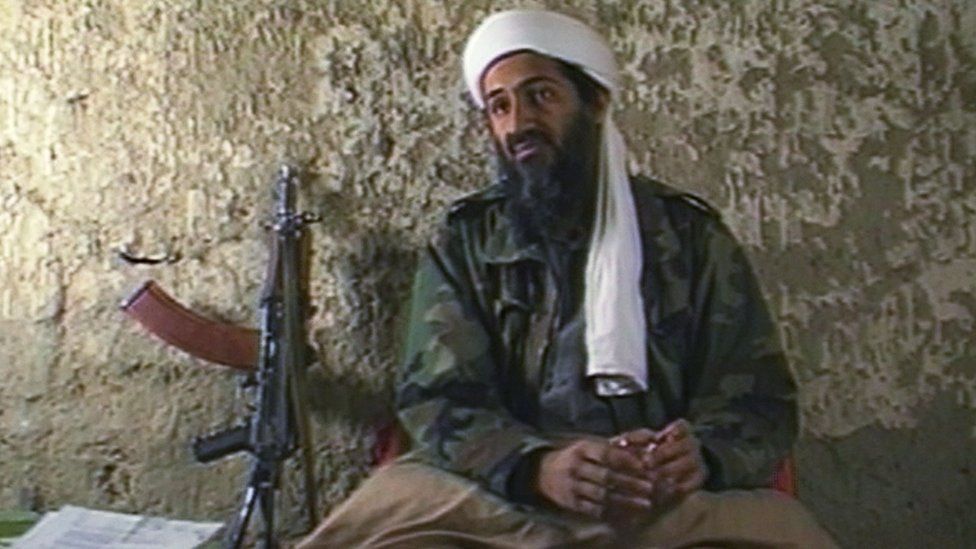
Bin Laden was disowned by his family in 1994 and there is no suggestion that his half-brothers had links to his activities.
According to the report, Prince Charles accepted the money from Bakr Bin Laden, who heads the wealthy Saudi family, and Bakr’s brother Shafiq, following a meeting with Bakr at Clarence House.
The heir to the throne took the money despite objections from advisers at Clarence House and PWCF, the Sunday Times reports, citing multiple sources.
However, Sir Ian Cheshire, chairman of PWCF, told the newspaper that the 2013 donation was agreed “carefully considered” by the five trustees at the time.
“Due diligence was conducted, with information sought from a wide range of sources, including government,” Sir Ian added.
“The decision to accept the donation was taken wholly by the trustees. Any attempt to suggest otherwise is misleading and inaccurate.”
The PWCF awards grants to UK-registered non-profit organisations to deliver projects in the UK, Commonwealth and overseas.
No rule has been broken, no law has been broken. All appropriate checks were carried out and even the Foreign Office was called upon to give its opinion – it cleared the donation.
So how is this front page news?
A source at the Prince of Wales’s Charitable Fund told the BBC that “the sins of the father” – that’s Osama Bin Laden – should not disqualify other members of the family from making a donation. Which makes sense.
But equally, did Prince Charles or his inner circle really think it was a good idea to take money from the Bin Ladens? Or did they think it was fine so long as it was never made public?
Because once it was public – however many checks were made and rules were followed – it was always going to look horrible.
Just like the enormous cash donation from a former Qatari Prime Minister or the letter from Prince Charles’s close friend and aide promising a knighthood to a Saudi citizen who had promised and made substantial donations.
Ministers and members of parliament are, in the end, governed by the ballot box. The Royal Family derives its position and authority from a different place, from a settled acceptance by the public that overall they bring credit to the country.
Does a donation from the Bin Ladens – however remote from the evildoing of a disowned son – fit into this model of monarchy?
Osama Bin Laden was top of the US’ “most wanted” list. He is believed to have ordered the terror attacks on New York and Washington on 11 September 2001 – which killed almost 3,000 people – including 67 Britons.
He was killed by US forces in 2011.
A PWCF source told the BBC that “though the name [Bin Laden] has very unhappy history, the sins of the father should not be visited on the rest of the family, which is an eminent one in the region.”
The source added that the donation had been cleared by the Foreign Office.
Image source, CNN via Getty ImagesImage caption, Osama Bin Laden was disowned by his family nearly 20 years before the reported donation
This is not the first time that Prince Charles or his charity have been scrutinised over its donations.
It was reported last month that Prince Charles accepted a suitcase containing a million euros in cash from a former Qatari prime minister – one of three cash donations totalling around £2.5m.
Clarence House said at the time that donations from the sheikh were passed immediately to one of the prince’s charities and all the correct processes were followed.
The Charity Commission later decided against launching an investigation into the donation.
In February, the Metropolitan Police began an investigation into claims the charity offered honours help to a Saudi citizen.
Clarence House said the prince had “no knowledge of the alleged offer of honours or British citizenship on the basis of donation to his charities”.
To millions of Saudis, the name Bin Laden is totally innocuous. In the West and much of the rest of the world, it will forever be associated with the 9/11 terror attacks of 2001.
But in Saudi Arabia, it is a byword for the Jeddah-based construction firm that used newfound oil wealth to fund mosques, palaces and other buildings by royal decree.
The family were not originally Saudi: they came from a part of southern Yemen, the Hadhramaut, that has produced many of Jeddah’s most successful and wealthy entrepreneurial families.
Osama, one of the many sons of the company’s founder, who emigrated from Yemen in the early 20th century, was long known as the “black sheep of the family”.
He spent much of the 1980s in Afghanistan helping the mujahideen fight the invading Soviet army, so essentially he was on the same side then as the CIA and Pakistan.
But by the 1990s, he had become a radical Islamic extremist and the family disowned him in 1994. Osama Bin Laden then moved first to Sudan, and soon after to Afghanistan. The rest is history.
Vice President Mahamudu BawumiaSunday launched the 175th Anniversary Celebration of the Evangelical Presbyterian Church Ghana, acknowledging its enormous contributions toward national development.
He said the Church had been a reliable, trusted, and formidable agent of the transformation, civilisation and progress of society.
The year-long celebration is on the theme: “A journey of 175 years in ministry: Achievements, Challenges and the Way Forward.”
Vice President Bawumia believed that the celebration would strengthen their faith in the Lord and reposition the church as a great contributor to the moral, spiritual and socio-economic wellbeing of the people and humanity in general.
“The gains we have made as a nation pre- and post-independence in moral, spiritual and socio-economic development could not have been entirely possible without the keen involvement of the church,” Dr Bawumia stated.
“Indeed, we cannot mention any monumental contributions of the church to nation-building without recognising the role of the Evangelical Presbyterian Church Ghana. Before Ghana attained independence in 1957, the church had already been birthed on Sunday, November 14, 1847, through the missionary effort of the North German Mission Society (Bremen Mission),” he added.
The Vice President noted that the Church had played a vital role in the emergence and development of formal education in the country.
He said, for instance, the pioneer missionaries rolled out several socio-economic initiatives such as clinics, hospitals, schools and agricultural stations, and many others that complemented the work of the Colonial Administrations in developing the nation.
Dr Bawumia observed that the 175 years in the life of the EP Church Ghana were worth celebrating, especially considering the huge sacrifices that the pioneer missionaries like Rev. Lorenz Wolf, Quinuius, Daeuble and Pleasing, had had to make to bring the light of the gospel to Africa and Ghana.
The Vice President acknowledged the numerous educational establishments undertaken by the church, including over 500 basic and tertiary institutions such as Mawuli, Mawuko, EP Senior High Schools in Hohoe, Saboba, Tatale, plus Vocational and Technical Schools, as well as Colleges of Education.
“You have also earned the enviable reputation of establishing the first university in the entire Volta and Oti Regions-the Evangelical Presbyterian University College.
“Your health centres in Wapuli, Ho, Dambai, Blajai, inter alia, coupled with your numerous relief and development projects in the areas of agricultural development, climate change advocacy, HIV/AIDS & TB Programmes, among several others, have added to your endless list of achievements over the past seventeen and half decades of your existence,” Dr Bawumia stated.
The Vice President lauded the church for dedicating parts of the celebration to reflect on its challenges and thus, underscored the need for all well-meaning Ghanaians to pool their resources together to rebuild the economy, ravaged by the Coronavirus pandemic and the Russia-Ukraine war.
“The challenges that have bedevilled our world in the past decades and the present such as COVID-19 and the Russian-Ukraine War with their concomitant effects have spared no institution, and the EP Church Ghana is no exception.
“As you, therefore, reflect on the strategies to surmounting your challenges and strategising for the way forward in the decades ahead, may we all pool together our collective and nationalistic efforts to rebuild our nation and recover from the internal and external devastations that have hit our economy very hard,” Dr Bawumia advised.
He entreated the Church to roll out more socio-economic interventions like its water production business, which would be commissioned on Thursday, August 18, 2022, to create jobs and contribute to the overall gross domestic product (GDP) of the nation.
“The EP Church should also consider rolling out interventions that would create opportunities to develop the human capital of the nation, especially the teeming youth who have benefitted from free education, and thus are in urgent need of work opportunities to contribute their quota to our nation-building quests,” the Vice President pointed out.
In addition to economic and development issues, Dr Bawumia urged the Church to be concerned about building a peaceful nation, noting that, the recent Global Peace Index placed Ghana as the second most peaceful country in Sub-Saharan Africa.
He said such a remarkable feat must be guarded jealously without any compromises since both the Bible and the Quran placed much emphasis on peace.
The Reverend Dr Setri Nyomi, Council Chair, the Evangelical Presbyterian University College at Ho, said the EP Church had impacted the nation in so many ways including providing educational facilities, potable water and resolving ethnic conflicts.
He said the Church had been a voice for the marginalised and vulnerable persons in society and urged the members to continue upholding discipline, hard work and responsibility as the hallmark of the Church and refrain from any acts of mediocrity in both public and private life.
A wildfire in California has exploded in size to become the largest blaze in the state so far this year.
The McKinney Fire, which started in the northern Siskiyou county on Friday, has already burnt 21,000 hectares (52,500 acres), the state’s fire service said.
At least 2,000 residents as well as trekkers on the Pacific Crest hiking trail have left the area. An unknown number of homes have been destroyed.
It was still 0% contained on Monday morning, the fire service reported.
McKinney Fire is burning in the Klamath National Forest, near the border with Oregon. Some 650 firefighters are battling the flames in punishing heat, the Los Angeles Times reports.
A red flag warning indicating the threat of dangerous fire conditions is in place, as California suffers from persistent drought conditions.
A state of emergency was declared in Siskiyou county on Saturday, after homes were destroyed and infrastructure was threatened, state governor Gavin Newsom said.
The fire was “intensified and spread by dry fuels, extreme drought conditions, high temperatures, winds and lightning storms”, he added.
Several communities are being threatened, including Yreka and Fort Jones, the US Forest Service said.
‘I just saw it explode’
Artist, Harlene Althea Schwander had only moved into her new home near the fire’s starting point a month ago, and had not yet unpacked everything. It’s now all gone, she told Reuters news agency.
“Three generations of beautiful things, all of my paintings… they’re all gone, and I’m very sad,” she said.
“When I saw it coming over from the community centre, and I just saw it explode in the dark. I knew the house was gone because I knew right where it was. And the fire department came and told me, ‘just leave now,’” she said.
There was one piece of good news however – Ms Schwander’s daughter-in-law had grabbed her jewellery before they fled.
Image source, Reuters
Image caption, Yreka residents Dawn and Robert Butterfield were evacuated to a shelter in the nearby town of Weed
Jonathan Dixon, who lives in Yreka, a small town with a population of 7,590, told the Los Angeles Times that he fears his house – and collection of art nouveau antiques, artwork and sculptures – will be gone when he returns.
“I’m terrified that my house is going to burn down, and I’ve kind of accepted it,” Mr Dixon, 37, told the paper.
Another Yreka local, Jan Williamson, 66, told the paper she and her husband had to flee with their 40-year-old daughter, Leanne, who is a quadriplegic and has cerebral palsy.
They had to leave behind vital equipment that helps with Leanne’s care and comfort. Leanne is also autistic, and bites herself when her routine is disrupted, or she becomes frustrated.
“Whenever it’s especially bad like this, we just have to take one or two minutes at a time, and just manage to get through each day,” Ms Williamson said.
Authorities warn that possible thunderstorms could result in more fires developing in the coming days.
“The fuel beds are so dry and they can just erupt from that lightning,” US Forest Service spokesperson Adrienne Freeman told reporters, adding that the “gusty erratic winds” that come with thunder cells can “blow fire in every direction.
The fire is the second major blaze to hit the state in recent days. The Oak Fire, near Yosemite National Park, is still roaring after eight days but has been 67% contained, the fire department Cal Fire said.
California still has months of its fire season ahead.
Climate change increases the risk of the hot, dry weather that is likely to fuel wildfires.
The world has already warmed by about 1.1C since the industrial era began and temperatures will keep rising unless governments around the world make steep cuts to emissions.
Ghanaian singer KiDi and his little golden boy, Zane have once again melted hearts with their father and son videos; this time, the young boy crowned his dad the wealthiest man in the world.
In a video shared on his Instagram story, the reigning VGMA Artiste of the Year was spotted cruising in town with his young boy who was busily recording a video on a smartphone.
“Man’s vlogging,” KiDi wrote in the first post followed by a crab-cracking video where Zane showered praise on his father for a gift he got him.
“My dad knows everything. He’s just the smartest dad in the whole world…my daddy is the richest. See what I got, he is the richest in the whole world,” the three-year-old declared.
KiDi holds his son dear to his heart and has a huge tattoo of his name across his chest.
The singer featured his son’s name in the introduction song of his smashing ‘Golden Boy’ album.
Fresh off directing photography on the Spotify Free Forever Campaign starring Chicago rapper Vic Mensa, Atsuson Jr has dropped a new single titled “Quiet Thunder.†The song was released on July 29 and is his first single of 2022. The 25-year-old singer has been off the music scene for a year traveling across Africa and filming documentaries.
Endowed with celestial vocals, the singer details the beauty and struggle in a distance affair on heavy dance instrumental. With a deep connection to soulful music and a gift for storytelling, he tells the story of an adventurer on a quest to bring something to his people. However, his perspective and that of his loved ones would differ.
“I wrote this song to embody the emotions involved from both parties,” Atsuson Jrsaid about the song. With “Quiet Thunder,” he hopes to inspire people to love with enormous patience and go after their convictions. “Quiet Thunder†was produced by Sadi Beats Day, a student of the University of Ghana.
About Atsuson Jr.
Jeffrey “Atsuson Jr“ is a 25-year-old filmmaker and recording artist based in Accra, Ghana. As a child, he was encouraged to pursue his interests in soccer, creative writing, and music. He joined the Victory Bible church choir, where he was the only male, and began writing songs at 12.
Jeffrey started to explore rap music during his early days in high school. He started making cover songs and freestyle videos which helped him build a following and establish himself as an artist among his colleagues.
Atsuson Jr. is an alumnus of the National Film and Television Institute, where he studied as a film director and scriptwriter. He has worked with different production houses, shooting music videos for local and international acts and having his short film screened at film festivals. Jeffrey went on to direct photography on documentaries like the Facebook Year of Return, Spotify This Is, and Spotify Free Forever.
Taking influence from the likes of Drake, The Weeknd, Enya, Celine Dion, Aurora, Xxtentacion & Billie Eilish, Jeffrey makes sounds centered around feels, exploring R&B and Soul with dance and pop music. His music aims at connecting with people emotionally.
Listen to “Quiet Thunder” on all music streaming platforms.
The country’s maritime border has also reopened, with cruise ships and foreign recreational yachts now allowed to dock.
New Zealand first announced a phased reopening plan in February. It allowed vaccinated citizens to return from Australia that month, and those coming from elsewhere to return in March.
In May, it started welcoming tourists from more than 50 countries on a visa-waiver list.
“We, alongside the rest of the world, continue to manage a very live global pandemic, while keeping our people safe,” said Ms Ardern in a speech at the China Business Summit in Auckland on Monday.
“But keeping people safe extends to incomes and wellbeing too.”
Tourism was one of the industries hardest hit by New Zealand’s tough Covid measures.
In the year ending March 2021, the industry’s contribution to the GDP dropped to 2.9%, from 5.5% the year before.
International tourism took an especially big hit, plunging 91.5% – or NZ$16.2bn ($10.2bn; £8.4bn) – to NZ$1.5bn, according to official data.
The number of people directly employed in tourism also fell by over 72,000 during this period.
American actress Nichelle Nichols, best known for her role in 1960s sci-fi TV series Star Trek, has died aged 89.
Ms Nichols broke barriers in her role as Lieutenant Nyota Uhura in the series, becoming one of the first black actresses in the US to play a figure in authority.
She was later employed by Nasa in an effort to encourage more women and African-Americans to become astronauts.
She died of natural causes on Saturday night, her son Kyle Johnson said.
In a statement posted on Facebook, Mr Johnson wrote: “I regret to inform you that a great light in the firmament no longer shines for us as it has for so many years.
“Her light however, like the ancient galaxies now being seen for the first time, will remain for us and future generations to enjoy, learn from, and draw inspiration.”
The Star Trek TV series broke down stereotypes in the 1960s by casting black and minority actors in high-profile roles.
Ms Nicholls was cast in the series as Lt Uhura, who was portrayed as a competent and level-headed communications officer – shattering stereotypes.
In 1968, she and Star Trek star William Shatner, who played Captain Kirk in the series, broke new ground when they shared one of television’s first interracial kisses – though it was not a romantic one.
Despite her success, however, Ms Nicholls had initially considered leaving the show. But she was convinced otherwise by Dr. Martin Luther King Jr., who described her character as the “first non-stereotypical role portrayed by a black woman in television history”.
She went on to feature in the first six Star Trek movies following the series’ end in 1969.
As well as working as an actress, Ms Nicholls also became an ambassador for the US space agency Nasa, helping to recruit women and minorities to its Space programme.
Following the news of her death, Star Trek co-star George Takei wrote in a tweet: “My heart is heavy, my eyes shining like the stars you now rest among, my dearest friend.”
“The importance of Nichelle’s legacy cannot be over-emphasised. She was much loved and will be missed,” said TV director Adam Nimoy – the son of Star Trek actor Leonard Nimoy.
Shatner also paid tribute.
“She was a beautiful woman and played an admirable character that did so much for redefining social issues both here in the US and throughout the world,” he wrote on Twitter.
Marina Sirtis, who portrayed Counsellor Deanna Troi in Star Trek: The Next Generation and its four feature film adaptations, wrote that Nichols “opened the door for the rest of us who followed in your wake”.
Nasa described Nicholls as a “trailblazer” and “role model”.
J.J. Abrams, who was behind the 2009 Star Trek reboot and its 2013 follow-up Star Trek Into Darkness, called Nichols “a remarkable woman in a remarkable role.”
British actress Adjoa Andoh wrote: “We stand on shoulders of groundbreaking greats. Nichelle Nichols you gave so many of us hope. Thank you.”
Kosovo’s government has postponed the implementation of new rules that would force people in majority ethnic Serb areas to swap their Serbian-issued car number plates for Kosovan-issued ones.
The rules were due to come into force at midnight on Monday.
But on Sunday ethnic Serbs in the north barricaded roads and armed men fired shots in protest.
The rules’ implementation has been delayed for a month following consultations with the US and EU.
Kosovo unilaterally declared independence from Serbia in February 2008, nearly a decade after it broke away following a bloody war which saw Nato bombing Serbia.
Relations between its Serb and mainly Albanian inhabitants had been strained for years.
It has been recognised by the United States and major European Union countries, but Serbia, backed by its ally Russia, refuses to do so, as do most ethnic Serbs inside Kosovo.
Some 50,000 people living in majority Serb areas of the north use licence plates issued by Serbian authorities and refuse to recognise Kosovan institutions.
Image source, Getty ImagesImage caption, Italian police helped guard a bridge in Mitrovica
The Kosovan government’s decision to introduce new rules, including replacing Serbian license plates with Kosovan ones, led to clashes.
Nato described the situation as “tense” as hundreds of ethnic Serbs parked trucks, tankers and other vehicles near two key border crossings with Serbia in protest over the new rules, forcing the police to close the two crossings.
There were also reports of shots being fired by armed men, though Kosovo’s police said they had not received reports of any injuries.
The rise in tensions led to consultations with US and EU ambassadors.
US Ambassador Jeffrey Hovenier said he asked Kosovo’s government to delay the enforcement of the license plate ruling for 30 days “because it seems that there was misinformation and misunderstanding about the decision,” according to the BBC’s Guy Delauney.
Kosovo then agreed to delay the new rules for 30 days.
The EU’s head of foreign policy, Josep Borrell, welcomed the announcement in a tweet and said he expected all roadblocks to be removed immediately.
Serbian President Alexandar Vucic also said he expected tensions to “de-escalate” following the rules’ postponement.
Similar protests took place last year over proposals to change licence plate rules.
Tensions between Kosovo and Serbia continue despite the two sides having committed to engage in EU-sponsored dialogue to try to resolve longstanding issues.
Tight competition in crowded markets and current global happenings requires that local producers and manufacturers would go beyond their limitations, and innovate to meet the changing needs of the market and to stay in business, says Shirley Ayorkor-Botchwey, Minister of Foreign Affairs and Regional Integration.
In a speech read on her behalf at the sixth edition of the Global Business Quality Award and Summit on the theme: “Celebrating Decades of Quality Global Brands in Ghana†in Accra, the minister also asked local manufacturers and producers to explore existing opportunities in the single continental market.
According to Ayorkor-Botchwey, government is poised to empower the private sector to export to other African countries underpinned by its national action plan for boosting intra-African trade and the national export development strategy.
“These are designed to transform the Ghanaian economy and position the country as a new manufacturing hub of the region,†she said.
The minister further commended the organisers of the awards for recognising and rewarding the efforts of businesses that are committed to building quality and lasting brands.
“It is refreshing to know that these companies, irrespective of the strides they make, get to be acknowledged and celebrated for being able to keep their heads above these global waters,†she noted.
The Global Business Award and Summit is an annual event of the Entrepreneurs Foundation of Ghana that gives recognition to individuals and companies local and foreign operating in Ghana for their commitments to improving the quality delivery of goods and services, and open to innovation and cutting edge technologies that add value to their products and services.
A third woman has said she thinks her picture may have been used for a Spanish “beach body” advertising campaign without her permission.
Cancer survivor Juliet FitzPatrick, who has had a mastectomy, thinks a woman in the advert may have been based on her.
The advert by Spain’s equality ministry aimed to encourage women to go to the beach, regardless of how they look.
But now three British women have come forward to say their pictures were used without permission.
One of the complaints came on Friday. On Saturday another woman featured on the poster said her prosthetic leg had been edited out.
The campaign’s creator, Arte Mapache, apologised for using those images without consent.
Sixty-year-old Ms FitzPatrick, from southern England, said the face of the woman who had a mastectomy could be based on one of her pictures.
But she told the BBC on Sunday that the body in the poster was not hers as the woman had one breast while she had a double mastectomy – as the picture below shows.
What happened “seems to be totally against” the theme of the campaign, she added. “For me it is about how my body has been used and represented without my permission.”
Image source, Ami BarwellImage caption, Juliet FitzPatrick was diagnosed with breast cancer in 2016 and is now cancer-free
Ami Barwell, a British photographer who took the above photo, suspects the body in the poster was lifted from her picture of another woman.
“I think that the person who created the art has gone through my gallery and pieced them together,” Barwell told the BBC.
“But without any clarification from the artist I can’t say for absolutely certain,” she added.
Both Ms FitzPatrick and Barwell only found out about the poster after they received messages on social media on Saturday.
Both of them have said they have contacted the artist Arte Mapache but are still waiting for a response.
Over the past few days British models Nyome Nicholas-Williams and Sian Green-Lord said their pictures were used in the poster without their permission.
Arte Mapache issued an apology.
“Given the – justified – controversy over the image rights in the illustration, I have decided that the best way to make amends for the damages that may have resulted from my actions is to share out the money I received for the work and give equal parts to the people in the poster,” the artist said.
“I hope to be able to solve all this as soon as possible, I accept my mistakes and that is why I am now trying to repair the damage caused,” she added.
The BBC has reached out to both Arte Mapache and the Spanish government for comment but has received no response so far.
In a statement earlier this week, Spain’s Women’s Institute said the campaign was a response to the “fatphobia, hatred and the questioning of non-normative bodies – particularly those of women, something that’s most prevalent in the summertime.”
Hearts of Oak won the inaugural CAF Confederations Cup in 2004, defeating Asante Kotoko 8-7 on penalties after the tie ended two-all on aggregate.
The most vivid memory of the second leg at the Baba Yara Sports Stadium was Hearts equalising few minutes after Kotoko coach Hans Dieter-Schmidt substituted Charles Taylor.
Many Kotoko fans still blame the coach’s decision for their defeat. Meanwhile, Hearts of Oak supporters boast that their ‘operations’ regarding the substitution were spot on.
Former Hearts midfielder Emmanuel Osei Kuffour has admitted that they used juju on the manager and believes it worked because Kotoko was led by a white coach.
“Yeah the coach was white not black that’s why it worked. If he were to be black I think he wouldn’t have substituted him but because he was white it worked easily,” he told Dan Kwaku Yeboah TV on YouTube.
“For juju everyone does it but for me I don’t understand why it worked on the white man. Because I’m very sure that it wouldn’t have worked if he were a black man.
He also revealed that during the game, they warned Taylor to walk off the pitch else he will be substituted.
“He was our (former)teammate and the intention wasn’t to fight him. It’s football and we wanted to tell him what’s good for him that he should “leave the pitch. It will be better for you to leave. If you don’t leave, we will let your coach sub you off.”
The first leg of the final ended one-all at the Accra Sports Stadium. Louis Agyemang netting a 90th minutes equaliser for Hearts of Oak after Michael Osei had given Kotoko the lead on the hour mark.
During the second leg in Kumasi, Charles Taylor put the home side ahead on the 53 minutes, before Lawrence Adjah-Tetteh pulled parity inside the 80th minute to send the match into extra-time.
Hearts went on to clinch the trophy that was dubbed ‘the virgin cup’ via penalty shootouts.
The Phobians following their triumph made history by becoming the first club to win all three CAF Inter-Club Competitions – CAF Champions League (2000), CAF Confederations Cup(2004) and CAF Champions of Champions- Super Cup (200).
Scientists have supercharged one of Earth’s most powerful telescopes with new technology that will reveal how our galaxy formed in unprecedented detail.
The William Herschel Telescope (WHT) in La Palma, Spain will be able to survey 1,000 stars per hour until it has catalogued a total of five million.
A super-fast mapping device linked up to WHT will analyse the make-up of each star and the speed at which it travels.
It will show how our Milky Way galaxy was built up over billions of years.
Prof Gavin Dalton of Oxford University has spent more than a decade developing the instrument, known as ‘Weave’.
He told me that he was “beyond excited” that it is ready to go.
“It’s a fantastic achievement from a lot of people to make this happen and it’s great to have it working,” he said. “The next step is the new adventure, it’s brilliant!”
BBC Science Correspondent Pallab Ghosh meets the scientists on a mission to discover where the stars we see in the night sky came from
Image source, Gavin DaltonImage caption, Weave’s nimble robotic fingers position a thousand fibre optics precisely, each one pointed at a star
Weave has been installed on the WHT, which sits high on a mountain top on the Spanish Canary Island of La Palma. The name stands for WHT Enhanced Area Velocity Explorer – and that’s exactly what it does.
It has 80,000 separate parts and is a miracle of engineering.
For each patch of sky the WHT is pointed at, astronomers identify the positions of a thousand stars. Weave’s nimble robotic fingers then carefully place a fibre-optic – a light-transmitting tube – precisely on each location on a plate, pointing towards its corresponding star.
These fibres are in effect tiny telescopes. Each one captures light from a single star and channels it to another instrument. This then splits it into a rainbow spectrum, which contains the secrets of the star’s origin and history.
All this is completed in just one hour. While this is going on, fibre optics for the next thousand stars are positioned on the reverse side of the plate, which flips over to analyse the next set of targets once the previous survey has been completed.
Image source, Science Photo LibraryImage caption, Artwork: The Milky Way is surrounded by “dwarf” satellite galaxies
Our galaxy is a dense spiral swirl of up to 400 billion stars. But it started out as a relatively small collection of stars.
It grew from successive mergers with other small galaxies over billions of years. As well as the addition of stars from the new galaxies joining ours, each merger stirs things up enough to lead to brand new star formation.
Weave is able to calculate the speed, direction, age and composition of each star it observes, essentially creating a motion picture of stars moving in the Milky Way. According to Prof Dalton, by extrapolating backwards, it will be possible to reconstruct the entire formation of the Milky Way in detail never seen before.
“We’ll be able to trace the galaxies that have been absorbed as the Milky Way has been built up over cosmic time – and see how each absorption triggers new star formation,” he said.
Dr Marc Balcells, who is in overall charge of the WHT told BBC News that he believed that Weave would lead to a big shift in our understanding of how galaxies are made.
”We have been hearing for decades that we are in a golden era of astronomy – but what the future awaits is a lot more important.
“Weave is going to be answering questions that astronomers have been trying to be answer for decades such as how many pieces come together to make a big galaxy and how many galaxies were united to make the Milky Way?”
Image source, BBC NewsImage caption, Instrumentation specialist Dr Cecilia Farina says that Weave might discover completely unexpected phenomenon
Dr Cecilia Farina, an instrumentation specialist on the project, said she believed that Weave would make astronomical history.
“There are an enormous amount of things that we are going to discover that we had not expected to find,” she said. “Because the Universe is full of surprises.”
A subdued response to a speech at a major policy conference on Friday indicated that all was not well. He admitted that his party, the governing African National Congress (ANC), was “at its weakest”, but the president himself is in the firing line.
Four years ago, he replaced corruption-tainted Jacob Zuma as president on the promise of being clean.
But now he has his own potentially explosive corruption scandal. Dubbed “farmgate”, the controversy surrounds an alleged cover-up of a robbery that took place at his private farm, Phala Phala, back in February 2020.
This is happening in a year when the ANC is set to pick its presidential candidate for the 2024 election and Mr Ramaphosa is under increasing scrutiny.
After dragging his feet, he finally responded to questions about the incident from the country’s top anti-corruption official, known as the Public Protector.
Kholeka Gcaleka had threatened to subpoena the president after he failed to meet an initial deadline for the answers to be delivered.
The robbery and the alleged aftermath was first brought to light in June by Arthur Fraser, the country’s former head of the State Security Agency.
The ex-spy chief, who is a close ally of Zuma, accused the president of kidnapping, bribery and acting unlawfully by allegedly authorising the pursuit of suspects who stole an estimated $4m (£3.2m) from his farm.
Mr Fraser further alleged that such a large amount of money, which was reportedly stuffed in cushions, could have been the proceeds from money laundering and corruption.
The theft was allegedly committed by Namibian nationals who conspired with a domestic worker on the farm.
‘No criminal conduct’
As the stolen cash was reportedly in foreign currency, it means that exchange control laws could also have been contravened.
In an initial response, the president said that there was “no basis for the claims of criminal conduct”.
Mr Ramaphosa’s office confirmed that there was a robbery at his farm in Limpopo province “in which proceeds from the sale of game were stolen”, but disputed the figure given by Mr Fraser.
Image source, ReutersImage caption, Former South African Presidents Thabo Mbkei (L) and Kgalema Motlanthe (R) shared a platform with Mr Ramaphosa at the ANC policy conference
Some of the questions posed by the Public Protector concerned whether the president violated the code of ethics and the constitution by concealing the break-in at his farm. She also wanted to know what steps the president took to ensure that the theft was thoroughly investigated.
The president has dismissed Mr Fraser’s allegations as a political smear campaign against him by those opposed to his anti-corruption agenda. He also believes that his political opponents inside the ANC do not want him to have a second term in office.
In a speech two weeks ago, Mr Ramaphosa said he had “pledged his full co-operation to the investigation” and he was happy to be held accountable.
In a veiled declaration of an internal war within the ANC, the president also said he “would not allow the [corruption] allegations to deter me from what needs to be done to rebuild our economy, and to deter me and discourage me from the work I have to do”. Mr Ramaphosa was cheered on by his supporters.
According to ANC rules, anyone charged with corruption or other crimes must step down while investigations take place.
Even though the president has not been formally charged with any crimes, supporters of Zuma want him to resign.
Last month, hundreds of them protested at the ANC’s headquarters, demanding his arrest and resignation.
Zuma, whose corruption trial is set to restart this month, enjoys the support of a left-wing ANC faction and his supporters are still smarting from his jailing last year for contempt of court for failing to attend a separate inquiry into corruption during his presidency. He served nearly two months of a 15-month sentence before being released on medical parole.
Their resignation demand was further driven home when some delegates later booed Mr Ramaphosa at a conference in KwaZulu-Natal province – a Zuma stronghold.
‘Damaging country’s image’
The opposition is also turning up the heat on the president.
Bantu Holomisa, the leader of the United Democratic Movement, wrote to the speaker of parliament demanding that the president be suspended pending the outcome of the investigation against him.
“The allegations have been greatly destructive of the country’s image and likely to affect investor confidence negatively, given that President Ramaphosa has acted as a champion of good governance,” Mr Holomisa said.
Even though President Ramaphosa does have questions to answer about the dollars stolen from his farm, Mr Fraser’s timing is widely seen as suspicious in light of the ANC’s leadership contest.
South Africans have grown accustomed to explosive scandals, conspiracies and mudslinging ahead of the brutal race for the ANC’s top position.
The Minister of Communications and Digitalization, Ursula Owusu-Ekufulhas hit back at critics blaming her for challenges bedeviling the SIM card re-registration with the Ghana card.
Ursula Owusu-Ekuful said criticisms against her are unfounded, as she does not have oversight responsibility over the registration process.
She asked persons encountering challenges to seek help from the Interior Minister; Ambrose Dery and the Executive Secretary of the National Identification Authority (NIA); Ken Attafuah.
“The Ministry of Communications and Digitalization is not the supervisory Ministry for the NIA even though we collaborate and work with them. My hapless self has been roundly vilified for Ghana card challenges, which I am not responsible for. Prof. Attafuah and his Sector Minister, Ambrose Dery are available to answer any question,†the Minister said during a press conference on Sunday, July 31, 2022.
Ursula has come under intense public criticism after she warned that the deadline for the registration of SIM cardsin Ghana, will not be extended again.
Many had called for an extension of the re-registration deadline to the end of the year as the majority of Ghanaians had logistical challenges in obtaining NIA cards and using the same to register their SIM.
At the press conference, the Minister said the deadline had been extended to September 30.
It is aimed at people who live in remote areas who cannot get high-speed internet.
“There are people in the UK in that category, but more across the world, in places like Africa,” says Dr Lucinda King, Space Projects Manager at the University of Portsmouth.
Starlink’s satellites have been put in low-level orbit around the Earth to make connection speeds between the satellites and the ground as fast as possible.
However, a great many low-level satellites are needed to provide full coverage of the globe.
It’s thought Starlink has put some 3,000 of them into space since 2018. It may eventually use 10,000 or 12,000, says Chris Hall.
“Using satellites solves the problem of getting internet connections to remote locations in deserts and mountains,” he says.
“It bypasses the need to build massive amounts of infrastructure, like cables and masts, to reach those areas.”
How much does Starlink cost and who will use it?
Compared to standard internet providers, Starlink isn’t cheap.
It charges customers $99 per month (£89 per month in the UK). The dish and router needed to connect to the satellites costs $549 (£529 in the UK).
However, 96% of households in the UK already have access to high-speed internet, as do 90% of households in the EU and the US.
“Most of the developed world is already well connected,” says Professor Sa’id Mosteshar of London University’s Institute of Space Policy and Law. “They’re relying on a small share of the market for revenues.”
The company says it has 400,000 subscribers in the 36 countries it currently covers – mostly in North America, Europe and Australasia. This is made up of both households and businesses.
Next year, Starlink plans to extend its coverage further across Africa and South America, and into Asia – regions of the world where internet coverage is more patchy.
“Starlink’s prices may be too high for many households in Africa, say,” says Chris Hall. “But it could play an important role in connecting schools and hospitals in remote areas there.”
How is Starlink helping in Ukraine?
As Russian forces have advanced in Ukraine they have closed down Ukrainian internet services and tried to block social media.
Elon Musk made Starlink available in Ukraine immediately after the invasion started. About 15,000 of Starlink’s sets of dishes and routers have been shipped to the country.
“Starlink has kept things going, like public services and government,” says Chris Hall. “The Russians haven’t found a way of disabling it.”
It has also been used on the battlefield.
“Ukrainian forces are using it to communicate – for example, between headquarters and troops in the field,” says Dr Marina Miron, defence studies researcher at Kings College London.
“Its signals cannot be jammed like ordinary radio signals can be, and it takes only 15 minutes to set up the kit.”
Is Starlink creating space clutter?
In addition to Starlink, rivals such as OneWeb and Viasat – who also run satellite internet services – are putting thousands of satellites into low-Earth orbit.
That will lead to problems, says Sa’id Mosteshar.
“It makes space less and less safe in terms of collisions,” he says.
“Satellites could hit other vessels and create fragments of wreckage and these, in turn, could cause a lot more damage when flying at high speeds.”
“If there are too many fragments, it could make low-Earth orbit unusable in the future,” says Dr King of Portsmouth University.
“And we may not be able to get out of low-Earth orbit into higher orbits, where our navigational satellites and telecoms satellites are situated.”
Image source, Getty Images
Image caption, Starlink satellites often show up in photographs as streaks of light, obscuring stars and planets
Starlink’s satellites are also creating problems for astronomers.
At sunrise and sunset, they may be seen by the naked eye because the sun glints off their wings.
This can cause streaks on telescope images, obscuring the view of stars and planets.
“Astronomers saw the problems early,” says Professor Mosteshar. “They were the first to complain.”
For millions of Indians, getting access to clean water is still a distant dream. People living in rural areas travel miles on foot, across harsh terrain, to collect water from sources that are not always clean.
In 2019, India’s Prime Minister Narendra Modi launched the Jal Jeevan (water is life) Mission, which aims to bring tap water to every Indian home by 2024. Millions of households have benefitted from the programme.
With just two years to go before the deadline, millions are still waiting to get clean tap water.
The BBC’s Divya Arya travelled across the country to see the successes of the programme and also the challenges that remain.
When the Taliban took control of Afghanistan last August, life for many women in the country changed overnight. For one TV presenter, it meant the end of her career, along with her hopes and dreams. Now, almost a year on, she is trying to a build a new life as a refugee in the UK.
In recent days, the Taliban had swept across Afghanistan and had now reached the outskirts of the capital.
The 24-year-old Shabhnam was a rising star. She went on air to break the news to viewers who were glued to their TV screens following every development of the story.
“I was so emotional that I couldn’t even read the lead story. People watching me at home could tell what I was going through,” she says.
When she woke the next morning, Kabul had fallen to the militant group.
A Taliban member, with the group’s black and white flag behind him, was now sitting in the same seat in the studio where Shabhnam had sat the night before.
It marked the end of an era.
Image source, Radio Television Afghanistan
Image caption,
People were sharing before and after screengrabs from Radio Television Afghanistan
At their first official news conference, a Taliban spokesman told a room filled with journalists that women could work “shoulder to shoulder with men”.
The next day, a nervous but excited Shabhnam put on her work clothes and made her way to the office.
But as soon as she arrived, she was confronted by Taliban soldiers, who she says were guarding the building and only allowing male workers to enter.
Shabhnam says a soldier told her that “in the Islamic Emirate of Afghanistan, we haven’t decided about women yet”. Another soldier, she says, told her: “You’ve worked enough, now it’s our time.”
When she told them she had every right to work, Shabhnam says one of the soldiers pointed his rifle at her, placed his finger on the trigger and said: “One bullet will be enough for you – will you leave or should I shoot you here?”
She then left, but posted a video describing the encounter on social media. It went viral, putting her and her family’s life in danger.
She packed a small bag and fled the country a few days later, taking her two younger siblings – Meena and Hemat – with her.
Image caption,
Shabhnam (left) with her younger brother and sister, Hemat and Meena, in their local park in north London
A new life
Shabhnam and her siblings later arrived in the UK, along with thousands of other Afghan refugees. They faced a long wait to be settled.
As a refugee with no English and limited job prospects, Shabhnam had a hard time adjusting to her new surroundings.
“I feel like I lost the six years I worked in Afghanistan. Now I have to learn English and go to university. On the first days we couldn’t even go shopping. If we needed some essentials, we couldn’t express what we wanted. It was extremely difficult and painful.”
Almost a year on, the majority of recent Afghan refugees in the UK remain in hotels across the country. Shabhnam and her siblings, however, have been lucky – they were provided with a council house earlier this year.
“Our life starts now. We’re like a new baby that has to start from the very beginning,” she says with a smile as she instructs her sister Meena to put the kettle on to make “chai sabz”, the traditional Afghan green tea that contains cardamom.
They are slowly getting used to life in London and have been enjoying their first English summer, though they still miss home.
“I’m a local now,” Shabhnam says, giggling. She knows where to find the bakery with the warm bread that looks and smells like the ones they had back home, and where to get the best dried fruit and green tea.
She and her sister are now studying English at a college and her brother attends secondary school.
Image caption,
Shabhnam and Meena are adjusting to life in London – and their new home
Shabhnam believes her family has been well supported by the UK government, but worries about other Afghan refugees, some of whom are her friends. She says their plight has been overshadowed by the war in Ukraine.
“Processing the cases of Afghans, and especially those stuck in hotels, has been massively delayed because of Ukrainian refugees. They [the British government] have put a limit on Afghans coming to the UK but not on Ukrainians. They shouldn’t have behaved like that with Afghans.”
The BBC put her concerns to the UK Home Office. It said: “It is wrong to set these two vulnerable groups against each other. Our Afghan Citizens Resettlement Scheme will provide up to 20,000 women, children and other at risk groups with a safe and legal route to resettle in the UK.
“The housing of Afghan individuals and families can be a complex process. We are working with over 300 local authorities across the UK to meet the demand and have moved – or are in the process of moving – over 6,000 people into homes since June 2021.”
A lot has changed in Afghanistan since Shabhnam left home. Girls have been banned from going to secondary school in most parts of the country, parks have been segregated and women have been ordered to cover their faces.
This rule has particularly affected female TV presenters who have been forced to wear face coverings on air.
Image source, Reuters
Image caption,
The Taliban have ordered female presenters to cover their faces when appearing on TV
Shabhnam sympathises with her colleagues who have no choice but to accept the harsh edicts if they wish to continue working.
“[The Taliban] want to force women to say ‘we give up, we don’t want to come to work anymore and we submit to staying at home’,” she says. “Until they change their way of thinking, they’ll not bring a positive change in society.”
But she has not given up hope of one day returning to Afghanistan.
“Like a glass that falls on the floor and breaks into pieces, my hopes, plans and dreams were shattered,” she says.
“I hope for a day when Afghanistan is a place where people are not just surviving – but thriving. I will not be in doubt of returning then.”
The 2020 Vice Presidential Candidate of the National Democratic Congress (NDC),Prof. Jane Naana Opoku-Agyemang on Wednesday launched a book on the administrative history of the party in Accra.
Compiled as part of the 30th anniversary of the NDC, the launch was attended by the Chairman, the General Secretary and members of the Council of Elders of the party.
Also present were the Regional and Constituency Executives, members of the diplomatic corps and supporters of the party.
In the village of Vybuty, a large crowd has gathered outside a church. People are queuing up to kiss the icon of a saint.
An Orthodox priest in a gold embroidered vestment chants a prayer for Russia: “For our blessed country, its rulers and its army.”
In the congregation are Russian servicemen. They cross themselves with three fingers according to the Orthodox tradition.
Ukraine isn’t mentioned in the mass. But it’s on people’s minds.
“In our family, we have a lot of young men who are serving there,” one of the worshippers, Ludmila, tells me. “God won’t abandon them. They will definitely return home.”
Many Russian soldiers haven’t.
Image caption, Russia gives no details of the numbers killed in Ukraine referring only to “significant losses”
Just a few metres away, in the village cemetery, there are two dozen fresh graves of Russian paratroopers.
The burial ground is carpeted with wreaths, while banners of the men’s regiment flutter in the wind. Attached to wooden crosses are plaques with names and dates of death.
All these soldiers were killed after 24 February: the day Russia launched its invasion of Ukraine.
The scene is a stark reminder of the “significant losses” the Kremlin admits Russia has suffered in Ukraine.
The invasion was President Vladimir Putin’s idea. He ordered it. It is his “special military operation”.
Despite the thousands of civilian deaths in Ukraine, the Kremlin leader has displayed no remorse, no hint of regret over his decision to attack a sovereign, independent nation.
Image caption, “No to war” reads this graffiti in Pskov, but there is little opposition to the war to be found
But what of the Russian public? More than five months on, do Russians believe their president took the right decision?
In the big cities, such as Moscow and St Petersburg, it’s not uncommon to hear people criticise the Kremlin’s “special operation”.
But I’m a long way from the capital after a nine-hour drive north-west of Moscow.
I leave the village and head to the regional capital, Pskov. As I drive past a military base, the slogan on the poster outside catches my eye: “The borders of Russia never end!”
Pskov is a medieval fortress town which, in a thousand years, has seen many battles.
With its high walls and watchtowers, the ancient citadel is curiously topical and symbolic. This is how the Kremlin portrays modern Russia: as a besieged fortress threatened by the West.
In town, at a rundown Soviet era sports stadium, they’re re-enacting a battle from World War Two.
People posing a Russian partisans are involved in a shoot-out with a group dressed as German Nazis. A mock-up of a Russian village is in flames.s
The Kremlin likens what is happening in Ukraine now to the Second World War. It insists that today, once again, Russians are victims, heroes, liberators: the good guys fighting Nazis and fascists.
It is a false image. A parallel reality. But many here believe it.
Image caption, The Kremlin has rallied support by comparing its invasion of Ukraine to World War Two
“My youngest child says that Russians always win. That Russia will always be victorious. I hope that’s true,” says one of the spectators, Tatyana. “The past teaches us that people gave their lives so that we could live. That’s why we must support our soldiers now.”
The event organisers do not support us asking questions about Ukraine. Just as I’m about to interview another spectator, the re-enactment director interrupts us. He smiles awkwardly.
“Thank you for coming,” he says. “I respect you. But I must ask you leave. This is a complex part of the country.”
It is also one of the poorest.
I continue my journey through Pskov region and drive to Novorzhev. Russia may be an energy superpower, but this town has no gas supply – it’s still being built.
To heat their homes, many people here burn firewood. One apartment block I visit has no running water. The residents bring it in buckets from a well.
Image caption, Living is so rudimentary in Novorzhev that some residents have no running water
At the local market, I meet senior citizen Natalya Sergeyevna.
More than two decades of Vladimir Putin in power have not given her a comfortable retirement. To supplement her pension, Natalya sells everything she grows at home: from blackberries to potted plants.
At the age of 84, Natalya still toils in the garden, planting and harvesting potatoes to raise extra cash. She doesn’t blame her president, though.
“I like Putin and what he’s doing,” she tells me. “I feel sorry for him. He gets no rest. As for America and all those other troublemakers, they just want to break Russia into parts. They don’t understand that they mustn’t try to humiliate us.”
I have heard the criticisms Natalya makes about Ukraine, the US and the West many times before on Russian TV. It’s hardly surprising.
In Russia, television remains the key tool for shaping public opinion. And since the Kremlin controls TV, it pretty much controls the narrative and the messaging in the country. Especially since independent media in Russia have been silenced.
The result: the Russian public is receiving a highly filtered, distorted picture of what is happening in Ukraine. But state propaganda doesn’t work in isolation.
Like Natalya Sergeyevna’s garden, which produces a wealth of berries, fruits and vegetables, in Russia there is a fertile soil for the idea of Russia as an empire, a superpower, dictating to its neighbours and taking on the West.
The Kremlin knows that its messaging will strike a chord with many here. But striking a chord is one thing. Persuading Russians to join the fight in Ukraine is quite another.
“I support the special military operation. So many of our lads have been killed,” says an 18-year-old student in Novorzhev. “If I’m called up, I’ll go and fight. But I don’t want to sign up.”
“It’s our duty to fight, if we’re enlisted,” another student, Konstantin, tells me. “Otherwise I won’t go near there. Not for money, not for anything. Family’s more important.”
The Kremlin may dominate the information landscape. But there are limits to its powers of persuasion.
Government has extended the deadline for the mandatory Subscriber Identity Module (SIM) card registration with the Ghana Card to September 30, 2022, to allow users of 26,062,571 unregistered SIM representing 62 per cent of total voice SIM cards to do so.
The Minister of Communication, Mrs Ursula Owusu-Ekuful, who announced the decision at a press briefing in Accra on Sunday said that the extension, which was “conditional†was to provide a full year cycle for the registration exercise.
“It will be reviewed at the end of next month and any SIM that has not been fully registered by the end of August will be barred from receiving certain services, including voice and data services and it will also be more expensive to use unregistered sims,†she said.
After consultation with stakeholders, she said, there had been a reluctance to extend the exercise due to a 90 per cent drop rate in registration when the first extension was announced, with queues building up two weeks to the deadline and about 50 per cent of those who completed the first stage of registration showing reluctance to complete the second stage.
“I have also been informed that people who have obtained quick loans from service providers have decided not to register SIMs to avoid repaying their loans and that is evil corruption, and you will be found out,†she said.
Sharing data from the National Communications Authority (NCA), the Minister indicated that as of July 28, 2022, there were 42,121, 921 voice SIM cards with 25,260,661 voice SIMs completing stage one of the registration process, representing 60 per cent of the total registration.
The Minister said stage one had 16,861,260 unregistered SIM cards representing 40 per cent while 16,590,350 SIMs representing 38 per cent had fully completed the stage one and stage two registration process.
Mrs Owusu-Ekuful said that the exercise had been bedevilled with challenges such as delay in launching a self-service registration app and the lack of adequate time for publicity and public education on the use of the app.
Other challenges, she said, were issues with the issuance of Ghana cards by the National Identification Authority and the delay in starting broadband wireless registration.
“As of Thursday, July 21, 2022, 16,969,034 have registered for the Ghana card with about 16,535,623 cards printed and 15, 702,719 have been issued with 832,904 cards yet to be collected,†she said.
“Many data-only SIMs have also not been registered and my information is that their owners were not aware that these SIMS also needed to be registered and those are the SIMs in your MIFIs, and other devices,†she said.
Up to the end of December 2022, she said, non-resident Ghanaians without Ghana cards could use passports to complete the process via the app but would be required to update details once they acquired the Ghana card.
“All visitors to Ghana can now acquire sims with their passport and I encouraged the Airport Authorities to work with network operators to provide adequate venues for the registration of SIMs at the Airport and these would be valid for three months.
“To use them for a long period they must acquire the non-citizen identification card to validate their SIMs,†she said.
She added that Ghanaians on official assignments outside the country or students on scholarship who could not acquire Ghana cards by December should contact the NCA.
“Special provisions have already been made for members of the diplomatic corps in consultation with the Ministry of Foreign Affairs and Regional Integration.â€
She said a decision would be taken with the NIA on modalities for amputees and others with physical challenges who had difficulty registering their SIMs.
The Ghana card-SIM registration exercise is intended to build a SIM database with integrity to curb fraudulent activities and secure sim card-based transactions while aiding the determination of accurate valid sim cards across telecommunications networks at any point in time.
The exercise first commenced on October 1, 2021.
The 6-month exercise was expected to end on March 31, 2022, but extended by another four months to July 31, 2022.
Russia has been blockading Ukrainian ports since February, but the two sides agreed a deal to resume shipments.
It is hoped the deal will ease the global food crisis and lower the price of grain.
In a statement issued ahead of the ship’s departure, Turkey said the Sierra Leone-flagged vessel would dock in Lebanon, adding that further shipments were planned over the coming weeks.
The Joint Coordination Centre (JCC) in Istanbul set up under the deal said the ship was carrying some 26,000 tonnes of corn and was expected to arrive in Turkish waters for inspection on Tuesday.
“Unlocking ports will provide at least $1 billion in foreign exchange revenue to the economy and an opportunity for the agricultural sector to plan for next year.”
Mr Kubrakov added that 16 other ships were waiting to depart in the ports of Odesa Region in the coming weeks.
Last month’s deal – brokered by the UN and Turkey – took two months to reach and is set to last for 120 days. It can be renewed if both parties agree.
The blockade of Ukraine’s grain has caused a global food crisis with wheat-based products like bread and pasta becoming more expensive, and cooking oils and fertiliser also increasing in price.
Under the terms of the deal, Russia has agreed not to target ports while shipments are in transit and Ukraine has agreed that its naval vessels will guide cargo ships through waters that have been mined.
Turkey – supported by the United Nations – will inspect ships, to allay Russian fears of weapons smuggling.
Three ports in southern Ukraine – Odesa, Chornomorsk and Pivdenny – are expected to be the focal point of the exports.
But the deal was thrown into chaos less than 24 hours after it was announced that Russia had launched two missiles at Odesa port.
Ukraine’s President Volodymyr Zelensky said the strike showed that Moscow could not be trusted to stick to the deal.
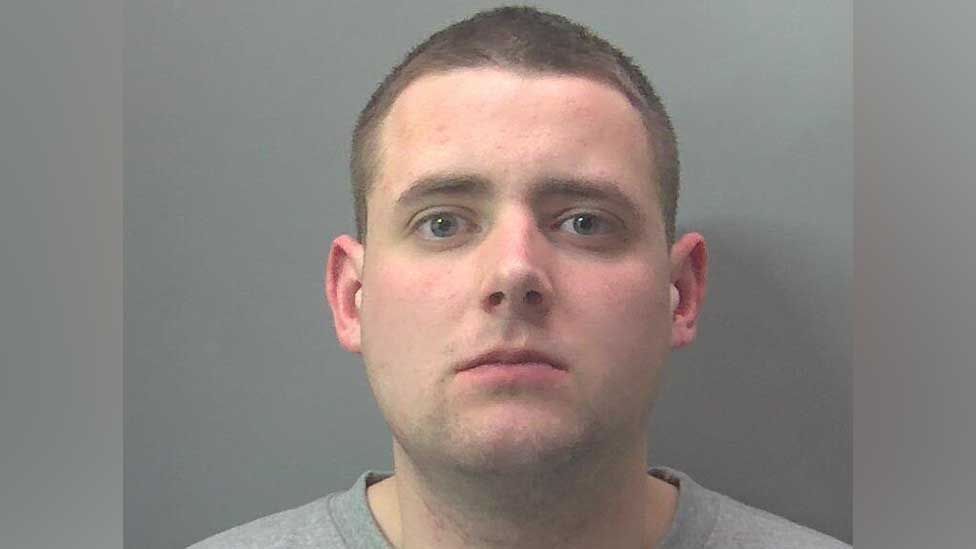 Image source, Cambridgeshire Police