The Ghana Investment Promotion Centre (GIPC) has entreated both foreign and local investors to take advantage of the agro-processing, tourism, property and real estate sectors in the Central region.
Investments in these sectors, the Head of Monitoring and Evaluation at GIPC, Dr George Asafo-Agyei, said will help expand the market base of the region.
This, he said will also create jobs in the central region to help curb the teeming unemployed youth in the country.
“Investors must take advantage of the agro-processing sector, tourism, property and real estate and Information and Communications Technology (ICT) opportunities in the region to even expand their market and provide job avenues in the region,” Dr Asafo-Agyei stated.
Dr Asafo-Agyei further advised businesses to register their companies with GIPC for them to also take advantage of the untapped sectors in the country.
“There is not a single settlement in Donetsk region that has not been shelled,” Pavlo Kyrylenko said on Ukrainian television. “The entire territory is under fire. The enemy is destroying civilian infrastructure.”
He added that “the front is approaching the city of Bakhmut, where there were systematic artillery fire and air strikes” on Monday.
Bakhmut is a key objective of Russian forces as a gateway to the remainder of the region still in Ukrainian hands. Russian forces are estimated to be about 6 kilometers (3.7 miles) southeast of the town.
In its latest assessment Monday, the US-based Institute for the Study of War said Russian forces “made marginal gains south of Bakhmut but are unlikely to be able to effectively leverage these advances to take full control of Bakhmut itself.”
“Enemy units replenish stocks of ammunition and fuel,” the military’s General Staff said.
Russian assaults in the area around the town of Spirne had been repelled, it added. Similarly, the General Staff said a Russian effort to break through north of Sloviansk had been rebuffed in the Sviati Hory area.
Finance Minister, Ken Ofori-Atta, has disclosed government plans to use the windfall from the country’s petroleum sector to fill revenue gaps and improve revenue generation.
According to him, the move forms part of broader fiscal measures government is adopting to help sustain the economy while holding engagements with the International Monetary Fund for an economic support programme.
Delivering the 2022 Mid-Year Budget Review in Parliament on July 25, the finance minister said, “Mr. Speaker, we have seen some major shifts in our budget assumptions compared to November, 2021, when we presented the Budget. These changes have led to reduced revenues, increased interest payments and changes in interest rates and exchange rates. However, we are committed to staying within the appropriation for 2022.â€
“In spite of the underperforming revenues and strong external headwinds, we are not seeking additional funds in this Mid-Year Review. We are determined to efficiently use the windfall from the upstream Petroleum Sector to make-up for our revenue shortfall and aggressively improve our revenues even as we rationalize expenditures,†he added.
Meanwhile, the finance minister during the presentation told lawmakers government will not be seeking additional funds in the 2022 budget.
He explained government was committed to staying within its appropriation for the 2022 financial year.
Russian state news agency TASS reported that the fire broke out at an oil depot in the Budennovsky district. It said the plant had come under fire from Ukraine.
The Ukrainian military rarely comments on attacks against infrastructure in Donetsk, but several fuel and munitions depots in DPR-held territory have come under attack this month.
A TASS reporter in Donetsk said the blaze could be seen in several areas of the city, “with the flames reaching a couple of dozen meters in height.”
TASS said tanks of fuel and lubricants were burning. Video early Tuesday showed that smoke was still rising from the location, several hours after the fire began.
A report released by World Investment has shown that Ghana is the second country in West Africa with more foreign direct investments.
It noted that the Foreign Direct Investment (FDI) flows in Ghana increased by 39 percent to $2.6 billion in 2021.
The rise in the country’s FDI flows was attributed to major projects in the extractive sector.
“The increase in FDI flows reflects the findings of the Deloitte 2022 Africa Investment Attractiveness Index, which placed Ghana as the second most appealing destination for investments in Africa based on the comments of nearly 200 CEOs,” the report stated.
Reacting to this, Chief Executive Officer of Ghana Investment Promotion Centre (GIPC), Yofi Grant alluded that Ghana has a great global reputation.
He indicated that the country also has a conducive environment for businesses to thrive.
“Ghana has a great global reputation, and as the host of the African Continental Free Trade Area, it provides considerable opportunities for businesses to trade in the enormous African market,” he said.
“Furthermore, with our democratic stability and smart business policies in place, such as the 10-Point Industrialization Agenda, Ghana most appeals to investors seeking stability and vibrancy in order to prosper and grow their firms. So, despite the current economic difficulties, investors continue to see Ghana as a desirable destination to invest,†Yofi Grant added.
In recent years, the government through the GIPC has made FDI attraction a priority by improving its investment attraction strategy to a more proactive one.
It has also spurred private sector investment through the Ghana Covid 19 Alleviation and Revitalization of Enterprises (CARES) programme – a 100 billion Ghana Cedis economic response programme, aimed at supporting the private sector in targeted sectors, to accelerate growth and stabilize the Ghanaian economy.
Joining her Czech counterpart, Jan Lipavsky, in Prague for a joint press conference, Annalena Baerbock said: “We are underlining with this that we will not let ourselves be divided, where we as EU states could also act against each other because gas is so scarce, but that we are standing together and that is the most important signal to the Russian President.”
“In the long term, the path is clear: Europe will gain sovereignty through the expansion of renewable energies,” she said.
She added that, with every wind turbine and solar plant Europe erects, they will gain “freedom” and “become stronger together.”
“This also means that we need to rapidly expand the infrastructure in Europe with which we transport energy,” she said.
The challenge for all European countries is to maintain the security of supply, said Baerbock, noting that gas, not electricity, is the main source of heat supply in Germany.
EU ministers have reached a “political agreement” on gas demand reduction, according to the Czech Presidency of the Council of the European Union.
The Czech Presidency announced the agreement in a tweet on Tuesday, saying “this was not a Mission Impossible.”
EU energy ministers met in Brussels on Tuesday to discuss energy supply amid a reduction in flows of Russian gas.
Some background: Last week, the European Commission laid out its “Save Gas for a Safe Winter” plan which asked the 27 member states to reduce their gas demand by 15% between August and March next year. This reduction is based on countries’ average gas consumption during the same months over the past five years.
Gas supplies to the European Union are set to take a further hit after Russian energy giant Gazprom announced it would again reduce supply.
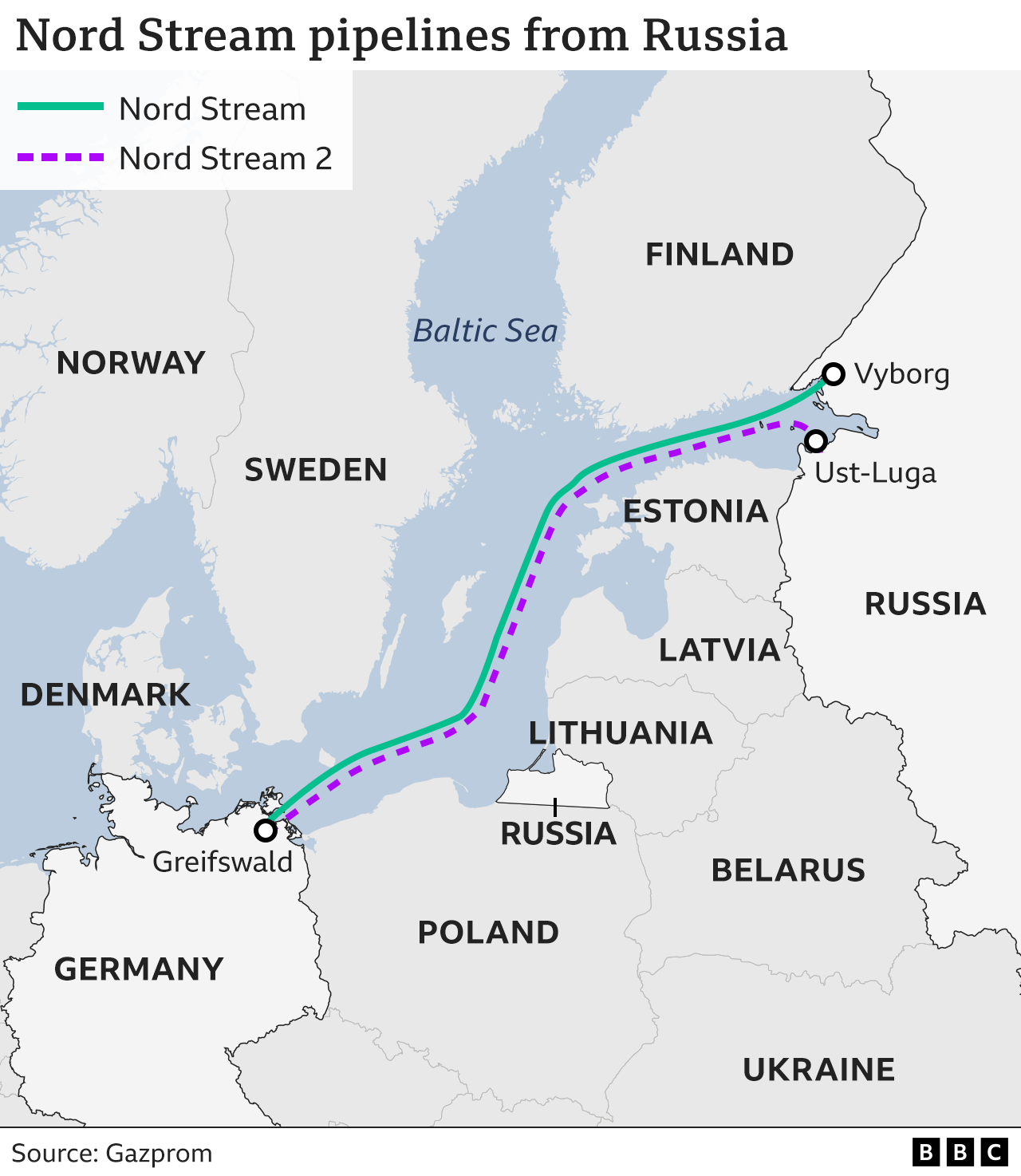
The firm said the flow of gas through its Nord Stream 1 pipeline, which runs from Russia to Germany, would be cut to about 20% of capacity for technical reasons.
Russia supplied 40% of the EU’s gas in 2021 and Europe accuses Moscow of using energy supply as a weapon.
Fighting on the ground in Ukraine continues to rage. Russia kept up shelling across the frontline in the eastern Donetsk region while the cities of Avdiivka and Kramatorsk faced renewed attacks.
Kyiv says it had destroyed 50 Russian ammunition depots with US Himars rocket launch systems since receiving them last month. Moscow says took out a Himars ammunition depot in the western Khmelnytskyi region.
Ukraine also said its forces had moved within tactical striking distance of targets in the Kherson region where a counter-offensive was being organised.
UK to host next year’s Eurovision
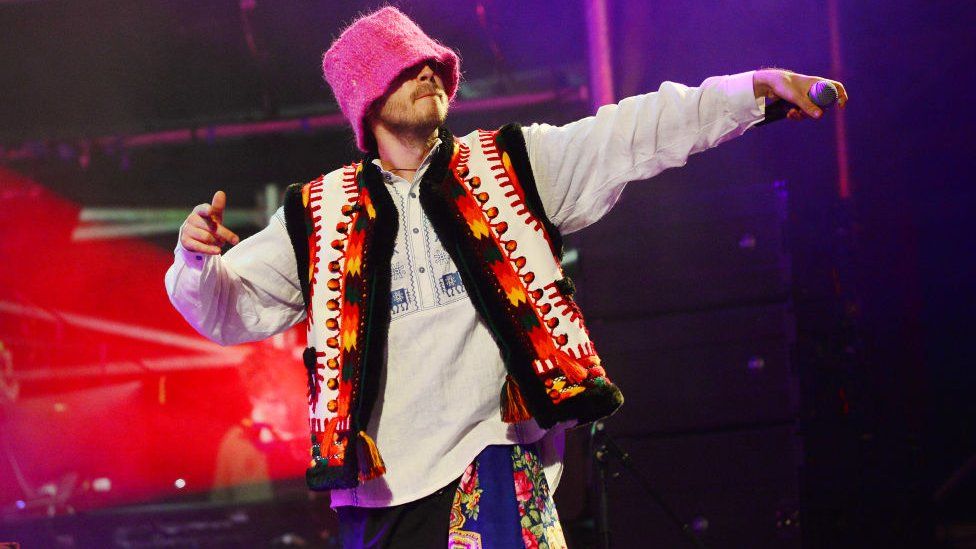
Image source, Getty ImagesImage caption, Kalush Orchestra were Ukraine’s 2022 entrant, winning the competition and beating out the UK’s Sam Ryder
Ukraine will not host the 2023 Eurovision Song Contest after show organisers decided that it could not be held in the country due to the ongoing war with Russia.
Ukraine’s Kalush Orchestra won this year’s contest, which would normally give the country the right to host next year’s event. But instead it will be held in the UK, whose entrant – Sam Ryder – came second.
The UK government said it will ensure the competition “reflects Ukraine’s recent Eurovision victory and Ukrainian creativity”.
Grain exports could restart ‘within days’
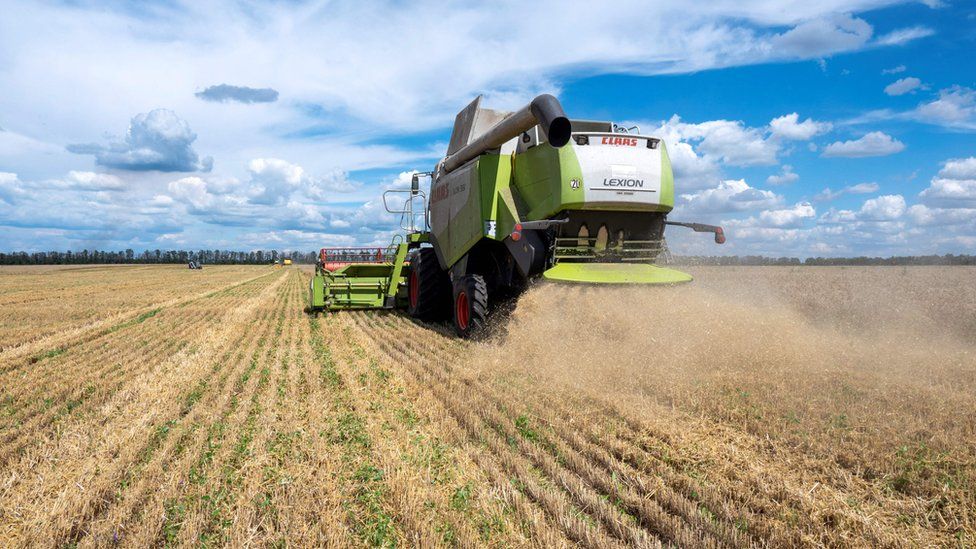
Image source, AFPImage caption, Farmers harvesting a wheat field in Kharkiv region
The first vessels laden with grain could be leaving Ukrainian-controlled ports within days, according to a Ukrainian government official.
“If the sides guarantee security, the agreement will work. If they do not, it will not work,” Infrastructure Minister Oleksandr Kubrakov said.
The shipments are possible thanks to a landmark UN-brokered deal signed on Friday. However it was feared the agreement would be scrapped after Russian missiles struck Ukraine’s main port of Odesa on Saturday.
As many as 20 million tonnes of grain are trapped in ports, unable to leave because of Russian naval forces.
A Ghanaian-American by the name of Kenneth Anim, aged 38, has been arrested and charged with matters relating to money laundering.
According to indictments in the Southern District of Texas of the US Attorney General’s office dated July 12, 2022, noted that the accused was arrested “following the return of an indictment in a nationwide romance fraud scheme.”
Facts of the case per the indictment
From 2014 to 2019, Anim and his co-conspirator created individual sham businesses, according to the charges. They allegedly operated as money mules in relation to various mail and wire fraud schemes including internet fraud and romance scams.
The indictment further alleges Anim also opened and maintained bank accounts to collect proceeds from the schemes and to send the money to himself, his co-conspirators and overseas.
Arrest and possible jail time
“If convicted, Anim faces up to 20 years in federal prison and a possible $500,000 maximum fine,” the indictment stated.
Kenneth Anim, was taken into custody on the day the indictment was issued. He is said to have previously resided in the Houston and Richmond areas.
Investigations leading to his arrest were conducted by the Federal Bureau of Investigations, FBI. Assistant U.S. Attorneys Belinda Beek and Grace Murphy of Houston FBI are prosecuting the case.
#FBIHouston arrested dual citizen Kenneth Anim for acting as a money mule and laundering using sham businesses from 2014 to 2019 in a nationwide romance scam. If convicted, he faces up to 20 years in federal prison & a $500k maximum fine. #ICYMIhttps://t.co/UtOesEQ5cVpic.twitter.com/aaVg1sjJ2p
An indictment is a formal accusation of criminal conduct, not evidence. A defendant is presumed innocent unless convicted through due process of law.
This is the latest in a string of recent cases where Ghanaians living in the United States have been arrested and charged with similar crimes either as main suspects or as conspirators.
Host of Newsfile, Samson Lardy Anyenini has admitted that he could have done more to question the propriety of an allegation made against President Nana Addo Dankwa Akufo-Addo on his show last Saturday, July 23, 2022.
The allegation related to a claim by lawyer Martin Kpebu, a panelist, who suggested that the President was part of a criminal syndicate at the Jubilee House slamming his inertia in the fight against corruption.
A disclaimer issued by Anyenini and his employers said after a review of the show, “The sincere view is that the expression suggesting a direct involvement of the President in crime relative to some scandals was regrettable.”
It continued: “Samson Lardy Anyenini is upfront that, on this occasion, he could have done more than stopping at asking Mr. Martin Kpebu (a panellist) if he thought the comment was “warrantedâ€, “justified†or “fair†for reasons he canvassed including that the President is not the police to prosecute those indicted in the NDA contract-price forgery scandal and anti-corruption laws and policies made under his regime.”
Mr. Kpebu has also issued a statement retracting and apologising to the President for the comments.
“I do, hereby, retract and apologise for the expression purporting to connect the President of the Republic to crime,” his statement read in parts.
Disclaimer: Matin Kpebu’s comment
Management, together with the host of Newsfile, has reviewed Saturday, the 23rd July, 2022 edition which discussed the UNODC-funded CHRAJ/GSS survey report on actual corruption by public officials.
The sincere view is that the expression suggesting a direct involvement of the President in crime relative to some scandals was regrettable.
Samson Lardy Anyenini is upfront that, on this occasion, he could have done more than stopping at asking Mr. Martin Kpebu (a panellist) if he thought the comment was “warrantedâ€, “justified†or “fair†for reasons he canvassed including that the President is not the police to prosecute those indicted in the NDA contract-price forgery scandal and anti-corruption laws and policies made under his regime.
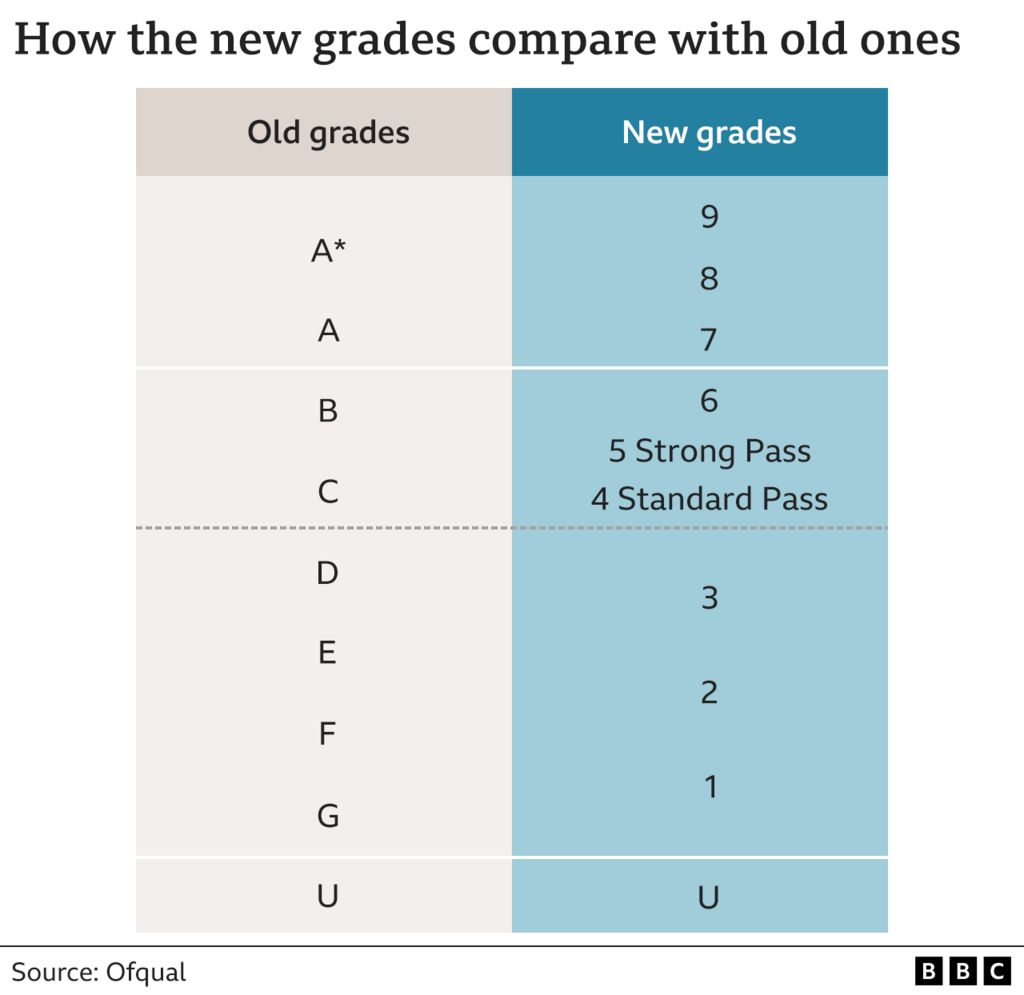
In recognition of the serious disruption pupils faced during the pandemic, this year’s exams will be graded more generously.
When is results day?
Pupils will get their GCSE results from 08:00 BST on Thursday, 25 August in England, Wales and Northern Ireland. Some BTec Firsts, Technical and Tech Awards students will also receive results.
In Scotland, students get their National 4 and 5 results from 08:00 BST on Tuesday, 9 August.
How do I get my results?
You should be able to collect your results in person from your school, so check what arrangements are in place.
If you can’t go, ask your school in advance if you can access them online, or if someone else can pick them up for you.
In Scotland, your certificate will come in the post, but if you signed up to MySQA, you’ll get your results by text or email.
How have grades been decided this year?
The year’s final grades are based on exams.
Students may need fewer marks to reach a particular grade, or if they are very close to the number of marks needed for a higher mark, they may be looked at more favourably than in previous years.
Some parts of the curriculum were cut, and students were also given information about areas to revise.
However, exam boards were criticised for mistakes on some papers, where pupils were tested on topics they had been told wouldn’t come up.
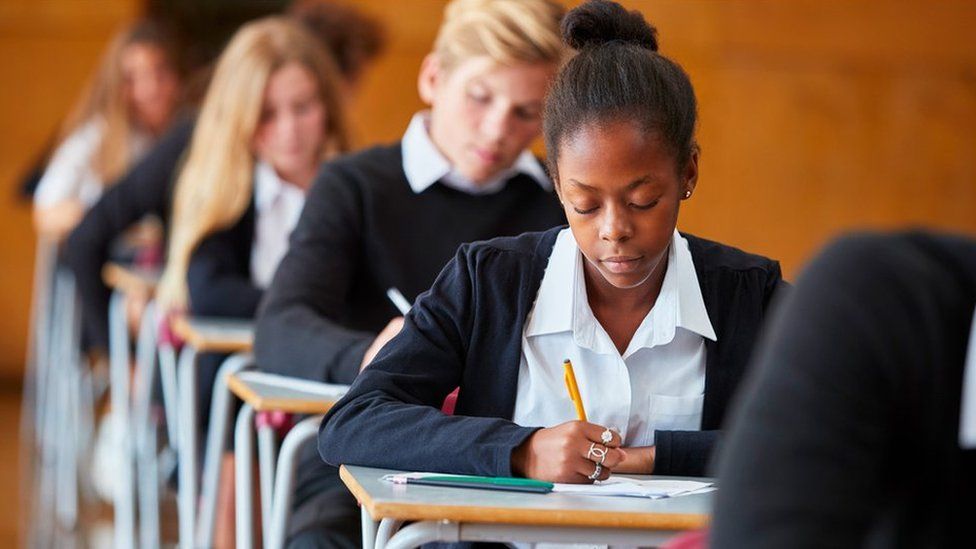
Image source, Getty Images
It’s expected that the overall results will be lower than in the last two years, when grades were based entirely on teacher assessment. But they are predicted to be higher than in 2019, the last year of exams before the pandemic.
Scotland had record results in 2020, based on teacher assessments, but saw a slight dip in 2021 when the Scottish Qualification Authority (SQA) marked student work which had been done in school.
The SQA is also taking a more generous approach to grading this year.
What grade will I get?
Wales kept its letter-based grading structure, while Northern Ireland opted for a mixture of letters and numbers.
In Scotland, the National 4 qualification is based on continuous assessment, with each unit that makes up the course marked as pass or fail. National 5s are graded A-D or “no award”.
What about BTecs?
BTecs – or Business and Technology Education Council qualifications – are largely assessed through practical work done during the course, with exams making up a smaller proportion of the final mark.
Image source, Getty Images
Grade boundaries for each unit taken in school or college have been looked at, as well as those for the final exams.
Students are normally awarded a pass, merit or distinction.
What if I’m not happy with my results?
If you’re unhappy with your GCSE or BTec grade, you should first talk to your school or college.
In England, Wales and Northern Ireland, your school will contact the exam board on your behalf and ask for your marks to be reviewed.
If you still think you’ve been unfairly graded after a review, you can ask your school or college to appeal. The exam board will look at your work again, and correct your mark if necessary.
BTec students can also appeal directly to their exam board.
If you’re still not satisfied, you can request a review from the exams regulator Ofqual.
In Scotland, the process is slightly different. You normally receive a grade estimate which is submitted to the exam board.
If your final grade is lower that this, you can appeal directly to the SQA, but should speak to your school or college first. If your appeal is accepted, the exam board will look at the marks you received.
Former Speaker of Parliament, Professor Aaron Mike Ocquaye, has called for a ban on the importation of some selected products including foreign juice, chicken and other agric products.
According to him, the country ought to restructure its economy to be self-reliant in terms of feeding itself.
Speaking at the launch of the 60th anniversary celebration of the Department Of Political Science at the University of Ghana on Friday, July 22, Professor Mike Ocquaye wondered if citizens will be left to perish if something bigger than Covid-19 and the ongoing Russia-Ukraine war, which has disrupted global supply chains, occurs.
He asked that companies that are into agriculture be given special attention in order to curtail post-harvest losses.
“We should look at our agro-based industries to process, store and distribute food, juices etc. How can the mangoes [be] rotten in Mangoase, Dodowa etc and the other fruits in other parts of Ghana rot whiles we languish? We need to industrialize.
“Produce more by agric and preserve them. Ladies and Gentlemen, this brings us to the WTO [World Trade Organisation] arrangement which allows the free dumping of finished products in the developing nation. No industrialized nation in the world today by its history grew to that status without isolating itself.
“Therefore, by way of serious political economy studies, we should have to close our gates and lock out all these products that are dumped upon us as against the directives of the WTO. I emphasize that the right to protect infant industries is a global human right. Foreign juices, foreign chicken and other agric products should be banned to save our nations here in Africa,†Professor Mike Ocquaye stated.
A chartered economist Mr. Prince Obiri Yeboah, has asked the government to stop using the COVID-19 pandemic, and the Russian-Ukraine war as an excuse for mismanaging the economy.
The economist explained that although the COVID-19 and Russian-Ukraine war could have had an impact on the current state of the economy, the major cause of our woes has been necessitated by the mismanagement and, financial indiscipline, and incompetence on the part of the government.
He said, over the last three years, Ghana has faced challenges, including the outbreak and the Russian-Ukraine war, coupled with financial indiscipline, which has led us to the International Monetary Fund for a bailout.
He said when people are faced with challenges, they seek excuses and those to blame. But when you evaluate our situation, you will discover that there was fiscal indiscipline from the President to his appointees.
For him, the COVID-19 outbreak affected several countries but Ghana did not have any major negative impact on the economy as people make it seem.
â€The leaders we voted for have not been financially disciplined. Governance is about revenue and expenditure, and when you overspend or spend more than what you generated, you will face an economic crisis and borrow more. That is what we find ourselves today. We have overborrowed and have no other option than to go to the IMF to seek a bailout.â€
Furigay was mayor of Lamitan, a city in the Philippines’ restive south. But police pointed to the suspect’s “long history” of disputes with Furigay.
Her assistant and one of the university’s security guards were also killed during the attack.
Police have said Furigay’s daughter was in a stable condition in hospital.
Alexander Gesmundo, chief justice of the Philippines, was on his way to speak at the ceremony moments before the shooting.
In a statement, Philippines President Ferdinand Marcos Jr said police would “thoroughly and swiftly investigate these killings and bring all involved to justice”.
Finance Minister, Ken Ofori-Atta, has assured Ghanaians that government will soon stabilize the local economy.
According to him, the government is committed to being disciplined and working hard towards the recovery of the economy from its current woes.
Making this known in the 2022 mid-year budget review presentation in parliament on Monday, July 26, 2022, Ken Ofori-Atta said, “With discipline, dedication and hard work, we will overcome the current challenges that confront our nation.
“We are convinced we can do this again. We worked closely with Ghanaians to turn around the economic situation in 2017,†he added.
The Finance Minister indicated that government will manage the windfall from the petroleum sector to make up for the country’s revenue shortfalls.
He added that the government was committed to staying within its appropriation for the 2022 financial year.
Meanwhile, the government is seeking a financial bailout from the International Monetary Fund (IMF).
The IMF programme, when successful, will help the country restore its macroeconomic stability, as well as, safeguard debt sustainability.
IMF only a short term measure, Ghana needs a major structural shift – Ofori-Atta
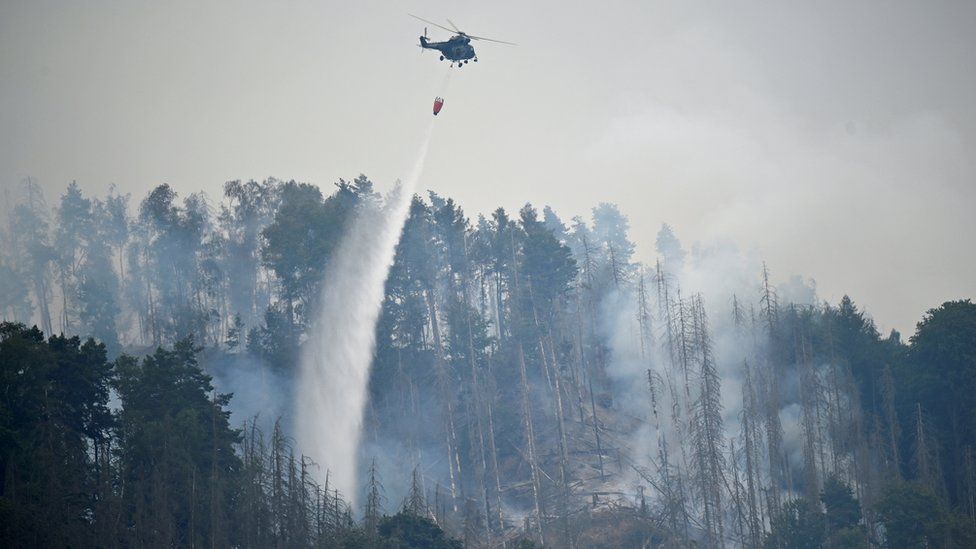
Homes have been destroyed and the smell of smoke has reached the capital Prague 100km (60 miles) to the south.
Smoke has also been detected in the Pardubice area, 180km to the south-east.
Hundreds of Czech firefighters were deployed as the fire destroyed areas of forest and homes in the village of Mezna. The fire was also threatening the nearby village of Hrensko, close to the German border, and dozens of people were forced to flee their homes.
The fire service was inundated with calls about the drift of smoke and appealed to Czechs not to contact them unless they saw flames. Human carelessness has been blamed for the fire, the BBC’s Rob Cameron in Prague reports.
Image source, Getty ImagesImage caption, The national park is a major tourist attraction along the border with Germany
Czech helicopters could be seen filling buckets from the River Elbe before heading towards the fire. Firefighters from Slovakia, Poland and Italy, as well as Germany have responded to Czech calls for aid under the EU’s civil protection mechanism.
While there have been no reports of injuries from the Czech fire, hundreds of people have fled their homes since Sunday. Prime Minister Petr Fiala visited the scene of the fire on Tuesday.
The Bohemian Switzerland national park is a popular tourist attraction, and its naturally formed sandstone arch – the largest in Europe – has featured in a number of films, including The Chronicles of Narnia.
Authorities in northern Greece were continuing to battle a devastating blaze in Dadia national park in Evros for a sixth day
In Spain three wildfires in the Castile and León region stabilised and large fires that had ravaged Galicia were reported under control
A blaze in northern Tenerife continued but had stopped spreading while several smaller fires continued across Spain.
That helped to spark the kind of blazes more commonly seen in the countryside.
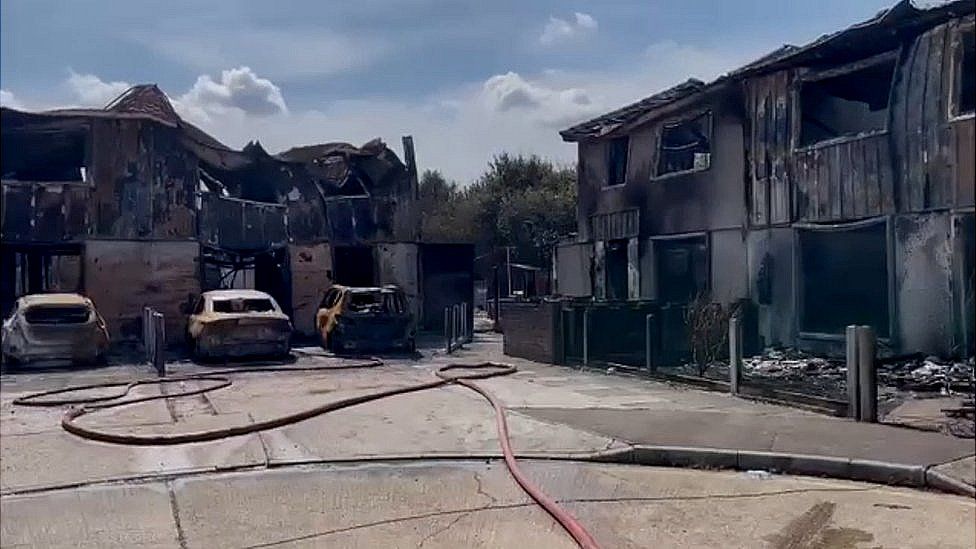
More than 40 houses and shops were destroyed after a number of grass fires spread to nearby buildings.
The Met Office estimates that climate change makes the extreme heat seen last week in the UK 10 times more likely. Extreme heat and dry conditions are major factors contributing to wildfires.
According to the National Fire Chiefs Council (NFCC) there have been almost 500 wildfires so far this year alone in England and Wales, compared with 237 last year.
NFCC lead wildfire tactical advisor David Swallow, who is also group commander for Hereford and Worcester Fire Service, said: “Everything is bone-dry and services need to recognise the risk they’ve now got. If they don’t, then they’re naïve.
“There are very urban services that think that wildfires are low down on the risk list. I understand the need to prioritise resources, but there needs to be a review.”
Image caption, A fire in Dagenham destroyed several homes and vehicles after spreading from nearby grassland
The wildfire group that Mr Swallow leads draws its members – and expertise – from firefighters in predominantly rural areas more susceptible to such blazes, like Northumberland, South Wales, the Peak District, and Wiltshire.
Mr Swallow believes that every fire service in the UK should have wildfire training. That way, forces could learn valuable tactics from firefighters more familiar with tackling blazes on grasslands, on moors and in woods.
He said that his wildfire group had for some time been preparing for the increased risk of wildfires from climate change but that the risk was now “immediate”.
But, last year, a report for the government’s Third UK Climate Change Risk Assessment found that two out of eight fire services in the south east of England – identified as a key area at growing threat of extreme temperatures – made no reference to wildfires in their Integrated Risk Management Plans (IRMP).
IRMPs are statutory strategy documents which outline every service’s priorities and determine how resources will be allocated.
Today, London Fire Brigade and Royal Berkshire Fire and Rescue Service have no reference to wildfires in their IRMPs, while Oxfordshire and Buckinghamshire services only have passing references.
All the fire services said they followed national guidelines and worked to raise awareness of the risk of wildfires locally.
A spokesman for Royal Berkshire Fire and Rescue Service said: “Moving forward, we will include more specific wildfire risk analysis as part of our new Community Risk Management Plan for 2023-2027.”
A London Fire Brigade spokesperson said they were “constantly looking at developing our equipment and procedures to meet all the new challenges that we face”.
She added: “We will learn lessons from the recent intense grass fires, evaluate our response and put in place any additional training that will help to keep Londoners and our firefighters safe.”
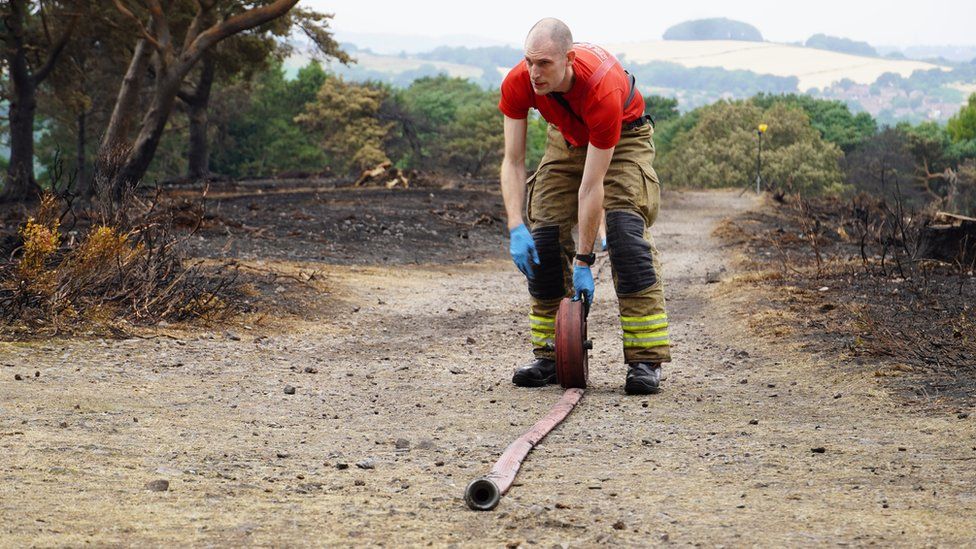
Image source, BBC/Claire MarshallImage caption, Scorched earth must be dampened down – sometimes for days – to make sure it doesn’t reignite
South Wales Fire Service is seen as leading the way in its approach to wildfires.
Its station manager, Craig Hope, is another of the UK’s wildfire tactical advisers. His force keeps specialised lightweight kit, off-road vehicles, a controlled burns team and a helicopter on standby.
However, 5,500 hectares of the Brecon Beacons National Park have already burned in wildfires this year.
“It’s horrific, but we have predicted it,” he said. “I just don’t think anyone would have predicted that it would happen so soon.”
He added that years have been spent “making little steps” and that now is the time for “big strides, because the climate is not on our side”.
“The fires we are seeing now are what they were getting in Spain in the 80s and 90s.”
He urges authorities to invest more in developing a UK-wide “national plan for wildfire”.
One solution Mr Hope proposes is that, rather than each force individually spending money on improving its response, there should be funding for a deployable central specialised unit.
Mr Hope added: “The solutions are there. They are complex, but we all need to work together.
“By doing nothing, we risk losing everything.”
The BBC went to the Malvern Hills to see the kind of expertise being developed by rural fire crews working alongside landowners.
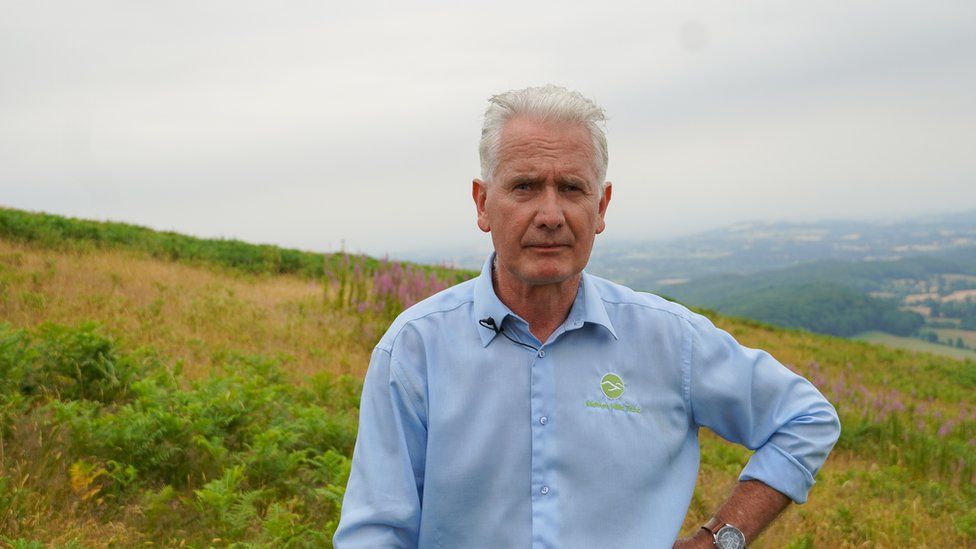
Duncan Bridges, chief executive for the Malvern Hills Trust, works with the Hereford and Worcester Fire Service to map where the local access points are, and to understand how wind and fire are likely to travel through a landscape.
Image source, BBC/Claire MarshallImage caption, The chief executive of the Malvern Hills Trust says he is strengthening plans to deal with wildfires
As part of the trust’s wildlife management, the keepers also help to reduce the amount of combustible vegetation, by rolling back bracken and allowing livestock to graze the grass.
Mr Bridges says climate change means the prevention of wildfires is going to become “increasingly more critical”.
“There doesn’t seem to be any systematic approach across the whole country when it comes to dealing with landowners and land managers,” he says. “When dealing with fire prevention and fire safety, it’s more a case of each one doing it their own way.”
Defra has included wildfire in its national climate adaptation plan, and the Home Office pointed out a plan for England it had published last December outlined plans for “close co-ordination… to provide an effective response to wildfire incidents.”
It added: “The government is committed to ensuring fire services have the resources they need to keep us safe, including from wildfires, and, overall, fire and rescue authorities will receive £2.5bn in 2022/23.”
Harry Styles, Sam Fender and Little Simz are among the artists competing for this year’s Mercury Prize, arguably British music’s most prestigious award.
Recognising the best British or Irish album of the last 12 months, the Mercury has previously gone to acts like Pulp, Skepta and PJ Harvey.
A shimmering, fleet-footed pop record, it’s unlikely to win (no pop artist has taken the prize since M People in 1994) but marks another step in the star’s ascension to Britain’s pop elite.
Sam Fender’s Seventeen Going Under is another chart-topper, full of sax-soaked rock epics that tackle life, death, family trauma and the social deprivation in England’s North East.
Image source, EPAImage caption, Little Simz picks up her second nomination at this year’s prize
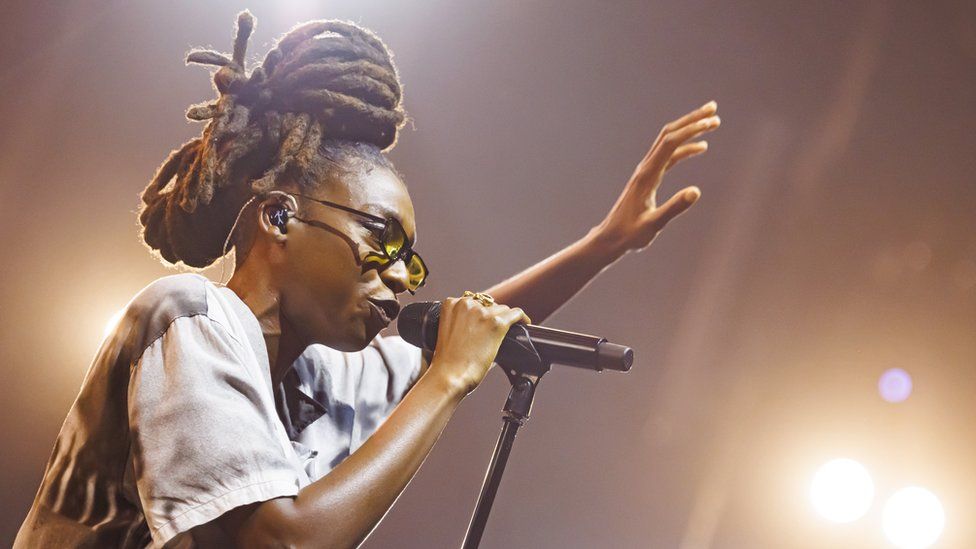
London rapper Little Simz is one of two returning nominees, having previously been shortlisted for her 2019 album Grey Area.
This year, she’s recognised for Sometimes I Might Be Introvert, an orchestral hip-hop album in which she reckons with her public and personal demons, to stirring effect.
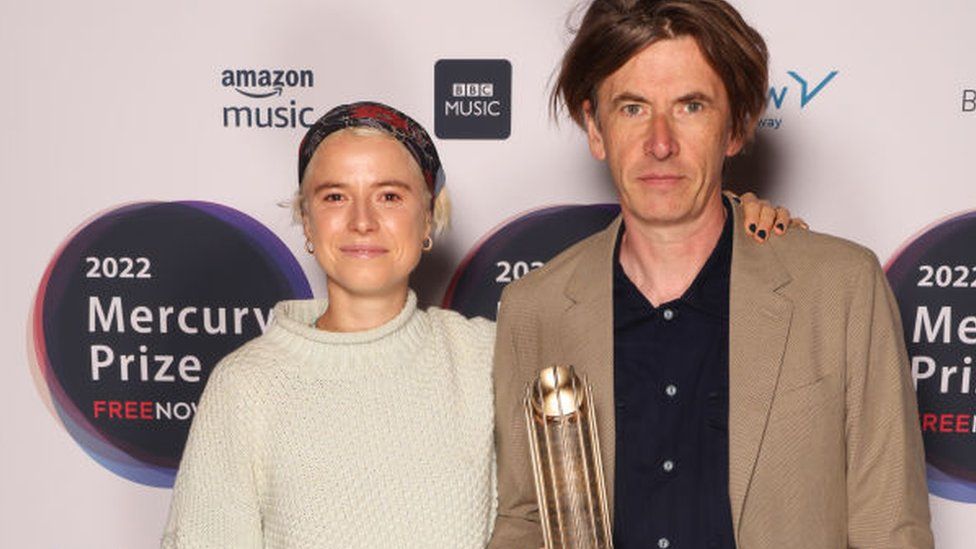
Guitarist Bernard Butler, who won the second ever Mercury Prize with Suede in 1993, also makes a return, this time for his collaboration with actress Jessie Buckley, better known for her roles in Chernobyl, Wild Rose and The Lost Daughter (for which she received an Oscar nomination).
Image source, Getty ImagesImage caption, Jessie Buckley and Bernard Butler attended the Mercury Prize shortlist announcement on Tuesday, where all nominees receive trophies
The shortlist is completed by Leeds-based post-punk act Yard Act, south London soul singer Joy Crookes and rapper Kojey Radical.
Albums that missed out on a spot included Adele’s chart blockbuster 30, Charli XCX’s pop masterclass Crash, Dave’s We’re All In This Together and Florence and the Machine’s critically-acclaimed Dance Fever.
“‘Getting down to 12 albums this year was not easy,” said the judges in a statement, “simply because there were so many remarkable ones to choose from.
“Now comes the really hard part… choosing only one overall winner.”
That winner will be chosen on 8 September, the night of the Mercury Prize ceremony.
Until then, here’s all you need to know about this year’s nominees.
The Bureau of Public Safety (BPS) has disclosed that approximately 2 persons in Ghana died accidentally on a daily basis, in the first half of 2022.
This was contained in the Ghana Public Safety and Crime Report for the period January-June 2022. The Bureau encapsulated in the report that these death were caused by unintentional means.
“Preventable deaths (also referred to as accidental/unintentional deaths) recorded in the first half of Y2022 increased by 22% over the same period in Y2021,” with a minimum of two persons dying each day.
The document cited transportation-related incidents (mainly road traffic crashes) as the leading cause of accidental deaths in the first half of 2022; and deaths increased by 19% over the same period in 2021.
The Ghana Public Safety and Crime Report (BPS WATCH) broadly categorizes public safety issues into ten categories (index) namely Crime, Violent Crime, Fires/Industrial (Workplace) related incidents, Transportation related incidents, Civil Disturbances, Police Officer Casualties, Police Brutalities, Police Arrests, etc.
Other details in the report
The report further indicated that total public safety incidents reported decreased by 0.2% over the same period in Y2021, being a total of 664 events for Y2021 as against 663 events for Y2022.
Also, total reported deaths monitored scaled up by 9%, from 501 deaths in 2021 to 546 deaths in Y2022.
In addition, total reported injuries monitored for the period in 2022 increased by over 35% compared to the same period in Y2021.
Transportation-related events
Reported transportation-related events, dominated by road crashes, increased by 19% with a 25% increase in fatalities (deaths) compared to the same period in Y2021.
About the Bureau of Public Safety
The Bureau of Public Safety (BPS) is a registered entity under the laws of Ghana as a Non-Profit Organization with interest in matters of Public Safety and Security, Health and Environment. Founded in 2009 and incorporated in January 2010, the BPS has considerable local and international repute.
Officers were called to Helliers Road in Chard, Somerset, at about 23:30 BST on 16 July.
The injured child was taken to hospital and died on 23 July, police said.
A 35-year-old man was arrested on suspicion of causing grievous bodily harm with intent and was released on bail. A 24-year-old woman was arrested then released under investigation.
Det Ch Insp Simon Dewfall from Avon and Somerset Police said: “We’re carrying out a full and thorough investigation into this tragic incident, which will seek to determine how and why this baby has suffered these injuries.
“Specialist liaison officers are supporting the baby’s family during this incredibly difficult time.
“While we’re treating this as an isolated incident, we know this will be of significant concern to the local community.”
The pay rises are below the 9.4% rate of inflation.
The worker, who wished to remain anonymous, told BBC Wales the increase was “a step in the right direction” but added: “I don’t know how much help that will be considering how much inflation is going up.
“I can’t really get started in life on my current wages. I feel very stuck.”
‘Things are difficult for many of us’
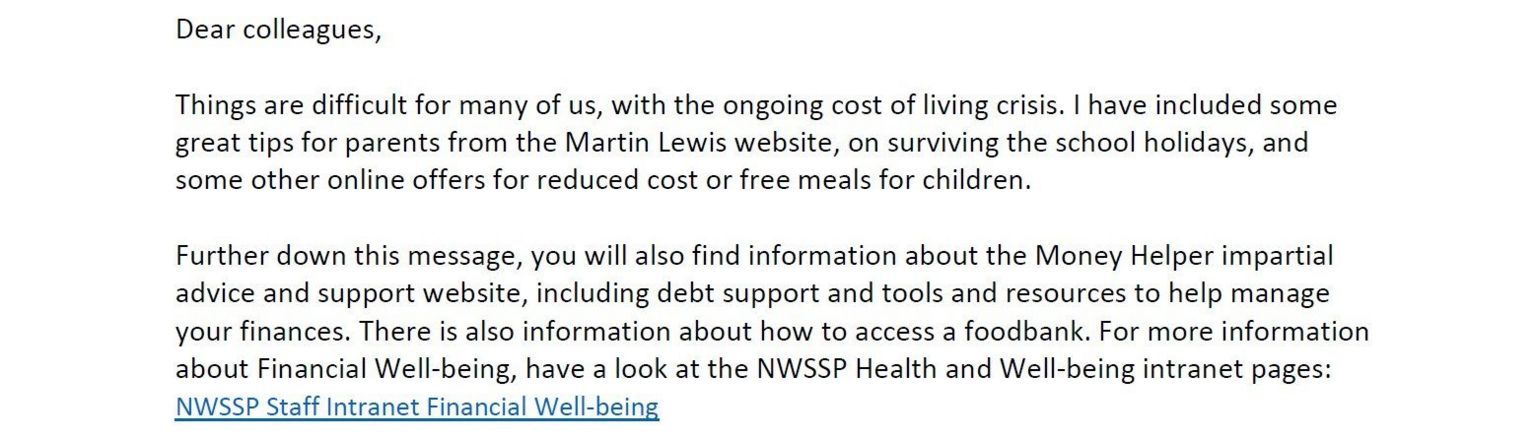
The email, sent to NHS Wales Shared Services Partnership (NWSSP) staff, was entitled “Financial well-being support” and said: “Things are difficult for many of us, with the ongoing cost of living crisis.”
Alongside money saving tips for parents on “surviving the school holidays”, and information about the Money Helper advice website, it linked to articles on how to access a food bank, and a service providing information on where to find them.
Image caption, An email to staff at NWSSP provided advice on how to access a food bank
The NWSSP provides a wide range of administrative services to health boards across Wales including procurement, audit and employment support.
The staff member said that after putting in so much extra work during the pandemic the email felt “very hollow – like what we were doing was not appreciated enough by governing bodies”.
“I was sad that people were struggling so much that we were left with no other alternative option other than to go to the foodbanks.
“I was a bit incredulous as well that people would be left to suffer after giving so much of their time and energy to helping others.”
‘No surprise’
Hugh McDyer, head of health at the Unison Cymru Wales union, said it came as “no surprise”, and his organisation had seen claims of work poverty and members not being able to pay the bills “rise exponentially”.
He said while the advice was in “some ways well intentioned” the irony would not be lost on healthcare workers.
“It’s a sad day when our members are having to make choices to heat or eat or go to a food bank to ensure their family does eat,” he said.
He said the NHS pay review body’s recommendations – which were accepted by the Welsh government – were “simply not enough”.
An NWSSP spokesperson said: “A health and well-being themed internal communication was circulated to NWSSP staff on 13 July 2022, in response to a series of questions from our staff.”
The spokesperson said it included “a minor reference about how to access a foodbank”.
They added that the organisation recognised “the incredible hard work, commitment and dedication that our staff undertake on a day to day basis” and that the email “was not intended to cause offence but rather communicate the wide range of support on offer”.
Last week’s pay announcements by the Welsh government angered trade union.
The Royal College of Nurses (RCN) said it would ballot members on possible industrial action after most NHS workers in Wales were offered a below-inflation pay rise last week.
Two education unions are expected to ballot members for industrial action after teachers were also made a below-inflation pay offer.
‘Cost-of-living crisis’
Earlier this week the UK government agreed with the pay recommendations for the NHS in England.
The UK government said it planned to fund pay rises in England from existing budgets, which means the Welsh government would not receive extra funding and will have to find the cash from elsewhere.
Ms Morgan said that without additional funding from the UK government, “there are inevitably limits to how far we can go in Wales”.
In a previous response to the criticism, the UK government said the Welsh government has had more funding than at any time since devolution began.
From September, monthly subscriptions will go up £1 to £8.99 and annual membership will rise from £79 to £95.
Amazon said the price rise, its first in the UK since 2014, was partly due to inflation, which is at a 40-year high.
Other services such as Netflix have also increased subscription prices, despite signs people are beginning to cut back on streaming services.
However, Amazon Prime offers more than just its streaming service. Prime also offer unlimited deliveries of products.
Amazon said the new pricing would begin from September, or at the customer’s next membership renewal date, adding that switching to an annual plan or cancellation of membership was also an option.
The move comes at a time when many households are looking to cut back on spending, with prices of goods rising at the fastest pace for 40 years.
Retail analyst Natalie Berg, who has written a book about how Amazon will shape the future of shopping, said the Prime price hike was “not really a surprise” after Amazon put up its prices for Prime in the US in February.
“It is an incredibly bold move to increase fees smack in the middle of the worst cost-of-living crisis in a generation, but Amazon is indispensable to many shoppers and they [the company] know that,” she told the BBC.
“Amazon has become so deeply embedded in our daily lives that so many people will accept the hike.”
Earlier this year, a BBC-commissioned survey found people struggling with soaring energy bills and fuel prices were cutting back on food and car journeys to save money. More than half (56%) the 4,011 people asked had bought fewer groceries, and the same proportion had skipped meals.
Recent research has suggested that more people are cancelling video streaming subscriptions, such as Netflix, Disney+ and Amazon Prime, due to the rising cost of living.
A total of 1.66 million services were dropped in the second quarter of 2022, market research firm Kantar said, with the under-24s age group most likely to cancel.
More than a third of cancellations were attributed to cutting costs, with the primary reason as “wanting to save money”.
Can I save money on my subscription?
It might only be an extra pound a month, but with everyone looking to tighten their budgets at the moment every pound counts, so here’s a few ideas on how to beat the rise.
Most people pay monthly for Amazon Prime, which means the price rise will kick in from mid-September. But if you’ve got the cash handy then you can save by paying for a full year’s subscription upfront before that point. That will lock you in at the lower price until 2023, and save you about £30.
It’s worth checking if you’re signed up to Prime even if you think you’re not, because it’s easy to click ‘join’ by mistake when making a purchase and get rolled into membership without realising.
Take a long hard look at your subscriptions. There’s no charge to cancel your monthly Prime membership and, after a lot of pressure, Amazon have made it easier to find and click through to that cancellation process. They should even refund you if you’ve only just paid for that month. If you decide to sign up again later you might even be able to get one month free when re-joining, which would save you that £8.99.
If you’ve a few different TV subscriptions, it’s worth thinking about rotating. Maybe your Christmas fix is on one provider but your summer love is with another – switch them so you’re only paying for one at a time. Binge-watch, then cancel your membership, and switch to another service rather than paying for each of them all year-round.
High competition in the streaming industry has led to competitive pricing and offers for customers.
But Netflix increased the price of its plans in 2021 and 2022. It recently announced it had lost almost a million subscribers between April and July, and it has now lost members for two quarters in a row.
However, Ms Berg added Amazon Prime could not be directly compared to Netflix and other streaming platforms due to brand’s main service being free shipping for products.
“Amazon has got a lot more stickiness because of the shopping element,” she said.
Amazon said it had invested billions of pounds in streaming content in recent years, with original series such as The Terminal List, as well as Clarkson’s Farm.
It has also moved into sports broadcasting, after successfully bidding for the rights to screen Tuesday night Champions League football matches from 2024.
Amazon already has the exclusive rights to 20 Premier League matches a season, including the entire round of matches on and around Boxing Day each year. And it has a five-year deal to exclusively broadcast the US Open tennis tournament in the UK.
Its report also called energy regulator Ofgem “incompetent”. Ofgem said it was working hard to reform the market.
Overhaul of policy
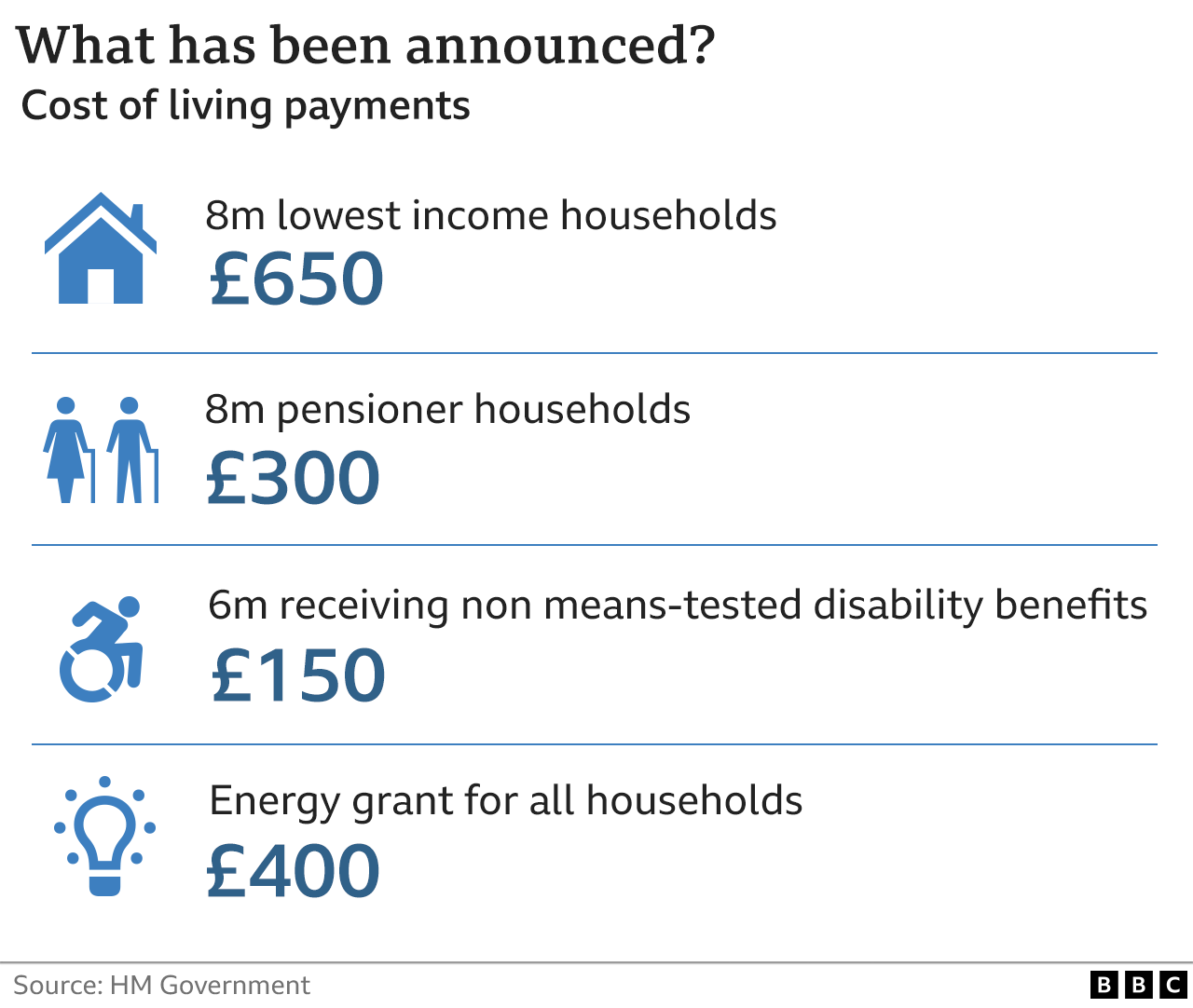
In recent days, millions of low-income households on benefits have been receiving the first £326 instalment of payments to assist with the rising cost of living.
Further payments will come later in the year, including extra support for pensioners and people with disabilities, and a £400 discount on everyone’s domestic energy bill.
Those payments were set when the typical energy bill was anticipated to rise by £800 – a prediction Ofgem says is now too low. Influential industry analyst Cornwall Insight has predicted a rise of more than £1,200 a year in October, pushing the typical bill to £3,244 a year from October, then £3,363 a year from January.
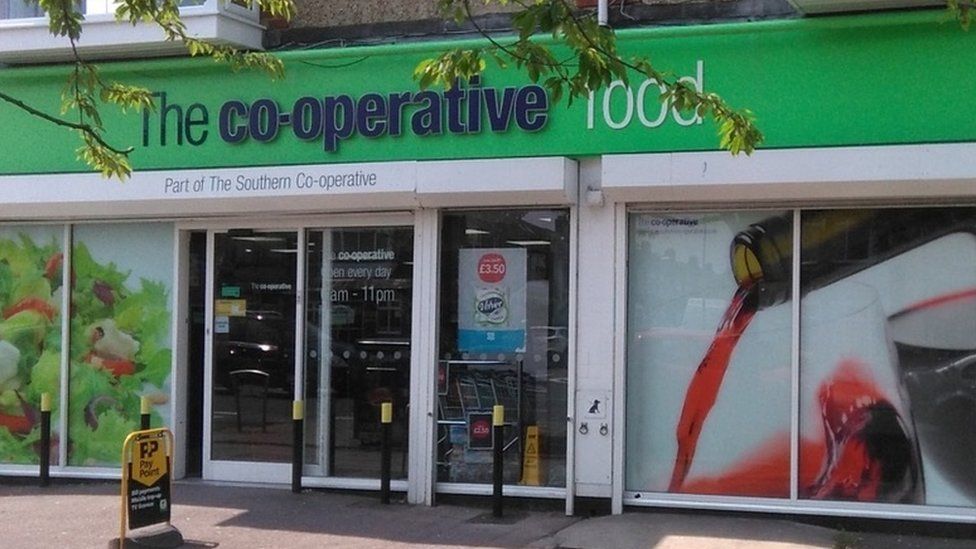
The privacy campaign group says the system at the convenience stores breaches data protection and people may end up on a watch-list without knowing.
But Southern says it is only using the Facewatch system in shops with a history of crime, to protect its staff.
The co-operative runs 200 convenience stores across southern England, of which 35 have the system installed.
A single camera captures the faces of people who enter the shops, and the images are analysed and converted into biometric data.
This is then compared with a database of people the co-operative says have stolen from its shops, or been violent.
A spokeswoman said the watch-list was not a list of people with criminal convictions, but of people for which the business had evidence of criminal or anti-social behaviour.
Any shopper previously banned would be asked to leave, and others would be approached by staff with an offer of “how can I help?” to make it clear their presence had been detected.
‘Orwellian’
Big Brother Watch has challenged the legality of the system in a submission to the ICO, shared with the BBC.
The group says the biometric scans are “Orwellian in the extreme”.
“The supermarket is adding customers to secret watch-lists with no due process, meaning shoppers can be spied on, blacklisted across multiple stores and denied food shopping despite being entirely innocent,” said Big Brother Watch’s director Silkie Carlo.
“This is a deeply unethical and a frankly chilling way for any business to behave.”
The complaint to the ICO claims the system breaches data protection laws because the information is processed in ways which are not proportionate to the need to prevent crime.
Big Brother Watch argues that facial recognition is “privacy-intrusive” in general, and “highly privacy-intrusive” for people whose details are on the watch-list.
This was not justified because the system was not necessary for preventing crime, it said.
“It does not bring serious criminals to justice… it does not protect the public from harm in any meaningful way,” the complaint says.
“At best, it displaces crime, empowering individual businesses to keep ‘undesirables’ out of their stores and move them elsewhere.”
The data produced from the facial recognition cameras is deleted after being compared with the watch-list, but the original picture is kept for 72 hours in case an individual subsequently breaks the law or is violent.
Crime prevention
Southern Co-Op said it would welcome any “constructive feedback” from the Information Commissioner.
“We take our responsibilities around the use of facial recognition extremely seriously and work hard to balance our customers’ rights with the need to protect our colleagues and customers from unacceptable violence and abuse,” it said.
“The safety of our colleagues and customers is paramount and this technology has made a significant difference to this, in the limited number of high-risk locations where it is being used.
“Signage is on display in the relevant stores. As long as it continues to prevent violent attacks, then we believe its use is justified.”
Image source, Southern Co-Op
Image caption, Southern Co-Op has installed cameras at 35 shops
The cameras are in use at Southern Co-Op shops in towns and cities including Portsmouth, Southampton, Bristol, Bournemouth, Hove, Croydon and Chichester.
Facewatch also provides the biometric cameras to Costcutter, Sports Direct, Spar, Nisa and Frasers Group.
The security system company said: “Facial recognition may be used where it is necessary because other methods to prevent crime, such as policing, CCTV and manned guarding, have tried and failed.
“Any privacy intrusion is minimal and proportionate. Facewatch is proven to be effective at crime prevention, and our clients experience a significant reduction in crime.”
The attacks are being blamed on Japanese macaques.
However, while they are a common sight in large parts of the country, incidents like these are unusual.
“It’s rare to see this many attacks in a short period of time,” said one city official, declining to give their name. “Initially only children and women were attacked. Recently elderly people and adult men have been targeted too.”
Attempts to capture the animals with traps ended in failure and police patrols implemented since the first attack in early July have failed to deter the culprits.
Authorities are also unsure if the assaults are the work of a single rogue monkey or several.
Injuries have varied, with local media reporting victims have received anything from scratches, bitten legs and hands, to bitten necks and stomachs.
Stories include a four-year-old girl scratched during an apartment break-in, while in another instance a monkey breached a kindergarten classroom.
Some residents have reported multiple incursions in their homes as the primates gain access by sliding screen doors or entering through open windows.
“I heard crying coming from the ground floor, so I hurried down,” one father told Japanese press. “Then I saw a monkey hunching over my child.”
Once a vulnerable species, Japanese macaque numbers have recently increased. They are now listed by the International Union for Conservation of Nature as a species of “Least Concern”.
However their recovery has “triggered serious conflicts between people and the macaques”, according to research from Yamagata University.
A decrease in distance between humans and macaques is blamed by the study. Shifting cultural attitudes towards macaques, changes in human behaviour and changes in forest environments are given as possible reasons why.
A state department spokesperson said China could influence Myanmar more than any other country – but China said it did not interfere in other countries’ internal affairs.
Meanwhile Myanmar’s junta insisted the men “deserved many death sentences”.
A spokesman said the four had been able to defend themselves in court.
“If we compare their sentence with other death penalty cases, they have committed crimes for which they should have been given death sentences many times,” junta spokesman Zaw Min Tun said at a regular press briefing.
The four men had been allowed to speak with family members by video link before their execution, Zaw Min Tun said.
State department spokesman Ned Price said there could be “no business as usual” with the junta.
“We are calling on countries around the world to do more. We will be doing more as well,” he said.
He called on all countries to ban sales of military equipment to the country and “refrain from lending the regime any degree of international credibility”.
Activist Kyaw Min Yu, better known as Ko Jimmy, and former lawmaker Phyo Zeya Thaw were among those executed.
The activists were arrested after an army-led coup last year and accused of committing “terror acts”. They were sentenced to death in a closed-door trial that rights groups criticised as being unjust.
Both Phyo Zeya Thaw and Ko Jimmy lost their appeals against their sentences in June.
Less is known about the two other activists – Hla Myo Aung and Aung Thura Zaw. They were sentenced to death for killing a woman who was an alleged informer for the junta.
Rights group Amnesty has warned that 100 more people in the country have been sentenced to death after being convicted in similar proceedings.
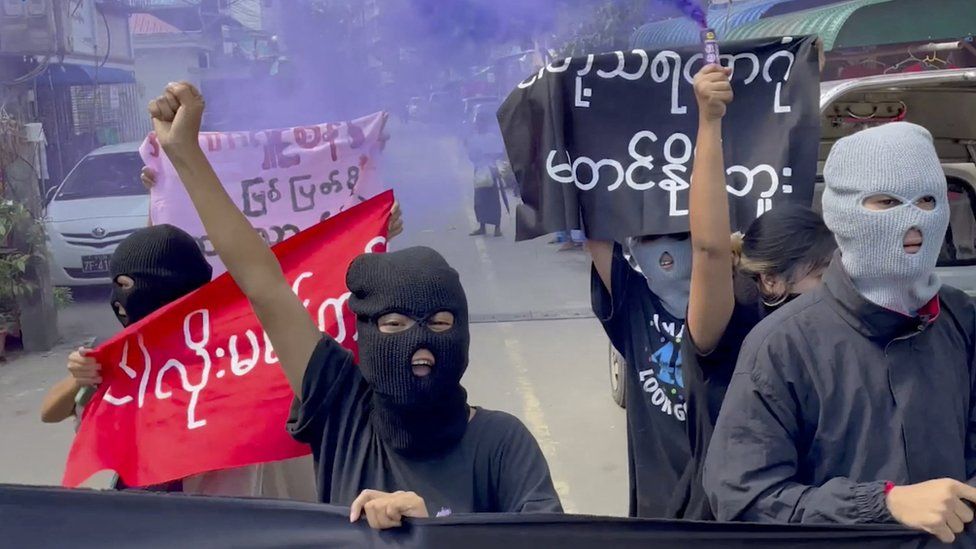
Image source, LU NGE KHITImage caption, People protested in Yangon after the executions were announced
The executions have been roundly criticised by the international community.
In a joint statement, the EU, Australia, Canada, Japan, New Zealand, Norway, South Korea, the UK and the US called them “reprehensible acts of violence that further exemplify the regime’s disregard for human rights and the rule of law”.
They also called for the junta regime to fulfil its obligation to seek peace through dialogue under an agreement negotiated with the Association of Southeast Asian Nations (Asean).
However former US ambassador to Myanmar Scott Marciel told the BBC that the Asean plan had been “dead on arrival” last year and countries sympathetic to Myanmar’s democracy movement should do more.
“It keeps being trotted out and highlighted as a way forward when in fact it’s not,” he said.
Asean itself, UN human rights chief Michelle Bachelet and rights groups have all condemned the executions.
“This cruel and regressive step is an extension of the military’s ongoing repressive campaign against its own people,” said Ms Bachelet.
Four suspects accused of stealing personal belongings from the bodies of the young people who died in mysterious circumstances at a tavern in East London, South Africa, have made an initial appearance in a Magistrate’s Court.
The male suspects, aged between 16 and 21, were arrested last week.
None of them have yet entered a plea, as police are still investigating.
The four allegedly stole hair weaves, shoes, clothing and a watch in the wake of the deaths of the 21 youngsters.
Cases of theft, possession of stolen property, and defeating the ends of justice have been opened against them for further investigation.
Last month, the 21 young people from Scenery Park, a township outside East London, died in the Enyobeni tavern – the youngest was aged 13.
A recent toxicology report was inconclusive, but initial findings show traces of methanol, which is a common ingredient in cleaning chemicals, were found in the bloodstream of all the victims.
They were celebrating the end of the school term when, according to eye witnesses, the pupils started collapsing.
The tavern owner and two employees appeared last week in court, charged with illegal alcohol sales to underaged people. The legal drinking age in South Africa is 18.
The leader of Ethiopia‘s rebel Tigray People’s Liberation Front (TPLF) has said the group will not negotiate on the disarmament of the “Tigray army” as it prepares for peace talks with the federal government.
The TPLF-run Tigray TV reported that Debretsion Gebremichael made the comments during a briefing to local media.
“We should disarm because the [Ethiopian] constitution stipulates that [regional states] should not have an army. There is nothing like that,” he said.
However, Mr Debretsion said that “Western Tigray” should be given back to Tigray as it belongs to the region in accordance with the same constitution.
“According to the constitution, Western Tigray belongs to Tigray. So they [Ethiopian government] should hand it over to Tigray. This benefits the people of Tigray, if at all they hand it over,” he said.
The two sides are preparing to hold peace talks to end the civil war that has killed thousands of people and displaced millions since November 2020.
Tunisia’s President Kais Saied has been celebrating his apparent victory in a referendum on a new constitution that gives him almost unlimited powers.
Mr Saied appeared in front of jubilant supporters after an exit poll indicated more than 90% of those who had voted had supported the president’s plan.
But turnout was only 27.5%, with main opposition parties boycotting the poll.
The president’s opponents say his changes would just entrench the personal powers he seized a year ago.
Mr Saied said turnout – announced by the country’s electoral commission – have been higher if voting had taken place over two days.
He promised that Tunisia would now enter a new phase after a decade of political deadlock. But his opponents will cite the low turnout as denying legitimacy to what they see as a worrying move back towards autocracy.
Tunisia became the birthplace of the Arab Spring when it overthrew its long-serving ruler Zine al-Abidine Ben Ali in 2011.
The date of the referendum was chosen by President Saied to mark a year to the day since his dramatic move to suspend parliament and dismiss the government.
Since then, he has effectively ruled by decree.
The new constitution, which replaces one drafted in 2014 three years after the Arab Spring, would give the head of state full executive control, supreme command of the army and the ability to appoint a government without parliamentary approval.
Mr Saied has said it was needed to break a cycle of political paralysis and economic decay.
He said his reforms were being done in the spirit of the 2011 revolution and will ensure a better future.
“Our money and our wealth are enormous, and our will is even greater, to rebuild a new Tunisia and a new republic, one that breaks with the past,” the president said after voting on Monday morning.
His many critics say it could lead Tunisia back to dictatorship in all but name.
Although President Saied still has a core of support among Tunisians who believe the country needs a strong leader to address its problems, there seemed little enthusiasm for the referendum.
Tunisia’s President Kais Saied has been celebrating his apparent victory in a referendum on a new constitution that gives him almost unlimited powers.
Mr Saied appeared in front of jubilant supporters after an exit poll indicated more than 90% of those who had voted had supported the president’s plan.
But turnout was only 27.5%, with main opposition parties boycotting the poll.
The president’s opponents say his changes would just entrench the personal powers he seized a year ago.
Mr Saied said turnout – announced by the country’s electoral commission – have been higher if voting had taken place over two days.
He promised that Tunisia would now enter a new phase after a decade of political deadlock. But his opponents will cite the low turnout as denying legitimacy to what they see as a worrying move back towards autocracy.
Tunisia became the birthplace of the Arab Spring when it overthrew its long-serving ruler Zine al-Abidine Ben Ali in 2011.
The date of the referendum was chosen by President Saied to mark a year to the day since his dramatic move to suspend parliament and dismiss the government.
Since then, he has effectively ruled by decree.
The new constitution, which replaces one drafted in 2014 three years after the Arab Spring, would give the head of state full executive control, supreme command of the army and the ability to appoint a government without parliamentary approval.
Mr Saied has said it was needed to break a cycle of political paralysis and economic decay.
He said his reforms were being done in the spirit of the 2011 revolution and will ensure a better future.
“Our money and our wealth are enormous, and our will is even greater, to rebuild a new Tunisia and a new republic, one that breaks with the past,” the president said after voting on Monday morning.
His many critics say it could lead Tunisia back to dictatorship in all but name.
Although President Saied still has a core of support among Tunisians who believe the country needs a strong leader to address its problems, there seemed little enthusiasm for the referendum.
A fourth-placed finisher at both the 2019 World Athletics Championships and the delayed 2020 Tokyo Olympics, the Nigerian’s persistence has finally seen her engrave her name into the track and field record books.
The 25-year-old ran a time of 12.12 seconds – shaving almost a tenth of a second off the previous world record – in the semi-finals of the World Championships in Oregon before going on to win gold in the final.
However, it always seemed as if the odds were stacked against her running career from the beginning.
“My parents are both teachers, they are strict disciplinarians,” Amusan told BBC Sport Africa.
“When you grow up in such a family, they feel you should focus on school. And being a female, they think you are going to go astray, lose focus and all of that.
“But because my mum saw what I didn’t see [in] myself, she felt she could give me a chance. And she kept telling me not to disappoint her.
“My mum would tell my dad I was going to church while I sneaked to practice or tell him I was going to a school debate while I went to an out-of-state competition. That’s where it all started.
“My dad got really mad one time when he found out [I was running]. He burnt all my training gear and told my mum that’s the last time he wanted to see me in a stadium.”
Fast forward several years, and tears of joy flowed freely as Amusan stood on the top step of the podium at Hayward Field on a historic day for Nigeria, which saw the country’s national anthem played at the World Athletics Championships for the first time ever.
“It has not sunk in yet, maybe the magnitude of what just happened it will hit me later,” she said.
“I go out there and put 100% in every championship and it’s just never enough. Every time it’s a fourth-place finish.
“Then this time my 100% is not only a gold medal but a world record. Trusting myself just made everything easier. I’m thankful to the man above for keeping me healthy. When God says it’s your time, it’s your time.”
Director of Communications of the governing New Patriotic Party (NPP), Yaw Buaben Asamoa, has delivered his profound gratitude to the party leadership as his tenure comes to an end.
Yaw Buaben Asamoa will from this day no longer be the party’s Communications Director.
This follows the election of new national executives for the party which happened on Saturday, July 16, 2022 at the Accra Sports Stadium.
By the constitution of the party, Yaw Buaben Asamoa, whose position is by appointment, is to vacate his office.
Speaking on Peace FM’s “Kokrokoo” programme, he was thankful to the party for allowing him to lead the communication machinery.
According to him, it is an honour to him because, “it seldom happens that although I was a Member of Parliament for Adentan, I would also be called upon to serve in the capacity” of a Communications Director.
Mr. Buaben Asamoa extolled his excellent performance stressing he effectively executed his duties.
Appreciating the party, he emphasized; “I am satisfied that the party gave me this opportunity to serve in this capacity.”
In a statement on Monday, the education ministry said the closure of the Federal Government College in the city’s suburb of Kwali became necessary over insecurity in nearby villages.
It said a security breach on Sheda and Lambata villages threatened the school – after gunmen attacked Sheda on Sunday morning, kidnapping a resident.
The Federal Government College is located in Sheda.
He also asked principals of government schools across the country to liaise with security agencies to ensure adequate security for their students.
Nigeria is grappling with rising attacks by gunmen, many of them targeting individuals, priests and students.
In 2021, armed gangs known locally as bandits, carried out abductions in at least 10 schools in north-western Zamfara, Kaduna, and Kebbi states as well as Niger state in central Nigeria.
The Chairman of the Board of Trustees of the National Cathedral Project, Apostle Prof. Opoku Onyinah, has said that there is nothing shrouded in secrecy about the construction of the National Cathedral.
He was unhappy about the misconception peddled by some individuals that is further polluting the minds of Ghanaians about the importance of the project.
Prof. Opoku Onyinah who spoke exclusively to Peacefmonline.com in Kumasi during a temple dedication of the Pentecost International Worship Centre (PIWC Asokwa) noted that the President pledged to do four things in support of its construction, i.e provide land, seed money, an architect and also establish a Secretariat.
All these commitments have been met by the President and that the remaining works are also left in the hands of the Board of Trustees and its Technical Committee.
He further charged the public should not worry about the monetary matters for the construction of the national cathedral.
“The project is being supervised by experienced men of God who will ensure prudent management of financial resources,” he noted.
About Asokwa PIWC
The PIWC Asokwa, began its journey in 1986 by holding church service in a classroom block at Yaa Achiaa Girls JHS at Roman Hill in Kumasi with obviously few membership.
Due to difficulties in securing a convenient and conducive place of worship, the church had hold services and meetings in different areas such as Amakom, Asawase and subsequently Asokwa, their current and permanent location.
Today, the church can boast of over 2,500 membership with plans expanding it to reach out to as many as possible through evangelism.
Resident Minister, Apostle Dr. Joseph Ignatius Teye Buertey, in an interview disclosed that with the years ahead, they have resolved to intensify evangelism to win more souls for the kingdom of God.
“We are also keen about deepening the faith of our members to be deeply rooted in the word of God,” he added.
Chief of Amakom, Nana Adu Mensah urged the church to consider establishing a school. He said this will help build the human resource of the country for national development.
The Municipal Chief Executive for Asokwa, Hon. Akwannuasa Gyimah also implored on churches in the country to be on high alert and security consciousness in the wake of terrorism threats in neighboring countries.
The Minister of Finance, Mr Ken Ofori-Atta, has assured that the government remained focused on driving the economy out of the current economic challenges.
He said the government has a track record of navigating its way around the challenges and thus called on the citizens to have faith for a quicker return to stability.
The minister said the government was prioritising fiscal discipline, which involved sticking to agreed targets, cutting expenditures when revenues are underperforming and ensuring prudent spending to get value for money.
Presenting his sixth in the row mid year budget review to Parliament Monday (July 15, 2022), Mr Ofori-Atta sought to rally the nation behind the government in a march against the grueling high cost of living that is manifesting in soaring price jumps, a weak currency and low economic activities.
“With discipline, dedication and hard work, we will overcome the current challenges that confront our nation,†he said.
“We are convinced we can do this again. We worked closely with Ghanaians to turn around the economic situation in 2017,†he said.
In line with the commitment to fiscal discipline, the minister said revenue and expenditure targets for the year had been revised downwards to reflect the pressure that the remnants of the COVID-19 pandemic and the Russia/Ukraine crisis was impacting on the economy.
“Mr Speaker, in the immediate term, we will strengthen our focus on efficiency in our fiscal operations and transformation efforts.
To this end, we are aggressively improving revenue mobilisation by adopting more innovative and comprehensive approaches including technology, rationalising expenditures, adopting policies to address inflation, promoting production and improving productivity, including implementing the Ghana CARES and YouStart programmes and exploring innovative financing as illustrated by the recently approved US$750 million African Export-Import (Afrexim) Facility,†he added.
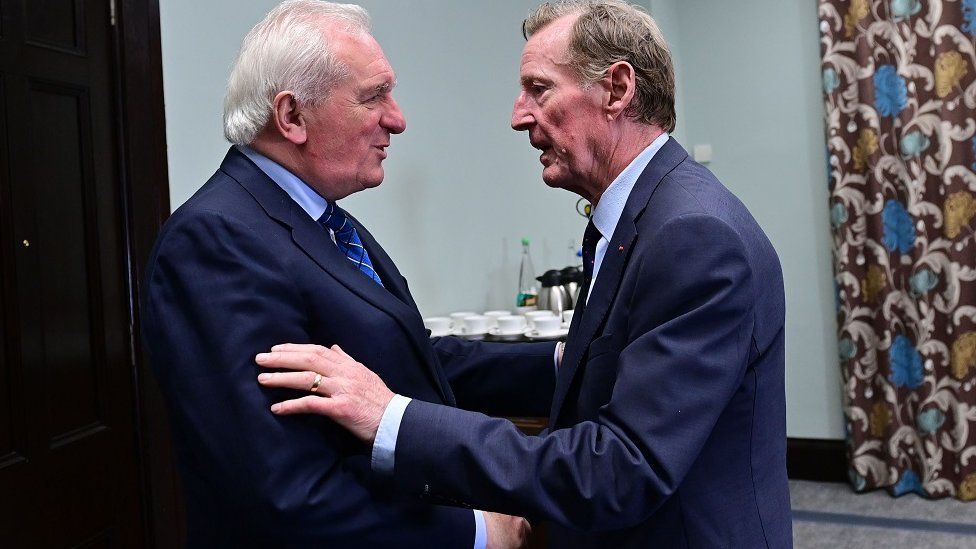
And former prime minister Sir Tony Blair said without David Trimble, the Good Friday Agreement would not have been possible.
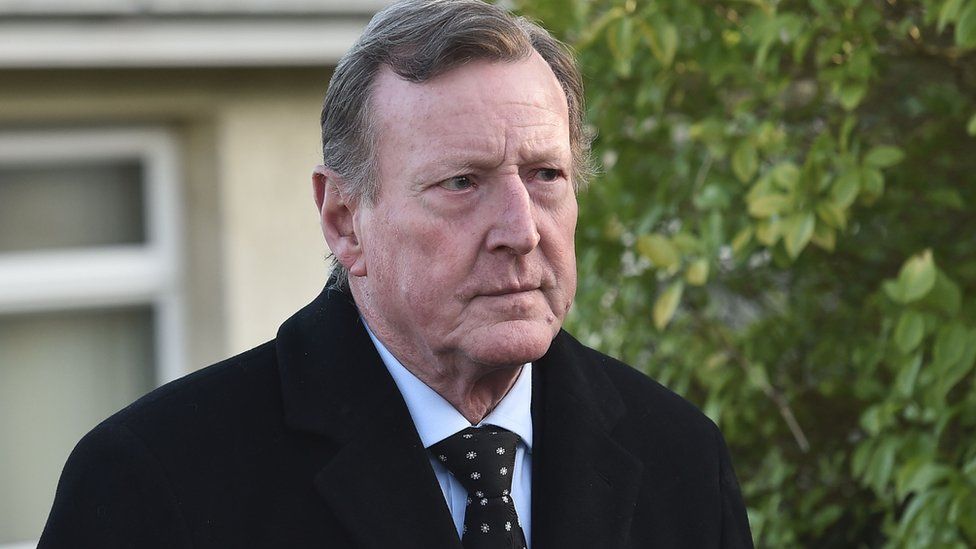
Lord Trimble died on Monday aged 77. He was instrumental in the negotiation of the 1998 Good Friday Agreement.
This was the peace deal which ended the worst of Northern Ireland’s Troubles.
Lord Trimble led the Ulster Unionist Party (UUP) between 1995 and 2005.
He won the Nobel Peace Prize, along with Social Democratic and Labour Party (SDLP) leader John Hume and was the first person to serve in the role of first minister in the new Northern Ireland Executive established as part of the Good Friday Agreement.
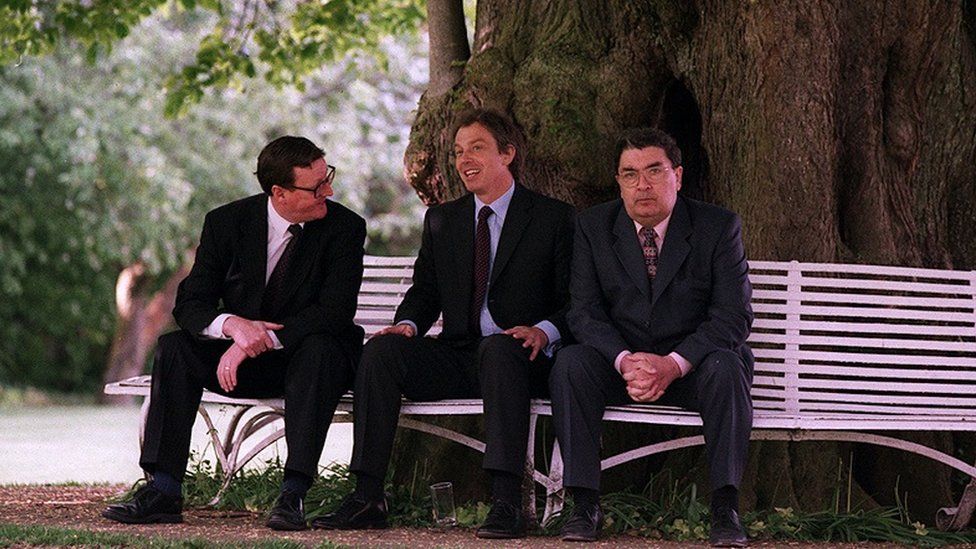
Image source, PacemakerImage caption, Lord Trimble and John Hume, who months later would be jointly awarded the Nobel Peace Prize, with Tony Blair as they began to form a government for Northern Ireland in 1998
Since 2006, Lord Trimble sat in the House of Lords.
In recent years, he was vocal in his opposition to the Northern Ireland Protocol – part of the 2019 Brexit deal that keeps Northern Ireland in the EU’s single market for goods, preventing a hard border with the Republic of Ireland.
Lord Trimble argued that it put the Good Friday Agreement at risk.
“Time after time during the negotiations that led to the Good Friday Agreement, he made the hard choices over the politically expedient ones because he believed future generations deserved to grow up free from violence and hatred.
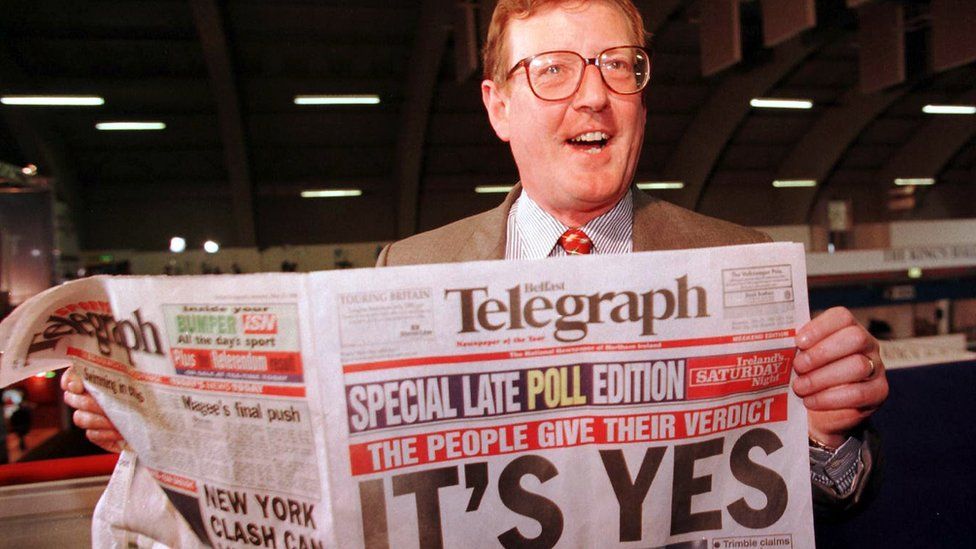
Image source, PacemakerImage caption, Lord Trimble at the Kings Hall in Belfast on 23 May, 1998, triumphantly holds the Belfast Telegraph after the majority Yes Vote mood for the Good Friday Agreement
“His faith in the democratic process allowed him to stand up to strong opposition in his own community, persuade them of the merits of compromise, and share power with his former adversaries. His legacy will endure in all who are living better lives because of him today.”
Sir Tony said Lord Trimble’s contribution to the peace process was “immense”.
“It was a masterclass in leadership,” he told BBC’s Radio Four’s Today programme. “He saw the chance of being able to settle the issue on terms that were acceptable to unionism.
“He was never in any doubt that he was going to be accused of betrayal. He paid the political price for that.”
Sir Tony said Lord Trimble’s vision for Northern Ireland was of “a Northern Ireland healed and brought together in peace”.
“Once he said he would do something, he did it, that was absolutely invaluable to the trust needed to make the process work.”
Image source, PacemakerImage caption, Former Taoiseach Bertie Ahern described Lord Trimble as a “passionate and determined peacemaker”, pictured in June
Former Taoiseach (Irish PM) Bertie Ahern, who led the Irish government at the Good Friday Agreement negotiations in 1998, said Lord Trimble was courageous and that although they had “many a row, many arguments”, they were able to laugh about that in later years.
“We got on very well. We had lots of one-to-one conversations,” he said.
“Of course we fought, of course we had differences and some of them were fiery. There’s no use saying they were not. But we always kept negotiating and dealing with the issues in front of us.
“The reality is, in his time as first minister, with the up and downs and suspensions in the institutions, he stuck with it.
“He made a great contribution.”
Mr Ahern said he had a long conversation with Lord Trimble just a few weeks ago at Queen’s University in Belfast.
“He knew what was coming, he was brave in that, as he was in everything else,” he told the BBC’s Good Morning Ulster programme.
“David’s contribution to the Good Friday Agreement and to the quarter century of relative peace that followed cannot be underestimated,” Mr Adams said.
Current UUP leader Doug Beattie described Lord Trimble as a “political giant”.
“David Trimble was a man of courage and vision. He chose to grasp the opportunity for peace when it presented itself and sought to end the decades of violence that blighted his beloved Northern Ireland,” Mr Beattie said.
Image source, PacemakerImage caption, U2 frontman Bono endorsed Lord Trimble and John Hume’s calls for peace ahead of the 1998 referendum on the Good Friday Agreement
“The bravery and courage he demonstrated whilst battling his recent illness was typical of the qualities he showed in his political career, at Stormont and at Westminster.”
‘Giant of politics’
Prime Minister Boris Johnson described Lord Trimble as “a giant of British and international politics”.
“[He] will be long remembered for his intellect, personal bravery and fierce determination to change politics for the better,” Mr Johnson added.
Current Taoiseach Micheál Martin said Lord Trimble played “a crucial and courageous role in bringing peace to Northern Ireland”.
Democratic Unionist Party (DUP) leader Sir Jeffrey Donaldson said the former first minister “made a huge contribution to Northern Ireland, and to political life in the United Kingdom” and was a “committed and passionate unionist who always wanted the best for Northern Ireland”.
Image source, PAcemaker
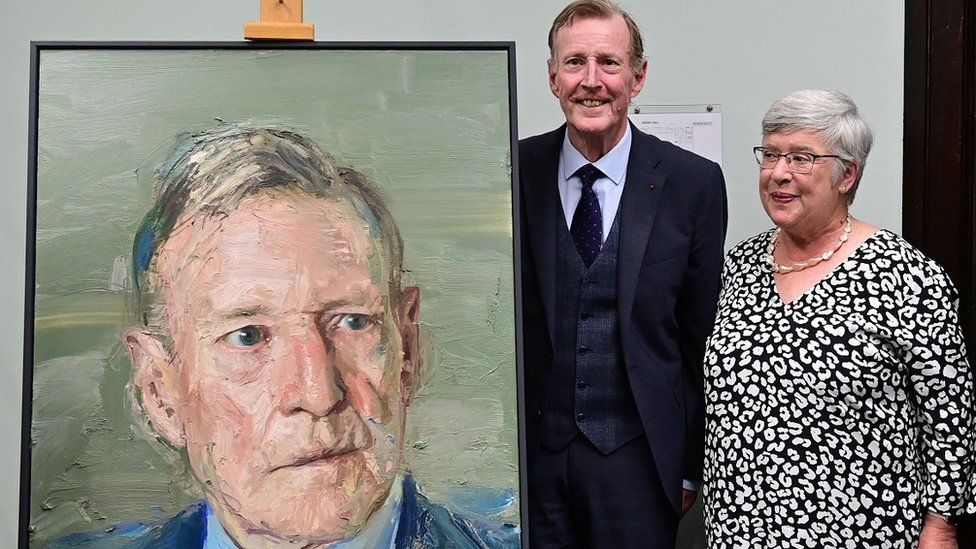
Image caption, David Trimble with his wife, Daphne, at the unveiling of a portrait of him at Queen’s University in Belfast last month
Sir Jeffrey’s disagreements with Lord Trimble over the Good Friday Agreement led to him quitting the UUP in 2003 and defecting to the DUP.
“Whilst our political paths parted within the Ulster Unionist Party, there can be no doubting his bravery and determination in leadership at that time,” Sir Jeffrey added.
Lord Trimble’s political journey took him from a young hardliner in the 1970s to a unionist leader who compromised to help deliver an executive and assembly at Stormont where unionism and nationalism shared power.
He received much praise, including the Nobel Peace Prize with Mr Hume, for helping to bring to an end to decades of violence in Northern Ireland.
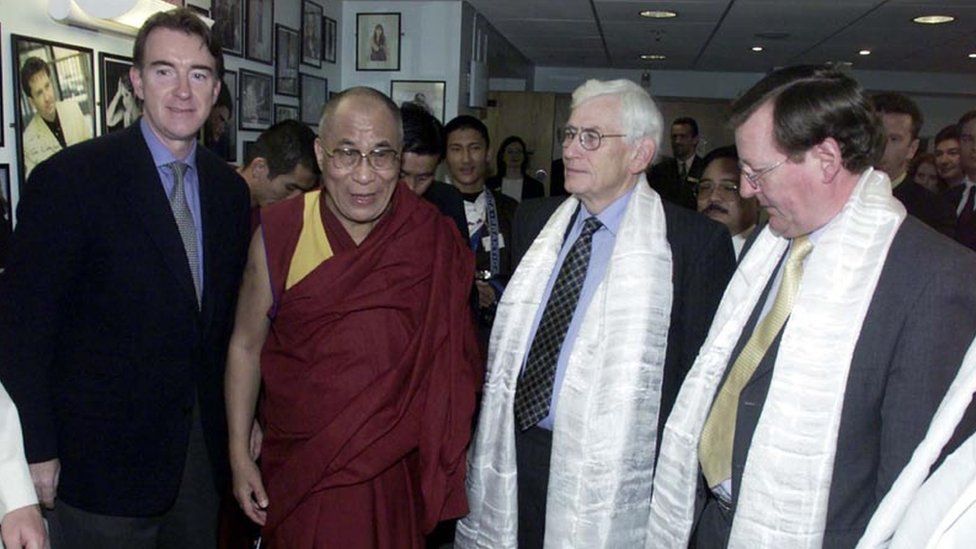
Image source, PacemakerImage caption, The Dalai Lama met Lord Trimble alongside the then Secretary of State Peter Mandelson and Seamus Mallon in the Waterfront hall on 20 October 2000, during his three-day visit to Northern Ireland
Former prime minister Sir John Major, said: “When David Trimble became leader of the Ulster Unionist Party, he made a critical contribution to the Northern Ireland peace process.
“He shed his former opposition to the process, and became an innovative advocate for a peaceful settlement.
“He thoroughly merits an honourable place amongst peacemakers.”
But Lord Trimble also came in for sustained criticism from others within political unionism for signing up to the Good Friday Agreement, particularly the DUP.
The Ghana Health Service(GHS) has launched the 2022 World Hepatitis Day campaign to create awareness on the condition.
The Day, which is observed on July 28 annually, highlights the need to accelerate the fight against viral hepatitis and to influence real change.
Hepatitis is an inflammatory condition of the liver and is commonly caused by a viral infection.
The five main viral classifications of hepatitis are hepatitis A, B, C, D, and E with different viruses responsible for each type of viral hepatitis.
Dr Franklin Asiedu-Bekoe, the Director of Public Health, GHS, in representing the Director General at the event, said hepatitis was a global condition and that the World Health Organisation (WHO) was working towards its elimination by 2030.
To that end, there was an ongoing project in Ghana to ascertain the number of pregnant women with the condition to effectively vaccinate them after delivery to bring care closer to the people, he said.
He urged Ghanaians not to wait but get tested for hepatitis to know their status for early treatment.
The Director of Public Health called for partnerships and investments to bring the necessary attention to hepatitis treatment in the country.
“Hepatitis is about investing. Investment here is not just government but also the private sector and that is why all partners must work together to bring the necessary investment to ensure that Ghana achieved the 2030 goal of eliminating the condition”, he said.
The 2022 World Hepatitis Day is on the theme, “Bringing Hepatitis Care Closer to Communities- Hep Can’t Wait.”
Dr Atsu Godwin Seake-Kwaku, Programme Manager, National Viral Hepatitis Control Programme, GHS, giving a presentation on viral hepatitis situation in Ghana, said there was the need to increase interventions to deal with the condition.
He said Ghana in 2015 recorded 12.3 per cent of chronic hepatitis B, 1.5 million new infections per year and a total of 820,000 deaths with 6.6 million on treatment.
In 2019, 3.3 per cent was also recorded for chronic hepatitis C, 1.5 million new infections per year, 299,000 deaths and 9.4 million on treatment, he added.
Dr Seake-Kwaku said it was, therefore, important to increase prevention, testing, link to cure, treatment and chronic care as the cost of medication for treatment was expensive.
Dr Charles Adjei, the Executive Director, Hepatitis Alliance of Ghana, representing Civil Society Organizations, stated that a number of activities had been outlined in the coming days to observe the Day.
He said aside the official launching of the World Hepatitis Day, there would be free hepatitis B and C screening and care in Accra, Cape Coast, Ho and Lawra on July 25-27.
A scientific seminar for midwives on 26, a national stakeholder meeting on July 28, free hepatitis B screening in the Northern Region, and free Hepatitis B and C in Upper West Region, all on 28 respectively.
Dr Adjei said there would also be hepatitis awareness campaigns and testing at Teshie in Accra and on August 2, there would also be hepatitis testing and vaccination in Kumasi and media engagements.
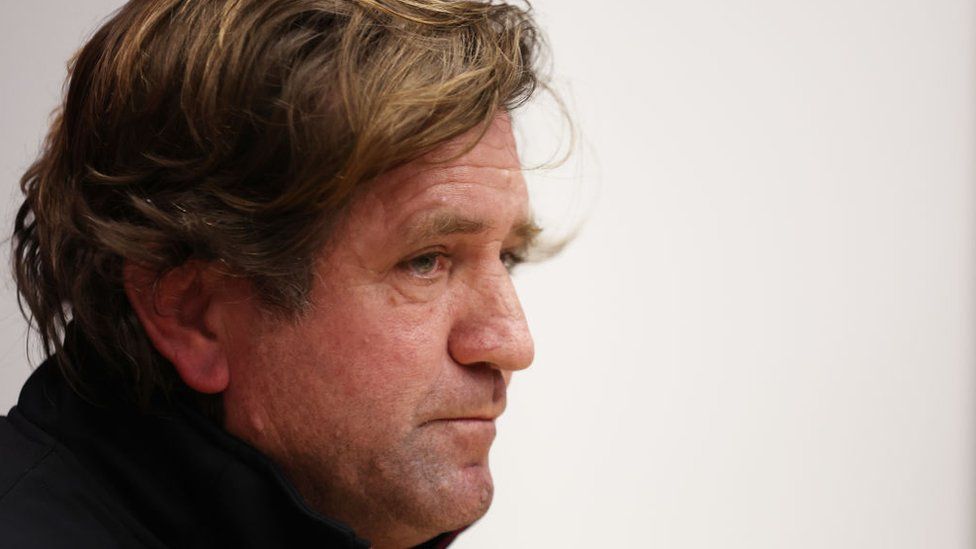
Seven players in Australia’s National Rugby League (NRL) will boycott a key match over their team’s decision to wear a gay pride jersey.
On Thursday, the Manly Warringah Sea Eagles will become the first team in the competition ever to don a kit which promotes LGBT inclusivity in the sport.
But players weren’t consulted and some object to the move on religious and cultural grounds.
The club apologised for its handling of the situation.
Coach Des Hasler said the club had made a “significant mistake” that had caused “confusion, discomfort and pain for many people, in particular those groups whose human rights we were in fact attempting to support”.
In a press conference on Tuesday, he apologised to the LGBT community and to the players involved.
“They were not included in any of the discussions, and at a minimum, they should have been consulted,” Hasler said.
Under league rules, players from the same team cannot wear different jerseys.
Local media identified the seven players as Josh Aloiai, Jason Saab, Christian Tuipulotu, Josh Schuster, Haumole Olakau’atu, Tolu Koula and Toafofoa Sipley.
Thursday’s game is considered important to the club’s chances of making the NRL finals and the players’ stance has sparked a backlash online.
“What infuriates me (and always has) is that players will boycott over a rainbow but never boycott a teammate if he’s been accused of violence against women or any other morally reprehensible behaviour that they would all agree they don’t condone,” wrote Pam Whaley on Twitter.
Others accused the seven of hypocrisy, pointing out the team is sponsored by a brewery and betting agency.
Hasler said he respected the men’s decisions and is concerned for their welfare amid the backlash.
Image source, Getty ImagesImage caption, Hasler said club management had made “significant mistakes”
Former Manly star Ian Roberts – the first-ever former NRL player to come out as gay – says the boycott “breaks his heart”.
“It’s sad and uncomfortable,” he told Sydney’s Daily Telegraph.
Prime Minister Anthony Albanese praised Manly for its stance, saying: “It’s important in Australian society that we respect everyone for who they are.”
It isn’t the first time an Australian athlete has objected to wearing a pride jersey. Last year AFL Women’s player Haneen Zreika missed a game after declining to don the jersey on religious grounds.
Few Australian sport stars have come out. Mr Roberts and others say homophobia remains a big issue among fans and players in the country’s top competitions.
Adelaide United footballer Josh Cavallo – who came out in October – has called out the abuse directed at him by crowds over his sexuality.
In 2015 Israel Folau – who has played rugby league, rugby union and Australian Rules football at the highest levels – was controversially sacked by Rugby Australia for making anti-gay posts on social media.
Japan has executed a 39-year-old man who killed seven people in Tokyo in 2008 during a stabbing rampage.
Tomohiro Kato committed one of the most shocking mass murders in the country’s recent history.
He was 25 when he drove a truck into a lunch-time crowd of pedestrians at Akihabara shopping district, killing three people.
He then stabbed passers-by with a dagger, killing four and wounding eight.
He was apprehended by police at the scene and later admitted his crimes in his trial, saying he had been angered by online bullying.
The crime sparked much debate in Japanese society at the time over random killings, online influence and the failures in mental health support for young people. Laws on knife ownership were also tightened in response.
On Tuesday, eight years after Kato was sentenced to death, the government confirmed it had ordered his execution.
“The case has been fully tried in the courts and the courts’ final conclusion was the death sentence… I have taken the greatest care possible in considering this case,” Justice Minister Yoshihisa Furukawa said at a press conference.
Image source, STR/AFP via Getty ImagesImage caption, The attack took place during a busy shopping weekend in central Tokyo
Kato was hanged in the Tokyo Detention Centre. He lost his challenge to commute the sentence in Japan’s top court in 2015.
Kato told police at the time of his arrest: “I came to Akihabara to kill people. It didn’t matter who I’d kill.”
Kato was born into a wealthy family and graduated from a top high school. But he failed his university entrance exams and struggled to maintain steady employment afterwards.
During his trial, prosecutors also painted a picture of a troubled young man, who had posted several times in online forums about his anger and alienation from society.
Prosecutors said Kato was particularly demoralised after a woman he was chatting with online stopped emailing him. On his way into the city the day of the attack, he’d declared his intention to carry out a mass murder.
The Tokyo District Court which sentenced him in 2011 said his brutal crime had not indicated “a shred of humanity”.
Japan remains one of the few developed countries that still uses the death penalty despite criticism from international and local human rights groups.
It hanged three people last December. Kato’s case is the country’s first execution this year.
More than 100 prisoners remain on death row.
Mr Furukawa defended his country’s use of capital punishment on Tuesday saying: “Since there is no end to heinous crimes, I regret death penalties remain necessary. Therefore abolishing the penalty is not appropriate.”
Japan resumed executions when Prime Minister Fumio Kishida came to power in late 2021. Before that, the country had not carried out any executions for two years.
The Bureau of Public Safety (BPS) has revealed that total reported deaths associated with crime and public safety issues for the first half of the year, has scaled up by 9%. This is against data for the same period in 2021.
According to the Bureau, “501 deaths were recorded in relation to crime and public safety between January and June 2021, against 546, recorded in the same period in 2022.
The report broadly categorizes public safety issues into ten categories (index) namely Crime, Violent Crime, Fires/Industrial (Workplace) related incidents, Transportation related incidents, Civil Disturbances, Police Officer Casualties, Police Brutalities, Police Arrests, etc.
It, however, indicated that total public safety incidents reported decreased by 0.2% over the same period in Y2021, being a total of 664 events for Y2021 as against 663 events for Y2022.
Also, total reported injuries monitored for the period in 2022 increased by over 35 compared to the same period in Y2021.
It further indicated that overall reported violent crimes decreased by about 12% in Y2022 compared to the same period in Y2021.
“Reported incidents of murder/manslaughter, armed robbery, and civil disorder for the period of Y2022 decreased over Y2021, at 20%, 19%, and 22% respectively,” it added.
Reported deaths arising out of violent crimes also increased by 1.2% in Y2022 compared to the same period in Y2021.
Despite the decrease in the number of violent crime incidents, more people continue to fall victim to violent crime activities, leading to an increase in deaths resulting from violent crime activities, the report stated.
“Reported use of firearms in the commission of violent crimes in Y2022 increased by more than 4% over the same period in Y2021.
Reported cases of illegal arms trafficking, possession, and unauthorized use increased by over 300% in the first half of Y2022 over the same period in Y2021,” it added.
It also stated that data monitored showed a 2% increase in reported police arrests for the first half of Y2022 compared to the same period in Y2021.
Rishi Sunak and Liz Truss tore into each other over their rival visions for the future of the UK economy, in their first head-to-head TV debate.
The two contenders to be the next PM did not hold back from “blue-on-blue” attacks in the hour-long BBC special.
Mr Sunak told Ms Truss her tax cut plan would “tip millions of people into misery” and cost the Conservatives the next election.
Ms Truss said tax rises brought in by him would lead to a recession.
The foreign secretary and former chancellor, who until three weeks ago were in the same cabinet, talked over each other at times and shot angry glances across the stage at Stoke-on-Trent’s Victoria Hall.
It led to complaints afterwards by Ms Truss’s supporters that the ex-chancellor was being too aggressive and was “mansplaining” – something fiercely denied by the Sunak camp.
The pair were on better terms by the end of the debate, with Ms Truss saying she would “love” to have Mr Sunak on her team if she becomes PM. The ex-chancellor praised her stance on Russia.
But the row over tax dominated the early exchanges.
Ms Truss wants to scrap the rise to National Insurance, a planned rise in corporation tax and would temporarily scrap green levies on energy bills to be paid for through borrowing.
Mr Sunak says he would not cut taxes until inflation was under control.
Mr Sunak – who quit as chancellor earlier this month – said the coronavirus pandemic had created a large bill and that putting it on the “country’s credit card” would “pass the tab to our children and grandchildren”.
Media caption, Watch: Sunak and Truss angrily debate borrowing and debt
Ms Truss insisted that under her plans the UK would start paying down the debt in three year’s time – and paying it back straight away as Mr Sunak wanted to do would push the UK into a recession.
Mr Sunak suggested her plans would lead to higher interest rates, but the foreign secretary dismiss this as “scaremongering” and “project fear” – an echo of the criticism aimed at the Remain campaign during Brexit referendum.
Mr Sunak took this opportunity to point out that, unlike him, Ms Truss campaigned against Brexit.
“Maybe I learnt from that,” she replied. She later said the Brexit referendum was when she had learnt not to trust Treasury forecasts on the economy.
Other key moments in the debate included:
Both candidates accusing the other of not having been tough enough on China in the past
Ms Truss contrasting her comprehensive school education with that of Mr Sunak’s, who attended the fee-paying Winchester College
Mr Sunak said he was “not going to apologise” for his background, adding that his parents’ aspirational values were Conservative – something that earned him the evening’s first round of applause
Mr Sunak’s resignation as chancellor helped trigger the downfall of Mr Johnson.
He praised Mr Johnson’s handling of Brexit and the pandemic but said he had quit as a matter of principle over the PM’s “conduct” and the fact that they had “very different views about the direction of travel on the economy”.
Ms Truss acknowledged the prime minister had made mistakes but said they were not “sufficient” enough for the Conservative Party to have “rejected him”.
Neither said they would accept Mr Johnson in their cabinet.
Chief secretary to the Treasury and Truss-backer Simon Clarke told BBC Breakfast that polling after the debate showed the majority of Conservative voters thought his candidate had won the evening – and it had reaffirmed his view that she was the right candidate to lead the country.
He refused to criticise Mr Sunak for interrupting, but said viewers would have to make up their own minds about his debating style. He added he thought Ms Truss had been “cool, controlled” and had made compelling arguments.
Labour leader Sir Keir Starmer told BBC Breakfast the debate showed a Conservative Party which had “lost the plot and lost its purpose”.
He said Mr Sunak was acting like he had “just come down from the moon” and discovered the economy was in a bad way when he had been in charge of it until three weeks ago, while Ms Truss was playing “fantasy economics” without explaining how she would pay for tax cuts.
“We do need change in the UK but the change we need is not a change at the top of the Conservative Party, it is more fundamental than that. We need a fresh start for Britain. We need a Labour government,” he said.
A Liberal Democrat spokesperson simply said: “Eurgh.”
For all the talk of wanting the “blue-on-blue” attacks to subside – this debate showed they haven’t gone away.
Liz Truss’s campaign accused Rishi Sunak of not letting her get a word in edgeways, and Rishi Sunak continued to slam Liz Truss’s tax cut plans for not being economically sound.
Sources close to Sunak said he had “won the argument” on the economy, with his argument that her tax cuts would further fuel inflation and push up interest rates and people’s mortgages.
Behind the scenes, Truss’s camp feel positive too – claiming that while she stayed calm Sunak was “flustered”.
Debates about their backgrounds haven’t gone away either. Both are keen to distance themselves from any suggestion they had certain privileges.
Truss pointed to her comprehensive school education but distanced herself slightly, though, from the outright attacks on Sunak’s clothing and education from some of her supporters.
But the key battleground – and the biggest dividing line between the two – is still tax.
Then Governemt of Ghana has revised the country’s Gross Domestic Product (GDP) growth rate from 5.8 percent to 3.7 percent for 2022.
According to the Finance Minister, the revision of the GDP growth target and other macroeconomic variables is necessitated by the current economic hardships on the globe.
Delivering the 2022 mid-year budget review in parliament on July 25, Ken Ofori-Atta explained, “In the light of significate changes in the global environment and our own unique challenges, we have revised our economic growth estimate for 2022 to 3.7 percent, down from 5.8 percent as stated in the 2022 budget.”
The Finance Minister added that apart from the revised overall GDP growth rate, almost all other macroeconomic variables have been revised downward.
“… non-oil GDP growth of 4.3 percent down from 4.9 percent; end-period inflation of 28.5 percent, up from 8 percent. The overall deficit of 6.6 percent of GDP, down from 7.4 percent; primary surplus of 0.4 percent of GDP, up from a surplus of 0.1 percent and a Gross International Reserve of not less than 3-months import cover,” he told lawmakers in parliament.
He further stated that the overall GDP growth rate for the first quarter of 2022 was pegged at 3.3 percent, with the non-oil GDP growth rate being 3.7 percent.
The Finance Minister further disclosed that the overall GDP growth rate for 2021 was 5.4 percent compared to 0.5 percent recorded in 2020, and non-oil GDP growth increased to 6.9 percent compared to the 1 percent recorded in 2020.
Read the Minister’s full 2022 mid-year budget statement below:
According to him, this is part of efforts to beef up security and combat crime, in the wake of terrorism attacks in neighbouring countries.
“To further improve internal security, the Ghana Police Service has recruited and trained 5,000 additional officers to put more police in our streets and communities,” he said while delivering the 2022 mid-year budget review in Parliament on Monday, July 25, 2022.
Addressing the House, Mr Ofori reiterated government’s commitment to clamp down on crime and ensure the safety of the citizenry.
“Mr. Speaker, the safety of Ghanaians in the face of complex security threats is a major concern to Government,” he stressed.
“We are using a significant amount of resources to ensure that we keep our people and country safe. Considering what is happening in the West African region, it is important that we prioritise national security, and we have.
“Whilst it will not be prudent to disclose the full cost of ensuring the security of this state, let me emphasise that it is significant,” he maintained.
As part of efforts to clamp down on terrorism, government has introduced the “See something, Say something” campaign to sensitise the public on activities of terrorists.
To complement this effort, the Ghana Armed Forces (GAF) is implementing an enhanced surveillance programme for the country’s air space and international borders through collaboration with other domestic security agencies, Mr Ofori-Atta added.
“We are also aggressively pursuing the Forward Operating Bases (FOB) programme to improve response time and prevent cross border crimes as well as terrorist infiltration,” he said.
Ukraine has accused Moscow of waging a “gas war” against Europe and cutting supplies to inflict “terror” on people.
Russian energy firm Gazprom announced it is once again reducing gas flows into Germany to allow work on a turbine on the Nord Stream 1 pipeline.
But Ukraine’s President Volodymyr Zelensky said this was simply “gas blackmail” against Europe.
The Nord Stream 1 pipeline, which pumps gas from Russia to Germany, has been running well below capacity for weeks.
Earlier this month, Russia’s biggest European pipeline was completely shut down for a 10-day maintenance break, sparking fears in Europe that shipments would not resume at all.
Shipments did restart five days ago – albeit still at a reduced capacity. But on Monday, Gazprom announced it would be cutting its gas supply further once again.
This time, it said it needed to cut gas supply to around half of current levels in order to carry out maintenance work. The German government, however, said there was no technical reason for it to limit the supply.
“The gas blackmail of Europe, which only gets worse every month, is needed by a terrorist state to make the life of every European worse,” said Mr Zelensky in his nightly address.
He said it was deliberately intended to make it difficult for Europe to prepare for winter, without any care for the poverty people may suffer in the colder months as a result.
The EU, which received 40% of its gas from Russia last year, has also accused Russia of using energy as a weapon.
The latest reduction in flows puts pressure on EU countries to reduce their dependence on Russian gas even further, and will likely make it more difficult for them to replenish their gas supplies ahead of winter.
European energy ministers are meeting in Brussels on Tuesday where they hope to sign off on a joint response to the crisis.
Last week, the European Commission proposed member states cut gas consumption by 15% over the next seven months. The target would be voluntary, but under the proposals the Commission could decide to make it mandatory in an emergency.
Although some countries have resisted the plan, the pressure on EU capitals to reach an agreement is high.
Ursula von der Leyen, the European Commission President, has previously said the prospect of Russia completely cutting off gas supplies to the EU was a “likely scenario”.
Since Russia invaded Ukraine in February the price of wholesale gas has already soared, with a knock-on impact on consumer energy bills across the globe.
The Kremlin blames the price hike on Western sanctions, insisting it is a reliable energy partner and not responsible for the recent disruption to gas supplies.
Meanwhile, Ukraine still hopes that a landmark deal brokered by the UN last week could mean grain exports resume from its Black Sea ports “within days.”
“If the sides guarantee security, the agreement will work. If they do not, it will not work,” Infrastructure Minister Oleksandr Kubrakov said.
In his nightly address, President Zelensky also said he was confident that grain exports from Ukraine will start again this week.
His comments came after fears the deal could fall apart after Russia targeted Ukraine’s main port of Odesa with missiles on Saturday.
As many as 20 million tonnes of grain are trapped in Ukraine, unable to leave because the Russian navy controls most of the Black Sea.
It is likely to make it more difficult for EU countries to replenish their stores of gas before winter.
The Nord Stream 1 pipeline, which pumps gas from Russia to Germany, has been running well below capacity for weeks, and was completely shut down for a 10-day maintenance break earlier this month.
Russia supplied the EU with 40% of its gas last year, and the EU has accused Russia of using energy as a weapon.
The European Commission has urged countries to cut gas use by 15% over the next seven months after Russia warned it could curb or halt supplies altogether.
Under the proposals, the voluntary target could become mandatory in an emergency.
European Commission President, Ursula von der Leyen, has said the prospect of Russia cutting off all supplies to the EU is a “likely scenario”.
On Tuesday energy ministers will meet in Brussels in an attempt to sign off the plans.
But numerous opt-outs are expected amid resistance from some member states.
Wholesale gas prices have soared since Russia invaded Ukraine in February, with a knock-on impact on consumer energy bills.
Reacting to Gazprom’s announcement, Ukrainian President Volodymyr Zelensky said this was “an overt gas war that Russia is waging against a united Europe – this is exactly how it should be perceived”.
Gazprom said the latest reduction in supply would begin at 04:00 GMT on Wednesday due to the “technical condition” of one of the last two operating turbines.
But a German economy ministry spokeswoman told AFP news agency: “According to the information we have there is no technical reason for a reduction of deliveries.”
The Kremlin maintains that it is a reliable energy partner, and blames Western sanctions for the recent disruption of gas supplies to the EU.
Gazprom says the delayed return – because of sanctions – of equipment serviced in Canada has forced it to keep the gas flow through Nord Stream 1 to just 40% of capacity.
“Our product, our rules. We don’t play by rules we didn’t create,” Gazprom chief executive Alexei Miller has said.
The continued reduction in gas supply through Nord Stream 1 is likely to make it more difficult for countries to replenish their stores before winter, when gas usage is much higher.
Gazprom has cut gas supplies altogether to Bulgaria, Denmark, Finland, the Netherlands and Poland, over their refusal to comply with a Kremlin order to pay their bills in roubles, instead of euros or dollars.
A Police Officer, who allegedly impersonated the Inspector General of Police, Dr George Akuffo Dampareand Director-General of CID, COP Ken Yeboah, has been granted bail by an Accra Circuit Court.
General Corporal Akonor Opoku was charged on two counts of attempt to commit crime and defrauding by false pretense.
He pleaded not guilty to all the charges.
The Court, presided over by Mrs Adelaide Abui Keddey, admitted the accused person to bail in the sum of GHS100,000.00 with two sureties.
The bail was granted when the Court found out that the accused person was not fright risk and had a fixed place of abode as prayed by his Counsel, Mr Kofi Agyena Agyemang.
The Court ordered the prosecution to file and serve all disclosures and witness statement within 21 days.
The case has been adjourned to August 31, 2022, for Case Management Conference between the parties.
Police Chief Inspector Richard Amoah, prosecuting, told the Court that the complainant was a Lebanese and a resident of Tema Community 11, whilst the accused person was a Police Officer stationed at National Patrols Department of the Ghana Police Headquarters-Accra.
The prosecution said on October 11, 2021, the complainant petitioned the Director General of CID to investigate and arrest one Nalia for stealing USD40,000.00 from his room on August 18, 2021.
On August 19, 2021, the complainant received text messages and phone calls on his Vodafone and MTN contact numbers from an unknown Airtel Tigo number posing as the IGP and the Director-General of CID.
Chief Inspector Amoah told the Court that the callers told the complainant that they knew where the suspect Nalia was hiding and that he should pay GHS10,000.00 for her arrest.
The prosecution said the complainant pleaded and sent GHS150.00 to the accused person through MoMo and promised to pay the remaining amount upon the arrest of the suspect.
Chief Inspector Amoah said the callers kept on calling the complainant and sending him text messages to demand for the balance.
The prosecution said the complainant, upon realising that the callers, whom he used to communicate with were neither IGP nor Director-General of CID, reported the incident to the Police.
Investigations revealed that a Bontel phone with two SIM slots with their relative IME’s used by two Airtel Tigo numbers to contact the complainant as the IGP and Director-General of CID was found to have been used in 198 times between the period of August 23,2021 and September 27, 2021, by the accused person with his personal phone number.
Further investigations revealed that the accused person registered the Airtel Tigo numbers from mobile money vendors, who were witnesses in the case, under the pretext of registering them for his superiors at the Police Headquarters-Accra.
A Kumasi based popular man of God, Apostle Dr. Dirl Airl King Mashal has said government’s decision to seek an International Monetary Fund (IMF) bailout is not a permanent solution to Ghana’s economic woes.
According to the Apostle who is the founder and leader of the Soldiers of Christ Prayer Group of All Churches, God has through a prophecy revealed to him, a key that could help President Akufo-Addo unlock economic potential.
Apostle King Mashal who was speaking to the correspondent in reaction to the public views on whether the IMF loan can possibly deliver the country from its economic predicaments or not indicated that borrowing from external sources is not the plan of God for Ghana to build a prosperous economy.
He noted that the current economic crisis is spiritual.
According to King Mashal God has revealed to him on 8th, 9th and 11th July 2022 the key to economic freedom.
He said the President should invite him (King Mashal) to the Flagstaff house to show him (Nana Addo) the said key God has revealed to him.
Giving Bible references to justify his prophecy on how God freed the Israelites at the time the country was in difficulties under Prophet Elijah, Apostle Mashal cited 1st Kings 17-1 to 16 and 2nd Kings7- 1 to 2.
Apostle Dr Airl Dirl King Mashal allegedly recalled that when the country was in crisis during the regimes of the late John Jerry Rawlings and the sitting ex-President John Agyekum Kufour, God revealed a secret key to him.
He claims both Presidents sent down delegates to him for the key to help tackle the problems the country faced.
According to him, President Akufo Addo can find out from the former Ashanti Regional Minister, Hon S.K. Boafo who was also a former Member of Parliament for Subin Constituency in the Ashanti Region who President Kufour delegated to see him for details.
The Ghana Public Safety and Crime report has disclosed that overall reported violent crimes in the country declined by about 12% in Y2022 compared to the same period in Y2021.
According to the report issued by the Bureau of Public Safety, reported incidents of murder/manslaughter, armed robbery, and civil disorder for the period of Y2022 decreased over Y2021.
Giving a breakdown of the figure, the document stated that reported incidents of murder declined by 20%, while armed robbery declined by 19%, and civil disorder by 22% respectively in 2022 compared to the 2021 figure.
It also mentioned that reported deaths arising out of violent crimes increased by 1.2% in Y2022 compared to the same period in Y2021.
Despite the decrease in the number of violent crime incidents, more people continue to fall victim to violent crime activities, leading to an increase in deaths resulting from violent crime activities.
Reported use of firearms in the commission of violent crimes in Y2022 increased by more than 4% over the same period in Y2021.
Also, reported cases of illegal arms trafficking, possession, and unauthorized use increased by over 300% in the first half of Y2022 over the same period in Y2021.
Data monitored also showed a 2% increase in reported police arrests for the first half of Y2022 compared to the same period in Y2021.
Ghanaian teenager, Obed Obeng Danso of the Community Development and Vocational Technical Institute (CONVOTECH) in Tarkwa in the Western Region, has built his first car.
The 18-year-old’s vehicle runs on fuel with almost no challenge as it moves with no impediments on the road.
Danso told Ghanaweb on BizTech that he always dreamt of building a vehicle, and through determination, he finally made it a reality.
Photos of Obed Obeng Danso. Credit: Ghanaweb
Source: UGC
Despite his little resources, Danso’s resilience led him to buy scrap parts of a discarded three-wheeled vehicle, known in Ghanaian parlance as ‘Aboboyaa’, to finish his work.
The Auto Mechanic student said he taught himself how to build cars, deriving inspiration and knowledge from how three-wheeled cars work.
After building his first car, Danso said he wants to become a professional to train others in the skill, especially young people.
Finance Minister, Ken Ofori-Atta, has said a total of 295,000 Ghanaians were enrolled into the public sector.
He further stated that 84,000 new employees were being registered to be employed.
Speaking on the floor of parliament during the 2022 mid-year budget review statement, Ken Ofori-Atta pointed out that public sector workers received their full salaries during the peak of the global pandemic – coronavirus.
He further said the government will provide a 15% Cost of Living Allowance to public sector workers to cushion them in these challenging times.
“Mr Speaker, this government has kept fate of public sector workers. Not a single public sector worker employee was laid off as a result of COVID-19 pandemic. Employees receive their full salaries, with frontline workers receiving additional incentives,” Ken Ofori-Atta said.
“Since 2017, this government has employed an additional 295,000 Ghanaians in the public sector with it being the highest registering 84,000 new employees.
“In spite of the prevailing global economic upheavals and the resultant fiscal challenges, government continues to pay salaries of all public sector employees..and has committed to pay Cost of Living Allowance of 15%,” he added.
Cost of Living Allowance is the amount of money that an employee gets in addition to his or her normal pay.
This comes in handy when the cost of living in a particular country is high.