Author: Persis

  • Until Ahmed Suale’s murder is resolved, Ghana’s press freedom will continue to be tainted – Franklin Cudjoe

    President of IMANI Centre for Policy and Education, Franklin Cudjoe, has bemoaned the inability of Ghana’s security apparatus to bring to book the persons responsible for the murder of investigative journalist Ahmed Hussein-Suale.

    The IMANI president said that until the murder of the journalist who was killed in 2019 is resolved, the Government of Ghana will continue to be viewed by the international community as repressive towards the media.

    “It hurts gravely that the masterminds, agitators and assassins of Ahmed Suale are still lurking about freely. Until this and other murders are resolved, our free press ranking will be bad,” a tweet shared by Cudjoe on May 4, 2022, read.

    Franklin Cudjoe made these comments reacting to the release of the 2022 World Press Freedom Index, which ranked Ghana at 60 out of 180 countries in the world and 9th in Africa in terms of press freedom.

    Ghana’s performance on the index shows that it dropped 30 places in the world from its previous 30th position, and it also fell by six places from its previous third position in Africa.

    Stakeholders in the media landscape in Ghana have described the performance as the worst in the last 17 years and have attributed the poor performance to the murder of Ahmed Hussein-Suale and the criminalisation of speech which has led to recent arrests of some media personalities in the country.

    Ahmed Hussein-Suale, an associate of fellow Ghanaian investigative journalist Anas Aremeyaw Anas, was murdered on Wednesday, January 16 2019. He was shot three times while in his vehicle, twice in the chest and once in the neck, by two unidentified men on motorbikes.

    Ahmed Hussein-Suale was a member of an investigative firm called the Tiger Eye Private Investigations. This firm investigated corruption in the Ghana Football Association named Number 12, which led to the dismissal and ban of its president, Kwesi Nyantakyi. He was also part of an investigative journalism piece in collaboration with the BBC into human body parts sold for rituals in Malawi.

    Source: www.ghananweb.com

  • I was beaten, slapped and spat on Barker-Vormawor recounts arrest and torture

    Convener of #FixTheCountry Movement Oliver Mawusi Barker-Vormawor was arrested on February 11, 2022, at the Kotoka International Airport and subsequently detained for some 34 days before a Tema High Court granted him bail.

    The activist who has been sharing his arrest experience says he was tortured by men believed to be part of the state security apparatus prior to his detention at the Ashaiman Police Station.

    In an interview on Unprovoked, a YouTube channel, Barker-Vormawor said the people who arrested him subjected him to beatings and slaps, and went as far as depositing spits on him. He described the acts as torture.

    “I arrived in this country around 5.00 pm on Friday, February 11; I was detained by the Immigration Service for about 30 minutes; persons in the military, armed to the teeth, and persons in plainclothes – non were in police uniforms – came to pick me up at the airport [Kotoka International Airport] for over 5 hours, I was beaten up, [they] stepped on me, spat on me; I consider those to be torture,” he stated.

    On his journey to detention after being arrested, the activist said all his efforts to seek answers from his abusers on where they were taking him rather attracted further assault.

    Based on the circumstance, he said he feared that day would be his last on earth as he concluded that he was being taken away to be killed.

    “I was blindfolded and being driven out of the airport. Anytime I asked the personnel where I was being taken to, I get a slap for it, so I genuinely believed that I was going to be killed because I did not know where I was being taken to.

    “While we were going, I could sense we were no longer in Accra [because there was no traffic]; I could sense that perhaps this is the motorway. My instincts were telling me that I was going to be killed at Bundase; eventually, we parked, and I had to reorient myself that perhaps this is a police station and even that, I did not know which police station it was…” he said.

    Oliver Barker-Vormawor’s arrest on account of the Ghana Police Service was about a Facebook post in which he had threatened to “do the coup” himself if the Electronic Transfer Levy Bill was passed into law.

    Charged with treason felony, his trial at the Ashaiman District Court has been adjourned on multiple occasions, with the state yet to move the case forward.

    Source: www.ghanaweb.com

  • Fuel prices hit new highs in Tanzania

    Fuel prices have hit new highs in Tanzania as tensions in eastern Europe continued to hurt the global oil market.

    According to the latest cap prices for May for petroleum products, announced late Tuesday by the Energy and Water Utilities Regulatory Authority (EWURA), petrol will be sold at Tsh3,148 ($1.36) and diesel at Tsh3,258 ($1.40) per litre at the pump in Dar es Salaam, up from Tsh2,861 ($1.23) and Tsh2,692 ($1.16), respectively in April.

    The new prices, effective Wednesday, May 4, represent an increase of 9.5 per cent for petrol and 17.1 per cent for diesel following hikes of 12 and 21 per cent, respectively in April.

    According to EWURA, the retail price for kerosene in Dar es Salaam will be Tsh3,112 ($1.34) per litre compared to Tsh2,682 ($1.15) in April and Tsh2,209 ($0.95) in March.

    “Prices of each petroleum product throughout the country will be computed based on the cost of the product received through the ports and the transport costs to the respective regions,” the agency said.

    The most expensive selling point remains Kyerwa district in the Kagera region on the border with Rwanda and Uganda, where petrol now costs Tsh3,385 ($1.46), diesel Tsh3,495 ($1.51) and kerosene Tsh3,350 ($1.44) per litre.

    EWURA explained that “about 93 percent” of the latest price changes were attributable to rising world oil market prices and “about 4 per cent to premiums”.

    “Furthermore, prices in the country are comparable to prices applicable to neighbouring countries,” it added.

    The new retail prices were announced as wholesale prices for petrol and diesel shipments offloaded at Tanzania’s main ports went past the Tsh3,000 or $1.3 per litre mark for the first time in April.

    According to EWURA, petrol shipped in through the port of Dar es Salaam will cost Tsh3,015 ($1.302) per litre, while it will cost Tsh3,028 ($1.308) for coming in through Tanga and Tsh3,044 ($1.315) for Mtwara.

    Diesel shipments were priced at Tsh3,125 ($1.35) per litre for Dar, Tsh3,131 ($1.353) for Tanga and Tsh3,176 ($1.372) for Mtwara.

    Kerosene imports came through the port of Dar es Salaam only and will be sold at Tsh2,980 ($1.287) per litre wholesale without taking into account transport costs to other parts of the country.

    Source: theeastafrican.co.ke

  • Ala Adjetey, Doe Adjaho and 5 other Speakers who have shaped Ghana’s Parliament under the 4th Republic

    The adoption of Ghana’s 1992 Constitution ushered the country into its Fourth and current republic dispensation.

    As a nation practising democracy, Ghana’s legislature has been instrumental in the nation’s governance structure by enacting and reviewing laws as well as providing oversight responsibilities to the other arms of government.

    As a house, the Parliament of Ghana has always been led by a speaker whose role and authority, among other things, are defined by the Constitution as ranking third in the official order of precedence after the President and the Vice President.

    From the commencement of the 1st Parliament of the Fourth Republic in 1993 to the current 8th parliament, the house has been presided by seven speakers who are listed in order of succession below:

    Rt. Hon. Justice Daniel Francis Annan Hughes – January 7, 1993, to January 6, 2001

    On the inauguration of the fourth republic, Justice Annan was elected Speaker of Parliament in January 1993, a position he held during the second parliament of the fourth republic as well till 2001.

    He was a member of the Provisional National Defence Council government that governed Ghana prior to the Fourth Republic and was Chairman of the National Commission for Democracy.

    With his education, majorly in the legal field, Justice Annan worked at the Attorney General’s department in Accra from 1958 to 1964. He rose from Assistant State Attorney through State Attorney and finally worked as Senior State Attorney during that period.

    He joined the bench in 1964 as a Circuit Court Judge for two years. He was promoted to High Court Judge in 1966 and then an Appeals Court Judge in 1971.

    He served as the Stool Lands Boundaries Settlement Commissioner and also as a Member of the Legal Class Appointment Board from 1974 to 1976. Justice Daniel Annan also held other positions, including chairman of the Press Freedom and Complaints Committee of the Ghana Press Commission in 1980 and chairman of the Ghana Police Council in 1984, as well as the chairman of the National Economic Commission in 1984.

    Rt. Hon. Peter Ala Adjetey Janaury 7, 2001 to January 6, 2005

    Peter Ala Adjetey was the Speaker of the Parliament of Ghana from 2001 to 2005.

    He left a very firm print in the history of Ghana’s legal profession, having worked as a Law Officer with the Attorney General’s department and later becoming a part-time lecturer at the Institute of Adult Education, University of Ghana between 1960 and 1962.

    He was also a part-time lecturer at the Ghana School of Law between 1964 and 1968. He also served on numerous boards at various times, including membership of the Judicial Council of Ghana from 1984 to 1989. He was the President of the Ghana Bar Association between 1985 and 1989. He was appointed the President of the African Bar Association in 2000.

    Peter Ala Adjetey also had a political life in his history as he was the Member of Parliament for Kpeshie in the Third Republic of Ghana. He was also the leader of the United National Convention Parliamentary group during the same period. In 1995, he became chairman of the New Patriotic Party (NPP), a position he held until 1998.

    He died on July 15, 2008.

    Rt. Hon. Ebenezer Begyina Sekyi January 7, 2005, to January 6, 2009

    Born on September 4, 1939, Ebenezer Begyina Sekyi-Hughes was admitted to the Ghana Bar as a barrister and solicitor of the Supreme Court of Ghana in 1966 after graduating from the Ghana School of Law with an LLB in the same year.

    He did private legal practice in Accra and Takoradi in the Western Region from October 1966. He was appointed notary public by the Chief Justice of Ghana in 1974 and rose to the level of Senior Advocate in 1990. Sekyi-Hughes was the President of the Western Region Branch of the Ghana Bar Association from 1977 to 1981. He was also a member of the Judicial Council of Ghana during the same period.

    Sekyi-Hughes was elected by the chiefs and people of the Western Region to the Council of State of Ghana in 2001. Although he lost elections as the first National Vice-Chairman in the late 1990s, he remained loyal to the party until he was re-elected to the National Council of Elders and subsequently appointed as the Speaker of Parliament during the NPP Administration.

    Rt. Hon. Justice Joyce Adeline Bamford-Addo January 7, 2009, to January 6, 2013

    The first and only female speaker in Ghana’s parliamentary history, Justice Joyce Adeline Bamford-Addo, served as the speaker of the Parliament of Ghana from 2009 to 2013, having previously served as a judge in the Supreme Court of Ghana.

    Her appointment to the Supreme Court made her the first female to assume a seat on the bench at the apex court of Ghana, where she served from 1991 to her retirement in 2004.

    She was a known advocate for women’s empowerment and demonstrated same in many conferences, meetings and workshops both locally and internationally.

    After returning to Ghana from the United Kingdom where she started her legal career, Justice Bamford Addo served as Assistant State Attorney in 1963 and was promoted to State Attorney, then subsequently promoted to become a Senior State Attorney before becoming a Principal State Attorney.

    She rose to become Chief State Attorney in 1973. She was appointed Director of Public Prosecutions in 1976, a position she held for ten years.

    1991, during the late Provisional National Defence Council (PNDC) era, Bamford-Addo became the Second Deputy Speaker of Ghana’s Consultative Assembly, set up to draft what became the 1992 constitution.

    Her election as the first female speaker also made her the second female to head an arm of government after Georgina Theodora Wood was appointed Chief Justice of the Supreme Court of Ghana. Her election also made her the highest-ranked female in Ghana’s political history, surpassing Georgina Theodora Woods. She joined the roll of other female speakers like Betty Boothroyd in the United Kingdom and Nancy Pelosi of the United States of America as the first female speakers of their respective countries across Africa and the globe.

    Rt. Hon. Edward Doe Adjaho January 7, 2013, to January 6, 2017

    Edward Korbly Doe Adjahowas the first speaker to have been elected from among members of Ghana’s parliament and served as head of the legislature between 2013 and 2017.

    He was a Member of Parliament for Avenor Ave Constituency, now known as Akatsi South but resigned as a lawmaker following his election as speaker.

    Edward Doe Adjaho was one of the few politicians who retained their seats in parliament throughout the Fourth Republic of Ghana, serving for 20 years from 1993 to 2013.

    A lawyer by profession, the former speaker worked at the Attorney-General’s department before changing his career to politics.

    Vying on the ticket of the National Democratic Congress, he retained his seat in the 1st, 2nd, 3rd, 4th and 5th parliament of the Republic of Ghana and was the First Deputy Speaker of Parliament from 2009 to 2013.

    Rt. Hon. Prof. Aaron Mike Oquaye January 7, 2017, to January 6, 2021

    An academic, diplomat and Baptist minister, Aaron Mike Oquaye served as the sixth Speaker of Parliament of the Fourth Republic of Ghana from 2017 to 2021.

    He previously held the ministerial cabinet portfolios for energy and communication and was also the Ghanaian High Commissioner to India and Maldives in the Kufuor administration.

    Prof Oquaye holds a BA (Hons.) Political Science, LLB (Hons.), BL and PhD. He is a qualified solicitor and barrister, as well as the founder and senior partner of his own law firm. He is a barrister of the Supreme Court of England and Wales, a senior member of the Ghana Bar Association, and a solicitor for some leading companies and financial institutions.

    He is a professor of Political Science at the University of Ghana (Legon) and was previously the Head of the Department of Political Science and a member of the university’s Academic Board, the highest authority at the level of the faculties. He received his PhD from the School of Oriental and African Studies in London, as well as winning the Rockefeller Senior Scholar Award in 1993 and the Senior Fulbright Scholar Award in 1997. He has been a visiting lecturer at George Mason University in Virginia. From 1997 to 1999, he was vice-president of the African Association of Political Science (AAPS), based in Zimbabwe.

    Prof Oquaye is also a writer who has researched and written extensively on good governance, conflicts, political education, decentralization and development, human rights, military intervention in politics, NGOs, rural development and gender issues.

    He is an advocate for women’s rights, including affirmative action. He is the author of an award-winning book – Politics in Ghana – 1972-1979, in which he depicts inter-alia, the military as the bane of Government and Politics in Africa and recounted instances of human rights abuses, conflictual politics, economic mismanagement and national decadence.

    He wrote a second volume, Politics in Ghana – 1982-1992, dealing with the politics of revolution, CDRs, Public Tribunals, popular power, positive defiance and human rights issues of the period. His scholarly write-ups have been published in international journals such as Human Rights Quarterly (US), Journal of Commonwealth and Comparative Politics (UK), African Affairs (UK), and Review of Human Factor Studies (Canada).

    In politics, Prof Oquaye is credited as a founding member of the New Patriotic Party and was the first Regional Secretary of NPP for Greater Accra in 1992, and also the first Chairman of the Party for the Ga District Rural Constituency, which later split into Ga West District and Ga East District. He was the secretary of the Research Committee and a member of the first National Campaign Team of the NPP in the third quarter of 1992.

    Prof Oquaye was integral in the NPP’s victory in the 2000 presidential elections. His role in winning the NPP its first presidency included journalistic contributions and involvement in other activities of the party between 1993 and 2000.

    After serving as Ghana’s High Commissioner to India between 2001 and 2004, Prof Oquaye served two terms as Member of Parliament for Dome Kwabenya between 2009 and 2013 and decided against contesting the third term.

    When his tenure as speaker of parliament ended in January 2021, the NPP renominated Aaron Mike Oquaye as speaker candidate but lost his reelection bid to Alban Kingsford Sumani Bagbin of the opposition National Democratic Congress.

    Rt. Hon. Alban Kingsford Sumana Bagbin January 7, 2021
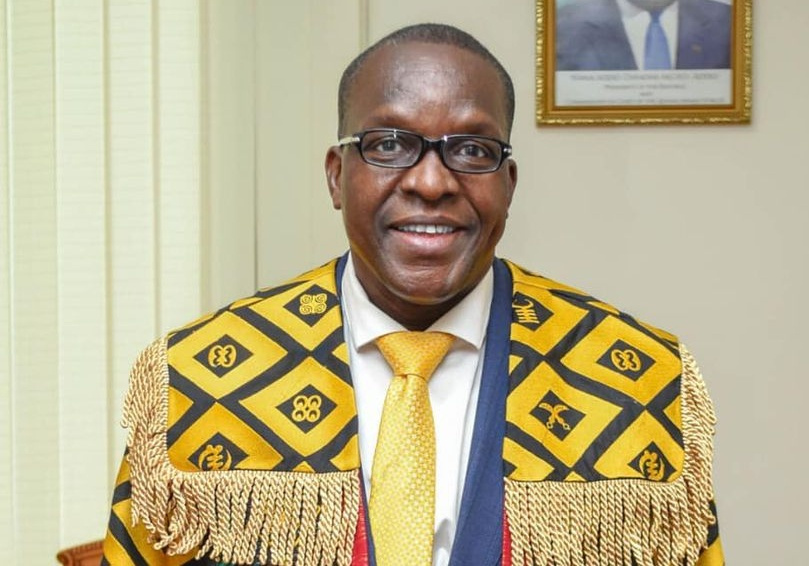
    Before assuming the position of Speaker of Ghana’s 8th Parliament, Alban Sumana Kingsford Bagbin had been a member of parliament representing the people of Nadowli West in the 1st, 2nd, 3rd, 4th, 5th, 6th and 7th parliaments of the 4th republic of Ghana.

    He served as Minister for Health from January 2013 to February 2013.

    Bagbin, in 2019 contested for the NDC’s flagbearer but lost to former President John Dramani Mahama.

    Bagbin, after earning a Bachelor of Arts degree in Law and English at the University of Ghana in 1980, went on to graduate from the Ghana School of Law and was called to the bar in 1982.

    He also holds an Executive Masters in Governance and Leadership from the Ghana Institute of Management and Public Administration (GIMPA).

    Bagbin, prior to venturing into politics, worked as Personnel Manager of the erstwhile State Hotels Corporation consisting of Ambassador and Continental Hotels between 1982 and 1983, before relocating to Libya to teach English in Tripoli at the Suk Juma Secondary School.

    Upon his return to Ghana in 1986, he joined Akyem Chambers, a law firm of legal practitioners, consultants and notaries public, as an attorney, eventually rising to become a partner. Whilst working at Okyeman Chambers, between 1989 and 1992, he was appointed as the external solicitor of the Nii Ngleshie royal family of James Town, Credit Unions Association of Ghana (CUA) and several other private business firms within Accra.

    After working at Okyeman Chambers for seven years, he moved from there in 1993 and, to date, is a partner of the Law Trust company, a legal firm of law practitioners, consultants and notaries public.

    Alban Sumana Kingsford Bagbin was sworn in as Speaker of Ghana’s 8th Parliament on January 7, 2021.

    Source: www.ghanaweb.com

  • Ukraine war: Russia denies it plans to declare war on 9 May

    Russia has dismissed speculation that it will declare all-out war in Ukraine in the coming days as “nonsense”.

    Moscow has up until now denied it is at war, instead referring to the invasion as a “special military operation”.

    But Western officials have speculated that President Vladimir Putin could use the 9 May Victory Parade to announce an escalation of military action.

    Kremlin spokesman Dmitry Peskov, however, said there was no truth to the rumours “at all”.

    UK Defence Secretary Ben Wallace said last week that the Moscow parade – commemorating the defeat of the Nazis and World War Two – might be used to drum up support for a mass mobilisation of troops and renewed push into Ukraine.

    “I would not be surprised, and I don’t have any information about this, that he is probably going to declare on this May Day that ‘we are now at war with the world’s Nazis and we need to mass mobilise the Russian people’,” he told LBC radio.

    Russian officials only refer to the invasion as a “special military operation” to “demilitarise” or “de-Nazify” the country, referencing a baseless claim about Nazis in the Ukrainian government which Moscow used to justify the invasion.

    As well as the annual parade in Moscow, there are also long-standing reports that the Kremlin is planning some sort of additional parade in the city of Mariupol in southern Ukraine, almost all of which is now under Russian control. Ukrainian forces remain in one area of the city – a vast industrial steelworks called Azovstal.

    Latest reports suggest that after the recent successful evacuation of some civilians, attacks on the steelworks have resumedand contact has been lost with the last remaining soldiers inside.

    Ukrainian officials say the streets of the city centre are being cleared of debris, bodies, and unexploded bombs. Large parts of the city lie in ruins, after Russian forces bombarded it relentlessly for weeks under siege.

    Ukrainian politician Alyona Shkrum told the BBC she was expecting things to become more difficult alongside Russia’s victory day celebrations.

    “For Putin and for the empire he’s trying to build, basically this is a symbolic day, right?” she said.

    “So he takes some kind of victory day and he turns it into a big fight right now against Nazis, which is obviously Russian propaganda and completely ridiculous.

    “We are expecting that there will be quite tough times here in Kyiv and in Odesa and in Mariupol, and in other cities for 9 May.”

    Source: bbc.com

  • Kenyans petition Prince William over land evictions

    A group of Kenyans have sought Prince William’s help in getting reparations paid for what they say are human rights abuses committed and land stolen during British colonial rule.

    They also want an apology from the UK government.

    The group is composed of people from the Talai and Kipsigis clans in Kenya’s western Kericho county.

    In a letter to the Duke of Cambridge, lawyer Joel Kimutai Bosek said the UK government had refused to engage with the victims and their representatives.

    He said a request to meet officials from the UK’s Foreign, Commonwealth and Development Office had been denied this week and no opportunity to resolve the matter had been offered.

    Last year, six UN special rapporteurs wrote to the UK government expressing concern over its failure to provide “effective remedies and reparations” to the two clans who were brutally evicted from their farms by the British army in the late 1800s to mid 1960s to make way tea plantations owned by white settlers.

    In response, the UK government said that in 2013 it “made a settlement in the Mau Mau emergency case of 1952-1963 and therefore do not need to provide any further apology or reparation”.

    In their letter, the group has asked Prince William to treat their request with urgency as he prepares to celebrate his grandmother’s Platinum Jubilee, which marks Queen Elizabeth II’s 70 year reign.

    “Our own elderly family members remember the pain of having their homes and land taken away from them at the same time. We have very little to celebrate.”

    In March on a visit to Jamaica, Prince William spoke of his “profound sorrow” over slavery, saying it should never have happened.

    Source: bbc.com

  • Central Region: Residents unwilling to complete COVID-19 dose

    The Central Regional Health Directorate has expressed worry about the reluctance of eligible residents in the region to receive or complete doses of the COVID-19 vaccine.

    This, the directorate indicated, was making the vaccine deployment in the region difficult and hampering the Ghana Health Service’s vaccination campaign.

    Of the 1.3 million eligible persons in the region who have received the vaccine so far, only 32 per cent have received the complete dose, while four per cent have received the boosters.

    About 50 per cent of them have received only the first dose.

    Addressing the media on developments on the pandemic and attempts to remedy the situation in the region, the Central Regional Director of Health, Akosua Agyeiwaa Owusu Sarpong, said the skepticism towards receiving the vaccine stemmed from a variety of factors.

    This, she said, included the belief that the virus was a hoax, while others believed that the vaccine could cause other illnesses.

    She told the press that it was critical for residents to participate in the vaccination exercise so that the region could develop herd immunity and avoid the destruction the COVID-19 virus could wreak.

    “Some individuals have developed vaccine resistance, which is not good for the vaccination campaign in general,” she stated.

    She emphasised that “vaccinations have been around for a long time and our children are still living, and females are reproducing and so the misinformation going round is really disturbing the campaign and we are doing our best to mitigate these impacts by continuing to educate the public.”

    Situation

    Mrs Sarpong further reported that individuals had been less concerned about COVID-19 preventive measures such as handwashing and the use of face masks.

    “Before, when you went to any public place, you would see people mounting the Veronica buckets and strictly enforcing the handwashing measure but that and other restrictions have been eased”, she said, emphasising that it was unsettling.

    Mrs Sarpong added that the region’s status as having no COVID-19 cases currently could only be maintained if residents continued to follow the instructions.

    “Thankfully, there are no active COVID-19 cases in our region but we can only keep this status if we all follow the guidelines and get the vaccines,” she said.

    She emphasised that the Regional Health Directorate had subsequently taken steps to guarantee that all eligible persons in the region were properly vaccinated, particularly the half of the eligible population who had only gotten the first dosage and had not attempted to receive the second dose.

    She urged key stakeholders in the region to join the campaign aimed at assuaging public worries and educating them on the necessity of the vaccines.

  • Supreme Court dismisses injunction application against E-Levy

    The Supreme Court by a unanimous decision has dismissed an application for an injunction at the Supreme Court to stop the implementation of the Electronic Transfer Levy (E-Levy).

    Three Members of Parliament; Minority Leader, Haruna Iddrisu; Mahama Ayariga, the MP for Bawku Central; and Samuel Okudzeto Ablakwa, the MP for North Tongu; are demanding that the Apex Court restrains the Ghana Revenue Authority (GRA) from implementing the E-Levy until the final determination of their suit challenging the constitutionality of its passage by Parliament.

    The injunction application filed by their lawyer, Godwin Kudzo Tameklo, on April 19, 2022, “avers that millions of people will suffer irreparable harm if the E-Levy Act is not put on hold and the court determines that its passage was unconstitutional.”

    According to the suit, GRA would be unable to reimburse the millions who would have paid the E-Levy while the 1992 constitution, which is the supreme law of the land, would have been undermined.

    The court dismissed the application stating that should the substantive case be heard and ruled as unconstitutional, the GRA should keep accurate record for reimbursement.

    The case was presided over by a seven-member panel made up of Justices Nene Amegatcher, Prof. Nii Ashie Kotey, Mariama Owusu, Avril Lovelace Johnson, Gertrude Torkornoo, Henrietta Mensa-Bonsu, Yonny Kulendi

    More soon

    Source: www.ghanaweb.com

  • Press Freedom Ranking: Even Burkina Faso under Military rule is ahead of Ghana – Sulemana Braimah

    The Executive Director of the Media Foundation for West Africa (MFWA), Sulemana Braimah, has bemoaned Ghana’s press freedom ranking in the recent past.

    Braimah indicated that recent activities in the media space in Ghana have led to the country falling by 30 places in the latest World Press Freedom Index, as well as the country losing its leading position in press freedom in Africa.

    He added that what is most worrying is that countries in the West African sub-region under military dictatorships are even doing better than Ghana in terms of press freedom.

    “The verdict is out. Ghana drops record 30 places in 2022 World Press Freedom Index. From 30th to 60th in the world and from 3rd to the 9th in Africa. Even Burkina Faso under Military rule is ahead of Ghana at 41st in the world and 5th in Africa,” a tweet shared by Braimah on May 3, 2022, read.

    The MFWA Executive Director further stated that Ghana’s performance on the 2022 Press Freedom Index is the worst in the last 17 years and represents a 100 per cent drop in the press freedom ranking.

    “Talking about the political conditions under which journalists in Ghana work, the report said: “To protect their jobs and their security, they increasingly resort to self-censorship, as the government shows itself intolerant of criticism”,” another tweet by Braimah read.

    Braimah had previously stated that the Nana Addo Dankwa Akufo-Addo-led government would go down as the worse in the 4th Republic of Ghana in terms of press freedom if the current trend of attacks on journalists in the country does not change.

    He cited the murder of investigative journalist Ahmed Hussein-Suale in 2019, which has still not been resolved, and the criminalisation of speech which has led to recent arrests of some media personalities, as setbacks in the fight for free and credible media.

    Source: www.ghanaweb.com

  • Dampare reportedly lifts interdiction on the personal bodyguard of Madina MP

    The Inspector General of Police, Dr. George Akuffo Dampare, has with immediate effect lifted the interdiction placed on the Personal Bodyguard of the Madina MP, Inspector Daniel Agbavor.

    It will be recalled that the Police release on 31st October 2021 said that the bodyguard allegedly drove into a crowd recklessly after a protest “endangering the lives of two senior officers and other civilians”.

    This was following road demonstrations in Madina and the subsequent attempt by the Police to arrest the MP for Madina Constituency, Francis-Xavier Sosu .

    News of lifting of the interdiction was commuted to the Member of Parliament and the Officer through the Parliament Protection Unit (PPU).

    Source: angelonline.com.gh

  • Floods: We are tired of lip service – Asylum Down residents

    Some residents of Asylum Down in Accra are livid about the perennial flooding of the community and asked Government to address the situation and desist from “lip service.”

    Residents along the main drain at Asylum Down said they had always been submerged by floodwaters with reports of people losing their lives and said it was time the government fixed the problem.

    Mr. Kofi Atsu Dogbadzi, a resident, in an interview with the Ghana News Agency, said Government officials had failed to honor their pledges of fixing the problem after many engagements with the people.

    He said the floodwaters usually accumulate from the Mamobi-Nima stretch through Paloma and to Asylum Down, destroying lives and property.

    “The big gutter is not able to contain the volume of water here in Asylum Down. The flood breaks the wall and overflows. Besides, the gutter is not that deep and needs proper reconstruction,” Mr. Dogbadzi said.?

    “Former Works and Housing Minister Atta Kyea had been here, Zanetor Agyeman Rawlings, MP for Korle Klottey Constituency had been here and Former Assembly leaders as well. We explained to them but they went and nothing happened to date,” Mr. Dogbadzi alleged?

    He said Madam Zanetor Agyeman Rawlings, in her quest to find a solution to the problem, erected parts of the wall destroyed but it got broken again with a heavy flow?

    “We are begging the Government! We are Ghanaians and we deserve better than this…” Mr. Dogbadzi said.

    The main drain has two footbridges connecting Nima, Kokomlemle, Paloma, and Adabraka.

    Residents in these communities complained of the weakness of the bridge and asked for it to be fixed in time.

    Madam Deborah Amiorkor Sarpie, a resident of Asylum Down, said parts of the bridge had broken, exposing metals on the sides and the floor?

    Source: GNA

  • DVLA to arrest, prosecute users of expired DV Plates

    The Driver and Vehicle Licensing Authority (DVLA) is to embark on an enforcement exercise to arrest and prosecute motorists who use expired trade plates contrary to road traffic regulations.

    The Authority said the exercise, which would be carried out in collaboration with the Motor Traffic and Transport Department (MTTD) of the Ghana Police Service had become necessary following an observation that some drivers continued to use expired Defective Vehicle (DV) Plates last year, DV 2021.

    A statement issued by the management of the DVLA, and copied to the Ghana News Agency, said the practice was contrary to Regulation 23(2) of the Road Traffic Regulation, 2012 (L.I. 2180) which stated that “a trade license is valid for a period of one year and only in relation to the specific motor vehicle for which the trade license was issued.”

    The Authority said it had also noted that motor vehicles bearing trade plates were being used for carrying fare-paying passengers, goods, and for hiring purposes against Regulation 23(8) “which only authorizes the carrying of passengers who are engaging in testing or inspecting the motor vehicle with the view of purchasing the vehicle.”

    “Unfortunately, most of the motor vehicles used under a trade plate, do not have the plates affixed on the front and rear of the vehicle, which is also an upfront to the law, specifically, Regulation 23(9) of L.I. 2180.

    Most dealers or fleet owners also failed to enter the movements of the motor vehicle in the trade license logbook as captured in Regulation 24(2) of the Road Traffic Regulation, 2012 (L.I. 2180), it said.

    The Authority also expressed concerns over the use of Direct from Port (DP) plates beyond the stipulated time of two weeks.

    “The misuse of these trade plates is prevalent during holidays and weekends and the Authority wishes to caution the general public against these occurrences,” it said.

    “We wish to remind motorists that the law provides for severe sanctions on persons who contravene the regulations, including imprisonment,” it added.

    The Authority urged dealers, fleet owners, and the general driving public to either get valid trade plates for 2022 (DV 22) or have their vehicles registered before using the road.

    It also urged road users to drive cautiously with the onset of the rains, observe road signs, and avoid careless overtaking and over-speeding to avoid needless crashes.

    Source: GNA

  • Revealed: Bawumia pledged and redeemed GH¢55,000 at ‘Wataniya’ programme in 2019

    Contrary to the viral video going around of a Sheikh claiming Vice President Bawumia failed to redeem a five thousand Cedis (GH¢5000) pledge he made to purchase his book at an event, it has emerged that Dr. Bawumia actually paid the GH¢5,000 Cedis right at the programme, alongside a fifty thousand Cedis (GH¢50,000) pledge he made at same Programme towards the construction of a school.

    The event

    The Vice President was the Special Guest of a Maulid by the Wattaaniya Society in Kumasi in 2019.

    During the ceremony, Dr. Bawumia responded to an appeal by Wattaaniya for support towards the construction of Wataniiya School, by announcing a GH¢50,000 Cedis support.

    Also during the programme, a book written by Sheikh Mohamed Aminu Bamba was launched and auctioned, and Dr. Bawumia pledged to buy a copy of the book for five thousand Cedis.

    Pledge paid

    Right at the ceremony, Dr Bawumia paid the two pledges – that is the support towards the construction of the school and the book – amounting to GH¢55,000 thousand Cedis.

    Indeed available audio and video of the programme confirm the Vice President announced his support of GH¢50,000 Cedis towards the construction of the school, as well as the GH¢5,000 Cedis towards the book, which were both paid.

    Also, a popular Zongo blogger, Peace Dawah Media, which circulated the viral video of the Imam claiming that his five-thousand Cedis has not been paid, has done a rejoinder admitting that Dr. Bawumia announced a combined GH¢55,000 Cedis support at the said programme, which was redeemed.

    Vice President’s office shocked

    An aide to the Vice President, who spoke to GhanaWeb but pleaded anonymity, has expressed shock at the turn of events after three years but says the Office of the Vice President won’t respond publicly to the viral video out of respect for the Sheikh and the Wattaaniya Islamic School.

    The aide to the Vice President rather confirmed that the Vice President paid the two pledges right at the programme, and wondered why the GH¢50,000 Cedis, which was the larger pledge was paid and not the GH¢5,000 Cedis.

    “Clearly, there is some missing link somewhere if the Sheikh is saying he did not receive the GH¢5000 Cedis,” the aide said.

    Another GH¢5000 cedis paid

    Meanwhile, despite Dr. Bawumia redeeming the pledge three years ago, a ‘new’ GH¢5,000 Cedis has been sent to the author of the book.

    The GH¢5,000 Cedis was sent to the author on Sunday, following his public admission that he did not receive it.

    Source: www.ghanaweb.com
  • Use your executive powers to grant workers at least 20% ‘COLA’ – TUC to Akufo-Addo

    Organised Labour has appealed to President Nana Addo Dankwa Akufo-Addo to use his executive powers to grant workers at least a 20 per cent Cost of Living Allowance (COLA) in the wake of the economic hardships being experienced in the country.

    Addressing the 2022 May Day parade at the Black Star Square in Accra on Sunday, the Secretary-General of the Trades Union Congress (TUC), Dr Yaw Baah speaking on behalf of Organised Labour made the special request to the President.

    “With the rising cost of living due to high inflation, we will like to appeal to you [President Akufo-Addo] to use your executive powers to grant a cost of living allowance (COLA) of at least 20 per cent to all public service workers.”

    Dr Baah said the appeal was not only for those on the Single Spine Pay Policy (SSPP) but also for the Armed Forces, the police, prisons, immigration, fire and all the security and intelligence agencies. “The cost of living allowance must also be extended to workers in the private sector who are earning just GH¢365 a month.

    “We also expect that this COLA will be extended to all those pensioners on the SSNIT scheme who are earning just GH¢300 per month. Mr President the proposed COLA will not only cushion workers and pensioners from the harsh effects of inflation but even more importantly, it is prevent mass poverty in this country among the working group who are contributing so much to the development of our country.

    Watch the video below

    “Mr President, Ghanaians are suffering too much, this is not the country that was envisaged by our leaders who fought with their tears and blood to gain independence for us. God has endowed us with gold, diamond, forest, ocean, oil and other resources, therefore, nothing can justify the high incidence of severe poverty, destitution and suffering in Ghana today, 65 years after independence.”

    “It is obvious to us that the numerous IMF programmes in Ghana did not work, it is also clear to us that the partisan approach in dealing with Ghana’s problems is not working. What we need is our own homegrown solutions, supported by all the major stakeholders in the economy, including the executive, parliament, judiciary, workers and their unions, the business community , farmers, traders, NOGs, political parties and civil society organisations. We are confident that Mr President together we can transform our economy into a more resilient and prosperous one which can provide job for the youth and improve standard of living in all the 16 regions of the country.

  • Why are CEOs of loss-making SOEs earning salaries 3 times higher than that of the President? – TUC

    Organised Labour has questioned why Chief Executives and heads of some loss making State-Owned Enterprises (SOEs) are earning salaries that are three times higher than that of even the President of Ghana.

    Addressing the 2022 May Day parade at the Black Star Square in Accra on Sunday, the Secretary-General of the Trades Union Congress (TUC), Dr Yaw Baah speaking on behalf of Organised Labour appealed to President Nana Addo Dankwa Akufo-Addo to ensure that the reward system in the entire public service, including emoluments for Article 71 office holders and the top management of SOEs was totally overhauled.

    He argued that in 2021 and 2022, when public sector workers were given just 4 per cent and 7 per cent pay increases, some state-owned enterprises actually awarded themselves over 25 per cent salary increase even though their salaries are already much higher than workers on the Single Spine Pay Policy (SSPP), and they did so without clearance from the Fair Wages and Salaries Commission (FWSC) as required by Act 737.

    “Chief Executives and top management of SOEs are using public funds to pay themselves very fat salaries and allowances because they know they will not be held accountable,” he said.

    The low level of salaries and the pay inequalities have very serious implications for workers not only when they are in active service but also when they retire, he added.

    Watch the video below

    Review SSPP

    Dr Baah recalled that at the 2022 Labour conferene held at Nkwatia in Kwahu, which was graced by President Akufo-Addo and the Vice-President, Dr Mahamudu Bawumia, “social partners agreed that the Single Spine Pay Policy (SSPP) should be reviewed and a technical committee has since been constituted to review the policy.”

    He urged the committee to present its report before the end of June 2022 so that pay increases can be factored into the 2023 national budget.

    He said they expect the committee to address key challenges that have hindered the effective implementation of the SSPP.

    The first challenge has to do with the low levels of pay for workers. “Some public sector workers on the Single Spine are actually receiving salaries as low as
    GH¢415 a month. This is woefully inadequate for any meaningful life in this difficult times. One of the main objectives of Single Spine was to ensure fairness in the reward system in the public service [but] after 12years of implementation of the policy, pay differential in the public service has actually worsened. We now have a situation where some junior officers in some public service institutions, especially those that are not on the Single Spine are earning much higher than senior officers on the Single Spine structure. Workers on the Single Spine structure are receiving lowest salaries compared to their counterparts on other salary structures in the public service.”

    “The highest salary on the Single Spine now is GH¢7000 per month but some heads of public sector institutions earn over four times this salary. This is not the right thing to do. Infact there are some heads of state-owned enterprises who are earning over three times the salary of the President of the Republic, even though some of the SOEs are making huge losses. Why should a Chief Executive Officer who is managing a loss making state-owned enterprise receive over three times the salary of the President of the country who is managing the entire country, why?

    Again in 2021 and 2022, when public sector workers were given just 4 per cent and 7 per cent, some state-owned enterprises actually awarded themselves over 25 per cent salary increase even though their salaries are already much higher than workers on the Single Spine, and they did so without clearance from Fair Wages and Salaries Commission (FWSC) as required by Act 737.

    Chief Executives and top management of SOEs are using public funds to pay themselves very fat salaries and allowances because they know they will not be held accountable.

    Organised Labour therefore appealed to President Akufo-Addo to ensure that the reward system in the entire public service, including emoluments for Article 71 office holders and the top management of SOEs is totally overhauled.

    The low level of salaries and the pay inequalities have very serious implications for workers not only they are in active service but also when they retire. Currently a significant number of pensioners are receiving the minimum pension of just GH¢300 per month compared to someone on the same pension scheme who is receiving GH¢142,000 a month. I mean, the lowest monthly pension as a ratio of the highest monthly pension is 1:475… this is not right and it must be fixed. Nearly 60 percent of all pensioners on social security receive less than GH¢1000 per month and approximately 90 per cent receive less than GH¢2000 per month when somebody is receiving GH¢142,000 a month. Life is very very tough retirees in Ghana, especially for those who retire ,” he said.

    Source: graphic.com.gh

  • Ghanaian member of ISIS jailed for life in US

    A British-born terrorist of Ghanaian descent, Alexander Kotey has been sentenced to life by a federal judge in Virginia, United States of America.

    Alexander Kotey, was sentenced by a federal Judge, Thomas Selby Ellis at Alexandria District Court in Virginia on Friday, April 29, 2022

    The 38-year-old was condemned to life imprisonment for his central role in the kidnap, torture, and killing of western hostages who were held by the Islamic State in Syria.

    He was a member of a brutal ISIS cell of Britons called the IS Beatles, a nickname given to them by their victims due to their accent.

    The group, which included ringleader Mohammed Emwazi, known as Jihadi John, El Shafee Elsheikh, and Alexander Kotey, was responsible for the murders of a number of hostages in the mid-2010s.

    The convict pleaded guilty to multiple charges against him in September 2021, guaranteeing he would spend the rest of his life behind bars.

    It is widely reported that, during the sentencing on Friday April 29, 2022, British and American families read statements describing their shattered lives.

    Alexander Kotey sat quietly and listened to parents and siblings recount their horror before and after the deaths of their loved ones whom he was directly involved in slaying.

    According to news.sky.com, he showed no emotions as he was handed eight life sentences for his crime.

    He admitted to being directly involved in the detention and hostage-taking of four Americans in 2012 and 2013 who had traveled to Syria as journalists or to provide humanitarian aid and died in Islamic State custody as well as inflicting torture on hostages, including waterboarding and electric shocks with a stun gun.

    Meanwhile, the leader of the group, Mohammed Emwazi was killed in a drone strike in 2015.

    Source: www.ghanaweb.com

  • Policeman allegedly commits suicide

    A police constable allegedly committed suicide at his duty post, a telecommunication office, near the Obetsebi Circle, in Accra, on Wednesday.

    The deceased, identified as Abukari Salifu of the Operational Unit at the police headquarters, Accra, who was suspected to have shot himself with a service rifle, was found in a pool of blood in a washroom at his duty post.

    The Ghanaian Times gathered that police had information about the tragedy at 12:30pm and proceeded to the scene to commence investigations.

    A team from the Crime Scene Unit of the Criminal Investigation Department (CID) visited the scene and the body was conveyed to the Police Hospital Mortuary.

    Eyewitnesses reportedly alerted the police that they heard a sound of a gunshot in the washroom, and when they went to find out what had happened, they found Salifu lying in a pool of blood.

    A statement issued by the Director-General of the Police Public Affairs, Deputy Commissioner of Police (DCOP) Kwesi Ofori, confirmed the tragedy.

    It said, “The Ghana Police Service (GPS) is investigating the circumstances surrounding the death of one of our own, a police officer, who allegedly shot himself, while on duty, on April 27, 2022, at the Graphic Road, Abossey Okai.”

    It would be recalled that there had been a series of alleged suicide by police personnel within the last two years.

    They include Deputy Superintendent of Police (DSP) Divine Asiam, who was with the Legal and Prosecutions Unit of the Ghana Police Service (GPS), until he allegedly shot himself in his room at Borteyman, Accra.

    Superintendent of Police Cyprian Zenge, who was Half Assini District Police Commander, also reportedly shot himself on January 30, 2021.

    Consequently, the GPS, last year, established the Police Counseling Unit to give police personnel and their dependents psychological services and assistance.

    Source: ghanaiantimes.com.gh

  • Coronavirus vaccines expiring Central Regional Health Director laments

    The Central Regional Health Directorate has disclosed that the Coronavirus(COVID-19) vaccines in stock are expiring as residents in the Central Region have stopped taking the vaccines.

    According to the Directorate, residents in the region are reluctant to take the vaccine after the government eased restrictions on the pandemic in the country.

    Addressing the media during a Press Conference, the Central Regional Health Director, Dr. Akosua Agyeiwa Owusu Sarpong said only 50 percent of people in the region have taken the single dose of the vaccines.

    He added that 32 percent have received two doses while four percent have received the boosters.

    The Health Director also indicated that out of over one million vaccines for the region, three hundred thousand have been administered, though the target was to immunize seven hundred thousand.

    She added that the patronage has been very low as compared to when the restrictions were still in force.

    Madam Owusu Sarpong appealed to residents in the Central Region to get vaccinated adding that the vaccines are available in all the Health Centers in the region.

    Background

    President Nana Addo Dankwa Akufo-Addo in March announced sea and land borders which were shut in the wake of COVID-19 outbreak will be opened.

    The President also announced that fully vaccinated travellers will be allowed entry into the country without a negative PRC test.

    “As from tomorrow, Monday, March 28, all land and sea borders will be opened. Fully vaccinated travellers will be allowed entry through the land and sea borders without a negative PCR test result from the country of origin

    “Citizens and foreign residents in Ghana, who are not fully vaccinated, will have to produce a negative 48-hour PCR test result, and will be offered vaccination on arrival,” the President announced in his 28th address since the pandemic on Sunday, March 27, 2022,” he added.

    President Akufo-Addo also stated that wearing of facemask is no more mandatory in the country.

    “All in-person activities, such as those that take place in churches, mosques, conferences, workshops, private parties and events, cinemas, and theatres may resume at full capacity, as long as the audience and/or participants are fully vaccinated. Hand washing and hand sanitising points should be made available at these venues.

    “Outdoor functions at sporting events, entertainment spots, political rallies and funerals may resume at full capacity, again, as long as all persons at these events are fully vaccinated.”

    Source: starrfm.com.gh

  • NPP delegate dies after his candidate failed to win chairmanship race

    A member of the New Patriotic Party (NPP) has been reported dead after the declaration of the constituency election results in the Upper East Region.

    According to the Upper East Regional Chairman for the party, Anthony Namoo who confirmed the news, the delegate, Amaliba Azika collapsed after his candidate lost the elections.

    Amaliba Azika who is said to be an Assembly Member of the Bolgatanga Municipal Assembly was rushed to the Regional Hospital but was pronounced dead upon arrival, Mynewsgh.com reports.

    Speaking in an interview with Bolgatanga-based A1 Radio, Anthony Namoo said, “My condolences also goes to Bolgatanga Central. I understand that after some results were declared, one of our party members collapsed and unfortunately lost his life.

    “That goes to show how people can emotionally invest their minds, hearts, and thoughts in the party. It is our prayer that God will grant him good rest. He died fighting for a course that he believed in,” Mynewsgh.com quoted.

    The New Patriotic Party has begun its elections to select leaders who will lead the party into the 2024 elections on April 29.

    The positions to be contested include Constituency Chairperson, First Constituency Vice-Chairperson, Second Constituency Vice-Chairperson, Constituency Secretary, Constituency Assistant Secretary, and Constituency Treasurer.

    The rest are Constituency Organiser, Constituency Women Organiser, Constituency Youth Organiser, and Constituency NASARA Coordinator.

    Source: www.ghanaweb.com

  • NPP Constituency elections: Desist from any action that will tarnish NPP’s image – Boakye Agyarko

    Former Energy Minister and a potential 2024 flag bearer of the New Patriotic Party (NPP), Boakye Agyarko has called on all contestants of the ongoing constituency elections to save the image of the party.

    The former Minister wants all contestants to eschew any form of practice that will derail the progress of the party.

    The NPP is currently selecting its constituency executives by way of voting across the country. This election is a very important exercise to the party as the constituency executives play major roles for the party.

    Mr. Boakye Agyarko however wants a peaceful exercise and has asked all the executives to ensure a peaceful event.

    He advised, “As I have always insisted upon, it is the responsibility of each and every one of us to avoid any actions and use of any language that will tarnish the good name and image of our party”.

    Boakye Agyarko says he doesn’t want unfortunate incidents that occurred during the polling station elections to reoccur during the constituency elections.

    He has on that note extended the best of luck to all contestants as the elections commence.

    Source: ghanaguardian.com

  • One person dies in a renewed Yong Chieftaincy clash

    One person died with three others sustaining various degrees of injuries in a renewed chieftaincy clash at Yong Dakpema Yile, a farming community in the Tamale Metropolis of the Northern Region.

    The Ghana News Agency gathered that four houses belonging to the combatants were set ablaze.

    Mohammed Chimsi, one of the contestants for the skin in the dispute, and his wife were among the three injured, and are receiving medical attention from the Tamale Teaching Hospital.

    Sporadic gunshot exchanges in the community between the feuding sides allegedly forced some community members to desert the community for safety.

    Police personnel detailed to the scene to bring calm were allegedly attacked by unknown fighters who fired uncontrollably targeting the men in uniform, although none of them sustained any injury at the time of filing this report.

    The Northern Regional Police command has deployed more personnel to the community to ensure the peace and safety of properties.

    The Yong Dakpema Yile community has been nursing a protracted dispute between two brothers over who is the rightful heir to the Yong skin.

    The community for a long time has experienced protracted Chieftaincy conflict leading to fatal clashes and destruction of property.

    Northern Regional Crime Officer, Superintendent Bernard Baba Ananga explained that the police had initiated investigations into the incident to establish the immediate cause of the renewed clash and to help factions get lasting solutions to the conflict.

    Source: GNA

  • Ghana’s media have promoted hate towards members of LGBTQ+ Community – Prof Gadzekpo

    Ghana’s media has for years, acted unfairly toward members of the LGBTQ+ Community through their reportage and failure to call out persons as well as leaders who trample on the rights of this minority group, this is according to Professor Audrey Gadzekpo.

    According to her journalists who are expected to protect minority groups and also give equal opportunity in their coverage have instead stereotyped persons perceived to be homosexuals.

    Prof. Gadzekpo speaking at her Inaugural Lecture on Thursday, April 28, noted that she has been a victim of abuse, just because she was against the ‘controversial’ Anti-Homosexuality Bill.

    “The media, particularly, social media have acted as accelerants of hate against certain social groups, notably in recent times, members of the LGBTQ+ Community. Journalists have betrayed their own biases against sexual minorities by stereotyping and denigrating them in their coverage. By failing to give them adequate opportunity to defend their right and generally failing to challenge those who seek to trample on their human rights,” said the Former Dean, School of Information and Communication Studies at the University of Ghana.

    Speaking at the lecture monitored by GhanaWeb under the theme “Taking the Grown to Town: Reflection of a Scholar-Activist on Media in Ghana’s Democratic Journey’, Prof Gadzekpo called out ‘legacy media practitioners’ for attacks against persons who dare to speak against the abuse and infringement of the rights of members of the LGBTQ+ Community in Ghana.

    She named herself as a victim of verbal abuse for speaking against the anti-LGBTQI+ Bill which she described as inhumane. The Professor is among the 18-member group that submitted a memorandum challenging the anti-gay legislation.

    “It has been disappointing to see how reluctant the media have been to call out traditional leaders who threaten to ban citizens perceived as LGBTQ+ from their towns and villages. I of course have had direct experience of these injustices as a member of a group of eighteen persons who sent a memorandum to Parliament against the proposed Anti-Homosexuality Bill. Not only have we been verbally lynched on social media, but at times, the attack has been carefully orchestrated by legacy media practitioners,” she noted.

    Source: www.ghanaweb.com

  • Current constitution doesnt meet needs of Ghanaians Agyemang-Duah

    A governance expert, Professor Baffuor Agyemang-Duah, has pointed out why the current Constitution does not fully serve the interest of Ghanaians.

    According to him, the current Supreme law of the land concentrates power in the political class instead of vesting these powers in the people.

    His comments were captured on TV3’s major news bulletin on Thursday, April 28, hours after President Akufo-Addo had delivered his address on the 30th anniversary of the referendum that births the Fourth Republic.

    ”In my humble opinion [the Constitution] does not meet the needs of the people,” the one-time Senior United Nations Nations official stressed.

    He explained further: “For a constitution to meet the basic needs of the people that constitution should be seen in action at the grassroots level. Democracy is best when it emerges from the bottom to the top. What we have today, is a democracy that is literally a top-down democracy.”

    President Akufo-Addo in the address raised a number of issues, one of which was the need t amend the Constitution if need be.

    He explained that Constitutions are living documents that needed to be amended to reflect contemporary realities, admonishing the citizenry to reject people who call for coups.

    What Akufo-Addo said:

    “The Constitution is a living document and so whenever circumstances require, we should be prepared to make the necessary amendments to affect the needs of contemporary and future times.

    “Several attempts to take Ghana down the path of multiparty democracy were met with stiff opposition and cynical response. They will rather have authoritarian rule foisted on the citizens claiming Ghana was underdeveloped and we needed to get things done in a hurry.

    “They claimed that democracy was cumbersome and will divide Ghanaians along tribal lines. However, the word was widespread and unanimous to have a decade-long ban on party-political activities imposed in 1981 lifted and the return to multiparty democracy established. The Ghanaian people wanted a living condition of freedom where there was respect for individual liberty.”

    He added: “Simply because they have no respect for the Ghanaian people, they are either unwilling to subject themselves to the open scrutiny of the Ghanaian people or because they know that that they will be rejected by the Ghanaian people.

    “Thus, seeking a shortcut to office in power. Let us resist such persons for our common good.”

    Source: www.ghanaweb.com

  • ‘We are arguably the most stable democracy in West Africa’ Akufo-Addo

    President Nana Addo Dankwa Akufo-Addo has touted Ghana as operating the best democracy in the West African sub-region.

    The president pointed out the political successes of the Fourth Republic in arriving at that conclusion.

    Among others, he cited the peaceful transfers of power since 1992 and the resort to the courts to deal with major electoral disputes after presidential elections.

    “We have had five presidents in the history of the 4th Republic, with peaceful transfers of power from a governing to an opposition party on three separate occasions.

    “Even when there was disagreement with the outcome of an election, it was the Supreme Court, on two occasions, rather than the streets, that validated its result. We are, arguably, the most stable democracy in West Africa,” he added in an address on April 28 to commemorate the 30th anniversary of the referendum that birthed the Fourth Republic.

    In making a strong case for Ghanaians to protect the democracy that has been nurtured over three decades, he stressed: “there are no short-cuts for the progress and prosperity of our country. Only hard work, creativity, innovation, a sense of enterprise and unity in the nation can produce the accelerated economic development that we all yearn for and deserve.”

    The President also urged the citizenry to consolidate their trust in democracy and remain vigilance given that, “the price of liberty is eternal vigilance.”

    “I say so because there are some, who for their own parochial and selfish interests, would want to see a return to the dark days of authoritarian rule, simply because, with no respect for the Ghanaian people, they are either unwilling to subject themselves or their vision to the open scrutiny of the Ghanaian people, or because they know they will be rejected by the Ghanaian people and, thus, seek a shortcut to office and power. Let us strengthen our resolve to resist such persons for our own common good,” he said.

    Source: www.ghanaweb.com

  • LPG will pay GH¢200 monthly allowance to every Ghanaian child if voted into power – Akpaloo

    The Founder and Leader of the Liberal Party of Ghana (LPG), Percival Kofi Akpaloo has asked Ghanaians to forget about National Democratic Congress(NDC) and New Patriotic Party(NPP) to support the Liberal Party of Ghana to initiate the social intervention dubbed ‘Child Benefit’ policy.

    According to him, LPG winning the 2024 elections will ensure the massive transformation of the economy hence his party will initiate a social intervention policy dubbed ‘Child Benefit’ to meet the needs of Ghanaian children if given the nod to govern the nation.

    Kofi Akpaloo explained that the party would roll out policies and programmes to benefit children across all the spheres of social life.

    “The Party intends to pay GH¢200.00 monthly stipend to every Ghanaian child from age one to 18, while twins will receive GH¢300.”

    Kofi Akpaloo told Fiifi Pratt on Accra-based Kingdom Plus FM, that the lack of child welfare policy exposes children to various harmful practices and it was time the nation prioritized children’s welfare.

    He said successive governments failed to prioritize children’s needs, beginning from the country’s democratic dispensation.

    True transformation of the society, he believed could not be achieved without a policy on child rights that supported their education, health and livelihood programmes, particularly in vulnerable constituencies.

    Source: kingdomfmonline.com

  • Man, 20, jailed 15 years for stealing iPhone 7 plus

    An Asamankese circuit court has sentenced a 20-year-old motorbike rider identified as Emmanuel Afanu to 15 years imprisonment for robbery.

    His conviction was after he was found guilty of charges which includes conspiration to commit a crime, to wit, robbery, and robbery.

    The offence is contrary to section149 of the criminal offences Act1960(Act 29).

    According to a myjoyonline.com report, the prosecutor, Inspector Samuel Owusu, said the accused, together with his friend who is at large, on April, 8, robbed his victim of an iPhone 7 plus mobile phone valued at Ghs2,500.00 after he assaulted Sakyi Michael, the complaint, with a pair of scissors at Yayo a suburb of Asamankese.

    The complainant, a student who lives at Anum-Asamakese, and was on his way home at around 7:50 pm when he was attacked.

    The convict is reported to have snatched the complaint phone and during the process the two engaged in fisticuff of which the convict inflicted the victim with a pair of scissors, bolting away with the phone.

    However, Emmanuel Afanu was arrested and sent to the Asamankese Police station by some residents after the complaint screamed for help.

    After a police investigation, he was found guilty and convicted to 15 years imprisonment with hard labour.

    Source: www.ghanaweb.com

  • There are fundamental errors in your ruling, reverse it – Assin North MP challenges Supreme Court ruling

    The Member of Parliament for Assin North has filed for a review to challenge the ruling of the Supreme Court on April 13, 2022.

    On April 13, the Supreme Court in a 5-2 decision barred the Assin North MP from performing parliamentary duties.

    This comes after a citizen of Assin Bereku, by name of Michael Ankomah Nimfah, on January 27, 2022, filed an interlocutory injunction against the MP from performing his parliamentary duties after a high court judgment annulled his election due to the issue of dual citizenship on July 28, 2021.

    The embattled Member of Parliament had appealed against the High Court judgment but was struck out for failing to file written submissions within the mandatory period.

    Based on the Supreme Court ruling, the lawyers of the MP have applied for an order of review of this ruling.

    In the document sighted by Ghanaweb, the lawyers stated the grounds of the application which said that, “the majority decision was in patent and fundamental error and violated article 129(2) of the constitution in assuming jurisdiction over the determination of the validity of the parliamentary election and proceeding to grant the application for an interim injunction.”

    It also states that the majority decision violates articles 296(a) and (b) of the Constitution in exercising discretion unfairly and unreasonably,

    “the decision to proceed with the hearing of application for the interim injunction brought under the High Court(Civil Procedure) Rules C. I 47 prior to the preliminary objection raised but the Applicant herein was per incuriam the binding precedents of Kogledx V. Attieh(2003-2004)1 SCGLR 75 and Ampofo v. Samampa(2003-20042 SCGLR11555, “ he further stated.

    The reliefs sought by the Plaintiff in the writ are stated as follows:1. A Declaration that upon a true and proper interpretation of Article 94(2)(a) of the Constitution, 1992 of the Republic of Ghana at the time of filing his nomination form between 5th October 2020 to contest the 2020 Parliamentary elections for the Assin North Constituency the 1st Defendant was not qualified as a member of Parliament. 2. A Declaration that upon a true and proper interpretation of Article 94(2) (a) of the Constitution, 1992 of the Republic of Ghana the decision of 2nd Defendant to permit the 1st Defendant to contest Parliamentary Elections in the Assin North Constituency when the 3rd Defendant owed allegiance to a country other than Ghana is inconsistent with and violates Article 94(2) (a) of the Constitution of the Republic of Ghana.

    3. A Declaration that upon a true and proper interpretation of Article94(2)(a) of the Constitution, 1992 of the Republic of Ghana the election of the 1st Defendant as Member of Parliament for the AssinNorth Constituency was unconstitutional.

    4. A Declaration that upon a true and proper interpretation of Article94(2)(a) of the Constitution, 1992 of the Republic of Ghana the swearing-in of 1st defendant as a member of Parliament for the Assin North Constituency was unconstitutional, null, and void and of no legal effect.

    Source: www.ghanaweb.com

  • Dome Kwabenya, Odododiodio and other identified hotspots in NPP constituency elections

    The New Patriotic Party’s annual delegate conference at the various constituencies commences today, Thursday, April 28, 2022.

    The five-day event scheduled to end on Monday, May 2, 2022, will conclude with the election of the party’s executives across the various constituencies.

    Preceding the constituency delegates conference was the election of the polling station and electoral area officials of the party, who will, in turn, elect the constituency officials.

    From the onset of the election of polling station officials, several accusations were levelled at some party officials of deliberately denying application forms to some candidates in a bid to favour other candidates.

    The alleged acts of sabotage which led to disagreements caused elevated levels of violence in several constituencies across the country.

    Events from the election of the polling station and electoral area officials, have left the NPP at a tipping point of a likely outbreak of misunderstanding in its constituency elections.

    Dome Kwabenya

    The Dome Kwabenya Constituency has been identified by the NPP as one of four flashpoints in the Greater Accra Region ahead of the annual delegates conference.

    This, according to the NPP’s Greater Accra Regional Chairman, Divine Agorhom, has caused the party to liaise with the security agencies to put in place measures to forestall any unforeseen development.

    “We’ve engaged him [the IGP]. He will be detailing his men to provide security. They have just a few flashpoints for which they would have to beef up on the numbers. Ordinarily, I would have said that the Police Command in the districts should be enough for this except for areas whereas I said earlier we consider flashpoints,” he told Joy News.

    “So far, they [the flashpoint constituencies] are just about four; you know we have quite a volatile situation at Odododiodio, also Dome Kwabenya, you know the situation there. I think these two we can put on air; the rest we don’t want they themselves to even know we consider their constituencies as flashpoints,” he added.

    According to some NPP members in the Dome Kwabenya Constituency, there have been deliberate attempts to expunge names of aspirants aligned to the current MP, Sarah Adwoa Sarfo, from the constituency’s register ahead of the election.

    Some disgruntled party members have sent the matter before the Kwabenya Circuit Court. The applicants have asked the court to grant an injunction stopping the election from taking place until the matter is resolved.

    Akuapem North Constituency

    There has been growing tension in the Akuapem North NPP between members aligned to the incumbent MP, Ama Dokua and the current Director-General of the National Lotteries Authority, Sammy Awuku.

    During the election of polling station officials, members from both sides accused each other of resorting to intimidation, abuse and sabotage against their preferred candidates.

    The Constituency Women’s Organizer of Akuapem North, Awo Boatemaa, speaking of the situation during the election of polling station executives, said, “I wish you were here to witness what is going on; it is unsavoury. When the election started, armed men invaded the town, and we’ve not enjoyed any peace ever since.”

    She added that “I hear Sammy Awuku wants to contest for the MP in Akuapem North. So, when you go to vote for the polling station executives, they tell you to vote for the supporter of Sammy Awuku or Dokua. The election is not an NPP election. It is a Sammy Awuku and Ama Dokua election.”

    The polling station election in Akuapem North is said to have witnessed men clad in police and military uniforms carrying whips, guns and knives intimidating electorates to vote for polling station executives who owe allegiance to a candidate.

    Yendi Constituency

    In the Yendi Constituency, a fierce competition between the incumbent MP, Farouk Mahama and the Chief Executive Officer for the Microfinance and Small Loans Centre (MASLOC), Hajia Abibata Shani Mahama Zakaria, has led to unease in the constituency.

    The same allegations of intimidation, sabotage and abuse were common between the two factions and their supporters during the election of polling station executives.

    At an event held to wrap up campaigning ahead of the constituency executive elections, accusations were traded between the 1st vice-chairman, Baba Gambari and an aspiring constituency chairman, Alhaji Baba Gazale, over the confusion in the constituency.

    While the 1st vice-chairman made allegations of hatred against the incumbent MP by some officials, Alhaji Baba also levelled a counteraccusation of efforts to bring instability into the party.
    There have been several allegations of album manipulation in the Yendi constituency.

    At a press conference held on Sunday, April 24, 2022, Yendi constituency chairman Saddick Nam said, “We are appealing to the party leadership to suspend the elections or change the electoral album. If nothing is done about the situation before the election day, we will take matters into our hands.”

    Subin Constituency

    In the Subin Constituency, the same allegations of album manipulation led some members and disgruntled candidates to stage a protest during the election of polling station executives.

    The protesters went on to lock up the party’s constituency office while threatening to thwart the operations of the party if their names, which allegedly had been deleted from the party album, were not restored.

    Fomena Constituency

    In the Fomena Constituency, some members of the party have been up in arms against what they say are attempts to impose the independent Member of Parliament for the area, Andrew Amoako Asiamah, on the party as a parliamentary candidate.

    The situation led to a protest by the party members, who ended up painting the constituency office of the NPP in the colours of the opposition NDC amidst threats to defect from the party.

    Other constituencies with pending issues

    With the same problems and allegations of deliberate attempts to manipulate albums in favour of some candidates, several constituencies have also experienced agitations and confrontations between party members.

    Some of these constituencies include Bantama, Obuasi, Kade, Juaben North and South, Manhyia, Abirem, Tano North, Hemang, Ahafo and Kwadaso.

    Source: www.ghanaweb.com

  • Gas tanker filled with LPG crashes on Tema motorway

    A gas tanker filled with Liquefied Petroleum Gas (LPG) has crashed on the Tema motorway.

    According to a 3new.com report, the accident occurred on the dawn of Thursday, April 28, 2022.

    Personnel of Ghana Fire Service are reported to be on the ground ensuring the tanker does not explode.

    Also, an empty gas tanker has been transported to the accident scene for the transfer of the LPG in the crashed tanker with the registration number GN 4513-2.

    According to some witnesses on Twitter, the incident has resulted in most of the vehicles heading toward Tema returning back to Accra.

    The Ghana Police Service is yet to comment on the matter, however, there are personnel on the ground controlling the traffic the accident has caused. Motorists using the motorway have been advised to drive carefully.

    Source: www.ghanaweb.com

  • Lands Commission pays courtesy call on National Chief Imam

    Mr Alex Quaynor, the Chairman of the Lands Commission, Mr Alex Quaynor, has led a delegation from the Commission to pay a courtesy call on the National Chief Imam, Sheikh Osman Nuhu Sharubutu, at his residence at Fadama, Accra.

    The call was to ask for his blessings as the Commission embarks on a sensitisation campaign on the provisions of the Lands Act 2020 (Act 1036), which governs land administration in the country.

    The Commission has identified traditional authorities and the clergy as major stakeholders in educating the public on the new legislation.

    The Chairman expressed joy for the opportunity and said the Commission had presence in all the 16 regions of Ghana and responsible for registering land titles in the Greater Accra Region and parts of the Ashanti Region.

    Mr James Dadson, the Acting Executive Secretary of the Lands Commission, explained the structure of the Commission, which has four divisions, comprising the Survey and Mapping, Public and Vested Land Management, Land Valuation, and the Land Registration divisions.

    Section 12 of the Land Act had criminalised the activities of “land guards”, he said, and that both the sponsor and the land guard committed an offence and could be persecuted and jailed for a term of not less than five years and not more than 15 years.

    Therefore, it was imperative for land owners to be abreast of the provisions in the Act and be guided in their land dealings, adding that the Act was one sure way of bringing sanity into the land market.

    Mr Dadson said the public engagement was to ensure free flow of information to every segment of society and called for cooperation to make the exercise successful.

    The delegation presented 10 copies of the Lands Act to the Chief Imam.

    The personalities in the team include the Chairperson of the Greater Accra Lands Commission, Mrs Yvonne Sowah, the Deputy Executive Secretary in charge of Operations, Mr Benjamin Arthur, the Acting Greater Accra Regional Lands Officer, Mr Timothy Anyidoho, and Acting Director of Survey and Mapping, Naa Abdullah Abubakari.

    The others are the Head of Human Resource, Mr Evans Mamphey, Mr Richard Owusu Afoakwah, the Acting Director, PVLMD, Head of Procurement, Mr Randy Glymin, and Mr Michael Appiah, Head of Monitoring and Evaluation.

    The National Chief Imam expressed excitement over the gesture and assured the delegation that he would do his best to ensure that the Lands Act was explained to the Muslim Community at the different mosques.

    Mr Sheikh Aremeyaw Shaib, the Spokesperson to the Chief Imam, expressed gratitude to the delegation and pledged support towards the sensitisation of the Muslim Community.

    Source: GNA

  • What is Akufo-Addo hiding? Ablakwa demands list of 2021 presidential staffers

    Member of Parliament for North Tongu, Samuel Okudzeto Ablakwa, has lamented the continuous failure of President Nana Addo Dankwa Akufo-Addo to furnish Parliament with the list of presidential staffers as required by law.

    This is the second time this month that the Ranking Member on Foreign Affairs is raising the issue of the President’s non-compliance with the Presidential Office Act.

    In early April, Ablakwa raised the matter on the floor of Parliament accusing Akufo-Addo of “violating the laws of our country in such a violent manner.”

    His most recent demand was via his social media handles when he asked whether the President was hiding anything from the public.

    “Prez Akufo-Addo refuses to comply with the Presidential Office Act, 1993 (Act 463) by defiantly not submitting his 2021 list of presidential staffers to Parliament despite the March legal deadline.

    “What is he hiding?” the MP quizzed rhetorically before adding: “Elsewhere, PM Boris Johnson paid a fine for breaking the law.”

    What Ablakwa said in Parliament in early April

    “Section 11 of Act 463 of the Presidential Office Act states relates to an annual report and it provides … the President shall within 3 months after the end of each financial year submit to Parliament an annual report containing the following information; the number of presidential staff employed at the Office, the rank or grade of such staff; and employees in the other public services assigned to the Office.

    “Mr speaker today is the 1st of April, the president is in clear breach of the Presidential Office Act … we cannot accept this as a House. If this delay continues, it undermines the authority of this institution.

    “I recall that virtually every year the president is in breach of this provision and I have to be screaming and crying and yelling before the presidency will comply.

    He added that it is baffling that it takes a lot of effort to get “the President who likes to project himself as a paragon of the rule of law to be violating the laws of our country in such a violent manner.”

    Source: www.ghanaweb.com

  • Why I voted against 1992 Constitution – Sekou Nkrumah explains

    Dr. Sekou Nkrumah, one of the sons of the first President of Ghana, Osagyefo Dr. Kwame Nkrumah, has explained why he voted “No” in a referendum that approved the 1992 Constitution.

    On April 28, 1992, Ghanaians went to the polls to vote for a new Constitution to mark the end of the military regime of the late President Jerry John Rawlings, which started in 1981.

    The results indicated that the majority of the citizens voted “Yes” and by that had chosen democracy, that was how the Fourth Republic was born.

    The results were; 3,408,119 voting ‘YES’ with 272,855 voting ‘NO.’ In percentage terms, 92.59% wanted a new Constitution whereas 7.41% were against it.

    After three decades of political stability in Ghana, Sekou Nkrumah, has been recounting how and why Ghana has reached such height in its democratic dispensation.

    Explaining his decision to vote against the new Constitution of Ghana in 1992, the son of Kwame Nkrumah, who was a one-time member of the opposition NDC said, at the time, he was reluctant and could not comprehend why Rawlings, who came into power through a military coup, would want to “buy” eight more years in the new democratic Ghana.

    According to Sekou, he also voted “No” against the Constitution in 1992 because of the “indemnity clause that sought to protect Rawlings and his PNDC cohorts.”

    “I could not understand why those who fought for probity and accountability, cannot face the music?” Dr. Nkrumah said in a post on his Facebook timeline on Thursday, April 28, 2022.

    He said, those calling for constitutional reforms should take into consideration the views of the two dominant political parties (NPP and NDC).

    “If these two parties who have shared power in the past 30 years do not want constitutional reforms, then it is going to be a long long struggle to achieve reforms.

    “It will mean a lot of pressure from political activists, civil society etc and even then without penetrating the two main political parties, it will be a tall order,” Sekou Nkrumah noted.

    To Kwame Nkrumah’s son, Ghanaians should be proud in celebrating the 1992 Constitution which has created political stability for the past three decades.

    “We as a nation should be proud celebrating 30 years of constitutional rule. For three decades now we have enjoyed political stability, as we move forward towards our fight for economic freedom,” he stressed.

    Source: www.ghanaweb.com

  • Two fake police officers arrested during NPP primaries – Police

    The Ghana Police Service has arrested two men from the Okaikoi South Constituency during the governing New Patriotic Party’s Constituency executive elections.

    DCOP Kwesi Ofori, Director-General of Public Relations, in a statement issued on Thursday, April 28, 2022; explained that the suspects, John Essel Baah and Enoch Kwame Bosompem, were in some police apparel, which created an impression that they were security personnel.

    The suspects, the police said, “were spotted at the Okaikoi South Constituency where the voting was taking place.”

    “We would like to emphatically state that the two suspects are not Police Officers. Meanwhile, they are in custody as the investigation continues.

    “We wish to assure the public that they will be taken through the due process of the law,” the statement from the Police concluded.

    There were agitations at the voting centre in the constituency during after some members protested allegations that about 400 names had been removed from the register.

    Also, there were allegations that some members of the National Democratic Congress (NDC) have been added to the register to increase the fortunes of some aspirants.

    However, the police managed to restore calm for the exercise to commence.

    Four delegates were reported to have been arrested for obstructing the elections in Okaikwei South.

    Source: www.ghanaweb.com

  • GES releases results of 2021 promotion test

    Some 26,954 candidates representing 67.5 per cent were successful out of the 39,918 candidates who were shortlisted for the December 2021 promotion test to various teaching grades within the Ghana Education Service (GES).

    This was contained in a statement released by the GES.

    The promotion test was written for the grades including Deputy Director, Assistant Director I, Assistant Director II and Principal Superintendent.

    Out of the 3,538 candidates who took the test for the, Deputy Director grade, 2,330, representing 65.8 per cent passed.

    Also, 7,785 representing 71 per cent out of the 10,950 candidates who took the test passed for the Assistant Director grade.

    For the Principal Superintendent grade, 2,298 representing 69 per cent were successful, out of the 3,329 candidates, who were shortlisted for the test.

    “Formal promotion letters will be released in due course,” the GES revealed in the statement.

    Source: classfmonline.com

  • Dumsor in Parliament not due to ECG disconnection Parliament

    The Director of Public Affairs, Kate Addo has refuted claims that the Electricity Company of Ghana (ECG) disconnected power to Parliament due to outstanding debt.

    According to her, even though Parliament suffered power outages on Wednesday, the power cut was due to an internal fault.

    “My conversation with the head of the Development Department shows that there was no such disconnection. On Wednesday, we had two power trips, and it had nothing to do with ECG coming to disconnect power from parliament,” citinewroom.com reports

    Her comment comes after a visit by ECG to Parliament on Wednesday, April 27, to serve them following failure to pay some bill arrears.

    The exercise according to ECG was due to the indebtedness of the House.

    Even though the amount owed was not stated, the report indicates that Parliament has a huge debt of over several million cedis.

    It is based on this Kate Addo has denied claims that the ECG had disconnected Parliament power.

    Source: www.ghanaweb.com

  • Nigeria’s illegal oil refineries: Dirty, dangerous, lucrative

    The deaths of more than 100 people following an explosion at an illegal oil refinery in southern Nigeria has thrown a spotlight on the lucrative world of illicit refining, which the BBC’s Mayeni Jones and Josephine Casserly have been investigating.

    Short presentational grey line

    Hours by car, motorbike and on foot brought us to a remote illegal oil refinery – a site recently raided and shut down by the authorities.

    The smell of oil hits the nostrils first before anything is visible. Then, the lush green vegetation falls away and we arrive at a blackened clearing.

    There are puddles of oil on the floor, with burnt, black tree trunks rising from them. The earth is so charred it looks like the scene of a volcanic eruption.

    Polluted creek
    Image source, Fyneface Dumnamene/BBC Image caption, The illegal oil refineries are hidden in the creeks of the Niger Delta

    This is part of a creek in the Niger Delta, a dense network of waterways in southern Nigeria.

    An oil slick glimmers on the water and what must once have been mangroves is now a tangle of bare, grey branches, their roots tinted with oil.

    We are accompanied by local politician, Chidi Lloyd, and his team, who explain how stolen crude oil was brought here by boat.

    In the middle of the clearing are two big, rusting metal cauldrons where crude oil was refined or “cooked”.

    Burnt-out oil refinery equipment
    Image source, Fyneface Dumnamene/BBC Image caption, The illicit refineries are at the centre of a complex criminal network

    A fire is lit in a pit under the cauldron and the crude oil is heated and condensed into different petroleum products from kerosene to diesel. The heated oil is then funnelled into a cooling chamber.

    But this process does not always go to plan – and when it fails, it causes explosions, which can be deadly, such as the one last Friday.

    The large death toll reflects how illegal oil refining has become such a huge employer in Niger Delta over the last decade – in a country where unemployment is soaring.

    Workers camp out at refineries like this for weeks at a time, often working at night for those behind a highly organised enterprise that involves technical, logistical and financial expertise.

    The government estimates that over the last year, more than $3bn (£2.4bn) of oil was stolen. This crude oil, which is siphoned off from official pipelines and then refined in the bush, is sold on the black market in Nigeria or exported.

    Soot v ‘starvation’

    The pollution caused by these refineries is not only felt in the immediate vicinity.

    The gas produced in oil extraction is often burnt off, instead of re-used, in an air-polluting practice called gas flaring. But it is not only informal refineries that do this – even though it is against the law – oil companies are at it too.

    Polluted waterway
    Image caption, The water in the creeks has been blackened by the oil

    But as the illegal oil business has been growing, gas flaring has intensified and air pollution has worsened.

    It is immediately apparent driving into Port Harcourt, the major city in the Niger Delta.

    A thick black cloud of soot hangs in the air, sometimes it is so dense that is impossible to see anything beyond 30m (100ft).

    A night spent sleeping in the city can leave a black residue around the nose, despite having the windows closed. A doctor at a local hospital says he is seeing increasing numbers of patients with respiratory problems linked to the pollution.

    But some, like Osaja who lives in a lavish mansion in the city and asked us not to use his real name, think this is a price worth paying.

    In his soft voice he tells us that he runs two illegal refineries and is involved in supplying stolen oil, as well as refining and selling it.

    His collection of luxury sports cars and swimming pool hint at his wealth.

    “Is it not better you live in a polluted environment than you die of starvation? If you are hungry will you smell anything?

    “If the reason for the pollution is generating enough funds for everybody to live, you’ll even forget that there’s pollution,” he says.

    ‘Modern-day Robin Hood’

    Some of those who have failed to find jobs elsewhere agree.

    A photographer in his 30s tell us how he started doing jobs at a refinery in the bush when he could not find enough work.

    He “cooked” the crude oil – which produces a lot of smoke that the workers inhale. He said when it went wrong and explosions occurred they would run into the creek, but that did not always bring safety as if there was oil on the water it would catch fire.

    The dangers involved convinced him to stop.

    Burned ground at an oil refinery
    Image source, Fyneface Dumnamene/BBC Image caption, The illegal refineries have destroyed the land and the waterways close by

    But a computer science graduate, who got involved in the industry after struggling to find professional work, is less worried about safety issues – even as a woman out on the creeks.

    She is in her 40s, with long hair and silver earrings, and uses her boat to transport drums of oil to and from the refineries: “I’m a riverine woman, it’s not so difficult for us.”

    Those involved in the illicit trade told us if the government intends to crack down on illegal refineries – as Rivers state Governor Ezenwo Nyesom Wike is doing – something needs to be done about providing jobs.

    They also think the illicit trade will not be easy to stop given how many sections of society are involved, including law enforcement.

    Osaja says he regularly pays bribes to protect his refineries from being raided: “Everybody is involved. It’s organised crime.”

    Meanwhile the police are investigating allegations from the Rivers state governor that a senior officer is operating an illegal refinery.

    Burnt-out vehicles
    Image source, Arise TV Image caption, The burnt-out remains of vehicles were all that was left after last week’s fire at an illegal refinery in Imo state

    For Osaja, illegal refining is not just about making money. He sees himself as a Robin Hood figure, stealing from the oil companies to give to the people.

    His home village has been a very productive location for oil companies, but the local people are still impoverished, lacking basic amenities, he says.

    “We have seen so much injustice. What is going to the local community? Nothing! Zero!

    “This is our property. This is my own and you are taking it, what are you giving to me? So now everybody has tasted the black gold [and] how useful it is to the society.”

    Map

    Source: bbc.com

    1px transparent line

  • Ukraine war to cause biggest price shock in 50 years – World Bank

    The war in Ukraine is set to cause the “largest commodity shock” since the 1970s, the World Bank has warned.

    In a new forecast, it said disruption caused by the conflict would contribute to huge price rises for goods ranging from natural gas to wheat and cotton.

    The increase in prices “is starting to have very large economic and humanitarian effects”, Peter Nagle, a co-author of the report, told the BBC.

    He said “households across the world are feeling the cost of living crisis”.

    “We’re particularly worried about the poorest households since they spend a larger share of income on food and energy, so they’re particularly vulnerable to this price spike,” the senior economist at the World Bank added.

    Energy prices are set to increase more than 50%, pushing up bills for households and businesses, the World Bank says.

    The biggest rise will be in the price of natural gas in Europe, which is set to more than double in cost. Prices are forecast to fall next year and in 2024, but even then will remain 15% higher than they were last year.

    The World Bank said this means that from the lows of April 2020 until the highs of March this year we have seen “the largest 23-month increase in energy prices since the 1973 oil price hike”, when tensions in the Middle East sent prices soaring.

    oil-producing platform is seen at Pechora Sea, Russia
    Image source, Anadolu / Getty Image caption, Energy prices are soaring because of Russia’s invasion of Ukraine and set to remain high into 2024
     

    Similarly oil prices are expected to remain elevated into 2024 with a barrel of the benchmark measure, Brent Crude, projected to average $100 this year, something which will lead to widespread inflation.

    Russia produces about 11% of the world’s oil, the third biggest share, but the report said “disruptions resulting from the war are expected to having a lasting negative effect” as sanctions mean that foreign companies leave and access to technology is reduced.

    Russia currently provides 40% of the EU’s gas and 27% of its oil, but European governments are moving to wean their countries off of supplies from Russia . That has helped push up global prices by creating more demand for supplies from elsewhere.

    Wheat set for record highs

    The World Bank commodity outlook also warned many foods are set to see steep rises in their costs. The UN food prices index already shows they are at their highest since records began 60 years ago.

    Wheat is forecast to increase 42.7% and reach new record highs in dollar terms. Other notable increases will be 33.3% for barley, 20% for soybeans and 29.8% for oils and 41.8% for chicken. These increases reflect the fact that exports from Ukraine and Russia have fallen drastically.

    Before the war the two countries accounted for 28.9% of global wheat exports according to JP Morgan, and 60% of global sunflower supplies – a key ingredient in many processed foods – according to S&P Global.

    food market in Colombo
    Image source, AFP Image caption, The rising cost of food has contributed to protests against the government in Sri Lanka
     

    Prices for other raw materials including fertilisers, metals and minerals are also predicted to go up. The costs of timber, tea and rice are amongst the few expected to fall.

    “Wheat is one of the hardest agriculture exports to replace,” according to a research note from the Bank of America. It points out that poor weather conditions in North America and China are likely to exacerbate the impact of Ukrainian supplies being reduced, something which will continue because the war has disrupted the spring planting season.

    The note also suggests grain and oilseed shipments from Ukraine have fallen more than 80% because of the fighting and these lost exports, over the course of a year, “equate to about 10 days of world food supply”.

    The chief executive of Archer Daniels Midland, one of the world’s four big food commodity traders, said he does not expect prices to come down soon.

    As the US firm announced a 53% increase in net earnings for the first three month of this year, to $1.05bn, Juan Luciano said: “We expect reduced crop supplies – caused by the weak Canadian canola crop, the short South American crops, and now the disruptions in the Black Sea region – to drive continued tightness in global grain markets for the next few years”.

    Peter Nagle
    Image caption, The World Bank’s Peter Nagle says rising food prices are having “very large economic and humanitarian effects”

    Mr Nagle, from the World Bank, said other countries can help solve the supply shortage caused by Ukraine’s war in the medium term. However a forecast 69% increase in fertiliser prices this year means “there’s a real risk that as farmers start to use fewer fertilisers, agricultural yields will decline”.

    For commodities overall, the World Bank report said: “While prices generally are expected to peak in 2022, they are to remain much higher than previously forecast.”

    It added that “the outlook for commodity markets depends heavily on the duration of the war in Ukraine” and the disruption it causes to supply chains.

  • Gazprom halts gas supply to Poland and Bulgaria as Russia accused of blackmail

    Poland and Bulgaria have accused Moscow of “blackmail” after the Russian energy giant Gazprom said it had cut off gas exports to the countries.

    Poland’s deputy foreign minister, Marcin Przydacz, told the BBC that Russia was seeking to “foster divisions” between Western allies.

    EU Commission President Ursula von der Leyen said the move showed Russia’s “unreliability” as an energy supplier.

    It follows Poland and Bulgaria’s refusal to pay for gas in roubles.

    Last month, Russian President Vladimir Putin decreed that all energy payments must be made in the Russian currency.

    The move, which was designed to shore up the faltering currency which has been battered by Western sanctions, has been fiercely resisted by European nations.

    In a statement issued on Wednesday, Gazprom said it had “completely suspended gas supplies” to Poland and Bulgaria in line with the decree issued by Mr Putin.

    The company also warned the countries – which are transit states for Russian gas – that any unauthorised withdrawal of gas intended for other European nations would see supplies reduced by an equivalent amount.

    Polish state gas company PGNiG confirmed that Gazprom’s supplies to the country had been halted and warned that it reserved “the right to seek compensation” and would use “all available contractual and legal means to do so”.

    A map of gas pipelines across Europe

    PGNiG bought 53% of its gas imports from Gazprom in the first quarter of this year, but Warsaw has said it can get gas from other sources. It described the suspension as a breach of contract, adding that the company would take steps to reinstate the gas supply.

    Bulgarian Prime Minister Kiril Petkov said the country was reviewing all of its contracts with Gazprom, including for transit of Russian gas to Serbia and Hungary, emphasising that “one-sided blackmail was not acceptable”.

    Bulgarian Energy Minister Alexander Nikolov said Russia was using gas as a “political and economic weapon in the current war”.

    Sofia, which relies on Gazprom for more than 90% of its gas supply, said overnight it had taken steps to find alternative sources but no restrictions on gas consumption were currently required.

    A host of Western leaders condemned Gazprom’s move on Wednesday morning.

    UK Deputy Prime Minister Dominic Raab told Sky News the decision to cut off gas supplies would have “a very damaging effect on Russia”.

    He added that the decision would further isolate Russia and lead to it becoming “an economic pariah”.

    In a statement, EU Commission President Ursula von der Leyen said Gazprom’s move was “unjustified and unacceptable”, and argued that the decision showed “once again the unreliability of Russia as a gas supplier”.

    EU Commission President Ursula von der Leyen
    Image source, Getty Images Image caption, Ursula von der Leyen said the EU will support member states impacted by the gas freeze

    She added that the bloc was “prepared for this scenario” and that European leaders have been working to “ensure alternative deliveries and the best possible storage levels across the EU”.

    Ahead of Gazprom’s move, Ukrainian President Volodymyr Zelensky’s chief of staff accused Russia of “beginning the gas blackmail of Europe”.

    Andriy Yermak said that Moscow was seeking to use energy resources as a “weapon” and called on the EU to “impose an embargo on energy resources, depriving the Russians of their energy weapons”.

    But Vyacheslav Volodin, speaker of the Duma – the lower house of Russia’s parliament – praised Gazprom’s move and urged it to take similar action against other “unfriendly” countries.

    Warsaw said it had “taken some decisions many years ago to prepare for such a situation” and PGNiG said its underground gas storage was almost 80% full and, with summer approaching, demand was lower.

    Europe depends on Russia for more than a third of its gas needs and Gazprom holds a monopoly on pipeline supplies in Russia.

    While the EU has been firm that it will not comply with Mr Putin’s demands that payments be made in roubles, several European nations, including Slovakia and Hungary have reached workaround deals with Gazprom.

    The countries will pay into a euro-denominated account with Gazprombank, a subsidiary of the energy giant, which in turn will deposit the amount in roubles.

  • Cutting gas supply is an instrument of blackmail, says EU

    Russia’s decision to stop delivering gas to customers in Europe is “an instrument of blackmail”, European Commission chief Ursula von der Leyen says.

    The move is “unjustified and unacceptable” and shows the unreliability of Russia as a gas supplier, she adds.

    She says EU member states have contingency plans in place for this scenario and the European Commission is in close contact with them to ensure alternative deliveries and the best possible storage levels across the bloc.

    A meeting of the gas coordination group is taking place now to map out the EU’s coordinated response, von der Leyen adds.

    “We will also continue working with international partners to secure alternative flows – and I will continue working with European and world leaders to ensure the security of energy supply in Europe,” she says.

    “Europeans can count on our full support.”

    Source: bbc.com

  • ‘EU must stock up on gas before winter’

    Europe needs to find new sources of gas now in order to meet its energy demands this winter, energy expert Samuel Ciszuk from the ELS Anaylsis consultancy tells the BBC.

    He says there’s pressure on all EU countries to start increasing gas storage supplies in preparation for the colder months, when demand is higher.

    “Going into the summer, everything is about stocking up.”

    “There have been orders going out from several governments to companies in their countries to buy as much as possible in order to fill their storages,” he said. “Even including buying as much Russian gas as possible.”

    Ciszuk added that one unanswered question is what will happen to Russian gas originally destined for Poland and Bulgaria.

    “What remains to be seen is whether Russia will offer some of these volumes to buyers other than Poland,” he says.

    Source: bbc.com

  • Elon Musk strikes deal to buy Twitter for $44bn

    The board of Twitter has agreed to a $44bn (£34.5bn) takeover offer from the billionaire Elon Musk.

    Mr Musk, who made the shock bid less than two weeks ago, said Twitter had “tremendous potential” that he would unlock.

    He also called for a series of changes from relaxing its content restrictions to eradicating fake accounts.

    The firm initially rebuffed Mr Musk’s bid, but it will now ask shareholders to vote to approve the deal.

    Mr Musk is the world’s richest person, according to Forbes magazine, with an estimated net worth of $273.6bn mostly due to his shareholding in electric vehicle maker Tesla which he runs. He also leads the aerospace firm SpaceX.

    “Free speech is the bedrock of a functioning democracy, and Twitter is the digital town square where matters vital to the future of humanity are debated,” Mr Musk said in a statement announcing the deal.

    “I also want to make Twitter better than ever by enhancing the product with new features, making the algorithms open source to increase trust, defeating the spam bots, and authenticating all humans,” he added.

    “Twitter has tremendous potential – I look forward to working with the company and the community of users to unlock it.”

    The move comes as Twitter faces growing pressure from politicians and regulators over the content that appears on its platform. It has drawn critics from left and right over its efforts to mediate misinformation on the platform.

    In one of its most high-profile moves, last year it banned former US President Donald Trump, perhaps its most powerful user, citing the risk of “incitement of violence”.

    At the time Mr Musk observed: “A lot of people are going to be super unhappy with West Coast high tech as the de facto arbiter of free speech.”

    News of the takeover has been cheered by the right in the US, although Mr Trump on Monday told Fox News he had no plans to re-join the platform.

    The White House declined to comment on the takeover but spokesperson Jen Psaki told reporters: “No matter who owns or runs Twitter, the president has long been concerned about the power of large social media platforms.”

    On Twitter, MP Julian Knight, chairman of the UK’s Digital, Culture, Media and Sport Committee, called the deal an “extraordinary development in the world of social media”.

    “It will be interesting to see how a privately owned Twitter (run by a man who is an absolutist over free speech) will react to global moves to regulate.”

    BBC environment analyst Roger Harrabin says scientists are nervous about the potential impact of the takeover on the climate debate.

    He notes that Twitter announced last week it would ban advertisements that deny the scientific consensus on the climate crisis, with the firm admitting that misleading information can undermine efforts to protect the planet.

    Elon Musk and Twitter logo
    Image source, Getty Images


    Controversial history


    Mr Musk, who has more than 80 million followers on Twitter, has a controversial history on the platform himself.

    In 2018 US financial regulators accused him of misleading Tesla investors with his tweets, claims that were resolved in a $40 million settlement and that Mr Musk continues to deny.

    And in 2019 he was hit with a defamation suit – which he successfully defeated – after calling a diver involved in rescuing schoolboys in Thailand “pedo guy” on the platform.

    On Monday, Mr Musk, who has been known to clash with journalists and block critics, suggested that he saw Twitter as a forum for debate.

    “I hope that even my worst critics remain on Twitter, because that is what free speech means,” he wrote just hours before the deal was announced.

    Can Musk turn Twitter around?


    As part of the takeover, which is expected to close later this year, Twitter’s shares will be delisted and it will be taken private.

    Mr Musk has suggested this will give him freedom to make the changes he wants to the business.

    Among other ideas, he has suggested allowing longer posts and introducing the ability to edit them after they have been published.

    Twitter shares on Monday closed more than 5% higher after the deal was announced.

    But the price remained lower than Mr Musk’s $54.20 per share offer, a sign that Wall Street believes he is overpaying for the firm.

    Mr Musk has said he doesn’t “care about the economics” of the purchase. However, he will take on a company with a chequered record of financial performance.

    Despite its influence, Twitter has rarely turned a profit and user growth, particularly in the US, has slowed.

    The company, founded in 2004, ended 2021 with $5bn in revenue and 217 million daily users globally – a fraction of the figures claimed by other platforms such as Facebook.

    Bret Taylor, chair of Twitter’s board, said it had fully assessed Mr Musk’s offer and it was “the best path forward for Twitter’s stockholders”.

    Parag Agrawal
    Image source, Twitter Image caption, Parag Agrawal succeeded Twitter co-founder Jack Dorsey in November

    It is not clear who will lead the company moving forward. Twitter is currently led by Parag Agrawal, who took over from co-founder and former boss Jack Dorsey last November.

    But in his offer document, Mr Musk told Twitter’s board: “I don’t have confidence in management.”

    Mr Agrawal told employees on Monday that the future of Twitter is uncertain.

    “Once the deal closes, we don’t know which direction the platform will go,” he said, according to the Reuters news agency.

    Mr Musk’s targeting of Twitter has moved at remarkable speed. It emerged at the beginning of April that he had become the largest shareholder in the firm with a 9.2% stake.

    He was then invited to join Twitter’s board but turned down the offer before launching a surprise bid for the company on 14 April, saying he wanted to “unlock” its potential as a bastion of freedom of speech.

    Twitter tried to fend off his bid, threatening to dilute the shareholdings of anyone who bought more than a 15% stake in the firm. However, its stance shifted after Mr Musk revealed more financial details about his proposed bid.

    He has secured $25.5bn of financing for the deal and will take a $21bn stake in the business.

    The board unanimously approved the bid, which will now be presented to shareholders for a vote.

    line
    Analysis box by James Clayton, North America technology reporter

    Elon Musk: Twitter’s new king


    The speed this move has happened at had many heads in Silicon Valley spinning.

    From nowhere, Elon Musk is the absolute monarch of Twitter.

    He himself has said it’s not about the “economics”, this is about power and influence.

    By taking the company private he will exercise total control over Twitter.

    He has the power to do with the company as he pleases. In practice that will mean a much lighter moderation policy.

    He also says that he will make its algorithm public – so that people can better understand how Twitter works.

    The move leaves the door open to Donald Trump’s return to the platform, though he apparently says he would rather use his own social media platform Truth Social for now.

    For years conservatives have argued that Twitter is biased against them – and the news has left Republicans in the US delighted.

    Others have been left dismayed at what Twitter might look like without strong platform moderation.

    You only need to look at how much criticism Facebook has received for not taking down groups linked to the QAnon conspiracy theory, or the Stop the Steal movement to imagine how much criticism Elon Musk is in store for.

    The danger that Twitter now faces is that unfettered free speech on social media can become very ugly, very quickly.

  • What do I need again after coaching at the World Cup? – Coach Kwesi Appiah

    Former Black Stars coach, Kwesi Appiah believes that he has seen it all when it comes to managing a football team at the highest level.

    Speaking on Untold Stories TV, Kwesi Appiah questioned why he has to return to active football when he has already led the Black Stars at the 2014 World Cup.

    According to him, having been a coach and a footballer has taught him a lot and he now wants to impart knowledge to the young ones.

    “I have been a player and I have been a coach, for me to coach at the World Cup level what do I need again,” the former Black Stars coach said.

    He explained that he enjoys his current work at Kenpong Academy more because there is no pressure on him and has taken him away from verbal abuse by football fans.

    “It’s good to impact knowledge and for me being at Kenpong Academy, I love it more than up there.

    “Because up there you do the best that you can, those who are coming to compete against you are also coming to do their best,” he stated.

    Coach Kwesi Appiah managed the Black Stars at the 2014 World Cup where Ghana crashed out at the group stages for the first time.

    He returned to the scene again for the 2019 AFCON where the Black Stars were knocked out at the Quarter-final stages.

    Source: www.ghanaweb.com

  • Meet the British footballer of Ghanaian descent who played for Arsenal, Chelsea

    Anita Asante, a British footballer of Ghanaian descent has announced that she will draw down the curtain on her 19-year professional career at the end of the 2021/2022 Women’s Premier League season.

    Asante made her retirement announcement on Tuesday, April 26, 2022, with her final game set to be against Birmingham this weekend.

    ”It was a difficult decision to make and I’m enjoying my season with Villa at the moment. But every journey must come to an end and for me, I think it’s the right time to hang my boots up and give thanks to everyone who’s helped me along my journey,” she said as quoted by skysports.com.

    Here is a look into her 19 years of professional career

    Clubs career

    Anita Ama Asante, born on April 27, 1985, turned 37 years on Wednesday, April 27, 2022.

    She was born and bred in the UK and thus spent a chunk of his career in the European country.

    Asante started her club career at Arsenal. She joined the youth team in 1998 and made her debut for the first team in 2003.

    The center back played for 9 different clubs, amongst them, Arsenal was her longest-serving club. She spent 5 spells with the team, where she achieved most of her successes.

    Asante joined rival London club, Chelsea in 2008 before traveling abroad to join US-based Sky Blues.

    During her time in the US, she played for Saint Louis Athletica, Chicago Red Stars, Washington Freedom, and back to Sky Blues all in the space of two years.

    She then moved to Sweden in 2012, spending five seasons in the Swedish league- one season at Goteborg and four seasons at FC Rosengard/Malmo.

    She then return to England, joining Chelsea in 2018 before a move to Aston Villa in 2020, where sj=he will call it a wrap.

    International career

    Anita Asante served the English national team for 11 years after playing at all levels in the youth team, including being named as the captain of the U19.

    She made her senior debut in 2004 when she came on as a substitute in a game against Iceland.

    She played at four different major tournaments for England, namely Euros- 2005, 2009, 2013, and the World Cup in 2011.

    She made a total of 71 appearances for England. Her 50th game was a 1-0 win over Japan at the 2011 World Cup.

    Anita scored one goal in her international career, her goal gave England a 1-0 win against Norway in a friendly in 2005.

    Honours

    Asante is one of the most decorated female British players. She is a Quadruple winner and a double winner.

    At Arsenal, she won the UEFA Women’s Cup (Arsenal) in 2007 the FA Women’s Cup 3 times -2004, 2006, 2007, 2008, the FA Women’s National Premier League 4 times 2004, 2005, 2006, 2007, 2008, and FA Women’s Premier League Cup 3 times 2005, 2005, 2007.

    She won the quadruple with Arsenal in 2007 (UEFA Cup, League, League Cup and FA cup) and a double in 2006 and 2008 all at Arsenal – League and FA Cup.

    Her spell in Sweden also landed her four trophies, the Svenska Cupen in 2012 and Svenska Supercupen in 2013 while at Göteborg. She won the same trophies with FC Rosengard/Malmo in 2015 and 2016.

    Coaching Career

    Anita Asante has sight at coaching right after retirement. She has revealed that she is on the verge of completing her UEFA B coaching badge.

    “I’m currently completing my UEFA B [coaching] badge at the moment, and I hope to continue that journey and explore it.” she said.

    Source: www.ghanaweb.com

  • We’ll be pushed out of business, workers to be sacked – MoMo Agents

    General Secretary of Mobile Money Agents Association of Ghana, Evans Otumfour, has said the wrong implementation of the Electronic Transfer Levy (E-Levy) will badly affect them.

    According to him, many businesses would be cut off, whiles workers will also be laid off if the MoMo business is not brisk as usual.

    Speaking in an interview on 3FM’s Sunrise show on April 25, Mr Otumfuor said, “Even before we finally reach the implementation, signals we are picking from our business suggest a lot of unforeseen situations like people going to have their business cut off and our workers will stand being laid off. As it stands now business is not as usual as we used to have it.”

    He stated that the business has taken a nosedive since the announcement of the controversial E-Levy.

    Evans Otumfuor, therefore, called on government to intensify public education for there to be a smooth running of MoMo business.

    It would be recalled that Finance Minister, Ken Ofori-Atta, on Tuesday, March 29, 2022, moved the motion for the passage of the E-Levy bill at a revised rate of 1.5% in Parliament.

    This 1.5% levy will be charged on all electronic transfers of about GH¢100. It’s a move by the goverment to widen the country’s tax net.

    A total of GH¢6.9 billion target would be generated by the end of the year.

    Source: www.ghanaweb.com

  • 5-2 Supreme Court ruling: ‘Ousted’ Assin North MP files for review

    Injuncted Assin North Member of Parliament, James Gyakye Quaysonis back in court nearly two weeks after the Supreme Court barred him from performing parliamentary duties pending the determination of a substantive suit.

    The MP is seeking a review of the 5-2 majority ruling that he believes resulted in what he termed as, “a grave miscarriage of justice against the people of Assin North as well as myself.”

    Mr. Quayson contends that the apex court lacked jurisdiction to determine the validity of a parliamentary election as it is the High Court that has such exclusive jurisdiction.

    He again emphasized that the Supreme Court in its ruling failed to observe that the writ upon which it based its ruling sought to invite the court to enforce a High Court ruling.

    “The majority decision was in patent and fundamental error and violated article 129(3) of the Constitution in assuming jurisdiction over the determination of the validity of a Parliamentary election and proceeding to grant the application for interim injunction.

    “The majority decision was in patent and fundamental error in failing to appreciate that the suit was I reality an attempt to enforce the decisions of the High Court disguised as an invocation of the original jurisdiction of the Supreme Court,” part of the review application read.

    Mr. Quayson further maintained that the Supreme Court granting an order of interlocutory injunction pending the determination of the [substantive] suit when what the applicant was seeking by [the] this application was for the execution of decisions in the courts below… constituted an error and a gross miscarriage of justice.

    Meanwhile, the review application is expected to be heard on Tuesday, May 17, 2022.

    Background

    In July 2021, a High Court in Cape Coast nullified the election of the Assin North MP, after it found that he owed allegiance to Canada at the time of filing his nomination forms to contest the polls.

    Michael Ankomah Nimfah, a resident of the constituency, filed the petition in court and later initiated another action at the Supreme Court to enforce the High Court’s decision.

    He urged the Court to prevent a further breach of the constitution by restraining the MP.

    On Wednesday, April 13, the Supreme Court in a 5-2 decision ruled on the issue by barring the Assin North MP from performing any Parliamentary duty.

    This is until the determination of the substantive case filed against him at the Supreme Court.

    Source: www.ghanaweb.com

  • Fuel station manager jailed 120 months for stealing GH¢398,000

    Ernest Boakye, a 30-year-old fuel station manager of the Kwahu-Tafo branch of Infin Ghana Limited has been jailed for 120 months in hard labour by the Mpraeso Circuit Court for stealing GH¢398,545 belonging to his employer.

    He pleaded not guilty to stealing, was slapped with the sentence after the court, presided over by Stephen Kumi held that the prosecution proved its case beyond a reasonable doubt to establish his guilt.

    Delivering his sentence, Stephen Kumi, the Circuit Court judge said Boakye deserved to be punished to serve as a deterrent to employees who engaged in fraudulent deals which could potentially collapse businesses and demotivate people in opening businesses, leading to an increase in the already high unemployment rate.

    According to the court, it could also not gloss over the fact that Boakye committed the crime in 2021 at the height of the COVID-19 pandemic when businesses were laying off workers and people were in distress.

    “The complainant company did not lay off the convict. He still kept his job to enable him to take care of himself and his family. Instead of reciprocating this gesture by working diligently and with integrity, he rather decided to betray the trust of the company and stole such a huge sum of money from them,” the presiding judge said.

    The prosecution presented a case to the court that in May last year, the administrator of Infin Ghana Limited noticed some discrepancies in the pay-in-slips by Boakye as against the bank statements.

    In view of the discrepancies, on June 16, 2021, officers of the company conducted a check on the sales by Boakye and realised that he had stolen GHC92,457. The company then caused his arrest.

    According to the prosecution, on July 5, 2021, the company sent its internal auditor to conduct an audit on the accounts of the Kwahu-Tafo branch, and realised that Boakye had stolen a total of GH¢398,545.56 from the company.

    Source: www.ghanaweb.com

  • Ghana has not forgotten so soon – Disgruntled Menzgold customers call for Stonebwoy’s arrest

    Some disgruntled customers of the defunct gold-trading company, Menzgold Ghana, have sent a reminder to award-winning dancehall artiste, Livingstone Etse Satekla, popularly known as Stonebwoy, that they have not forgotten his role in putting them through their current plights.

    According to the Coalition of Aggrieved Customers, Stonebwoy should not deceive himself that he can easily re-introduce another investment of similar fashion to Menzgold to his huge fan-base and get away with it.

    “Ghana has not forgotten so soon that Livingstone Etse Satekla alias Stonebwoy was one of the lead brand ambassadors for the botched MenzGold investment where in a similar fashion he and others lured their followers into investing in MenzGold which has resulted in the deaths of not less than 179 victims with many others down with various degrees of ailments,” portions of the statement said, reports classfmonline.com.

    The group has since called on the Economic and Organised Crime Office (EOCO), and the Criminal Investigation Department (CID) of the Ghana Police Service to arrest Stonebwoy for endorsing and promoting an unlicensed financial scheme called SidiCoinNFT.

    Stonebwoy recently announced the new investment scheme via a tweet but the coalition wants even stiffer punitive actions to be taken against the dancehall: to be stripped of any “national or corporate award” he has earned.

    “It should be noted that Stonebwoy has over 2.8 million followers on Twitter, over 3.1 million followers on Facebook and over 4 million followers on Instagram and as such we must not take his influence lightly.

    “This unlicensed sidicoinNFT has been structured in almost the same manner as MenzGold was. Their legal terms, purity of gold of the coin being offered, fixed percentages of dividends one is assured, and language of their terms and conditions cleverly tells you that this business is a Nam1- made- scam,” the statement co-signed by its Public Relations Officer (PRO) and Vice-President, Francis Owusu, added.

    The group further expressed shock and disappointment in the dancehall artiste for continuously supporting such initiatives, especially when it is linked to the same person.

    “Media reports that this new scheme belongs to Nam1 is not doubtful and as victims of MenzGold we cannot understand why this gentleman has been a bi-annual innovator, creator and father of modern day schemes in Ghana and our state authorities continue to look on helplessly in bringing him and his assigns including Stonebwoy to face full justice,” it added.

    The group also wants all relevant security to investigate and arrest all the people linked to the new SidiCoinNFT investment.

    “The relevant security agencies and state authorities to investigate, arrest, and prosecute all those behind this SidicoinNFT and its brand ambassador Stonebwoy without delay,” it added.

    In the meantime, the company known as SidiCoin says it is not aware of any company registered under the name SidiCoinNFT in the country.

    Source: www.ghanaweb.com

  • Inaki, Nico Williams get approval from parents to play for Ghana – Reports

    The Ghana Football Association have reportedly started documentation of Inaki and Nico Williams as the two players undergo a process to switch nationality from Spain to Ghana.

    According to a report by Kumasi-based Kessben FM, the GFA started the documentation process after the parents of Inaki and Nico Williams gave the green light for their children to switch allegiance from Spain and play for the Black Stars.

    Kessben FM initially reported that the father of the duo had agreed for them to join the Black Stars after Ghana’s qualification to the 2022 FIFA World Cup in Qatar but the mother is reluctant.

    The report further stated that the Ghana Football Association comment on the story when the Kessben Sports team contacted them.

    Inaki Williams has made just an appearance for the Spain national team while his brother Nico is yet to receive a call-up despite playing for all the juvenile teams.

    Source: www.ghanaweb.com

  • Pregnant women at higher risk of contracting malaria

    Fetus Kojo Acquah who works with the Noguchi Memorial Institute for Medical Research has said that World Malaria Day is being celebrated, because malaria is still a problem.

    He gave some statistics about the Ghana situation.

    “Five million people had malaria in 2020 and 275 people died of malaria in 2021”.

    Mr. Festus added that children between five and 15 years, as well as pregnant women are at higher risk of having malaria, due to their low immunity.

    He advises the public to get tested at a clinic, anytime “there are signs of feverishness”.

    He also added that pregnant women were at increased risk of contracting the mosquito-borne disease which claims a lot of lives in Ghana and across much of Africa.

    Every April 25 is observed by the United Nations as World Malaria Day.

    Source: gbcghanaonline.com

  • NAGRAT pushes for 19% minimum wage hike

    The National Association of Graduate Teachers (NAGRAT) has asked the Tripartite Committee negotiating for a national minimum wage to come out with a wage pegged at the current inflation rate.

    According to the National President of NAGRAT, Mr. Angel Carbonu, everywhere in the world, minimum wages are pegged to inflation rates.

    “How do you expect workers to survive when the price of everything has doubled in the last couple of months?” he quizzed.

    He added that even the cost of government services has gone up.

    “So, how are workers expected to survive in the wake of these increments and rising inflation leading to price hikes?”

    It is in view of this that Mr. Carbonu said NAGRAT is pushing for a 19 percent increase in the yet-to-be-announced minimum wage to cushion workers in these hard times.

    Mr. Cabonu said this in an interview on Accra-based Joy FM.

    Source: classfmonline.com