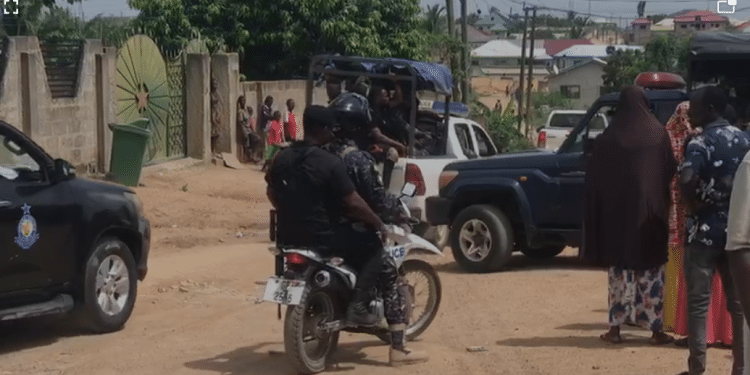
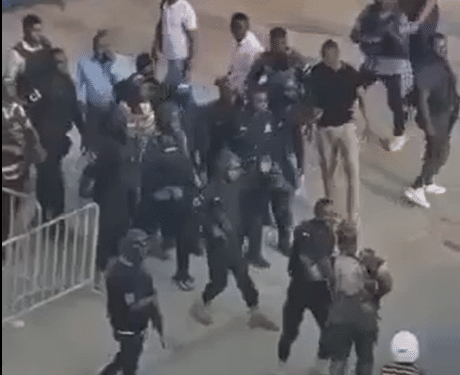
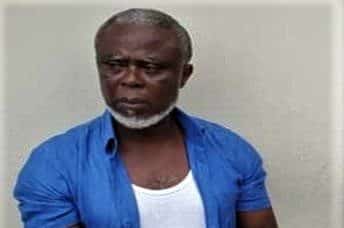
Some staff of the company have recently come under attack while executing the company’s ongoing revenue mobilisation programme to recover some GH¢5.7 billion owed by the consuming public.
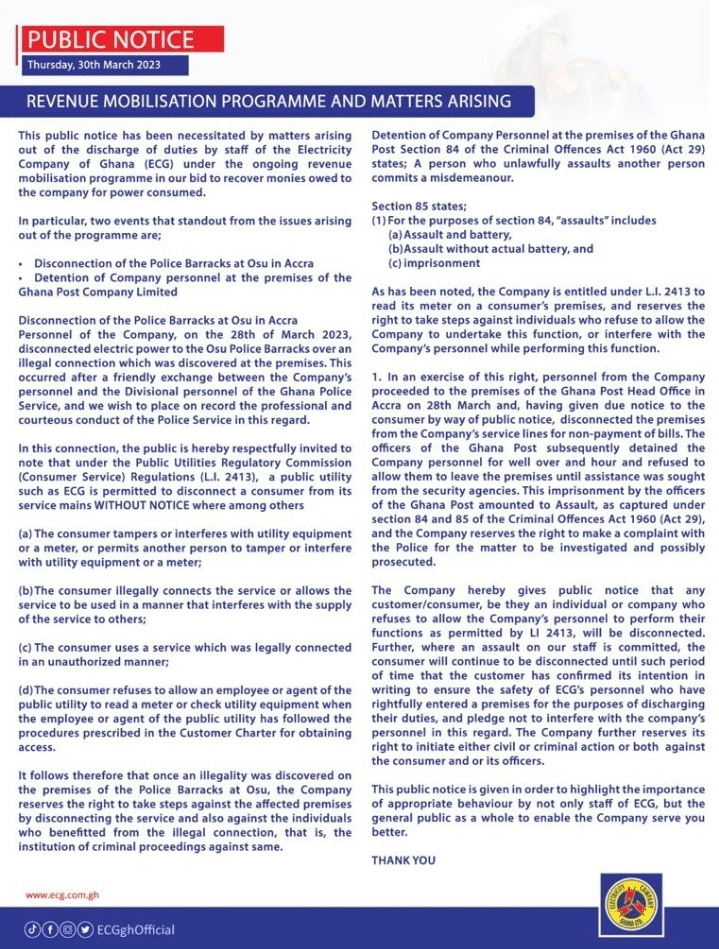
ECG cited the detention of its personnel by the Ghana Post Company over a GH¢89,000 debt to buttress its caution.
Some personnel of the Company were detained on March 28 by Ghana Post Company when they attempted to disconnect power over the GH¢89,000 debt.
In a statement the ECG therefore, cautioned the general public against illegal connections and attacks on its personnel in the line of their duty which it said is a crime under Ll 2413.
It said it will not countenance any attacks and hesitate to disconnect any customer that owes the Company or threatens its staff.
“The Company hereby gives public notice that any customer/consumer, be they an Individual or company who refuses to allow the Company’s personnel to perform their functions as permitted by Ll 2413, will be disconnected. Further, where an assault on our staff is committed, the consumer will continue to be disconnected until such period of time that the customer has confirmed intention in writing to ensure the safety of ECG’s personnel who have rightfully entered the premises to discharge their duties and pledge not to interfere with the company’s personnel in this regard.
“The Company further reserves its right to initiate either civil or criminal action or both against the consumer and or its officers.”
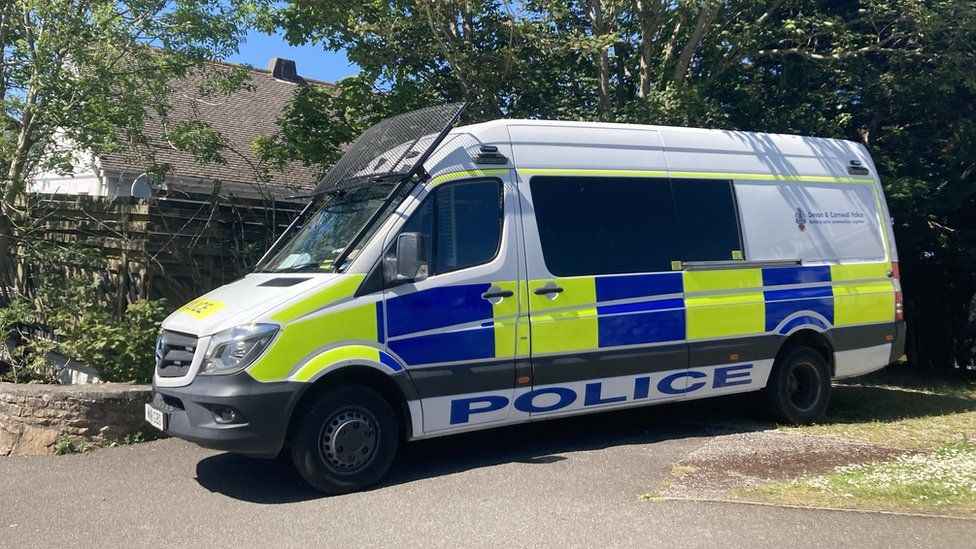
According to testimony during a misconduct tribunal, an on-duty cop had sex with an off-duty coworker in a marked police van.
Stephen Athawes and Daria Krolewicz were found guilty of gross misconduct at a hearing earlier in March.
Both former PCs had left their posts before the hearing, Devon and CornwallPolice said.
Supt Jo Arundale said “had the officers still been serving, they would have been dismissed without notice”.
‘Undermined trust’
Supt Arundale, the force’s head of professional standards, said: “On this occasion the behaviour of the officers fell below the standards expected within policing.
“Through their actions, the officers undermined the public’s trust and confidence in the police force and did not fulfil their duties and responsibilities.”
The hearing concluded on 9 March and both officers will now be submitted to the College of Policing barred list.
The panel heard Mr Athawes had been working on the night of 30 May 2021, when he dropped his crew mate back at a police station.
Following the two-day public hearing, the panel concluded that the allegations were proven
He then went in a police riot van to collect Ms Krolewicz who had been on a night out in Exeter with friends.
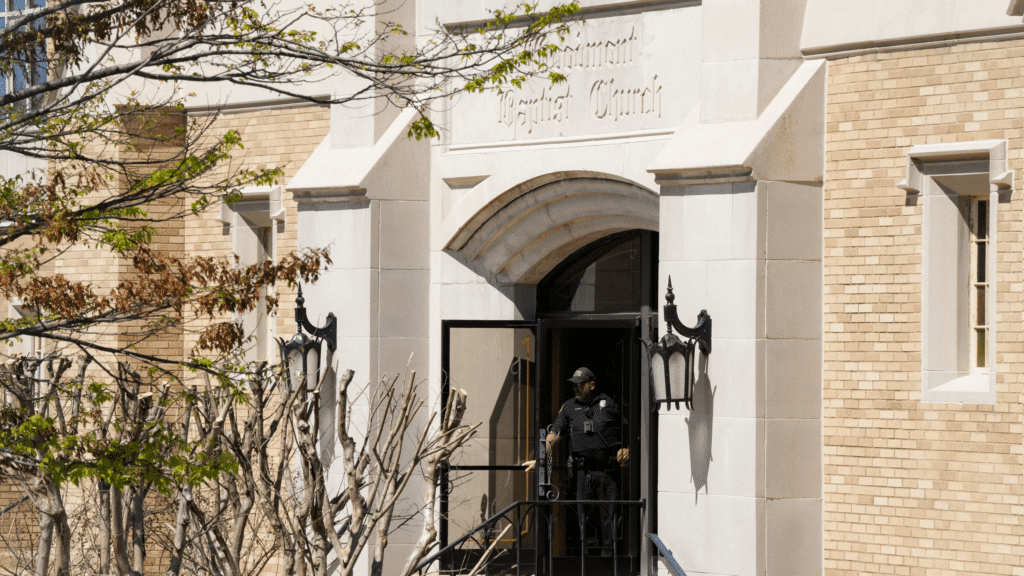
They then drove to a secluded car park and church yard.
The panel heard how on 17 June, Ms Krolewicz had told a colleague they had not had sex but that they had done “everything else”.
She also referred to having “done stuff in a vehicle” and disclosed that Mr Athawes’ “radio was operating so frequently they were unable to have sex”, the panel heard.
The panel upheld allegations that Mr Athawes had breached the standards appropriate to the conduct of a police officer in respect of honesty and integrity, discreditable conduct, authority, respect and courtesy and duties and responsibilities.
It was found he had knowingly planned to collect Ms Krolewicz, who was off-duty, without a policing purpose, and then engaged in sexual encounters in a marked police vehicle with her whilst he was on duty.
He also falsely told his supervisor and crew mate he was on a medication run at the time, and so unavailable for response calls, the panel found.
Ms Krolewicz was found to have breached the standards appropriate to the conduct of a police officer in respect of discreditable conduct.
Following the two-day public hearing, the panel concluded both had breached the expected standards of professional behaviour.
The panel determined that had the officers still been serving, they would have been dismissed without notice.
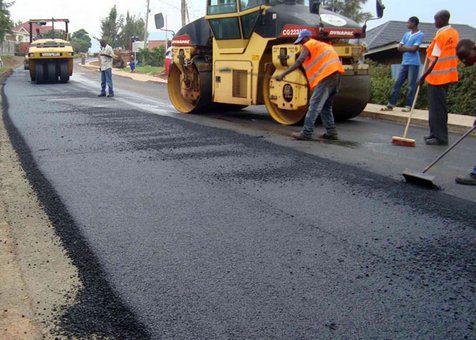
TheMinistry of Roads and Highwayshas responded to claims that it has redistributed funds intended for building a bridge and several roads in Afram Plains, Eastern Region.
The Members of Parliament for Afram Plains North and South, Betty Nana Efua Krosbi Mensah and Joseph Appiah Boateng respectively, claimed that the government had proposed to use the funds for construction works on the Accra-Kumasi highway instead of Adawso-Bunso to Ekye – Amanfrom.
They argued that the move would affect the food production capacity of the area.
Responding in a statement, the Ministry of Roads and Highways described the allegations by the MPs as misleading and inaccurate.
“The Ministry wishes to state that the joint statement is misleading and that the Members of Parliament could have easily sought the necessary clarification from the Ministry. The allegation by the Members of Parliament against the Ministry is biased and cannot, therefore, be accurate,” the Ministry said in its statement.
The Ministry explained that government had anticipated that two components of the project, with a total cost of €350 million will be executed concurrently, but it has not been able to conclude the arrangement of financing for the project.
The Ministry attributed the government’s inability to conclude the financialarrangements to the current debt restructuring exercise.
“It was expected that the two components of the project, with a total cost of €350 million, will be executed concurrently and be completed in thirty (30) months subject to the successful completion of the financing arrangement. It is in light of this that Government allocated about US$98 million under the US$750 million African Export-Import Bank (Afreximbank) Loan as a contribution to the road contract component after one of the financiers declined to participate in the financial arrangement”.
The Ministry of Roads and Highways further stressed, “It is important to state that due to the current debt restructuring exercise, Government has not been able to conclude the arrangement of the financing for the project”.
According to the Ministry, government decided to apply the allocation under the Afreximbank facility to the Accra-Kumasi corridor.
“This has informed Government’s prudent decision to apply the allocation under the Afreximbank facility to the equally important Accra-Kumasi corridor,” it said.
The Ministry said the re-allocation of the funds will be applied to Apedwa to Ejisu section of the Accra – Kumasi Road.
“The re-allocation will be applied to specifically the Apedwa to Ejisu section of the Accra – Kumasi Road. This stretch goes through major towns such as Osino, Anyinam, Enyiresi, Nkawkaw and Konongo in the Eastern and Ashanti Regions. It is common knowledge that sections of the road within these towns are usually marked with heavy traffic congestion causing a lot of delays, accidents, pedestrian-related crashes and increased travel time,” the Ministry of Roads and Highways explained in its statement.
The Ministry justified that the decision is in the interest of the welfare of Ghanaians entreating them to cooperate with the Ministry to improve the national road network.
“The Ministry wishes to assure the good people of the Afram Plains area, including the Honourable Members for the Afram Plains, and the general public that the decision taken is in the interest of the general welfare of the people of Ghana. Government is committed to addressing their road network challenges and encourages all to cooperate with the Ministry as we strive to improve upon the national road network,” the Ministry urged.
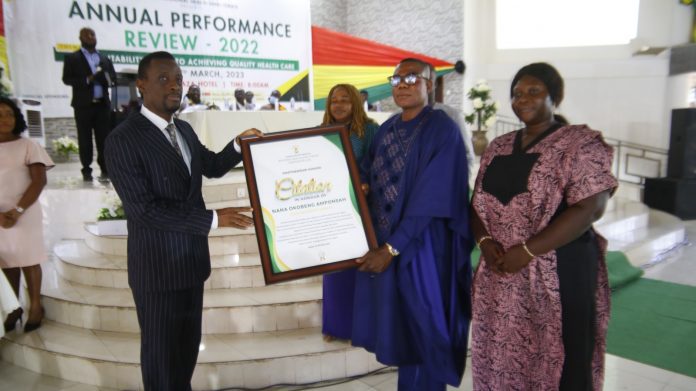
An honor given to Nana Okobeng Amponsah, CEO of Okobeng Mining Company Ltd, has been withdrawn by theGhana Health Service(GHS).
Western Regional Directorate of the Ghana Health Service presented the award to the miner for his philanthropic work towards quality healthcare delivery in the Prestea Huni Valley Municipality of the Western Region on Tuesday, March 28, 2023 at its Annual Performance Review in Takoradi.
The award was presented to Nana Okobeng Amponsah by the Western Region Minister, Kwabena Okyere Darko Mensah.
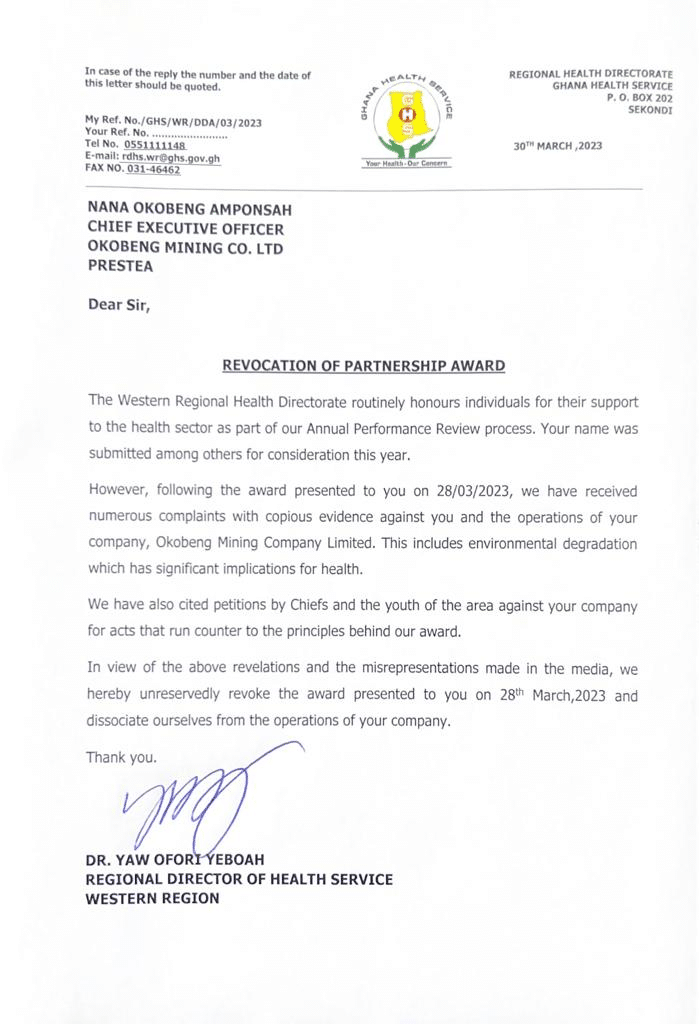
However, in a release sighted by 3news.com, the award has been revoked.
Western Regional Director of Health Dr. Yaw Ofori Yeboah indicated in the release that the operations of Okobeng fall contrary to the principles of the Ghana Health Service.
The statement adds that “after numerous complaints and evidence received by the Service on the operations of Okobeng Mining Company Limited, the award has been revoked”. Find the full statement below:
The West African Examinations Council(WAEC) Chairperson, Professor Ato Essuman, has said that without skill development for students, free secondary education in Ghana will be meaningless.
Although he believes the concept ofFree Senior High School (SHS) is admirable, his worry, however, is that it falls short of teacher development and providing students with the necessary skills for the world of work or further education.
Prof. Essuman said this as the keynote speaker at the 2023 edition of Achimota Speaks at the Ghana Academy of Arts and Sciences on Thursday.
The theme of the event was “The Governance, Management, and Financing of Secondary Education in Ghana.”
“The argument about free secondary education is about access and not enough about the content and the outcomes expected. Matters about skills development, teacher orientation, reorientation and training and development as well as new pedagogical approaches are less stressed. Clearly, fair attention to all these is likely to produce students ready to transition either to the tertiary level or the world of work.”
He continued to say, “the policy of making secondary education free and available to all is a lofty one but such a goal will be useless and needlessly expensive if all it does is to create opportunity and give young people access without the skills that will make them great assets for the nation development or otherwise, the problems would continue to compound.”
Prof. Essuman, who is also the Dean of Education and Entrepreneurship at Methodist University College in Ghana, poked holes in what he feels to be the poor implementation of free secondary education in the country.
This, he blames for the numerous difficulties that have beset such initiatives.
“Implementing free secondary education in Ghana may have been desirable if a gradualist approach and phased implementation of the program had been adopted. Learning from other countries’ experiences may have led to better management of the policy.
“With the problem of inadequate resources and delays in funds released to schools, a strategy for mean testing to target the poor and the vulnerable could have been adopted. I do not think that as a country we have many options.”
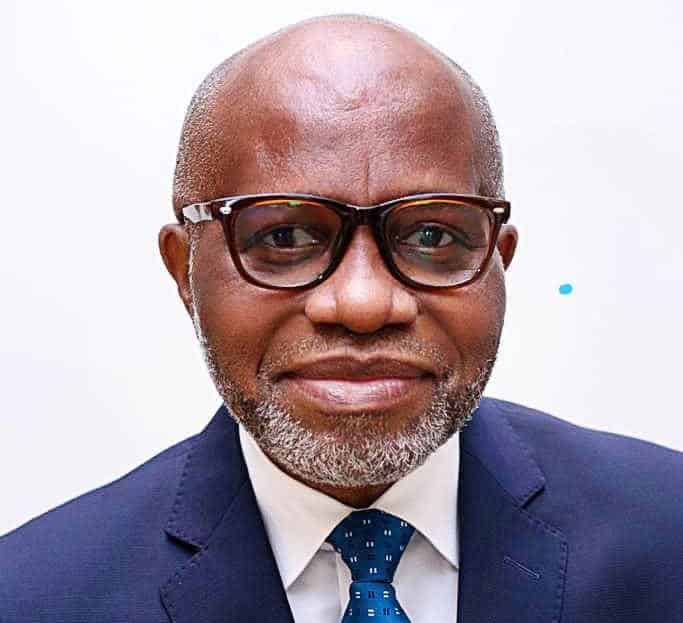
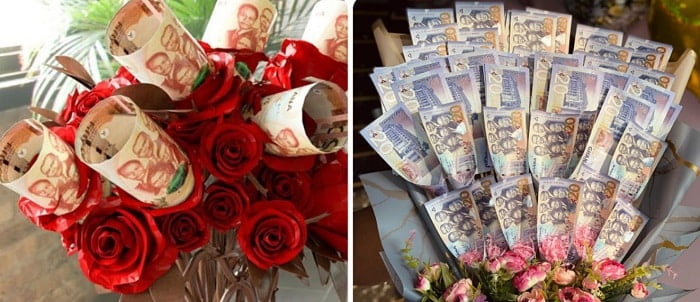
TheBank of Ghanahas warned Ghanaians to refrain from sending gifts to others in the form of cedi bouquets and hampers.
It said the currency was issued to be used as a medium of exchange for the purchase of goods and services.
The Director of the Currency Department at the central bank, Mr.Dominic Owusu, told journalists today (Thursday, March 30, 2023) that any other use of the currency was illegal and subject to prosecution.
He said the bank had noticed that some people were using the cedi notes as bouquets and hampers as gifts during weddings, birthdays and other celebrations, a practice he said must be stopped.
He said beyond being illegal, such acts made it easier for the notes to spoil or get defaced.
Given that spoilt and worn-out notes are replaced at a cost, he said such acts affected the operations of the central bank.
Mr Owusu was speaking to journalists on how to preserve the currency as part of events marking Ghana month in March.
He said the local currency was a great symbol of the country and efforts to preserve its quality and cleanliness must be prioritised by all.
A nationwide load-shedding schedule has been announced by theElectricity Company of Ghana (ECG) in response to a decrease in power generation imposed on by the shutdown of the Atuabo gas processing plant.
The load-shedding which kicked off on Thursday, March 30, will last till Friday, April 7, 2023, between 6.00pm and 11.00pm.
The ECG in a statement explained that this is due to “maintenance works being carried out by the Ghana National Gas Company(GNGC) at Atuabo, [hence] there is a power generation shortfall. In this regard, please find below a load management schedule from Thursday, 30th March to Friday 7th April 2023, between 6.00pm and 11.00pm”.
Volta, Ashanti, Western, Eastern, Central, Greater Accra and Tema will all be affected.
“We call on our customers to bear the inconvenience with us while the Ghana Gas Processing Plant undertakes this all-important maintenance activity,” the ECG appealed in its statement.
Some of the affected places in group A include: South Odorkor, Baah Yard, Odorgonno, Awoshie Massalatsi, Been-To, Parts of Trasacco, Estates, Parts of Airport Residential Area, GHIPSS, ValCo Trust, Enterprise Market, Trust Bank, Shippers Council, ABSA Bank, Ecobank, Adabraka Free Town, Government Boys, GNTC Bottling, Nayak, Ga East Hospital, Dome New Market, Agingo, Taifa, Nkatie Burger, Mr. Adjei, Demod.
Others are Hotel Adodo, CMB Flats, Coffee Shop, Parts of Labadi, Parts of Labone, Olebu, New Ayawaso, Amamole, Korle Bu Teaching Hospital, Ayigbe Town, Parts of Lartebiokorshie, Alogboshie, Neoplan, Best Point, Kaneshie Flats, St. Theresa, Cocoa Clinic, Accra Sound, Kaneshie Sports Complex, Parts of Kokomlemle, Mallam Atta Market.
The minority is against the new income legislation currently before Parliament, according toMahama Ayariga, the member of parliament from Bawku Central.
He said the Minority will vote against the bill when the time comes.
Mr. Ayariga indicated that, unlike the approval of the ministerial nominees where a secret vote was used, a headcount will be conducted to determine whether the new tax bills should be accepted or not and that will help in the rejection of the bills.
Making the declaration on Eyewitness News on Citi FM, Mr. Ayariga disclosed that “it is going to be a voice vote where if you are not satisfied, we call for a division and then there will be a headcount and the matter will be determined, and I am very confident that all our members will be in the House and vote in line with our position to vote against the bill.”
“You will stand and be counted and everybody including your constituents will be watching and so if you don’t go with your constituents, they will see and measure you accordingly,” he further explained.
Mr. Ayariga stressed that the Minority would have been considerate if the government was making efforts at cutting down on its expenditure but so long as it is “only interested in asking Ghanaians to pay more taxes and not cutting down on the consumption of the taxes,” it will not allow such burden on Ghanaians.
Government is under pressure to have three new revenue bills passed by Parliament as it seeks to rake in GH¢4 billion per year to shore up revenue to fix the ailing economy and secure a Board approval for a bailout from the International Monetary Fund (IMF).
The bills which include the Excise Tax Stamp and Excise Duty amendment bills, Income Tax amendment bill and Growth and Sustainability levy bill are already being rejected by some business groups.
The Catholic Bishops Conference has urged the government to forgo any business with the United States that is premised on the acceptance of the LGBTQ community in Ghana.
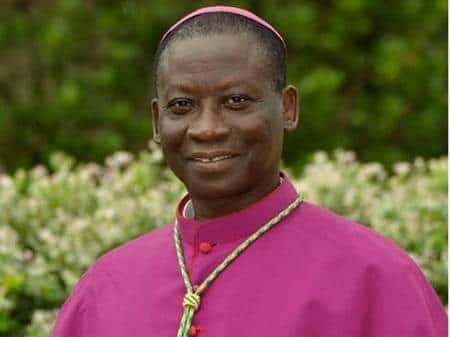
Speaking in an interview with Catholic Trends, the President of the Catholic Bishop Conference, Most Rev. Matthew Gyamfi, said that accepting aid from the US government with any LGBTQ conditions would amount to the government selling the country’s birth right.
He added that the government must tell the people of Ghana what the conditions for the $139 million are before accepting it.
“This is a very serious issue. It is at the gate of who we are as Ghanaians and nobody should toy with it with money. And if that should be the case (the aid is tied to Ghana accepting LGBT), let the government reject the money and tell the people, this is what they are saying. Should I take it? So that you do this or not and let the people decide.
“This is not the first time. We have seen the European Union, the United States and these rich countries sometimes push down our throats with certain reforms and certain things and they say if only you do these things, we would give you the money.
“I know the government has done that over and over and over, and many Ghanaians know it. It is not only I who is saying it. So when it comes to something that makes a people, a people. That is their culture and tradition, then if you sell your birth right, culture and tradition, if you sell who you are for money when you get the money who are you again?” Most Rev. Gyamfi said.
The office of the United States Vice President indicated that the US government will support Ghana with $139 million for the 2024 fiscal year.
According to Aljazeera, the $139 million is an addition to the $100 million security support, Vice President Kamala Harris announced for five West African countries including Ghana.
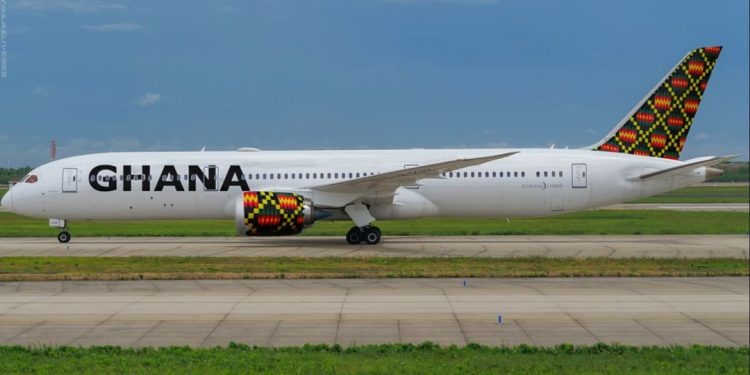
Ghana Airlines will launch operations in June, according to the transport minister,Kwaku Asiamah Ofori.
He added that the new national Airline will fly to the UK and USA.
Addressing journalists in Accra, Kwaku Asiamah Ofori says the Airline has satisfied all the requirements.
“It is well grounded and all the requirements have been satisfied. They are going to launch their logo, my information is that by the end of April or May, they will start selling their tickets. And by June-July, you will see a national airline-Ghana Airlines flying in the air. Insha Allah it shall be well,” Transport Minister noted.
The Ashanti Airlines, a privately registered Ghanaian airline is in partnership with theGovernment, to operate a national commercial air carrier known as Ghana Airlines Ltd.
Zotus Group Inc, United Kingdom, known for its diverse portfolio of projects is the financial and operational partner of Ashanti Airlines with the Government of Ghana.
The new Airline will commence operations in the third quarter of 2023 with flights on domestic routes, then later to Regional and International routes, including flights to Heathrow Airport, London (UK), JFK Airport in New York (USA), and beyond.
More than 1,000 residents of Suncity, a suburb ofBuduburam, have been left homeless following a land dispute case.
The residents lament that they were given no adequate time to relocate from the area.
The residents were evicted from their houses by the litigant identified as SNBB under the supervision of a police task force.
Personal belongings of the affected persons were thrown out of their rooms and entrances were locked with fresh padlocks provided by the litigant.
The litigant who claims ownership of the land has won a court case against property owners of the area. According to the litigant, the court has given him the right to demolish all the houses to be able to recover his land.
Some stranded residents who shared their frustrations with Citi News said they were not given prior notice before they were thrown out of their rooms.
“They are not land guards but the way they did the operation is scary. You wake up early morning, and you see Police and Taskforce at your doorstep evicting you. No one has informed us about the demolition and this is not good. They initially wrote on the walls giving us a warning, but we didn’t know it was that serious. People are crying over the issues,” a resident narrated in a Citi News interview.
Another said “We were here this morning when the taskforce came and told us to move from the area. We don’t have anywhere to go, and I can’t go to my village because there is nothing there for me. We need government intervention.”
“We are tenants here, and we have never built a house so if they tell us to move just today, it is not a good thing. If you are ejecting me in just two minutes and telling me to move my belongings out, it is not something that should be encouraged.
“I have a three-week-old baby and I don’t know where to go. We want to appeal to the owner of the land to calm down and negotiate with us.”
The litigant declined to speak to the media about the development.
The government’s plans to re-allocate 350 million euros intended for the construction of a road and bridge inAfram Plains North constituency has been criticised by the member of parliament for the area.
According to Betty Efua Krosbi Mensah government has proposed to use the funds for further construction works on the Accra-Kumasi highway.
Speaking to journalists, the lawmaker said the move would affect the food production capacity of the area.
“We are very sad to bring you this news that the government has the intention of re-allocating this huge amount of money from constructing the road from Adawso to Ekye – Amanfrom. The money is currently being allocated or re-allocated to construct the road that isAccra-Kumasiroad.
“This situation is a very sad one for us the MPs representing the people of Afram Plains. Government enlisted why it prioritises Afram Plains, knowing very well that it is one of the food basket communities or districts in the country and that it was an opportunity to open the Afram Plains to the rest of the country,” Afram Plains North MP lamented.
Parliament in 2022 approved an amount of Three Hundred and Fifty Million Euros (€350,000,000.00) for the construction of a bridge over the Afram River and the construction of 124Km of roads from Adawso-Bunso, Ekye – Amanfrom and other specified roads within the Afram areas.
Presenting the report of the Committee on Roads and Transport, the Chairman of the Committee, Kennedy Osei Nyarko, noted that Government recognises the important role that accessibility to road infrastructure plays in poverty reduction, fostering regional integration and enhancing economic development through income generation activities that are linked to agriculture and other sectors of the economy.
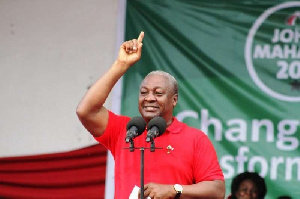
Former President John Dramani Mahama has criticized the Akufo-Addo-led administration for abusing pensioners due to its ineffective economic management.
According to Mr. Mahama, after borrowing recklessly and irresponsibly, government has taken funds belonging to pensioners.
“Our own pensioners who have finished active service to the nation and are going to rest, the money that they earned that is supposed to feed them, [money] that they used to buy government bonds, today, this government says they cannot pay them what is theirs,” he said.
The former president was speaking at a campaign meeting with branch and constituency executives in the Awutu Senya West Constituency during his ‘Building the Ghana we want together” tour of the Central Region.
“I ask myself: are you God to determine that the retiree will live that long to receive his or her money by 2035? Yet, that is how they have structured things. This is money that our pensioners use to purchase their little medicines to cater for themselves”, Mr. Mahama noted.
President Mahama therefore called for Ghanaians to vote out the NPP government in 20204 for its lack of sensitivity and consideration.
“If a government can behave like this to a segment of its most vulnerable population, that government does not deserve to remain in power,” he said.
The National Identification Authority (NIA) has announced that it has completed printing the 541,529 backlogs of Ghana cards and are ready for collection.
On February 28, 2023, the NIA assured Members of Parliament that it will print the cards within 11 days.
The expedited printing exercise, which began on 18 March 2023, “came to a smooth end on Monday, 27 March 2023 with all records in backlog printed, the ultimate objective of this exercise was to print records of registered Ghanaians in backlog since July 2022,” a statement issued by the corporate affairs directorate of the NIA said.
According to the NIA “With focus, rigour and coherence in project management and implementation, NIA achieved this feat with a dedicated team of supervisors, assistant technical support officers and assistant technical enrolment officers drawn from its headquarters, regional and district offices. The staff worked fervently for ten continuous days in two shifts — day and night.
“The printed cards, which are now being packaged, will be distributed to NIA’s Regional and District Offices nationwide from today Wednesday, 29 March 2023 to Sunday, 2 April 2023 for issuance to registered applicants,” the statement said.
“All Ghanaians who have registered for their Ghana Cards since July 2022 but are yet to receive them, are assured that effective Wednesday, 5 April 2023, they can visit the District or Regional Offices where they registered for their printed cards to be issued to them.
“The NIA stands committed to serving the public and the nation as whole with respect, dignity, integrity and efficiency as a dedicated and responsible public sector institution,” the statement added.
Start of printing
The NIA, in a press release dated 22 March 2023, announced the commencement of the expedited printing of the backlog of 541,529 records accumulated since July 2022.
“Preparatory works for the expedited printing started on Wednesday, 15th March 2023 and included the configuration of printers, print servers and laminators, as well as the deployment of additional staff from NIA’s regional and district offices to augment the staff capacity at the Head Office,” the 22 March statement said.
“The commencement of the expedited printing follows the payment of GHC100 million by Government of Ghana (GoG) to CalBank PLC, which then caused the release of a quantity of blank cards to NIA on Tuesday, 14 March 2023. The printing of the blank cards is expected to last for 11 days, ending on 29 March 2023,” the Authority further said.
At the end of the exercise, the NIA says it “will make the cards available at its regional and district offices nationwide and announce to the public when the persons who registered for the cards since July 2022 should go to their respective NIA offices for the cards to be issued to them”.
According to security analyst Emmanuel Kotin the altercation between the militaryand police on Monday afternoon in Accra is a major breach of security.
The clash began when some military officers in an official military vehicle allegedly chased and attacked a plain-clothes police officer on a motorcycle following an alleged traffic infraction by the police officer.
Reports suggest despite several pleas from the police officer and identifying himself as an Inspector in an attempt to deter the attack, the soldiers continued to beat him.
Mr. Kotin believes it is high time the military focused on its core mission.
“That incident was a very serious security breach. For two security agencies meant to play complementary roles when need be. Despite their clear-cut roles, there is no doubt that the police are in charge of internal security while the military is in charge of external security of the country although the Commander in Chief of the Arm Forces can assign other roles to the military. So, for the military to be involved in internal security lately is a larger problem and a threat to our democracy.”
Background
An eyewitness who spoke to citinewsroom.com stated that despite several pleas by the police officer and also identifying himself as an Inspector, in an attempt to ward off the attack, that did not stop the soldiers from pummelling him.
The police officer is reported to have gone to the Accra Central Police Station to report the incident afterwards.
Some police officers on duty armed themselves and pursued the soldiers arresting one of them in the process.
The soldiers are reported to have called for reinforcement in an attempt to rescue their colleague, but they were stiffly resisted by the police until some senior officers managed to quell the tensions.
The eyewitness added that traders were shocked to see personnel from the country’s topmost security agencies engage in open combat and verbally and physically assault each other.
Authorities of the University of Ghana have been referred to Parliament’s Education Committee by the First Deputy Speaker of Parliament, Joseph Osei-Owusu for failing to abide to a High Court directive.
According to him, the Committee should probe the reason behind the University’s intransigence.
“I would refer this statement to the Committee of Education and urge them to engage the University and to report back to us why the University authorities, headed by the immediate past Chief Justice – she is the Chairman of the University Council, so we expect that she will ensure that the sanctity of the court order is respected,” he said.
It would be recalled that the University of Ghana was directed by an Accra High Court to halt its residential policy which removed continuing Commonwealth Hall students from the Hall.
The University is yet to comply with the directive.
However, the MP for Builsa South, delivering a statement on the floor, criticised the University for failing to adhere to the court order.
According to him, the continuous refusal of the Management of the University of Ghana to reinstate the affected students, as ordered by the court, is unacceptable and unlawful.
“Mr Speaker, we call on you and this august House and all well-meaning Ghanaians to join us to impress upon the University of Ghana to do the needful by respecting the laws of the land,” he said.
Also, a bipartisan group of MPs slammed the University’s reluctance to obey the order of the court.
They are; Health Minister Kwaku Agyeman Manu, Dormaa East MP, Paul Twum Barima, MP for Salaga South, Zuwera Ibrahimah and Bole Bamboi MP Yusif Sulemana.
According to them, the House cannot allow the University to flout a court order.
“It is a very serious matter. Disobeying a court order with impunity as a citizen of this country. The University doesn’t belong to individuals and I am surprised why a whole institution would be allowed to impugn on the dignity of court in our country,” Mr. Agyeman Manu said.
They added that the disregard for the court ruling is sad.
According to them, the hall has produced very important personalities who are contributing to the development of the nation, therefore the hall should not be toyed with.
It was on the back of this debates that the Speaker referred the issue to Parliament’s Education Committee to be investigated.
When the anti-LGBT measure is ultimately passed by Parliament, Most Reverend Matthew Gyamfi, the president of the Ghana Catholic Bishops Conference, has encouraged President Akufo-Addo to sign it.
According to him, the President should not give in to pressure from western donors who may threaten to withdraw their support, particularly now that the country is cash strapped, if the anti-LGBT bill is passed.
He said the bill was the wish of the people and the President and his government must ensure that it is passed and implemented to the letter.
Speaking on JoyNews’ PM Express, he said, “If I were to meet him [the President], I will remind him that he should look at this bill on thisLGBTQ that has come from the people of Ghana, it didn’t come from the executives, it did not generate in parliament.
“The people who have chosen the parliament, the people who have chosen him and they say this is what we want to be done on this issue. Probably one of the few laws generated from outside the executive and then the legislative.
“Christians, Muslims, traditionalists, all of these people publicly they have spoken about this law. So I will tell him to be extraordinarily careful about whatever decision he takes on behalf of Ghana. And if I were him, I will just say he should go for what the people are saying they want to be done and I suggest he doesn’t change it…we all requested it, he asked us to do this and this is what they have done and these are the consequences.”
His comments follow the Catholic Bishop Conference advising the President not to accept a $137 million grant from the government of the United States should it have the acceptance of LGBTQ rights as conditionality.
The group has maintained that LGBT rights are offensive to Ghanaian cultural and religious values and thus must be opposed.
There is no specific legislative prohibition on wearing military camouflage in Ghana, according to Peter Lanchene Toobu, the member of parliament for Wa West.
The former superintendent of police said the wearing of replicas isn’t criminal.
Speaking on the back of the invitation of some Ashanti Regional NDC executives by the Regional Police Command for wearing military camouflage during a tour by former president John Dramani Mahama, Mr. Toobu said if wearing camouflage was illegal, the government would have taken measures to halt the importation of the many replicas that flood the open markets.
Mr. Toobu explained that “the principle is simple, if you are a police officer, you dress in a uniform to show that you are an officer and if you are a soldier, you are a soldier by training, but the uniform is symbolic of who you are and so if you are not a police officer or a soldier, and you are wearing army uniform, they [the military] have the right to question you.”
He further intimated that aside from the questioning by the military to prevent impersonations, there is actually nothing unlawful about wearing replicas.
“If you wear camouflage, that is not the Ghana Army uniform, that shouldn’t be an issue unless there is a law banning the importation of camouflageinto the country,” he further told Umaru Sanda Amadu on Eyewitness News on Citi FM.
Mr. Toobu also admonished the public and the media to be circumspect in reporting these incidents to avoid unnecessarily denting the image of the Ghana Army.
Six executives of the National Democratic Congress (NDC) in the Ashanti Region were invited for questioning for wearing military attire during the former president’s visit.
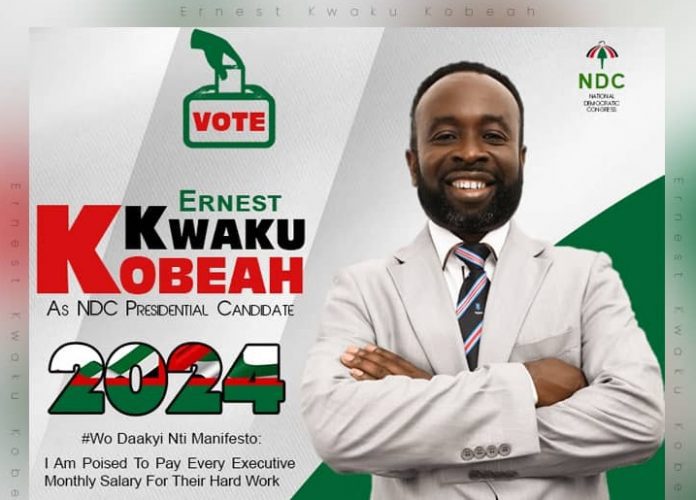
Former President John Dramani Mahama has expressed gratitude to Ernest Kobea for supporting him by withdrawing from the National Democratic Congress (NDC) flagbearer competition.
Kobea who was one of four members of the NDC to pick presidential nomination forms, announced his withdrawal from the race on Wednesday, March 29
The party has scheduled Saturday, May 13 on which to go to polls to elect the man to lead its presidential campaign in next year’s elections.
Four persons including Mr Kobeah had picked nomination forms to contest the primaries. They have all since been vetted.
On Tuesday, March 28 when he faced the Vetting Committee, Mr Kobeah was asked to return with some documents.
He was, however, full of praise for the Committee members, describing the brief process as “successful”.
“There is no issue,” he told journalists after facing the Committee.
“Just [that] I need to come back tomorrow [Wednesday]. Everything is fine and successful.”
His withdrawal leaves Mr Mahama,Dr Kwabena Duffuorand Kojo Bonsu as the aspirants awaiting the Vetting Committee’s report for clearance or otherwise to contest the primaries.
Commenting on his Facebook page,Mr Mahama said “Balloting has been done for the May 13 presidential primaries and John Mahama is No.1 on the ballot.
“I thank you all for your dedication, support and prayers through it all, thus far. I also want to thank my younger brother, Ernest who has not only stepped down from the contest, but has declared his support for me.”
Former mayor of Kumasi, Kojo Bonsu, has urged administrators of the new Kejetia market to promptly halt all traders from cooking inside the marketplace.
His call comes after fire gutted the new market recently destroying thousands of items running into millions of cedis.
The former mayor while addressing the matter indicated that management of the market must have a plan which should be executed to avert future fire incidents within the enclave.
“The fire that engulfed the market you could say it was a maintenance failure. I hear there were some carbide and something that brought the fire. So you cannot blame management for that. All cooking activities should come to a halt at the new Kejetia market,” the former Mayor of Kumasi opined.
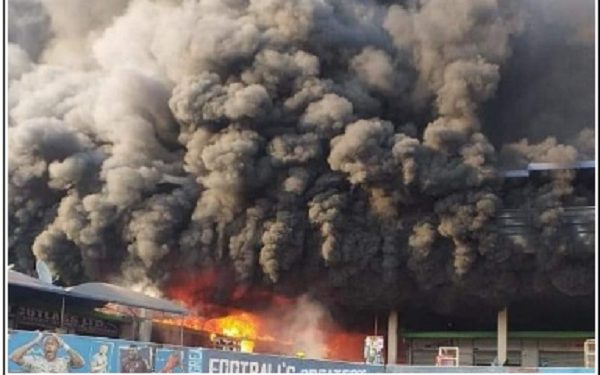
Following the March 15 fire outbreak at the facility, aside from the shops that were directly affected, some other shops were asked to be closed down for a structural integrity test to be conducted before being allowed to operate.
The Vice President,Dr. Mahamudu Bawumia, says the briefing he received from the Ghana National Fire Service indicates that a fire from a trader cooking at the new Kejetia market caused the inferno at the facility.
According to Dr. Bawumia, the shop owner was cooking inside her shop when the gas cylinder she was using caught fire spreading to a nearby chemical shop, thus destroying 33 shops out of 8,000 shops at the market.
He added that the chemical shop owner amongst others sells combustibles such as carbide, turpentine and gunpowder which exploded.
A trader at the market was arrested for cooking at the facility but was later granted bail.
The Ministry of Local Government, Decentralization and Rural Development has thus inaugurated a 5-member committee to probe the recent fire incident.
The committee which has been tasked to make its findings ready within three weeks was constituted on March 17.
Despite Media journalist, Afia Pokuaa alias Vim Lady has said that the rate of ignorance and misinformation in Ghana is at an epic stage.
Her comment is in line with public reactions to the lighting of Ghana’s seat presidency with colours of the United States and Ghana flags.
As part of the visit by US Vice President, Kamala Harris to Ghana, the Jubilee House on Monday, March 27, 2023, was lit with colours of the Ghana and American flag.
However, some critics miconstrued the incident instead claiming that the two flags put side by side reflected the rainbow colours of the LGBTQ+ movement, going on to claim that the whole episode was an attempt to propagate homosexuality in the country.
But reacting to this in a Facebook post sighted by GhanaWeb, Afia Pokuaa attributed the criticism to ignorance and misinformation while bitterly lamenting the fixation of Ghanaians on otherwise trivial matters instead of productive issues.
“The level of IGNORANCE and MISINFORMATION in this country is at an epic level. How can anyone say that the jubilee house has been draped with LGBTQ+ colours yet the same people were jubilating when the Burj Khalifa in Dubai was lit with Ghana colours????? Seriously? It doesn’t take you taking an international relations class to understand these basic things oh?
“Ghana has moved from producing tires, batteries, and glass to a state where we can’t even produce commercial starch from cassava and this is the issue that we are focusing on. ASSUMING IT WAS RAINBOW COLORS, SO GOD DIDN’T CREATE THE RAINBOW AFTER THE NOAH FLOOD EH,” she added.
TWI NEWS
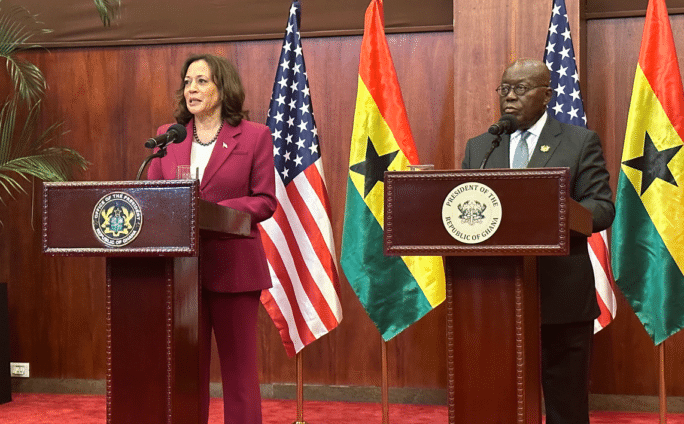
Meanwhile, the US vice president during a joint address with President Akufo-Addo on Monday raised human rights concerns about the anti-homosexuality bill currently before Parliament.
“Let me be clear about where we stand. First of all, for the American press who are here, you know that a great deal of work in my career has been to address human rights issues, equality issues across the board including those related to the LGBT community.
“And I feel very strongly about the importance of supporting the freedom and supporting and fighting for equality among all people and that all people be treated equally.
“I will also say that this is an issue that we consider and I consider to be a human rights issue and that will not change,” she stressed.
In response to the subject, President Akufo-Addo assured that government had through the Attorney General made significant input into the legislation.
He said that the anti-LGBT bill, which was championed by “only a hand full of MPs”, is currently being considered by Parliament.
Akufo-Addo added that even if the bill is passed, it will still have to be ratified by him.
One of the candidates for the National Democratic Congress’ (NDC) flagbearer race, John Dramani Mahama has taken the number spot on the ballot paper.
Former Metropolitan Chief Executive (MCE) of the Kumasi Metropolitan Assembly, Kojo Bonsu, and former Finance MinisterDr. Kwabena Duffuorpicked the second and third slots respectively.
Chairman of the NDC Vetting Committee, Edward Doe Adjaho speaking to the media said the balloting was done after the successful vetting of the threecandidates.
The fourth candidate Ernest Kwaku Kobeah withdrew from the contest before the balloting was done. Ernest Kwaku Kobeah
The NDC’s Presidential and Parliamentary primaries are slated for May 13, 2023.
A National Democratic Congress (NDC) presidential candidate for 2024, John Mahama, has characterized the Akufo-Addo-led administration as a governmentthat shirks accountability.
According to him, accepting responsibility is a mark of good leadership, a quality that is lacking inPresident Akufo-Addo.
“What is making it difficult for them to govern is that they are not people who listen to advice. They never accept their mistakes, so they are not able to learn from their mistakes. Notwithstanding the poor state of Ghana’s economy, still they are not accepting responsibility.“Nothing can be fixed if the leader cannot take responsibility,” he insisted.
Speaking to branch and constituency executives of the NDC in the Awutu Senya East and West Constituencies on Tuesday, Mr. Mahama who is campaigning to lead his party to the 2024 presidential election said: “When you listen to them, they say it is not their fault. Are they saying it is the fault of Ghanaians? Who went for all those loans? It was them. Yet whenever you tune in to the news, they say it was Covid-19 that caused our problems. They say it was Russian-Ukraine that caused them.”
He expressed surprise that the President did not follow his example but continues to refuse to accept responsibility for the woeful state of the nation.
“When President went to parliament to deliver the State of the Nation Address, I thought he would accept responsibility the way I did when we had an energy crisis in this country. I did not cause it; it was caused by lack of addition to our (power) generation for many years. So, it got to a time, our demand had exceeded our ability to generate power” he explained.
“I went to Parliament. I did not say I did not cause it. I said you elected me to take responsibility, so I take responsibility for it, and I will fix it. That is what leadership is about. This is a President who cannot take responsibility and if you can’t take responsibility, you can’t fix anything” he said to wild cheers.
President Mahama is on a three-day ‘Building the Ghana we want together’ campaign tour of the twenty-three constituencies in the Central Region.
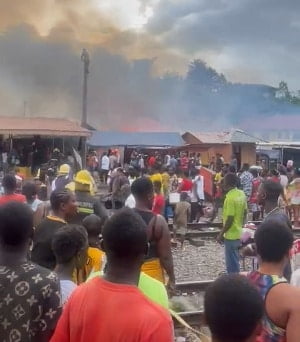
On Tuesday, March 28, 2023, some plywood-built brothels which had roughly fifty cubicles each at the Tarkwa railway station were destroyed by fire.
This is the third time the brothels have been guttered by fire within three months. It happened on the 12th and 24th of December 2022 and on March 28, 2023.
The base has been inundated with prostitutes, most of whom are said to be Nigerians.
An eyewitness, Samuel Mensah, who spoke to GhanaWeb said, there was fire in a refuse dump closer to one of the brothels. After the heavy downpour, there was a storm that swept some of the fire under the plywood which started burning gradually and escalated to the brothels.
“All the ‘ashawo’ girls came out not knowing what to do. Some had already brought their things out, and others also wanted to go through the fire to bring out their belongings but one fire officer who was around told them not to enter, and that saved their lives,” he said.
The Tarkwa Nsuaem Municipal Fire Commander, Alex Asiem said “when we came, we saw that the fire had gutted a drinking spot so we quickly laid two hoses to control the fire and secured the place.”
— The Independent Ghana (@independent_gh) March 29, 2023
He said the Fire Service has been frequenting the place to make sure that anything that may cause fire is taken care of.
He commended the affected persons for helping douse the fire.
There have been calls by community folk for the Tarkwa Nsuaem Municipal Assembly to clamp down on the activities of the prostitutes but to no avail. So, the recent fire outbreaks have come as “good news” for some people who abhor such practices.
One person told GhanaWeb “we thank God this place keeps burning because we have made several efforts for the assembly to stop these ashawo girls but no one seems to care.”
“They should destroy all those brothels, grade the place and use it for a market because the land is a vast one. We can use that place for another better purpose,” another person said.
At Ejisu-Donyina in the Ashanti Region, a 47-year-old pastor has been beaten to death.
The deceased, Ben Jesus, was allegedly killed by one Mr. Kwabena, 35, who claimed the deceased had insulted his parents on Monday March 27,2023.
Speaking to OTEC News Jacob Agyenim Boateng, the spokesperson for deceased’s family, Nana Kofi Akwaboa Otoku said his brother was beaten mercilessly by the suspect and left to die on the street.
He shared, “I received a distress call from some residents who witnessed the incident and so I rushed to the scene, and upon getting there, I saw the victim grasping for breath”.
“Those who witnessed the situation said my brother was subjected to live threatening beatings and so had to rushed him to hospital, the doctors after few minutes of examination declared my brother dead “.
Mr. Akwaboah diclosed that, the suspect has since been arrested by the Ejisu Divisional Police Commandafter an official complaint was lodged by the family.
Body of the victim has been deposited at Emena hospital’s morgue pending autopsy.
Parts of the Criminal Offenses Act, 1960 Act 29, which criminalizes attempted suicide, have been adjusted by Parliament.
In August 2021, the Member of Parliament for Akatsi South and Ranking Member of the Constitutional, Legal and Parliamentary Affairs Committee, Bernard Ahiafor, proposed that the Bill criminalizing suicide be scrapped.
The chairman of the committee, Mr. Kwame Anyimadu-Antwi, seconded the motion and said that if the Bill is approved into law, it will be a significant legislative step toward the transformation of Ghana’s justice system.
On Tuesday, March 28, 2023 debating on the said subject Parliament concluded that, suicide attempts will now be regarded by the legislation as mental health conditions requiring assistance.
“An act to amend the criminal Offenses Act 1960, Act 29 to decriminalize attempted suicide and provide for related matter, the long title is hereby adapted,” Second Deputy Speaker Speaker of the Eighth Parliament, Andrew Asiamah Amoako said.
The proposer thanked the committee for supporting to pass the Act emphasing that “Mr speaker all over the world, attempted suicide is being decriminalize in the sense that life is one therefore for you to decide to take your life it ,means you are either going through a psychological problem as a result of which you cannot appreciate the nature and quality of the Act”
Parliament for sometime now has had several debates concerning the passage of the law.
Then Minority Leader, Mr. Haruna Iddrisu, opposed calls for the country to decriminalize attempted suicide, characterizing it as an inappropriate behavior that should be punished and discouraged instead.
He contended that making suicide attempts illegal would significantly reduce the number of Ghanaians, particularly young people, who would consider suicide to be acceptable.
“You do not want to think that when you have depression and distress, the ultimate thing is that you go and take your life since you cannot recover your life back.
“If we do not criminalize Attempted Suicide as a country, then we are saying that it is a normal behavior, but this cannot be.
“Any person who has researched deeply into suicide will know that the only type of suicide that is behaviorally rewarding is the altruistic suicide during which the individual places societal values higher than his individual values,” he stated.
Managing director of the Train2inspire Consultancy, Oscar Bimpong, has refuted the perceptions that one requires money to succeed in life.
According to the successful author and corporate trainer, the majority of Ghanaians have a warped mindset about wealth and success. He disclosed that it would only take the right mindset and attitude to make it in life.
He made these revelations when he joined Rosleyn Feli on Prime Morning.
“You don’t need money to make money; you need the right mindset to make money. You need the right idea to make money. How do you attract it? Honesty is one of the greatest currencies you can use to attract anything you want, but in our society, a lot of people are not honest,” he disclosed
He further admonished people to work on their mindsets because contrary to popular belief, their skillsand abilities may not be able to pitch them to self-actualization.
“It’s about time we work on our minds. If we don’t work on our minds, sometimes our skills and abilities will never take us anywhere.”
Mr Bimpong also used the avenue to profer solutions to people who due to one or two failures had reclined in life and were not deliberate in pursuing their dreams.
He said the conscious mind only makes up about 5% of the mind hence it was a challenge for most people to utilize it.
“We’ve got the conscious and the subconscious mind. Your conscious mind is your wishes and desires in life. The subconscious mind is what I refer to as the memory bank. It’s from the day you were born till now. Every episode you’ve had in life is stored in the subconscious mind,” he said.
In order to pass the three revenue bills that are currently before the House, Kojo Oppong Nkrumah, minister of information, has urged the minority in parliament to cooperate with the majority.
They are theIncome Tax Amendment Bill, Excise Duty Amendment Bill, and Growth and Sustainability Amendment Bill.
The government is seeking to pass these bills to generate approximately GH¢4 billion per year to supplement domestic revenue.
Mr Oppong Nkrumah who is also a Member of Parliament for Ofoase Ayirebi told journalists in an interview on Tuesday, March 28 that “To our colleagues in the Minority, I think it is clear that we need to work together to achieve a certain objective for the country.
“Sometimes we are whipped up but let’s look at the country’s interest at this point in time.”
“The world is ready to help us, China, the Paris Club and external creditors are all with us in a good place now and are looking at us to see if we can help ourselves. My appeal to those in government, Minority, economic groups is that, we must ensure that these revenue bills are passed to close this GH¢4 billion gap”, he added.
Governor of the Bank of Ghana (BoG) Dr Ernest Addison also urged the House to prioritize passage of the Bil.
He said that the Monetary Policy Committee noted that the budget statement for 2023 has set fiscal policy on a consolidation path.
He said this was consistent with key elements agreed with the International Monetary Fund (IMF) at the Staff Level in December 2022.
The domestic debt exchange programme launched by the government, new revenue measures, and structural fiscal reforms will provide significant reduction of debt service and help create fiscal space, Dr Addison stated.
Addressing the 111th Monetary Policy Committee (MPC) press conference in Accra on Monday, March 27, he said the fiscal outlook is contingent on financing of the budget and will require the conclusion of the domestic debt exchange programme as well as securing the requisite financing assurances from bilateral donors. Indications are that these discussions are proceeding well.
“Based on the above, it is imperative that Parliament prioritizes the passage of the revenue bills currently before it,” Dr Addison said.
He further intimated that under the Staff Level Agreement with the IMF, the Bank of Ghana and the Ministry of Finance have finalised a Memorandum of Understanding on zero financing to the budget, which will be signed shortly.
“The passage of the relevant revenue bills by Parliament will therefore conclude the required prior actions to advance Ghana’s programme to the IMF Executive Board.
“This will be critical in resetting the economy on the path of recovery, including putting it firmly on a disinflation path and sustained growth,” he said.
Last week, Finance Minister Ken Ofori-Atta, led a high-level delegation from the ministry to China to engage in bilateral talks with his Chinese counterpart and other Chinese officials.
The Finance Ministry said that Mr Ofori-Atta had very positive and encouraging meetings in China.
The Ministry said they were looking forward to securing external assurances very soon.
“So far had very positive and encouraging meetings in China! Looking forward to securing external assurances very soon, even as we pass our outstanding domestic revenue bills back home. Great progress on all fronts…#ResolvingTogether #GhanaFirst,” the Office of the Finance Minister tweeted on Friday.
Mr Ofori-Atta also mentioned to the Chinese Finance Minister Liu Kun the Domestic Debt Exchange Programme that has been introduced by the government as an indication that Ghana was ready to take the necessary action to readjust its fiscal path.
In response, Mr Kun said “we know that these are short-term challenges which we as responsible creditors remain committed to resolving” and that “the long-standing and prosperous relationship between Ghana and China imposes on us, a responsibility to help”.
The Chinese Finance Minister further said it was the hope of his country that Multilateral and Commercial creditors would also fully participate in the interest of burden sharing.
“Chinese authorities have confidence in Ghana’s economic management, and its long-term economic viability,” Mr Kun said.
He added “China believes in promoting debt sustainability and sustainable development,”
He said these when Mr Ofori-Atta, led a high-level delegation from the ministry to China to engage in bilateral talks with his Chinese counterpart and other Chinese officials.
Ernest Kwaku Kobeah, one of the four potential flagbearer candidates for the National Democratic Congress(NDC), has been directed to return before the screening panel on Wednesday to complete the procedure.
He was one of two aspirants who appeared before the Vetting Committee on Tuesday, March 28.
Former Finance Minister Dr Kwabena Duffuor took about one-and-a-half hours to go through the vetting process.
However, businessmen Ernest Kobeah took less than an hour.
“There is no issue,” he told journalists after the process was said to have been put on hold.
“Just [that] I need to come back tomorrow [Wednesday]. Everything is fine and successful.”
He expressed happiness about the reception given by the Committee, noting that “they welcomed me and talked to me like father and son”.
He is expected to present some documents for the vetting to complete.
Meanwhile, former Kumasi mayorKojo Bonsu will take his turn on Wednesday, March 29.
Presumptive candidate John Dramani Mahama was at the party headquarters on Monday, March 27 for his vetting.
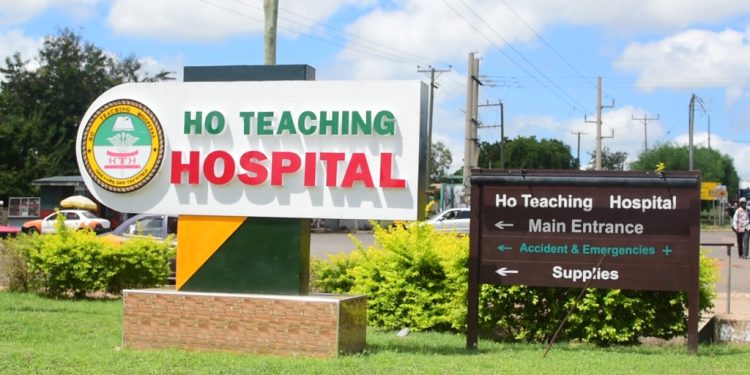
Two significant hospitals in Ho have received a disconnection notice from theElectricity Company of Ghana (ECG) due to unpaid bills.
Ho Teaching and Ho Municipal Hospitals have been given six working days to pay their debts or risk losing access to the national power grid on April 3, 2023.
According to the ECG, the hospitals owe a total of GH¢1,875,300.18 in accruals dating from 2021 to the present, with Ho Teaching Hospital owing GH¢1,459,926.23 and Ho Municipal Hospital owing GH¢415,373.95.
According to PURC RegulationsLI 2413,37, sub-regulation (2), the ECG served written notices of disconnection to the hospitals at least three working days before disconnecting the service.
To avoid disconnection, the disconnection notice urges hospitals to settle their arrears within six working days.
Ing. Michael Buabin, Acting General Manager of ECG in the Volta Region, stated that “disconnection is usually a last resort in order to prevent customers from accruing more debt and to enable the company to collect more revenue to keep the electricity supply chain running.”
He also stated that ECG “does not take pleasure in disconnecting customers” and urged all customers to make paying their electricity bills a top priority. These are sensitive facilities that require power to function, and ECG claims it has engaged with them on several occasions to allow them to settle their arrears before issuing the disconnection notice.
Ing. Buabeng added that “ECG is hoping for a positive response from the hospitals to prevent any form of disconnection. Failure to meet ECG’s target could affect the electricity supply chain and the economy through the unavailability of power”.
ECG has launched a one-month nationwide campaign to recover approximately 5.7 billion Cedis from its debtors, with approximately 220 million Cedis in the Volta Region.
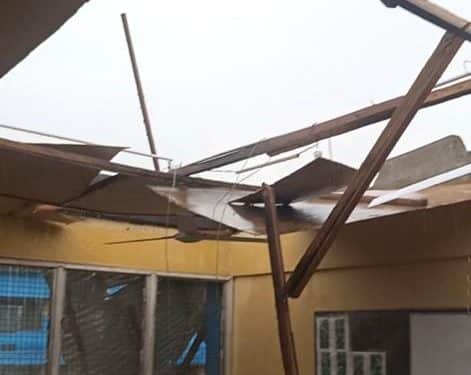
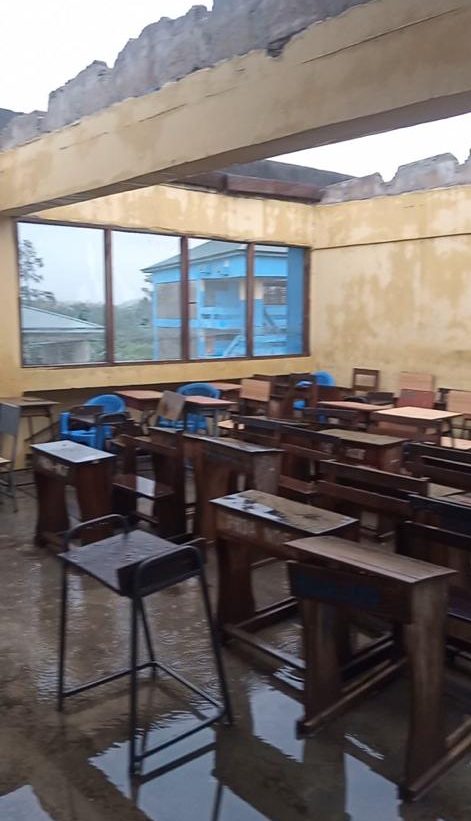
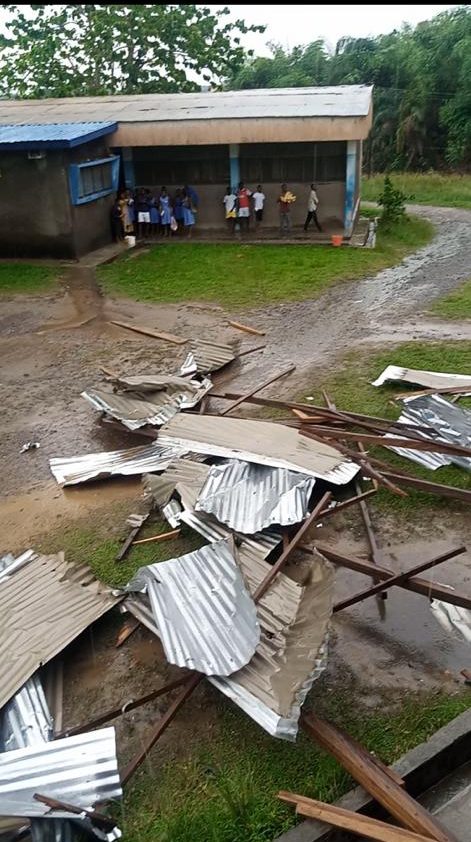
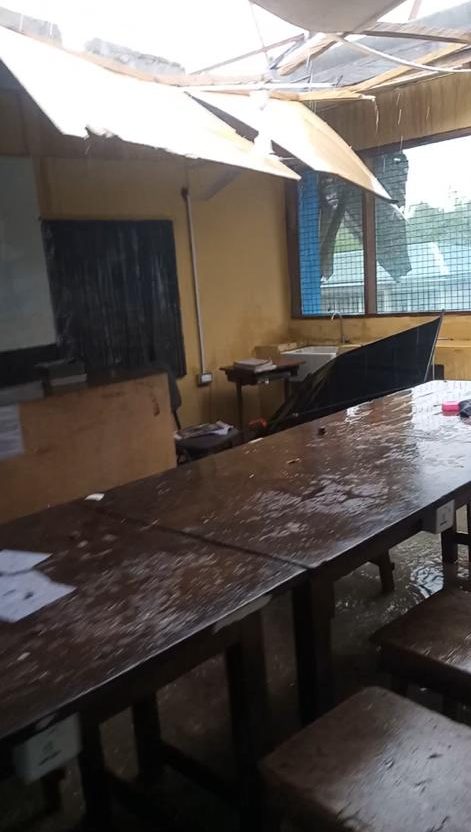
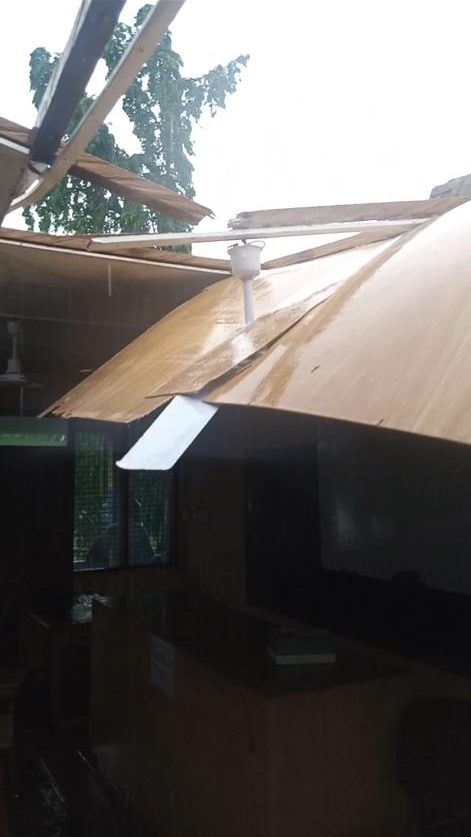
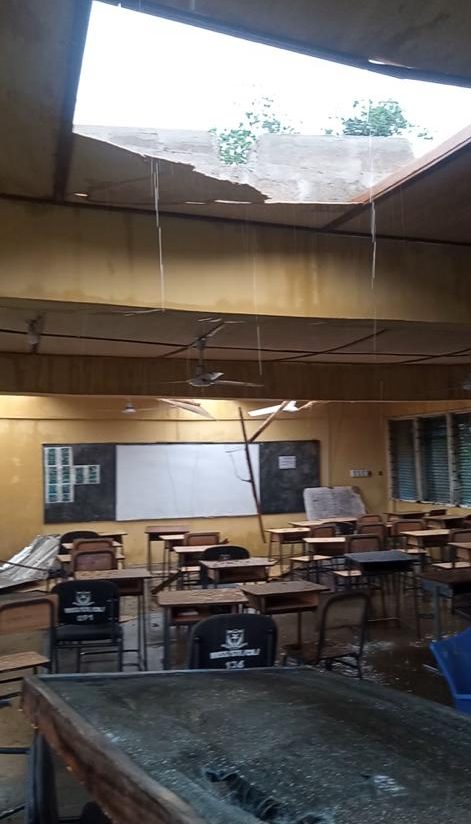
The roof of the science block at the Huni-Valley Senior High School in the Western Region has been ripped off by a heavy rain that began at 3:40 pm on Tuesday, March 28, 2023.
The block houses the school’s Biology, Chemistry, and Physics laboratories.
The rainfall severely impacted the science block, which also houses five classrooms used by SHS 3 students.
The incident occurred at a time when final-year students are eagerly awaiting the start of their first mock exams on Thursday, March 30.
A source told Citi News, learning materials in laboratories and classrooms have been exposed to rain, while electricity poles in the school have been impacted.
Some surrounding communities have been left in the dark.
The violent rainstorm wreaked havoc on nearby communities such as Amoanda in the Prestea-Huni-Valley Municipality, as well as individual homes.
Rumors that the lateKumawu MP, Philip Basoah fainted in the House and was taken to the Korle-Bu Teaching Hospital have been refuted by Solomon Basoah, the MP’s brother.
Philip Basoah, aged 54 was pronounced dead on the dawn of Tuesday, March 28, exactly a week after the passing of Dr. Anthony Osei Akoto, another stalwart of the New Patriotic Party (NPP).
Reacting to the rumour put out by the Speaker of Parliament that the Kumawu legislator collapsed in Parliament on Friday [March 23], Solomon Basoah said the account of Alban Bagbin is misleading.
“I heard the Speaker say that my brother collapsed in Parliament. That is far from the truth. My brother went to Parliament on Thursday [March 23] and returned home and the houseboy was expecting him to wake up on Friday [March 24] and when he didn’t come out, he called people to help break the MP’s door and saw him unconscious on his bed and took him to the hospital,” the brother of the late MP told Umaru Sanda Amadu on Eyewitness News on Citi FM.
He added that when they broke his door and found him unconscious on his bed, “they took him to the LEKMA Hospital and then to Euracare Ghana Hospital, and finally to the Korle-Bu Teaching Hospital where he died.”
He also dismissed the widely circulated rumour that the late lawmaker was brought in an ambulance to vote to approve President Akufo-Addo’s six new ministerial nominees.
“It is never true that he was brought in an ambulance to Parliament to come and vote to approve President Akufo-Addo’s ministerial nominees.”
According toSamuel Nartey George, the Member of Parliament (MP) for Ningo Prampram, it would be politically suicide should President Akufo-Addo decide not to sign the Anti-LGBTQ+ Bill when Parliament approves it.
According to the MP, if the President fails to assent to the bill otherwise known as the Promotion of Proper Sexual Human Rights and Ghanaian Family Values Bill, two-thirds of members of Parliament can vote in favour of the bill to be passed into law.
Speaking on Eyewitness News, Samuel George indicated that failure to approve the bill will be an indictment on the government.
“The President will be requested by Parliament to sign the bill into law. It will be politically suicidal, and it will mark the sound of a dead mill on his abysmal government if he said he was not going to sign that bill into law. That will be the beginning of the collapse of his government and his legacy. And so I don’t want to have that thought because I think that his advisers and handlers will advise him accordingly,” theNingo Prampram MP said.
President Akufo-Addo during a joint press conference he had with US Vice President, Kamala Harris at the Jubilee House on Monday, disclosed that his government had intervened to modify the current anti-LGBTQ Bill.
Kamala Harris also tried to belittle Ghana’s efforts to pass the anti-LGBTQ bill.
Incensed over the comments, the Speaker of Parliament, Alban Bagbin lambasted Akufo-Addo and Kamala Harris describing the comments as undemocratic.
“As the Vice President of the USA, Kamala Harris did yesterday, these things should not be tolerated, that is undemocratic. What is democracy? That someone should have to dictate to me what is good and what is bad? Unheard of, because we have decided to devalue ourselves and go begging? Come on, we have more than enough. God has created more than enough for every person, the Bill will be passed,” Bagbin added.
TheKumasi Metropolitan Assemblyhas received a report from the committee tasked to examine the cause of the Kejetia New Market fire incident.
The committee in its report among other things recommended that the epicentre of the fire should be closed indefinitely to make way for further assessment of the damage caused by the inferno and also check the integrity of structures there.
Among the key findings of the committee, it disclosed that against the measures and fire regulations instituted in the market, “there were gas cylinders in the area of the fire that should not have been there”.
It lauded the rescue services provided by emergency service providers including the Ghana National Service and intimated that though they did their best in fighting the inferno, the fire still “caused considerable damage to the structure of the fire-affected area of the building. The flames destroyed goods and properties whilst the upper area of the market structure building suffered from significant smoke staining to the soffit of the roof covering.”
The report also disclosed that the incident damaged about 42 shops out of which 12 recorded severe damages.
Parts of the Kejetia New Market went up in flames on Wednesday, March 15 destroying properties worth thousands of Ghana Cedis.
A Committee was constituted on Friday, March 17 after a visit by a delegation from the Local Government Ministry, led by Osei Bonsu Amoah, same day the Ghana National Fire Service also commenced investigations into the fire incident.
Included in the Committee’s key recommendations are; a renewal of the building permit (mandatory), renewal of the fire permit (mandatory), and renewal of the EPA’s permit (mandatory).
Following his release on Friday after more than 900 days in prison, opposition leader from RwandaPaul Rusesabaginahas arrived in Qatar.
In 2021, he was sentenced to 25 years in jail over his ties to a group opposed to Rwandan President Paul Kagame, that has an armed wing.
A permanent resident of theUnited States, his release came after months of negotiations between Washington and Kigali.
The 68-year-old former hotelier inspired the Hollywood film, “Hotel Rwanda” about his role in saving the lives of hundreds of people fleeing Hutus during the 1994 genocide against Tutsis.
He became a fierce critic of Kagame and formed his own political party. In 1996, he left Rwanda for Belgium but his family said he was tricked into taking a flight in 2020 that was diverted to Kigali.
Reportedly in fragile health, diplomats have told the AFP that he is to undergo medical checks and rest before flying to the United States on Wednesday.
Several traders atKejetia Market F-line, whose stores were shut down owing to a recent fire breakout, have taken down the barricades in opposition to the city authorities.
The angry traders have decided to forcibly enter the barricaded area to resume operation.
City authorities cordoned off the affected area to enable maintenance works to be carried out.
But traders who were not directly affected by the inferno at that section of the market disagree with the decision.
The recent fire at the kejetia market destroyed 33 shops.
City authorities after several meetings placed a ban on businessactivities at the affected area.
Eight hundred and seven shops were cordoned off.
But traders who were not directly affected disagree. Shop owners at Kejetia Market protest closure
Amidst noise making and clad in red, they registered their displeasure against managers of the facility.
They say, they were not directly affected by the fire.
Leader of the affected traders, Andrews Kwofi claims Management has failed to provide alternatives for businesses affected by their decision.
For each of the upcoming two men’s World Cups, the world football governing body Fifa will now pay clubs £298.74 million ($355 million) for the release of players.
Clubs earned £170.58 million ($209 million) for the 2022 World Cup in Qatar.
The move is the central component of a new Memorandum of Understanding between Fifa and the European Clubs’ Association, which will run to 2030.
The next men’s World Cup, hosted by the United States, Canada and Mexico, takes place in June and July 2026.
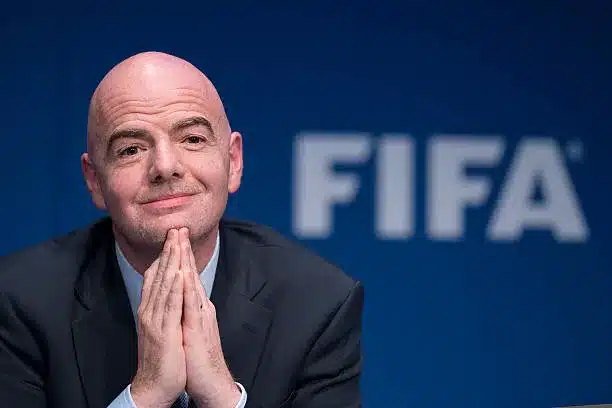
Fifa president Gianni Infantino and Uefa counterpart Aleksander Ceferin were present at the ECA general assembly in Budapest for the announcement.
It brings to end months of bickering between the two bodies, who had initially been at loggerheads over Infantino’s desire to host a biennial World Cup, an idea that was met with huge opposition.
An expanded 32-team Club World Cup, featuring 12 European teams, has been agreed in its place, with Uefa and ECA support guaranteeing this will be put into the international calendar from 2025 despite opposition from leagues and unease among player unions.
Agreement has also been reached over the concept of a Women’s Club World Cup, although the format of this is still to be decided.
In addition, the ECA has backed Fifa’s plan for a player welfare taskforce, which players’ union Fifpro believes is essential.
The new agreed international match calendar will also include an annual match between the Champions League winner and the winner of an intercontinental playoff.
Infantino said: “This is a significant day for the future of footballand its long-term stability. We are very happy to renew and strengthen our cooperation agreement with ECA, an important stakeholder representing clubs from all over Europe.
“To have the new international match calendar endorsed by ECA provides the necessary balance between club and national team football. We have exciting projects ahead, including the new Fifa Club World Cup in 2025 and the new Fifa Women’s Club World Cup.
“A close collaboration with clubs in Europe, and the rest of the world, will be essential for the success of those events.”
The precise format for the Club World Cup is to be determined but as the four winners prior to the tournament up to 2024 will be included, Chelsea are already guaranteed entry after winning the 2021 Champions League.
In addition, ECA chairman Nasser Al-Khelaifi, who is also president of Paris St-Germain, touched on the close relationship between his organisation and European governing body Uefa in his opening address.
This included another rebuke at Juventus, Real Madrid and Barcelona, who are awaiting a ruling from the European Courts of Justice over Uefa’s monopoly position, which they believe has put barriers in the way of their cherished European Super League concept.
“In this next era of the ECA, I am determined that we will be recognized for driving financial prosperity and distribution for the entire football pyramid, not just the elite,” Al-Khelaifi said.
“Thinking back to the sorry events in April 2021 – which we should not forget – the ECA’s relationship with Uefa has changed completely in the past two years.
“Today, it is founded on trust, respect and common interest. As a result, we are both much stronger. Thank you President Ceferin.”
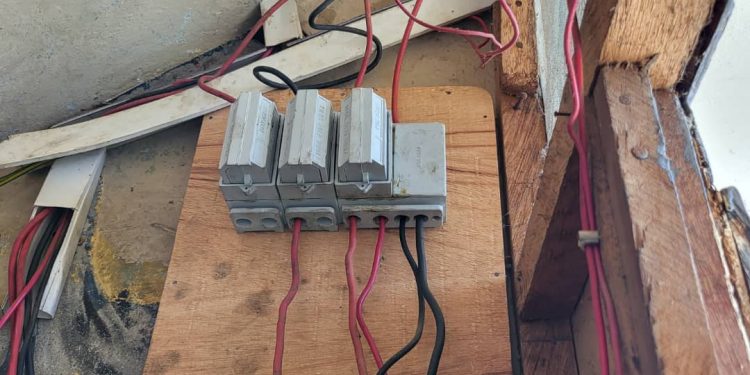
The national revenue mobilization taskforce of the Electricity Company of Ghana(ECG) has cut off power to three blocks at the police barracks at Osu in Accra due to an unauthorized connection (power was connected without a meter).
The task force discovered the illegality on Tuesday on its usual rounds to recover monies owed by customers.
The task force, aside from chasing people who owe ECG debts, uses the opportunity to check for illegal connections.
“Since it’s an illegal connection, we have the first right to disconnect before we deal with issues.” The manager in charge of external communications, Laila Abubakari told Citi News.
The disconnection is part of a national exercise to collect monies owed to ECG by customers and to also ascertain the condition of all meters.
“The Ghana police would have to come to ECG where a bill will be generated for them covering a period of 12 months,” she added.
She said power will be restored when they pay the surcharged amount.
“The administration block also owes, but due to security implications, we’ve spared that facility while we discuss further the amount involved. We consider the police accommodation facilities (blocks) a general facility hence the disconnection”.
Meanwhile, the ECG Revenue Mobilization Taskforce was held hostage for about 30 minutes after they disconnected the Ghana Post Company over GH¢89,000 debt.
The task force was at the premises to conduct its ongoing revenue mobilization exercise on Tuesday when the staff prevented the task force from leaving the Accra main office.
The disconnection exercise is in its second week of the month-long national exercise aimed at retrieving GH¢5.7 billion on their books.
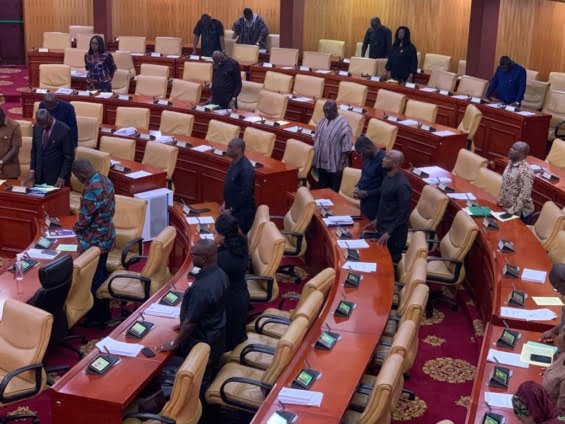
Today, Tuesday, March 28 majority in Parliament wore black to parliament in honor of theirdeceased colleague, Philip Basoah.
He was MP for Kumawu in the Ashanti Region and the Chairman of the Employment, Social Welfare and State Enterprises Committee of Parliament.
Mr Basoah’s death came as a shock to many especially the Caucus, which needed him so much on Friday but was absent due to a sudden illness he suffered.
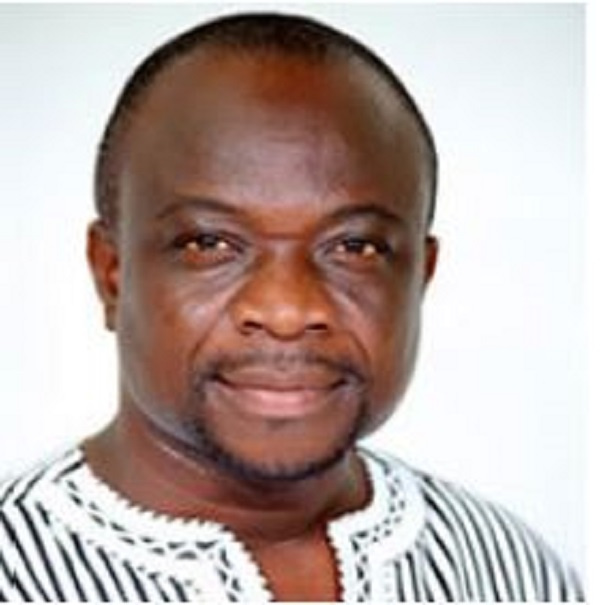
Philip Atta Basoah
The Caucus appeared in the chamber devastated and calm and in a mourning mood with little or no words emanating from the Caucus’ side.
Philip Basoah came to Parliament in 2013 and was part of 6th, 7th and 8th Parliaments.
He served on the Lands & Forestry and Committee on Selection before becoming the chairman of the Employment, Social Welfare and Public Enterprises.
Mr Basoah held a Master’s Degree (Human Resource Management) – 2012, B.ED (Education) – 2000, GCE A Level – 1994, GCE O Level – 1991 and MLSC – 1986.
He was also a teacher.
Meanwhile, the House has been paying respect to him.
The speaker ordered for a minute of silence to be observed in his memory and advised that legislators take issues of their health seriously.
Beninese-French singer-songwriter, Angelique Kidjo has emerged winner at the Polar Music Prize 2023.
The multiple Grammy Award winner is one of three (3) Laureates who have been awarded the Polar Music Prize 2023.
The two (2) others are Chris Blackwell, founder of Island Records, one of the UK’s greatest independent record labels, and Estonian Arvo Pärt, the world’s most-performed living composer.
The Polar Music Prize ceremony will take place on Tuesday 23 May in Stockholm at the Grand Hôtel.
Since the inaugural ceremony in 1992, the Polar Music Prizehas been renowned as music’s most prestigious honour. It has been celebrating the achievements of some of the world’s most important and inspiring musical figures for over three decades. The prize is presented in Stockholm in the presence of the Swedish Royal Family. Each Laureate will receive prize money of 600,000 Swedish Kroner (approx. £47,681/US $57,384).
Marie Ledin, managing director of the Polar Music Prize, said:
“We are delighted to honour these three Laureates who have all made such a global impact with their music. Angélique Kidjo is an inspirational artist, she constantly explores and challenges and is one of the greatest singer-songwriters in international music. We are thrilled to be recognising her talent and shining a light on her important work with the Batonga Foundation.
On being awarded the Polar Music Prize, Angélique Kidjo said: “My passion for music has always been unwavering. Being on stage for me is like being in paradise – it’s my sanctuary. It’s my place to link and to connect with my fellow human beings. That is something that I’m grateful for every day.
“To be awarded the Polar Music Prize is humbling. I have no words to say how important this is for me. It comes with a sense of responsibility that is bestowed upon me as an artist to continue to do great work. I will do my best to be a proud recipient of the Prize through my work as a UNICEF Goodwill Ambassador, on behalf of the children, and as an ambassador of music, to help create a world in which we can all live in peace. Thank you so much for making me part of this prestigious Prize, in such a prestigious company.”
Angélique Kidjo is a five-time Grammy Award winner, a creative force with 16 albums to her name, and was named “Africa’s premier diva” by Time Magazine. Furthermore, the BBC included Kidjo in its list of ‘The Continent’s 50 Most Iconic Figures’. She was included in The Guardian’s ‘Top 100 Most Inspiring Women in the World’, and was the first woman on Forbes’ list of ‘The Most Powerful Celebrities in Africa’.
As a performer, Angélique’s striking voice, stage presence and fluency in multiple cultures and languages has won respect from her peers, expanding her following across national borders. She has cross-pollinated the West African traditions of her childhood in Benin with elements of American R&B, funk and jazz, as well as influences from Europe and Latin America.
Angélique travels the world advocating on behalf of children in her capacity as a UNICEF and OXFAM goodwill Ambassador. She has created her own charitable foundation, Batonga, dedicated to supporting the education of young girls in Africa.
Previous recipients of the Polar Music Prize include Paul McCartney, Bruce Springsteen, Peter Gabriel, Chuck Berry, Ennio Morricone, Led Zeppelin, Patti Smith, Stevie Wonder, Paul Simon, Kronos Quartet, Joni Mitchell, Elton John, Metallica, Iggy Pop, Ravi Shankar, Renée Fleming, Miriam Makeba, Wayne Shorter, Sofia Gubaidulina and many more.
The police has said that it is investigating the targeted attack at a private elementary school that killed six people, including three children.
The shooting occurred at a private school that serves about 200 students in preschool through sixth grade.
Federal and local investigators in Nashville were working on Tuesday to piece together clues about the actions and motives of the shooter who killed three students and three adults at a private school before being shot dead by the police.
The assailant who opened fire at the Christian elementary school in Nashville on Monday was identified by officials asAudrey E. Hale, a 28-year-old former student who lived in the area.
The Nashville police chief, John Drake, said on Monday that the attack was targeted, rather than random, but that it was too early to discuss a possible motive. Local and federal investigators working on the case were reviewing writings and had made contact with the shooter’s father, Chief Drake said.
CreditCredit…Desiree Rios/The New York Times
The school, called the Covenant School, is in the wealthy Green Hills neighborhood of Nashville, a few miles south of downtown, and enrolls about 200 students in preschool through sixth grade. The attack on Monday was the 13th school shooting in the United States this year that resulted in injury or death, according to Education Week.
Here’s what we know so far: What happened?
The police received a report of the shooting at 10:13 a.m. on Monday and heard gunshots on the second floor when they arrived at the school, said Don Aaron, a spokesman for the Metropolitan Nashville Police Department.
The assailant had entered the building through a side door, armed with two assault-style rifles and a handgun, and went from the first floor to the second floor firing “multiple shots,” Mr. Aaron said. Officers went to the second floor, saw the assailant shooting, and two officers opened fire, killing the shooter at 10:27 a.m., Mr. Aaron said.
Surveillance video released by the police on Monday showed the shooter drive up to the school in what the police described as a Honda Fit. In the clip, two sets of glass doors shatter from bullets before the shooter ducks into the building through the broken glass. Wearing camouflage pants, a black vest and a backward red baseball cap, the shooter walks through rooms and hallways with a weapon drawn.
Surveillance video shows an attacker whom the police identified as Audrey E. Hale driving up to the Covenant School in Nashville, and then shooting out the entrance doors to get into the building.CreditCredit…Metropolitan Nashville Police Department
Schoolchildren and members of the school’s staff were escorted out of the building after the shooting, said Kendra Loney, a spokeswoman for the Nashville Fire Department. A total of 108 people, she added, were transported to the nearby Woodmont Baptist Church, where parents were reunited with their children. Who were the victims?
The police identified the six victims as:
— Evelyn Dieckhaus, 9
— William Kinney, 9
— Hallie Scruggs, 9, daughter of the church pastor, Chad Scruggs
— Mike Hill, 61, a school custodian
— Cynthia Peak, 61, a substitute teacher
— Katherine Koonce, 60, the head of school, according to the school website What do we know about the shooter?
The authorities identified the shooter as Audrey E. Hale. The police said they had found writings and detailed maps of the school and its security protocols.
The assailant was “prepared for a confrontation with law enforcement” and “prepared to do more harm” before being killed, Chief Drake said. At least two of the guns used in the shooting appeared to have been purchased legally in the Nashville area, he said.
In the aftermath of the shooting, there was confusion about the shooter’s gender identity. Chief Drake said the shooter identified as transgender, and officials used “she” and “her” to refer to the attacker. But according to a social media post and a LinkedIn profile, the shooter appeared to identify as male in recent months.
Investigators had made contact with the shooter’s father and were carrying out an investigation at the home, Chief Drake said. As of Monday evening, the motive was unknown. And the school?
The Covenant School is a private school that was founded in 2001 as a ministry of the Covenant Presbyterian Church. The church started the school in part because parents at the church were finding it difficult to enroll their children in other private schools in the area, according to Jim Bachmann, a former pastor at the church.
The school is “intentionally small,” according to its website, with 200 students in preschool through sixth grade, and a student-to-teacher ratio of 8-to-1. Tuition costs about $16,000 a year.
Covenant Presbyterian is a large church affiliated with the Presbyterian Church in America, a theologically conservative denomination.
Chad Scruggs is the current pastor of Covenant Presbyterian. His 9-year-old daughter, Hallie Scruggs, was killed in the shooting.
The Member of Parliament for South Dayi, Rockson Nelson Dafeamekpor, has expressed shock over the death of colleague, MP for Kumawu, Philip Basoah.
According to family sources he passed away Tuesday morning, March 28.
He died at Korle Bu Teaching Hospital at the age of 53.
He is one of three majority MPs who were absent from Parliament on Friday during the debate and subsequent voting of some new Ministers.
He first came to Parliament in 2017 after winning the 2016 general elections in the Kumawu constituency.
Prior to sailing to Parliament, Mr. Basoah was a Chief Executive for the Sekyere East District from June 2005 to January 2009 and was also a tutor at the Agogo State College.
In a tweet, Mr Dafeamekpor expressed shock at the passing of the legislator saying he was very active in parliament the previous week.
“This is so tragic. Hon. Basoah you were so active just last week in Parliament. Very calm & focused yet very active, especially on the Public Accounts Committee where you & I serve. Fare thee well, my brother. My deepest condolences to your family & Constituents. You served well.”
Reports that the governmentowes some seedling suppliers for the Green Ghana project 2.5 billion cedis have been refuted by the Ministry of Lands and Natural Resources.
The seedling contractors were tasked to supply seedlings for the tree planting exercise during the Green Ghana Day celebrations for 2021 and 2022.
According to the association, several engagements with the Ministry of Lands and Natural Resources and the Forestry Commission for the government to pay them have been unsuccessful despite the many assurances.
According to members of the association, they are currently frustrated as they are constantly being harassed by banks they secured loans from to procure the seedlings.
Speaking to Citi News, the Secretary of the Ashanti Region Seedlings Contractors Association, Gloria Amponsah called on President Akufo-Addoto intervene in ensuring that they are paid to lessen their burden.
“The situation is really hurting us. A lot of people are in trouble and the law courts are attacking them. We have gone to the Forestry Commission several times to no avail, sometimes we even sleep there but all the promises have not come true. When we go there, they treat us like we are not humans, they don’t have empathy for us”.
But the government has attempted to set the record straight describing the quoted amount as outrageous and that the government owes them only 28 million cedis.
Speaking during a tour to inspect some trees planted at some sites of the Green Ghana Project, Deputy Minister of Lands and Natural Resources Benito Owusu Bio said the government is making frantic efforts to pay them.
“Please we don’t owe anyone GH¢2.5 billion. Yes government owes for 2021 to 2022. In all, it is just 28 million Ghana cedis so where from the 2.5 billion? Let’s report the fact as it is.”
He further added that despite some peculiar challenges it has recorded, the survival rates during the 2021 and 2022 Green Ghana projects have been positive.
He added that the government will continually embark on such exercises to achieve its intended purpose.
The Ministry of Employment and Labour Relationshas warned the public against an ongoing recruitment scam in which an email purporting to be from the Ministry informs recipients that they have been selected for an interview.
The purported interview was being held at the Ministry of Foreign Affairs and Regional Integration, which started on March 7, 2023, and is ongoing.
A statement issued by the Ministry of Employment and Labour Relations, copied to the Ghana News Agency, said the email directed persons interested in the job offer to pay ¢300 into mobile money account numbers 0203536390 and 0560785536.
The fee was meant to facilitate the interview and subsequent completion of Public Service Interview Evaluation forms.
It noted that additionally, text messages titled: “Ministries”, had been sent to the public to contact one Romeo Adams, designated as the Human Resource Manager on 0203536390 to confirm participation in the said interview.
However, contacts of unsuspecting job seekers, who sent monies, were blocked from making calls to the recipient’s number, the statement said.
‘’The Ministry of Employment and Labour Relations is seizing this opportunity to inform all and sundry, especially job seekers and Ghanaian youth that the Ministry had not officially notified the public of any recruitment interview at the Foreign Affairs Ministry…”
“Romeo Adams is not a staff of the Employment and Labour Relations Ministry and the Ministry is not a recruitment body,” the Ministry stated in their press release.
The Ministry urged the public to take note of its website and Facebook page, www.melr.gov.gh and Ministry of Employment and Labour Relations-Ghana, respectively.
The US government has pledged to give five countries in West Africa $100 million to help fight potential extreme terrorism.
The countries include Côte d’Ivoire, Ghana, Benin, Guinea, and Togo.
This is in line with the US initiative to boost it eliminate violence and propel stability in areas vulnerable to conflict. US commits $100m to help combat terrorism in coastal West Africa
This was announced by US Vice President Kamala Harris during her visit to the Jubilee House in Accra.
She was hosted by President Akufo-Addowhere they both held pertinent discussions of mutual interest.
“Today I am pleased to announce $100 million in support of Benin, Ghana, Guinea, Cote d’Ivoire and Togo,” she said on Monday.
“Last week President Joe Biden announced a strategic plan for coastal West Africa as part of the United States strategy to prevent conflict and promote stability.”
She expressed hope that the funding will help implement the policy outlined by US President Joe Biden in the strategic plan. US commits $100m to help combat terrorism in coastal West Africa
Madam Harris is currently embarking on a one-week tour which will see her visit Ghana and two other African countries – Tanzania and Zambia.
The head of the political science department at the University of Ghana,Dr. Seidu Alidu, claims that the subject is misconstrued if the National Democratic Congress (NDC) members of parliament are simply labeled as traitors for not voting down the President’s nominees for ministerial positions.
According to him, many factors have to be taken into consideration to determine the reasons that influenced the defecting MPs to vote in the way they did.
Speaking on JoyNews’ PM Express, he explained that while outsiders may just simply view it as the MPs defying the orders of the party, it could be more than just that.
“You’re looking at relationships individual MPs have had with other MPs across the divide, but you’re also looking at group interests. So the group interests, the MPs operate in caucuses so we have Volta caucus, Eastern caucus, Ashanti caucus, Northern caucus, Muslims, Christians and all those things.
“So you have a member of parliament who is NPP and he has been nominated as a minister and he fellowships at the same church with you, he’s in the same caucus with you, you’re from the same region with him, and you know that he can dispense patronage to you when he becomes a minister.
“You’re in opposition you need a very bad road in your constituency to be fixed for you to win re-election, he has assured you he will do it for you, can you look him in the eye and vote against him?” he said.
He also added that the close friendships that some MPs have cultivated with MPs from across the political divide sometimes also affect the way they come to a decision in cases like these.
“Some of them are in-laws, some of them are very good friends even though they’re from the same divide, they sit together they eat together, when they’re out of parliament they’re together, they do a lot of things together.
“And then the personal interest, you see the NDC has opened up nominations, people need money to file, people need to justify their inclusion through projects, people need a lot and then somebody promises you ‘if you’re able to do this I’ll give you that.’
“So Evans, our analyses have focused largely on the formal institutions, the constituency, the party interest, the national interest. But we cannot also ignore that informal dynamics that occur daily among MPs and sometimes which are even stronger than some of the party, state and constituency interest,” he said.
Dr. Seidu Alidu further stated that the defecting MPs may have voted the way they did as a protest against certain actions taken by the party or by the party’s leadership in recent times.
Thus, while these MPs may have lacked the courage to raise their objections during group consultations with party leadership, felt the need to register their displeasure by breaking rank during the secret balloting.
“People may not be happy with a lot of things that have happened in the party or something that has happened in the party. When you engage them they won’t tell you, but they will have to prove to you that they’re not happy by the way they vote.
“And in national elections, protest votes do occur, and when protest votes occur what you need to do is to find out why people are protesting or defying the party three-line whip and then see how you can engage them,” he said.
“The MPs are so close that the Majority side knows some of the people who are disillusioned and disaffected and have challenges or don’t like what their leadership is doing or what their party is doing and the NDC knows on the NPP side those people.
“So sometimes it is very [easy] for them to just go straight to them, take advantage of their disappointments, offer them something that will make them very happy or to prove to them that they’re not happy with their leadership and they’ll go,” he added.
Meanwhile, he has urged that cool heads prevail and that the party leadership foment trust within the party’s rank and file to prevent a repeat situation in the future.
“So I think … that cool heads must prevail. There’s still a lot that’s supposed to happen up to the end of this parliament and 137-137 is more about the definition of politics – compromise and consensus building – you will have to create that element of trust within your rank and file, and that will give you the impetus to engage the other.
“Identify the people with the challenges in your rank and file and know how to bring them on board, other than that the other side will identify them and work with them,” he said.
He noted that should the NDC decide to witch-hunt the defecting MPs, it will “deepen mistrust and suspicion in the party,” and this would affect the party’s chances of reclaiming victory in the upcoming general elections.
The Rt. Honorable Speaker of Parliament, Alban Kingsford Sumana Bagbin, has formally been introduced as a newly installed sub Chief of Awudome with the title Togbe Nutefeworla Awudome I.
The enstoolment was done by the Paramount Chief of the Awudome Traditional Area, Togbega Addai Kwasi Dzani XIII.
Togbega Addai Kwasi Dzani XIII expressed his gratitude to Speaker Bagbin for accepting their invitation to attend the Awo Festival as a special guest of honour in 2022.
He praised the Speaker for his integrity and unique sense of impartiality, which kept democracy at peace.
The Paramount Chief called on Speaker Bagbin to maintain his balance in the supreme interest of Ghana, and expressed the desire of the people of Awudome to build an everlasting relationship with his character and integrity which called for the highest honor of Awudome to be bestowed upon him as “Man of Integrity” .
Addressing the delegation, Speaker Bagbin expressed his deepest appreciation for the delegation’s presence and thanked the Chiefs and people of Awudome for the invitation and honour.
He assured them of his continuous commitment to impartiality and serving the people of Ghana with dignity and honor. He emphasized that impartiality gives honour and dignity to the House and expressed his pleasure at having the delegation present at the humble ceremony led by the Togbega himself.
In attendance at the ceremony were Members of the Parliamentary Service Boards, Members of Parliament and Staff of the Parliamentary Service .
The Chiefs and people of Awudome Traditional Area in the Volta Region honored the Rt. Hon Speaker Alban Sumana Kingsford Bagbin, as Togbe Nutefeworla I for his contribution to national development during the AWO Festival in 2022 .
In court on Monday, March 27, when the case was called before a three-member High Court panel presided over by Justice Afia Serwah Asare-Botwe, Lawyer Maud Opoku who held brief for Lawyer Ephraim A. Vordoagu, said the first accused person has passed on.
“With respect, My Lords, the family of Dr. Mac-Palm has told us that, on Saturday, March 25, he passed on to glory,” Lawyer Maud Opoku told the court.
Asked by Justice Asare-Botwe if they have any evidence of that information, the Prosecution Winifred Sarpong, a Principal State Attorney, said upon hearing the information, they asked National Intelligence Bureau to verify from the hospital.
She said the facility has since confirmed the news.
But the panel which also includes Justice Hafisata Amaleboba and Justice Stephen Oppong, all Justices of the Court of Appeal said the court would need a medical certificate confirming his demise.
“We are going into whether the man is alive or dead and not the cause of death,” the president of the panel noted.
EIB Network’s Legal Affairs Correspondent, Murtala Inusah, who was in court reports that some of the nine other accused persons were in black outfits while the case has been adjourned to March 29.