The Ghana Navy and the Marine Operations Unitof the Ghana Ports and Harbours Authority (GPHA) have started a combined simulation exercise to see how prepared they are to handle an oil spillage at sea.
Captain Francis Kwesi Micah, Harbour Master at theTema Port, explained that the simulation was staged for a level one oil spillage involving an illegal bunkering operation.
Captain Micah said the process required that the port control was alerted for the working frequency to be established, after which, deploying one of GPHA’s tugs, ‘Ben Owusu Mensah’ which has all the capabilities of handling a spill of that nature.
The simulation, he said, was done under the 2023 Edition of the “Obangame Express,” which is a multinational maritime exercise in the Gulf of Guinea between January and February annually.
Captain Micah explained that the Obangame Express focused on increased regional cooperation in maritime safety and security, with this year’s edition designed to involve stakeholders in Ghana’s maritime industry to ensure interoperability between maritime partners and cooperation at sea.
He said GPHA’s participation was to demonstrate its commitment to international exercises intended to create an environmentally safe and secure marine environment.
He said the Ghana Navy, on its part, was available to cordon off the area to prevent the inflow of traffic around the area of operation.
He added that “thereon we deployed the booms which are designed to contain the oil from spreading. After they used the skimmers to gather all the oil settled at the surface of the water into the holding tanks of the tugs and after that we use the dispersants.”
Captain Micah said all the operations carried out during the simulation were done with permission from the Environmental Protection Agency (EPA).
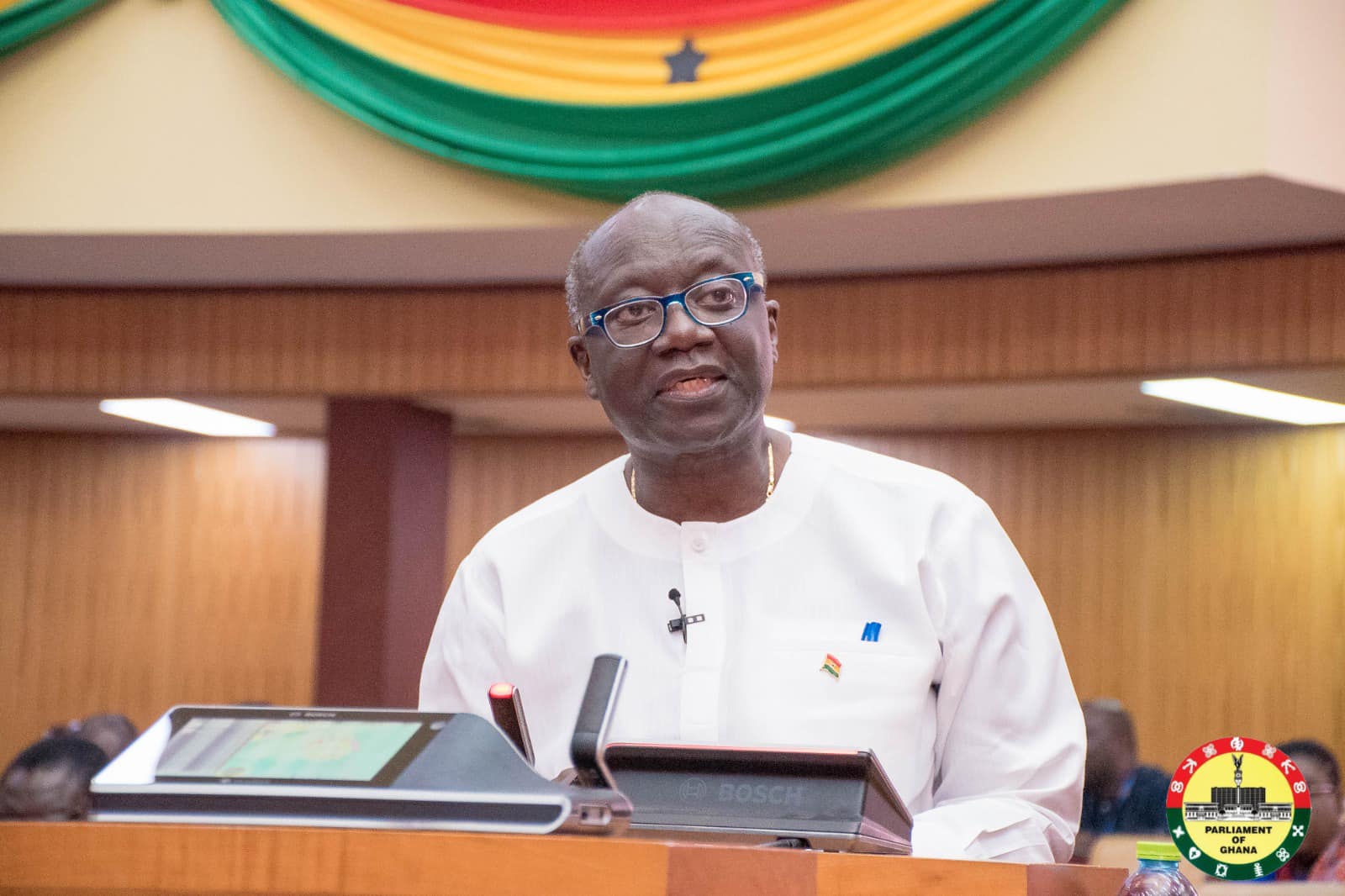
A deadline for paying back outstanding bonds that the government defaulted on which also matured on February 6 has finally been provided by Finance Minister Ken Ofori-Atta.
According to him, all outstanding coupons will be paid after February 21.
“Settlements will be made after Tuesday, February 21 and then we can begin to look at processing everybody’s [bonds],” Finance Ministerassured the pensioner individual bondholders on Friday when they met to thank him for exempting them from the debt exchange programme.
Explaining the reason for the delay in payment, he pointed out that the processing of coupon payments on bonds delayed due to the settlement period for the programme.
He, however, reiterated that the government is working to ensure that every bondholder is paid their dividends upon maturity of their bonds and urged the bondholders to remain calm.
“But let nobody have any inkling that anybody is going to be punished for whatever reason. All coupons will be attended to the same way in which the contracts were signed.
“We are in a difficult situation that is why we are doing the debt exchange programme and so we hope that the percentage of bonds signed onto the programme will bring down our interest on debts and give us the fiscal space to honour whatever commitments we have with our bonds,” he said.
This comes in the wake of Individual bondholders piling pressure on the Finance Ministry to pay the over GH¢4 billion in interest and principal on which the Ministry defaulted.
The Individual Bondholder’s Forum dispatched a letter to the Finance Minister, Ken Ofori-Atta demanding the payment of outstanding bonds that matured on February 6.
The Individual Bondholders Association of Ghana has taken it a step further. A delegation from the association was at the Police Headquarters on Monday to serve a formal notice of an impending 5-day protest.
The protest is expected to start from February 20 to 24.
The Individual bondholders will be picketing at Black Star Square.
Per the agreement, a group of about 30 or 50 individual bondholders will be escorted to the Finance Ministry to present a petition and back to the square.
On his part, a private legal practitioner and convener, Martin Kpebu stated that government should not only honour its promise to bondholders but should also exempt individual bondholders from the Debt Exchange Programme.
According to him, picketing for five days will galvanize more support for the cause of the group to push for an exemption.
The exemption protest, he said is a cause for which individual bondholders must win at all costs.
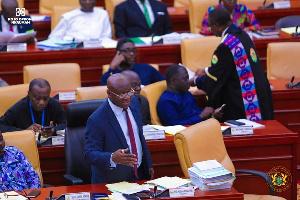
Alexander Afenyo-Markin, the member ofparliament representing the Effutu Constituency, has asked for a comprehensive online child protection strategy to limit children’s access to social media.
In a statement on the floor of Parliament on Friday, February 17, the Deputy Majority Leader said the “present and future of our children are in grave peril” if efforts and measures are not scaled up to protect them from the dangerous hazards of early social media use and consumption.
He has thus recommended that Parliament direct the Ministries of Interior, Communications and Digitalisation and Gender, Children and Social Protection to expedite work on developing a comprehensive Online Child Protection Policy for adoption and implementation within the immediate future.
He also wants Parliament to lead an amendment to the Cyber Security Act 2020 to impose an obligation on the Cyber Security Authority to submit SEPARATE bi-annual reports for consideration and subsequent action on detailed measures it has taken to specifically safeguard Ghanaian children from the harmful effects of Social Media use and consumption.
Finally, the MP has also called on Parliament to draft and pass a new law, through the efforts of private members, prohibiting Ghanaian children under 16 from irresponsibly consuming and or using Social Media.
In that law, Mr Afenyo-Markin says offending parents or guardians –– through whose negligence and or acquiescence children consume or use harmful Social Media content or become owners of Social Media accounts ¬–– must face punitive fines.
STATEMENT ON THE FLOOR OF PARLIAMENT BY ALEXANDER KWAMENA AFENYO-MARKIN, DEPUTY MAJORITY LEADER AND MP FOR EFFUTU, ON THE NEED FOR GHANA TO SCALE UP EFFORTS TO CLAMP DOWN ON EARLY SOCIAL MEDIA USE BY GHANAIAN CHILDREN
INTRODUCTION
1. Right Honourable Speaker, on the authority of the permission you have so gracefully granted me this fateful day, I rise to make a crucial statement on Social Media consumption among children and the alarming social and technological cankers it has induced, threatening the immediate and future safety of our children and, possibly, future generations.
2. To begin with, Mr. Speaker, it will be helpful to provide a working definition of the technical term “Social Media”. According to Investopedia, the term Social Media concerns “a computer-based technology that facilitates the sharing of ideas, thoughts, and information through virtual networks and communities.” It explains that Social Media “is internet-based and gives users quick electronic communication of content, such as personal information, documents, videos, and photos.”
3. Social Media users or consumers typically engage with various platforms through a tablet or a smartphone with web-based software, applications, or a computer. Examples of major Social Media platforms, particularly those in intense use in Ghana, are Tik Tok, Facebook, Twitter, Instagram, Snapchat, and YouTube. Usually, Social Media platforms allow for user-personalised profiles, generated content and subscriptions. Often these platforms require that a person wishing to create a user-personalised profile must be at least 13 years old.
SOCIAL MEDIA EXPLOSION AND ASSOCIATED DANGERS
4. Mr. Speaker, it is estimated that over 4.5 billion people around the globe use Social Media as of October 2021. Other estimates published by business.com suggest that Social Media use has increased sharply since the Covid-19 pandemic. Let me hasten to concede that it is indeed the case that Social Media sites can serve as valuable platforms for both adults and children to acquire crucial knowledge, learn new and vital skills, consume valuable news content, and even earn a living through lawful Social Media marketing and content creation.
5. To quote my respected colleague lawmaker and Minister for Communications and Digitalisation, Hon. Ursula Owusu-Ekuful, “The internet revolution has transformed how we… access information and is an increasingly valuable resource for children and young people to learn, socialise, innovate and connect.”
6. However, the unfortunate reality is that the internet is not always helpful. Indeed, Social Media sites on the internet have become very dangerous and destructive tools and platforms used by perverts belonging to the evil fringes of society to target, victimise, radicalise, and destroy the present and future of innocent or curious or unsuspecting children.
7. One study identified some of the main negative implications of the use of Social Media by school children as: “distraction of pupils’ attention from their studies, frequent use of Pidgin English as well as unnecessary fashion consciousness.” However, more deadly dangers are flowing from Social Media consumption by children that demand urgent attention. According to Australia’s Raising Children Network, these include: (a) exposure to inappropriate or upsetting content, like mean, aggressive, violent or sexual comments or images (b) uploading inappropriate content, like embarrassing or provocative or nude photos or videos of themselves or others (c) sharing personal information with strangers – for example, images, date of birth, location or address (d) cyberbullying (e) exposure to too much-targeted advertising and marketing, including those meant for adults (f) and exposure to data breaches like having their data sold on to other organisations.
8. To use a translated Ghanaian proverb, many parents and/or guardians “have slept in their beds. Unfortunately, however, their legs are languishing or lurking far beyond the confines of our bedrooms.”
9. A few official figures on the scale of the problem around the world and in Ghana should suffice. For example, Mr. Speaker, a UNICEF report released in 2021 revealed that globally 1 in 5 girls and 1 in 13 boys suffer sexual abuse or exploitation through electronic media before their 18th birthday. The reports stated, “The scale, complexity and danger of online facilitated child sexual abuse and exploitation is escalating, with technology enabling new modes of child abuse to emerge such as the live streaming of sexual assaults of children and sexual extortion of children, often to coerce a child to take part in the production of child sexual abuse material under threat.”
10. Much earlier, in 2018, another research titled “Risks and Opportunities Related to Child Online Practices” which interviewed some two thousand children between the ages of 9 and 17 and up to one thousand parents or caregivers across the country’s various regions, also returned a disturbing result. Although the report found that seven out of 10 young persons use the internet for learning, a troubling four out of 10 children or adolescents have contacted strangers they had never met in person. Also, two out of 10 children or adolescents have met persons face to face that they only first met on the internet.
11. Further, around three in 10 children or adolescents reported that they had experienced bothersome or upsetting incidents or things online. Worst still, the National Center for Missing and Exploited Children in the United States of America has also found that over 13,000 images and videos featuring the sexual abuse of children were either accessed and or uploaded from within Ghana in the year 2020 alone.
12. A more disturbing statistic is that only two out of ten parents or guardians expressed confidence that their children or wards could cope with things that bothered or upset them online. Also, around three out of ten, which translates to 28% of parents or guardians interviewed, said they were confident in supporting their wards or children to cope with upsetting things online.
13. Clearly, these facts and figures demand a robust response from all of us as parents (first of all) and lawmakers to put in place measures to protect or rescue our children. In making this statement, I am well aware that in 2020 this House passed the Cyber Security Act 2020 (Act 1038), setting up the Cyber Security Authority under section 2 and empowering it to, among other things, ensure the safety of children online. The Act, under Section 97, defines a child to mean “a person below the age of eighteen years.” The same section defines “cybercrime” to mean “the use of cyberspace, information technology or electronic facilities to commit a crime.”
14. Under Sections 62-67 of the same Act, this House criminalised abuses of children online. The prohibitions include the production, viewing and distribution of materials featuring the sexual abuse of children. Other prohibitions concern online grooming of children, cyberstalking a child and sextortion, which occurs when someone threatens to distribute a person’s confidential and sensitive material if the person does not furnish them with images of a sexual nature, sexual favours, or money. Upon conviction, a person can face many years in jail.
NEED FOR URGENT ACTION
15. Mr. Speaker, the facts documented in this statement should lead us to one conclusion only: that the present and future of our children are in grave peril if we do not scale up efforts and measures to protect them from the dangerous hazards of early Social Media use and consumption. Accordingly, permit me, Mr. Speaker, to recommend the following urgent steps to help protect our future leaders.
16. Firstly, this Parliament must firmly direct the Ministries of 1) Interior, 2) Communications and Digitalisation 3) Gender, Children and Social Protection to expedite work on developing a comprehensive Online Child Protection Policy for adoption and implementation within the immediate future.
17. Secondly, Parliament must lead an amendment to the Cyber Security Act 2020 to impose an obligation on the Cyber Security Authority to submit SEPARATE bi-annual reports to this House for consideration and subsequent action on detailed measures it has taken to specifically safeguard Ghanaian children from the harmful effects of Social Media use and consumption.
18. Thirdly, this House must draft and pass a new law, through the efforts of private members, prohibiting Ghanaian children under 16 from irresponsibly consuming and or using Social Media. In that law, offending parents or guardians –– through whose negligence and or acquiescence children consume or use harmful Social Media content or become owners of Social Media accounts ¬–– must face punitive fines. Liability for the offence will be strict, and it is enough that a person under 16 is seen consuming Social Media or using or opening a prohibited Social Media account.
THE ROLE OF PARENTS
19. While I pray for this House to consider my proposals and act on them, there are self-help measures that we, as parents, can adopt to protect our children. For example, and as proposed elsewhere, we MUST: a) Have regular and truthful discussions with our children about how predators may attempt to befriend them online; b) Serve as a haven for our children to report or discuss the importance of immediately reporting abusive or uncomfortable conversations they have online or everything concerning anything inappropriate that they have been asked to do online; c) Critically examine our children’s online profiles as frequently as possible to know precisely the content they generate and or post, the people they follow, and the online friends who either comment on their posts or send messages; d) Conduct regular inventory on social networks and apps to guarantee that their respective privacy settings are locked on the most restrictive levels; e) Have conversations with our children about the dangers of sharing inappropriate or intimate videos or photos with anyone online; f) Monitor the digital activities or footprints or trails of our children online; g) Enquire regularly about the apps they use, the content they consume, and whom they talk or chat with online; h) Recruit safe and law-abiding professionals to teach our children about safe ways of searching the web for helpful information; i) Install, where appropriate, adequate parental controls crafted to “block risky sites, filter inappropriate content, and help parents set screen limits.” Indeed, we as parents must be quick to check intermittently on the home screens of our children to ensure they are not staying in dangerous cyberspaces; j) And impose limits on our children’s screen time and set phone curfews to prevent our children from having late-night conversations online;
20. Also, the fact that our children attend online classes does not mean they are safe. Therefore, we must keep a keen eye on them and monitor what they do online by regularly reviewing their computer browser history. Further, we must periodically speak with relevant authorities in their schools to know the safety protocols used to protect pupils while they use library computers or ICT labs.
21. More importantly, it is also crucial that we promptly inform law enforcement officers, especially the Cyber Crime Unit of the Ghana Police Service and the Cyber Security Authority, the moment any child is threatened or abused online.
CONCLUSION 22. To conclude, Mr. Speaker, there is certainly no way to avoid all the risks that come with children using the web or online applications. The bitter truth is that there will always be evil men and women finding sneaky ways to weaponise many of the internet’s bountiful opportunities and use them to destroy innocent, curious, or unsuspecting children.
23. As a nation, we cannot throw our hands in the air. We must confront the problem by taking proactive steps, including formulating appropriate policies and creating responsive legal frameworks to tame or defeat such evil minds. The making of this statement is one small effort in that direction. As parents, it offers us an opportunity to appreciate some of the risks our children face online, take relevant and timely action to reduce the risks, and do everything within our power as parents to give our children the tools they need to cope with the hazards that inevitably come with an online presence.
24. Before resuming my seat, Mr. Speaker, I pray that you lead this House to adequately respond to the dangers I have highlighted here by referring this statement to a joint Committee made of the Committees on Gender, Children, and Social Protection, and Communication and Digitalisation for consideration and a report that will guide subsequent legislation and policy response.
25. Thank you, Mr. Speaker, for permitting me to make this important statement. Equally, I thank my colleagues for indulging me.
The strike was to demand Osmani Aludiba Ayuba, Managing Director of NEDCo, to voluntarily resign or be removed from office by the Board of Directors.
The angry NEDCo staff accused the Managing Director of failing to improve the company’s financial situation.
“Our finances from 2019 to date has been worse. In fact, our cash flow is terribly bad to the extent that we are unable to pay our third parties (contractors). In Bolgatanga, our contractors went on strike because of work they have done for NEDCo. From January-December 2022, we are not able to pay and so that is how bad the situation is.”
They also accused the Managing Director of incompetence saying it has resulted in the companylosing revenue.
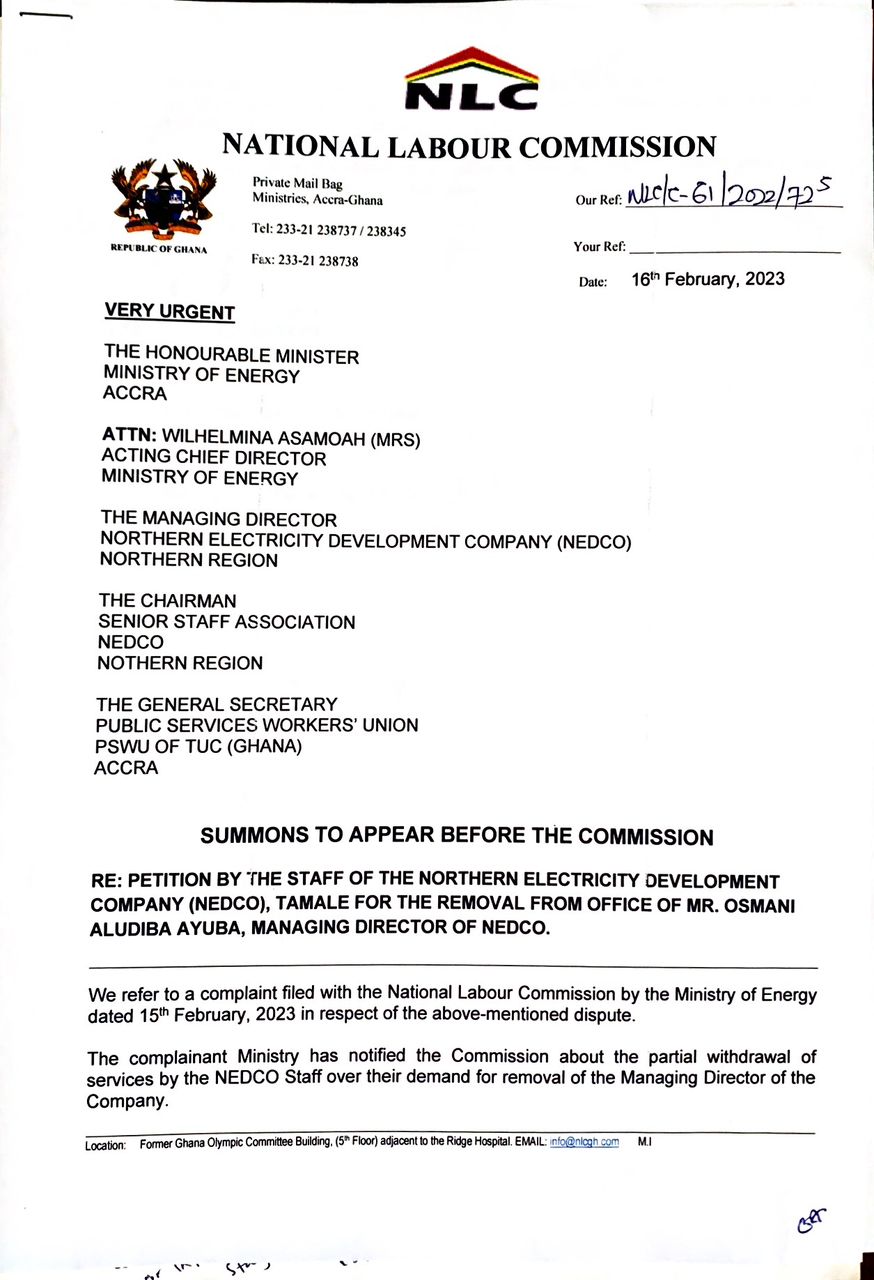
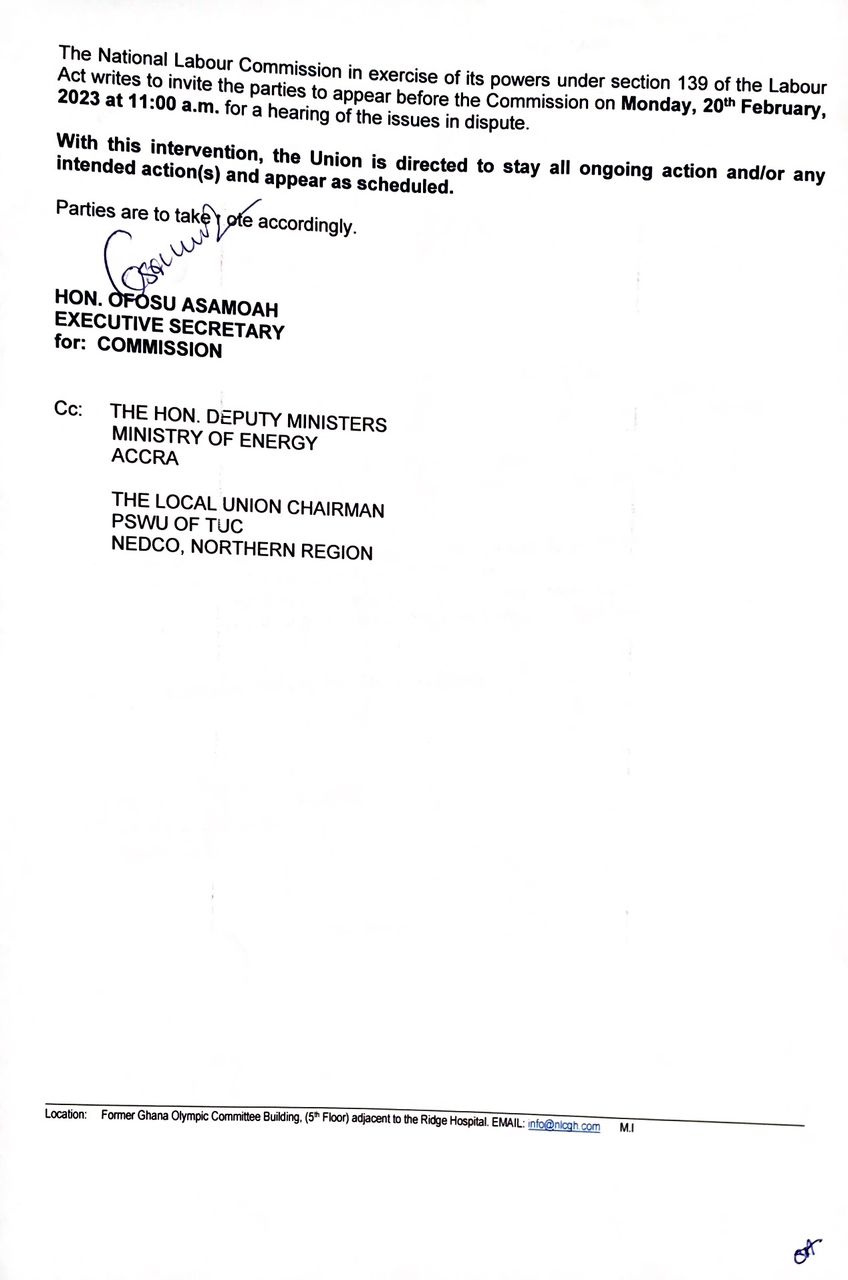
The National Labour Commission (NLC) on Friday summoned the agitating staff for a meeting after a complaint by the Ministry of Energy.
In a letter, the staff union asked all its members to resume work effective Friday, February 17, 2023, in compliance with the NLC directive.
Below is the full statement by NEDCo
UPDATE ON VRA/NEDCo STAFF GROUPS RESOLUTION FOR THE REMOVAL OF MR OSMANI ALUDIBA AYUBA AS THE MANAGING DIRECTOR, NEDCO
The Staff Groups Leadership of VRA/NEDCo wish to bring to you an update on the Resolution passed by staff in all five (5) Operational Areas in NEDCo at emergency meetings held from January 06, 2023, to January 10, 2023, calling on Mr. Osmani Aludiba Ayuba, the Managing Director, NEDCo to voluntarily resign or be removed from office by the NEDCo Board of Directors on or before the end of January 2023.
At an emergency meeting held by Staff in all five (5) Operational Areas including head office on February 16, 2023, Staff affirmed the earlier resolution for the removal of Mr. Osmani Aludiba Ayuba as Managing Director of NEDCo and also voted massively for the escalation of the industrial action.
Staff Group Leadership was served later in the evening with a summons to appear before the National Labour Commission on Monday, February 20, 2023, in Accra. The commission also directed that we stay all ongoing industrial action and/or any intended action and appear as scheduled.
In view of this latest development, Leadership directs that we suspend the partial withdrawal of services and resume all services effective Friday, February 17, 2023, in compliance with the NLC directive.
Leadership will update Staff on the next line of action after the meeting at the National Labour Commission on Monday.
At a news conference that was organized by both political parties in Accra, members of parliament from the Old VandalsAssociation criticized the University of Ghana’s administration for trying to sabotage Commonwealth Hall’s culture and heritage.
Builsa South MP, Clement Apak addressed the media in Parliament today and used the opportunity to accuse the university of attempting to be a law onto itself.
“We are cautioning the police to be very circumspect in what they do about the impasse between Commonwealth Hall and the university. We believe and hope that the impasse can be resolved amicably, but in the meantime, we expect the university to respect the rules of the land.”
“As alumni of Commonwealth Hall from both sides of the house, we are displeased with how the University of Ghanahas gone about things. We fail to understand why the university is failing to respect the law.”
The University revoked the tenancy of continuing students from the two halls as a punitive measure after clashes between some students of the two halls led to the destruction of the bust of John Mensah Sarbah.
According to the university, all continuing students of the Commonwealth Hall – an all-male hall – and continuing male students of Mensah Sarbah Hall will not return to their halls nor to any of the traditional halls.
But the students expressed their displeasure about the move insisting that the decision is ill-intended and poses financial challenges to them as the new halls offered are extremely expensive.
At least one person is has been shot dead after an altercation between workers at theAsanko Gold Mine and youth from the Amansie South District in the Ashanti Region.
According to a news report by UTV, the person shot was one of the youth of Amansie South, and this resulted in further clashes between the miners and the youth.
The District Chief Executive of Amansie South, Clement Opoku Gyamfi, who confirmed the incident in an interview with UTV that was monitored by GhanaWeb, said that the youth who was shot had been taken to the hospital.
“Some of the youth enter one of the pits of Asanko Gold to mine in order to find something to eat. And they were confronted by the security of the mining company, which led to a clash and some gunshots being fired.
“One of the youths was hit by a gunshot, and he is now in the hospital getting treatment. The news of one of the youth being shot resulted in reprisal attacks, which led to one of the trucks of Asoka Gold being completely burned, and other vehicles and facilities of the company being damaged,” he said in the Twi dialect.
Opoku Gyamfi called on the youth to remain calm as the incident is being investigated.
The General-Manager of Asanko Mines, Ahmed Muhadeeni Yahaya, also said the youth who entered the mining pit were illegal miners.
He added that the policemen protecting the pit only opened fire on them because they (the youth) started attacking them with cutlasses.
Ibrahim Oppong Kwarteng, the executive director of the Crime Check Foundation, has stated that he has been informed that Christian Atsuleft his flat before the earthquake occurred.
Christian Atsu and his Hataysporclub technical director, Taner Savut, have both been missing since Monday, February 6, 2023, following a 7.8 magnitude earthquake that hit Turkey and Syria.
His agent, Nana Sechere went to the site with a rescue team in search of his player but revealed that only a pair of his shoes were found at the apartment and that there was no sign of Christian Atsu.
Providing his own update, Ibrahim Oppong Kwarteng who has been working with Christian Atsu over the years, stated that he has been told the player left the apartment minutes before the earthquake hit his building.
“I have been briefed by the club that he was not in the building. He run to the parking garage to get his car out and it was during that period that the Renaissance building totally collapsed and that happened 20 minutes after he left the apartment.”
“Our brother was not in the building, he went out before the building collapsed. But I can’t confirm whether he will able to leave the parking garage with his car or not,” he added in his update on Crime Check’s YouTube page sighted by GhanaWeb.
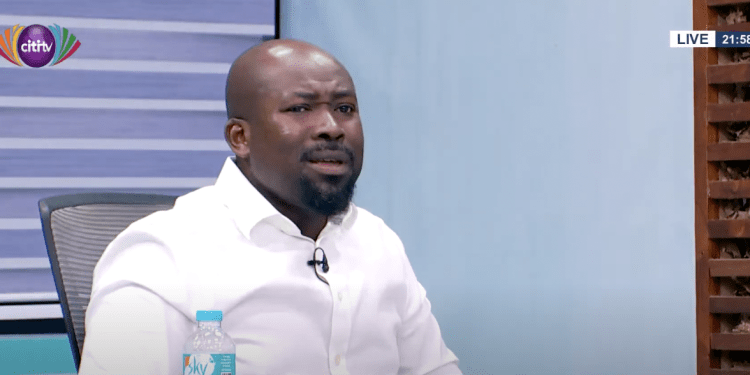
The Individual Bondholders Forum’s convener,Senyo Hosi, has denied claims that his position on government’s Domestic Debt Exchange Program(DDEP) has changed.
Following a recent media appearance on the subject, Senyo Hosi has been accused of making a U-turn on the debt exchange despite his earlier vociferous opposition to the debt swap.
He insisted that, he finds some of the remarks from the public unpleasant.
“I have noted various commentaries on my interview on Joy FM’s News File on 11th February 2023. While I find some of the commentary unfortunate, I absolutely respect the right of anyone to form or hold their opinions. It is also obvious to me that many may have failed to listen to the full interview and may have lost the context of the discourse. For the avoidance of doubt, I find the representation I made as consistent with the position I have held”, his statement read in parts.
He reiterated that he hasn’t changed his mind about the fact that the debt exchange does not bode well for bondholders and financial sector trust, and that his recent appearance has been grossly misinterpreted.
“I have one task: advocate and secure the investment interests of the IBF membership. I do not have a hate-and-bash-a-particular-person or government mandate. I will bash or commend when it gets me to the just realisation of the objects of the IBF membership I represent.”
“All I am focused on is the protection of the legitimate interest of those who opted to trust in our advocacy. I am no poster boy for anyone’s political or personal vendetta. I pursue and stand for that which I believe in”, a concerned Senyo Hosi further stressed.
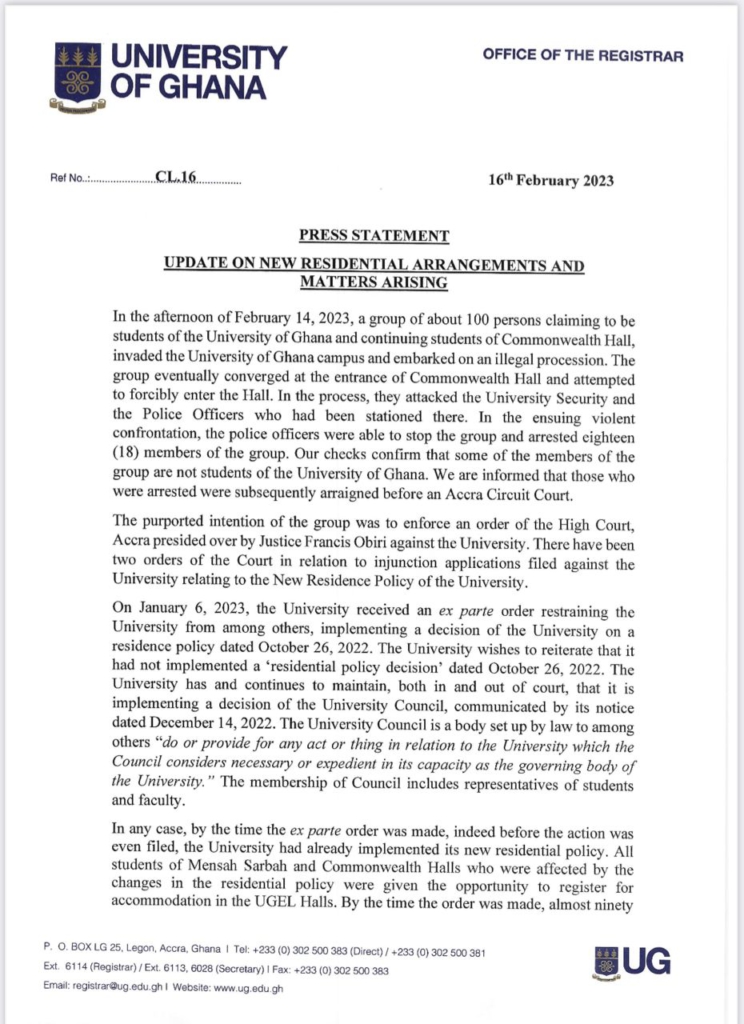
Authorities atUniversity of Ghana, Legon has defended itself against claims that it disregarded a court order to stop the implementation of its new residential policy for some campus residence halls.
The university, in a press statement, insisted that though it did not second the injunction secured over the modality in Mensah Sarbah Hall and Commonwealth Hall, it complied.
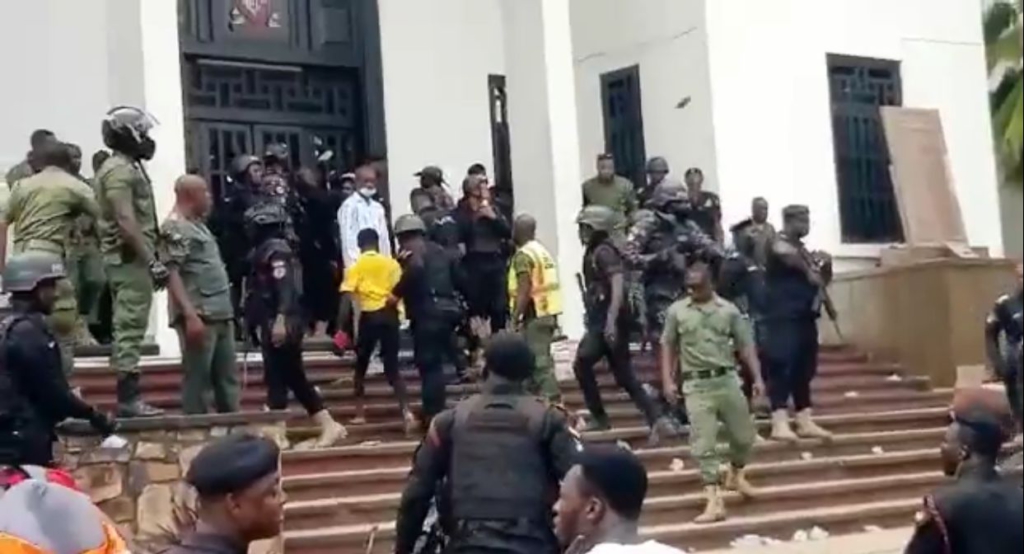
This follows police clashes with students on February 14, during a protest where some affected former residents of the Commonwealth Halllamented the management’s lack of response to the court ruling.
The development led to the arrest of some 18 persons by the Ghana Police Service, some of whom the University says are not students.
In the statement dated February 16, the Registrar, Emelia Agyei-Mensah explained that “in spite of the difficulty in comprehending the ex parte order, as it related to a decision that did not exist, upon receipt of the order, the University immediately stopped further allocation of rooms at Commonwealth Hall out of the abundance of caution.”
The university clarified that it released the “second order of the Court by the same judge was obtained on February 9, 2023, and served on the University on February 14, 2023, the same day that the illegal procession and breach of peace by the group took place.”
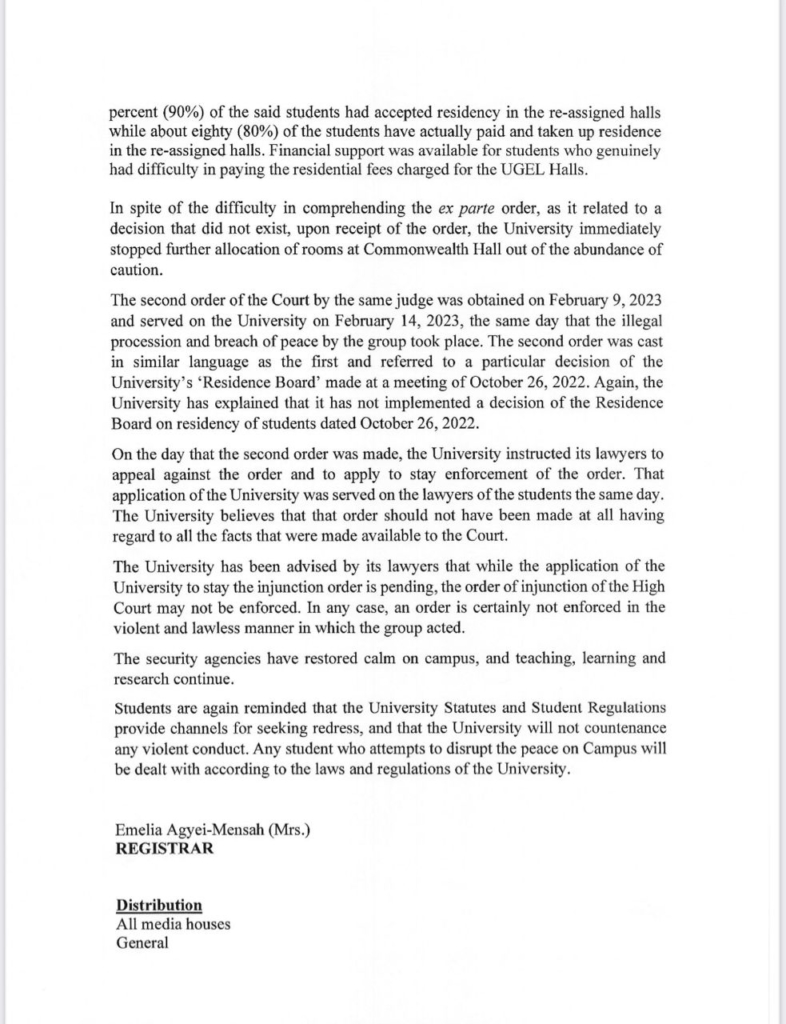
The press release also reminded students of the institution’s regulations and advised that appropriate channels are explored in seeking redress devoid of violence.
“Any student who attempts to disrupt the peace on campus will be dealt with according to the laws and regulations of the university,” it added.
Meanwhile, the management also clarified that there is no ‘residential board’ in place orchestrating any policy regarding students’ residency on campus.
Rather, the administration indicated that the decision to relocate continuing students from Mensah Sarbah and Commonwealth halls to UGEL halls was made in accordance with University Council directives.
It indicated that “On January 6, 2023, the University received an ex parte order restraining the University from among others, implementing a decision of the University on a residence policy dated October 26, 2022. The University wishes to reiterate that it had not implemented a ‘residential policy decision’ dated October 26, 2022.
The statement further mentioned that there is no ‘Residence Board’ as stipulated in the accusations purported to be supervising room allocations.
“The second order was cast in similar language as the first and referred to a particular decision of the University’s ‘Residence Board’ made at a meeting of October 26, 2022. Again, the University has explained that it has not implemented a decision of the ‘Residence Board’ on residency of students dated October 26, 2022.”
It reiterated that the University Council is the body set up by law to among others to ‘do or provide for any act or thing in relation to the University which the Council considers necessary or expedient in its capacity as the governing body of the University.’
Notwithstanding the admission, it was also pointed out that the administration of the university granted all students who had been genuinely affected by the relocation the opportunity to register for housing in the UGEL halls.
“By the time the order was made, almost ninety percent (90%) of the said students had accepted residency in the re-assigned halls while about eighty (80%) of the students have actually paid and taken up residence in the re-assigned halls. Financial support was available for students who genuinely had difficulty in paying the residential fees charged for the UGEL Halls,” excerpts of the release statement indicated.
The State of the Nation Address (SONA) will be delivered by President Akufo-Addoin Parliament on February 28, 2023.
The address will be done pursuant to Article 67 of the 1992 Constitution.
President Akufo-Addo will be expected to present his plans for the next 2 years of his governance.
This includes government programs and what strategies the government intends to implement, how to achieve them, and also how to rally the people of Ghana towards accelerated national development and progress among others.
This was revealed by the Majority Leader when he presented the business statement for the third week ending February 24.
The Northern Electricity CompanyLtd (NEDCo) personnel has been called to a meeting by the National Labour Commission (NLC) as a result of a complaint from the Ministry of Energy.
The complaint was filed after some aggrieved staff of NEDCo petitioned the Minister of Energy, Dr. Matthew Opoku Prempeh, demanding the removal of their Managing Director, Osman Aludiba Ayuba.
The staff argued that the financial performance of the energy distribution company has worsened since his assumption of office in 2019.
The staff accused the MD of lacking a clear strategy for the company and quoting an exorbitant contract sum for a sole source procurement of point-of-sale devices and also worsening distribution losses of the company.
In protest to demand the MD’s removal, the staff has partially withdrawn their services in their operational areas.
William Kwame Asare, the Senior Chairman of the Senior Staff Association of NEDCo said they were ready to rally behind a common goal to uplift NEDCo but until then, they will not call off their partial withdrawal of services.
Meanwhile, the Managing Director in an interview with Citi News denied all the allegations levelled against him.
He appealed to the staff to allow the Board of the Company to attend to their concerns and not run to the media as they are currently doing.
Survivors of the shooting which occurred on Tuesday showed LuvNews their bullet-ridden vehicles and recounted their ordeal.
The stunned drivers say they decided to drive out of Bawku with their perishable goods after the police refused to grant them escort out of the community.
These cargo vehicles, one driven from the scene of the shooting in Bawku to Akomadan and Suame in Kumasi bear evidence of what took place on Tuesday.
Bullet holes on the windscreen, side and rear of the vehicles show aggressive spontaneous shooting.
Kwaku Karl, 44, the driver of the cargo truck, parked at Akomadan, survived the assault but lost his son, 22-year-old, Kofi Karl.
He narrates how the two of them lay on their side on the floor of the vehicle in an attempt to escape the rain of bullets.
“We laid low in the car to prevent sustaining wounds. I hid my head somewhere with my son’s legs on top of me. Sadly, he sustained some bullets and could not survive. This is just how we positioned ourselves” he stated.
Yakubu Asaripue, the owner of one of the cargo trucks that were attacked, said the incident has gotten him scared.
“The car leading the team is mine. Unfortunately, I lost my driver due to the incident even after putting in much effort to rescue them” he said.
Haruna Issah sustained multiple gunshot wounds from the incident.
“They chased us right after we got into the community. After releasing multiple gunshots at us, we were forced to hide under the car seats but even with that, my driver could not survive and my other mate, is receiving treatment” he explained the situation to Luv News.
Vivo Energy and United Way Ghana collaborate to encourage environmental sustainability in classrooms.
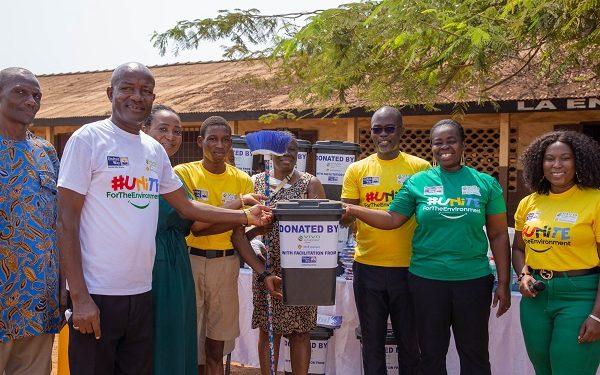
Vivo Energy Ghana, the exclusive marketer and distributor of Shell branded fuels and lubricants in partnership with the United Way Ghana has launched the first-ever Vivo Energy Environmental Club under its umbrella initiative, Cyclean, to promote environmental sustainability in schools.
The initiative which is in line with the Vivo Energy Sustainability Framework seeks to inculcate the habit of good environmental practices among pupils as their contribution to supporting the government’s efforts towards achieving the Sustainable Development Goal (SDG) 12 – target 12.5 of substantially reducing waste generation through prevention, reduction, recycling, and reuse.
The programme is critical to Vivo Energy Ghana as it forms part of the company’s overall business efforts to support the achievement of the 2030 SDGs Agenda by investing in the communities where it operates and working with successive governments to support the development of these communities. The Human Resources Manager of Vivo Energy Ghana, Mrs Mercy Amoah stated this in her remarks during the launch of the Club at the La Enobal School in the La Dade-Kotopon Municipality.
“We believe that creating public awareness and educating people, especially children on how to preserve the environment is the foundation for a sustainable world for us and future generations. For this reason, we are pleased to be launching this programme and donating cleaning tools, handwashing facilities and other toiletries to support the club and the students with access to adequate resources for proper waste collection and disposal, tools to recycle waste items from the environment and ignite their creativity to beautify the school environment” she said.
As the main implementers of the programme, the Executive Director of United Way Ghana, Mr Felix Kissiedu expressed his excitement at the launch of the programme and said it will provide the opportunity for pupils to be engaged in lessons and green activities, facilitated by teachers trained with a multi-stakeholder validated Ghana Education Service (GES) curriculum and relevant learning materials.
“Over the initial period of one academic year, our pupils from La Enobal Basic School will have the opportunity to expand their eco-consciousness and gain knowledge about the environment, help to solve local environmental problems, learn about green technology and compete in Environmental Club Competitions,” he said.
The Municipal Director of Education of the La Dade-Kotopon Municipality, Madam Habiba Kotomah, was full of praise for Vivo Energy and United Way Ghana for selecting the La Enobal School as the first to benefit from this initiative. “This programme is one that we have always yearned to initiate in the schools within this municipality, and I am tremendously excited about the launch of this important programme which I hope and know will transform not just individual lives but the community as well,” she said.
She also appealed to Vivo Energy Ghana and other corporate bodies to assist in building WASH facilities for the municipality’s underserved schools.
TheMinority in Parliamentis again demanding that the Finance Minister, Ken-Ofori Atta resigns or be sacked from his post.
The group contends that the Minister’s incompetence has contributed to the economic crisis which has necessitated the Domestic Debt Exchange Programme (DDEP) for $3 billion in support from the International Monetary Fund (IMF).
The Minority caucus filed the vote of censure motion against the Finance Minister, accusing him of mismanagement of the economy, financial recklessness, conflict of interest, and gross mismanagement of the economy.
The censure motion failed during voting on Thursday, December 8, 2022, as the Majority caucus staged a walkout.
This was because only 136 legislators on the Minority side voted to demand the removal of Mr. Ofori-Atta thus falling short of the two-thirds constitutional requirement for the motion to pass through.
The proponents of the motion needed the votes of 183 legislators to have the motion passed against Mr. Ofori-Atta.
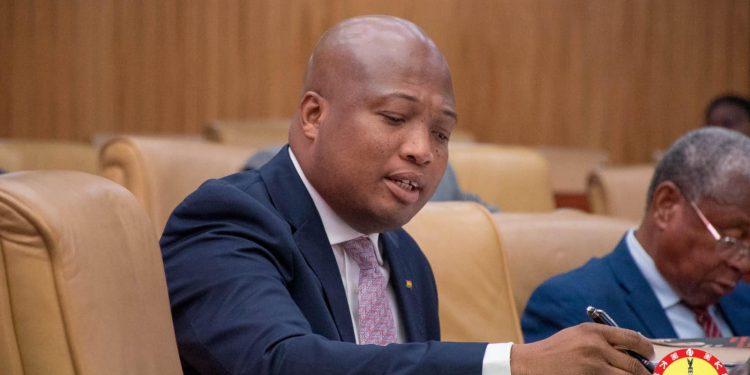
Reacting to a briefing on the DDEP by the Finance Minister in Parliament, some members of the Minority caucus, MP for Asunafo South, Eric Opoku and MP for North Tongu, Samuel Okudzeto Ablakwa called for the resignation of the Minister.
“Mr. Speaker, the Finance Minister ought to have resigned long time ago, our colleagues on the other hand [Majority caucus], share this view with us. They agree with us that the Minister is messing up the economy. We must rise up against the incompetence and recklessness of the Honourable Minister of Finance,” Eric Opoku reiterated.
Ablakwa also insisted, “what did the Jamaicans do? Immediately they ran their country into the ditch, the Prime Minister, Finance Minister, Governor of the central bank of Jamaica all resigned. This Finance Minister must go”.
The Attorney General, after a thorough assessment has approved the sale of Vodafone Ghana to Telecel.
The Finance Ministry had earlier written to the Attorney General with a request for a review of all relevant transaction documents on the transfer of 70 percent majority shares in Ghana Telecommunications Company Limited (Vodafone Ghana) held by Vodafone International Holdings B.V. to Telecel Group with a view to carrying out due diligence for the transaction and providing legal advice.
Commenting on the details of the transactions after the review the Attorney General indicated that the documents provided met all the conditions per Section 98 of the Companies Act, 2019 (Act 992), Regulations 34 of the Regulations and Articles 14 & 15 of the Shareholders’ Agreement.
In a letter cited by Citi Business News from the office of the Attorney-General and Ministry of Justice to the Minister of Finance on the deal, the AG advised that “the transaction may proceed…”
This development was the final lap to complete the transfer of shares to be approved by the company’sboard.
With this concluded, insiders at Vodafone Ghana say the board will likely meet next week to approve the transaction.
Last year, Vodafone Ghana applied to the NCA to transfer 70 percent of its majority shares to Telecel, but this did not pull through after it failed to meet regulatory requirements.
The Authority earlier this year gave clearance but added that it was conditional on both sides making concessions and was issued in response to the assessment of the Telecel Group’s revised proposal.
The statement added, “Following the NCA’s decision, the buyer resubmitted a revised financial and technical proposal in December 2022 which demonstrated the needed capital investment to extend the deployment of 4G and launch innovative Fintech solutions,” the statement read in part.
“The NCA found that the revised proposal provided more clarity and certainty in terms of the funding required for the acquisition and commitments from both the Seller and buyer.
In addition, the buyer has strengthened the overall governance and management team, and made firm commitments toward meeting the regulatory requirements of the NCA,” it further indicated.
Based on this, the NCA determined that the Purchaser’s revised plan now satisfies regulatory requirements.
As a result, it gave conditional approval for the transfer of shares to the buyer, subject to the filing of a staff retention strategy.
But since news broke about the deal, there has been uneasy calm amongst the staff of Vodafone over their job security. Speaking in an exclusive interview with Citi Business News, Managing Partner at Telecel Group, Nicholas Bourg, stated that there was no cause for concern.
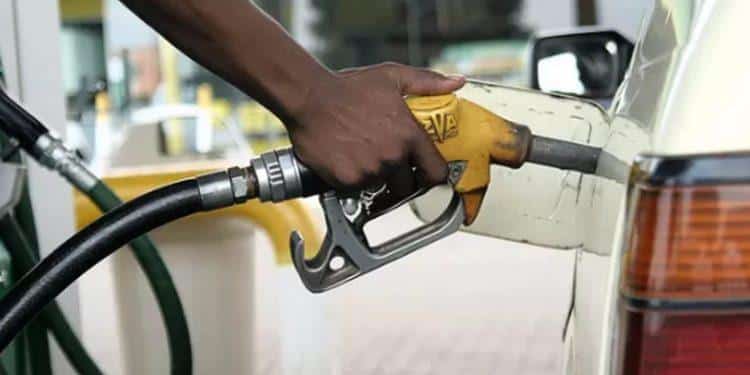
Its forecast on lower fuel prices in the second pricing window, according to the Institute of Energy Security(IES), is due to a slight drop in prices on the global market.
According to IES, the impact of government’s gold-for-oil policy which is intended to cushion consumers to purchase fuel at a cheaper price is yet to be felt.
IES in its prediction for the second pricing window projected that petrol will sell at about GH¢14.40 and diesel around GH¢13.90.
Explaining the decrease in fuel prices to Citi News, Research Analyst at the IES, Adam Yakubu said, “let me state that what we are reporting at the moment is not as a result of the gold-for-oil policy but as a result of international market indicators and the domestic performance of the forex”.
“But the government has also given indications that early weeks of March, we will be receiving more consignment from the gold-for-oil policy. So let me say that from now till the end of the window, we might not see much from the gold-for-oil policy. But we still call for government to give more details so that we input it in our computation”.
Greater Accra region employees in the public sector earn more money than their counterparts in other areas.
This was revealed in a document released by theGhana Statistical Service (GSS) dubbed Ghana 2022 earnings: Inequality in the public sector.
According to the GSS, while some public sector workers earn an average monthly net salary of GH₵3,142, others in the North East Region receive around GH₵2,212.
“Greater Accra has the highest average monthly net salary (GH₵3,142) with North East recording the lowest (GH₵2,212),” GSS said in the report.
GSS in the report also disclosed that men have a higher average monthly net salary of GH₵2,669 as against women’s salary of GH₵2,504.
“The difference between the average net salary of men and women is GH₵165. This means that the gender pay gap is 6.0 percent. Men have a higher average monthly net salary, of GH₵2,669, while women have an average of GH₵2,504. The average monthly net salary of women is lower than that of men in all 16 regions,” the report stated.
The GSS in its report added that women in the Central Region earn less than men with a gender pay gap of 5.0 percent.
“The difference is highest for employees in the Upper West region, with men earning on average GH₵348 more than women. This is a gender pay gap of 13 percent. In the Central Region the difference between men and women is the least, with women earning GH₵124 less than men. This means the gender pay gap of 5.0 percent,” the GSS stated in its report.
According to GSS, the average monthly salary for employees older than 60 years is much higher than that of any other age group.
“The average monthly salary for employees older than 60 years (GH₵14,466) is much higher than that of any other age group, almost five (4.7) times the average of 51 to 60 years, the group with the next highest average. For the age groups up to 41 to 50 years, the average monthly net salary increases by between GH₵300 and GH₵500 from one age group to the next, with an increase of around GH₵200 between 41 to 50 years and 51 to 60 years.,” GSS noted.
The report stressed that “the average monthly net salary of public sector employees is GH₵2,594. The highest paid earner takes home GH₵33,855, which is close to 81 times as high as the net salary of the lowest paid worker (GH₵418). The top 10 percent of the employees with the highest net salaries earn 22 percent of the total net salary. Half of the employees earn only one-third of the total net salary”.
Per the report from the GSS, the Government of Ghana employs about 688,000 persons, with over one-third (34.8%) of the employees in the Ashanti (18.2%) and Greater Accra (16.5%) regions.
The North East (1.4%) and Savannah regions (1.4%) hold only 2.8 percent of the total number of public sector employees.
The Accra High Courthas postponed the lawsuit on defamation presented by award-winning investigative journalist, Anas Aremeyaw Anas, against Kennedy Ohene Agyapong to March 15.
The Assin Central Member of Parliament (MP) is facing a GH¢25 million suit from Anas over some comments he (MP) had allegedly made against the investigative journalist in public after airing his investigative piece #Number 12, which exposed some rots in Ghana Football.
Justice Eric Baah, a Justice of the Court of Appeal who is sitting with additional responsibility as a High Court judge, had earlier fixed Thursday, February 16 after the parties had ended their testimonies.
EIB Network’s Legal Affairs Correspondent, Murtala Inusah, reports that the judgement was deferred because the parties failed to file their written addresses by December 6, 2022, deadline given by the court.
They, instead, filed them at a later date, hence the decision of the court to defer to allow the judge ample time to write his judgment.
Background
Sometime in 2018, the ace international investigative journalist, Anas Aremeyaw Anas dragged the Member of Parliament (MP) for Assin Central, Mr Kennedy Ohene Agyapong, to court for defaming him.
Anas was asking the High Court to award aggravated damages to the tune of GH¢25 million arising from defamatory materials published by the MP.
He said the MP had been publishing materials in his bid to discredit him after releasing an explosive piece on the rot in Ghana football.
Displeased with the MP’s actions, Anas, through his lawyer, Mr Kissi Agyebeng, sued Mr Agyapong for the award of general damages for defamation in the defendant’s publications.
A journalist, Mr Listowell Yesu Bukarson, has been granted the lawful attorney to stand in for Anas.
Publications
The publication complained of are May 29, 2018, live programme in Twi on Adom TV, where Mr Agyapong categorically stated that Anas was a blackmailer, corrupt, an extortionist and evil.
According to the statement of claim, the defendant, in a similar manner, published defamatory words on May 31, 2018, via Oman FM, a private radio station owned by the defendant.
The statement of claim also stated that the defendant published more defamatory materials against the plaintiff via other platforms to the extent of releasing pictures purported to be those of the investigative journalist in his bid to blow the latter’s cover.
Dr. Nyaho Nyaho-Tamakloe, a statesman and founding member of the ruling New Patriotic Party(NPP), has advised the finance minister, Ken-Ofori Atta to come up with a plan that will exempt pensioners from government’sDomestic Debt Exchange Programme (DDEP) since the retirees are not his age mates.
, “To Ken Ofori Atta, I will only say one thing, he must know that he is dealing with people who are not at all his age group.
“They are elderly folks, and like Sophia mentioned, he is not treating them with respect, and he should know the consequences,” he remarked on Happy 98.9FM’s Epa Hoa Daben show.
His remarks follow the country’s economic difficulties, which include the devaluing cedi, ongoing IMF negotiations, cuts in government spending and wages to free up funding.
Apart from pride, what else is stopping the Minister of Finance, Ken Ofori-Atta from responding to pensioner bondholders in writing on the status of their government bonds in relation to their call for an exempt in the Domestic Debt Exchange Programme (DDEP), the immediate past chief Justice, Sophia Akuffo has questioned.
To her, the pensioner bondholders have written to the Finance Ministry, asking for a total exempt from the government’s Domestic Debt Exchange Programme (DDEP) but as of now, they have not even received a note acknowledging receipt of their letter or a response in writing.
She questioned why other groups wrote letters to the Finance Ministry on a similar issue after the pensioners had sent theirs, but those groups have received responses and yet t
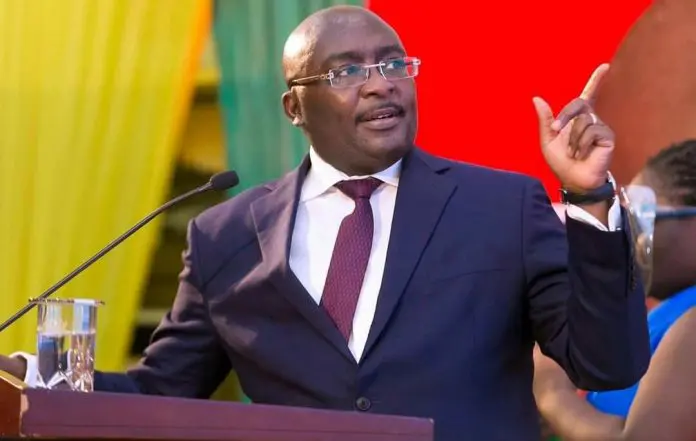
According to Dr. Gideon Boako, Dr. Mahamudu Bawumia’s spokesperson, Dr. Mahamudu Bawumia will run for the New Patriotic Party’s (NPP) flagbearership when nominations are opened.
He told Adom TV that his boss was ready to throw his hat into a race that included the likes of Alan Kyerematen, Kennedy Agyapong, Kwabena Agyepong, Francis Addai-Nimoh, Kofi Konadu Apraku and Boakye Agyarko.
Explaining the weight thatBawumia brings to the race, Boako said his boss was in politics strictly to serve unlike others who get in to amass wealth, stressing that the NPP and Ghana needs such a leader at this time.
He also stressed that with all the signs showing that the main opposition National Democratic Congress (NDC) will field former president John Dramani Mahama in the 2024 elections, the NPP needed a Bawumia-type personality to match the opposition.
“In 2024, the NDC will surely bring Mahama, so we should get personality who can measure up to Mahama and then also we need to look at the level of knowledge the candidate brings on board.
“Unofficially, all Ghanaians believe that the vice president has demonstrated beyond his office and has been more impactful in modern-day political season is Bawumia. He did not just play a supportive role but he had major involvement,” Boako stressed.
Bawumia is Ghana’s sixth vice president under the 1992 Constitution. He occupies an office previously held by Kow Nkensen Arkaah, John Evans Atta Mills, Alhaji Aliu Mahama and John Dramani Mahama and Kwei Bekoe Amissah-Arthur.
Dr. Boako said all major achievements of the current government, listing among others: Zipline drone, Free SHS, mobilemoney interoperability, NABCo, digitization, Agenda 111, ambulances, before adding: “all these ideas and things, you cannot take Bawumia out.”
The NDC has a May 2023 date to hold its presidential and parliamentary primaries whereas in the case of the NPP, reports say the national leadership of the party and its caucus in parliament wanted an early congress which the presidency is opposed to.
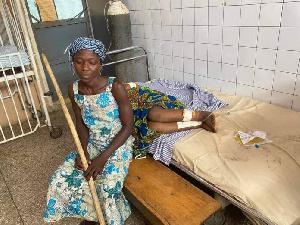
According to reports,Linda Mirekua, age 11, who is suffering from kidney disease has been left standed at Korle Bu Teaching Hospital due to lack of medical beds.
Mirekua from Nobi, a farming community in Abuakwa North Municipality has been diagnosed of kidney disease but left to die in the house due to the inability of her physically challenged poor mother to foot the cost of her dialysis.
Her condition worsened in recent times and was admitted at the Akyem Tafo Government Hospital.
Linda’s situation was posted on a local social media platform where Ghc6,000 was mobilized from contribution of philanthropists for dialysis service at Korle Bu Teaching Hospital.
However, Korle Bu Teaching Hospital on Wednesday, February 16, 2023, reportedly denied her admission over the unavailability of a bed.
Management of Akyem Tafo Hospital further contacted University of Ghana Medical Center (UGMC) to refer Linda Mirekua but UGMC is demanding the patient to pay Ghc8,000 medical bill arrears owed the facility last year and be prepared for “cash and carry” before she will be admitted for the dialysis service.
Linda Mirekua is stranded at Akyem Tafo Government hospital as her condition deteriorates.
Nurses at the hospital have been contributing to support her feeding and other needs.
An Assembly Member William Kofi Afari Agyemang, fronting mobilization of financial contributions to support the little girl told Starr News “she was supposed to go Accra yesterday for her dialysis after mobilizing about GHC 6000 for her. The health officer at the Tafo hospital made some calls to get bed available before she is transported. The first call was made to Korle bu teaching hospital and we were told there is no bed to admit her for her case for now”.
He continued: ” Second call went to Legon UGMC where they told us Little Linda is owing the facility Ghc8,000 so they have to pay those arrears and should prepare for cash down service before she will be admitted. But now the money we have been able to mobilize is Ghc6,000 which cannot even settle the arrears at UGMC.So in short Linda is still at the Tafo hospital where we are managing the situation till we get a green light from Korle Bu teaching hospital. We are still calling on Philanthropists to support us”.
According to Medical Doctors, the most common causes of kidney disease in children are: kidney birth defects, genetic diseases, Kidney infection, nephrotic syndrome, systemic diseases Kidney trauma or injury problems with the urinary system.
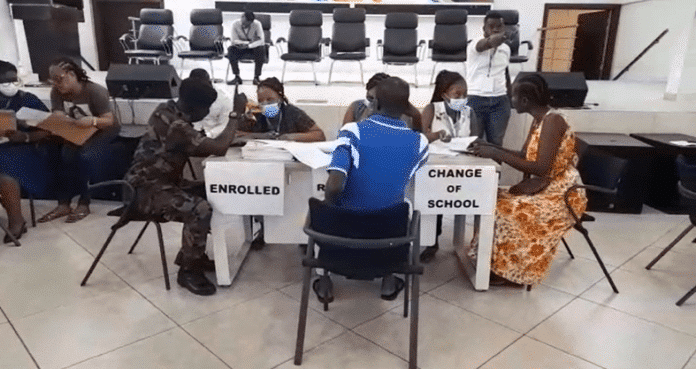
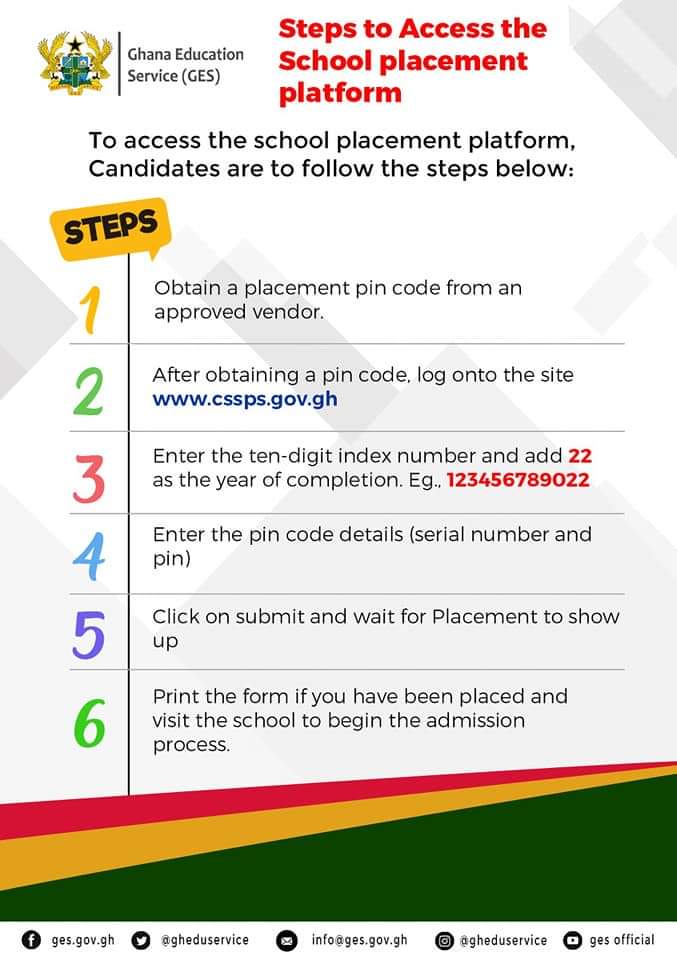
The issues with the Computerized School Selection Placement System (CSSPS) will be fixed, according to Nana Afrah Sika Mensah, the Deputy Coordinator of the Free SHS Secretariat.
Hundreds of parents of students who sat for the 2022 Basic Education Certificate Examination (BECE) on Thursday thronged the GNAT Hall in Accra for placement.
The centre was set up by the Ghana Education Service (GES) to help with both self-placement and replacement of students in available schools in all categories, except category ‘A’ schools.
A total of 165,601 candidates will have to do self-placement because they could not be matched to their school of choice, according to the Ghana Education Service.
The GES in a statement revealed that “out of the 547,329 candidates who sat for the examination, 538,399 qualified for school placement. Out of these, 372,780 candidates have automatically been placed into various schools”.
Asked whether the secretariat can resolve all issues regarding the placement of BECE graduates, Nana Afrah Mensah said “Provided there is a space in the choice that they have made, if there is a space we will replace it for them but if there is no space we can’t do anything for them but we will give them options so that out of those schools they will choose and we send to the resolution for them to resolve the issues.”
She also revealed that several resolution centres have been set up across the country to help resolve issues of students who are yet to be placed in senior high schools.
Safety concerns at an apartment complex in the Turkish city of Gaziantep were raised long before last week’s deadly earthquakes.
More than 130 people living there lost their lives.
A BBC team has spent three days looking at what happened – and the early warnings voiced by residents.
With only a bonfire for light and warmth on a bitter winter’s night, an extended family sits at the roadside waiting for amiracle.
They’ve been here for nine days and nights but their loved ones have not been found.
This personal grief is being played out in the rubble of one of the most desirable streets money can buy here.
“This is one of the most luxurious residential areas in Gaziantep,” says musician Yunus Emre, whose cousin and his family of four are missing. “The wealthiest live here. Those flats are sold for millions.”
But the price of the property meant nothing when the earthquake struck.
“I’m just angry. I want to bring someone to justice but I don’t know who,” says the 28-year-old. For him, so many parties are culpable in what is not just a national tragedy but, with the collapse of so many buildings, a national scandal.Image caption,
Yunus Emre lost five family members
“It starts with the contractor,” he explains.
“He uses low-quality building material. Next comes the certifying authority. They have the bloodof people who died here on their hands.
“It’s not right to scapegoat the contractor. The ones who approved this building are responsible together with the government and the state. They shouldn’t have signed off on this building project at all.”
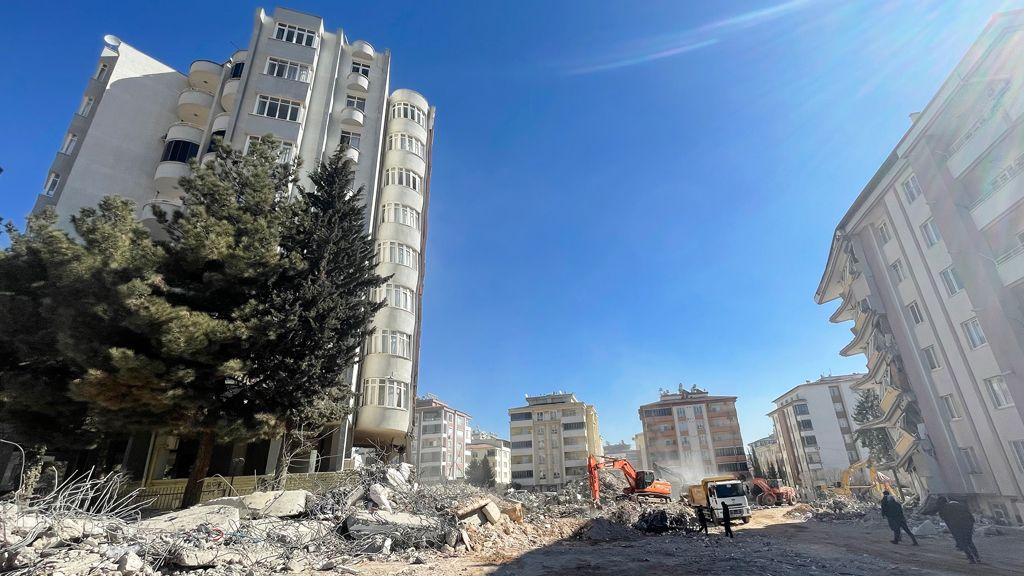
The Ayşe Mehmet Polat apartment complex is 24 years old. Four of its six blocks collapsed while other buildings around it stood tall.
We came to this site because we had heard that a man said to be the building’s contractor had been arrested. He will later tell us through his lawyer he was doing nothing wrong and should bear no responsibility.
But what exactly happened here on 6 February, and could it have been prevented?
As we return to the complex the next morning, emergency services reveal to us a shocking figure – 136 people are known to have died here as they slept.
At a petrol station next door, we ask if they have any CCTV footage of when the earthquakes struck. We are given videos from four separate cameras which show the horror unfolding. First, the violent shaking of the lights, then seconds later, people running for their lives before, finally, a thick cloud of smoke and dust enveloping everything in its path.
The neighbouring apartment buildings collapsed in a matter of seconds.Media caption,
Watch: CCTV from a petrol station next to the apartment complex shows when one of the earthquakes struck
As we leave the petrol station, we are drawn to the pile of personal possessions on the edge of the forecourt. It is a deeply upsetting museum of lives suddenly extinguished – homework, dolls, cooking pans and family photos. Scouring the heap, and sobbing inconsolably, is 65-year-old Emel Filik.
“Everything is gone,” she tells us.
She explains that her cousin had been sleeping in one of the four destroyed blocks, and no-one had taken responsibility for keeping the building safe.
“Once you start to live in your flat, nothing happens. No inspection. Earthquake insurance and property insurance don’t work either. The municipality doesn’t make checks. No such thing as monitoring.”Image caption,
Emel Filik tells us apartment residents were worried about safety before the earthquakes.
There had been concerns about these apartments, she says, adding that the head of the residents’ association – a woman known as Selma – had even asked neighbours to come to a meeting to listen to her fears.
“Six months ago, Selma told us about the problems of the building. She said ‘Dear residents, our buildings might collapse at the slightest of earthquakes. Let’s strengthen the pillars. If you’re short on money, the municipality could help us for a cheaper solution.’ She held several meetings. But nothing happened.”
We find a phone number for Selma and she confirms she held meetings to express her fears.
But should residents really have to pay to be safe in their own homes? This was a question of structural integrity, not repainting walls.
The head of the organisation representing architects in Turkey, Eyüp Muhçu, tells us the ultimate responsibility for making sure buildings are safe rests with the Turkish government.
“The priority of the central government was not to make the cities safe, but to implement some projects that were solely planned for maximising profits. For this reason, 65% of the current building stock in Turkey is risky. And no measures have been implemented regarding these risky structures.”
With two residents having told us there had been potential problems within the blocks – we start trying to find out if those responsible for the building knew about it and whether they did anything.
When we had first arrived at the block the previous night, a boy had come up to us briefly to say his dad had pulled seven people from the rubble with his bare hands. It sounded a remarkable story, given the scale of the destruction we could see, but we didn’t discount it.
And sure enough, when we hear others talking about the bravery of a man called Bahattin Aşan we decide to track him down.
“I saw the building twirling and crashing down. I came here running, it was dark, raining, there was snow and I was the first responder,” he tells us.Image caption,
Bahattin Aşan says he pulled seven people from the rubble
Bahattin Aşan used to work as a security guard at the housing complex.
He shows us a harrowing video he took in the smoking ruins, in which he’s calling out to those trapped. Some people reply.
“I rescued seven people by myself. It was like the apocalypse. Even now as I’m telling you this, I’m still shaking,” he says.
But what about these supposed concerns over the buildings’ safety, I ask? Did he see this?
“In the car park, I witnessed the defects with my own eyes. When I touched the concrete columns it would crumble to dust in my hands, as though it wasn’t concrete at all. Iron was rusting in the columns, the rainfall was damaging and corroded the iron.”
When I ask Bahattin Aşan if he ever reported this, he insists it was obvious to the management as well as the residents.
“I used to tell a friend that if they were to give me a flat here I wouldn’t take it. I said it was because I didn’t think the columns were solid and in an earthquake the building would collapse.”
But the man accused of being the contractor, Mehmet Akay, says the building complied with regulation at the time it was built. He claims that sewage and water works were added to the property after construction – and that this, or other work, may have damaged the supporting columns.
How many other security guards and caretakers across Turkey had voiced similar concerns in a country precariously positioned at the crossroads of shifting tectonic plates?
Your device may not support this visualisation
The immediate picture that is emerging in this Gaziantep neighbourhood is not of a cover-up or conspiracy – but either indifference or inaction.
Everyone knew there was a problem, but nobody did anything.
For opposition MP Garo Paylan, from the HDP party, who we meet as he visits this site, it is indicative of criminal negligence on an industrial scale in Turkish construction and oversight.
“This is a crime. This is a sin.”
Mr Paylan accuses the government of Turkey’s president, Recep Tayyip Erdogan, of failing to ensure the safety of new buildings as well as failing to strengthen older ones.
“The scientists were shouting about it, this disaster is coming, but the government did almost nothing. We warned the cities, we warned them to prepare the rescue teams, but they did nothing and we live this catastrophe. They say this is destiny. No, it is not. In civilised countries these kinds of disasters happen but fewer people die. But here we have tens of thousands of people under the rubble.”
Mehmet Akay, the man whom authorities say was the building contractor for the Ayşe Mehmet Polat complex, was arrested on Saturday 11 February – five days after the earthquakes. He was stopped at Istanbul Airport as he tried to leave the country.
State prosecutors say he was the building contractor, but responding to questions put to him through his lawyer, Mr Akay claims he was the construction co-ordinator, but not the contractor. He also rejects accusations that cheap building materials were used.
Image source, Istanbul PoliceImage caption,
Mehmet Akay (l) was detained by police in Istanbul
In Gaziantep, we ask the local authority, Şehitkamil Municipality, for a response. Spokesman Ahmet Aydın Sert says no complaints were received about the complex buildings, and therefore no inspections were made. “We went through the records and found no irregularities.”
President Erdogan has conceded that the emergency response to the disaster was slow in places, but has urged his people not to listen to those whom he accuses of politicising a tragedy.
His government denies negligence and claims that more than 98% of buildings that collapsed were older – like the Ayşe Mehmet Polat complex – and built before the ruling party took office.
There are plenty who would say every country has a moral – if not legal – duty to protect its citizens, no matter the age of their property.
And when Turks go to the polls in the summer they will decide for themselves who can best ensure their families are safe in their own homes.
Additional reporting by Naomi Scherbel-Ball, Doğu Eroğlu, Dilay Yalçin and Jake Horton
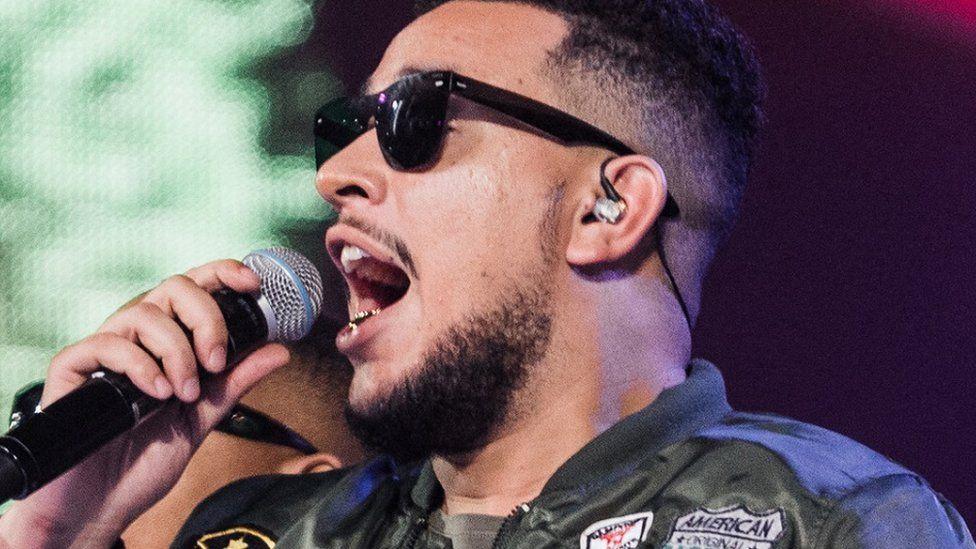
AKA declared he “never planned… never intended to be a celebrity” in the first song of his 2011 blockbuster solo album Altar Ego.
But the South African, who was gunned down in Durbana week ago, did not hold back about his talents.
A few days before his death, which police believe was a targeted killing, the award-winning 35-year-old rapper anointed himself as the best producer in his genre.
Sparking a huge debate, the artist who also went by the nickname Supa Mega, tweeted: “Statistically speaking, since I’ve produced 90% of all my music, surely I’m the greatest SA hip-hop producer of all time.”
But already in 2014, on Congratulate, one of the hits that solidified his megastar status, he said he would be “shining like a diamond that’s forever, now congratulate me”.
Thousands of fans – known collectively as “The Megacy” – are expected to either follow online or turn up at his public memorial on Friday in Johannesburg, making sure that he will continue to shine.
He may have said that he did not want it but he undoubtedly achieved that celebrity status.
However, his life and career were not without controversy.
Image caption, Mourners have gathered close to where AKA was shot in Durban to pay their respects
AKA, born Kiernan Forbes in Cape Town in 1988, was one of the country’s most celebrated hip-hop artists after releasing three solo albums, as well as collaborations with other performers.
When he was very young he lived with his grandparents in Mitchells Plain, one of Cape Town’s most dangerous townships, known for gangsterism and drug abuse.
But he then moved to Johannesburg with his mother, where he attended St John’s College, an Anglican institution that describes itself as being “among South Africa’s pre-eminent schools”.
It was there that his musical career began, forming a hip-hop band called Entity with two high-school friends, Sizwe Mpofu-Walsh and Nhlanhla Makena. They went on to be nominated for a KORA All Africa Music Award.
“He was destined for greatness from then,” Mpofu-Walsh, now a writer and academic, said in a tribute on Twitter.
After the group disbanded, AKA went on to study sound engineering and then produced hits for artists including ProKid and Kuli Chana.
He later worked with the likes of Nigerian Afrobeats star Burna Boy, as well as Da L.E.S, Nasty C and Kwesta.
The large number of musicians, producers, politicians and celebrities who have paid tribute has been testament to his impact.
But in the last five years, scrutiny over his personal life grew, with news about his romances and public break-ups making tabloid headlines.
He dated well-known celebrities including DJ Zinhle, with whom he had a daughter, now seven years old.
Image caption, AKA, pictured here in 2018, had one daughter from a relationship with DJ Zinhle
He also did not shy away from public spats with other industry colleagues, including fellow South African rapper Cassper Nyovest and memorably Burna Boy.
During South Africa’s xenophobic clashes in 2019, AKA started a feud with the Nigerian after the West African artist urged black migrants in South Africa to protect themselves against attacks.
In 2021, the scandals surrounding the rapper took a dark turn when his 22-year-old fiancée Anele Tembe died in controversial circumstances, when she fell from the 10th floor of a Cape Town hotel.
It was believed that she had taken her own life. But at her funeral, her father, well-known businessman Moses Tembe, denied this and said his daughter was not suicidal.
In her honour, AKA released single Tears Run Dry as a reminder of their relationship.
“When I wake up, I cannot feel sunshine ’cause you’re not by my side,” he sang.
But a different side of the musician surfaced after the model’s death, when videos were leaked on social media, showing quarrels between the couple, with him breaking down doors during one altercation.
In a battle to restore his battered reputation a few weeks after his fiancée’s death, AKA denied ever being abusive or violent. In a move seen as a vindication for him, South African prosecutors decided not to pursue a case against him.
Some of those close to AKA said that Tembe’s death changed him, including South African recording artist and award-winning DJ Oscar Mdlongwa, popularly known as Oskido.
“When he left this world, he was a changed Kiernan, you could see that he wasn’t the Kiernan we knew 10 years ago,” he said after visiting the family to pay his respects earlier this week.
AKA himself said he was a changed man.
“Sometimes I crave dishing out humble pie like I used to… rubbing people’s faces in it… Being a better person is challenging,” he said.
‘Assassinated in broad daylight’
The authorities believe that his killing outside a popular restaurant in Durban on Friday evening was carried out by a paid hitman.
On CCTV footage, a man wearing a white sweater and hat can be seen crossing the road and walking towards AKA and then firing two shots to the rapper’s head, killing him instantly. AKA was killed along with his long-time friend Tebello “Tibz” Motsoane.
“From what we know and have seen, it was a hit, AKA was assassinated in broad daylight,” said Transport Minister Fikile Mbalula who visited the family on Sunday.
“We need to get to the bottom of why this happened, because AKA was not a drug lord, he was a musician, why does he deserve to be killed like that?” he asked.
In that opening track of his solo debut album, AKA asked: “What would happen to just a normal dude who had extraordinary talent?”
Twelve years later that question had a tragic answer.
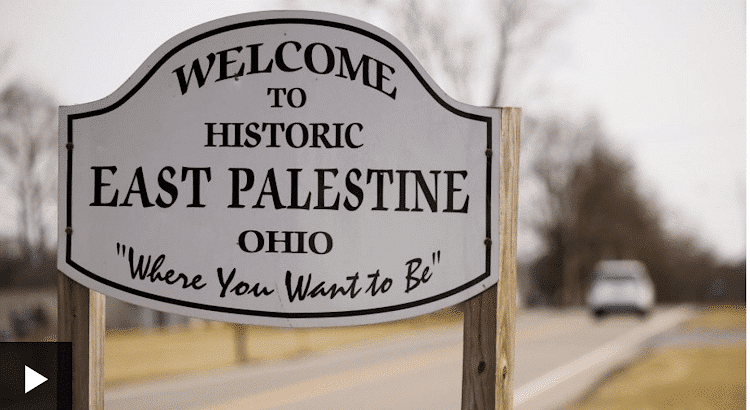
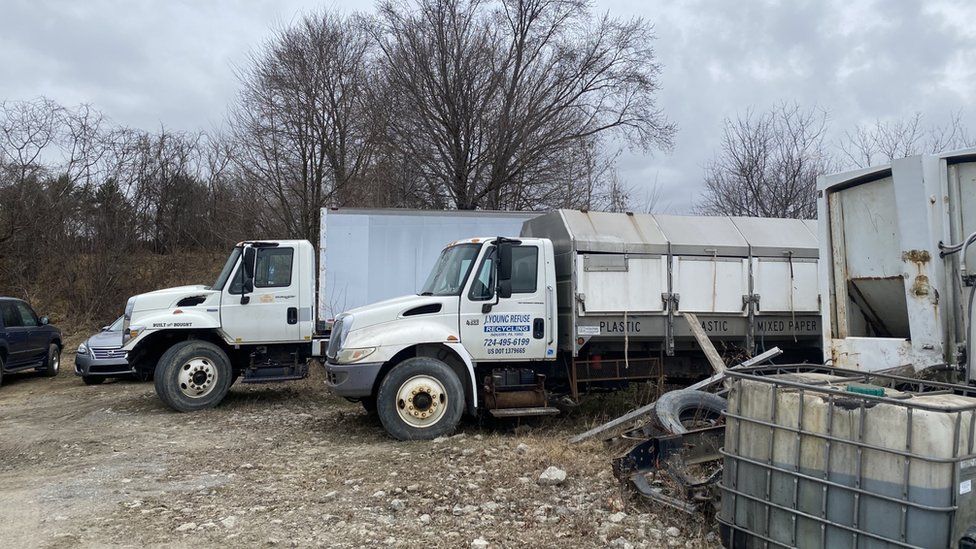
John and Lisa Hamner, residents ofEast Palestine, experienced the end of their way of life at 20:55 on February 3.
It was that day that a toxin-laden train derailed just metres from their successful garbage truck business, which they’d grown from five customers to more than 7,000 over an 18-year period in and around this close-knitOhio town.
“It’s totally wrecked our life,” he told the BBC, choking back tears in the parking lot of his business, where the stench of chemicals and sulphur from the derailment remains powerful.
“I’m at the point now where I want out of here,” he added. “We’re going to relocate. We can’t do it no more.”
Mr Hamner’s eyes are red and swollen, which he credits to the lingering physical impact of the chemicals spilled in East Palestine.
But he and his wife tell the BBC that their main wounds are unseen and psychological.
“I’m losing so much sleep. I’ve already been to the doctor twice, and I’m taking anxiety pills,” he said.
“This is 10 times worst than just losing my livelihood. We built this business.”
Image caption, The Hamners have lost business at their trucking company due to the crash
Like her husband, Mrs Hamner said she’s spent sleepless nights worrying about their business, their 10 employees and the town where she’s spent 20 years of her life.
Already, several dozen of their long-standing customers have cancelled their collection services and said they plan to leave East Palestine.
“I’m afraid for the people that live here,” she says. “I don’t know anybody who can sleep, because it’s on so many fronts. It’s your business, it’s your health, and it’s the health of your friends.”
Standing on a mound of dirt within sight of the charred remains of several railway cars from the derailment, Mr Hamner likened the incident to “East Palestine’s Chernobyl”, a reference to an April 1986 nuclear accident in then-Soviet Ukraine.
He’s not alone. Over the course of two days in East Palestine, several residents told the BBC that they consider the derailment a seminal moment in the town’s history. At least for the foreseeable future, their lives will be measured by what happened before the 3 February disaster and what took place after.
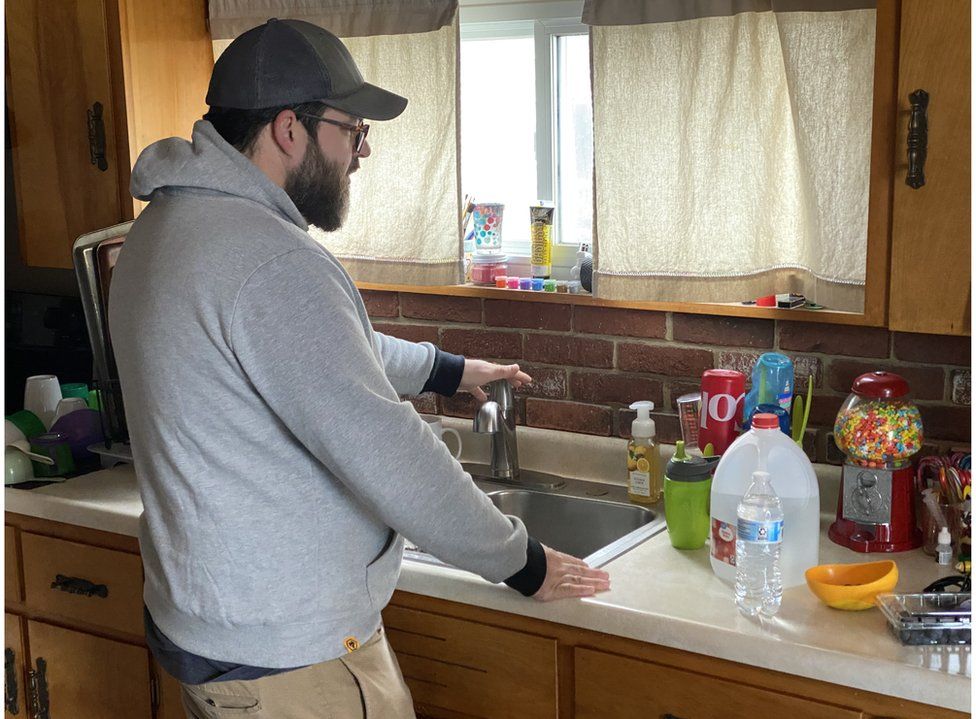
Federal and local officials have advised residents to drink bottled water. The authorities said it was safe for people to return to the town a couple days after the derailment, though environmental experts have voiced scepticism.
Sufficient exposure to the chemicals released in the crash – which include vinyl chloride and butyl acrylate – can result in symptoms from nausea to cancer.
“For this town, this is a Pearl Harbor, or a 9/11. One of those things that people always talk about,” said coffee shop owner Ben Ratner.
In Mr Ratner’s case, he said the stress and trauma has manifested itself in an “interesting mix” of emotions and sensations.
He now visibly bristles at the once-routine sound of trains passing by, adding that they seem louder and more abrasive than they had in the past.
He described friends in East Palestine as easily panicked now and constantly on alert, feelings that he compared to post-traumatic stress.
“We need to start looking at the emotional and psychological long-term impact,” he said.
“People are concerned when they hear trains, or when they think of their kids going outside, or letting their dog outside and having it accidentally drink contaminated water… it’s serious.”
Image caption, Ben Ratner is using bottled water
Mr Ratner added that local children – after years of Covid-19 disruptions – now have to contend with another traumatic event upending their lives.
“This thing could go on for generations,” he said. “It’s a lot more than gasses and the big cloud and plume of chemicals. That stuff is serious, but there a lot of family and social things.”
Lingering mistrust
On Thursday, the administrator of the Environmental Protection Agency (EPA), Michael Regan, visited East Palestine to oversee recovery efforts, meet local officials and reassure residents that the government stands behind them.
“We see you, we hear you, and we understand why there is anxiety,” he said.
Additionally, both of Ohio’s Senators – JD Vance and Sherrod Brown – offered messages of support for the community, while Ohio Governor Mike DeWine requested assistance from federal authorities.
In a letter, Alan Shaw, the CEO of Norfolk Southern – the company that operated the derailed train – acknowledged that residents are tired, worried and left with “questions without answers”. Media caption,
Watch: Anger erupts at Ohio train crash town meeting
Some residents believe there is little that can be said to overcome the mistrust and anger that still hovers over the town.
Several reported that they had yet to hear from inspectors or officials nearly a fortnight after the derailment.
“Nobody has been down to ask us anything. Nobody has checked anything. Nothing,” said Kim Hancock, who lives just over one mile (1.6 km) from the derailment site.
“How can they tell me that all is safe? There’s no way,” she said.
“I’m not dumb. I watched the smoke cloud come over my house.”
Taiwan claims it has discovered the remains of what seems to be a Chineseweather balloon that dropped.
Taiwan’s military said it had spotted an unidentified object drifting above Dongyin – a Taiwanese-controlled island off China’s coast – at 11:00 local time (03:00 GMT) on Thursday.
It later found a crash site on a shooting range.
Initial investigations suggested the remnants were part of a meteorological instrument, the military added.
On Friday, Taiwan’s Defence Minister Chiu Kuo-cheng said that officials would further investigate the crashed balloon but would not “jump to conclusions”.
This is the first time such a discovery has been made in Taiwan’s offshore islands, said senior defence official Chen Yu-lin, according to local media.
Tensions between China and the US have seen a fresh spike in recent weeks, after the US downed what it said was a Chinese surveillance balloon in its airspace earlier this month. The US also shot down three other objects it says are unlikely to be foreign spy crafts.
The sphere found on Dongyin was about a metre in diameter and bore the name of a China-based company that, based on online searches, stocks meteorological and radio appliances.
The company Taiyuan Radio No 1 Factory Co. Ltd is based in Taiyuan, one of China’s main industrial bases and capital of Shanxi province.
The sphere was also marked “GTS13 digital atmospheric sounding instrument” and “meteorological instrument”, with simplified Chinese language characters, the military said in a statement.
China has used simplified Chinese characters since the 1950s, but Taiwan continues to use traditional characters.
Authorities have not released pictures of the object.
Taiwan’s defence ministry said on Tuesday that it has not spotted any surveillance balloons from China in its vicinity, but also said it will shoot down any balloon it deems a threat.
China sees self-ruled Taiwan as a breakaway province that will eventually be under Beijing’s control.
But Taiwan sees itself as distinct from the Chinese mainland, with its own constitution and democratically-elected leaders.
The docket and pathology report about the individual who passed away at the West Hills mall have been sent to the attorney general’s office for review.
32-year-old
was confirmed dead at a hospital after video footage revealed some persons attacking him while handcuffed on the floor.
The family of the deceased have since accused the police of negligently causing the death of their relative.
They claim a police officer caused his arrest and left him in the hands of bystanders who allegedly assaulted him until his untimely death.
But the Police pathology report revealed that the deceased had swallowed a substance believed to narcotic drug which affected his breathing.
The case has been adjourned to March 2, 2023.
It emerged that the suspect died of asphyxiation and obstruction of his airway by a foreign body, a police autopsy report confirmed.
According to the autopsy report, the deceased had actually ingested what the police believed to be marijuana.
The police pathologist found eight zipped packets of dry leaves that were likely drug-related in the deceased’s throat, tied with a piece of black polythene.
The representative for North Tongu, Samuel Okudzeto Ablakwa, has criticized Finance Minister, Ken Ofori-Atta for urging retirees to participate in the government’s Domestic Debt Exchange Program (DDEP).
Ofori-Atta, while addressing pensioner bondholders who were picketing over the involvement of their bonds in the programme, said to the pensioner in Twi, ‘boa me na meboa wo’ which means ‘help me so that I can help you”.
Reacting to the minister’s remarks on the floor of Parliament, on Thursday, the North Tongu MP said that Ofori-Atta was rather telling the pensioners that they should help him so that he can bury them.
“What is so annoying when the finance minister met then (the pensioners), all he (the finance minister) had to tell was that ‘boa me na me nboa wo’.
“You are actually doing ‘boa me na me nsie wo’ and you are saying ‘boa me na me nboa wo’… you are taking money from them, people’s hard-earned investments and their life savings and then you add insult to injury.
“Apart from quoting wrong scriptures, scriptures that don’t align with the times, you are adding ‘boa me na me nboa wo’. Let the records reflect that what the minister is actually doing is ‘boa me na me nsie wo’,” he said.
Blood Donor RecruitmentOfficer of the Ghana National Blood Service, Mr Felix Appertey, has disclosed that Ghana’s blood demand is estimated to be 350,000 units per year.
He indicated that due to insufficient blood, many health procedures that required blood transfusions were either halted or postponed in various health facilities.
Mr Appertey was speaking at a blood donation and COVID-19 test event organized on Valentine’s Day by the Southern Zone Research Staff Association (RSA) of the Council for Scientific and Industrial Research (CSIR).
About 100 people attended the event, which aimed to promote preventive health care through COVID-19 testing and encourage blood donation to save lives. The participants included students from Labone Senior High School (SHS), staff of the CSIR, members of the RSA, and the media.
Mr Appertey said Ghana managed to get access to a total of 170,000 units of blood, consisting of both voluntary blood and family replacement donors in 2022.
“Every morning, cars are packed in our facility waiting for blood to be sent to their facility for their transfusion, but they don’t get it. So, what we do is that when you need 10, we give you five or two,” he said.
He indicated that blood donors benefit greatly because donating blood allows excess blood to be released, preventing blood clotting, which can lead to a variety of illnesses, including cancer.
When a donor gives blood, the hemoglobin reproduces fresh blood in the body system within 24 hours, and a donor card is given to the donor to ensure that the donor has access to blood in the future.
Professor Paul Bosu, Director-General of the CSIR, noted that the blood donation and COVID-19 test events were not a coincidence and that Valentine’s Day was set aside to show love to one another, but it has since turned into a romantic way of expressing love.
“As I wanted to understand the romantic love, I found that apart from the Agape love that is from God, there is also the Philia. It is called brotherly love as in the city of Philadelphia,” he noted.
He highlighted the significance of love, saying that a touch of the philia love promoted good health, lower blood pressure, fewer doctor visits, shorter hospital stays, less pain, and more positive emotions.
As a result, as a way of expressing his philia, he encouraged citizens to donate blood to save the lives of people who could be friends or relatives. “The blood you give today will also save a life tomorrow. So, as we donate blood today, we might not know exactly who is going to receive it, but we know that whoever receives our blood becomes part of our family. Blood is thicker than water,” he said.
The Ghana National Blood Service is the Ministry of Health agency tasked with ensuring an effective and coordinated national approach to the provision of safe, adequate, and efficacious blood and blood products in the country.
The Ghana Police have completed investigations into the killing of Ms Georgina Asor Botwe, a 25-year-old prospective student nurse at Mankessim.
The Service is however awaiting further directive from the Attorney General’s Office, where the docket has been sent.
Deputy Superintendent of Police (DSP) Daniel Gadzo, the prosecutor, updated the Cape Coast District Magistrate’s Court, presided over by Mr Eric Oheneba Antwi Boaisiako, who sat in for Mrs Bernice Mensima Ackon, now on vacation.
The court, upon the update, adjourned the case for the seventh time to Tuesday, February 28, 2023, and told the Office of the Attorney General to speed up the process for the necessary actions to be taken.
Christopher Clarke Quansah, the first accused, raised his hands to speak but was denied permission by the court.
Pleas of Quansah and Michael Darko, a self-styled pastor, are yet to be taken by the court.
On Thursday, September 8, 2022, the deceased, Ms Botwe, who had come from Yeji in the Bono East Region for an interview at the Ankaful Nursing Training School in Cape Coast, as a student applicant, called Darko, who was her sister’s boy-friend to inform him of her presence in town.
Darko promised to pick her up after the interview on Friday, September 9, 2022.
Prosecutor said the two accused persons went to pick the deceased from Ankaful in a Taxicab to Pedu in Cape Coast, where Quansah had parked his Benz saloon car, with registration number GT 8686 – C and drove her to Akwakrom, a suburb of Mankessim.
Quansah and Darko then took her iPhone, locked her in a room and left for Sikafoambantem, a suburb of Mankessim, where they dug a hole in an uncompleted storey building. They later took the lady there and Quansah hit her neck with a club from behind while Darko held her neck till she died.
They then cut her hair and buried her in the hole. The Central Regional Police Command picked up intelligence, which led to the arrest of Darko at Anomabo but Quansah managed to escape. On Wednesday, September 21, 2022, Quansah was also picked up from his hideout upon a tip off.
The Ghana Education Service (GES) has donated 100 life jackets and learning materials to the Atigagorme and Wayokope communities in the Sene East District in the Bono East Region.
Director-General of GES, Dr Eric Nkansah, said the donation was an interim safety and security measure for the school children, after eight pupils died while crossing a river from Atigagorme to attend school at Wayokope.
In a statement, Dr Nkansah said the Ministry of Education would soon construct a school in the island community after inspecting a piece of land donated by the community.
“We are deeply saddened by the occurrence, and as leaders, it is our duty to ensure that such bad news never befalls our children again. “To address the challenge, the Ministry is constructing a school in Atigagorme within the shortest possible time.
“As we wait for the completion of the school, I plead with all parents and teachers to ensure that our children wear the life jackets we have donated,” he said. The Director-General disclosed that he was in talks with the District Chief Executive (DCE) of Sene East to recruit and post teachers in the community to address the challenge of inadequate teachers in the area.
Dr Nkansah consoled the surviving children who were on the boat when the incident occurred and assured them of the continuous support of GES to ensure they were safe and secure.
Mr Nathan Baflo, the Assemblyman for Old Nkomi Electoral Area, commended GES for the donations and pledged to ensure that the school children used the items when crossing the river.
“We are grateful to the GES for the proactive measures they have taken since the incident occurred. Indeed, the lack of life jackets for the school children has been a major challenge, and I am happy that we have received these new 100 jackets today,” he said.
Mr Kofi Gyimah, the DCE, Sene East, applauded the Director-General for the donations to prevent future occurrences and aid effective learning and teaching. On Tuesday, January 24, 2023, eight school children who were among 20 travelling to school from Atigagorme to Wayokope drowned when the boat capsized.
The country’s public debt, expressed in present value terms, was 103% of GDP in 2022, according to Mr. Ken Ofori-Atta, the Minister of Finance, as opposed to the debt sustainability ceiling of 55% for nations like Ghana with a medium level of debt-carrying capacity.
The Minister made the disclosure on the floor of Parliament when he briefed the House on Ghana’s Domestic Debt Exchange Programme (DDEP).
The Minister also informed the House that tax to GDP ratio for the same period was “just about 12.6%, woefully below the Sub-Saharan Africa average of 18% and insufficient enough to meet pressures on the public purse.”
Government’s Domestic Debt Exchange Programme (DDEP) has been compared to the infamous Menzgold scandal by John Jinapor, member of parliament for Yapei/Kusawgu.
He maintains that the entire programme spearheaded by the Finance Minister is not only obnoxious but one that does not bode well for holders of government bonds or, more broadly, financial sector confidence.
Following an economic downturn and difficulties in servicing its debt, the government implemented the domestic debt exchange programme to give itself more time to meet its fiscal obligations.
Without the debt exchange programme, the government warned that the nation’s economy would collapse severely.
Speaking after Finance Minister, briefed Members of Parliament on Thursday on the debt swap process, the legislator said that the Minister’s decision to subject bondholders to a debt exchange is similar to the Menzgold Ponzi scheme that hit the country several years ago.
“If you digest all these, the most important thing the Finance Minister has told the people of Ghana is very simple. If you evaluate what he is doing, and evaluate what NAM 1 of Menzgold did, the two are synonymous and the same. There is no difference”, he emphasized.
The MP has also advised Leonard Chumo, who has been appointed by the International Monetary Fund (IMF) as a financial adviser to the Bank of Ghana, to exercise extreme caution.
Mr. Jinapor stated that Mr. Chumo must thoroughly review all documents provided to him by the Central Bank.
“I welcome Mr Chumo but please open your eyes at the Bank of Ghana…read and scrutinise the documents,” Mr. Jinapor said.
Ghana is currently requesting a $3 billion bailout from the IMF to bolster the struggling national economy.
Before the Bretton Woods institution’s board would evaluate Ghana’s request, one of the requirements is the domestic debt restructuring scheme.
A staff-level agreement between Ghana and the IMF was achieved in December, opening the door for the $3 billion rescue.
The International Monetary Fund (IMF) has elected Leonard Chumo as a financial consultant to the Bank of Ghana.
The member of parliament representing the Yapei Kusawgu district, John Jinapor, has cautioned Chumo to exercise utmost caution.
Commenting on the Finance Minister’s address to Parliament on the state of the Domestic Debt Exchange Programme (DDEP) on Thursday, February 16, Mr Jinapor said Mr Chumo must scrutinise all documents provided to him at the Central Bank.
“I welcome Mr Chumo but please open your eyes at the Bank of Ghana…read and scrutinise the documents,” Mr Jinapor said.
Funded by Switzerland’s State Secretariat for Economic Affairs (SECO), the resident adviser is expected to provide technical assistance and help build the capacity of the banking supervision function in the country.
A press release from the Bank of Ghana indicated that “the Adviser’s placement is a continuation of cooperation in this area between the Bank of Ghana, the IMF, and SECO, that started as early as in 2015 and had already seen the assignment of a previous Adviser until 2018.”
According to the Bank of Ghana, the previous adviser contributed to some achievements which make the current assignment eminent.
Ghana is currently before the IMF seeking a $3 billion bailout to support the country’s ailing economy.
The Domestic Debt restructuring programme is part of the conditions before the board of the Bretton Wood institution considers Ghana’s proposal. Ghana in December reached a staff-level agreement with the IMF paving the way for the $3 billion bailout.
The Finance Minister, Ken Ofori-Atta, on Thursday, confirmed that all pensioners who failed to tender their old bonds for new ones under the Domestic Debt Exchange Programme (DDEP) have been exempted from the programme.
Addressing Parliament, Mr Ofori-Atta said the pensioners have nothing to worry about adding that all their coupons and principals will be honoured when maturity is due.
He added that an official letter has been written to the pensioner bondholders who did not sign onto the Programme of their exemption from the exercise.
Member of parliament for North Tongu, Samuel Okudzeto Ablakwa, considers it disconcerting that thegovernment has declined to accept responsibility for the country’s current economic difficulties.
He maintains that government single-handedly dragged the nation into the mess it is in through its fiscal recklessness.
“We keep blaming external factors. Why are we the only country in Africa going through a Debt Restructuring Programme? Are we saying these external factors did not affect others? We have a Finance Minister who refuses to take responsibility.”
“Instead of him [Finance Minister] to tender in a resignation, he has come here to offer dubious explanations,” he said on the floor of Parliament on Thursday.
He further indicated that his records show that government expenditure has gone up by GH¢82 billion between last year and this year.
“How can this be the case, especially at a time government is demanding money from pensioners and individual bondholders?”
“I support a demand for a resolution by this house that the pensioner bondholders, individual bondholders should be exempted from this draconian Ken Ofori-Atta, Bawumia, and Nana Addo inflated debt exchange programme.”
The MP forBolgatanga Central, Isaac Adongo, appears to be tired with the Finance Minister’s constant references to the Bible in his speeches to the country.
Ken Ofori-Atta appeared before Parliament on Thursday to brief the legislators about the government’s Domestic Debt Exchange Programme(DDEP) and as has become the norm, he concluded his statement with a quotation from the Holy Book.
But Mr Adongo would not have that today.
He questioned the moral grounds the Finance Minister had to throw the word of God at Ghanaians while taking their hard-earned money.
“As a country, we are not angry enough. This cannot happen to anybody. You are here reading this boring and underwhelming statement to us and yet you are taking our money.
“This is not a joke, you are even quoting the Bible. Which of the Bibles are you quoting? Quoting the Bible and taking our money? You are denying the poor pensioner his/her money and you are still quoting the Bible?” he quizzed.
The Bolgatanga Central lawmaker subsequently asked the Finance Minister to resign with immediate effect for mismanaging the economy.
“Resign! Resign right here in your statement to Parliament,” he was categorical.
The Ledzokuku Municipal Assembly has been instructed by Mr. Francis Asenso-Boakye, Minister for Works and Housing, to take immediate action to halt ongoing building development activities by some private developers on theKpeshie Lagoon Wetlands in Teshie, a suburb of Accra prior to the rainy season.
This came to light when the Minister, accompanied by officials of the Ministry, the Hydrological Services Authority and some Municipal Assemblies within the Greater Accra region, embarked on a working visit to inspect progress of ongoing drainage works in selected flood prone areas in the city, and also to assess the readiness of the completed drainage infrastructure ahead of the rainy season.
The Kpeshie Lagoon Wetlands, the Kordjor River, all in the Ledzokuku Municipal Assembly, as well as the La Dade-Kotopong where parts of the buffer is, have been built on by many private developers, including Messrs RA CONGLOMERATE, operating without the appropriate building permits, and eventually filling the reserved buffer, which is meant to hold excess volumes of water flow during heavy rains.
In recent times, several illegal structures comprising of residential buildings as well as heavy encroachment by developers in some notable wetlands have conspired to thwart the investments of Government in its efforts to provide drainage infrastructure across the country.
Orders of the President
This unfortunate development caused President Akufo-Addo to issue directives to all Metropolitan, Municipal and District Assemblies (MDAs) to pull down structures that are illegally sited on waterways and in wetlands.
He has therefore called on the Assemblies under whose jurisdictions the illegal constructions are taking place, to take the necessary step to comply with the directives of the President and demolish structures that have been erected within wetlands or in waterways, and thereby, further exposing the city to the devastating effects of perennial flooding.
The sector Minister expressed shock at the rate at which the Kpeshie Lagoon Wetlands and its buffer reserve areas are blatantly being filled with construction materials by private developers.
Mr. Asenso-Boakye reminded the Assemblies of the directives of the President to pull down structures that are illegally cited within or on the way of wetlands or waterways that have the tendency to contribute the perennial flooding in the country.
“It is unfortunate that despite the heavy investment in drainage infrastructure over the years, irresponsible behavior of private developers continue to expose the city, especially in areas, which hitherto, were not noted for flooding”. The Minister stated.
The sector Minister said the power to embark on a demolition of the illegal structures lies within the Assemblies and therefore called on them to act swiftly to avert flood related disasters with the onset of the rainy season.
Commenting on the need to demolish structures built on waterways and in wetlands, the MCE for the La Dade-Kotopon where the Kpeshie Lagoon buffer is, Mr Solomon Kotey Nikoi said, “the Assembly’s efforts to stop the building of illegal structures have become a challenge that need the urgent intervention of its supervising Ministry. Efforts to stop, demolish, and arrest culprits have been met with assaults by landguards and death threats.”
He suggested that Government constitutes a national taskforce to deal with the menace of encroachment in wetlands.
On the security challenge, the Works and Housing Minister assured of his readiness to engage his senior colleague at the Local Government Ministry to solicit the support of security authorities to deal with private developers who are bent on thwarting the efforts of government with blatant disregard for the laws, towards the flooding menace.
The GNAT Hall inAccra is crowded with parents and students who took the Basic Education Certificate Examination (BECE) in 2022 to get placement.
The center was set up by the Ghana Education Service(GES) to help with both self-placement and replacement of students in available schools in all categories, excerpt category ‘A’ schools.
According to the GES, “Out of the 547,329 candidates who sat for the examination, 538,399 qualified for school placement. out of these, 372,780 candidates have automatically been placed into various schools.”
This leaves a total of “165,601 candidates who will have to do self-placement because they could not be matched to their school of choice.”
Speaking in an interview with JoyNews, the Deputy Coordinator for Free SHS, Nana Afrah Sika Mensah said “the exercise is going to run for six weeks.”
“We are doing the placement into secondary schools, TVET schools and the new STEM schools” she added.
According to one parent, Meshach Fred Mintah, her daughter who got aggregate 9 could not get placement into her first choice school, Holy Child SHS.
“She was rather offered her 4th choice Suhum SHS. She has worked hard so I want a better school for her to study General science.”
Meanwhile, another parent who got a boarding school for his child said, he wants a Day School for her instead.
Reacting to the activities of middlemen, Nana Afrah Mensah warned parents against dealing with such persons.
“The only accredited people you can approach are the people wearing tags. If you are a parent and anyone approach to take money from you and place you in any school, report them to us ” she warned.
The GES has also set up help centers in all 16 regional offices to assist with placement issues across the country.
According to a recent survey by theGhana Statistical Service(GSS), four out of every five workers in the public sector make less than GH3000.
Out of of the 688,000 persons employed by thegovernment, 533,179 of them earn less than GH₵3000.
This represents 80 per cent of the total workforce.
The new survey titled the Ghana 2022 earnings: inequality in the public sector also revealed that 104,349 people earn between GH₵3000 to GH₵4999, while 20,606 persons earn between GH₵5000 to GH₵ 9999.
The report indicated that 6,225 people earn over GH₵10,000
Henry Quartey, the Greater Accra Regional Minister, has urgedGhanaiansto join his fight against indiscretion in the city.
Mr Quartey is calling on Civil Society Organisations, Churches, the Media and Commercial drivers to join his efforts in making Accra the cleanest city in Africa.
In his view, fighting indiscipline in the capital city must be a collaborative effort and not the work of an individual.
“I want to see a system working than a Henry Quartey doing everything, and I have laid the foundations so today let me make this passionate call again to the good people of this region, I cannot do it alone, but I need everybody on board,” theRegional Ministersaid on the Point of View on Wednesday, February 15.
Mr Quartey also assured of his preparedness to remove all unauthorized billboards across the city.
According to him, the indiscipline associated with the indiscriminate erection of billboards across the city is worrisome, vowing that all illegally erected billboards will be pulled down.
“We are going to start with billboards. We commissioned Mr Dadzie of AAG to do some extensive work over the last 15 months and I will engage them in the next two months. We will send signals around, and we will remove every unauthorised billboard.
“Nobody should come to me and say he is a party person because I won’t even listen,” the Regional Minister told host Bernard Avle.
The Adansi-Asokwa Constituency in the Ashanti Region is represented in parliament by Kobina Tahir Hammond.
He is commonly known as “K. T. Hammond” among his peers and among the general public.
Typically, the NPP lawmaker is known for his controversial remarks and strongly-worded opinions which often set tongues wagging on social media.
But despite being widely perceived as a ‘no-nonsense’ personality, it appears the lawyer cum politician also has a lighter side outside his serious-minded posturing.
On Wednesday February 15, this came to bear when he walked stealthily from behind to use his palm to cover the eyes of former Energy Minister, Dr Kwabena Donkor; who was busily addressing a press conference on the nature of roads in his constituency.
Dr Donkor did not see it coming. In an excerpt captured by JoyNews’ parliamentary correspondent, Kwaku Asante, the former Energy Minister in the erstwhile Mahama administration appeared bemused by the act.
Turning around to see who could have dared to interrupt him like that on live television, here was KT Hammond; running away after executing his mischief.
The gesture got the NDC lawmaker laughing, as he turned to watch KT Hammond fleeing the scene after implementing his agenda.
But he was not the only one who laughed it off.
MP for Klottey Korle, Dr Zanetor Agyemang-Rawlings who earlier saw KT Hammond jetting off to obstruct Dr Kwabena Donkor giggled as well.
“Oww … what are you doing?”, she said amidst her laughter.
Meanwhile, the former Energy Minister and MP for Pru East, Dr Kwabena Donkor says he will sue the Road Minister and the Ghana Highways Authority if they do not fix the central corridor roads immediately.
The road goes through Atebubu, Yeji and is a major link road from the Southern part of Ghana to the North.
But the MP says it appears the two state institutions are conspiring to endanger the lives of road users on what he describes as a ‘major corridor’, by leaving it unattended to.
“I appeal to Highways Authority. I appeal to the Ministry of Roads and Highways and I am bringing in even the Ministry of National Security because the road has security implications”, he added.
The Greater Accra Regional Minister, Henry Quartey, has denied reports that he has changed his intentions to destroy unlawful buildings on Ramsar sites and other parts of Accra.
He simply dismissed suggestions that he has been clipped and thus cannot issue his previously promised warning.
Some unauthorised structures on encroached portions of lands belonging to the Council for Scientific and Industrial Research were to be demolished last year.
The Minister had also vowed to demolish buildings within the core zone of the Sakumo Ramsar siteafter a report from experts identified some specific buildings.
Some persons had said the minister had given up on the exercise.
However, while explaining his specific plan, he also stated that he had not been gagged at all.
“There was a miscommunication and I take the blame for it. When we said, we were coming to CSIR, we were making reference to those who had encroached within the 200-acre perimeter. So my position was that we were going to remove those people.”
“When I said Ramsar site, I also talked about the core area. So clearly, I was going to demolish structures that have been there for more than 25 years and are not within the core area. That is why we started with the fence walls. So if anyone says I have been clipped, with the greatest of respect, it’s laughable”, he said on the Point of View on Citi TV.
He also admitted to carrying out the demolition exercise, revealing how some illegal structures of prominent members of society were demolished.
“If I tell you the people who were behind the fence walls that we removed, you will be shocked. The ones that we brought down, were not for small boys. They are big people in society. The calls were coming, but I told my people to go ahead and remove them. I make sure I consult and take advice from the legal brains before I move in.”
The Minister has appealed to Ghanaians to come on board and support his fight against indiscipline in the capital.
Mr Quartey is calling on Civil Society Organisations, Churches, the Media and Commercial drivers to join his efforts in making Accra the cleanest city in the country.
In his view, fighting indiscipline in the capital city must be a collaborative effort and not the work of an individual.
“I want to see a system working than a Henry Quartey doing everything, and I have laid the foundations so today let me make this passionate call again to the good people of this region, I cannot do it alone, but I need everybody on board.”
The new Board will have former MP for Offinso South, Alhaji Ben Abdallah Banda as Chairman and Deputy Majority Chief Whip and Tolon MP, Habib Iddrisu as a member.
The rest of the members are Hajia Safia Mohammed, Chief Saddique Jimala III, Sheikh Amin Bonsu, Alhaji Inusah Amadau, Osumanu Yunusah, Mohammed Ibrahim Mohammed, Seidu Zakaria, Abdul Rahman Alhassan Gomda, Alhaji Musah Akambonga, ans Hajia Azara Haroun.
The President has also appointed Alhaji Farouk Hamza as the new Executive Secretary of the Hajj Board Secretariat, with Ibrahim Adjei as a member of the Secretariat as well as Ahmed Abu and Ahmed Tijani.
Government has presented a total of GH¢1,218,897 to three individuals injured during the Ejurariots in the Ashanti Region.
Awal Misbaw, 17, whose leg was amputated as a result of the shooting, received GH¢678,519.00, while 22-year-old Louis Ayikpa and 31-year-old Nazif Nuhu received GH¢347,953.00 and GH¢192,425.00 respectively, for gunshot wounds.
This came after the government, through the Interior Ministry, paid compensation to the deceased relatives in accordance with the Justice Koomson Committee’s recommendations.
When military officers opened fire on protesters who went on a rampage following the death of a social media activist, Ibrahim Mohammed, also known as Kaaka, two people were killed, and three others were seriously injured.
Adelaide Annor-Kumi, the Ministry of Interior’s Chief Director, handed out cheques to the families on Wednesday, explaining that the compensation amount was determined by the severity of the victims’ injuries.
The Chief of the Ejura Traditional Area, Barima Osei Hwedie II, praised the government and urged the Attorney General to track down the killers of Kaaka.
The acting minister of trade and industry, Samuel Abu Jinapor, has indicated that the Consumer Protection Bill will soon be introduced to parliamentfor approval as an act.
According to him, if this bill is passed into an act, the country will, for the first time, have a consumer protection rights act which will ensure that consumer rights are protected.
In an interview in parliament, he said the bill is set to be presented before Cabinet and should it be approved by the cabinet, it will be brought to the house for consideration.
“… I will sign it off (Consumer protection bill) to Cabinet and Cabinet will examine it, and I hope that cabinet will approve it. This will mean that this bill will come back to parliament and I see that the sentiment in parliament suggests that there will be a lot of enthusiasm and support for this kind of legislative intervention.
“…when we are able to pass it to parliament, Ghana will then, for the first time, have a consumer protection rights act. We will have a piece of legislation which deals with consumer protection which will cumulate into having a state agency which will be responsible for ensuring that we protect consumers in our country.”
Over the past ten years, there have been various attempts by the government to get the Consumer Protection Law passed.
Four presidents have come and gone, yet the progress has painstakingly been slow. It is evidently clear that the absence of the Consumer Protection Law in the country has contributed to the widespread and deliberate abuse of consumer rights.
However, Abu Jinapor has assured that this bill will soon be passed into an act as steps have been taken to speed up the process.
The Director of Communications for the New Patriotic Party (NPP), Richard Ahiagbah has responded to former President John Dramani Mahama on his comment that “President Akufo-Addo’s administration is not only indifferent in the fight against corruption – they are collaborators!”
Responding to him also in a tweet, Mr Ahiagbah said “At least President Akufo-Addo is clear about his incorruptibility. #Ghana”
Mr Dame wrote against the decision by the Auditor-General to publish the report on Covid expenditure.
Per Article 187(5) of the Constitution, Mr Dame explained, the Auditor-General is mandated to submit his report to Parliament to draw attention to any irregularities in the accounts audited?
The Auditor-General report stated that “During our review, we noted that senior management staff and other supporting staff of the Ministry of Information paid themselves a total amount of GH¢151,500.00 as COVID-19 risk allowance for coming to work during the lockdown.”
It further indicated that the Ministry of Health (MoH) entered a contract signed on 15 December 2021 for the supply of 26 Toyota Hiace Deluxe Ambulances valued at US$4,049,460.12 out of which US$607,419.02 was paid to vide PV No. IPF 22-007 of 2 September 2022 is to be delivered by 15 January 2022.
However, the report said, the ambulances remained undelivered as of 28 November 2022.
But the Attorney General in his letter said ” “I observe that the report of the special audit on the Government’s COVID-19 transactions has been published on the website of the Audit Service. In light of the constitutional provisions pertaining to the duty of the Auditor-General after the preparation of audit reports, I consider a publication of the COVID-19 audit report or indeed any audit report particularly when the same has not been either considered by Parliament or referred to a committee of Parliament, premature.”
Mr Dame has however justified the letter he wrote.
He stated that it is astonishing that CDD-Ghana disputes the propriety of the Attorney-General rendering legal advice to the Auditor-General, and construes same as “an interference with the independence of the auditor general”.
A proper reading of the Constitution, especially the provisions on the Public Services of Ghana, leads to the inescapable conclusion that the Attorney-General is fully vested with the constitutional function of giving legal advice to all the Public Services specifically listed in Article 190(1) of the Constitution, including the Audit Service, and such other public services as will be established by law.
Article 295 indicates that the public services listed in article 190 and other public services established by Parliament pursuant to its legislative powers, are part of the civil offices of Government.
In the face of the explicit constitutional mandate of the Attorney-General under article 88 of the Constitution as principal legal adviser to the Government, it is incomprehensible and rather illogical how an assertion may be made that the Attorney-General has no capacity to render legal advice to the Auditor-General.
Such an assertion can only be as a result of a simplistic and limited view of relevant provisions of the Constitution of Ghana.
The enskinment of a new Bawku Naba in Nalegiru on Wednesday, February 15, has been criticized by about five legislators from the Kusaug traditional area.
The group says the Zugrana, Naba Asigri Abugrago Azoka II remains the legally recognized Chief of Bawkuand the President of the Kusaug traditional area.
Addressing the media on the enskinment, the spokesperson of the group and Member of Parliament for Zebilla, Cletus Avoka said the unlawful act by the Nayiri has the tendency to aggravate the Bawku disturbances hence the need for the government to act immediately on the situation.
“It has come to our attention that the Nayiri in Nalerigu has purportedly enskinned a rival chief for Bawku and such action is unaccepted and should not have come from a person of his stature. Such enskinment is null and void and will not be recognized by any institution under the 1992 Constitution,” Cletus Avoka told the Parliamentary Press Corp.
He, therefore, admonished the government to take urgent and swift measures to ensure the new enskinment doesn’t further deteriorate the destabilized situation in Bawku.
The concerned lawmakers of the Bawku Central, Binduri, Zebilla, Pusiga, and Tempane constituencies said they need peace to prevail to enable them develop their respective constituencies.
Cletus Avoka called for punishments to be handed to the perpetrators of the enskinment.
“The government of Ghana must take every step to ensure the maintenance of peace and hold the perpetrators of this act accountable.”
“Meanwhile, we call on the people of Bawku to remain calm and assure them that this unlawful conduct will not stand,” he further stressed.
The government has also condemned the enskinment and stated that the security services in the region have been directed to arrest and prosecute anyone that holds himself as a new Bawku Naba.
Several buildings near to the Timber Market at Old Fadama, also known as Sodom and Gomorrah in the Amamomo Electoral Area of the Greater Accra Region, have caught fire.
While properties worth thousands ofGhana cedis have been lost to the fire, hundreds of residents have also been rendered homeless.
Firefighters are currently at the fire scene to douse the fire.
An eyewitness who narrated the incident to Citi News’ Fred Duhoe, said, “in this place, we know that some people use electric stoves, while others use charcoal for cooking forgetting that we are close to the Timber Market. When the fire personnel came, it was difficult for them to quench the fire though they tried their best. As of now, everywhere is burnt. The people living here are about 360 to 380”.
Interacting with the visiting Arch-Bishop of Canterbury, Justin Welby, President Akufo-Addo described the situation as worrying.
“One of the biggest problems we have in Ghana today will be of course the issue of refugees as a result of the dislocations that have taken place within the Sahel.
“We have until recently with quite evident people coming from Chad, littering our streets. Young people, children and women are in very disastrous circumstances.
“We now have an influx number of people from Burkina Faso as a result of the turbulence and insurgency going on there so we are very familiar with the issue of refugees,” he said.
More than 4,000 Burkinabes this month alone, have fled to seek refuge in Ghana following attacks by suspected terrorists and militants in the Sub-region.
The refugees, mostly women and children, have fled from trouble spots in Burkina Faso.
President Akufo-Addo called for an immediate solution to the crisis.
But the Director of the Faculty of Academic Affairs and Research at the Kofi Annan International Peacekeeping Training Centre, Professor Kwesi Aning says the country borders are porous.
This, according to him allows the free movement of people and goods.
He added apart from Pusiga and Kulungugu with borders, they do not have the technical equipment to scan items coming through.
“There are no borders apart from Pusiga and Kulungugu, where you can see thousands of people coming in every day, if you take Kulungugu with borders, they do not have the technical equipment to scan any of these containers through,” he stated.