Tag: 2023 Budget Statement and Economic Policy

  • Gov’t to invalidate unreturned diplomatic, service passports after March 17

    Gov’t to invalidate unreturned diplomatic, service passports after March 17

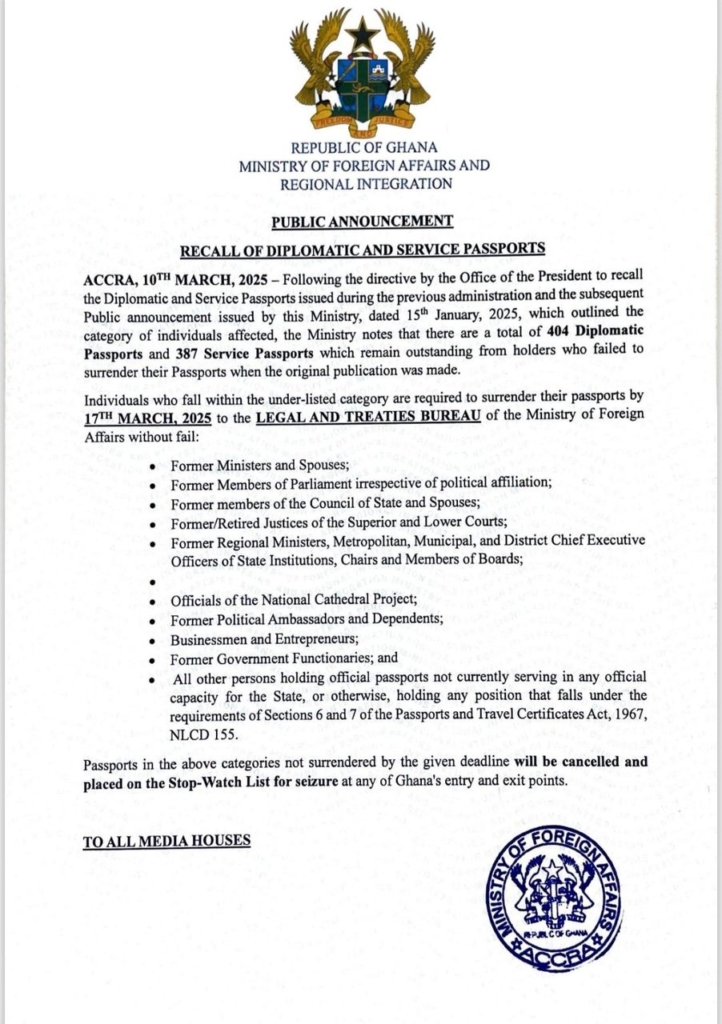
    The government has announced that all unreturned diplomatic and service passports will be rendered invalid after the March 17 deadline.

    The Ministry of Foreign Affairs and Regional Integration issued the directive as part of efforts to recover passports issued under the previous administration that no longer comply with current regulations.

    In a press release dated March 10, the Ministry stated that individuals who fail to return these passports will be added to the Stop-Watch List, resulting in their immediate confiscation at Ghana’s borders.

    “Passports in the above categories not surrendered by the given deadline will be cancelled and placed on the Stop-Watch List for seizure at any of Ghana’s entry and exit points,” parts of the statement read.

    This measure follows a January 15, announcement and aligns with a presidential directive to review and retrieve outdated official passports.

    Despite repeated notices, 404 Diplomatic Passports and 387 Service Passports remain unreturned.

    The Ministry has urged former ministers and their spouses, ex-Members of Parliament from all political parties, former Council of State members and their spouses, as well as retired justices of the Superior and Lower Courts, to return their passports immediately.

    Other individuals required to comply include former regional ministers, metropolitan, municipal, and district chief executives, former board chairs and members of state institutions, officials involved in the National Cathedral Project, and former political ambassadors along with their dependents.

    Additionally,entrepreneurs and individuals holding an official passport without an active state role are expected to surrender them within the time frame given.
  • Silence the doubts by proving your relevance – Mahama to Council of State

    Silence the doubts by proving your relevance – Mahama to Council of State

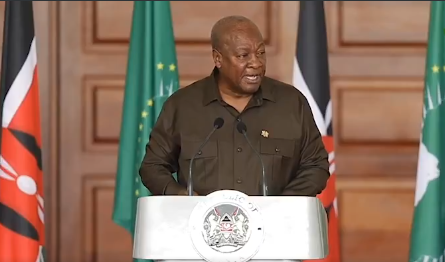
    President John Mahama has urged the freshly appointed 31-member advisory body to validate their significance and dispel increasing public doubts about its purpose.

    During the oath-taking event at the Presidential Palace on Tuesday, he acknowledged rising concerns over the group’s impact and emphasized the need for valuable input in shaping national policies.

    “In recent times, the Council of State has come under criticism from an expectant public who perceive its work as unsatisfactory and merely a rubber stamp for executive decisions. Some have even questioned its very relevance and called for its abolition,” the President said.

    “I hold out hope that your tenure will convince doubters of your importance and put to rest any such perceptions. I am confident that with your collective wisdom, we will continue to build a nation that upholds justice, progress, freedom, and unity.”

    This appeal emerges amid rising public scrutiny, as citizens advocate for greater clarity and accountability from advisory panels.

    Edward Doe Adjaho, who previously led Parliament, has been appointed as the head of the council, which includes distinguished individuals such as former top judge Sophia Akufo, past justice minister Betty Mould Iddrisu, and one-time Zebilla legislator Cletus Avoka.

    In his statement, Mr. Adjaho committed to ensuring the council fulfills its duties effectively.

    “It is true many have questioned the relevance of the Council of State, and as you rightly pointed out, some have even called for its abolition,” he noted.

    “But I want to assure you that this will be a council of difference. Fortunately, many members are distinguished individuals I’ve encountered in my public life, including many accomplished women. We are committed to justifying the council’s role through diligent service.”

  • Robbery incident at Ahodwo claims life of police officer

    Robbery incident at Ahodwo claims life of police officer

    The Ghana Police Service has apprehended an individual in connection with the robbery that led to the death of a Police officer at Ahodwo, Nhyiaseo in Kumasi.

    The incident occurred around 1 am on Thursday, June 27, 2024.

    In a concise announcement, the Ghana Police Service indicated that an intelligence operation is ongoing to capture the other suspects implicated in the robbery.

    They emphasized their commitment to diligently pursue justice by ensuring all suspects are apprehended and brought to trial.

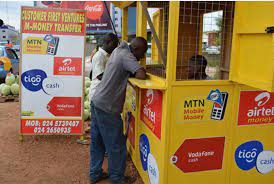
  • New E-levy rate takes effect today

    New E-levy rate takes effect today

    The revised Electronic Transaction Levy (e-levy) rate of 1.0% is expected to take effect today, January 11, 2022, as announced by the Ghana Chamber of Telecommunications. 

    A statement from the chamber confirming the implementation noted that “as captured in the Electronic Transfer Levy (Amendment) Act, 2022, Act 1089 which has been passed by parliament and assented to by the President, the levy on electronic transfers has been reduced from 1.5% to 1%, while the GH₵100 threshold remains unchanged.”

    The directive is in line with policies outlined by the Finance Minister in the 2023 Budget Statement and Economic Policy. 

    Reading the Budget Statement, Mr Ofori-Atta noted the E-Levy Act will be reviewed “and more specifically, the headline rate will be reduced from 1.5% to 1% of the transaction value.”

    He also announced the removal of the daily threshold of GH₵100, however, after debating the matter, Parliament approved only the revised rate. 

    The E-levy since its implementation has been greeted with mixed reactions from the public. While it’s implementers believed it was the surest way to raise revenue for the state, the tax measure was highly criticised by another section of the public who argued that it was not only a way of double taxing citizens or Mobile Money (MoMo) users, but also, it had the tendency of collapsing the MoMo business. 

    Nonetheless, the levy was approved by Parliament in a dramatic way, after which its implementation took effect on May 1, 2022. 

    Fews months later, the government disclosed that the tax did  not rake in the expected revenue and a leading member of the New Patriotic Party (NPP), Gabby Otchere-Darko, stated that the levy generated only 10% of the expected revenue.

    “After 5 months of stalemate and bashing, the e-levy, after implementation, is delivering only 10% of estimated revenues; our revenues remain very low as compared to the rest of the world; debt levels dangerously high, cedi, like most currencies, struggling against the US dollar,” he wrote in tweet. 

    Meanwhile, the Chamber has given the public the assurance that its members are working feverishly with the Ghana Revenue Authority and other crucial institutions to ensure a smooth implementation of the updated electronic transfer levy.

    Source: The Independent Ghana

  • Economic Management Team has no constitutional basis – Majority Leader ‘shields’ Bawumia

    The Economic Management Team (EMT) post lacks a constitutional foundation, according to Minority Leader Osei Kyei-Mensah-Bonsu, and the Minister of Finance, who serves at the president’s direction, is in charge of economic management as a whole.

    Whenever the subject of the economy came up, the opposition National Democratic Congress (NDC), which is theoretically in charge of the EMT, promptly enlisted Vice President Dr. Mahamudu Bawumia, the member of parliament for Suame stated it was curious.

    He cited how, despite economic challenges under the John Atta-Mills administration, then-Vice President John Dramani Mahama was not ‘attacked’ as head of EMT in order to make the argument that the president bears primary responsibility for the economy.

    “When the Minority Group discusses the current economic challenges, they chuck along the Vice President as chair on Economic Management Team of cabinet. President Mills after 2011 had GDP growth rate drop from 14.4% in 2010 to 9.5% in 2011. Into 2012, GDP swung down again, the Vice President (then John Mahama) was chair of EMT but nobody roped him in.

    “The reason is that the Finance Minister manages the economy for and on behalf of the president not the Vice President. In the cabinet set up, in the committee system, the Vice President is not the chairman of the Economic Committee. Vice Presidents have never been.

    “In fact, I should tell you that the Economic Management Team has no constitutional basis…. So, when people talk about this, it is just because they want to give the Vice President a bad name, like the proverbial dog, just give it a bad name and hang it,” he submitted.

    The MP who also doubles as the Minister of Parliamentary Affairs made the submissions on Tuesday, December 6, 2022 during his final submissions on the 2023 Budget Statement and Economic Policy of Government debate in Parliament.

    Ghana is currently facing economic headwinds with a domestic debt programme facing opposition from stakeholders – largely from institutional bondholders.

    Government is hoping to close a deal on debt restructuring at home in order to be able to access an International Monetary Fund (IMF) facility to support the failing economy.

    Minister of Finance Ken Ofori-Atta on December 6 announced that government was restructuring bonds held by institutional investors, putting them into four groups stretching 15 years. With interest also spread in four tranches in four years.

    The Domestic Debt Exchange programme as it is called has faced some stiff opposition from major professional groups and workers union in the country.

  • IMF programme to improve Ghana’s fiscal position, re-instill investor confidence – Deloitte Ghana

    The government’s choice to work with the International Monetary Fund (IMF) has been characterized as one that will strengthen the nation’s budgetary situation and restore investor confidence.

    Ghana urgently needs to access the Fund due to the current economic difficulties, claims auditing and accountancy firm Deloitte Ghana.

    “Based on history, the fund may force government to boost income which may be in the form of new taxes, which is likely to worsen the misery of Ghanaians especially within this current economic situation,” the business stated in its evaluation of the 2023 Budget Statement and Economic Policy.

    “Some conditionalities may require government to implement expenditure cutting measures including halting new employment and ongoing and new capital projects in the public sector,” Deloitte Ghana added.

    It however pointed out that the possible IMF-supported programme is expected to increase Ghana’s foreign currency reserves as well as stabilise the value of the local currency and soaring inflation which government says is an imported one.

    Deloitte Ghana in its review also said an IMF programme will result in credibility and boost investor confidence.

    This, it added will ensure Ghana regains access to the international capital market under more favourable conditions in the medium to long term.

    Meanwhile, government is hoping to reach a Staff Level Agreement by the end of this year with the IMF to help restore macroeconomic stability, among others.

    Ghana is targeting to receive US$3 billion over three years under an Extended Credit Facility from the IMF.

  • Economic crisis: MPs should consider 10 – 15% pay cut – Kyei-Mensah-Bonsu

    Members of Parliament have been urged to take wage cuts into consideration in order to demonstrate their support for struggling Ghanaians.

    On Tuesday, December 6, 2022, Majority Leader Osei Kyei-Mensah-Bonsu made the suggestion during his closing remarks for the debate in Parliament on the 2023 Budget Statement and Economic Policy of Government.

    Times are difficult, but as representatives of the people, it would be wise to learn from the Executive branch of government, which has been suffering a 30% wage cut since early this year, according to the Leader, who is also the MP for Suame.

    “Mr. Speaker, perhaps as Members of Parliament, just as the Executive has done, maybe we could also, even though these are difficult period for all of us…

    “We could also utilize the opportunity and also show some example by sacrificing anything between 10 and 15% of our salaries to demonstrate to fellow Ghanaians that we are with them in these difficult moments,” he suggested.

    He also proposed that with the funds, Parliament could use the youth to build toilets at designated points monthly.

    He also proposed that government reviews flagship projects in order to get achieve greater value for money and also that salary adjustments be made in respect of State Owned Enterprises (SOEs) in order to realign their earnings to the Single Spine Salary structure.

    Ghana is currently facing economic headwinds with a domestic debt programme facing opposition from stakeholders – largely from institutional bondholders.

    Government is hoping to close a deal on debt restructuring at home in order to be able to access an International Monetary Fund (IMF) facility to support the failing economy.

    Minister of Finance Ken Ofori-Atta on December 6 announced that government was restructuring bonds held by institutional investors, putting them into four groups stretching 15 years. With interest also spread in four tranches in four years.

    The Domestic Debt Exchange programme as it is called has faced some stiff opposition from major professional groups and workers union in the country.

  • ‘We appreciate your hard work’ – Atiwa East MP celebrates farmers

    Abena Osei-Asare, the Member of Parliament (MP) for Atiwa East, has complimented the farmers in her district for their tenacious efforts in boosting Ghana’s economy.

    Osei-Asare, who also serves as the Akufo-Addo administration’s Deputy Minister of Finance, emphasized the necessity of encouraging the nation’s thronging youth to start farms in order to feed the population and lower unemployment.

    At the 38th Farmers’ Day celebration held in the town of Adasawase in the Atiwa East District of Eastern Region, the congresswoman remarked in a speech delivered on her behalf, “The agricultural industry is incredibly beneficial both economically and socially, so I encourage the youth to continue to delve into it.”

    The MP also used the occasion to tout the government’s achievements in the agric sector through its flagship programmes assuring Ghanaian farmers of such initiatives and support when the 2023 budget is implemented.

    “Through the one district one factory initiative (1D1F), the Government is working hard to add value to our farm produce in order to reduce post-harvest losses and generate more income…The government through the 2023 Budget Statement and Economic Policy will continue to support farmers, especially those who want to venture into commercial farming”, she said.

    The occasion was heavily attended by Assemblymen, farmer groups, and officials from the Ministry of Food and Agriculture, traditional leaders, the clergy among others.

    Farmers whose efforts were recognized were awarded. The MP for instance donated cutlasses, wellington boots, motorbikes, and cash prizes to the overall best farmer, best youth farmer, and best woman farmer.

    Footballs, jerseys, and a cash prize were also given to the best school that ventured into farming.

    This year’s Farmers’ Day was held in all 16 regions across Ghana under the theme: “Accelerating Agricultural Development through Value Addition”.

  • Minority to resist approval of budget estimates over sector ministers’ absence

    Mr Haruna Iddrisu, Minority Leader, says the group will resist the approval of budget estimates for ministers who fail to move the motion of the ongoing debate of the 2023 Budget Statement and Economic Policy of their respective ministries in the House.

    He expressed concern about how ministers of the various ministries were not taking the business of the House seriously.

    “Mr Speaker, going forward, we will resist the approval of any estimates coming from ministers who absent themselves from such exercises,” he said.

    Mr Iddirsu said this on the floor of Parliament on Thursday.

    Parliament is expected to conclude a debate on the 2023 Budget Statement and Economic Policy presented by Mr Ken Ofori-Atta, Finance Minister, Tuesday, December 6, 2022.

    The House is thus expected to subsequently approve the Appropriation Bill.

    Mr Iddrisu, the Member of Parliament for Tamale South on the ticket of the National Democratic Congress, further cautioned sector ministers to avail themselves to the House for the approval of their budgets.

    “When we get to the approval of budget estimates and ministers don’t appear in person in Parliament by themselves, we will not support the approval of the budget allocations to those ministries.

    “Ministers must take this House very seriously, and only ministers so appointed by the President to oversee the sectors of those ministries must rise from their seats to move motions to ask for budget allocations and approval by this House. Failure to do so will mean that we will stump down a number of those motions,” Mr Iddrisu said.

    He noted that Parliament and the minority would hold the government accountable, adding that “we intend to strengthen oversight, and it begins with this our decision. If ministers don’t appear in person to move motions for budget allocations, then they should expect the fiercest resistance from this side of the House.”

    Since the debate on the 2023 Budget Statement and Economic Policy began on Tuesday, November 29, the MPs on the Majority side have silently protested without showing up to contribute to the debate compared to the Minority side of the House.

    The group had also called for the timely debate of the censure motion against Mr Ofori-Atta since it was not captured in the Business Statement for the following week.

    “On the motion of censure against the Finance Minister, the words in Article 82 do not give Parliament perpetuity to discuss the matter, we are within defined time limits to consider the motion and take decisions as appropriate so whatever committee has been set up, we need to bring closure to it,” he said.

  • Review E-Levy rate to 0.5%, maintain GH¢300 daily threshold – Haruna Iddrisu

    Haruna Iddrisu, the minority leader and MP for Tamale North in the northern region of Ghana, has urged the government to further evaluate the proposed one percent (1%) e-levy at zero rate to 0.5 percent at a threshold of GH300 and above in order to earn support from Ghanaians.

    The Minority Leader claims that during the discussion of the government’s 2023 Budget Statement and Economic Policy, the National Democratic Congress (NDC) members in the August House will make a solid case for that.

    At the present, two-day post-budget workshop in Ho, the Volta Regional Capital, the Minority Leader announced his decision in an open address.

    , has urged the government to further evaluate the proposed one percent (1%) e-levy at zero rate to 0.5 percent at a threshold of GH300 and above in order to earn support from Ghanaians.

    The Minority Leader claims that during the discussion of the government’s 2023 Budget Statement and Economic Policy, the National Democratic Congress (NDC) members in the August House will make a solid case for that.

    At the present, two-day post-budget workshop in Ho, the Volta Regional Capital, the Minority Leader announced his decision in an open address.

    The Tamale South lawmaker explained that setting the e-levy at 1% will have a negative impact on individuals and businesses that rely on electronic money transfer services.He thus urged the government to reconsider the newly proposed rate.

    “We will subject this new proposal to further critical and thorough discussions as a caucus, but without going into the scenarios, as you look at your scenarios, consider for say of 0.5% at a threshold of ¢300 as compared to what you have admitted of 1% at zero threshold.”

    The Tamale South MP hinted that his side was yet to take a decision on the proposed increase of the VAT rate by 2.5 percent.

    He, however, warned that the 2.5 percent increase in VAT may have terrible consequences on businesses.

    Government announced last Thursday that it was reducing the rate from 1.5 percent to 1 percent and removing the 100 cedis tax-free daily threshold. That means any amount transferred is taxable.

  • 2023 budget: All transactions to attract 1.0% E-Levy charge – Government

    The Electronic Transfer Levy (E-levy) daily threshold of GH 100 will no longer apply, and the headline rate will drop from 1.5 percent to 1 percent.

    In his presentation of the 2023 Budget Statement and Economic Policy to parliament, Finance Minister Ken Ofori-Atta disclosed this.

    In particular, he added, “we will review the E-Levy Act and cut the headline rate from 1.5 percent to 1 percent of the transaction amount as well as remove the daily threshold.”

    The E-levy review, among other reforms and interventions, according to the Finance Minister, forms part of revenue measures aimed at restoring macro-economic stability and accelerating economic transformation.

    The move, he also said, is in response to proposals government has received for a review of the levy.

    “Government has consistently indicated its intention to improve the revenue collection effort by leveraging technology to enhance tax administration, identify and register taxable persons, and improve tax compliance.

    “Government has received several proposals for a review of the Electronic Transfer Levy, and is working closely with all stakeholders to evaluate the levy’s impact in order to decide on the next line of action – which will include a revision of the various exclusions.

    “As a first step, however, the headline rate will be reduced to 1 percent of the transaction value alongside removal of the daily threshold,” he said.

    As other means to aggressively mobilise domestic revenue, Mr. Ofori-Atta also announced “an increase in the VAT rate by 2.5 percent to directly support our roads and digitalisation agenda; and Fast-tracking implementation of the Unified Property Rate Platform programme in 2023.

    Parliament, on Tuesday, March 29, 2022, passed the Electronic Levy bill. The E-levy was introduced by government in the 2022 Budget, with the objective of broadening the country’s tax base by imposing the levy on electronic transfers to enhance government’s drive for revenue mobilisation.

  • 2023 Budget: Agriculture sector recording low growth

    In comparison to the same period in 2021, Ghana’s agricultural output expanded just modestly in the first half of 2022.

    From January through June of this year, the sector expanded by an average of 4.9% as opposed to 8.9% in 2021.

    Despite the monetary and fiscal policy interventions implemented this year, the government blamed the situation on the rapid exchange rate depreciation, unmanageable debt load, excessive inflation, fiscal stress, and external sector shocks.

    This was revealed in the 2023 Budget Highlights by Mr Ken Ofori- Atta, Minister of Finance and Economic Planning, at the 2023 Budget Statement and Economic Policy presentation on the floor of Parliament on Thursday 24th November.

    Whilst industry grew by 1.8 per cent, the services sector  had a growth rate of 5.4 per cent in the first half 2022 compared to a growth rate of -3.1 per cent and 8.0 respectively in 2021.

    The budget statement said the rise in inflation was driven by both food and non food prices, influenced by prices of local and imported goods.

    The elevated public debt burden was said to have a total gross debt of Gh¢ 467, 371.32 million, representing about 75.9 per cent of Gross Domestic Product (GDP) as of September 2022, impacting the sectoral performances of the economy.

    The Ghana Cedi also depreciated cumulatively by 54.2 per cent against the US dollar as at November 23, this year, compared to 4.1 per cent at the end of December 2021.

    Meanwhile, the budget highlights indicated that the structure of the economy remained unchanged from previous years.

    It said: “The Services sector continued to lead by contributing an average share of 46.2 per cent in the first half of 2022, the agriculture sector contributed 21.7 per cent while the industry sector recorded 32.1 per cent.”

    The 2023 budget was named “Nkabom Budget” and themed: “Restoring and Sustaining Macroeconomic Stability and Resilience through Inclusive Growth and Value Addition”.