Tag: 95% of African artifacts

  • Ghana to receive 2,000 looted artefacts from Netherlands, Germany

    Ghana to receive 2,000 looted artefacts from Netherlands, Germany

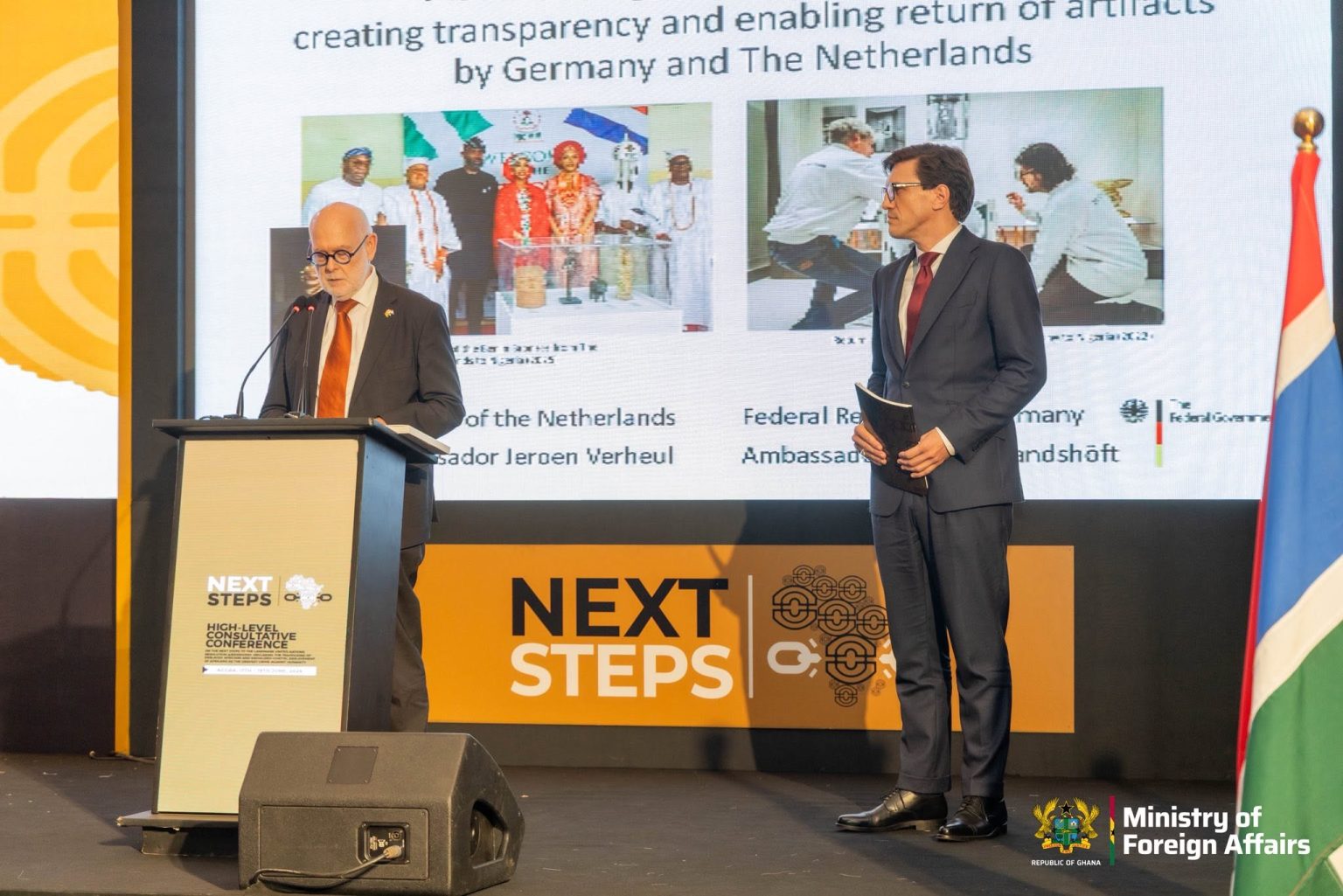
    Ghana is set to receive about 2,000 looted artefacts from the Governments of the Netherlands and Germany in the coming days.

    Ambassadors of both countries disclosed this during a meeting with President John Dramani Mahama at the Next Steps Conference, where they presented a catalogue of the artefacts.

    In a Facebook post on Saturday, June 20, Foreign Affairs Minister Samuel Okudzeto Ablakwa described the development as part of broader restitution efforts to address colonial-era appropriation of African cultural heritage.

    In 2025, Manhyia Palace received one hundred and thirty (130) gold and bronze artworks from South Africa and Britain.

    These artefacts, crafted in Kumasi, the Ashanti Region, about a century and a half ago, were purchased by AngloGold Ashanti and have now been returned to the Asantehene, Otumfuo Osei Tutu II, at the Manhyia Palace and to the museum.

    Some of these pieces are aged between forty-five (45) and one hundred and sixty (160) years, reflecting governance systems in villages and towns as well as the socio-economic importance of gold.

    In a ceremony marked by traditional Asante cultural protocols such as drumming, dancing, and the presence of chiefs and elders, some executives of AngloGold Ashanti, led by Chief Corporate Affairs and Sustainability Officer Stuart Bailey, presented the items to the Asantehene. They were accompanied by the Managing Director of the Obuasi mine, Samuel Boakye Pobee, and former MP of Obuasi, Edward Ennin.

    In 2024, twenty-eight artefacts looted during the Sagrenti War were returned to the Asantehene, Otumfuo Osei Tutu II, in a ceremonial event at the Manhyia Palace in Kumasi.

    The occasion coincided with the 100th anniversary of King Prempeh I’s return from exile in Seychelles, marking a significant milestone in the Ashanti Kingdom’s history.

    The artefacts, which include gold jewellery, ceremonial swords, treasury padlocks, and other regalia, were taken by British forces during the war.

    Over the years, they came into the possession of a West African art collector in 1922. AngloGold Ashanti, the mining company, later acquired the items in 2000 and, following negotiations with the Manhyia Palace, facilitated their return.

    Stewart Bailey, the Chief Sustainability and Corporate Affairs Director of AngloGold Ashanti, praised the company’s role in ensuring the artefacts’ return.

    He highlighted the collaborative effort that made the repatriation possible and expressed gratitude to Otumfuo Osei Tutu II, Seychelles President Wavel Ramkalawan, and other dignitaries present.

    “This return is a testament to what unity and partnership can achieve in preserving and honouring cultural legacies,” Bailey remarked.

    Otumfuo Osei Tutu II acknowledged the importance of the return, describing it as a significant step in healing the wounds of history.

    He expressed his gratitude for the gesture, which he believes contributes to restoring the dignity of the Ashanti Kingdom.

    The Sagrenti War, also known as the Yaa Asantewaa War, marked a key moment in the Ashanti Kingdom’s resistance against British colonial forces, led by Nana Yaa Asantewaa, Queen Mother of Ejisu.

    Article image 1

    Following the war, King Prempeh I was exiled, and many cultural artefacts were taken by the British.

    The repatriated artefacts will be displayed at the Manhyia Palace Museum, offering the public a chance to engage with these important cultural treasures.

    The return is part of a wider commemoration of King Prempeh I’s return, which includes a grand durbar and a symposium on his lasting legacy.

  • 7 most valuable African artifacts that have been returned by Europeans

    The colonial era in Africa for all its evil including the selling and buying of human beings is also marred by the theft that defined the era.

    Not only did colonists rob Africans of its natural resources, it also robbed the continent of its identity, and heritage. During this period artifacts that held great significance to numerous indigenous tribes were stolen. Even smugglers managed to get their hands on African treasures.

    For over a century this issue has been scarcely addressed. 95% of African artifacts are still housed in western museums and there remains a popular narrative amongst westerners that their museums are the right places to house these monuments based on security.

    This bone of contention has been revisited countless times, and these numerous debates are yet to yield any consolidated response, let alone reparation.

    Millions of African artifacts are currently scattered all across Europe and America. In France alone, there are over 300,000 looted treasures, one-third of which are from Africa.

    French President, Emmanuel Macron, apologized and asked a law to be passed that all African artifacts in the country should be returned to its rightful place. This has been slow to take effect as tens of thousands of African art works are still held in France.

    Regardless of the outrage and pressure from African activists, the French government has noted that it would dictate the pace at which the looted treasures would be returned.

    Both England and America share France’s sentiments as they are lackluster in returning these stolen valuables.

    The looting of African treasures does not just end with objects, it also goes as far as hoarding the remains of Africans.

    In response to the pressure being heaped upon these western governments some artifacts have been returned, with promise that more will be returned. Below are seven of Africa’s belongings that have been brought back to the mother land.

    Patrice Lumumba’s Teeth: Patrice Lumumba is a figure who’s name will forever be etched in the history of the Democratic Republic of Congo’s liberation. He was on the frontlines for the liberation of his people, but met a disastrous end for it. Following his death, his corpse was dissolved in acid, except for his gold tooth which was kept as a trophy by the Belgian policeman who oversaw the disposal. After 61 years, Belgian authorities finally returned the gold tooth to his children on June 22, 2022.

    Sarah Baartman’s remains: Sarah Baartman was a South African woman who was stolen from her home and exhibited as a freak show in 19th-century Europe. She died in 1815, but she was still being exhibited. Her brain, skeleton and sexual organs remained on display in a Paris museum until 1974. It was only 200 years later that her body was returned. On March 6, 2002, her remains were returned and buried at Hankey in the Eastern Cape Province.

    Dahomey throne: Formerly the Dahomey kingdom, the west African country of Benin saw the return of 26 of its artifacts, including the Dahomey throne that was looted in 1892, from the last king of the kingdom, King Guezo. The throne was returned on November 10 2021. Among the returned items were the thrones of former kings, four doors of the Royal Palace of Abomey, altars, royal scepters, statues representing former kings, a calabash, and army clothes from one of Benin’s famed female soldiers.

    Sword of Omar Saidou Tall: The sword of West African leader, Omar Saidou Tall, who led an anti-colonial struggle against the French, was returned on November 17th 2019. Omar Saidou Tall was a political and religious leader who led his people in battle against the French in the 19th century. He fought French troops from 1857 to 1859 before signing a peace treaty with them in 1860. As the story goes, he mysteriously disappeared. The disappearance of his treasures were not so much a mystery.

    Bronze Cockerel of the Benin Kingdom : After 124 years, Cambridge University handed over the bronze statue of a cockerel that once belonged to the powerful kingdom of Benin, back to its people. The statue was looted by British troops in 1897, and was finally returned on 27th of October 2021. The statue dates back to the 16th century and has immense religious and cultural significance to the people of Benin.

    Head of Oba bronze statue of the Benin Kingdom: This statue alongside the Cockrel statue was also returned on the 27th of October 2021 to the same recipients. This statue, like the cockerel statue, holds great historic and spiritual significance to the proud Benin people. Both statues were handed over to the Nigerian High Commission, and the current Oba of Benin Oba Ewuare II.

    Kakungu mask: The king of Congo, King Philippe, on his first visit to the Democratic Republic of Congo since assuming the throne in 2013, handed over the Kakungu mask, a large wooden mask, to the Congolese president, Felix Tshisekedi on June 8th 2022. The mask belonged to the Suku people who inhabited the southwest region of DRC today. The people used this mask during important ceremonies.

    Source:pulse.com