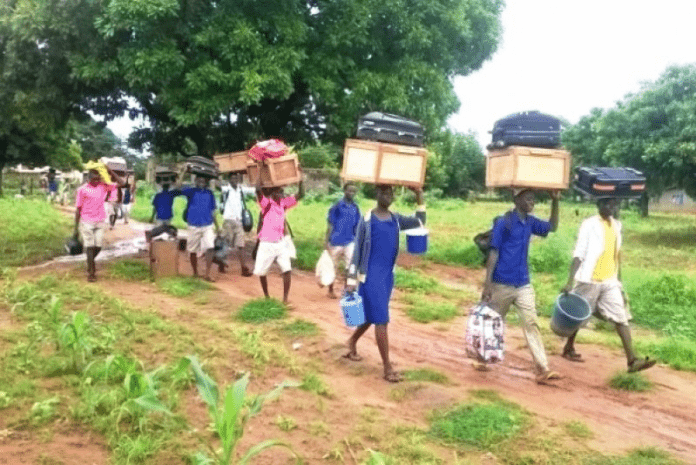
A recent study by three institutions has found that the Free Senior High School (Free SHS) policy, introduced by the government in 2017, has had a less significant impact on poverty reduction than initially expected.
The study attributes this to the policy’s universal approach, which does not adequately address the significant disparities in access to secondary education between wealthy and disadvantaged households.
The research was conducted by the World Bank, Oxfam in Ghana, and the Institute of Statistical, Social and Economic Research (ISSER) at the University of Ghana. It aimed to assess the impact of the government’s fiscal interventions on Ghanaian society.
Titled “Fiscal Interventions and Welfare in Ghana: A Commitment to Equity (CEQ) Assessment Using the Ghana Living Standards Survey (Round 7),” the study’s findings were presented during the launch of an analytical simulation tool designed to monitor and understand living conditions in the country.
The tool, known as the Microsimulation Tool on Fiscal Incidence Analysis, is based on the Ghana Living Standards Survey (GLSS).
Economic Growth
Presenting the study’s findings in Accra last Friday, researchers from the International Centre for Evaluation and Research highlighted that Ghana experienced a steady economic growth rate of over six percent on average from 2005 to 2017 (World Development Indicators, 2022).
However, Dr. Kwadwo Danso-Mensah, Director of Research at the International Centre for Evaluation and Research, noted that the benefits of this growth were not equitably distributed. This inequity has the potential to undermine the extent of poverty reduction and welfare improvement that high economic growth could otherwise achieve.
Dr. Danso-Mensah pointed out that while poverty rates have declined, inequality has been rising.
Government’s Role
Dr. Danso-Mensah emphasized that the government’s role in ensuring that economic growth leads to significant welfare gains through improved income distribution and poverty reduction cannot be overstated. The government wields substantial control over the economy, particularly through fiscal policy measures, which can either promote inclusive growth or indirectly lead to significant changes that benefit welfare outcomes in both the short and long term.
He stressed the importance of comprehensively investigating how various government spending and taxation measures impact poverty and inequality.
“This brings to the fore the need to investigate in a comprehensive manner, the extent to which various governments’ spending and taxation instruments independently or together impact on poverty and inequality.
“An analysis such as is done in this study provides evidence on key factors that promote or limit the redistribution and poverty reduction effect of government’s fiscals,” he said.
Methodology
The study employed the Commitment to Equity (CEQ) assessment framework, developed by the CEQ Institute and detailed in the CEQ Handbook. Unlike other approaches for fiscal incidence analysis that focus on specific taxes or expenditures, the CEQ framework accommodates multiple fiscal policy elements simultaneously, providing a comprehensive analysis of their redistributive impacts.
Dr. Danso-Mensah explained that the framework allows for the allocation of benefits from various fiscal interventions and government programs to households in a micro-level socio-economic survey, comparing different income concepts within the CEQ building blocks of fiscal incidence analysis.
Findings
The simulation results for the Free SHS policy indicated that, in the short term (without considering any behavioral responses to the policy), poverty rates decreased marginally by 0.07 percentage points and 0.22 percentage points at the national lower and upper poverty lines, respectively.
The Gini coefficient, a measure of income inequality, also reduced by 0.10 percentage points when households incurred some education expenses. A higher Gini coefficient indicates greater income inequality.
However, Dr. Danso-Mensah noted that the Free SHS policy was less progressive than if there were no Free SHS. This outcome is expected, given the policy’s universal nature and the fact that wealthier households had better access to secondary education when the policy was introduced.
“This result, however, comes with a strong caveat that the analysis is static and does not incorporate behavioral responses which may reflect increased access or enrollment rates for the poor,” Dr. Danso-Mensah said.
Microsimulation Tool
Paul Coral, Senior Economist at the World Bank, explained that the tool is built on the GLSS round seven, the most recent data on living standards in the country.
“The tool allows us to assess the distributional impacts of policies and reforms and their effects on the poor, the vulnerable, and the population at large. It helps identify progressive versus regressive impacts,” he added.