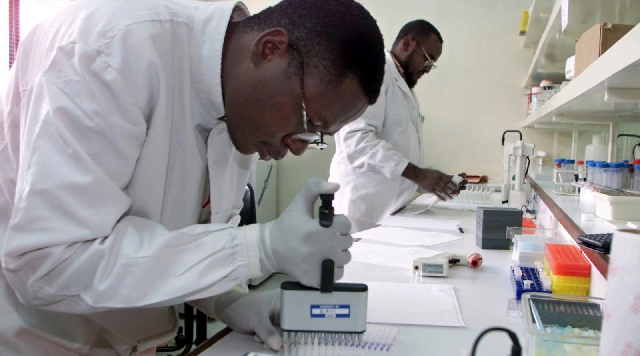
The Medical Laboratory Professional Workers Union (MELPWU) has expressed serious concerns about how their colleagues are being treated nationwide amidst their current strike.
Dr. Cephas Akotor, the General Secretary of the Union, highlighted instances where many members have faced intimidation from hospital administrators during the strike.
According to Dr. Akotor, some union members have been threatened simply for advocating for better working conditions.
The strike by the union aims to protest against the inadequate working conditions endured by medical laboratory professionals.
Dr. Akotor passionately appealed for an end to these intimidating actions.
He stressed the importance of hospital directors, human resources personnel, and administrators supporting their staff rather than taking an adversarial approach.
“I want to use the opportunity to also talk to our directors, HRs and administrators at the various hospitals that we work with, and we are their employees. If we have difficulties, they should be speaking for us, not [when] we go on the rampage before they know we have concerns.
“The intimidation happening in the various hospitals should stop. People are threatening that they will not validate people’s salaries, taking people’s positions from them as heads of departments, asking our members to vacate their accommodations and all that. I think that we haven’t gotten to that stage.”
Mesuna Adiza, who is seven months pregnant, is currently fighting for her life after her husband attacked her with a cutlass in Banda, located in the Krachi Nchumuru District of the Oti Region.
The grievously injured victim was immediately taken to the Banda Health Centre emergency room for urgent medical care.
The suspect, Ibrahim Anas, has been arrested and is now in police custody pending further investigation.
John Mpoebi Nteleye, the Assembly Member for Donwieso West Electoral Area, confirmed the tragic incident to the Ghana News Agency (GNA). The motive behind the attack remains unclear at this time.
According to the Assembly Member, Adiza sustained multiple deep cuts on her forehead, hands, mouth, shoulder, and stomach.
Godfred Atsu Kpodo, a physician assistant at Banda Health Centre, reported that the victim is currently responding to treatment after sustaining the multiple machete wounds.
The police have yet to release any additional information regarding the incident.
The Ghana Education Service (GES) has officially rescheduled the 2024 West African Senior School Certificate Examination (WASSCE), shifting the examination period from August 5 to September 27.
This alteration deviates from the previously announced timeframe of July 1 to August 31, 2024.
Concurrently, the 2024 Basic Education Certificate Examination (BECE) remains scheduled for July 8 to July 12.
In a circular dated March 12, 2024, addressed to regional directors, the acting Director of the Schools and Instructions Division of GES, Prince C. Agyemang-Duah, communicated the revised WASSCE date.
The communication emphasized the need for all senior high school (SHS) heads to acknowledge and prepare candidates accordingly for the updated examination period.
This new schedule supersedes the earlier one and aims to provide candidates with ample time for preparation.
While no official reason was provided for the date change, sources suggest it is to ensure candidates are adequately prepared for the examination.
Head of Public Affairs at the West African Examinations Council (WAEC), John Kapi, confirmed that Ghana would proceed with the Ghana Only Version of the WASSCE-SC due to the shift in dates.
This marks the third time Ghanaian candidates will sit for the WASSCE-SC exclusively, as other WAEC member countries—Nigeria, Liberia, Sierra Leone, and The Gambia—have reverted to their traditional May/June examination calendar post-COVID-19.
Mr Kapi clarified misconceptions surrounding the Ghana Only Version, emphasizing that it adheres to the same rigorous standards as the examination administered in other WAEC member countries.
The examination process, content compilation, and grading standards remain unchanged, ensuring parity with international standards.
Despite the adjustment in the examination schedule, Mr Kapi affirmed that WAEC remains committed to releasing results promptly to facilitate students’ transition to tertiary institutions.
“It is just that we have decided to push ours further so that our students are able to make time for it to be able to write and write it well,” he explained.
“We usually have a timetable after examinations.
So, obviously yes.
Yes, I believe so,” he added.
Additionally, he noted that registration for the WASSCE-SC commenced on March 11 and will conclude on April 19, 2024.
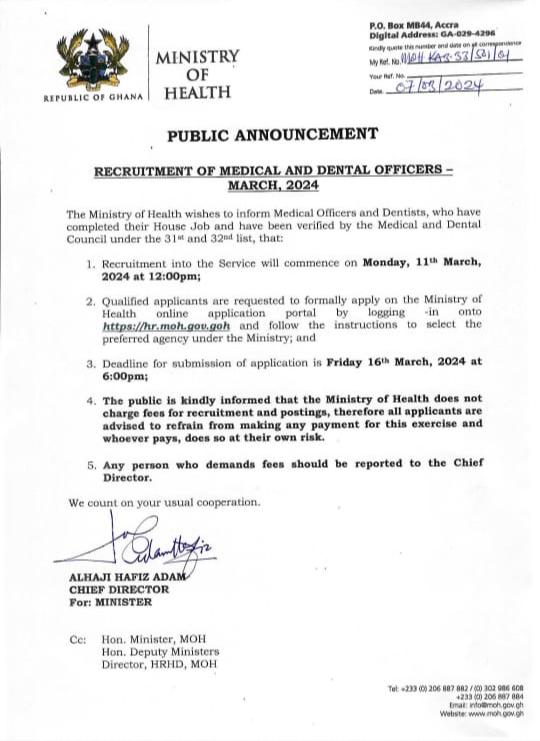
The Ministry of Health (MoH) has declared the commencement of the recruitment for Medical Officers and Dentists who have successfully completed their housemanship and received verification from the Medical and Dental Council.
In an official statement released on Thursday, March 7, 2024, the MoH specified that the recruitment process is set to initiate on Monday, March 11, 2024.
The Ministry emphasized that no charges are associated with the recruitment and posting procedures.
Therefore, applicants are strongly cautioned against making any payments during the recruitment process.
Furthermore, the deadline for submitting applications is set for Friday, March 15, 2024.
Prospective candidates are advised to exclusively use the MoH online application portal and are encouraged to report any instances of fee demands to the Chief Director.
The boy’s father told Sky News: “They said it’s a miracle. It’s not a miracle, this is faulty medical science.”
The safety alert sent to staff at NHS Blood and Transport, seen by Sky News, advised them to pay “particular attention to pre-conditions and red flags” in children after the boy began breathing independently.
The child’s father has told Sky News that “extra caution” is not good enough.
“They did four brain stem tests on him and certified his death. When I asked whether there was an alternative test they said no. If there’s just one test to prove someone is alive or dead it should be 100 percent accurate.
“They said it’s a miracle. It’s not a miracle, this is faulty medical science.”
Two weeks later, a nurse at the hospital noticed the boy, then four months was breathing.
The Academy of Royal Medical Colleges (ARMC), which sets the test, said in August it would rewrite the code of practice on brain stem testing after the child’s case came to light.
This week it told Sky News it has sped up the process with a report due to be ready in months.
It has not offered parents or hospitals advice on what to do in the meantime.
David Jones, a professor of bioethics at St Mary’s University, warned there was a risk of organs being extracted from living children if clinicians got diagnoses wrong.
“The doctors could’ve said ‘This child is dead and they could’ve taken his organs,” Professor Jones said.
“But they didn’t because of an ongoing legal issue, and because they didn’t, they later found out that he wasn’t dead.”
More and more clinicians are now expressing concern about brain stem testing, according to Professor Jones.
“If the test is a matter of life and death, and if death means you can take organs, you want certainty. I think some of that certainty has been taken away by this case,” he told Sky News.
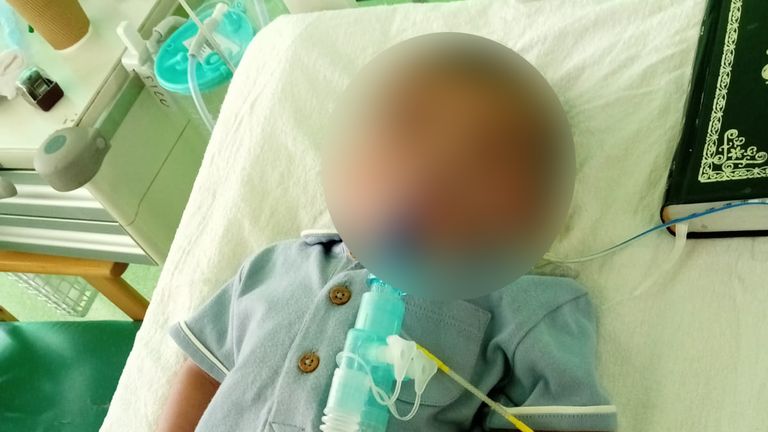
Image:The baby began breathing two weeks after he was declared brain-dead
The interim safety alert sent to NHSBT staff calls for “extra caution in any infant when diagnosing death using neurological criteria – paying particular attention to pre-conditions and red flags”.
An NHSBT spokesperson said: “There are strict criteria in place in the UK to provide safe, timely, and consistent criteria for the diagnosis of death, provided by the Academy of Medical Royal Colleges.
“As medicine advances, new treatments and clinical practice mean that protocols must be updated accordingly, and any new learnings shared. Clinicians pay particularly close attention to any rare or unusual cases, to ensure that the highest standards for patient and donor care and safety continue to be upheld.”
NHSBT refused to comment on whether a moratorium should be in place until the ARMC’s expert group review is published.
Professor Jones said: “I think that if there isn’t a moratorium then at the very least all parents ought to be informed that this has happened and that this is a risk.
“But in the meantime, I think that it shouldn’t be used on young children.”
In June, the High Court ruled against the parents of 12-year-old Archie Battersbee after Barts Health NHS Trust took them to court to brain stem test him on the recommendation of doctors who said he was brain-dead.
After a legal battle lasting weeks, Archie’s life support machine was switched off and he died on 6 August.