The African Centre for Parliamentary Affairs (ACEPA) has noted that the New Patriotic Party (NPP) Minority in Parliament may resort to various strategies to frustrate government business, as a walkout alone would not yield significant results in the current parliamentary setup.
Speaking in an interview on Saturday, ACEPA’s Executive Director, Dr. Rasheed Draman, emphasized that the numerical balance in the 9th Parliament diminishes the effectiveness of walkouts as a political tool.
“Given the numbers that they [the NPP] have, I believe that they have lined up a number of strategies because a walkout in this Parliament is not going to achieve very much since quorum could still be formed without them,” Dr. Draman observed.
He highlighted how the current dynamics differ from those in the 8th Parliament when the National Democratic Congress (NDC) Minority was better positioned to disrupt government business due to a more evenly balanced Parliament.
“For four years, we didn’t see the NDC, and in fact, they were well-positioned because they could hold government business to ransom in the 8th Parliament more than the NPP can do in this Parliament, but we didn’t see any of that. And one will ask, was that a weak strategy on their [NDC’s] part, that they didn’t speak for the same issues that are being spoken by the NPP?” Dr. Draman questioned.
The current NPP Minority, with only 88 seats compared to the NDC Majority’s overwhelming 180-plus, faces a significant numerical disadvantage that limits its ability to influence proceedings through conventional opposition tactics.
Dr. Draman also examined the traditional use of walkouts as a means to signal dissatisfaction, boycott debates, or draw attention to concerns. However, he reiterated that the success of such strategies is largely contingent on the opposition’s numerical strength and the willingness of the Majority to engage constructively.
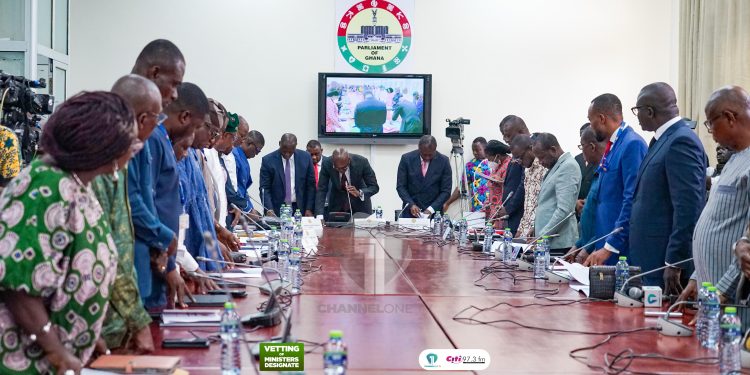
The African Centre for Parliamentary Affairs (ACEPA) has criticized the ongoing vetting of ministerial nominees, characterizing the process as deficient and lacking depth.
According to ACEPA, the conduct of parliamentarians from both the majority and minority sides has impeded meaningful engagement, stifling comprehensive analysis of nominees on crucial national matters.
Speaking to Citi News, Dr. Rasheed Draman, Executive Director of ACEPA, underscored the importance of revamping the Appointments Committee’s methodology to restore credibility and ensure the vetting process achieves its intended purpose.
Dr. Draman emphasized that the current framework is ill-equipped to facilitate a substantive evaluation of nominees, particularly on significant issues impacting the country.
He called for immediate reforms to enhance the committee’s effectiveness and transparency.
“I think this process has been very unsatisfactory. There is a need for some serious rethinking about how the Appointments Committee conducts its business. We see, first of all, Members of Parliament, particularly those from the Minority, missing a very important opportunity to exact accountability from nominees.
“They focus on trivial issues, issues that are not speaking to the competence, the integrity, and the fit of the person to the ministry or department that he or she is going to.
“On the side of the members of the Majority, I think they have turned this whole process into some kind of friendly match. I mean, it is their colleagues from the same party, but I think we still have to take this business very seriously.”
Executive Director of the African Center for Parliamentary Affairs (ACEPA), Dr. Rasheed Draman, has raised concerns over the timing of Speaker Alban Bagbin’s decision to declare four parliamentary seats vacant, a move that has ignited political tensions and debate.
On October 17, Speaker Bagbin ruled that the seats held by Cynthia Mamle Morrison (NPP, Agona West), Kwadjo Asante (NPP, Suhum), Peter Kwakye-Ackah (NDC, Amenfi Central), and Andrew Amoako Asiamah (an independent MP from Fomena who recently rejoined the NPP) were vacant. This decision followed allegations of constitutional violations by the MPs.
In a recent interview, Dr. Draman expressed doubts about whether this was the right time to make such a significant ruling, especially with the country heading toward national elections. He highlighted the potential implications of this decision on the political climate and parliamentary operations.
While acknowledging the legal provisions that permit such declarations, Dr. Draman urged caution, stressing that these decisions should be approached with careful consideration due to their impact on both the functioning of Parliament and the country’s democracy.
He also supported the Majority Leader’s call for the courts to provide clarity on the matter, warning that any boycott of Parliament would not be in the country’s best interest, particularly during an election year.
His concern comes in response to complaints from the Minority, alleging that many Majority members have been absent from parliamentary sessions due to campaign tours with the New Patriotic Party’s flagbearer, Dr. Mahamudu Bawumia, since the House resumed from recess.
During a media engagement Dr. Draman expressed serious concern about this issue, noting its persistent nature across multiple parliamentary sessions highlighting the current Parliament ineffectiveness in addressing absenteeism adequately.
Dr. Draman pointed out that existing constitutional sanctions and measures are not enforced, attributing this to a lack of accountability from Parliament’s leadership.
To combat this problem, Dr. Draman suggested that Parliament should explore alternative approaches to ensure members’ attendance and accountability.
He said , “Parliament has been very weak when it comes to dealing with this matter. Either because the kind of sanction and the measures put in the constitution and the standing orders are ones that a parliament cannot really implement, or the leadership of parliament is running away from its responsibilities.
“In the past, when some of these issues came up, I think some of us have found out that if parliament knows that they cannot punish our own for absenteeism,. Then perhaps they should consider other methods of dealing with absenteeism”.
He advised Members of Parliament to prioritise punctuality at parliamentary sittings, emphasising that MPs should join campaign activities during recess periods, not when parliamentary business is in session.
He said, ”They are doing work that is not supposed to be their work. Because Parliament is not in recess, during the recess, they could follow the Vice President, or, for that matter, any presidential candidate of their choice. But even then, it raises issues because, when they are on recess, that is when they are supposed to be with their constituents.
“For me, that brings me to the issue of absenteeism that we are grappling with as a country. And unfortunately, Parliament, that is, this Parliament, as well as all the seven Parliaments before this one have not been able to have a handle on this issue of absenteeism”.
To effectively deal with absenteeism by MPs without proper permissions, he recommended an adoption of European sanctions and penalties meted out to absentee MPs.
Examples of such penalties include fines or deductions from their salaries for unapproved absences, suspension of travel and subsistence allowances.
“Like what is done in some European countries where you absent yourself and you lose some benefits.
Otherwise, because there is no real sanction regime, people can just walk away from Parliament. And show up anytime, because they know nothing is going to happen to them, as has been the case over the years” he added.
“Like what is done in some European countries where youabsent yourself and you lose some benefits,. Otherwise, because there is no real sanction regime, people can just walk away from Parliament. And show up anytime, because they know nothing is going to happen to them, as has been the case over the years.”
The Executive Director of the African Centre for Parliamentary Affairs (ACEPA), Dr. Rasheed Draman, has underscored the significance of consultations in the reorganization of parliamentary leadership.
Instead of outright resignations, Dr. Draman notes that parliamentary leaders are typically reshuffled through extensive consultations.
His comments come in the wake of the resignation of Majority Leader and Minister for Parliamentary Affairs, Osei Kyei-Mensah-Bonsu, on February 21. Dr. Draman expresses concern that the absence of such consultations could diminish the motivation of parliamentarians to fully contribute to their parties.
Quoted by 3news.com, Dr. Draman states, “It is sad for our parliament but most importantly, it is not a motivation for others to give their all in terms of their contributions to their party and so on.”
Emphasizing the importance of broad consultations within both the New Patriotic Party (NPP) and the National Democratic Congress (NDC), Dr. Draman highlights the need for inclusivity when contemplating changes in parliamentary leadership.
“The party has every right, as the leader has said, in terms of making decisions but the keyword is consultation and carrying everybody along,” he says.
Dr. Draman contended that such consultations would dispel the perception that party leadership does not consider the views and suggestions of its members before making decisions.
He also asserted that parliamentary caucuses deserve better treatment from their party leadership.
Reflecting on past events, Dr. Draman notes dissatisfaction among caucus members during previous reshuffles due to a lack of consultation being the primary issue.
“The party has every right, as the leader has said, in terms of making decisions but the keyword is consultation and carrying everybody along,” Dr. Draman said.
He also believes that such consultations would dispel the notion that party leadership does not heed the views and suggestions of its members before making decisions.
Dr. Draman further asserted that parliamentary caucuses deserve better treatment from their party leadership.
Reflecting on past events, he said there are dissatisfactions among caucus members during previous reshuffles because of a lack of consultation as the primary issue.
He explained, “When the NDC thing [reshuffle] happened, there were a lot of members of the caucus who were very angry, not because of the change but because of the process and how most of them were not consulted.”
Executive Director of the African Centre for Parliamentary Affairs (ACEPA), Rasheed Draman, has indicated that the newly introduced Standing Orders in parliament is a response to the challenges of absenteeism and the lack of quorum experienced during sessions.
In an interview with TV3 he stated that the roll call is positioned as a crucial tool to promote transparency and curb absenteeism, ultimately contributing to the overall integrity of parliamentary proceedings.
He stated that under this approach, the roll is called, requiring every member to respond.
According to him in cases where a member is absent, the standing orders permit the transfer of voting rights to another member on matters before the house.
… the roll is called and everybody has to respond and if you are not there eerrm, whoever for instance the standing orders is allowed for you to give your vote to somebody on a matter that is before the house all those are mentioned during the roll call,” he added.
Rasheed Draman emphasized the significance of addressing these issues during the roll call, providing a systematic method to manage the challenges faced by the parliamentary body.
Mr Draman expressed the frustration associated with absenteeism and the repercussions of inadequate quorum in parliamentary proceedings.
He advocated for a consistent adherence to the roll call, acknowledging that while it may be time-consuming to mention the names of all 275 members, the benefits of bringing order and accountability to the house outweigh the time investment.
“Look we have been dealing with this issue of absenteeism and the frustrations with lack of quorum in the house over the days. If I am to advise the right honorable Speaker I will say let’s stick to this roll call because I mean it might take time but I guess mentioning the names of 275 members will take more than 15 to 20 minutes doing that will bring sanity to the house,” he stated.
As the new Standing Orders come into effect, they aim to instill discipline and responsibility among parliamentarians, ensuring that the house functions efficiently and effectively.
On Tuesday, February 6, a notable change took effect in parliamentary proceedings as members kicked off sessions by reciting the National Pledge.
New Parliamentary Standing Orders: The roll call will address issues of absenteeism. – Rasheed Draman, Exec Dir, ACEPA#GhanaTonightpic.twitter.com/IYguEi8R9Z
Executive Director of the African Center for Parliamentary Affairs (ACEPA), Dr Rasheed Draman, has expressed deep concern about the rising prevalence of vote-buying by politicians during elections, emphasizing its detrimental impact on democracy.
Dr Draman highlights vote-buying as a worrisome trend where electoral contestants use monetary or other incentives to influence voters in their favor.
Dr Draman believes this development poses a significant threat to the democratic process, as it may compromise the selection of candidates based on merit and qualifications.
In an interview on the January 29 edition of Ghana Tonight on TV3 Dr Draman stated, “I can tell you on authority that some of the people who have decided not to contest, some of them lament that those who have come with big moneys to replace them are people who perhaps are ill-prepared, with very little education to go into parliament. You get them in there, and certainly, quality is going to be affected.”
Dr Rasheed Draman highlighted the potential repercussions of the increasing trend of vote-buying, including the challenges faced by new Members of Parliament (MPs) in adapting to their roles.
This difficulty could result in challenges maintaining a quorum during parliamentary sessions. Dr. Draman emphasized the lack of regular induction and preparation for new entrants into Parliament as a complicating factor.
He further warned of the possible infiltration of illegitimate funds into the democratic system. The ACEPA director urged authorities to investigate the funding sources behind financially endowed individuals entering politics and emphasized the potential national security implications of such scenarios.
“If nothing is done, I think in the next two cycles of our election, we are going to have a big crisis on our hands. Because, those who have money are going to line up to go into parliament. It is going to be like a buffet and experienced MPs who don’t have fat wallets are going to continue to get pushed out. That’s not going to be good for our democracy and even the national security implication of that.
“All these people who have money and are pushing experienced MPS out, where are they getting the money from? Who is funding them? What is the interest of all these people who are providing them with funding? We need to interrogate all these and the implications of that on the quality of our democracy.”
The Executive Director of the African Center for Parliamentary Affairs (ACEPA), Dr. Rasheed Draman, has expressed concern over the increasing prevalence of vote buying by politicians during elections.
Vote buying involves contestants in an election using monetary or other incentives to sway the electorate in their favor.
According to Dr. Draman, it is evident that individuals with substantial financial resources are winning over voters, sidelining experienced and competent candidates. He believes this trend is detrimental to democracy.
“I can tell you on authority that some of the people who have decided not to contest, some of them lament that those who have come with big moneys to replace them, are people who perhaps are ill-prepared, with very little no education to go into parliament. You get them in there, and certainly quality is going to be affected.
Dr. Draman highlighted that some individuals who opt not to run for office lament that those with significant financial backing replacing them may lack adequate preparation and education for parliamentary duties. This, in turn, could compromise the overall quality of parliamentary proceedings.
Speaking on Ghana Tonight on TV3 with Alfred Ocansey on January 29, Dr. Draman warned of the potential infiltration of drug money into the democratic system if vote buying is not addressed.
He emphasized that allowing democracy to become a bidding war may lead to funds from illegitimate sources influencing the political landscape, posing significant national security implications.
Expressing concern for the future, Dr. Draman predicted a crisis in the next two election cycles if the issue is not tackled promptly.
He envisioned a scenario where financially well-endowed individuals dominate parliamentary seats, potentially sidelining experienced MPs who lack substantial financial backing.
Dr. Draman called for scrutiny into the funding sources of these wealthy candidates and questioned the motives behind such financial support, emphasizing the need to assess its impact on the quality of democracy.
The Executive Director of the African Center for Parliamentary Affairs (ACEPA), Dr. Rasheed Draman, has admonished Ghanaians who will cast their votes in the 2024 elections to desist from selling their rights to politicians.
According to him, accepting cash from some politicians in the bid to secure seats in parliament comes with repercussions in the future.
He argued that Ghana is experiencing a crisis due to the act of accepting cash from politicians during elections since most of them are not competent for the role.
Vote buying involves contestants in an election using monetary or other incentives to sway the electorate in their favor.
According to Dr. Draman, it is evident that individuals with substantial financial resources are winning over voters, sidelining experienced and competent candidates. He believes this trend is detrimental to democracy.
“I can tell you on authority that some of the people who have decided not to contest, some of them lament that those who have come with big moneys to replace them, are people who perhaps are ill-prepared, with very little no education to go into parliament. You get them in there, and certainly quality is going to be affected.
Dr. Draman highlighted that some individuals who opt not to run for office lament that those with significant financial backing replacing them may lack adequate preparation and education for parliamentary duties. This, in turn, could compromise the overall quality of parliamentary proceedings.
Speaking on Ghana Tonight on TV3 with Alfred Ocansey on January 29, Dr. Draman warned of the potential infiltration of drug money into the democratic system if vote buying is not addressed.
He emphasized that allowing democracy to become a bidding war may lead to funds from illegitimate sources influencing the political landscape, posing significant national security implications.
Expressing concern for the future, Dr. Draman predicted a crisis in the next two election cycles if the issue is not tackled promptly. He envisioned a scenario where financially well-endowed individuals dominate parliamentary seats, potentially sidelining experienced MPs who lack substantial financial backing. Dr. Draman called for scrutiny into the funding sources of these wealthy candidates and questioned the motives behind such financial support, emphasizing the need to assess its impact on the quality of democracy.
Executive Director of the African Center for Parliamentary Affairs (ACEPA), Dr Rasheed Draman, has called on political parties to implement intentional grooming strategies for the effective replacement of seasoned Members of Parliament.
Several veteran Members of Parliament from the Majority, including the Majority Leader, Osei Kyei-Mensah-Bonsu, have indicated their decision not to contest in the upcoming parliamentary elections in 2024.
Their decisions have raised concerns about creating a deficit of experienced legislators.
In an interview, Dr Rasheed Draman called on political parties to develop a deliberate strategy to phase out MPs.
“In Norway, the parties have academics; they prepare young people, they have a way of preparing people to go to parliament. In that system, you can have a lot of young people in parliament, with people who are already prepared, people who have gained some experience through the preparations and support that they have had from the parties.”
“In our system, I don’t know if there is any school or academic where a candidate who is preparing to go to parliament is taken through some kind of skills training and preparations. You wake up, and if there’s a mad rush, everybody wants to go to parliament without any experience. And then you have these experienced hands leaving; then it creates a big void.”
Dr. Draman also bemoaned the impact of the exit of some experienced MPs on the business of parliament.
“The work of parliament, legislative work, is not for the faint-hearted; I mean, it’s not for everyone. You get the experience by doing, and you learn by doing. People become very important assets, both for the parties, parliament, and the country. I would have hoped that there has been some cause in the past for some seats to be protected. I would have hoped that the parties in parliament would have found a way, at least to ensure that through some internal negotiations and agreement, some seats will be protected,” the Executive Director of ACEPA said.
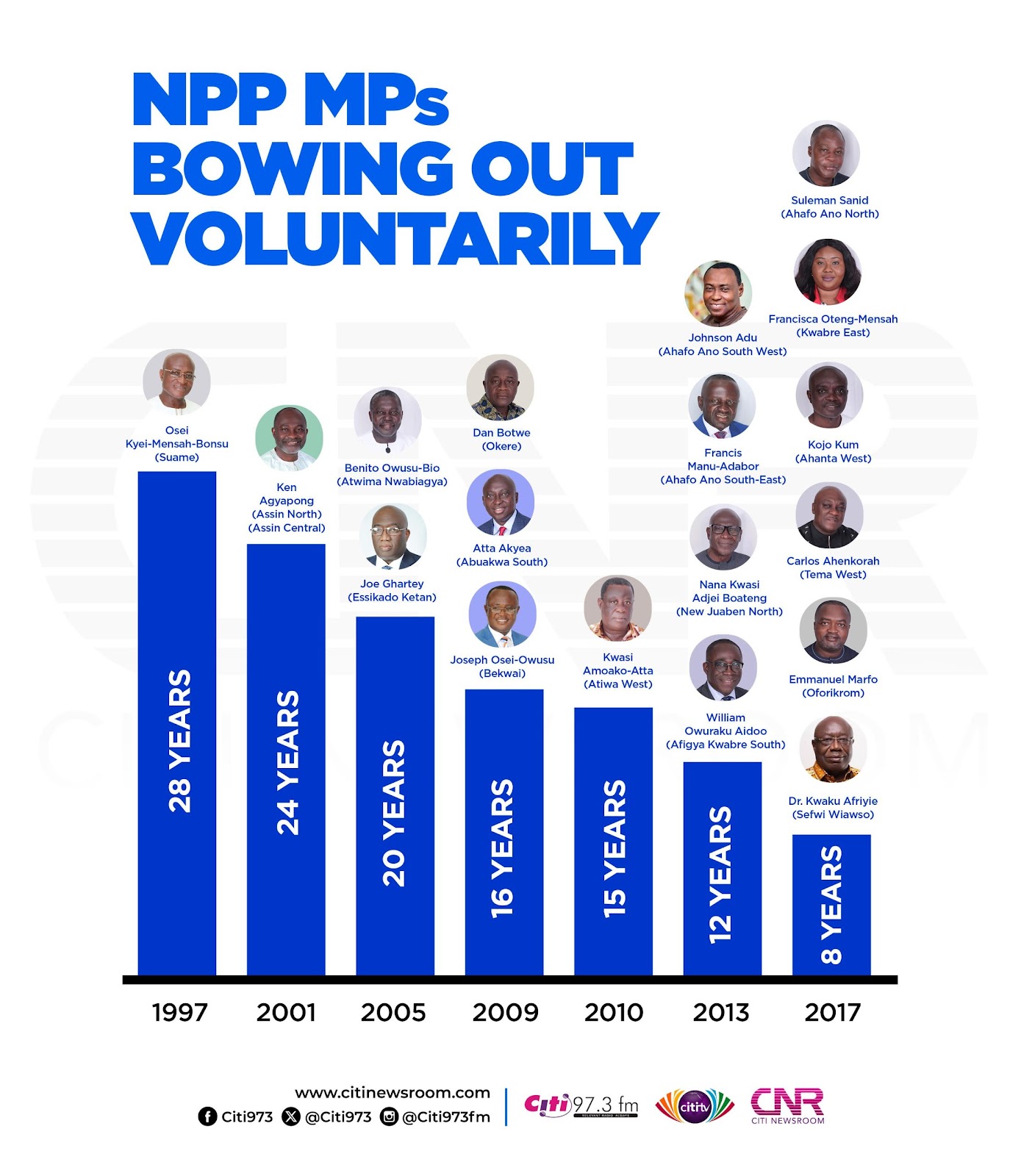
Among the noteworthy MPs opting not to seek reelection are prominent figures such as Majority Leader Osei Kyei-Mensah-Bonsu (Suame), First Deputy Speaker Joe Osei Owusu (Bekwai), Atta Akyea (Abuakwa South), Joe Ghartey (Essikado Ketan), and Ken Agyapong (Assin Central). Their decision undoubtedly leaves a void in the party’s leadership and parliamentary representation.
Other MPs who have decided to step down include Dan Botwe (Okere), Kwasi Amoako-Atta (Atiwa West), Dr. Kwaku Afriyie (Sefwi Wiaso), and Emmanuel Marfo (Oforikrom). Additionally, Benito Owusu-Bio (Atwima Nwabiagya), Carlos Ahenkora (Tema West), Nana Kwasi Adjei Boateng (New Juabeng North), William Owuraku Aidoo (Afigya Kwabre South), Johnson Adu (Ahafo Ano South West), Francis Manu-Adabor (Ahafo Ano South-East), Suleman Sanid (Ahafo Ano North), Kojo Kum (Ahanta West), and Francisca Oteng (Kwabre East) are among those opting not to seek reelection.
The reasons behind their decision remain unclear, with speculation ranging from potential retirements from politics to pursuing alternative professional opportunities or taking a break from the demanding nature of parliamentary life.
The Executive Director of the African Center for Parliamentary Affairs (ACEPA), Dr. Rasheed Draman, has advocated for political parties to implement intentional grooming strategies to effectively replace seasoned Members of Parliament.
Several Senior Majority Members of Parliament, including the Majority Leader, Osei Kyei-Mensah-Bonsu, have indicated that they will not be contesting in the upcoming parliamentary elections in 2024.
This development has prompted concerns about the potential shortage of experienced legislators.
In an interview with Citi News, Dr. Rasheed Draman urged political parties to formulate deliberate strategies for the phased replacement of MPs.
“In Norway, the parties have academics; they prepare young people, they have a way of preparing people to go to parliament. In that system, you can have a lot of young people in parliament, with people who are already prepared, people who have gained some experience through the preparations and support that they have had from the parties.”
“In our system, I don’t know if there is any school or academic where a candidate who is preparing to go to parliament is taken through some kind of skills training and preparations. You wake up, and if there’s a mad rush, everybody wants to go to parliament without any experience. And then you have these experienced hands leaving; then it creates a big void.”
Drawing a parallel with Norway, he highlighted the importance of academic preparation and training provided by parties to groom young individuals for parliamentary roles.
Dr. Draman expressed skepticism about the absence of similar training programs or academic initiatives for parliamentary candidates in the Ghanaian system.
He emphasized the need for aspiring MPs to undergo skills training and preparations before entering parliament to fill the void left by departing experienced hands.
The Executive Director of ACEPA also lamented the impact of losing experienced MPs on parliamentary proceedings, emphasizing that legislative work requires experience gained through practical involvement.
Reflecting on the departure of prominent MPs, including Majority Leader Osei Kyei-Mensah-Bonsu, First Deputy Speaker Joe Osei Owusu, Atta Akyea, Joe Ghartey, and Ken Agyapong, among others, Dr. Draman underscored the significance of protecting certain seats through internal negotiations and agreements within political parties.
Notable MPs opting not to seek reelection include Dan Botwe, Kwasi Amoako-Atta, Dr. Kwaku Afriyie, Emmanuel Marfo, Benito Owusu-Bio, Carlos Ahenkora, Nana Kwasi Adjei Boateng, William Owuraku Aidoo, Johnson Adu, Francis Manu-Adabor, Suleman Sanid, Kojo Kum, and Francisca Oteng. The reasons behind their decisions remain uncertain, with speculation ranging from potential retirements to pursuing alternative professional opportunities or taking a break from parliamentary life.
Executive Director of the African Center for Parliamentary Affairs (ACEPA), Dr. Rasheed Draman, emphasized the importance of having a systematic approach to grooming new talents within political parties to replace experienced MPs gradually.
He highlighted the need for mentorship programs, capacity building, and the involvement of young politicians in various parliamentary activities to prepare them for future leadership roles.
The call for deliberate grooming strategies comes as several long-serving MPs announce their decision not to seek reelection, raising questions about the potential loss of institutional knowledge and experience in the legislature.
“In Norway, the parties have academics; they prepare young people, they have a way of preparing people to go to parliament. In that system, you can have a lot of young people in parliament, with people who are already prepared, people who have gained some experience through the preparations and support that they have had from the parties.”
“In our system, I don’t know if there is any school or academic where a candidate who is preparing to go to parliament is taken through some kind of skills training and preparations. You wake up, and if there’s a mad rush, everybody wants to go to parliament without any experience. And then you have these experienced hands leaving; then it creates a big void,” he told Citinews.
Dr. Rasheed Draman expressed concern about the potential impact of the exit of experienced Members of Parliament on the overall functioning of the legislative body.
“The work of parliament, legislative work, is not for the faint-hearted; I mean, it’s not for everyone. You get the experience by doing, and you learn by doing. People become very important assets, both for the parties, parliament, and the country. I would have hoped that there has been some cause in the past for some seats to be protected. I would have hoped that the parties in parliament would have found a way, at least to ensure that through some internal negotiations and agreement, some seats will be protected,” the Executive Director of ACEPA said.
Several MPs, including key figures like Majority Leader Osei Kyei-Mensah-Bonsu, First Deputy Speaker Joe Osei Owusu, Atta Akyea, Joe Ghartey, and Ken Agyapong, have chosen not to seek reelection in the upcoming 2024 parliamentary elections. This decision raises concerns about a potential leadership void and its impact on parliamentary representation.
Among other MPs opting not to run again are Dan Botwe, Kwasi Amoako-Atta, Dr. Kwaku Afriyie, Emmanuel Marfo, Benito Owusu-Bio, Carlos Ahenkora, Nana Kwasi Adjei Boateng, William Owuraku Aidoo, Johnson Adu, Francis Manu-Adabor, Suleman Sanid, Kojo Kum, and Francisca Oteng. The reasons for their decisions remain unclear, with speculations ranging from potential retirements to pursuing alternative professional opportunities or taking a break from the demanding nature of parliamentary life.
The exit of these experienced MPs underscores the importance of succession planning and grooming emerging leaders within political parties to ensure a smooth transition and effective parliamentary functioning.
Executive Director of the Africa Centre for Parliamentary Affairs (ACEPA), Dr. Rasheed Draman, has emphasized that the departure of Majority Leader Osei-Kyei-Mensah-Bonsu and other lawmakers from Parliament will create a substantial void within the legislative body.
Dr. Draman highlighted that the decision of certain New Patriotic Party (NPP) MPs to abstain from contesting in the upcoming parliamentary primaries will result in a significant gap in the legislative process.
Speaking on the Ghana Tonight show on TV3 on Tuesday, December 26, he expressed his concerns, stating, “There will be a very huge vacuum.”
“If you try to research into, for instance, the lawmaking process in parliament, yes lawmaking happens at the level of the committee, but many will tell you that there are very few MPs who have developed that interest in going through the intricacies and very details of the bills when they come before the House. I can tell you from my experience and my knowledge from working with Parliament that some of these people are those exiting.”
The New Patriotic Party (NPP) closed nominations on December 25 for parliamentary aspirants in constituencies where it has sitting Members of Parliament (MPs).
The election is scheduled for January 27, 2024, marking the next stage in the party’s initiative to field candidates in all 275 constituencies. This followed the successful hosting of primaries in what the party terms orphan constituencies on December 2.
At the close of nominations on Christmas day, some seasoned members of the party chose not to pick forms, voluntarily deciding to conclude their parliamentary careers. Notably, Osei Kyei-Mensah-Bonsu, representing Suame Constituency in the Ashanti Region and serving in Parliament since 1997, is among the prominent figures who have opted out.
Majority Leader in Parliament
Joseph Osei-Owusu (Bekwai Constituency- Ashanti Region). Has been in Parliament since 2009
Samuel Atta Akyea (Abuakwa South Constituency). He has been in Parliament since 2009.
Atta Akyea
Joe Ghartey (Essikado Ketan Constituency). He has been in Parliament since 2005.
Kennedy Agyapong (Assin Central Constituency). He has been in Parliament since 2001.
Kennedy Agyapong
Daniel Botwe (Okere Constituency). He has been in Parliament since 2009.
Dan Botwe
Kwasi Amoako-Atta (Atiwa West Constituency). He has been in Parliemnt since 2009.
Dr. Kwaku Afriyie (Sefwi Wiaso Constituency). He has been in Parliament since 2017.
Emmanuel Marfo (Oforikrom Constituency). He has been in Parliament since 2017.
Benito Owusu-Bio (Atwima Nwabiagya Constituency). He has been in Parliament since 2005.
Carlos Ahenkora (Tema West Constituency). He has been in Parliament since 2017.
Nana Kwasi Adjei Boateng (New Juabeng North Constituency). He has been in Parliament since 2013.
William Owuraku Aidoo (Afigya Kwabre South Constituency). He has been in Parliament since 2013.
Johnson Adu (Ahafo Ano South West Constituency). He has been in Parliament since 2013.
African Centre for Parliamentary Affairs (ACEPA) has cautioned that the attrition rate in Parliament may worsen in the near future unless political parties take proactive measures to address the situation.
Dr. Rasheed Draman, the Executive Director of ACEPA, highlighted that political parties appear to prioritise financially affluent individuals over competent MPs, contributing to the current state of affairs.
This concern has been raised in response to comments by the National Chairman of the opposition National Democratic Congress (NDC), Johnson Asiedu Nketiah, who linked the increasing attrition rate in Parliament to the excessive monetization of politics in Ghana.
Mr. Nketiah, speaking on the Citi Breakfast Show on Citi FM, claimed that there has been a deviation from the original purpose of serving the nation through law formulation, with MPs now using their parliamentary privileges to recoup campaign investments or advance personal business interests.
Dr. Draman lamented the prioritisation of money over knowledge and experience by political parties.
“In advanced democracies, there are some seats where(sic) you don’t contest a sitting MP because of the wealth of knowledge or experience that he or she brings to the legislative agenda and the fact that the party needs the person to be in the House.
“Now the party looks at who has a fat wallet and who can win elections for them, even if the person is not going to bring anything to the table when it comes to the work of Parliament.”
He suggests that there should be a reevaluation of the positions within the executive arm granted to legislators, emphasising the necessity of a disconnect in this regard.
To build trust and confidence in the judiciary, the concerns raised by the Minority in Parliament must be addressed, according to the Executive Director of the African Centre for Parliamentary Affairs (ACEPA), Dr. Rasheed Draman.
Dr. Draman further advocated for a dialogue among Members of Parliament (MP) to effectively tackle these concerns, acknowledging the principle of the separation of powers.
While recognizing the importance of the separation of powers, he noted that recent judicial orders to parliament have demonstrated that one branch of government can indeed influence the work of another branch.
“First of all, if you listen to the NDC side, their argument about the whole process in terms of how this is being handled, there seem to be some concerns about justice delivery in our country. I think that the earlier this matter is looked at the better for us.
“Parliament, I believe, is the right forum and I hear Members of Parliament say separation of powers prevents them from interfering with the work of the judiciary but we have seen the judiciary interfere with the work of parliament in recent weeks. I believe in the interest of the entire citizenry of our country, if there are concerns about the judiciary I think the earlier we address these concerns the better for all of us so that we can all trust the judiciary,” he said on the Ghana Tonight show on TV3 Thursday, July 6.
Dr. Draman also advised the Minority to reassess their decision to boycott parliamentary proceedings in solidarity with their members facing trials in court.
He stated that such boycotts would not be sustainable, particularly if the cases are expected to extend over a significant period of time.
“It might be difficult to sustain particularly if the cases are going to travel a very long period like many cases in our country. I don’t think the NDC caucus can afford to be out of parliament for that long. So perhaps a relook at this strategy might be necessary on their part,” Dr Draman said on the Ghana Tonight show on TV3 Thursday, July 6.
On Thursday, July 6, the Minority of the National Democratic Congress (NDC) refrained from attending parliamentary sessions in order to accompany and show solidarity with two of their caucus members.
These members were Dr. Cassiel Ato Forson, the Minority Leader, and James Gyakye Quayson, the lawmaker for Assin North, who were appearing in court for ongoing prosecutions led by the Attorney-General and the NPP Government. In a statement released by Minority Chief Whip Kwame Agbodza, it was stated that the Minority stands united with their colleagues, leading them to be unable to fulfill their parliamentary duties on that day.
“This is the beginning of a series of actions that the Caucus will be embarking on to end the ongoing persecution of the Minority Leader himself, the Hon. James Gyakye Quayson and the Hon. Collins Dauda. We wish to reiterate the point that amidst persecution, cooperation will suffer.”
Following James Gyakye Quayson’s swearing-in as an MP on July 4, the Minority Leader, Ato Forson, announced that the caucus had resolved to stand in solidarity with Quayson throughout his trial in court.
Quayson took the Oath of Allegiance and the Oath of Member of Parliament administered by Speaker Alban Sumana Kingsford Bagbin. This came one week after he won the by-election following his deposition by a Supreme Court ruling, which deemed his election invalid.
During Quayson’s swearing-in ceremony, attended by friends and family, Dr. Ato Forson declared that the Minority would abstain from participating in parliamentary proceedings on the days when the Assin North member has his court hearings.
“Mr Speaker, I wish to serve notice that the entire Minority Group will accompany our colleague to court today and any other day that he is to appear in court,” he stated.
“Mr Speaker, we are solidarising with our colleague and we will not participate in the business of the House anytime our colleague is in court and we will be withdrawing form the chamber after this ceremony if the court processes indeed happen today.”
The case was called at the High Court on Tuesday, July 4 but it was adjourned to Thursday, July 6.
The Minority insists cooperation in the House will be difficult to achieve in the face of the ongoing trial.
“Amid persecution, cooperation will certainly suffer. Mr Speaker, a word to wise is in Assin North.”
The African Centre for Energy Policy (ACEP) has criticised the decision to lease the Tema Oil Refinery (TOR) to a private company known as Torentco Assets Management (TAM).
ACEP’s Executive Director of ACEP, Benjamin Boakye, in an interview on Adom FM’s Burning Issues, revealed that the TAM is owned by an individual and not a consortium.
“We all want TOR to work, but, will not sit and watch Management do something that will not benefit the country. Because this Torentco Assets Management is one person’s company who does not have any expertise in oil.
“For now, we know who is behind the Torentco company and when you check his background, he has not sold kerosene before; let alone, refining oil that he can use to help turn things around at TOR,’’ he said on Wednesday.
Mixed reaction greeted the news of the government leasing TOR. While some considered it a prudent step to revive the Refinery, others believe the contract is a shady one, designed to rip off the country.
Touching on the deal, Mr Boakye said the yet-to-be-finalised contract between TOR’s management and Torentco Assets Management did not go through the right process – be it competitive bidding or sole sourcing.
On the same show, an aspiring presidential candidate for the New Patriotic Party (NPP), Kwadwo Nsafoa Poku, endorsed the privatisation of TOR.
According to him, considering the current state of TOR the only way to turn things around is for a private company to take over.
He, however, advised the refinery’s Managing Director to come out to explain to Ghanaians the truth behind the transaction and defuse the speculations his silence is generating.
Meanwhile, a Member of Parliament’s Select Committee of Energy, Rashid Pelpuo, said the Committee has not been briefed on the development.
On the back of that, the Committee will invite the CEO and directors of the company to brief them.
The Executive Director of the African Centre for Parliamentary Affairs (ACEPA), Dr Rahseed Draman, has made claims that the minority in Parliament is having a negative ripple effect as a result of its previous reshuffle in the minority leadership.
His claim was sighted by GhanaWeb in a 3news.com report.
According to him, it appears that the current Minority leadership has not been fully embraced by the Minority caucus, necessitating additional efforts on their part.
Haruna Iddrisu, James Klutse Avedzi and Mohammed-Muntaka Mubarak as Minority Leader, Deputy Minority Leader and Minority Chief Whip, respectively, were removed by the National Democratic Congress (NDC) leadership and replaced with Dr Casiel Ato Forson, Emmanuel Armah Kofi-Buah and Kwame Agbodza as leaders of the minority.
This change, according to the Executive Director, has resulted in agitation among the Minority caucus.
“It looks like the ghost of the reshuffle in the Minority bench is still haunting the caucus, and I am not (the only one) saying this. This has been said by people like Muntaka; said by the former Minority leader, and today when we listen to proceedings in Parliament, the Majority Leader jokingly took a jab at the Minority Leader [Dr Cassiel Ato Forson] and said you have not been confirmed yet,” he said.
Dr Rahseed Draman further explained that because the minority side has not fully accepted the new leadership, a lot of work needs to be done even as 17 of their members will not be returning to Parliament.
“The new leadership has not been fully accepted by the rank and file of the Minority caucus, so there is a lot of work that needs to be done for the leadership to endear themselves to the entire caucus, particularly given its dilemma that is facing them where they have 17 of their members that are likely not to come back,” he added.