Tag: Adultery

  • Indonesia readies to illegalize adultery and ban unmarried couples living together

    Indonesia is about to change its criminal code, making sex outside of marriage punishable by up to a year in prison, a move that critics say will limit freedoms and police morality.

    Indonesia is on the verge of ratifying major changes to its criminal code that would criminalise extramarital sex and make it illegal for unmarried couples to live together.

    If officials ratify sweeping changes to the country’s criminal code on Tuesday, people who have sex outside of marriage could face up to a year in prison.

    In addition to criminalising adultery, the revised code would prohibit unmarried couples from cohabiting.

    The law, if passed, would apply to Indonesian citizens and foreigners alike, including tourists to the hotspots of Bali and the islands off Lombok.

    Insulting the president and spreading views counter to the secular national ideology, known as the Pancasila, will also be outlawed.

    Legal experts and civil society groups say the changes are a “huge setback” for the southeast Asian nation.

    “The state cannot manage morality. The government’s duty is not as an umpire between conservative and liberal Indonesia,” said Bivitri Susanti, a law expert from the Indonesia Jentera School of Law.

    Deputy speaker of the House of Representatives, Sufmi Dasco Ahmad, and Bambang Wuryanto, head of the parliamentary commission overseeing the revision, told Reuters that parliament would hold a plenary session on Tuesday to ratify the new code.

    Previous plans to ratify the new draft code in September 2019 were brought to a halt by nationwide demonstrations. Tens of thousands of protesters took to the streets and the protests turned violent, with police dispersing crowds using tear gas and water cannons.
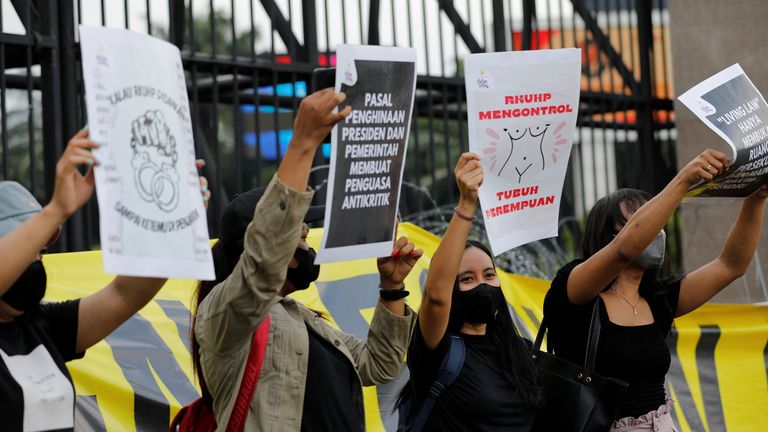
    People protest against new laws in Indonesia banning adultery.
    Image: People protest against new laws in Indonesia banning adultery.

    The revisions to the code, which dates back to the colonial era, have been decades in the making. While the changes have sparked mass protests in recent years, the response has been considerably more muted this year.

    Daniel Winarta, a University of Indonesia student, was among a small crowd of protesters that gathered outside parliament in the capital of Jakarta on Monday.

    “On cohabitation, for example, it’s clearly a private matter,” he said. “We will keep rejecting this.”

    Indonesia’s population is predominantly Muslim, with sizeable groups of Hindus, Christians and people of other faiths. Most Indonesian Muslims practice a moderate version of Islam, but recent years have seen a rise in religious conservatism that has crept into politics.

    Under the revised code, only close relatives such as a spouse, parent or child can report complaints related to extramarital sex or cohabiting.

    Only the president can file a complaint about being insulted, but such a crime will carry a three-year jail sentence.

    It will take three years after the code is ratified for it to come into effect to give the government time to draft related regulations.


  • Sudan court quashes decision to stone woman to death

    An appeal court in southern White Nile state in Sudan has invalidated a court decision that a young woman convicted of adultery be stoned to death, her lawyer said.

    In June, a court in Kosti town found Maryam Tiraab guilty under a Sudanese law that states that a married person, male or female, be stoned to death if he/she commits adultery.

    Intisaar Abdullah, her defence lawyer, told the Sudan Tribune news website, on Thursday that a court of appeal “invalidated the court ruling concerning Tiraab”.

    Ms Abdullah said that the court of appeal decided to return the case to the trial court, and ordered it to reconsider the ruling, saying that it had not “taken into consideration the guidelines of a fair trial”.

    She said that the court of appeal also ordered the trial court to restart the litigation process afresh, in accordance with “instructions it had issued”, without giving more details.

    Ms Tiraab’s defence lawyers said that the previous ruling was “illegal” since their client had no “legal representation”.

    Ms Tiraab, 20, who separated from her husband in 2020, was accused of adultery by her husband a year later.

    The trial court’s decision had angered many Sudanese lawyers, who sympathised with Ms Tiraab, and vowed to appeal against the decision.

    Source: BBC.com 

  • 20-year-old woman to be lapidated over adultery

    A 20-year-old woman accused of adultery has been sentenced to death by stoning.

    However, human rights activists are making all efforts possible to prevent the incident from happening.

    According to the BBC, the woman was found guilty in June 2022 by a court in the city of Kosti, in Sudan’s White Nile state.

    With the help of her lawyer, Intisar Abdala, the woman has appealed the ruling of the court, and all fingers are crossed to see whether the appellate court will uphold the lower court’s decision or quash it.

    Sulaima Ishaq, the head of the Violence Against Women Unit at the Ministry of Social Development described the judgement of the court as unfair.

    “We don’t have a minister who can intervene to demand her release,” Ishaq lamented as the Sudanese government was overthrown by a military junta, which resulted in the dissolution of the government.

    The BBC reports Mossaad Mohamed Ali, executive director of the African Centre for Justice and Peace Studies (ACJPS) as alleging that the woman was not given access to a lawyer while in custody and was not aware of the charges against her.

    “We have grounds to believe she was illegally forced into signing a confession by the police,” the ACJPS boss alleged.

    It is reported that the woman separated from her husband in 2020 and went to live with her family. A year later the man accused her of adultery, leading to her arrest and prosecution.

    Sudan still imposes the death penalty for some hudud crimes – offences specified by Allah in the Quran, including theft and adultery. In Sudanese law, they carry penalties such as flogging, the amputation of hands and feet, hanging and stoning.