The United Nations‘ human rights leader, Volker Türk, expressed great concern about the mistreatment of Afghan refugees in Pakistan as the country forces them to leave.
Türk said he is worried about reports that Afghan people are being kicked out of Pakistan for no good reason and also being treated badly, arrested, and forced to leave their things behind.
He asked the Pakistani government to stop sending people back to their country until they have a fair way to decide who should go back and investigate reports of mistreatment by the police.
Pakistan asked over a million Afghan refugees to leave the country by November 1. They can leave on their own, without being forced.
The UN says that over 327,000 refugees have returned to Afghanistan from Pakistan because they were afraid of getting arrested.
The UN heard that Afghan refugees in Pakistan are being treated unfairly. Some were arrested for no reason and had their things taken away by the police.
“Unfair arrests and keeping people in custody go against Pakistan’s responsibilities under international laws,” Türk added.
The UN Human Rights Chief wants Pakistan to make sure that people who could be in danger in Afghanistan are kept safe and not sent back there.
Türk said that women and girls are at higher risk if they are sent back against their will because the authorities’ rules stop them from going to school, working, moving around, and taking part in public activities.
In August 2021, the Taliban took over the country again and stopped girls from going to school and women from going to university. Lately, they have shut down beauty salons and stopped women from going to a well-liked national park.
By the end of 2022, Pakistan had over 1. 3 million Afghan refugees who were officially registered, and about 427,000 other people from Afghanistan in similar situations, as reported by the United Nations refugee agency.
But many people in Pakistan have been upset about them being there for a long time. The police have tried to stop them and have threatened to send them away in the past.
Pakistan’s government has made a plan to crack down on people who are in the country illegally.
A group of people is working together to catch people who have fake ID cards and illegal houses built with fake documents. The national database and registration body has been told to cancel any fake ID cards and check with DNA testing to confirm cases.
In 1979, lots of Afghans left their country because of the Soviet invasion and went to live in Pakistan. This was the biggest refugee crisis in the world at that time. In 2021, many Afghans fled to Pakistan after the Taliban took control of Kabul. They didn’t have all the right papers and were waiting for visas to go to other countries like the United States.
Tag: Afghan refugees
-

Chief of UN Human Rights ‘alarmed’ by allegations of torture against Afghan refugees in Pakistan
-
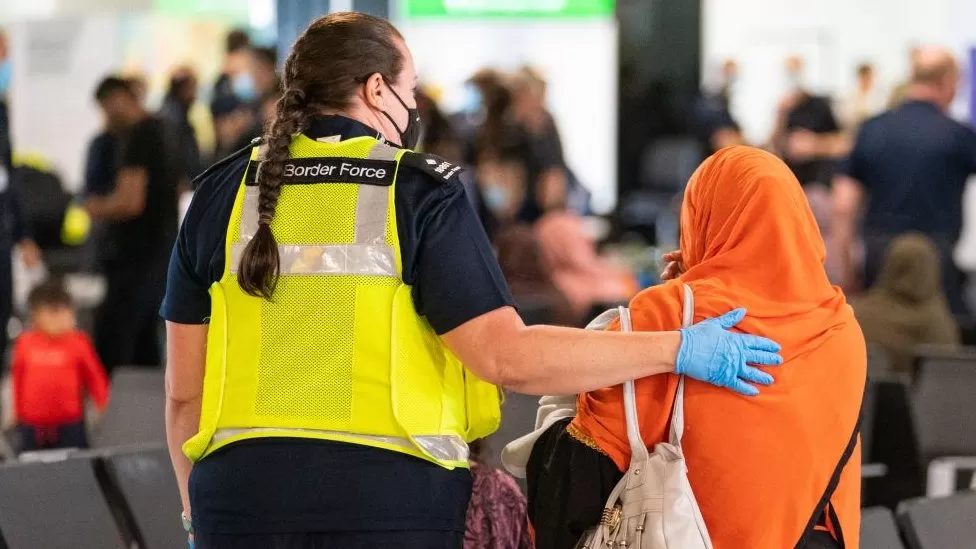
Afghan refugees abandoned by UK – Think tank
According to a research group, the UK has “let down” many Afghan refugees, some of whom have been living in hotels for up to two years and are now in danger of being evicted.
Lessons must be learnt, according to More in Common, to better assist refugees in the future.
It occurs on August 15, 2021, the anniversary of both the UK’s evacuation plan and the Taliban’s capture of Kabul.
Minister Johnny Mercer acknowledged “challenges” but declared he was committed to making Afghan plans succeed.
During Operation Pitting, the UK airlifted approximately 15,000 individuals out of Kabul, including British nationals, UK employees in Afghanistan, and their families.
Those who didn’t have a place to dwell were put up in motels paid for by the government. In spite of the fact that this was meant to be a temporary arrangement, by the end of March, there were still about 8,800 Afghans living in hotels.
The government has given Afghans until the end of August to leave hotels, but authorities have warned that some may end up homeless because they are unable to find other places to live.
132 Afghans living in the UK were polled by More In Common, a group established in the wake of the murder of Labour MP Jo Cox.
It was reported that there had been breakdowns in housing-related communication between local governments and the Home Office, that rental applications had been frequently denied, and that unsuitable properties had been offered, sometimes hundreds of miles away.
One instance included a refugee who was given permanent housing in Northern Ireland while residing in temporary housing in Bristol, where they had family.
Amir Hussain Ibrahimi has been residing in a hotel in Southend-on-Sea, Essex, ever since the UK evacuated him from Afghanistan two years ago.
The 24-year-old Afghan journalist and photographer claimed that after being captured and attacked by the Taliban, he was forced to leave his family behind.
“The first days when I was in the hotel we had a lot of promises – the government told us that you’re going to stay three months, four months, or five months,” he said to BBC News.
It is challenging since you are unsure about your life’s next move.
He remarked, “Sometimes you want to feel a place is like a home,” and he has experienced depression on occasion since moving to the UK.
After being turned down by more than ten landlords, Mr. Ibrahimi said he was delighted the council had finally given him a permanent home. He is currently anticipating whether this landlord will approve him as a tenant.
He claimed to know numerous other families who had been unsuccessful in finding housing, though.
Mr. Ibrahimi admitted that there were difficulties because many Afghans had huge families and had never worked in the UK. He did note that additional assistance was required from the government.
It was admitted that “things could have always been done differently” and that Afghan families had been housed in hotels “for far too long” by Cabinet Office minister Mr. Mercer, who served in Afghanistan during his time in the military and is in charge of the resettlement programme.
The deadline for guests to check out of hotels by the end of August, he told the PA news agency, had been “a controversial move,” but it had been made “with compassion in mind.”
“I couldn’t have generated that momentum without putting that hard deadline in there,” he claimed, adding that 440 Afghans had been matched to homes in the previous week.
According to the government, it has already assisted more than 10,500 Afghans in making the transition from hotels to long-term housing with financing totaling £285 million.
A representative for the Local Government Association claimed that despite facing difficulties such as a housing scarcity, councils have worked “incredibly hard” to support Afghan families.
It acknowledged that there were lessons to be learnt but accused the government of creating a lot of confusion by delaying financing and providing instructions.
When Kabul fell to the Taliban, Sir Laurie Bristow, the British ambassador there, remarked that the UK owed a debt of gratitude to its employees.
“There are people who worked for us and worked with us in Afghanistan and in refugee camps, and whose lives are in danger as a result of doing so,” he said on Radio 4’s Today programme.
Sir Laurie asserted that while the question of whether or not to negotiate with the Taliban is still up for dispute, doing so successfully might help to address the reasons why Afghans were migrating to the UK.
However, organisations have attacked relocation programmes for being too slow and for keeping many Afghans who want to immigrate to the UK stranded there.
Up until the end of March, only 40 refugees who had fled Afghanistan to nearby countries had been resettled in the UK under the Afghan Citizens Resettlement Scheme (ACRS), while only 14 members of at-risk groups had been resettled directly from Afghanistan since the original evacuation.
11,398 Afghans have been transported to the UK via a programme for those who worked for or with the UK government, while 9,059 more Operation Pitting immigrants have also been placed under the ACRS.
While others have chosen riskier routes, like travelling across the English Channel in small boats, Afghans have been the most frequent nationality to arrive this way so far this year.
The programmes, according to the human rights charity Justice, were characterised by “significant delays, a lack of transparency, and a lack of consistency.”
It demanded more efficient applicant communication and speedier processing times.
Mr. Mercer confirmed that once the Taliban took control, some people were left behind and were still not taken to safety.
Nevertheless, he declared that he was committed to making resettlement programmes “work properly” and that the UK should be “proud” of its efforts to save people.
According to a representative for the Home Office, there is “no need for Afghans to risk their lives by taking dangerous and illegal journeys” because the UK has “one of the largest commitments of any country to support Afghanistan.”