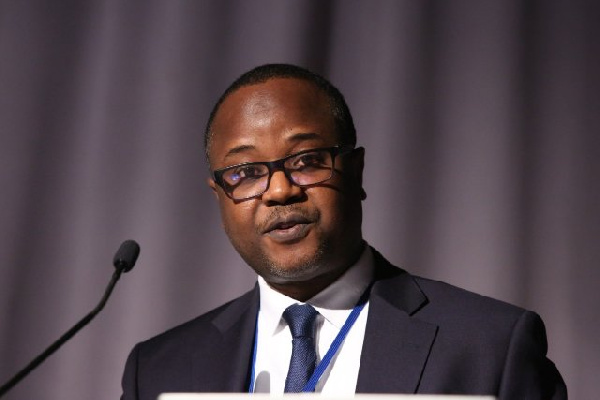
Respected First Deputy Governor of the Bank of Ghana, Dr. Maxwell Opoku-Afari, is eagerly looking forward to the upcoming 3i Africa Summit, acknowledging its potential to stimulate digital economic growth across the continent.
Under Dr. Opoku-Afari’s leadership, the pivotal summit underscores the importance of collaboration among stakeholders, emphasizing the potential for collective action to surmount challenges and drive the growth of the FinTech sector.
The inaugural 3i Africa Summit spans three days, aiming to advance technology and digitalization in the financial industry to enhance inclusion.
Organized by the Bank of Ghana and Development Bank Ghana, with support from Elevandi established by the Monetary Authority of Singapore, the event anticipates the participation of approximately 4,000 corporate executives from around 80 nations, scheduled from May 13 to May 15.
The summit’s topic, “Unleashing Africa’s FinTech and Digital Economic Potential,” will centre on how long-term, sustainable capital allocation can change Africa’s economic environment.
The event aims to provide a platform for policy discussions, international collaboration on intellectual resources, entrepreneurial endeavors, and investment networking. Additionally, the summit will explore topics such as artificial intelligence (AI), its applications in daily life, and ethical considerations regarding the protection of customer data.
Catalyzing FinTech Growth and Regulatory Innovation
In preparation for the summit, Dr. Opoku-Afari outlined the Bank of Ghana’s pivotal role in catalyzing FinTech growth and regulatory innovation. Emphasizing the institution’s commitment to fostering an environment conducive to innovation, he cited initiatives such as the regulatory sandbox and eCedi as crucial drivers of progress in the financial technology sector.
Dr. Maxwell Opoku-Afari: A Beacon of Leadership in Ghana’s Financial Sector
He delved into his illustrious career journey, leadership principles, and the pivotal role he plays in shaping Ghana’s financial landscape in a candid conversation with Business Insider Africa.
Inspiration and Career Trajectory
Dr. Opoku-Afari’s journey into economics and banking was spurred by a curiosity cultivated during his secondary school years. Reflecting on his academic path, he shared, “I was introduced to the subject of economics way back in secondary school and have never left it since then.” This initial spark led him to pursue a multidisciplinary approach, combining economics, statistics, and political science during his undergraduate studies. His academic pursuits culminated in a specialization in applied macroeconometrics during graduate studies, setting the stage for his impactful career in central banking.
Guiding Principles in Leadership
As the First Deputy Governor, Dr. Opoku-Afari emphasized the importance of evidence-based policymaking and talent development. He stated, “I am always guided by strong analytical and evidence-based policymaking.” Furthermore, he underscored his commitment to nurturing human capital within the Bank of Ghana, recognizing it as a cornerstone of organizational success.
Navigating Challenges
Dr. Opoku-Afari recounted a pivotal moment in his career—the revocation of bank licenses in Ghana. Despite the complexity of the task, he and his team successfully executed the initiative under the guidance of the Governor. He remarked, “Working as part of the Management team… tested all our skills… But under the guidance of the Governor, we were able to have a seamless exercise.”
Contributions to Economic Advancement
Dr. Opoku-Afari’s contributions to Ghana’s economy are multifaceted. He played a pivotal role in establishing the Ghana Integrated Payment and Settlement Systems (GHIPSS), revolutionizing the country’s payment landscape. He highlighted initiatives such as payment interoperability and digital innovation as key drivers of financial inclusion and economic growth.
Profile: Maxwell Opoku-Afari, First Deputy Governor, Bank of Ghana
Maxwell Opoku-Afari is a distinguished economist and policymaker with almost three decades of experience in central banking and international finance and has held senior positions at the International Monetary Fund (IMF) and the Bank of Ghana. He was appointed the First Deputy Governor of the Bank of Ghana on August 7, 2017, and currently serves in this role.
Before he was appointed First Deputy Governor, Dr. Opoku-Afari worked in various positions at the International Monetary Fund (IMF) for nearly a decade, where he rose to the positions of Deputy Division Chief and Mission Chief. In this role, he led program negotiation missions and numerous Article IV consultations at the IMF.
He was Mission Chief for São Tomé Príncipe and Mauritius and also worked in Rwanda, Zambia, and Jamaica during his time at the IMF.
In addition, as the Deputy Division Chief in the Regional Studies Division in the African Department of the IMF, he led the production of the Regional Economic Outlook for sub-Saharan Africa, one of the IMF’s flagship publications. He also participated in IMF negotiations in several African and Caribbean countries and was a reviewer of policy documents for many developing nations during his time as a Senior Economist in the Strategy, Policy, and Review (SPR) Department of the IMF.
Dr. Opoku-Afari’s work at the IMF focused on monetary policy modernization, macro-financial linkages, and debt restructuring. He also co-authored several IMF policy papers on these topics. He has also published extensively on monetary policy, inclusive growth, short-term output indicators in low-income countries, aid effectiveness, capital flows, and real exchange rate dynamics. And more recently, on the role of digitalization in supervision, fintech, innovation, and financial inclusion.
Before his tenure at the IMF, Dr. Opoku-Afari worked for 13 years at the Bank of Ghana, where he rose to the position of Head of the Special Studies Division in the Research Department and later served as Special Assistant to the Governor. He was also a member of the Ghana Government’s Capital Markets Committee from 2006 to 2008 and played an integral part in the first Eurobond issuance by Ghana in 2007.
Dr. Opoku-Afari holds a first degree in Economics and Statistics, an MPhil in Economics, both from the University of Ghana, Legon, and a PhD in Economics from the University of Nottingham in the United Kingdom. His expertise and leadership have been widely recognized, and he has received numerous awards and honours throughout his career.
He is currently a Fellow (FGA) of the Ghana Academy of Arts and Sciences, an honorary fellow of the Chartered Institute of Bankers (CIB), the Institute of Directors, Ghana (IoD), and chairs the Advisory Board of the College of Humanities at the University of Ghana.