Tag: African

  • DSTV’s price hikes must be checked – CUTS International to govt

    DSTV’s price hikes must be checked – CUTS International to govt

    Consumer rights organization CUTS International is pushing for government intervention in MultiChoice Ghana Limited’s decision to raise subscription fees, arguing that customers were given inadequate notice ahead of the increase.

    The revised pricing, set to take effect on April 1, will see an average 15% rise across all packages. MultiChoice Ghana has defended the adjustment, pointing to rising inflation and economic conditions as key factors influencing the change.

    However, CUTS International has taken issue with the short timeframe customers were given to adjust. While acknowledging that price increases are normal in a deregulated market, the advocacy group insists that subscribers deserve more time to prepare.

    Speaking to Citi Business News, CUTS International’s West African Regional Director, Appiah Kusi Adomako, highlighted MultiChoice’s stronghold on satellite television in Ghana, particularly its exclusive rights to premium sports content.

    “DSTV has some kind of dominance when it comes to satellite TV. They have access to premium content like the EPL and the UEFA channel and this has given them some leverage on the market, and other competitors don’t have access to this kind of content. DSTV is trying to abuse its dominant role in the market,” he remarked.

    He further called on regulatory bodies to ensure fair treatment for consumers by extending the notice period.

    “If it was not having this dominant role, I am not sure it would have done this. I want to ask the Ministry of Communication and Trade to compel DSTV to rescind it on its one-week notice and give Ghanaians a minimum of a month notice as per the terms of a good contract,” Adomako stated.

    With just days remaining before the new pricing takes effect, consumers and advocacy groups are watching closely to see if the government will take action.

  • AMAA 2024 call for entries to commemorate its 20th-anniversary ceremony

    AMAA 2024 call for entries to commemorate its 20th-anniversary ceremony

    The Africa Movie Academy Awards (AMAA) is celebrating its 20th anniversary in 2024 by inviting film submissions from across the continent.

    To mark this milestone, the deadline for late entries has been extended to August 10, 2024.

    Founded by the late Peace Anyiam-Osigwe, the AMAA was created to honor and elevate African cinema.

    Her visionary efforts laid the groundwork for a thriving Nollywood and expanded the global recognition of African films.

    The AMAA has consistently aimed to celebrate excellence in filmmaking, build professional networks, and highlight the exceptional talents within the industry.

    As we commemorate two decades of the awards, we also pay tribute to Peace Anyiam-Osigwe for her profound impact on the industry, which has helped connect seasoned professionals with emerging talents and fostered new collaborations.

    For the 20th edition of the AMAA, films including features, shorts, and documentaries released between January 2023 and July 2024 are eligible for submission.

    This extended call allows filmmakers from all over Africa to participate in celebrating the rich tapestry of African storytelling through cinema.

  • BADEA to launch major $50bn project aiding 1m African SMEs

    BADEA to launch major $50bn project aiding 1m African SMEs

    The Arab Bank for Economic Development in Africa (BADEA) is initiating a program to support one million small and medium-sized enterprises (SMEs) throughout Africa.

    This program is part of three significant partnerships BADEA plans to establish with key stakeholders to promote development across the continent.

    Fatima Elsheikh, strategic advisor to the BADEA president, announced the initiative during a press briefing on Thursday, July 18.

    The signing of these partnerships will take place on Sunday, July 21, in Accra.

    Elsheikh emphasized the transformative impact of these agreements for BADEA’s future, highlighting the bank’s commitment to Africa’s long-term development.

    One major agreement involves a memorandum of understanding (MoU) with Wamkele Mene, Secretary-General of the African Continental Free Trade Area (AfCFTA).

    This MoU will facilitate the creation of a unified Africa trade facility. Additionally, BADEA will collaborate to enhance the competitiveness of African exports and will release a joint report with the Africa Capacity Building Foundation (ACBF).

    The event will also feature the launch of the Arab-Africa Financial Consortium (AAFC), an alliance of Arab and African Development Financial Institutions.

    The consortium aims to strengthen economic, financial, and technical cooperation between Arab and African countries.

    In celebration of its 50th anniversary, BADEA will host an event themed “Prosperity through Partnership: 50 Years of Arab-Africa Cooperation for Development.”

    This event will take place during the African Union Mid-Year Coordination Meeting in Accra and will include a leaders’ breakfast to celebrate BADEA’s five decades in development finance.

    The breakfast will also serve as the first platform to discuss the establishment and implementation of the AAFC.

    Dr. Sidi Ould Tah, BADEA President, announced the bank’s goal to mobilize $50 billion for Africa’s development over the next six years.

    This effort is part of BADEA’s broader 50th-anniversary celebrations and demonstrates its dedication to supporting the continent’s economic growth.

    Gabby Octhere-Darko, Executive Chairman and Founder of the Africa Prosperity Network, stated that the event aims to build on the existing relationship between Africa and the Arab world, fostering greater economic integration and development.

    He highlighted Africa’s vast natural resources and potential for prosperity, emphasizing the need for financial support and policy reforms to achieve the African Union’s Agenda 2063 and the Sustainable Development Goals (SDGs).

  • ‘Shocked’ Nathaniel Bassey reacts to KODA’s death

    ‘Shocked’ Nathaniel Bassey reacts to KODA’s death

    Ghana and the broader African music community are grieving the sudden passing of revered gospel music artist KODA known for his unique and creative expression of faith through music.

    The news of his death, which came as a shock to many, has left a profound impact on fans and fellow musicians alike.

    KODA, whose real name is Kofi Owusu Dua Anto, was widely regarded as one of Ghana’s finest musicians and a leading figure in the African gospel music scene.

    His innovative approach to blending traditional gospel themes with contemporary sounds resonated with audiences across the continent and beyond.

    The announcement of KODA’s passing was met with an outpouring of tributes from fans, colleagues, and industry insiders.

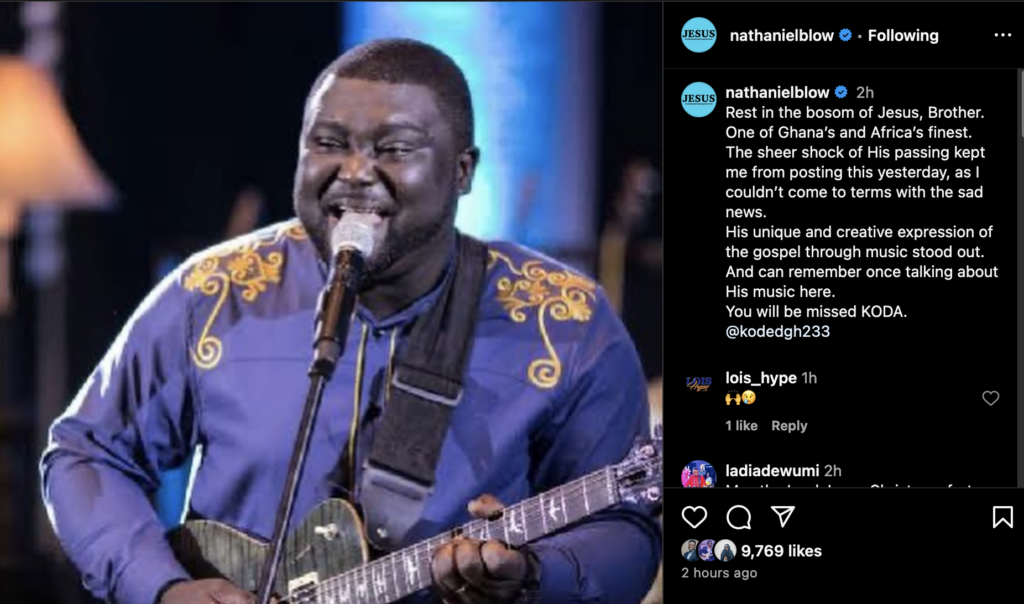
    Nigerian music icon Nathaniel Bassey expressed shock at the passing of the Ghanaian gospel musician.

    Taking to his social media platform he said “Rest in the bosom of Jesus, Brother. One of Ghana’s and Africa’s finest. The sheer shock of His passing kept me from posting this yesterday, as I couldn’t come to terms with the sad news.His unique and creative expression of the gospel through music stood out. And can remember once talking about His music here. You will be missed KODA.”

    See post below:

  • Sustained growth could have made African families 35% more wealthier – World Bank

    Sustained growth could have made African families 35% more wealthier – World Bank

    The Chief Economist for the Africa Region at the World Bank, Andrew Dabalen, has emphasized the potential wealth increase of African families by 35% if growth had been sustained over the past 14 years.

    These insights were shared during discussions on the World Bank’s Africa Pulse Report for April 2024.

    In an interview with Bernard Avle on Citi TV’s Point of View program, Mr Dabalen noted the challenges of maintaining growth rates in Africa over an extended period, despite lower growth rates compared to other regions.

    He highlighted that Africa’s ability to reduce poverty through growth is only half of the global average and pointed out differences in economic recovery durations between Africa and East Asia.

    Mr Dabalen drew comparisons with East Asia, noting that economic recovery in Africa tends to be short-lived, whereas in East Asia, it persists for a longer duration before faltering.

    This observation underscores the economic resilience and sustainability disparities between the two regions.

    He concluded by noting that Africa’s growth rate reduces poverty at a slower pace compared to other regions, particularly East Asia, which experiences much higher poverty reduction rates.

    “Africa’s growth has been traditionally low compared to other regions being in the same situation as Africa, such as East Asia for instance. And it has been very difficult to sustain over a long period of time. Countries in Asia and Africa went through a recession, there’s an economic downturn we have had the experience.

    “Let’s say there’s a recovery, the recovery in Africa lasts maybe three years and then a shock comes, and it falters. It doesn’t sustain. Recovery in East Asia takes about eight years before it falters, that is a huge difference.

    He added, “Not only do you find Africa’s growth is lower, but you also find it is not sustained over a long period. And because of that, it’s extremely costly. If Africa’s growth was sustained at the rate at which it grew, it’s not high, but even if it was sustained between 2002 and 2014, that window of 14 years, African families would be 35% richer than they are now. That is the kind of things that give you a sense of how completely costly this low growth has been.

    “The speed at which Africa’s growth reduces poverty is only half of what we see in the rest of the world. East Asia is much higher.”

  • Stonebwoy bags Best African Dancehall Entertainer at the International Reggae and World Music Awards 2024

    Stonebwoy bags Best African Dancehall Entertainer at the International Reggae and World Music Awards 2024


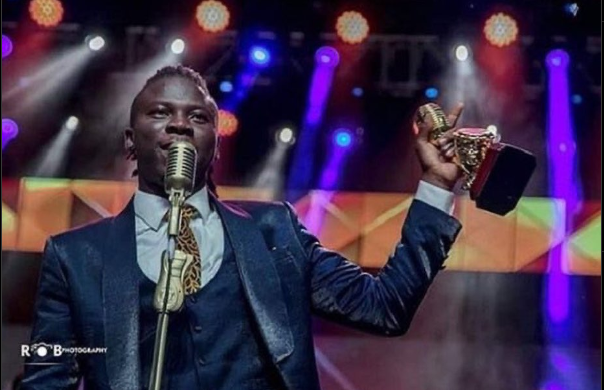
    Ghanaian music sensation  Livingstone Etse Satekla, better known by his stage name Stonebwoy triumphed at the 2024 International Reggae and World Music Awards (IRWMA) by clinching the prestigious title of Best African Dancehall Entertainer.

    The event, held at the Lauderhill Performing Arts Center in Fort Lauderdale on March 22nd, 2024, marked the 41st anniversary of the awards ceremony and highlighted exceptional talent while also promoting Health Awareness.

    Among the other notable winners were Nigerian star Wizkid, who secured the Best Afrobeat Entertainer award, and Burna Boy, who took home three awards for Best African Entertainer, Best Music Video, and Best Crossover Song with “Talibans II.”

    Additionally, Seun Paul was honored with the esteemed Emperor of Reggae & World Music category.

    See post below:

  • Ghana is not a happy country; ranks 120th out of 150 countries

    Ghana is not a happy country; ranks 120th out of 150 countries

    The 2024 World Happiness Report places Ghana in the 120th spot for happiness among countries worldwide.

    Ghana got 4,289 points and failed to make it into the top 10 happiest countries in Africa.

    All 54 countries in Africa failed to make it to the first fifty countries on the list of the World Happiness Report once again.

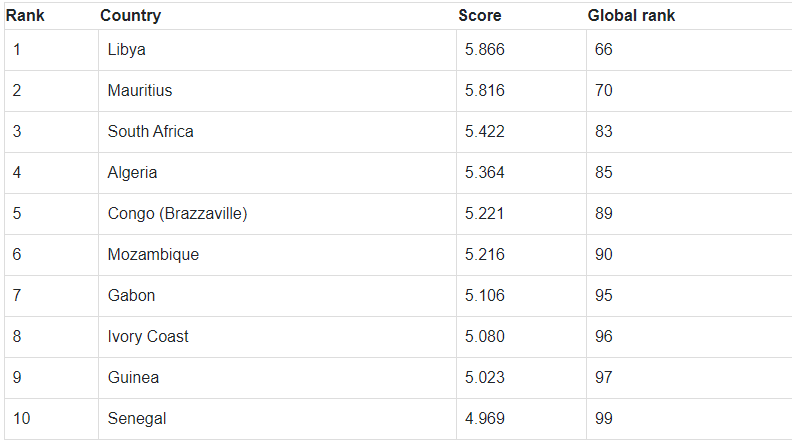
    Libya deemed the most joyful country in Africa, achieving a happiness score of 5.866, is ranked 66th globally.

    In 2023, Mauritius, ranked the happiest African country, took the 52nd position.

    The World Happiness Report has once again ranked Finland as the happiest country for the third consecutive year. The United States went down to 23rd place from 15th place. Afghanistan, Lebanon and Lesotho were at the end of the list.

    John Helliwell, a Canadian economist and founding editor of the World Happiness Report, said on Wednesday that younger people are not as happy as they were 10 or 12 years ago.

    “The older people have not experienced many changes, and their life circumstances have stayed the same. This is causing them anxiety. ”

    The report looks at information from 140 countries and uses six important factors to understand how people feel about their lives: how much money they have, how much support they get from others, how long they are expected to live, how much freedom they have, how generous they are, and how they feel about corruption.

    The 2024 report was the first to rank people by age, showing big differences between young and old in some countries.

    The top 20 list

    1. Finland;
    2. Denmark;
    3. Iceland;
    4. Sweden;
    5. Israel;
    6. Netherlands;
    7. Norway;
    8. Luxembourg
    9. Switzerland;
    10. Australia;
    11. New Zealand;
    12. Costa Rica;
    13. Kuwait;
    14. Austria;
    15. Canada;
    16. Belgium;
    17. Ireland;
    18. Czechia;
    19. Lithuania; and
    20. United Kingdom


  • I won’t help my relatives come abroad; they should do that themselves – Woman declares

    I won’t help my relatives come abroad; they should do that themselves – Woman declares


    In a widely circulated video, an African woman has emphatically expressed her decision not to bring her relatives to join her in Europe.

    She clarified that her choice stems from a concern about being held responsible for the difficulties her relatives might encounter in the country.

    She insisted that if her relatives aspire to move abroad, they should take the initiative themselves.

    Furthermore, she stressed the importance of respecting individuals living abroad, emphasizing the hardships they endure.

    The woman pointed out that many Africans opt to return to their home continent as they find life challenging in foreign countries.

    “Me take my relatives to Sweden to be blamed for the bad life they will have here Do you know how hard it is. You have to give respect to those of us who are abroad because we suffer. Have you how many Africans pack their bags to come back to Africa. If my relatives want to come to abroad they should come by themselves. People I will never take to Euroupe are men. Do you know how our men are disrespected here,” she added.

    Watch the video below:

  • Let’s invest a minimum of 30% of our reserves in multilateral institutions – Akufo-Addo to African leaders

    Let’s invest a minimum of 30% of our reserves in multilateral institutions – Akufo-Addo to African leaders

    President Akufo-Addo has suggested allocating 30 percent of Africa’s sovereign reserves, currently held in foreign banks, to be invested in the continent’s financial institutions.

    During the Presidential Dialogue on the African Union‘s (AU) Financial Institutions, held on the sidelines of the 37th Ordinary Session of the AU Assembly in Ethiopia, President Akufo-Addo highlighted the importance of strengthening the capital base of institutions like the African Development Bank (AfDB) and Afreximbank.

    “We should decide that a minimum of 30 per cent of the reserves of each one of us, should, be invested in the multilateral institutions,” he said, citing the African Development Bank (AfDB) and Afreximbank.

    The President emphasized that increasing the financial power of African institutions could significantly contribute to financing the continent’s development and growth.

    Currently, many countries hold their reserves in foreign banks, attracting predominantly negative interest rates.

    President Akufo-Addo urged African leaders to consider ratifying the decision to designate Afreximbank as a specialized agency of the AU.

    He acknowledged the critical role played by institutions like AfDB and Afreximbank, citing their contributions during the COVID-19 pandemic.

    “The fundamental fact is that, if we find a way that we can increase the financial power of our own institutions, we are in a better place to finance our development,” he echoed.

    “These are institutions which are ours, and which we can trust. So, if we can find a way of strengthening them, we strengthen ourselves,” he noted.

    While championing global financial architecture reforms, the President stressed the need for a monitoring mechanism to ensure accountability in the utilization of funds invested in African banks.

    He called for collaborative efforts among leaders to develop a robust global financial architecture that prioritizes African development and addresses illicit financial flows from the continent.

    The recent push by African Union Heads of State and Government for the establishment of an African Monetary Union, including the African Central Bank, African Monetary Fund, African Investment Bank, and Pan-African Stock Exchange, aligns with the continent’s aspirations for economic transformation.

    The 37th Ordinary Session of the AU will also witness the launch of the Alliance of African Multilateral Financial Institutions, known as the Africa Club, aimed at fostering collaboration and finding solutions to financing challenges for sustainable economic development in Africa.

  • African countries aim to expand their mining sector

    African countries aim to expand their mining sector

    African leaders, mining experts, and global investors are gathering in South Africa for a yearly conference about mining.

    Africa has a lot of valuable minerals, about 30% of the world’s reserves. But most of these minerals are not being used.

    “Africa has the ability to become a key part of the world’s shift to cleaner energy, with mining as its central focus,” stated South Africa’s President Cyril Ramaphosa at the start of a four-day event in Cape Town.

    We will talk about the competition to get important minerals from Africa. These minerals, like lithium, nickel, cobalt, manganese, and graphite, are needed to make renewable energy, like solar panels and wind turbines.

    South Africa emits the most greenhouse gases in Africa. The majority of these gases come from power plants that use coal. These power plants make 80% of the electricity in the country.

    South Africa is having a hard time shutting down their coal power plants because of the energy crisis.

    President Ramaphosa said that South Africa is working towards changing its energy in a fair way. The goal is to do this in a way that the country can manage, make sure there is enough energy, and create new opportunities for people.

    Many African countries send out valuable minerals as raw materials without making them more valuable at the place they come from. This has made them not get the most out of these resources. It has also led to unfair labor practices in the mining industries in Africa.

    Countries have trouble getting their minerals to markets because they don’t have the right transportation and facilities. This makes it expensive and inefficient.

    The mining industry has only given 8% of the money to the government in the top 15 African countries that rely on mining.

    African governments will want to have more say and get better deals for their resources at the conference.

  • Taiwan’s president to travel to Eswatini

    Taiwan’s president to travel to Eswatini

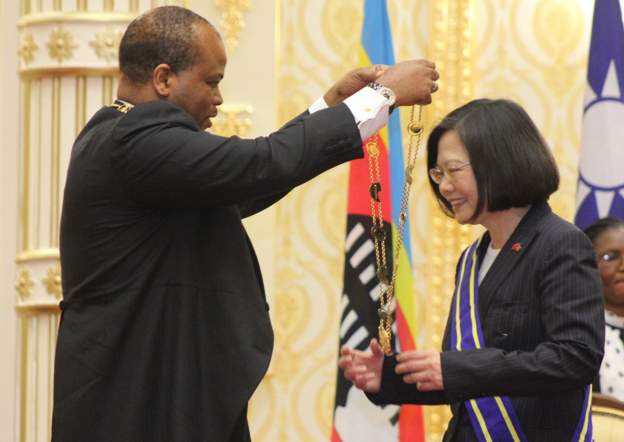
    Taiwan’s President Tsai Ing-wen will visit Eswatini, its only African ally, next month to strengthen their relationship.

    During the visit, she will go to parties to celebrate the country’s independence day and King Mswati III’s birthday.

    She will go on a trip from 5th to 7th September, which is also the 55th anniversary of the countries’ friendship.

    China says that Taiwan belongs to them and should not be allowed to have relationships with other countries as an independent state. It only has official connections with 13 countries, including Eswatini.

    Taiwan’s Deputy Foreign Minister, Roy Lee, said that the Taiwanese president’s visit to South Africa is not meant to rival Chinese President Xi Jinping’s visit to the same country this week.

    Ms Tsai went to Eswatini in 2018. This is the only African country that still talks diplomatically with the Asian island, while Burkina Faso changed to China’s side in May 2018.


  • Akufo-Addo receives ‘Anti-Corruption Crusader’ award in South Africa

    Akufo-Addo receives ‘Anti-Corruption Crusader’ award in South Africa

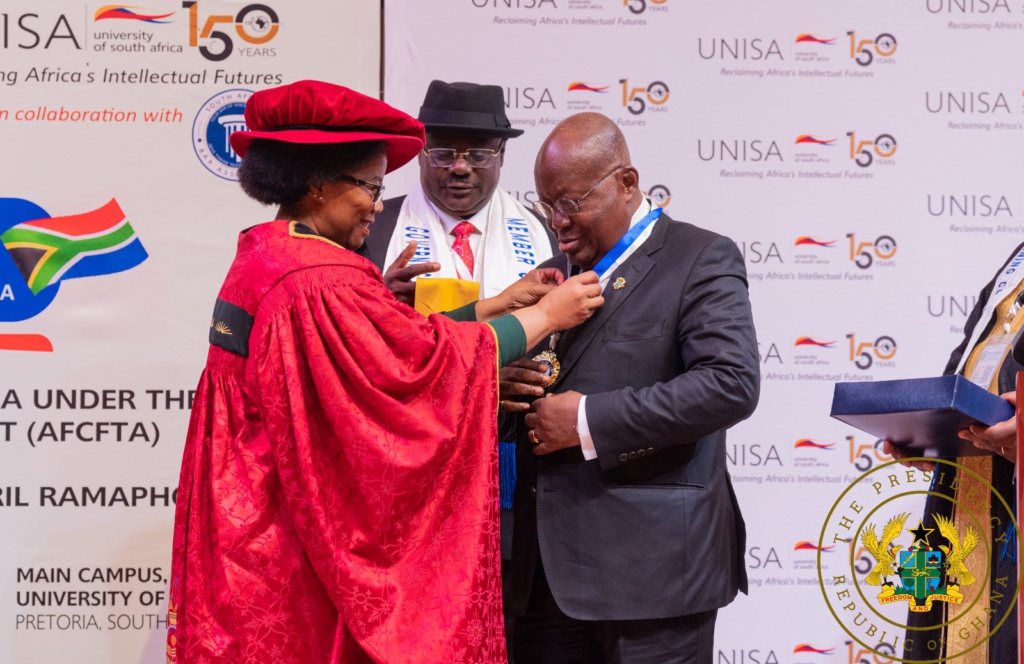
    The Africa Bar Association has bestowed President Akufo-Addo with the Medal of Merit in Leadership Award.

    The President of the Association, Hannibal Egbe Uwaifo, explained that the award recognizes President Akufo-Addo’s pan-Africanist ideals, commitment to combating corruption, outstanding governance, and enduring statesmanship.

    “The Award was conferred on President Akufo-Addo because he is “a pan-Africanist, Anti-Corruption Crusader, a rare democratic leader in the field of good governance, a true African Statesman whose legacies present African leaders must emulate, and we are minded to say will stand the test of time,” Mr Uwaifo added.

    Expressing gratitude for the honor, President Akufo-Addo acknowledged the esteemed status of lawyers in African societies and their pivotal role in liberation struggles.

    “In all our countries, it must be a source of pride for us that lawyers were at the forefront of the fight for liberation from colonialism. Indeed, since independence, lawyers have moved seamlessly between politics and the legal profession,” he stated.

    Speaking at the 2023 Annual Conference of the African Bar Association in Pretoria, South Africa, President Akufo-Addo emphasized the need for Africa to define its narrative, promote intra-African trade, and challenge colonial economic models.

    He underscored the significance of the African Continental Free Trade Area (AfCFTA) as a historic opportunity for fostering intra-African trade, job creation, and economic growth.

    The President highlighted that unity, stability, and democratic governance are vital for realizing the AfCFTA’s potential and achieving transformative industrialization across the continent.

    President Akufo-Addo urged governments and businesses to provide bold leadership in embracing this pivotal moment in Africa’s journey towards prosperity.

  • African startups face funding challenge

    African startups face funding challenge

    An award-winning Ethiopian startup, Kubik, takes pride in its groundbreaking and environmentally friendly technology that transforms plastic waste, a global environmental issue, into construction blocks.

    However, achieving success has been a formidable challenge for the youthful leader of the company, as they have had to persevere and struggle to secure funding.

    The process at Kubik involves collecting bundles of discarded plastic and organizing them into different categories.

    Specifically chosen plastics are then mixed, melted, combined with additives, and molded into the desired shapes.

    The result: black beams and interlocking blocks which today are being assembled in a pilot project — the building of a daycare center in the capital Addis Ababa.

    The site has no cranes or cement mixer, just a concrete floor on which four workers make a wall by fitting the blocks together like Lego, tapping them with a mallet to ensure a good fit. There’s no glue or cement.

    The beams, bolted together on all four sides of the walls, hold the structure up.

    “The idea’s for it to be super simple,” said overseer Hayat Hassen Bedane, a 34-year-old structural engineer.

    “You have a manual, and the whole point is to get it done with inexperienced workers, obviously under supervision.

    “You can build 50 square metres (540 square feet) of a building in just five days, so that’s super-fast compared to other forms of construction,” she said.

    “We’ve done tests, tension-stress tests and compressive tests, so it’s durable and very strong.”

    Speed and the smart use of unwanted plastic aren’t the only benefits.

    The recycling generates just a fifth of the carbon from cement making. If Kubik’s plant processes 45 tonnes of ditched plastic each day, that’s 100,000 tonnes of carbon dioxide (CO2) averted each year, the company says.

    There’s a trickledown socially, too, boosting the country’s many informal waste pickers, many of whom are women.

    Funding challenge
    But Kubik’s CEO, Kidus Asfaw, 36, said he battled to get seed money for his company.

    He received a lot of knock-backs from wary investors, he says, before catching a break.

    He has just completed a round of funding for several million dollars to scale up production — a success that coincided with the prestigious AfricaTech award for the company, which boosted visibility.

    The Ethiopian previously worked for Google, the World Bank and Unicef after studying in the United States.

    “He then took the plunge to become an entrepreneur,” he said.

    “There’s a really large network that I already had within my professional sphere that I could tap into in the beginning,” he told AFP last month in Paris, where he went to pick up the award.

    Even so, “having that did not make it any easier” to raise funds.

    “I’ve met over 600 people in two years. Out of those 600 people, about 20 of them have become investors.”

    Startups in Africa face myriad hurdles, from laws and regulations and lack of infrastructure to a fragmented continental market.

    But funding, in a continent that lacks intrepid individual investors to provide support, is a persistent and major headache.

    “There are very few ‘business angels’ in Africa,” said Sergio Pimenta, Vice President for Africa at the Societe Financiere Internationale (SFI), a private-sector unit of the World Bank that has just launched a $180-million fund to help provide a financing source.

    “Out of $415 billion in risk capital deployed around the world, just over one percent of $5.4 billion goes to Africa,” he said.

    And of this sum, 80 percent goes to just four countries: South Africa, Kenya, Nigeria and Egypt.

  • Let’s use films to decolonise ourselves, stop mental slavery – Actress Akofa Edjeani

    Let’s use films to decolonise ourselves, stop mental slavery – Actress Akofa Edjeani

    Veteran actress, Akofa Edjeani has highlighted the significant impact of film in decolonizing the African mentality.

    According to her, film possesses the power to effectively challenge the persistent influences of slavery and colonialism.

    “…and again, if the colonial masters used film as part of their weapons in colonizing us, I think that the honor is on us to do the same, by using film to decolonize ourselves, the mental slavery is still there… we are not independent, we are still begging for things and so many things.”

    During an interview with the media on July 1, 2023, Akofa Edjeani emphasized the historical use of film by colonial powers to maintain control over their colonies.

    She called upon African governments to prioritize and support their local film industries in response.

    Edjeani expressed her belief that film has the power to bring about significant positive change and create numerous opportunities if it receives the necessary attention and investment.

    She questioned the disparity in financial support between sports and the film industry, highlighting the potential for job creation and revenue generation in the latter.

    According to Edjeani, the film industry possesses immense potential and could surpass the benefits derived from sports.

    “Look at how much money we pump into sports and most times we go and, we don’t really win, …so if we can pump all that money into sports, the bonuses that they get…but the film can even do better so they should pay equal attention to film as well.

    “Sports yes, but how many jobs can it create and how much money is it bringing compared to if you give the necessary push to film, so, there are so many reasons.

    “The job creation and the fact that it is education as well. You know it is that medium that you can use to showcase your heritage… film is that powerful tool to create that identity, we use film to change policies, we use film to change perceptions.

    “Film is a tool that can attract tourists, so when you are talking about tourism, the best tool is to showcase your tourist attraction, and your heritage in film, and that will make people flood to your country just to see those places,” she added.

  • Meet the 5 African millionaires who made fortune through tobacco

    Meet the 5 African millionaires who made fortune through tobacco

    These five African multimillionaires grew incredibly wealthy by promoting smoking, one of the world’s most dangerous and deadly vices. We can’t recommend tobacco dealing as a path to creating wealth, but these folks found extraordinary success in manufacturing and distributing tobacco products.

    Tribert Rujugiro Ayabatwa

    Nationality: Rwandan

    Company: PanAfrican Tobacco Group Holding

    Tribert Rujugiro Ayabatwa founded PanAfrican Tobacco Group Holding in 1978 in Burundi. It is now the largest tobacco manufacturing company owned by an African. It manufactures cigarettes in the Democratic Republic of Congo, South Africa, Angola, Uganda, Tanzania, the United Arab Emirates, Nigeria, and South Sudan. Today, the company records over $250 million in annual revenues and employs more than 7,000 people across Africa. Its brands include Supermatch, Forum, Legends, and Yes.

    Simon Rudland

    Nationality: Zimbabwean

    Company: Gold Leaf Tobacco

    Zimbabwean tobacco tycoon Simon Rudland owns Gold Leaf Tobacco, a multinational manufacturer and distributor of the Rudland & George RG cigarette brand. The company manufactures cigarettes in South Africa for both the South African and export markets. Gold Leaf Tobacco is also a full-service contract manufacturer which produces various blends and variants of cigarettes for its clients.

    Apollinaire Compaore

    Nationality: Burkinabe

    Company: SODICOM

    Apollinaire Compaore is one of the most successful businessmen in Burkina Faso. He heads the Planor Group, which has interests in insurance, retail, and telecommunications. Through one of Planor Group’s subsidiary companies, SODICOM, he is also the representative of the multinational tobacco company Philip Morris International in Burkina Faso and the sole distributor of their products in the West African country.

    Wilfred Murungi

    Nationality: Burkinabe

    Company: Mastermind Tobacco Kenya

    The late Murungi worked as an engineer at British American Tobacco before quitting and setting up Mastermind Tobacco Kenya in the late 1980s. Mastermind is currently the only indigenous tobacco company in Kenya, with its Headquarters in Nairobi. The company is in eight countries in East, Central, and Southern Africa and is involved in growing tobacco, manufacturing, and cigarette marketing. It manufactures 12 brands of cigarettes, with its most popular brand being “Supermatch.”

    Ylias Akbaraly

    Nationality: Madagascan

    Company: Focus Madagascar

    Madagascar’s richest man is the owner of Sipromad Group, the largest conglomerate in the country. Two of its subsidiary companies, Focus Madagascar and Madagascar Tobacco Network, manufacture the Apache and Paname brand of cigarettes, which are both popular in the island country.

  • Akufo-Addo eulogises Buhari over sterling leadership

    Akufo-Addo eulogises Buhari over sterling leadership

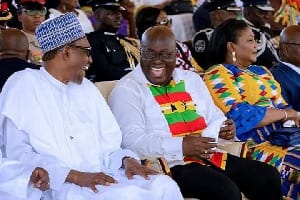
    President Nana Addo Dankwa Akufo-Addo hs eulogized his Nigerian counterpart Muhammadu Buhari who exists office in a little over a week.

    Akufo-Addo was a guest of honour at the May 19, 2023 launch of two biographies by the former military ruler turned elected democratic president of Africa’s most populous nation.

    In comments made at the launch, local media captured Akufo-Addo as saying: “As leaders, we all have our high and low moments, but I have no doubt that posterity will be kind to Muhammadu Buhari,” Akufo-Addo said.

    President Buhari, we will miss you. West Africa, Africa, and indeed, the world will miss your leadership. The leadership of a military ruler turned consummate democrat who was extremely solicitous of Nigeria’s and Africa’s interests and who sought principles in all decisions which he took.

    “I’m yet to have a book written about me, let alone author one myself. I have some 19 months to leave office, and I guess I have to take a cue from my senior and hope the books will give about me.”

    The two books about Buhari

    The books are titled: “State of Repair: How Muhammadu Buhari tried to transform Nigeria for the better” and “The Legacy of Muhammadu Buhari.”

    They were authored by Anthony Goldman, a former journalist and ex-Africa editor of the Financial Times of London; and Abu Ibrahim, former federal lawmaker from his native Katsina State respetively.

  • Five interesting facts about African Jees you need to know

    Five interesting facts about African Jees you need to know

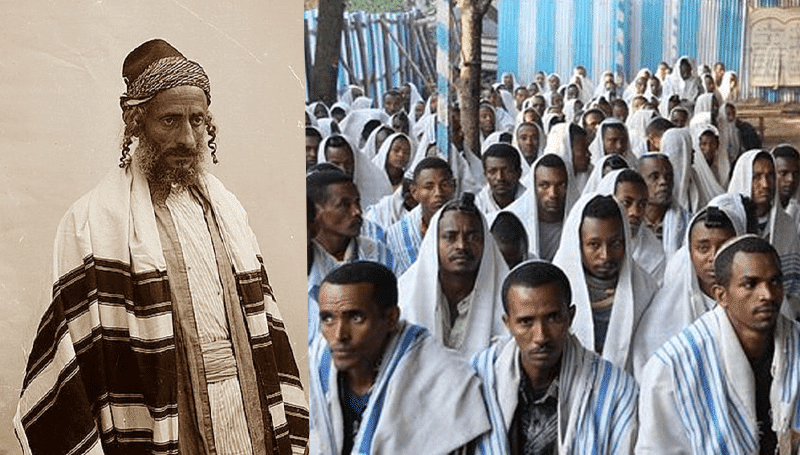
    Jews lived on the Arabian Peninsula, which is located northeast of Africa on the Arabian Plate and contains nations like Kuwait, Qatar, Saudi Arabia, and the United Arab Emirates (UAE), before Christianity and Islam took hold there. Trade allowed Judaism to spread to Africa.

    African Jews, also called the Beta Israel community, believe they are descended from King Solomon and the Queen of Sheba. There are many interesting and little-known facts about them. Here are five interesting facts about this interesting group:

    1. African Jews have a long and complex history.

    Some historians think that the Beta Israel community is made up of the descendants of ancient Israelite tribes who moved to Ethiopia, while others believe they may have become Jewish in the Middle Ages. What is certain is that the Beta Israel have lived in Ethiopia for many centuries and have kept their own culture and religion even though they have been persecuted and treated badly for many years.

    1. African Jews have their own unique traditions and practices.

    Even though they believe and act in many of the same ways as other Jewish groups around the world, the Beta Israel have made their own traditions over the centuries. For example, they use a version of the Jewish calendar that is different from what Jews use, and they have their own language for worship called Ge’ez. They also have a long history of folk music, dance, and stories. These things are important parts of their culture.

    1. African Jews faced significant persecution and discrimination.

    Even though the Beta Israel have lived in Ethiopia for a long time, the Christian and Muslim groups that make up most of the country have often ignored and mistreated them. In the 1970s and 1980s, they were treated very badly by Mengistu Haile Mariam’s communist government. Many of them were moved to cities against their will and were not allowed to go to school or get a job.

    1. African Jews have experienced a mass migration to Israel.

    In the 1980s and 1990s, tens of thousands of Beta Israel moved to Israel. Under the Law of Return, they were given citizenship. But moving to Israel and becoming part of Israeli society was not always easy, and many African Jews had a hard time getting used to life in a new place.

    1. African Jews are making important contributions to Israeli society.

    With many of its members holding significant positions in politics, business, and the arts, the Beta Israel community in Israel is now well-established and flourishing. The history and customs of African Jews have recently attracted increased interest, and groups like the Association for the Research of Ethiopian Jewry and the Center for Jewish Ethiopian Heritage are seeking to protect and advance this unique cultural heritage.

  • African airlines experience expedited comeback as tourism picks up – Report

    African airlines experience expedited comeback as tourism picks up – Report

    An association of African carriers said in a recent report that African air traffic has made a strong recovery and is almost back to pre-pandemic levels.

    As additional international routes and tourist destinations reopened, the African Airlines Association (AFRAA) reported that traffic in March increased by 94.8% over 2019 levels.

    It noted that domestic flights accounted for 37 per cent of the March traffic, with intra-Africa flights at 31 per cent and intercontinental travel at 32 per cent.

    Data also shows that the total number of intercontinental routes operated by African airlines have exceeded pre-Covid levels since October 2022.

    The association said that African airlines are on course to narrow their revenue gap in 2023.

    African airlines lost $3.5 billion in revenue in 2022 and $8.6 billion in 2021.

    The Covid-19 pandemic hit African hard as travel restrictions led to the grounding of aircraft. Some airlines, such as Air Namibia and Air Mauritius completely folded while others such as South African Airways and Kenya’s flag carrier, KQ needed big bailout funding from the state to keep flying.

    Others, like Ethiopian airlines converted their passenger jets into freighters to compensate for reduced passenger traffic.

  • Stepping out of my comfort zone and breaking out of my shell takes me places – Shashl

    Stepping out of my comfort zone and breaking out of my shell takes me places – Shashl

    In 2017, Ashleigh Moyo, nicknamed Shashl, became a household name thanks to the debut song she ever wrote, which also led to her signing with a big record label on the continent.

    Shashl was signed by Universal Music Africa while still a teen for the R&B song No More. She was the organization’s first female musician from Zimbabwe.

    There were advantages and disadvantages to being so young and inexperienced in music when she signed.

    “It put me on the map, which I needed to be. It helped me in a great way – I can now handle a lot of situations that people go through in the music industry,” she says.

    “But I was so young that I didn’t have the freedom to be as creative as I [truly] was. I was still finding myself trying to figure out my sound, trying to figure out who I actually am and what I wanted to do in life.”

    The 23-year-old has since found her sound – a mix of R&B, Afrobeats, a bit of Afro-fusion. And she sings in Shona and in English.

    Being the daughter of a former government minister meant that she grew up in a privileged way. But she wanted her music and her lyrics to appeal to less well-off Zimbabweans – and so she started visiting high-density residential areas so that she could try to relate to the sorts of issues most people endure on a daily basis.

    “Stepping out my comfort zone and breaking out of my shell takes me places – and that’s exactly what I did,” she recalls.

    In 2021, she had a huge hit with Ghetto Buddies, which has had about 1.5 million listens so far, and which she sang in Shona.

    “I feel it’s easier to break into a market when you are being more genuine,” she reflects.

    She won Best Newcomer at the Zimbabwe Music Awards, and was nominated for best female artist in the Southern African region at the African Muzik Magazine Awards the same year.

    “The fact that what I love to do is being appreciated by people. It just fills my heart with so much joy.”

    It also made Shashl realise that her musical talent is special, and she doesn’t need to fit in with everyone else. “For the first time I told myself that you were born to stand out.”

    The name she performs under – Shashl – came about because she has an older sister called Sherris. They look very similar, which meant that relatives would often get them mixed up and end up calling her a combination of Sherris and Ashleigh.

    Shashl plays 10 instruments – including guitar, marimba, mbira, violin and the cello.

    “One day I will give a performance playing all of them – because I feel the world deserves it,” she tells me.

  • Kunle Afolayan’s Movie, “Anikulapo” set to be expanded into series

    Kunle Afolayan’s Movie, “Anikulapo” set to be expanded into series

    Filmmaker Kunle Afolayan has announced that his movie “Anikulapo” will be expanded into a series.

    During a recent forum, Afolayan explained that “Anikulapo” was initially conceived as a series and shared the story of how it came to feature on Netflix.

    “We tested the waters with “Anikulapo” as a film, and it became a success. Then, the conversation started for a week to get it to the original proposition, which is the series. Currently, I am not giving details, but it is happening this year. We will do the first season of the series,” Afolayan told local media.

    Afolayan also spoke about his fascination with exploring African mysteries in some of his movies.

    “The story was informed by my interest in exploring the idea of Orisha and finding a way to merge it with entertainment and visual arts without pitching a particular religion,” he said.

    He added that he aims to create masterpieces that capture the essence of Yoruba culture and the world beyond Nigeria.

  • Meet the first Ghanaian lawyer to have Legon Sarbah Hall dedicated in his honor

    Meet the first Ghanaian lawyer to have Legon Sarbah Hall dedicated in his honor

    John Mensah Sarbah is recognized as being the first African and Ghanaian to achieve the rank of barrister.

    He was born on June 3, 1864, in Anomabo to John Sarbah, a merchant and member of the Legislative Council of Gold Coast, and his mother, Sarah Sarbah.

    Mr Sarbah schooled at the Cape Coast Wesleyan school which he later renamed Mfantsipim School before proceeding to the Queen’s College in Tauriton, Somerset in the United Kingdom.

    He then continued to study law at the Lincoln’s Inn in London and was called to the English bar in 1887.

    He was the first ever Ghanaian and African to have achieved that feat in the Gold Coast.

    In 1901, he was appointed a member of the legislative council like his father and was re-appointed in 1906.

    The Mensah Sarbah Hall; one of the traditional halls at the University of Ghana, was named after John Mensah Sarbah to honour his contribution to education in the country.

    The Mensah Sarbah Hall is close to the Central Cafeteria and the Union House – the office of the Student Representative Council (SRC).

    Members of this Hall are called Vikings.

    The hall consists of a main hall built around a quadrangle and a number of annexes standing to the north and east. The last two south annexes are attached to the Hall.

    John Mensah Sarbah is known for his famous educational quote; “When you educate a man, you educate a single individual, but when you educate a woman, you educate a whole nation”.

    Mensah Sarbah died on November 1910.

    Family Life:

    In 1904, John Mensah Sarbah married Marion Wood from Accra and they had three children.

    Contribution to education:

    John Mensah Sarbah is known for his promotion of secondary education through various initiatives. He founded the Dutton scholarship at Queen’s College Taunton in memory of his younger brother, Joseph Dutton Sarbah who died there in 1892.

    He joined his colleague William Edward Sam to promote Fanti Public Schools Limited and the Fanti National Educational Fund to improve educational facilities in the country and award scholarships.

    He also started a scholarship scheme called Dutton Sarbah Scholarship at Mfantsipim School.

  • African nations need to become better negotiators when dealing with China – Edward Boateng

    African nations need to become better negotiators when dealing with China – Edward Boateng

    In order to achieve the required and maximum benefits, African states should enhance their negotiating skills while working with China, according to SIGA Director General Edward Boateng.

    The former Ambassador to China debunked the claim that the Chinese have ripped off African states and overburdened them with unsustainable debts and said contracts between China and African states are often negotiated so all that is needed is strong negotiation skills from Africa.

    Appearing on Face to Face on Citi TV, the SIGA boss said the presence of the Chinese in Africa and their infrastructural development on the continent is laudable but poor negotiations on the side of African states often demonize the Chinese as rip-offs.

    “What the Chinese have done well in the last twenty years is the development of infrastructure in Africa. Travelling across Africa was difficult, and the Chinese came with the mindset of infrastructural development of Africa and many countries have benefitted.”

    Mr. Boateng noted that “Bui Dam was in the books for a long time and then the Chinese came, and today we have Bui and there are so many examples of these projects dotted across Africa. I think where Africa needs to do better is the negotiations because we are often weak in negotiations and therefore something that may cost $100 to do in China may cost $500 in some African countries.”

    He further called for strict measures to regulate the stay of Chinese in Africa to ensure that they follow and respect local laws to prevent them from taking advantage of the loopholes in our systems.

    “They come from a very regimented society and when they come into our communities that are so relaxed, we allow them to take advantage of us, and so we have to make sure that when they come in, they have to play by our rules.”

  • African Development Fund approves $27m for Savannah Agriculture project

    The African Development Fund’s Board of Directors has approved a grant of $6.12 million to support the improvement of public finance governance in low-income African nations.

    The amount will be used to implement Phase 2 of the Regional Institutional Support Project in Public Finance Governance (RISPFG) by the African Tax
    Administration Forum (ATAF) and the Collaborative Africa Budget Reform Initiative (CABRI).

    The grant, which was formally approved on November 3, 2022, will be split as follows: $3.90 million will go to ATAF to support budget reforms and improve public finance management, and $2.22 million will go to CABRI to support tax administration reforms and domestic resource mobilisation efforts on the continent.

    Director of the Governance and Public Financial Management Coordination Office at the African Development Bank, Abdoulaye Coulibal, stated that the project’s goals included strengthening national systems’ resilience to various shocks, enhancing disaster preparedness, and promoting the shift to low-carbon economies through climate-smart budgeting and fiscal policies.

    “The project will contribute to strengthening the actions of the Public Financial Management Academy, a virtual capacity building platform for African
    countries across the cycle and ecosystem of public financial management created in August 2022 by the Bank,” said Coulibaly

    The African Development Bank approved the first phase of this project in 2016, and both institutions successfully closed the first phase in September 2021 (ATAF and CABRI).

    The overarching goal of the project is to support recipient countries in their efforts to achieve sustainable,inclusive growth and development by enhancing domestic resource mobilization and public financial management.

    More particularly, it aims to strengthen public financial management capabilities. Additionally, to integrate gender and climate change into taxation, and improve African tax systems through the development of technical ability.

    This project will also assist nations in forging a unifying stance and a more powerful voice for the continent on regional and international venues.

    The project will benefit the African Development Fund member nations that are also a part of the two implementing organisations.

    Building capacity will be beneficial for their tax administrations as well as staff members from the finance ministries. The project
    will help the African continent accomplish its development goals and fulfil a number of obligations, including finance for development, Agenda 2063, and the Sustainable Development Goals.

    It will be put into action over the course of three years.

    The African Tax Administration Forum (ATAF) was established in 2009 with the goal of strengthening more effective and efficient tax systems in Africa
    in order to decrease reliance on aid, enhance fiscal management, eradicate poverty, and enhance the standard of living for African inhabitants.

    It is made up of forty (40) African countries. ATAF has for over a decade gained international recognition as an expert institution, technical
    leader, and voice of authority on tax issues.

    Collaborative Africa Budget Reform Initiative (CABRI) on the other hand is an international organisation made up of 17 African nations and was founded in 2009.

    CABRI’s sole aim is to increase civil servants’ ability to carryout changes that guarantee the honest, open, and accountable management of public financial resources.

    For African Ministries of Finance, Budget, and Planning, it acts as a platform for learning and communication.

    It presently collaborates with over 35 nations.


  • Competitive African Rice Platform chair fires back at profiteering claims

    The chairman of the Competitive African Rice Platform, Yaw Adu Opoku, pushed back against concerns that profiteering from some traders and producers is driving food inflation.

    Speaking on the Citi Breakfast Show, Mr. Opoku noted that he was not making excessive profits from his investments in the rice value chain.

    “I invest not less than GH¢6,000 on a ton, from farm gate to the retail levels. My margin is not GH¢200. So check. What is the percentage? So if someone talks about profiteering, I beg to differ.”

    “It is passion, not profiteering. That is what is driving us, not profiteering. We are not making money out of this,” Mr. Opoku added.

    Food inflation is currently at 43.7 percent and traders have been accused of profiteering amid Ghana’s economic crisis.

    Ghana was earlier ranked 1st by the World Bank for having the highest food prices in Sub-Saharan Africa in 2022.

    According to the World Bank’s October 2022, Africa Pulse Report, food prices have gone up by 22 percent since January.

    On some of his costs, he said last year, he was paying GHS 14,000 to transport 100 tons of rice from Tamale to Tema.

    This has gone up to GHS60,000 to transport the same amount of rice from Tamale to Tema.

    At the farm gate, he also said he last week, was paying GHS3,200 for a ton of paddy but this week, he is paying GHS4,800 from the same farm.

    Despite this, Mr. Opoku said his rice has been selling for GHS750 for 50 kg, up from GHS500 last week.

    He believes the current economic situation is bleak and “we are caught in a vice, all of us.”

    “Fuel has jumped up. When the pump price goes down, the transporter will not go down. And the dollar has also gone up so when these two things class, we the ones who deal in them suffer.”


  • Ghanaians say climate change is making life worse, needs urgent action by government and citizens

    Ghanaians say the government and ordinary citizens share responsibility for fighting climate change, the latest Afrobarometer survey shows. While fewer than half of citizens have heard of climate change, a majority of those who are aware of the phenomenon say it is making life in the country worse and requires urgent government action.

    Citizens also call on other key stakeholders – including business and industry, developed countries, and ordinary citizens – to do a lot more to limit climate change.

    Key findings

    ▪In Ghana, 44% of adults say they have heard of climate change (Figure 1).

    ▪ Among Ghanaians who are aware of climate change:

    o Six out of 10 (60%) say it is making life worse, a 12-percentage-point increase since 2020 (Figure 2).

    o More than three-fourths say that ordinary citizens can help curb climate change (77%) and believe that the government needs to take immediate action to limit climate change, even if it causes some job losses or other harm to the economy (87%) (Figure 3).

    o Views are divided as to whether the government (43%) or ordinary citizens (42%) have the primary responsibility for fighting climate change and limiting its impact.

    Far fewer place this responsibility mainly on business and industry (9%), rich or developed countries (3%), and traditional leaders (2%) (Figure 4).

    o But a slim majority (53%) say the government is performing “fairly badly” or “very badly” in handling climate change (Figure 5).

    o Strong majorities say the government (81%), business and industry (74%), developed countries (69%), and citizens (67%) “need to do a lot more” to limit climate change (Figure 6).

    Afrobarometer surveys

    Afrobarometer is a pan-African, non-partisan survey research network that provides reliable data on African experiences and evaluations of democracy, governance, and quality of life.

    Eight survey rounds in up to 39 countries have been completed since 1999. Round 9 surveys (2021/2022) are currently underway. Afrobarometer’s national partners conduct face-to-face interviews in the language of the respondent’s choice.

    The Afrobarometer team in Ghana, led by the Ghana Center for Democratic Development, interviewed a nationally representative sample of 2,369 adult Ghanaians in April 2022. A sample of this size yields country-level results with a margin of error of +/-2 percentage points at a 95% confidence level.

    Previous surveys were conducted in Ghana in 1999, 2002, 2005, 2008, 2012, 2014, 2017, and 2019.

    Chart

  • Woodin launches new ready-to-wear collection for a young and trendy audience

    Woodin’s new ready–to–wear collection is made from exclusive prints from our heritage.

    “Fabric designs for this collection are mainly Bogolan in nature, with the objective of getting our customers to appreciate Bogolan in a modern way and to promote African creativity,” says Georgina Mensah, Head of Marketing at Woodin. “We want the youth to know Woodin can help them forge their individual identity and stand out from the crowd.”

    With trendy patterns and stripes in harmonious mix of colours, styles for this ready-to-wear collection are suitable for casual and smart-casual occasions. Collection available in all Woodin Retail Stores nationwide. Woodin, Le créateur.

    Woodin, Africa’s number 1 retail fashion brand, is a truly African brand that is inspired by African art and culture. As a fast fashion brand, we constantly work to deliver fashion inspiration to our consumers, who reflect confidence whenever they wear our unique designs everywhere they go.  We have over 37 years of fashion design expertise that enables us to play this role of true fashion connoisseurs, helping to define African fashion today.


    Source: thebftonline.com

  • My daughter’s unknown condition has worsened in 10 years – Mother asks for support

    Elizabeth Atiako has been suffering from an undiagnosed condition for the past ten years.

    The mother of Elizabeth, Madam Lydia Adofo, explained her daughter’s condition and pleaded for support in an interview on SVTV Africa with DJ Nyaami.

    Madam Adofo indicated that her daughter’s ailment began while writing her third paper for the West African Senior School Certificate Examination (WASSCE).

    Elizabeth attended Gomoa Ahyiem Senior High School, but she was befallen by an unknown condition while at the examination hall and quickly rushed home.

    “They rushed her to me, and we took her to a hospital in Essikuma, but all they said was malaria. I’ve visited many pastors, and I’ve spent a lot of money on her, but she doesn’t improve. Initially, she would shout suddenly, but it has stopped now. I took her to Ankaful (psychiatric hospital). But whenever drugs were administered, her tongue would pull out while she spun continuously. So I stopped,” she recounted.

    The single mother of five pleaded for financial support for a thorough examination. Madam Lydia indicated that her daughter does not speak and often acts out aggressively when touched.

    “I plead for support to help Lizzy get the help she needs because it is her well-being that I’m looking out for. I’ve sold all I have to cater to her, but the condition is still the same. It’s been ten years since it began, and I don’t know what to do,” she added.

    Source: SVTV Africa


  • UAE ban on Ghana: Disregard the news – Ministry of Foreign Affairs clarifies

    Following earlier news that Ghanaians had been barred from entering the United Arab Emirates (UAE), the Ministry of Foreign Affairs and Regional Integration has issued a statement to refute the claims.

    According to the statement issued by the ministry, it has no such communication in its possession, and as such, the information should be disregarded.

    “The said publication assigned no reason for the ban, but social media sources have alleged that it is aimed at keeping away visitors from African countries who usually overstay their visit visas in the UAE.

    “The Ministry wishes to assure the general public that it has received no such communication from the authorities in the UAE and as such, the story should be disregarded,” it stated.

    The ministry has however indicated that information available to it is that the UAE has reviewed its visa requirements.

    “Meanwhile, information available to the Ministry indicates that the UAE has reviewed the requirements for its tourist and visit visas. The revision of visa regimes and requirements includes the following:

    “The 30-day single entry visas have been put in hold, a 60-day multiple visa entry regime is currently in force, travellers to the UAE should secure a round-trio ticket and a hotel booking prior to the visa application,” it added.

    Read the full statement below:/b>

  • UAE bans nationals of Ghana, 19 other African countries from entering Dubai

    The United Arab Emirates (UAE) has reportedly banned nationals of Ghana and 19 other African countries from entering its capital city, Dubai.

    Even though the reason for the ban was not stated, it was expected to start on Monday, October 24, 2022, according to DW Africa.

    “The United Arab Emirates (UAE) has announced a visa ban on nationalities from 20 African countries seeking to visit Dubai.

    “Countries affected include Ghana, Sierra Leone, Sudan, Cameroon, Nigeria, Liberia, Burundi, Republic of Guinea, Gambia, Togo, Democratic Republic of Congo, Senegal, Benin, Ivory Coast, Congo, Rwanda, Burkina Faso, Guinea Bissau, and Comoros. The ban takes immediate effect,” parts of a Facebook post shared by DW Africa on Monday read.

    This is not the first time Ghana and other African countries have been barred from travelling to Dubai.

    Emirates Airline announced on December 28, 2021, that eight African countries will not be accepted to travel to or through Dubai until further notice due to the spread of the Omicron COVID-19 variant.

    The countries included: Ghana Angola, Guinea, Kenya, Tanzania, Uganda, Cote d’Ivoire and Ethiopia.


  • We have to pray; a dollar will be selling for GH¢50 before Akufo-Addo leaves power – Odike

    The founder and leader of the United Progressive Party (UPP), Akwasi Addai Odike, has urged Ghanaians to seriously start praying for divine intervention with the rapid depreciation of the Ghana Cedi.

    According to him, the current government seems to have no clue as to how to stabilise the cedi against the major currencies, including the US dollar, and without God’s intervention, one might need GH¢50 in order to acquire $1 before 2025.

    He added that the Vice President, Dr. Mahamudu Bawumia, who, as the head of Ghana’s Economic Management Team, is supposed to outline measures to get the country out of the current situation, has suddenly gone quiet.

    “During the time of Atta-Mills, the dollar to cedi rate was relatively better. During the time of Mahama, it depreciated, but now the depreciation is worse.

    “We have to pray because if care is not taken, the dollar will be falling at GH¢50 before Akufo-Addo leaves power.

    “We need someone who will come and tell us that these are the measures we are implementing to stop the cedi from depreciating. Because this can’t continue. Is the vice president still alive,” he said in Twi in a Power FM interview monitored by Ghanaweb.

    Meanwhile, the Ghana cedi is currently the world’s worst-performing currency against the US dollar, Bloomberg reports have indicated.

    The currency has continually depreciated against the dollar in the last couple of months.

    This has been attributed to the situation where “wait-and-see investors continued to squeeze foreign capital to the west African country before its deal with the International Monetary Fund.”

    Bloomberg noted that the cedi lost about 45.1% to the US dollar this year to sell at GH¢11.2625 per dollar.

    This makes the cedi’s depreciation the worst among 148 currencies tracked by Bloomberg, overtaking Sri Lanka’s rupee, whose depreciation has been 44.7%.

  • Ghana is not alone in facing economic challenges – UK High Commissioner

    The UK High Commissioner to Ghana, Harriet Thompson has said Ghana is not alone in facing economic challenges.

    She said in a tweet that there was the need to take the difficult decisions and come together internationally to get through.

    Her tweet comes after the UK’s Minister for Development, Vicky Ford said “Ghana is a great friend of the UK.

    “In my meeting with Hon. Minister Ofori-Atta @MoF_Ghana we discussed the global economic challenges and the support we as the international community can offer Ghana, including a possible new @IMFNews programme.”

    Harriet Thompson tweeted “Ghana is not alone in facing economic challenges. We must be ready to take the difficult decisions & come together internationally to get through. We look forward to welcoming you back to Ghana in your new role@vickyford(& we’re glad to see you love your made-in-Ghana jacket!”

    Ghana is not alone in facing economic challenges. We must be ready to take the difficult decisions & come together internationally to get through 🇬🇭🇬🇧

    We look forward to welcoming you back to 🇬🇭 in your new role @vickyford (& we’re glad to see you ❤️ your made-in-Ghana jacket!). https://t.co/qh9CwLB58p

    — Harriet Thompson (@HCThompson001) October 14, 2022

    Meanwhile, the G7 has asked the World Bank to provide financial support to Ghana and other African countries to enable them deal with the impact of the economic crisis caused by force majeures.

    The decision was taken during a meeting with African Finance Minsters  with the G7 as part of the ongoing World Bank/International Monetary Fund (IMF) Meetings in Washington D.C.

    The G7, an informal grouping of seven of the world’s advanced economies: Canada, France, Germany, Italy, Japan, the United Kingdom, the United States and the European Union.

    Representatives from Ghana, Tunisia, Morocco, Senegal were all at the meeting.

    Speaking in an exclusive interview with TV3, Ghana’s Finance Minister Ken Ofori-Atta described the meeting as historic because this is the first time African Finance Ministers have been invited to for such discussions.

    Mr Ofori-Atta said “It was actually quite a historic meeting because for the first time the G7 has called African Finance Ministers to deliberate on the crisis that they see.

    “The trues that these are exogenous factors that have really, even their own economies put it under serious stress and are therefore, looking for ways in which they can add to the capital needs to make sure that things do not deteriorate. So countries such as Ghana, Senegal, Tunisia, Morocco  were there.”

    He added “The empathy is clear, the need to [introduce] something new and therefore, their interest in encouraging the world Bank to find more resource, tapping into the private sector  so that they will stabilize where things are going.

    “They have reduced growth rate to 2.7 per cent expecting a grim and difficult period, they don’t want to make sure that things deteriorate from liquidly to insolvency to chaos.”

    The meeting brings together central bankers, ministers of finance and development, parliamentarians, private sector executives, representatives from civil society organizations and academics to discuss issues of global concern, including the world economic outlook, poverty eradication, economic development, and aid effectiveness.

    Also featured are seminars, regional briefings, press conferences, and many other events focused on the global economy, international development, and the world’s financial system.

  • African countries divided over UN vote against Russia

    Twenty-six African countries voted in favour of the resolution, rejecting Moscow’s controversial referenda in four Ukrainian regions. Nineteen others abstained.

    Mali, the Central African Republic, Ethiopia, the Republic of Congo, South Africa, Sudan, Uganda, and Zimbabwe were among the African countries that abstained. Eritrea, which had previously voted to reject a UN resolution condemning the Russian invasion of Ukraine, also abstained.

    Three of these countries hosted Russian diplomatic chief, Sergei Lavrov, during his tour of the region in July.

    Burkina Faso, Cameroon, Equatorial Guinea, and Sao Tome were absent from the assembly.

    The General Assembly of the 193 member states had met in an emergency meeting. It adopted the resolution with 143 votes in favour, with five countries against and 35 abstaining, including China, India, Pakistan, and South Africa, despite diplomatic efforts by the United States.

    The five states that voted against were Russia, Belarus, Syria, North Korea, and Nicaragua.

    Earlier this month, Ukrainian Foreign Minister,DmytroKuleba, toured Africa in an effort to counter Russia’s apparent hold on the continent. The goal was to persuade leaders to support Kyiv.

    He was forced to cut his visit short after Moscow intensified its bombing of Ukraine.

  • Strong and robust logistics support fundamental to successful implementation of AfCFTA – Alan Kyerematen

    The Minister of Trade and Industry, Alan Kyerematen, has called on governments of African countries to put in place the needed institutional and logistical support frameworks to ensure that they collectively reap the full benefits from the implementation of the African Continental Free Trade Area agreement.

    Speaking at the launch of the Africa Guided Trade Initiative in Accra, the minister stressed that “at our national levels, we should have institutional structures and a programme of action for boosting intra African trade to enable entrepreneurs to produce to take advantage of the huge market provided by the agreement.

    “We must ensure that we have the logistics support to ensure that we are able to move the goods from one country to another.”

    According to the minister, the launch “symbolizes that AfCFTA is not just on paper but a reality. And we are moving from talk and negotiations to action. It also symbolizes that governments in Africa who have been involved in the negotiations are now giving way to the private sector to make it a reality.”

    The guided trade initiative was launched for seven member countries.

    These seven countries which have signaled their readiness to start trading under AfCFTA were Tanzania, Mauritania, Kenya, Egypt, Cameroon, Rwanda, and Ghana.

    Speaking at the same event, Secretary-General of the AfCFTA Secretariat, Wamkele Mene said at least 96 different products from the seven countries could be freely traded under the rules of AfCFTA.

    Products approved to trade under AfCFTA include horticultural products, pharmaceuticals, rubber, aluminum kitchenware, sugar, steel, and wooden products. These products originating from Africa will enjoy duty-free and quota-free trading among the partnering countries.

    “This is the moment the founding mothers and fathers of the Organization of African Unity have longed (for). We have finally honored and made reality the vision of those who liberated our continent.

    “We are connecting East Africa to West Africa, North Africa to Southern Africa. Trade will be the driver of inclusivity, creating opportunities for young Africans. So we have taken the first journey today, and I hope in 15 years, we will have succeeded in lifting millions and millions of Africans out of poverty,” Mene said.

  • Developing African solutions for youth employability in Ghana, Nigeria, Kenya and South Africa

    In a world transformed by technology African universities have a vital role to play in ensuring that young people develop the skills required to remain relevant and employable in an increasingly automated world and to contribute to progress on the continent.

    Africa’s youth population is rapidly growing and expected to double to over 830 million by 2050.The continent is the youngest on the planet. Of its nearly 420 million youth aged 15-35, one-third are unemployed, another third is vulnerably employed, and only one in six is in wage employment. Failure to invest in and support the continent’s youth will have a profound impact on the global economy, as half of the new entrants into the global workforce over the next decade will come from sub-Saharan Africa.

    The International Monetary Fund (IMF) has warned that neglecting Africa now will result in critical labour shortages globally. There are opportunities for African countries to benefit from the changes the fourth industrial revolution (4IR) is bringing, but without the skill sets in place, the continent will fall behind.

    The new requirement for African universities is to be able to track skills demands and respond quickly to make sure that graduates are ready to add real value to businesses worldwide, and to think entrepreneurially, critically, creatively, and analytically. At present, they are not being adequately prepared to enter employment.

    This has triggered a renewed focus on higher education. Graduates with limited skills require further training to meet modern workplace needs. Universities also need to produce job creators as well as job seekers. They need to cultivate innovation and entrepreneurship as exploratory solutions to youth employability.

    Beyond providing a platform for learning, research and knowledge creation, universities can be catalysts for change and drivers of economic growth by developing young people who can contribute to the growth of new and existing companies. Universities can also encourage and support the creation of new ideas, innovations, and commercialisation. They have a vital role to play in researching the ecosystems that support innovation and entrepreneurship.

    One way to respond to the critical shortage of skills is to encourage the development of collaborative partnerships between universities in Africa and abroad, to adopt global best practices when it comes to content, programmes and processes and strengthening research capacity.

    An example of a successful initiative is the British Council’s Innovation for African Universities (IAU) programme, launched in 2021. The IAU supports the development of skilled youth who are equipped for the new world of work. The objective is to develop young Africans who can start innovative businesses, generate jobs, build wealth and take advantage of growth opportunities.

    The IAU aims to strengthen the capacity of African universities to participate and provide meaningful contributions as key players within the entrepreneurship ecosystem, and to foster a culture of innovation among students.

    Universities can give graduates the knowledge and skills to contribute to the growth of new economic initiatives. They can also encourage and support the creation of new ideas, innovations, and commercialisation.

    The IAU programme facilitates the development of practical skills required to build industries, companies, products and services and is being developed through partnerships between African and UK universities. Together, they are building institutional capacity for engagement in entrepreneurship and innovation ecosystems in South Africa, Kenya, Ghana and Nigeria – where 24 projects have been chosen that will grow universities’ capabilities for developing a culture of entrepreneurship and giving graduates the skills they need to build sustainable industries, companies and services.

    A learning and collaboration platform, the IAU brings together African and UK universities to engage, interact and learn from one another, and develop mutually beneficial partnerships that strengthen higher education systems in both regions. The programme’s objectives are already being actualised and many positive outcomes are being achieved.

    De Montfort University in the UK is working with the Pan African University Life and Earth Sciences Institute and Africa’s largest innovation hub Co-Creation Hub to create ecosystems that re-use and recycle plastic into new products, reducing the need for landfill and creating new businesses. Academics at the three institutions take creative ideas and test them in the real world.

    In Ghana the IAU has brought together Accra Technical University, University of Huddersfield, Achievers Ghana Education, and the University of Bolton to drive social enterprise innovation. The aim is to develop a toolkit for higher education institutions in Ghana to help them embed social enterprise within the curriculum, across the whole university.

    Transforming Climate Innovation Ecosystems through Inclusive Transdisciplinarity (TransCIIT), a project comprising five partners: Jaramogi Oginga Odinga University of Science and Technology (JOOUST), Kenya Climate Innovation Center (KCIC), and African Centre for Technology Studies (ACTS), along with the University of Johannesburg and University of Sussex. The partnership is developing an integrated research ecosystem emphasising the greening of the economy, skills, and building back better (post-COVID) agendas.

    The Carbon Literacy for Youth Employability project includes the Durban University of Technology in South Africa, Sheffield Hallam University in the UK, as well as Innovate Durban, Kisii University in Kenya, and Ladoke Akintola University of Technology in Nigeria.

    With stronger peer-to-peer connections and sharing best practices and knowledge between higher education institutions, the programme aims to enhance students’ employability and support economic development across Kenya and Sub-Saharan Africa now and into the future.

    The university of the Witwatersrand’s Wits Entrepreneurship Clinic (WEC) in Johannesburg was created to address the alarming youth unemployment rate in South Africa. The Clinic is a partnership between the University of the Witwatersrand School of Business, the University of Edinburgh in the UK, the Wits Tshimologong Digital Innovation Precinct, and the African Circular Economy Network (ACEN). The clinic is training graduate and  postgraduate students to become consultants, providing them with a skill set that they can add to their CVs and use as a stronger basis to seek employment. The clinic also helps graduates through the acceleration of businesses started by student entrepreneurs.

    These types of partnerships are fostering institutional capacity for higher education engagement in entrepreneurship and innovation particularly because the solutions are being developed locally in the selected African countries. The overarching objective is to strengthen the capacity of universities and increase their capability to participate and provide meaningful contributions as key players within the much-needed entrepreneurship ecosystem.

    Increased investment in higher education is needed to develop a pipeline of skilled youth on the continent. Private sector companies need to reassess their social investment and sustainability plans and provide greater investments in higher education to help build the talent and skills of young men and women as an engine to power sustainable economic transformation.

    As the IAU prepares for the next cycle of programmes to be launched, we are calling on technology players and universities to come on board as partners and help accelerate the development of graduates who are as work ready as possible.


    DISCLAIMER: Brand Voice is a paid program. Articles appearing in this section have been commercially supported.


    Source: Forbes Africa

  • Sustainability requirements shouldn’t be a ruse to block our cocoa and coffee – Oppong Nkrumah

    Minister for Information, Kojo Oppong-Nkrumah has called on the European Union (EU) to work with African, Caribbean and Pacific (ACP) countries to prevent its proposed ethical and sustainable supply chain rules from becoming a burden for the local cocoa and coffee industry.

    According to Nkrumah, though the new legislation is a way to drive better practices within the cocoa and coffee subsector, more importantly, the EU must work with ACP countries in achieving these sustainability standards else, it risk putting players within the value chain out of business.

    He made the call when he chaired a two-day forum on the future of Ghanaian cocoa and coffee value chains in the face of this new EU legislation at the “Alliances in Ghana: Coffee and Chocolate at the table” in Brussels, Belgium organized by the International Trade Centre (ITC) and the Ghanaian Mission in Brussels last week.

    “At a time where farmlands are coming under threats for competing and more rewarding economic activities, sustainability is a matter that requires some more attention. By no means however should sustainability be used as a pretext to limit market accessibility. Exchange of best practices and technical assistance is necessary so that we can have a win-win situation in all of this,” he said.

    “Farmers deserve a recompense for their hard work and should not be left out in any business or policy negotiation. Their social reality and cultural context must be considered when designing legislation so they may meet their demands and not bear a disproportionate burden for complying with the regulation,” he said.

    EU lawmakers have backed a proposal for a law that will ban the sale of agriculture products linked to the destruction of forests, and human rights violations. The bill was supported by 453 votes, to 57 with 123 abstentions.

    The EU Parliament will now start negotiations on the final text with EU member states.

    Once approved, the law would force companies and producers to give assurances that products are deforestation-free and meets EU’s sustainability standards.

    Businesses will be forced to verify that agricultural goods sold in the EU have not been made on deforested or degraded land anywhere in the world.

    This, Mr. Oppong Nkrumah said could soon make Ghanaian cocoa and coffee unexportable to many international markets within the 27-nation bloc.

    He said Ghana must act quickly to ensure the two industries meet the interests of European markets else millions of households and the economy in general could be significantly affected by this proposed legislation.

    Source:ghanaweb.com

  • Ranking Africa’s most expensive transfers eve

    17. Eric Bailly

    Bailly became Africa‘s most expensive defender when he signed for Manchester United from Villarreal for £30 million.

    It was a significant gamble by arriving Red Devils boss Jose Mourinho, but Bailly quickly adapted to life in the Premier League and looked set to establish himself as the club’s first-choice defender for a decade to come.

    Unfortunately, injuries, managerial upheaval, and a loss of form have limited his impact at Old Trafford in recent campaigns, and he departed on loan for Olympique de Marseille this summer.

    16. Hakim Ziyech

    Chelsea parted with £33 million to sign Ziyech from Ajax, and it’s fair to say they haven’t truly got the best value for their outlay.

    The Moroccan did win the Champions League under Thomas Tuchel, but he’s struggled for form and with injuries.

    15. Kalidou Koulibaly

    Another big money arrival at Chelsea—Koulibaly finally made the move to the Premier League this summer after being long been tipped for a switch to the PL.

    He’s endured a mixed start to life in England, and while the exit of Tuchel is a blow, in time, he should prove to be a smart investment for the Pensioners.

    Chelsea paid Napoli a reported £33 million for the Senegal defender’s services.

    14. Sadio Mane

    Mohamed Salah’s move to Liverpool knocked his new Reds teammate off top spot as Africa’s (then) most expensive player of all time.

    Mane moved to Anfield from Southampton for £35 million, and while his maiden campaign on Merseyside wasn’t trouble-free, he made an excellent impression, and initially at least, threatened to be the catalyst for an unexpected title tilt by the Reds.

    In subsequent campaigns, he grew into a genuine world-class player, and was influential as the Merseysiders clinched the Champions League in 2019.


    13. Achraf Hakimi

    Internazionale reportedly parted with £36.3 million to sign then-21-year-old Hakimi from Real Madrid following the conclusion of his loan spell at Borussia Dortmund.

    The wideman’s stay in Italy was brief—just one season—although he did win the Serie A title under Antonio Conte before moving on to Paris Saint-Germain.

    12. Mohamed Salah

    Liverpool snared the AS Roma forward for an initial £36.9 million with some reports suggesting that the price could rise to £43.9 million considering add-ons.

    Either way, the deal represents an absolute bargain for the Reds.

    Salah thrived under the pressure, smashing records aplenty during his maiden season in Anfield, and becoming the darling of the home fans in the process.

    Salah went on to inspire Liverpool to the Champions League crown in 2019 and the Premier League title in 2020.

    11. Sebastien Haller

    West Ham United parted with £45 million to sign Haller from Eintracht Frankfurt.

    He struggled to adapt to life in the Premier League and subsequently moved on to Borussia Dortmund.

    10. Thomas Partey

    Squeezing into the top 100 most expensive transfers of all time, Arsenal met Atletico Madrid’s €50 million asking price to prise Partey away from La Liga.

    When fit, he’s impressed for the Gunners, but he hasn’t been an overwhelming success, with injuries costing him significant swathes of gametime.

    9. Aaron Wan-Bissaka

    The Anglo-Congolese full-back joined Manchester United from Crystal Palace for £49.5 million.

    He’s excelled in the Premier League with the Eagles, impressing with his sturdy defensive displays, but has fallen down the pecking order at Old Trafford, and represents a major flop.

    8. Naby Keita

    Nabbed by Liverpool from RasenBallsport Leipzig, Keita is yet to truly realise his potential following a £52.75 million move.

    He was one of the key protagonists in Leipzig’s climb up the German football ladder, but took his time adapting to life in the Premier League, before injury affected his progress.

    7. Pierre-Emerick Aubameyang

    Arsenal parted with £56 million to bring Borussia Dortmund’s Aubameyang to North London, despite the Gabon international having been linked with a move to Real Madrid.

    The Central African hitman wasted little time demonstrating his quality under Arsene Wenger, and then Unai Emery.

    Auba went on to share the Premier League’s Golden Boot with Mane and Salah.

    6. Achraf Hakimi

    Making the list for a second time, Hakimi’s one-year stay at Inter ended when he moved to PSG for an initial fee of £51.3 million, rising to £60 million.

    The Wideman has already enjoyed success in France—winning the Ligue 1 title to add to his extensive medal haul—but the major aim at the Parc des Princes is surely getting his hand on the European Cup.

    5. Riyad Mahrez

    Manchester City parted with a club-record £60 million to sign Mahrez, finally ending the Algeria international’s extended wait to exit Leicester City.

    He may have been a Premier League winner with the Foxes in 2016, during that most remarkable of campaigns, but Mahrez hasn’t always held down a starting berth at City.

    4. Cedric Bakambu

    Beijing Guoan parted with an eye-watering £65 million to take Bakambu to China after the striker had netted 15 goals for Villarreal during the 2017-18 season.

    He hit the ground running in the Far East, with eight goals in his first eight games, and also caught the eye with a series of fine showings during the 2019 Africa Cup of Nations.

    The Democratic Republic of Congo hitman previously represented Sochaux and Bursaspor.

    3. Victor Osimhen

    Coming in at €80 million plus add-ons, Osimhen’s move from LOSC Lille to Napoli was primed to propel the striker to become Africa’s top striker.

    He’s finally settled into life as the Partenopei’s leading man, scoring 24 goals across his first two seasons at the club, prompting rumours of a move to Manchester United.

    2. Nicolas Pepe

    Pepe became Africa’s most expensive player when Arsenal parted with £72 million to bring the winger to the Emirates Stadium from LOSC Lille.

    He penned a five-year contract with the Gunners after scoring 22 goals and contributing 11 assists in Ligue 1, prompting Unai Emery to turn to him ahead of Wilfried Zaha.

    Arsenal fans were desperate for Pepe to emulate Eden Hazard, LOSC’s finest import to the Premier League, rather than his compatriot Gervinho, but the wideman never hit the heights in London.

    1. Wesley Fofana

    Still eligible for the Ivory Coast, Fofana swapped LeicesterCity for Chelsea during the recent transfer window after forcing through his exit from the King Power Stadium.

    The 21-year-old moved to Stamford Bridge for a fee of €80.4 million, making him the big spenders’ second biggest transfer of all time, although his arrival couldn’t save Thomas Tuchel from being dismissed.


  • We’re ready to do business with other African football federations – Procal Links CEO

    The Chief Executive Officer of Procal Links Ghana Limited, the official match ball partner of the Ghana Football Association (GFA) Alhaji Alhassan Mutala has hinted that his outfit is capable and ready to supply match balls to other African football leagues.

    Alhassan Mutalatold Power and TV XYZ Sports that his companywhich has been the sole supplier of balls to both Ghana Premier League and Division One for the past three seasons, took delivery of a forty-fetter container of tempo balls just to fulfill a contractual obligation with the Ghana Football Association as the new football season is about to start.

    Procol Links first introduced Macron match balls in their business relationship with Ghana Football Association before coming up with the famous and match talked about TEMPO which later gained strikes and became coaches’ favorite in the Ghanaian Premier League.

    Mr Mutala also disclosed the mechanism, the behavior, and the tempo of Macron and Tempo balls are specially designed for the African weather condition and the facilities available for our game, so he is calling on all African Football Federations to honor their football leagues with match balls design for Africa performance for football fans to enjoy.


    Source: Ghanaweb

  • Letter from Africa: How African generosity dried a crying teacher’s tears

    In our series of letters from African journalists, Kenyan Joseph Warungu looks at the acts of generosity helping ordinary people through desperately trying times.

    When Covid-19 hit Africa, the effects were devastating – but some people have been crushed more than others, by the illness but also by the measures to deal with it.

    Private-school teachers, who make up a significant amount of the education workforce, have been particularly hard hit by school closures as they have no safety net and in most cases no firm return date either.

    Many have turned to farming, cleaning and street hawking in the meantime.

    ‘Don’t cry, it’s ok’
    The strain has become unbearable, moving many to tears – among them Akindele Oluwasheun Oladipupo in Nigeria’s capital, Abuja.

    He and other teachers were full of hope in July when the Nigerian government said it would allow schools to reopen for exams. But when that decision was reversed, the pain was too much.

    Akindele, who is married with three children under eight years, told me in a telephone interview that he just sat in shock digesting the news, before tears ran down his face.

    “My wife said to me, ‘Don’t cry, it’s ok, we’ll manage, somehow.’ But I was thinking of the many teachers who have nothing to feed their families. In many cases, both wife and husband are teachers. That’s the entire family income gone – indefinitely.”

    Unable to bear his own and other teachers’ burdens, he turned to his mobile phone and poured out his sorrow.

    A friend saw the video recording and urged him to post it online. It went viral, earning him the nickname of “the crying teacher”.

    Akindele says he filmed it in the hope of encouraging people to help other private-school teachers in need.

    Nigerian journalist Lara Wise launched a Facebook campaign to find Akindele and urged him to post a second clip with his account details. Donations poured in from around the world.

    Overwhelmed by the generosity, Akindele decided to re-direct the more than 1.2m naira ($3,100; £2,400) to dozens of needy teachers.

    “I said to myself – now that God has tested me and has opened a way for the money to come in, if I should sit on that money, it means I’m sitting on the destiny of my children.

    “That’s how we started looking for teachers who were struggling. We reached out to more than 200 teachers and gave them enough foodstuff including rice, spaghetti. We also put some money in envelopes and gave it them.”

    It is only when Akindele started to distribute relief packages that he realised the scale of the problem. Many teachers from different parts of Nigeria sought help from him.

    “It was really difficult seeing elderly teachers who had given many years of service to the profession pleading for food.”

    Facebook was full of comments lauding the crying teacher while also castigating the government for ignoring the plight of private-school teachers.

    ‘God bless Akindele’
    One Nigerian said: “Shame on the politicians who eat this country dry. If a man who receives grace from God can do all this, all those men in agbadas (flowing robes) and those women hiding under [social media] filters, should bury their faces in shame.”

    “God bless Akindele immensely,” wrote another. “May God remember and help many who are ashamed to cry out publicly… who are dying in silence.”

    Apart from the selfless acts of frontline workers, especially health professionals who are saving lives during the pandemic, many people across the continent are coping through the generosity of ordinary Africans.

    As he waits to see if the new school reopening date of late August will materialise, Akindele tells me this spirit of ubuntu – a common humanity and shared responsibility – shocked him.

    “Africans are great people. That’s what I’ve seen in these past three weeks,” he says.

    “People I’ve never met in my life – they don’t know me, they don’t know where I come from, they don’t know if I’m a scammer or fraudster – but they have been sending money to my account. I’m very grateful to them all.”

    ‘My suffering sparked empathy’
    In Kenya, Michael Munene has also been praised for his spirit of giving during the pandemic.

    Brought up in a poor family that could hardly afford one meal a day, he knows how hunger and poverty feels. When he started out in life working odd jobs he kept falling behind on rent.

    He told me of the incident that unexpectedly sparked ubuntu in him.

    “Early one morning my landlord waited for me to use the bathroom, which was outside the house, and quickly locked me out of his house because of rent arrears.

    “Stuck outside with no clothes and no money, I swore to himself I would never let anyone else suffer such humiliation.”

    Today Michael is a landlord renting to nearly 30 tenants. When their incomes shrank he gave them a payment holiday on their rent, which they have not had to pay since May.

    “It’s tough for my business but I can’t bear the sight of homelessness. I’ve told my tenants that for now they should just focus on finding food for their families.”

    In Ghana’s capital, Accra, when the lockdown was announced, Elizabeth Yawson’s thoughts turned to the vulnerable living on the streets.

    When the radio journalist launched an online campaign to help homeless people, the response was enthusiastic.

    “People responded generously and we were able to feed about 100 people for one week.

    “I later got the support of two restaurants and we reached out to 30 health workers at a hospital in Kasoa, in the central region of Ghana, giving them free lunch for a whole week.”

    What Akindele, Michael and Elizabeth have shown is that although the cock belongs to one household, when it crows it is heard in the whole village.

    News of their deeds and others like them have stirred many souls across the continent.

    Source: bbc.com

  • African nations seek UN inquiry into US racism, ‘police brutality’

    African countries are lobbying to set up a U.N. inquiry into “systemic racism” and “police brutality” in the United States and elsewhere, aiming to defend the rights of people of African descent, a draft resolution seen by Reuters shows.

    The text, circulating among diplomats in Geneva, voiced alarm at “recent incidents of police brutality against peaceful demonstrators defending the rights of Africans and of people of African descent”. It is due to be considered at an urgent debate of the U.N. Human Rights Council on Wednesday.

    The 47-member Council agreed on Tuesday to convene at the request of Burkina Faso on behalf of African countries after the death last month of George Floyd, an African American, in police custody in Minneapolis. His death has ignited protests worldwide.

    The United States, which quit the Council two years ago alleging bias against its ally Israel, has not commented on being put in the dock.

    The text, subject to change after negotiation at the Council, calls for setting up “an independent international commission of inquiry … to establish facts and circumstances related to the systemic racism, alleged violations of international human rights law and abuses against Africans and of people of African descent in the United States of America and other parts of the world”.

    The panel should examine federal, state and local government responses to peaceful protests “including the alleged use of excessive force against protesters, bystanders and journalists”.

    The resolution calls on the United States and other countries to cooperate fully with the inquiry, which would report back in a year.

    The Council already has commissions of inquiry or fact-finding missions into human rights violations in hotspots including Syria, Burundi, Myanmar, South Sudan, Venezuela and Yemen.

    Source: reuters.com

  • UN must do more to remove ‘stain of racism’ – Officials

    More than 20 senior United Nations officials from different African countries have spoken about their outrage at systemic racism and police brutality in the United States and across the world.

    The authors of a letter, including the head of the World Health Organization Dr Tedros Adhanom Ghebreyesus and the head of UNAids Winnie Byanyima, say the organisation must do more to remove what they called the “stain of racism on humanity”.

    Writing in a personal capacity they say racism exists within the UN and the organisation needs an honest assessment of itself if it is to lead the wider fight for equality.

    Source: bbc.com

  • Former African presidents condemn Floyd killing

    Former African presidents have condemned the killing of George Floyd as violent protests continue in the US following his death in police custody.

    The Forum of Former Heads of State and Government has urged African countries to “raise a strong protest” to the killing and demand that the “perpetrators of this crime and all other crimes of this sort be punished in the strongest terms”, according to a statement released by former Beninese President Nicéphore Soglo.

    “What level of cruelty must you reach that the entire world finally wakes up and manifests its indignation. Who would dare here, their face visible, to treat in such a way a European, an Arab, an Israeli, an Indian, a Chinese, a Japanese, an Argentinian, etc. Enough is enough,” he said.

    Ghanaian President Nana Addo Dankwa Akufo-Addo has said in a tweet that black people were “shocked and destroyed”.

    “We stand with our kith and kin in America in these difficult and trying times, and we hope that the unfortunate ,tragic death of George Floyd will inspire a lasting change in how America confronts head on the problems of hate and racism.”

    South Africa’s governing party, the African National Congress (ANC), has urged President Cyril Ramaphosa to engage with the US” to defuse racial tensions and build social cohesion among different races”.

    Source: bbc.com

  • Mory Kanté: African music star dies aged 70

    The singer Mory Kanté, who helped bring African music to world audiences with hits like Yéké Yéké, has died in Guinea.

    Kanté died in hospital on Friday in the capital, Conakry, aged 70, his son Balla Kanté told the AFP news agency.

    His death was the result of untreated health problems, Balla Kanté said.

    “He suffered from chronic illnesses and often travelled to France for treatment but that was no longer possible with the coronavirus,” he said.

    “We saw his condition deteriorate rapidly, but I was still surprised because he’d been through much worse times before.”

    Source: bbc.com

  • EU blacklists four African states over money-laundering

    The European Union has added 12 countries to its money-laundering blacklist, putting their financial transactions under greater scrutiny.

    They include Botswana, Ghana, Mauritius and Zimbabwe.

    Others are Bahamas, Barbados, Jamaica, Nicaragua, Panama, Cambodia, Mongolia and Myanmar.

    Once approved by the European parliament the list will come into force in October.

    The commission Vice-President Valdis Dombrovskis said the EU needed to put an end to dirty money infiltrating its financial system.

    Of the 22 blacklisted countries, only North Korea has refused to commit to trying to tackle the problem.

    Source: bbc.com

  • Ghana is Africa’s second exporter of footballers to foreign leagues – CIES Report

    Ghana is the second African country with the highest number of players in foreign leagues and 15th in the world for the year 2019.

    This is according to the latest edition of the CIES Football Observatory Weekly Post.

    A total of 311 players were exported to clubs abroad with 67.8% active in top division leagues.

    This is more than the 286 recorded for the year 2018.

    Nigeria tops the list in Africa after transferring 399 players abroad with 73.2% of them playing in the top division.

    In third place is Senegal who have 230 players abroad with a percentage of 59.6% in the top flight.

    Despite having 71.6 % of players in top division, Côte d’Ivoire sold 204 players to foreign clubs.

    Brazil is at the top of the table (1,600 players, of which 74.6% active in top division leagues) ahead of France (1,027, 74.0%) and Argentina (972, 75.5%).

    In total, 186 national associations had at least one player expatriated in the 141 leagues from 93 countries included in the sample.

    Source: GHANAsoccernet.com

  • Martins, Gyan and the greatest Africans to play in China

    Something of an unlikely winner for the BBC African Player of the Year award in 2012, Katongo won over the public with his inspirational showings for Zambia as the Chipolopolo pulled off an astonishing, emotional victory at the Cup of Nations.

    The attacker, who has had something of a nomadic career, spent two years at Henan Construction before moving to PSL side Golden Arrows.

    #9 Obafemi Martins

    One of the most successful African imports to the Chinese Super League, Martins arrived in Chinese football four years ago when he signed for Shanghai Shenhua following a spell with Seattle Sounders.

    The Nigeria international previously starred in the Premier League and in Serie A, and was a Chinese Cup winner in 2017 – one of two occasions in which he top scored in the competition.

    #8 Aiyegbeni Yakubu

    Ageless Yakubu may best be remembered for one unbelievable miss at the 2010 World Cup against South Korea, but it would be an incredible disservice to a prolific career if that were to be his lasting legacy!

    A two-time Israeli Premier League winner with Maccabi Haifa, and a Europa League runner-up with Middlesbrough, the Yak bagged 24 goals in 43 league games for Guangzhou R&F.

    We expect Chinese defences were relieved when he moved on in 2013 after two seasons.

    #7 Gervinho

    On his day, one of the most electric attacking talents in Europe, the Cup of Nations winner was offloaded to Hebei China Fortune soon after Luciano Spalletti took the reins at AS Roma, despite having recovered his top form in Serie A.

    The wideman was a Ligue 1 champion with LOSC Lille, but lost his way at Arsenal before rediscovering his momentum in Italy.

    After a sojourn in China, he’s now back in Serie A with Parma, where his quality has shone through during a tumultuous campaign.

    #6 Mohamed Sissoko

    The Mali midfielder was unfortunate to have just missed out on playing for a few excellent sides, although he did join Valencia in time to win the Liga BBVA title in 2004, even if he missed Los Che’s Champions League (near) glories.

    He won the Europa League and the Uefa Super Cup with the Spanish heavyweights, and moved onto Liverpool, Juventus and Paris Saint-Germain.

    He had a brief spell with Shanghai Shenhua, and recently hung up his boots.

    #5 Frederic Kanoute

    The sublime goalscorer was the first-ever non-African-born player to win the African Footballer of the Year award, and while he could never guide Mali to the Cup of Nations title, he shone with Sevilla—winning the Europa League in 2006 and 2007.

    He spent the final year of his active career with Beijing Guoan.

    #4 Asamoah Gyan

    The Ghana striker was criticised when he swapped Premier League action for a move to United Arab Emirates side Al-Ain, and later China, with some questioning whether the forward would regret his decision to abdicate from the central narratives of the world game.

    Gyan’s form for the Black Stars demonstrates that his class remains undiminished, and the attacker was one of the world’s best paid players during his time with Shanghai SIPG, when he commanded a £227k-per-week contract.

    #3 Seydou Keita

    Keita was a key member—if not always a starter—in Pep Guardiola’s magnificent Barcelona side, winning three La Liga titles, two Copa del Reys and two Champions League titles in Catalonia.

    He also enjoyed spells with Valencia, Sevilla and AS Roma, and arguably moved to China too early when he swapped the Nou Camp for Dalian Aerbin in 2012, in the immediate aftermath of a Copa del Rey triumph.

    #2 Didier Drogba

    Drogba is one of Chelsea’s all-time greats, and was influential as the Pensioners won the Champions League in 2012.

    He may have missed out on winning the Cup of Nations title with the Ivory Coast, but Drogba can boast of a trophy haul that few of the continent’s stars can match.

    He spent eight months in China with Shanghai Shenhua before continuing his late-career tour of world football by moving to Montreal Impact.

    #1 Yaya Toure

    In his prime, Toure was one of the world’s finest players, and after coming to the end of the road of a trophy-laden spell at Manchester City, he departed for Olympiakos in 2018.

    Two league appearances later, his return to the Greek giants was over, and he moved on to China, and currently employers Qingdao Huanghai.

    Yaya won three Premier League titles at City, but perhaps his most important contribution to the Citizens’ rise were the winning goals he scored in the semi-final and final of the 2011 FA Cup as the Manchester heavyweights ended their half-century wait for silverware.

    Source: Goal.com


  • Crisis at Botswana’s Ministry of Water Resources

    Ministry of Lands Management, Sanitation and Water Resources top management and Public Procurement and Asset Disposal Board’s (PPADB) failure to listen to the advice from their Project Management Officers (PMOs) has come back to haunt them and has thrown the whole government into financial mess.

    The two entities found themselves in the multibillion tenders which they withdrawn from China Jiangsu International after the advice of the Directorate of Intelligence Services (DIS) that the company is involved in massive corruption and are a threat to national security.

    Last week High Court confirmed the fears of PMO when delivering judgment stating that the withdrawal of an award for the award of the tender for the Design, Supply and Build of Water Distribution Network, Sanitation, Reticulation, Telemetry and SCADA and other associated Works in Maun was illegal.

    Delivering judgment, Acting Judge Rahim Khan ordered that MLWS to issue a letter of notification of award to China Jiangsu International for the Maun Project immediately and forthwith.

    This judgment came after MLWS advised PPADB to withdraw the awarding of the tender to the Chinese State company because DIS has indicated that they are involved in massive corruption and are threat to national security.

    The withdrawal of the P1.5 billion tender didn’t sit well with the Chinese company who applied for an expedited appeal at the Court of Appeal whilst waiting for the review of the decision which was before Justice Khan. The Court of Appeal Justice Isaac Lesetedi dismissed the application with costs.

    Immediately after the Court of Appeal, senior leadership at MLWS ordered the speedily re-awarding of the P1.5 billion Maun Water Reticulation project to the second bidder Zhengtai Group Botswana.

    The PMOs then advised the ministry senior leadership that the matter is still before the court and insisted that they should first wait for the judgment on the review.

    This was prompted by the statement made by Justice Dube and Khan that PPADB cannot rely on the mere correspondence from DIS in withdrawing the tender.

    Dube stated that the information from DIS advising the procuring entities not to conduct business with China Jiangsu International could not be admissible in court because it was introduced outside the procurement process.

    Justice Khan echoed the same statement when throwing confusion at the government enclave regarding the Maun Water project tender.

    “The note by DISS which makes certain allegations without being substantiated is unacceptable as criteria to be considered in the evaluation process,” stated Justice Khan.

    He said that PPADB has statutory obligations in terms of its mandate to fulfill and that it cannot transfer those responsibilities to a third party as this is not permissible in terms of the legislation.

    “Its reliance on the note by DISS is entirely misplaced and therefore the contents of the note by DISS must be ignored as a basis for the rejection by the 1st respondent (PPADB) of the tender,” he stated.

    Another concern for the PMOs is that the difference between the first bidder China Jiangsu and Zhengtai Group is P300 million, which they argue, doesn’t make economic sense for the ministry and government.

    China Jiangsu International had won the tender to the value of P1.5 billion with Zhengtai Group coming second with a quote of P1.8 billion.

    On the 21st December DIS Director General Peter Magosi wrote a letter to PPADB advising them to terminate all the tenders awarded to China Jiangsu International as their investigations have shown that the company is involved in massive corruption and threat to national security.

    In February 2019 PPADB withdrew all the tenders awarded to China Jiangsu.

    MLWS through Water Utilities Corporation (WUC) will soon find themselves in another predicament regarding the over P800 million tender for the design supply, installation and commissioning of the Mmamashia Water Treatment Plant-Tender No. WUC 015(2018). The tender was won by China Jiangsu International but DIS instructed WUC to withdraw the awarding of the tender to the state owned Chinese company. Lobatse High Court Judge Justice Tebogo Tau instructed that an International arbitrator be appointed to mediate on the matter.

    Justice Khan smells rat

    In delivering judgment on the Maun Water Reticulation project, Justice Khan hinted that the conduct of the respondents appeared to be employing tactics which will allow the case to drag on indefinitely whilst at the same time the contract is being implemented.

    Immediately after China Jiangsu lost the appeal at the court of Appeal, MLWS is said to have instructed PPADB to sign contract with Zhengtai Group. The company was immediately given P180 million by MLWs as advance payment.

    “That there has been substantial progress in the implementation of the contract so that this court should not reverse the progress made in implementation and that on a balance of convenience it would be preferable for the contract to continue rather than impede its implementation,” observed Justice Khan.

    He said that it is clear that the implementation of the project whilst the matter is still before the courts was to try to ensure that the project even if the matter is appealed; a period of time will elapse and benefit MLWS.

    “So as implementation would have occurred and the courts are reluctant to impede a contract where substantial progress has been made and it would not be expeditious to prevent their progress in a contract,” he said.

    Source: allafrica.com