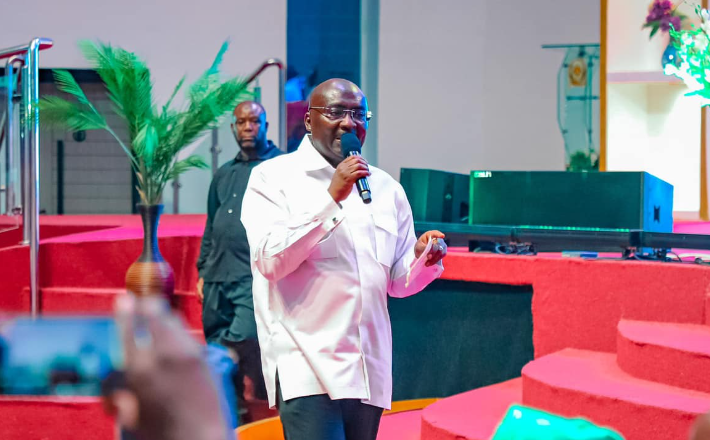
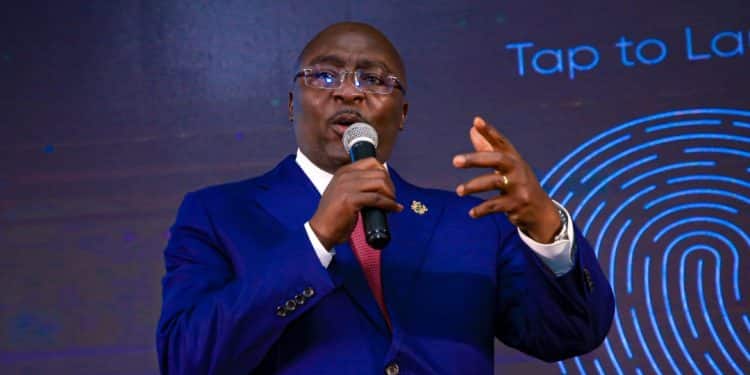
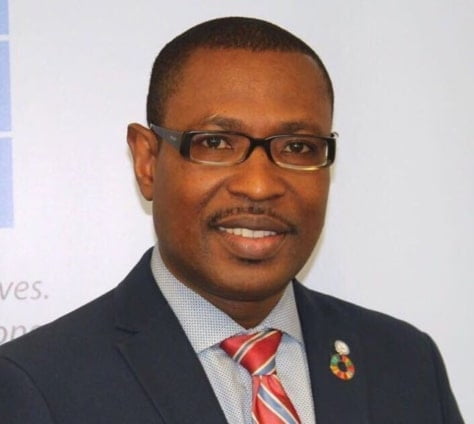
Former Vice President of Ghana, Dr. Mahamudu Bawumia, has called on African leaders to prioritize respecting the will of their citizens through transparent and fair elections as a critical measure to safeguard democracy on the continent.
Speaking on Monday, January 27, during a forum on democracy, governance, and political integrity in Nigeria, Dr. Bawumia raised concerns about the weakening state of democratic institutions and political stability in Africa. He cited alarming trends of political instability, constitutional manipulation, and a surge in military coups that have disrupted governance in several nations.
“Between 2020 and 2023, there were approximately eight coup d’états in Africa,” he revealed, adding that these incidents reflect a deepening crisis of governance in the region. He further lamented the actions of some leaders who amend constitutions to extend their time in office, warning that such practices jeopardize the democratic order.
“A few leaders have also changed or are changing their constitutions to allow them to stay in power beyond their constitutionally mandated terms,” Dr. Bawumia noted, emphasizing that these actions erode trust in governance and threaten political stability.
Highlighting the centrality of elections in a functioning democracy, Dr. Bawumia stressed the need for leaders, especially incumbents, to embrace the outcomes of electoral processes. “Leaders (especially incumbents) must trust the electoral process and accept the will of the people for the survival of democracy,” he urged.
While acknowledging the challenges inherent in democratic governance, he maintained that democracy remains the most effective system for ensuring political stability and advancing the welfare of citizens. He noted that adherence to the rule of law, respect for the electorate’s voice, and accountability are essential for democracy to thrive.
“Democracy is not without its challenges, but it remains the best system of governance when leaders respect the rule of law and the voice of the people,” he asserted.
Dr. Bawumia also extended his message to the international community, advocating for a united effort to combat rising authoritarianism and protect democratic principles globally. According to him, a commitment to fairness, transparency, and integrity in governance is vital for sustaining democratic institutions and fostering peace and development.
President Akufo-Addo has urged African leaders to act swiftly to halt the illicit financial outflows from the continent.
He emphasized the need for serious attention to this issue, which is robbing Africa of crucial resources that could drive its development.
The President made this appeal during the opening of the Sixth African Union (AU) Mid-Year Coordination meeting in Accra on Sunday.
The meeting’s objective is to harmonize the AU’s policies with those of the Regional Economic Communities (RECs) and Regional Mechanisms (RMs) to advance the Union’s integration agenda and discuss critical issues related to interregional trade and operations.
The meeting is on the theme “Educate an African Fit for the 21st Century: Building Resilient Education Systems for Increased Access to Inclusive and Lifelong Quality and Relevant Learning in Africa.”
A host of African Heads of State and Governments, the heads of the regional economic communities, the heads of the regional mechanisms, and members of the AU commission, along with continental stakeholders, participated in the meeting.
Addressing the gathering, President Akufo-Addo emphasized the urgent need to implement the recommendations of the Mbeki Commission on illicit financial flows from Africa, which, since 2011, has highlighted the alarming rate at which resources are being illegally siphoned out of the continent.
He stressed that decisive action must be taken to stop this outflow and retain these crucial resources for Africa’s development.
“Despite the recommendations and the call to action, we have struggled to curb effectively these flows. The persistence of illicit financial flows undermines our ability to finance development projects, weakens governance structures and perpetuates inequality.
“It is imperative that we intensify our efforts to implement the Commission’s recommendations, strengthen our legal or regulatory frameworks and enhance international cooperation to combat these illicit activities.
“By reclaiming these lost resources, we can boost our development financing and ensure that the wealth generated within Africa remains in Africa to benefit our people,” he stated.
Furthermore, the President emphasized the need for the AU to consider the proposal for African countries to deposit 30 percent of their reserves in foreign multinational banks.
He suggested that instead of allowing these resources to remain idle in international banks, often with negative interest rates, placing them in African multinational banks would enhance the continent’s self-reliance and strengthen the capacity of its financial institutions.
“By retaining a sizable portion of our reserves within the continent, we can enhance the stability and liquidity of our financial systems, providing a stronger foundation for economic growth,” he said.
President Akufo-Addo expressed optimism that this approach would enable African banks to back large-scale development projects and foster a more resilient financial ecosystem, reducing reliance on external financial institutions.
“I am hopeful that the EU Commission will complete its evaluation of the proposal soon so that action can be taken on it as quickly as possible,” he said.
AU Chairperson Mr. Mohamed Ould Ghazouani stated that the Union is targeting to raise approximately $100 billion. He emphasized that effective coordination between the AU and regional blocs is crucial for advancing continental integration and achieving the goals of Agenda 2063, which focuses on inclusive and sustainable socio-economic development over the next 50 years.
Mr Ghazouani highlighted that a robust economic integration among African nations would strengthen the AU’s influence at key global institutions, including the United Nations General Assembly, the International Monetary Fund, G20 nations, and the World Bank.
He also noted that the African Continental Free Trade Area (AfCFTA) provides an excellent framework for enhancing bilateral trade and fostering economic integration across the continent.
Minister for Lands and Natural Resources, Samuel Abu Jinapor has urged African countries to make investment opportunities attractive for investors while insisting on the importance of value addition for the growth of their country’s mineral infrastructure.
He stressed the need to move away from the “dig and ship” approach and highlighted two essential pillars to help achieve that: first, insisting on value addition, and local participation; and second, ensuring that states and governments provide the necessary infrastructure and environment, including cadastre and other facilitated systems, for investors to operate, optimize, and maximize benefits shared equitably.
The Minister emphasized, “You cannot achieve value addition or participate at the highest end of the value chain if the government doesn’t establish a proper, investor-friendly environment. It’s crucial, and governments must prioritize this.”
The Minister was contributing to a Ministerial Symposium panel discussion on the topic; “Pushing Africa into a new investment era with solutions to the continent’s greatest challenges” at the ongoing “African Mining Indaba” conference in Cape Town, South Africa, on Sunday, 4th February, 2024.
He added that fundamental elements, such as a solid and consistent rail system, reliable infrastructure, and power systems, must be in place to attract private entities effectively.
Using Ghana as a case study, Samuel Abu Jinapor explained the importance of having a policy framework where both the state and investors play their roles effectively.
Taking the example of bauxite, he mentioned Ghana’s efforts to build an integrated aluminum industry with a policy framework supervised by President Akufo-Addo.
The goal is to exploit and manage resources efficiently while striking a balance between value addition, indigenous participation, and creating mutually satisfactory arrangements.
Minister Jinapor acknowledged the challenge of changing government policies in some African countries but emphasized the need for sustainable policies that serve the continent’s best interests.
Highlighting successful private sector participation and investment in Ghana, he pointed to the establishment of an automobile industry, attributing it to a sensible policy framework aligned with the primary goal of private sector investments – making a profit.
The Minister advocated for synchronized policy frameworks across Africa to universally promote value addition, citing the African Mining Vision as a guiding principle. He also mentioned the collaborative effort of Ghana and Cote d’Ivoire in structuring a common market pricing on cocoa as a positive example of African collaboration for growth.
Hon. Jinapor and the other panelists in the end agreed that the new perspective on mining sector investment in Africa, should be envisioning a shift from the “rich Africa with poor Africans” model to one resulting in “rich Africans from rich Africa,” catalyzed by mining.
The Ministerial Symposium is a high-level, invite-only policy roundtable, that brings together Mining Ministers to develop and discuss a shared vision for Africa’s future sustainable mining and mineral value supply chains. The Symposium aims to strengthen collaboration between government, investors, and the private sector in order to improve bilateral relationships across the continent.
The Agbogbomefia of Asogli State, Togbe Afede XIV, has urged all African leaders to work together to reap the benefits of the African Continental Free Trade Agreement (AfCFTA).
He stated that the continent’s unity is required for the free trade zone to reach its full potential.
Togbe Afede XIV stated during the Made in Ghana Awards night on September 30, 2023, that “AfCFTA needs the unity of this continent to realise its dream so even if we can’t come together politically, we can do so economically to harness the full benefit of the agreement.”
The AfCFTA, a cornerstone of Agenda 2063, represents an ambitious trade agreement with broad-ranging coverage, encompassing vital aspects of Africa’s economy, including digital trade and investment protection, among other key areas.
Its primary aim is to remove trade barriers across the African continent, with the goal of substantially enhancing intra-African trade, particularly in value-added production and across all sectors of the African economy.
Launched in January 2021, the AfCFTA stands as the world’s largest free trade area, spanning 55 African nations, boasting a collective population of 1.3 billion people, and a combined Gross Domestic Product (GDP) exceeding $3.4 trillion.
This initiative is anticipated to fortify African economies, rendering them more resilient in the face of internal and external economic shocks.
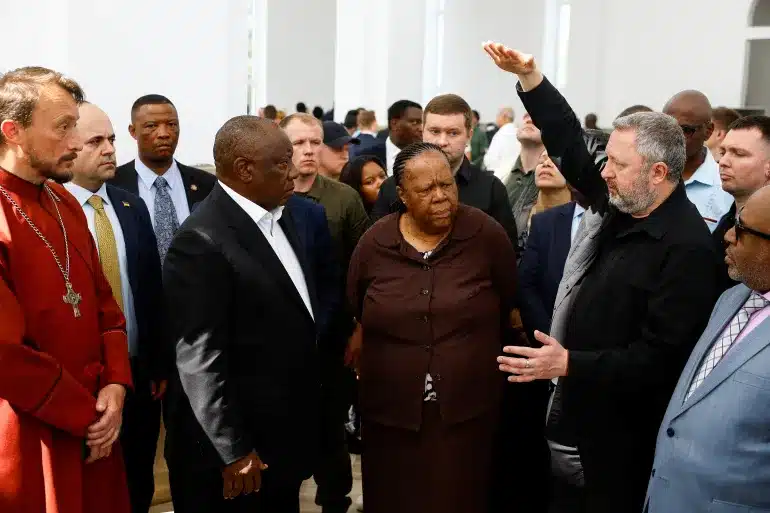
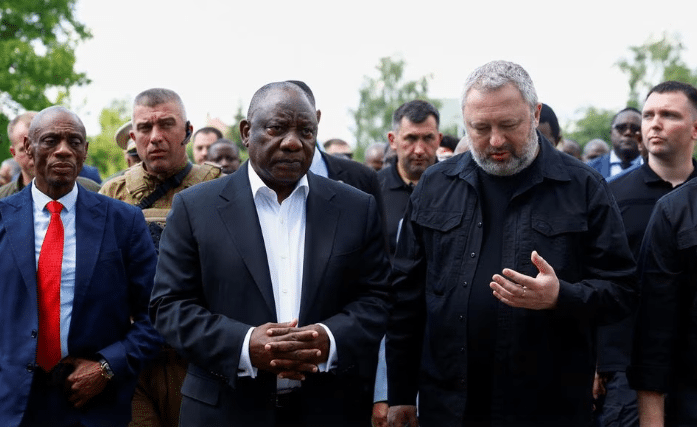
Explosions rang out as five African leaders, including South African President Cyril Ramaphosa and African Union chairwoman and Union of Comoros President Azali Assoumani, arrived in Ukraine as part of an African peace mission.
Air raid sirens also blared in Kyiv as the visit began, the latest in a series of twists as the mission gets underway.
The leaders who are expected to meet Ukrainian President Volodymyr Zelenskyy on Friday and then travel to Russia for talks with President Vladimir Putin in St Petersburg on Saturday, took cover in a bomb shelter.
The South African presidency posted footage of Ramaphosa arriving by train in the Bucha area near Kyiv after travelling from Poland.
Ramaphosa is heading a delegation, which also includes Assoumani and leaders from Zambia, Senegal, and Egypt’s prime minister.
Presidents Yoweri Museveni of Uganda, Denis Nguesso of the Republic of the Congo and Abdel Fattah el-Sisi of Egypt were also meant to go along, but they pulled out of the trip and sent representatives.
The peace mission could propose a series of “confidence-building measures” during initial efforts at mediation, according to a draft framework document seen by the Reuters news agency.
The document stated that the objective of the mission is “to promote the importance of peace and to encourage the parties to agree to a diplomacy-led process of negotiations”.
Its measures could include a Russian pullback, removal of tactical nuclear weapons from Belarus and suspension of the implementation of an International Criminal Court arrest warrant targeting Putin.
A ceasefire could follow and would need to be accompanied by negotiations between Russia and the West, the document stated.
As African leaders embark on a peace mission to Ukraine, the city of Kyiv has come under attack from drones and missiles.
The delegation, comprised of seven leaders including representatives from South Africa and Egypt, will hold discussions with President Volodymyr Zelensky in Kyiv before proceeding to Russia tomorrow.
Their primary objective is to engage in dialogue with both Zelensky and Russian President Vladimir Putin, with the aim of achieving a ceasefire and fostering lasting peace.
However, this mission unfolds amidst Kyiv’s launch of a counter-offensive against the ongoing Russian invasion, leading to a surge in intensified fighting.
As tensions escalate, it becomes imperative for the African leaders to navigate the complex landscape in pursuit of a resolution.
South African President Cyril Ramaphosa has arrived in Kyiv as part of his "African Peace Mission". Meanwhile, air raid sirens are sounding across the city, as another Russian air raid is detected. pic.twitter.com/GeNOuKJk2r
In a separate development, a recent investigation by the BBC has uncovered that the number of Russian soldiers killed in Ukraine is significantly higher than the figure officially released by Moscow.
The investigation estimates that at least 25,000 Russian soldiers have lost their lives, four times the reported number. This revelation adds further gravity to the conflict and underscores the urgent need for diplomatic efforts to quell the violence.
Simultaneously, in Brussels, NATO defense ministers are convening to discuss the situation, emphasizing the international community’s concern over the escalating crisis.
Meanwhile, the St. Petersburg International Economic Forum is underway, with President Putin anticipated to deliver a pivotal keynote address, likely addressing the ongoing conflict and its impact on the regional and global economies.
Vice President,Dr. Mahamudu Bawumia has urged African leaders not to give up focus of the fourth industrial revolution.
He believes that modern technology and artificial intelligence have the potential to change African economies.
In an interview with the Africa Policy Journal, Dr. Bawumia stated that Africa cannot continue to fall behind and that the continent must actively engage in the fourth industrial revolution by leveraging technology advancements to accelerate socioeconomic growth.
“We were left behind in the first, second and third industrial revolutions, but we should not be left out in the fourth industrial revolution. I think that artificial intelligence applied properly will be a big boost to Africa to help us leapfrog and help us catch up in many areas. I think that AI should be seen as a tool to assist us”, he said.
Touching on key areas of transformation, Dr. Bawumia noted that health, education and agriculture should be critical areas for the digitization revolution on the continent.
“I see three main areas that we in Africa can use AI; health. If we have many doctors and nurses using ChatGPT 4 to ask questions, they can get very accurate answers in providing healthcare. We already have drones supplying essential medicines, vaccines blood supplies to remote areas in saving lives.”
“These are practical benefits of AI, and we need to embrace it. Also in education, it is not everywhere we have teachers but with these tools, we can get teachers. The same can be said with agriculture. So, I think that if we focus on some of these areas, Africa can always benefit.”
With the introduction of sophisticated technologies such as the Internet of Things, artificial intelligence and advanced automation, the fourth industrial revolution has the potential to increase productivity and efficiencies.
“In terms of these technologies, Africa comes to the table with no legacy systems. We can find many areas to leapfrog that the developed countries will find difficult to follow. So, we should not use the developed countries as a measure. We have to chart our own course because they have a different set of facts on the grounds from us. So, we shouldn’t be intimidated.”
Minister of Environment, science, technology, and Innovation, Dr Kwaku Afriyie, has urged African leaders to take responsibility for their own development and to stop putting too much reliance on the West for solutions.
According to him, Ghana has been able to solve some critical health problems in the past and has demonstrated a sense of ability and innovation.
Speaking on the sidelines of the Africa Economic Summit, Dr Afriyie cited several examples of Ghana’s track record in solving issues including the outbreak of the COVID-19 pandemic.
He said “If we can perform very well in the health system, we’ve managed to abolish so many diseases, and guinea worms, among others. We have reduced it and we have formed a program called the expanded program of Immunization I am a product of that programme. And so, I’ve seen how we’ve co-operated together to make this happen.
“So, in the economic realm too, we can do the same. I’m saying that we should not use Western standards to define things and make things difficult for us as if we are perpetually at the bottom of the heap. Because there are so many things that are going on for us that they do not have and we can bring it into the conversation and say that Africa is also here. I’m not romanticizing poverty but we can grow at our own pace and get our own development out of that,” he added.
The Africa Economic Summit has been instituted to bring forward new perspectives and stimulate strategic discussions around Africa’s economic challenges and policy priorities.
Heads of State, Ministers, Law Makers, Governors, Heads of Financial Institutions, CEOs of Leading Companies in Africa, and other stakeholders will gather for a two-day candid discussion and high-level networking to provide strategic guidelines on the competitiveness of African nations.
President Akufo-Addohas urged African leaders to increase their financial support for education.
According to him, a recent UNESCO and African Union research indicates that millions of children are not attending school.
Speaking at the World Book Capital 2023 launch in Accra, President Akufo-Addo said more has to be done in the educational sector.
“At the primary level, the report suggests that one in five primary-age children are not in the classroom. While six in 10 adolescents are out of school due to several inter-linking factors. Again, 58 percent of upper secondary-aged children in sub-Saharan Africa do not attend school. This is the scenario completely unacceptable.”
The President described the World Book Capital 2023 as a great potential to contribute to education, culture and wealth.
He called on international partners to leverage on the diverse linkages to culture and education to deepen their collective actions in making progress on the 2030 Sustainable Development Goals.
President Akufo-Addo remarked, “It is with pleasure to join you to launch the UNESCO World Book Capital 2023. Winning the World Book title of Accra is no mean an achievement. It’s a great potential to contribute to education, culture and the wealth of our nation. It’s also an acknowledgement of the giant strides Ghana and Africa are making to develop our book in creative industries as well as scale up the youth through the transformative power of reading for societal development.
“For us in Ghana, the Accra World Book Capital is more than a reading campaign. It’s an opportunity for government and international partners to leverage on the diverse linkages to culture and education to deepen our collective actions to make progress of the 2030 Sustainable Development Goals”.
He called on the private sector, and corporate organisations to support financially the 2023 World Book Capital.
“I call on all stakeholders to come on board and support the programme for maximum impact. Further, I call on the private sector, corporate organisations, the UN family, foundations and similar institutions to support financially this exciting initiative that seeks to connect minds for socio-economic progress,” he appealed.
An African human development expert, according to Dr. Ishmael Nii Amanor Dodoo, anyone who wants to take the lead in transforming Africa must first transform themselves.
“Growing up in Africa and working across the continent throughout my career I have come to the conclusion that the only way to effectively solve the myriad of challenges facing Africa is for those at the forefront of bringing about those changes to transform themselves first,” he stated.
Dr Dodoo, who is also a Senior Strategy Advisor to governments, the UN and multilateral institutions was speaking in an interview with Global Award-Winning Management Consultant, Executive Coach, Author, and Speaker Modesta Mahiga on her 360 Leadership Podcast.
He thinks current and prospectiveAfrican leadersneed the to have right mindset, competencies, skills, philosophies, and personal values to couch their vision if they were to effectively addresses the challenges of the continent.
He explained that Africa is a very multi-dimensional continent with several cultures, religions, systems and structures, but many people don’t take the time to understand the continent and its dynamics before choosing to take leadership positions on the continent.
According to him the philosophy of the Africans, their indigenous systems and structures in terms of how things are done on the continent are all things that need to be properly unravelled through anthropological studies to serve as a resource for anyone who desires to be at the forefront of Africa’s transformation.
“Anyone seeking to lead in any African country – whether in politics, business or within the socio-economic space with a vision to help transform Africa must first transform themselves and rethink their approach to dealing with the peoples, systems and structures.
”You can’t give what you don’t have – that is the philosophy I am driving right now,” said Dr Dodoo, who is also a renowned voice on youth leadership, influence and self-transformation for effective governance.
Dr Dodoo further stated that several Africans with the benefit of Western education who are seeking leadership roles in Africa tend to think they wield some superior knowledge and skills that make them better placed than the people on the continent to lead the transformation of the continent, but that notion is wrong.
According to him, having travelled across and worked in at least 36 African countries on the ticket of the UN and other multilateral institution as an adviser on human development and consultant to several presidents, he can tell that Africa has very talented and intelligent people, except that the systems, structures and cultures are vast and varied and those are nuisances that anyone seeking to lead the transformation of the continent cannot ignore.
He believes Africa is poised to be at the forefront of global transformation in the 22nd Century, but that will take leaders who are willing to transform themselves, beginning with an introspective look at their own personal inspiration, purpose, and values and how those are linked to their desire to lead African states.
“Anyone seeking to lead the transformation of Africa first needs to ask himself what inspires them, what is their purpose in life and what are the lenses (values) through which they view the world. If those three elements are more selfish than for the greater good then you have no business going into leadership in Africa,” he said.
Dr Dodoo argued that the majority of people in politics on the African continent got in either by chance or by accident because a family member or friend was in there and offered them an opportunity to also get in and gain some personal benefit, and that is why the problems of Africa are still not being solved.
He however believes there are still a few people in politics who are driven by a genuine desire to transform the continent and those are his focus to work together with them to get Africa into the position where it can lead the world to glory in the 22nd century.
The elephant and lion analogy
Dr Dodoo told a mythical story from his late dad, about why the elephant is the biggest animal in the jungle but the lion is the king of the jungle.
He said the elephant was seen by all jungle dwellers as problematic because its movement and loud trumpeting sounds usually scared everyone, destroyed plants and made everyone uncomfortable.
The animals and plants therefore met and decided the elephant was a problem that needed to be removed in the interest of everyone.
So, they made the lion king and the lion decided that the elephant would serve a better purpose dead than alive. It should be killed and eaten instead of being allowed to move around and scare everyone.
“That is why when there is a big problem at hand in meetings, we often describe it as the ‘elephant in the room’. In other words, we need to remove the elephants in leadership positions on the African continent before we can really have peace and the conducive atmosphere to bring transformation,” he said.
“The elephant in the room in this case refers to those in leadership for selfish interest rather than for the greater good of the continent.”
As the remains of Queen Elizabeth II will be laid to rest today, some of African leaders are in the United Kingdom to bid farewell to the fallen leader.
It is not wrong for African leaders to attend the ceremony, however something caught the attention of people which got them talking.
As it is well known that African leaders are praised and seen as gods in their respective countries, it is not the case with how they are being treated at Queen’s funeral.
In a picture making rounds on social media, the African leaders are seen packed in one bus though it seems to be of a good standard but they look like university students.
From the look of their faces, one can see the embarrassment the leaders are carrying some might even regretting coming to London.
World leaders from across the globe gathered together on Monday to say goodbye to Britain’s longest-reigning monarch and people could not help but notice the different ways they arrived at Westminster Abbey.
In a motorcade and private car known as The Beast, US President Joe Biden and First Lady Jill Biden arrived in their typical fashion.
But arriving in several coach and minibuses were other world leaders, including those from African countries.
“President William Ruto and other African leaders inside a bus vs. America’s Joe Biden motorcade as they head to the Buckingham Palace in honor of Queen Elizabeth II,” media outlet Kenyans wrote on Twitter.
In the photo, President of Kenya William Ruto and other leaders sit together on one of the busses as they make their way to Westminster Abbey.
Later, the world leaders were photographed arriving at the Abbey and it seems nearly every one was forced to take the bus unlike the US President and First Lady.
Several African leaders are among hundreds of foreign dignitaries at the funeral of the Queen Elizabeth II in London.
Over 2,000 people have gathered in Westminster Abbey for her state funeral.
The African who are attending leaders include South Africa’s Cyril Ramaphosa, Kenya’s William Ruto, Ghana’s Nana Akufo-Addo, Tanzania’s Suluhu Samia Hassan, King Letsie III of Lesotho and Senegal’s Macky Sall, as the current chair of the African Union.
Also there is Rwanda’s Paul Kagame, the chair of the Commonwealth, and Ali Bongo, President of the Commonwealth’s newest member, Gabon.
Some Sudanese activists have criticised the decision to invite Sudan’s Sudan’s military ruler, Gen Abdel Fattah al-Burhan.
Nigeria is represented by Vice-President Yemi Osinbajo, while Foreign Minister Frederick Shava is on London on behalf of Zimbabwe, which has left the Commonwealth.
There are so many foreign leaders that they couldn’t all travel to the cathedral seperately so they went by bus following UK government guidance. One of the few exceptions is US President Joe Biden, who arrived in his armoured limousine, known as “The Beast”.
On social media a picture of African leaders riding on a bus is being contrasted to the US president’s motorcade.
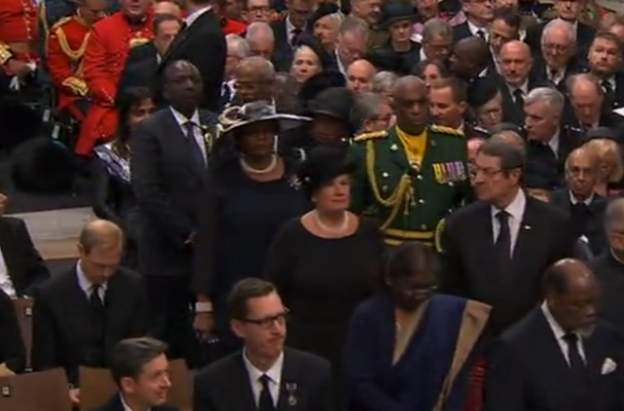
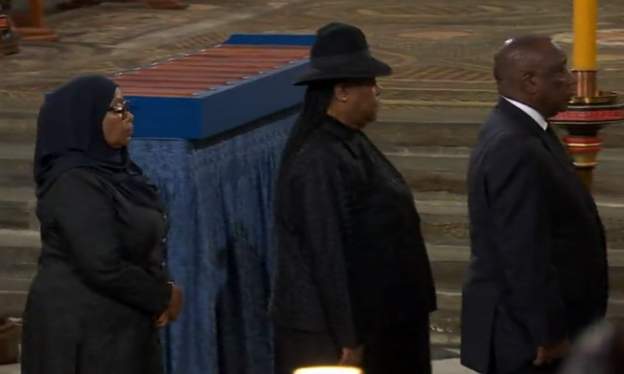
Here are some pictures of African leaders arriving for the service.
Copyright: BBC
Image caption: Kenya’s President William Ruto (standing at the back) arrives at Westminster Abbey
Copyright: BBC
Image caption: Tanzania’s President Suluhu Samia Hassan (left) and South Africa’s President Cyril Ramapahosa (right)