Tag: African National Congress (ANC)

  • South Africa’s Ramaphosa escapes impeachment after parliament votes against move

    Despite allegations of misconduct and a breach of the oath of office against the president, the majority of parliament resolved against opening impeachment proceedings against him.In response to a report that claimed President Cyril Ramaphosa kept unreported foreign currency at his farm in 2020, the South African parliament voted against initiating impeachment proceedings against him.

    On Tuesday, the lawmakers rejected the motion to impeach Ramaphosa 214 to 148. Ramaphosa was largely supported by the majority-holding African National Congress (ANC), which prevented the motion from obtaining the two-thirds majority required to move forward with impeachment.

    However, four ANC lawmakers demonstrated their disapproval of Ramaphosa by voting in favour of impeachment, and a few more chose to abstain from the vote.

    The crucial vote came after a damning parliamentary report alleged that Ramaphosa illegally hid at least $580,000 in cash in a sofa at his Phala Phala game ranch. It said he did not report the theft of the money to the police in order to avoid questions over how he got the foreign currency and why he had not declared it to authorities.

    The report has brought Ramaphosa’s opponents – opposition parties and even rivals within his ANC party – to call for him to step down.

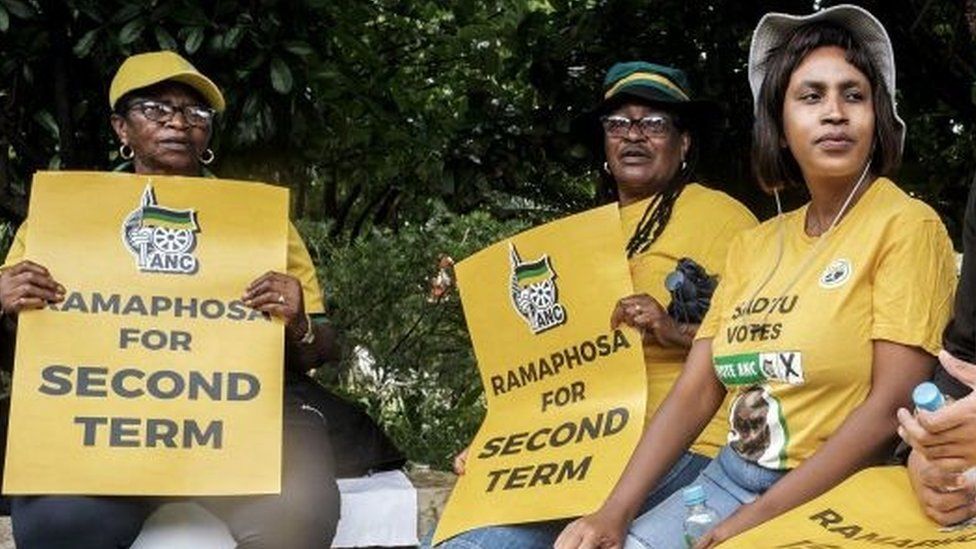
    The parliamentary vote comes in a week where Ramaphosa will also be fighting for his political life as he seeks to be re-elected the leader of the ANC at its national conference starting in Johannesburg on Friday.

    The conference will also elect members of the party’s National Executive Committee, which is the party’s highest decision-making body.

    Ramaphosa must be re-elected as the ANC leader in order to standfor re-election to a second term as South Africa’s president in 2024.


  • Cyril Ramaphosa: How Arthur Fraser got South Africa’s president in hot waters

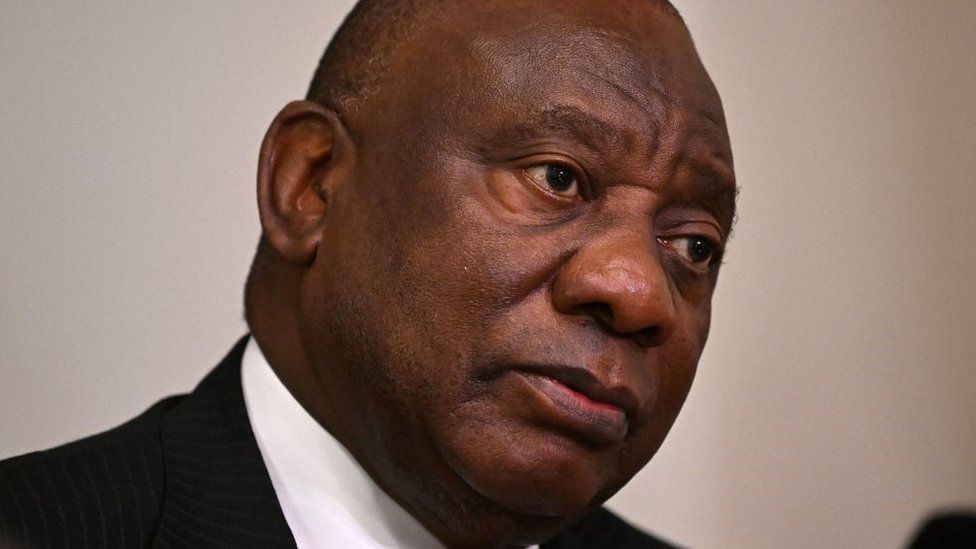
    South Africa’s President Cyril Ramaphosa is fighting back after being politically harmed by allegations that he hid a large sum of foreign currency in a sofa on his game farm and then covered it up.

    He has rallied his governing African National Congress (ANC) to back him in parliament, while his high-powered legal team is attempting to overturn a panel of legal experts’ damning findings against him in the biggest scandal to rock his presidency.

    Former spy chief Arthur Fraser is Mr Ramaphosa’s accuser, and his allegations against the president appear to be straight out of a John le Carré novel – except that they are contained in statements he made to law-enforcement agencies and have been included in the panel’s report, which parliament will consider.

    Mr Fraser alleged that a close aide of Mr Ramaphosa, Bejani Chauke, brought “large sums” of US dollars from Saudi Arabia, Egypt, Morocco, and Equatorial Guinea, and, adding to the intrigue, he alleged that the aide hid the money in a couch at his home in a plush suburb in South Africa’s main city Johannesburg, before taking the cash to Mr Ramaphosa’s game farm with his “full knowledge and acquiescence”.

    But in a nightmare for the president, robbers, allegedly working in cahoots with one of his employees, stole what is “speculated” to be somewhere between $4m (£3.3m) and $8m.

    That is small change compared to the spymaster’s other allegation – that a whopping $20m was “moved” to a South African citizen, whom he named, after he asked police to investigate the president.

    While some would dismiss Mr Fraser’s claims as nothing more than a good bed-time read, they have given Mr Ramaphosa a huge political and legal headache, as about eight bodies – including the central bank – became involved in investigations.

    Mr Ramaphosa has denied any wrongdoing, and the panel – led by a former chief justice – said it could not “verify” the allegations, while “the President has rightly criticised the evidence contained in Mr Fraser’s statements as full of hearsay”.

    Mr Chauke had also denied the allegations.

    What Mr Ramaphosa did admit was that $580,000 had been stolen from his farm in February 2020.

    While Mr Fraser alleged that this was part of the cash previously stashed in Johannesburg, the president gave a completely different version of events – that his lodge manager had sold 20 buffaloes to a Sudanese businessman on Christmas Day 2019, and this was the money stolen.

    But in a blow to Mr Ramaphosa, the panel said there was “substantial doubt” that this sale took place, noting that neither the lodge manager nor the Sudanese national had confirmed this is what happened.

    “We think that the President has a case to answer on the origin of the foreign currency that was stolen, as well as the underlying transaction for it,” the panel added.

    It also questioned whether only $580,000 was stolen, saying the information at its disposal suggested that an apprehended suspect had confessed to stealing $800,000, while an investigator, in an audio clip, mentioned an amount of “20 million”.

    “Whether the investigator was referring to US$ or ZAR [South African rand] this amount is far more than $580,000 that was alleged to have been hidden inside the sofa [at the president’s farm],” the panel said.

    Supporters of South African President Cyril Ramaphosa gestures against Carl Niehaus (not framed), veteran member of the African National Congress (ANC) outside the NASREC Centre in Johannesburg, on December 05, 2022 before the start of a National Executive Committee (NEC) meeting of the Africa National Congress (ANC) to discuss the fate of the Presiden
    IMAGE SOURCE,GETTY IMAGES Image caption, South Africa’s president is seeking re-election as the governing ANC’s leader later this month

    The panel said that in another “troubling feature”, the theft was neither reported to local police as an “ordinary crime” nor to the Directorate for Priority Crime Investigation (DPCI), the police unit responsible for stamping out money-laundering and organised crime in South Africa.

    The panel said this was despite the fact that, in its view, the president, as the farm’s owner, was required by the Prevention and Combating of Corrupt Activities Act to report it to the DPCI.

    It believed there were grounds for an impeachment committee of parliament to investigate whether or not Mr Ramaphosa had committed a “serious” violation of the Act, which, the panel noted, imposes a fine or a prison sentence on anyone who fails to report a theft of more than 100,000 rand that they become aware of.

    “A person who keeps huge sums of illicit money concealed at his or her house is unlikely to report the theft of such money for fear of being discovered that he or she is involved in money laundering,” the panel said.

    “For this reason, the legislature considered it prudent to require any person who has knowledge of the commission of the offence of theft to report it,” the panel added.

    The panel also concluded that the head of Mr Ramaphosa’s bodyguard unit, Gen Wally Rhoode, put together a team that “surreptitiously” investigated the theft, tracking down suspects in Cape Town and across the border in Namibia.

    Despite this, no-one has been prosecuted or convicted of the theft, the panel’s report said, adding: “All of this occurs amid accusations of torture and bribery of the suspects to buy their silence.”

    The panel also said that the information before it suggested that Mr Ramaphosa had sought the help of his Namibian counterpart, Hage Geingob to apprehend a suspect, and Gen Rhoode had travelled to Namibia as part of the investigation.

    The panel said it had noted that Mr Geingob’s office issued a press statement earlier this year denying any wrongdoing on the Namibian leader’s part, but “significantly” it did not deny that President Ramaphosa had approached him.

    “Nor does it deny that the request was acceded to,” the panel added.

    South Africa's President Cyril Ramaphosa speaks during a press conference in central London on November 24, 2022
    IMAGE SOURCE,GETTY IMAGES Image caption, Mr Ramaphosa, 70, became president in 2018 on a promise to fight corruption

    In another damaging blow to Mr Ramaphosa, the panel went on to say that the South African leader “abused his position as Head of State to have the matter investigated and seeking the assistance of the Namibian President to apprehend a suspect”.

    As if that was not enough, the panel said it appeared that Mr Ramaphosa had “thrust himself into a situation where there was a conflict of interest between his official responsibilities as the Head of State and as businessperson involved in cattle and game farming” and he had “acted in a manner that was inconsistent with his office”.

    As a result, the panel felt there were sufficient grounds for parliament to establish an impeachment committee – which would have the power to subpoena witnesses, and documents – to carry out further investigations, before deciding whether or not the president should be removed from office for endangering “our constitution and the rule of law”.

    “The authority to impeach is deeply rooted in the principle of accountability,” it said.

    However, Mr Ramaphosa has challenged the panel’s report in South Africa’s highest court, the Constitutional Court, with his lawyers describing it as “unlawful” and saying it should be annulled.

    And in a sign of his strong position in the ANC as he seeks a second term as party leader later this month, its top leadership body has ordered its MPs, who form a majority in parliament, to vote against the report’s adoption because of the court case.

    The law states that a president can be impeached only if his alleged violations of the constitution and law are “serious”.

    Mr Ramaphosa’s many supporters will be hoping that South Africa’s most senior judges rule in his favour, and, at most, he is accused of minor transgressions.

    As for the stolen money, its current whereabouts are unclear.

    Namibian police reported – according to the panel – that they had identified bank accounts, lodges, houses and vehicles suspected to have been purchased with the proceeds of the crime, while Mr Fraser alleged that Gen Rhoode had “seized” cash in Namibia, although the president’s main bodyguard has “emphatically denied that he investigated the theft of money”.

    The plot thickens.

  • South Africans protest the release of Hani’s murderer

    Members of South Africa’s ruling African National Congress (ANC) and its allied Communist Party protested outside Johannesburg’s Constitutional Court to express their outrage over the decision to free the man who murdered anti-apartheid activist Chris Hani.

    Janusz Walus, a Polish immigrant, murdered Hani in 1993 to sabotage the transition from white minority rule to democracy.

    On Monday, Chief Justice Ray Zondo directed the country’s corrections minister to grant Walus parole.

    Panyaza Lesufi, a senior ANC member, said more protests were planned to coincide with his expected release next week.

    Walus killed Hani as he picked up the newspapers outside his home in April 1993 by shooting him at point-blank range in the chin, behind the ear and in the chest.

    He was arrested and sentenced to death. The sentence was commuted to life after South Africa abolished the death penalty at the end of apartheid, a legalised system of racial discrimination, in 1994.

    Hani’s murder still evokes deep emotions in South Africa. He was regarded as the most popular politician after South Africa’s first black President Nelson Mandela, and his death caused much shock and anger.

  • Farm scandal: South Africa’s Ramaphosa denies wrongdoing

    The president was speaking to a parliamentary committee formed to investigate the theft of $4 million in cash from his game farm.

    President Cyril Ramaphosa of South Africa has denied wrongdoing in testimony to a parliamentary panel investigating whether he should face impeachment over an alleged cover-up of a heist at his farmhouse, according to his office.

    Ramaphosa “categorically denies that he violated this oath in any way, and denies that he is guilty of any of the allegations made against him,” the presidency said on Monday in written responses provided to the independent panel on Sunday.

    The scandal erupted in June after South Africa’s former national spy boss filed a complaint with the police alleging that robbers broke into Phala Phala, the president’s farm in the northeast of the country, and stole $4m in cash stashed in furniture.

    The complaint alleged that Ramaphosa hid the robbery from the authorities and instead organised for the robbers to be kidnapped and bribed into silence.

    The scandal risks derailing Ramaphosa’s bid for a second term as president of the African National Congress (ANC) as the ruling party heads to hotly contested internal polls in December.

    Ramaphosa’s office said he has always made it a point “to abide by his oath of office and set an example in his respect for the constitution”.

    The independent panel, which was appointed by the National Assembly speaker last month, includes an ex-chief justice, a former prominent high court judge, and a lawyer.

    It was established after a motion tabled by a legislator from The African Transformation Movement, one of the country’s opposition parties, and is set to report its findings in mid-November.

    Impeaching a president requires a two-thirds majority vote in South Africa’s National Assembly, where Ramaphosa’s ANC commands more than two-thirds of the seats. But in June, he was heckled in parliament by opposition legislators.