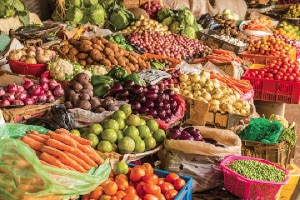
A new report by the African Union and three UN bodies has disclosed that nearly 282 million people in Africa, constituting about 20% of the continent’s population, are grappling with undernourishment.
Shockingly, this figure represents an increase of 57 million people since the onset of the COVID-19 pandemic, signaling a concerning deterioration in Africa’s food crisis.
“The majority of Africa’s population – about 78%, or more than one billion people – remain unable to afford a healthy diet, compared with 42 percent at the global level, and the number is rising,” the agencies added.
The report attributes the pervasive unaffordability of nutritious food to the rising costs of food in recent years, particularly in Western and Eastern Africa.
This situation has impacted “not only the poor but also a large proportion of people defined as non-poor” unable to maintain a healthy diet.
Additionally, according to the agencies, malnutrition causes stunting in about 30% of children under five on the continent.
Time Magazine has named Kenya’s President William Ruto as one of the top 100 leaders in the world who are making a big difference in helping the environment.
He announced the list during the week when he organized a national holiday to plant 100 million trees in one day.
Mr Ruto was chosen with the mayor of Freetown, Yvonne Aki-Sawyerr.
Architect Francis Kéré from Burkina Faso and entrepreneur Kidus Asfaw from Ethiopia were also on the Time list.
The “Time 100 Climate” ranking was released on Thursday. It’s the first time the magazine has tried to name people who are important in addressing climate change around the world.
Time chose those who have made big progress in fighting climate change while also creating value for their businesses.
The magazine chose the honourees because they have recently made successful and measurable progress in fighting climate change, instead of just making promises and announcements.
The special day to plant trees on 13 November was a small part of his big goal for Kenya to plant 15 billion trees in 10 years.
In September, he held the first Africa Climate Summit in Kenya’s capital, Nairobi. They asked big polluters to give more help to poorer countries.
Some environmentalists say Mr. Ruto is a hypocrite because he promotes planting trees but doesn’t stop illegal logging in public forests.
Last month, a court that deals with issues about the environment stopped Mr Ruto from lifting a ban on logging that was put in place in 2018.
In October, he said that people should be made to leave the 380,000-hectare Mau Forest.
Some people who care about the environment think it’s good to protect the forest. But others say the government kicked out the Ogiek people, who have lived there for a long time, just to make money from carbon offsetting.
MrRuto is being recognized as a leader for taking action on climate change. The World Bank said on Friday that if Kenya doesn’t do something about climate change, its economy could shrink by 7. 25%
Time named Francis Kéré an architect for his creative and environmentally friendly building designs. He worked on projects like state houses in Benin and his own country, Burkina Faso.
In 2022, he was the first black person from Africa to win the important Pritzker Architecture Prize.
Mr Asfaw has a small business that turns old plastic into cheap and eco-friendly building materials.
Time magazine said that his new company provides a fast and long-lasting way to fix the lack of houses as the population in Africa keeps increasing.
Mayor Aki-Sawyerr was recognized for “working to protect the environment and make the city better prepared for climate change. ” She did things like creating a plan to deal with climate change in Freetown and hiring someone to help with extreme heat in the city, which had never been done in Sierra Leone or Africa before.
The African Development Bank (AfDB), has reported that around 15 million individuals in Africa were plunged into poverty in 2022 as a result of elevated food and energy costs.
Nevertheless, the AfDB noted that the influence of rising energy prices on poverty was more pronounced than that of food prices.
This disparity arose because the escalation in energy costs directly impacted household earnings, whereas the adverse effect of elevated food prices was somewhat counteracted by augmented household income from net sales.
“In Africa, the additional number of people falling into extreme poverty due to energy price inflation is estimated at 10.2 million, bringing the combined poverty effect of soaring food and energy prices to about 15 million people,” the bank noted.
This information was detailed within the African Development Bank’s (AfDB) 2023 West Africa Economic Outlook report, which highlighted a notable 10% surge in the region’s average poverty rate from 2019 to 2022.
The report also identified that, in comparison to a counterfactual scenario, the international poverty rate, defined by the US$2.15-a-day poverty line, saw an upturn in nine West African countries.
Among the observations, it was noted that the average household well-being diminished in 12 out of 14 countries, collectively resulting in an average actual income decline of 0.82%. The AfDB underscored that this decline disproportionately affected the more economically disadvantaged households.
“The fall in real household per capita income due to high global food and energy prices has impacted household welfare and exacerbated poverty and inequality in African countries,” AfDB reported.
The report cautioned that prolonged increases in the prices of food and energy could yield lasting ramifications for prosperity in numerous African nations, further exacerbating issues of poverty and inequality.
In response, the Bank urged African governments to adopt proactive measures encompassing monetary, fiscal, and structural policies to counter the repercussions of mounting inflation and subdued economic growth.
The AfDB also advocated for heightened support towards fostering a pro-growth structural transformation, which is crucial for sustaining rapid, sustainable, and inclusive economic expansion.
As Russia initiated its invasion of Ukraine from February to March 2022, crude oil prices escalated by approximately 20%, surging from $93.5 per barrel per day (bpd) to $112.4 bpd. Throughout the period from March to October 2022, the average stood at $102.8 bpd in Africa.
In a similar trajectory, wheat prices experienced a surge of approximately 28%, climbing from $364.9 per metric ton (mt) in February 2022 to $446.5 per mt in March 2022. Between March and October 2022, the average price was $427.2 per mt.
Similarly, fertilizer prices also underwent an increase of around 22%, soaring from $547.1 per mt in February 2022 to $668.9 per mt in March 2022. The average price from March to October 2022 settled at $624.9 per mt.
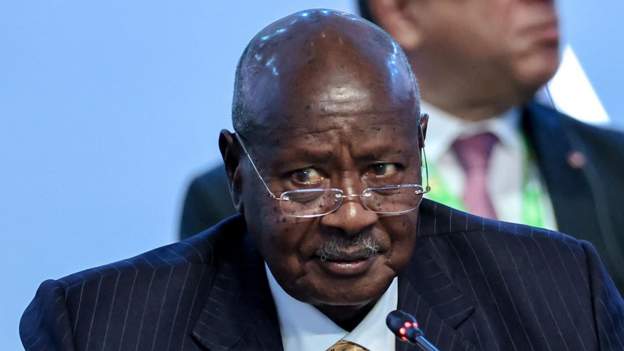
President Yoweri Museveni of Uganda claims that the World Bank is trying “to coerce” his country’s government into changing its anti-LGBT laws.
It comes after the lender’s declaration that it will stop making new loans to the nation because the law prohibiting same-sex relationships goes against its core principles.
However, in a message distributed over social media, according to President Museveni, “Loans or no loans, Uganda will develop.”
He expressed regret that the lender was attempting to “use money to coerce us into giving up our faith, culture, principles, and sovereignty.”
“They significantly undervalue all Africans. Nobody needs to put any pressure on us; we already know how to address issues in our society. They are issues we have,” he continued.
However, Mr. Museveni stated that the nation was still in contact with the World Bank “so that they and we avoid this diversion if possible”.
The death penalty is applied for “aggravated homosexuality” and a 20-year prison sentence is imposed for “promoting” homosexuality under the anti-LGBT law that President Museveni signed in May.
Human rights organisations from Uganda and around the world have denounced the law. The new law has also been denounced by the UN, the US, and other nations.
In addition to the US, the World Bank has imposed penalties on Uganda because of its anti-homosexuality law.
The seas off the Canary Islands is being searched by Spanish police for a boat that vanished more than a week ago carrying at least 200 African migrants.
Other ships in the region have been instructed to keep an eye out for the missing ship, and a search plane is currently probing the waters south of the Spanish islands.
A seaside village in southern Senegal called Kafountine is 1,700 kilometers (or around 1,000 miles) from the Canaries, where the boat left from.
Many children are on board, according to aid workers.
Also reported missing are two smaller boats from the same region that were carrying numerous people.
Some Africans have rejected western influences and have adhered to their cultural traditions.
There are unavoidable commonalities among Africans when it comes to food, attire, and occasionally even languages.
However, some African cultures are innate and unique to borders and nationalities, with traditions and practices that truly make Africa special and stand out.
Though a percentage of Africans have modernized and allowed contemporary Western influences to white-wash their cultures, there are groups of people who have continued to stay true to who they are.
In recognition of cultures that have stood the test of time, here are some surprising African traditions and cultures you need to know.
Khweta ceremony
This tradition is unique to the Transkei, an ancient tribe of Southern Africa. It is a special ceremony that celebrates the transition from boyhood to manhood.
It is mandatory for all young boys to participate in the ceremony to demonstrate their maturity as men. During the ceremony, boys of all ages are made to stay in a location called the circumcision lodge. There, they undergo tests with the supervision of a master and are circumcised during this time.
The young boys wear white sheepskin to ward off evil spirits after the days of seclusion. Their bodies are also painted with sandstone and they engage in special dances, moving like bulls, with their head in the air. As part of the ritual, they are not allowed to go near girls.
On completion of the ceremony, all the tools used for the ceremony are burnt. The boys head to the river for a cleansing bath, which they do while being flogged. They are not to look back while this happens.
Finally, the white paint is washed off and replaced with a red one, which they wear for three months. After that, they are declared men and are allowed to get married.
Spitting blessing
From their vigorous jumping dance to their clothing style, the Maasai nomadic tribe of Kenya have traditions that continue to surprise and impress many around the world. Spitting is a sign of respect in the Maasai culture.
The tribesmen spit in their hands before shaking hands; this is a sign of blessing and is viewed as a good omen. Not just anyone receives spit on the hand – it is reserved for revered persons, and shows the utmost respect.
Apart from greetings, newborns are spat on for blessings by the family and well-wishers. Babies that do not receive any spits are said to grow up unhappy. Words are also spoken over the babies to invoke good things and give them a happy life.
Brides also receive congratulatory spits. In fact, their fathers spit on their foreheads and breast to wish them good fertility.
Wife Stealing Festival
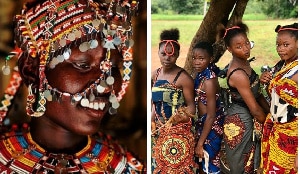
The Wodaabe tribe is a Fulani tribe in Niger. The males of the tribe are quite confident that they are the most handsome men and carry a mirror always.
Their marriages are usually arranged when they are born, although one is free to have as many sexual partners before they get married – marriage is not the end for this tribe.
The tribe celebrates a festival called Gerewol, which aims at giving the opportunity for men to impress the wives of their compatriots. Thus, the tribesmen dress themselves up in the most elaborate makeup, to do just that.
Three of the tribe’s most beautiful women are chosen to judge as the men show off through a dance, moving in circles. The rest of the women eye and select which man they would wish to marry next. For the polygamous tribe, this is not frowned upon.
A man is allowed to keep a woman even if she’s already married, as long as her husband does not catch him stealing her by the end of the ceremony. Some men make their wives sit it out, to be on the safer side, because they do not want them to be stolen.
Bull jumping
Bull Jumping is an old rite of passage for the young men in the Hamer tribe– a community that lives in the lower Omo Valley of Ethiopia.
The day of the occasion sees a lot of celebration, with about 100 and 300 people in attendance. The women of the tribe dance in their traditional dresses, play horns and wear bells on their legs.
This ritual is performed to show a boy’s manliness and maturity. It involves the tedious task of running on the back of seven or 10 bulls four times without falling down. In families, the rite happens in succession; the eldest has to go before the youngest – it is the duty of the father, or in the absence of the father, the uncle of the boy to decide when he is ready for the rite.
When a boy is deemed ready by his father or uncle, he is given a short stick (boko) and has to travel to the houses of all his relatives to tell them the news and invite them to the ceremony. He gives the family members a coil of rope to show the number of days leading up to the feast because there are no calendars.
On the day of the ceremony, elders of the tribe who have been through the ritual but are still unmarried, gather castrated male cattle and smear them with dung to make them slippery. The boys also have to be completely naked, their hair partly shaven before jumping over the cattle.
Their bodies are rubbed with sand to wash away their sins and get rid of bad luck – they are also smeared with dung for strength. The boy finally jumps on the back of the bull and steps on each bull’s back before jumping back down. His sprightliness, fearlessness, and strength prove that he is a man. In the case where a boy falls down in his attempts, he has to try again the next year.
From there on, he can get married to a woman selected by his father.
Sometimes, the auntie has to have sex with the groom to really make the first confirmation. In other places, the aunty will watch the couple have sex for the test.
A woman’s virginity is a big deal in these communities and is well preserved from the time the girl is getting to her teenage years. The girls are married off before sexual maturity, right after their first menstruation, in order to prevent teenage pregnancies before marriage.
Dr. Mahamudu Bawumia, vice president, claims that Africa’s continued reliance on basic commodities is hindering its economic development.
Dr. Bawumia says the situation is forcing many African governments to manage crises due to external shocks.
Speaking at the Harvard University’s Africa Development Conference in the United States over the weekend, Dr. Bawumia said African countries must shift from raw material production to value addition.
“The reliance on primary commodities has made African countries vulnerable to external shocks. As a result, the focus of economic management by successive African governments since independence has been crisis management as a result of factors such as an increase in oil prices, collapse in commodity prices, debt unsustainability, macro-instability and so on.
“Governments have by and large not focused on the underlying system that underpins economic activities and economic growth. Our focus has always been on managing crisis of one nature or the other,” the Vice President said.
Dr. Bawumia further urged, “Our generation needs to break the shackles of the impossibility mindset and embrace the mindset of possibility! It is time for us to figure out the best ways to be masters of our destiny, to chart our own path and develop on our own terms. It is possible!”
The US-Africa Leaders’ Summit discussions were put on hold while President Joe Biden of the United States and several of his guests watched some World Cup action.
The game in question being the second semi-final clash between Morocco and France at the Al Bayt stadium in Doha, Qatar.
A photo shared by the US president showed him seated in the company of among others, presidents George Weah and Muhammadu Buhari of Libéria and Nigeria respectively.
Ethiopian and Moroocan Prime Ministers, Abiy Ahmed Ali and Aziz Akhannouch were also watching the game as was Malawian president Lazarus Chakwera.
The performance of Morocco’s Atlas Lions at the 2022 World Cup did not only impress Moroccans, Africans and Arabs but also presidents of some powerful countries.
United States of America president, Joe Biden and French President, Emmanuel Marcron are two world leaders who have been awed by the spirited performance of the Atlas Lions.
In a social media post, President Biden announced that he watched Morocco’s 2-0 defeat to France with the Moroccan Prime Minister and despite the defeat was proud of the performance of the team.
More praise for Atlas Lions despite France defeat
Leading world sports journalist, Fabrizio Romano also reported that French president Emmanuel Marcron stormed the Moroccan dressing room after the game and commended them for their incredible run in the tournament, singling out midfielder Amrabat for praise as the best midfielder in the competition.
US Congresswoman Ilhan Omar also took to Twitter to shower praises on the Moroccan for becoming the first African country to reach the semi-final of the World Cup.
Former Arsenal and German midfielder Mesut Ozil who was at the Al Bayt Stadium to support Morocco also applauded them and so did Arsenal and Egyptian midfielder Mohammed Elneny.
Despite not making the final, Morocco are being hailed as true winners as the upset odds to reach the semis.
During what hs been described as being historic as an incredible run, Morocco defeated Spain, Portugal and Belgium to set up a date with France.
Unfortunately for the Atlas Lions of Africa, they were overpowered by an efficient French team that scored through Theo Hernandez and Kolo Muani.
France will now play Argentina in the final on Sunday, December 18, 2022 but before then Morocco will take on Croatia in the third-place play-off.
Rituals are characteristic of most cultures. They are passed down from generation to generation. Different actions explain why some rituals are sacred while others may not. Traditional Africansused varied rituals to keep things running smoothly, bring people together, and help the community grow.
Fishing is only allowed in this little, sacred lake once a year, during the special ceremony known as Antogo, which takes place in the town of Bamba in the northern area of the Dogon region in Mali. Bamba was built among the rubble at the base of a 500-meter cliff. During the peak of the dry season, everything here except for a single sacred pond full of fish dries up. Antogo, a centuries-old fishing ceremony, is performed annually on the lake, and it is a sight to behold for anybody interested in history.
Even though fishing in the lake is technically illegal every other day of the year, hundreds of men ignore that on the day of Antogo to catch fish with their bare hands. In total, the turmoil lasts for around fifteen minutes. Reports say that the size, scope, and seriousness of the event are just too much to handle.
Legend says that fishing well will bring good luck in many ways, such as a good harvest, a happy marriage, the recovery of sick family members, and more. Men who go through the fishing season without catching anything are considered unlucky for the next 12 months. They won’t find a spouse or have a successful harvest, among other things, in that particular year, and the most they can do is wait for better fortune next year.
The fishing ritual is performed in May, which is traditionally the sixth month of the dry season, but the council of wise men determines the exact day. In Bamba, Saturdays are market days, and on the first three market days of each month, wooden sticks are positioned in the middle of the lake as a signal that the ceremony is drawing near.
On the day of Antogo, a lot of Dogon people from all over Mali gather around the lake. The most important and well-known families from different Dogon communities make up the three largest groups. The groups watch the wise men recite spells and praise gods while remaining mute. Once they have finished speaking, the ritual itself and all the magic that goes along with it start.
After the sound of a gunshot, hundreds of men and children—women are not allowed to take part—jump into the lake while carrying fishing baskets, trying to catch as many fish as possible as quickly as they can.
Even though females are barred from participating in the festivities, folklore has it that a young woman first learned of the lake and its miracle fish. Whatever the case may be, the Antogo event is unlike any other world fishing opener, observers say.
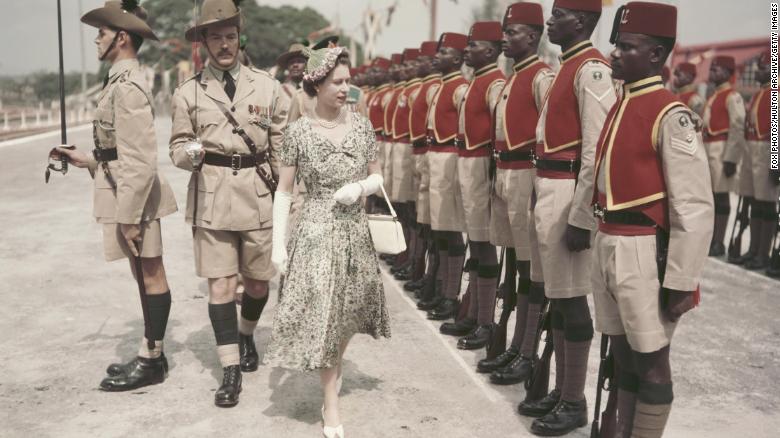
The death of Queen Elizabeth II has prompted an outpouring of reflectionand reaction online. But not all was grief — some young Africans instead are sharing images and stories of their own elders, who endured a brutal period ofBritish colonial history during the Queen’s long reign.
“I cannot mourn,” one wrote on Twitter, posting an image of what she said was her grandmother’s “movement pass” — a colonial document which prevented free travel for Kenyans under British rule in the east African country.
Another wrote that her grandmother “used to narrate to us how they were beaten & how their husbands were taken away from them & left to look after their kids,” during colonial times. “May we never forget them. They are our heroes,” she added.
Their refusal to mourn highlights the complexity of the legacy of the Queen, who despite widespread popularity was also seen as a symbol of oppression in parts of the world where the British Empire once extended.
Kenya, which had been under British rule since 1895, was named an official colony in 1920 and remained that way until it won independence in 1963. Among the worst atrocities under British rule occurred during the Mau Mau uprising, which started in 1952 — the year Queen Elizabeth took the throne.
The colonial administration at the time carried out extreme acts of torture, including castration and sexual assault, in detainment camps where as many as 150,000 Kenyans were held. Elderly Kenyans who sued for compensation in 2011 were ultimately awarded £19.9 million by a British court, to be split between more than 5,000 claimants.
The UK Foreign Secretary at the time, William Hague, said: “The British Government recognises that Kenyans were subject to torture and other forms of ill treatment at the hands of the colonial administration. The British government sincerely regrets that these abuses took place, and that they marred Kenya’s progress towards independence.”
Africa’s memory of the Queen cannot be separated from that colonial past, professor of communication Farooq Kperogi at Kennesaw State University told CNN.
“The Queen’s legacy started in colonialism and is still wrapped in it. It used to be said that the sun did not set over the British empire. No amount of compassion or sympathy that her death has generated can wipe that away,” he told CNN.
‘Tragic period’
While many African leaders have mourned her passing — including Nigeria’s President Muhammadu Buhari, who described her reign as “unique and wonderful” — other prominent voices in regional politics have not.
In South Africa, one opposition party, the Economic Freedom Fighters (EFF), was unequivocal. “We do not mourn the death of Elizabeth, because to us her death is a reminder of a very tragic period in this country and Africa’s history,” the EFF said in a statement.
“Our interaction with Britain has been one of pain, … death and dispossession, and of the dehumanisation of the African people,” it added.
Others recalled Britain’s role in the Nigerian civil war, where arms were secretly supplied to the government for use against Biafrans who wanted to form a breakaway republic. Between 1 million and 3 million people died in that war. British musician John Lennon returned his MBE, an honorary title, to the Queen in protest over Britain’s role in the war.
Still, many on the continent remember the Queen as a stabilizing force who brought about positive change during her reign.
Ayodele Modupe Obayelu from Nigeria told CNN: “Her reign saw the end of the British Empire and the African countries … became a Republic. She doesn’t really deserve any award or standing ovation for it, but it was a step in the right direction.”
And Ovation magazine publisher Dele Momodu was full of praise, recounting meeting her in 2003 in Abuja while covering her visit to Nigeria. He added that he had fled Nigeria for the UK in 1995, during the dictator Sani Abacha’s regime.
“I told her I was a refugee and now the publisher of a magazine. She told me ‘congratulations,’ and moved on to the other people on the line. I salute her. She worked to the very end and was never tired of working for her country. She did her best for her country and that is a lesson in leadership,” he told CNN.
Momodu believes that the Queen did try to “atone” for the brutality of the British Empire. “She came to Nigeria during our independence and some of the artifacts were returned under her reign. That is why the Commonwealth continues to thrive. I feel very sad that the world has lost a great human being.”
Adekunbi Rowland, also from Nigeria, said: “The Queen’s passing represents the end of an era. As a woman, I’m intrigued by her story. This young woman had an unprecedented accession to the throne, and with much grace and dignity did everything in her power to protect the country and Commonwealth she loved no matter what it took.”
Commonwealth Queen
The Queen once declared, “I think I have seen more of Africa than almost anybody.”
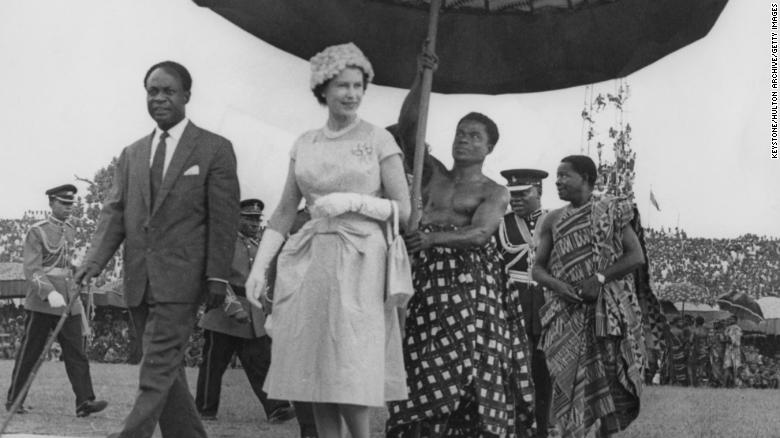
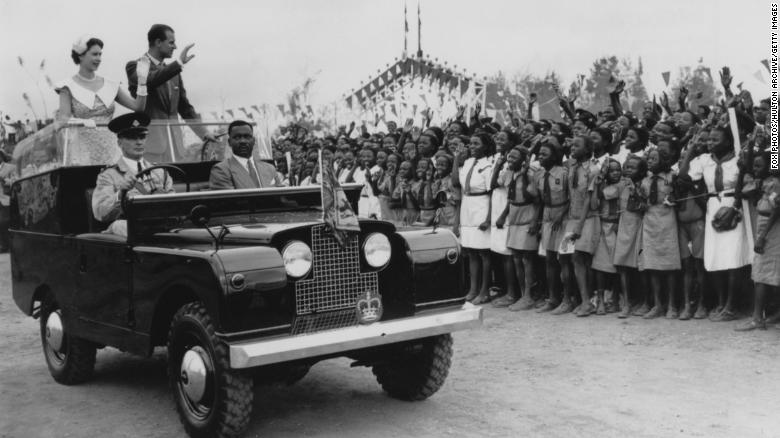
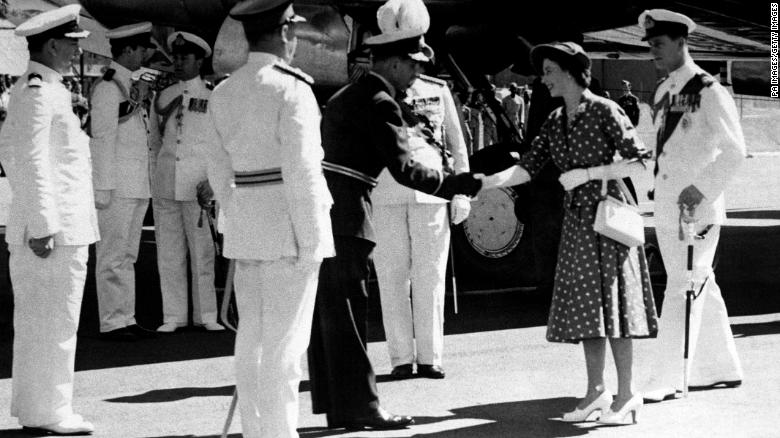
She made her first official overseas visit to South Africa in 1947, as a princess and would go on to visit more than 120 countries during her reign, many of them on the continent.
It was while visiting Kenya in 1952 that she learned that she had become Queen. Her father George passed away while she was there with Prince Phillip and she immediately ascended the throne.
As colonialism later crumbled and gave way to independence and self-rule in what had been British overseas territories, the former colonies became part of a Commonwealth group of nations with the Queen at its head and she worked tirelessly to keep the group together over the years.
She forged strong bonds with African leaders, including Nelson Mandela, whom she visited twice in South Africa, and Kwame Nkrumah, with whom she was famously pictured dancing during her visit to Ghana in 1961.
However, there is now a growing clamor for independence and accountability over Britain’s past crimes such as slavery. In November 2021, Barbados removed the Queen as its head of state, 55 years after it declared independence from Britain, and other Caribbean countries, such as Jamaica, have indicated they intend to do the same.
Prince William and his wife, Catherine, Duchess of Cambridge, visited Jamaica in March but they faced protests and calls for reparations during the trip. There were also calls for a formal apology for the royal family’s links to slavery.
“During her 70 years on the throne, your grandmother has done nothing to redress and atone for the suffering of our ancestors that took place during her reign and/or during the entire period of British trafficking of Africans, enslavement, indentureship and colonization,” wrote members of a protest group, the Advocates Network Jamaica.
In June, Prince Charles became the first UK royal to visit Rwanda, where he was representing the Queen at the Commonwealth Heads of Government Meeting.
Following his mother’s death, he now heads the Commonwealth, and will embark on a new relationship with its members, about a third of which are in Africa.
Some are asking whether he will be as effective in building the organization as his mother, and above all, how relevant it still is, given its roots in Empire.
It is quite disappointing that Africans are never on time for scheduled appointments. This is well recognized because the majority of Africans in the Diaspora also disregard the passage of time. Africans are constantly late for appointments they have with you.
The Polish author and journalist Ryszard Kapuscinski’s book “The Shadow of the Sun” further explains this viewpoint. He made extended trips all over the world, especially to Africa.
As one of Poland’s most prolific non-fiction writers, he is renowned for his sharp and intensely intimate assessments of social and political upheavals around the globe. The author passed away on January 23, 2007, in Warsaw.
To get to the heart of the story, Kapuciski braved malaria, civil conflict, and confrontations with brutal rulers.
His books dive into the causes of racial and political conflict, sifting through millennia of strife, chaos, and even ritual to build a picture that is at once real, educational, and moving.
The lack of concern towards Africa’s time is one of the topics the author of “Shadow of the Sun” highlighted in his account of his journey to Ghana. Yes! From the colonial era to the present day, many Africans have no concept of the passing of time.
If an African says, “I’ll be coming at 9 a.m., it’ll be 11 a.m., or I’m leaving at 2 p.m., it’ll be 4 p.m. For many Africans, time has no real meaning. Not just in Africa is the illness present. It has also been exported by Africans to Europe and America.
Kapuscinski boards a bus from Accra, the nation’s capital, on his route to Kumasi in the Ashanti Region of Ghana. When he asks when the bus departs, he is informed, “Until it is full.” Ryszard Kapuscinski feels compelled to include this information in his book; he most likely first saw it on the continent of Africa.
If we look at the history of poor China from decades ago, Africa has a long way to go because we are far behind in every area. Years after gaining freedom, Africa continues to look to heaven for miracles, forgetting that God supports those who support themselves.
Africa must battle corruption, build its nation, provide jobs for its citizens, and cease accusing its erstwhile colonial overlords of devouring the continent now that the riches are available. Yes! They pillaged, yet they left some of Africa’s wealth behind.
Despite its wealth, Africa remains the least respected continent. People are subjected to ongoing discrimination as a result of their attitudes, behaviors, and methods of doing various tasks. By making changes on the continent and in relation to time, we can disprove the white man.