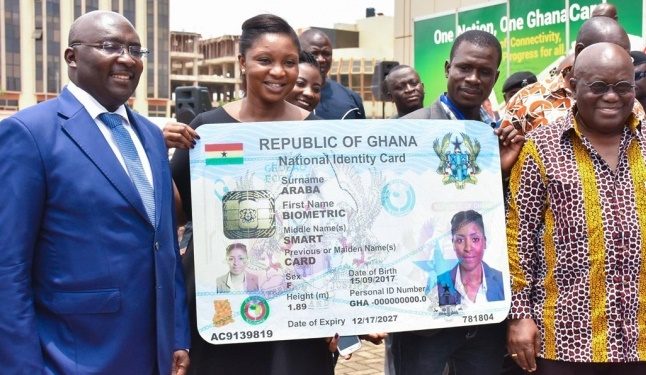
The nationwide Ghana Card registration exercise for Ghanaian children aged between 6 and 14 years in the Northern Region has commenced. The exercise National Identification Authority (NIA), in collaboration with the National Health Insurance Authority (NHIA), in the region begun today, Thursday, June 10.
A statement dated June 10 noted, “The National Identification Authority (NIA), in collaboration with the National Health Insurance Authority (NHIA), wishes to inform the general public that the nationwide Ghana Card registration exercise for Ghanaian children aged 6-14 years will commence in the Northern Region on Thursday, 11th June 2026”.
Ghanaian children who meet the requirements must be accompanied by a parent or legal guardian to undergo the process. He noted that cards will be issued immediately after the registration.
“They have to come with their parents. After registration, we bind their details to their parents and issue the cards instantly,” he stated.
In 2024, the NIA issued about 18.7 million Ghana Cards to persons aged 15 and above. The children who have already been registered were accompanied by their parents or legal guardians to receive their cards at the schools where they underwent registration.
In September, the NIA commenced the registration of Ghanaian children aged 6 to 14 years at all NIA Premium Centres nationwide. This move, according to the Authority, is in line with its legal mandate to register all Ghanaians, both at home and abroad, and to ensure that every citizen has a secure and verifiable national identity.
It marks another step forward in building a comprehensive and inclusive National Identity Register (NIR) that captures every Ghanaian from childhood.
The fee for first-time registration at Premium Centres was GHS 310, consistent with the approved charges for premium services.
In another development, the NIA is set to upgrade the Ghana Card into an electronic wallet, allowing holders to use it not only as a national ID but also for digital financial transactions.
Executive Secretary of the NIA, Yayra Korku Deku, shared the news with Joy News’ James Avedzi, where he intimated that the initiative will help the authority generate revenue to support its activities. He is optimistic this will optimise the operations of the authority.
“What it means is that you can put money on your Ghana card and use it to do transactions. That is to pay for anything that you do. And we are hoping that that one will generate a huge sum of money for us,” she stated.
Adding that the e-wallet initiative will be a significant move that will reshape the NIA’s operations while boosting electronic money transfers in Ghana.
He noted that several financial institutions are eager to partner with the NIA to ensure the initiative succeeds
As of May 2025, a total of 648,862 Ghana cards printed by the National Identification Authority (NIA) were yet to be collected by their respective holders.
The NIA made this known on its Facebook platform when it released recent data on the national identification registration exercise as of May 9.
Per the data, a total of 18,713,474 individuals have been enrolled onto the National Identification System. So far, some 18,197,477 Ghana cards have been printed, whereas 17,548,615 cards have been issued.
The NIA is urging individuals who are yet to claim their Ghana Cards to do so.
“Still Haven’t Collected Your Ghana Card? Thousands of cards are ready and waiting! Check. Collect. Be Identified. Visit your nearest NIA District Office today, we’re Open and Operational!” the NIA stated.
Last month, the Ghana Revenue Authority responded to claims that it had been disconnected from the National Identification Authority (NIA)’s Identity Verification System (IVS).
The NIA disconnected GRA from its Identity Verification Service (IVS) platform on Tuesday, August 5, 2025 due to the GRA’s failure to settle a GH₵376 million debt.
In a statement released on August 5, 2025, the GRA clarified that the current administration seemed to have inherited a legacy debt due to some services rendered to the GRA by the NIA prior to 2025.
However, “from the GRA’s present assessment, there were no regulatory and governance approvals for the transaction that created the purported debt. GRA’s principles of transparency, compliance and governance protocols do not permit enforcement of transactions that do not meet regulatory requirements, particularly as demanded by the reset vision of the President and the Government,” the statement read.
The authority further clarified that added GRA’s principles of transparency, compliance and governance protocols do not permit enforcement of transactions that do not meet regulatory requirements, particularly as demanded by the reset vision of the President and the Government,” the statement indicated.
Nonetheless, discussions are currently ongoing between high officials of the two agencies to resolve the issue.
“There are current high-level discussions between the two agencies in resolving the issues particularly where GRA has identified some procedural breaches and cannot affirm the existence of a service agreement between the parties,” a part of the statement read.
The IVS platform is a critical digital infrastructure that aids with public and private institutions to instantly verify the identity of individuals using the Ghana Card database.
This function is vital for a wide range of services, including revenue mobilisation, passport issuance, banking, and healthcare access.The National Identification Authority (NIA) has blocked the Ghana Revenue Authority (GRA) from using its identity verification system over the Authority’s GH₵376 million debt owed to them.
The National Identification Authority officially announced the disconnection of the Ghana Revenue Authority (GRA) from its Identity Verification Service (IVS) platform during an interview with JoyNews during their midday news.
During the interview, the Head of Corporate Affairs at the NIA, Williams Aumman Dallas, stated that the NIA will restrict GRA’s access to their identity verification platform due to the Authority’s failure to settle the financial obligations to the NIA. He noted that GRA has not made any financial commitments to the NIA over the last three years.
“Effective 1st August, we have restricted them — we’ve cut them off, we’ve unplugged them from our identity verification platform. For over three years, their financial obligations to the National Identification Authority have not been fulfilled,” Williams Aumman Dallas stated.
The NIA explained that before the disconnection, the GRA was using its system to register taxpayers for Personal Identification Numbers (PINs), now rebranded as Ghana Card numbers, in line with government policy. The government had earlier directed GRA and other institutions to cease issuing separate ID cards and instead integrate the use of the Ghana Card and the NIA database into their operations.
GRA began integrating NIA data into its systems around 2021, when the two agencies started harmonising databases. By September 30, 2021, over 14.7 million individuals had already been migrated from the NIA database to GRA’s systems.
To assist the GRA, the NIA had provided bulk biometric data to enable them to perform identity matching with client records. However, the GRA was never fully onboarded onto the NIA’s system via the standard API integration.
With no payments forthcoming and no signs of commitment to resolve the matter, the NIA has taken further steps by writing to the Data Protection Commission for approval to access GRA servers and delete the data previously provided.
“The data belongs to us,” the spokesperson stressed. “Once we retrieve it, we will know we have no further obligations to them,” he fumed.
“Our contact centre is inundated with calls from people asking for help to clear their goods. But from where we stand, there’s nothing we can do. The authority must fulfil its financial obligations. Once that is done, we can reconnect them and resume normal business,” he added.
While GRA has not responded to NIA’s gesture, the impact of the move has already started being felt by many importers and exporters. They have been left stranded, as they are unable to clear goods at the country’s ports.
This is because the NIA’s Identity Verification Service (IVS) platform is essential for verifying individuals’ identities using the Ghana Card database, which is a critical step in customs clearance and tax-related processes.
Without access to the IVS, GRA cannot confirm the identities of traders, which means goods cannot be processed or released. This has resulted in frozen operations at key clearance points, a situation that the Executive Secretary of the Importers and Exporters Association, Samson Asaki Awingobit, has described as a disaster. He said that many of his members have been directly affected by this action.
Williams Aumman Dallas contends that “the verification platform needs to be maintained, and we need money.” In a press conference held on the morning of August 5 at the Tomreik Hotel in Accra, Ghana, Mr Dallas announced the current financial constraints the NIA is facing due to the heavy debt from various public institutions.
“Let me state that there are institutions that are owing us. These are public institutions, and I’ve been advised not to mention names. So I will not mention names, but it is honestly affecting our operations as an authority,” Dallas said.
He further went on to charge all indebted public institutions to fulfil their financial obligations without delay or risk facing the same fate as GRa is currently facing.
“And so by this press briefing, we are appealing to these public institutions to fulfil their financial obligations owed to us so that we can maximise our operations. Failure to fulfil their financial obligations; we will be left with no other choice but to deny them the services,” he stated.
The NIA’s financial woes have been a recurring issue. The authority, which operates on a semi-commercial basis, generates revenue from providing identity verification services and the issuance of Ghana Cards.
However, a significant portion of its operational budget is often tied up in delayed payments from government agencies. In 2024, the NIA reported an estimated debt of over GH₵ 150 million from various government entities, a figure that has likely grown.
The continuous debt has hampered the NIA’s ability to maintain its systems, expand its services, and even pay staff salaries on time. Meanwhile, a total number of 648,862 Ghana cards printed by the National Identification Authority (NIA) are yet to be collected by their respective holders.
The NIA made this known on its Facebook platform when it released recent data on the national identification registration exercise as of May 9. Per the data, a total of 18,713,474 individuals have been enrolled onto the National Identification System.
So far, some 18,197,477 Ghana cards have been printed, whereas 17,548,615 cards have been issued. The NIA is urging individuals who have yet to claim their Ghana Cards to do so. “Still Haven’t Collected Your Ghana Card? Thousands of cards are ready and waiting! Check. Collect. Be Identified. Visit your nearest NIA District Office today, we’re Open and Operational!” the NIA stated.