The ongoing strike by jurors since May 16 has severely disrupted several important trials, including the highly publicized Ritual killing case involving two boys who have been accused of murdering a ten-year-old boy.
Trials like those of Gregory Afoko, JB Danquah, and the Abessim murder have also been significantly impacted due to jurors’ protests over unpaid allowances.
In the Kasoa case, Nicholas Kini, the second accused, concluded his defense on February 14, 2024. The court awaited closing arguments from the prosecution and defense, as well as final instructions from the judge to the jury for their deliberations and verdict.
Originally set for May 7, the proceedings were postponed to June 24 as the judge had not finished summing up. However, on June 24, court proceedings could not proceed due to the jury strike.
Justice Lydia Osei Marfo, presiding over the case on Monday, lamented the strike, calling it regrettable for the judicial process.
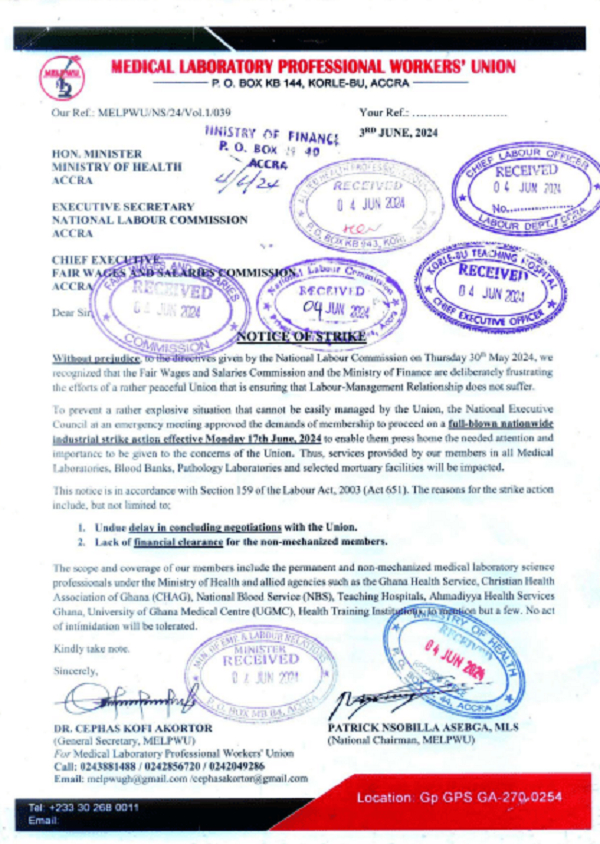
The Medical Laboratory Professional Workers’ Union (MELPWU) has announced a nationwide strike scheduled to commence on the 17th of June 2024.
Citing prolonged and stalled negotiations as the primary reason, the Union deemed the strike necessary.
In a notice, the Union stated, “Without prejudice to the directives given by the National Labour Commission on 30th May 2024, we recognize that the Fair Wages and Salaries Commission and the Ministry of Finance are deliberately frustrating the efforts of a rather peaceful union that is ensuring that Labour-Management relationship does not suffer,” the Union indicated in a notice.
The notice continued, “To prevent a rather explosive situation that cannot be easily managed by the union, the National Executive Council at an emergency meeting, approved the demands of membership to proceed on a full-blown industrial strike action effective Monday 17th June 2024 to enable them to press home the needed attention and importance to be given to the concerns of the union.
“Thus, services provided by our members in all medical laboratories, blood banks, pathology laboratories, and selected mortuary facilities will be impacted.”
“In light of the escalating situation, the National Executive Council, during an emergency meeting, sanctioned the membership’s demands to initiate a full-scale industrial strike action starting Monday, the 17th of June 2024. This action aims to draw attention to the concerns of the union.”
The strike is expected to affect services provided by members in medical laboratories, blood banks, pathology laboratories, and selected mortuary facilities.
The ongoing sit-down strike by the Ghana National Petroleum Tanker Drivers Union poses a significant risk of leaving over 400 million litres of fuel stranded at various petroleum loading terminals nationwide.
This development is expected to have a notable impact on around 3.5 million consumers across the country in the coming days.
The genesis of this standoff dates back to November 2023 when the union submitted a policy framework delineating the conditions of service for its members to the National Petroleum Authority (NPA) for review and approval.
Despite being crafted by a 21-member committee, this framework is still awaiting the NPA Board’s endorsement.
However, instead of granting approval, the Board has requested amendments to the framework without providing specific guidance on the required changes.
Despite repeated pleas for clarification, the committee has been left in the dark. Frustrated by the lack of communication, the committee has lodged a petition with the Presidency, hoping for a resolution.
The aggrieved tanker drivers are emphasizing the urgent need to implement the policy framework to ensure smoother operations and enhance their welfare.
She made him a cup of coffee, put on the shoes and headed off to school, a 10-minute walk away in the village of Let Yet Kone in central Myanmar. Shortly afterwards, her uncle recalls, he saw two helicopters circling over the village. Suddenly they started shooting.
Zin Nwe Phyo and her classmates had just arrived at the school and were settling down with their teachers, when someone shouted that the aircraft were coming their way.
They began running for cover, terrified and crying out for help, as rockets and ammunition struck the school.
“Children inside the main school building were hit by the weapons and began running outside, trying to hide,” said another teacher. With her class she managed to hide behind a big tamarind tree.
“They fired right through the school walls, hitting the children,” said one eyewitness. “Pieces flying out of the main building injured children in the next building. There were big holes blown out of the ground floor.”
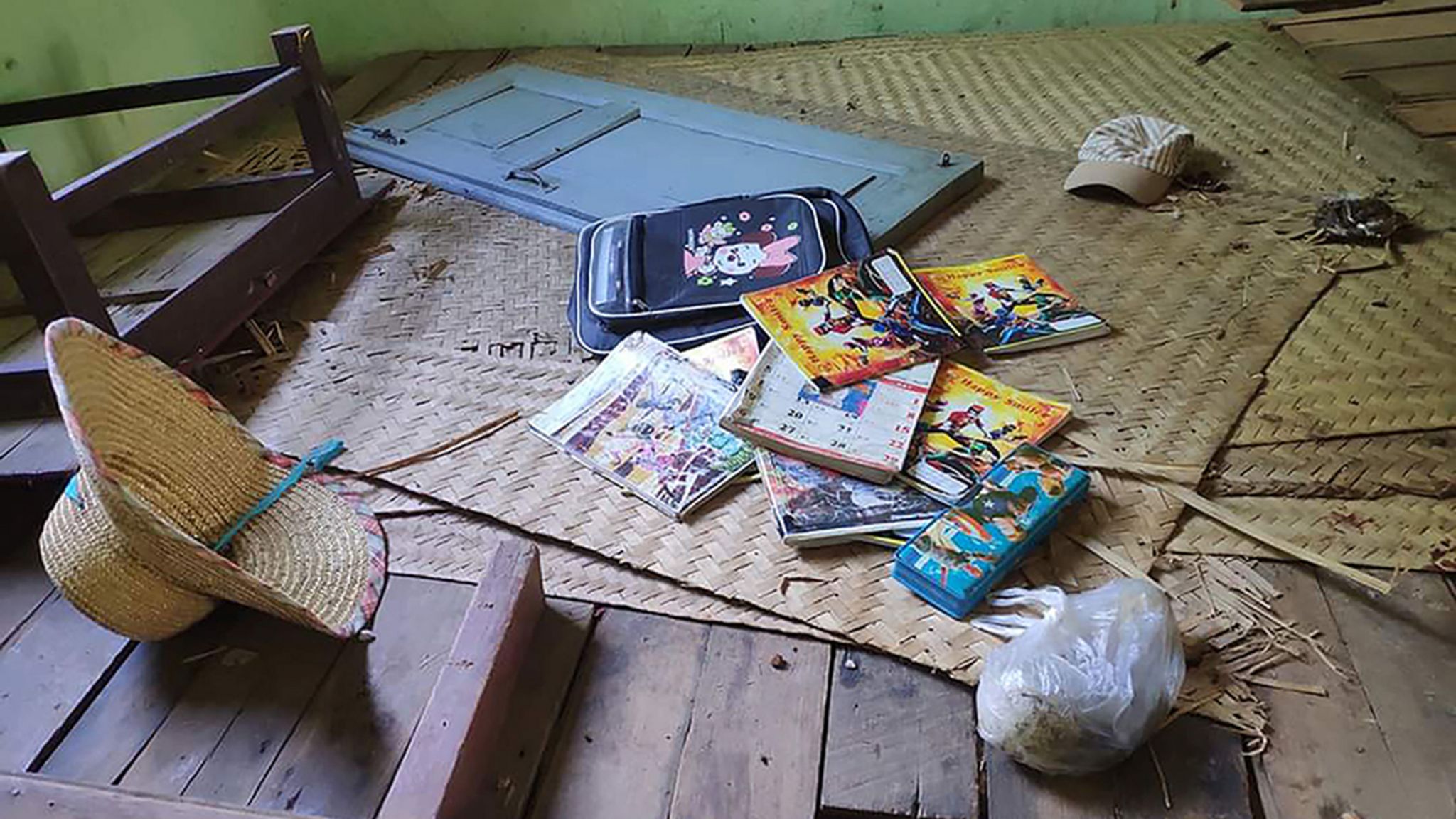
Image caption, Belongings on the floor of a classroom after the air strike
Their attackers were two Russian-made Mi-35 helicopter gunships, nicknamed “flying tanks” or “crocodiles” because of their sinister appearance and protective armour. They carry a formidable array of weapons, including powerful rapid-fire cannon, and pods that fire multiple rockets, which are devastating to people, vehicles and all but the strongest buildings.
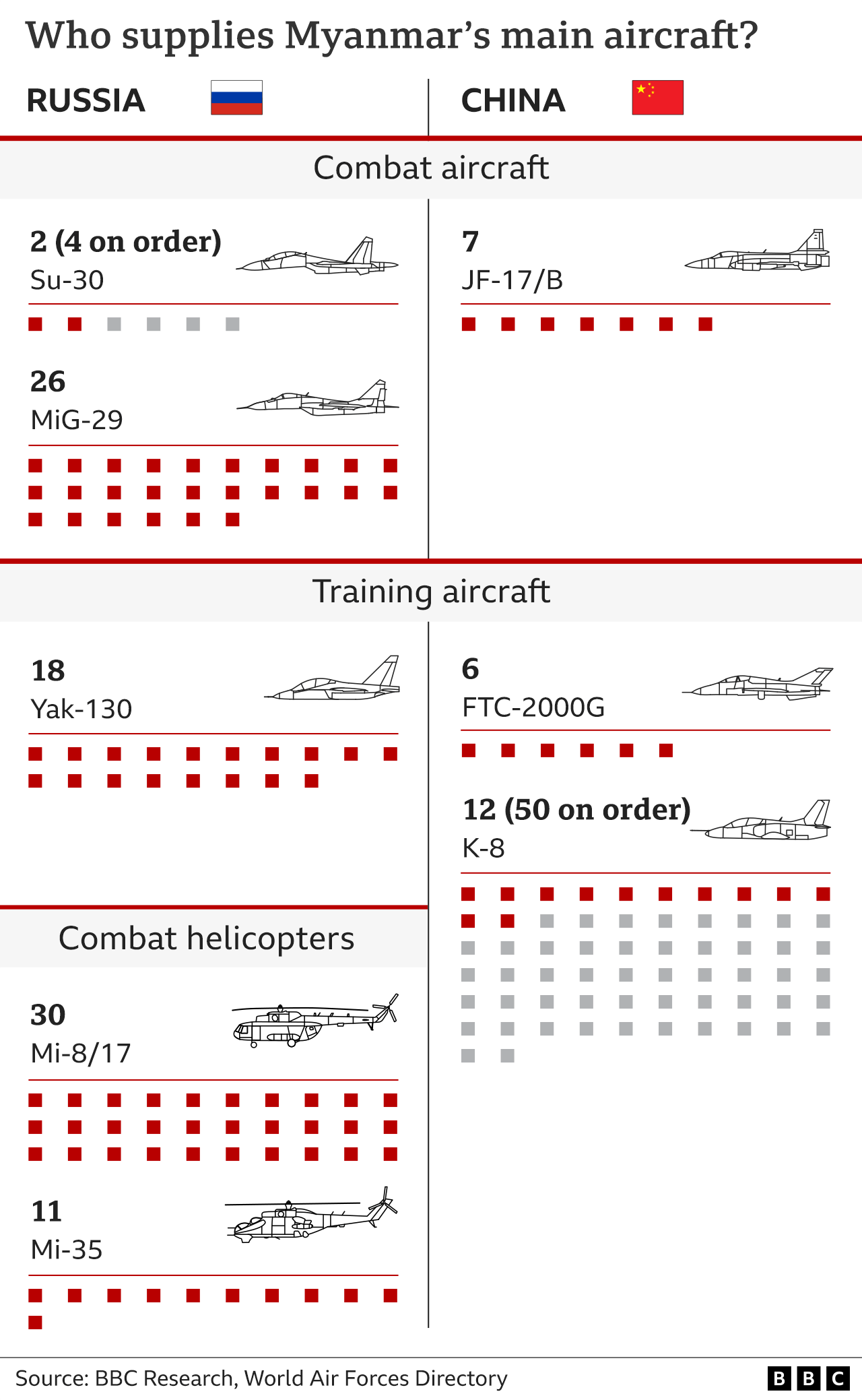
In the two years since Myanmar’s military ousted Aung San Suu Kyi’s elected government, air strikes like this have become a new and deadly tactic in a civil war that is now a brutal stalemate across much of the country, conducted by an air force which has in recent years grown to about 70 aircraft, mostly Russian and Chinese-made.
It’s hard to estimate how many have died in such air attacks because access to much of Myanmar is now impossible, making the conflict’s true toll largely invisible to the outside world. The BBC spoke to eyewitnesses, villagers and families over a series of phone calls to find out how the attack on the school unfolded.
The firing continued for around 30 minutes, eyewitnesses said, tearing chunks out of the walls and roofs.
Then soldiers, who had landed in two other helicopters nearby, marched in, some still shooting, and ordered the survivors to come out and squat on the ground. They were warned not to look up, or they would be killed. The soldiers began questioning them about the presence of any opposition forces in the village.
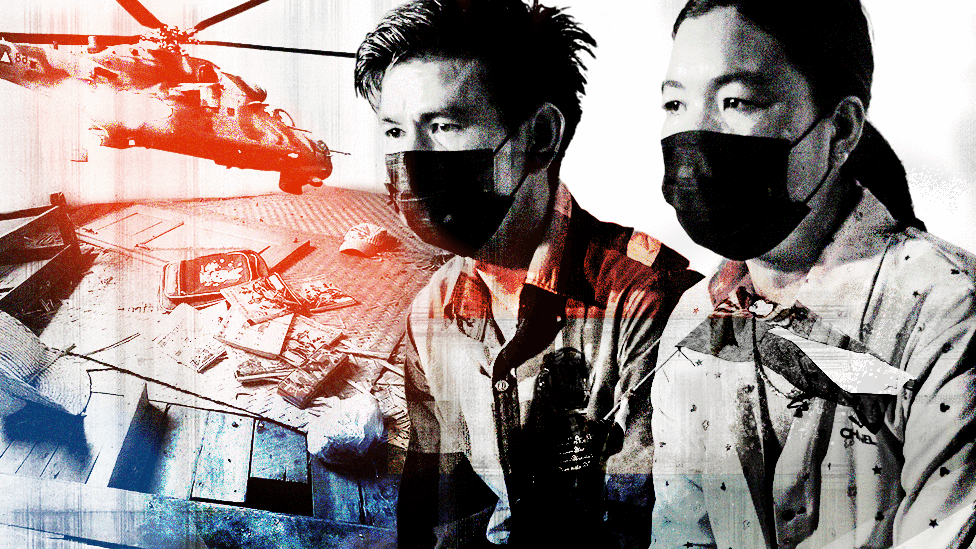
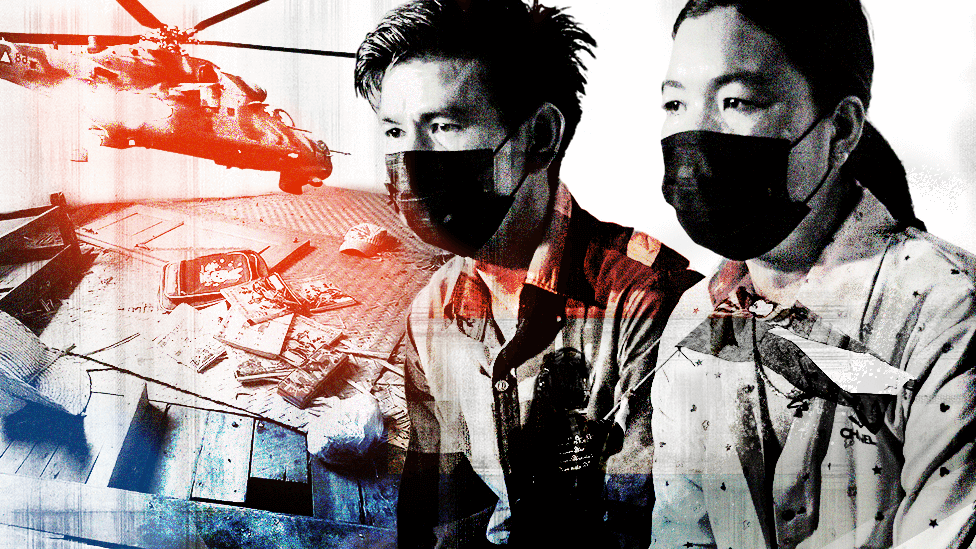
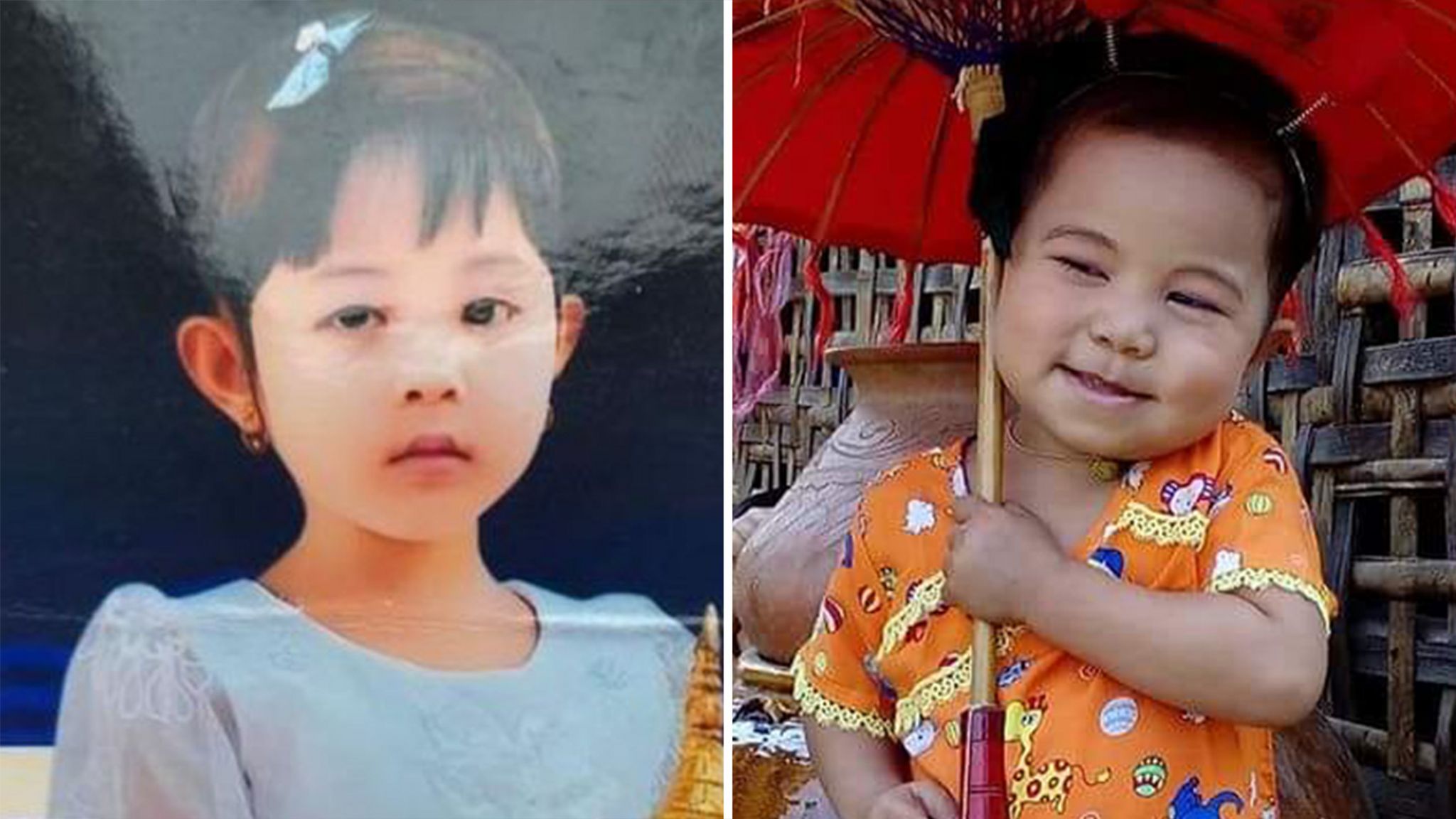
Image caption, Zin Nwe Phyo, 9 (L) and Su Yati Hlaing, 7
Inside the main school building three children lay dead. One was Zin Nwe Phyo. Another was seven-year-old Su Yati Hlaing – she and her older sister were being brought up by their grandmother. Their parents, like so many in this region, had moved to Thailand to seek work. Others were horribly injured, some missing limbs. Among them was Phone Tay Za, also seven years old, crying out in pain.
The soldiers used plastic bin liners to collect body parts. At least 12 wounded children and teachers were loaded on to two trucks commandeered by the military and driven away to the nearest hospital in the town of Ye-U. Two of the children later died. In the fields skirting the village, a teenage boy and six adults had been shot dead by the soldiers.
This is a country that has long been at war with itself. The Burmese armed forces have been fighting various insurgent groups since independence in 1948. But these conflicts were low-tech affairs, involving mainly ground troops in an endless tussle for territory in contested border regions. They were often little different from the trench warfare of a century ago.
It was in 2012 in Kachin state – just after the air force had obtained its first Mi-35 gunship – that the military first used aerial weapons extensively against insurgents. Air strikes were also used in some of the other internal conflicts which kept burning throughout Myanmar’s 10-year democratic interlude, in Shan and Rakhine states.
However, since the February 2021 coup, the army has suffered heavy casualties in road ambushes carried out by the hundreds of so-called People’s Defence Forces, or PDFs – volunteer militias that were established after the junta crushed peaceful protests against the coup.
So it has been forced to rely on air support – bombing by aircraft suitable for ground attack; or air mobile operations like the one at Let Yet Kone, where gunships blast targets before soldiers arrive to kill or capture any opposition forces they find.
There were at least 600 air attacks by the military between February 2021 and January 2023, according to a BBC analysis of data from the conflict-monitoring group Acled (Armed Conflict Location and Event Data Project).
Casualties from these strikes are difficult to estimate. According to the clandestine National Unity Government or NUG, which leads opposition to the military regime, air attacks by the armed forces killed 155 civilians between October 2021 and September 2022.
The resistance groups are poorly armed, with no capacity to fight back against the air strikes. They have adapted consumer drones to launch their own air attacks, dropping small explosives on military vehicles and guard posts, but to limited effect.
It is not clear why Let Yet Kone was targeted by the army. It is a poor village of around 3,000 inhabitants, most of them rice or groundnut farmers, set in the scrubby brown landscape of central Myanmar’s dry zone, where water is scarce outside of the monsoon season.
It is in a district called Depayin where resistance to the coup has been strong. Depayin has seen many armed clashes between the army and PDFs, although not, according to residents, in Let Yet Kone. At least 112 of the 268 attacks recorded by NUG were in southern Sagaing, where Depayin is located.
A spokesman for the military government said after the school attack that soldiers had gone to the village to check the reported presence of fighters from a PDF and from the Kachin Independence Army (KIA), and that they had come under fire from the school. This account is contradicted by every eyewitness who spoke to the BBC. The military has produced no evidence of insurgent activity at the school.
The school had been set up only three months earlier in the Buddhist monastery at the northern edge of the village. It taught around 240 pupils. Residents told the BBC that it is one of more than 100 schools in Depayin which are now being run by communities opposing military rule.
Teachers and health workers were among the earliest supporters of the civil disobedience movement. In one of the first and most widely-supported acts of defiance against the coup, state workers vowed to withdraw all co-operation with the new military government. As a result a lot of schools and health centres are now being run by communities, not the government.
Phone Tay Za’s mother says she heard the shooting and explosions start about 30 minutes after she had seen her son off to school. But, like Zin Nwe Phyo’s uncle, she assumed it could not be the target of the helicopter gunships.
“After the sound of the heavy guns firing died down I headed toward the school”, she said. “I saw children and adults squatting on the ground with their heads lowered. The soldiers were kicking those who turned their heads up.”
She begged the soldiers to let her look for her son. They refused. “You people care when your own get shot,” one told her, “but not when it happens to us.”
Then she heard Phone Tay Za calling out to her, and they let her go to him inside the ruined classroom.
“I found him in a pool of blood with eyes blinking slowly. He said, ‘mom, just kill me please.’ I told him he would be fine. ‘You will not die’.”
“I cried my heart out, shouting ‘how dare you do this to my son’. The whole monastery compound was in absolute silence. When I shouted, it echoed through the buildings. A soldier yelled at me not to scream like that and told me to stay still where I was. So I sat there in the classroom for about 45 minutes with my child in my arms. I saw three children’s dead bodies there. I did not know whose children they were. I could not look at their faces.”
Phone Tay Za died shortly afterwards. The soldiers refused to let his mother keep his body and took it away. The bodies of Zin Nwe Phyo and Su Yati Hlaing were also taken by the military, before their families could see them, and later secretly cremated.
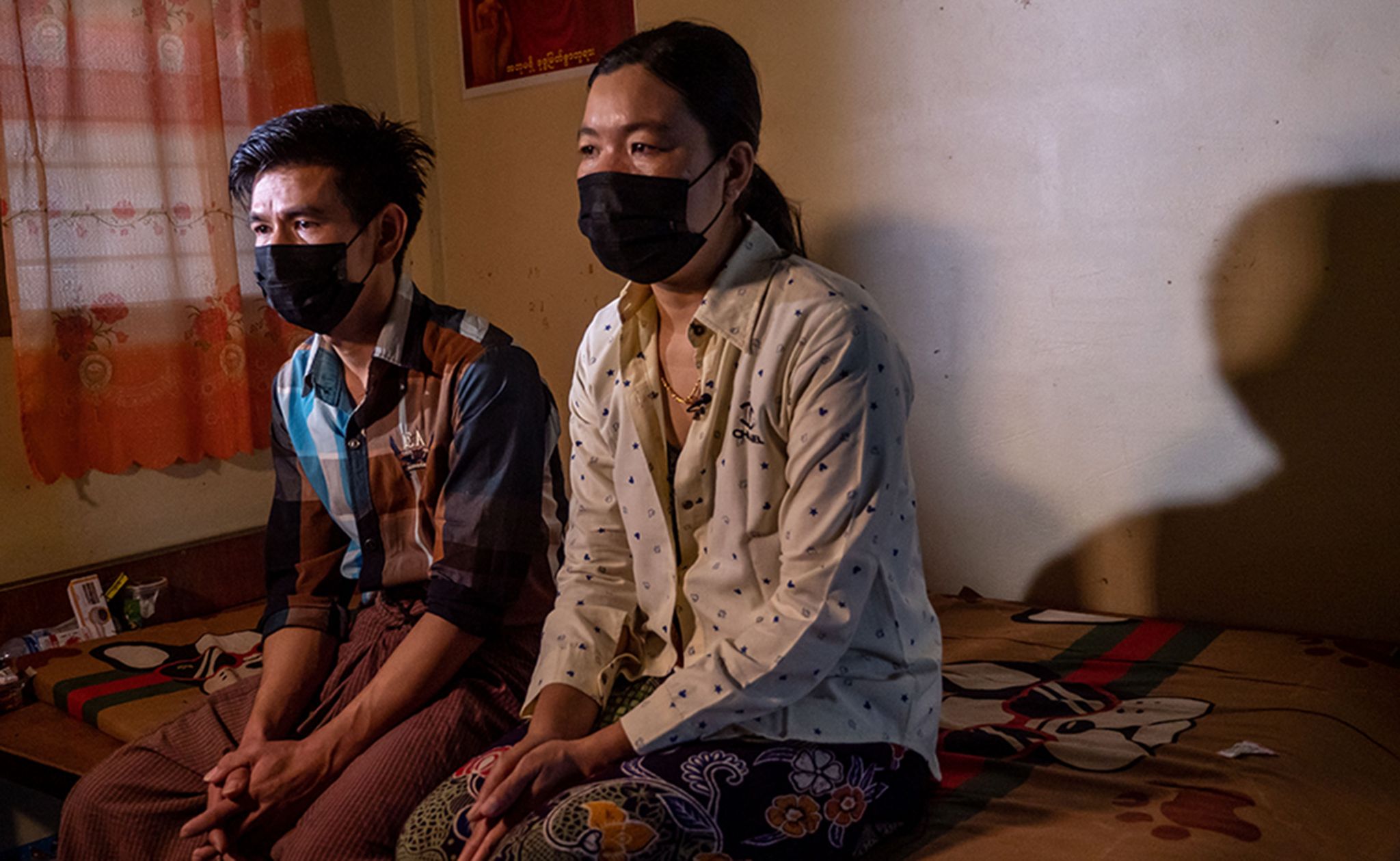
A thousand kilometres away in Thailand Su Yati Hlaing’s parents were working their shifts in the electronic components factory when they heard that the military had attacked their village.
Image caption, Su Yati Hlaing’s parents were working in Thailand in the hope of earning enough to give her a better life
“My wife and I were in agony. We could not concentrate on our work anymore,” her father said.
“It was around 2:30 in the afternoon so we could not leave. We kept working, with heavy hearts. Colleagues asked us if we were ok. My wife could not hold her tears anymore and started crying. We decided to not do the usual overtime that day and asked our team leader to go back to our room.”
Later that evening they got a call from Su Yati Hlaing’s grandmother telling them she had been killed.
The attack in Let Yet Kone drew international rebuke and horror, but the air strikes continued.
On 23 October air force jets bombed a concert in Kachin State commemorating the anniversary of the start of the KIA insurgency.
Survivors say three huge explosions ripped through the large crowd which had gathered for the event, killing 60 people, including senior KIA commanders and a popular Kachin singer. Many more are thought to have died in the following days after the army blocked the evacuation of those who had been seriously injured in the attack.
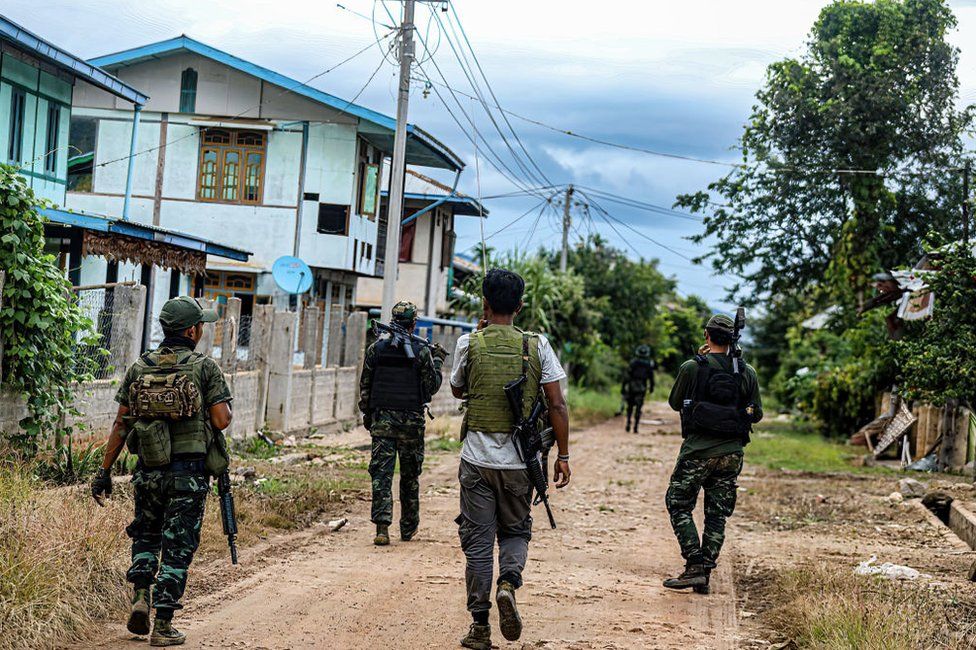
Image caption, PDFs or volunteer militias have inflicted heavy casualties on the Burmese forces
At the other end of the country the air force bombed a lead mine in southern Karen State, close to the border with Thailand, on 15 November, killing three miners and injuring eight others. The junta spokesman justified the attack on the grounds that the mining was illegal, and in an area controlled by the insurgent Karen National Union.
And only last month, the air force bombed the main base of the insurgent Chin National Front, next to the border with India. It also launched air strikes which hit two churches in Karen State, killing five non-combatants.
This increased capacity for aerial warfare is being sustained by continued support from Russia and China after the coup, despite many other governments ostracising Myanmar’s military regime.
Russia, in particular, has stepped up to become its strongest foreign backer. Russian equipment, like the Mi-35 and the agile Yak-130 ground attack jets, are central to the air campaign against insurgents. China has recently supplied Myanmar with modern FTC-2000 trainers, aircraft which are also well-suited for a ground attack.
The high death toll in such attacks has drawn the attention of war crimes investigators. The Myanmar armed forces have often been accused of such crimes in the past – often abuses by ground troops, particularly against the Rohingyas in 2017. But the use of air power brings with it new types of atrocities.
For the survivors of Let Yet Kone, the nightmare did not end on 16 September.
They say many of the children and some of the adults are still traumatised by what they saw that day. The military has continued to target their village, attacking it again three more times, and burning down many of the houses.
This is a poor community. They do not have the resources to rebuild, and in any case they do not know when the soldiers will be back to burn them again.
“Children are everything for their parents,” says one local militia leader. “By killing our children, the military has crushed them mentally. And I must say they have succeeded. Even for me, I will need a lot of motivation to carry on the revolutionary fight now.”
Su Yati Hlaing’s parents are still in Thailand, unable to return after their daughter’s death. They cannot afford the cost of the journey, nor the risk of losing the factory jobs they had always hoped would give their little girl a better life.
“There were many things I had imagined,” says her mother. “I imagined that when I finally went back I would live happily with my daughters, I would cook for them, whatever they wanted. I had so many dreams. I wanted them to be wise and educated, as much as we, their parents, are uneducated. They were just about to begin their journey. My daughter did not even get our affection and warmth closely, because we were away so long. Now, she is gone for forever.”
The BBC analysed attack data from the Armed Conflict Location & Event Data Project (Acled), which collects reports of incidents related to political violence and protests around the world. Aerial attacks have been defined as conflict events involving aircraft in specific locations either during an armed clash or as an independent strike. The data covers the period 1 February 2021 to 20 January 2023.
Despite Washington‘s denial, Iranian state television has accused the US of being behind the attacks.
According to a Syrian war monitor, Iranian state television, and Iraqi paramilitary officers, air attacks have hit eastern Syria along the Iraqi border, killing Iran-backed fighters.
The number of casualties has not been confirmed, but according to two Iraqi paramilitary officers, some of those killed in the attack late Tuesday were Iranian nationals. According to the Syrian Observatory for Human Rights, at least 14 people were killed in the raids, the majority of whom were fighters.
According to the Syrian Observatory, the attacks targeted a convoy of “fuel tankers and trucks loaded with weapons” for the fighters in Syria’s eastern province of Deir Az Zor.
It is not yet clear who was behind the raid but the United States military has carried out similar attacks in the past.
The US military has, however, so far denied involvement. Army Major Rachael L Jeffcoat said that “no US forces or US-led coalition (members) conducted an airstrike in al-Qaim, Iraq, on the border with Syria”.
The convoy of 22 tanker trucks was travelling from Iran to Lebanon, an official in the Iraqi border guard said. Ten trucks were hit, of which four were “completely burnt”, after entering Syrian territory through the Al-Qaim – Abu Kamal border crossing.
The Deir Ezzor 24, an activist collective, reported three air strikes targeting Iran-backed militias in the Syrian border town of Abu Kamal and nearby areas. It had no immediate word on casualties.
Earlier, members of Iraqi paramilitary groups operating in the area said an air attack on a convoy carrying fuel across the Iraqi border into Syria killed at least 10 people late on Tuesday.
Iranian state television Press TV claimed the convoy was carrying Iranian oil to Lebanon through Syria, but offered no casualty details. It also claimed that the convoy attack was carried out by US drones and helicopters, adding that the attack took place after eight of the trucks had crossed into Syria.
Iran is a major supporter of Syria’s President Bashar al-Assad, sending thousands of fighters to help Syrian government troops in the country’s 11-year war against the country’s opposition.
In August, the US military carried out air raids in Deir Az Zor targeting Iran-backed fighters after a rocket attack left several US soldiers lightly wounded. At least two fighters described by US Central Command as “suspected Iran-backed militants” were killed. The Pentagon said the strikes were a message to Iran.
Fresh air strikes against Ethiopia’s northern Tigray region killed at least six people on Tuesday, an aid worker told the BBC, with rebel forces accusing neighbouring Eritrea of carrying out the attack.
The Eritrean government, whose troops previously fought alongside Ethiopian soldiers in the region, has not responded to the accusation.
Tuesday’s attack targeted Adi-Daero town, located near the Eritrean border, the aid worker said.
He added that he saw people injured in the attack being taken to hospital by an ambulance.
The Tigrayan authorities say the air strikes were carried out “repeatedly” on Tuesday and destroyed residential houses.
The regional media run by the Tigray authoritiesaired footage of the devastation caused by the alleged attack.
The BBC is unable to verify the events. All means of communication have been cut off in the region and journalists have been denied access to the region.
However the BBC has analysed satellite images showing a major military build-up around Shiraro, a border town the Tigray forces had reportedly lost a few weeks ago.
The satellite images taken this month show troops and heavy artilleries positioned along the border between Ethiopia and Eritrea.