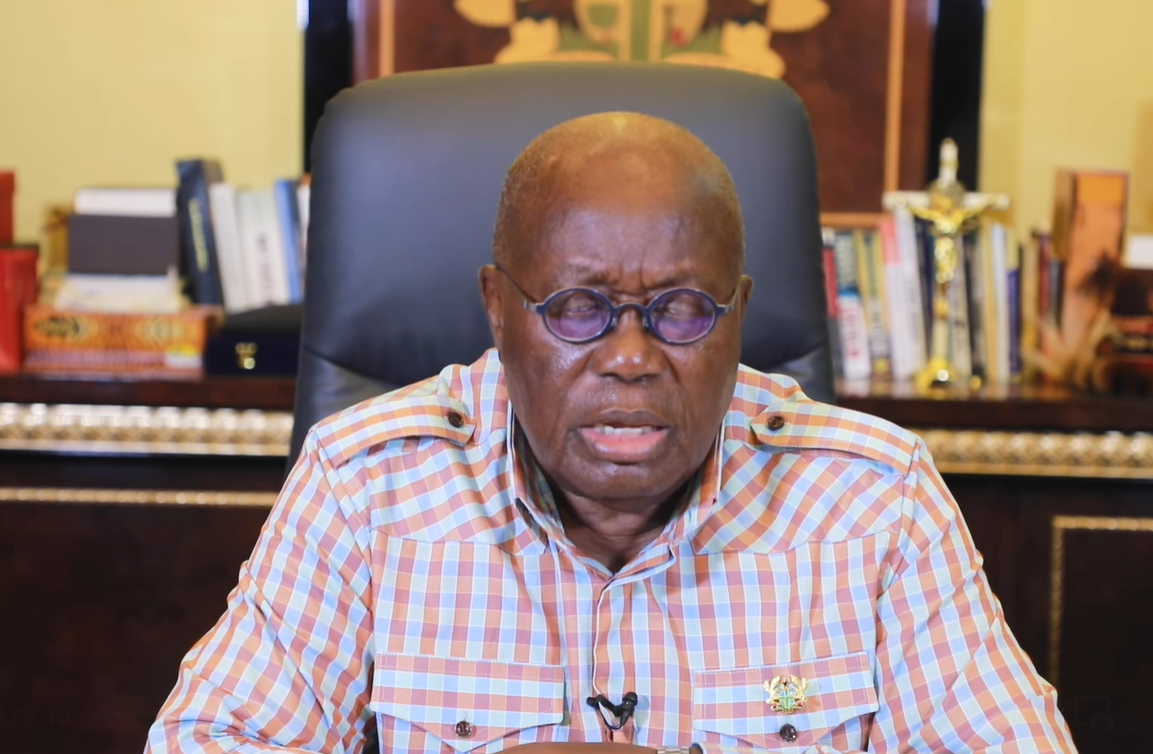
President Nana Addo Dankwa Akufo-Addo has praised the increasing influence of South African businesses in Ghana within the framework of the African Continental Free Trade Area, amid calls for heightened investment in Ghana.
With Ghana’s exports to South Africa soaring to a record US$546 million worth of products, compared to imports from South Africa totaling around US$413 million, President Akufo-Addo’s initiatives have yielded significant dividends for trade relations between the two countries.
The Akufo-Addo administration’s efforts towards this upward trend received a significant boost with the state visit of President Cyril Matamela Ramaphosa to Ghana in December 2021. During this visit, both countries decided to elevate their bilateral relations from the Permanent Joint Commission for Cooperation (PJCC) to the Bi-National Commission (BNC).
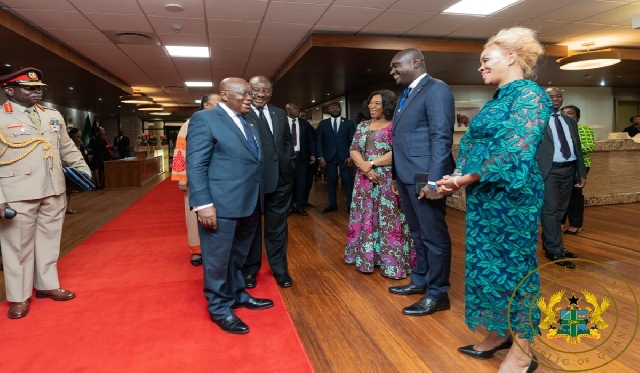
Speaking at the closing ceremony of the Ghana-South Africa Business Forum on Tuesday, March 12, 2024, in Johannesburg, South Africa, President Akufo-Addo highlighted the establishment of a Joint Trade and Investment Commission (JTIC) as part of the Bi-National Commission.
This commission aims to implement the Memorandum of Understanding (MoU) on Economic and Technical Cooperation, among other key initiatives, to enhance economic and trade relations between Ghana and South Africa.
Expressing satisfaction with the fruitful connections, partnerships, and achievements resulting from the forum, President Akufo-Addo commended government officials, experts, and industry leaders from both countries for their dedication to ensuring a successful business gathering.
He described the timing of the event as opportune, especially coinciding with South Africa’s official launch of preferential trading under the AfCFTA agreement, which he believes will further strengthen economic ties between the two nations.
“is expected to lead to diversification of exports, increased productivity and capacity, acceleration of economic growth, investments, the creation of employment opportunities, and, most importantly, broaden economic inclusion in South Africa and the rest of the continent.”
“Today, it is safe to say that the AfCFTA framework has provided a unique advantage for intra-African trade and Ghana is at the forefront of implementing this agreement,” he added.
He noted that, with Ghana trading amongst a number of African countries, including South Africa, Kenya, Tanzania and Cameroon under the AfCFTA Guided Trade Initiative (GTI), which was launched in 2022 to pilot the implementation of the AfCFTA agreement, he said, “the Initiative, which allows commercially meaningful trading, and tests the operational, institutional, legal and trade policy environment under the AfCFTA, has thrown more light on how to create an enabling environment for the private sector to thrive and foster economic relations among Africa countries.”
“I am confident that Africa would be able, finally, to take a front row seat in the global market with the full commitment of Member States towards the implementation of the AfCFTA,” he urged.
On Ghana’s enviable business climate, he told that gathering that, “Ghana is a haven of peace, security and stability, indeed, the safest country in West Africa. Legitimate investments are protected. We are a country where the principles of democratic accountability and respect for the rule of law, individual liberties and human rights are now firmly entrenched in our body politic, and where the separation of powers is real in promoting accountable governance under the rule of law.
Based on the firm conviction of his New Patriotic Party government on the crucial role of the private sector in the development of our national economy, he pointed out that, “government’s ongoing digitalization drive is formalising the Ghanaian economy, reducing the cost of doing business, and facilitating interactions between businesses.”
He said, “it has enabled Ghana streamline the processes and procedures of many service providers, including e-business registration systems at the Registrar General’s Department, paperless port clearance system at our ports, the implementation of mobile money interoperability to provide wider access to financial services electronically, a digital addressing system with unique addresses for all properties in Ghana, and now a performance tracker that allows citizens track the progress of projects or initiatives undertaken by Government.”
“The implementation of Government’s flagship programmes, such as the Programme for Planting for Food and Jobs; “One District, One Factory” initiative; the Planting for Food and Export Programme; the Port Modernisation Programme; the Industrial Transformation Agenda; the nascent Automotive Development Sector; the development of an Integrated Bauxite Aluminum Industry; the development of an Integrated Iron and Steel Industry; the Ada Songhor Salt Development Project; and the new Integrated Trade Facilitation and Customs Management System (ICUMS/UNIPASS) are all interventions designed to transform the Ghanaian economy, and help position Ghana as the manufacturing hub of West Africa,” he added.
He also welcomed South African investments and participation in undertaking many infrastructural projects, such as the Keta Port Project, aimed at decongesting the Tema and Takoradi Ports.
Reminding them of the fiscal incentives in Ghana for investors, he said, “not only is Ghana the best place for doing business in West Africa, but she is also the preferred destination for a perfect blend of mineral resource potential, stable regulatory environment, favourable fiscal regime, and socially responsive mining in Africa” and urged the private sector in South Africa to take advantage of the business-friendly climate in the country to invest in Ghana.