Tag: Alan Kyerematen

  • FULL TEXT: Alan Kyerematen officially announces presidential ambition

    FULL TEXT: Alan Kyerematen officially announces presidential ambition

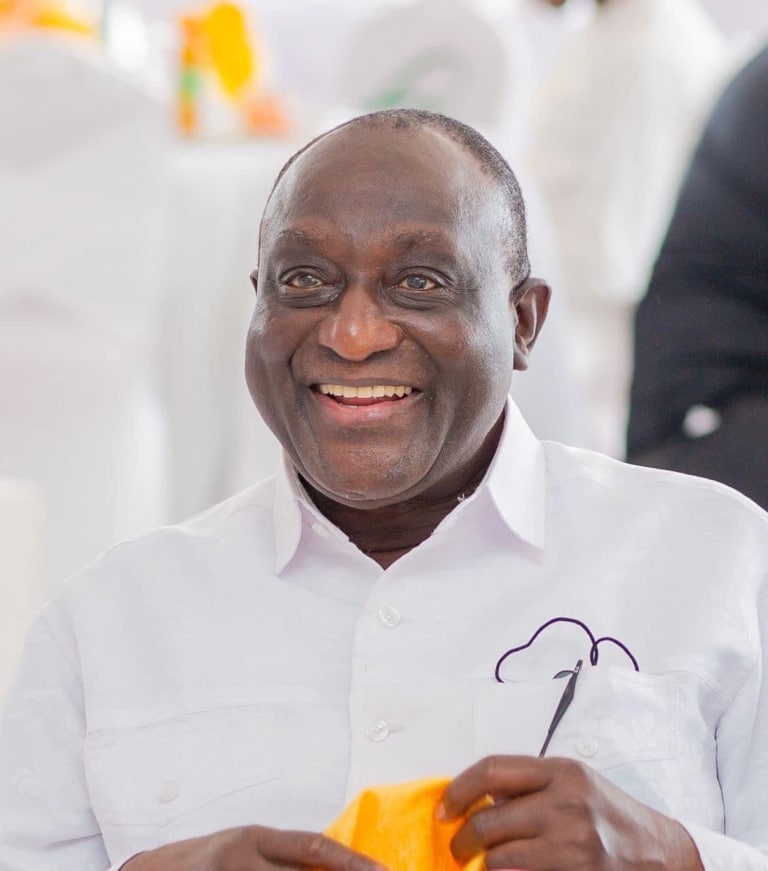
    Former Trade Minister, Alan Kyerematen, has finally informed Ghanaians the reason behind his decision to resign from post.

    On Tuesday, Mr Kyerematen noted that he resigned last week Thursday in order to focus on his presidential ambition.

    He hopes to run on the ticket of the governing New Patriotic Party (NPP) in 2024.

    Below is the full speech delivered by the former minister:

    NATIONAL BROADCAST BY HON. ALAN KYEREMATEN, OUTGOING MINISTER FOR TRADE & INDUSTRY

    • FELLOW COUNTRYMEN & WOMEN
    • FRIENDS OF GHANA

    Let me start first by wishing you all a happy, healthy, productive and a prosperous New Year.

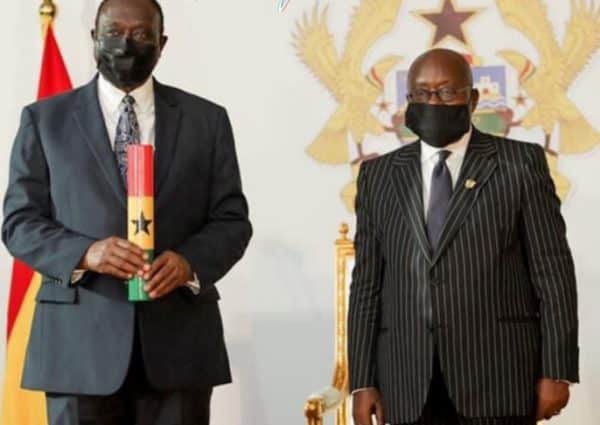
    Secondly, I wish to express formally, my profound gratitude to His Excellency the President for the opportunity given me to serve the good people of Ghana in his Administration over the last six years, and for graciously accepting my resignation as Cabinet Minister responsible for Trade and Industry, with effect from 16th of January 2023.

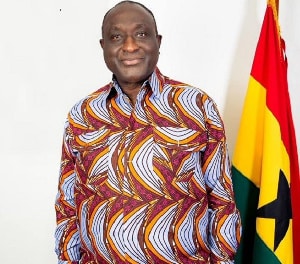
    Thirdly, I wish to use this platform to formally announce my decision to contest the flagbearership of the New Patriotic Party when the Party officially opens nominations for that purpose.

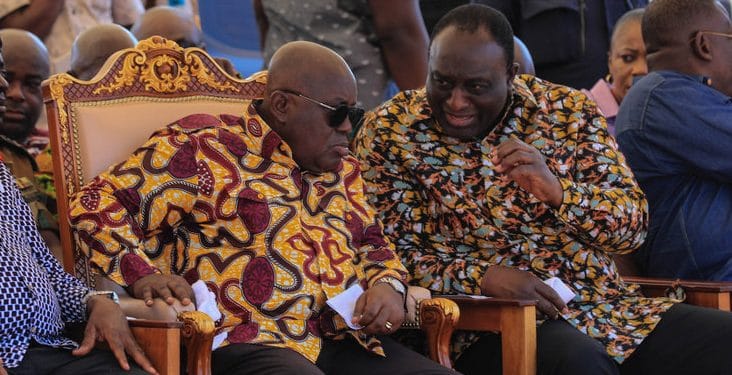
    His Excellency the President, Nana Addo Dankwa Akufo-Addo has been a good friend of mine and will always remain so based on our shared commitment to the ideals and principles that inspired the founding fathers of our great Party, the New Patriotic Party (NPP). We have competed in the past but have always worked together thereafter.

    The President has laid a strong foundation for the socioeconomic development of our country, although I believe there are things that could have been done differently. My vision is to build a superstructure on this foundation that will bring prosperity to our nation.

    The pre-COVID-19 performance of our economy, the flagship programmes including the Free SHS, the One District One Factory (1D1F) Initiative, the Planting for Food and Jobs programme, the Agenda 111 project and the COVID-19 Response initiatives, are all testimonies of the strong leadership that the President has provided over the last six years.

    In spite of all of the above however, it is an undeniable fact that the combined effect of the COVID-19 Pandemic and the Russia-Ukraine war has stampeded our country into a crisis of unprecedent proportions, with its negative impacts on the economy, on businesses, and on our social lives.

    I have no doubt that the anticipated International Monetary Fund (IMF) Support Package will restore confidence in our economy, and bring it back to the pre-COVID levels.

    Fellow Countrymen and Women
    This is the seventeenth time that we have gone to the IMF over the last 57 years. We promised never to go back but we have gone back. One of the lessons that we have learnt from the recent developments is that Ghana’s economy is still fragile, vulnerable and susceptible to both external and domestic shocks.

    This primarily is as a result of the fact that our economy is highly dependent on the export of commodities with little or no value addition. Indeed, the 5.1% projected GDP growth for the Ghanaian economy for 2023 is based on the anticipated increase in commodity prices.

    To avoid going back to the IMF, we need a new Plan. A Plan that will lead us to a more self-reliant and resilient economy. That Plan must move Ghana from Stability and Growth to Transformation.

    Fellow Countrymen and Women
    If by the will of God and through your goodwill, I am voted first, as the flagbearer of the NPP and subsequently as President of the Republic in the next general elections, I will become the transformational leader of our time, who will build on the foundations laid by successive leaders of our nation over the last sixty-five (65) years.

    To achieve this strategic goal of transforming our dear country to become the shining star of the new Africa, I will as President, launch and lead the execution of the Great Transformational Plan (GTP) of Ghana which will span the period 2025 to 2030.

    The Post-COVID Economic Recovery Programme (P-CERP) currently being implemented with the anticipated support from the IMF from 2023 to 2025, will be a transitional economic programme leading to the roll out of this Great Transformational Plan.

    Fellow Countrymen and Women
    Before I proceed to provide a brief insight into the key elements of the Great Transformational Plan, seven critical considerations would need to be taken into account to guarantee the success of the Plan.

    1. The primacy of the Private Sector in our national development agenda. The Private Sector, both domestic and foreign, formal and informal has to be at the centre of our transformational agenda. The Government’s focus must be to facilitate the process of making our private sector competitive, by creating an enabling environment for businesses.
    2. Attitude to work and enforcement of discipline. We as a people should appreciate the need for discipline in all spheres of our national lives and change our attitude to work. Whether you are working for the Private sector or for Government, as a worker, you are not doing a favour to your employer. It is your duty to ensure that you earn your living from the efforts of your labour.
    3. Corruption and petty theft or thievery, particularly from the public purse, deny our country the benefit of utilizing its tax revenue and other resources for the development of our country.
    4. The arrogance of power has been a major obstruction to progress in our country. People in positions of authority must understand that leadership is an opportunity to serve the people, and not to lord over them. In servant leadership, humility is an asset and not a weakness.
    5. Passion for excellence. As a country we must celebrate competence and excellence and not mediocrity.
    6. As a people, we must focus more on getting things done than talking. Ghana is gradually becoming a NATO country – “No Action Talk Only”. We need to remember that the use of time is a zero-sum game. What Ghana needs now are solutions and actions not debates.
    7. And last but not the least, our politics in Ghana is too divisive. This keeps out some of our best talents in offering themselves for political appointments. Yes, we pride ourselves as being the bastion of democracy in Africa, but that does not mean that we should allow partisan politics to destroy our collective interests.

    These seven critical considerations outlined above, will provide what I will describe as the ‘soft power’ for the effective implementation of our Great Transformational Plan.

    Fellow Countrymen and Women,
    Let me now provide a brief synopsis of the Great Transformational Plan (GTP). The GTP will be anchored on the following key pillars:

    1. A Strong Macroeconomic Environment: The success of the GTP will depend primarily on strong macroeconomic fundamentals, which will include among other things, a stable currency, low inflation, sustainable debt levels, revenue optimization and tight expenditure control to guarantee fiscal balance, low competitive interest rates, strong external reserves backed by high levels of liquidity to support the financial sector.
      To a large extent, the IMF support programme when fully executed, will create the appropriate conditions that will underpin the Great Transformational Plan.
    2. A New Agricultural Revolution (NAR) for Ghana: The NAR will be based on five critical elements.
      i. Optimizing Value to Farmers by the establishment of Farmer-owned Large Scale Commercial Farms and Processing Facilities which will bring the full benefits of the agriculture value chain to farmers.
      ii. Introducing Technology and Innovation into Agriculture, through Research & Development (R&D) in Agronomy, Mechanization, Irrigation, and Plantation Management. This will build on the foundation laid by the Planting for Food and Jobs and Planting for Export and Rural Development (PERD) Programmes. Our farmers cannot be competitive without technology and innovation.
      iii. The establishment of Licensed Food Distribution and Marketing companies by the Private Sector throughout the country at the district level, to be supported by the Government. These companies will constitute a vital link between farmers and Market Queens in the urban and peri-urban areas. It will be complemented by the introduction of a digitalized food distribution and marketing online platform which will connect producers to buyers and consumers.
      iv. The strengthening of the Ghana Commodity Exchange as the marketplace for all actors in the Agricultural value chain.
      v. Deepening the current regime for lending and financing for the agricultural sector.
      vi. Enhancing the de-regulation of the Cocoa sector by deepening private sector participation in the buying and marketing (including export) of Cocoa.
      vii. Mass Citizens participation in Agriculture by introducing an ‘Operation Own a Farm’ programme for the Ghanaian citizenry in general.
    3. Industrial Transformation: This will build on the successes of Government’s Ten Point Industrial Transformation Programme including the One District One Factory (1D1F) initiative; the establishment of Strategic Anchor Industries to diversify the economy beyond Cocoa and Gold e.g the Automobile assembly, Garment and Textiles, Pharmaceuticals and the Petrochemical industry; enhancing the growth and development of Small and Medium Enterprises; establishment of Industrial Parks and Special Economic Zones; and supporting Domestic Retail Trade and Distribution.
    4. Accelerated Infrastructure Development: Promoting Private sector financing for public infrastructure such as Roads, Railways, Ports and Harbours, Water Supply Systems, Public Housing etc, which will reduce Government’s exposure to the financing of such infrastructure projects.
    5. Digital Mainstreaming: Digitalization will be mainstreamed in all Government and Public sector activities, building on the current work led by the Ministry of Communication and Digitalization.
    6. Energy Security and Diversification: Greater emphasis to be placed on developing renewable sources of energy, by fast-tracking the execution of Government’s energy transition strategy, including but not limited to nuclear and hydrogen energy.
    7. Decarbonization and Climate Resilience: Scaling up Government’s current efforts at reducing Ghana’s carbon footprints and facilitating access to the carbon trading markets, as well as establishing mechanisms to strengthen the country’s preparedness against the negative effects of climate change.
    8. National Security and Defence Optimization: Deploying resources to strengthen National Security and Defence Mechanisms and Infrastructure, to deal substantively with emerging security threats and challenges, particularly in the Sahalian region.
    9. Downsizing Government: The architecture of Government will be overhauled by consolidating some existing Ministries, Departments and Agencies. This will mean running a lean Government structure that will ensure operational efficiency and effectiveness in the delivery of Government services.
    10. Strategic Engagement with the International Community: Ghana’s diplomatic and economic relations with the International Community under the GTP will be predicated on the principle of ‘positive neutrality’, based on the strategic interests of Ghana, as well as our shared commitments for the preservation of peace around the world and respect for humanity.
      I will in the next several months provide further details of this Great Transformational Plan in the new ‘Alan K Prime Time Talk Show’ to be introduced. I will also seek inputs from the people of Ghana as I go round in the regions and districts on my campaign tours.

    Fellow Countrymen and Women
    The execution of the GTP will require our collective efforts, irrespective of political orientation, ethnicity or religion. It will lead to a new dawn of Restoration, Rebuilding and Reward.

    The future of our country is bright. I want you fellow countrymen and women, to make me your next President when the time comes, and you will see a significant difference in your lives.

    Fellow Countrymen and Women,
    I want you to invest in your own future by supporting my campaign. I will therefore be launching a mass “Ketewa biara nsua” Campaign and “Adopt a Constituency Initiative”, which will afford Ghanaians from all walks of life the opportunity to be part of my campaign.

    For all those who will have the honour and privilege of being Delegates to select the Flagbearer of our great Party, the NPP, please remember, Alan Kyerematen is your Candidate to win power for you in 2024.

    Together We shall break the Eight!

    As we do say in our local Ghanaian dialects:
    • #Akyea na emmui (symbolizing Hope)
    • #Mu sadaqa da yo; saboda anfaani go be! (Let’s Sacrifice for the future)
    • # Èkpè deka metuna hò(r) o! (a symbol of unity and collective effort)
    • # Mòfiaamò baaye nii! (we shall all enjoy)

    God bless our homeland Ghana and make our nation great and strong!!

    I thank you for your kind attention.
  • Ghana, as well as sub-regional and continental blocs, benefit from Alan Kyerematen

    Ghana, as well as sub-regional and continental blocs, benefit from Alan Kyerematen

    The outgoing minister of trade and industry, Alan Kyerematen, has been praised by the Ghana Union of Traders Association (GUTA) as a benefit to Ghana, Africa, and the entire world.

    The Union highlighted in a statement sighted by GhanaWeb Business that Alan Kyerematen’s resignation was somewhat unexpected but lauded the minister for being a humble servant and having good people skills.

    “All those who know him and happen to have come in contact with this affable gentleman will attest to the fact that he is an astute politician, a very humble public servant, versed in his area of duty, coupled with excellent human relations which have endeared him to all who have happened to meet him on matters of trade and industry, especially, those of us in the private sector,” the statement by GUTA read.

    “We can confidently say that he has performed excellently and left an indelible footprint that will ever remain in our memories. So, we see him as an asset not only to Ghana but also to the sub-regional and continental blocs, as well as the entire globe,” it added.

    On January 7, 2023, Alan Kyerematen broke his silence after resigning from his position as Trade and Industry minister in the Nana Addo Dankwa Akufo-Addo administration.

    “I would like to thank H.E the President for the opportunity to serve and for graciously accepting my resignation as Cabinet Minister responsible for Trade and Industry, effective 16th January, 2023,” he wrote via Twitter.

    “I sincerely appreciate the support from my family, colleagues, my party the NPP, the international community, and the general public during my tenure as a Minister,” Alan Kyeremanten added.

    This came after President Nana Addo Dankwa Akufo-Addo on January 6, 2023, accepted the resignation of Alan Kyerematen after reports emerged that he tendered his resignation on January 5, 2023, after he personally informed the president of the move.

    Although there are no clear reasons for Alan Kyerematen’s resignation, it is believed that he did so on the basis of contesting in the flagbearership race of the New Patriotic Party (NPP) ahead of the 2024 general elections.

    President Akufo-Addo has since directed Finance Minister, Ken Ofori-Atta to serve as the caretaker Minister of Trade and Industry until a substantive minister is appointed for the ministry.

  • Appoint another competent, hardworking person as Trade Minister – GUTA tells Akufo-Addo

    Appoint another competent, hardworking person as Trade Minister – GUTA tells Akufo-Addo

    The Ghana Union of Traders Association has appealed to President Nana Addo Dankwa Akufo-Addo to appoint a person of the same stature as Mr Alan Kyerematen to be the next Minister of Trade and Industry following the resignation of Mr Kyerematen.

    The union indicated that Mr Kyerematen did an excellent job while in office therefore, they expect the new substantive appointee to follow suit.

    “The Ghana Union of Traders’ Associations (GUTA) is deeply saddened by the news of the sudden resignation of the Trade and Industry Minister, Hon. Alan Kyerematen.

    “All those who know him and happen to have come in contact with this affable gentleman will attest to the fact that he is an astute politician, a very humble public servant, versed in his area of duty, coupled with excellent human relations which have endeared him to all who have happened to meet him on matters of trade and industry, especially, those of us in the private sector.

    “We can confidently say that he has performed excellently and left an indelible footprint that will ever remain in our memories. So we see him as an asset not only to Ghana but also to the sub-regional and continental blocs, as well as the entire globe”, parts of the Press Statement from GUTA reads.

    Following Mr Kyerematen’s resignation, the President asked the Minister for Finance, Mr Ken Ofori-Atta, to act as caretaker Minister at the Ministry of Trade and Industry, until a substantive appointment is made.

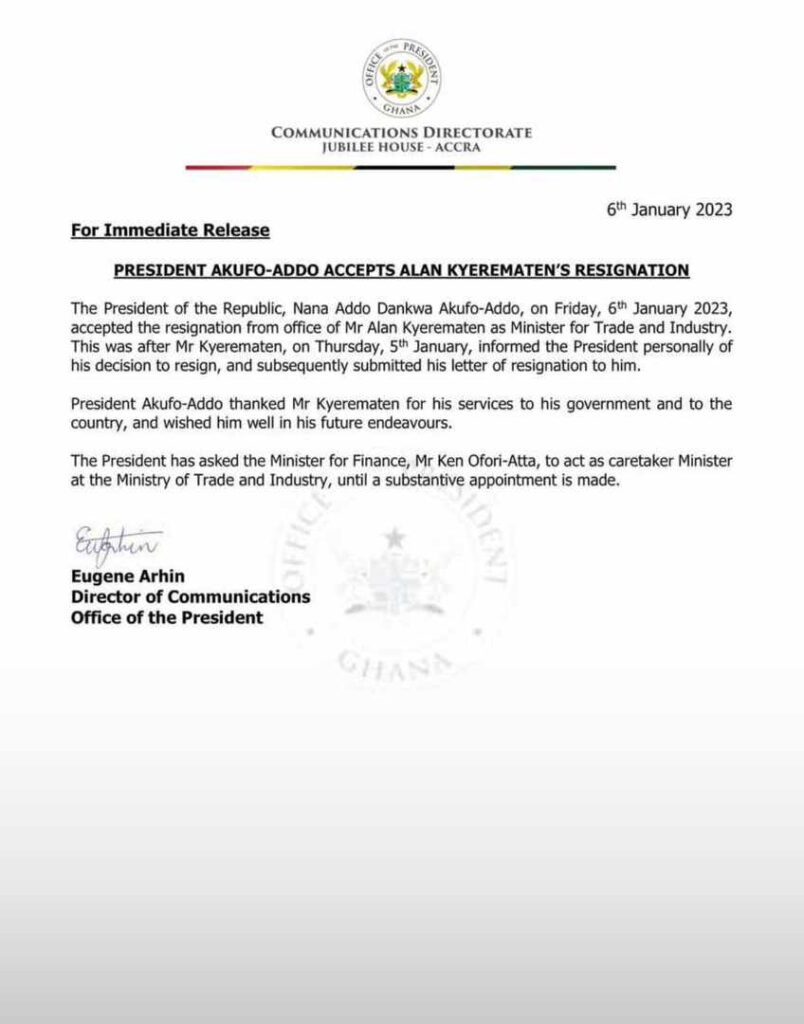
    Mr Akufo-Addo on Friday, 6th January 2023, accepted the resignation from office of Mr Alan Kyerematen.

    This was after Mr Kyerematen, on Thursday, 5th January, informed him personally of his decision to resign, and subsequently submitted his letter of resignation to him.

    President Akufo-Addo thanked Mr Kyerematen for his services to his government and to the country, and wished him well in his future endeavours.

  • In the coming days, I shall address Ghanaians – outgoing trade minister

    In the coming days, I shall address Ghanaians – outgoing trade minister

    After resigned from his job as Trade and Industry Minister under the Nana Addo Dankwa Akufo-Addo administration, Alan Kyerematen has spoken out.

    Alan Kyerematen’s resignation was accepted by President Akufo-Addo on January 6, 2023, according to reports that he submitted it on January 5, 2023, after personally notifying the president of his intention to quit.

    The outgoing trade minister thanked the president for the opportunity to serve and for gracefully accepting his acceptance of my resignation as Cabinet Minister responsible for Trade and Industry, effective January 16, 2023, in a tweet posted on January 7, 2023.

    “I sincerely appreciate the support from my family, colleagues, my party the NPP, the international community, and the general public during my tenure as a Minister.”

    He further added that he will be addressing Ghanaians in the coming days following his resignation as Trade Minister.

    Although there are no clear reasons for Alan Kyerematen’s resignation, it is believed that he did so on the basis of contesting in the flagbearership race of the New Patriotic Party (NPP) ahead of the 2024 general elections.

    Meanwhile, President Akufo-Addo has directed Finance Minister, Ken Ofori-Atta to serve as the caretaker Minister of Trade and Industry until a substantive minister is appointed for the ministry.

    President Akufo-Addo thanked Alan Kyerematen for his services to government, and the country and wished him the very best in his future endeavors.

  • Alan Kyerematen thanks Akufo-Addo; to address nation soon

    Alan Kyerematen thanks Akufo-Addo; to address nation soon

    The former Trade and Industry Minister, Alan Kyerematen has expressed gratitude to President Akufo-Addo for accepting his resignation.

    In a post on Facebook, Mr Kyerematen noted that he was thankful to have served under the government.

    He added that he was also grateful for the support from his party members, friends and family.

    “I would like to thank H.E the President for the opportunity to serve and for graciously accepting my resignation as Cabinet Minister responsible for Trade and Industry, effective 16th January 2023,” he wrote.

    Mr Kyerematen added that “I sincerely appreciate the support from my family, colleagues, my party the NPP, the international community, and the general public during my tenure as a Minister.”

    He noted that in the coming days, he will be addressing Ghanaians.

    On Friday, it was reported that Alan John Kwadwo Kyerematen had resigned from the government as the Trade and Industry Minister.

    He tendered his resignation letter to President Nana Akufo-Addo on Thursday, Jan 5, 2023.

    The man popularly called ‘Alan Cash’ has long been rumoured to be nursing the ambition to contest the flagbearership slot of the New Patriotic Party (NPP).

    His resignation is believed to buy him time to campaign to promote his presidential ambition.

    President Akufo-Addo has since accepted the Trade Minister, Alan Kyerematen’s resignation from office.

    The President subsequently directed the Finance Minister, Ken Ofori-Atta to act as caretaker minister until a substantive appointment is made.

    Source: wontumionline.com

  • Ken Ofori-Atta to manage Trade Ministry in Alan’s absence

    President Akufo-Addo has appointed Finance Minister, Ken Ofori-Atta, to act as caretaker Minister of the Trade and Industry Ministry.

    The president made the appointment after he acknowledged the resignation of Trade and Industry Minister, Alan John Kyerematen.

    “The President of the Republic, Nana Addo Dankwa Akufo-Addo, on Friday, 6 January 2023, accepted the resignation from office of Mr Alan Kyerematen as Minister for Trade and Industry,’ a statement signed by Director of Communications at the Office of the President, Eugene Arhin, read.

    Mr Kyerematen resigned from his position on Friday, January 6, 2023.

    The Office of the President indicated that Mr Kyerematen on Thursday, January 5, 2023, informed the president personally of his decision to resign and subsequently submitted his letter of resignation.

    Mr Ofori-Atta will now have to juggle work at the Finance and Trade ministries until a substantive Trade Minister is appointed.

  • Akufo-Addo accepts Alan Kyerematen’s resignation as Trade Minister

    Akufo-Addo accepts Alan Kyerematen’s resignation as Trade Minister

    President Akufo-Addo has acknowledged the resignation of Trade and Industry Minister, Alan John Kyerematen.

    “The President of the Republic, Nana Addo Dankwa Akufo-Addo, on Friday, 6* January 2023, accepted the resignation from office of Mr Alan Kyerematen as Minister for Trade and Industry,’ a statement signed by Director of Communications at the Office of the President, Eugene Arhin, read.

    Mr Kyerematen stepped down from his position today, Friday, January 6, 2023.

    http://backend.theindependentghana.com/alan-kyerematen-reportedly-resigns-as-trade-minister/

    A statement from the Office of the President revealed that Mr Kyerematen on Thursday, January 5, 2023, informed the president personally of his decision to resign and subsequently submitted his letter of resignation.

    In 2017, Mr Alan Kyerematen was sworn in as Trade Minister.

    Meanwhile, President Akufo-Addo has thanked Mr Kyerematen for his services to his government and to the country.

    Finance Minister, Ken Ofori-Atta, has been appointed to act as caretaker Minister until a substantive appointment is made.

    Mr Kyerematen popularly referred to as ‘Alan Cash’ has long been rumoured to be nursing the ambition to contest the flagbearership slot of the New Patriotic Party (NPP).

    It is however unclear if the resignation is to allow him to concentrate on that ambition.

    In 2007, Mr. Kyerematen ran for the NPP leadership and received 32.3% of the votes cast.

  • Ben Ephson predicts Cabinet reshuffle after Alan’s resignation

    Ben Ephson predicts Cabinet reshuffle after Alan’s resignation

    President Akufo-Addo may be planning to change his cabinet by the end of next week, according to pollster Ben Ephson.

    Even so, he is confident it will happen by next Tuesday or Wednesday.

    It comes after Alan Kyerematen, the trade and industry minister, abruptly announced his resignation on January 5 despite extensive rumors to the contrary.

    Bigwigs in the New Patriotic Party (NPP) believe Alan to be the front-runner for the position of party flagbearer in the 2024 elections, replacing President Akufo-Addo.

    http://backend.theindependentghana.com/alan-kyerematen-reportedly-resigns-as-trade-minister/

    Analysts claim that by resigning, he will be able to devote all of his attention to his bid to become the NPP flagbearer as opposed to continuing to manage his portfolio with a divided focus.

    According to Mr. Ephson, Alan has a lot of catching up to do because many of the NPP delegates may be younger than his generation and may not relate to Alan’s political heft very well.

    Ben Ephson says that catching up is the best course of action because NPP delegates 30 years of age and younger would not readily remember who Alan was to the NPP some 20 years ago when he was at the height of his powers.

    And a few others are anticipated to follow Alan’s lead, else they will be moved out.

    “I believe the reshuffle will occur between now and Tuesday. As for the Agric Minister, even if the reshuffle does not affect him, he will have to resign by the end of the month or he will be sacked,” Ben Ephson said, and explained that former Attorney General Joe Ghartey was not holding any post currently because he declared his interest in the presidency early on.

    Dr. Owusu Afriyie Akoto, the minister of agriculture and a politician and agricultural economist, has also expressed interest in running for the party to succeed President Akufo-Addo.

  • Alan Kyerematen reportedly resigns as Trade Minister

    Alan Kyerematen reportedly resigns as Trade Minister

    Trade Minister Alan John Kwadwo Kyerematen has reportedly resigned from the government.

    Sources say Mr Kyerematen tendered his resignation letter to President Nana Akufo-Addo on Thursday, January 5, 2023.

    Mr Kyerematen popularly referred to as ‘Alan Cash’ has long been rumoured to be nursing the ambition to contest the flagbearership slot of the New Patriotic Party (NPP).

    It is however unclear if the resignation is to allow him to concentrate on that ambition.

    In 2007, Mr. Kyerematen ran for the NPP leadership and received 32.3% of the votes cast.

    He came in second place behind Nana Akufo-Addo, who received 47.96% of the vote.

    In his subsequent bids for the party’s leadership in 2010 and 2014, Mr. Kyerematen came in second to Akufo-Addo, who had won the primary elections.

    To replace departing Director-General Pascal Lamy, Ghana submitted Kyerematen for the position of WTO director-general in 2012, and the African Union (AU) supported his candidacy.

    More soon….

  • Savelugu Municipal Rice Processing Factory is officially opened by the trade minister

    Alan Kyerematen, Minister of Trade and Industry, officially opened the Savelugu Municipal Rice Processing Factory to start formal operations for processing rice produced by local farmers to provide higher income.

    The Savelugu Municipal Rice Processing Factory, which received funding through the government’s One District, One Factory (1D1F) Common User Facility (CUF) Initiative, is equipped with cutting-edge rice processing technology and has the capacity to produce 1.5 and 2.8 tonnes of processed rice per hour.

    The factory’s construction started in January 2020 and was finished and turned over in July 2021.

    The processing plant installed at the factory included a modern parboiling, milling, and packaging plants with a standby generator and a mechanised borehole to supply the factory with water.

    It also has a warehouse, fully furnished office accommodation, a conference room, laboratory room and a canteen for the workers.

    The total cost of the factory is about Gh¢7.375 million, including the cost of factory building, processing plant and machinery, offices, office equipment, and a Nissan Double Cabin Pickup vehicle.

    Mr Alan Kyerematen, Minister for Trade and Industry, who inaugurated the factory at Savelugu in the Northern Region, said it would increase the productivity of farmers in the area.

    The Savelugu Municipal Union of Rice Farmers Association LBG (the mother Association of all Rice Farmer-Based Organisations in the Savelugu Municipality), owned the factory by 70 per cent while the Ministry of Trade and Industry, the Savelugu Municipal Assembly, and the Traditional Council also owned 10 per cent each.

    Mr Kyerematen said, “Despite the hard work of farmers in this area, they still remain poor because they are unable to take advantage of the full value of what they produce. This facility will help reverse the narrative.”

    He swore into office a nine-member Board of Directors to oversee the management and operations of the factory.

    Mr Akwasi Attah Antwi, National Director, Rural Enterprises Programme, said the factory was expected to employ about 118 people, including management professionals, factory floor workers, and plantation workers, who would work on the nucleus rice farms.

    He said, “In addition, over 754 farmers in the Savelugu Municipality and neighbouring communities will be directly engaged to supply rice to the factory.”

    He said, “With funding from the African Development Bank, the Rural Enterprises Programme has established five of the CUFs nationwide; Savelugu Municipality of the Northern Region, Dormaa West District of the Bono Region, Sefwi Akontombra District of the Western North Region, Tarkwa Nsuaem Municipality of the Western Region and Sekyere Central District of the Ashanti Region.”

    Alhaji Shani Alhassan Saibu, the Northern Regional Minister, said the factory would serve as a catalyst that would bring about the needed development in the region while enhancing food security in the country.

    Hajia Ayishetu Seidu, Savelugu Municipal Chief Executive, said it would help address unemployment and attract young people into the agricultural sector.

    She urged residents to take advantage of the initiative to enhance sustainable growth and development of the area.

    Alhaji Sayibu Braimah, Chairman of the Board of Directors of the factory, pledged to discharge their duties efficiently to ensure that the factory achieved its intended purpose.

    Meanwhile, Mr Kyerematen has also inaugurated the Savelugu Technology Solution Centre to facilitate the production of spare parts and repair services, manufacturing of agro-processing equipment, and providing training for human resource and capacity building for various businesses in the area, including the factory. 

    The government’s 1D1F CUF is a farmer-owned agro-industrial processing facility established with seed funding from the Ministry of Trade and Industry under the Rural Enterprises Programme.

    It seeks to enhance the ability of farmers and other agricultural value chain actors, with little or no financial capacity, to establish their own common user processing facilities to process their farm produce.

  • Media dominance by potential first women in 2024

    The National Democratic Congress (NDC) and the New Patriotic Party (NPP), Ghana’s two main political parties, have finished reorganizing, electing their respective executives for polling places, constituencies, regions, and the national level.

    Now, the entire nation’s focus is on the two parties’ primaries for president and parliament, which will determine their parliamentary nominees and, most crucially, their presidential nominee for the 2024 election.

    In the NPP, for instance, names such as the Vice President of Ghana, Dr Mahamudu Bawumia; the Minister of Trade and Industry, Alan Kyerematen; former Railways Minister, Joe Ghartey; the Minister for Food and Agriculture, Dr Owusu Afriyie Akoto and the former General Secretary of the NPP, Kwabena Agyapong, have come up as potential flagbearers.

    The NDC also has the likes of former President John Dramani Mahama; former Minister for Finance, Kwabena Duffuor and the former Metropolitan Chief Executive (MCE) of the Kumasi Metropolitan Assembly, Kojo Bonsu, expressing their interest to contest for the flagbearership position of the party.

    But one important factor that is mostly ignored in the elections of presidential candidates is who their ‘chief advisors’, the wives who have journeyed with them throughout their political careers and have become their true confidants, are.

    GhanaWeb in this article takes a look at some of the wives of likely flagbearer candidates for the presidential primaries of the NDC and the NPP out of which Ghana’s first lady will emerge.

    Lordina Mahama:

    Nearly like the first possible First Lady on this list, Lordina Mahama, who is married to Ghana’s former president, John Dramani Mahama, who is largely regarded as the presumptive flagbearer of the NDC.

    She, like her husband, quickly rose to the highest office of the land after the sudden death of the late John Evans Atta Mills in 2012.

    Lordina Mahama left office on January 7, 2017, but with her husband looking to return as president, she could just return to the high office she once occupied.

    She attended the Anglican elementary school and then proceeded to the Ghana Secondary School in Tamale, where she met her husband John Dramani Mahama.

    She has a degree in Hospitality Management and a Masters in Governance and Leadership from the Ghana Institute of Management and Public Administration.

    She also acquired a Master of Laws (LLM) in Business Law/International Business Law from De Montfort University in the United Kingdom in 2019.

    Samira Bawumia

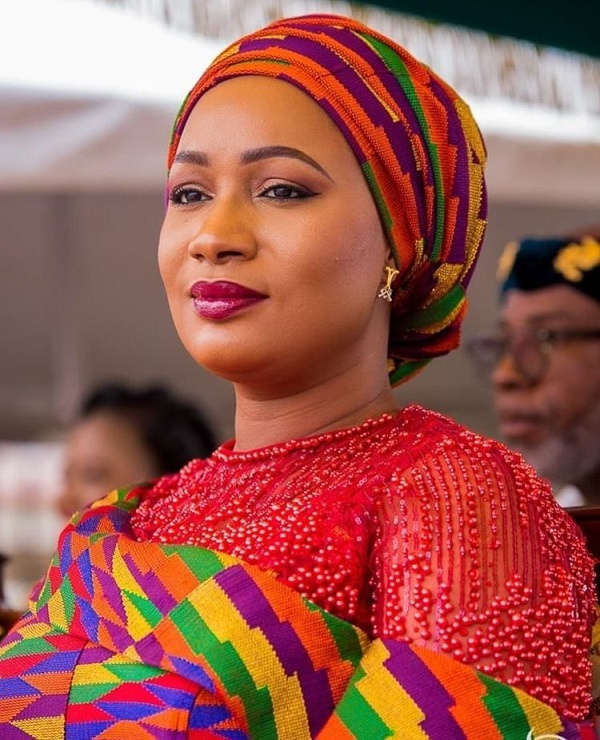
    Samira Bawumia, the wife of Ghana’s current Vice President, Dr Mahamudu Bawumia, is one to look out for as a potential first lady with her husband being touted as one of the leading candidates for NPP’s flagbearership position.

    Samira started her early education at the Answarudeen Islamic School at Fadama in Accra, before continuing to the Akosombo International School (AIS) and then to Mfantsiman Girls’ Secondary School at Saltpond in the Central Region.

    At the Kwame Nkrumah University of Science and Technology (KNUST), she studied BA in Social Science in Law and Technology. At the Ghana Institute of Management and Public Relations (GIMPA), she was adjudged the Best Student in Master of Business Administration (MBA).

    Mrs. Bawumia is the Ambassador for the Global Alliance for Clean Cookstoves and joins former UN Secretary-General Kofi Annan, Academy Award-winning actor Julia Roberts, and Grammy-nominated musician Rocky Dawuni to work with the Alliance and its partners to raise awareness of household air pollution and encourage broader adoption of clean cooking solutions in developing countries in a bid to create cleaner environments and eradicate deaths caused by pollution from the burning of solid fuels for cooking.

    Patricia Christabel Kyerematen

    In the NPP, one of the names that are widely rumoured to vie for the position of flagbearer of the party, and eventually run as president, is Alan Kyerematen, who is the current Minister of Trade and Industry.

    He is married to Patricia Christabel Kyerematen, whom very little is known about.

    She was born Patricia Christabel Kingsley-Nyinah, as the daughter of Justice Joseph Kingsley-Nyinah, Ghana’s Electoral Commissioner during the 1979 presidential election.

    They have two children – Alexander and Victor.

    Nana Akosua Fosuah

    A man who has, in the last few months, been touring the country and putting his face out there for the NDC is a former Minister of Finance, Dr. Kwabena Duffuor.

    It would seem that just as nearly private as Dr. Duffuor is, his wife appears the same.

    If her husband becomes president, Nana Akosua Fosuah would be Ghana’s First Lady from January 7, 2025.

    Together with her husband, they have five children.

    Efua Ghartey:

    Joe Ghartey, a former attorney general and minister of justice and railways development minister is one of the leading members of the NPP who has stated his intention of running for the party’s presidential primaries.

    Joe Ghartey is married to Efua Ghartey with whom he has 5 children.

    Mrs Ghartey, like her husband, is a lawyer by profession and the two are the co-founder of the law firm, Ghartey & Ghartey.

    She is the Chairperson of the Bible Society of Ghana and the Chairperson of the International Board of the United Bible Societies (UBS), which operates in more than 200 countries.

    She is additionally the president of the Greater Accra Ghana Bar Association as well as a member of the Constitutional and Legal Committee of the New Patriotic Party.

    Dr. Lawrencia Agyapong

    The former General Secretary of the NPP, Kwabena Agyapong, who all other factors being equal will contest in the NPP presidential primaries, is married to Dr Lawrencia Agyapong.

    The two have three fully grown children.

    Dr Lawrencia Agyapong is an academic and is currently the Head of the Communications Department, as well as the research coordinator at the School of Graduate Studies at the Ghana Institute of Journalism (GIJ).

    Dr Owusu Afriyie Akoto’s wife:

    The Minister for Food and Agriculture, a potential flagbearer for the ruling NPP, is married with seven children but little is now about her children.

    Kojo Bonsu’s wife:

    Very little is known about the wife of former Kumasi Mayor, Kojo Bonsu, who will be contesting in the NDC presidential primaries.

    In 2016 he admitted that his marriage of 30 years was on the rocks and stated that he had a girlfriend.

  • Economic woes will be over if we prioritize agric industrialization – Alan

    The Minister of Trades and Industry, Alan Kyerematen, says enhancing agricultural production is the surest way of reviving Ghana’s ailing economy.

    He is hopeful that, with policies such as the 1D1F Enable Youth Initiative, government is on course to boost the economy through agriculture.

    “Agriculture without industrialization is not sustainable. That is why we have been struggling with our agricultural sector for many years because we are unable to process what we process and produce. So the industrialization aspect of this program is going to further enhance and deepen agricultural productivity and that is very important for the industrialization of our country”, he stressed.

    Alan Kyerematen was speaking at the official launch of 1D1F Enable Youth Initiative in Accra on Friday.

    There, the Minister indicated that the programme would help create sustainable jobs and also enhance agricultural production to boost the country’s economy.

    “It is going to bring our youth to support our country’s macro-stability effort. If we are able to replicate what we are doing with our youth-owned and managed companies, it means that, we will be able to reduce the amount of foreign exchange that we are currently spending on importing almost everything that we can produce.”

    “At the same time, we are going to enhance our capacity to be able to export more to earn foreign exchange which is the only way to stabilize the local currency. If you are thinking in the long term of avoiding what we are going through today, it is through initiatives of this nature”, Alan Kyerematen emphasized.

    He also revealed that the government’s newly launched 1D1F Enable Youth Initiative will tackle youth unemployment by creating 16,000 jobs for the youth in the country.

    About 1.74 million (13.4 percent) of the total working population of 13 million in the age bracket of 15 years and above were unemployed in the first quarter of the year, a study conducted by the Ghana Statistical Service (GSS) revealed.

    The high level of unemployment in the country has been described by many as a national security threat.

    However, Mr Kyerematen said the unemployment in the country will be drastically reduced through the introduction of the 1D1F Enable Youth Initiative.

    According to him, the program will directly create employment for 3,000 youth and over 16,000 indirect jobs for unemployed persons across the country.

    “It is an uncontestable fact, that one of the problems confronting our country is how we deal with youth unemployment. This particular initiative will contribute to employing almost 3000 youth. It is also going to contribute indirectly to creating over 16, 000 jobs.”

    Source: citinews

  • Launch of the “1D1F Enable Youth Initiative” to generate 16,000 employment

    The 1D1F Enable Young Initiative, which was started by the government, intends to address youth unemployment by giving the nation’s youth 16,000 jobs.

    The initiative’s founder, Minister of Trade and Industry Alan Kyerematen, predicted that the 1D1F Enable Youth Initiative would drastically lower unemployment once it was implemented.

    According to him, the program will directly employ 3,000 young people and indirectly employ more than 16,000 unemployed individuals nationwide.

    Speaking at the official launch of 1D1F Enable Youth Initiative in Accra on Friday, the Minister said the programme would help create sustainable jobs.

    It would also enhance agricultural production to boost the country’s economy, he added.

    “It is an uncontestable fact, that one of the problems confronting our country is how we deal with youth unemployment. This particular initiative will contribute to employing almost 3,000 youth. It is also going to contribute indirectly to creating over 16,000 jobs.”

  • To stimulate the economy, we must encourage direct investments – Trade minister

    Alan Kyerematen, the minister of trade and industry, has stated that encouraging private direct investment is necessary for Ghana to experience rapid development.

    The local economy will expand as a result of both domestic and foreign direct investment.

    Alan Kyerematen stressed that Ghana needs to stop depending so heavily on access to the capital international financial market and instead concentrate on luring investors to pump money into the local economy by establishing businesses there. He was speaking at the opening ceremony of the third Annual Investment Week of the Ghana Free Zones Authority.

    He said, “If we’re going to put investment at the centre of our development agenda then we need to appreciate the fact that we cannot continue relying only on access to the capital international financial market but we have to think seriously about how we aggressively promote private direct investments be it domestic or foreign.”

    An increase in direct investments is often associated with a host country’s economic growth due to increased tax revenues and an influx of capital.

    Speaking in the same vein, Chief Executive Officer of Free Zones Authority, Mike Oquaye Jnr noted that his outfit raked in over US$27 billion so far.

    He added that about 33,000 direct jobs have been created for the teeming unemployed youth.

  • Alan Kyerematen’s campaign song pops up at Kufuor’s 84th birthday bash

    In order to improve his chances of leading the New Patriotic Party (NPP) as flagbearer into the 2012 general elections, Alan Kyerematen’s campaign wrote a song during the 2010 NPP Primaries.

    Mr Kyeremeten would eventually concede to Nana Akufo-Addo after the party election.

    Years down the line, the Trade Minister’s trademark song was performed by a choir at former President John Agyekum Kufuor’s 84th birthday bash on December 8.

    Alan Kyerematen's campaign song pops up at Kufuor’s 84th birthday bash

    This comes at a time when the Minister is gunning for another chance at the NPP’s presidential candidature going into the 2024 general elections.

    “Alan Kyerematen is the one we want,” is the refrain in the lyrics of the popular song.

    The Minister was seen joining in on the chorus with his entourage while it was being performed.

    Other names that have surfaced for the NPP leadership race include Vice President, Dr Mahamudu Bawumia, and Agriculture Minister Osei Akoto among others.

    Source: Myjoyonline

  • Manufacturing on the cusp of transformation – Trade Minister

    According to Alan Kyerematen, Minister of Trade and Industry, the manufacturing sector is about to undergo a transformation thanks to funding secured through the Development Bank Ghana (DBG), new and updated policies ready to be implemented, an increase in the supply of electricity, and improved transportation infrastructure.

    Speaking at the third annual Ghana Free Zones Authority (GFZA) Investment Week, Mr. Kyerematen sounded very optimistic about the sector’s prospects and the potential it has to not only transform the economy while stabilizing the local currency and reducing the country’s overreliance on imports, but also to create jobs.

    “There is a need to promote exports as a nation now more than ever. As a country and a growing economy, we must be able to produce our basic needs as well as have the abundance to promote exports for foreign exchange. This is the key objective of government’s initiatives, such as the One District One Factory (1D1F),” he said.

    New and updated policies

    Touching on the individual policies and moves by other agencies, departments and ministries, Mr. Kyerematen pointed at the Special Economic Zones Policy which is an upgrade of the free zone programme to ensure that Ghana stays abreast with the trends. “Development of other industrial parks and special economic zones will be designed to have the full supply chains and interrelated industries to create synergy within the zones.”

    He added that his ministry is implementing other sector specific programmes, such as the Automotive Assembly Programme which has seen government approve a new Components Manufacturing Policy that seeks to support the local production and supply of components and spare parts for the automotive industry.

    “Through this policy, it is expected that the automotive industry will have access to ready and locally manufactured spare parts which will also create more employment opportunities. These programmes present investment opportunities for companies interested in this sector. The policy will be launched, and implementation will commence in 2023.”

    Funding

    On funding, Mr. Kyerematen said government has made considerable provision through the Development Bank Ghana (DBG). This has resulted in the establishment of a GH¢500million special credit programme called the DBG Emergency Economic Programme (DEEP) to support businesses in the agribusiness value chain over the next five years. The priority sectors are poultry, rice & cereals, pharmaceutical manufacturing, tourism, textiles & garments to help build economic resilience.

    Electricity/Energy

    “Access to electricity is key to industrialisation. In this regard, I am happy to report that connectivity to the national grid has seen an immense increase, with a total of 157 communities linked to the national grid as of September 2022. The Ministry of Energy will further connect an additional 400 towns under the SHEP-4, SHEP-5 and Turnkey Projects in 2023. This will also go a long way to support businesses, such as the single factory free zones enterprises located all over the country, to have access to reliable energy to produce more for export,” he said.

    Transport

    Connectivity through transport infrastructure is critical to development, productivity and increased export. The government, he noted, is committed to infrastructural projects – the construction of the Kumasi Lake Roads and Drainage Extension project, the rehabilitation of Assin Fosu-Assin Praso roads, the dualisation on the Tema-Aflao, and the Tema-Akosombo roads, and many others – that will help connect various companies including free zones enterprises.

    GFZA Investment Week

    Ambassador Micheal Oquaye Jnr., Chief Executive Officer of GFZA, noted that the Investment Week celebration, which was under the theme ‘GFZA: Championing Export-Led Industrial Growth in the context of AfCFTA and World Trade’, is an annual event to showcase the achievements of the Free Zones Programme.

    “The essence of this forum is to come together to take stock and discuss issues of common interest to improve the operations of the Free Zones Authority and Enterprises as well as address any challenges you and we may be facing because of the pandemic and current worldwide economic situation. It is also to update you on new trends and policies that will have an impact on your operations”.

    Currently, there are 217 active free zone enterprises. Cumulatively, the free zone enterprises have made export earnings of over US$27billion, employing about 33,000 people directly with over 31,000 being Ghanaians. “These are impressive achievements, and I would like to take this opportunity to appreciate your contribution toward the development of the Ghanaian economy.”

    Amb. Oquaye Jnr. charged that with traditional supply chains from Europe, America, China, India, Turkey unable to sustain the needs of Africa, “we need to drive our own business cars and fly our own business jets all over Africa, and therefore, the AfCFTA is our only solution of self-reliance in Africa. The time to walk the talk is now and the GFZA is ready to take this charge in tandem with AfCFTA Secretariat and MOTI”.

  • Trade Minister praises Free Zones Authority and urges industrialisation focused on exports

    On December 5, 2022, at the Third Annual Investment Week held in Accra, Ghana, Trade and Industry Minister Alan Kyerematen praised the Ghana Free Zones Authority (GFZA) for its historic accomplishments.

    He claims that the Authority has supported several investment opportunities and the establishment of the Africa Continental Free Trade Area over the course of the past year (AFCFTA).

    In his remarks at the occasion, Alan Kyerematen urged investors to fully utilize the AfCFTA.
    to enhance exports of goods made locally and to create additional jobs.

    The Trade and Industry Minister argued in favor of AfCFTA by pointing out how simple it is for member countries to exchange products and services under the AfCTA protocol.

    “The theme for the Investment Week celebration calls for championing export-led industrial growth; in the context of AfCFTA and World Trade. The Africa Continental Free Trade Agreement (AfCFTA) provides an opportunity for Ghana to increase its exports to other African countries through the creation of a single market, thus boosting intra-African trade. The AfCFTA is tasked to implement protocols to eliminate trade barriers and cooperate with member states on investment and competition policies, intellectual property rights, settlement of disputes and other trade-liberating strategies”, Alan Kyerematen told investors.

    He added, “There is therefore the need to promote exports as a nation now more than ever before. As a country, we have enough local capacity couple with abundant resource endowment to produce our basic needs, as well as have enough to export for foreign exchange.

    “Government agencies such as the Ghana Free Zones Authority will have to provide support to the private sector to among others, expand their productive capacity across all relevant value chains within the economy. This will not only promote exports, but greatly encourage value addition for import substitution.”

    The minister continued, “It is expected that through increased focus on the concept of Free Zones and Special Economic Zones, job creation will become one of the major benefits that the private sector will offer.

    “As we are all aware, enterprises that operate under the Free Zones and Special Economic Zones have the capacity to generate significant employment opportunities,” he concluded.

    Since its establishment, the Free Zones Authority has created avenues for multiple goods and services to be exchanged between member counties as part of Africa’s industrialization and exportation project.

  • Firing Hopeson Adorye from National Security wrong – Obiri Boahen

    The former Deputy National General Secretary of the New Patriotic Party (NPP) has criticized the decision of the government to fire the one-time parliamentary aspirant of the party for Kpone Katamanso, Hopeson Adorye.

    According to Nana Obiri Boahen, the circumstances surrounding the dismissal of Hopeson Adorye do not augur well for the NPP and might lead to unnecessary divisions in the party.

    Speaking in an Okay FM interview monitored by GhanaWeb, Obiri Boahen said that the issue with Hopeson Adorye could have been settled without him being fired.

    “For me, honestly speaking it (the firing of Hopeson Adorye) is not the best. It can bring confusion to the party.

    “You can call him (Hopeson Adorye) on the quiet and talk to him about where he has faulted and even put him on secondment at other agencies such as NADMO (National Disaster Management Organisation) or Economic and Organised Crime Office (EOCO).

    “So, he will be working at NADMO and still be on the National Security payroll. He will be soliciting information and then he will be campaigning for Alan Kyerematen. We need to tread carefully,” he said in Twi.

    Citing similar issues that happened in 2007, Obiri Boahen further suggested that the party deals meticulously with such matters to ensure that the party is not ultimately affected.

    “In 2007, we saw this kind of division with members of the party claiming to be members of different factions in the NPP. And we forgot the common enemy and before we will realized it, we were in opposition,” he added.

    Hopeson Adorye, who was previously the Deputy National Security Coordinator in Charge of Airports, announced on live radio in November that he had been fired from the National Security Secretariat.

    He said during a discussion on Oman FM’s Boiling Point programme, on which he is a regular guest; that he had been fired purposefully because of his support for Alan Kyerematen.

    Adorye is a vocal supporter of the Trade and Industry Minister in respect of the minister’s rumoured bid to lead the NPP as flagbearer when elections take place next year.

    “God will cater for us, we will eat, uncle (referring to the show host), God has got us. How we toiled in opposition for Akufo-Addo to come to power, we will do same for Alan Kwadwo Kyerematen to come.

    “I’m not a zombie, uncle, I was told that my support is not towards a particular camp so I should be dismissed, I have been dismissed. ‘Your appointment has been terminated with immediate effect.’ That is why I am stressing that God will cater for us, we will never die,” he stressed.

  • Hopeson Adorye recounts how he was sacked from National Security

    A one-time parliamentary aspirant of the New Patriotic Party (NPP) for Kpone Katamanso, Hopeson Adorye, has refuted news publications that his removal from the National Security Secretariat was because he was not supposed to be working there after he was fired in 2017.

    Speaking in an Okay FM interview monitored by GhanaWeb, Hopeson Adorye said that the sack letter he received was dated November 17, 2022.

    Adorye, who was previously the Deputy National Security Coordinator in Charge of Airports, added that the reasons for his sacking were not stated in the letter because it was President Nana Addo Dankwa Akufo-Addo who ordered his dismissal.

    “The news publication is wrong. Why will someone be sacked and leave his post after 4 years? What happened was that in 2017, I had to leave my post at the airport and go back to the ‘blue gate’ because the security at the VIP section of the airport, which the National Security was in charge of, was being taken over by the Foreign Affairs Ministry. I was never sacked; what ‘The Herald’ is saying is false,” he explained in Twi.

    “How can one person be sacked from the same job twice? Tomorrow will be exactly two weeks since I received the letter indicating my appointment had been terminated with immediate effect. The letter was dated 17th November 2022 and I received the letter on 21st November, a day after my birthday,” he added.

    He added that many elders of the NPP have advised him not to talk about the circumstances surrounding his dismissal, and he will for now heed their advice.
    Hopeson Adorye had previously announced on live radio this week that he had been fired from his government job.

    He said during a discussion on Oman FM’s Boiling Point programme, on which he is a regular guest, that he had been fired purposefully because of his support for Alan Kyerematen.

    Adorye is a vocal supporter of the Trade and Industry Minister in respect of the minister’s rumoured bid to lead the NPP as flagbearer when elections take place next year.

    “God will cater for us; we will eat, Uncle (referring to the show host); God has got us. How we toiled in opposition for Akufo-Addo to come to power, we will do same for Alan Kwadwo Kyerematen to come.

    “I’m not a zombie, uncle, I was told that my support is not towards a particular camp, so I should be dismissed. I have been dismissed. ‘Your appointment has been terminated with immediate effect.’ That is why I am stressing that God will cater for us; we will never die,” he stressed.

  • Raw sugar imports into Ghana skyrocket to US$151 million

    According to the most recent data from the United Nations COMTRADE database, Ghana imported raw sugar worth US$151 million in 2020 alone, ranking as the 45th highest importer of the good internationally.

    The product is also among the top ten most imported goods into the nation, with the cost of importing Ghana’s staple foods rising year over year and now totaling US$2 billion, according to the finance ministry.

    The statistics also showed that Mexico, Brazil, the United States, Guatemala, France, and India were the top importers of sugar and sugar confectionery in 2019, with imports totaling US$158.3 million.

    Data from the Ghana Export Promotion Authority (GEPA) show that the country consumes about 370,000 tonnes of sugar annually, with domestic production currently at an all-time low.

    Industrial and domestic supply prospects

    Huge supply opportunities exist for large industrial sugar importers, such as FNJ Investments, Fan Milk, Multi-Pac, Kasapreko, Stallion Industries, Nutrifoods and Blow Chem, among others

    The Ministry of Trade and Industry has further projected that domestic consumption of sugar in Ghana could rise to 872,000 metric tonnes in 2030.

    Similarly, the West Africa sub-region – which is also forecast to experience rapid growth in sugar consumption – also presents a potential sugar export market for Ghana. Amid these market potentials and existing congenial climatic and lithospheric conditions, production of sugar remains at zero.

    The Sugar Industry in Ghana>/b>

    Ghana’s sugar industry is virtually fully dependent on imports. Local production remains negligible at a mere 150 tonnes in 2013 according to the UN data, and there’s a mere 6,000 hectares of sugar plantation in existence.

    With two sugar mills in Asutsuare and Komenda, these facilities have been lying idle since 1983 largely due to inefficient management. However, the Komenda Sugar Factory was revived in 2015 and 2016 – but was shut down shortly after due to lack of raw materials.

    Attempts to revive Komenda sugar factory

    In 2016, government secured a US$35million loan from the Export-Import (EXIM) Bank of India and invested it in the factory. An additional US$24million was set aside to support out-grower farmers.

    The factory, which was inaugurated on May 31, 2016 to produce sugar, became stillborn due to a multiplicity of factors that were touted as technical and operational challenges.

    On June 3, 2020, however, Trade and Industry Minister Alan Kyerematen announced in parliament that Cabinet had officially approved Park Agrotech Limited as a new strategic investor to operate the factory.

    That notwithstanding, the current status of the investment by Park Agrotech is unknown.

    Nevertheless, a number of plans, according to the trade ministry, are also underway to develop sugar-cane plantations for a second revival of the Komenda sugar factory.

    Also, plans by multinational trading house Cargill to build a sugar refinery in Tema are a possibility.

    GEPA’s NEDS projections

    Meanwhile, GEPA through the National Export Development Strategy (NEDS) has designed a blueprint for harnessing the full potential of sugar production to curb the rising imports.

    In the NEDS, the Authority has projected revenues from the export of sugar by 2029 to be US$1.2billion.

  • Raw sugar imports skyrocket to US$151m

    Current data from the United Nations COMTRADE database have indicated that Ghana imported US$151million worth of raw sugar in 2020 alone – with the country being ranked 45th largest importer of the commodity globally.

    The commodity is also ranked among the first ten most-imported products into the country, as Ghana’s essential food imports bill continuously rise year by year – currently valued at US$2billion according to the finance ministry.

    The data also added that the imports of sugar and sugar confectionery was US$158.3million in 2019, with Mexico, Brazil, USA, Guatemala, France and India being the lead importers.

    Data from the Ghana Export Promotion Authority (GEPA) show that the country consumes about 370,000 tonnes of sugar annually, with domestic production currently at an all-time low.

    Industrial and domestic supply prospects

    Huge supply opportunities exist for large industrial sugar importers, such as FNJ Investments, Fan Milk, Multi-Pac, Kasapreko, Stallion Industries, Nutrifoods and Blow Chem, among others

    The Ministry of Trade and Industry has further projected that domestic consumption of sugar in Ghana could rise to 872,000 metric tonnes in 2030.

    Similarly, the West Africa sub-region – which is also forecast to experience rapid growth in sugar consumption – also presents a potential sugar export market for Ghana. Amid these market potentials and existing congenial climatic and lithospheric conditions, production of sugar remains at zero.

    The Sugar Industry in Ghana

    Ghana’s sugar industry is virtually fully dependent on imports. Local production remains negligible at a mere 150 tonnes in 2013 according to the UN data, and there’s a mere 6,000 hectares of sugar plantation in existence.

    With two sugar mills in Asutsuare and Komenda, these facilities have been lying idle since 1983 largely due to inefficient management. However, the Komenda Sugar Factory was revived in 2015 and 2016 – but was shut down shortly after due to lack of raw materials.

    Attempts to revive Komenda sugar factory

    In 2016, government secured a US$35million loan from the Export-Import (EXIM) Bank of India and invested it in the factory. An additional US$24million was set aside to support out-grower farmers.

    The factory, which was inaugurated on May 31, 2016 to produce sugar, became stillborn due to a multiplicity of factors that were touted as technical and operational challenges.

    On June 3, 2020, however, Trade and Industry Minister Alan Kyerematen announced in parliament that Cabinet had officially approved Park Agrotech Limited as a new strategic investor to operate the factory.

    That notwithstanding, the current status of the investment by Park Agrotech is unknown.

    Nevertheless, a number of plans, according to the trade ministry, are also underway to develop sugar-cane plantations for a second revival of the Komenda sugar factory.

    Also, plans by multinational trading house Cargill to build a sugar refinery in Tema are a possibility.

    GEPA’s NEDS projections

    Meanwhile, GEPA through the National Export Development Strategy (NEDS) has designed a blueprint for harnessing the full potential of sugar production to curb the rising imports.

    In the NEDS, the Authority has projected revenues from the export of sugar by 2029 to be US$1.2billion.

  • Zambian prophet makes interesting prophecies about NPP presidential race, predicts breakaway

    Apostle Elijah King, the leader of the Fire Nation Arena Ministries in Lusaka, Zambia has made some interesting predictions about the flagbearer race of the New Patriotic Party (NPP).

    In a sermon in his church that has been in circulation on social media, Apostle Elijah King disclosed that there will be instances of backbiting and betrayal from some of the candidates.

    According to him, one of the leading candidates who will fall victim to the scheme will break away from the NPP and set up his own party.

    This person, he claims will win the general elections and set the country on the path of autocracy and military rule.

    “The Lord shows me that there will be confusion in the present government of Ghana. There will be confusion in the NPP and they will end up fighting each other and setting each other up. There is this race of the next presidential candidate. I won’t go into details but there is one particular man amongst the candidates that the Lord focused on and spoke to me about.

    “I saw that the man will be set up and betrayed by the party. Out of the betrayal and anger, he will walk away and set up his own political party. He will buy people and Lord says, he will rule like a military government. Whatever he says will become final,” he said.

    The three leading candidates in the NPP race are Vice President, Dr Mahamudu Bawumia, Trades, and Industry Minister, Alan Kyerematen, and Assin Central MP, Kennedy Agyapong.

    Though the first two names are yet to officially announce their interest in the race but Kennedy Agyapong has announced his, detailing his plans for the primaries and the national election.


  • 1D1F CUF: FBOs to receive dividends, enhance value addition – Trade Minister

    Minister of Trade and Industry Alan Kyerematen is certain that the adoption of a model under the government’s One-District-One Factory plan will enhance the agricultural value chain, particularly for Farmer-Based Organizations.

    The model, referred to as the 1D1F Common User Facility (CUF), calls for the establishment of a farmer-owned agro-industrial processing facility with seed money from the government and its partners.

    Trade Minister, Alan Kyerematen, speaking in an interview with GhanaWeb Business in the Ashanti region said the model comes under the Ministry of Trade and Industry (MOTI) under the Rural Enterprises Programme (REP).

    “We looked at this model where a group of farmers can organise themselves into Farmer Based Organisations (FBOs) and instead of helping just one investor or individual to establish a 1D1F factory and then government directly supports the farmer groups to own the processing plant to add value their farm produce,” he told GhanaWeb Business.

    “In this particular district of Nsuta Kwagyeri in the Ashanti region, we have identified that there is no 1D1F factory here, but the common food commodity coming from this area is maize and the farmers are willing to make more income from the commodity through processing or adding value,” the minister added.

    He continued, “…So, our resolve is to bring them together and put some funds to add up their capital and get the support of the African Development Bank to establish this facility which is replicated in the other four regions of the country”.

    Alan Kyerematen pointed out that the new model under the 1D1F CUF seeks to ensure that farmers can earn more income from their products as well as dividends from the factory since they have become owners of the facility.

    Meanwhile, some 600 farmers in the Nsuta Kwagyeri district have become the first beneficiaries to receive support from government under the 1D1F CUF model following the construction of a factory for the processing of maize.

    The factory, which can process 4-5 tonnes of dry maize, and five tonnes of maize grits per day respectively, was established with support from the African Development Bank.

    Government is expected to replicate a similar model across key districts within the region and the country.

  • Textile tax stamps policy to reduce importation, boost local production – Trade Minister

    Alan Kyerematen, the minister of trade and industry, stated that the country’s new tax stamps policy on textiles aims to increase domestic production and give customers the comfort that they are making authentic purchases.

    He claims that the tax policy, which is not anticipated to bring in significant amounts of money, aims to ensure that smuggled African textile prints, which aim to undercut locally manufactured ones on the market, are decreased on the market along with the proper tariffs being paid.

    Alan Kyerematen discussed additional policy initiatives aimed at boosting and sustaining the textile sector to support job creation in his speech at the Textiles Tax Stamp Policy’s Accra launch.

    “The introduction of a new import regime and restrictions management for textiles is to ensure that entry of pirated designs are restricted. Let me assure you that this measure is not in any way meant to unduly restrain imports,” he said.

    “We currently do not have the local manufacturing capacity to meet the total national demand of over 120 million yards per annum out of which 35% is produced locally.”

    “The system for acquiring textiles tax stamps has been developed with the help of the Intellectual Property Office to ensure that legitimate textiles are traded on the local market,” Alan Kyerematen explained.

    He said that in the coming months, the introduction of designated entry corridors will be adopted to ensure that imported African prints adhere to necessary standards.

    “By this, all imported textiles would be required to enter the country through dedicated corridors; Tema and Aflao which have been fitted with affixing facilities and other needed equipment to keep track and ensure that imported African prints adhere to standards,” he said.

    The Minister said engagements with local manufacturers will be held as part of efforts to reduce inefficiencies, enhance low cost of production and improve competitive pricing of wax prints.

    “Currently, local manufacturers benefit from zero-rate VAT granted in January 2019 which has been extended to December 2023. ”

    “To also ensure Ghana can attract foreign textile manufacturers to set up or relocate their plants in Ghana, government will continue to create the necessary environment and engagements to encourage foreign firms including textile manufacturers,” the trade minister said.

    Meanwhile, the tax stamps policy is expected to commence on November 1, 2023.

    The implementation modalities will include having textiles stamps affixed on all textile prints traded in Ghana.

    Subsequently, the operation of the textiles task force will be reviewed to ensure that stakeholder membership on the Task Force is adequately representative.

    The task force is expected to undertake monitoring exercises on all markets after the inception of the effective enforcement date which is scheduled for March 1, 2023.

    The Textile Tax Stamps Policy is in collaboration with the Ministry of Finance, Ghana Revenue Authority (GRA), the Intellectual Property Office and the Ghana Standards Authority which form part of the key implementing agencies.

  • Trade Ministry engages wholesalers, retailers on Textiles Tax Stamps Policy

    The Minister of Trade and Industry, Mr Alan Kyerematen, has engaged with textiles wholesalers and retailers on the implementation of the Textiles Tax Stamps Policy.

    The engagement forms part of a public education campaign towards the launch and implementation of the policy before the close of the year.

    It follows an earlier engagement with importers in May 2022.

    The Minister, at the engagement, said the education and sensitisation exercise showed Government’s commitment to addressing the challenges of the textiles industry, developing and harnessing the significant potentials the sector offered.

    He noted that the local demand for African prints was about 120 million yards per annum-about 65 per cent imported.

    Mr Kyerematen recalled the vibrancy of the Ghanaian textiles industry some three decades ago, which had been dampened by the influx of pirated designs and infringements on trademarks of local textile manufacturers.

    He said the Government, since 2018 had taken strategic steps and implemented policies to give lasting solutions to the challenges and make the local textile industry thrive under the Industrial Transformation Agenda.

    The measures were also to strengthen the textiles sector and position it to create millions of well-paid jobs for Ghanaians.

    The measures include the introduction and implementation of textiles tax stamps; import management systems; and the introduction of Designated Entry Corridors (Tema Port and Aflao Border for textile imports).

    Others include the provision of incentive packages for local manufacturers to make them competitive; attracting foreign textile manufacturers to set up or relocate their plants to Ghana; and the reconstitution of the task force to embark on effective market monitoring and surveillance.

    The Minister was optimistic that the policy measures would lead to the development of local textile firms and reduction in the importation of pirated textiles by promoting local manufacturing.

    He was hopeful that the policies would also help to streamline the importation of textiles and further ensure that all the players involved in the textiles industry benefited.

    The roll-out of the textiles tax stamps is expected to begin on November 1, 2022.

    The implementation modalities will include having textiles stamps affixed on all textile prints traded in Ghana.

    The wholesalers and retailers engaged the sector Ministry, Ministry of Finance, Ghana Revenue Authority-Domestic Tax Revenue Division, Intellectual Property Office and Ghana Standards Authority on other issues in the sector.

    Sources: GNA

  • Trade Ministry to roll out textile tax stamp from Nov 1

    The implementation of the textiles tax stamps policy aimed at tackling the influx of pirated and fake textiles in the country as well as other challenges in the industry is slated to commence on November 1 this year.

    Implementation modalities of the policy, according to the Minister of Trade and Industry, Alan Kyerematen would include having textiles stamps affixed on all textile prints traded in Ghana.

    Speaking at an engagement forum with textiles wholesalers and retailers on the policy in Accra on Friday, he said, the textiles tax stamp policy was one of six measures aimed at finding lasting solutions to the challenges and also strengthen the textiles sector to create jobs for Ghanaians.

    Mr Kyerematen (second from left) interacting with the traders during the engagement forum

    The forum was to sensitise and educate the public, particularly dealers in the industry on the introduction of the textiles tax stamps as part of the government’s commitment to addressing the challenges of the textiles industry as well as developing the sector to harness the significant gains the sector stands to offer.

    Participants included representatives from the Ministry of Finance, Ghana Revenue Authority-Domestic Tax Revenue Division, Intellectual Property Office and Ghana Standards Authority.

    The other measures, he noted include, Import management systems; Introduction of Designated Entry Corridors (Tema Port and Aflao Border for textile imports); Provision of Incentive Packages for local manufacturers to make them competitive; attract foreign textile manufacturers to set up or relocate their plants in Ghana; and reconstitute the Task Force to embark on effective market monitoring and surveillance.

    Mr Kyerematen revealed that the local demand for African prints was about 120 million yards per annum, of which the local supply is just about 35 per cent (42million yards), with the remaining 65 per cent imported.

    He recalled that the local textiles industry used to be vibrant in the last three decades, but that the influx of pirated designs and gross infringements on trademarks of local textile manufacturers have been identified as two of the key areas which have adversely affected the textiles industry in the country.

    The government, he said, we convinced that the policy measures would lead to the development of the local textile firms to reduce the import of pirated textiles by promoting local manufacturing.

    Mr Kyerematen assured the stakeholders that, despite the introduction of the measures, importation of textiles was still allowed since the country does not currently have the local manufacturing capacity to meet the total national demand of over 120 million yards per annum.

    He expressed the hope that the policies were going to help streamline the imports of textiles and further ensure that all the players involved in the textiles industry benefit.

  • Trade Ministry engages stakeholders on implementation of Textiles Tax Stamp policy

    Another national session for wholesalers and retailers of textiles to discuss the implementation of the Textiles Tax Stamps Policy was organized by the Ministry of Trade and Industry.

    This meeting, which took place on May 27, 2022, at the African Regent Hotel in Airport-Accra, followed a previous one with importers and is a part of the preparations for the policy’s introduction and implementation before the year’s end.

    According to the sector minister, Alan Kyerematen, the aim of the engagement was to “sensitize and educate the public, particularly dealers in the industry on the introduction/implementation of the textiles tax stamps as part of the Government’s commitment to addressing the challenges of the textiles industry as well as developing the sector to harness the significant gains the sector stands to offer.”

    The minister revealed that the local demand for African prints is about 120 million yards per annum, of which the local supply is just about 35% (42million yards), with the remaining 65% imported.

    Alan Kyerematen recalled that the local textiles industry used to be very vibrant in the last three decades, but that the influx of pirated designs and gross infringements on trademarks of local textile manufacturers have been identified as two of the key areas which have adversely affected the textiles Industry in Ghana.

    Towards addressing the situation, the minister said in 2018 that the Ministry of Trade and Industry, under the Industrial Transformation Agenda of the government announced Six Policy Measures aimed at finding lasting solutions to the challenges and also strengthening the textiles sector which can create millions of well-paid jobs for Ghanaians, namely:

    1. Introduction and implementation of textiles tax stamps; 2. Import management systems; 3. Introduction of Designated Entry Corridors (Tema Port and Aflao Border for textile imports); 4. Provision of Incentive Packages for local manufacturers to make them competitive; 5. Attract Foreign textile manufacturers to set up or relocate their plants in Ghana; and 6. Reconstitute the Task Force to embark on effective market monitoring and surveillance.

    The minister was of the firm belief that these policy measures will lead to the development of the local textile firms to reduce the import of pirated textiles by promoting local manufacturing.

    He assured the stakeholders that with the introduction of the measures, importation is still allowed since the country does not currently have the local manufacturing capacity to meet the total national demand of over 120 million yards per annum.

    He was hopeful that the policies were going to help streamline the imports of textiles and further ensure that all the players involved in the textiles industry benefit.

    The roll-out of the textiles tax stamps has been scheduled for November 1, 2022 and the implementation modalities shall include having textiles stamps affixed on all textile prints traded in Ghana.

    Participants used the opportunity to ask questions related to the discussions, from the team from the Ministry of Trade and Industry, Ministry of Finance, Ghana Revenue Authority-Domestic Tax Revenue Division, Intellectual Property Office and Ghana Standards Authority who responded accordingly.

  • AfCFTA: Have institutional structures to support entrepreneurs – Alan Kyerematen to Africa

    Trade and Industry Minister, Alan Kyerematen, has entreated African governments to put in place industrial structures to support entrepreneurs under the Africa Continental Free Trade Area (AfCFTA).

    According to him, the industrial structures will help entrepreneurs produce more goods and remain competitive in the market.

    He added that air logistics must also be made available to ensure the free movement of goods across the continent.

    Speaking at the launch of AfCFTA Guided Trade Initiative in Accra on Friday, October 7, 2022, Alan Kyerematen said the above-mentioned; industrial structures and air logistics were necessary to facilitate trade in Africa.

    The Trade Minister said, “We have to make sure that full things occur [under AfCFTA]. At our national level, we should have institutional structures and the programme of action to support our entrepreneurs is to be able to produce.”

    “We must ensure that we have the logistics support to be able to move the goods from one country to the other. Without sea freight, air cargo, this is not going to work,” he stated.

    Alan Kyerematen, at the launch of the Guided Trade Initiative, disclosed that the Chief Executive Officer of McDan Group, Daniel McKorley, has signed an agreement to invest cargo planes and sea freight vessels under the Africa Continental Free Trade Area.

    He called on other entrepreneurs across the continent to start looking at investing in transport logistic services.

    AfCFTA was introduced in 2018 with the aim of creating a single market for Africa, as well as, ensuring the free movement of goods and services on the continent.

    This free movement of goods and services will help expand Intra-African trade.

    This implies that goods will be sold at a relatively cheaper price because of the increase in production which will, in turn, create both direct and indirect jobs for the teeming unemployed youth.

    The free trade area also provides traders and importers an opportunity to stay competitive.

    Businesses when conducted in a free and safe environment will help reduce poverty in member states as well as create sustainable development.


  • Alan Kyerematen’s industrialization vision will curb Cedi depreciation, others – Adorye

    Hopeson Adorye, a former New Patriotic Party candidate for the Kpone Katamanso seat, claimed that Trade and Industry Minister Alan Kyerematen is a person of action.

    He said that the minister has long been committed to the idea of industrialisation in an interview with Okay FM in Accra on October 3.

    Adorye said that the rumored New Patriotic Party flagbearer candidate was instrumental in securing Ghana as the location for the Secretariat of the African Continental Free Trade Area (AfCFTA).

    With his vision of industrialization, the former NPP parliamentary candidate believes the country will progress economically under the presidency of Alan Kyerematen.

    “Alan is a cool person and a doer. He is not going to be a talkative but action-oriented person. Nations that have developed have based on industrialization and with Alan Kyerematen, it is not because of President Akufo-Addo’s appointment that he is working on industries.

    “He was the coordinator for Trade Commission for the whole of Africa in the 90’s. He presented a paper where he advocated for the creation of the African Continental Trade.

    “When he became Trade Minister, he pursued it and lobbied for AfCFTA headquarters to be in Ghana. If somebody like this, with an industrialization vision, when he becomes president, you will see that the country will also be driven by industrialization. Industrialization will reduce hardship and the Cedi’s depreciation. Our only hope is Alan Kyerematen,” Adorye said.

    Background

    The New Patriotic Party, is bent on breaking the eight-year rotational power cycle between itself and the opposition National Democratic Congress, NDC.

    Ahead of that, it is billed to elect a flagbearer next year. Some of the names which have popped up besides Alan Kyerematen include Vice President Dr. Mahamudu Bawumia, Assin Central MP, Kennedy Agyapong, and Former NPP General Secretary, Kwabena Agyei Agyapong.

    Political analysts however predict that the contest is going to be a two-horse race between Alan Kyerematen and Dr. Mahamudu Bawumia.

  • 2024 polls: Alan will beat Mahama by 54% – Hopeson Adorye

    Former New Patriotic Party parliamentary candidate for Kpone Katamanso, Hopeson Adorye, has stated that Alan Kyerematen and former President John Dramani Mahama will lead the New Patriotic Party and the National Democratic Congress respectively into the 2024 elections.

    According to him, the contest between the two will see NPP ease past its longstanding political rival NDC by garnering 54% of votes cast – a result which will manifest the NPP’s ‘break the 8’ agenda.

    In an interview with Accra-based Okay FM on October 3, Adorye stressed that Alan Kyerematen was the only candidate amongst candidates interested in the flagbearership slot who will deliver victory for the NPP.

    He said that the Trade and Industry Minister appealed to the middle class, grassroots, people in the academia as well as persons on the other side of the political divide.

    This he believes will inure to the benefit of NPP going into the 2024 elections.

    “NDC’s candidate for 2024 is obviously Mr Dumsor John Dramani Mahama. Alan will defeat him cool. Alan is the only person who is politically careful when speaking. He sticks to facts. You won’t get Alan’s voice in which he is contradicting himself. There’s none like that.

    “The academia, middle class and grassroots like him because of this. It is the polling station officers who are bringing Alan as flagbearer. They are always asking him when he is stepping down from his role as minister.

    “The people on the grounds are mounting pressure for him to step down. NDC’s candidate is automatically John Mahama. John Mahama facing Alan…you will see NPP garnering 54% of votes cast. I’m sure on that,” Adorye said.

    The New Patriotic Party, is bent on breaking the eight-year rotational power cycle between itself and the opposition party NDC.

    Ahead of that, it is billed to elect a flagbearer next year. Some of the names which have popped up besides Alan Kyerematen include Vice President Dr. Mahamudu Bawumia, Assin Central MP, Kennedy Agyapong, and Former NPP General Secretary, Kwabena Agyei Agyapong amongst others.

    Political analysts however predict that the contest is going to be a two-horse race between Alan Kyerematen and Dr. Mahamudu Bawumia.

    Source: Ghanaweb

  • Pressure mounts on Alan Kyerematen to resign as Trades Minister

    New Patriotic Party (NPP) polling station executives are mounting pressure on Alan Kyerematen to resign as Trade and Industry Minister to enable him to focus on his presidential ambition, Hopeson Adorye has said.

    The former NPP parliamentary candidate for Kpone Katamanso in an interview with Okay FM on October 3 extolled the qualities of Alan Kyerematen.

    He stated that Alan Kyerematen has in the course of his lifetime distinguished himself and has patiently waited for his turn to be the flagbearer of the elephant party.

    He indicated that the Trades Minister remains the only candidate amongst the lot whose names have popped up in the flagbearership race to retain the party in power in 2024.

    Adorye stated that Alan Kyerematen’s appeal to electorates cuts across the political divide as well as persons belonging to the middle class.

    “We are bringing him that is why we say ‘eduruwoso’. The question we must ask is which candidate won’t take us into opposition. All the aspirants are okay but which of them won’t take us to the opposition? It is only one person who will retain us in power.

    “He is someone who appeals to the middle class, children, party members and is able to sway opposition members to vote for NPP. He is in the person of Alan Cash. Apart from him, no one else. Nobody can find fault with him because he is a man who has distinguished himself. Alan has comported himself when it comes to adhering to NPP’s ban on a campaign,” he said.


    On the occasion of the Trades Minister’s birthday yesterday, Adorye said party members throng the minister’s office to celebrate with him while also urging him to resign from his role in government.

    He expressed confidence that NPP delegates will vote massively for him in the race in which he is expected to come up against some other heavyweights in the party.

    “On his birthday today [October 3, 2022], party delegates are in his office to prevail on him to leave his appointment in government and come and lead the party. The Bible says they that wait shall renew their strength. If you look at the way Alan has waited, even when in 2006 he attempted to contest he was prevailed upon to allow J. A Kufuor and others to lead.

    “He waited patiently and prepared himself until now. God will make a way for him by Grace. If you have an objective, God will deliver on it for you if you are focused on it. With Christ in the boat, we will sail through. By 2024, about 140,000 out of 200,000 delegates to elect flagbearer will vote for Alan Kyerematen to win 2024 elections,” Adorye stated.

    Further commenting on election 2024, the staunch supporter of Alan Kyerematen said that the opposition NDC have no choice but to bring former President John Dramani Mahama.

    In a contest between the two candidates of the leading political parties, the former NPP parliamentary candidate said Alan Kyerematen will deliver a resounding victory for the governing party by obtaining 54% of the votes cast.

    “It is the polling station officers who are bringing Alan as flagbearer. They are always asking him when he is stepping down from his role as minister. The people on the ground are mounting pressure for him to step down. NDC’s candidate is automatically John Mahama. John Mahama facing Alan…you will see NPP garnering 54% of votes cast. I’m sure on that,” a confident Adorye submitted.

    Background

    The New Patriotic Party, is bent on breaking the eight-year rotational power cycle between itself and the opposition party NDC.

    Ahead of that, it is billed to elect a flagbearer next year. Some of the names which have popped up besides Alan Kyerematen include Vice President Dr. Mahamudu Bawumia, Assin Central MP, Kennedy Agyapong, and Former NPP General Secretary, Kwabena Agyei Agyapong amongst others.

    Political analysts however predict that the contest is going to be a two-horse race between Alan Kyerematen and Dr. Mahamudu Bawumia.

    Source: Ghanaweb


  • Ghana needs support of Diasporan community to advance industrialisation – Alan Kyerematen

    Minister of Trade and Industry, Mr Alan Kyerematen, has urged Ghana’s Diasporan community to partner local stakeholders to accelerate the nation’s industrialisation process.

    “Ghana cannot succeed in her quest to become an industrialised country without the full support and participation of her Diasporan citizens,” he emphasised.

    “Beyond the remittances you send back home to support your families, Diasporans have increasingly become a great source of capital, creativity, entrepreneurship, technology, and knowledge transfer,” he said.

    Mr Kyerematen was speaking at the Ghana Diaspora Public Affairs Collective (GHPAC) inaugural Goldren Gala Awards and Symposium in Washington DC, in the United States of America.

    The GHPAC is a nonpartisan, and non-profit social welfare advocacy dedicated to empowering Ghanaians in the Diaspora through civic and political action that can be instrumental in helping Ghana achieve her industrial transformation goal.

    The Minister said the government’s strategic approach to harnessing the capabilities and network of Ghanaians in the diaspora was based on a number of considerations, including improving the business environment; enhancing the productive capacity of Small and Medium Scale Enterprises (SMEs) to produce for both export and local consumption; providing fiscal and non-fiscal incentives for manufacturing; and improving access to foreign markets.

    No country had developed without industrialisation, he noted, hence the 10 largest economies in the world– the United States, China, Japan, Germany, United Kingdom, India, France, South Korea, Italy and Canada – were also the most industrialised economies.

    The Minister said in pursuit of the strategic objectives, the Government had since the year 2017 been aggressively implementing numerous interventions as part of its Industrial Transformation Agenda aimed at making Ghana the new manufacturing hub for Africa.

    These include promoting One District One Factory (1D1F) Initiative; developing new Strategic Anchor Industries aimed at diversifying the Ghanaian economy beyond Cocoa and Gold; and decentralising institutional support for SMEs through the establishment of Business Resource Centres and Business Advisory Centres throughout the country.

    Also are the development of Industrial Parks and Special Economic Zones around the country to provide access to industrial lands, dedicated source of electricity, water, telecommunication services , among others, for those interested in going into manufacturing.

    Mr Kyerematen noted that, in spite of the current global economic challenges largely occasioned by the joint effects of the COVID-19 pandemic and the Russia-Ukraine war, the Ghanaian private sector had stood resolute and continued to explore opportunities to expand their frontiers.

    He, therefore, urged Ghanaians in the diaspora to partner their counterparts in Ghana to take full advantage of the market opportunities.

    “The Government of Ghana will, therefore, continue to provide relevant support and incentives for such partnerships between Ghanaians in Ghana and their counterparts living in the diaspora,” he added.

    Source: GNA

  • Ghana needs support of Diasporan community to advance industrialisation – Alan Kyerematen

    The Minister of Trade and Industry, Alan Kyerematen, has urged Ghana’s Diasporan community to partner local stakeholders to accelerate the nation’s industrialisation process.

    “Ghana cannot succeed in her quest to become an industrialised country without the full support and participation of her Diasporan citizens,” he emphasised.

    “Beyond the remittances you send back home to support your families, Diasporans have increasingly become a great source of capital, creativity, entrepreneurship, technology, and knowledge transfer,” he said.

    Mr Kyerematen was speaking at the Ghana Diaspora Public Affairs Collective (GHPAC) inaugural Goldren Gala Awards and Symposium in Washington DC, in the United States of America.

    The GHPAC is a nonpartisan, and non-profit social welfare advocacy dedicated to empowering Ghanaians in the Diaspora through civic and political action that can be instrumental in helping Ghana achieve her industrial transformation goal.

    The Minister said the government’s strategic approach to harnessing the capabilities and network of Ghanaians in the diaspora was based on a number of considerations, including improving the business environment; enhancing the productive capacity of Small and Medium Scale Enterprises (SMEs) to produce for both export and local consumption; providing fiscal and non-fiscal incentives for manufacturing; and improving access to foreign markets.

    No country had developed without industrialisation, he noted, hence the 10 largest economies in the world – the United States, China, Japan, Germany, United Kingdom, India, France, South Korea, Italy and Canada – were also the most industrialised economies.

    The Minister said in pursuit of the strategic objectives, the Government had since the year 2017 been aggressively implementing numerous interventions as part of its Industrial Transformation Agenda aimed at making Ghana the new manufacturing hub for Africa.

    These include promoting One District One Factory (1D1F) Initiative; developing new Strategic Anchor Industries aimed at diversifying the Ghanaian economy beyond Cocoa and Gold; and decentralising institutional support for SMEs through the establishment of Business Resource Centres and Business Advisory Centres throughout the country.

    Again, measures had been put in place for the development of Industrial Parks and Special Economic Zones around the country to provide access to industrial lands, dedicated source of electricity, water, telecommunication services , among others, for those interested in going into manufacturing.

    Mr Kyerematen noted that, in spite of the current global economic challenges largely occasioned by the joint effects of the COVID-19 pandemic and the Russia-Ukraine war, the Ghanaian private sector had stood resolute and continued to explore opportunities to expand their frontiers.

    He, therefore, urged Ghanaians in the diaspora to partner their counterparts in Ghana to take full advantage of the market opportunities.

    “The Government of Ghana will, therefore, continue to provide relevant support and incentives for such partnerships between Ghanaians in Ghana and their counterparts living in the diaspora,” he added.

    Source:myonline.com

  • Ghana’s industrialisation efforts cannot succeed without diaspora investments – Trade Minister

    Alan Kyerematen, Ghana’s Minister of Trade and Industry, has emphasized the value of contributions from Ghana’s diaspora in the country’s effort to develop an industrialized economy.

    He claimed that without industrialization as part of its fundamental model and strategy and financial support from the diaspora, no nation has ever been able to successfully develop on its own.

    Alan Kyerematen stated, “We are totally convinced that Ghana cannot achieve in her goal to become an industrialized country without the full support and participation of her Diaspora residents,” at an awards event hosted by the Ghana Diaspora Public Affairs Collective (GHPAC) in Washington, DC, USA.

    “Beyond the remittances, you send back home to support your families, Diasporans have increasingly become a great source of capital, creativity, entrepreneurship, technology, and knowledge transfer. Diasporans have made us proud in many ways and we intend to leverage your capabilities and networks,” he added.

    The Trade Minister further lauded the establishment of GHPAC as an opportunity to woo diaspora investments into Ghana to propel growth and development.

    “Our strategic approach to harnessing the capabilities and network of Ghanaians in the diaspora is based on a number of considerations, including, improved the business environment; enhancing the productive capacity of Small and Medium Scale Enterprises (SMEs) to produce for both export and local consumption; providing fiscal and non-fiscal incentives for manufacturing; and improving access to foreign markets,” he explained.

    Meanwhile, Alan Kyerematen used the occasion to express gratitude, especially to the United States for their relentless support and investment in key socio-economic initiatives undertaken in Ghana over the years.

    He cited the Millennium Challenge Corporation, and the African Growth and Opportunity Act (AGOA) as some examples of support offered by the US.

    “Currently, the United States is supporting Ghana to implement a number of projects aimed at enhancing the Ghanaian private sector operators’ productive capacities to take advantage of numerous market opportunities at home and abroad,” Alan Kyerematen said.

    The GHPAC is a nonpartisan, non-profit social welfare advocacy collective dedicated to empowering Ghanaians in the Diaspora.

    It focuses on civic and political action which is instrumental in helping Ghana achieve its industrial transformation goal.

  • Government committed to making MSMEs major players in AfCFTA

    Alan Kyerematen, the minister of trade and industry, has reaffirmed the government’s commitment to fostering and growing MSMEs’ capacities in the areas of supply chain linkage, matchmaking, and profiling in order for them to play a significant role in the Africa Continental Free Trade Area.

    Last Tuesday, Dr. John-Hawkins Asiedu, the technical advisor at the Trade and Industry Ministry, spoke at the West Africa Connect (WAC) 2022 conference in Accra on behalf of Mr. Kyerematen. He said that as the main players in the nation’s business community, the MSMEs sector’s importance in the economic development of Ghana and the West Africa sub-region cannot be overemphasized.

    He said about 70 percent of all industrial establishments in the country are Micro, Small and Medium Enterprises – providing over 85 percent of manufacturing jobs and contributing to 70 percent of GDP.

    That notwithstanding, the sector is confronted with numerous problems which constrain the competitiveness and overall growth of MSMEs in the country; prompting government to put in place measures to ensure the competitiveness of players across the country.

    West Africa Connect apt for growth of the sector

    Touching on this year’s edition of the WAC, the minister commended organisers of the event for connecting MSMEs across the sub-region within the areas of cassava and mango production and Information Communication Technology (ICT) value chains as a promotion tool to facilitate access to markets, as well as to discuss opportunities and conclude on potential businesses with partners.

    Entreating all the participating MSMEs in this year’s WAC to take full advantages of opportunities being presented by the event, Mr. Kyerematen pledged government’s commitment to fully accelerating the country’s MSME sector by collaborating with key stakeholders in the space.

    “I would like to encourage the ECOWAS Trade Network and private sector actors – especially representatives of the regional business associations – to take ownership of this regional initiative to boost intra African trade and international trade opportunities to promote MSMEs of the region and support sustainable development,” he stated.

    Hybrid matchmaking: mango, cassava and ICT suppliers meet buyers

    The West Africa Connect brought industry representatives from the mango, cassava and ICT service sectors together in a hybrid format in Accra, Ghana. With financial support from the European Union (EU), the event connected more than 160 suppliers from 16 West African countries, with more than 20 buyers from West Africa and other regions.

    During the event, which was open to many international visitors, West African suppliers showcased their products and attendees also learnt more about the valuable solutions the West African ICT services sector offers.

    The event further welcomed high-level representatives from the Economic Community of West African States (ECOWAS) Commission; West African Monetary and Economic Union (UEMOA) Commission; and the ECOWAS Trade Promotion Organisation (TPO) Network.

    The acting Director of Trade-ECOWAS Commission, Kolawole Sofola, said the event’s main objective was to connect suppliers from the region with buyers inside and outside the region, in order to promote access to market opportunities and linkages with global value chains.

    “For this purpose, an open and competitive call for applications was launched to secure the participation of targetted enterprises in the region. I would like to seize this opportunity to thank all buyers and enterprises from around the world for taking the time to attend this event and connecting with our local firms. These local firms have untapped potential, and this event will allow them to demonstrate the quality of their products and services – which we believe will lead to promising businesses and partnerships during these B2B sessions,” he stated.

    On his part, Ruben Poolchund, Chief office for Africa, International Trade Centres (ITC), expressed ITC’s commitment to playing its role in the promotion of trade through strengthening MSMEs’ competitiveness.

    “We reiterate our commitment to support the ECOWAS Agenda on trade and private sector development, and we will continue to foster our collaboration with UNIDO, our sister agency, and with all UN partners in view of the UN Sustainable Development Goals (SDGs),” he stated.

    West Africa Connect is implemented as part of the West Africa Competitiveness Programme (WACOMP). The WACOMP is funded by the European Union and aims to strengthen West Africa region’s competitiveness and enhance the integration of ECOWAS member-states and Mauritania into the regional and international trading system. The WACOMP is led by the ECOWAS Commission in collaboration with UEMOA Commission, and implemented by the United Nations Industrial Development Organisation (UNIDO).

  • 1D1F will industrialize the local economy – Trade Minister

    One District One Factory (1D1F), a government initiative, will soon industrialize the local economy, according to Trade and Industry Minister Alan Kyerematen.

    He added that the 1D1F plan would lead to the establishment of numerous industries across the nation.

    His remarks follow the president’s commissioning of a Ghanaian-owned auto lubricant manufacturing firm. Nana Addo Dankwa Akufo-Addo.

    The Trade Minister stated that this company, RIKPAT Company Limited, will create various automotive items for the market.

    In a tweet sighted by GhanaWeb on Monday, September 5, 2022, Alan Kyerematen said, “I was pleased to join @NAkufoAddo to commission RIKPAT Company Limited, a solely Ghanaian-owned auto-lubricant manufacturing company which produces various lines of automotive products.”

    “#1D1F is working to transform the Ghanaian economy into an industrialized one. More to come,” his tweet added.

    President Nana Addo Dankwa Akufo-Addo earlier this year announced that 106 out of 278 factories under his government’s 1D1F initiative were operational.

    He added that 148 factories were under construction while 24 were at the mobilization stage.

    He made this known during the 2022 State of the Nations Address in parliament.

  • Alan Kyerematen celebrates Samira Bawumia on her birthday

    Trade and Industry Minister, Alan Kyerematen and his wife on Saturday, August 20, joined in celebrating the birthday of Second Lady Samira Bawumia.

    The Minister posted a photo of Samira on Twitter with a terse caption that read: “From Patricia and I, wishing you a very happy birthday, @SBawumia. God bless!”

    The Second Lady on Saturday, August 20, 2022, turned 42 and the Samira Bawumia in commemoration of the day, has described his wife as being blessed with a kind heart, brains and personality.

    For her part, the Second Lady posted a message on her social media timeline thanking all well-wishers on her big day: “Thank you all for your kind words, well-wishes and prayers. May Allah grant us another year of his protection and endless blessings.”

    Bawumia showers Samira with love

    The Vice President expressed his love for the Second Lady emphasizing the significance of her role in keeping their family together.

    “Happy birthday to My dear wife Samira Bawumia. You have been blessed with a kind heart, brains and personality and I thank the good Lord for your life and everything you do for our family.

    “I love you darling. Enjoy your day,” the Vice President shared on his social media pages.

    Samira Bawumia began her early education at the Answarudeen Islamic School at Fadama and Alsyd Academy in Accra, before continuing to the Akosombo International School (AIS) and then to Mfantsiman Girls’ Secondary School at Saltpond in the Central Region of Ghana.

    She went on to study Bachelor of Arts in Social Science in Law and Sociology and Technology at the Kwame Nkrumah University of Science and Technology.

    She pursued a post-graduate study at the Ghana Institute of Management and Public Administration (GIMPA) where she was awarded the Best Student in Master of Business Administration (MBA).

    Samira Bawumia is a multi-lingual who is fluent in languages including Ewe, Ga, Twi, Fanti and Mamprusi.

    She became the Second Lady of Ghana in 2017 when her husband was sworn into office as Vice President. She is a mother of four.


    Source; Ghanaweb

  • We need a confident not cowardly president Afia Schwarzenegger shades Alan Kyerematen

    Media personality, Afia Schwarzenegger, has been talking New Patriotic Party, NPP, and politics in her recent post on the social media platform, TikTok.

    She zooms in on the presidential flagbearership race with emphasis on three frontline candidates Kennedy Agyapong, Alan Kyerematen, and Mahamudu Bawumia.

    She dedicates the major part of her three-minute rant to Trade and Industry Minister, Alan Kyerematen, who she describes as more cowardly than confident.

    She cited how the Minister in times past resigned from the NPP after losing a presidential primary before returning at a later date.

    “With all due respect to Mr. Alan Cash [referring to Alan Kyerematen], when you resign from a group and return, you join the queue from the back because the position is not reserved for you. So, you join from the back,” she said while mocking a recent pro-Alan walk in Kumasi as a gathering of drunkards.


    “You needed to be a man and not to have packed your baggage and bolted. You claim your supporters were being hounded, but excuse me to say, you bolted from the internal competition, can you stand the NDC, can you stand the opposition?

    “We need a president who is confident not a coward, not a president who bolts to Ukraine, flees in times of adversity. When a conflict arose, you run away to Yammousoukro and stayed there till things were okay, you packed and returned,” she charged.

    On Kennedy Agyapong, with whom she has previously had public disagreements, she advised him to stay off the race because of his loud mouth and that delegates will only spend his money and not vote for him.

    She jabbed Vice President Bawumia as a potential candidate who was always wearing a suit and talking about Ghana Card and digitalization whiles others are busily working against his bid.

    The NPP is due to elect a new flagbearer for the 2024 election. President Nana Addo Dankwa Akufo-Addo is expected to hand over to a new president in January 2025 after the elections. The NPP will hold a conference to elect a flagbearer sometime next year.


  • Alan Kyerematen’s camp seems complacent ahead of 2023 primaries

    The main mistake Alan Kwadwo Kyerematen’s camp is making is comparing the 2023 presidential primaries to the 2007 one and thinking that just as Alan Kyerematen and Aliu Mahama didn’t get the nod and it went to Akufo-Addo, so, this time, Kyeremanten would get it easily.

    They are very wrong, because, unlike Vice President Aliu Mahama, Dr Muhammadu Bawumia is a very active player who has contributed strategically and openly from 2008 to Nana Akufo-Addo and NPP’s 2016 victory.

    That is why many NPP members and supporters genuinely sympathize with him. From that perspective, he deserves the nod because he has worked hard for it. We saw his role in the 2012 elections and 2013 election petition hearing. He and Lawyer Addison were the star players of NPP. Nobody can forget that.

    We saw the impact of his lectures and how he pulled the middle class to campaign for Nana Akufo-Addo and the NPP. Many NPP supporters cannot forget that and they may support him as a reciprocating gesture. This explains a lot of the support he has in the NPP.

    Another factor one cannot lose sight of is Nana Akufo-Addo’s role and determination to reward Dr Bawumia for helping him realise his childhood ambition.

    It is also no secret that the President and his family are committed to consolidating their legacies, securing themselves and extending their reign through Bawumia. Unlike John Kufuor, Nana Akufo-Addo is capable of employing every power and resource at his disposal to achieve that. We saw how Alan Kyeremanten’s supporters were maltreated during and after the 2007 primaries.

    So, Alan Kyerematen’s camp should not think that they can be doing inconsistent communication and sleepwalking until their candidate resigns to start his campaigns.

    The candidature of NPP is nobody’s birthright. It has not been willed to Alan nor is it his birthright. They must get that clear before they come back crying for sympathy after the deal is completely done.

    What they should know is that regardless of how long NPP has existed, Bawumia has contributed enough to deserve to represent the party just as Alan and any other candidate since the party is not a monarchy that has especially predetermined people to lead.

    If Alan Kwadwo Kyerematen is serious to run, it must reflect in his strategy and the communications of his camp.

    For now, his posture may give people the impression that he is either not serious or he is thinking that he automatically has the right to lead the party which, could go against him if his opponents do their propaganda work well.

    As things stand, none of the candidates should be complacent the way Alan’s camp seems.

    Source: Ghanaweb

    DISCLAIMER: Independentghana.com will not be liable for any inaccuracies contained in this article. The views expressed in the article are solely those of the author(s) and do not reflect those of The Independent Ghana.

  • Ibrahim Mahama commended by Alan Kyerematen over Dzata Cement

    Trade and Industry Minister, Alan Kyerematen, has commended Ibrahim Mahama, Founder of Dzata Cement Limited, for investing heavily in the cement industry.

    The over US$100 million investment is located on a 10-acre land near the Tema Port.

    Mr Kyerematen made the commendation when he paid a working visit to the plant of Dzata Cement Limited on Monday.

    The visit was to enable him to have first-hand information on the cement-producing plant and the progress of work so far.

    The technology deployed for producing the cement is from Germany and was developed by Haver and Boecker.

    The cement grade produced by the plant is ordinary Portland cement, which is imported for the plant and then bagged.

    The plant, which is wholly managed by Ghanaians, can produce an average of 120 bags per minute from the two production lines.

    The Minister said the industry had been solely dominated by global foreign companies and that Dzata Cement Limited was the first wholly Ghanaian investment in the cement industry and that alone was remarkable.

    He said the government very much appreciated the importance of foreign investment capital but there was no evidence of any country anywhere in the world that had been able to achieve quality growth without supporting their indigenous entrepreneurs.

    “That is why l think this particular investment should pave the way for investments in industries which otherwise have been dominated only by foreign companies,” he added.

    Mr. Kyerematen also lauded Mr. Mahama for the investment in state-of-the-art technology, which also was important as a developing country.

    He said as a safeguard measure to protect the domestic cement industry against import surges of Portland cement, the Export and Import (Restrictions on Importation of Portland Cement) Regulations, 2016 (L.I 2240) was passed.

    The regulation requires every commercial importation of Portland cement from outside the ECOWAS region to be covered by permit or license from the Ministry.

    Section (4.0) (a-d) of the Second Schedule of LI 2240 provides that an applicant for a permit to import Portland cement for re-bagging must provide evidence of elaborate plans to undertake Cement production in Ghana, including the state of the factory being constructed.

    The Minister said the facility was going to create high skills jobs for Ghanaians and contribute to job creation.

    He encouraged the management of the Company to as much as possible use local raw materials to create sustainable job opportunities for Ghanaians.

    He urged the management to take advantage of opportunities the ECOWAS and AfCFTA markets offered to develop and grow the company while contributing to the Ghanaian economy.

    Nana Philip Archer, Managing Director of Dzata Cement Limited, said the working environment was an eco-friendly one though it was a cement production factory.

    He said phase I was a two-line re-bagging installed capacity of 1.2 million tonnes per annum using jumbo bags of imported bulk cement.

    He said the production of Silos could hold 40, 000 metric tonnes of cement.

    Phase II will have a plant capacity of 2.4 million tonnes per annum using imported bulk Portland cement, while Phase III will involve actual manufacturing and bagging, using two vertical grinding mills of 3 million tones capacity each.

    The Managing Director expressed gratitude to the Minister for the visit, even though they were yet to commence full operations.

    The commencement of production by Dzata Cement will make it the 2nd bagging plant and the 12th plant in the industry and provide consumers with the additional choice of cement on the market.

    Currently, there are eleven cement plants in production in the industry, excluding Dzata Cement.

    They are nine grinding plants, one integrated plant (Savanah Diamonds), and one bagging plant (Dangote).

    Source: Goldstreet Business

  • Alan speaks on creation of a Ghana-Canada Business Council

    Trade Minister Alan Kyerematen and the High Commissioner of Canada to Ghana H.E Kati Csaba have discussed the establishment of a Ghana-Canada Business Council to further boost the economic and trade relations between our two countries.

    The meeting took place on Friday 16th April, 2021.

    A statement by the Trade Ministry said Mr Kyerematen “received in separate audience, the High Commissioner of Canada, H.E Kati Csaba and the Ambassador of Switzerland to Ghana, H. E. Philipp Stalder at the Ministry of Trade and Industry.

    “Discussions with the envoys focused on ways to strengthen the bilateral relations between their respective countries and Ghana.

    “With High Commissioner Csaba, we discussed the establishment of a Ghana-Canada Business Council to further boost the economic and trade relations between our two countries.

    “With Ambassador Stalder, the discussion centred on attracting Swizz business interests into the pharmaceutical and other viable economic ventures in Ghana.

    “The two envoys expressed their commitment to help further deepen relations between countries and Ghana for the mutual benefit of the people.”

    Source: 3 News

  • Alan Kyerematen explains why Komenda Sugar Factory is not working

    Alan John Kwadwo Kyerematen, the Trade and Industry minister-nominee has explained that the Komenda Sugar Factory is not working because a full test run was never completed before the factory was commissioned on May 30, 2016.

    According to him, the reason was from an audit report conducted in October 2017.

    Answering questions from the Appointments Committee when he appeared to be vetted, Alan Kyerematen stated: “A number of critical parts of the factory had not been installed. For instance, there should be a crushing plant for crushing sugarcane. There should also be a vertical and horizontal crystallizer and it is only when these components are in place, one can produce white sugar.”

    Alan Kyerematen was responding to a question posed by Lawyer Francis Xavier Sosu (NDC- Madina MP).

    The nominee said a re-evaluation and a forensic audit have been conducted and the sugar factory has been handed over to Agrotech, but for the COVID-19 pandemic, work would have commenced at the factory to ensure that it was fully operationalised.

    Source: www.ghanaweb.com

  • AfCFTA to commence operation in January 2021 – Alan Kyerematen

    The African Continental Free Trade Area ( AfCFTA ) whose Secretariat is hosted by Ghana in Accra, is to commence operation by January 2021.

    AfCFTA was created by the African Union (AU) to facilitate and boost trade among member states of the Union.

    The Minister of Trade and Industry, Alan John Kojo Kyerematen made this known when members of the Committee on Foreign Affairs of Parliament paid a visit to the AfCFTA Secretariat.

    Mr Alan Kyerematen said “originally the AfCFTA was scheduled to be officially commissioned on 31st March 2020 for commencement of trading among member states under the agreement on 1st July 2020 but the arrangements were rescheduled following the outbreak of Covid19.”

    The Minister said “African Council of Ministers of Trade who will have oversight responsibility over the AfCFTA will hold a meeting in August 2020 , to be followed by a meeting of African Heads of State in December 2020 to approve outstanding work on rules of origin and market access offer before AfCFTA commences operation in January 2021.”

    The Minister said as part of Ghana’s obligation to host the Secretariat of AfCFTA, the country is required to provide a fully furnished office space in a secured and easily accessible location for the Secretary General of AfCFTA and also provide a fully furnished permanent residence for him (the Secretary General of AfCFTA ).

    In addition, Ghana is required to grant diplomatic immunity to staff of AfCFTA and their dependents.

    In bidding for the offer to host the Secretariat, the Minister said Ghana was required to offer US$ 10 million as settling in grant facilitate the setting up of the AfCFTA Secretariat .

    The Minister said the AfCFTA is a tremendous opportunity for Ghana and all AU member states.

    Chairman of the Committee on Foreign Affairs of Parliament and MP for Nsawam/Adoagyiri Hon Frank Annoh-Dompreh said the Committee will do all it can to support the Ministry of Trade and Industry to ensure the successful completion of preparation towards the commencement of operation of the AfCFTA.

    The Deputy Minority Ranking Member on the Committee on Foreign Affairs and MP for Jirapa, Hon Dr Francis Dakura described AfCFTA as a fantastic opportunity for the continent.

    Source: Peace FM

  • Automobile Industry to spur import substitution and exports of Ghanaian products to Africa – Ken Ofori-Atta

    Government says it intends to use the development in the automobile industry as a catalyst for import substitution and exports of Ghanaian products within the African region.

    Speaking at the Mid-Year Policy Review in Parliament yesterday, Finance Minister said the automobile industry is considered by the government as a strategic anchor and one that has the potential to transform the economy.

    “Ghana is well positioned to become the new automobile manufacturing hub in Africa”, Ken Ofori-Atta stated.

    Giving details on the sector, he said the Ministry of Trade and Industry policy on Industrial Transformation Agenda is a significant step towards import substitution and boost exports within the context of the African Continental Free Trade Area (AfCTA).

    The introduction of a comprehensive Automotive Manufacturing Development Policy, government sources say, have attracted leading global automobile companies to the country.

    In March this year, the Volkswagen Group rolled out the first VW locally assembled vehicle in the country. VW Ghana is currently producing six different brands of vehicles, namely Tiguan, Teramont, Amarok, Passat, Polo and Caddy,

    Sinotruk, a leading global manufacturer of Heavy Duty Trucks is also assembling a variety of trucks in the country through Zonda Tec Ghana Limited.

    The only indigenous Ghanaian company, the Kantanka Group has also been formally granted a license to continue their auto assembly operations in Ghana and to benefit from incentives under the Ghana Automotive Manufacturing Development Policy, Mr Ofori-Atta disclosed.

    To consolidate these gains so far, the government, the Finance Minister noted, will establish an Automobile Industry Development Center in the country.

    The Centre will among other things, coordinate the technical processes for licensing vehicle assemblers and manufacturers and monitor their compliance with industry regulations and standards.

    The Center will also coordinate the implementation of a Vehicle Financing Scheme which will link financial institutions to individuals and groups interested in purchasing newly assembled vehicles in Ghana.

    Furthermore, it will manage an Automotive Skills and Technology Upgrading Programme to provide requisite skills for the industry.

    “The continued and successful implementation of these interventions is delivering real relief to our people. Effectively, we are gradually building a stronger foundation for a more inclusive transformation of our country”, the Minister concluded.

    Source: theghanareport.com

  • Alan Kyerematen hosts African trade ministers

    Ghana, under the auspices of the Ministry of Trade and Industry, is playing host to African Ministers of Trade from the African Union member states from Monday, December 09 to Sunday, December 15, 2019 at the Accra International Conference Centre.

    The period will see the holding of series of meetings such as the underlisted.

    17th Meeting of the African Continental Free Trade Area (AfCFTA) Negotiating Forum (9th-11th December)
    10th meeting of the Committee of Senior Trade Officials (12th-13th December, 2019).

    African Ministers of Trade Meeting and the AfCFTA Council of Ministers Meeting (14th-15th December, 2019).

    African countries must adopt innovative financing models to close infrastructure gap Alan Kyerematen

    The 17th African Continental Free Trade Area (AfCFTA) Negotiating Forum will seek to finalise outstanding works on phase one negotiations which deals with the trade in goods and services protocols as well as dispute settlement mechanisms. Technical Working Groups on investments, competition policy and intellectual property rights will also be established.

    The report of the Negotiating Forum will form the agenda for the meeting of the Senior Trade Officials from the 12th-13th December, 2019.

    At the Council of Ministers Meeting, attention will be paid to the consideration of the report of the meeting of the Senior Trade Officials as well as consideration of work plans and budgets of the interim AfCFTA Secretariat and the permanent Secretariat.

    These meetings are of particular relevance to the country considering the fact that Ghana is the host of the AfCFTA Secretariat.

    The African Continental Free Trade Area (AfCFTA) is a Single Market (Duty-free, Quota-free) covering the entire African Continent with a total population of 1.2 billion and a combined GDP of almost USD 3 trillion.

    The AfCFTA is the single most significant development in Africa since the establishment of Organization of African Unity (OAU) in 1963. It is considered as the flagship project under the AU Agenda 2063.

    It is the worlds largest Free Trade Area, second only to the World Trade Organisation (WTO) in terms of the number of member states.

    The AfCFTA seeks to increase intra-African trade through better harmonisation and coordination of trade within the African continent. It is estimated that intra-African trade will increase by as much as $35 billion per annum or 52% by 2022.

    Africa Free Trade to rake in $35bn Alan Kyerematen

    The Free Trade Area also aims at addressing the challenge of small fragmented markets in Africa by creating a single continental market which will lead to economies of scale; add value to Africas abundant natural resources and promote economic diversification and industrialization.

    It is also envisaged to develop regional value chains and facilitate cross border investments; enhance access to an expanded market for SMEs in Africa on preferential trade terms; attract Foreign Direct Investments (FDI) into Africa with strong regional and local content; facilitate the integration of Africa economies into global markets and thereby significantly improve the Terms of Trade for African countries; among others.

    The AfCFTA is operational, with Ghana as the host country, at a time when Ghana is implementing a comprehensive industrial transformation plan to diversify the production base of the economy to take advantage of the enormous market access opportunities available under preferential terms for Ghanaian and other producers in Africa.

    In addition to focusing on harnessing the benefits of the AfCFTA, Government has set up an institutional coordination and support framework, which includes an Inter-Ministerial Facilitation Committee, a National Steering Committee and Seven (7) Technical Working Groups to implement a Programme of Action to Boost Intra-African Trade, all to be supported by a National Coordination Office for AfCFTA.

    It is instructive to note that despite Ghanas pioneering role in the struggle for independence in Africa and subsequent contributions to the integration of the African continent, Ghana has not had the honour and privilege of hosting any AU Organ. Although it has been long in coming, it has come at a time when Africa is rising and Ghana is rising.

    Full implementation of the Free Trade Area, in the knowledge and wisdom of the African Union and its leadership, is scheduled to commence on July 1, 2020 to, rightfully so, coincide with the day Ghana attained a Republican Status.

    Source: kingdomfmonline.com