Tag: Ambulance strikes

  • TUTAG threatens nationwide demo over galamsey crisis

    TUTAG threatens nationwide demo over galamsey crisis

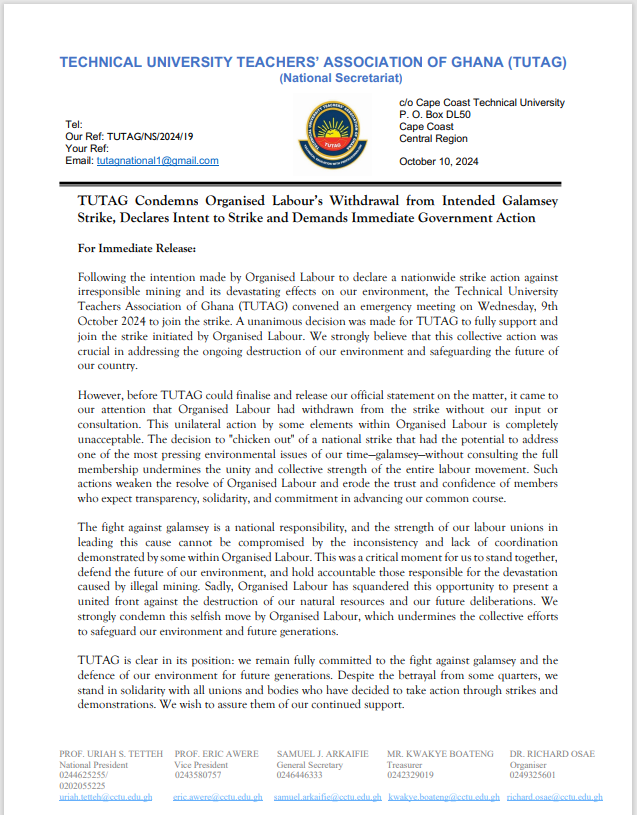
    The Technical University Teachers Association of Ghana (TUTAG) has announced its decision to initiate a strike against the pervasive issue of illegal mining, commonly known as galamsey.

    This decision comes on the heels of Organised Labour’s recent move to call off a nationwide strike following governmental intervention.

    In a statement released on October 10, TUTAG expressed its discontent over Organised Labour’s withdrawal from the strike, which occurred without prior consultation or input from its members.

    TUTAG described this unilateral action as “completely unacceptable,” stating, “This unilateral action by some elements within Organised Labour is completely unacceptable. The decision to “chicken out” of a national strike that had the potential to address one of the most pressing environmental issues of our time—galamsey—without consulting the full membership undermines the unity and collective strength of the entire labour movement.

    The association further emphasized that such actions erode the trust and confidence of its members, who expect transparency, solidarity, and commitment to collective efforts.

    “Such actions weaken the resolve of Organised Labour and erode the trust and confidence of members who expect transparency, solidarity, and commitment in advancing our common course.”

    “The fight against galamsey is a national responsibility, and the strength of our labour unions in leading this cause cannot be compromised by the inconsistency and lack of coordination demonstrated by some within Organised Labour. This was a critical moment for us to stand together, defend the future of our environment, and hold accountable those responsible for the devastation caused by illegal mining.

    “Sadly, Organised Labour has squandered this opportunity to present a united front against the destruction of our natural resources and our future deliberations. We strongly condemn this selfish move by Organised Labour, which undermines the collective efforts to safeguard our environment and future generations,” it stated.

    TUTAG condemned Organised Labour’s actions as a wasted opportunity to present a united front against the destruction of natural resources, stating, “Despite the betrayal from some quarters, we stand in solidarity with all unions and bodies who have decided to take action through strikes and demonstrations. We wish to assure them of our continued support. At an Emergency Congress held on Thursday, 10th October 2024, TUTAG has resolved to embark on a strike action. We are initiating the necessary processes under the Labour Act to invoke our right to strike, and we will soon join the call for action”.

    Despite feeling betrayed, TUTAG reaffirmed its commitment to combating galamsey and safeguarding the environment for future generations.

    During an Emergency Congress on October 10, 2024, TUTAG resolved to embark on a strike and is initiating processes under the Labour Act to exercise its right to strike in the near future.

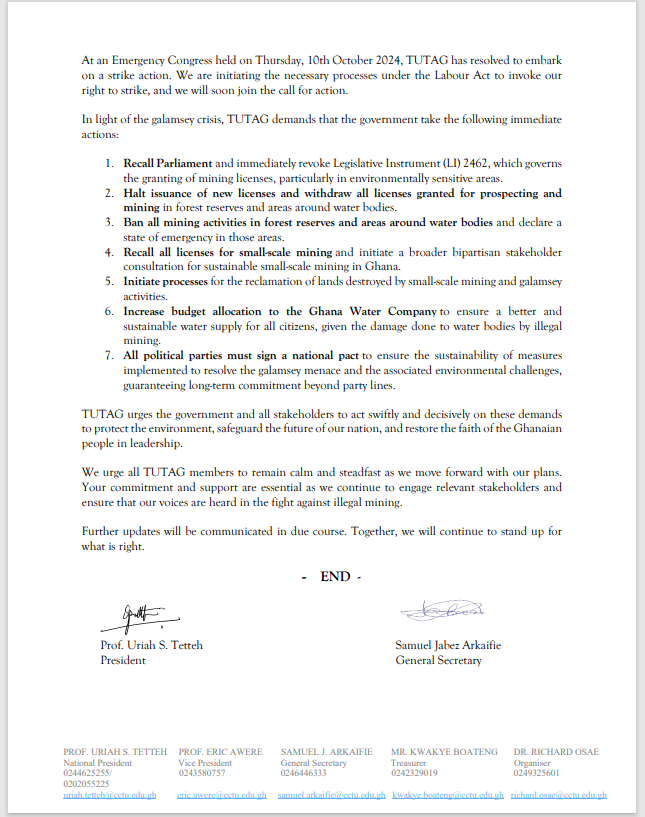
    TUTAG’s demands include the immediate recall of Parliament to revoke Legislative Instrument (LI) 2462, which regulates the granting of mining licenses in environmentally sensitive areas. They call for an immediate halt to issuing new licenses and the withdrawal of all existing licenses for prospecting and mining in forest reserves and areas near water bodies.

    The association is also urging the government to ban all mining activities in these sensitive areas and declare a state of emergency in affected regions. They advocate for the recall of all small-scale mining licenses and the initiation of broad stakeholder consultations for sustainable small-scale mining practices in Ghana.
    Moreover, TUTAG is calling for increased budget allocations to the Ghana Water Company to ensure a sustainable water supply for all citizens, considering the damage illegal mining has inflicted on water bodies.

    They urged all political parties to sign a national pact to ensure sustainable measures are enacted to address the galamsey crisis, transcending party lines.

    TUTAG concluded by urging the government and stakeholders to act swiftly on their demands to protect the environment and restore the faith of Ghanaians in their leadership.

    “We urge all TUTAG members to remain calm and steadfast as we move forward with our plans. Your commitment and support are essential as we continue to engage relevant stakeholders and ensure that our voices are heard in the fight against illegal mining,” it added.
  • We will sue you if you try to freeze our salaries – CETAG to govt

    We will sue you if you try to freeze our salaries – CETAG to govt

    The Colleges of Education Teachers Association (CETAG) leadership has pledged to fight any unlawful attempts to freeze their members’ salaries and will continue their indefinite strike until the government enforces the arbitral award and agrees to the negotiated service conditions.

    In a press briefing in Accra, CETAG President Prince Obeng-Himang stated that the strike will persist until all unresolved issues are resolved.

    “Any attempt to illegally freeze salaries would lead to legal action, as the strike is a legitimate response to the government’s delay in implementing the arbitral award and negotiated service conditions,” he cautioned.

    CETAG insists that its ongoing strike, which started in June, is legally justified and criticizes the National Labour Commission (NLC) for disseminating false information about their actions.

    The Association refutes claims that members have received their Book and Research Allowance arrears for the 2022/2023 academic year.

    Since the strike began, all academic activities at Colleges of Education nationwide have been disrupted, as members protest the government’s failure to implement the agreed-upon conditions.

    Additionally, CETAG has denied allegations that its members are administering quizzes and tests during the strike.

    They clarified that students who miss over 21 days of lectures or classes are ineligible for examinations based on affiliate universities’ attendance policies.

    “CETAG advises students, principals, and affiliate universities to respect this policy and warns of legal action against any violations,” Obeng-Himang stated.

  • Health bosses are deeply worried about the ambulance strike

    Health officials have cautioned that during today’s ambulance strike in England and Wales, patient safety cannot be guaranteed.

    However, according to NHS England, emergency care will still be offered.

    People are urged to use services “wisely” and to use 111 online as a backup plan before calling 999 unless the situation is truly life-threatening.

    There is a severe strain on A&Es, and ambulance response times are already twice as long as they were two years ago.

    Eight of the top ten ambulance services in England have reported critical incidents, a sign of the extreme pressure they are already facing.

    Ministers have advised the public to exercise extra caution and to stay away from contact sports and pointless car trips.

    Unions say life-threatening callouts will continue to be responded to over the next 24 hours but some urgent calls, for example for late-stage labour or a fall in the home, might not be answered.

    No industrial action is taking place in Northern Ireland and Scotland, and there will be no strikes in the east of England or the Isle of Wight.

    But elsewhere, there is likely to be major disruption as paramedics, call handlers, emergency care assistants and technicians go on strike.

    About 750 armed forces staff are being drafted in to cover the walkouts, however their role will be limited. They will not be sent on call-outs involving critical care, nor will they provide any clinical care.

    What do I do if I’m hurt?

    Patients who are seriously ill or injured, or whose lives are in danger, are being advised by the NHS to call 999.

    For all other healthcare needs, the NHS is advising people to contact NHS 111 online or via the NHS 111 helpline, or to contact their local GP or pharmacy.

    In the run-up to the strike, rhetoric from both sides has intensified.

    Writing in the Daily Telegraph, Health Secretary Steve Barclay said: “We now know that the NHS contingency plans will not cover all 999 calls. Ambulance unions have made a conscious choice to inflict harm on patients.”

    But union boss Christina McAnea, from Unison, told Talk TV’s First Edition the government’s refusal to open any kind of negotiations with them was irresponsible.

    Asked whose fault it would be if people died, she said: “Absolutely the government’s.”

    In a letter to the prime minister, the NHS Confederation, which represents healthcare systems in England, Wales and Northern Ireland, said there was now “deep worry among NHS leaders about the level of harm and risk that could occur to patients”.

    “This is not something NHS leaders would ever say lightly,” the letter stated, “but many now tell us that they cannot guarantee patient safety”.

    The letter has now also been signed by NHS Providers, the body which represents hospital trusts, mental health and ambulance services.

    What’s happening in my area?

    Not all unions are striking for the same hours on Wednesday, and it is difficult to say how many workers at each individual service will strike.

    You can use our interactive tool to find out which unions are on strike at your local ambulance service:

    The industrial action by ambulance workers follows two days of strikes by nurses this month over pay. It has also been some of the busiest months on record for people attending Accident and Emergency departments.

    Long waits for ambulances after an emergency 999 call have become a regular occurrence, as have queues of ambulances outside A&E waiting to offload patients.

    Rachel Harrison, national secretary of the GMB Union, said ambulance staff were tired of spending all day in an ambulance outside a hospital with a patient because of delays in handing over patients to A&E.

    She said they often did not know whether patients would “still be alive” when they reached them after a callout.

    “We’ve been raising these issues for years and [have] been ignored,” she added.

    Ambulance workers are asking for a pay rise above inflation – although not a precise figure – and a plan for recouping lost earnings over many years.

    Mr Barclay met union representatives on Tuesday afternoon but there were no discussions around pay – only what care would still be provided during the strike.

    Onay Kasab, from Unite, said the meeting was “entirely pointless” because the health secretary refused to discuss pay.

    Mr Barclay called the strikes “deeply regrettable” and urged the public to take extra care and check in on vulnerable friends, family and neighbours.

    He said most ambulance staff have received a pay rise of at least 4%, taking average earnings to £47,000. A further pay increase would mean taking money from frontline services, he added.

    Prime Minister Rishi Sunak has insisted he will not back down against striking workers. He has said the best way to help the workforce would be to reduce inflation as quickly as possible.

    Not all Conservatives agree and want to see some flexibility from the government. Sir Geoffrey Clifton-Brown, MP for the Cotswolds, said: “These things have got to be solved by negotiation. There are people who are desperately likely to need this service over Christmas.”

    NHS England says it will have more staff answering 999 calls and is helping individual trusts speed up the process of handing over emergency patients and discharging those well enough to go home.

    London Ambulance Service will not dispatch an ambulance to all 999 callouts. Instead, a team of clinicians will call patients back to see if they can be helped in other ways.

    They expect there to be 200 ambulances compared to the normal 400. Most will be staffed by the military, with a clinician alongside that may or may not be a paramedic. Taxis may also be used for some patients.

    If there are not enough ambulances to get to all life-threatening emergencies, staff will leave the picket line to respond, the head of the service, Daniel Elkeles, said.

    On Tuesday, eight ambulance services declared critical incidents, including North East Ambulance Service, South East Coast Ambulance Service, the East of England Ambulance Service, Yorkshire Ambulance Service and South Central Ambulance Service, because of pressure on services.

    A critical incident allows services to prioritise certain patients and cancel non-urgent demands on staff such as training. It can happen because of a very high number of calls, for example.