Tag: Anti-Gay Bill

  • President Mahama’s honorary doctorate degree from Lincoln University withdrawn over LGBTQ stance

    President Mahama’s honorary doctorate degree from Lincoln University withdrawn over LGBTQ stance

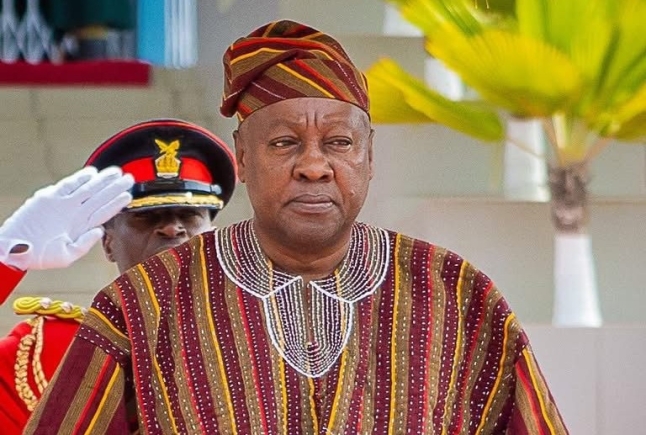
    Management of the Lincoln University has withdrawn an honorary doctorate degree, honoris causa, conferred on President John Dramani Mahama.

    According to the University, revocation follows calls from one group alleging President Mahama’s view on Ghana’s Human Sexual Rights and Family Values Bill, popularly known as the anti-gay Bill.

    However, Ghana’s Embassy in the United States has expressed profound disappointment following the development.

    The embassy in n a statement released on Tuesday, March 24, noted “It is both surprising and regrettable that such concerns have surfaced at this late stage, particularly with the President already in the United States in anticipation of the visit”.

    President Mahama was expected to have paid a visit the Lincoln University on Wednesday, March 25. President Mahama on several occasions has pledged to sign into law the anti-gay Bill.

    Having expired with the conclusion of the previous 8th Parliament’s session, the Speaker of Parliament, Alban Bagbin, has directed the Business Committee to schedule the reintroduced bill for parliamentary deliberation.

    The bill, which aims to outlaw LGBTQ+ activities and criminalise their promotion, advocacy, and funding, was previously passed by the 8th Parliament.

    Meanwhile, President John Dramani Mahama has confidently stated that he will sign anti-LGBTQ bill once it is successfully approved by parliament.

    During a courtesy visit by the Christian Council of Ghana on Tuesday, November 18, at Jubilee House, the president mentioned all the factors that must come to play for him to assent to the bill.

    “I believe that we have no questions or equivocations about what we believe. I believe that we are completely aligned with the Christian Council in terms of your belief. We agree with the Speaker to relay the bill and let Parliament debate it.”

    “And if there are any amendments or adjustments that need to be made, if the people’s representatives in Parliament endorse the bill, vote on it, and pass it, and it comes to me as president, I will sign it,” President Mahama said.

    Before his return to office, President Mahama had already expressed a cautious approach toward the bill, emphasizing the need for a constitutional review.

    Speaking with BBC Africa on December 4, he elaborated: “It is not an anti-LGBTQI Bill; it is a Family Values Bill. It was approved unanimously by our Parliament. [LGBTQI] is against our African culture, it is against our religious faith, but I think we must look at the Bill, and the president must indicate what he finds wrong with that bill and send it back to Parliament or alternatively he must send it to the Council of State and get the Council of State’s advice.”

    When asked if he would sign the bill into law if elected, Mahama responded cautiously, stating, “It depends on what is in the Bill.” He emphasized that any decision would be based on a thorough examination of the bill’s content and legal compliance. “That is what I would have done,” he affirmed.

    While proponents argue the bill is necessary to safeguard Ghanaian cultural and moral values from external influences, human rights advocates have raised concerns, stating it infringes on freedoms of expression, association, and equality under the law.

    The bill previously faced legal opposition from journalist Richard Dela Sky and academic Dr. Amanda Odoi, who contested its passage, citing a lack of parliamentary quorum.

    The Supreme Court, however, dismissed their challenge, with Justice Lovelace Johnson clarifying that a bill can only be subject to constitutional scrutiny after receiving presidential assent.

  • Our stand remains the same – Mahama Ayariga on Anti-Gay Bill

    Our stand remains the same – Mahama Ayariga on Anti-Gay Bill

    Majority Leader Mahama Ayariga has reaffirmed the government’s support for the Proper Human Sexual Rights and Family Values Bill, commonly known as the Anti-Gay Bill.

    Speaking in an interview on Channel One TV, as reported by myjoyonline.com, Ayariga emphasized that the National Democratic Congress (NDC) remains firm in its position on the bill.

    He explained that legislative proposals not completed during a president’s term are usually considered void once that administration ends.

    Addressing concerns over the status of the bill, he stated, “No, there has been no change in our stance. The question now is whether we can simply sign and pass it into law. Would it be recognised as proper legislation, or might the process be challenged on the grounds that its validity expired with the previous Parliament?”

    Former President John Dramani Mahama has indicated that the bill be reintroduced as a government-sponsored bill rather than a Private Member’s Bill to allow for broader stakeholder consultations.

    The Anti-Gay Bill, passed by Parliament in February 2024, criminalises LGBTQ acts and imposes penalties on those who engage in or promote such activities.

    However, following its passage, former President Nana Addo Dankwa Akufo-Addo, in a letter to the Clerk of Parliament, advised against transmitting the bill for presidential assent until ongoing legal challenges were resolved at the time.

    The Supreme Court dismissed these legal challenges in December 2024, clearing the way for further legislative action on the controversial bill.

  • Anti-LGBTQ Bill protest happening today

    Anti-LGBTQ Bill protest happening today

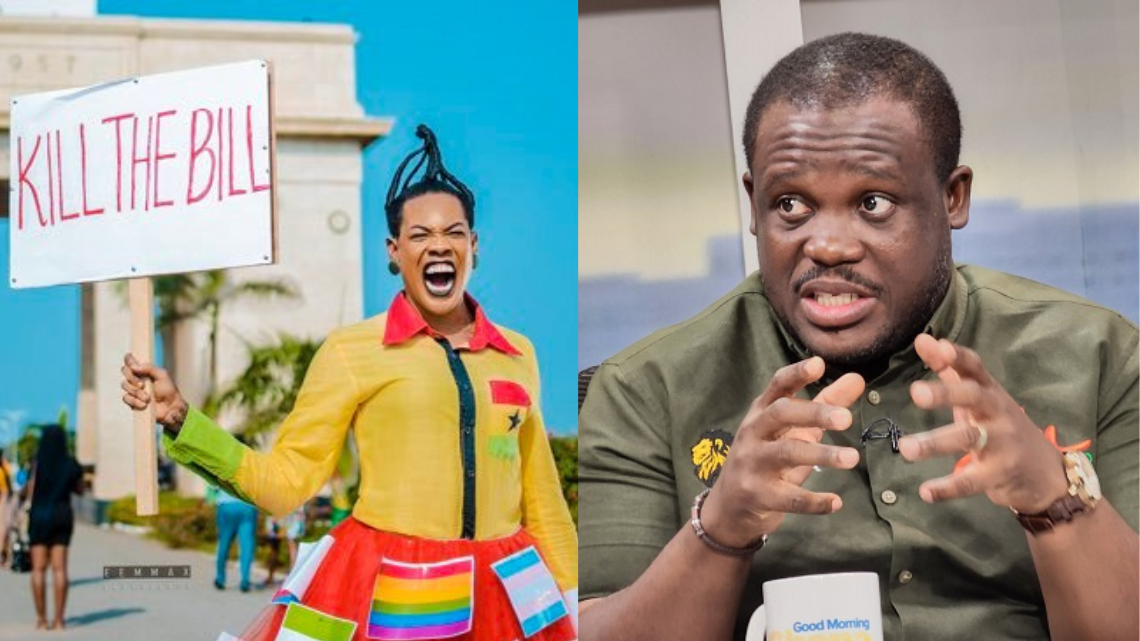
    Supporters of the Human Sexual Rights and Family Values Bill, commonly known as the anti-LGBTQ+ bill, are staging a protest today, Tuesday, October 8, to express their frustration over the delays in the bill’s final approval.

    The demonstrators are demanding swift action, urging the president to sign the bill into law. Although Parliament passed the bill on February 28, 2024, it has not progressed further.

    The protest aims to highlight the extended wait for the bill’s implementation, which has been stalled in part due to a Supreme Court ruling on July 17, 2024. The court postponed its decision on legal challenges to the bill until all related issues are resolved, adding to the growing anxiety among its proponents.

    Samuel Nartey George, the Member of Parliament for Ningo-Prampram and a key advocate for the bill, has been leading the call for its enactment. In an interview with Citi FM, George expressed his frustration with the delays, stressing that the bill reflects the will of the Ghanaian people, as demonstrated by its approval in Parliament.

    He argued that the continued postponement is weakening the legislative process and urged the Chief Justice to expedite the legal review. George emphasised the need for the judiciary to prioritise the case so that the bill can be signed into law, asserting that it is crucial to uphold the values and principles of the nation.

    “The Chief Justice has the power to demand of all the parties in the case that they file within the times stipulated in the Rules of Procedure, that you file a statement of claim within 14 days. All of this is clear, and the Chief Justice is the one who has powers to ensure that.”

    “If everybody is going to take one year to file their documents, the Chief Justice thinks that that is a proper delivery of justice, where parties in the case will determine as and when and how they would be doing their filing.”

    “Justice delayed is justice denied, and the expeditious delivery of justice is critical to an effective justice delivery system, and so the Chief Justice has to be up and doing,” he stated.

    Supporters of the Human Sexual Rights and Family Values Bill believe it is essential to safeguard Ghana’s cultural traditions and counter the increasing presence of LGBTQ+ practices in the nation.

    They are optimistic that their protest will prompt both the government and judiciary to expedite the process, ensuring the bill is advanced for final approval.

  • Anti-LGBTQ Bill supporters to protest on October 8

    Anti-LGBTQ Bill supporters to protest on October 8

    Proponents of the Human Sexual Rights and Family Values Bill, commonly referred to as the Anti-Gay Bill, have scheduled a peaceful march to the Supreme Court to protest delays in the final ruling on the bill.

    Scheduled for Tuesday, October 8, 2024, the march will begin at Kwame Nkrumah Circle in Accra, with participants proceeding to submit petitions to the Attorney General and Chief Justice Gertrude Torkonoo.

    The demonstration aims to push for a resolution to the bill, which has been in limbo since Parliament passed it on February 28, 2024.

    The peaceful protest, initially set for two months earlier, will include various religious groups and key stakeholders. The decision to go ahead with the march follows the Supreme Court’s ruling on July 17, 2024, to delay its verdict on anti-gay cases until all legal issues are settled.

    The Human Sexual Rights and Family Values Bill seeks to criminalise LGBTQ+ activities across Ghana. During the march, the sponsors intend to formally request Chief Justice Torkonoo to set a date for the court’s final decision on the matter, highlighting the ongoing national debate on LGBTQ+ rights.

    Sam George, the bill’s lead advocate, voiced his concerns in an interview with Umaru Sanda Amadu on Face to Face on Channel One TV, criticising the Supreme Court’s slow action in scheduling a hearing. He stressed that the court’s delay is impeding the resolution of a critical national issue.

    “Basically what the Supreme Court has done is stage judgements. The judiciary today is stopping the legislature from doing a constitutional mandate. Based on Article 106/7 of the Constitution, the Chief Justice and the Supreme Court have basically restrained Parliament from doing so without uttering those words.

    “Now you say you want to hear the main case, they haven’t said anything to us; they haven’t given us a timetable. Are you hearing it now? One month or two years, nobody knows what’s going on. She has not even called the main case. We need a timetable to know what she’s going to call the case.”

    The Member of Parliament noted that the Supreme Court has previously heard cases during vacation periods, highlighting the inconsistency in delaying this particular case.

    He emphasised that further delays are not in the country’s best interest.

    “The Supreme Court has been hearing cases during vacation. During vacation, the court of the land has been sitting, and it’s about placing a premium on it.

    Earlier two months ago, a decision was taken by the sponsors and some other partners, the Chief Imam’s office, and Ghana Pentecostal and Charismatic Church that we were going to march to the Chief Justice’s office and give a petition to her, demanding from her to give us a timetable.

    “This is a major national issue; we need to have a final determination on the matter, and they should act expeditiously. It’s not a matter the Supreme Court can choose and be lackadaisical or drag its feet. We want to see some action.

    “It’s coming off this Tuesday, October 8, we will start from Kwame Nkrumah Circle, a peaceful march, nobody is supposed to come with party colours. We will march to the Supreme Court to demand a ruling on the case.”

    Background

    On February 28, 2024, Parliament passed the Human Sexual Rights and Family Values Act, 2024, a law that outlaws LGBTQ+ activities, including their advocacy, promotion, and financial support.

    Under the new legislation, individuals found guilty of engaging in such activities could face imprisonment ranging from 6 months to 3 years. Those involved in promoting or sponsoring these actions could receive jail terms of 3 to 5 years.

    The act has been met with legal challenges, with private lawyers Richard Dela Sky and gender activist Dr. Amanda Odoi filing lawsuits to have the law nullified. Additionally, Prince Obiri-Korang, a law lecturer from the University of Ghana, has taken legal steps to overturn the statute.

    Although the bill has passed Parliament, its future remains unclear, as President Nana Addo Dankwa Akufo-Addo has yet to sign it into law, amid growing international pressure and concerns about its potential economic consequences for Ghana.

    The Human Sexual Rights and Family Values Bill, first introduced in 2021, has sparked intense debate, with supporters advocating for the preservation of traditional family structures and critics warning of human rights violations.

  • Sam George to lead demonstration against Chief Justice over delay in sending bill to Akufo-Addo

    Sam George to lead demonstration against Chief Justice over delay in sending bill to Akufo-Addo

    Supporters of the anti-LGBTQ bill have announced plans to protest against the Chief Justice on August 21, 2024, due to what they consider a delay in forwarding the bill to the President.

    The Supreme Court postponed its decision on the injunction requests from Dr. Amanda Odoi and Broadcast Journalist Richard Sky concerning the bill’s transmission to the President, choosing instead to deliver the ruling on the same day as the final judgment.

    Samuel Nartey George, the lead sponsor of the anti-LGBTQ bill, made this statement during a visit with some minority members to the National Chief Imam and the Acting President of the Osu Traditional Council.

    He promised a peaceful demonstration to ensure the bill reaches the President for approval.

    “We want to do a peaceful march on the 21st of August to the Chief Justice because right now it is not the president that is holding it. It is the Chief Justice. She is the one who is preventing parliament from sending it to the president.”

    “…The people of Ghana just want her to do what we pay her salary for. Hear the case and give a judgement…If you don’t give a judgement, we are all hanging in the air,” he stated.

  • Parliament resumes sitting to address financial issues and urgent govt business

    Parliament resumes sitting to address financial issues and urgent govt business

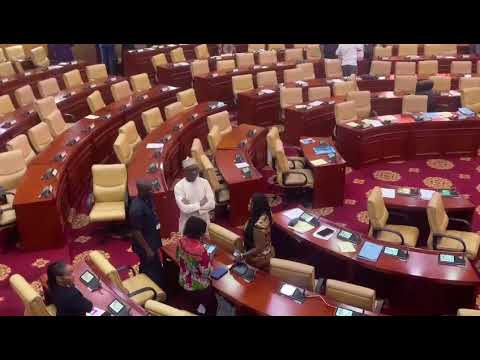
    Parliament is set to resume today, Tuesday, June 11, for the second meeting of the Fourth Session.

    The House had been abruptly adjourned by Speaker Alban Bagbin on March 20, 2024, following an extensive response to a letter from the Presidency advising against transmitting the Human Sexual Rights and Family Values Bill, commonly known as the anti-gay bill, to the President for assent.

    On May 3, 2024, the Majority Caucus petitioned the Speaker to urgently reconvene the House to address critical government business items, including the adoption of the 34th Report of the Appointments Committee and a motion on additional financing.

    In response, a letter from the Office of the Speaker has called Members of Parliament back from recess to commence proceedings today.

  • Anti-gay Bill court proceedings to be broadcasted – Judicial Service issues permit

    Anti-gay Bill court proceedings to be broadcasted – Judicial Service issues permit

    In a notable development, the Judicial Service of Ghana has authorized media outlets to have unrestricted access to court proceedings concerning the controversial Human Sexual Rights and Family Values Bill 2024, widely known as the anti-gay Bill.

    This decision, conveyed through a communiqué released on Tuesday, May 28, grants both radio and television media the opportunity to cover all pertinent court proceedings associated with the bill.

    The move comes amidst considerable public interest in the legislation, which has ignited substantial nationwide discourse.

    By granting media access, the Judicial Service aims to ensure transparency and keep the public informed about the legal process as it unfolds.

    “Reference instructions from Management of the Judicial Service of Ghana regarding the public interest in cases on the Human Sexual Rights and Family Values Bill 2024 (the “Bill”), permission has been granted for the media (including Radio and Television) to have full access to the relevant courts to undertake a coverage of all proceedings in those cases concerning the Bill,” an excerpt of the statement said.

    At present, there are four distinct legal challenges lodged against the bill.

    Amanda Odoi and Richard Dela Sky have directly petitioned the Supreme Court, contesting the bill’s validity and passage.

    Separately, Paul Boama-Sefa and Prince Obiri-Korang have initiated their own challenges at the High Court.

    In response to these legal maneuvers, President Akufo-Addo has opted to withhold his signature from the bill until the pending cases are resolved.

    This stance has drawn criticism from the minority in parliament and various other groups and individuals.

  • Judgment on constitutionality of law against gay, consensual anal sex set to be given on July 27

    Judgment on constitutionality of law against gay, consensual anal sex set to be given on July 27

    Supreme Court is set to render a decision on the constitutionality of the nation’s criminal law concerning consensual gay, anal, and other forms of unnatural sexual intercourse on July 27, 2024.

    The panel, chaired by Justice Paul Baffoe-Bonnie, scheduled this date following hearings involving the plaintiff, Dr. Obiri-Korang, and the Attorney General.

    In addition to Justice Baffoe-Bonnie, the panel comprises Justices Omoro Amadu Tanko, Ernest Gaewu, Adjei-Frimpong, Avril Lovelace-Johnson, Emmanuel Yonny Kulendi, and Yaw Darko Asare.

    During the proceedings, the panel adopted the joint memorandum of issues presented by Dr. Prince Obiri-Korang, who represented himself, and the Attorney General.

    Dr. Sylvia Adesu, the Chief State Attorney, sought permission to submit a witness statement from a medical professional addressing whether anal, gay, and other unnatural sexual intercourse forms caused harm to others.

    While four issues were agreed upon, the fifth issue was dismissed.

    According to EIB Network’s Legal Affairs Correspondent, Murtala Inusah, there were power outages during the court proceedings.

    Plaintiff’s grounds

    It is the case of the Plaintiff that, it is unconstitutionality of section 104(1)(b) of Act 29 is grounded on the breaches of the said section to rights of privacy, non-discrimination and liberties of a person.

    He also contended that, section 104(1)(b) of Act 29 sins against Articles 18(2), 17(2) and 14(1) of the 1992 Constitution of the Republic of Ghana.

    The section of Act 29 complained about reads reads;

    1. Unnatural carnal knowledge
      (1) A person who has unnatural carnal knowledge.

    (b) of another person of not less than sixteen years of age with the consent of that other person commits a misdemeanour.

    The Plaintiff seeks to cause the apex Court to tow the line of Constitutional Courts in India and some parts of the Caribbean and other States with similar laws on unnatural sexual intercourse which have been pronounced on as unconstitutional which.

  • Akufo-Addo cannot sign anti-gay bill because he doesn’t have the holy spirit in him – Rev.Dr Samuel Mensah

    Akufo-Addo cannot sign anti-gay bill because he doesn’t have the holy spirit in him – Rev.Dr Samuel Mensah

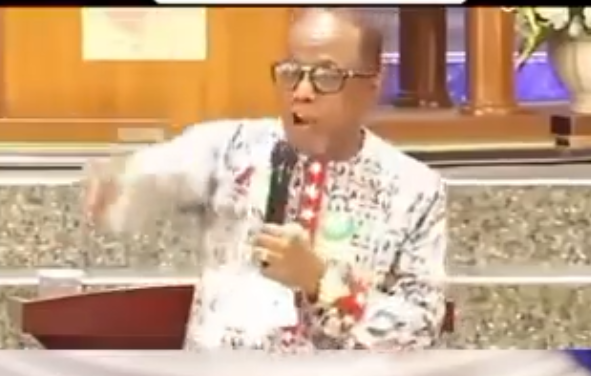
    A pastor at Full Gospel Church International, Rev. Dr. Samuel Mensah, has asserted that President Akufo-Addo’s reluctance to sign the Proper Human Rights Family Value Bill, commonly known as the anti-LGBTQ bill, indicates a lack of the Holy Spirit within him.

    In a widely circulated video, the pastor emphasized the importance of having a leader filled with the Holy Spirit, arguing that such a leader would unequivocally support legislation against LGBTQ activities.

    He challenged the notion that mere attendance at church services equates to true faith, urging individuals to demonstrate their beliefs through actions. Rev. Mensah also criticized the Akufo-Addo-led administration, alleging widespread corruption and moral decay within the government.

    He called upon President Akufo-Addo to embody the principles of his faith and enact positive change in the country.

    “If we have a holy spirit filled president, he will sign the LGBTQ into law. He can’t come and deceive us that I go to church, if you really go to church and you believe it, show it. If you claim you belong to one of the traditional  churches, show it.

    “Let your faith speak for you. If the fish rots it rots from the head. Right from the Jubilee House and everywhere there’s rottenness yet they said they are christians. Take your faith to where you belong to and let your faith change the environment,” he said.


    On Wednesday, February 28, 2024, Parliament approved the anti-LGBTQ bill, set to criminalize activities related to lesbian, gay, bisexual, and transgender (LGBT) individuals, as well as their promotion, advocacy, and funding within Ghana.

    President Akufo-Addo has clarified that the anti-LGBTQI bill has not yet reached his desk for approval. Despite concerns raised in diplomatic circles, he assured that Parliament’s bipartisan approval of the bill will not compromise Ghana’s human rights record.

    Addressing anxieties surrounding any potential shift in Ghana’s stance on human rights and the rule of law, President Akufo-Addo emphasized his commitment to upholding these principles.

    While refraining from discussing the bill’s origin or its pending status, he acknowledged a constitutional challenge filed at the Supreme Court regarding the proposed legislation. The President urged patience, suggesting that everyone await the court’s decision before taking any further action.

    Watch video below:

  • Akufo-Addo risks going to jail if he signs anti-gay bill – New Juaben South MP

    Akufo-Addo risks going to jail if he signs anti-gay bill – New Juaben South MP

    New Juaben South’s Member of Parliament, Michael Okyere Baafi, has warned of potential legal consequences for President Akufo-Addo if he proceeds to sign the anti-gay bill currently under review by the Supreme Court.

    The bill, which received parliamentary approval in February 2024, has stirred controversy due to President Akufo-Addo’s reluctance to endorse it.

    Criticism has arisen from both proponents of the bill and Parliament’s Speaker, Alban Bagbin, who considers the president’s hesitation unconstitutional.

    However, the President’s Executive Secretary, Nana Bediatuo Asante, clarified that the delay is attributed to a legal injunction filed at the Supreme Court.

    Addressing congregants at the Church of Pentecost’s Easter Convention in Koforidua, Michael Okyere Baafi refuted claims of deliberate delays by the president, citing the legal impediment as the primary barrier.

    “That foolish thing called LGBTQ cannot be tolerated. The 1992 Constitution already frowns on it. So, we, the MPs, based on powers given to us, support the anti-LGBTQ+ bill in parliament…

    “If the president goes ahead to sign, he will be jailed. The people who sent the matter to court want the president to be jailed if he signs the bill.”

    “In any case, if President Akufo-Addo signs the bill, he won’t suffer the consequences because it is left with his eight months to leave,” he added.

    “The president says he will sign the bill right after the Supreme Court decision,” Okyere Baafi assured.

    Okyere Baafi reaffirmed President Akufo-Addo’s backing for the bill and assured the congregation that the delay is a testament to the government’s commitment to upholding the rule of law.

    Regarding concerns raised by the Ministry of Finance regarding potential economic repercussions, Okyere Baafi expressed confidence that the government stands to gain from signing the bill.

    However, he underscored the president’s pledge to await the Supreme Court’s ruling before proceeding with the bill’s signing.

  • Parliament urges prompt action on interlocutory injunctions concerning the anti-gay bill

    Parliament urges prompt action on interlocutory injunctions concerning the anti-gay bill

    Parliament is urging the Supreme Court to accelerate the resolution of the interlocutory injunctions against the anti-gay bill, which were initiated by private legal practitioner Richard Dela Sky and gender activist Dr. Amanda Odoi.

    Both Richard Dela Sky and Dr. Odoi have separately filed lawsuits against the anti-gay bill, seeking to prevent President Nana Addo Dankwa Akufo-Addo from enacting it into law, citing violations of constitutional rights of homosexual individuals.

    Parliament contends that while a similar case involving MP for South Dayi, Rockson-Nelson Dafeamekpor, has already been adjudicated, the cases brought by Richard Dela Sky and Dr. Odoi are still pending before the court.

    In a letter to the Supreme Court’s Registrar, dated Thursday, March 28, 2024, lawyers for Parliament, Sory at Law Barristers and Solicitors, said, “It will accordingly be appreciated if the parties are given a very early date to expedite the hearing of the applications pending before the Court. We trust that as the applications raise matters of public interest, you will give our letter the attention it deserves.”

    The National Democratic Congress (NDC) has criticized the Attorney-General for perceived bias following the Supreme Court’s decision to prioritize the trial involving the South Dayi MP’s application against the approval of ministerial nominees, while Richard Sky’s case against the anti-LGBTQ Bill remains pending.

    In reaction to the lawsuits, the Presidency has intervened by halting the transmission of the anti-gay bill for assent. Despite this, Parliament has recently passed the contentious anti-gay bill.

  • Passing anti-gay bill will be an “economic disaster” for Ghana  – Stanford Uni Prof

    Passing anti-gay bill will be an “economic disaster” for Ghana – Stanford Uni Prof

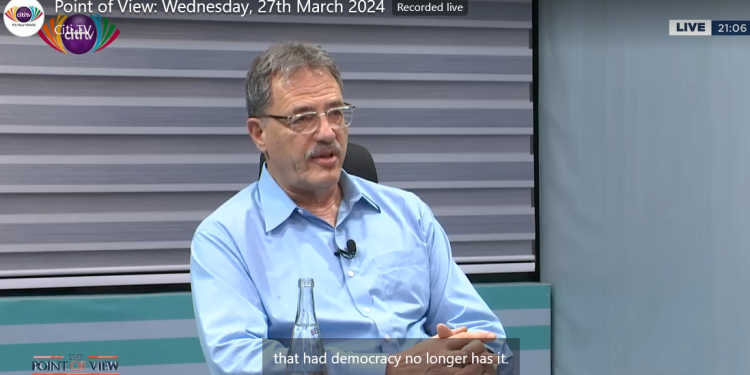
    Professor Larry Diamond, a renowned democracy scholar affiliated with the Hoover Institute and Stanford University, has cautioned Ghana about the potential dire consequences of passing the controversial anti-gay bill into law.

    The Ministry of Finance has joined the chorus of voices urging President Akufo-Addo to refrain from giving his approval to the bill recently endorsed by Parliament.

    According to the Ministry, Ghana could face significant financial fallout if the bill is enacted.

    The Ministry’s statement highlighted the risk of losing substantial World Bank funding, projecting a potential loss of USD$3.8 billion over the next five to six years.

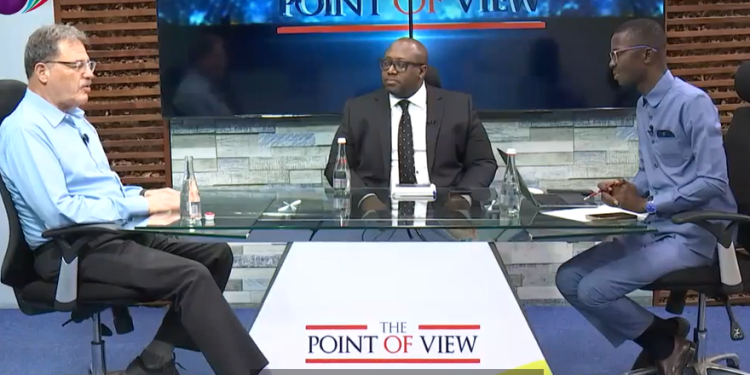
    Speaking on Citi TV’s The Point of View with Bernard Avle, Professor Diamond emphasized the economic catastrophe that could result from passing the bill.

    He underscored the likelihood of foreign investors imposing restrictions on Ghana due to its infringement on the rights of a minority group.

    Professor Diamond also argued that Western nations are primarily driving the anti-gay agenda in Africa, exacerbating the situation.

    “I would remind people of what some friends of Ghana have been saying. This act will be a disaster for Ghana economically [if passed into law]. Because Western companies are not going to come and invest in a country that is pummeling minority rights.

    “The extreme religious rights have failed to achieve this religious agenda in the United States. And so now they are coming to Africa to try and push the agenda. People who complain about neo-colonialism? Shouldn’t they be asking questions about this? he asked.

    On March 18, the Presidency sent a letter to Parliament, pausing the progress of the anti-LGBTQ+ Bill for approval due to legal concerns. Speaker of Parliament Alban Bagbin rebuked President Nana Addo Dankwa Akufo-Addo for this move.

  • Ghana’s anti-gay bill a misdirection from governance challenges – Prof Diamond warns

    Ghana’s anti-gay bill a misdirection from governance challenges – Prof Diamond warns

    Professor Larry Diamond, a Democracy Scholar at the Hoover Institute and Stanford University, has expressed grave concerns regarding the recent controversy surrounding Ghana’s anti-gay bill, which was recently passed by Parliament.

    During an interview on The Point of View program on Citi TV, Professor Diamond argued that the focus on the anti-gay bill is diverting attention from the significant governance challenges facing Ghana.

    “One concern to put it bluntly is the bill parliament has adopted although it’s not transmitted, which I think is a diversion from the real developments of issues facing the country. People have different religious convictions in many ways which is an admirable thing. They have a religious faith that can be resourced, it can be a moral resource if you take it seriously,” he added.

    “It can be a source of solace and cooperation, but what’s the aim of prosecuting people who were born and all of the psychological research is showing that the sexual identity is determined by genetics inherent at a very young age.”

    He questioned the rationale behind the support for the bill within a segment of the population.

    Furthermore, he raised doubts about the country’s decision to prosecute individuals who belong to a small minority and possess inherent traits beyond their control.

    The Democracy Scholar criticized the harassment of homosexuals in Ghana, describing it as morally unjust.

    “So, picking on people who are gender fluid, lesbians, gays, transgender whatever, what is going to be next? You are going pick on people who are in wheelchairs, who use their left hand to eat, rather than the right hand.

    ‘It’s not morally right I think to beat up on and bully from the vulnerable minority this way. It can be a very effective tool for this bullying. To divert attention from bad governance and it’s really not what the great religious figures have in mind when they called for tolerance and all of those children being loved.”

    “This act will be a disaster for Ghana economically if passed into law,” he pointed out.

    He warned of dire economic consequences for Ghana if the bill is enacted into law.

  • It’s either you sign anti-gay bill or have us contend with you – Suma Omanhene to Akufo-Addo

    It’s either you sign anti-gay bill or have us contend with you – Suma Omanhene to Akufo-Addo


    The leader of the Suma Traditional Council in the Bono Region, Odeneho Afram Brempong III, has urged President Akufo-Addo to endorse the Anti-LGBT+ Bill or face community backlash.

    Expressing dissatisfaction with the president’s hesitance to enact the bill, Odeneho Afram Brempong III warned of severe repercussions against individuals involved in LGBT+ activities if the legislation remains unratified.

    He stressed the readiness of the Suma community to challenge the president if necessary.

    Addressing the media on March 25, 2024, Odeneho Afram Brempong III stated, “We have heard that Parliament has passed the LGBT+ Bill and the president is saying he won’t even touch the bill, let alone assent to it.

    “If the president doesn’t sign the Anti-LGBT+ Bill, the Suma community has him to contend with. Because in 2021, we called all MPs here to commend them for having such a foresight to make laws against the activities of LGBT+.

    “If he signs and he doesn’t agree, he can take it to court and we will also challenge it.

    “So, for him refusing to sign, he is worrying us and making us scared because of his past comment that it is bound to happen,” he said.

    “In the olden days, we had ways of punishing people engaging in the act of LGBT+. If there are no laws at the moment, we will be using the olden systems, if you are caught, we will lash you first, then we ban you from the community,” he added.

    Referring to traditional forms of punishment, the Omanhene underscored the community’s willingness to employ customary measures against those involved in LGBT+ activities if the president fails to endorse the bill.

    The Anti-LGBT+ Bill, as passed by Parliament, prohibits LGBT activities and criminalizes their promotion, advocacy, and funding. Perpetrators could face imprisonment ranging from six months to three years, while promoters and sponsors could be sentenced to three to five years in jail.

    President Akufo-Addo has deferred his decision on signing the bill into law, citing a constitutional challenge in the Supreme Court. Nevertheless, if he opts against it, MPs can override his decision with a two-thirds majority vote, making the bill’s provisions enforceable.

  • Akufo-Addo has the right to withhold assent to”unconstitutional” anti-gay bill – Dennis Miracles

    Akufo-Addo has the right to withhold assent to”unconstitutional” anti-gay bill – Dennis Miracles

    The Director of Communications for the Bawumia 2024 Campaign Team, Dennis Miracles Aboagye, has indicated that the government does not oppose the passage of the Proper Human Sexual Rights and Ghanaian Family Values (anti-gay) bill, pending the approval of President Akufo-Addo.


    Speaking on TV3, he emphasized that the bill is a complex issue and requires thorough assessment to avoid potential future repercussions.

    “The law has been passed it’s a law purely passed based on consensus, largely by everybody across the political divide. On the floor of the house there was a complete consensus on the passage of the law, there were members of parliaments raised issues of amendments in the law and these amendments were either carried or thrown away, but in principle nobody from the NPP or the NDC side has been against the passage of the anti-LGBTQ law and that is a fact and the law has been approved by parliament,” he stated.


    Mr Aboagye explained that one of the procedural steps for signing the bill involves President Akufo-Addo raising concerns, which must be addressed by Parliament before the bill can become law.

    He further noted that the process concludes when any amendments and embedded sanctions in the bill are unanimously accepted by both Parliament and the President.

    “It has to be transmitted to the president for the president to assent to it or otherwise or raise concerns don’t forget when it is transmitted to the president it is not only assenting to the law but the president can communicate back to parliament on areas of concern.

    “It’s not as if the whole process ends at the point where parliament transmits to the president and the only thing left  is for the president to assent. The president under the law is mandated to look at it and then areas of concern he can write to parliament and say that I have received the law but I think that you should look at ABCD and parliament also under the same law can look at the issues raised by the president,” he added.

    Parliament passed the anti-LGBTQ bill on Wednesday, February 28, 2024.

    Once enacted into law, it will criminalize lesbian, gay, bisexual, and transgender (LGBT) activities, as well as their promotion, advocacy, and funding in Ghana.

    However, President Akufo-Addo clarified on Monday, March 4, that the anti-LGBTQI bill has not yet reached his office.

    Despite concerns within diplomatic circles, he assured that the bipartisan approval of the bill by Parliament will not compromise Ghana’s human rights record.


    Addressing anxieties about any potential shift in Ghana’s stance on human rights and the rule of law, President Akufo-Addo emphasized his commitment to upholding these principles.

    While refraining from discussing the bill’s origin, pending on his desk, he acknowledged a constitutional challenge filed at the Supreme Court regarding the proposed legislation.

    The President urged patience, suggesting that everyone await the court’s decision before taking any action.

    He underscored the importance of Ghanaian state institutions in shaping the future trajectory of rule of law and human rights compliance in the country.

  • Your brother died wearing pampers; learn from that! – Akufo-Addo ‘warned’

    Your brother died wearing pampers; learn from that! – Akufo-Addo ‘warned’

    Deputy Communication Officer of the National Democratic Congress (NDC), Maleek Basintale, has taken a swipe at President Akufo-Addo following a ‘degrading’ tweet by the Director of Communications, New Patriotic Party (NPP), Richard Ahiagbah.

    The Communications Director of the NPP tweeted an old photo of the NDC flagbearer and former president of Ghana, John Mahama, alongside LGBTQ activist and human rights advocate Andrew Solomon.

    The caption implied that Mahama supports the LGBTQ community but is being hypocritical about his stance because his party is advocating for the passage of the anti-gay bill.

    In a reactionary tweet to this, Maleek made reference to the sibling of Akufo-Addo, Paul Danquah who was openly gay. He lived with his life partner, Peter Pollock, in the United Kingdom, and later died in Tangier, Morocco, on August 13, 2015.

    He alleged that the President’s brother wore diapers days before his demise.

    In light of this, he urged Akufo-Addo to learn from the ‘predicament’ of his late brother and be circumspect in his dealings as far as the anti-gay bill is concerned.

    “Well, Akuffo-Addo watched his brother Paul Danquah wear pampers before dying. He should use this as a guide and stop meddling with Lesbians like Serwa B,” he said in a tweet.

  • A president in his right frame of mind would never sign anti-gay bill – Kofi Akpaloo

    A president in his right frame of mind would never sign anti-gay bill – Kofi Akpaloo

    Speaker of Parliament, Alban Bagbin, has sparked discussions on X after announcing the suspension of the approval process for newly-vetted ministers nominated by the president.

    Bagbin’s decision, made on March 20, came in response to a presidential directive instructing Parliament to hold off on forwarding the bill on Human Sexual Rights and Family Values to the president for assent. This directive was issued pending the Supreme Court’s determination of cases related to the anti-gay bill.

    The Speaker’s move has triggered various reactions, with Attorney-General Godfred Dame suggesting that Bagbin may have been misled or misinformed in making his decision.

    On X, users have been actively sharing their views on this matter, making the Speaker’s actions a trending topic.

    “In the circumstance, you are kindly requested to cease and desist from transmitting the bill to the President until the matter before the Supreme Court is resolved,” Mr. Bediatuo stated.

    Numerous Members of Parliament have voiced their discontent regarding the directive from the Presidency, with former Minority Leader Haruna Iddrisu labelling the letter as a threat to Ghana’s democratic principles.

    During a discussion on Ghana Kasa on Kasapa 102.5FM, Kofi Akpaloo remarked that President Akufo-Addo should refrain from signing the bill at this particular juncture.

    “I’m not sure anybody in his right sense occupying the seat President Akufo-Addo is currently sitting on, will sign the anti-LGBT bill. The country’s economy is now recovering from the devastation caused by COVID-19, and the negative effects of the Russia-Ukraine war on our economy. There’s too much hardship in the country.”

    “You recall the threat issued by the US Ambassador when the bill was passed in Parliament. We are not self-sufficient as a country, we depend on others to survive. I don’t support anyone practising LGBTQ activities, however, we should not do things out of emotions.

    Have you ever heard that Saudi Arabia and Qatar which frown on LGBTQ activities have ever gone for a loan from any country before? As a country, let us put our things right economically, then any president can boldly and fearlessly sign the bill into law.”

  • You must think twice before assenting to anti-gay bill –  Akufo-Addo told

    You must think twice before assenting to anti-gay bill – Akufo-Addo told

    Local Governance Expert, Dr. Frederick Oduro has asserted that given Ghana’s current economic circumstances, no President would be cautious about assenting to the LGBT+ Bill.

    This statement follows the Office of the President’s directive to Parliament, urging a halt on transmitting the LGBTQ+ bill for assent until the Supreme Court renders its ruling on the matter.

    In a letter addressed to Parliament and signed by the Secretary to the President, Nana Asante Bediatuo, it was clarified that the Human Sexual Rights and Family Value Bill faces two ongoing court cases.

    Thus, Parliament is advised against transmitting the bill to the Presidency until the Supreme Court resolves the issue.

    Speaking on Morning Starr with Francis Abban, the Local Governance Expert highlighted the attention the bill has drawn to Ghana.

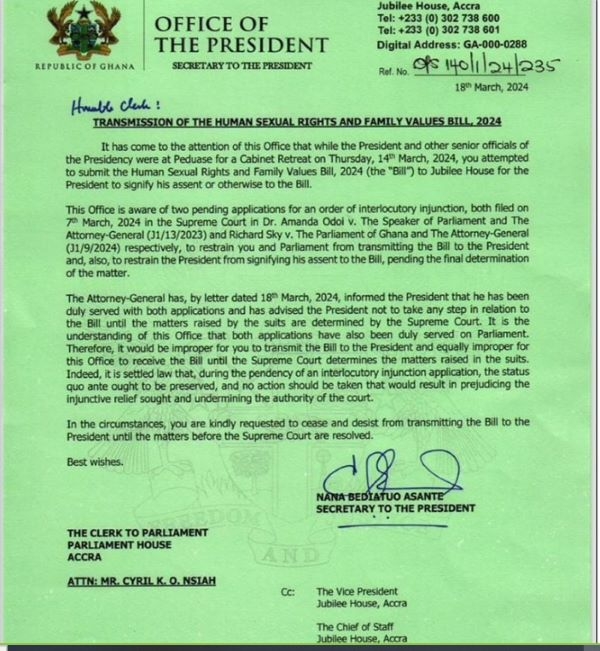
    “In the circumstance, you are kindly requested to cease and desist from transmitting the bill to the President until the matter before the Supreme Court is resolved,” Mr. Bediatuo stated.

    Commenting on the development on Morning Starr with Francis Abban, the Local Governance Expert indicated that the bill has brought some level of attention to Ghana.

    “Until this bill was presented to Parliament, Ghana was not considered anti-LGBTQ, but in as much as our laws do not permit its operation, we did not come out specifically to say we are going to put people in jail for practising it or promoting it.

    “Now, we are in a financial situation that calls for support from these institutions and we also have this bill ahead of us. Every President who will find himself in this situation is bound to think twice before assenting to that kind of bill,” Dr. Oduro stated.

    He expressed concerns regarding the Constitutional provision of Private Member’s Bill, particularly in cases where financial implications arise.

    “The government is not obligated to assent to bills with financial implications. Thus, we find ourselves in a dilemma,” he added.

  • Anti-gay bill: You lack the right to write to parliament – Haruna Iddrisu to Akufo-Addo’s secretary

    Anti-gay bill: You lack the right to write to parliament – Haruna Iddrisu to Akufo-Addo’s secretary


    The Member of Parliament for Tamale South, Haruna Iddrisu, has criticized Akufo-Addo for showing disregard towards parliament regarding a letter addressed to the clerk of parliament.

    Haruna Iddrisu expressed deep concern over what he termed a significant threat to Ghana’s democracy and the integrity of parliament as an institution.

    He emphasized the need for all democracy-loving individuals to stand against President Akufo-Addo’s apparent quest for dominance over other state organs.

    “I am unable to sleep because this is a monumental threat to Ghana’s democracy and a monumental threat to parliament as an institution,” remarked Haruna Iddrisu during an interview. “This letter only reflects President Akufo-Addo’s quest for predominance over other organs of the state. That is unacceptable and must be fought by all persons who love democracy and cherish the principles and values of the 1992 Constitution.”

    “Politically, what power does the president’s secretary have to write to the clerk of parliament? And not the president himself writing directly to the Speaker of Parliament as required in the Standing Orders, so that officially, this can be read as communication from the president. So ideally, this paper means nothing and should be ignored by the clerk because communication to parliament must be signed by the president, addressed to the Speaker of Parliament,” Haruna Iddrisu said in an interview.

    Haruna Iddrisu questioned the authority of the president’s secretary to correspond directly with the clerk of parliament, bypassing the established protocol of communication between the president and the Speaker of Parliament. He stressed that official communication to parliament should bear the president’s signature and be addressed to the Speaker.

    In response to the letter from the presidency urging parliament not to transmit the Anti-LGBT+ Bill to President Akufo-Addo for assent, citing pending legal actions, Haruna Iddrisu highlighted the significance of proper protocol in such matters.

    “It has come to the attention of this Office that while the President and other senior officials of the Presidency were at Peduase for a Cabinet Retreat on Thursday, March 14, 2024, you attempted to submit the Human Sexual Rights and Family Values Bill, 2024 (the ‘Bill’) to Jubilee House for the president to signify his assent or otherwise to the Bill,” the statement from Nana Bediatuo Asante, the Secretary to the President, read.

    “This Office is aware of two pending applications for an order of interlocutory injunction, both filed on March 7, 2024, in the Supreme Court in Dr. Amanda Odoi v. The Speaker of Parliament and The Attorney-General (J1/13/2023) and Richard Sky v. The Parliament of Ghana and The Attorney-General (31/9/2024), respectively, to restrain you and Parliament from transmitting the Bill to the President and also to restrain the President from signifying his assent to the Bill, pending the final determination of the matter,” the statement continued.

  • I can’t even sleep! – Haruna Iddrisu on presidency’s anti-LGBTQ bill ‘threat’

    Member of Parliament for Tamale South, Haruna Iddrisu, has expressed deep concerns regarding recent communication from the presidency concerning a letter addressed to parliament.

    In the letter, parliament was advised not to send the Bill on Human Sexual Rights and Family Values to President Akufo-Addo for approval.

    Iddrisu emphasized the gravity of the situation, stating that he has been unable to sleep due to the perceived threat to democracy posed by the president’s communication.

    The directive from the Office of the President, dated March 18, 2024, instructed parliament not to forward the anti-LGBT+ Bill for presidential assent.
    Nana Bediatuo Asante, the Secretary to the President, defended this decision, citing the ongoing case before the Supreme Court. Asante stated that President Akufo-Addo would only take action after the court reached a decision.

    In response, Haruna Iddrisu characterized the directive as an attempt by President Akufo-Addo to wield undue influence over other branches of government, as reported by citinewsroom.com.

    “I am unable to sleep because this is a monumental threat to Ghana’s democracy and a monumental threat to parliament as an institution. By Article 93, we are clothed with legislative authority and legislative mandate. This letter only reflects President Akufo-Addo’s quest for predominance over other organs of state, and that is unacceptable and must be fought by all persons who love democracy and who cherish the principles and values of the 1992 Constitution.

    “The framers of our Constitution endowed Ghana with a separation of powers: the executive, the legislature, the judiciary, and a division of powers.

    It endowed us that parliament shall be responsible for making laws, and what powers does the president’s secretary have in writing to the Clerk of Parliament and not the president himself in writing directly to the Speaker of Parliament as is required by our standing order so that officially this can be read as communication from the president? So ideally, this paper means nothing and must be ignored by the clerk,” he stated.

  • You have proven you cannot be trusted – Sam George reacts to Akufo-Addo’s letter on anti-gay bill

    You have proven you cannot be trusted – Sam George reacts to Akufo-Addo’s letter on anti-gay bill

    In response to the recent directive from the Office of the President directing Parliament to refrain from sending the anti-gay bill to President Akufo-Addo for his assent, Member of Parliament for Ningo-Prampram, Sam George, has expressed strong disapproval.


    The statement from the Office of the President cited pending legal matters before the Supreme Court as a result for the halt.


    Taking to the X platform, Sam George penned a scathing letter addressed to President Akufo-Addo, condemning the move as “shameful and disgraceful.”

    He accused the President of failing to uphold his promises and questioned the sincerity of his words.

    “Dear@NAkufoAddo, this is not just shameful and disgraceful but speaks to the facts that when it comes to your words and promises, they are mere fluff and flowery English. Once again, you prove to the Ghanaian people that you are not to be trusted,” he added.


    The anti-gay bill has sparked significant debate and controversy in Ghana, with proponents advocating for its enactment to criminalize same-sex relationships, while opponents argue against it on grounds of human rights and equality.

    On Wednesday, the February 28 2024, passed the Proper Human Sexual Rights and Ghanaian Family Values, also known as the anti-LGBTQ bill. 

    The legislation prohibits lesbian, gay, bisexual, and transgender (LGBT) activities and criminalizes their promotion, advocacy, and funding in the country.

    The bill awaits approval from President Akufo-Addo for implementation.

    The United States of America (USA) has warned that Ghana’s public health, media, civic spaces, and economy could be affected should the bill be endorsed.

    In a statement, US State Department Spokesperson Matthew Miller stated that the legislation threatens Ghana’s tradition of tolerance, peace, and respect for human rights. 

    Mr. Miller has called for a review of the bill to safeguard the rights of all individuals in Ghana, citing its inconsistency with the country’s values.

     However, Sam George, who is also the proponent of the LGBTQ bill, has indicated that President Akufo-Addo must be confident enough to assent to the bill as Ghana stands to lose. 

    He emphasized that American businesses operate in Ghana to make profits and not because of LGBTQ-related agendas.

    According to him, no American business owners in Ghana will cease operations if they are making huge profits just to oppose the country’s cultural values.

    He added that whoever will not be comfortable with what the country supports can suspend their businesses, as those willing to will come and occupy their spaces.

    “Well Ghana is a proud African Nation, first country in sub saharan Africa to gain independence and lead a light for the rest of Africa. I expect the leaders of our country, the president of our country to stand shoulder high and tell the American people you either do business on our terms or you can walk. 

    “American businesses that operate in Ghana are not here because of LGBTQ, they are here because they make a profit. If you are an American business working in Ghana and you turn 100 million dollars in profit every year, if you think that because we are protecting our cultural values and say no to LGBTQ you want to lose a 100 million dollars in profit, pack up and go another company to come to Ghana and do business, he added.

  • Akufo-Addo cannot assent to anti-gay bill until Supreme Court says so – Presidency to Akufo-Addo

    Akufo-Addo cannot assent to anti-gay bill until Supreme Court says so – Presidency to Akufo-Addo

    The Office of the President has made a formal request to Parliament, urging them to refrain from forwarding the anti-gay bill to President Akufo-Addo for his approval.

    The Secretary to the President, Nana Bediatuo Asante, revealed that this decision was prompted by the existence of two pending applications for an order of interlocutory injunction before the Supreme Court.

    These applications aim to halt Parliament from sending the Bill to the President and to prevent the President from giving his assent to the Bill until the final determination of the matter.

    In a statement issued on Monday and signed by Nana Bediatuo, the Office disclosed that the Attorney-General had officially notified the President, via a letter dated March 18, 2024, confirming receipt of both applications.Furthermore, the Attorney-General advised the President against taking any action regarding the Bill until the Supreme Court resolves the issues raised by the lawsuits.

    The statement emphasized that both applications had been duly served on Parliament as well.

    Therefore, it would be inappropriate to transmit the Bill to the President and equally improper for the Office of the President to receive the Bill until the Supreme Court reaches a verdict on the suits.

    Additionally, the Office highlighted the established legal principle that during the pendency of an interlocutory injunction application, the status quo ante should be upheld, and no actions should be taken that might prejudice the sought-after injunctive relief or undermine the authority of the court.

    Consequently, Parliament was kindly urged to refrain from transmitting the Bill to the President until the matters before the Supreme Court are resolved.

    “It is the understanding of this Office that both applications have also been duly served on Parliament. Therefore, it would be improper for you to transmit the Bill to the President and equally improper for this Office to receive the Bill until the Supreme Court determines the matters raised in the suits,” it added.

    “In the circumstances, you are kindly requested to cease and desist from transmitting the Bill to the President until the matters before the Supreme Court are resolved,” it added.

  • Anti-gay bill is “harsh” and “unjust” – Samia Nkrumah

    Anti-gay bill is “harsh” and “unjust” – Samia Nkrumah

    Former Member of Parliament for Jomoro, Samia Nkrumah, has criticized the legislation, emphasizing concerns about its severity and lack of fairness.

    Speaking to the media, she urged President Akufo-Addo not to give his assent to the controversial anti-LGBT+ bill.

    Criticizing the legislation as excessively “harsh and unjust,” Nkrumah expressed concerns that it could further deepen divisions within Ghanaian society.

    She urged President Akufo-Addo to exercise caution and advocated for a more inclusive and education-focused approach rather than endorsing the proposed law.

    Speaking to the media, she stated, “I pray the president does not sign it or assent to it. I believe it is a brutal, harsh, and unjust law, and we don’t need it. We are against rape, paedophilia, against all these situations that people seem to be terrified of gays, and I think we need to educate ourselves.

    “But most importantly, I don’t support anything that brings division and torments the people of Ghana. We are all Ghanaians, and we need to protect and take care of each other”.

    In the midst of the controversy, President Akufo-Addo has declared a temporary halt on assenting to the anti-LGBT+ bill pending a Supreme Court ruling on its constitutionality.

    He informed the diplomatic community of a pending case challenging the bill’s legality and assured them that Ghana remains committed to human rights and the rule of law.

    The bill has elicited widespread reactions nationally and internationally, with the Ministry of Finance advising against its approval due to potential repercussions for the country’s financial support from international organizations.

    The President emphasized the need to await the court’s decision before taking any action, acknowledging concerns raised by the diplomatic community about the bill’s passage through Parliament.

  • Assenting to anti-gay bill will destroy victims – Samia Nkrumah to Akufo-Addo

    Assenting to anti-gay bill will destroy victims – Samia Nkrumah to Akufo-Addo

    A former Member of Parliament for Jomoro, Samia Yaba Nkrumah, has called on President Akufo-Addo to withhold his approval of the contentious anti-LGBT+ bill.

    Criticizing the legislation as excessively “harsh and unjust,” Nkrumah expressed concerns that it could further deepen divisions within Ghanaian society.

    She urged President Akufo-Addo to exercise caution and advocated for a more inclusive and education-focused approach rather than endorsing the proposed law.

    In an interview with Daily Graphic, she stated, “I pray the president does not sign it or assent to it. I believe it is a brutal, harsh, and unjust law, and we don’t need it. We are against rape, paedophilia, against all these situations that people seem to be terrified of gays, and I think we need to educate ourselves.

    “But most importantly, I don’t support anything that brings division and torments the people of Ghana. We are all Ghanaians, and we need to protect and take care of each other”.

    In the midst of the controversy, President Akufo-Addo has declared a temporary halt on assenting to the anti-LGBT+ bill pending a Supreme Court ruling on its constitutionality.

    He informed the diplomatic community of a pending case challenging the bill’s legality and assured them that Ghana remains committed to human rights and the rule of law.

    The bill has elicited widespread reactions nationally and internationally, with the Ministry of Finance advising against its approval due to potential repercussions for the country’s financial support from international organizations. The President emphasized the need to await the court’s decision before taking any action, acknowledging concerns raised by the diplomatic community about the bill’s passage through Parliament.

  • School and health crises persist, why would we waste our time on this ‘waste’ of a bill?- Okatakyie Afrifa on LGBT bill

    School and health crises persist, why would we waste our time on this ‘waste’ of a bill?- Okatakyie Afrifa on LGBT bill

    On Wednesday, February 28, 2024, the Parliament of Ghana passed the Promotion of Human Sexual Rights and Family Values Bill, commonly referred to as the anti-LGBT+ bill.

    This legislation, currently awaiting presidential approval, prohibits activities related to Lesbian, Gay, Bisexual, and Transgender (LGBT) individuals and criminalises their promotion, advocacy, and financial support.

    Individuals found engaging in these activities could face imprisonment ranging from six months to three years, while those promoting and funding such acts may be sentenced to three to five years in jail.

    The bill will become law within seven days if President Nana Addo Dankwa Akufo-Addo grants his assent. However, if the President declines to approve the bill, Parliament can still enact it into law with a two-thirds majority vote.

    “A nation whose population keeps increasing through a high birth rate, children are not getting access to educational infrastructure, yet, the most important thing to us is LGBT+ issues.

    “The country has no direction so anybody can determine for us. That’s not how we build a nation; it should be able to chart its path. We are not done tackling issues on education, hospitals, bad roads, and security, yet we are discussing this useless policy [the anti-gay bill],” he said while speaking on Angel FM.

    About the passage of the anti-gay bill:

    On Wednesday, February 28, 2024, the Parliament of Ghana passed the Promotion of Human Sexual Rights and Family Values Bill, commonly referred to as the anti-LGBT+ bill.

    This legislation, currently awaiting presidential approval, prohibits activities related to Lesbian, Gay, Bisexual, and Transgender (LGBT) individuals and criminalises their promotion, advocacy, and financial support.

    Individuals found engaging in these activities could face imprisonment ranging from six months to three years, while those promoting and funding such acts may be sentenced to three to five years in jail.

    The bill will become law within seven days if President Nana Addo Dankwa Akufo-Addo grants his assent. However, if the President declines to approve the bill, Parliament can still enact it into law with a two-thirds majority vote.

  • ‘My son is gay’ – Afia Schwarzenegger confirms

    ‘My son is gay’ – Afia Schwarzenegger confirms

    Ghanaian media personality Afia Schwarzenegger has found herself at the center of a heated controversy after a recent video surfaced in which she addressed accusations surrounding her son’s sexuality.

    The drama unfolded as Afia unleashed a barrage of insults against individuals who claimed she was opposing the Anti-Gay bill because of her own children.

    This revelation comes just two years after her former best friend forever (BFF), Nana Tornado, accused Afia’s twin son, James Heerdegen, of being gay.

    Nana Tornado, not holding back, labelled Afia Schwarzenegger an irresponsible mother, blaming her for what he perceived as the destruction of her children, particularly pointing fingers at James’ alleged homosexuality.

    In a stark warning, Nana Tornado threatened to expose all of Afia’s secrets if she did not halt her campaign against him.

    Amidst the escalating controversy, James’ alleged gay partner stepped forward to deny the rumors circulating about their relationship.

    However, the plot thickened when Afia Schwarzenegger, in her latest video, subtly admitted that one of her sons was indeed gay, adding fuel to the already blazing fire.

    “If my son is gay, how does it concern you, it’s none of your business,” Afia Schwarzenegger stated.

    The Ghanaian public is now captivated by this sensational feud, as social media platforms buzz with discussions about family dynamics, personal choices, and the ongoing debate over the Anti-Gay bill.

    Afia Schwarzenegger’s revelation has thrust her into the spotlight, leaving many to wonder how this controversy will further unfold and impact the public discourse on LGBTQ+ rights in Ghana.

    Watch video below:

  • Revealed: Akufo-Addo lived and grew up with homosexuals – Basintale

    Revealed: Akufo-Addo lived and grew up with homosexuals – Basintale

    Deputy Communications Officer for the National Democratic Congress (NDC), Malik Basintale has alleged that president Akufo-Addo was bred and fed in the midst of homosexuals.

    In an interview with TV3, he claimed that Akufo-Addo’s nephew, Paul Danquah, who was the first son to the late J.B Danquah was known for indulging in homosexual activities.

    According to him, Paul Danquah got married to an English steel heir, Peter Pallock and they lived together in the United Kingdom (UK).

    “Akufo-Addo should have known better than the 2 of us, he stayed and grew up with the homosexuals. Mr Akufo -Addo grew up with the first son of his uncle J.B Danquah who was called Paul  Danquah. Paul Danquah was a renowned homosexual who got married to Peter Pallock.They lived together and the entire world knew that Akufo-Addo’s nephew was homosexual,” he added.

    This revelation comes in response to Akufo-Addo’s reluctance to the anti-gay bill passed by parliament on Wednesday February 26, 2024.

    In defense of his delay to assenting the bill, president Akufo-Addo has stated that certain individuals have dragged parliament to the Supreme Court over the passage of the bill.

    The president emphasised that he will make a decision after the court has given a verdict regarding the lawsuit.


    In contrast, the Deputy Communications Officer for the NDC believes that Akufo-Addo has ulterior motives rather than waiting on the Supreme Court.

    He added ” So I think that if there is a man to know more about homosexuality like Akufo-Addo stated in the Aljazeera interview that growing up in the UK he saw people virtually advocating for it and what have you . There was cause for action and that is why he is waiting to see the same in this country”.

    The anti-LGBT+ Bill currently criminalizes and proscribes LGBT activities, along with their promotion, advocacy, and funding.

    Offenders face penalties of six months to a three-year jail term, while promoters and sponsors could be sentenced to three to five years in prison.

  • We can do without you, stop threatening us – Prof Agyekum tells the West over anti-gay bill

    We can do without you, stop threatening us – Prof Agyekum tells the West over anti-gay bill

    The Head of the Linguistics Department at the University of Ghana, Professor Kofi Agyekum, has emphasized the importance of economic independence for Ghana in the face of threats from foreign agencies and governments regarding the anti-LGBT+ Bill.

    Professor Agyekum highlighted that recent warnings of funding cuts from foreign governments and international finance organizations underscore the necessity for Ghana to strive towards economic self-reliance.

    Speaking on Peace FM’s Kokrokoo on Tuesday, March 5, 2024, he commended the resilience of Ghanaians in overcoming economic challenges, citing the experience of the 1984 food crisis.

    “In 1983 we thought all Ghanaians were going to die. We went through a serious famine but survived. If we lead a good life, it doesn’t matter the threats, we can survive whatever comes at us,” he said.

    The anti-LGBT+ Bill, passed by parliament on February 28, seeks to criminalize various aspects of homosexuality, including promotion, advocacy, funding, and the acts themselves.

    Despite the Ministry of Finance advising President Akufo-Addo against signing the bill into law, citing potential repercussions on international financial support, the President reassured the diplomatic community of Ghana’s commitment to respecting fundamental human rights.

    President Akufo-Addo emphasized ongoing legal challenges to the bill’s constitutionality.

    A concerned citizen has invoked the Supreme Court’s original jurisdiction to challenge the bill’s constitutionality, leading to calls for patience until the court issues its ruling.

  • Surviving 1983 food crisis was a battle but we conquered – Lecturer tells Western over anti-gay bill threats

    Surviving 1983 food crisis was a battle but we conquered – Lecturer tells Western over anti-gay bill threats

    Head of the Linguistics Department at the University of Ghana, Professor Kofi Agyekum, has urged Ghana to pursue economic independence amidst threats from foreign entities regarding the anti-LGBTQ+ bill.

    Highlighting the recent warnings of funding cuts from foreign governments and international finance organizations, Prof Agyekum emphasizes the critical need for the nation to achieve economic self-reliance.

    Speaking on the March 5, 2024, edition of Peace FM’s Kokrokoo, he commended the resilience of Ghanaians in the face of economic challenges, citing the survival of the 1984 food crisis.

    “In 1983, we thought all Ghanaians were going to die. We went through a serious famine but survived. If we lead a good life, it doesn’t matter the threats; we can survive whatever comes at us,” he remarked.

    The anti-LGBT+ Bill, passed by parliament on February 28, aims to criminalize various aspects of homosexuality, including promotion, advocacy, funding, and the acts themselves.

    Despite the Ministry of Finance advising President Akufo-Addo against signing the bill into law, citing potential repercussions on international financial support, the President reassured the diplomatic community of Ghana’s commitment to respecting fundamental human rights.

    President Akufo-Addo emphasized ongoing legal challenges to the bill’s constitutionality.

    A concerned citizen has invoked the original jurisdiction of the Supreme Court to challenge the bill’s constitutionality, prompting calls for patience until the court issues its ruling.

  • LGBTQ+ advocates stage protest in UK over Ghana’s anti-gay bill

    LGBTQ+ advocates stage protest in UK over Ghana’s anti-gay bill

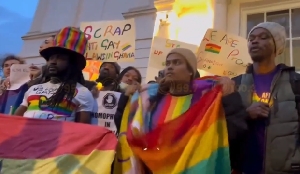
    On March 6, 2024, approximately 100 activists and supporters of the Lesbian, Gay, Bisexual, and Transgender (LGBT+) community staged a protest outside Ghana’s High Commission in the United Kingdom.

    Their demonstration aimed at opposing the Human Sexual Rights and Family Values Bill, commonly known as the anti-LGBT+ Bill, recently passed by Ghana’s parliament.

    Clad in dresses displaying the gay pride colors, the protesters held banners calling for the repeal of the Bill. In a video shared by Asaase Radio, several speakers expressed their concerns about the pain inflicted by such legislation, while others rallied for the rights and lives of sexual minorities.

    Addressing the gathering, one activist stated,”They are driving many of us away, but this time not on a slave ship but on a piece of paper filled with hate and written with ink by people like them,” one of the activists.

    The anti-LGBT+ Bill currently criminalizes and proscribes LGBT activities, along with their promotion, advocacy, and funding.

    Offenders face penalties of six months to a three-year jail term, while promoters and sponsors could be sentenced to three to five years in prison.

    President Akufo-Addo has temporarily suspended his decision on signing the Bill into law, citing a constitutional challenge to the Bill in the Supreme Court.

  • Akufo-Addo using every avenue not to sign anti-gay bill – Ahmed Ibrahim

    Akufo-Addo using every avenue not to sign anti-gay bill – Ahmed Ibrahim

    First Deputy Minority Whip, Ahmed Ibrahim, has alleged that President Akufo-Addo is employing various strategies to avoid giving assent to the anti-LGBTQ+ Bill.

    The bill, criminalizing LGBTQ+ activities, promotion, advocacy, and funding, was approved by Parliament on February 28, 2024.

    President Akufo-Addo has committed to awaiting the Supreme Court’s ruling on a legal challenge by Richard Sky before making a decision on the controversial anti-LGBTQ+ Bill.

    In an interview with Citi News, the Member of Parliament for Banda suggests that President Akufo-Addo is attempting to delay signing the bill into law.

    He pointed out that if the president doesn’t sign the bill within seven days, he is obligated to refer it to the Council of State for advice.

    “The president I know is buying time. He used every avenue and wanted us to delay the bill so that it doesn’t come to Jubilee House under his time for him to sign. That is why they wanted to put it down, bring other bills, we finish them, and they will bring others until Parliament said if we don’t finish this one, we will not do anything else. That is when they realized their hands were tied, and it was passed.”

    “Now, by Article 106 of the 1992 Constitution, the president is mandated to refer the bill within seven days to the Council of State if he doesn’t want to sign it.”

  • Disgraceful National Peace Council must be disbanded – Sam George

    Disgraceful National Peace Council must be disbanded – Sam George

    Member of Parliament for Ningo Prampram, Sam George, has urged for the disbandment of the National Peace Council due to concerns regarding potential threats to Ghana’s peace.

    His comments follow the Council’s boss’s remarks that his outfit is yet to take a stance on Sam George’s advocacy and activism against gay rights in the country.

    Sam George, in response, called the council a band of ‘bipartisan hypocrites’ who should be disbanded for the peace of Ghana.

    “The Peace Council is a disgrace and a shame. I have said this before and I will say it again. They are hypocrites—extremely hypocritical.

    We’ve seen the posture of the Peace Council. The Peace Council has become a political organisation; it should be disbanded for the santity of Ghana’s peace. The Peace Council is a threat to our peace, yes ” he fumed during an appearance on 3FM’s Sunrise on March 5, 2024.

    Using the analogy of the biblical story of Essau and Jacob, Sam George chided the members of the Council for having sold their consciences.

    “It’s a bunch of hypocrites who have sold their conscience, like Essau sold his birthright for a bowl of porridge. The men and women who sit on the peace council , if they have conscience and if they fear the God that they say they serve and worship, should bow their heads in shame, he fumed.

  • MoF’s release on anti-gay bill just a tool to sow fear and panic in Ghanaians – Lord Mensah

    MoF’s release on anti-gay bill just a tool to sow fear and panic in Ghanaians – Lord Mensah

    Senior lecturer at the University of Ghana Business School (UGBS), Professor Lord Mensah, has deemed the press release by the Ministry of Finance (MoF) regarding the implications of President Nana Addo Dankwa Akufo-Addo’s assent to the LGBTQ+ bill as unnecessary.

    During an interview on Morning Starr with Francis Abban on Tuesday, Prof Mensah elaborated that the foreign support for the 2024 budget is of little significance to cause alarm among Ghanaians if it doesn’t materialise.

    “Go into the 2024 budget and look at the grants that we are targeting, which is just about 3.3 percent of our GDP. So it tells you that it’s just a microcosm of what we do in the country. We may do without them so I don’t see the reason why we should get ourselves worried,” Prof. Lord Mensah stated.

    According to him, the current International Monetary Fund (IMF) bailout for Ghana also has nothing on the LGBT+ bill.

    “Again, the IMF programme never talked about LGBTQ. So if the president goes ahead to assent the bill and we manage very well and we do what the IMF is looking out for, we should be able to get the releases.

    “The World Bank will also be supporting us because the conditions behind the World Bank was that if we are able to meet the IMF target and continue to have the programme with them, they will be supporting us,” the senior lecturer stated.

    He continued: “So it has nothing to do with the bill, the release the Ministry brought is just a panic statement that they are throwing into the system which was not necessary. Let the President do his job, he should go ahead and put his pen to the bill and then we will see what will happen.”

    Background

    According to the Ministry of Finance, Ghana faces a potential loss of US$3.8 billion in World Bank financing over the next five to six years and risks derailing the International Monetary Fund (IMF) program if the bill is assented to.

    In a statement, the Ministry outlined several challenges Ghana may encounter due to the passage of the bill by Parliament.

    “The expected US$300 million financing from the First Ghana Resilient Recovery Development Policy Operation (Budget Support) which is currently pending Parliamentary approval might not be disbursed by the Bank when it is approved by Parliament.;

    “On-going negotiations on the Second Ghana Resilient Recovery Development Policy Operation (Budget Support) amounting to US$300 million may be suspended; On-going negotiations for US$250 million to support the Ghana Financial Stability Fund may be suspended;

    “Disbursement of undisbursed amounts totaling US$2.1 billion for on-going projects will be suspended; and Preparation of pipeline projects and declaration of effectiveness for two projects totaling worth US$900million may be suspended. Full details of the World Bank portfolio are attached as Appendix 1 & 2.

    “In total, Ghana is likely to lose US$3.8 billion in World Bank Financing over the next five to six years. For 2024 Ghana will lose US$600 million Budget support and US$250 million for the Financial Stability Fund. This will negatively impact on Ghana’s foreign exchange reserves and exchange rate stability as these inflows are expected to shore the country’s reserve position,” the statement read in parts.

  • Speaker of Parliament sued over anti-gay bill – Sam George

    Speaker of Parliament sued over anti-gay bill – Sam George

    One of the leading proponents and sponsors of the anti-LGBTQ+ bill, MP for Ningo-Prampram, Sam George, has disclosed that the Speaker of Parliament, Hon. Alban Bagbin, has been dragged to court by one of the leading advocates of gay rights over the anti-gay bill.

    He has been in court since last year , the Ningo-Prampram MP said.

    He made the disclosure during an interview on 3FM’s Sunrise on March 5, 2024, during discussions on the controversies surrounding the anti-LGBTQ bill.

    “From where I sit, its sad that people don’t know that the speaker since last year has been sued for doing his job as a speaker. There’s an ongoing case in which the speaker is having to pay lawyers to personally represent him.

    He has been sued by a lady named Amanda Odoi, another puppet of the gay lobby. She is being funded and used by the gay lobby to do what she’s been doing.”

  • Western powers using Finance Ministry to blackmail Akufo-Addo – Economist

    Western powers using Finance Ministry to blackmail Akufo-Addo – Economist


    An economics professor and dean of the University of Cape Coast Business School, Professor John Gasti, has alleged a significant lobbying effort aimed at persuading President Akufo-Addo not to endorse the recently passed anti-gay bill.

    He suggested that the Ministry of Finance is being influenced in its plea to the President not to sign the Proper Human Sexual Rights and Ghanaian Family Values Bill, 2021.

    Prof. Gasti’s comments follow the Ministry of Finance’s financial report to President Akufo-Addo, outlining potential losses in international donor funds, particularly from the World Bank, should the controversial bill be enacted.

    According to the ministry’s report, Ghana stands to lose over US$3.8 billion from the World Bank if the anti-gay bill becomes law. However, the President, in a statement on March 4, mentioned that the bill has not reached his desk.

    Speaking on TV3’s Ghana Tonight on March 4, Prof. Gasti questioned the relevance of the anti-gay bill in relation to the conditions set for the IMF bailout.

    He asserted that the bill, whether passed or not, was not part of the conditions required for Ghana to receive approval for the US$3 billion rescue loan from the IMF.

    “It sounds like there is a heavy dose of lobbying activities going on [in] these last minutes of the process. We knew that the constituents of the world that are not happy with the stand of Ghana on LGBTQ were very clear. All attempts were made to stop the process in parliament that didn’t happen”, he said, adding that the international community, having seen the signs of a unanimous decision to pass the bill in parliament, has occasioned “the upscale of lobbying activities across the board”.

    “And now they are using our own finance ministry to blackmail Ghanaians to support the President not to sign the bill”, Prof. Gasti added.

    “When we went to the IMF, there was no condition regarding LGBTQ issues”, the economics professor said.

    “In fact, when the World Bank was giving us [Ghana] money, the only thing that they were waiting for was the signing of the IMF deal that opened the door for them to provide those credits that they’re providing to us”, he told Alfred Ocansey on Ghana Tonight.

    He expressed concern about the apparent surge in lobbying activities, especially in the final stages of the process. Prof. Gasti noted that the global entities opposing Ghana’s stance on LGBTQ issues intensified their lobbying efforts when attempts to halt the bill’s progress in parliament were unsuccessful.

    Addressing the role of Ghana’s Finance Ministry, Prof. Gasti accused international forces of using it to pressure Ghanaians to support the President in not signing the bill into law.

    He emphasized that the conditions set by the IMF did not include LGBTQ issues and highlighted that the World Bank’s financial support was contingent on Ghana signing the IMF deal, which had already been done.

    The Finance Ministry’s concerns about potential cuts in World Bank financing included the First Ghana Resilient Recovery Development Policy Operation (US$300 million), the ongoing negotiation for the Second Ghana Resilient Recovery Development Policy Operation (US$300 million), and the Ghana Financial Stability Fund (US$250 million). Additionally, fears were raised about the cessation of disbursements for ongoing projects worth US$2.1 billion and another US$900 million in projects if the anti-gay bill were to become law.

  • List of countries that passed laws against LGBTQ+

    List of countries that passed laws against LGBTQ+

    National laws criminalizing consensual same-sex relations between adults exist in a minimum of 67 countries.

    These laws may specifically target certain sexual acts, and in some cases, they are general and open to interpretation.

    Penalties range from fines to life imprisonment and, in extreme cases, the death penalty.

    Law enforcement agencies in certain places actively pursue and prosecute individuals suspected of being lesbian, gay, bisexual, or transgender.

    In other instances, while the laws are rarely enforced, they still have severe consequences for LGBTQ+ people, affecting their access to employment, health services, and police protection.

    Furthermore, at least nine countries have national laws criminalizing forms of gender expression that disproportionately impact transgender and gender nonconforming individuals. For example:

    1. Southern and Western Asia (Brunei and Oman) criminalize “posing as” or “imitating” a person of a different sex.

    2.Saudi Arabia routinely arrests people based on their gender expression.

    3. Malaysia penalizes “posing as” a different sex in its Sharia codes.

    3. Nigeria criminalizes transgender and gender nonconforming people in its northern states under Sharia.

    4. South Sudan applies such laws only to men who “dress as women.”

    5. Malawi criminalizes men who wear their hair long.

    6. Tonga prohibits any “male person” from presenting as a female while “soliciting for an immoral purpose.”

    7. The United Arab Emirates (UAE) has laws prohibiting men from “posing as” women in women-only spaces, which they have used to prosecute gay and transgender people even in mixed-gender spaces.

    Additionally, 15 countries maintain unequal ages of consent, imposing a higher bar for same-sex couples than different-sex couples or for anal sex compared to vaginal sex.

    This includes countries like Canada and Chile.

    In 11 states of the United States, unenforceable laws prohibiting consensual same-sex conduct remain on the books despite a 2003 Supreme Court decision that found such laws unconstitutional.

    However, in Ghana, the law to criminalize lesbian, gay, bisexual, and transgender (LGBT) activities and criminalizes their promotion, advocacy, and funding in the country awaits approval from President Akufo-Addo .

  • Prof Takyiwaa Manuh denies allegations of being paid to oppose Anti-Gay Bill

    Prof Takyiwaa Manuh denies allegations of being paid to oppose Anti-Gay Bill

    A heated exchange has erupted between notable figures regarding the motivations behind opposition to the controversial legislation following the passage of Ghana’s Anti-LGBTQ+ Bill.

    A former Director of the Institute of African Studies at the University of Ghana, Legon, Emerita Professor Takyiwaa Manuh, has found herself at the center of this discourse following allegations made by Member of Parliament for Ningo-Prampram, Samuel Nartey George. 

    Sam George claimed that Prof Manuh, along with other prominent individuals, has been financially compensated by LGBTQ+ groups to advocate against the anti-gay bill.

    In response to these accusations, Prof Manuh firmly denied the allegations and accused the MP of resorting to insults due to the perceived inadequacy of the bill. She argued that the legislation is redundant given existing laws prohibiting “unnatural canal activities” and the abuse of children. Moreover, she expressed concerns that the bill could perpetuate discrimination and unwarranted attacks against the LGBT+ community.

    Quoting the philosopher Socrates, Manuh asserted, “When the debate is lost, insult becomes the loser’s tool,” suggesting that George’s resort to personal attacks indicates a lack of substantive argument in favor of the bill.

    Challenging George to provide evidence for his claims, Manuh emphasized her intention to uphold her reputation through legal recourse if necessary. She asserted her belief in the protection of the law, stating that the burden of proof lies with those making the allegations.

    Meanwhile, in his interview on Adom FM, MP Samuel Nartey George reiterated his allegations against Manuh and other individuals, accusing them of being funded by pro-LGBTQ+ groups. He questioned the inconsistency in their opposition to the bill despite the existence of similar provisions in current laws.

    The Promotion of Human Sexual Rights and Family Values Bill, now awaiting presidential assent, seeks to criminalize and penalize LGBT activities and their advocacy in Ghana. If signed into law, individuals engaging in such activities could face jail terms, while promoters and sponsors could also be subject to legal consequences.

    As the bill awaits presidential action, the nation remains divided, with proponents citing the preservation of traditional family values, while opponents raise concerns about human rights and the potential for discrimination.

    The outcome of this contentious legislative debate now hinges on the decision of President Nana Addo Dankwa Akufo-Addo, whose approval or rejection of the bill will determine its fate.

  • Prof Manuh vows to drag Akufo-Addo to court if he assents to anti-LGBT+ Bill

    Prof Manuh vows to drag Akufo-Addo to court if he assents to anti-LGBT+ Bill

    Renowned Ghanaian human rights activist and member of the Ghana Centre for Democratic Development (CDD-Ghana), Emerita Prof. Takyiwaa Manuh, has issued a stern warning of potential legal action against the Government of Ghana if the Promotion of Human Sexual Rights and Family Values Bill (anti-gay bill) is passed into law through presidential assent.
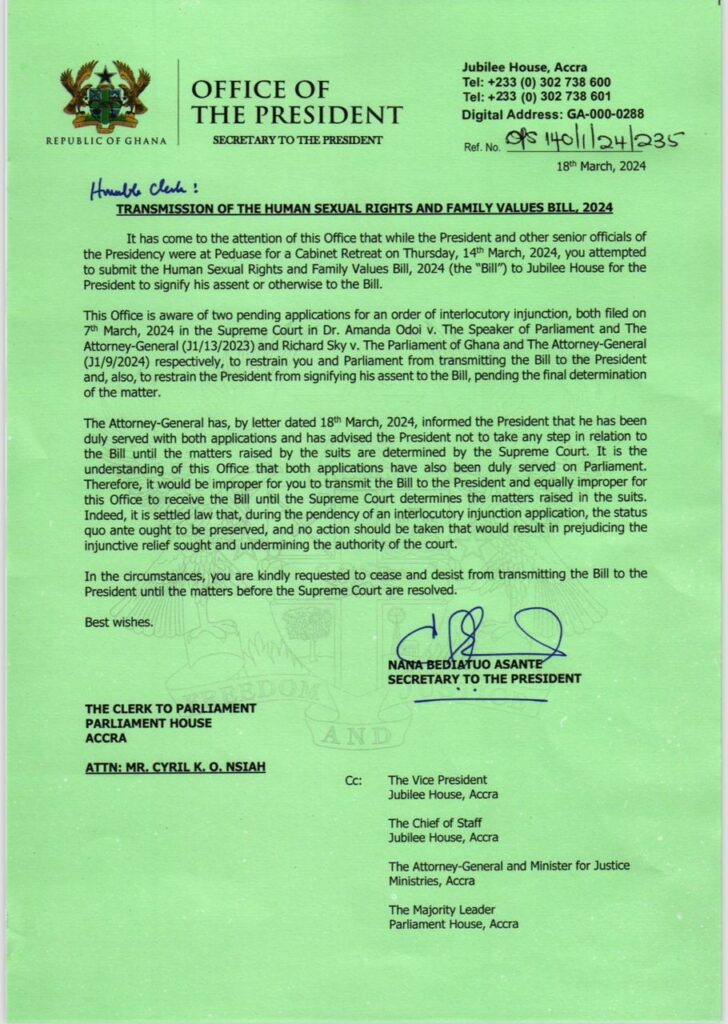
    In an interview with GhanaWeb on Thursday, February 29, 2024, Emerita Prof Manuh asserted that her group had implored President Nana Addo Dankwa Akufo-Addo not to assent to the bill, highlighting concerns that it would lead to the oppression of Ghanaians and tarnish the country’s international reputation.

    According to Prof. Manuh, the bill, if enacted, would not only violate the rights of citizens but also cast Ghana in a negative light as a democratic and law-abiding society. She expressed alarm at the global backlash and public health implications, as well as the heightened fear and anxiety among the LGBT+ community in Ghana.

    “We have asked the president not to assent to this bill because it does not advance the rights of anybody in Ghana. And it actually makes Ghana’s reputation as a democratic, law-abiding society worse,” Prof Manuh emphasized.

    Furthermore, Prof. Manuh declared that if the government proceeds to approve the anti-gay bill into law, her group would seek legal recourse. She underscored the supremacy of the constitution, stating, “If the president assents to the bill, we would go to court. The constitution is the final law of this land; no law can be inconsistent with the constitution.”

    The passage of the Promotion of Human Sexual Rights and Family Values Bill by the Parliament of Ghana on Wednesday, February 28, 2024, marked a significant development in the legislative process. The bill, awaiting presidential assent, aims to outlaw and criminalize LGBT+ activities, including their promotion, advocacy, and funding.

    Under the proposed legislation, individuals engaged in such acts could face imprisonment ranging from six months to three years, while promoters and sponsors could be subject to three to five years’ imprisonment.

    The fate of the bill now rests on President Akufo-Addo’s decision to either assent to it or reject it. If the president declines to assent, parliamentary approval by a two-thirds majority vote could facilitate its enactment into law.

  • I haven’t slept since passage of LGBTQ+ bill – Ghanaian transgender

    I haven’t slept since passage of LGBTQ+ bill – Ghanaian transgender

    In the wake of parliament passing the anti-LGBTQ+ bill, a Ghanaian musician transgender and a longstanding advocate against the bill, Angel Maxine, has expressed profound concerns for her safety.

    Maxine, along with activists, had hoped for the bill’s rejection when it first reached parliament in 2021, but their efforts have been in vain.

    In an interview with DW News, Maxine expressed sadness, stating, “I felt devastated, I was heartbroken, I haven’t slept. It is painful to know that your life as a human being is being criminalised. The life you have always struggled for, the life you want to live, you haven’t lived a decent life as any other being is now criminalised,”

     “I am sad because we have been working all these years for this bill not to be passed.”

    Parliament approved the bill on Wednesday, February 28, the controversial bill, aimed at restricting the rights of LGBTQ+ individuals in Ghana, imposes a jail term of up to three years for those identifying as LGBTQ+ engaged in same-sex relationships and activities.

    It further entails a prison sentence of up to five years for the promotion, sponsorship, or support of LGBTQ+ activities. Individuals convicted of promoting and funding LGBTQ+ related activities could face up to a decade behind bars.

    Ghana’s conservative society, influenced by religious and cultural beliefs, has long considered homosexuality taboo.

    The new legislation enjoys widespread support among Ghanaians, evident in the unanimous backing from lawmakers on Wednesday.

    This support came from a coalition of Christian, Muslim, and Ghanaian traditional leaders.

    The bill’s main sponsor, opposition lawmaker Sam George, urged President Akufo-Addo not to delay signing the bill into law, emphasizing its effectiveness in dealing with LGBTQ+ issues.

    President Akufo-Addo’s decision to sign the bill is now under scrutiny. 

    Last year, he declined to sign certain human rights-related bills, citing financial implications for the state. 

    The anti-LGBTQ+ bill could face similar considerations.

    Human rights groups, including the “Big 18” umbrella group in Ghana, have urged the president not to sign the bill.

    Professor Takyiwaa Manuh, a member of the coalition, emphasized, “You cannot criminalize a person’s identity, and that’s what the bill is doing, and it’s absolutely wrong.”

    Global condemnation has followed, with the United States expressing deep concerns, and UNAIDS warning that the bill could obstruct access to crucial services and jeopardize Ghana’s development success.

    The international community’s response is a point of concern for some Ghanaians, with worries about potential negative impacts on Ghana’s image and economy.

     Local opinions on the bill remain mixed, with some applauding the legislation and others expressing reservations about potential fallout.

  • We won’t stop fighting until anti-gay bill is squashed – CDD

    We won’t stop fighting until anti-gay bill is squashed – CDD

    The Center for Democratic Development (CDD) has expressed profound disappointment following the approval of the Human Sexual Rights and Family Values Bill, 2021 by Parliament.

    In a press release dated February 29, the CDD described the legislation as grossly ill-conceived, unconstitutional, and contrary to the nation’s best interests.

    The Think-Tank emphasized that if enacted into law, the bill would constitute a significant setback for Ghana and its democratic principles.

    The statement by CDD is a response to Parliament’s passage of the bill on February 28, culminating in a third reading and a voice vote led by Speaker Alban Sumana Bagbin, who declared, “the ayes have it.”

    While acknowledging the passage of the bill, the CDD underscored that its legal status remains that of a bill, not law.

    The organization asserted, “Passage of the bill is, of course, not the end of the matter. We note, importantly, that the bill is still only a bill, not law. Thus, passage of the bill does not change the legal status quo.”

    Furthermore, the CDD emphasized its commitment to opposing the bill outside of Parliament, asserting that Ghana’s democracy is not solely a majoritarian system. The organization stressed that constitutional democracy protects minorities against the potential oppression by a majority, insisting that the bill, if enacted, would stigmatize and oppress a social minority.

    Please read full press release below:

    On Wednesday, February 28, 2024, the Parliament of Ghana, by a voice vote, passed the so-called Human Sexual Rights and Family Values Bill, 2021. While we find passage of this bill by Ghana’s Parliament regrettable, the action of Parliament does not come as a surprise.

    The mass hysteria and fanaticism which proponents of the bill had mobilized in support of the bill and against anyone who dared to oppose it made level-headed debate about the bill practically impossible. Consequently, its passage by Parliament became politically unstoppable, particularly in a tough election year. Notwithstanding Parliament’s action yesterday, we remain resolute in our conviction that this bill is grossly ill-conceived, unconstitutional, and not in the best interest of the nation. It would be a major setback for Ghana and its standing as a democratic society if such a bill was to become law.

    Passage of the bill is, of course, not the end of the matter. We note, importantly, that the bill is still only a bill, not law. Thus, passage of the bill does not change the legal status quo.

    Parliament is only one player in the law-making process. Moreover, Parliament does not have the final say in determining whether a bill becomes law or, even if a bill were to become law, whether that law passes the test of constitutionality.

    We remain determined to fight this bill outside Parliament. Ghana’s democracy is not a simple majoritarian democracy where the majority can impose their will or prejudices on a minority merely because they have numbers on their side. Ours is a constitutional democracy, in which even a majority, no matter how numerous or vociferous, is restricted as to what it can and cannot do in the name of law. Importantly, our constitution protects minorities against oppression at the hands of a majority. We believe that this bill passed by Parliament is a clear instance of a majority or an influential coalition of interests, acting through Parliament, to stigmatize and oppress a social minority.

    Now that Parliament has proceeded to pass this bill, we believe the time is ripe for the Supreme Court to hear and finally determine the case that is already before it, challenging the constitutionality of this bill, in light of the restrictions placed on Parliament under Article 108 of the Constitution. That provision enjoins Parliament to not enact or pass a Private Member’s bill that has the purpose or effect of imposing a charge on public funds. We believe, as the suit before the Supreme Court rightfully alleges, that this bill, which, among other things, imposes penal sanctions, including years of imprisonment for a violation, is precisely the kind of Private Member’s bill that Article 108 prohibits Parliament from considering or acting upon.

    Quite apart from being defective in terms of Article 108, the bill also fails the constitutional test on multiple substantive grounds. Among other things, the bill infringes on the rights of privacy, freedom of association, freedom of speech and expression, freedom of opinion, freedom of the media, and the right to equality under the law. In fact, the bill prohibits even advocacy intended to change or repeal the bill were it to become law. In other words, if this bill were to become law, no person, LGBTQ or otherwise, could advocate publicly for its repeal. Not even the Constitution of Ghana, the supreme law of the land, enjoys this untouchable status!

    We note that an interim injunction was previously sought from the Supreme Court to prevent Parliament from acting upon this bill while the bill was still making its way through Parliament.

    The Court denied that application for interim injunction, as Parliament had not completed its legislative work. Now that the Legislature’s work is done and the bill has been passed, we expect the Court to adjudicate the merits of the Article 108 case that has been pending before it for several months. Indeed, we believe that the bill’s unconstitutionality under Article 108 provides sufficient grounds for the President to refuse the sign the bill into law. We remain confident that this bill will ultimately fail the constitutional test.

    We wish to remind Ghanaians, especially our law enforcement authorities, that the legal status quo has not changed in any way as a result of the passage of this bill by Parliament.

    Thus, no provision of the bill passed by Parliament may be enforced against any person, as the bill, despite having been passed by Parliament, is not law. We especially urge our law enforcement authorities to be mindful of their professional and legal obligation to enforce only the laws of Ghana and to do so without prejudice, fear, ill-will or discrimination against any person or group of persons. In particular, our law enforcement authorities must work to safeguard the rights of all persons, including persons suspected or accused of being LGBTQ, and ensure that people do not attack or cause harm to persons suspected or accused of being LGBTQ.

  • What if Akufo-Addo says no to anti-gay bill?

    What if Akufo-Addo says no to anti-gay bill?

    On February 28, 2024, Ghana’s Parliament passed the Promotion of Human Sexual Rights and Family Values Bill, commonly known as the anti-LGBT+ bill.

    The legislation criminalizes and prohibits activities related to Lesbian, Gay, Bisexual, and Transgender (LGBT) individuals, including their promotion, advocacy, and funding.

    Although approved by Parliament, the bill is not yet law, pending President Akufo-Addo’s assent.
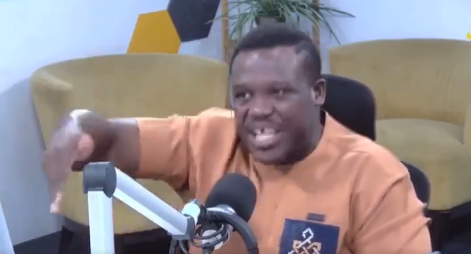
    According to Article 106 of Ghana’s 1992 Constitution, the president must assent within seven days of Parliament’s passage for the bill to become law.

    The bill outlines a jail term of six months to three years for individuals engaged in prohibited acts, with sponsors and promoters facing three to five years.

    In case President Akufo-Addo refuses assent, the Parliament has the authority to pass the bill into law by a two-thirds majority vote, as stipulated in Section 10 of Article 106.

    Here is what the law says:

    (1) The power of Parliament to make laws shall be exercised by bills passed by Parliament and assented to by the president.
    (2) No bill, other than such a bill as is referred to in paragraph (a) of Article 108 of this Constitution, shall be introduced in Parliament unless –

    (a) It is accompanied by an explanatory memorandum setting out in detail the policy and principles of the bill, the defects of the existing law, the remedies proposed to deal with those defects and the necessity for its introduction; and

    (b) it has been published in the Gazette at least fourteen days before the date of its introduction in Parliament.
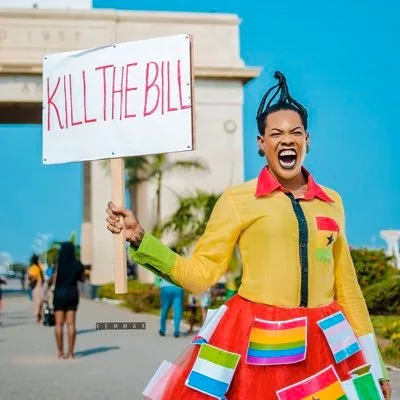
    (3) A bill affecting the institution of chieftaincy shall not be introduced in Parliament without prior reference to the National House of Chiefs.

    (4) Whenever a bill is read for the first time in Parliament, it shall be referred to the appropriate committee appointed under Article 103 of this Constitution, which shall examine the bill in detail and make all such inquiries in relation to it as the committee considers expedient or necessary.

    (5) Where a bill has been deliberated upon by the appropriate committee, it shall be reported to Parliament.

    (6) The report of the committee, together with the explanatory memorandum to the bill, shall form the basis for a full debate on the bill for its passage, with or without amendments or its rejection, by Parliament.

    (7) Where a bill passed by Parliament is presented to the president for assent, he shall signify, within seven days after the presentation, to the Speaker that he assents to the bill or that he refuses to assent to the bill, unless the bill has been referred by the president to the Council of State under Article 90 of this Constitution.


    This provision enables Parliament to reconsider the bill and, if supported by at least two-thirds of its members, compel the president to assent within thirty days.

    Former President John Dramani Mahama suggested that Akufo-Addo might withhold assent due to potential costs to the government, raising uncertainties about the bill’s final status.

  • Ghana’s public health, economy will be undermined by anti-gay bill – US

    Ghana’s public health, economy will be undermined by anti-gay bill – US

    The passage of Ghana’s Human Sexual Rights and Family Values Bill, commonly known as the anti-gay bill, has raised concerns from the United States of America.

    The bill was approved by Ghana’s Parliament on Wednesday, February 28, following extensive debates, contributions, and some opposition.

    In a statement, US State Department Spokesperson Matthew Miller expressed worry about the potential impact of the bill on Ghana’s public health, media, civic spaces, and economy.

    He emphasized that the legislation threatens Ghana’s tradition of tolerance, peace, and respect for human rights. Miller called for a review of the bill to safeguard the rights of all individuals in Ghana, citing its inconsistency with the country’s values.

    The spokesperson highlighted the bill’s provisions that criminalize individuals identifying as LGBTQI+ and those who fail to report them, stating that limiting the rights of one group undermines the rights of all.

    Miller echoed the voices of Ghanaians urging a review of the bill’s constitutionality and warned of the potential harm to business and economic growth in Ghana due to international opposition against discrimination.

    In conclusion, Miller emphasized that Ghana’s tradition of tolerance and respect for human rights, which has served as a model globally, could be undermined if the legislation becomes law.

    The United States stands troubled by the legislation and advocates for the protection of constitutionally protected freedoms in Ghana.

    “I am saddened because some of the smartest, most creative, most decent people I know are LGBT. The bill Parliament passed takes away not only their basic human rights but those of all Ghanaians because it undermines their constitutional rights to freedom of speech, freedom of assembly, and freedom of the press.

    “It will be bad for public order and public health. If enacted, it will also hurt Ghana’s international reputation and Ghana’s economy.”

    She added, “Lots of ethnic communities make Ghana strong, stable, and attractive for investments. I hope it stays that way with regard to the LGBTQ community. They should be managed to be made the colour of the money green or red if it’s Ghanaian, but if there is discrimination, then that will send a signal not to [only] LGBTQ investors and exporters but to other American companies that Ghana is less welcoming than I am telling people that it is now.”

  • I will be disappointed if Akufo-Addo assents to the anti-gay bill – Prof. Takyiwaa Manuh

    I will be disappointed if Akufo-Addo assents to the anti-gay bill – Prof. Takyiwaa Manuh

    A vocal opponent of the Sexual Human Rights and Family Values Bill (commonly referred to as the anti-LGBTQ bill), Emerita Prof. Takyiwaa Manuh, has stated that she will be disappointed should President Akufo-Addo give his assent to the legislation.

    The bill was passed by Parliament on February 28, 2024, following the completion of the Third Reading.

    The proposed legislation, which awaits the president’s approval, aims to impose a maximum penalty of five years for individuals engaging in or supporting LGBTQ+ activities. The enacted bill seeks to criminalize LGBTQI+ activities and impose penalties on their promotion, advocacy, and funding.

    In an interview with Starr News, Prof. Takyiwaa Manuh voiced her opposition, deeming the bill unnecessary.

    “The reason why the President has not assented to the other private members bills that were sent to him was that they violate Article 108 of the Constitution. I believe that this bill violates Article 108 even more because every part of it is about enforcement, which is going to be a charge on the public purse. So if we are to follow the president’s reasoning, I will be surprised if he assents to this bill.

    “We live in a country that is governed by the rule of law; we live under a constitution. No law, no Act that is passed can be inconsistent with the Constitution. Therefore, if there are violations of the Constitution, especially as regards the rights and freedoms that are guaranteed to all Ghanaians, the Constitution does not begin to differentiate according to your religion or identity. This law is unnecessary; we already have provisions in our laws that govern all matters,” she said.

    She argued that the bill potentially violates Article 108 of the Constitution even more than previous private members’ bills that the President had not assented to, as it heavily focuses on enforcement, which she believes would incur costs on the public purse.

    Highlighting the importance of upholding the rule of law and the Constitution, Prof. Takyiwaa Manuh emphasized that any law or act passed should not be inconsistent with the Constitution.

    She asserted that the bill, addressing matters already covered by existing laws, is redundant and unnecessary, especially considering its potential infringements on the rights and freedoms guaranteed to all Ghanaians.

  • How global media and organizations reported Ghana’s passage of the anti-gay bill

    How global media and organizations reported Ghana’s passage of the anti-gay bill

    The recent passage of the Anti-LGBT+ Bill in Ghana has sparked widespread concern and condemnation from international media outlets and organizations, who fear its implications for human rights and inclusivity. 

    The legislation, which seeks to proscribe and criminalize lesbian, gay, bisexual, and transgender (LGBT) activities, has drawn sharp criticism for its potential to marginalize and endanger vulnerable communities.

    The bill, which was approved on February 28, 2024, awaits presidential assent to come into effect. Its provisions include imposing hefty penalties on individuals engaged in same-sex relations, with a six-month to three-year jail term for offenders and a three to five-year jail term for promoters and sponsors of such acts.

    International media coverage of the bill’s passage has largely focused on expressing concern over its potential impact on the rights and freedoms of LGBT individuals. News outlets have highlighted the discriminatory nature of the legislation, which seeks to restrict fundamental liberties based on sexual orientation and gender identity.

    Moreover, prominent international organizations have joined the chorus of criticism, denouncing the bill as a violation of human rights principles. Human Rights Watch, Amnesty International, and other advocacy groups have issued statements condemning the legislation and urging [Country]’s government to reconsider its stance. They warn that the bill’s enforcement could lead to widespread discrimination, persecution, and violence against LGBT individuals, further exacerbating social divisions and undermining efforts to promote equality and tolerance.

    In addition to concerns about its human rights implications, international commentators have also questioned the motivations behind the bill’s passage. Some have speculated that political maneuvering and pandering to conservative elements may have influenced the decision to enact such legislation, rather than a genuine commitment to upholding societal values.

    The passage of the Anti-LGBT+ Bill in Ghana has reignited debates about the rights of LGBT individuals and the role of governments in safeguarding their freedoms. As the bill awaits presidential assent, pressure continues to mount on Ghana’s leadership to reconsider its approach and ensure that all citizens are treated with dignity and respect, regardless of their sexual orientation or gender identity.

    Al Jazeera

    Al Jazeera reported that the Bill, considered one of the harshest of its kind in Africa, could lead to imprisonment ranging from six months to three years for those participating in LGBTQ+ activities and three to five years for those promoting or supporting such activities.

    Reuters

    Reuters emphasised the intensified crackdown on LGBTQ+ rights in Ghana.

    According to the Reuters report, the bill, sponsored by a coalition of religious and traditional leaders, received favour from the majority of lawmakers and if signed into law by President Nana Addo Dankwa Akufo-Addo, it would further restrict the rights of LGBTQ+ individuals and those advocating for their rights.

    BBC Pidgin

    BBC Pidgin highlighted the local context, noting the widespread support for the bill in Ghana despite opposition from human rights groups and civil society organizations.

    The report underscored the concerns that the law could potentially abuse the rights of sexual minorities and the controversial nature of criminalizing private activities.

    CNN

    CNN pointed to the unanimous passage by parliament, describing it as a comprehensive measure that not only criminalizes LGBTQ+ relationships but also targets individuals supporting LGBTQ+ rights.

    The news outlet referenced the three-year prison term for identifying as LGBTQ+ and the five-year sentence for promoting or supporting LGBTQ+ activities.

    New York Times

    The New York Times zoomed in on the severity of the legislation, stating that if signed into law, it would be among the harshest on the African continent.

    The report highlighted the potential three-year jail term for identifying as gay and the five-year sentence for promoters of LGBTQ+ issues.

    DW

    The German broadcaster reported on the bill’s background, noting that the legislation has been the subject of discussion since 2021.

    The report highlighted the support from a coalition of Christian, Muslim, and Ghanaian traditional leaders and the potential jail terms that engaging in, promoting or supporting LGBTQ+ activities came with.

  • Anti-Gay Bill poses societal threat – CDD

    Anti-Gay Bill poses societal threat – CDD

    The Board Chair of the Center for Democratic Development (CDD-Ghana), Professor Audrey Gadzekpo, has condemned the Anti-Gay Bill, deeming it detrimental to societal well-being.

    Ghana’s parliament approved the stringent legislation on February 28, prescribing a maximum of five years imprisonment for forming or financing LGBTQ+ groups.

    The bill, supported by both major political parties, awaits President Akufo-Addo’s approval to become law.

    According to the bill, individuals engaged in prohibited activities could face jail terms ranging from 6 months to 3 years, while sponsors and promoters may be imprisoned for 3 to 5 years.

    In an interview on Citi FM’s Eyewitness News, Prof. Gadzekpo stressed the crucial importance of upholding rights and freedoms in a constitutional democracy.

    When asked if she found the bill unwholesome, she responded unequivocally, stating, “Absolutely and without any question in my mind.” She also expressed skepticism about the quorum during the bill’s approval, stating, “I don’t even think they had a quorum. It was an empty chamber that I was seeing from my TV.”

  • Approval of Anti-Gay Bill postponed to February 27

    Approval of Anti-Gay Bill postponed to February 27

    Parliament has rescheduled the ratification of the bill commonly known as the anti-gay bill, officially titled “Promotion of Proper Human Sexual Rights and Ghanaian Family Values,” to Tuesday, February 27, 2024.

    This decision adheres to the updated standing orders of the house, requiring a minimum of one sitting day between the second review and the third reading of a bill.

    The delay follows the second review of the bill, which seeks to criminalize LGBT activities and impose penalties for their promotion, advocacy, and funding.

    Simultaneously, Alexander Afenyo-Markin, the Majority Leader in Parliament, has withdrawn proposed amendments to the bill on the promotion of proper human sexual rights and Ghanaian family values.

    This withdrawal follows the rejection of two proposals by the House, advocating for the replacement of imprisonment with community service for those involved in LGBT activities.

    Mr. Afenyo-Markin has also withdrawn his amendment seeking mandatory counseling on human sexual rights and Ghanaian family values as a post-conviction sentence.

    The anti-gay bill has been a source of controversy since its introduction, with human rights groups asserting that it would infringe upon the rights of the LGBTQ+ community in Ghana.

    On Thursday, February 8, Parliament approved a jail term of three to five years for individuals intentionally promoting or sponsoring LGBTQ+ activities, with those caught in the act facing a minimum of six months and a maximum of three years in prison.

    During the bill’s amendment process, Mr. Afenyo-Markin argued against punitive measures, expressing concerns about the country’s prisons’ ability to provide necessary rehabilitation for offenders. He proposed replacing a minimum two-month imprisonment sentence with a minimum one-month community service for individuals found guilty of LGBTQ+ activities.

  • Anti-LGBTQ+ bill expected to be passed by Friday – Minority Leader reveals

    Anti-LGBTQ+ bill expected to be passed by Friday – Minority Leader reveals

    Minority Leader, Dr Cassiel Ato Forson, has disclosed that Ghana’s highly contentious Human Sexual Rights and Family Values Bill is set to be passed by Friday, February 16. This legislation aims to prohibit activities related to lesbian, gay, bisexual, transgender, and queer (LGBTQ+) individuals within the country.

    Speaking on JoyNews’ PM Express, Dr Forson emphasized that the bill has undergone rigorous scrutiny and is currently undergoing final checks to ensure that all proposed amendments approved by Parliament are accurately incorporated.

    He outlined the procedural timeline, stating that by Wednesday, the bill’s review process will be completed, with the Speaker expected to pose the question for Members of Parliament (MPs) to cast their votes by Thursday.

    “By the weekend, Ghana should have a bill called the Human Sexual Rights and Family Values Bill,” Dr Forson affirmed.

    Responding to concerns about potential international backlash, Dr Forson asserted that the people of Ghana are overwhelmingly in favor of the bill’s passage. He noted surprising unanimity among MPs during the Speaker’s inquiry, with no significant opposition voiced.

    Highlighting the protracted nature of the debate, Dr. Forson underscored that the bill’s details have been under parliamentary consideration since 2021. Despite extended deliberations, he remains confident in widespread support for the legislation.

    “It has been here for three years, and we’re still debating it. We’ve finished the consideration, what is left is the third reading, and after that, the speaker will put the question,” he stated.

    Dr. Forson expressed certainty that the bill would eventually become law, even if President Akufo-Addo were to exercise his discretion not to approve it. He explained that Parliament could use a two-thirds majority to override a presidential veto.

    “So as it stands now, I think the Human Sexual Rights and Family Values Bill will become law even if the President fails to [willingly] sign it,” Dr. Forson concluded.

    The impending passage of this bill reflects ongoing debates surrounding LGBTQ+ rights in Ghana and the government’s stance on these issues. As the legislation moves closer to enactment, it is likely to spark further discussion and scrutiny both domestically and internationally.

  • NDC aligns with Mahama’s stance on same-sex marriages – Sam George asserts

    NDC aligns with Mahama’s stance on same-sex marriages – Sam George asserts

    The National Democratic Congress (NDC) has voiced its support for the position of its flagbearer, John Dramani Mahama, on LGBTQ+ issues. 

    The former President recently expressed his opposition to same-sex marriages, citing his faith and emphasizing the natural order of creation. 

    Samuel Nartey George, the Member of Parliament for Ningo-Prampram, affirmed that any decision made by the party’s flagbearer reflects the party’s stance on LGBTQ+ matters. 

    He noted that both past and current party leadership endorse the proponents of the anti-gay bill. 

    The bill, aimed at criminalizing LGBT activities, is currently at the 60% consideration stage in Parliament, with George expressing optimism about its eventual passage.

  • Sam George confident in passage of Anti-Gay Bill by March 2024

    Sam George confident in passage of Anti-Gay Bill by March 2024

    A prominent advocate for the Promotion of Proper Human Sexual Rights and Ghanaian Family Values Bill, Sam Nartey George, has expressed confidence in the potential passage of the Bill by March 2024. 

    Often referred to as the anti-gay bill, the legislation seeks to criminalize same-sex relationships, including oral and anal activities, proposing penalties ranging from five to 10 years of imprisonment.

    In an interview on Eyewitness News at Citi FM, the Member of Parliament for Ningo-Prampram shared insights into the bill’s current status, highlighting ongoing amendments with inputs from various stakeholders.

    “They are almost 60% done with consideration. Hopefully, there will be another two weeks of parliamentary work when we resume, and they should be done with consideration. The third stage of reading is just a procedural thing. It is read, and then the bill is passed,” George explained.

    Providing a timeline for the potential passage, George stated, “In fact, during the first session of the meeting we are about to start, we believe that in the first session, which is going to run from the 6th of February to the end of March or early April, I believe that we should pass the bill before Easter. I think it is something we should give as an Easter gift from parliament to the nation. So we would strive to work with the speaker and the committee chair.”

  • “Amendments to Anti-Gay Bill could be completed by March” – Anyimadu-Antwi

    “Amendments to Anti-Gay Bill could be completed by March” – Anyimadu-Antwi

    The Chairman of the Constitutional, Legal, and Parliamentary Affairs Committee of Parliament, Kwame Anyimadu-Antwi, expressed confidence that the committee would complete the amendment of clauses in the bill concerning the promotion of proper human sexual rights and Ghanaian family values, commonly known as the anti-gay bill, between February and March of this year, facilitating its passage.

    The bill, designed to criminalize LGBT activities, has generated controversy since its introduction in Parliament by the Member of Parliament (MP) for Ningo-Prampram, Samuel Nartey George, and other lawmakers.

    Despite Speaker Alban Bagbin’s assurance that the anti-gay bill would be passed before the Christmas break, the clause-by-clause amendments at the consideration stage were not concluded.

    During an interview with Citi News, Mr. Anyimadu-Antwi expressed his confidence that the remaining amendments would be completed when Parliament resumes, allowing for the bill’s passage.

    “We were at clause four, so we did clauses one, two, and three. And then we have clause four, clause six, clause eight, clause nine up till the end of it. So when we get back in Parliament, we have amendments in almost all the clauses, and it ends at clause 24.”

    “And I am very sure that in February or March, we will be able to go through what is otherwise known as the LGBT, and then everybody will be free,” he said.