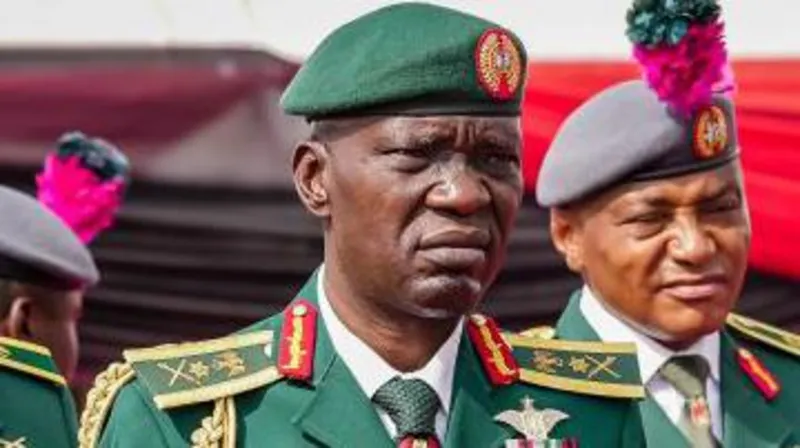
Nigeria’s Chief of Army Staff, General Taoreed Lagbaja, has passed away at the age of 56 following an extended illness, President Bola Tinubu confirmed.
The general died on Tuesday evening in Lagos, although the specifics of his illness were not disclosed.
In a statement posted on X by presidential spokesperson Bayo Onanuga, President Tinubu extended his “heartfelt condolences” to General Lagbaja’s family.
“President Tinubu prays for eternal peace for Lt General Lagbaja and honors his remarkable service to the country,” the statement said.
General Lagbaja’s death represents a profound loss to the Nigerian military, where he had been instrumental in various internal security operations.
He is survived by his wife, Mariya, and their two children.
The Chief of Army Staff, Major General Bismarck Kwasi Onwona, has urged the Ghana Armed Forces (GAF) to maintain neutrality and professionalism, cautioning soldiers against being swayed by political influence as the country approaches the December 2024 general elections.
He emphasized the importance of military personnel remaining professional and refraining from engaging in partisan politics during this critical period. Addressing the army’s role in maintaining peace during the elections, Major General Onwona reaffirmed the military’s commitment to upholding its professionalism.
He called on all officers to stay focused on their duties to ensure a peaceful and orderly electoral process, assuring Ghanaians of the army’s readiness to safeguard the country during the elections.
In his speech, Major General Onwona also appealed to the media to act responsibly, urging them to avoid spreading misinformation and disinformation. He warned that inaccurate reporting could threaten the nation’s peace and stability, particularly during this sensitive election period.
“I am not singling out any group of people. What I mean is that they should not allow themselves to be influenced by anybody; their politicians, members of the media fraternity, or people in the business community,” he stated.
“We are not politicians; our role is to defend the Constitution. So, I am referring to everybody and anybody who has the intention of influencing any member of the Armed Forces negatively,” he added.
The Army Chief made these remarks during the commissioning of a new accommodation facility for officers at the Central Command in Kumasi. The project, aimed at improving the living conditions of army personnel, was overseen by Brigadier General Michael Kwadwo Opoku, the General Officer Commanding the Central Command.
The newly commissioned facility is expected to enhance the welfare of military personnel stationed in the region as the army prepares to support the nation’s efforts in ensuring a successful and peaceful election in December.
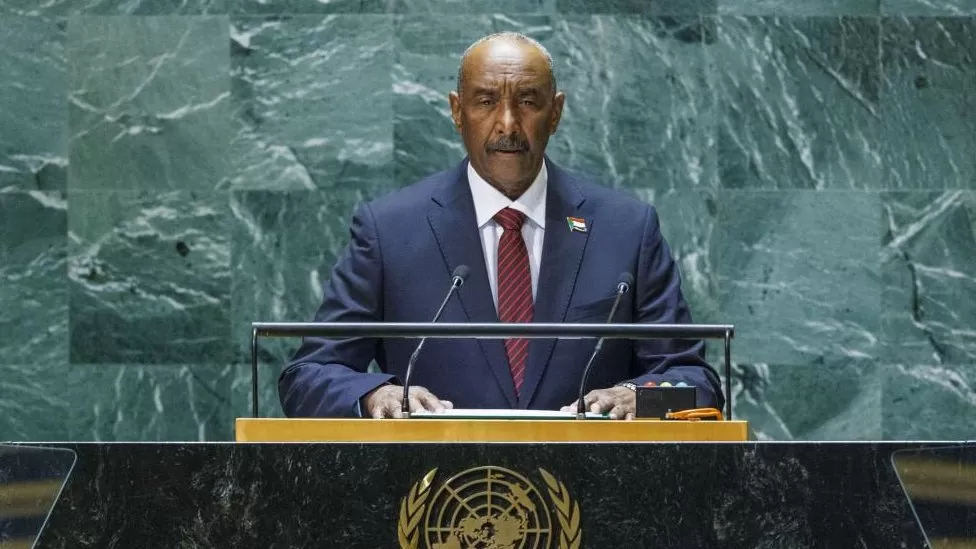
Sudan’s de facto leader has warned the UN that the country’s war could spill over into neighboring African nations.
General Abdel Fattah al-Burhan also called on the international community to designate his opponents, the Rapid Support Forces (RSF), as a terrorist group.
Meanwhile, RSF leader Hamdan Dagalo expressed readiness for a ceasefire. Since April, Sudan has been in a civil war that has claimed thousands of lives.
In 2021, the two generals staged a coup, leading to a recent power struggle between them and armed conflicts among their followers.
Gen Burhan expressed openness to peace talks, while Gen Dagalo, also known as Hemedti, conveyed his willingness to engage in dialogue in a rare video message to the UN.
Sudan’s civil war erupted in April when RSF members were deployed around the country, seen as a threat by the army led by Gen Burhan, and the conflict has since resulted in thousands of casualties and displaced millions.
Following a coup in 2021, Gen. Burhan assumed the role of de facto ruler of Sudan. Since then, he has been traveling the globe in an effort to win over the support of other nations.
In his remarks before the UN, he also made mention of the RSF’s connections to Wagner, an organization of Russian mercenaries that is active throughout Africa in places including the Central African Republic, Sudan, Libya, Mozambique, and Mali.
“The danger of this war is now a threat to regional and international peace and security as those rebels have sought the support of outlaws and terrorist groups from different countries in the region and the world,” he said.
Gen Burhan also argued the RSF should be considered a terrorist group as they had “supported killing, burning, raping, forced displacement, looting, stealing, torture, trafficking of arms and drugs, bringing mercenaries or recruiting children”.
He emphasized the need for accountability and punishment for those crimes. However, Gen Burhan has faced criticism for military actions throughout the conflict.
UN envoy to Sudan, Volker Perthes, who resigned in mid-September, was highly critical of both generals, accusing them of leading the country into a war.
Perthes held the RSF responsible for sexual violence, looting, and killings in areas it controls and condemned the Sudanese armed forces for indiscriminate aerial bombings.
RSF fighters are situated in densely populated urban areas, and the Sudanese military has targeted these areas, seen as legitimate targets. The US has already imposed sanctions on RSF leaders, including Gen Dagalo.
Still, the West has also criticized Gen Burhan for his role in displacing Sudan’s leading party in a 2021 coup.
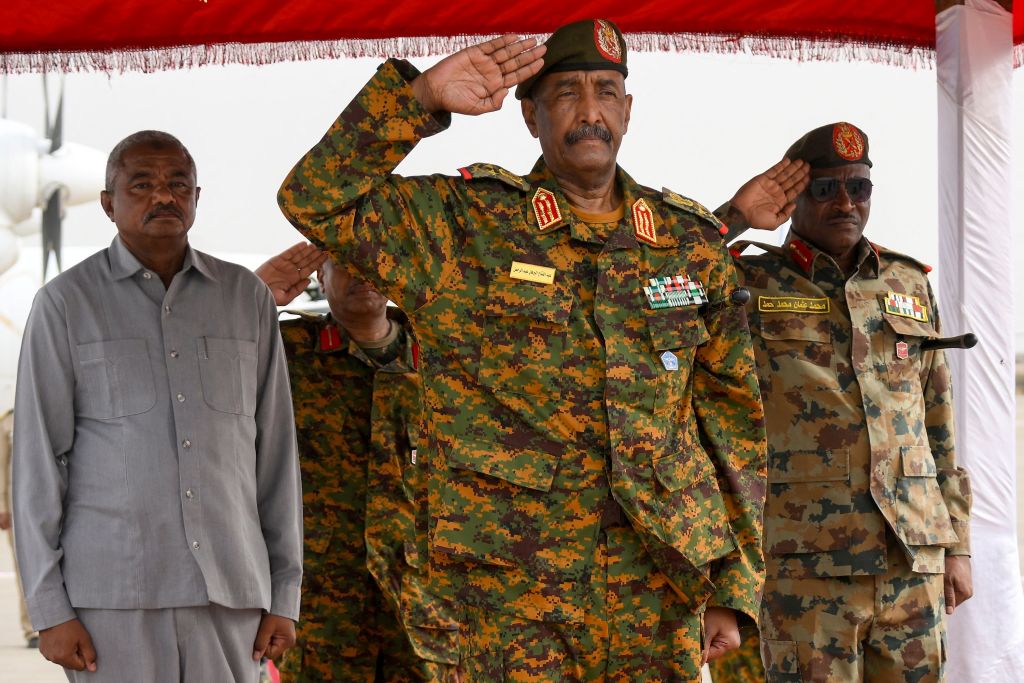
As the violent battle in the nation of Sudan approaches its fifth month, the army chief declared on Monday that he evacuated the city during a significant military assault.
General Al-Burhan affirmed that no arrangement with adversary Daglo to facilitate his exit from the capital had been made.
“I confirm that my exit from the General Command took place without any help, and I did not leave with a deal or by arranging any agreement. This was a military action carried out by the armed forces, and anyone who says that there is an agreement or that there is a party that helped or that there
eople (traitors referring to Rapid Support Forces and those outside Sudan meaning Americans),” declared General Abdel Fattah Al-Burhane.
Burhane said that navy and aviation troops were involved in the military operation that allowed him to escape Khartoum’s army headquarters during this infrequent public appearance in the coastal port of Port Sudan.
One of the conflict’s main hotspots has been the military command.
According to the general of the Sudanese army, the operation resulted in armed conflicts that resulted in the deaths of two people.
“We are proud that our brothers in the Navy were part of this operation (his exit from Khartoum) and there are two martyrs in the operation of the general’s commander (referring to himself) exit from the General Command, and the Air Force, the Land Forces and the Navy participated in this operation, and it was an operation in which there was fighting, and we offered martyrs in it,” Added the army chief.
Marriyum Aurangzeb, the Minister of Information, announced the appointment on Twitter, putting an end to weeks of speculation about the powerful position. Lieutenant General Asim Munir has been named as Pakistan’s new army chief by Prime Minister Shehbaz Sharif.
Marriyum Aurangzeb, the information minister, announced the appointment on Twitter on Thursday, putting an end to weeks of speculation about what some call the most powerful position in the South Asian nation.
For nearly half of Pakistan’s 75-year history, the military has directly ruled the country of 220 million people.
Lieutenant General Sahir Shamshad will take charge as the chairman of the Joint Chiefs of Staff Committee, Aurangzeb added in her tweet.
Munir will replace General Qamar Javed Bajwa who will end his six-year tenure as army chief on November 29.
PM Sharif held a cabinet meeting earlier on Thursday where he selected Munir from a list of six nominees for the top military post.
Munir is currently posted at the army headquarters in Rawalpindi. He has served briefly as chief of the country’s premier intelligence agency, the Inter-Services Intelligence (ISI).
Will president approve?
Defence minister Khawaja Asif said the names of Munir and Shamshad have been sent for approval to President Arif Alvi, who is also the supreme commander of Pakistan’s armed forces.
Alvi belongs to the opposition Pakistan Tehreek-e-Insaf (PTI) party, headed by former Prime Minister Imran Khan, who earlier accused the government of trying to pick a favourite as the army chief.
In a tweet, defence minister Asif wondered if Alvi “will pay heed to political advice or to the constitutional and legal advice”.
“Now this is Imran Khan’s test if he wants to strengthen the institution which defends the country or make it controversial. It is also a test for President Alvi,” Asif wrote.
Soon after Aurangzeb’s announcement on Twitter, the official handle of Khan’s PTI quoted its chief as saying both him and Alvi “will act according to constitution and law”.
Former defence secretary and retired army officer, Asif Yasin Malik, told Al Jazeera Munir has an “impeccable reputation” in the military.
“In the military, your reputation matters a great deal and Asim Munir is very well regarded for his competence and capabilities. So far, his career has been without any controversy and I think he can be a very good chief,” he said, hoping the presidential approval of the nomination goes smoothly.
Islamabad-based security analyst Muhammed Faisal said the new army chief will take charge at a time when the country is in crisis.
“The new chief has to navigate complex political, internal and external challenges, with the economic crisis being the most urgent, as was acknowledged even by the outgoing army chief,” he told Al Jazeera.