Tag: Asante Gold

  • Asante Gold reports US$345million loss for 2025

    Asante Gold reports US$345million loss for 2025

    Asante Gold Corporation has reported a net loss of $345.44 million for the eleven months ended December 31, 2025, representing a more than 450% increase from the $62.18 million loss reported the previous year, according to the company’s audited consolidated financial statements released on March 31, 2026.

    The financial statements, signed by Directors Alex Heath and David Anthony, showed that revenue for the period increased to $482.59 million from $458.88 million, driven by higher gold prices, even as sales volumes declined to 143,138 ounces from 190,985 ounces in the previous year.

    Consequently, total comprehensive loss attributable to shareholders widened to $345.44 million from $62.18 million, while loss per share rose to $0.55 from $0.16.

    Gold equivalent production fell to 146,571 ounces in the period, down from 189,600 ounces a year earlier. At the Bibiani Gold Mine, output dropped to 50,497 ounces from 60,760 ounces, while Chirano produced 96,074 ounces, compared with 128,840 ounces previously.

    The company said the decline at Bibiani was due to lower-grade plant feed, as operations focused on reducing a backlog of waste stripping. At Chirano, lower ore grades and reduced recovery rates, caused by issues with intertank screens at the carbon-in-leach plant, were cited as the main factors.

    Consolidated all-in sustaining costs rose sharply to $3,902 per ounce for the eleven-month period, up from $2,168 per ounce in the previous financial year. The Bibiani Gold Mine reported the highest cost at $6,036 per ounce, while Chirano’s AISC came in at $2,877 per ounce.

    The surge at Bibiani was mainly driven by higher stripping requirements, processing of lower-grade ore from stockpiles, and increased sustaining capital expenditures. At Chirano, the rise in costs was largely due to reduced gold production, which spread fixed costs over fewer ounces.

    During the period, the company completed a financing package comprising a senior debt facility of $150 million, a mezzanine facility of $125 million, gold stream agreements totaling $50 million, and equity raisings of approximately $182 million.

    The company also restructured deferred payments owing to Kinross Gold Corporation, making a cash payment of $53.42 million, issuing 36.93 million common shares valued at $44.04 million, and issuing a secured convertible debenture of $77.46 million. The debenture was subsequently converted by Kinross in October 2025, resulting in the issuance of 61.74 million common shares and a loss on conversion of $28.38 million.

    The company’s auditors, PricewaterhouseCoopers LLP, drew attention to a material uncertainty that may cast significant doubt on Asante’s ability to continue as a going concern. As of December 31, 2025, the company had cash of $43.99 million and a working capital deficiency of $229.33 million.

    “These conditions indicate the existence of a material uncertainty that may cast significant doubt on the Company’s ability to continue as a going concern,” the auditor’s report stated.

    The company has since strengthened its liquidity position through a bought-deal private placement raising C$179.4 million in January 2026, a non-brokered private placement raising C$13.8 million, and an additional advance deposit of $100 million from Fujairah for gold deliveries scheduled to commence in March 2026.

    Meanwhile, in an unrelated development, the Ghana Gold Board (GoldBod) partnered with the Gold Coast Refinery to enhance Ghana’s gold processing capacity.

    GoldBod Chief Executive Officer Sammy Gyamfi, at the signing ceremony on Tuesday, January 20, 2026, indicated that the agreement would significantly enhance the implementation of a track-and-trace system across the gold sector.

    He added that instead of exporting raw gold, Ghana’s daily gold exports, estimated at one tonne, will now be refined to the highest industry standard of 99.9% purity before shipment.

    “This development marks a major milestone in Ghana’s gold trade and will help maximise national benefits from our mineral resources,” Mr. Gyamfi said.

    He further highlighted the economic benefits, noting: “The millions of dollars we pay as refinery charges to refineries in Dubai, Switzerland, India, Hong Kong, and other foreign countries will now stay in our banking sector. That money will now stay in our economy.”

    On job creation, he added: “What this agreement also means is that we are creating more direct and indirect jobs, particularly because Gold Coast Refinery has committed to operating 24/7 in line with the government’s 24-hour policy.”

    This major step was taken towards deepening value addition within Ghana’s gold sector to reduce the country’s long-standing reliance on exporting raw gold. This practice has historically led to significant revenue losses that could otherwise be captured through domestic refining and downstream processing.

    GoldBod explained that the partnership will strengthen local gold processing so Ghana can fully benefit from its status as Africa’s top gold producer.

    A technical, independent report recently presented to GoldBod by economists from the University of Ghana (UG) and the University of Ghana Business School (UGBS) — Professor Festus Ebo Turkson, Professor Agyapomaa Gyeke-Dako, and economist Peter Junior Dotse — indicated that artisanal and small-scale mining (ASM) gold exports rose by 39.4 tons, increasing from 63.6 tons in 2024 to 103 tons in 2025.

    According to the report, GoldBod has mitigated the rate at which gold was being smuggled out of Ghana; trading is now conducted officially through the correct channels, leading to an increase in foreign exchange entering the country. The benefits to the economy are much larger than the trading losses reported by the Bank of Ghana.

    The report explains that each ton of gold is worth about $96.5 million. Based on this value, the gold that was brought into the formal system is worth approximately $3.8 billion in foreign currency.

    This means the benefits are 18 times greater than the $214 million loss reported by the Bank of Ghana. In fact, the report notes that formalising just 2.2 tons of gold would be enough to cover that loss.

  • Asante Gold strikes deal for $500M to fund growth plans

    Asante Gold strikes deal for $500M to fund growth plans

    Asante Gold Corporation has signed agreements with Kinross Gold Corporation (Kinross) to secure approximately $500 million in financing to support its operations and expansion plans in Ghana.

    The financing package includes a $150 million senior debt facility, a $125 million mezzanine facility, a $50 million gold stream arrangement, and $10 million from a non-brokered private placement. It also incorporates the C$237 million ($165 million) raised through a brokered private placement completed in July.

    The company expects the funds to be received in two stages by the end of August 2025. Proceeds will be used to advance development at the Bibiani and Chirano gold mines, settle a cash payment to Kinross Gold Corporation as part of a restructuring deal, retire short-term liabilities, and provide working capital.

    Asante Gold operates the Bibiani and Chirano mines and is advancing exploration at its Kubi project and other prospects in Ghana’s Bibiani and Ashanti gold belts. The senior debt facility consists of a $130 million term loan and a $20 million revolving credit facility, led by FirstRand Bank Limited’s Rand Merchant Bank division with commitments also from Appian Capital Advisory Limited, Ecobank Ghana Plc, and Fidelity Bank Ghana Limited.

    The mezzanine facility includes $75 million from Appian and $50 million from Helikon Investments, with a seven-year maturity and an interest rate of SOFR + 9.75%. The $50 million gold stream involves the sale of a percentage of payable gold from Bibiani and Chirano at 20% of market price for 24 months, after which the percentage changes.

    As part of the financing, Asante has entered a restructuring agreement with Kinross Gold Corporation involving a $53 million cash payment, issuance of 36,927,650 common shares, and an $80 million secured convertible debenture. The financing is expected to close in two stages: about $350 million by August 15, 2025, and the remaining $145 million from the senior debt facility by the end of August 2025.

    Earlier this year, the Asante Gold Corporation announced plans to launch underground mining operations at its Bibiani Gold Mine, with annual gold production projected to exceed 250,000 ounces starting in 2026.

    The company had completed a Definitive Feasibility Study (DFS) confirming the technical and financial viability of extending the mine’s lifespan through underground development. “We are pleased to confirm the potential for an underground mine development with an initial life of seven years at Bibiani. This will incorporate 831,000 ounces of gold produced and an attractive all-in sustaining cost (AISC) of $1,035 per ounce,” said Dave Anthony, CEO of Asante.

    He further highlighted, “Since Asante acquired the Bibiani property in 2021, we have revitalized the operation and reshaped the business plan. We are on a path to achieving annual production of more than 250,000 ounces in 2026 and beyond, further supported by the commencement of underground mining in Q4 2025 and other growth initiatives that have already advanced. These include the Bibiani-Goaso Highway bypass in June 2024 to facilitate access to additional mineralized material and completion of the new sulphide treatment plant, which is on track for Q2 2025.”

    The DFS, prepared by Bara International with contributions from Middindi Consulting and SLR Consulting, focuses on the underground mining potential beneath the existing Bibiani Main and Walsh pits. The study outlines the mining of 11.93 million tonnes of ore at an average grade of 2.36g/t gold, with underground reserves as of December 31, 2023.

    The estimated initial capital cost stands at $116 million, with projected gold production of 798,000 ounces at an AISC of $1,035 per ounce. The project is expected to generate a post-tax Net Present Value (NPV) of $516 million, assuming a gold price of $2,500 per ounce, with an internal rate of return (IRR) of 71%.

    Key next steps include finalizing the combined open pit and underground mine plan, selecting a mining contractor by Q3 2025, and commencing underground operations in late 2025. The development will be funded through ongoing open-pit mining activities.

    The DFS also details the equipment selection and infrastructure required for the underground expansion. Mining equipment has been chosen to align with the orebody’s geometry, minimizing dilution while maximizing productivity. Lessons from Asante’s nearby Chirano Gold Mine influenced the selection, ensuring standardization across both sites. The study outlines manpower requirements, remuneration, and cost schedules for development and operational phases.

    Ore from the Bibiani underground operations will be processed at the existing Bibiani Process Plant, which was originally designed by Lycopodium in 1997 and refurbished under Asante’s management between 2021 and 2022.

    The plant, which includes a gravity concentration circuit and a reconditioned primary gyratory crusher, currently operates at a throughput rate of 2.4 million tonnes per annum (Mtpa). Further upgrades to the sulfide recovery section are scheduled for completion in Q2 2025, ahead of the start of underground mining.

  • Asante Gold to commence underground mining, targets over 250,000 ounces gold production annually

    Asante Gold to commence underground mining, targets over 250,000 ounces gold production annually

    Asante Gold Corporation has announced plans to launch underground mining operations at its Bibiani Gold Mine, with annual gold production projected to exceed 250,000 ounces starting in 2026.

    The company recently completed a Definitive Feasibility Study (DFS) confirming the technical and financial viability of extending the mine’s lifespan through underground development.

    “We are pleased to confirm the potential for an underground mine development with an initial life of seven years at Bibiani. This will incorporate 831,000 ounces of gold produced and an attractive all-in sustaining cost (AISC) of $1,035 per ounce,” said Dave Anthony, CEO of Asante.

    He further highlighted, “Since Asante acquired the Bibiani property in 2021, we have revitalized the operation and reshaped the business plan. We are on a path to achieving annual production of more than 250,000 ounces in 2026 and beyond, further supported by commencement of underground mining in Q4 2025 and other growth initiatives that have already advanced. These include the Bibiani-Goaso Highway bypass in June 2024 to facilitate access to additional mineralized material and completion of the new sulphide treatment plant, which is on track for Q2 2025.”

    The DFS, prepared by Bara International with contributions from Middindi Consulting and SLR Consulting, focuses on the underground mining potential beneath the existing Bibiani Main and Walsh pits. The study outlines the mining of 11.93 million tonnes of ore at an average grade of 2.36g/t gold, with underground reserves as of December 31, 2023.

    The estimated initial capital cost stands at $116 million, with projected gold production of 798,000 ounces at an AISC of $1,035 per ounce. The project is expected to generate a post-tax Net Present Value (NPV) of $516 million, assuming a gold price of $2,500 per ounce, with an internal rate of return (IRR) of 71%.

    Key next steps include finalizing the combined open pit and underground mine plan, selecting a mining contractor by Q3 2025, and commencing underground operations in late 2025. The development will be funded through ongoing open pit mining activities.

    The DFS also details the equipment selection and infrastructure required for the underground expansion. Mining equipment has been chosen to align with the orebody’s geometry, minimizing dilution while maximizing productivity. Lessons from Asante’s nearby Chirano Gold Mine influenced the selection, ensuring standardization across both sites. The study outlines manpower requirements, remuneration, and cost schedules for development and operational phases.

    Ore from the Bibiani underground operations will be processed at the existing Bibiani Process Plant, which was originally designed by Lycopodium in 1997 and refurbished under Asante’s management between 2021 and 2022.

    The plant, which includes a gravity concentration circuit and a reconditioned primary gyratory crusher, currently operates at a throughput rate of 2.4 million tonnes per annum (Mtpa). Further upgrades to the sulphide recovery section are scheduled for completion in Q2 2025, ahead of the start of underground mining.

  • Asante Gold: UK to return Ghana’s stolen “crown jewels”

    Asante Gold: UK to return Ghana’s stolen “crown jewels”

    The UK is returning some of Ghana’s valuable treasures that were taken from the king’s court 150 years ago.

    A gold peace pipe is one of 32 things that will be returned on loan for a long time, the media has found out.

    The V&A museum is giving 17 things and 15 of them are from the British Museum.

    Ghana’s main negotiator said he wants better cultural cooperation after many years of anger.

    Some national museums in the UK, like the V&A and the British Museum, are not allowed to permanently return disputed items in their collections. Instead, they can lend the items to other countries as a way to give them back temporarily.

    However, some countries that say they own disputed artifacts are worried that by borrowing them, it will seem like they agree that the UK owns them.

    Tristram Hunt, who is in charge of the V&A museum, told the media that the gold items used by the court are like our important Crown Jewels.

    The things that will be borrowed include a special sword and gold badges. These were taken during wars in the 1800s between the British and the Asante. The badges were worn by officials who had the job of helping the king.

    Mr Hunt said that when museums have things taken from wars and military campaigns, they should think about sharing them more fairly with the countries they came from.

    “I don’t think our museums will be in danger if we form partnerships and trade with others. ”

    However, Hunt said the new cultural partnership is not a way to give back permanent ownership to Ghana.

    The loans will last for three years, and there is a possibility to extend them for another three years. They are not with the government of Ghana, but with Otumfo Osei Tutu II, who is the current Asante king. He is also known as the Asantehene and attended the Coronation of King Charles last year.

    The Asantehene still has an important ceremonial role, even though his kingdom is now part of Ghana’s modern government.

    The things will be shown at the Manhyia Palace Museum in Kumasi, the main city of the Asante region, to honor the Asantehene’s 25th anniversary.

    The Asante gold artifacts are very important to the Asante royal government. People think they have the spirits of past Asante kings in them.

    They are very important to Ghana just like the Benin Bronzes. The Benin Bronzes are thousands of sculptures and plaques that were taken by Britain from the palace of the Kingdom of Benin, in southern Nigeria. Nigeria has been asking for them to come back for many years.

    Nana Oforiatta Ayim, who helps the culture minister in Ghana, said to the media: “These items are not just things, they are also very important for spiritual reasons. ” They are an important part of the country’s spirit. “It’s parts of us coming back. ”

    She said that the loan was a good way to start and a sign that some healing and remembering of the violence that happened is beginning.

    British museums have a lot of stuff from Ghana, like a gold trophy head that is a well-known piece of Asante royalty.

    The Asante people created a strong and powerful state in West Africa. They traded gold, textiles, and enslaved people.

    The kingdom was well known for being strong and rich because of its army and money. Even today, when the Asantehene greets people on important events, he wears so many heavy gold bracelets that he sometimes needs someone to help hold up his arm.

    Europeans went to a place in Africa called the Gold Coast because they heard there was a lot of money there. The British had many fights with the Asante people during the 1800s.

    In 1874, British soldiers attacked Kumasi as punishment for an Asante attack. They looted the city and took many valuable items from the palace.

    Many of the things the V&A is giving back were purchased at an auction on 18 April 1874 at Garrards, a London jewelry store that looks after the UK’s Crown Jewels.

    They are three heavy gold items called ‘soul washers’ badges (Akrafokonmu), which were worn around the necks of important officials at court. Their job was to cleanse the soul of the king.

    Angus Patterson, who works at the V&A museum, said that taking these things in the 19th Century wasn’t just about getting rich, but it was a part of it. It’s also about getting rid of signs of the government or signs of people in charge. “It’s a very political action”.

    The British Museum is giving back 15 items that were taken during a war in 1895-1896. One of the items is a special sword called the Mpomponsuo.

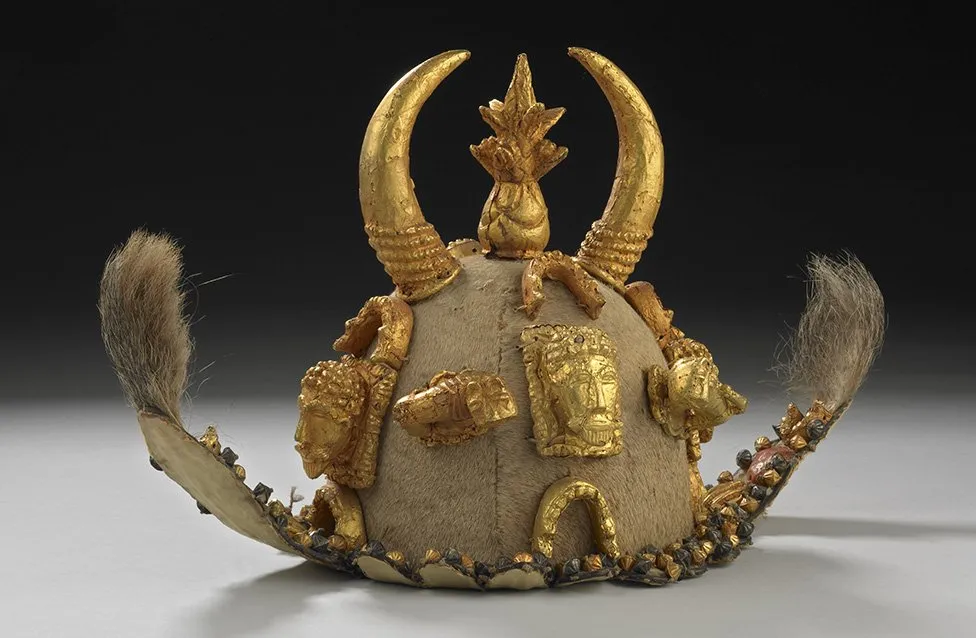
    There is also a special hat called a Denkyemke, which is decorated with lots of gold ornaments. High-ranking officials like lords or ladies wore it at important events like coronations and big celebrations.

    The British Museum is sharing a gold model of a lute-harp called Sankuo. It’s almost 200 years old and has a connection with the Asantehenes. This model was not stolen or taken and will be on display.

    In 1817, the British writer and diplomat Thomas Bowdich was given a sankuo as a gift from the Asantehene. The gift was meant to show how rich and powerful the Asante nation was.
    “Solve the problems without getting involved in the politics. ”

    Can you give back things to a country that says you took them without permission.

    This is a solution to rules in the UK that some countries may not like because they are trying to fix something bad that happened in the past.

    The Parthenon Sculptures, also known as the Elgin Marbles in the UK, is the most well-known example of this issue.

    Greece has been asking for the old sculptures in the British Museum to be given back. The leader of the trustees, George Osborne, recently said he wants to find a practical and sensible solution. He is considering a partnership that sets aside the question of who really owns the ancient sculptures.

    This deal with the Asantehene is like another version of that; a fair agreement that works for the Asante king and follows the laws of Britain.

    Nigeria probably wouldn’t take a loan of the Benin Bronzes, and Ghana’s government would have had a hard time accepting this kind of agreement.

    But Hunt said the agreements between the V&A, the British Museum, and the Manhyia Palace Museum “go beyond politics. ” “It doesn’t fix the problem, but it starts the talk. ”

    Ms Oforiatta Ayim, who advises the culture minister of Ghana, said that it is natural for people to be upset about the idea of a loan. They hope to see the items eventually returned to Ghana for good.

    “We know that the things were taken during a violent event, and we know that they belong to the Asante people,” she said.

    The British government keeps things that are disputed and explains why they are kept.

    Neither the Conservative or Labour parties want to change the laws. The British Museum Act of 1963 and the National Heritage Act of 1983 stop museum leaders at important museums from selling or getting rid of things in their collections.

    Mr Hunt wants to make a new law. He wants museums to have more freedom, but also a committee to approve returning items.

    Some are worried that British museums might have to give away some of their most valuable items in the future. Or, as Michelle Donelan, a former culture secretary, told me about the return of the Parthenon Sculptures, it could lead to a discussion about everything in our museums.

    But Hunt said that very few people have argued about who owns the V&A’s 2. 8

    Another worry is that things that are borrowed and fought over might not be given back.

    Ghana’s main negotiator, Ivor Agyeman-Duah, denied that. “He said you always keep your promises and never break them. ”

    There are more pretty Asante gold things in the UK. The Wallace Collection has the trophy head, which is one of the most well-known Asante treasures. The British forces took it and bought it at the 1874 auction.

    The Royal Collection also has a mask made of gold, which looks like a trophy head. This item showed that enemies had been beaten. It was attached to ceremonial swords in the state’s special equipment.

    Is there a chance that they will be shown in Ghana in the future. Agyeman-Duah is being careful and patient in making it happen.

    As Britain is dealing more and more with its history of ruling other countries, these agreements could be a good way to talk about the past and improve relationships in the future, as long as both sides agree.