Social media platforms are buzzing with excitement as images flood in from a spectacular three-day pre-wedding gala hosted by Mukesh Ambani, Asia‘s wealthiest individual.
The affluent event, held at Ambani’s resort in Gujarat state, marked the impending union of his son, Anant Ambani, with fiancée Radhika Merchant, set to tie the knot in July.
The star-studded guest list boasted global icons such as Bill Gates and Mark Zuckerberg, who joined approximately 1,200 attendees in celebrating the joyous occasion with song, dance, and unparalleled extravagance.
The gala showcased a blend of tradition and glamour, featuring some of India’s biggest film stars gracing the stage, dancing to their chart-topping songs.
However, stealing the spotlight was pop sensation Rihanna, who made her much-anticipated debut performance in India, captivating the audience with her electrifying presence and hit songs.
The news of Rihanna’s headline act added an extra layer of allure to an already star-studded affair, making Mukesh Ambani’s pre-wedding celebration an unforgettable event that left the world in awe.
As a terrible April heat wave continues to engulf much of the continent, with no sign of relief in sight, temperature records are being broken in nations all around Asia.
This week saw record-breaking high temperatures in various Southeast Asian nations, while the Indian subcontinent’s scorching heat has claimed the lives of more than a dozen individuals.
According to weather historian Maximiliano Herrera, Laos is the most recent nation to break a record after Luang Prabang hit 42.7°C (109°F) on Tuesday.
Over the weekend, Thailand topped 45°C (113°F) for the first time in its history, according to Herrera, using data from the Thai Meteorological Department. The northwest city of Tak reached 45.4°C Saturday, but large portions of the country have been in the upper 30s to low 40s since late March.
Earlier this month, Thai authorities issued a health alert for several provinces as the heat index was forecast to reach 50.2°C in the Bang Na district of the capital Bangkok. The heat index is what the temperature “feels like” and considers both air temperature and humidity to measure its impact.
On Tuesday, Thai Prime Minister Prayut Chan-o-cha expressed concern over “dangerously high temperatures in various parts of Thailand” and said in Bangkok’s Bang Na area, temperatures “could reach 52.3°C,” according to a statement from the prime ministers office.
Neighboring Myanmar set an April temperature record on Monday as Kalewa, in central Sagaing region, reached 44°C (111°F), Herrera tweeted.
April and May are typically the hottest months of the year for South and Southeast Asia as temperatures rise before monsoon rains begin and bring some relief.
But the heat in Thailand has been compounded by an intense smoggy season that has caused pollution levels to spike.
The tourist hotspot of Chiang Mai in the north ranked as the world’s most polluted city for seven straight days as smoke from forest fires and widespread crop burning deteriorated the air quality. At least one hospital in the city said it had reached “full ward capacity” as patients sought medical treatment for respiratory issues.
The scorching temperatures have also been widespread across China.
On Tuesday, the country saw temperatures as high as 42.4°C (108°F) in Yuanyang, in the southeast – only 0.3°C from the country-wide record for April, according to Herrera.
On Monday, more than 100 weather stations in 12 provinces broke their April temperature record, according to climatologist Jim Yang.
Although not record-breaking in most cases, the heat has also been prevalent – and deadly – across South Asia. Pakistan, India, Nepal and Bangladesh have all seen temperatures topping 40°C (104°F) for many days.
In India’s western Maharashtra state, at least 13 people died from heatstroke after attending a state award ceremony on Sunday. More than 1 million people attended the event in Navi Mumbai and between 50 to 60 people were hospitalized, according to a city police official.
Meanwhile, at least two states, Tripura in the northeast and West Bengal in the east, ordered schools to shut this week, as temperatures rose more than 5 degrees Celsius above normal, state governments said, Reuters reported.
Heat waves in India usually take place between March and July, but in recent years these hot spells have become more intense, more frequent and longer.
Last year, India experienced a searing heatwave, where parts of the country reached more than 49°C (120°F). As the impacts of the human-caused climate crisis accelerate and global temperatures continue to rise, scientists say heat waves will only become more common.
A 2022 study found that dangerous heat waves will be between three and 10 times more often by the turn of the century.
In the tropics, which encompasses much of Asia, people could be exposed to dangerous heat most days of the year, the study found. Days of “extremely dangerous heat” – which is defined as 51°C (124°F) – could double and experts say those levels of heat push the limits of human survivability.
Extremely hot temperatures across South and Southeast Asia are expected to continue. Meanwhile, cooler conditions are on the way for much of China as temperatures are forecast to fall from around 10°C (18°F) above average to 10°C (18° F) below average this weekend.
Luxury brand Dior has been accused of racism on Chinese social media over an advertisement showing an Asian model pulling up the corner of her eye.
The French label posted the picture on its Instagram account earlier this week, before swiftly taking it down.
Dior has not made any public comment. The BBC has asked them for a response.
Chinese netizens have become increasingly sensitive to the depiction of Chinese people amid rising nationalist sentiment online.
The controversial picture was posted six days ago to promote Dior’s new makeup collection. It shows the model pulling up her eye with the caption “Channel your feline fierceness”.
It was later reposted by netizens on Chinese social media platforms, where it received criticism and sparked the viral hashtag “Dior makeup advertisement accused of discriminating against Asians” on Weibo.
The picture was posted on Dior’s Instagram account but has since been taken down
Angry comments have also flooded the label’s Instagram account. “It’s racial discrimination,” a top-liked comment reads.
“Are you trying to make money and play racism at the same time?” a Chinese user posted.
State-owned newspaper Global Times published an editorial calling on the brand to apologise.
“‘Pulling your eyes back’… makes fun of the appearance of Asians, especially East Asians,” it said. “We hope that Dior can face up to its mistakes, make a sincere apology and response to Asian society, and make clear statements on how to prevent similar problems from happening in the future.”
Some netizens have also called on Chinese celebrities who model for Dior to end their association with the brand.
But there are also some who think the discussion is over the top.
“An extreme unconfident person won’t be able to take any level of humour,” one Weibo user wrote.
“Those who buy Dior never think it insults China, it’s always those who don’t buy that are concerned by it,” another one said.
This is not the first time Dior has been caught up in controversy in China, one of its biggest markets.
A Chinese fashion photographer’s picture for the brand sparked outrage in 2021 after some netizens said it perpetuated Western stereotypes of Asian faces. The photographer later apologised and Dior said it “respects the sentiments of the Chinese people”.
In 2022, Dior was accused of “culturally appropriating” a Chinese traditional design for one of its skirts.
A Chinese snack brand was also previously accused of racism for using a model with narrow eyes in its advertisements.
Thirteen-year-old Nika Selivanova made a heart shape with both her hands, waving goodbye to her best friend Inna who was pressed up against the glass partition that divided the entrance hall of Kherson’s train station from the waiting area.
Moments earlier, they’d hugged, tears welling up in their eyes. Inna had kissed Asia, a tan dachshund dog wrapped up in a warm blanket, carried by Nika in her arms.
The girls didn’t know when they might see each other again.
Nika’s family was leaving Kherson, not sure of where they would end up eventually. For now, they were heading to the western city of Khmelnytskyi, hoping they would get some help there.
The past few days in Kherson had simply been too much for Nika’s mother Elena.
“Before, they [Russian forces] shelled us seven to 10 times a day, now it’s 70-80 times, all day long. It’s too scary.” Elena said. “I love Ukraine and my dear city. But we have to go.”
Elena and her three daughters are among more than 400 people who have left Kherson since Christmas Day, after a sharp increase in the intensity of the bombardment of the city by the Russian military.
On Tuesday, a hospital maternity ward was shelled. No-one was hurt but it has further escalated fear among people.
Elena left by train, in an evacuation facilitated by the Ukrainian government.
Image caption, These cars were driving out of Kherson on Christmas morning
Hundreds of people are leaving on their own, a queue of cars building up at the checkpoint leading out of Kherson, filled with terrified civilians.
Iryna Antonenko was in tears when we walked up to her car to speak to her.
‘We can’t take it anymore. The shelling is so intense. We stayed this whole time and thought it would pass and that we would be lucky. But a strike hit the house next to ours, and my father’s home was also shelled,” she said.
She planned to travel to Kryvyi Rih, a city in central Ukraine where she has family.
Image caption, This image shows the aftermath of one of many strikes which hit Kherson on 24 December
Just last month, there had been jubilant scenes in Kherson. Taken by Russian forces on the second day of the invasion, the city was liberated on 11 November.
Close to the spot where masses had gathered waving Ukrainian flags to celebrate being freed from Russian control, a mortar attack on Christmas Eve left eleven dead, and dozens injured.
Among the dead were a social worker, a butcher and a woman selling mobile Sim cards – ordinary people working at or visiting the city’s central market.
That day, Kherson was hit by mortars 41 times, according to the Ukrainian government.
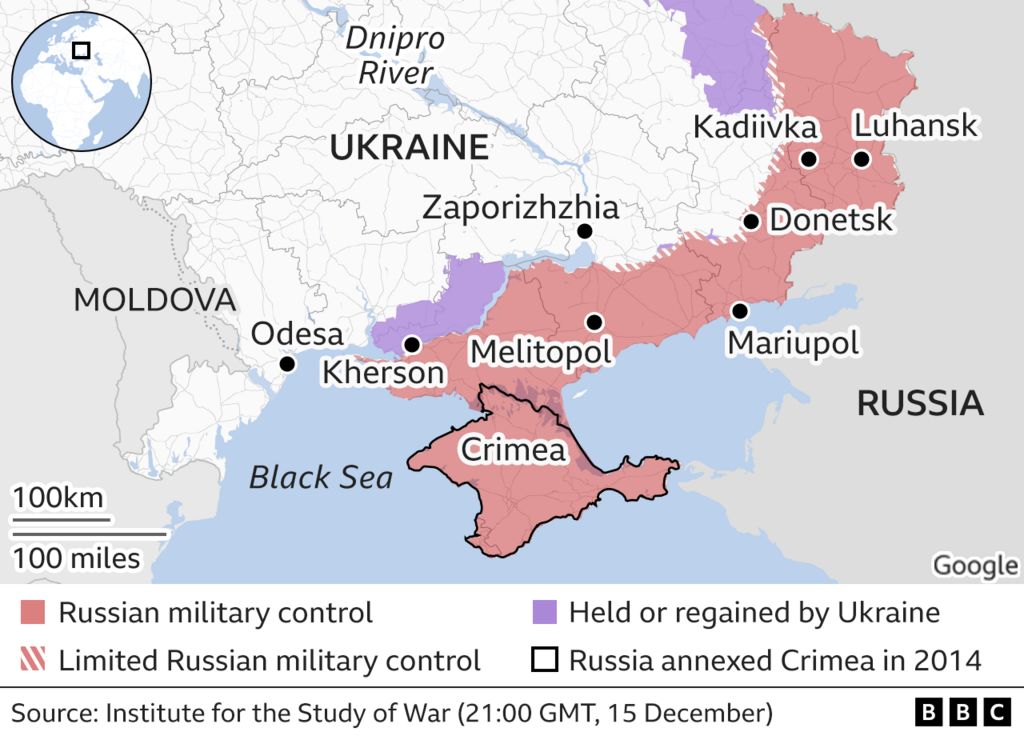
The Russians are firing from the left (east) bank of the Dnipro river, where they withdrew to; the waterway has become a de facto frontline in the south of Ukraine.
Kherson is a strategically important region, often called the gateway to Crimea. Many analysts say that Russia has now been forced into a defensive position here.
It’s hard to see what it hopes to gain from the pounding of Kherson. In addition to mortar shells, we have also seen incendiary munitions being used – fiery sparks raining down on the city, intended to set fire to targets.
It’s also unclear if the Ukrainian military is attempting to take back control of areas on the left bank of the river.
Here in the city, there’s barely ever a break from the constant sound of mortar shell attacks.
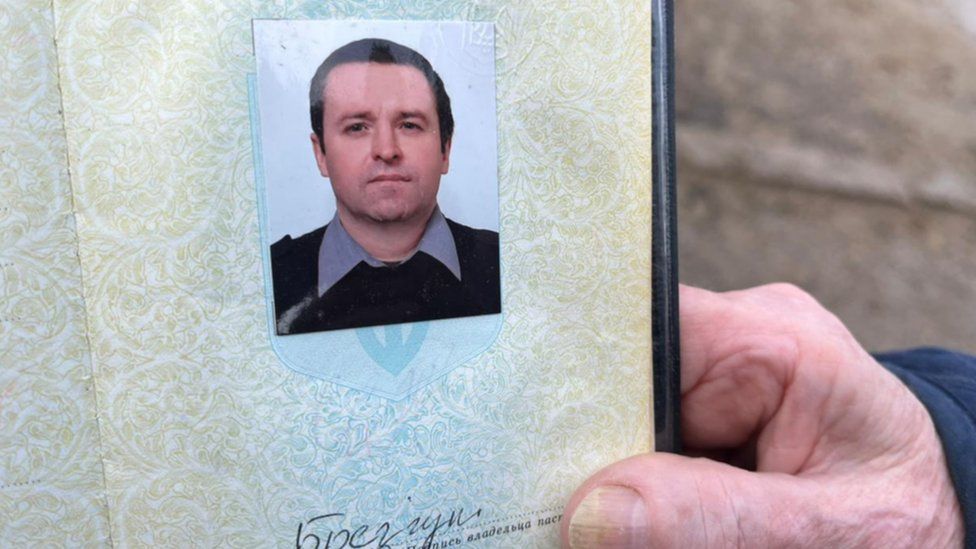
Serhii Breshun, 56, was killed when he was asleep. His home collapsed on him after a shell hit it.
Image caption, Serhii’s passport was retrieved from the ruins of his home
The day after he died, we met his mother, 82-year-old Tamara, who had come to search for his passport in the rubble. She needed the document to get his body released from the morgue.
“I must have had a sense that something would go wrong that day. Because I spoke to him [over the phone] and urged him to leave the house. He didn’t and that was it. Our lives have been ruined,” she wept.
We’d barely finished talking to her, and there were more loud explosions.
The elderly mother’s lone pursuit to give her son a dignified farewell is a dangerous one, because no part of Kherson is safe.
Image caption, Tamara, 82, must now bury her son
Surviving here, whether out in a street or inside a home, is a matter of chance.
Thirty-nine-year-old Red Cross volunteer Viktoria Yaryshko was killed in a mortar shell explosion just outside the organisation’s base in Kherson, a few feet away from safety.
Her mother Liudmyla Berezhna showed us the medal of honour Viktoria was given.
“I’m very happy she helped a lot of people. She was so kind. But it’s also painful for me. I must recover and raise her two children. I tell them they should be proud of their mother because she is a hero,” she said.
Image caption, Viktoria was a Red Cross volunteer and the mother of two children
Viktoria had been living in the underground shelter of the Red Cross with her two children – 17-year-old Alyonushka and 12-year-old Sasha. They continue to live there, feeling comfort and protection amidst a group of volunteers who’ve become family.
‘When someone so close dies, it is difficult. But if we give up and stop, then her death would have been in vain. We work to make sure people live. Everything else is secondary,” said Dmitro Rakitskyi, Viktoria’s friend and another volunteer.
But it’s hard to do that knowing your own family could be in danger every minute.
When a few moments later, more bombs go off, Dmitro paces up and down trying to call his wife, tension visible on his face. He has two children.
“They don’t want to leave. They worry about me, and I worry about them. That’s how we live,” he said.
Image caption, Dmitro, a friend of Viktoria’s, knows he and his family remain at risk in Kherson
“What makes me most angry is that they [Russian forces] always hit civilian infrastructure. Houses, apartment blocks, boiler rooms. It’s impossible to understand the logic behind these attacks,” Dmitro said.
“We almost never have power or water. It comes briefly sometimes and is gone again because of shelling. It’s very scary at night. We still have gas though, and are able to stay warm,” one resident, Larysa Revtova, said.
Tens of thousands of civilians are still living in Kherson, but at least twice this week the regional administration has urged them to leave.It is a city haunted by relentless and indiscriminate attacks.
Food importers from Africa to Asia are scrambling for dollars to pay their bills as a surge in the US currency drives prices even higher for countries already facing a historic global food crisis.
In Ghana, importers are warning about shortages in the run up to Christmas. Thousands of containers loaded with food recently piled up at ports in Pakistan, while private bakers in Egypt raised bread prices after some flour mills ran out of wheat because it was stranded at customs.
Around the world, countries that rely on food imports are grappling with a destructive combination of high interest rates, a soaring dollar and elevated commodity prices, eroding their power to pay for goods that are typically priced in the greenback. Dwindling foreign-currency reserves in many cases has reduced access to dollars, and banks are slow in releasing payments.
“They cannot afford it, they cannot pay for these commodities,” said Alex Sanfeliu, world trading head for crop giant Cargill Inc. “It’s happening in many parts of the world.”
The problem isn’t a new one for many of the countries — nor is it limited to agricultural commodities — but the reduced purchasing power and dollar shortages are compounding wider strains across global food systems following Russia’s invasion of Ukraine.
The International Monetary Fund has warned of a catastrophe at least as severe as the food emergency in 2007-08, US Treasury Secretary Janet Yellen called for more food aid for the most vulnerable, while the World Food Programme says the globe is facing its largest food crisis in modern history.
On the ground, many importers are struggling with rising costs, shrinking capital and difficulty in obtaining dollars to ensure their shipments are released from customs on time. That means cargoes get stuck at ports or may even be diverted to other destinations.
“There was always a historical strain on making these payments, but at the moment it’s unbearable pressure,” said Tedd George, a consultant specializing in Africa and commodities markets.
In Ghana, where the cedi has lost about 44% this year against the dollar — making it the second-worst-performing currency in the world — there are already worries about supplies ahead of Christmas.
“We think there is going to be a shortage of some food items,” said Samson Asaki Awingobit, executive secretary of Ghana’s importers and exporters association which includes buyers of grains, flour and rice. “The dollar is swallowing our cedi and we are in a hopeless situation.”
To be sure, some countries may be cushioned by their purchases in other currencies like euros, while energy-exporting nations will profit from overseas revenues. Global food-commodity costs have also fallen for six straight months, giving hopes for a relief to consumers.
But the soaring dollar threatens to erode some of that benefit, according to Monika Tothova, an economist at the United Nations’ Food and Agriculture Organization, which sees this year’s global food import bill at a record high.
The situation is still fragile. Concerns are mounting anew over supplies out of the Black Sea region as the war in Ukraine escalates and there are questions over the future of the deal to ship grains out of Ukrainian ports. Weather shocks have driven volatility in recent months, stocks are low and soaring fertilizer and energy prices are boosting food production costs.
As the Federal Reserve continues to tighten monetary policy, the dollar’s strength versus currencies in emerging and developing markets will add to inflation and debt pressures, the IMF said in its global outlook this week.
In flood-ravaged Pakistan, government moves to prevent foreign-exchange outflows meant that containers holding food like chickpeas and other pulses piled up at ports last month, sending prices surging, according to Muzzammil Rauf Chappal, the chairman of the Cereal Association of Pakistan.
The situation eased after the appointment of new finance minister who pledged to clear pending transactions for businesses that have been delayed because of a dollar shortage in its interbank market.
“The situation was quite dangerous,” said Chappal, whose company is the country’s biggest private sector wheat importer. “We were expecting the country to face a serious grain crisis.”
In Egypt, one of the world’s top wheat importers, shortages have plagued private sector mills that supply flour for bread that isn’t part of the country’s subsidy program.
About 80% of millers have run out of wheat and stopped operations as some 700,000 tons of grain remain stuck at the country’s ports since the start of last month, according to the Chamber of Cereal Industry. The supply ministry said Wednesday it would provide wheat and flour to private sector mills and pasta factories.
Cargill’s Sanfeliu said he expects global wheat trade flow to shrink by as much as 6% in the upcoming months, with corn and soybean meal flows dropping by as much as 3%, as developing countries struggle to pay for food and animal feed.
In Bangladesh, business conglomerate Meghna Group of Industries may have to cut the amount of wheat it had planned to import before the war broke out amid at least a 20% jump in wheat import costs due to the stronger dollar, said Taslim Shahriar, the company’s procurement official.
“Currency fluctuations are creating huge losses for the company,” said Shahriar. “We have never seen this before.”
–With assistance from Arun Devnath, Abdel Latif Wahba, Asantha Sirimanne, Tarso Veloso Ribeiro, Souhail Karam, Katarina Hoije, Ama Tanoh and Eddie Spence.
The majority of Asian markets increased on Monday as investors cheered evidence of declining US inflation; however, Hong Kong and Shanghai declined as statistics indicated that China’s economy was suffering due to the Covid-19 limitations.
The markets have been worried that additional hikes of a comparable magnitude could stifle economic recovery after two straight increases in borrowing costs by the Federal Reserve of three-quarters of a percentage point.
Last week’s indicators of improved inflation statistics have sparked discussion about whether the Fed may change course more rapidly from its current stance of moving aggressively to raise interest rates.
“We’re definitely heading in a better direction,” Kristina Hooper, Invesco chief global market strategist, told Bloomberg Television.
“It looks like we are passed peak for inflation. The problem is inflation is still very, very high.”
Wall Street ended Friday on a positive note after consumer and producer price data indicated a meaningful cooling in inflation.
The optimistic mood carried over to Asia, with Tokyo climbing one percent as GDP data showed the Japanese economy recovering after the government lifted Covid-19 curbs on businesses.
Sydney rose 0.5 percent and Taipei was up 0.7 percent. Wellington, Manila, and Kuala Lumpur also saw gains. Seoul and Mumbai were closed for holidays.
Among the few losers, Hong Kong and Shanghai fell as Chinese economic figures came in weaker than analysts’ expectations.
China unexpectedly cut key interest rates as a raft of data released Monday indicated the world’s second-largest economy was struggling with virus restrictions and a slumping property market.
The figures showed China’s industrial production and retail sales growth for July came in lower than expected. Industrial production was up 3.8 percent year-on-year, but down from 3.9 percent in June and below Bloomberg economists’ forecasts of a 4.3 percent increase.
“The risk of stagflation in the world economy is rising, and the foundation for domestic economic recovery is not yet solid,” China’s National Bureau of Statistics warned.
Beijing’s rigid adherence to a zero-Covid strategy has held back economic recovery as snap lockdowns and long quarantines batter business activity and a recovery in consumption.
“July’s economic data is very alarming,” Raymond Yeung, Greater China economist at Australia & New Zealand Banking Group, told Bloomberg.
“The Covid-zero policy continues to hit the service sector and dampen household consumption.”
Oil was lower in Asian trade, with WTI down one percent at $91.20 while Brent was off 0.9 percent at $97.25.
North Korea has fired three ballistic missiles early Wednesday morning, South Korea’s military has said.
Authorities in Seoul said the missiles were fired in the space of less than an hour from the Sunan area in Pyongyang.
It comes just a day after US President Joe Biden left the region, following a trip that saw him vowing to bolster measures to deter North Korea.
North Korea has been test-firing a flurry of ballistic missiles since the beginning of this year.
Japan confirmed at least two launches happened on Wednesday but acknowledged there may have been more.
Japan’s Defence Minister Nobuo Kishi said first missile flew about 300km (186 miles) with a maximum altitude of around 550 km, while the second, reaching as high as 50 km, travelled around 750 km.
Mr Kishi criticised the launches, saying they were “not acceptable” adding that it would “threaten the peace, stability and safety of Japan and the international community”.
In a meeting convened after the missile launch, South Korea’s National Security Council called the test a “grave provocation”, the presidential office said.
The launches came hours after US President Joe Biden departed for the US on Tuesday evening, after a five-day trip that saw him visiting South Korea and Japan.
U.S. and South Korean officials had earlier warned that North Korea appeared ready for another weapons test, possibly during Biden’s visit.
During his visit to Seoul over the weekend, Mr Biden and his South Korean counterpart Yoon Suk-yeol agreed to hold bigger military drills and deploy more U.S. strategic assets if necessary to deter North Korea’s intensifying weapons tests.
Mr Biden had said the United States was “prepared for anything North Korea does.”