The space agency of India will soon start important tests before sending astronauts into space in 2025.
The Gaganyaan spacecraft will be launched on Saturday at 08:00 in Sriharikota.
The test will show if the crew can safely get out of the rocket if it doesn’t work correctly.
If it works, it will make it possible for other missions without people, including sending a robot into space next year.
We will only send a mission with three astronauts into low-Earth orbit after we finish all these tests. The government said it will probably happen in 2025.
The Gaganyaan project, which means “craft or vehicle to the sky” in Sanskrit, was created at a cost of 90 billion rupees ($1 billion; £897 million). The goal is to launch the astronauts into space 400km above Earth and bring them back safely after three days. If India is successful, it will be the fourth country to send a person into space, following the Soviet Union, the US, and China.
Before that, the space agency Isro has to show that the capsule carrying humans can come back home safely. Saturday’s flight, known as Flight Test Vehicle Abort Mission-1 (or TV-D1) by Isro, will try to do that.
The head of ISRO, S Somanath, has said that they will be testing the spaceship’s “escape system for the crew” which is a very important part of the spaceship.
Mr Somanath said that if something goes wrong with the rocket, we can make sure the crew stays safe by moving them at least 2km (1. 2 miles) away from the rocket that’s exploding.
“After the rocket goes up in the air, when it reaches a height of 12km to 16km, we will activate the safety system and separate the crew escape system from it,” he explained.
According to the Isro website, some parachutes will be used to help the module land safely in the waters of Bay of Bengal, about 10km away from the Sriharikota coast.
The Indian navy will be nearby with a ship and a group of divers. They will retrieve the module and bring it back to land safely.
The space agency says that the “short duration” test will take about nine minutes.
The craft has been equipped with cameras and instruments that will collect information and pictures. Isro claims that this data will be useful for future tests and the final Gaganyaan mission.
If the test on Saturday goes well, Isro will then send a robot that looks like a human in a spacecraft called Gaganyaan next year, according to junior minister for science Jitendra Singh. Isro introduced Vyommitra, a female humanoid, in 2019. The word “Vyommitra” means “space friend” in Sanskrit.
The agency also showed pictures of Indian air force pilots who were selected to be part of the crew. They mentioned that the pilots were going through a lot of physical exercises, lab tests, X-rays, medical tests, and assessments of their mindset.
Isro recently shared pictures of their rocket on a social media platform called X. They also shared a picture that shows the path the rocket will take from its launch to when it lands in the ocean.
Saturday’s upcoming test has gotten a lot of attention in India, even though it’s happening pretty late compared to when astronauts from the Soviet Union and the US started going to the low Earth orbit in 1961. In October 2003, China became the third country to go to space. They sent a mission that lasted 21 hours and circled the Earth 14 times. The US and China have space stations in orbit around Earth that are fully working.
In 1984, an astronaut from India named Rakesh Sharma went to space. He spent 21 days and 40 minutes on a Russian spacecraft.
But people are interested in Isro’s planned test on Saturday because it’s happening soon after India made a historic achievement by being the first country to land near the Moon’s south pole on 23 August 2023.
A few weeks later, India sent its first observation mission to the Sun, called Aditya-L1. According to India’s space agency, it will travel a distance of 1. 5 million km (932,000 miles) from Earth, which is about 1% of the distance between the Earth and the Sun. It is expected to reach its intended destination in mid-January.
This week, India announced big goals for space. They plan to build a space station by 2035 and send one of their own astronauts to the Moon by 2040.
Tag: astronauts
-
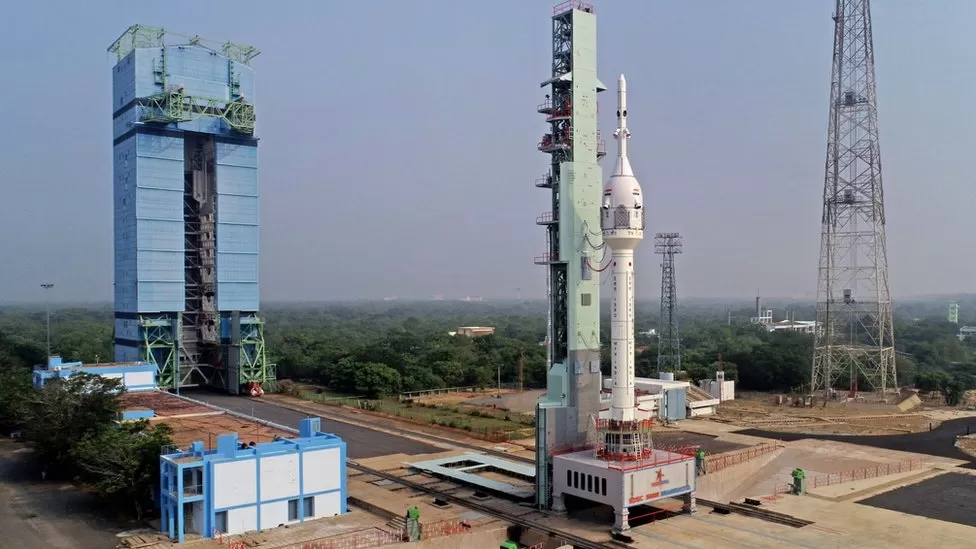
India conducts important test flights prior to astronauts space mission
-
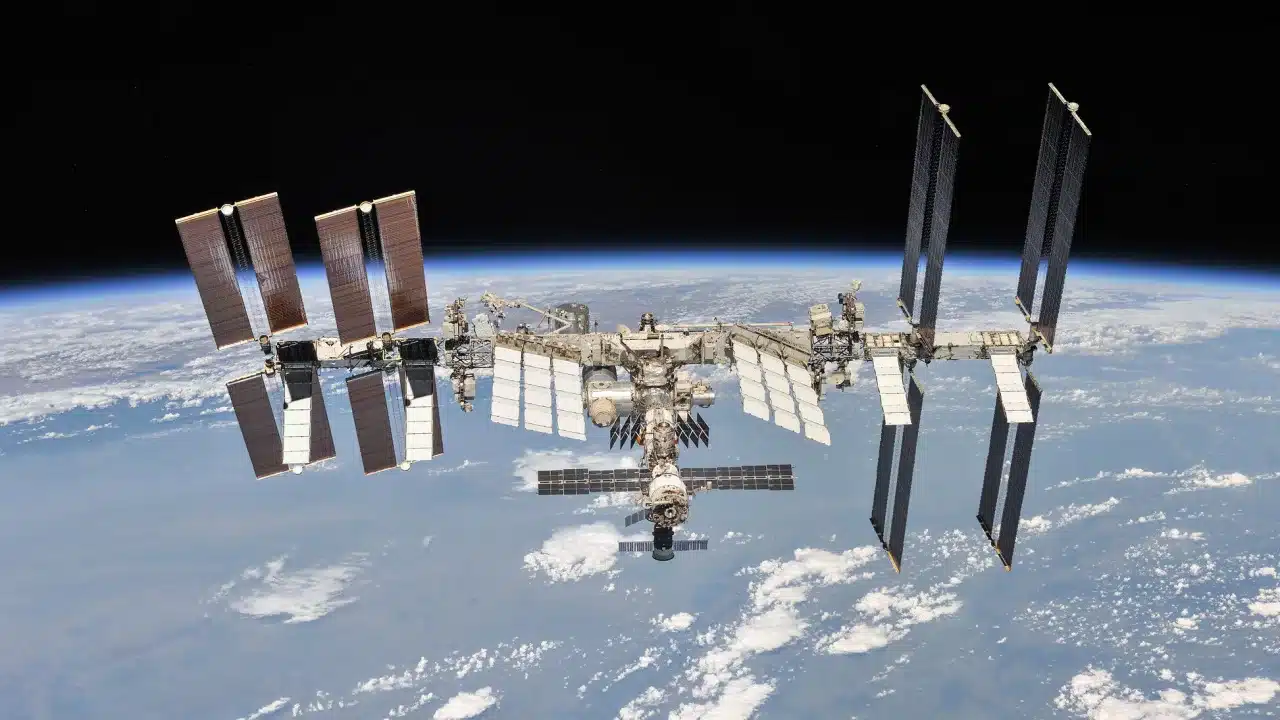
Astronauts brains affected by prolonged space flights
Following a new research, astronauts’ brains are affected by spaceflights lasting six months or longer, and crew members may need to wait at least three years before going back into space.
The brain scans of 30 astronauts were compared to scans performed after they had returned to Earth in order to determine how their brains had changed throughout their two-week, six-month, and one-year space missions. The scans showed that in the brains of astronauts who spent at least six months on voyages to the International Space Station, the ventricles, or chambers within the brain that are filled with cerebrospinal fluid, dramatically grew.
The findings have implications for future longer-term missions as NASA and its international partners aim to establish a sustained human presence on the moon with the Artemis program, with the eventual goal of sending humans to deep-space destinations such as Mars.A study detailing the findings was published Thursday in the journal Scientific Reports.
Cerebrospinal fluid provides the brain with protection and nourishment while removing waste. But when astronauts go to space, fluids within the body shift toward the head and push the brain higher against the skull, causing expansion of the ventricles.
“We found that the more time people spent in space, the larger their ventricles became,” said lead study author Rachael Seidler, a professor of applied physiology and kinesiology at the University of Florida, in a statement. “Many astronauts travel to space more than one time, and our study shows it takes about three years between flights for the ventricles to fully recover.”
Eight of the astronauts in the study went on two-week missions, while 18 ventured on six-month missions. Four astronauts had missions that lasted for about a year. During the analysis, the researchers determined that the degree to which the ventricles enlarged varied depending on how long the astronauts were in space.
“The biggest jump comes when you go from two weeks to six months in space,” said Seidler, who is also a member of UF Health’s Norman Fixel Institute for Neurological Diseases.
There was no further increase between six months and one year, meaning that ventricular enlargement seems to taper off after six months, which surprised the researchers, Seidler said. “This is good news for future Mars travelers who may end up spending (approximately) two years in microgravity.”
And the impact was minimal for astronauts on two-week jaunts to space — a positive finding for the commercial space industry as short-duration space tourism flights increase in popularity.
“People who spend just a couple of weeks show little to no change in these structures,” Seidler said. “This is good news for those going on short space junkets.”
For 11 of the astronauts, all of whom had more than three years to recover in between missions, the researchers noted an increase in ventricular volume after each of their most recent missions. Seven of the astronauts with a shorter period of recovery between missions showed little ventricular enlargement after their most recent flight.
While this finding sounds positive, it suggests that the brains of experienced astronauts have ventricles that remain enlarged ahead of their next mission and “have less available room or compliance for ventricular expansion with spaceflight,” the authors wrote in the study.
The scientists don’t know how long it takes ventricles to recover fully after spaceflight, but their analysis showed that astronauts experienced a 55% to 64% recovery toward their preflight levels about six to seven months after a six-month mission to the space station.
Based on the research results, the team concluded that astronauts need at least three years between missions to allow their ventricles to recover fully.
The findings could be used as NASA and other space agencies plan future missions, but Seidler said more research is needed. She is beginning to work on a new project that will look at the long-term health and recovery up to five years after spaceflights lasting six months.
“We don’t yet know for sure what the long-term consequences of this is on the health and behavioral health of space travelers, so allowing the brain time to recover seems like a good idea,” she said.
“The findings may suggest that three years are needed for recovery. However, astronauts have very specialized skill sets and training and there may be rationale to include them on additional missions before this time.”
-
After a six-month mission, Chinese astronauts have returned to Earth
After a six-month mission aboard China’s space station, three Chinese astronauts have returned to Earth.
They launched into space on June 5 to oversee the final stages of the Tiangong space station’s construction, which was completed in November.
On Sunday, the crew of the Shenzhou-14 spacecraft landed in China’s autonomous region of Inner Mongolia.
The mission was declared a “complete success” by China’s space agency.
In audio broadcast by state broadcaster CCTV, Commander Chen Dong and teammates Liu Yang and Cai Xuzhe said they were feeling fine after landing.
Staff at the landing site assisted the crew as they exited the exit capsule, which landed shortly after 20:00 local time, about nine hours after docking with the space station.
Ms Yang, China’s first female astronaut, said she had an unforgettable memory in the space station and “is excited to return to the motherland,” Xinhua state news agency reported.
While in space, the three astronauts oversaw the arrival of the second and third modules for Tiangong and carried out three spacewalks to check and test the new facilities.
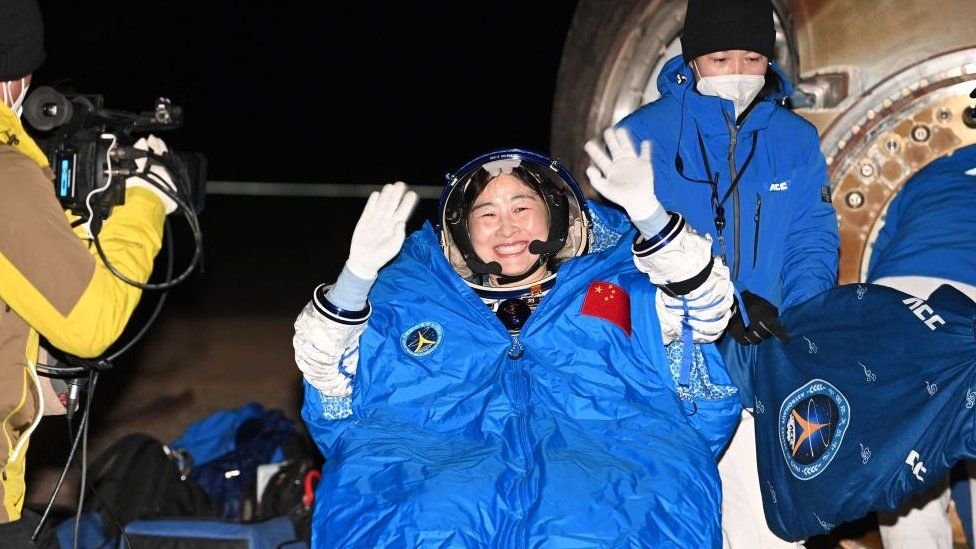
IMAGE SOURCE,GETTY IMAGES Image caption, Liu Yang, who took part in the mission, is China’s first female astronaut A new crew of three Chinese astronauts arrived at the space station to make its first in-orbit crew handover on Wednesday.
The new crew lifted off in the Shenzhou-15 spacecraft from the Jiuquan Satellite Launch Centre in the Gobi Desert in north-west China.
They will live on the station for six months. It will be the second permanently inhabited space outpost, after the Nasa-led International Space Station from which China was excluded in 2011.
It is the last of 11 missions required to assemble the station that is expected to operate for around a decade and run experiments in near-zero gravity.
The new crew will focus on installing equipment and facilities around the space station, a spokesperson for the China Manned Space Administration said.China is only the third country in history to have put both astronauts into space and to build a space station, after the Soviet Union and the US.
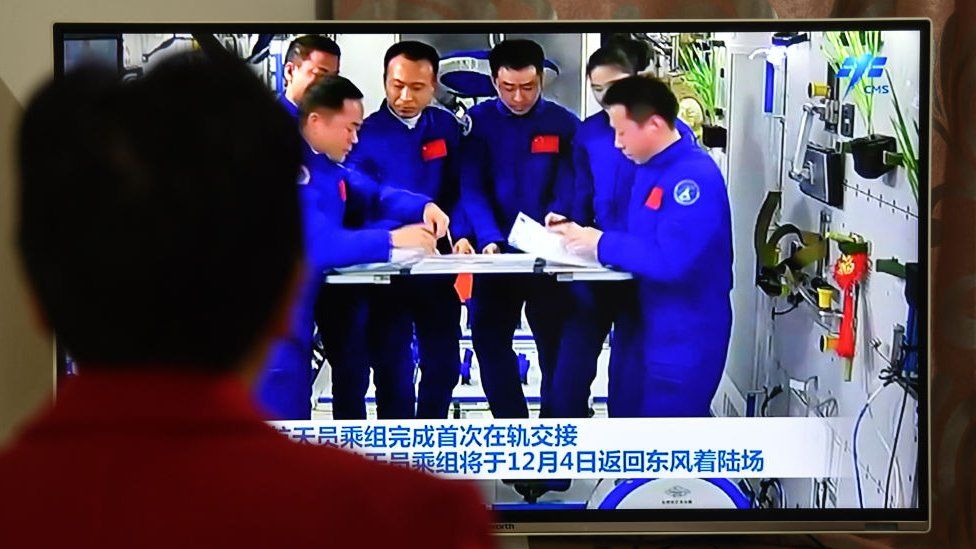
IMAGE SOURCE,GETTY IMAGES Image caption, Chinese astronauts completed the first in-orbit handover at the Tiangong space station Tiangong space station, or “Heavenly Palace”, is China’s new permanent space station. The country has previously launched two temporary trial space stations, named as Tiangong-1 and Tiangong-2.
Over the next decade of the Tiangong’s operation, it is expected China will launch two crewed missions to the station each year.
China has opened the selection process for astronauts for future missions to applicants from the “special administrative regions” of Macau and Hong Kong, who have previously been excluded.
China put its first satellite into orbit in 1970 – as it went through massive disruptions caused by the Cultural Revolution.
In the past 10 years, China has launched more than 200 rockets.
It has already sent an unmanned mission to the Moon, called Chang’e 5, to collect and return rock samples. It planted a Chinese flag on the lunar surface – which was deliberately bigger than previous US flags.