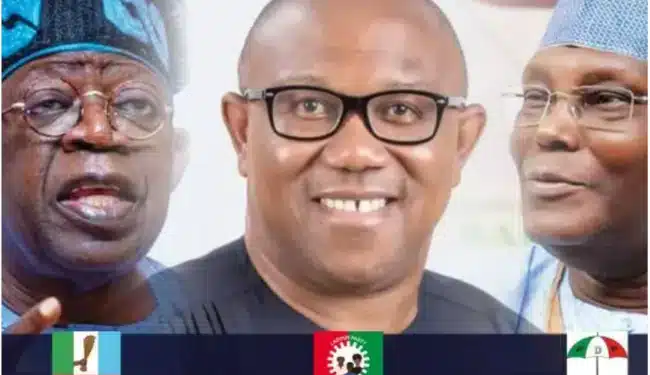
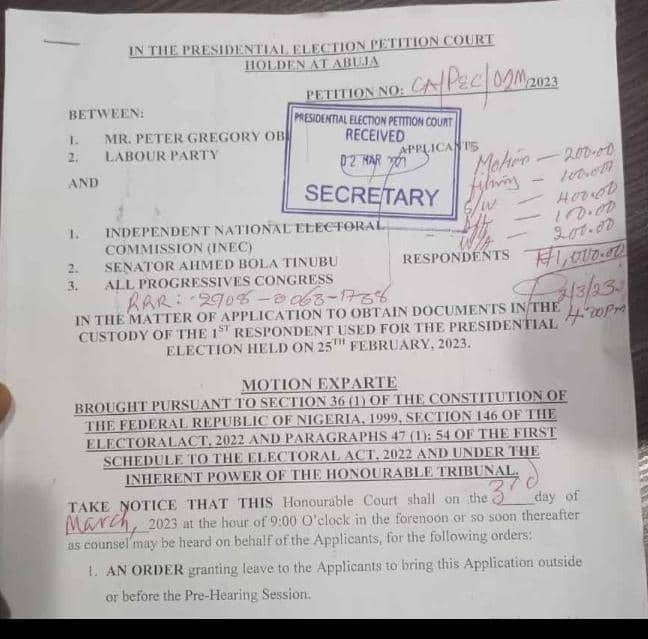
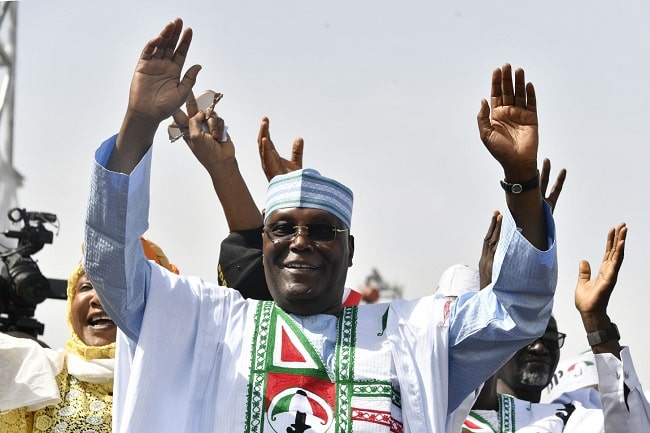
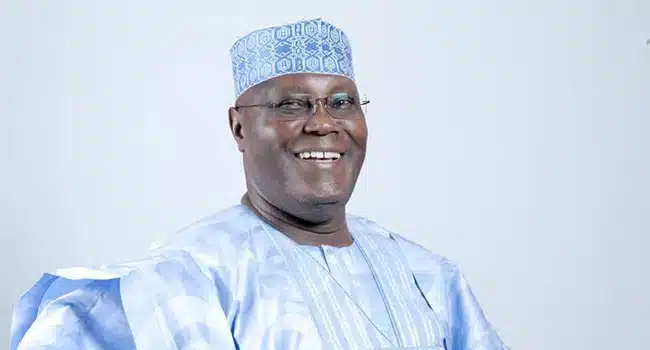
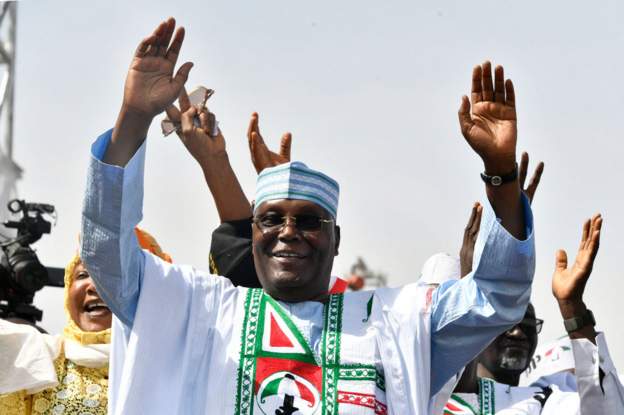
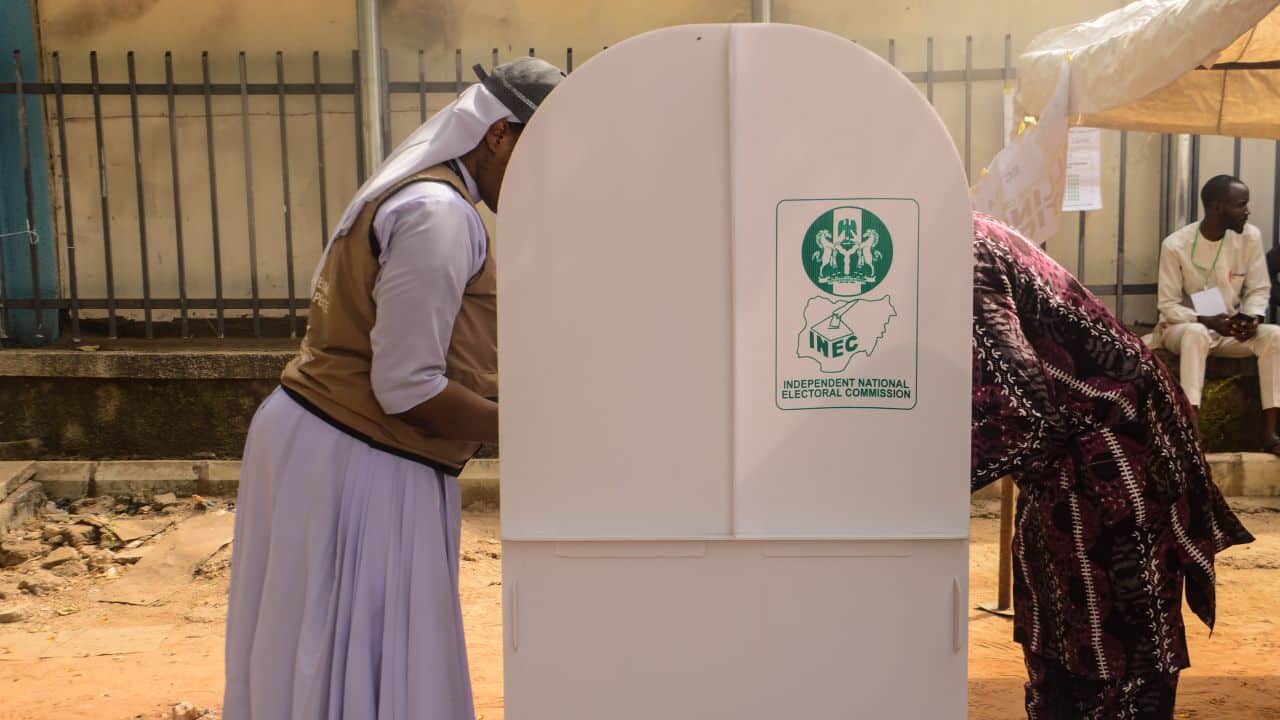
Atiku Abubakar of the Peoples Democratic Party (PDP) and Peter Obi of the Labour Party (LP) have applied to the Presidential Election Court (PEC), Abuja, for a ruling allowing them to inspect materials used for the election on February 25, but there seems to be no end in sight to the legal disputes surrounding it.
Their request is contained in two ex-parte motions they both filed at the PEC secretariat at the Court of Appeal, Abuja earlier this week.
Atiku’s motion was filed on Wednesday, March 1, while Obi’s filed his on Thursday.
Meanwhile, six states of the federation; Adamawa, Akwa-Ibom, Bayelsa, Delta, Edo and Sokoto have also dragged the federal government before the Supreme Court over the conduct, collation and announcement of the February 25, 2023, presidential and National Assembly elections.
The States want the apex court to declare that the pronouncement of the candidate of the All Progressives Congress, Bola Ahmed Tinubu, as the winner of the presidential election and president-elect based on that election be voided by the court.
There have been mixed reactions following the declaration of Bola Tinubu of the APC as the winner of the February 25 presidential poll. Some analysts believe the process that led to the Tinubu’s emergence as president-elect was marred by irregularities amidst other forms of electoral rigging.
Peter has a bright future if he and his Party go back to the drawing board and heal the fractures in the party and put correct processes in place because he was able to poll 6,101,533 against the President-8,794,726. elect’s
30% of the more than 80 million eligible voters actually cast ballots, which is the lowest turnout since 1999.
For being able to advance in a hot state like Lagos and even defeat Tinubu, who served as governor of Lagos State from 1999 to 2007, Peter must be applauded from the rear.
The benefits of this is that, you get people(House and Senate Candidates and his Team) on grounds to campaign for you in your absence. These same people will help resolve issues so that party faithful will be happy in campaigning.
Secondly, these are the people (Candidates for House and Senate) you will be working with should you win the election, so it will be good to get more of your people in the House and in the Senate to help you succeed.
The Labour Party failed here because out of 109 seats in the Senate, Peter Obi’s Labour Party had only 80 candidates contesting which gives a deficit of 29 seats here.
Again, out of 360 in the House of Representatives, his party had only 208 candidates contesting. Again a deficit of 152 seats which is unacceptable.
So even if Peter Obi had won the Presidential election, he would not have had the numbers from both the Senate and the House of Representatives to run his Government.
The bottom line is Peter wasn’t well cooked to win.
To add to these analysis, there were pockets of misunderstanding among the Labour Party in the North and the National Executives including the Presidenial Candidate, Mr Obi.
The chairmen in the North felt marginalised in everything the Party does to the extent of claiming that they never received any funds when the Party is disbursing funds to Executives and alleged that disbursement was done based on tribe.
This was said barely 48 hours to voting during a press conference led by Sani Abdulsalam, the Gombe state Labour Party chairman and co-ordinating chairman for the 36 states.
“As of tonight, no alert has been received by any state chairmen and information reaching us confirmed that money was paid based on ethnic and religious consideration because only persons of a particular ethnic group currently run the campaign of Mr. Peter Obi in cohort with the national chairman, Mr. Julius Abure, has polluted the party.”
Accompanied by Mohammed Alkali, the national vice chairman, northeast, Ibrahim Bukar, the Yobe state chairman, amongst others, the leader of LP states chairmen alleged that money meant for the mobilisation of polling agents was withheld by the national chairman, Julius Abure.
“I speak on behalf of 36 state chairmen of our party in my capacity as the coordinating chairman. We have never been respected by the party leadership and also our presidential candidate has no respect for our party executives at state levels because Peter Obi deliberately mismanaged our good will with the imposition of his members and other support groups that decamped with him in May 2022 to our party”.
“To our surprise, the national chairman Julius Abure said the presidential candidate Peter Obi has no confidence in all the 36 state chapters’ leadership but would rather choose to work with their cronies and support group that came with him”.
As members of the Labour Party National Executive and National Working Committee (NWC), it is our considered opinion and informed conclusion that Peter Obi cannot win this election since all party executives have been sidelined. He is not ready and is grossly ill-prepared for the Presidential race.”
Why should it be so when you have a running mate who is from the North? This running mate was supposed to pull his region along no matter what the grievancesaid are. He should be a unifier and not just to occupy space.
This clearly means Mr. Yusuf Datti Baba-Ahmed failed his Boss Peter and his Party in this regard.
PeterObi
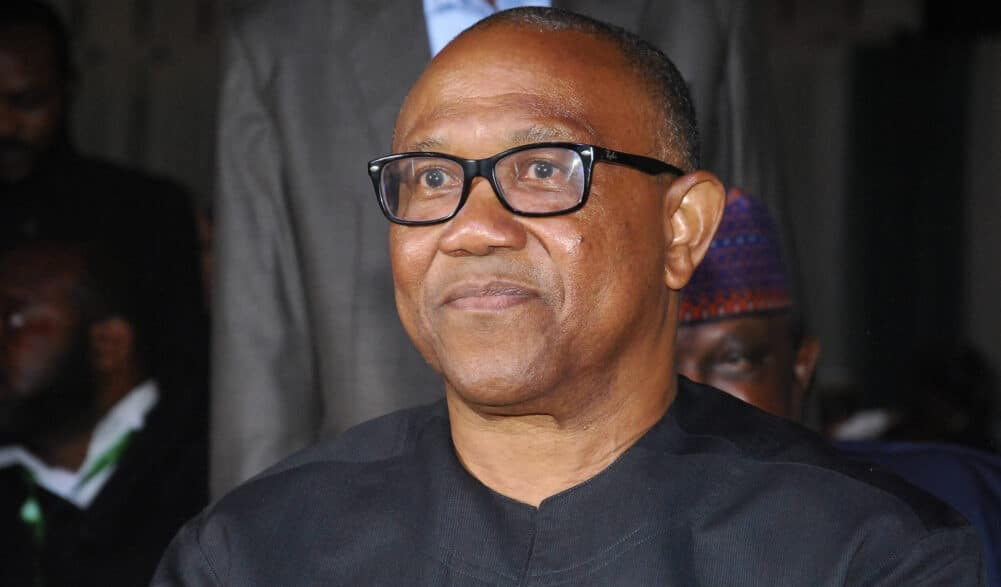
Peter Obi, a business man, a Banker and a politician. He was the governor of the Anambera State and became the running mate to Atiku Abubakar in the 2019 election but broke away. He is now the leader of Labour Party. He seems to have galvanized enough support from the youth and alot of entertainers. He has always maintained that it’s time for Nigerians to take their Country back. The youth believed he is the one to break the APC and PDP jinx and bring in new style of governance which will be people centered. Many people say he is a Nollywood president and will remain so.
We believe that, Mr Peter Obi stands a better chance in the next Election if he puts his house in order.
DISCLAIMER: Independentghana.com will not be liable for any inaccuracies contained in this article. The views expressed in the article are solely those of the author’s, and do not reflect those of The Independent Ghana
Nigerians are awaiting the final results to find out who will succeed President Muhammadu Buhari, as well as the results for the numerous candidates elected to the national parliament and the senate.
Results from the various states in the nation are still coming in slowly after more than 48 hours.
The Independent National Electoral Commission (INEC) of Nigeria has characterized the election as largely peaceful, despite isolated incidents of violence and interference at some polling places.
The Commission has been providing updates about the electoral process in between time during which they also announce voting results from the states where results have been collated.
The provisional figures indicated in no way determine the final results as the figures from the other states could change the ‘game’ at any point.
Regardless, these are the figures currently as indicative of provisional results.
1. Bola Ahmed Tinubu of the All Progressives Congress (APC) currently has 3,329,968 votes representing 42.98%
2. Atiku Abubakar of the Peoples Democratic Party (PDP) currently has 2,292,433 representing 29.59%
3. Peter Obi of the Labour Party (LP) has some 1,480,948 votes, representing 19.11%
4. Rabiu Musa Kwankwaso of the New Nigeria Peoples Party (NNP) got 573,372 representing 7.40%
The other candidates – Peter Umeadi of APGA, Adebayo Adewole of SDP, Omoyele Sowore of AAC, Dumebi Kachikwu of ADC, Christopher Imumolen of AP, Hamza Al-Mustapha of AA, Yusuf Sani Yabagi of ADP, Ojei Chichi of APM, Adenuga Sunday Oluwafemi of BP, Okwudili Nwa-Anyajike of NRM, Abiola Latifu Kolawole of PRP, Ado-Ibrahim Abdulmalik of YPP, Daniel Nwanyanwu of ZLP, and Charles Nnadi Osita of APP all currently have votes beneath 1%.
Breakdown:
Bola Ahmed Tinubu of the All Progressives Congress (APC) won states like Benue, Jigawa, Katsina, Kwara, Lagos, Niger, Ogun, Oyo, Rivers, Sokoto, Yobe and Ekiti Atiku Abuabkar of of the Peoples Democratic Party (PDP) won states including – Ondo, Federal Capital Territory, Taraba, Osun, Kaduna, Bayelsa, Bauchi, Akwa Ibom, and Adamawa
Peter Obi of the Labour Party (LP) won states including Abia, Delta, Ebony, Edo, Enugu, Gombe, Imo, and Plateau
Rabiu Musa Kwankwaso of the New Nigeria Peoples Party (NNP) won the Kano state.
The Peoples Democratic Party’s (PDP) presidential candidate, Atiku Abubakar, won the Gombe State presidential vote on February 25.
In the 11 local government areas (LGAs) of the state, he received 319,123 votes, according to the results released by the Independent National Electoral Commission (INEC).
According to the Gombe State Collation Officer, Prof Maimuna Waziri, who announced the results around 1 a.m. on Monday, the PDP candidate received the most votes in the North-East state.
The former vice president defeated his closest competitors, Peter Obi of the Labour Party (LP), Bola Tinubu of the All Progressives Congress (APC), and Rabiu Kwankwaso of the New Nigeria Peoples Party (NNPP), by a margin of more than 160,000 votes.
When the results from 12 of the state’s 21 local government areas were totaled, the APC received 99,898 votes, PDP 213,117, NNPP 3,609, and LP 56,857.
Atiku Abubakar, the Peoples Democratic Party’s (PDP) nominee for president, is in the lead in his native Adamawa after winning all 12 local government areas (LGAs) that have been declared so far by the Independent National Electoral Commission (INEC).
The former vice president is currently ahead of his closest competitors, Peter Obi of the Labour Party (LP), Bola Tinubu of the All Progressives Congress (APC), and Rabiu Kwankwaso of the New Nigeria Peoples Party (NNPP), by more than 110,000 votes as of 8 o’clock on Monday
The collation of results in the state has since been postponed to Monday, by 10:00 in the morning.
The State collation officer, Professor Mohammed Mele announced the decision for the postponement after over one hour of waiting for the results of the remaining nine local government areas to arrive.
Mele at exactly 1:18 in the morning announced the decision to close the collation centre until 10:00 am.
So far, results from Lamurde, Guyuk, Gerei, Song, Numan, Fufore, Demsa, Yola South, Mayo-Belwa, Ganye and Shelleng local government areas have been collated.
Those remaining are Yola North (state capital), Jada, Gombi, Hong, Madagali, Maiha, Michika, Mubi North and Mubi South local government areas.
See results:
2023 PRESIDENTIAL ELECTION RESULTS FROM ELEVEN (12) LOCAL GOVERNMENT AREAS OF ADAMAWA STATE
01. LAMURDE LGA
TOTAL REGISTERED VOTERS – 76,097 ACCREDITED VOTERS – 25,105
Atiku Abubakar, the opposition Peoples Democratic Party (PDP) candidate, claims that early results indicate he will likely win Nigeria’s presidential election.
The party said on Twitter that Mr Abubakar was “securing the highest number of valid votes cast as well as the statutory 25% in at least two thirds of the states”.
This is true despite the fact that only one of Nigeria’s 36 states had official results declared by the Independent National Electoral Commission (Inec).
Bola Tinubu, the candidate for the ruling All Progressives Congress (APC) party, received 201,494 votes from the state’s southwest.
Peter Obi of the Labour Party received 11,397 votes, compared to Mr. Abubakar’s 89,554 votes.
Mahmood Yakubu, the chairman of Inec, stated that the commission would make part of the findings from the other states public on Monday at 10:00 GMT.
On Sunday, Inec announced that it was attempting to resolve issues with its portal for viewing election results.
Final presidential results are expected to be declared by 1 March. The vote on Saturday was marred by pockets of violence, widespread delays and logistical problems.
The Economic Community of West African States’ (Ecowas) election observer mission described the election as generally peaceful and with a massive voter turnout.
How are elections held with almost 93 million voters? It turns out with a lot of trouble, headaches, delays, and technological problems.
In Africa’s largest democratic exercise, some Nigerians continued to cast ballots more than 24 hours after polls closed.
Nigeria has 176,606 polling locations, and voting took place without incident in the majority of them.
However, it was overshadowed by numerous reports of errors, difficulties with the technology, as well as assaults and voter intimidation at certain polling places.
A CNN team in Lagos saw voters still trying to find a way to cast their ballot Sunday at a school in Lagos where two polling units didn’t get to vote in Saturday’s elections.
In the capital Abuja, voting continued until late on Saturday, as voters used car headlights to help themselves see.
When a CNN team visited some polling units, dozens of voters were still waiting to cast their ballot. In parts of Lagos, voting went on well into midnight.
The election is one of the most hotly contested contests since the end of military dictatorship in 1999, and the two-party system that has dominated Nigerian politics since then is facing an unprecedented threat.
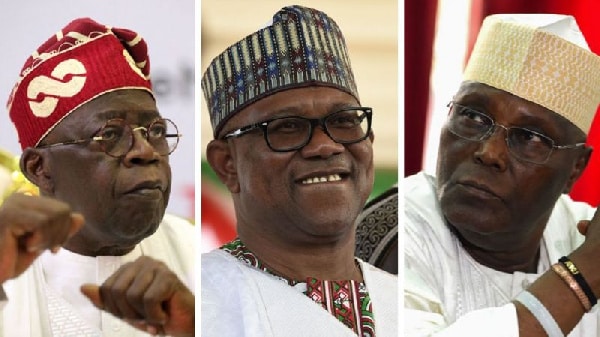
The frontrunners are Bola Ahmed Tinubu of the ruling APC party, Atiku Abubakar from the PDP and Peter Obi from the lesser-known Labour Party.
Obi, 61, has gained in popularity and is seen as the third force candidate that could emerge as leader.
Many of his supporters, mostly first time voters, who registered in huge numbers to vote, complained of attempts to suppress their vote.
At one polling unit in Lekki, Lagos, several people were attacked.
Dr. Chidi Nwagwu told CNN: “I arrived at around 10am. Polling materials were late and we set up to start voting. Some thugs arrived and started hitting people with chairs. I was hit several times with a chair. There was a doctor who helped us. A lot of women were attacked, including a pregnant woman. She was knocked to the ground and they smashed her phone.”
Alicia Gberikon said: “There was harassment and if you had a phone that was a crime. People were beaten and had their phones smashed. It was very scary.”
Yiaga Africa, a non-profit civic group that deployed 3,836 observers across the country said it was disappointed with the elections. “There’s a sense of disappointment, quite frankly, with the way this process has gone. Clearly, we’ve not overcome and resolved, perennially our logistical challenges with elections,” Samson Itodo, Yiaga’s Executive Director told CNN.
This was supposed to be the year that the electoral commission would provide real-time results via its new portal, iReV.
Yiaga said it was concerned that as of Saturday 10pm local time, when results were known from thousands of polling units, they had not been uploaded to the electoral commission’s voting portal.
“It raises a lot of questions about the entire process because it deviates from the guidelines for the elections. But it also casts doubt on the integrity of this entire process,” Itodo said.
“To make matters worse, the commission is not speaking or has not spoken to Nigerians.”
The chairman of the electoral commission (INEC) Chairman Mahmood Yakubu briefly addressed the country at a media briefing on Sunday where he explained the collation process but did not address the issues around results transmission.
Yakubu reported there were pockets of violence across the country and electoral machines known as Bimodal Voter Accreditation system (BVAS) were lost in some of those disruptions.
Atiku Abubakar, thePeoples Democratic Party’s (PDP) presidential candidate, and his wife Titi have cast their ballots at Polling Unit 012, Ajiya Ward in Adamawa State’s Yola North Local Government Area.
Speaking to reporters, the former vice president expressed optimism and confidence that he would win the election for president and succeed President Muhammadu Buhari, whose two terms expire on May 29, 2023.
One of the front-runners in the race for Aso Rock is the PDP flagbearer. Bola Tinubu of the All Progressives Congress (APC), Peter Obi of the Labour Party (LP), and Rabiu Kwankwaso of the New Nigeria People’s Party (NNPP) are among Atiku’s top rivals.
Atiku was also the PDP candidate in 2019, and he came in second with over 11 million votes, right behind Buhari, who polled over 15 million votes.
Nationwide, officials of the country’s electoral agency, the Independent National Electoral Commission (INEC) have arrived at some of the 176,606 polling units scattered across the 36 states and the Federal Capital Territory that make up Nigeria.
Accreditation and voting commenced around 8:30 a.m. in some polling units in parts of Nigeria as the 87.2 million voters with Permanent Voter Cards go to the polls to elect a new president and members of the country’s National Assembly.
Presidential candidate of the Peoples Democratic Party (PDP), Atiku Abubakar, has cast his ballot in Jimeta, Adamawa State, at polling place Ajiya 02, Gwadabawa ward.
It was quiet impossible for him to cast a secret ballot due to the crowd who were more of the media persons eager to interogate him.
The noise in the area was also unbearable to hear him speak.
Thus, he was unable to talk to anyone and that’s how Mr. Atiku left the polling station in Adamawa state.
In a vital presidential election, Nigerians will cast their ballots to choose the nation’s new leader. In addition to electing members of the nation’s parliament, the contentious election is taking place concurrently.
According to the electoral agency INEC, 93 million Nigerians are registered to vote, but only 87 million have a permanent voter card (PVC), which is a necessary prerequisite for voting.
The polls will be open beginning at 8:30 a.m. local time and closing at 2:30 p.m. (or 2:30 a.m. ET Saturday to 8:30 a.m. ET). Yet according to INEC, those who were in line to cast their ballots by the polls closed still have the opportunity to do so.
Ballots will be counted at polling places at the close of voting and transmitted electronically in real-time to INEC’s Result Viewing portal (IReV), a first of its kind in Nigeria, the commission tells CNN.
“With the electronic transmission system (IREV), people will already know the winners before the official announcement is made,” adds Rotimi Oyekanmi, a spokesman for INEC’s chairperson.
To win, a candidate must garner a sufficient number of ballots to meet the 25% vote spread in 24 of Nigeria’s 36 states. In the absence of this, a second round run-off between the top two candidates will be held within 21 days.
Eighteen candidates are on the ballot for Nigeria’s top, but three are leading the race for the popular vote, according to pre-election surveys.
One of the key contenders is Bola Ahmed Tinubu, the candidate of term-limited President Muhammadu Buhari’s party, the All Progressives Congress (APC). Another is the main opposition leader and former vice president Atiku Abubakar, of the People’s Democratic Party (PDP). And third strong contender, Peter Obi, is running under the lesser known Labour Party, and altered early predictions of the presidential vote, which has typically been two-horse races between the ruling and opposition parties.
Seventy-year-old Tinubu, 70, is a former governor of Nigeria’s wealthy Lagos State, who wields significant influence in the southwestern region where he is acclaimed as a political godfather and kingmaker.
He boasts of aiding the election of Buhari to the presidency and declares it is now his turn to lead the country.
Here’s what to know about Nigeria’s presidential election
Candidate of the opposition party PDP Abubakar, 76, is a former Nigerian vice president and a staunch capitalist who made his fortune investing in various sectors in the country.
Abubakar’s presidential bid (his sixth attempt) had fueled concern that it might usurp an unofficial arrangement to rotate the presidency between Nigeria’s northern and southern regions, since he is from the same northern region as the outgoing leader, Buhari.
Labor Party’s Obi is a two-time former governor of southeastern Anambra State and has been touted as a credible alternative to the two major candidates by his hordes of supporters, mostly young Nigerians who call themselves ‘Obidients.’
Obi is also the only Christian among the leading candidates. His southeastern region has yet to produce a president or vice president since Nigeria returned to civil rule in 1999.
The ruling party’s Tinubu, from the religiously mixed southwestern part of the country, is a Muslim and also chose a Muslim running mate, despite the country’s unofficial tradition of mixed-faith presidential tickets.
All top three candidates are confident they can turn Nigeria’s fortunes around if voted into power, as the country battles myriad economic and security problems that range from fuel and cash shortages to rising terror attacks, high inflation, and a plummeting local currency.
Nigeria’s security forces have mobilized personnel to ensure hitch-free electioneering across the country.
The run-up to the polls has been fraught with violence that stemmed from protests against unpopular government policies and lethal attacks by armed criminal gangs.
On Wednesday, a senatorial candidate for the Labour Party, was shot and burned in his campaign vehicle in the country’s southeastern Enugu State, police said.
Before the killing, violent protests had erupted across Nigerian states as citizens railed against the scarcity of gasoline in petrol outlets and a shortage of cash that followed a controversial currency redesign.
Electoral body INEC hasn’t been spared from the chaos; its facilities have been torched in parts of the country.
Voting was canceled at more than 200 planned polling units across Nigeria and voters redirected to other poll locations, INEC said, due to security concerns.
Ahead of the elections, national police ordered a restriction of non-essential vehicular and waterway movements from midnight on election day until 6 p.m., while the country’s immigration service has ordered the closure of Nigeria’s land borders from midnight Saturday until midnight Sunday.
Weeks before polling day, the service had confiscated over 6000 voter cards from illegal migrants, whom it said had other national documents in their possession.
INEC spokesperson Oyekanmi nevertheless insists the poll results will be free and fair.
“The experience Nigerians will have for the 2023 elections will be far better than previous elections and the integrity (of the polls) will be clear for everyone to see,”Oyekanmi told CNN days before the election.
Final results are expected to be announced a few days after polling.
The Peoples Democratic Party’s (PDP) nominee for president, Atiku Abubakar, has stated that Nigerians should not trust their future to his primary opponents Peter Obi and Bola Tinubu in the 2023 presidential election.
Speaking at the Nigeria Economic Summit Group (NESG) Presidential Dialogue on the Economy in Lagos on Monday, Atiku said he had a good understanding of the challenges bedeviling Nigeria.
Atiku described Peter Obi, the candidate of the Labour Party, as a greenhorn and alleged that the APC-led government where Bola Tinubu is presidential candidate brought Nigerians to “this sorry situation,” Daily Trust reports.
He said, “Experience is important and we must avoid the mistakes of the recent past. It is too risky for Nigerians to hand over their future to a green horn or to the National Leader of the very party that brought us to this sorry situation.
“This is election season. So, you will see and hear from snake-oil salespeople, false prophets and purveyors of false hope and misleading statistics. There is, therefore, need for caution.
“We must also remember that we cannot trust the doctor that poisoned and continues to poison the patient to be the one who provides the curative treatment. The stakes are too high, so we must get it right. This may well be our last chance to do so.
“The Nigerian economy is barely growing. Per capita income, a measure of citizens’ well-being, has progressively fallen since 2015 because of declining output and a fast-growing population. Our people are worse-off today than they were in 2015.
“The oil and gas sector, which is the country’s main foreign exchange earner has declined for most of the period since 2014. For many economic sectors and for the ordinary citizens it still feels like we are in a recession.
“Under the current administration our people are not working. More than 23 million people are out of jobs. In just 5 years between 2015 and 2020, the number of fully employed people dropped by 54%, from 68 million to 31 million people. This is frightening in a country of 200 million people.
“And the majority of the unemployed are young men and women, who lack not only the means to survive but any hope for the future. The number of unemployed youths increased by 9 million from 4 million in 2015 to 13 million in 2020.
“High youth unemployment and limited employment opportunities pose serious economic and security challenges. It is, therefore, an urgent matter to ensure that there are enough jobs for Nigeria’s youth. More Nigerians are poorer and more miserable today than in 2015.”
Gunshotswere heard during the visit of Nigeria’s presidential candidate, Atiku Abubakar, to Borno State in the northeast of the country where an Islamist insurgency has uprooted millions.
The region also faces extreme food shortages as farmers were also forced to abandon their fields.
During the rally in the state capital, Maiduguri, the former vice-president and presidential candidate promised to restore peace to the region and the rest of the country.
“If PDP is elected we shall restore peace in Borno State, not only Borno State but throughout the country. We will reactivate Chad Basin development authority so that our farmers can go back to the farm, so that we can produce food for our own people and so that we can reduce unemployment we promise you that”, said the PDP presidential candidate, Atiku Abubakar.
Nigerians will go to the polls on the 25th of February 2023 to pick a new president and vice president.