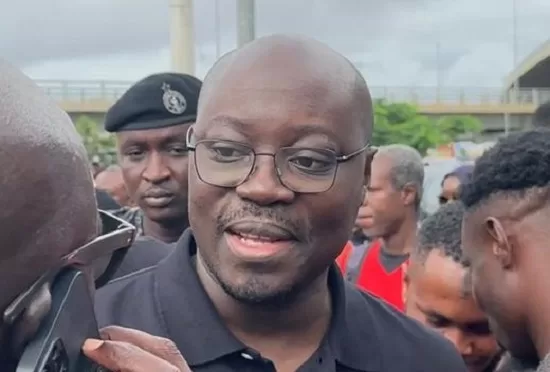
Tag: Ato Forson

  • Government to absorb COCOBOD’s $150m losses

    Government to absorb COCOBOD’s $150m losses

    The government has announced plans to absorb the outstanding $150 million financial loss incurred by the Ghana Cocoa Board (COCOBOD).

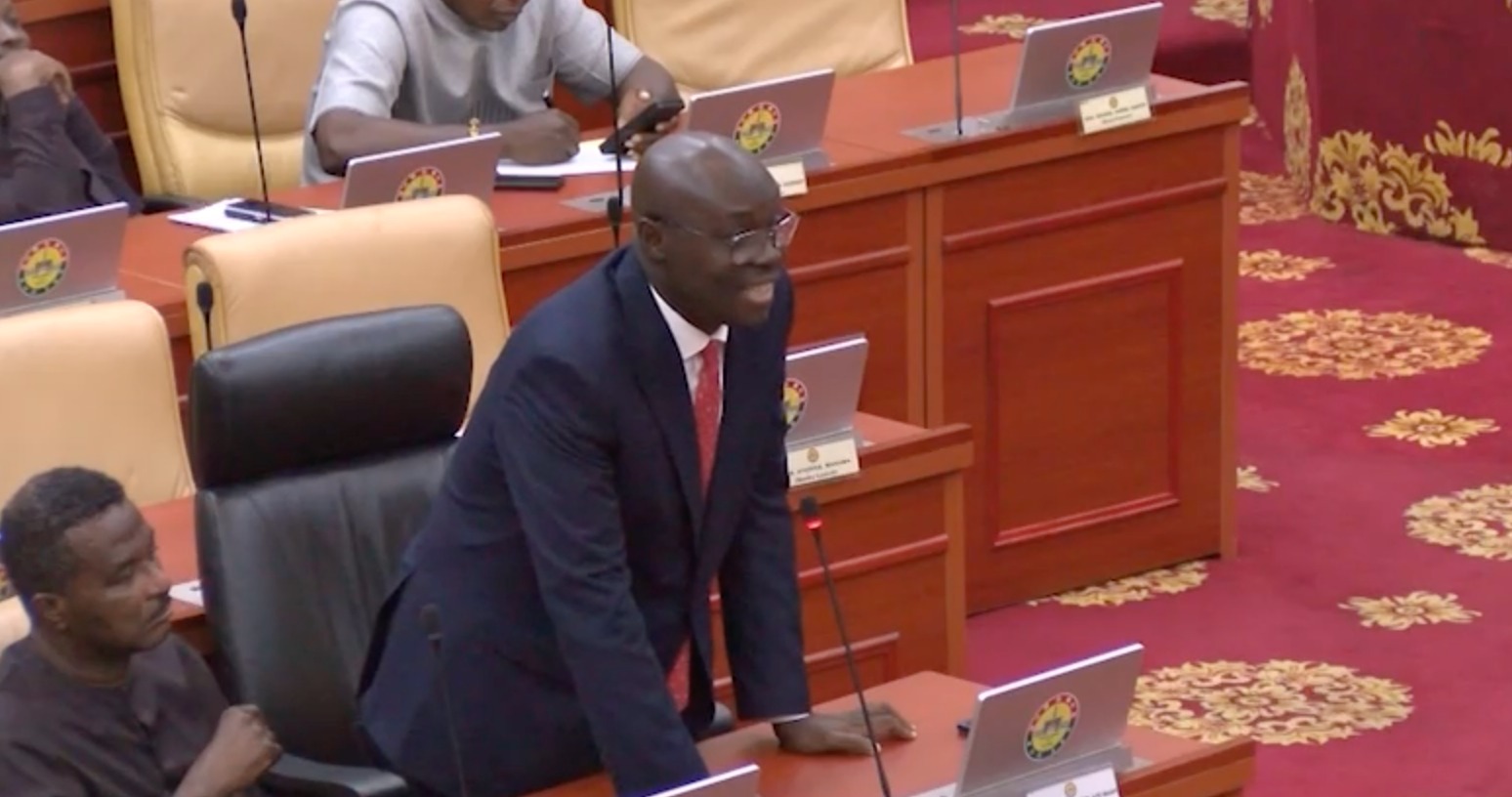
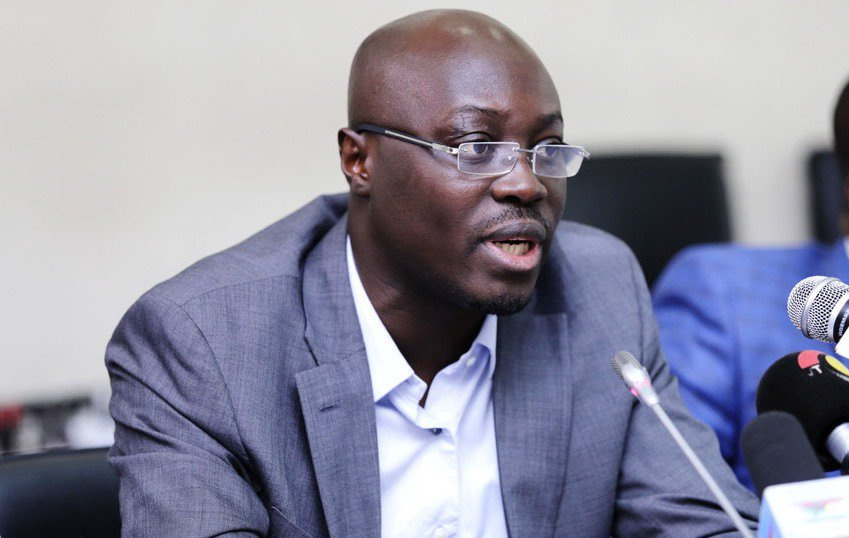
    Addressing the media on Thursday, the Minister for Finance, Dr. Ato Forson, disclosed that the decision was reached after consultations with Cabinet.

    He emphasised that all cocoa farmers who are yet to be paid would receive their outstanding payments in the coming days following the government’s intervention.

    “Cabinet has directed COCOBOD to commence immediate payment of all affected cocoa farmers,” he said.

    As part of reforms to revive the worsening crises at COCOBOD a new producer price for cocoa has been announced by government with the aim of stabilising the sector and supporting farmers.

    The decision according to the Finance Minister was influenced by prevailing circumstances within the international cocoa trade.

    “As a result of that, the PPRC thereby announces that effective today, Thursday 12th February 2026, the new producer price for the remainder of the 2025–2026 crop season will now be 41,392 Ghana Cedis per ton and 2,587 Ghana Cedis per bag,” he said.

    The new price approved by the Producer Price Review Committee (PPRC) will take effect immediately, with the revised price translating to GH¢2,587 per bag.

    The Finance Minister revealed that the Cabinet has approved comprehensive reforms to guarantee fair prices to cocoa farmers, secure the financial viability of the cocoa sector, and ensure the long-term sustainability of the industry.

    “To bring relief to unpaid cocoa farmers, Cabinet has accordingly directed the Ghana Cocoa Board to commence immediate payment of all affected cocoa farmers,” he added.

    The Ghana Cocoa Board (COCOBOD) is dealing with about 50,000 metric tonnes of cocoa that remain unsold at the ports, while Licensed Buying Companies (LBCs) are owed roughly GH¢2.04 billion ($185 million) by the regulator.

    Several farmers have gone without payment since November 2025, compelling many to cut down on meals, pull their children out of school, and neglect routine farm upkeep. The situation has further escalated, with reports indicating that some farmers have held purchasing clerks over unpaid cocoa transactions.

    The delays in payment have been attributed to several issues, including the loss of international financial support, a disparity between Ghana’s farmgate pricing and the sharp drop in global cocoa prices, as well as inherited forward sales agreements signed when prices were significantly lower.

    Under the planned reforms, the government intends to submit a new Cocoa Board bill to Parliament aimed at introducing an automatic system for adjusting producer prices.

    The draft legislation seeks to synchronise cocoa producer prices with global market price trends, currency exchange fluctuations, and other essential indicators.

    Importantly, the proposed bill will ensure that cocoa farmers receive no less than 70% of the gross FOB (Free on Board) price.

    “Cabinet has therefore decided on the following reforms to guarantee a fair price to the cocoa farmer, secure the financial viability of the cocoa sector, and ensure the long-term sustainability of the cocoa industry,” Dr Ato Forson stated.

    In May 2025, COCOBOD CEO Dr. Randy Abbey expressed deep concern over the limited results achieved from a major cocoa rehabilitation initiative, despite the significant financial investment it received.

    He revealed that although $263 million was borrowed to restore 156,000 hectares of cocoa farms damaged by disease, only 40,000 hectares had been rehabilitated when he took over leadership.

    “If we had successfully done this 156,000 hectares, it would have contributed up to 200,000 tonnes to our production; we took all this money, and all we have to show is just 40,000 hectares completed,” he said, speaking to farmers in Nkawie in the Ashanti Region.

    The rehabilitation program was introduced after nearly 40 percent of cocoa farms were found to be infected, prompting urgent intervention by COCOBOD’s previous administration—a move Dr. Abbey said was well-intentioned.

    However, he added that the project later received an additional GHS700 million, and he questioned how the funds were applied, given the modest progress achieved. He disclosed that the matter is now under scrutiny by the relevant investigative institutions.

    “There are agencies responsible for the investigation of these things. I am saddened by what has happened because it was the golden opportunity to turn things around in the sector,” he noted.

    To reverse the trend and bolster production, Dr. Abbey said COCOBOD was focused on rehabilitating 21,000 hectares of abandoned cocoa farms at the time.

    He affirmed his personal commitment to seeing it through, stating, “We have left some in the bush, and that is what I am trying to go and work on them and be able to hand them over so we can add them to the productive stock of farms we have.”He also mentioned that the new management inherited road contracts worth GHS21 billion and debt of GHS4.4 billion, posing additional challenges to the sector’s recovery.

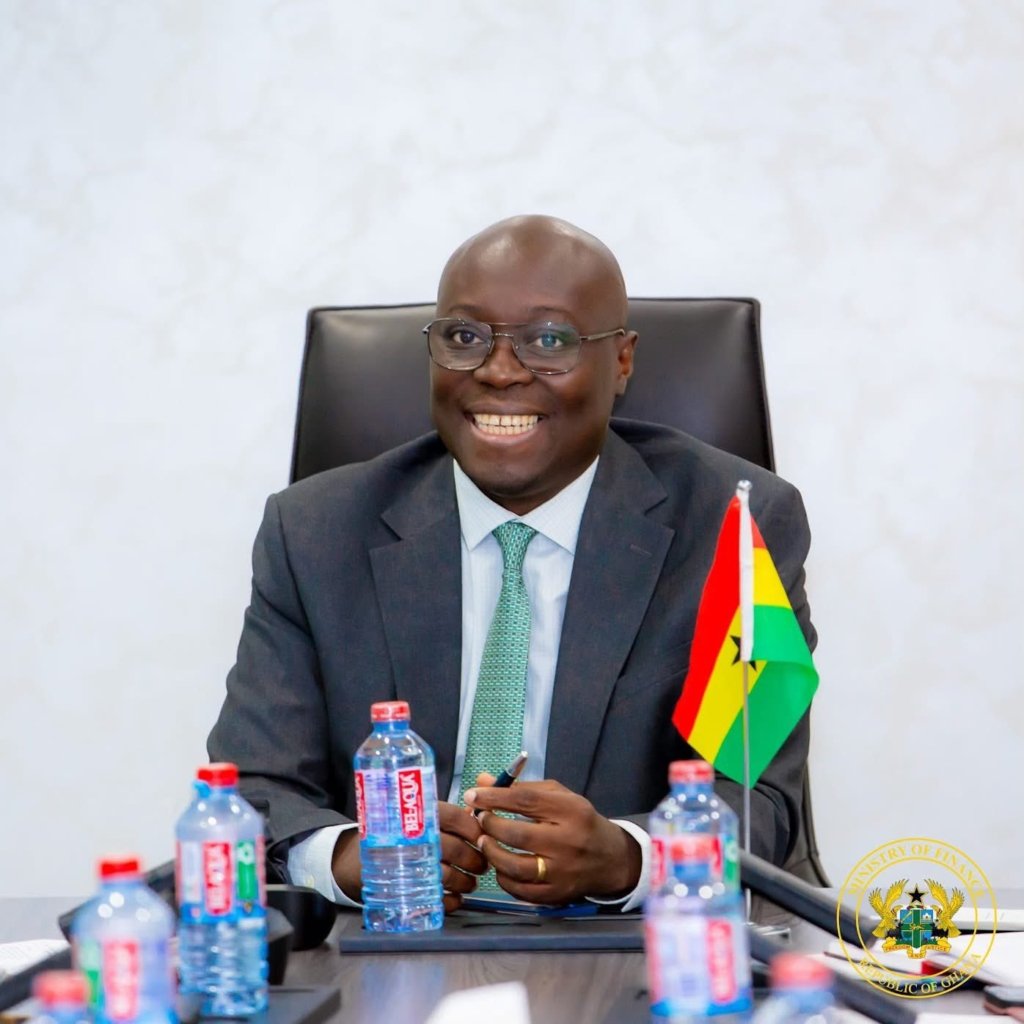
  • PLAYBACK: Ato Forson outlines cocoa sector reforms agenda

    PLAYBACK: Ato Forson outlines cocoa sector reforms agenda

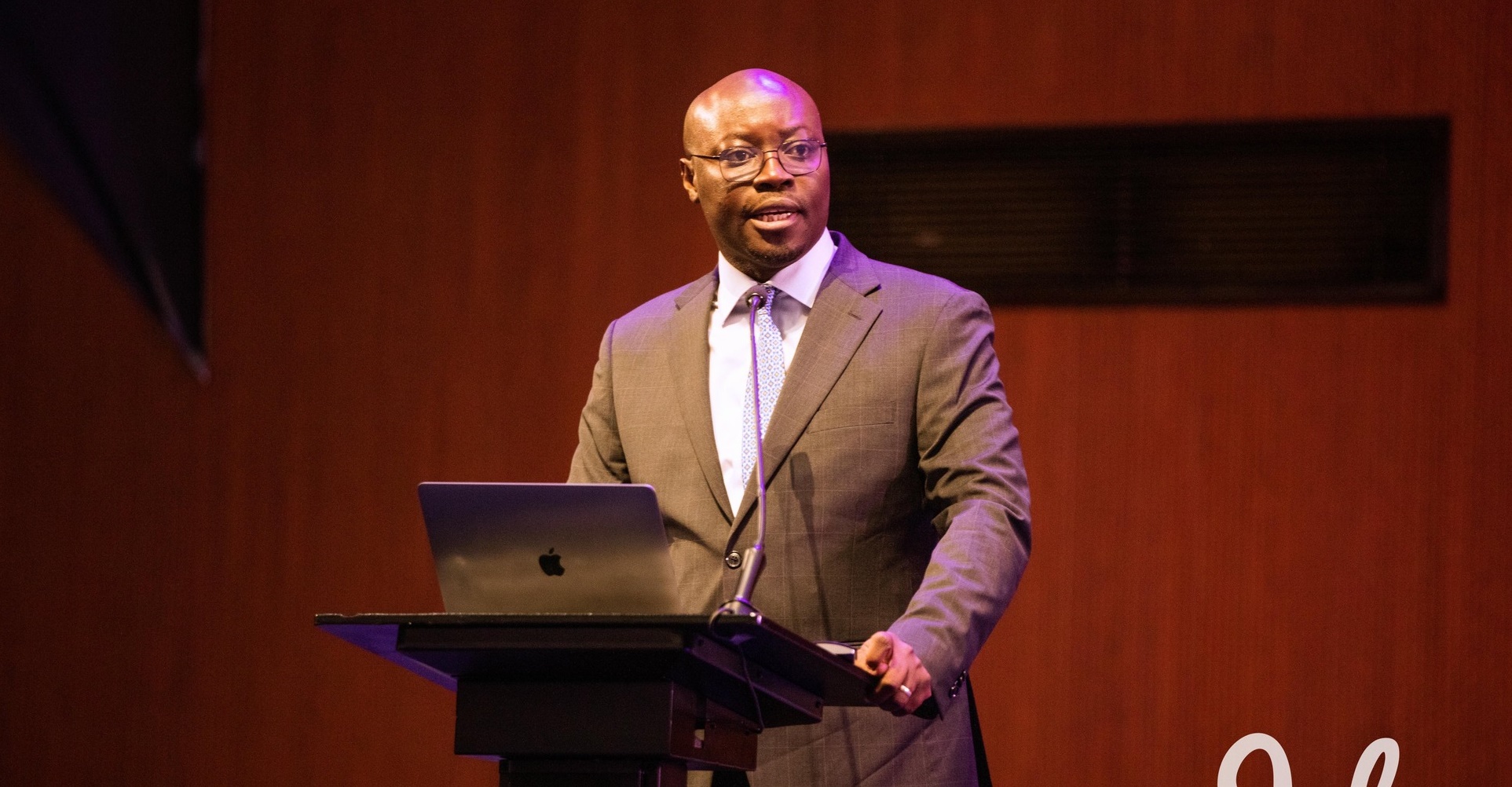
    The Minister for Finance, Dr. Ato Forson, addressed the nation today, Thursday, February 12, over the government’s reforms in saving Ghana’s cocoa sector. The Ghana Cocoa Board (COCOBOD) faces several challenges, with the Ghanaian cocoa fraternity and cocoa farmers repeatedly calling on the government to settle months of unpaid arrears.

    According to the Finance Minister, Dr. Cassiel Ato Forson, the GH¢32 billion in arrears the sector is experiencing is the result of indiscriminate contract awards by the previous administration.

    These contracts were awarded during the tenure of the New Patriotic Party (NPP) without proper checks or budget allocations to fund them. He disclosed that despite these challenges, COCOBOD’s financial pressures have not eased, as its weakened balance sheet prevents it from meeting its obligations.

    “When COCOBOD awards a contract, they have to pay the contractors, not the Finance Ministry. The previous government awarded contracts anyhow, without any sources to pay for these contracts. The COCOBOD CEO inherited GH¢32 billion worth of arrears. He cannot pay it in one year because he doesn’t have the resources. COCOBOD cannot go out and borrow because of its balance sheet, so how is it supposed to pay that?,” he added.Explore powerful AI tools designed for modern traders wertbundor login.

    Watch the livestream below:

    https://www.youtube.com/watch?v=n4ThGAoXtyE

    In May 2025, COCOBOD CEO Dr. Randy Abbey expressed deep concern over the limited results achieved from a major cocoa rehabilitation initiative, despite the significant financial investment it received.

    He revealed that although $263 million was borrowed to restore 156,000 hectares of cocoa farms damaged by disease, only 40,000 hectares had been rehabilitated when he took over leadership.

    “If we had successfully done this 156,000 hectares, it would have contributed up to 200,000 tonnes to our production; we took all this money, and all we have to show is just 40,000 hectares completed,” he said, speaking to farmers in Nkawie in the Ashanti Region.

    The rehabilitation program was introduced after nearly 40 percent of cocoa farms were found to be infected, prompting urgent intervention by COCOBOD’s previous administration—a move Dr. Abbey said was well-intentioned.

    However, he added that the project later received an additional GHS700 million, and he questioned how the funds were applied, given the modest progress achieved. He disclosed that the matter is now under scrutiny by the relevant investigative institutions.

    “There are agencies responsible for the investigation of these things. I am saddened by what has happened because it was the golden opportunity to turn things around in the sector,” he noted.

    To reverse the trend and bolster production, Dr. Abbey said COCOBOD is currently focused on rehabilitating 21,000 hectares of abandoned cocoa farms.

    He affirmed his personal commitment to seeing it through, stating, “We have left some in the bush, and that is what I am trying to go and work on them and be able to hand them over so we can add them to the productive stock of farms we have.”He also mentioned that the new management inherited road contracts worth GHS21 billion and debt of GHS4.4 billion, posing additional challenges to the sector’s recovery.
    Meanwhile, cocoa farmers will earn an extra GH₵400 per 64kg bag following a new price announced by the government for the 2025/2026 crop season.

    The new price, which is now GH₵3,625 per bag, equivalent to GH₵58,000 per tonne, represents a 12.27 per cent increase over the GH₵3,228.75 per bag price announced in August.

    This was revealed by the Minister for Finance, Cassiel Ato Forson, while speaking at an emergency meeting of the Producer Price Review Committee (PPRC) on cocoa in Accra on Thursday, October 2.

    The upward adjustment is believed to be an effort to match local prices with gains in the global cocoa market. Meanwhile, Ghana Cocoa Board (COCOBOD) has expressed its commitment to ensuring that cocoa farmers receive a meaningful and fair boost in their income, despite the hike in the dollar.

    Recently, the government disclosed its intention to reintroduce free fertilisers, aimed at supporting farmers to increase production.Finance Minister, Dr. Ato Forson, noted, “In preparation for the new season, COCOBOD has made available jute sacks and related logistics for the smooth take-off of the 2025/2026 crop Season.

    “Ladies and Gentlemen, and to the cocoa farmer, I am pleased to announce that President John Mahama’s administration has reintroduced the free cocoa fertiliser programme as an additional support to the Ghanaian cocoa farmer, beginning the 2025/2026 crop year.”

    Dr. Forson added that every single farmer will benefit from this initiative.“Beginning this crop year, President Mahama’s administration will supply free cocoa fertilisers (both liquid and granular), free insecticides, free spraying machines, free fungicides, and free flower inducers to farmers,” he added.

    Farmers were therefore cautioned against smuggling.“Government strongly advises cocoa farmers to apply these inputs solely for the purpose of improving cocoa yield and their income. Please do not smuggle them,” he said.

    Minister for Foreign Affairs, Honourable Samuel Okudzeto Ablakwa, and the Ambassador of the Kingdom of Morocco, Her Excellency Imane Ouaadil, on July 28, handed over two thousand (2,000) tons of fertilizer, equivalent to 40,000 bags of fertilizer, to the Ministry of Food and Agriculture.

    According to the Foreign Ministry, the fertilizer was donated to the West African country by the Kingdom of Morocco during the official visit of Mr Okudzeto Ablakwa to Morocco last month as part of the two countries’ commitment to sustainable agriculture to enhance food security.

    Deputy Minister for Food and Agriculture, John Setor Dumelo, received the donated fertilizers on behalf of the Minister for Food and Agriculture, Eric Opoku. He expressed gratitude to the Moroccan government for the donation. He assured that farmers will receive the fertilizers to aid crop production.

    “Yesterday, 40,000 bags of fertilizer were donated to Ghana by the Kingdom of Morocco through the Ministry of Foreign Affairs. On behalf of my boss, Hon Eric Opoku, I want to say a big thank you to Hon Ablakwa and Her Excellency Ouaadil for this kind gesture. We at the Ministry of Agriculture will ensure the fertilizers get straight to the deserving farmers as soon as possible,” he wrote in a post on the X platform on July 29.

    Stakeholders in the agricultural sector have bemoaned the absence of a single chemical fertiliser plant in the country. The Institute for Fiscal Studies noted that the absence of such a plant is having an adverse impact on crop production and the contribution of the agricultural sector to the country’s economy, i.e., the Gross Domestic Product (GDP). The sector’s contribution to the country’s GDP declined from 26.9% in 2010 to 22.7% in 2023.

    In March 2025, Senior Research Fellow at the Institute for Fiscal Studies, Dr. Said Boakye, said, “We need to establish several fertiliser manufacturing plants to ensure that adequate and affordable fertiliser is available to farmers, which will help boost agricultural productivity.”

    “The sad reality is that Ghana lacks a single chemical fertiliser plant. In our rice studies, we have been comparing with Vietnam, where they have more than 7,000 plants. Vietnam’s success in achieving high agricultural productivity is largely due to fertilisers being readily available to farmers at no cost, along with incentivized prices,” he added.

    The Institute for Fiscal Studies has entreated the government to allocate significant funding to establish a fertiliser manufacturing plant.COCOBOD has noted that it would not secure any syndicated loan to finance cocoa purchases for the 2025/26 crop season. According to them, the shortage of cocoa beans on the global level has informed such a decision.

    “We’re not doing syndication…this year [2025], we’re not doing syndication. What has necessitated us not to do syndication is that we’re experiencing a global shortage of the cocoa bean.”

    He made these revelations during an interview with Accra-based radio station, Citi FM, on Monday, August 4. The Head of Public Affairs at COCOBOD, Jerome Kwaku Sam, stated explicitly stated, that the Board had not sought syndicated financing for the 2024/2025 season and had no intention of doing so this year.

    “…To be very honest, last year [2024], we didn’t do syndication, and this year [2025], we’re not doing syndication.

    Mr Sam further noted that the move also reflects a strategic effort to reduce costs under prevailing market conditions.“We’re not doing syndication whereby we’re going to incur additional expenses and what have you. That is out of the system or table for now,” he emphasized.

  • AfDB injects $12.8m into govt’s Big Push programme

    AfDB injects $12.8m into govt’s Big Push programme

    The President John Dramani Mahama’s flagship program, Big Push has received a financial support from the African Development Bank (AfDB). This information was made public following an agreement signed between the Bank and the Minister for Finance, Dr Cassiel Ato Forson on Thursday, January 29.

    The US$12.83 million grant will support detailed feasibility studies, including full designs, costings, and environmental and social impact assessments.

    Last year, the government allocated GH¢30.8 billion to its flagship Big Push road construction initiative in the 2026 national budget. President John Dramani Mahama revealed this while cutting the sod for the Wa Big Push Project on Tuesday, November 11.

    The allocation is more than double the funding for the same program this year, which was GH¢13.8 billion. According to President Mahama, the recent allocation is aimed at reviving stalled projects, specifically in the northern transport corridors, as well as developing new road networks.

    “This initiative is a cornerstone of our long-term national development agenda,” he declared, emphasising that the success of the Big Push depends on quality work, fiscal discipline, and public accountability.

    “To our contractors and engineers, let me be clear: the day of poor construction, inflated claims, and abandoned projects is over. Ghana deserves better. You must deliver quality on schedule and within budget, and the Ghanaian taxpayer must see value in every kilometre of road we construct,” President Mahama said.

    Meanwhile, the Minister for Roads and Highways, Kwame Governs Agbodza, has projected a two-year timeline for the completion of all current and upcoming road projects under the government’s “Big Push” initiative.

    In an interview with the media on Friday, July 31, Mr. Agbodza stated that the days when road projects were abandoned midway are over, as the government is committed to completing all ongoing and future works within the stipulated timeframe.According to him, all “Big Push” projects will begin by the end of August, excluding the Dambai Bridge, which will commence once its structural work has been finalised.

    “The average Ghanaian has come to accept something that is completely unacceptable, because they see road projects start around their backyard, and no one can tell them when it will be completed. We want to reset. ‘Reset’ means we need to change that narrative. All the projects have been deliberately structured to span two years, 24 months, and we will not go beyond that,” he said.

    “Sometimes, a contractor is awarded 100 kilometres of road. People forget that constructing 100 kilometres is not a small undertaking. There may be people who are more interested in how much it costs — they focus on the money involved. So contractors take the job, and for seven or eight years, they do nothing. We want to avoid that,” he added.

    Parliament on July 30 unanimously endorsed the government’s proposal to divert all royalties received from oil revenues and mineral royalties to support the implementation of the Big Push Programme.

    This comes after the government requested Parliament to approve committing funds to assist in the construction of certain road projects.

    Mr. Isaac Adongo, the Chairman of the Parliament’s Finance Committee, while presenting the report by the Budget and Finance joint committee to the plenary, said, “The Committee has carefully considered the Referral, and it is of the opinion that the request is in the right direction.”

    The Committee also noted that Parliament had already approved the policy and the allocation to the “Big Push” Programme in the 2025 Budget Statement. Granting the request would enable the government to enter into multi-year contracts to execute the road infrastructure projects under the programme.

    “The Committee accordingly recommends to the House to approve the Request for the multi-year commitments for the selected road projects under the ‘Big Push’ Programme contained in the Mid-Year Fiscal Policy Review of the 2025 Budget Statement and Economic Policy of the Government of Ghana, in accordance with Section 33 of the Public Financial Management Act, 2016 (Act 921),” Mr. Adongo said.

    The initiative, aimed at improving road infrastructure across the country, is estimated at GH¢13.8 billion, and it is expected to be completed by 2028 with support from the country’s own financial resources. According to the 2025 budget, GH¢5.75 billion is owed by the Road Fund, with an allocation of GH¢2.81 billion programmed for road maintenance.

    This represents a 155.5% increase from the 2024 allocation of GH¢1.1 billion, underscoring the government’s emphasis on sustaining Ghana’s road network.

    The Minister for Roads and Highways, Kwame Governs Agbodza, on Wednesday, July 30, revealed that his ministry has undertaken studies and prepared comprehensive engineering interventions and cost estimates for road projects under the Big Push Programme.

    The Ministry of Finance has since issued commitment authorisations for some twenty-nine (29) road infrastructure projects under the Big Push Programme, which include: Upgrading of Akosombo-Gyakiti-Kudikope Road, Dualization of Winneba-Mankessim Road, Rehabilitation of Mankessim-Ajumako-Breman Asikuma-Agona Swedru, Construction of Enchi-Elubo Road, and Rehabilitation of Atimpoku-Asikuma Junction Road.

    The government has also selected a number of abandoned road projects for which no dedicated funding was allocated by the previous administration.

    These include rehabilitation and upgrading of Kasoa-Winneba Road, construction of Suame Interchange and local roads, reconstruction of Navrongo-Chuchuliga-Sandema Road, and upgrading of Tumu-Chuchuliga-Navrongo, including construction of a 36m-span reinforced concrete bridge over the Kanyibie River and a 24m-span reinforced concrete bridge over the Bechelihu River.

    The government will, by the end of July, settle GH¢4 billion out of the large debt owed to road contractors. Currently, the government owes road contractors GH¢21 billion, according to the Roads Minister. President John Mahama emphasized his government’s commitment to infrastructure development under his administration’s 24-hour economy agenda.

    He noted that prioritising road construction and the swift resumption of stalled road projects is key to promoting economic growth and productivity by ensuring adequate regional connectivity.

    The announcement has been met with excitement and optimism by many stakeholders in the construction sector. The Ghana Institute of Engineers and the Association of Road Contractors have largely welcomed the president’s announcement, but they have called for transparency.

    They have urged the government to publish clear timelines and payment schedules to ensure that contractors can plan and mobilise resources effectively.

    In March this year, Deputy Minister for Roads and Highways, Alhassan Suhuyini, acknowledged the significant financial burden facing the government to clear outstanding debts owed to contractors and suppliers.

    His remarks followed the presentation of the 2025 budget by Finance Minister Dr. Cassiel Ato Forson, who disclosed that the government’s total commitments to contractors stand at a staggering GH¢67.5 billion.

    He emphasized the importance of prioritising road maintenance, a sector that has suffered due to poor upkeep. “The minister has stressed that a significant portion of these funds will be directed toward road maintenance. This is a smart move because our poor maintenance culture has resulted in roads deteriorating within 8 to 10 years instead of lasting longer,” he explained.

    Mr. Suhuyini noted that, in addition to paying off some existing road maintenance debts, the government is looking at a broader infrastructure push. “With GH¢10 to GH¢13 billion allocated under the ‘Big Push’ initiative, several new road projects will commence, while some outstanding debts will also be retired,” he added.

  • Ghana’s Extended Credit Facility could be extended to August 2026 – IMF

    Ghana’s Extended Credit Facility could be extended to August 2026 – IMF

    Ghana’s current financial support programme, the Extended Credit Facility (ECF) with the International Monetary Fund (IMF), risks an extension from its initial end date.

    This follows a recent proposal from the IMF Board, which requested a three-month continuation before the programme concludes. Defending its proposal, the IMF Board noted that the extension would provide sufficient time for the implementation of reforms underpinning the sixth and final review of the programme.


    Ghana’s programme with the global lender is scheduled to end in May 2026, following the final review slated for April 2026. However, should the IMF’s recommendations be approved, the programme would be extended through August 2026.


    Part of the IMF report reads, “The extension through August 16, 2026, would help reach an understanding on the policies supporting completion of the 6th review, while allowing sufficient time to prepare and circulate Board documents.”


    So far, Ghana has secured about US$2.8 billion following the successful completion of the fifth programme review. The new development is expected to trigger the release of a sixth tranche of US$380 million.
    Reacting to the approval, the Minister for Finance, Dr. Cassiel Ato Forson, noted that the approval represents meaningful progress in the country’s broader economic recovery agenda.


    Recently, the government announced its fifth bilateral debt restructuring agreement, with the Kingdom of Spain as the latest partner. This was announced by the Finance Minister on Wednesday, October 8, after signing the agreement with Spain’s Ambassador to Ghana, H.E. Ángel Lossada Torres-Quevedo.


    “On behalf of the Republic of Ghana, I signed a Bilateral Debt Restructuring Agreement with the Kingdom of Spain, represented by their Ambassador to Ghana, H.E. Ángel Lossada Torres-Quevedo. To date, we have concluded five bilateral restructuring agreements with France, Finland, the United Kingdom, China EXIM Bank, and now Spain,” he shared on his X page.


    He added that the signing marks another important milestone in Ghana’s debt restructuring journey. Mr. Ato Forson expressed optimism that Ghana will complete the process and close this challenging chapter in its economic management history by the end of the year, considering the valuable lessons learned from the experience.
    He said the government is determined to maintain sound fiscal discipline and never again “allow ourselves to reach such unsustainable levels of debt.”


    “I remain confident that the measures we are implementing will safeguard our recovery and strengthen Ghana’s resilience,” Ato Forson expressed.


    On behalf of the government and people of Ghana, he expressed deep appreciation to Spain for its cooperation, understanding, and unwavering support throughout the process.


    Meanwhile, the government also formally signed a bilateral debt restructuring agreement with the United Kingdom (UK) as part of efforts with the External Creditor Committee to unlock funds for ‘The Big Push’ initiative and other government programmes.


    Taking to X on Wednesday, September 24, the Minister for Finance revealed that the US$256 million deal signed between the two countries is a key step in improving Ghana’s debt management.


    “On behalf of the Republic of Ghana, I signed a Bilateral Debt Restructuring Agreement with the United Kingdom, represented by His Majesty’s Trade Commissioner for Africa, Mr. John Humphrey. The agreement covers about US$256 million and represents another important step in Ghana’s debt restructuring efforts,” he wrote.


    According to the Finance Minister, the UK’s participation will motivate other lenders to act swiftly and finalise their respective parts of the debt restructuring process.


    In addition, Ghana is working with UK Export Finance (UKEF) to reinstate financing for several priority projects, including the Bolgatanga–Bawku–Pulimakom Road Project; the modernisation of the Komfo Anokye Teaching Hospital (KATH); the Obetsebi Lamptey Interchange and Ancillary Works Project Phase II; the construction of Phase 1 of the Tema–Aflao Road Project; and the redevelopment and modernisation of the Kumasi Central Market.


    The deal was sealed in Accra on Wednesday, September 24, after UK Export Finance and His Majesty’s Trade Commissioner for Africa, John Humphrey, paid an official visit to Ghana. Also present at the signing ceremony were the UK High Commissioner to Ghana, H.E. Christian Rogg; the Chief Director of the Ministry of Finance, Mr. Patrick Nomo; and other officials.


    A couple of months ago, the government concluded a series of engagements with China aimed at enhancing debt restructuring efforts. The Minister for Finance, Dr. Cassiel Ato Forson, described the meetings as helpful and a major step forward in addressing the country’s debt challenges, disclosing this in a social media post on Tuesday, July 1.


    According to him, the discussions form part of the government’s broader efforts to fix the economy, reduce the country’s debt burden, and protect the livelihoods of ordinary Ghanaians. Dr. Forson added that the progress made in China has placed Ghana in a stronger position to complete the difficult process and build a more stable and inclusive economy.


    In April this year, the sector minister announced Ghana’s readiness to conclude bilateral agreements for the restructuring of its US$5.1 billion official bilateral debt by June, a target the Finance Minister described as “ambitious.” This followed the signing of a Memorandum of Understanding (MoU) with the Official Creditor Committee (OCC) on January 28.


    These details are outlined in the 2025 Budget Statement and Economic Policy, which highlights Ghana’s fiscal strategies, including debt restructuring measures aimed at stabilising the economy. Highlighting the importance of the process, the Finance Minister stated, “We look forward to the support of this august House in achieving this objective within the established timeframe.”


    The agreement formalises the key terms of the restructuring, which were outlined in an Agreement in Principle (AIP) reached on January 12, 2024. It includes an extension of debt service repayments and provides approximately US$2.8 billion in debt relief.

    Additionally, the MoU establishes a cut-off date of December 31, 2022, and imposes limits on disbursements during Ghana’s IMF-supported programme from 2023 to 2026.


    The signing of the MoU paves the way for negotiations with individual OCC member countries. As part of the process, Ghana has commenced data reconciliation and validation exercises with several creditors in preparation for bilateral agreements.


    Beyond official bilateral debt restructuring, the government is also engaging commercial creditors, including Chinese commercial lenders, plurilateral institutions, and private banks, to restructure approximately US$2.7 billion in commercial debt. Discussions on draft Non-Disclosure Agreements (NDAs) are already underway, with a financial proposal for the restructuring expected to be presented soon.


    Furthermore, Ghana’s Domestic Debt Exchange Programme (DDEP), launched in December 2022, has significantly influenced the domestic debt market. The government has relied on short-term securities to finance the budget, raising GH¢45.4 billion in net proceeds from treasury bill issuance.


    The government remains committed to honouring its debt obligations, having successfully paid GH¢19.0 billion in DDEP bond coupons in 2024 and an additional GH¢9.5 billion in February 2025.


    The Ministry of Finance believes these efforts, combined with effective engagement with market participants, will enhance transparency, restore investor confidence, and stabilise the financial market.

  • COCOBOD debt crisis: GHS32bn arrears caused by reckless past contracts – Ato Forson

    COCOBOD debt crisis: GHS32bn arrears caused by reckless past contracts – Ato Forson

    The debt crisis facing the Ghana Cocoa Board (COCOBOD) has been linked to certain financial decisions taken by past officials.

    In an interview on Friday, November 14, Finance Minister, Dr. Cassiel Ato Forson, noted that the GH¢32 billion in arrears the sector is experiencing is the result of indiscriminate contract awards by the previous administration.

    According to him, these contracts were awarded during the tenure of the New Patriotic Party (NPP) without proper checks or budget allocations to fund them. He disclosed that despite these challenges, COCOBOD’s financial pressures have not eased, as its weakened balance sheet prevents it from meeting its obligations.

    “When COCOBOD awards a contract, they have to pay the contractors, not the Finance Ministry. The previous government awarded contracts anyhow, without any sources to pay for these contracts. The COCOBOD CEO inherited GH¢32 billion worth of arrears. He cannot pay it in one year because he doesn’t have the resources. COCOBOD cannot go out and borrow because of its balance sheet, so how is it supposed to pay that?”


    In May this year, COCOBOD CEO Dr. Randy Abbey expressed deep concern over the limited results achieved from a major cocoa rehabilitation initiative, despite the significant financial investment it received.


    He revealed that although $263 million was borrowed to restore 156,000 hectares of cocoa farms damaged by disease, only 40,000 hectares had been rehabilitated when he took over leadership.


    “If we had successfully done this 156,000 hectares, it would have contributed up to 200,000 tonnes to our production; we took all this money, and all we have to show is just 40,000 hectares completed,” he said, speaking to farmers in Nkawie in the Ashanti Region.


    The rehabilitation program was introduced after nearly 40 percent of cocoa farms were found to be infected, prompting urgent intervention by COCOBOD’s previous administration—a move Dr. Abbey said was well-intentioned.

    However, he added that the project later received an additional GHS700 million, and he questioned how the funds were applied, given the modest progress achieved. He disclosed that the matter is now under scrutiny by the relevant investigative institutions.


    “There are agencies responsible for the investigation of these things. I am saddened by what has happened because it was the golden opportunity to turn things around in the sector,” he noted.


    To reverse the trend and bolster production, Dr. Abbey said COCOBOD is currently focused on rehabilitating 21,000 hectares of abandoned cocoa farms.


    He affirmed his personal commitment to seeing it through, stating, “We have left some in the bush, and that is what I am trying to go and work on them and be able to hand them over so we can add them to the productive stock of farms we have.”


    He also mentioned that the new management inherited road contracts worth GHS21 billion and debt of GHS4.4 billion, posing additional challenges to the sector’s recovery.

    Meanwhile, cocoa farmers will earn an extra GH₵400 per 64kg bag following a new price announced by the government for the 2025/2026 crop season.

    The new price, which is now GH₵3,625 per bag, equivalent to GH₵58,000 per tonne, represents a 12.27 per cent increase over the GH₵3,228.75 per bag price announced in August.

    This was revealed by the Minister for Finance, Cassiel Ato Forson, while speaking at an emergency meeting of the Producer Price Review Committee (PPRC) on cocoa in Accra on Thursday, October 2.

    The upward adjustment is believed to be an effort to match local prices with gains in the global cocoa market. Meanwhile, Ghana Cocoa Board (COCOBOD) has expressed its commitment to ensuring that cocoa farmers receive a meaningful and fair boost in their income, despite the hike in the dollar.

    Recently, the government disclosed its intention to reintroduce free fertilisers, aimed at supporting farmers to increase production.

    Finance Minister, Dr. Ato Forson, noted, “In preparation for the new season, COCOBOD has made available jute sacks and related logistics for the smooth take-off of the 2025/2026 crop Season.

    “Ladies and Gentlemen, and to the cocoa farmer, I am pleased to announce that President John Mahama’s administration has reintroduced the free cocoa fertiliser programme as an additional support to the Ghanaian cocoa farmer, beginning the 2025/2026 crop year.”

    Dr. Forson added that every single farmer will benefit from this initiative.“Beginning this crop year, President Mahama’s administration will supply free cocoa fertilisers (both liquid and granular), free insecticides, free spraying machines, free fungicides, and free flower inducers to farmers,” he added.

    Farmers were therefore cautioned against smuggling.“Government strongly advises cocoa farmers to apply these inputs solely for the purpose of improving cocoa yield and their income. Please do not smuggle them,” he said.

    Minister for Foreign Affairs, Honourable Samuel Okudzeto Ablakwa, and the Ambassador of the Kingdom of Morocco, Her Excellency Imane Ouaadil, on July 28, handed over two thousand (2,000) tons of fertilizer, equivalent to 40,000 bags of fertilizer, to the Ministry of Food and Agriculture.

    According to the Foreign Ministry, the fertilizer was donated to the West African country by the Kingdom of Morocco during the official visit of Mr Okudzeto Ablakwa to Morocco last month as part of the two countries’ commitment to sustainable agriculture to enhance food security.

    Deputy Minister for Food and Agriculture, John Setor Dumelo, received the donated fertilizers on behalf of the Minister for Food and Agriculture, Eric Opoku. He expressed gratitude to the Morrocan government for the donation. He assured that farmers will receive the fertilizers to aid crop production.

    “Yesterday, 40,000 bags of fertilizer was donated to Ghana by the Kingdom of Morocco through the Ministry of Foreign Affairs. On behalf of my boss Hon Eric Opoku, I want to say a big thank you to Hon Ablakwa and Her Excellency Ouaadil for this kind gesture. We at the Ministry of Agriculture will ensure the fertilizers get straight to the deserving farmers as soon as possible,” he wrote in a post on the X platform on July 29.

    Stakeholders in the agricultural sector have bemoaned the absence of a single chemical fertiliser plant in the country. The Institute for Fiscal Studies noted that the absence of such a plant is having an adverse impact on crop production and the contribution of the agricultural sector to the country’s economy i.e. the Gross Domestic Product (GDP). The sector’s contribution to the country’s GDP declined from 26.9% in 2010 to 22.7% in 2023.

    In March this year, Senior Research Fellow at the Institute for Fiscal Studies, Dr. Said Boakye said, “We need to establish several fertiliser manufacturing plants to ensure that adequate and affordable fertiliser is available to farmers, which will help boost agricultural productivity.”

    “The sad reality is that Ghana lacks a single chemical fertiliser plant. In our rice studies, we have been comparing with Vietnam, where they have more than 7,000 plants. Vietnam’s success in achieving high agricultural productivity is largely due to fertilisers being readily available to farmers at no cost, along with incentivized prices,” he added.

    The Institute for Fiscal Studies has entreated the government to allocate significant funding to establish a fertiliser manufacturing plant.

    COCOBOD has noted that it would not secure any syndicated loan to finance cocoa purchases for the 2025/26 crop season. According to them, the shortage of cocoa beans on the global level has informed such a decision.

    “We’re not doing syndication…this year [2025], we’re not doing syndication. What has necessitated us not to do syndication is that we’re experiencing a global shortage of the cocoa bean.”

    He made these revelations during an interview with Accra-based radio station, Citi FM, on Monday, August 4. The Head of Public Affairs at COCOBOD, Jerome Kwaku Sam, stated explicitly stated, that the Board had not sought syndicated financing for the 2024/2025 season and had no intention of doing so this year.

    “…To be very honest, last year [2024], we didn’t do syndication, and this year [2025], we’re not doing syndication.

    Mr Sam further noted that the move also reflects a strategic effort to reduce costs under prevailing market conditions.

    “We’re not doing syndication whereby we’re going to incur additional expenses and what have you. That is out of the system or table for now,” he emphasized.

  • Ghana’s GDP to grow by 4.8%, inflation at 8% by 2026 – Ato Forson

    Ghana’s GDP to grow by 4.8%, inflation at 8% by 2026 – Ato Forson

    Ghana’s economy is expected to experience significant growth in 2026. Presenting the 2026 Budget Statement and Economic Policy on Thursday, November 11, the Finance Minister, Cassiel Ato Forson, projected a 4.8% increase in the country’s Gross Domestic Product (GDP) for 2026.

    He also forecasted that inflation would drop to 8% by the end of the year. “Right honorable Speaker, for the year 2026, we will achieve the following at the minimum, real GDP growth of at least 4.8%, driven by continued expansion in infrastructure, service sectors, and agriculture as well. … Mr. Speaker, at least 4.9%, and end the inflation for next year will be at least 8% ± 2,” he added.


    The Minister noted that the projected growth would be driven by continued development in infrastructure, the services sector, and agriculture. Ghana recorded a 6.3% Gross Domestic Product (GDP) in the second quarter of 2025 and an 8.0% inflation rate for October, down from 9.4% recorded in September.

    The 8.0% inflation rate indicates a sharp improvement from the 23.8% recorded in December 2024. The IMF projects a decrease in global inflation while predicting slower economic growth in 2025 for the U.S. and other regions.


    Meanwhile, the total value of all commodities bought and sold on Ghana’s Commodity Exchange (GCX) in 2024 amounted to GHS24.23 million, according to the Bank of Ghana’s (BoG) 2024 Financial Stability Review.

    The report attributed the gains to strong demand for maize and soybean contracts, which boosted overall market performance.


    “The Ghana Commodity Exchange (GCX) experienced remarkable growth, reinforcing its role in agricultural trade and market efficiency. Trading volume surged by 107.4 per cent to 5,161.03 metric tonnes in 2024. The total trade value soared by 114.8 per cent, from GH₵11.29 million in 2023 to GH₵24.23 million.


    “This growth was driven by several factors, including increased market participation, the strategic use of commodity aggregation funds, a faster settlement cycle (T+1, a day after the transaction date), improved warehouse infrastructure, and enhanced trader confidence.
    Additionally, settlement values grew by 113.3 per cent to GH₵23.31 million, reflecting enhanced liquidity and improved transactional efficiency,” the report stated.


    In 2023, the Ghana Commodity Exchange recorded a substantial decline in trading activity, with total trade value falling to GH₵11.3 million from GH₵20.7 million in 2022, representing a 45 per cent decrease.

    Factors such as economic and environmental challenges facing Ghana’s agricultural market were instrumental in this decline.
    GCX’s traded commodities include maize, soybeans, sorghum, sesame, rice, and cashews. In 2024, major commodities such as maize, sesame, rice, and soybeans were actively traded compared to 2023.


    The number of contracts executed on the GCX surged by 122.03 per cent to 4,898 contracts compared to 2023, boosting trading activity and market confidence.


    “The excellent growth in 2024 culminated in a six-year Compound Annual Growth Rate (CAGR) of approximately 14 per cent. The Exchange, for the period, traded three commodities relative to two commodities in 2023. The 2024 performance reinforces GCX’s role in driving price discovery, improving market accessibility, and promoting inclusion in Ghana’s commodities sector,” the report noted.


    Maize transaction volumes in 2023 stood at 2,311.78 metric tonnes and rose by 99.2 per cent to 4,604.38 metric tonnes in 2024, driven by increased demand, access to the market, and favourable pricing.


    “Trading volumes for major commodities recovered strongly, partly due to increased demand and favourable pricing. Maize trading volumes grew by 99.2 per cent to 4,604.38 metric tonnes in 2024 from 2,311.78 metric tonnes in 2023, driven by increased demand, improved market access, and favourable pricing,” it added.


    In 2024, maize prices increased by 34.2 per cent, selling at GH₵4,396.00 compared to GH₵3,276.50 in 2023. Soybean prices surged by 107.1 per cent to GH₵8,311.00 per metric tonne from GH₵4,012.50, while sorghum, sesame, and rice prices remained unchanged during the same period.


    “During the period, commodities exhibited varying price trends compared to 2023. Maize prices increased by 34.2 per cent to GH₵4,396.00 from GH₵3,276.50. Soybean prices experienced the sharpest rise, surging by 107.1 per cent to GH₵8,311.00 per metric tonne from GH₵4,012.50 due to increased export demand and rising input costs. Sorghum, sesame, and rice prices remained unchanged, pointing towards stable supply and demand dynamics in those segments of the market,” the report explained.


    Operations at GCX warehouses also expanded in 2023, driven by enhanced storage capacity and stricter adherence to regulatory standards. The number of warehouses increased from eight to nine in the same year.


    These warehouses are strategically distributed across Ghana’s key agricultural hubs, including the Ashanti, Bono, Northern, Upper East, and Upper West Regions.


    “Warehouse operations expanded, reflecting improvements in storage capacity and regulatory compliance. The number of warehouses increased from 8 to 9, indicating investment in storage infrastructure aimed at enhancing market accessibility. This expansion underscores GCX’s commitment to boosting storage and trading activities to address liquidity challenges.”


    The Bretton Woods institution attributed this anticipated improvement to the debt restructuring programme implemented by the erstwhile government, noting its positive impact in placing the country on a path toward debt sustainability.


    The 2026 budget presentation also touched on strategies for economic growth, job creation, and post-International Monetary Fund (IMF) management. It also introduced tax reforms, including a reduction of VAT from 22% to 20%, and a review of levies such as the COVID-19 levy.


    The presentation of the year-ahead budget is in accordance with the Public Financial Management Act, 2016 (Act 921) of Ghana, which was passed by Parliament and assented to on August 25, 2016.


    The Act governs how public funds are managed across all government entities. It mandates that the Finance Minister, acting on behalf of the President, lay before Parliament, not later than November 15 of each financial year, estimates of the revenues and expenditures of the government.


    According to some analysts, the 2025 Budget largely followed the same plans, ideas, and policies set up by the erstwhile government. In July this year, the Finance Minister, Dr. Ato Forson, mentioned that the Mahama-led administration would present its 2026 Budget and Economic Statement to Parliament in October 2025, instead of November 2025.


    With this, Parliament would have about an additional month to debate the 2026 Budget before the House goes on recess in late December. He noted that the new timeline for the presentation would aid thorough deliberation, allowing room for alterations before the budget comes into force at the beginning of 2026.


    “We are aiming to present the 2026 budget to Parliament by the end of October 2025. Preparations are already underway. We want to avoid the delays and uncertainties of the past. This government is committed to proper planning and transparency,” he disclosed during an appearance on a special edition of PM EXPRESS with host Evans Mensah on July 24.

  • Government abolishes COVID-19 Levy

    Government abolishes COVID-19 Levy

    The National Democratic Congress (NDC) government has honoured a promise it made before assuming office. In line with this, the government has officially scrapped the COVID-19 Health Recovery Levy introduced during the pandemic era.

    Introduced on 31 March 2021 under Act 1068 during the tenure of former President Nana Addo Dankwa Akufo-Addo, the levy applied a 1% charge on the supply of goods and services in Ghana, excluding certain items. and on imports of goods and services. According to the New Patriotic Party (NPP), the levy was intended to help the government raise funds to fight the pandemic and support recovery efforts.

    However, presenting the 2026 Budget Statement and Economic Policy to Parliament on Thursday, November 11, Finance Minister Cassiel Ato Forson disclosed that the government has abolished the levy with immediate effect.

    According to him, the move will save individuals and businesses GH₵3.7 billion in taxes, money that can instead be invested back into their businesses or personal ventures.

    The Finance Minister further added that, after months of detailed analysis and broad consultations with stakeholders, the Ministry has completed the design of a modernised Ghana Value Added Tax (VAT) system fit for the country’s economic transformation agenda.

    He mentioned that if approved by Parliament, the VAT reforms will make Ghana’s tax system more equitable, transparent, and business-friendly. “As the new VAT reforms will do the following, we will abolish the COVID-19 Health Recovery Levy, Mr Speaker; we will abolish the decoupling of GetFund and National Insurance Levies from the VAT tax base. The current VAT rate will be reduced from 21.9% to 20%,” he revealed.

    “In the 2025 budget, in the mid-year fiscal policy review, government made a firm promise to reform Ghana’s Value Added Tax (VAT) system to make it fairer, simpler, and more efficient. We pledged to remove distortions, address the cascading effects inherited in the VAT system, strengthen compliance, and create a tax regime that supports both businesses and fiscal stability. These distortions have negatively impacted overall welfare, increasing the deadweight loss in the economy and reducing VAT compliance.

    “Today, Mr Speaker, I am proud to report to this House that we have finally delivered on that promise. After months of detailed analysis and broad consultations with stakeholders, we have completed the design of a modernised VAT system fit for Ghana’s economic transformation agenda. Government is therefore submitting to this House today, for approval, a bold package of VAT reforms that will make our tax system more equitable, transparent, and business-friendly.

    “The new VAT reforms will do the following: we will abolish the COVID-19 Health Recovery Levy. We will abolish the decoupling of GetFund and National Insurance Levies from the VAT tax base. We will abolish VAT on the recognition of minerals. We will reduce the effective VAT rate from 21.9% to 20%. We will raise the VAT registration threshold from GH₵200,000 to GH₵750,000. 

    “We will extend VAT zero rating on the supply of local manufacturing textiles to 2028. Mr Speaker, for emphasis, we promised to abolish the COVID Levy, and with the support of this House, I am proud to say that today, the COVID Levy is accordingly abolished. By abolishing the COVID-19 Levy, the government is putting GH₵3.7 billion in the pockets of individuals and businesses in 2026 alone,” he added.

    While delivering the 2025 Mid-Year Budget Statement to Parliament on Thursday, July 24, the Finance Minister assured Ghanaians that the VAT Act was undergoing a series of reforms to eliminate successive charges that increased the cost of goods and services. As such, the COVID-19 Levy, Ghana Education Trust Fund (GETFund), and National Health Insurance Scheme (NHIS) levies assented to by former President Akufo-Addo during the NPP-led government will be scrapped next year.

    He noted that his ministry would conclude the review process by the end of September, adding that the new bill would then be submitted to Parliament in October to be included in the 2026 Budget Statement. The new development is aimed at reducing financial burdens on Ghanaians, thus improving economic conditions. The current VAT flat-rate scheme, the minister asserts, should be replaced with a unified VAT rate for all businesses.

    Additionally, the VAT registration threshold will also be raised, a measure expected to exempt small and micro enterprises from registering for and paying VAT, as well as to encourage growth in the informal sector.

    To ensure compliance and transparency, the government plans to roll out fiscal electronic devices such as e-invoicing systems and electronic cash registers. Furthermore, public education campaigns and awareness programs will be implemented.

    “Rt. Hon. Speaker, the Ministry of Finance hopes to complete this process by September 2025, prepare a new VAT bill by October 2025, and submit it to Parliament as part of the 2026 Budget Statement. Mr Speaker, I would like to reassure Ghanaians that under the reforms, at a minimum, the COVID-19 levy will be abolished, the effective VAT rate will be reduced, and the punitive cascading effect of the GETFund and NHIS levies will be removed. 

    “VAT flat rates will be removed, and a unified VAT rate will be implemented; the VAT registration threshold will be increased to exempt small and micro businesses; and compliance will be improved through public education, awareness creation, and the introduction of fiscal electronic devices,” he said.

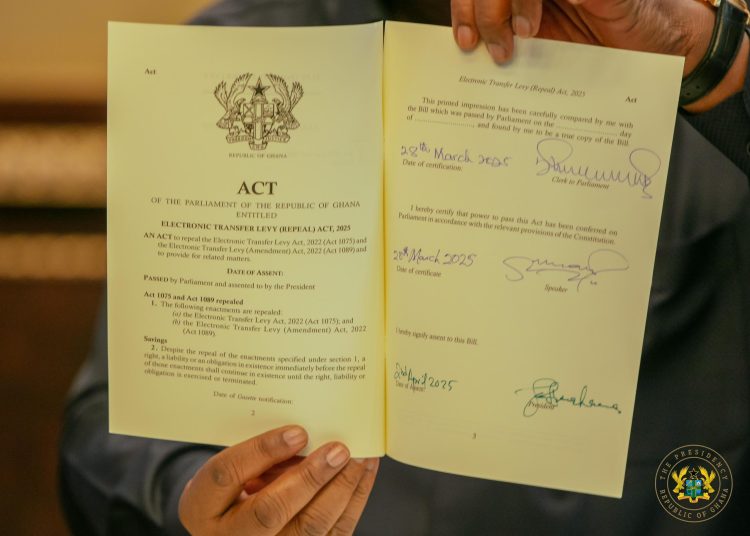
    Earlier this year, President John Dramani Mahama’s administration repealed the betting tax, emissions tax, and other levies. The Electronic Transaction Levy (E-Levy), introduced in 2022, imposed a 1.5% tax on electronic transactions. Although it was later reduced to 1%, the levy remained unpopular, drawing criticism from businesses, consumers, and political stakeholders who argued that it stifled digital transactions and disproportionately affected low-income earners. Many contended that it placed an unnecessary burden on citizens.

    The removal of this tax was a core pledge in the NDC’s manifesto, aimed at reducing the cost of living and encouraging business expansion. With the repeal bill now signed into law, many Ghanaians can breathe a sigh of relief.

    Supporters of the repeal argue that eliminating these levies will promote digital transactions, stimulate economic activity, and improve disposable income for households and businesses.

  • Ato Forson presents 2026 budget today

    Ato Forson presents 2026 budget today

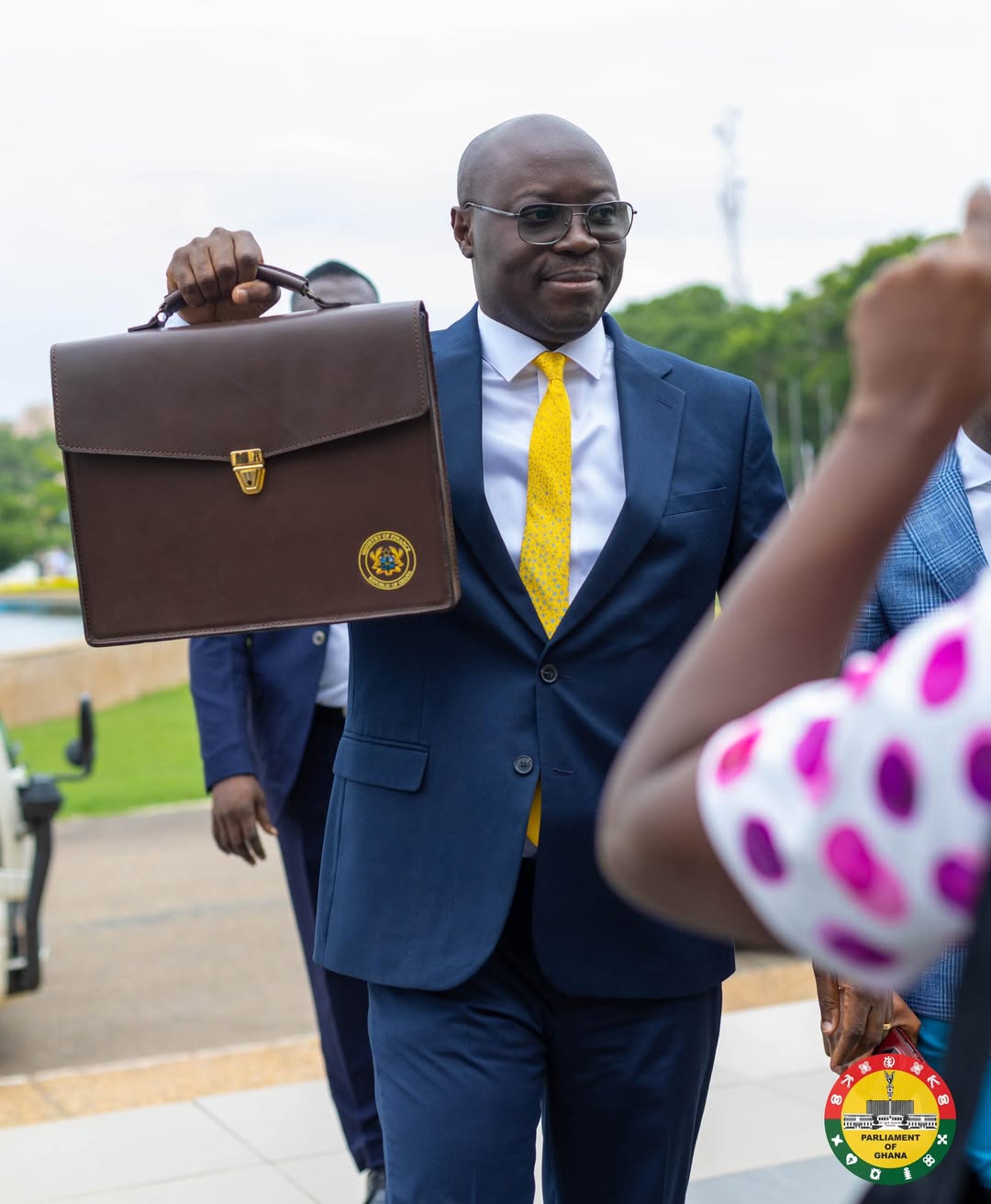
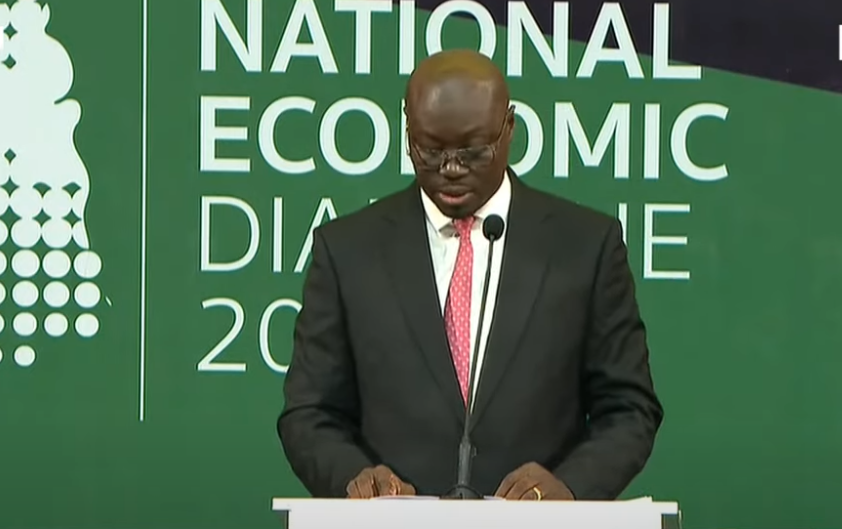
    Finance Minister Dr. Cassiel Ato Forson will today, Thursday, November 13, present the 2026 Budget Statement and Economic Policy to Parliament.

    The budget reading will outline strategies for economic growth, job creation, and post-International Monetary Fund (IMF) management.


    Earlier, Finance Minister Dr. Ato Forson announced plans to present the budget in October, but the date was later changed to allow for broader consultations and public input. Under the Public Financial Management Act, the Finance Minister is mandated to present the national budget to Parliament not later than November 15 each year.


    The 2026 Budget is expected to introduce tax reforms, including a reduction of VAT from 22% to 20%, and a review of levies such as the COVID-19 levy. With Ghana set to exit the IMF programme in May 2026, the budget will be crucial for ensuring fiscal stability.

    Dr. Forson maintains that growth targets and fiscal policies remain unchanged as inflation continues to fall, reaching 9.4% in September 2025 — the first single-digit rate since 2021.


    The presentation of the year-ahead budget is in accordance with the Public Financial Management Act, 2016 (Act 921) of Ghana, which was passed by Parliament and assented to on August 25, 2016.

    The Act governs how public funds are managed across all government entities.

    The Act mandates that the Finance Minister, acting on behalf of the President, lay before Parliament, not later than November 15 of each financial year, estimates of the revenues and expenditures of the government.

    According to some analysts, the 2025 Budget largely followed the same plans, ideas, and policies set up by the erstwhile government.
    In July this year, the Finance Minister, Dr. Ato Forson, mentioned that the Mahama-led administration would present its 2026 Budget and Economic Statement to Parliament in October 2025, instead of November 2025.

    With this, Parliament would have about an additional month to debate the 2026 Budget before the House goes on recess in late December. He noted that the new timeline for the presentation would aid thorough deliberation, allowing room for alterations before the budget comes into force at the beginning of 2026.


    “We are aiming to present the 2026 budget to Parliament by the end of October 2025. Preparations are already underway. We want to avoid the delays and uncertainties of the past. This government is committed to proper planning and transparency,” he disclosed during an appearance on a special edition of PM EXPRESS with host Evans Mensah on July 24.


    However, the Finance Ministry later announced in a statement in August that November 15 would be the new date for the budget presentation. In the same statement, it requested inputs from the general public to be considered in the 2026–2029 National Budget. The inputs, the Ministry said, were to be submitted electronically to bdru@mofep.gov.gh

    This call was in line with the government’s responsiveness to the needs of the Ghanaian citizenry to deepen citizens’ participation in the budget process, as well as implement inclusive policies.

    Consequently, the Finance Ministry has reportedly completed several rounds of stakeholder engagements and industry consultations to finalise the policies and programs that will feature in the 2026 Budget.

    In earlier interviews, Dr Forson has listed economic growth, development and job creation, particularly for Ghana’s ballooning youth and deepening unemployment crisis, as the main focus of the 2026 Budget.

    Sources also suggest that the Finance Minister is set to introduce new policy measures aimed at reforming the tax system and improving revenue mobilisation.

    According to the Commissioner-General of the Ghana Revenue Authority (GRA), Anthony Sarpong, the 2026 Budget will include a review of the Value Added Tax (VAT), with the effective rate expected to be reduced from 22% to 20%.

    This adjustment is part of ongoing reforms to simplify the VAT structure and make it more business-friendly.Additionally, Dr Forson is expected to review several tax levies, including the COVID-19 levy, as part of efforts to ease the tax burden on businesses and households.

    With Ghana set to exit the IMF programme in May 2026, attention will also be on how the Finance Minister plans to manage the economy in the post-programme period.

    The 2026 Budget will, therefore, be one of the government’s most significant economic policy documents, setting the tone for fiscal management and growth strategy after the IMF programme.

    Another key area of interest for industry players and economists will be how Dr Ato Forson intends to manage the fiscal deficit and expenditure in 2026 while maintaining macroeconomic stability.

    During the mid-year budget review, the Finance Minister announced the abolition of certain levies, including the e-levy, betting tax, and emissions levy, and provided projections for the country’s growth and other key indicators. He insisted that the government would stick to what was announced earlier this year. “We are not changing course. The growth target, the fiscal deficit, and the inflation target—all of it remains as announced in the 2025 Budget. We are sticking to it.” “The economy is responding well. We’ve seen 5.3% GDP growth in Q1, inflation is falling, and the cedi is stable. So there’s no need to revise the framework.”

    His comments came a few weeks after the Ghana Statistical Service (GSS) announced the sixth consecutive reduction in the inflation rate this year so far. According to GSS, as of June, the country recorded a 13.7 percent rate, a 4.7 percent decline from the 18.4 percent rate reported in May.

    This is also the lowest rate recorded since February 2022 at the time. Government Statistician Dr Alhassan Iddrisu, following the release of data on July 2, noted that the reduction in the rate was due to the decline in prices of foodstuffs and other items.

    Subsequently, Ghana has recorded a single-digit inflation with September 2025’s falling to 9.4%, marking the country’s first return to single-digit inflation since August 2021.

  • 2026 Budget presentation reportedly scheduled for Nov. 13 

    2026 Budget presentation reportedly scheduled for Nov. 13 

    A report from Joy Business suggests that the 2026 Budget Statement and Economic Policy will be presented to Parliament on November 13.

    The proposed date, which is subject to parliamentary approval, will mark the government’s first major budget presentation since winning the 2024 elections and having nearly nine months to steer the economy.

    The presentation of the year-ahead budget is per the Public Financial Management Act, 2016 (Act 921) of Ghana, which was passed by Parliament and assented to on August 25, 2016, and it governs how public funds are managed across all government entities.

    The Act mandates that the Finance Minister, acting on behalf of the President, lay before Parliament, not later than the 15th of November of each financial year, estimates of the revenues and expenditures of the government.
    According to some analysts, the 2025 Budget mostly followed the same plans, ideas, and policies that the erstwhile government set up.

    In July this year, the Finance Minister, Ato Forson, mentioned that the Mahama-led administration will present its 2026 budget and economic statement to Parliament in October 2025, instead of November 2025.

    With this, Parliament would have about an additional month to debate the 2026 budget before the House goes on recess in late December. He noted that the timeline for the presentation of the budget will aid thorough deliberation, allowing room for alterations before the budget comes into force at the beginning of 2026.

    “We are aiming to present the 2026 budget to Parliament by the end of October 2025. Preparations are already underway. We want to avoid the delays and uncertainties of the past. This government is committed to proper planning and transparency,” he disclosed during an appearance on a special edition of PM EXPRESS with host Evans Mensah on July 24.

    However, the Finance Ministry later announced in a statement in August that November 15 would be the new date for the budget presentation. In the same statement, it requested inputs from the general public to be considered in the 2026–2029 National Budget.

    The inputs, the Ministry said, were to be submitted electronically to bdru@mofep.gov.gh by close of business on Friday, 29th August, 2025.

    This call was in line with the government’s responsiveness to the needs of the Ghanaian citizenry to deepen citizens’ participation in the budget process, as well as implement inclusive policies.

    Consequently, the Finance Ministry has reportedly completed several rounds of stakeholder engagements and industry consultations to finalise the policies and programs that will feature in the 2026 Budget.

    In earlier interviews, Dr Forson has listed economic growth, development and job creation, particularly for Ghana’s ballooning youth and deepening unemployment crisis, as the main focus of the 2026 Budget.

    Sources also suggest that the Finance Minister is set to introduce new policy measures aimed at reforming the tax system and improving revenue mobilisation.

    According to the Commissioner-General of the Ghana Revenue Authority (GRA), Anthony Sarpong, the 2026 Budget will include a review of the Value Added Tax (VAT), with the effective rate expected to be reduced from 22% to 20%.

    This adjustment is part of ongoing reforms to simplify the VAT structure and make it more business-friendly.
    Additionally, Dr Forson is expected to review several tax levies, including the COVID-19 levy, as part of efforts to ease the tax burden on businesses and households.

    With Ghana set to exit the IMF programme in May 2026, attention will also be on how the Finance Minister plans to manage the economy in the post-programme period.

    The 2026 Budget will, therefore, be one of the government’s most significant economic policy documents, setting the tone for fiscal management and growth strategy after the IMF programme.

    Another key area of interest for industry players and economists will be how Dr Ato Forson intends to manage the fiscal deficit and expenditure in 2026 while maintaining macroeconomic stability.

    During the mid-year budget review, the Finance Minister announced the abolition of certain levies, including the e-levy, betting tax, and emissions levy, and provided projections for the country’s growth and other key indicators. He insisted that the government would stick to what was announced earlier this year. “We are not changing course. The growth target, the fiscal deficit, and the inflation target—all of it remains as announced in the 2025 Budget. We are sticking to it.” “The economy is responding well. We’ve seen 5.3% GDP growth in Q1, inflation is falling, and the cedi is stable. So there’s no need to revise the framework.”

    His comments came a few weeks after the Ghana Statistical Service (GSS) announced the sixth consecutive reduction in the inflation rate this year so far. According to GSS, as of June, the country recorded a 13.7 percent rate, a 4.7 percent decline from the 18.4 percent rate reported in May.

    This is also the lowest rate recorded since February 2022 at the time. Government Statistician Dr Alhassan Iddrisu, following the release of data on July 2, noted that the reduction in the rate was due to the decline in prices of foodstuffs and other items.

    Subsequently, Ghana has recorded a single-digit inflation with September 2025’s falling to 9.4%, marking the country’s first return to single-digit inflation since August 2021.

  • Ghanaians want Haruna Iddrisu over Asiedu Nketia, Ato Forson as NDC flagbearer – Global InfoAnalytics

    Ghanaians want Haruna Iddrisu over Asiedu Nketia, Ato Forson as NDC flagbearer – Global InfoAnalytics

    The Member of Parliament (MP) for Tamale South, Haruna Iddrisu, has led a poll conducted by Global InfoAnalytics on who should represent the National Democratic Congress (NDC) in the 2028 general elections. Haruna Iddrisu performed better than 10 other top officials within the NDC who were also included.

    30% of respondents support Haruna Iddrisu, while 24% back National Chairman Johnson Asiedu Nketia and 18% chose Finance Minister Ato Forson. 10% for Chief of Staff Julius Debrah and North Tongu MP Samuel Okudzeto Ablakwa secured 8%. While the Member of Parliament for Ablekuma South, Alfred Okoe Vanderpuije, gained no response, Minister of Food and Agriculture, Eric Opoku, a leading member of the NDC, Joshua Alabi, Lands Minister, Armah-Kofi Buah, and a leading member, Kwame Awuah-Darko, each polled 2%, with former Minister of Education Dr. Ekwow Spio-Garbrah at 1%.

    Even in a three-way contest, Asiedu Nketia and Julius Debrah lost to the MP for Tamale South, who doubles as the Education Minister, Haruna Iddrisu.  Haruna Iddrisu garnered 45% with Asiedu Nketia 37% and Julius Debrah’s 18%. Meanwhile majority of the respondents showed interest in Asiedu Nketia if Haruna Iddrisu decides not to contest in the NDC’s flagbearer race.

    In the case of the New Patriotic Party (NPP), former Vice President Dr Mahamudu Bawumia was selected as the preferred candidate to lead the New Patriotic Party (NPP) into the 2028 general election against his closest contender, former Member of Parliament (MP) for Assin Central, Kennedy Ohene Agyapong.

    The poll suggests that 57% of voters prefer Dr Bawumia as the party’s presidential candidate, while 29% picked Kennedy Ohene Agyapong.

    The other contenders, i.e., former Minister of Education, Dr Yaw Osei Adutwum, secured 6%, Minister of Food and Agriculture, Dr Bryan Acheampong, polled 5%, while former NPP General Secretary, Kwabena Agyapong, registered 3%.

    In the critical swing regions of Greater Accra, Central, and Western, Dr Bawumia also leads decisively with 57%, followed by Kennedy Agyapong at 32%. Dr Adutwum and Dr Acheampong each secured 4%, while Kwabena Agyapong obtained 3%.

    The survey further indicates that in a potential runoff between Dr Bawumia and Kennedy Agyapong, Dr. Bawumia would extend his lead with 62% against Agyapong’s 38%.

    Among NPP delegates, Dr Bawumia remains firmly ahead with 47%, while Kennedy Agyapong trails with 17%. Dr Acheampong and Dr Adutwum received 3% and 1% respectively, with Kwabena Agyapong also at 1%. However, 27% of delegates remain undecided, and 4% declined to disclose their preference.

    In a runoff scenario within the delegates’ poll, Dr Bawumia commands 49%, compared to Kennedy Agyapong’s 19%, with 27% undecided and 5% declining to disclose.

    The NPP has already demonstrated its readiness to battle for Ghana’s top seat in the 2028 elections. The vetting committee of the New Patriotic Party on Tuesday, September 23, assessed the former Vice-President Dr Mahamudu Bawumia and four other persons contesting to lead the party into the 2028 elections.

    The four others who have expressed interest in contesting include Dr. Yaw Osei Adutwum (former Education Minister and Member of Parliament for Bosomtwe), Bryan Acheampong (Member of Parliament for Abetifi), former party General Secretary Kwabena Agyepong, and former Assin Central MP Kennedy Ohene Agyapong.

    On Tuesday, July 29, the NPP opened nominations for its 2028 flagbearer position. Dr. Mahamudu Bawumia, the party’s 2024 flagbearer and former Vice President, Kennedy Agyapong, Kwabena Agyepong, and Dr. Osei Adutwum have all picked up nomination forms.

    Former General Secretary of the NPP, Kwabena Agyei Agyepong, officially filed his nomination forms on Tuesday, August 26. Party executives received the nomination forms from former Assin Central MP and presidential hopeful Kennedy Ohene Agyapong on Wednesday, August 27.

    Dr Yaw Osei Adutwum filed his nomination forms for the NPP flagbearer race on Thursday, August 28, 2025.

    In the meantime, Dr. Mahamudu Bawumia has received strong backing from 268 former Metropolitan, Municipal, and District Chief Executives (MMDCEs), who paid him a visit in June to pledge their support.Former Energy Minister and running mate of the New Patriotic Party’s (NPP) 2024 presidential candidate, Dr Matthew Opoku Prempeh, has decided to throw his weight behind Dr Mahamudu Bawumia ahead of the party’s presidential primaries in 2026.

    In an interview on Asempa FM on August 26, the former minister noted that he remains grateful to the former Vice President who decided to make him his running mate despite the many individuals who advised him to do otherwise. According to Dr Opoku Prempeh, popularly known as Napo, Dr Bawumia was engaged countless times by some bigwigs in the party to pick someone else to be his running mate.

    “I am not ungrateful. Look at this big party and all the people who were praying for the running mate slot; he ignored all of them and made me his running mate.

    “I know it was a difficult situation, but a lot of people don’t know. Some bigwigs in the party went to Dr Bawumia to tell him not to make me the running mate, but he ignored them. There are some names that, if I mentioned them, you would be shocked. Some even took him to offices to advise him against me, but still he chose me,” he remarked.

    He thus said, “So, I cannot be ungrateful to him… For those who stood in the flagbearership contest, everyone knows Kennedy Agyapong is my friend, but I am still for Bawumia”.

    The New Patriotic Party (NPP) has made room for new additions to its already approximately 220,000 delegates who are eligible to vote in its presidential primaries slated for Saturday, January 31, next year.

    In a statement dated August 26, signed and shared by the Secretary of the Presidential Elections Committee, Williams Yamoah, the party announced that registration has been opened for an additional 60,000 new delegates, which include nineteen new categories of people. This directive follows reforms adopted at the party’s National Annual Delegates Conference held in Accra on Saturday, July 19.

    The statement explained: “In accordance with Article 13(1)(11) of the Constitution of the New Patriotic Party (NPP), and pursuant to the motion on transitional provisions adopted at the National Annual Delegates Conference held in Accra on Saturday, July 19, 2025, the following new categories of Party officials and dignitaries have been included in the upcoming Presidential Primary voter register.”

    The updated voter register, also known as the party album, will now include several new categories of officials and dignitaries. These are: all former regional and constituency executives, members of the National Council of Elders, 30 members of the National Council of Patrons, all past national officers, former party-card-bearing MPs and parliamentary candidates, as well as former party-card-bearing ministers and deputy ministers.

    Other groups added to the list are external branch executives, former external branch executives, and key members of the Tertiary Students Confederacy (TESCON), including presidents of recognised institutions, the National TESCON Coordinator, regional coordinators, and one TESCON patron from each institution.

    Additionally, 10 members from each Regional Council of Elders, 10 patrons from each region, and five members and patrons from each constituency have also been included.

    The statement directed that “all officers that fall under the categories above are requested to register their names with their respective organisational structures, including the National Secretariat, Regions, Constituencies and External Branches, as applicable, with immediate effect.

    ”To make the registration process easier, the statement clarified that a digital link would be circulated to External Branch Executives for online registration. All other qualified members were advised to liaise with their respective regions and constituencies to register.

    However, the forms are to be accessed via the party’s official website. “The registration form may be downloaded from the Party’s official website. For ease of reference, a sample copy is hereby attached,” excerpts of the statement read. The statement further warned that the registration was strictly for the aforementioned categories of people, with a deadline set for Friday, September 19.

  • Ato Forson, Armah Buah to act as Defence, Environment Ministers respectively

    Ato Forson, Armah Buah to act as Defence, Environment Ministers respectively

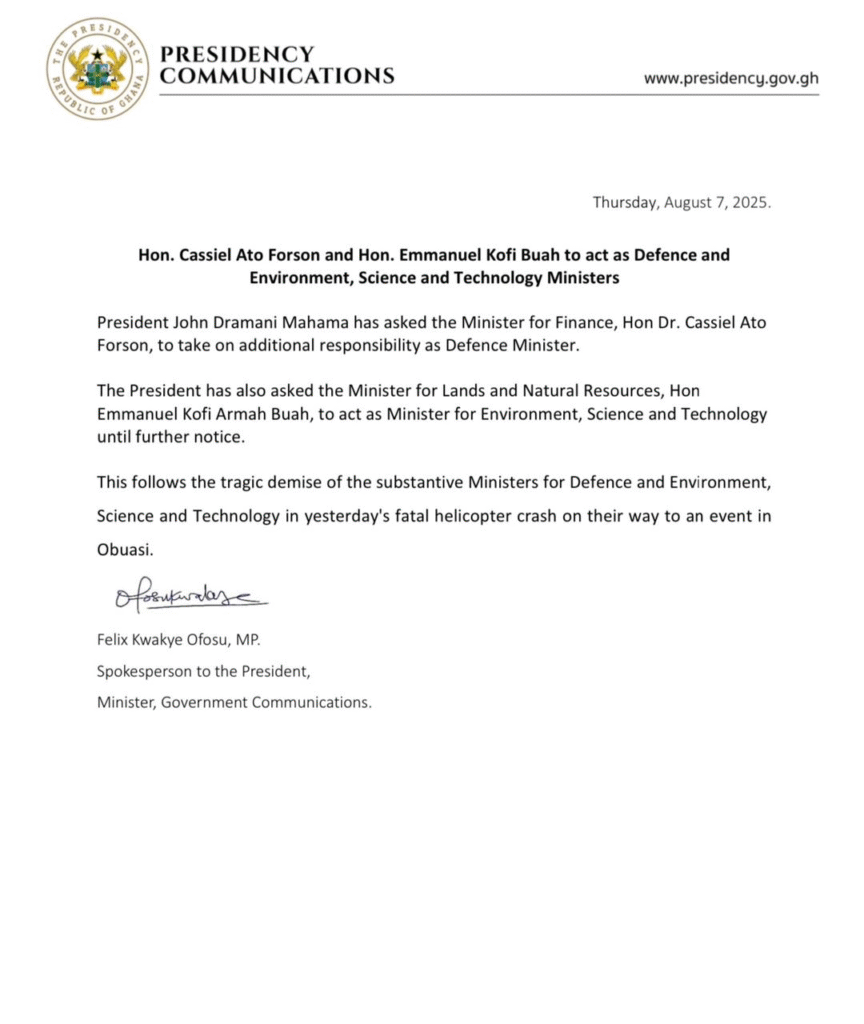
    President John Dramani Mahama has directed the Finance Minister, Hon. Cassiel Ato Forson, and the Minister for Lands and Natural Resources, Hon. Emmanuel Kofi Buah, to act as caretaker ministers for the Ministry of Defence and Environment, Science and Technology Ministers, respectively.

    This was revealed in a statement from the Office of the President on Thursday, August 7.

    This has become crucial following the tragic helicopter crash at Adansi Akrofrom in the Ashanti Region that claimed the lives of eight individuals, including the Defence Minister, Dr Omane Boamah and the Minister for Environment, Science, and Technology, who doubles as the Member of Parliament (MP) for Tamale Central, Ibrahim Murtala Mohammed.

    The other six individuals who are deceased include acting Deputy National Security Coordinator and former Minister for Food and Agriculture Alhaji Muniru Mohammed, Vice Chairman of the National Democratic Congress Dr. Samuel Sarpong, former Parliamentary candidate Samuel Aboagye,Squadron leader Peter Bafemi Anala, Flying Officer Twum Ampadu, and Sergeant Ernest Mensah.

    Ghana as a whole is mourning the tragic loss of eight individuals after a helicopter crash in the general area of Sikaman near Adansi Akrofuom in the Ashanti Region. Meanwhile, President John Dramani Mahama has declared three days of national mourning in honour of the victims.

    Chief of Staff Julius Debrah has directed that all flags are to fly at half-mast until further notice. Engaging the general public yesterday, Julius Debrah revealed the identities of the deceased individuals after the Ghana Armed Forces (GAF) earlier reported that its airforce helicopter Z9, which took off this morning at 0912 hrs from Accra and headed for Obuasi, was off the radar.

    The President and government have extended their condolences and sympathies to the family of the comrades and the servicemen who died in service to the country.

    Several statesmen, international dignitaries, and sympathizers have extended their deepest condolences to the incumbent government and Ghana as a whole.

    Yesterday, the remains of the deceased were flown to the airforce base. State officials and bereaved families were present for a brief ceremony to honour the deceased.

    Burial has been postponed for the Muslim victims who passed away following a tragic helicopter crash at Adansi Akrofrom in the Ashanti Region.

    This was revealed by the Deputy Minister for Roads and Highways and Member of Parliament for Tamale North, Alhassan Suhuyini, on Thursday, August 7.

    The burial was expected to be conducted today, Thursday, August 7, as per Islamic tradition. However, speaking to the media, the Deputy Minister stated that the recent development is the state of the remains of their bodies. According to him, a new date will be fixed after a conclusion has been made.

    Meanwhile, a team of investigators from the Ghana Air Force and other military personnel have departed to the helicopter crash site in Sikaman, where eight individuals lost their lives.

    Per reports, the team is being led by the area’s Assembly Member and local residents familiar with the forest terrain. Yesterday, the Ghana Armed Forces informed the general public that it has commenced investigations into the unfortunate incident.

    Profile of Defense Minister
    Dr. Edward Kofi Omane Boamah is a prominent Ghanaian politician, medical doctor, and Health Policy Planning and Financing Analyst with a rich background in strategic negotiation, solution-oriented leadership, environmental security and ICT including cybersecurity.

    He possesses a strong educational foundation from esteemed institutions, including the University of Ghana Medical School, the London School of Economics and Political Science, the London School of Hygiene and Tropical Medicine and Harvard University.

    His diverse educational background empowers him to merge his medical expertise with a deep understanding of financial planning and strategic analysis when solving complex challenges.

    Dr. Omane Boamah has consistently demonstrated exceptional leadership in various key roles. As Minister for Communications and Spokesperson for the President of Ghana, he championed several vital cybersecurity initiatives including Child Online Protection and led the rollout of the Government of Ghana’s 4G LTE network (GOTA) which provides enhanced communication capabilities for security agencies.

    As a former Civilian Employee of the Ministry of Defence, he has an unwavering commitment to national and human security. His innovative thinking and excellent negotiation skills, positions him as a forward-thinking leader, ready to address the complexities of modern security challenges and an advocate for the institution’s dignity and well-being of service women and men.

    Profile of Environment Minister

    Ibrahim Murtala Mohammed was a distinguished Ghanaian politician, educator, and public servant who played a significant role in shaping national policy and advocating for sustainable development.

    Born on December 14, 1974, in the Northern Region of Ghana, he pursued his education at Tamale College of Education, the University of Ghana, and Kwame Nkrumah University of Science and Technology, earning a Master of Arts in Development Studies along with additional qualifications in international relations and development planning.

    He began his political career as a Member of Parliament for the Nanton Constituency in 2013 and later represented the Tamale Central Constituency.

    ‘Over the years, he served as Deputy Minister for Information and Media Relations and Deputy Minister for Trade and Industry. In February 2025, he was appointed Minister for Environment, Science, Technology and Innovation, a role in which he championed environmental sustainability and technological advancement.

    Murtala Mohammed was known for his bold speeches, grassroots engagement, and commitment to public service. He was deeply religious, respected within both political and Islamic communities, and maintained a private family life as a married father of three.

  • Over 53,000 retired, resigned or deceased workers on govt payroll – Ato Forson

    Over 53,000 retired, resigned or deceased workers on govt payroll – Ato Forson

    Finance Minister Dr. Cassiel Ato Forson has disclosed that a recent audit by the Ghana Audit Service has exposed over fifty-three thousand separated staff on the government’s payroll.

    While delivering the 2025 Mid-Year Budget Statement to Parliament on Thursday, July 24, he explained that these names could belong to individuals who are no longer in active service.

    “53,311 separated staff—these are staff who are either retired, resigned, terminated, on leave without pay, or deceased, and yet remain on government payroll.

    “So far, we’ve found about 14,000 people that we can’t validate. We can’t find them. They may be ghosts. They are across sectors,” he said.

    The government engaged the Ghana Audit Service to undertake a nationwide payroll audit across all 16 regions of the country. The Finance Minister revealed that the Ghana Audit Service has completed 91% of the payroll audit.

    According to the sector minister, the Audit Services expects to recover GH¢150.4 million of unearned salaries from the separated staff over the 2023 and 2024 period.

    “Mr. Speaker, going forward, we will enforce the monthly payroll validation process and strictly apply sanctions to all who validate “ghosts” for payment of salaries. Rt. Hon. Speaker, let me use this opportunity to strongly caution those who validate “ghosts” across the public service that they will be personally liable for the loss of public funds,” Dr Cassiel Ato Forson said.

    He assured that the Ministry of Finance will continue to monitor the payroll and put in place measures to prevent “ghost names” on the payroll.

    By the end of August, the Ghana Audit Service, in partnership with EY and PWC, will complete the audit of arrears and payables as of the end of 2024.

    The Audit Service was tasked to audit and validate GH¢68.7 billion of arrears. The sector minister noted that about 87 percent of the audit has been completed.

    The preliminary results show that a total of GH¢28.3 billion has been validated for payment. Also, an amount of GH¢3.6 billion has been rejected because of errors, duplications, and non-compliance with PFM and procurement rules. An amount of GH¢562.6 million is without adequate supporting documents, and GH¢27.3 billion is pending validation.

    Dr Cassiel Ato Forson stated that “once finalized, we will update the House on the findings and outcomes.”

    In his delivery, Dr Cassiel Ato Forson noted that has come to the attention of the Ministry of Finance that a number of contractors implementing some of these 55 stalled projects have drawn down on the loans with no work done to match the amounts drawn down.

    Again, some contractors have submitted additional costs in excess of what Parliament approved. In light of this, the Ministry of Finance has commissioned a forensic audit into these projects.

    “Mr. Speaker, we will apprise the House when this audit is completed,” the sector minister assured.

    The Finance Minister also revealed that the government has experienced some significant pressures on the compensation budget for the first half of 2025, mainly emanating from wages and salaries.

    Wages and salaries exceeded the budget by GH¢1.3 billion for the first six months of the year. The wage pressures, the minister said, were largely driven by last-minute recruitments undertaken by the previous government in the last quarter of 2024, especially in the education, health, and security sectors.

    “In addition, ad-hoc reviews of conditions of service undertaken in previous years have distorted the Single Spine Pay Policy and further burdened the public wage bill,” the sector minister added.

    In February this year, Chief of Staff Julius Debrah issued a directive annulling all public service appointments and recruitments made after December 7, 2024.

    A letter was circulated to heads of government institutions, instructing them to comply with the directive and submit a report by February 17, 2025, detailing the actions taken in response.

    “Consistent with Government pronouncement in relation to near end of tenure appointments and recruitments, I wish to bring to your attention that all appointments and recruitments made in the Public Services of Ghana after 7th December, 2024 are not in compliance with established good governance practices and principles.”

    “Accordingly, all Heads of Government Institutions are hereby requested to take the necessary steps to annul any such appointments or recruitments and submit a comprehensive report on the actions taken to this Office by 17th February 2025.”

    Prior to the swearing-in of President-elect John Mahama, concerns were raised over last-minute appointments and financial transactions by the outgoing administration.

    The previous government defended these actions, stating, “these recruitment processes and payments have received the relevant statutory approvals and have not been proven to be illegal. It was decided that any specific allegation of illegality about any particular payment or recruitment should be brought to the attention of the Transition Team for a decision to be made.”

    Minority Leader Alexander Afenyo-Markin urged President Mahama to reconsider and overturn the cancellation of these appointments. In response, Minister of State responsible for Government Communications and a spokesperson for President John Dramani Mahama, Felix Kwakye Ofosu, defended the administration’s move to invalidate appointments made after December 7, citing procedural flaws in the recruitment process.

    Speaking to the media in Accra on Wednesday, February 19, Kwakye Ofosu said, “Let me also put it on record that this action has been taken not because of a perception or a belief that they were NPP. It is because we know that the recruitment processes were attended by irregularities.”

    He pointed out cases where some individuals were issued retroactive appointment letters to falsely suggest they had been hired well before the elections, while others secured positions without going through interviews or even formally applying.

    Kwakye Ofosu stressed that such irregularities could not be overlooked and reaffirmed the government’s commitment to launching a fresh recruitment exercise that would be open to all qualified Ghanaians, regardless of their political backgrounds.

    “In due course, government will do recruitment and it will be open to all Ghanaians irrespective of political colouration. Indeed, your party identity will not be required. You will not be asked to show whether you’re NPP or NDC when that comes, but we will do it in a regular manner,” he explained.

    He also guaranteed that individuals whose appointments had been nullified would still have the chance to apply again and participate in a fair recruitment process. “So even those who have had their employment revoked will still have the opportunity to reapply and go through due process,” Kwakye Ofosu added.

  • Govt to abolish NHIS Levy, COVID-19 Levy in 2026

    Govt to abolish NHIS Levy, COVID-19 Levy in 2026

    The Value Added Tax (VAT) Act is undergoing a series of tax reforms to ensure the elimination of successive charges of taxation that increase the cost of goods and services.


    As such, the COVID-19 Levy, Ghana Education Trust Fund (GETFund) and National Health Insurance Scheme (NHIS) levies assented to by former President Akufo-Addo during the New Patriotic Party-led government are expected to be scrapped next year.


    Finance Minister, Dr Cassiel Ato Forson, while delivering the 2025 Mid-Year Budget Statement to Parliament on Thursday, July 24, said his outfit will conclude the reviewing process by the close of September, adding that the new bill will then be submitted to Parliament in October to be included in the 2026 Budget Statement.


    He mentioned that the new development is aimed at reducing financial burdens on Ghanaians, thus improving economic conditions. The current VAT flat rate scheme, the minister asserts, should be a unified VAT rate for all businesses.

    Additionally, the VAT registration threshold will also be raised, a measure expected to exempt small and micro enterprises from registering for and paying VAT as well as encourage growth in the informal sector.

    To ensure compliance and transparency, the government has plans to roll out fiscal electronic devices such as e-invoicing systems and electronic cash registers. Furthermore, public education campaigns and awareness programs will be implemented for the public.

    “Rt. Hon. Speaker, the Ministry of Finance hopes to complete this process by September 2025, prepare a new VAT bill by October 2025 and submit the same to Parliament as part of the 2026 Budget Statement.

    “Mr. Speaker, I would like to reassure Ghanaians that under the reforms, at the minimum, the COVID-19 levy will be abolished, the effective VAT rate will be reduced, and the punitive cascading effect of the GETFund and NHIS levies will be removed.”

    “VAT flat rates will be removed, and a unified VAT rate will be implemented; the VAT registration threshold will be increased to exempt small and micro businesses; and compliance will be improved through public education, awareness creation and the introduction of fiscal electronic devices,” he said.


    Earlier this year, President John Dramani Mahama’s administration repealed the betting tax, emissions tax, and other levies. The Electronic Transaction Levy (E-Levy), introduced in 2022, imposed a 1.5% tax on electronic transactions.

    Although it was later reduced to 1%, the levy remained unpopular, drawing criticism from businesses, consumers, and political stakeholders who argued that it stifled digital transactions and disproportionately affected low-income earners. Many argued that it stifled digital transactions and placed an unnecessary burden on citizens.


    The removal of this tax was a core pledge in the National Democratic Congress (NDC)’s manifesto, aimed at reducing the cost of living and encouraging business expansion. With the repeal bill now signed into law, many Ghanaians breathe a sigh of relief.


    Supporters of the repeal argue that eliminating these levies will promote digital transactions, stimulate economic activity, and improve disposable income for households and businesses.

    The Finance Minister’s tweet suggests that the government is committed to fulfilling its campaign promises and easing the financial burden on citizens.


    Meanwhile, the Finance Minister has hinted at sanitization of the public sector payroll to remove the names of individuals who are not a part of government institutions but still receive salaries.

    In view of this, the Audit Service will conduct a payroll audit across all 16 regions of the country aimed at retrieving GH¢150.4 million of unearned salaries.

    “Mr. Speaker, as part of the fiscal consolidation strategy, we have taken measures to sanitize public sector payroll and rid it of ghost names. Subsequently, we engaged the Ghana Audit Service to undertake a nationwide payroll audit across all 16 regions of the country.

    “Mr. Speaker, the Ghana Audit Service has completed 91% of the payroll audit. So far, the Audit Service has not been able to identify and verify over 14,000 workers again; they have identified 53,311 separated staff.

    “Separated staff are staff who are either on retirement, resigned, terminated, on leave without pay, or deceased, and yet remain on government payroll; and the Audit Services expects to recover GH¢150.4 million of unearned salaries from the separated staff over the 2023 and 2024 period,” he added.

    Touching on Ghana’s programme with the International Monetary Fund (IMF), the Finance Minister noted that Ghana remains on track with the implementation of the Programme.

    He revealed that the government’s commitment to fiscal discipline, prudent debt management and exchange rate have paved way for a 5th review review scheduled for September.


    “The 5th Review, which is scheduled for September 2025, will be based on end-June 2025 data. Preliminary data shows that Ghana is on course to achieving most of the targets for the 5th Review. Mr. Speaker, our commitment to fiscal discipline, prudent debt management, and exchange rate appreciation has resulted in significant improvement in Ghana’s debt profile,” he added.

    On commercial debt restructuring, the Finance Minister stated that the Ministry has made two debt service payments of about US$700 million to Euro bondholders.

    Dr Forson disclosed that beginning August, the Ministry of Finance will commence the building of cash buffers to support the repayment of Ghana’s domestic debt service obligations relating to the Domestic Debt Exchange Programme bonds which will fall due in 2027 and 2028.

  • A roadmap will be provided to ensure SSNIT’s sustainability – Board of Trustees Chairman

    A roadmap will be provided to ensure SSNIT’s sustainability – Board of Trustees Chairman

    Chairman of the newly constituted Board of Trustees for the Social Security and National Insurance Trust (SSNIT), Nana Ansah Sasraku III, has committed to providing strategic direction to the Trust by leveraging collective expertise to drive growth, sustainability, and excellence in service delivery.

    Nana Ansah Sasraku III noted that a roadmap for the Trust will be provided to safeguard the Scheme’s sustainability and ensure that it continues to meet its obligations to its valued members. He acknowledged the magnitude of the task ahead and expressed the Board’s readiness to deliver.

    “We know that the task before us is immense. But what greater responsibility is there than securing the retirement incomes of the very people who built our nation? And what greater task is there than ensuring that after years of service, the Ghanaian worker can rest, assured that their future is safe? Yes, we are fully aware of the magnitude of the work ahead. But we are prepared, united and committed to ensure that the Trust’s resources are managed with integrity, prudence and foresight to secure the future of contributors and beneficiaries,” he said.

    He made the remarks following the inauguration of the new Board of Trustees on Tuesday, June 3, by Finance Minister Dr. Cassiel Ato Forson, who called for prudence, integrity, and transparency in the management of Ghana’s pension funds.

    Dr. Forson, in his address, noted the vital national importance of SSNIT, reminding the board that it is an institution “we will all need one day—when we retire.”

    He warned against any attempts to sell state assets to politically connected individuals as he questioned some of SSNIT’s past investment decisions

    “Please don’t sell state assets to politicians. The President will not accept it, and as your sector Minister, I will be the first to oppose it.”

    He stressed that the people of Ghana have entrusted their future into the board’s hands, and therefore, their actions must reflect the weight of that responsibility.

    The sector minister charged the new board to chart a new course and let their actions reflect the weight of the responsibility the people of Ghana have entrusted to them.

    In May 2024, Member of Parliament for North Tongu, Samuel Okudzeto Ablakwa, lodged a formal petition with the Commission on Human Rights and Administrative Justice (CHRAJ) to investigate allegations surrounding the sale of six hotels namely, Labadi Beach Hotel, La Palm Royal Beach Resort, Elmina Beach Resort, Ridge Royal Hotel, Busua Beach Resort, and the Trust Lodge Hotel.

    The Trust decided to sell a 60% stake in its hotels to Rock City Hotel owned by the Food and Agriculture Minister, Dr Bryan Acheampong. In response, Ghanaians demonstrated peacefully through the streets of Accra, compelling authorities to halt the planned sale.

    The then-Minority in Parliament called on former President Akufo-Addo, who was president at the time, to instruct the Social Security and National Insurance Trust (SSNIT) to halt the sale, including several state officials who shared the same sentiments.

    Later in July 2024, SSNIT eventually announced that it had halted the sale process following significant opposition from stakeholders. The private investor involved, Brian Acheampong’s Rock City Hotel, also withdrew from the transaction. 

    Former Minister for Employment, Labour Relations, and Pensions Ignatius Baffour Awuah reported that SSNIT’s total assets under management had seen substantial growth, increasing from GHS15.2 billion in December 2016 to GHS71.69 billion by March 2024. This, he said, represented a remarkable 350% increase over a seven-year period.

  • Finance Minister assures timely release of funds for school feeding caterers

    Finance Minister assures timely release of funds for school feeding caterers

    Finance Minister, Dr. Cassiel Ato Forson, has reaffirmed the government’s commitment to ensuring the prompt release of funds for caterers under the Ghana School Feeding Programme (GSFP).

    This assurance comes as part of efforts to address delays in payments and improve the effectiveness of the programme.

    Speaking during a courtesy visit by the new Country Representative of the United Nations World Food Programme (WFP), Ms. Aurore Rusiga, Dr. Forson stressed the importance of timely payments to caterers in order to sustain and enhance the programme’s impact.

    “The current rate of just over 1 cedi per child per day is woefully inadequate. That is why I have taken steps to increase it to 2 cedis and am actively working with partners to raise it further,” Dr. Forson said. “More importantly, we are committed to ensuring that payments to caterers are made on time to guarantee the smooth operation of the programme.”

    The government has allocated 1.78 billion cedis to the School Feeding Programme this year. However, Dr. Forson acknowledged that additional resources are needed to further expand its reach and improve its effectiveness. He urged the WFP to provide more support to strengthen the initiative.

    In response, Ms. Rusiga welcomed Dr. Forson’s commitment to ensuring timely payments and emphasized that the success of initiatives like introducing fortified rice to enhance the nutritional value of school meals depends on the reliability of funding.

    “We are ready to collaborate with the World Bank and the Government of Ghana on a comprehensive evaluation of the School Feeding Programme,” Ms. Rusiga added, highlighting the need for a thorough assessment to improve the programme’s outcomes.

    The Ghana School Feeding Programme plays a vital role in improving child nutrition, boosting school enrollment, and supporting local caterers and food suppliers. With the Finance Ministry’s assurance of timely fund disbursement, the programme is expected to operate more smoothly, benefiting both children and service providers across the country.

  • Finance Minister, Chinese Ambassador hold discussion on deepening bilateral cooperation

    Finance Minister, Chinese Ambassador hold discussion on deepening bilateral cooperation

    Finance Minister, Dr. Cassiel Ato Forson, has held strategic talks with the Chinese Ambassador to Ghana, H.E. Tong Defa, aimed at reinforcing the partnership between the two countries and charting new areas for cooperation.

    The meeting, which took place earlier today, emphasized the importance of infrastructure development and economic collaboration as key pillars of the Ghana-China relationship.

    Dr. Forson reflected on the longstanding partnership, highlighting a major milestone from his tenure as Deputy Minister: “With China’s support, we built the Atuabo Gas Processing Plant during my time as Deputy Minister. It’s now time to build a second gas processing plant.”

    As Ghana gears up for its Mid-Year Budget Review, the Finance Minister noted that several infrastructure projects—such as the Accra-Kumasi Expressway announced by President Nana Akufo-Addo—remain a top priority. He emphasized the critical role of international allies in executing such initiatives.

    “We will need support from partners like China,” Dr. Forson stated, invoking a Chinese proverb to underscore the agenda. “If you want to get rich, build roads first.”

    He went on to express satisfaction with ongoing collaborations, pointing out the progress made in current projects: “Most Chinese-funded projects in Ghana are near completion, and we hope new ones will commence soon.”

    Another key topic on the agenda was Ghana’s debt restructuring efforts. Dr. Forson appealed for continued Chinese support in finalizing the process to stabilize the economy and sustain growth.

    Ambassador Tong Defa, in response, reiterated China’s commitment to Ghana’s development goals. “The bilateral agreement and development partnership are ready to be signed,” he affirmed, adding that China remains a reliable partner in Ghana’s transformation journey.

  • Finance Minister engages BII to invest in agribusiness and financial sectors

    Finance Minister engages BII to invest in agribusiness and financial sectors

    Finance Minister, Dr. Cassiel Ato Forson, met with representatives from British International Investment (BII) to explore strategic opportunities, particularly in agribusiness and the financial sector in a significant move to deepen foreign investment in Ghana.

    The meeting highlighted Ghana’s evolving investment landscape, with a focus on leveraging private capital for economic growth.

    “Ghana is open for business, and we welcome partners ready to grow with us,” Dr. Forson emphasized.

    A major highlight of the discussion was Ghana’s upcoming Palm Industry Policy, aimed at diversifying the nation’s agricultural base beyond cocoa.

    The government plans to develop 50,000 hectares of oil palm, beginning with a $100 million investment for the first 20,000 hectares.

    “Our goal is to attract private sector investment into large-scale agribusiness that creates jobs and boosts export earnings,” said Dr. Forson.

    The Finance Minister also extended an invitation to BII to support the repositioning and growth of Consolidated Bank Ghana (CBG), signaling a broader push to strengthen the banking sector.

    BII, which currently holds over $200 million in investments in Ghana—particularly in the energy sector—responded positively, reaffirming their long-term commitment to the country.

    “We see Ghana as a priority market in the region,” BII representatives noted.

    In a promising development, BII is considering bringing its full Board to Ghana for the first time in nearly a decade, signaling renewed interest at the highest level.

    The institution also expressed readiness to support small and medium-sized enterprises (SMEs), forestry, and other key sectors.

    Dr. Forson concluded, “We are creating the right environment for investors who are committed to sustainable growth and shared prosperity.”

  • We will implement a new local procurement policy to boost industry – Finance Minister

    We will implement a new local procurement policy to boost industry – Finance Minister

    Finance Minister Dr. Cassiel Ato Forson says government is gearing up to roll out a local procurement policy aimed at promoting homegrown industries and cutting down on Ghana’s dependence on imported goods.

    Speaking at a strategic engagement with executives of the Association of Ghana Industries (AGI), Dr. Forson outlined plans to make it mandatory for all public sector institutions to source selected essential commodities directly from domestic producers.

    “To support our local industries, the government will soon publish a list of items that all public sector agencies must procure locally,” he said, adding that “any government procurement from outside Ghana will require special approval from the Office of the President.”

    The Finance Minister lamented the nation’s ongoing reliance on imports for everyday staples like sugar and rice, despite the local capacity to produce them. He said the new directive will serve as a key pillar in efforts to revitalise Ghana’s manufacturing sector and expand job opportunities.

    Alongside the local procurement agenda, Dr. Forson raised concerns about the persistent challenge of goods being smuggled into the country, which he described as a major threat to the survival of local businesses.

    “Smuggled goods are crippling our local businesses, and we are determined to stop it,” he warned. He revealed that government has mapped out major smuggling routes and will soon introduce strict enforcement measures to tackle the issue head-on.

    He further called for increased collaboration between state institutions and private sector stakeholders, encouraging industry leaders to engage in a working session on how local enterprises can align with the government’s 24-hour economy initiative.

    According to Dr. Forson, “robust partnerships will be key to sustaining long-term growth and enhancing local production capacity.”

    AGI President, Dr. Humphrey Ayim-Darke, welcomed the policy direction and praised the government’s renewed focus on industrial transformation. He was hopeful that stronger ties between government and industry players would help boost the performance and global competitiveness of Ghanaian manufacturers.

    He added that the planned procurement policy has the potential to channel public spending into sectors that will yield direct benefits for the country’s economy.

  • Ghana, IMF commence fourth review mission

    Ghana, IMF commence fourth review mission

    Ghana has begun its fourth review under the International Monetary Fund’s (IMF) Extended Credit Facility (ECF) programme, marking another crucial step in the country’s economic recovery efforts.

    The review, which runs from 2 April to 15 April, will evaluate Ghana’s progress in meeting key fiscal and monetary targets set under the agreement.

    The IMF team commenced discussions with officials from the Ministry of Finance and the Bank of Ghana, focusing on the nation’s financial health and economic outlook for 2024. The assessment will examine Ghana’s fiscal discipline, debt management strategies, and structural reforms aimed at stabilising the economy.

    Throughout the two-week period, IMF representatives will engage with policymakers, financial regulators, and other stakeholders to assess macroeconomic performance, including inflation trends, monetary policy effectiveness, and public sector expenditure controls.

    A critical aspect of the review will be Ghana’s ability to meet IMF benchmarks related to economic stability and debt sustainability. The outcome will determine the disbursement of the next tranche of financial support, which is essential to the country’s ongoing economic restructuring efforts.

    Government officials remain optimistic about Ghana’s ability to meet its commitments under the programme, citing ongoing policy adjustments and fiscal reforms as key drivers of economic stability.

    The IMF’s final assessment, expected on 15 April, will outline Ghana’s progress and the next steps in its financial support programme.

  • “It is finished” – Ato Forson reacts to abolishment of E-Levy bill, others

    “It is finished” – Ato Forson reacts to abolishment of E-Levy bill, others

    Finance Minister Dr. Cassiel Ato Forson has celebrated the successful abolishment of the Electronic Transfer Levy (E-Levy) and other taxes, following President John Dramani Mahama’s approval of the relevant legislative bills.

    The repealed taxes include the Electronic Transfer Levy (E-Levy), Betting Tax, and Emissions Tax.

    This decision became official on April 2, 2025, when President Mahama signed the necessary legislative bills into law.

    Dr. Ato Forson emphasized that the move reflects the government’s dedication to easing financial pressures on Ghanaians.

    In a social media post on April 2, he declared, “It is finished,” signifying the successful implementation of Mahama’s tax reforms.

    The new laws include the Electronic Transfer Levy (E-Levy) Repeal Bill 2025, which officially eliminates the controversial levy on mobile money and electronic transactions.

    The Emissions Levy Repeal Bill, another key measure, removes a tax originally meant to reduce pollution but widely opposed by businesses and individuals.

    Changes to the Value Added Tax (VAT) system have also been approved to improve compliance while lessening the burden on businesses and consumers.

    The Income Tax Amendment Bill 2025 introduces adjustments to tax rates and exemptions aimed at improving fairness and revenue collection.

    Further revisions include the Petroleum Revenue Management Amendment Bill 2025, which seeks to enhance the allocation of petroleum sector funds.

    The Public Financial Management Amendment Bill focuses on strengthening accountability and transparency in government spending.

    Additionally, the Earmarked Funds Capping and Realignment Bill aims to optimize budget allocations by setting limits and redistributing earmarked funds.

    Other legislative changes include a second amendment to the VAT system to refine tax administration.

    The Energy Sector Levy Act has also been introduced to restructure levies within the sector to boost financial stability and attract investment.

    The Gold Board Bill 2025 provides a regulatory framework for gold mining, trade, and exports to maximize its economic impact.

    The Growth and Sustainability Levy Act establishes measures designed to ensure the long-term stability of the economy.

  • Mahama will assent to removal of E-levy, others without delay – Ato Forson

    Mahama will assent to removal of E-levy, others without delay – Ato Forson

    Finance Minister Dr. Cassiel Ato Forson has expressed confidence that President John Dramani Mahama will promptly sign into law the newly passed bill that eliminates the E-Levy, Emission Levy, and Betting Tax.

    The bill, which recently secured parliamentary approval, seeks to ease financial burdens on businesses and individuals affected by these tax measures. Its passage marks a significant shift in the country’s taxation policies, with various stakeholders welcoming the move as a relief for the economy.

    Following the bill’s approval, Dr. Ato Forson shared his optimism on social media, stating, “Parliament has just passed the Income Tax (Amendment) Bill, 2025, which abolishes the ‘Betting Tax’ and other levies. I have no doubt that H.E. President John Dramani Mahama will be more than willing to sign it into law without delay.”

    The Emission Levy, introduced in 2024 to promote environmental sustainability, faced intense criticism from vehicle owners and businesses, who argued that it placed an undue financial strain on them. Likewise, the 10% Betting Tax, aimed at generating revenue from the gambling industry, was widely condemned for discouraging participation and negatively impacting betting operators’ earnings.

    With the repeal of these taxes, experts anticipate a shift in the country’s income tax structure and corporate taxation policies, potentially fostering a more business-friendly environment. The removal of the levies is expected to alleviate tax obligations across various sectors and stimulate economic activity.

    https://twitter.com/Cassielforson/status/1904927039963996510

  • This is deception – Afenyo-Markin slams govt’s plan to extend Special Import Levy

    This is deception – Afenyo-Markin slams govt’s plan to extend Special Import Levy

    Minority Leader Alexander Afenyo-Markin has strongly criticised the government’s proposal to extend the special import levy from 2025 to 2028, describing it as a move that disregards the concerns of ordinary Ghanaians and importers.

    Speaking on the matter in Parliament on Tuesday March 26, Afenyo-Markin expressed disappointment in what he called the government’s “ndaadaa” attitude (means a deceptive attitude) , accusing it of taking more from citizens without offering meaningful relief.

    On his part, the extension disregards the struggles of ordinary Ghanaians and importers citing that it will burden citizens further without providing significant relief.

    “We are also aware that there is this special import levy extension from 2025 to 2028. So this attitude of attempting to give one, take more—this ‘ndaadaa’ attitude—we can read in between the lines,” he remarked.

    The Minority Leader stressed the need for the levy to expire as scheduled, highlighting its significance for importers. He urged the Finance Minister to give a firm assurance that there would be no extension.

    He warned that any decision to prolong the levy would be a major letdown for importers who had been expecting its removal.

    “This government is not really a government that cares about the ordinary Ghanaians because importers who are expecting an end to this special import levy will be disappointed. The private sector can only thrive if the government is giving them a breather,” ” Afenyo-Markin stated.

    About the Special Import Levy

    The Special Import Levy was introduced in Ghana through the Special Import Levy Act, 2013 (Act 861). It imposed a 2% levy on certain imported goods to generate revenue for the government. The levy was initially intended to be temporary, but its duration has been extended multiple times over the years.

    It applies to a wide range of goods, including finished products and intermediary goods, and is collected alongside other import duties and taxes.

    The levy has been a subject of debate, with critics arguing that it increases the cost of imports and places additional financial strain on businesses and consumers. Supporters, however, view it as a necessary measure to boost government revenue and fund development projects.

  • 2025 budget is not just figures on paper – Ato Forson

    2025 budget is not just figures on paper – Ato Forson

    Finance Minister Dr. Cassiel Ato Forson has assured Ghanaians that the 2025 budget is designed to prioritize their concerns and improve their livelihoods.

    Speaking in Parliament on Tuesday, March 25, during the conclusion of discussions on the Budget Statement, he reaffirmed the government’s commitment to seeing its proposals fully executed.

    “This budget reflects our determination to put the people first, and we will ensure its successful execution for the benefit of all Ghanaians,” he stated.

    He emphasized that the document is not just a collection of economic projections but a strategic framework aimed at addressing the challenges citizens face.

    “This budget is not just figures on paper; it is a comprehensive plan to address the real concerns of Ghanaians. We have listened, and we are responding with practical solutions,” he added.

    Dr. Forson acknowledged Ghana’s persistent economic difficulties and stressed that resolving them requires a methodical and sustainable approach.

    “The problems of this country did not arise overnight, but we have begun the process of resolving them systematically and sustainably,” he noted.

    He urged Ghanaians to support the government’s plans, highlighting that the budget is a crucial step toward long-term economic stability and national progress.

  • Goldbod to purchase 3 tonnes of gold weekly to strengthen foreign exchange reserves – Ato Forson

    Goldbod to purchase 3 tonnes of gold weekly to strengthen foreign exchange reserves – Ato Forson

    Minister for Finance, Dr Cassiel Ato Forson, has announced that the government will fund the newly established Ghana Gold Board (GoldBod) to purchase three tonnes of gold weekly in a bid to bolster the country’s foreign exchange reserves.

    This initiative forms part of broader efforts to regulate the gold sector, curb smuggling, and ensure that Ghana fully benefits from its natural resources.

    “Gold is one of Ghana’s most valuable resources, yet illicit smuggling has robbed our economy of billions in revenue. To address this, the government will fund GoldBod to purchase three tonnes of gold every week, strengthening our foreign exchange reserves,” Dr. Forson stated in a post on X.

    Dr. Forson’s remarks follow revelations that in 2022, at the peak of Ghana’s economic crisis, an estimated 60 tonnes of gold—worth approximately $1.2 billion—were smuggled out of the country through illegal channels. The loss of this critical resource weakened Ghana’s ability to support its currency, contributing to cedi depreciation due to reduced foreign exchange inflows.

    “Imagine the impact if that wealth had stayed in our economy! The loss of such vast sums deprives us of crucial foreign exchange, further weakening the cedi. This is why GoldBod’s role is essential in ensuring that our gold stays within the legal market and directly supports our economy,” he emphasized.

    To address this challenge, the government has established GoldBod as a game-changing institution that will regulate the gold sector, combat smuggling, and promote responsible gold trade.

    Through the UK-Ghana Gold Programme [an initiative dedicated to breaking the link between illegal artisanal gold mining and serious organized crime (SOC)], GoldBod is collaborating with the Economic and Organised Crime Office (EOCO) to curb smuggling at key entry points such as Bole.

    Additionally, it is working with the Precious Minerals Marketing Company (PMMC) to enhance pricing mechanisms, introduce pre-financing options, encourage whistleblower reports on smuggling, and adopt responsible sourcing practices in line with London Bullion Market Association (LBMA) certification.

  • Goldbod to purchase 3 tonnes of gold weekly to strengthen foreign exchange reserves – Ato Forson

    Goldbod to purchase 3 tonnes of gold weekly to strengthen foreign exchange reserves – Ato Forson

    The Ghanaian government is taking bold steps to enhance its foreign exchange reserves through strategic gold purchases.

    Finance Minister Dr. Cassiel Ato Forson has announced that the Ghana Gold Board (GoldBod) will acquire “three tonnes of gold every week” as part of efforts to stabilize the country’s economy and curb illegal gold trade.

    Speaking on the initiative, Dr. Forson emphasized that gold smuggling had significantly drained Ghana’s economy, with “about 60 tonnes of gold—worth an estimated $1.2 billion—illegally exported in 2022.” He stressed that retaining such wealth within the economy could have positively impacted national development.

    To counter these losses, the government is collaborating with the UK-Ghana Gold Programme to enforce stricter regulations in the gold sector.

    “We are working closely with the Economic and Organised Crime Office (EOCO) to prevent smuggling at key border points, including Bole,” Dr. Forson disclosed.

    He added that GoldBod is partnering with the Precious Minerals Marketing Company (PMMC) to refine pricing structures, introduce pre-financing options for small-scale miners, and encourage whistleblower reports on illicit gold activities.

    In addition to these reforms, the finance minister announced a major policy shift: “As part of the 2025 Budget, we will abolish the 1.5% withholding tax on unprocessed gold.” This measure, he explained, is designed to incentivize legal gold trading and stimulate economic growth.

    With these strategies in place, the government aims to regain control over the gold industry, dismantle illegal networks, and ensure that the country’s mineral resources contribute meaningfully to national development. “This is just the beginning—together, we will build a stronger, more prosperous Ghana,” Dr. Forson affirmed.

  • Ghana lost $1.2bn to gold smuggling in 2022 – Ato Forson

    Ghana lost $1.2bn to gold smuggling in 2022 – Ato Forson

    Ghana is losing billions in revenue due to the illegal transfer of gold, Finance Minister Dr. Cassiel Ato Forson has revealed.

    According to him, at the peak of Ghana’s economic crisis in 2022, an estimated 60 tonnes of gold—valued at $1.2 billion—were smuggled out of the country through illegal channels.

    In a post on X, Dr. Forson lamented the economic toll of illicit gold trade, questioning how much the country could have gained if those resources had remained within the local economy.

    “Imagine the impact if that wealth had stayed in our economy!” he stated, emphasizing the need to curb illegal mining and smuggling, which continue to drain Ghana’s revenue.

    To address the issue, the minister disclosed that he had engaged officials from the UK-Ghana Gold Programme.

    The initiative is focused on breaking the connection between illegal artisanal mining and organized crime, ensuring that Ghana fully benefits from its natural resources.

  • I haven’t  sanctioned any $1.7m procurement deal – Ato Forson

    I haven’t sanctioned any $1.7m procurement deal – Ato Forson

    Finance Minister Dr. Cassiel Ato Forson has refuted claims circulating on social media that he approved a $1.7 million single-source procurement contract for the Ministry of Finance.

    In a Facebook post, Dr. Ato Forson described the allegation as false and urged the public to disregard it.

    “My attention has been drawn to yet another baseless and misleading claim circulating about an alleged $1.7 million single-source procurement contract approved by me. This claim is completely false and should be disregarded,” he stated.

    The Minister emphasized that since assuming office, he has not authorized any procurement, reaffirming his commitment to transparency and responsible economic management.

    Similarly, the Public Procurement Authority (PPA) has distanced itself from the alleged approval, stating that it has not granted any such clearance to the Ministry of Finance.

    “It has come to the attention of the PPA that a letter circulating on social media purports to grant single-source approvals to the Ministry of Finance for the engagement of Ostec Limited in respect of the implementation of Middleware and Oracle Business Intelligence Enterprise Edition with data warehouse.

    The Authority would like to clarify that it has not granted any such approvals. We therefore entreat the general public to ignore the said letters in circulation,” the PPA stated.

    The allegations have sparked public discussions on government procurement processes. However, with both the Finance Minister and the PPA denying any involvement, the claims remain unverified.

  • Govt to introduce debt ceiling as part of fiscal discipline – Ato Forson

    Govt to introduce debt ceiling as part of fiscal discipline – Ato Forson

    Finance Minister, Dr. Cassiel Ato Forson, says the government will be submitting a fiscal responsibility rule to Parliament, setting a debt ceiling that the Ministry of Finance cannot exceed.

    This move, he said, is part of efforts to entrench fiscal discipline and restore macroeconomic stability.

    Dr. Forson made this known during a high-level engagement with over 22 Managing Directors of banks on Thursday March 20, 2025, where discussions focused on economic recovery, fiscal consolidation, and financial sector stability.

    “We are making massive investment cuts and resetting goods and services expenditure to 2023 levels. Our target is clear: achieve a primary surplus of 1.5% as we work to consolidate our gains and rebuild confidence.

    “As part of our commitment to fiscal discipline, we will be submitting to Parliament a fiscal responsibility rule—a debt ceiling that the Ministry of Finance cannot exceed,” Dr. Ato Forson wrote in a Facebook post.

    On the Domestic Debt Exchange Programme (DDEP), the Finance Minister assured that the government has no intention of defaulting.

    “We do not intend to default. All outstanding holdouts have been paid, and we have built enough buffers to fully meet our DDEP obligations this year,”he emphasized.

    He also highlighted efforts to reduce reliance on Treasury bills and enhance policy coordination between fiscal and monetary authorities.

    “We are also taking deliberate steps to reduce our reliance on the Treasury bill market and strengthen policy coordination between fiscal and monetary authorities. Stability is our priority, and we will not return to the turbulence of 2022. We will not be reckless,” he assured.

    Dr. Forson acknowledged the crucial role of the banking sector in Ghana’s economic transformation and reaffirmed the government’s commitment to working closely with financial institutions.

    The meeting was attended by the Governor of the Bank of Ghana, Dr. Johnson Asiama, who is set to chair his first Monetary Policy Committee (MPC) meeting next week. His presence, alongside his deputy, the finance minister said signaled a renewed synergy between fiscal and monetary policies.

    Mr. Kwamina Asomaning, President of the Ghana Association of Banks (GAB) and CEO of Stanbic Bank Ghana, also commended the government’s budget, highlighting positive market reception and pledging the banking sector’s support in financial inclusion and capital market development.

  • NHIL uncapping will generate GHS9.9bn for health, other sectors – Ato Forson

    NHIL uncapping will generate GHS9.9bn for health, other sectors – Ato Forson

    The government has revealed that removing the cap on the National Health Insurance Levy (NHIL) is expected to generate around GH¢9.9 billion, with part of the funds set aside to cover the financial gap left by the suspension of the USAID program.

    A statement from the Presidency conveyed President John Dramani Mahama’s concerns over the estimated $156 million shortfall caused by the USAID suspension, cautioning that it could negatively impact key health and social intervention programs.

    Speaking in Parliament on Tuesday, March 18, Finance Minister Dr. Cassiel Ato Forson reassured legislators that measures to address these concerns have been incorporated into the 2025 budget.

    “The National Health Insurance Authority will be receiving in total, an amount of GH¢9.9 billion for the year 2025. This is because of the uncapping. The uncapping of the National Health Insurance Levy has made available additional resources worth GH¢4.2 billion to the National Health Insurance Authority.

    “This is indeed enough for the National Health Insurance Authority to be able to include in their priorities, the funding gap as created by the USAID suspension.”

  • Services sector mainly responsible for 5.7% economic growth in 2024 – GSS

    Services sector mainly responsible for 5.7% economic growth in 2024 – GSS

    The Ghana Statistical Service (GSS) has attributed the country’s 5.7% economic growth in 2024 to the strong performance of the services sector, particularly the increased use of data and SMS under the Information and Communication Services category.

    Addressing Parliament on Wednesday, March 11, Government Statistician Professor Samuel Kobina Anim emphasized that services contributed the most to the overall growth, surpassing other sectors.

    “Of the 5.7% growth rate that we saw in GDP, the services sector contributed the most, 2.51% of the 5.7% GDP growth rate that we saw for 2024.

    “Followed by the industry sector, which mining and quarrying is part of, which gold is part of, contributed to 2.24% of that.

    “Within the service sector, what is driving the service sector is information and communication. And in this case, it’s data and SMS messages that we are using,” he stated.

    This clarification counters an earlier assertion by Finance Minister Dr. Cassiel Ato Forson, who, during the presentation of the 2025 budget, credited the economic expansion primarily to illegal small-scale mining, known as galamsey.

  • Govt hasn’t frozen employment in public sector – Finance Minister

    Govt hasn’t frozen employment in public sector – Finance Minister

    Finance Minister Dr. Cassiel Ato Forson has refuted claims of a public sector employment freeze, assuring that recruitment remains active.

    Addressing concerns about job opportunities, he clarified in an interview with Channel One TV on Wednesday, March 12, that the government has not imposed any restrictions on hiring.

    “There is no freeze on employment,” he stated, emphasizing that recruitment will proceed in line with the country’s economic needs.

    His reassurance comes as job seekers and public sector workers express uncertainty over the government’s hiring policies.

    Dr. Ato Forson reiterated the government’s dedication to job creation and improving employment conditions, particularly for the youth.

    He also highlighted the administration’s commitment to maintaining essential public services, ensuring that critical sectors like health and education have sufficient personnel.

    By providing this clarification, the Finance Minister reinforced the government’s broader economic strategy to strengthen Ghana’s workforce and promote growth.

  • 2025 budget: Finance Minister details why sports was not captured

    2025 budget: Finance Minister details why sports was not captured

    Finance Minister Dr. Cassiel Ato Forson has announced that ministers from various sectors, including sports, will now brief Parliament on their work at scheduled times.

    He explained that this approach allows ministers to give a clear update on their sectors and outline steps being taken to enhance performance.

    As a result, the Minister of Sports and Recreation, Kofi Adams, will later present a report on sports, though the exact date has not been set.

    Dr. Forson added that this new system aims to ease the burden on the finance minister and speed up the reporting process.

    “Sector ministers will present to this house a detailed sectorial performance and outlook, as well as specific sector interventions to address the challenges of various MDAs.

    This is a departure from the norm, where finance ministers present detailed sectorial performance as part of their budget speech. I believe sector ministers must be made to do so,” he said.

    Dr. Ato Forson made this announcement during the presentation of the 2025 Budget Statement and Economic Policy on March 11, 2025.

    This addresses concerns some sports fans and stakeholders raised about why sporting issues were omitted from the 2025 budget reading, which deviates from previous practices.

  • Govt to introduce tech driven road tolls – Ato Forson

    Govt to introduce tech driven road tolls – Ato Forson

    Finance Minister Dr. Cassiel Ato Forson has revealed plans to reintroduce road tolls this year using a technology-driven system aimed at boosting revenue for road maintenance and supporting economic recovery.
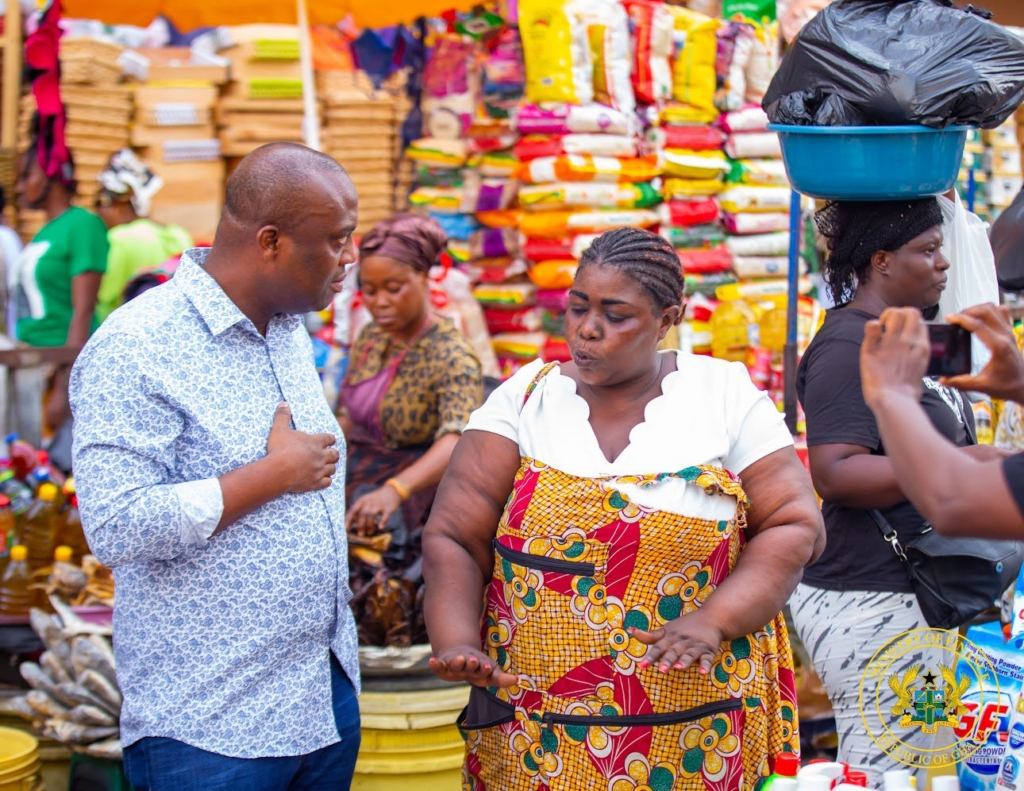
    According to him, this modernized toll collection approach will help optimize revenue generation while minimizing traffic congestion caused by manual toll booths.

    “The government will re-introduce the road toll driven by technology. The reintroduction would generate more revenue for road maintenance and related services,” he stated.

    He also reiterated the government’s commitment to policies that will aid in stabilizing the economy and preventing further financial distress.

    As part of these measures, Dr. Ato Forson announced an increase in the Growth and Sustainability Levy to provide additional economic support.

    “We are making adjustments to the Growth and Sustainability Levy to reinforce economic stability,” he stated.

    To ensure the smooth implementation of road tolls, he emphasized that a technologically advanced system would be put in place to reduce delays and inefficiencies.

    “We will increase the growth and sustainability levy,” he added.

    Additionally, he disclosed that approximately GH¢2.2 billion would be needed to fully recapitalize both the National Investment Bank (NIB) and the Agricultural Development Bank (ADB).

  • Market women understand the economy better than many – Ato Forson

    Market women understand the economy better than many – Ato Forson

    Finance Minister, Dr. Cassiel Ato Forson, has described market women as the country’s most knowledgeable economists.

    Speaking on JoyNews, he explained that their ability to navigate the intricate dynamics of trade played a key role in shaping aspects of the 2025 Budget, which he presented to Parliament on March 11, 2025.

    Dr. Forson noted that despite the complexities of buying and selling, traders effectively manage their businesses, demonstrating remarkable economic expertise.

    “The best economists in this country are market women. They have tried it, they’ve tested it, and they have been successful at it. So, to me, they are the best economists you can ever see around,” he said.

    He stated that the budget, titled “Resetting the Ghana We Want,” was crafted through wide-ranging consultations with key stakeholders, including representatives from the National Economic Forum, traders, and policy think tanks.

    Responding to inquiries about his choice to visit Makola Market for input before delivering the 2025 Budget, he pointed out that one recurring question stood out prominently during previous engagements.

    “The question that kept coming up was how the government is going to address the needs of the people.

    “We held series of meetings to ascertain the needs of the people. Then His Excellency, John Mahama, said I should engage further. I thought we should engage practitioners beyond think tanks and high-level experts, so, I decided to go down to the very basics. That is why I decided to visit the Makola Market,” he said.

    The Finance Minister expressed surprise at how well female traders grasped the direct link between exchange rate fluctuations and price stability.

    “What strongly stood out for me on my visit to Makola Market is the fact that most of the business owners were women,” he added.

    He further noted that the traders identified exchange rate volatility as their biggest challenge.

    According to them, stabilizing the Ghana cedi, as the government has promised, would help curb the unpredictable price increases of their goods.

  • NPP gov’t collected GHC80m from 10% betting tax – Ato Forson

    NPP gov’t collected GHC80m from 10% betting tax – Ato Forson

    Finance Minister Dr. Cassiel Ato Forson has refuted claims that the previous NPP government did not enforce the 10% withholding tax on betting winnings.

    During the presentation of the 2025 budget on Tuesday, Dr. Forson announced the removal of several taxes, including the 10% betting tax.

    However, shortly after his speech, former Finance Minister Dr. Mohammed Amin Adam argued that the NPP administration never implemented the tax.

    “Betting tax that they said they have abolished, we never collected Betting Tax. So to come and tell Ghanaians that you have abolished something that you have not implemented, is to deceive the people of Ghana.”

    In a swift response, the Dr. Ato Forson who appeared on PM Express on the JoyNews channel, debunked those claims on Tuesday night.

    ”I don’t think he is on top of that matter because my checks reveal that it was implemented in the second half of 2024. My checks also reveal that year to date, government of Ghana has collected GH₵ 80 million from the betting tax. So I don’t know what he is talking about. It is not the fact,” he concluded.

    In September 2023, Edward Gyambra from the Domestic Tax Revenue Division of the GRA revealed that the authority collected GH₵15 million each month from betting taxes. He added that by the end of the football season, this amount could increase to GH₵60 million.

    ”During the first month of implementation, we averaged GH¢20 million for the GGR. As for the withholding tax, we’ve just started the betting season, but during the lean season, we averaged GH¢15 million. We anticipate this to quadruple by May,” he concluded.

    By September 2024, the GRA projected to receive GH₵ 1.2 billion ($78.4 million) in betting taxes.

  • NPP govt collected over GHS80m from betting tax – Ato Forson

    NPP govt collected over GHS80m from betting tax – Ato Forson

    Finance Minister Ato Forson has refuted claims by his predecessor, Mohammed Amin Adam, that the previous administration never enforced the betting tax.

    During a press conference on Tuesday, March 11, shortly after delivering the new government’s first budget, Dr. Forson addressed the matter.

    The budget had announced the removal of several levies, including the e-levy and betting tax.

    Meanwhile, Dr. Amin Adam insisted that the NPP government never collected the tax on lottery and sports betting winnings, despite its passage in 2023.

    He argued that it was misleading for the NDC government to take credit for abolishing a tax that was never implemented.

    “Betting tax that they said they have abolished, we never collected Betting Tax. So to come and tell Ghanaians that you have abolished something that you have not implemented, is to deceive the people of Ghana.”

    Speaking on PM Express with Evans Mensah on Tuesday night, Finance Minister Ato Forson dismissed Mohammed Amin Adam’s claim, arguing that his predecessor was misinformed on the issue.

    According to Dr. Forson, checks indicate that the betting tax was enforced in the latter part of 2024, with government revenue records showing that over GH₵80 million had already been collected from it. He stressed that the facts contradict Dr. Amin Adam’s assertion.

    “I don’t think he’s on top of that matter because my checks revealed that it was implemented in the second half of 2024. And my checks also reveal that year-to-date, the government of Ghana has collected over GH₵80 million from betting tax, so I don’t know what he’s talking about. It is not the fact. The fact on the ground does not support his assertion. Clearly, the betting tax was implemented, he insisted.

    The betting tax, which imposed a 10% withholding tax on sports betting and lottery winnings, was introduced by the previous administration. While the policy faced widespread opposition, Dr. Amin Adam insists his government never implemented it before leaving office.

    During the NPP’s manifesto launch in Takoradi in August 2024, then-presidential candidate Dr. Mahamudu Bawumia reaffirmed his pledge to scrap the E-Levy and betting tax if elected.

    He also promised to reduce the withholding tax on small-scale gold exports to 1% to help curb smuggling.

    “We’ll also reduce Withholding Tax for small-scale gold exports to 1% to curb smuggling, and abolish the Betting Tax,” Dr Bawumia promised during the party’s manifesto launch in Takoradi on August 18, 2024.

  • Bill to abolish e-levy, others must be taken through a certificate of urgency – Ato Forson

    Bill to abolish e-levy, others must be taken through a certificate of urgency – Ato Forson

    Finance Minister Dr. Cassiel Ato Forson has emphasized the need for a swift legislative process to abolish several taxes, including the Electronic Transaction Levy (E-Levy), the COVID-19 Levy, and the 10% tax on lottery winnings, commonly referred to as the betting tax.

    Dr. Forson revealed that the bills to repeal these taxes would be presented to Parliament on Wednesday, March 13, under a certificate of urgency to ensure a speedy passage.

    “Tomorrow morning, I will be going to Parliament to submit the bills, and I expect Parliament to take them through a certificate of urgency,” Dr. Forson stated during an interview on JoyNews PM Express on Tuesday, March 11.

    He expressed confidence that repealing these taxes would be straightforward due to their simplicity.

    “Repealing the taxes will be one clause each. Repealing the betting tax is very easy, the e-levy and all of those things we are repealing are quite easy,” he added.

    The Finance Minister explained that since the bills fall under revenue legislation, they qualify to be laid before Parliament under a certificate of urgency.

    “It’s a revenue bill, and under the Constitution, you have any way to lay finance bills under a certificate of urgency,” he explained.

    The proposal to eliminate these taxes aligns with the Mahama-led government’s commitment to scrapping what it describes as “nuisance taxes” implemented by the previous Akufo-Addo administration.

    While presenting the 2025 Budget Statement to Parliament on March 11, Dr. Forson officially announced the plan to repeal multiple taxes.

    “Mr. Speaker, we will abolish the 10% withholding tax on winnings from lotteries, otherwise known as the ‘betting tax.’ We will abolish the Electronic Transfer Levy (E-Levy) of 1%. We will abolish the emission levy on industries and vehicles. We will abolish the VAT on motor vehicle insurance policies. And we will abolish the 1.5% withholding tax on the sale of unprocessed gold by small-scale miners,” he stated.

    He noted that these tax removals aim to alleviate financial burdens on households while boosting business growth and improving tax compliance.

    “…the removal of these taxes will ease the burden on households and improve their disposable incomes. In addition, it will support business growth and improve tax compliance,” he added.

    So far, the government has announced the removal of six taxes: the 10% betting tax, the 1% E-Levy, the emission levy on industries, VAT on motor insurance, the 1.5% withholding tax on unprocessed gold sales, and the COVID-19 levy. These tax repeals will take effect once the 2025 budget is passed by Parliament.

    Despite the anticipated relief for individuals and businesses, some experts and analysts have raised concerns about the potential impact on Ghana’s already struggling economy. In response, the government has outlined measures to mitigate the revenue shortfall, including adjustments to the tax refund ceiling.

    “Mr. Speaker, by reducing the ceiling on the tax refund from 6% to 4%, we will save GH¢3.8 billion. This amount is enough to close the revenue shortfall from the removal of the E-Levy, amounting to GH¢1.9 billion, and the betting tax of GH¢180 million,” Dr. Forson stated.

    Meanwhile, government revenue reports indicate that by the end of 2024, approximately GH¢6.4 billion had been collected from the COVID-19 Health Recovery Levy, GH¢246.9 million from the E-Levy, and about GH¢120 million from other levies.

    The fate of the proposed tax abolitions now rests with Parliament, as the government pushes for an expedited legislative process to implement these changes.

  • Your budget presentation made me proud – John Jinapor to Ato Forson

    Your budget presentation made me proud – John Jinapor to Ato Forson

    Minister for Energy and Green Transition, John Abdulai Jinapor, has commended Finance Minister Dr. Cassiel Ato Forson for his presentation on the 2025 budget.

    Dr. Forson delivered the budget statement to Parliament on Tuesday, March 11, outlining the government’s financial strategies and economic priorities for the year.

    Reacting to the presentation, Mr. Jinapor shared his views on social media, applauding the Finance Minister’s effort.

    He described the budget as comprehensive and forward-thinking, praising Dr. Forson for articulating a clear economic plan.

    “You’ve made me proud, Dr Cassiel Ato Forson. Your presentation was not only detailed but also reflected a deep commitment to the economic transformation of our country,” he wrote.

    Focusing on the budget’s priorities, the Energy Minister underscored policies aimed at bolstering Ghana’s energy sector and advancing sustainable development.

    Acknowledging the economic hurdles, he conveyed optimism about the government’s plans to address them effectively.

    He pointed out that the budget offers practical measures, with a strong emphasis on job creation, infrastructure expansion, and energy security.

    “This budget provides a clear pathway for economic recovery and sustainable growth. I am particularly pleased with the emphasis on renewable energy and local content development,” he added.

    By endorsing the budget presentation, Mr. Jinapor reaffirmed the government’s unified approach to its economic plans.

    His remarks reflect strong internal backing for the Finance Minister’s policies as the administration navigates Ghana’s economic future.

    He encouraged all stakeholders to align with the outlined policies to facilitate their successful execution for the benefit of the nation.

  • 2025 BUDGET : Allocations to various sectors, programmes

    2025 BUDGET : Allocations to various sectors, programmes

    Finance Minister Dr. Cassiel Ato Forson has unveiled the 2025 budget, outlining key financial commitments across sectors such as education, infrastructure, social protection, and disaster relief.

    These allocations are intended to drive economic recovery and support the government’s long-term development agenda by addressing immediate needs while fostering sustainable growth.

    A total of 19 key allocations were highlighted in the budget, including:

    1. GH¢13.85 billion: Allocation for the Big Push Programme.

    2. GH¢499.8 million: Allocation for the No-Academic-Fee policy for first-year students in public tertiary institutions.

    3. GH¢292.4 million: Allocation for the distribution of free sanitary pads to female students in primary and secondary schools.

    4. GH¢242.5 million: Allocation to support victims of the Akosombo dam spillage.

    5. GH¢200 million: Allocation to support victims of the tidal wave disaster in the Ketu South constituency.

    6. GH¢3.5 billion: Allocation for the free secondary education program.

    7. GH¢564.6 million: Allocation for comprehensive provision of free curricula-based textbooks.

    8. GH¢1.788 billion: Allocation for the School Feeding Programme.

    9. GH¢145.5 million: Allocation for the Capitation Grant.

    10. GH¢203 million: Allocation for the payment of teacher trainee allowances.

    11. GH¢480 million: Allocation for the payment of nursing trainee allowances.

    12. GH¢9.93 billion: Allocation for the National Health Insurance Scheme (NHIS).

    13. GH¢2.81 billion: Allocation for the Ghana Road Fund.

    14. GH¢2.81 billion: Allocation for the Ghana Road Fund.

    15. GH¢1.5 billion: Allocation for Agriculture for Economic Transformation Agenda (AETA).

    16. GH¢51.3 million: Allocation as seed fund for the establishment of the Women’s Development Bank.

    17. GH¢300 million: Allocation for the National Apprenticeship Programme.

    18. GH¢100 million: Allocation for the ‘Adwumawura’ Programme.

    19. GH¢100 million: Allocation for the National Coders Programme

  • PLAYBACK: Ato Forson presents 2025 budget to Parliament

    PLAYBACK: Ato Forson presents 2025 budget to Parliament

    Finance Minister Dr. Cassiel Ato Forson has presented the 2025 Budget Statement and Economic Policy to Parliament today.

    This was the Mahama administration’s first major financial plan.

    The budget introduced critical policies aimed at economic stability, fostering growth, and addressing fiscal concerns.

    A key highlight is the proposed abolition of certain contentious taxes, including the Electronic Transfer Levy (E-Levy), the COVID-19 Health Levy, and the Betting Tax.

    These taxes, introduced by the previous administration, have been widely criticized for adding to the financial burden of citizens.

  • Full Speech: 2025 budget by Finance Minister

    Full Speech: 2025 budget by Finance Minister

    Finance Minister Dr. Cassiel Ato Forson presented the 2025 Budget Statement and Economic Policy to Parliament on March 11, 2025. This budget marks the first comprehensive financial roadmap under President John Dramani Mahama’s administration.

    Dr. Forson outlined bold policy measures aimed at stabilizing the economy, fostering growth, and addressing the nation’s fiscal challenges.

    The presentation was made in accordance with Article 179 of the 1992 Constitution and Section 21 (3) of the Public Financial Management Act, 2016 (Act 921).

    Find below the full statement.

  • Destiny shaped my path to Finance Minister – Ato Forson

    Destiny shaped my path to Finance Minister – Ato Forson

    Finance Minister Dr. Cassiel Ato Forson reflected on his public service journey during the presentation of the 2025 Budget Statement in Parliament.

    He described his path as one guided by destiny and enriched with meaningful experiences.

    Looking back on his career, Dr. Forson shared how his journey from a young parliamentarian in 2009 to his current position as Finance Minister had shaped his perspective.

    “Standing here evokes a deep sense of nostalgia as I reflect on my journey in public service. From my early days as a young parliamentarian in this House in 2009, destiny has guided my path—from a backbencher to a member of the Finance Committee, then to Deputy Minister for Finance, Ranking Member on the Finance Committee, Minority Leader, briefly Majority Leader, and now Minister for Finance,” he stated.

    He recalled his progression from a backbencher to a member of the Finance Committee, then to Deputy Minister for Finance, Ranking Member on the Finance Committee, Minority Leader, and briefly, Majority Leader.

    He went on to explain how his extensive experience within the House has prepared him for the challenge of leading the country’s economic recovery, and he reaffirmed his commitment to supporting the President in stabilizing Ghana’s economy.

    “The invaluable experience I gained in this chamber has shaped my perspective, sharpened my focus, and prepared me for the task at hand. I am fully committed to supporting the President in restoring Ghana’s economy,” he added.

  • It seems DDEP was designed to make 2027 and 2028 difficult years – Finance Minister

    It seems DDEP was designed to make 2027 and 2028 difficult years – Finance Minister

    Finance Minister Cassiel Ato Forson has criticized the previous government’s Domestic Debt Exchange Programme (DDEP), saying it was set up in a way that would make repaying debts much harder in 2027 and 2028.

    Presenting the first budget of the Mahama government in Parliament, he expressed surprise that such a plan was approved but promised that his administration would fix it.

    “Right Hon Speaker, it seems the debt restructuring undertaken by the previous administration was designed to make 2027 and 2028 debt repayment heavy, sadly. Mr Speaker I don’t know how come we sat and allowed that design to happen, Mr Speaker that I say we will fix it”.

    About DDEP


    The Domestic Debt Exchange Program (DDEP) was initiated by the Akufo-Addo government in 2023 as part of Ghana’s broader debt restructuring strategy under an International Monetary Fund (IMF) program. The primary goal of the DDEP was to address the country’s economic challenges and restore fiscal stability.

    The program involved restructuring domestic debts, which included issuing new bonds with different terms to replace existing ones. This move aimed to reduce the debt burden and create a more sustainable debt profile for the country.

    The Akufo-Addo administration ensured timely coupon payments to bondholders under the DDEP, with three payments made between August 2023 and December 2024.

    These payments were made in both Payment-In-Cash (PIC) and Payment-In-Kind (PIK) forms, amounting to a total of GH₵17.25 billion in PIC and GH₵9.77 billion in PIK. Additionally, individual bondholders who did not tender their bonds were paid coupons totaling GH₵515.17 million during this period.

    The program faced criticism from some bondholders, but the government maintained its commitment to meeting financial obligations and restoring confidence in Ghana’s financial markets.


  • We inherited an economy in deep crisis – Ato Forson

    We inherited an economy in deep crisis – Ato Forson

    Finance Minister, Cassiel Ato Forson has reiterated concerns over the economic challenges inherited by the National Democratic Congress (NDC) government from the Akufo-Addo administration.

    Presenting the highly anticipated 2025 Budget Statement to Parliament on Tuesday, Dr. Forson described the economy as being in a dire state due to excessive debt, financial sector obligations, and unchecked expenditures.

    “Mr Speaker hands on heart we inherited an economy in deep crisis, Mr Speaker, an economy had hit with debt,.. and financial sector payments. Re-commitment control and reckless spending have reversed the progress made in physical consolidation even under the IMF programme that commenced in the year 2023.

    Despite the measures introduced under the IMF-supported programme, the Finance Minister noted that economic distress persists.

    He attributed this to the heavy sacrifices made by domestic bondholders, external creditors, and taxpayers, emphasizing that the nation is still grappling with the consequences of past mismanagement.

    “Mr Speaker not withstanding the gains made under the IMF supported programme that was to achieve through the painful sacrifice of Domestic Bondholders external creditors and taxpayers the economy remains in distress,” he added.

    The 2025 Budget is expected to outline strategies aimed at restoring economic stability and addressing the fiscal challenges confronting the country.

  • Your needs remain our focus – Finance Minister assures Ghanaians

    Your needs remain our focus – Finance Minister assures Ghanaians

    Finance Minister Dr. Cassiel Ato Forson has reaffirmed the Mahama administration’s commitment to putting the needs of Ghanaians first.

    He highlighted the government’s determination to ensure that national budget decisions genuinely reflect the concerns of the people.

    Dr. Forson shared this message on his X page following a discussion with traders at Accra’s Central Business District.

    “We are deeply grateful to you all our compatriots at Makola who welcomed us with open hearts, sharing your thoughts, fears, challenges, and ideas. We assure you that we will always remain mindful of your needs as a government. we will do all we can to truly represent you. This is just the beginning of many meaningful engagements—we are here to serve you!” he wrote.

    Speaking during a follow-up session on X Spaces with social media influencer KalyJay on Sunday, March 9, Dr. Forson reaffirmed the government’s commitment to fostering continuous engagement and open dialogue with the public.

    “Thank you to the over 60,000 participants who joined our engagement on X! Your input is crucial, and this is just the start of more meaningful interactions. To ensure every voice is heard, we’ve shared a Google Form for those who couldn’t ask their questions directly. Your views matter! The government remains committed to open dialogue and continuous engagement with the people. Stay connected!” he wrote.

    Dr. Forson acknowledged that Ghana’s financial state remains fragile, despite recent interventions.

    He urged caution, warning against complacency, “What we can do is to put together a framework where there will be a stable exchange rate, stable inflation, and a stable economy”.

    He further emphasized the importance of reducing domestic borrowing to allow greater financial resources to reach the private sector.

    Additionally, he highlighted the need for prudent government spending as a means to stimulate business growth and economic expansion.

    “It is very critical for the government to cut expenditure and reduce its appetite for borrowing. In doing so, there will be a lot more resources for the private sector to benefit from,” he stressed.

  • We need a framework to create stable exchange rate, inflation, and economy – Finance Minister

    We need a framework to create stable exchange rate, inflation, and economy – Finance Minister

    Finance Minister Dr. Cassiel Ato Forson has stressed the need for a well-structured economic framework to restore Ghana’s financial stability.

    Speaking during a youth engagement session on X Spaces, hosted by social media influencer KalyJay on Sunday, March 9, Dr. Forson noted that tackling inflation, stabilizing the exchange rate, and fostering overall economic resilience would be the government’s key priorities.

    “What we can do is to put together a framework where there will be a stable exchange rate, stable inflation, and a stable economy,” he said.

    Despite recent measures to address Ghana’s economic difficulties, Dr. Forson acknowledged that the country’s financial situation remains precarious. He warned against any assumption that the economy had fully recovered.

    “Let me make this point: let’s not deceive ourselves that the country is out of the woods yet. Our economy is still in distress, and the first thing we will need to do is to take measures to bring us back to the stability that we deserve,” he cautioned.

    Outlining some of the government’s policy directions, he highlighted plans to cut domestic borrowing and reduce government spending to allow the private sector greater access to financial resources.

    “It is very critical for the government to cut expenditure and reduce its appetite for borrowing. In doing so, there will be a lot more resources for the private sector to benefit from,” he stressed.

    Dr. Forson also reassured the public that their concerns would be factored into the 2025 Budget and Policy Statement. Following his recent interactions with traders at Accra’s Central Business District, he emphasized that the government was actively listening to citizens’ input.

    “I do not take the people of Ghana for granted. I am not here because I just wanted to. I am here because I want to hear your take—ignore the propaganda out there,” he affirmed.

    The 2025 budget, set to be presented on March 11, is expected to outline key policies aimed at stabilizing the economy and laying a foundation for long-term recovery.
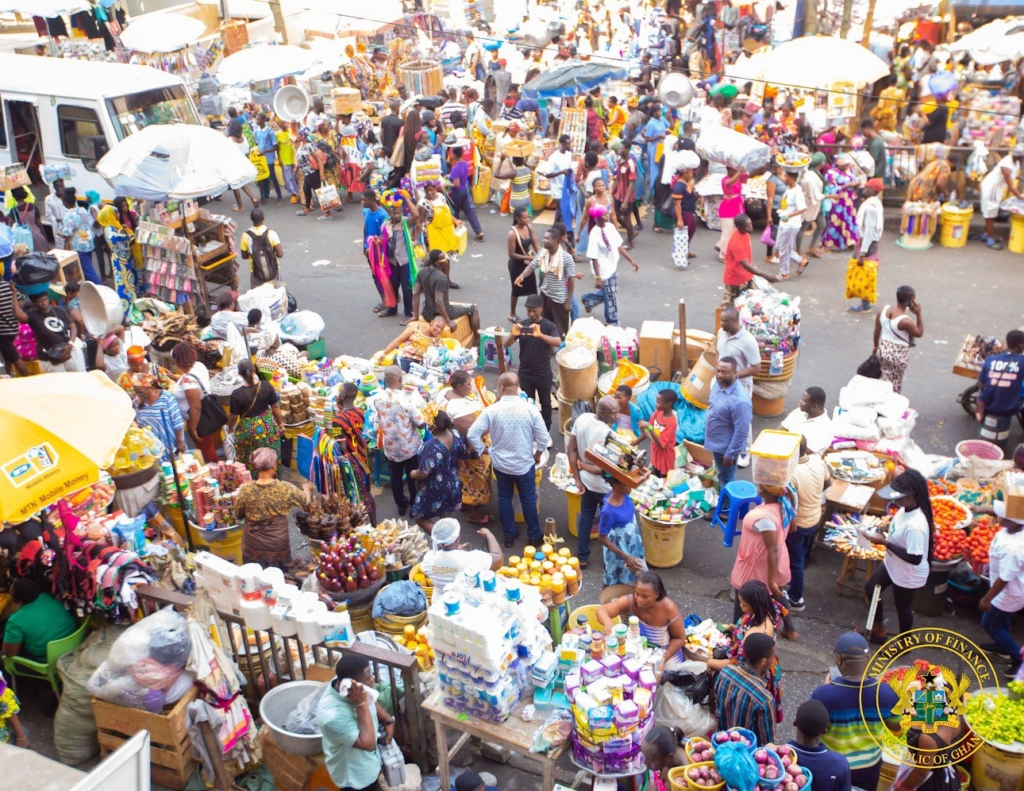
  • 2025 budget: Finance Minister visits, engages market women and kayayei ahead of presentation

    2025 budget: Finance Minister visits, engages market women and kayayei ahead of presentation

    Finance Minister Dr. Cassiel Ato Forson on March 7 wrapped up a meaningful discussion with market women, head porters (kayayei), and traders at Makola Market.

    The engagement allowed him to hear firsthand their concerns and expectations ahead of the 2025 Budget presentation scheduled for Tuesday, March 11.

    Expressing appreciation for the interaction, Dr. Forson described it as a privilege, recognizing the crucial contribution of these hardworking individuals to Ghana’s economic growth.

    “It was a privilege to interact with these hardworking Ghanaians who break their backs daily to support our economy,” he stated, highlighting their contributions to the country’s commercial sector.

    The conversation focused on the economic difficulties facing small-scale traders, such as rising inflation, taxation burdens, and limited access to credit.

    Dr. Forson assured them that their concerns would play a key role in shaping policies for the upcoming budget, emphasizing that their insights are essential in guiding the nation’s economic strategy.

    Their expectations ahead of Budget 2025 will help shape our shared future,” he affirmed.

  • Energy sector has become a ticking time bomb – Ato Forson

    Energy sector has become a ticking time bomb – Ato Forson

    Finance Minister Dr. Cassiel Ato Forson has sounded the alarm over Ghana’s energy sector, describing it as a “ticking time bomb” due to non-cost reflective tariffs and unsustainable energy subsidies.

    Speaking at the first session of the two-day National Economic Dialogue at the Accra International Conference Centre, Dr. Forson warned that the sector’s financial deficits could exceed nine billion dollars by 2026 despite government interventions.

    “The energy sector in Ghana has become a ticking time bomb. More than two per cent of GDP every year. Every year, the profits of the energy sector will probably fall back on the legal side. For citizens, we require radical measures,” he said.

    He pointed to the Electricity Company of Ghana (ECG) as a major concern, citing massive distribution and collection inefficiencies that worsen the sector’s financial struggles.

    “Currently, only 62 per cent of total energy purchase by ECG is collected, leaving out probably 62 per cent. 65 per cent of that amount is used to pay for supplies through the cash quarter for mechanism,” Dr. Forson stated.

    “Unfortunately, 35 per cent of ECG’s revenue is used to take care of ECG themselves over times that they don’t actually work,” he added.

    Dr. Forson lamented the impact of non-cost reflective tariffs, arguing that they fail to cover the actual cost of service provision.

    “In most reflective tariffs, about 50 per cent of cost of service provision is not for us to expect. However, I still maintain that tariffs should not be used to reward ECG’s inefficiencies and other inefficiencies in the system,” he emphasized.

    He disclosed that unpaid legacy arrears in the energy sector had reached $1.3 billion by the end of 2022, with annual cumulative shortfalls climbing to $2.2 billion in 2024, despite significant government funding.

    According to Dr. Forson, the sector’s crisis is fueled by political reluctance to implement cost-reflective tariffs, limited renewable energy adoption, and ECG’s operational inefficiencies.

    “Having generational costs due to lack of politicians and limited renewable capacity in the energy mix is a problem. Having distribution and collection losses at ECG is also a problem,” he stated.

    He urged a comprehensive reform strategy that addresses inefficiencies, promotes renewable energy, and ensures sustainable tariff policies to avert further financial instability.

    Without immediate action, Dr. Forson warned, the worsening financial crisis in the energy sector could pose a severe threat to Ghana’s overall economic stability.

  • Consumers can’t suffer because of your inefficiencies – Ato Forson to ECG

    Consumers can’t suffer because of your inefficiencies – Ato Forson to ECG

    The Electricity Company of Ghana (ECG) is facing a deepening financial crisis, with inefficiencies and revenue shortfalls straining the national budget.

    Finance Minister, Dr. Cassiel Ato Forson, speaking at the National Economic Dialogue, described ECG’s operations as unsustainable.

    He cautioned that without immediate reforms, the energy sector risks collapsing under the weight of growing debt.

    According to Dr. Forson, ECG successfully collects only 62% of the electricity it supplies, leaving nearly 40% unaccounted for—either lost due to technical faults or unpaid.

    “The inefficiencies at ECG are costing the nation heavily. Government transfers to support the energy sector have reached unsustainable levels, yet the company continues to struggle with revenue collection and operational inefficiencies,” he stated.

    This shortfall has forced the government to provide continuous financial support, with budgetary transfers reaching $2.1 billion over the past two years.

    Dr. Forson emphasized that these inefficiencies are severely impacting the economy, as government support for the energy sector has reached unsustainable levels while ECG continues to struggle with operational and revenue challenges.

    “The power sector should be a key driver of industrial growth, but instead, it has become a financial black hole, dragging the entire economy down,” Dr Forson stated.

    Despite ongoing interventions, the company’s financial troubles are deepening, with projections indicating that by 2026, the cumulative deficit in the energy sector could surpass $9 billion, posing a serious risk to Ghana’s economic stability.

    A major part of ECG’s struggle stems from widespread distribution losses, where a significant portion of power supplied is either lost due to system inefficiencies or stolen through illegal connections.

    Additionally, ECG faces persistent challenges in collecting payments from both government institutions and private consumers, leading to large outstanding debts.

    Poor financial management has further compounded the issue, as ECG often fails to meet its payment obligations to power producers, creating a chain reaction of debt across the energy sector.

  • We need bold, strategic decisions to address Ghana’s fiscal challenges – Ato Forson

    We need bold, strategic decisions to address Ghana’s fiscal challenges – Ato Forson

    Finance Minister Dr. Cassiel Ato Forson has underscored the urgency of Ghana’s fiscal crisis, calling for decisive measures to restore economic stability.

    Addressing the opening session of the National Economic Dialogue on Monday, March 3, 2025, Dr. Forson painted a stark picture of the country’s financial difficulties, citing high debt levels, revenue shortfalls, and rising government expenditure as key concerns.

    “We face serious fiscal challenges that demand bold and strategic decisions. We must ensure fiscal discipline and implement reforms that will restore confidence in our economy,” he stated.

    He stressed that overcoming these difficulties would require a collaborative approach involving policymakers, businesses, and citizens.

    Describing the National Economic Dialogue as a crucial platform for solutions, Dr. Forson urged stakeholders to use the discussions as an opportunity to develop forward-thinking policies that prevent future economic downturns.

    “This dialogue is a critical step in assessing our economic situation and finding practical solutions to move our country forward,” he added.

    Reaffirming the government’s commitment to reforms, the Finance Minister assured Ghanaians that efforts were underway to stabilize the economy and create conditions for sustainable growth.

    He encouraged all participants to actively engage in shaping policies that would steer Ghana toward a more resilient financial future.