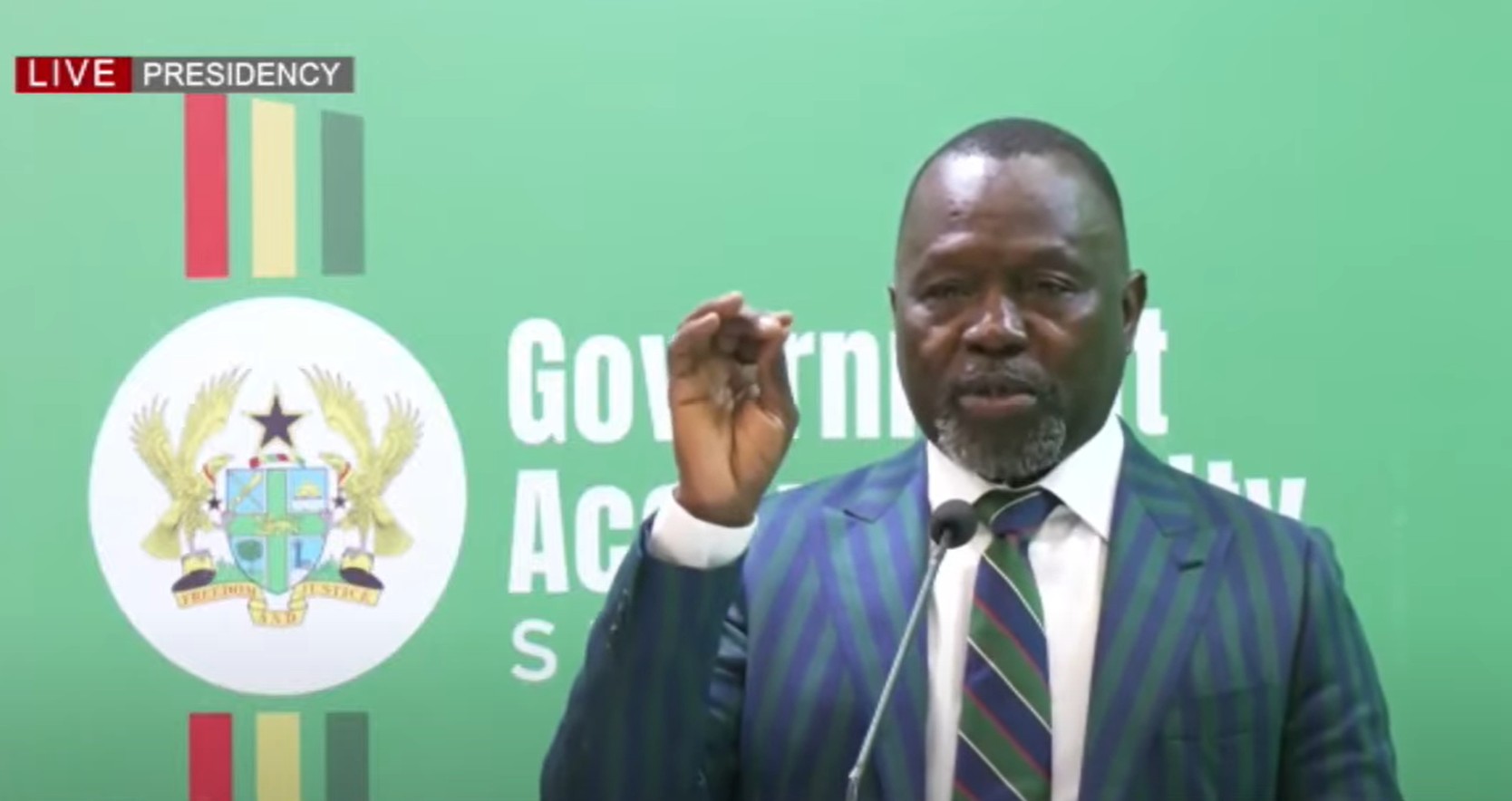
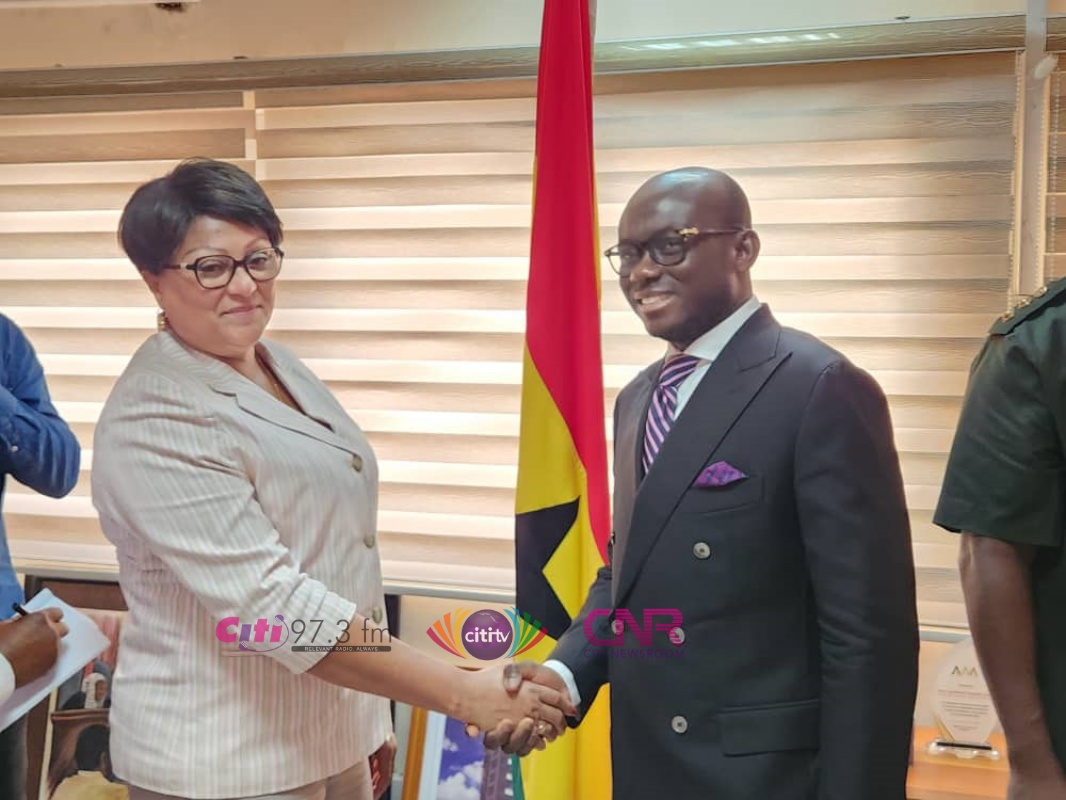
Ghana’s Foreign Affairs Minister, Samuel Okudzeto Ablakwa, has disclosed that the United States government has given its word to Ghana that it will not impede the extradition of former Finance Minister Ken Ofori‑Atta and former MASLOC boss Sedina Tamakloe Attionu.
Mr Ablakwa disclosed after a bilateral meeting held yesterday in Accra with the acting USA Ambassador to Ghana, Rolf Olson and his entourage.
“The United States Government has assured that, without prejudice to judicial processes, it will not stand in the way of Ghana as regards the removal of Ken Ofori‑Atta and Sedina Tamakloe Attionu,” he said.
About Ken’s arrest
On January 7, Ken Ofori-Atta’s lawyers, Menka-Premo, Osei-Bonsu, Bruce-Cathline and Partners issued a statement confirming their client’s arrest by US Immigration and Customs Enforcement (ICE) over his immigration status.
It explained that, “The United States Immigration and Customs Enforcement (ICE), as of yesterday, detained the former Minister for Finance, Mr Ken Ofori-Atta, regarding the status of his current stay in the United States. His US legal team is in contact with ICE and expects the matter to be resolved expeditiously.”
Ken Ofori-Atta left Ghana for the United States on January 4, 2025, according to investigative reporting detailing his departure timeline and visa use. As of today, January 8, 2026, that places his time in the U.S. at approximately 1 year and 4 days, following which he has been detained.
While his lawyers didn’t explicitly state whether he had overstayed his visa time, they noted that “Mr Ofori-Atta has a pending petition for adjustment of status, which authorises a person to stay in the US legally past the period of validity of their visa. Under US law, a change of status by this method is common.”
This comes amid a legal tussle involving Ofori-Atta. The Special Prosecutor, for about eight months, has been making efforts to bring him to Ghana to face the law over some corruption-related issues.
Ofori-Atta, who served as Ghana’s Finance Minister from 2017 to 2023, steered fiscal policy during the COVID-19 pandemic, debt restructuring efforts and IMF negotiations.
His extended stay in the U.S. has coincided with ongoing legal proceedings in Ghana, including corruption-related charges filed by the Office of the Special Prosecutor in November 2025, currently at the case-management stage.
Meanwhile, a request for Ken Ofori-Atta and an alleged accomplice, Ernest Darko Kore, from the United States has formally been submitted by the Attorney General (A-G), Dr Dominic Ayine.
Speaking at the government’s Accountability Series held on Thursday, December 18, Minister for Justice and Attorney General, Dr. Dominic Ayine, said the duo’s extradition processes were initiated by the Office of the Special Prosecutor (OSP) on November 19.
He added that the Attorney General’s Department initially examined the documents related to the case; however, the International Cooperation Unit found that some parts of the paperwork were incomplete.
Dr. Ayine added, “As a result, we communicated our observations to the Office of the Special Prosecutor in a letter dated November 25 and requested additional documentation to ensure completeness.”
He noted that, in response, the OSP finalized the extradition request package on December 9 by providing supplementary documents and addressing the issues raised by the International Cooperation Unit.
The Attorney-General (A-G), Dr Dominic Ayine, would have a difficult time in getting former Finance Minister Ken Ofori-Atta back in Ghana to face corruption charges, private legal practitioner Austin Brako-Powers has noted.
Sedinam case, her prosecution and extradition
Ex-MASLOC CEO Sedinam Tamakloe-Attionu, who was convicted of causing financial loss to the state and sentenced in Ghana in April 2024, has also been a subject of ongoing extradition efforts. She was tried in absentia and has since then been in the USA for nearly two years since her sentence.
The Attorney General said the formal request sent to the US Department of Justice in mid‑2024 remains under review, with authorities awaiting procedural completion.
US Ambassador’s earlier comments on his country’s extradition process
Chargé d’Affaires at the U.S. Embassy in Accra, Rolf Olson, during a media roundtable conversation with visiting Deputy Assistant Secretary for West Africa in the U.S. Department of State’s Bureau of African Affairs, William B. Stevens, on Friday, December 12, 2025, at the U.S. Embassy in Accra, emphasised that, the US government is always open to extradition requests from Ghana however, because the process is structured, and judicially driven, it usually takes time to complete.
“We are always open to receiving extradition requests. That is an important part of any good bilateral relationship, and certainly of ours. The process of evaluating an extradition request on the American side is very well established, but it is not generally very quick. Once we receive a request, it goes through the various mechanisms we have in place,” he said.
As of Monday, December 8, 2025, more than 3,100 people had signed a public petition addressed to the US Embassy in Accra demanding the extradition of former Finance Minister Ken Ofori-Atta.
US-based Ghanaian Professor Stephen Kwaku Asare, also known as Kwaku Azar, started a petition on December 2, asking American authorities to work with the Ghanaian government to help extradite Mr Ofori-Atta, who has been officially charged with economic crimes and corruption-related offences.
However, commenting on whether or not the American government was willing to cooperate with local authorities to trigger any process in the US, Rolf Olson explained that processes for evaluating an extradition request on the American side are “very well-established and it is generally not very quick.”
He added that if the US receives a request, it goes through the various mechanisms. “But the door is always open to requests. There is no individual case that can be prejudged because US judges make the decisions, so they can approve or disapprove a request.”
Mr Rolf Olson revealed that, since President Mahama took office this year, the US government has extradited nine Ghanaians, with the majority of the cases linked to romance scams or what is recently described as “elder crime”.
“Since President Mahama took office at the beginning of the year, Ghana has extradited nine individuals to the United States. Most of them have been involved in cybercrime, or what is commonly referred to as elder crime. These individuals can victimise anyone, and perhaps they already have, though that remains to be established. If proven in court, they are the kind of people who should be in prison, not free to take advantage of others, particularly older persons.
Although anyone could fall victim to such crimes, the idea of being targeted in this way is understandably horrifying,” he stressed.
Government is set to receive more cash in its coffers as President Mahama’s flagship anti‑corruption initiative Operation Recover All Loots (ORAL) pursue it’s asset and cash recovery efforts.
This was announced by the Attorney-General and Minister of Justice, Dr Dominic Ayine, during an appearance on JoyNews Newsfile on Saturday, January 10. Dr Ayine revealed that preliminary checks have already been done on the amount of money that can realistically be recovered within the year.
He said, “We have developed estimates of what is capable of being collected. Very soon, this year, I am sure things will start flowing into the government’s coffers. Money will start flowing into the government chest with respect to ORAL.”
While he anticipates the cash and assets, he is unable to state mathematically whether the amount expected to be recovered in full under the ORAL initiative. GH¢21 billion is projected to be recovered under the anti-corruption drive.
However, the Attorney-General cautioned that he could not state with absolute certainty whether the government would recover the full GH¢21 billion projected under the initiative.
“The question of whether we will be able to get exactly the 21 billion projected is one that I cannot answer with mathematical certainty at this point,” he added.
President Mahama officially launched ORAL on December 18, 2024, barely two-weeks after he won the 2024 elections. Ghanaians have received the Operation Recover All Loot (ORAL) initiative with a mix of optimism and scepticism. While many welcomed it as a bold anti‑corruption drive to reclaim billions in stolen assets, others criticised it as politicised, slow, and more of a performance than a genuine legal process.
However, Dr Ayine clarified that his outfit, in collaboration with the Economic and Organised Crime Office (EOCO) and the National Intelligence Bureau (NIB) are working both locally and internationally to track and recover misappropriated state funds.
He noted that, very soon, their coordinated efforts would produce tangible results and the anticipated results Ghanaians want to see, and in turn draw some money into state coffers, reinforcing the government’s commitment to accountability and the protection of public resources.
“Extensive work is currently underway, both locally and internationally, to track and recover misappropriated state funds. On the local front, my office is working closely with the Economic and Organised Crime Office (EOCO) and the National Intelligence Bureau (NIB). In addition, there is a special clandestine investigations team that reports directly to me. I am confident that the coordinated efforts of local agencies and foreign partners will soon translate into tangible financial recoveries for the state, reinforcing our commitment to accountability and the protection of public resources.”
Meanwhile, President John Dramani Mahama in June last year, stated that in due course, 33 former government appointees have been implicated in corruption-related cases in the Operation Recover All Loot (ORAL) Team report will face prosecution.
President Mahama, while addressing the African Union Advisory Board Against Corruption at the Jubilee House on Tuesday, 3 June, noted that the Attorney General (A-G), Dr Dominic Ayine, is preparing the cases for judicial proceedings.
“We set up the ORAL Committee, and they have identified 33 cases, which were handed over to the Attorney General. We have created special investigative teams to investigate each of them,” he said.
“Some of them have found a lot of evidence of the procurement of properties with illicit wealth. With many of them, they are just at the point of beginning prosecution. Some have also started the prosecution, and others are being lined up.”
Operation Recover All Loot (ORAL)is an initiative set up by the president to gather information on corruption to the appropriate government institutions for further investigation.
The committee is chaired by Samuel Okudzeto Ablakwa, who also serves as the Member of Parliament (MP) for North Tongu.
The other members include former Auditor-General Daniel Domelevo, retired Police Commissioner Nathaniel Kofi Boakye, legal practitioner Martin Kpebu, and investigative journalist Raymond Archer — all renowned for their integrity and strong stance against corruption.Currently, the hundreds of issues presented by the ORAL team to President John Mahama are being investigated by the Attorney-General and Minister for Justice, Dr. Dominic Ayine.
Additionally, its work has increased public awareness about the importance of protecting state resources.
The committee’s report has revealed that approximately $21.19 billion in potential recoveries are from misappropriated state assets and undervalued land transactions.
ORAL Chairman Samuel Okudzeto Ablakwa has indicated that “If we are successful in recoveries, we can retrieve as much as 20.49 billion United States dollars.”
Among the key cases cited were the National Cathedral project, the Power Distribution Services (PDS) deal, and the Saltpond decommissioning project.
Meanwhile, President Mahama has dismissed allegations that ORAL is being used for political vendettas, reassuring that the initiative is purely intended to strengthen Ghana’s anti-corruption efforts.
A request for the extradition of former Finance Minister Ken Ofori-Atta and an alleged accomplice, Ernest Darko Kore, from the United States has formally been submitted by the Attorney General (A-G), Dr. Dominic Ayine.
Speaking at the government’s Accountability Series held on Thursday, December 18, Minister for Justice and Attorney General, Dr. Dominic Ayine, said the duo’s extradition processes were initiated by the Office of the Special Prosecutor (OSP) on November 19.
He added that the Attorney General’s Department initially examined the documents related to the case; however, the International Cooperation Unit found that some parts of the paperwork were incomplete.
Dr. Ayine added, “As a result, we communicated our observations to the Office of the Special Prosecutor in a letter dated November 25 and requested additional documentation to ensure completeness.”
He noted that, in response, the OSP finalized the extradition request package on December 9 by providing supplementary documents and addressing the issues raised by the International Cooperation Unit.
Dr. Ayine added that the completed extradition request was subsequently forwarded to the Ministry of Foreign Affairs on December 10 for onward transmission to the appropriate authorities in the United States, specifically the Department of Justice, to conclude the process.
Adding, “At this point, it is left to the authorities of the United States, particularly the judicial authorities, to determine whether there is sufficient basis for the two accused persons to be extradited to Ghana to stand trial.”
Ofori-Atta continues to be a central figure in a legal battle, despite his current health condition. Ofori-Atta appeared on Interpol’s website for “using public office for profit” after being declared wanted by the OSP.
This followed his failure to appear before the Office of the Special Prosecutor (OSP) on Monday, June 2. His lawyers are said to have formally communicated the development to the OSP and the Human Rights Court, submitting medical reports that detail his current condition and outline scheduled surgical procedures.
The OSP, during an engagement with the press on Tuesday, June 3, noted the failure of the former minister to inform the OSP of changes in medical procedures that were to have happened in March of this year.
“He has failed to show any medical report that shows he is a medical risk. We want him physically, and we insist on it,” the OSP said, while noting that Mr. Ofori-Atta cannot indicate the mode of investigation. “His conduct is totally unacceptable. We will no longer tolerate him,” the OSP noted.
Later, the legal representatives of the former finance minister informed the OSP that their client is currently undergoing medical treatment in the United States and is unable to honor an invitation for questioning.
Ofori-Atta then assured the OSP of his commitment to appearing for questioning on a fixed date, which influenced the OSP’s decision to temporarily take his name off the list in March.
However, the office stressed that he is legally obligated to show up on June 2. Failure to do so would result in an Interpol Red Notice being issued and extradition proceedings being initiated in any country where he may be located.
Ken Ofori-Atta then took legal steps to block the OSP from re-declaring him wanted. His lawsuit argues that the agency’s actions are baseless and unjustified.
Ofori-Atta has dismissed allegations of financial misconduct and corruption, insisting that he has been cooperating with investigators through his legal representatives.
In his court filing, he contends that the OSP’s actions have inflicted serious harm on his reputation and personal life. He is seeking a legal injunction to prevent further declarations against him until the case is fully resolved.
The Human Rights Court adjourned to June 18 for a ruling on the motion filed by the former Finance Minister, seeking to restrain the OSP from declaring him wanted, among other reliefs. In February, the OSP declared Ofori-Atta wanted for causing financial loss to the state in several dealings.
These dealings include contractual arrangements between Strategic Mobilisation Ghana Limited (SML) and the Ghana Revenue Authority, aimed at enhancing revenue assurance in the downstream petroleum sector, upstream petroleum production, and the minerals and metals resource value chain.
They also include the termination of a distribution, loss reduction, and associated network improvement project contract between the Electricity Company of Ghana Limited and Beijing Xhao Chen Technology BXC.
Other issues involve the procurement of contractors, materials, and activities, as well as payments related to the National Cathedral project.
Additionally, activities and payments connected to a contract awarded by the Ministry of Health—initially commenced by the Ministry for Special Development Initiative—to service Ghana Auto Group Limited for the purchase, after-sales service, and maintenance of 307 Mercedes-Benz Sprinter 304 5 CDI Ambulances for the National Ambulance Service are included.
Finally, payments from and utilization of the tax refund account of the Ghana Revenue Authority were also cited.
INTERPOL Red Notice
A Red Notice is a request to law enforcement worldwide to locate and provisionally arrest a person pending extradition, surrender, or similar legal action. It is based on an arrest warrant or court order issued by the judicial authorities in the requesting country. Member countries apply their own laws in deciding whether to arrest a person.
INTERPOL cannot compel the law enforcement authorities in any country to arrest someone who is the subject of a Red Notice. Each member country decides what legal value it gives to a Red Notice and the authority of its law enforcement officers to make arrests.
Attorney General (A-G), Dr. Dominic Ayine, has indicated that extraditing former Finance Minister Ken Ofori-Atta to Ghana cannot be done solely based on a formal request.
Speaking at the Government Accountability Series in Accra on Wednesday, October 22, Dr. Ayine emphasized that one of the key requirements for extradition is a comprehensive docket containing documents, evidence, and details related to the charges against the former Finance Minister.
The Attorney-General, who also serves as the Minister for Justice, noted that his office is yet to receive the docket from the Special Prosecutor, Kissi Agyebeng.
However, he added that the Office of the Attorney-General has already begun the formal processes and will conclude arrangements for Ofori-Atta’s return to Ghana once the Office of the Special Prosecutor finalizes its part.
“Without the docket, we cannot make a request, so we’re still waiting for the docket. I have read everything said by the Special Prosecutor [Kissi Agyebeng] and his office. I respect his office and the autonomy of the office. But we in the Attorney General’s department cannot begin an extradition request with a letter. We need the evidence to do so. So, the formal processes have started,” he stated.
The clarification comes at a time when there are speculations that the Office of the Special Prosecutor and the Attorney General are dragging their feet on the matter. In June, Prof. Mrs. Angela Ofori-Atta, wife of the former Finance Minister, Ken Ofori-Atta, indicated that her husband will return to Ghana after his doctor’s approval.
Speaking to Joy News, she noted that Ofori-Atta’s absence is not an attempt to escape scrutiny, but a result of his current health condition.
“He has never not been accountable. This is not Ken Ofori-Atta, who runs away from accountability. I don’t think there is any other home but Ghana, no, Ghana is home,” she stated. “So why are we holding back on the investigation? Why would he [the OSP] not give the video?” she added.
Ofori-Atta continues to be a central figure in a legal battle, despite his current health condition. Ofori-Atta appeared on Interpol’s website for “using public office for profit” after being declared wanted by the OSP.
This was after he failed to appear before the Office of Special Prosecutor (OSP) on Monday, June 2. His lawyers are said to have formally communicated the development to the OSP and the Human Rights Court, submitting medical reports that detail his current condition and outline scheduled surgical procedures.
The OSP during an engagement with the press on Tuesday, June 3, noted the failure of the former minister to inform the OSP of changes in medical procedure that were to have happened in March of this year.
“He has failed to show any medical report that shows he is a medical risk.We want him physically, and we insist on it,” the OSP said, while noting that Mr Ofori-Atta cannot indicate the mode of investigation. His conduct is totally unacceptable. We will no longer tolerate him,” the OSP noted.
In February, the OSP declared Ofori-Atta wanted for causing financial loss to the state in several dealings, which include the following:
Contractual arrangement between Strategic Mobilisation Ghana Limited and the Ghana Revenue Authority for the stated objective of the enhancement of revenue assurance in the downstream petroleum sector, upstream petroleum production, and minerals and metals resource value chain.
Termination of a distribution, loss reduction, and associated network improvement project contract between the Electricity Company of Ghana Limited and Beijing Xhao Chen Technology BXC.
Procurement of contractors and materials, activities, and payments in respect of the National Cathedral project Activities and payments in respect of a contract awarded by the Ministry of Health initially commenced by the Ministry for Special Development Initiative to service Ghana Auto Group Limited for purchases and after-sales service and maintenance of 307 Mercedes-Benz Sprinter 304 5 CDI Ambulances for the National Ambulance Service.
Payments out of and utilization of the tax refund account of the Ghana Revenue Authority. Later, the legal representatives of the former finance minister informed the OSP that their client is currently undergoing medical treatment in the United States and is unable to honor an invitation for questioning.
Ofori-Atta then assured the OSP of its commitment to appearing for questioning on a fixed date, which influenced the OSP’s decision to take his name off the list in March.
However, the office stressed that he is legally obligated to show up on June 2. Failure to do so, an Interpol Red Notice would be issued and extradition proceedings would be initiated in any country where he may be located.
Ken Ofori-Atta then took legal steps to block the OSP from re-declaring him wanted. His lawsuit argues that the agency’s actions are baseless and unjustified.
Ofori-Atta has dismissed allegations of financial misconduct and corruption, insisting that he has been cooperating with investigators through his legal representatives.
In his court filing, he contends that the OSP’s actions have inflicted serious harm on his reputation and personal life. He is seeking a legal injunction to prevent further declarations against him until the case is fully resolved.
The Human Rights Court has adjourned to June 18 for a ruling on the motion filed by the former Finance Minister, seeking to restrain the OSP from declaring him wanted, among other reliefs.
INTERPOL Red Notice
A Red Notice is a request to law enforcement worldwide to locate and provisionally arrest a person pending extradition, surrender, or similar legal action.
It is based on an arrest warrant or court order issued by the judicial authorities in the requesting country. Member countries apply their own laws in deciding whether to arrest a person.
INTERPOL cannot compel the law enforcement authorities in any country to arrest someone who is the subject of a Red Notice. Each member country decides what legal value it gives to a Red Notice and the authority of their law enforcement officers to make arrests.
The investigation into the alleged illegal mining activities of Akonta Mining Limited, involving the Ashanti Regional Chairman of the New Patriotic Party (NPP), Bernard Antwi Boasiako, popularly known as Chairman Wontumi, has begun.
Wontumi is expected to appear before the Criminal Investigations Department (CID) of the Ghana Police Service today, Monday, October 6, for interrogations. On Monday, May 26, this year, the CID summoned Chairman Wontumi who is the owner of Akonta Mining over over allegations of illegal mining activities linked to the company’s operations.
His legal counsel, former Attorney General Godfred Yeboah Dame, and the former Member of Parliament for Asante-Akim North, Andy Appiah-Kubi accompanied him when he made his first appearance at the CID.
The Minister for Lands and Natural Resources, Emmanuel Armah-Kofi Buah in April revoked the company’s mining license for illegal mining activities within the Tano Nimiri Forest Reserve in the Western North Region.
The Minister explained that Akonta Mining has extended its illegal activities to the Aboi and Tano Nimiri Forest Reserves in the despite possessing a valid license to operate outside of forest reserves. Reacting to the Minister’s statement, the company refuted claims leveled against its operations.
It emphasised in a press statement, “We are not responsible for the activities in the Tano Nimiri Forest Reserve. That responsibility lies solely with the Forestry Commission and the Ministry of Lands and Natural Resources”.
The company added that such claims is a deliberate attempt by the Minister to tarnish the reputation of the company.
“The decision by the Minister to publicly accuse us and call for the revocation of our license without any investigation or hearing is not just unfair, it is a clear breach of natural justice and a politically motivated act,” the company said.
Chairman Wontumi’s expected reappearance comes at a time when there is mounting pressure on the Mahama-led administration to end illegal mining activities in the country.
The menace continues to threaten not only Ghana’s waterbodies, food crops and forest reserves but also the country’s energy infrastructure.
In a meeting with Civil Society Organisations (CSOs)on Friday, October 3, President John Dramani Mahama noted that he can only declare a state of emergency over the issue when his government’s advisors approve it.
According to him, government advisors believe the country can overcome galamsey by adopting best practices in small-scale mining, including technologies that help neutralize or remove harmful chemicals from water bodies.
President Mahama believes that the country can eradicate the long-term canker if it deploys more troops as well as invests more resources in the fight. He concluded that the battle seems to be a long one, but his administration is committed to fighting it.
“While we are fighting the menace, I am also saying we should uptake technology in order to protect the environment. So yes let’s fight the illegal mining but at the same time, let’s bring the new technology that will help us protect our environment.
“Now with the elephant in the room, state of emergency, yes, I have the power to do it, but the president acts on the advice of the National Security Council, and as at now, this moment, the National Security Council believes that we can win the fight against galamsey, declaring a state of emergency. I want to assure you that the day they advise me otherwise, that boss, now we need a state of emergency, I won’t hesitate,” he added.
Meanwhile, the Parliamentary Select Committee on Energy has given a stern warning about the potential future repercussions of galamsey if the country fails to find a lasting solution to the menace.
During a visit to the Anwomaso Thermal Power Station in Kumasi on Wednesday October 1, Deputy Ranking Member, Collins Adomako-Mensah, starling revelation about how Ghana’s power installations are being tempered with by illegal miners.
According to him, the country’s electricity generation authorities including the Ghana Grid Company (GRIDCo), the Bui Power Authority (BPA), WAPCO Gas Pipeline and the Volta River Authority risk shutting down over attacks on their infrastructure.
“When we were engaging the other participants, two things came up- one has to do with galamsey and it is having a heavy, heavy toll on the energy sector, not just about water. Gridco complained about galamsey. Their pylons, people are digging where they have a lot of their pylons. Yesterday we were at Bui and the Bui water situation is deteriorating because of the galamsey situation surrounding their water bodies.
He added, “Gridco complained about galamsey. Their pylons, people are digging where they have a lot of their pylons. Yesterday we were at Bui and the Bui water situation is deteriorating because of the galamsey situation surrounding their water bodies.”
In September, GRIDCo expressed grave concern over the encroachment on its transmission tower sites by galamsey operators, who are digging dangerously close to the foundations.
Acting Deputy Chief Executive Officer of Engineering and Operations, Frank Otchere, made this known at GRIDCo headquarters in Tema on Thursday, September 25.
Mr. Otchere stated that maintenance teams now face attacks when they attempt to access certain areas.
“Unfortunately, there are some areas that even when our maintenance teams go there, they get shot at. And some of them have had to run away,” he disclosed, adding that the situation has made it impossible for GRIDCo to operate in certain locations without security support.
He added that the galamseyers are weakening the towers, which are carefully engineered to withstand immense weight and pressure. He appealed for urgent assistance from national security agencies to protect transmission corridors and avert the potential collapse of towers.
“This engagement aims to provide a platform for frank and constructive dialogue between the Government and civil society on the menace of illegal mining, with a view to harnessing collective expertise, perspectives, and solutions to address this national challenge,” the letter stated.
Ongoing research by a forensic histopathologist and former Head of Pathology at KNUST and Komfo Anokye Teaching Hospital (KATH), Prof. Dr Paul Poku Sampene Ossei, has revealed alarming trends in the rising cases of spontaneous abortions among pregnant women in Ghana.
Approximately five hundred cases of spontaneous abortions (miscarriages) have been recorded in research that links these cases to severe contamination of placentas and the presence of heavy metals, such as lead and mercury, resulting from galamsey activities.
A spontaneous abortion is the unintentional expulsion of an embryo or fetus from the uterus before it is viable.Speaking on JoyNews’ Newsfile on Saturday, September 27, Prof. Sampene warned that galamsey is poisoning unborn babies and endangering the lives of mothers.
“I have about 500 cases where women go to the hospital and abort their babies because of the concentration of these heavy metals in their placenta,” he disclosed.
According to him, his research involved over 4,000 placentas examined from different regions across Ghana. The results showed dangerous levels of heavy metal contamination on both the maternal and foetal sides. “The placentas are all contaminated, polluted with heavy metals,” he said.
The dangers of these metals extend beyond pregnancy losses. Another effect of galamsey is the excessive use of alum to address the increasing turbidity of water.
Ghana Water Company Limited, the nation’s largest water supplier, has resorted to using higher concentrations of alum. Prof. Sampene cautioned that high levels of aluminium hydroxide pose serious health risks.
According to him, one of the consequences of excessive alum use is kidney disease, which is already on the rise. He warned that if left unchecked, “Ghana will be in big trouble.”
“Of course, people are talking about turbidity, and then the Water Company is saying that they are using more alum. Alum is aluminium hydroxide, that is the full name, aluminium hydroxide, and this aluminium hydroxide, when taken for a long period, in fact at higher concentration, has a lot of what you call health effects. One of them is kidney problems.
“When you use alum, that’s aluminium hydroxide, which is used to purify the water, especially when they are using that concentration, which I believe is so high, it’s going to cause kidney problems, it’s going to irritate the respiratory tract, and it’s going to cause what we call neurological defects.
“All these things have been proven, have been studied and proven to be important, and we have to be very careful about them now. This goes apart from the effects that we are seeing around,” he explained.
Among the recent measures taken to protect water bodies from illegal miners is the deployment of the National Anti-Illegal Mining Operations Secretariat (NAIMOS).
The Secretariat includes the Ghana Armed Forces, the Ghana Police Service, the Ghana Immigration Service, the National Intelligence Bureau (NIB), the Narcotics Control Commission, and the National Security Secretariat.
Addressing the security forces, the Minister for Lands and Natural Resources, Emmanuel Amarh Kofi-Buah, directed the team to ruthlessly counter the activities of galamsey operators as they are the enemies of the state.
“Any recalcitrant entering into these zones is not merely a trespasser. They are an enemy of the state. You are to be firm. You are to be resolute. You are to be ruthless.
“And please, take it from me, you will take no obstructionist instruction from any big man. Remember, the biggest man in Ghana is the President of the Republic, and he’s the one who has sent you,” Mr Kofi-Buah charged.
The Office of the Attorney General has broken its silence on the reasons behind the Liberal Party of Ghana (LPG’s) Percival Kofi Akpaloo’s arrest, three days after his apprehension.
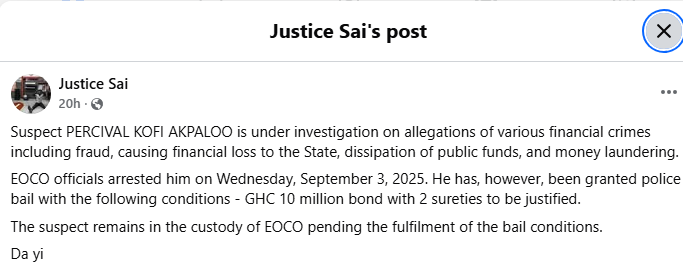
In a post on Facebook detailing the causes of his arrest, the Deputy Attorney General, Justice Srem-Sai, confirmed that Percival Kofi Akpaloo, leader and 2024 presidential candidate of the LPG, is under active investigation for alleged financial misappropriation and other related misconduct.
According to the A-G’s post, “Suspect PERCIVAL KOFI AKPALOO is under investigation on allegations of various financial crimes, including fraud, causing financial loss to the State, dissipation of public funds, and money laundering”.
He continued that, while a GH¢ 10million police bail has been approved for Akapaloo, he remains in custody as he has yet to meet the conditions. Akpaloo was arrested by the Economic and Organised Crime Office (EOCO) on Wednesday, September 3, in Kumasi.
“EOCO officials arrested him on Wednesday, September 3,2025. He has, however, been granted police bail with the following conditions – GHC 10 million bond with 2 sureties to be justified. The suspect remains in the custody of EOCO pending the fulfilment of the bail conditions”, the A-G highlighted.
Mr Akpaloo vied for presidency in the 2024 general elections. Prior to the election, Akpaloo expressed strong confidence in his chances for a decisive win, predicting victory over major contenders. However, he obtained 5,219 being 0.09%.
The new development has got many questioning the circumstances surrounding Kofi Akpaloo’s arrest. Recently, EOCO has been investigating high-profile political figures and business leaders.
The Economic and Organised Crime Office was established by the Economic and Organised Crime Office Act , 2010 (Act 804) as a specialized agency to monitor and investigate economic and organised crime and on the authority of the Attorney-General prosecute these offenses to recover the proceeds of crime and provide for related matters.
The EOCO has similar mandates to the Office of the Special Prosecutor (OSP). Recently, the OSP released a fifty-page report covering investigations and prosecutions carried out between January 1 and July 31 this year.
The OSP’s Seventh Half-yearly Report is pursuant to Section 3(3) of the Office of the Special Prosecutor Act, 2017 (Act 959). The document also outlines key developments in the Office’s operations.
According to the OSP, despite resistance from powerful interests, it stayed focused on executing its mandate during this period. As such, the Office successfully progressed significant corruption-related investigations to the stage of court proceedings, while also initiating new inquiries into suspected acts of corruption.
“Then again, the Office, as one of three implementing partners of the new National Ethics and Anti-Corruption Strategy and Implementing Plan, is fashioning and moulding anti-corruption structures that would stand the test of time. The task ahead remains formidable. Much more so is our resolve to perform.
“This reporting period was characterised by intensification of the Office’s prosecutorial mandate. We advanced high-profile investigations to court and initiated bold inquiries into suspected corruption, often in the face of deep-seated resistance from entrenched interests.
“Notwithstanding these expected challenges, the Office remains resolute and guided by the rule of law, fairness, firmness, evidence-based action, and the interest of the public. We recognise that the fight against corruption cannot be waged and won only through punitive action and incarceration,” parts of the report read.
The legislative framework of the Office of the Special Prosecutor mandates the Authority to crack down on corruption, recover assets, and confiscate illicit property.
“Indeed, the legislative set-up of the Office leans heavily on corruption-prevention and asset recovery and disgorgement of tainted property. Consequently, we proceed on sustainable anti-corruption outcomes by pairing enforcement with robust prevention and asset recovery, especially founded on our unique plea bargaining regime.
In this spirit, the Office scaled up its preventive mandate through active engagement with public institutions, private sector actors, civil society- and secured convictions and asset recovery through impactful plea bargaining. We also reckon that the nation’s anti-corruption legal framework requires re-imagination, modernisation and retooling to address the immense scale and complexity of modern corruption in the context of our social, economic and political constructs.
“On this score, the Office has proposed the inclusion of a new chapter in the Constitution dedicated to the fight against corruption through definitive constitutional expression by the institution of proposed concrete measures to effectively and comprehensively suppress and repress corruption in public life as well as in the private sector chief among which include lifestyle audit non-conviction-based asset recovery, enhanced asset declaration and verification regime, and reverse onus presumption of corruption as the foundation of both anti-corruption criminal proceedings and civil asset recovery proceedings,” parts of the report added.
The Office is also leading the charge in respect of the passage of a comprehensive Corrupt Practices Act and Conduct of Public Officers Act.
Currently, sixty-seven(67) cases are being handled by the Office, all of which are undergoing comprehensive review.
The corruption cases being investigated by OSP include: Minerals Income Investment Fund, Ghana Airports Company Limited, Ghana Education Service, National Commission on Culture, Ghana Revenue Authority/Tata Consulting Services, National Service Authority, Ministry of Health/Service Ghana Auto Group Limited, National Cathedral.
The others are: Tema oil refinery and Tema Energy and Processing Limited and the Electricity Company of Ghana Limited, State lands, Stool lands, and other Vested lands, Illegal Mining, National Sports Authority, Customs Division of Ghana Revenue Authority, Bank of Ghana and Estate of Kwadwo Owusu-Afriyie, alias Sir John.
It further hinted that “There were seven (7) convictions and one (1) acquittal in respect of the cases pending before the criminal courts during the period under review. The Office has filed an appeal in respect of the case in which the accused was acquitted.
Additionally, one hundred and fifty-two (152) cases are at the preliminary investigation stage, with the OSP assuring that details will be made public once they progress to the next stage.
The Office is also seized with one hundred and fifty-two (152) other cases at the preliminary investigation stage. These may be publicised if the Special Prosecutor determines that they are within the mandate of the Office and that they should be moved past the preliminary investigation stage.
This is a policy intended to protect the privacy of individuals and the business operations of institutions and companies, and to avoid unnecessary stigmatization.
Veteran Ghanaian actor Agya Koo has revealed that he narrowly escaped becoming a victim of the infamous occultist, Dr. Sri Yogi Ram Beckley, during his early years hustling as a cobbler on the streets of Accra.
Speaking on his Tete Mmofra Online TV podcast, the actor recounted how an unknown woman’s timely intervention saved him from stepping into the ritualist’s notorious Fadama residence.
“Someone called me to come and work for him. I turned around, and upon seeing the house, I had the inclination that there was going to be a lot of money to make, which was natural thinking for cobblers when we are called to work in a big house,” he recalled.
Just as he was about to enter, a woman urgently called him from behind, pleading with him to fix her shoe instead. Though reluctant at first, her persistence made him change his mind.
“As soon as I got closer to the woman, she warned me not to go into the house. She repeated herself, to my shock, and pushed some money into my palm and directed me to leave immediately. As soon as I left the place, the owner of the big house, who turned out to be Dr. Beckley, was arrested two days later,” he revealed.
Dr. Sri Yogi Ram Beckley was a medical doctor and alleged occultist who became notorious in the 1990s and early 2000s for his suspected involvement in ritual killings. Based in Accra, he was widely feared for reportedly kidnapping schoolchildren and women for human sacrifices.
In 1994, a police raid on his home in Fadama uncovered human skulls and school uniforms, triggering public outrage that led to his house being set ablaze by an angry mob. Although he was arrested and faced multiple charges, he was released on bail and managed to evade prosecution in some cases due to legal technicalities.
He resurfaced in 2002 in Gbawe, Accra, where he was accused of abducting two teenage girls. One was tied to a tree while the other was dragged into his home. The missing girl was never found, and another furious mob torched his house once again. His actions left a lasting scar on the country, forcing parents to take extreme precautions to protect their children.
Attorney General Godfred Yeboah Dame has urged Ghanaians to adopt the spirit of peace and unity embodied by Christmas, calling on the public to consider the principles that bring the nation together.
During an interview with Joy FM, the Attorney General highlighted the critical role of peace, particularly in the wake of the 2024 General Election.
“At Christmas, it is my wish that the peace of Christ would indeed permeate every home and resonate in the minds and hearts of the people,” Mr Dame said.
He recognized the country’s advancement in upholding a stable democracy, pointing out that while elections have generally been peaceful, there have been sporadic instances of violence that have tarnished the process.
“We must recognise that what binds us as a people is greater than the few things that divide us,” he remarked.
The Attorney General encouraged Ghanaians to handle post-election issues with a strong respect for the rule of law and a dedication to maintaining peace.
“I pray that we, as a people, will once again demonstrate our tenacity and responsibility for peace by ensuring that all post-election matters are resolved on balance and in law,” he stated.
Mr. Dame expressed pride in Ghana’s democratic achievements, highlighting the significant progress the country has made over the years.
“Democracy is a gift that many nations are still struggling to achieve. It is a system we have embraced as a way of life, and we should take pride in what we have achieved,” he said.
He urged citizens to value the stability democracy offers, describing it as a vital legacy that should be safeguarded for the generations to come.
“We have determined for ourselves a leader for the next four years, and it is essential that we resolve any disputes peacefully to further consolidate our democracy,” he added.
As the Christmas season progresses, the Attorney General reminded Ghanaians of the importance of unity and peace in fostering national growth.
“Let us ensure that the spirit of Christmas—peace, love, and togetherness—guides our actions in the coming days and beyond,” he concluded.
Attorney General (AG) hassubmitted initial disclosure documents it plans to use in the trial of Bishop Elisha Salifu Amoako, founder of Alive Chapel International, and his wife, Mouha Amoako, concerning an accident involving their underage son.
The incident led to the tragic deaths of two young girls in East Legon.
According to a report by Daily Guide Network, the Attorney General’s Office has not yet filed witness statements for individuals expected to testify in the case.
These statements will be used to support the charge against the couple for “permitting an unlicensed person to drive.”
Assistant State Attorney Yaw Acquah informed the court on Wednesday, November 13, 2024, that the prosecution had filed the first set of disclosure documents, which were still pending service to the defence.
The court directed Yaw Acquah to file the remaining documents by Thursday, November 28, 2024, in preparation for a case management conference.
In earlier proceedings, the court heard that Salifu Amoako and his wife had admitted to allowing their underage son to operate the vehicle.
Their son,isfacing a total of eight charges,including two counts of manslaughter, three counts of negligently causing harm, two counts of dangerous driving, and one count of driving without a valid license.
Attorney General Godfred Yeboah Dame has argued that the Speaker of Parliament, Alban Bagbin, should rely on the Attorney General’s office rather than his personal lawyers in the ongoing Supreme Court case concerning the status of four legislators.
The Supreme Court had earlier paused the execution of the Speaker’s ruling, which sought to declare the seats of these Members of Parliament vacant after they decided to contest as independent candidates ahead of the upcoming general election.
Dame stated that it falls under his office’s authority to represent public officeholders in legal matters, including the Speaker. “The Constitution designates the Attorney General as the defendant in all actions involving the government, including its parliamentary arm,” he emphasized.
Clarifying further, Dame noted, “The first defendant (the Speaker) is not even a proper party to the proceedings before the court, and his absence will not impede the court’s ability to proceed with the hearing of the matter.” He added, “It is even improper for the first defendant to be joined in this action; the proper defendant should solely be the Attorney General.”
The Attorney General’s remarks came after Bagbin’s indication that he would engage personal counsel for the case, which Dame argued was unnecessary for the court’s adjudication of the matter.
Earlier, the Supreme Court dismissed an application by the Speaker seeking to overturn its earlier decision to stay his declaration on the parliamentarians’ seats. This legal development follows a suit initially filed by Effutu MP Alexander Afenyo-Markin, who challenged Bagbin’s ruling.
The Speaker’s legal team argued the Supreme Court lacked jurisdiction over the matter, along with other grounds presented in court. The court has adjourned the substantive case to November 11, with Chief Justice Gertrude Torkornoo giving Bagbin until Wednesday, November 6, to file necessary documents.
The Attorney-General and Minister for Justice, Godfred Yeboah Dame, has emphasised the need to reform the legal regulatory processes governing international arbitration in Africa.
In his view, the rapidly evolving business climate in Africa and the increasing tendency for introduction of alternative dispute resolution clauses into commercial agreements the impact of arbitration on the economies of African countries cannot be underestimated.
Mr. Dame made these and other remarks in his keynote address as Guest of Honour at the African Regional forum held as part of the International Bar Association’s annual conference in Mexico City, Mexico on Thursday, 19th September, 2024. Founded in 1947, the International Bar Association is the foremost international bar association of international legal practitioners, bar associations and law societies.
The membership comprises of over 80,000 individual international lawyers from the world’s leading law firms, 190 law bar associations and law societies in over 170 countries. The annual conference of the International Bar Association opened on Sunday, 15th September, 2024 with remarks from former Mexican President, Ernesto Zedilo.
“For all its touted advantages, it is indisputable that the nature of arbitration itself, especially the secrecy of proceedings and finality of awards, except in few very exceptional circumstances, implies that in some situations, it becomes an unwitting vehicle for perpetrating fraud and abuse against the people of Africa. It is quite curious that in some instances, companies which fail to make out any claim in domestic courts of African countries succeed in extremely huge international arbitration actions, sometimes mounted on the back of contracts which have failed to receive the relevant statutory and constitutional approvals of the countries in which they operate.”
“This phenomenon is not because of a weakness of the judicial systems of African countries but simply because of the nature of international arbitration, particularly the secrecy of proceedings, flexibility of rules and the finality or non-appealability of awards, which I have just alluded to.” Godfred Dame stated.
The Attorney-General observed that international arbitration has become the principal means for resolving disputes between governments and private persons. Rather unfortunately, he noted that such disputes often end up being contested at huge cost outside Africa, with London, Paris and New York being the most popular seats for arbitration.
Even when African disputes involve two African parties, the cases tend to be subject to either the rules of the International Chamber of Commerce (ICC) or London Court of International Arbitration (LCIA) rules, and arbitration takes place with the seats being London, Paris, New York or Singapore. He noted that this development limits the opportunities for African arbitrators and stunts the development of the continent’s prowess in arbitration whilst also coming at enormous expense to the continent.
Making reference to a recent arbitration award of over 11 billion US dollars (US$11bn) against the Government of Nigeria in international arbitration in a claim by a small offshore gas company, Process & Industrial Development Limited (P&ID), which was eventually set aside by the High Court of London in October, 2023, Mr. Dame stated that Africa suffers a lot of prejudice in the international arbitration arena.
“Whilst international arbitration is touted to assure neutrality, privacy and efficiency in the adjudication of disputes, it cannot be disputed that African countries have been at the receiving end of some obnoxious and perverse awards. We cannot discount the prejudice Africa often suffers in international arbitration fora. We must all work towards the establishment of a justice system that guarantees all elements of the rule of law necessarily produces a business operating environment characterized by transparency, certainty and fairness.”
Mr. Dame deplored the negative aspects of international arbitration which harm Africa and stated that there was the need to reform.
“I should not be misconstrued as saying that Africa should shy away from international arbitration. Far from that. What I advocate for is a sober reflection on the regime for handling international arbitration on the African continent and a reform of same. The vulnerability of arbitration to abuse and fraud exposes the need for more robust safeguards in commercial disputes involving state parties, where the hard-earned purse of the nation is at stake. I deem it incompatible with the sovereignty of African nations for most of our international arbitration matters to be heard in foreign jurisdictions and with foreign countries being the seat of arbitration. “
“It is a truism that an arbitration is international not because of the forum or place of hearing, but largely because of the parties involved and the underlying transaction. If this is the case, then there is the need to work to make Africa a highly respected home for arbitration in cases emanating from Africa. I suggest that African nations must take steps to ensure that most international arbitrations involving them take place in their respective countries and are regulated by the laws of their own countries.”
The Attorney-General cited the case of Ghana which he noted, is taking steps to reform the regime for the conduct and hearing of arbitration involving the nation.
“It is pertinent to indicate that Ghana seeks to make further reform to the pursuit of arbitration against the state. The nation is currently undertaking processes to ensure the passage of a law, an amendment to her State (Property and Contracts) Act, 1960, to mandate all contracts involving the State and its agencies as parties, to not only stipulate Ghana law as the governing law but also to have Ghana as the seat of arbitration and with the ADR Centre in Accra being the venue for the arbitration. With this amendment, the practice whereby the State and Ghanaian lawyers travel to various jurisdictions – Paris, New York, London, Singapore, etc. for the conduct of arbitration involving the Government of Ghana and where arbitral awards are enforced all over the world at enormous cost to the State, and in jurisdictions with legal systems alien to Ghana’s, will cease and will be consigned to history,” the A-G stated.
Remove global regulatory barriers
The Attorney-General and Minister for Justice also urged global leaders, particularly regulators of the legal profession around the world, to take a second look at rules regulating the practice of law across borders in view of the circumstances of the world finds itself in.
Mr. Dame observed that “a virtualised world”, which the global community now is, implies that “law practice generally has assumed cross-border characteristics. The local jurisdiction in which law is practised is open to the world. African lawyers thus have to be world class, working as part of an open global community to resolve modern-day disputes, many of which have cross border elements.” Reflecting on the nature of legal practice around the continent and the world and the effect of globalisation on law practice, the Attorney-General had this to say.
“If our practice is essentially and unavoidably international or cross- border, then there must be a rethink of the legal framework regulating the practice of lawyers in our respective domestic settings. We must remove the barriers of licensing regimes which constrain the capacity of lawyers to appear in jurisdictions other than where they were trained to practise, if our practice is indeed, international.
Mr. Dame however said he was realistic in this call and that he was aware that countries may have different legal systems, different systems for training of lawyers, different licensing regimes and different standards for scrutinising and assessing compliance with rules of professional conduct and ethics.
However, in his view, “international legal practice has shown the way. Nations appear before regional courts, international tribunals and arbitration panels constituted to adjudicate cases in accordance with law. The lawyers representing them do not require a specific licensing to appear before such panels. Therefore, it can be done. We can begin with a common understanding to provide for state counsel or lawyers who are constitutionally and statutorily empowered in their respective countries to represent nations in disputes, to be able to, without the inhibition of the requirement for licence to practise, appear freely in domestic courts of other countries when disputes involving the nation occurs.”
Godfred Yeboah Dame further stated that “for instance, it is incongruous for state counsel to be able to appear before an arbitration panel seated in London or Nairobi without the requirement of a specific licence but the same state counsel cannot appear before the London High Court or the Nairobi High Court to defend his nation in proceedings to enforce the award resulting from the arbitration after the conclusion of the arbitration proceedings, simply because the state counsel is not qualified to practise in either London or Nairobi, as the case may be. We ought to begin the process of removing the regulatory barriers to the appearance of lawyers qualified in other jurisdictions in such proceedings. Such an exception will become the fulcrum for the development of a blueprint for a gradual harmonisation of legal training standards and ethics and the removal of regulatory barriers.”
The impact of African Continental Free Trade Area on law practice
Ghana’s Attorney-General and Minister for Justice also spoke about the impact of the integration of the African continent on law practice.
He observed that the African Continental Free Trade Area, expected to connect 1.3 billion people, create a $3.4 trillion economic bloc, and above all boost commerce within the African continent, is envisioned as the largest free zone since the establishment of the World Trade Organization in 1994.
“The African lawyer’s role in the resolution of disputes has been heightened by the setting up of AfCTA. Whereas countries have their own courts of first instance and appellate structures, the AfCFTA also has an established dispute settlement mechanism to hear trade disputes brought by aggrieved State parties.”
Godfred Dame noted that the setting up of the AfCFTA Dispute Settlement Body has the tendency to raise questions bordering on conflicts with the statutorily recognised structures for dispute resolution in individual countries as well as questions bordering on the sovereignty of nations.
He stated that the political endorsement by African states of the Dispute Settlement Body will ensure that the rulings of panels and the Appellate Body of AfCTA will become part of the legal acquis of African legal systems in order to bring legal security, certainty and predictability, and transparency. He observed that in addition to the firm political will of African states, the authority of the
AfCTA’s dispute resolution mechanisms can only be established through the cooperation of lawyers around the continent.
“I urge you all to support the AfCTA in its work, particularly, in ensuring that the dispute settlement body launched 3 years ago succeed. Respectfully, there must be a deliberate effort to train the African lawyer in the benefits, complexities and requirements for dispute adjudication in the regional integration body. African lawyers have to be voices in promoting the benefits of regional integration and the global multilateral trading system,” the A-G stated.
Speaking at the Annual Conference of the Ghana Bar Association 2024 today Monday, 9th September, 2024, in Kumasi, Ashanti Region, under the theme: “Peaceful, fair and transparent elections: the key to sustainable democracy,” Lawyer Dame confidently asserted that Ghana’s judicial system under his watch, has seen the judiciary operating free from external influence, particularly in cases involving the State.
According to the Attorney-General, the quality of judgments coming from Ghanaian courts speaks volumes about the independence of the judiciary.
“Ghana has gained a reputation worldwide for its justice system. Central to that reputation is the independence, integrity of the Judiciary and quality of judgements emanating from our courts, with decisions sometimes cited in courts in other jurisdictions.
I can confidently say that I have been an Attorney-General in whose tenure the Judiciary has demonstrated complete independence and strength through decisions it gives in cases involving the State” he boasted.
Meanhwile, the2023 Annual Conference of the Ghana Bar Association (GBA)took place in Cape Coast from September 9 to 15, 2023.
The theme of the event was “Ensuring High Standards and Integrity in Public Life – The Role of the Legal Profession”
Recent developments in the Wyllbee murder case indicate that all pertinent documents and evidence have been sent to the Attorney General‘s Office for further direction.
The latest court session, held on August 27, 2024, at the Akropong District Court, has resulted in the case being adjourned until September 30, 2024.
There is a possibility that the case may be elevated to a higher court based on the Attorney General’s recommendations.
The family, who gave an exclusive statement to the media, remains hopeful for a favorable resolution.
Wyllbee’s mother voiced her frustration and anger about the presence of her son’s alleged assailants in court, expressing her reliance on divine justice.
Background:
Wyllbee was fatally attacked in Abuakwa-Tanoso, Ashanti Region, while staying at Nana Yaa Nyarko’s residence.
It was reported that Nana Yaa’s husband’s family, who live abroad, were unaware of Wyllbee’s visit.
On July 5, 2024, Wyllbee was seen urinating in the compound and faced hostility from residents who suspected him of theft.
Despite his claims of visiting Nana Yaa, she allegedly denied knowing him, possibly to protect her marriage from her in-laws.
This denial intensified suspicions, leading to Wyllbee being lynched. Additionally, Wyllbee’s phone was smashed with a stone during the incident.
The Ghana School of Law has been referred to the Attorney General for potential prosecution following alleged violations.
The Auditor General’s report highlighted that the school breached the Procurement Act in acquiring items worth over GH₵300,000 from 17 different entities in 2021 and 2022.
This issue was raised at the Public Accounts Committee meeting on Wednesday, August 14, 2024.
Despite the school’s attempt to justify bypassing legal procedures in their procurement process, PAC Chairman James Klutse Avedzi dismissed their explanations.
“You have admitted that you have flouted so we will recommend you for prosecution,” he said.
Despite the School’s request for pardon, the Chairman indicated that “what we can do is to refer you to the court that the court will set you free.”
“We don’t have that power here to do it. We can only recommend you, then the one that has the power will listen to your plea, go home free and don’t do it again” he added.
The Attorney General has submitted into evidence the dismissal letter of the third accused, Richard Jakpa, in the case of the Republic, Minority leader, Cassiel Ato Forson and others.
This was to establish that Mr Jakpa’s departure from the Armed Forces was due to misconduct, contradicting his claim of an honorable discharge during cross-examination by the Director of Public Prosecutions.
The dismissal letter was issued by the Ghana Armed Forces in 2007.
The dismissal letter, read aloud in court, reveals Jakpa’s removal from the Ghana Army in November 2007 “for unsatisfactory conduct marked by fraudulent conduct, abrasiveness, general indiscipline” asserting that his behavior was incompatible with the Army’s standards of decency and gentlemanly conduct.
Signed by Brigadier General MKG Ahiaglo on behalf of the Chief of the Army Staff at the time, the letter also highlights Jakpa’s failure to advance to the rank of Captain despite eligibility, leading to his discharge due to inefficiency.
Before the Attorney General presented the dismissal letter, Richard Jakpa’s lawyer, Thaddeus Sory, objected in court, arguing that Jakpa had not been given the opportunity to identify or associate with all the documents sought to be tendered as evidence.
“We are objecting to the tendering of the letter addressed to the Attorney General through the witness. We also object to the document dated 12 September 2007, the addressee of which is not stated and also not copied to the accused person.
“The witness was not even given the benefit of identifying, let alone associating with these documents. He was only made to identify the letter dated 22 October 2007, and he explained that he had knowledge of it and could speak to it. No background was laid in respect of the first two letters which justify the tendering of those two letters through him, especially that he had denied knowledge of the other letters,” Mr Sory said in open court.
In response, Deputy Attorney General Alfred Tuah-Yeboah countered that the documents were relevant to Jakpa’s case as they pertained to his military release and were crucial in assessing his character.
Justice Afia Serwah Asare-Botwe, after considering arguments from both sides, ruled that all documents presented by the Attorney General were relevant and admissible, noting that Jakpa had acknowledged them and could speak to their contents.
During cross-examination, Jakpa admitted that his company received 28.7% of the government payment to Big Sea under an ambulance contract, totaling approximately 700,000 Euros.
The court session has been adjourned to Tuesday, July 2, 2024, for the Attorney General to continue cross-examining Richard Jakpa, with expectations that the process will conclude in the coming week.
Richard Jakpa, the businessman accused of causing financial loss of €2.37 million to the state in an ambulance deal with the Minority leader, Ato Forson has admitted that his company received 28.7% of the amount paid by the government to Big Sea under the Ambulance contract.
This amounts to approximately €700,000.
Mr Jakpa made this admission during cross-examination by the Attorney General (AG), Godfred Yeboah Dame.
When questioned about the Agency Agreement signed with Big Sea Limited, which entitled him to 10% of all monies paid under the Ambulance Contract, Mr Jakpa responded,”That is so but it is not my total entitlement. I was entitled to more by other clauses under the Agreement”.
Mr. Dame further pressed, “Out of the about €2.3 million paid by the Government to Big Sea under the Ambulance Contract, you and Jakpa at Business earned 28.7% of it. In fact, about €700,000 was paid to you.”
Jakpa stated “Yes, that was the amount paid to Jakpa at Business as an Agent”.
Additionally, Mr Jakpa refuted allegations that he approached Big Sea for the purchase of ambulances after receiving parliamentary approval.
He clarified that Big Sea was already known to the Ministry of Health and Ministry of Finance prior to the approval.
He pointed out that the agency agreement between Big Sea and Jakpa@business Limited was established on May 24, 2011, whereas parliamentary approval for the ambulance procurement occurred on November 1, 2012, more than a year later.
The ongoing trial involves a former Deputy Minister of Finance and the Minority Leader, Dr. Cassiel Ato Forson, alongside a former Chief Director of the Ministry of Health, Sylvester Anemana, and Richard Jakpa.
They have been accused of causing financial loss of €2.37 million to the state in a deal to purchase 200 ambulances for the country between 2014 and 2016.
Dr. Forson, who is also the National Democratic Congress (NDC) Member of Parliament for Ajumako Enyan Esiam and the Ranking Member on the Finance Committee of Parliament, faces charges alongside his co-accused.
On November 19, 2012, Mr Anemana is said to have written to the Public Procurement Authority (PPA) seeking approval to engage Big Sea through single sourcing for the supply of 200 ambulances.
By an agreement dated December 19, 2012, the Ministry of Health formally contracted Big Sea General Trading, based in Dubai, for the supply of 200 Mercedes Benz ambulances at a contract sum of €15.8 million, with a unit price of €79,000.
The delivery terms stipulated that the first batch of 25 vehicles should be delivered within 120 days of the agreement, with the remaining 175 vehicles to be delivered in batches of 25 every 30 days.
In a significant development in the ongoing ambulance procurement trial, the prosecution has for the first time admitted that Attorney General Godfred Yeboah Dame met with the 3rd accused person, Richard Jakpa, at the residence of Supreme Court judge, Justice Yonny Kulendi.
However, the prosecution clarified that the meeting was not arranged and that Richard Jakpa coincidentally “only appeared” at the judge’s residence when the Attorney General was visiting.
This affirmation by the prosecution was the first time they confirmed what Richard Jakpa had previously stated during cross-examination, that he had met Godfred Yeboah Dame at Justice Yonny Kulendi’s house on several occasions.
The revelation came during a question put to Richard Jakpa by the Director of Public Prosecution, Yvonne Atakora Obuobisa, who stated that “he (Richard Jakpa) only appeared at Justice Kulendi’s house when the Attorney General was there.”
Justice Yonny Kulendi
In response, Richard Jakpa denied the assertion, stating that it was the Attorney General who ambushed him at his cousin’s house. He further explained that he had spoken with the Attorney General on Justice Kulendi’s phone when he was securing his bail, contradicting the prosecution’s claim that there was no arrangement for the meeting.
The prosecution suggested that there was no evidence of the Attorney General arranging the meeting in the WhatsApp chats between him and Richard Jakpa. However, Richard Jakpa argued that he had asked for a meeting with the Attorney General and not an arrangement, noting that the Attorney General had the opportunity to decline his request.
The trial judge and lawyer for Richard Jakpa, Thaddeus Sory, engaged in an altercation over the manner in which the 3rd accused was answering questions. After the heated exchange, Richard Jakpa continued his testimony, stating that the Attorney General had put into action the text message he had sent to him to meet at Justice Kulendi’s house, where he felt comfortable.
The prosecution will continue to cross-examine the 3rd accused next week, but the exact date is yet to be determined.
Richard Jakpa, the third accused in the ongoing ambulance trial in Accra High Court, took the stand again on June 20, 2024.
His first cross-examination two days earlier was explosive, facing questions from Director of Public Prosecution Yvonne Attakorah Obuobisa.
The Attorney-General Godfred Dame and his deputy Alfred Tuah-Yeboah were both present in court during this session.
Jakpa’s testimony on June 20 highlighted the admission of 68 WhatsApp chats by the prosecution. This was to counter an edited version previously presented by Jakpa.
Justice Afia Serwah Asare-Botwe admitted these messages for the completeness of evidence, fairness to the trial, and reciprocity, despite objections from Jakpa’s lawyer, Thaddeus Sory, who questioned their relevance and authenticity, according to a report by thelawplatform.online.
“Relying on section 52 of NRCD 232, Evidence Act (1972), Mr. Sory said the admission of the messages would pose a danger of unfairly prejudicing the trial. He said there are missing parts of the conversation between the 3rd accused, Richard Jakpa, and the A-G and therefore does not give a complete picture of the correspondence between the two.
“He also argued that the processes already filed in court suggest that the A-G did not read the messages and thus the chat is not relevant for the purposes the A-G wishes to have the WhatsApp conversation tendered,” part of the thelawplatform.online report reads.
Broken Promise and Animosity Towards Dame
Jakpa revealed the reasons for his deep animosity towards Attorney-General Godfred Yeboah Dame. He recounted a secret meeting with Dame that was supposed to result in his discharge from the trial. However, despite the agreement, Jakpa was added to the list of accused and had to present his defense.
He claimed to have provided documents to Dame that were later used to strengthen the prosecution’s case. The DPP refuted this, stating that the documents were submitted by the prosecution five months before Jakpa’s meeting with the A-G.
Jakpa also mentioned a broken promise made by Dame at the residence of his cousin, Justice Yonny Kulendi. He described his animosity towards Dame as stemming from this unfulfilled promise.
Kulendi Links and Declaration of War
Justice Yonny Kulendi played a significant role in Jakpa’s story. Jakpa recalled a promise made at Kulendi’s home to ensure his acquittal, which Dame did not fulfil. This led to Jakpa’s declaration of war against Dame.
“I wasn’t surprised by the ruling to open defense because I’m familiar with the government’s tactics of not honouring agreements with perceived political adversaries,” Jakpa stated.
He shared how he messaged Justice Kulendi about being asked to open his defense, to which Kulendi suggested Dame might contact him.
“The night I learned of the broken promise was the night I declared war on the A-G,” Jakpa declared. He vowed to use his ‘underworld skills’ against Dame’s legal expertise, indicating a personal battle regardless of the trial’s outcome.
Jakpa emphasized that the conflict was not just about potential incarceration but also about the pain, reputational damage, and loss he has suffered, which he believes cannot be compensated by an acquittal alone.
“He is using his law skills and knowledge to take my liberty away from me unjustly, and I’m also going to use my underworld skills to pay him and deal with him. Use what you know best in your law, and I’ll also use what I know best on the street and we will see who will survive,” Jakpa told the court.
Despite attempts to calm him down, Jakpa affirmed that the battle line had already been drawn.
Richard Jakpa, the third accused in the ongoing ambulance case, faced intense cross-examination by Dr. Cassiel Ato Forson’s legal team on Thursday, June 13.
The cross-examination followed the admission of an audio recording involving the Attorney-General and Jakpa into evidence earlier in the day. Here are the major takeaways from Jakpa’s testimony:
1. Promise of Exoneration by Attorney-General:
Jakpa revealed under oath that Attorney-General Godfred Dame had promised to secure his exoneration by the conclusion of the trial.
This assurance led Jakpa to cooperate fully and share important documents with the Attorney-General, believing that Dame would support him.
2. Meetings at Justice Yonny Kulendi’s Residence:
Jakpa disclosed that he had four meetings with the Attorney-General, some of which took place at the residence of Supreme Court Justice Yonny Kulendi, who is Jakpa’s cousin.
While Jakpa initiated the first meeting, subsequent meetings were arranged at the insistence of the Attorney-General.
3. Targeting of Dr. Ato Forson:
Jakpa asserted that Godfred Dame explicitly stated that the primary target of the case was Dr. Cassiel Ato Forson, the current Member of Parliament for Ajumako Enyan Esiam Constituency and Minority Leader.
Jakpa claimed that he was added to the case to deflect attention from Dr. Forson.
4. Standard Procedures for Interacting with Government:
Jakpa detailed his standard procedures for interacting with the Ghanaian government as a businessman. According to him, communications typically originate from Secretaries of Chief Directors or Deputy Ministers, who forward letters to the office of the substantive Minister of Finance for approval.
Only then could the Controller and Accountant General’s Department (CAGD) or the Bank of Ghana (BoG) proceed with implementing the instructions contained in the letter.
These revelations shed light on the intricacies of the case and the interactions between Jakpa, the Attorney-General, and other key players.
Richard Jakpa, the third accused in the ongoing trial of Dr. Ato Forson, on Thursday, June 13, revealed during cross-examination that he had requested and attended meetings with the learned Attorney-General.
Mr Jakpa stated that he met the Attorney-General four times, facilitated through Justice Kulendi, to explain why he believed the charges against him were unfounded.
He asserted that these meetings allowed him to provide a comprehensive explanation of his situation. He detailed a conversation between himself and the Attorney-General in the presence of Supreme Court judge, Justice Yonny Kulendi, during the cross-examination led by Dr. Bassit Bamba, the lawyer for Dr. Ato Forson.
In his testimony, Mr Jakpa expressed the view that the prosecution was driven by political motives, aimed at discrediting the Minority Leader, Dr. Ato Forson, and forcing a by-election.
He suggested that the current government’s handling of the ambulance procurement and implementation process was the real issue, not his actions.
Mr Jakpa contended that the state and the current government failed to follow the implementation letter, leading to the ambulances being deemed unfit.
He argued that the accessories meant to be fitted into the ambulances had not yet been cleared and installed, thus the ambulances could not be declared unfit for their intended purpose.
The cross-examination by Dr. Bassit Bamba concluded, with Jakpa providing extensive answers that implied the state bore responsibility for the issues with the ambulances.
Following the conclusion of the defense’s cross-examination, the state began its cross-examination of Jakpa, which will continue on Tuesday, June 18, 2024.
Reflecting on the flurry of news encompassing his tenure, here is a comprehensive profile of the nation’s youngest Attorney General ever.
Born on 5th June, 1979, Godfred Yeboah Dame obtained his GCE Ordinary Level and Advanced Level Certificates from Adisadel College between 1989 and 1996. He graduated with a Bachelor of Laws degree (LLB) in 2001.
He proceeded to the Ghana School of Law from where he obtained his professional law qualification in 2003. On being called to the Bar in October, 2003, Godfred Yeboah Dame commenced his professional law practice with the firm of Messrs. Akufo-Addo, Prempeh & Co., an elite law firm in Ghana, specializing in various aspects of civil litigation.
Godfred Yeboah Dame rapidly and firmly established himself as one of Ghana’s leading advocates, conducting with a remarkable degree of success many of the politically important trials and constitutional cases in the Superior Courts of Ghana.
In 2006, in recognition of his contribution towards the defence of media and human rights, rule of law and civil liberties generally in Ghana, Mr. Dame was one of a few lawyers from across Africa and the rest of the world awarded the Open Society Initiative Fellowship, and selected to pursue the Programme in Comparative Media Law and Policy (PCMLP) at the University of Oxford’s Centre for Socio-Legal Studies.
Mr Dame’s active law practice saw him take charge of a significant number of high profile and landmark cases in the Supreme Court of Ghana which contributed to the advancement of constitutional law, human rights, criminal law and good governance in the country, including serving as counsel for the New Patriotic Party (NPP) for the party between 2012 and 2016.
In 2016, he was a member of the NPP Manifesto Committee on Governance which drafted the Party’s proposed policies for the Legal and Governance Sector. In 2013, together with three of the Party’s former Attorneys-General, Hon. Papa Owusu-Ankomah, Hon. Ayikoi Otoo and Hon. Joe Ghartey, he was appointed to review the 2013 Election Petition Verdict and come up with proposals to avoid a defeat of the Party in the 2016 elections which would result in another election petition, after having already served as one of the counsel for the Petitioners in the Election Petition.
From 2011 to 2016, Godfred Dame was part of the teaching faculty for Company Law and Practice at the Ghana School of Law. In January, 2017, he was appointed as a teacher in Advocacy and Legal Ethics at the Ghana School of Law, a commitment he was unable to fulfill as a result of his appointment as Deputy Attorney-General and Deputy Minister for Justice in President Akufo-Addo’s first term as President. He also served on very sensitive committees of the Ghana Bar Association contributing to the formulation of policy in the training of lawyers, notable among them being the Pupilage and Juniors Committee, which is concerned with the upholding of standards among junior practitioners of the law. In 2014, he was appointed member of the Ghana Bar Association’s legal team.
Mr. Dame, between 2009 and 2017, served as the Vice-Chairman of the Disciplinary Committee of the Ghana Football Association. Prior to that, from 2008 to 2009, he had been Chairman of the Greater-Accra Regional Football Association’s Disciplinary Committee. From 2011 to 2017, he was also a member of the Ghana Football Association Elections Committee.
As Deputy Attorney-General and Deputy Minister for Justice of Ghana from 2017 – 2012, he distinguished himself in active defence of the Government in various high-profile law suits against the Government and international arbitration involving the Government of Ghana. He transformed the image of the Attorney-General’s Office into a formidable force in litigation. He served on the Legal Service Board, the Ministerial Advisory Board of the Ministry of Justice, the Board of the Public Procurement Authority and the Board of the University of Ghana Medical Centre.
On 21st January, 2021, Godfred Yeboah Dame was nominated by President Akufo-Addo to the position of Attorney-General and Minister for Justice of the Republic of Ghana. His nomination received the approval of the Parliament of Ghana in accordance with the Constitution of Ghana and he was sworn in to office on 5th March, 2021, making him the youngest Attorney-General and Minister for Justice in the history of the nation. He was 41 when appointed. Mr. Dame has further distinguished himself in that office with his able defence of the Government and provision of sound and efficient legal advice.
In his current role as Attorney-General of Ghana, he has ensured a departure of the practice of the State hiring foreign counsel for representation of its interests in international arbitration and other international cases. He has achieved very remarkable success in that regard with the State going record as emerging victorious and avoiding huge judgment debts.
Mr. Dame is a member of the National Security Council, the Police Council, the Judicial Council, the General Legal Council, the Board of Legal Education, Public-Private Partnership Committee and the Legal Service Board.
He is a Christian and married to Dr. Joycelyn Assimeng Dame, a medical doctor with whom he has two children.
Throughout his career, Dame has been an active member of the Ghana Bar Association, serving on various committees, including the Pupilage and Juniors Committee, aimed at upholding standards among junior practitioners.
He was also part of the Ghana Bar Association’s legal team in 2014.
Beyond the legal realm, Dame has made significant contributions to sports administration.
He served as Vice-Chairman of the Disciplinary Committee of the Ghana Football Association from 2009 to 2017 and chaired the Greater-Accra Regional Football Association’s Disciplinary Committee from 2008 to 2009.
Additionally, he was a member of the Ghana Football Association Elections Committee from 2011 to 2017.
Since assuming the roles of Deputy Attorney-General and Deputy Minister for Justice in 2017, Dame has distinguished himself in defending the Government in high-profile lawsuits and international arbitration cases, transforming the Attorney-General’s Office into a formidable entity in litigation.
Notably, he spearheaded the Government’s endeavours to reclaim funds from businessman Alfred Agbesi Woyome, terminated three mining leases granted to Exton Cubic Company Limited, and contested the constitutionality of Martin Amidu’s appointment as Special Prosecutor.
Dame’s commitment to public service is evident through his involvement in various boards, including the Legal Service Board, the Ministerial Advisory Board of the Ministry of Justice, the Board of the University of Ghana Medical Centre, and the Board of the Public Procurement Authority.
The office of the Attorney-General has responded vigorously to Dr. Ato Forson’s recent court application, which seeks to investigate the Attorney-General’s conduct in the ongoing ambulance procurement trial.
Dr. Forson, the Minority Leader in Parliament and the first accused in the case, filed for a probe following allegations by the third accused, Richard Jakpa, that the Attorney-General had attempted to recruit him to aid in Forson’s prosecution.
In addition to requesting an inquiry into the Attorney-General’s conduct, Dr. Forson is seeking an order of mistrial, an injunction, and/or a stay of proceedings in the criminal case.
He argues that the Attorney-General’s actions constitute an abuse of court processes and violate constitutional obligations.
However, the Attorney-General’s office has firmly rejected these claims. In a comprehensive affidavit, the Principal State Attorney outlines some reasons why the charges against Jakpa and Forson should not be dismissed, describing the applications as “unfounded, unmeritorious, and unknown to the law.”
Key Points from the Affidavit:
Desperate Tactic to Avoid Prosecution
The Attorney-General argues that Forson’s and Jakpa’s applications are desperate attempts to evade justice. The affidavit states: “Clearly, the accused persons are bent on using any means necessary, fair or foul, to abort their legitimate prosecution for crimes committed against the Republic and must not be aided in that illegitimate endeavor through a grant of the instant application.”
Robust Evidence and Transparency
The affidavit emphasizes that the prosecution’s case is built on solid evidence from thorough investigations. The Attorney-General’s office has shared all relevant documents with the defense to ensure transparency and fairness. The affidavit notes: “In fairness to the accused persons, the Attorney-General duly filed all the evidence he intended to rely on at the trial and furnished all parties to this action with copies of all documents including even the ones he did not rely on.”
Denial of Allegations
The Attorney-General denies any improper conduct or attempts to manipulate Jakpa’s testimony. The affidavit rejects the claim that the Attorney-General tried to coach Jakpa on what to say in court, describing these allegations as “spurious and mischievous.”
Manipulation of Facts
The affidavit accuses Forson and Jakpa of manipulating facts to undermine the integrity of the court and discredit the prosecution. It states: “The depositions in the affidavit in support of the instant application are laden with spurious allegations which are carefully and mischievously calculated at creating unnecessary anxiety about the capacity of the court to dispense justice in this case.”
Background of the Case
Dr. Ato Forson and Richard Jakpa are accused of causing financial loss to the state through the procurement of faulty ambulances. Jakpa has claimed that in private conversations, the Attorney-General admitted there was no case against him, a claim purportedly supported by a recording released by the National Democratic Congress (NDC).
This recording allegedly captures the Attorney-General coaching Jakpa on what to say in court to incriminate Dr. Forson.
Despite these allegations, the Attorney-General’s office maintains that the prosecution is legitimate and based on robust evidence.
The Attorney-General has strongly opposed Dr.Cassiel Ato Forson‘s recent application to the High Court, calling it a “smokescreen” designed to avoid prosecution.
The Minority Leader in Parliament, Dr. Forson, is facing charges of wilfully causing financial loss to the state in a controversial ambulance procurement case.
Dr. Forson, who is the first accused in the case, has however accused the Attorney-General, Godfred Yeboah Dame, of attempting to manipulate the trial by allegedly trying to recruit the third accused, Richard Jakpa, to aid in his prosecution.
Dr. Forson filed an application for an inquiry into the A-G’s conduct following allegations from Richard Jakpa claiming that the A-G tried to recruit him to help prosecute Dr. Forson
In his application, Dr. Forson seeks an order to investigate the Attorney-General’s conduct, an order of mistrial, and an injunction or stay of proceedings in the criminal case. He argues that the Attorney-General’s actions constitute an abuse of court processes and violate constitutional obligations.
In a detailed affidavit, the A-G’s office firmly dismissed the application as baseless and an attempt to obstruct justice. The affidavit states, “The instant application is a smokescreen and a veiled attempt by the applicant to abort his legitimate prosecution for actions committed as a public officer which led to the State losing colossal amounts of funds. Same is incompetent as no one has immunity from prosecution under the laws of Ghana.”
The A-G’s affidavit argues that no valid legal grounds support Dr. Forson’s requests and maintains that the prosecution has conducted its duties fairly and justly. “The Attorney-General has always served the Republic of Ghana diligently and without fear or favor to all manner of persons, including the applicant herein,” the affidavit asserts.
Addressing specific allegations, the affidavit clarifies that the dismissal of Dr. Sylvester Anemana from the case was due to severe illness, not any exculpatory evidence favoring Dr. Forson. It also highlights that the prosecution has provided strong evidence, leading to a prima facie case against all accused.
“The Respondent states that a suspicion about the prosecution or motives for prosecution is not evidence upon which the court makes decisions and therefore the instant application is completely frivolous,” the A-G’s affidavit declares.
This rebuttal underscores the A-G’s stance that the trial should proceed without interruption, emphasizing the principle of equality before the law and rejecting any attempts to evade justice through unfounded allegations.
Background
Dr. Ato Forson and Richard Jakpa are accused of causing financial loss to the state through the procurement of defective ambulances worth €2.4 million.
The case has sparked significant public interest, with the recent developments adding another layer of complexity to the ongoing legal battle.
The Attorney General‘s (AG) office has characterized Richard Jakpa‘s attempt to dismiss charges against him as an additional act of public drama used by the third accused to undermine the prosecution against him.
This stance is outlined in the Attorney General’s affidavit opposing the motion.
Jakpa filed the motion on the basis that the Attorney General had misused his authority in pursuing the case against him.
This connects to Jakpa’s assertions that Godfred Yeboah Dame compelled him to testify against the minority leader, ATO FORSON, the primary accused in this matter, during odd hours.
According to Citi News, the Attorney General’s office refutes all accusations against Godfred Dame in the affidavit.
The Attorney General contends that the prosecution is founded on substantial evidence discovered through thorough investigations.
The office argues that the claims in support of the motion are filled with false allegations designed to create unnecessary doubt about the court’s ability to deliver justice in this case.
Additionally, the Attorney General’s office views this motion as part of the accused individuals’ efforts to discredit the prosecution and sow doubt about the court’s integrity.
Despite facing consistent insults and attacks on his integrity, the Attorney General’s office emphasizes its commitment to maintaining professionalism throughout the proceedings.
The 1992 Constitution is the supreme law of Ghana followed by Acts or legislations passed by Parliament and then subsidiary legislations such as the Legal Profession (Professional Conduct and Etiquette) Rules.
The Attorney General is the only person empowered by the Constitution, under Article 88, to prosecute all offences in the name of the Republic. The AG may however, delegate this prosecutorial power to other authority to exercise in accordance with law.
The AG is not bound to explain to anyone his strategy in prosecuting cases including his decision to discontinue any prosecution such as the filing of a nolle prosequi. In fact, the AG can even decide to turn an accused person into a prosecution witness for the purpose of securing the prosecution of other accused persons [who are the principal actors] in respect of the subject matter.
It is for this reason that it has been argued by seasoned lawyers that the AG, who derived his authority directly from Article 88 of the Constitution is not subject to the Professional Etiquette Rules (LI 2324) of the General Legal Council, which is an ordinary subsidiary legislation.
Indeed, Kwaku Y. Paintsil, a senior lawyer and notary public, disclosed on Metro TV Good Afternoon Ghana show on Wednesday, 29 May 2024, that, he once petitioned the GLC to look into the “unprofessional conduct” of a senior State Attorney but the GLC declined to hear the case on jurisdictional grounds.
So, if State Attorneys who derive their authority from the Attorney General, are not subject to the disciplinary jurisdiction of the GLC, how can the Attorney General himself who derives his authority directly from the Constitution be subject to the GLC’s ethical rules and disciplinary jurisdiction?
The available sanctions that can be imposed on a lawyer who breaches the GLC’s ethical rules include suspension for a stated period or debarring the lawyer from practicing by withdrawing his solicitor’s license.
However, the position of the law is that State Attorneys don’t need solicitor’s license to practice law in the country. So, it is understandable if the GLC declines jurisdiction in enforcing the ethical rules on State Attorneys.
Even if we were to assume without admitting that the ethical Rules are binding on the AG, and therefore, the AG was not entitled to engage an accused person in the absence of his lawyer, it is submitted that at the time the AG engaged Richard Jakpa, he was not represented by any lawyer on record. He had earlier informed the court that he was changing his lawyer.
As a matter of fact, before Jakpa engaged his current lawyer, Thaddeus Sory, he was previously represented by three different lawyers in the persons of Ekow Ampah Korsah, Reindorf Twumasi, and Thomas Aubyn. Note that per the Constitution, Article 19(1)(f), an accused person can decide not to even hire a lawyer.
Again, even if Jakpa had engaged a new lawyer, it can still be argued based on the foregoing legal authorities and constitutional principles that the AG, who is not subject to the ethical rules of the GLC, committed no wrong when he communicated with Jakpa without his lawyer. You cannot play politics and propaganda with the law.
The writer is Iddi Muhayu-Deen, ESQ, a member of the NPP national communication team.
DISCLAIMER: TIGPost.co will not be liable for any inaccuracies contained in this article. The views expressed in the article are solely those of the author’s, and do not reflect those of The Independent Ghana.
A user on X platform has reacted to the controversy surrounding the ambulance case involving Minority Leader, Dr Cassiel Ato Forson.
Investigations have uncovered a diabolical strategy by the National Democratic Congress (NDC) to use a secretly recorded conversation that took place in the residence of a Supreme Court Judge between the Supreme Court Judge, the 3rd accused person in the Ambulance Trial, Richard Jakpa and the Attorney-General as the main weapon to stop the prosecution of the Minority Leader, Cassiel Ato Forson and two others for causing financial loss to the State.
There has been incessant pressure on the Attorney-General to discontinue the Ambulance prosecution but the A-G has remained firm and stuck to his grounds adducing evidence in the form of many documents at the trial to back his case in court.
Pressure has come from many persons including former President Mahama, the Speaker of Parliament, Alban Bagbin, the leadership of the minority in Parliament and some senior members of the NPP.
It has been revealed that Former President Mahama had stated the discontinuance of the Ambulance Trial as a condition to get members of the minority in Parliament to agree to the recent recall of Parliament from recess. The former President has on other occasions, also stated it as a condition for the cooperation of the minority in Parliament.
The Attorney-General had also alleged in a press release, that Honourable Cassiel Ato Forson himself has been to the house of the A-G to negotiate a discontinuance of the prosecution.
Reacting to this, X user @Oh_Menua has asked what Dr Forson would be doing at the Attorney General’s house if he claims to be innocent.
“So the Minority Leader Ato Forson actually went to Attorney General Godfred Dane’s house to beg. Wow, what was he begging for if he is innocent as he claims? Wicked politicians.”
Investigations have disclosed that on the fateful day on which the secret recording was made, the Attorney-General had been invited by a Justice of the Supreme Court of Ghana to come to his house for a discussion. He obliged as would be expected. In the course of the conversation with the Justice of the Supreme Court, the third accused, Richard Jakpa, who the Judge introduced as a cousin, came over to visit.
The Supreme Court Judge then enquired about the status of the plea bargaining proposal submitted by the accused and whether it was possible for same to be accepted. Jakpa also claimed at the meeting that he was not guilty and that the A-G should stop prosecuting him.
The Attorney-General at the meeting explained the reason why the plea bargaining proposal had not yet been accepted by the prosecution. The A-G actually attributed the failure of the plea bargaining process to the strategies adopted by the accused persons. This plea bargaining proposal to the Office of the Attorney-General, form our investigations, is reflected in letters dated 16th April, 27th April, 16th May and 30th May, 2023 submitted to the A-G.
Richard Jakpa, in the presence of the Supreme Court Judge, accused the A-G of being too difficult and that the A-G had something against him. He stated that the A-G was the main hinderance to the settlement efforts and that if the A-G was really inclined, the case would have been settled long ago.
The A-G said at the meeting that he had taken this position because, Ato Forson, the 1st accused in the matter, had been to the A-G’s house in the company of a senior Member of Parliament and pleaded with the A-G to stop prosecuting him.
The A-G had told him that the only way out was for Ato Forson together with the other accused persons, to submit a plea bargaining proposal. Even though Ato Forson accepted to do this, he was not prepared to explicitly acknowledge on paper that he had offered to do plea bargaining with the A-G, since he thought to do so would imply acceptance of wrongdoing on his part. Unknown to the A-G, the whole conversation in the Supreme Court judge’s house was being recorded.
Our investigations further reveal that the Attorney-General assured the Justice of the Supreme Court that he did not really have a problem with the 3rd accused, and that if plea bargaining was what he wanted, it was just for him to come clean and indicate unequivocally that, he wanted same.
Mr Jakpa is reported to have said at the meeting that, in spite of all the A-G had stated, he was still pursuing him and that the A-G really meant to secure his conviction.
The A-G was compelled to assure Jakpa in the presence of the Justice of the Supreme Court once again, that he had nothing against him, and that, in his case, if he was truthful when testifying and did not attempt to be “clever” or evasive, it would facilitate an acceptance of a plea proposal by him.
The Attorney-General stated that all he would require of Jakpa, to facilitate a plea negotiation was for him to cooperate by being truthful and faithful to the record of the transaction.
The A-G told Jakpa in the presence of the Justice of the Supreme Court that, for instance, when he is cross-examining Jakpa, he would show him the Cabinet approval for the transaction (which the prosecution had already tendered at the trial) and ask whether Big Sea Company was mentioned in the Cabinet approval.
The answer. obviously, must be “No” because this is borne out by the record. The A-G will proceed to ask whether Big Sea was mentioned in the Parliamentary approval (which the prosecution had already tendered at the trial). The answer, clearly, must also be “No”. Jakpa should not think that by answering “No” or seeming to confirm the A-G’s position, he would be implicating himself or that the A-G is putting him into any trouble. Jakpa will only be confirming the truth as is clear from the record.
The A-G also said that he would ask Mr Jakpa about a letter written by Madam Sherry Aryittey, former Minister for Health (which the prosecution had already tendered at the trial). Sherry Aryittey, by that letter, had indicated to Big Sea that her Ministry, the Ministry of Health, did not have funds to establish the Letters of Credit (LCs), by which the transaction was paid for, and therefore Big Sea should stop producing the ambulances. In spite of this, the Ministry of Finance through the 1st accused, Ato Forson, proceeded to establish the LCs and directed the amount to be charged on the Ministry of Health’s account.
The 3rd accused sharply disagreed with the obvious interpretation of the letter written by Sherry Aryittey and claimed that by agreeing with the A-G, he would be “implicating” the 1st accused. Our investigations reveal that the 3rd accused said so, because, apparently, he was recording the conversation.
Soon thereafter, the A-G told the Justice of the Supreme Court that he wanted to leave, and he left the house of the Justice of the Supreme Court. He left the 3rd accused in that house.
The following day, the A-G called the 3rd accused on telephone and indicated that he desired an adjournment as he had to respond to a very pressing issue in Cabinet. The A-G called the 3rd accused because he had failed to reach his lawyer on phone.
Jakpa expressed his inability to be absent from court since the trial judge had, at the previous adjourned date, issued a bench warrant for Jakpa’s arrest since he had been absent from proceedings without reasonable cause. Unknown to the A-G, Jakpa recorded that conversation as well.
It has emerged that, subsequently, the A-G got through to the counsel for the 3rd accused and told him exactly what he had told the 3rd accused on phone. Counsel for the 3rd accused also later came over to meet the A-G and held discussions with him regarding the plea bargaining proposal of the 3rd accused.
Our investigations show that the A-G had never met the 3rd accused anywhere apart from the residence of the Supreme Court Judge. The meeting at the Suprem Court Judge’s house, apparently, was a set up as the 3rd accused knew that it was definitely not possible for him to meet the A-G anywhere and secretly record him.
The A-G had never been influenced by the introduction to Jakpa by the Supreme Court Judge, or any representation made by Jakpa, to stop the prosecution. The A-G had not been influenced by the strong pressure piled on him by the other accused persons, particularly, the 1st accused, Ato Forson, who had even visited the A-G in his house to plead. The A-G had kept his focus and proceeded to build a strong case against all the accused persons.
The A-G had apparently relied solely on documents existing in the public service, i.e. the various Ministries and Departments. The Court had, on 30th March, 2023, actually ruled that a prima facie case had been made by the prosecution against all the accused persons and that, they ought to open their defence.
PRESSURE TO DISCONTINUE THE PROSECUTION OF ATO FORSON AND TWO OTHERS
Investigations have disclosed that the accused persons in the Ambulance trial knew that they had lost the case on account of the evidence led by the prosecution at the trial. They thus started resorting to all manner of strategies including pressure on the A-G for him to discontinue.
Pressure has come from every angle – former President Mahama, the Speaker of Parliament, Alban Bagbin, the leadership of the minority in Parliament and some senior members of the NPP who are friends of Ato Forson. Former President Mahama recently stated the discontinuance of the Ambulance Trial as a condition to get members of the minority in Parliament to agree to the recent recall of Parliament. The former President has on other occasions, stated it as a condition for the cooperation of the minority in Parliament. The Speaker of Parliament has on a number of occasions spoken with the A-G for him to stop the prosecution of the Minority Leader but the A-G has refused to do so.
A user on X platform has reacted to the controversy surrounding the ambulance case involving Minority Leader, Dr Cassiel Ato Forson.
Investigations have uncovered a diabolical strategy by the National Democratic Congress (NDC) to use a secretly recorded conversation that took place in the residence of a Supreme Court Judge between the Supreme Court Judge, the 3rd accused person in the Ambulance Trial, Richard Jakpa and the Attorney-General as the main weapon to stop the prosecution of the Minority Leader, Cassiel Ato Forson and two others for causing financial loss to the State.
There has been incessant pressure on the Attorney-General to discontinue the Ambulance prosecution but the A-G has remained firm and stuck to his grounds adducing evidence in the form of many documents at the trial to back his case in court.
Pressure has come from many persons including former President Mahama, the Speaker of Parliament, Alban Bagbin, the leadership of the minority in Parliament and some senior members of the NPP.
It has been revealed that Former President Mahama had stated the discontinuance of the Ambulance Trial as a condition to get members of the minority in Parliament to agree to the recent recall of Parliament from recess. The former President has on other occasions, also stated it as a condition for the cooperation of the minority in Parliament.
The Attorney-General had also alleged in a press release, that Honourable Cassiel Ato Forson himself has been to the house of the A-G to negotiate a discontinuance of the prosecution.
Reacting to this, X user @Oh_Menua has asked what Dr Forson would be doing at the Attorney General’s house if he claims to be innocent.
“So the Minority Leader Ato Forson actually went to Attorney General Godfred Dane’s house to beg. Wow, what was he begging for if he is innocent as he claims? Wicked politicians.”
Investigations have disclosed that on the fateful day on which the secret recording was made, the Attorney-General had been invited by a Justice of the Supreme Court of Ghana to come to his house for a discussion. He obliged as would be expected. In the course of the conversation with the Justice of the Supreme Court, the third accused, Richard Jakpa, who the Judge introduced as a cousin, came over to visit.
The Supreme Court Judge then enquired about the status of the plea bargaining proposal submitted by the accused and whether it was possible for same to be accepted. Jakpa also claimed at the meeting that he was not guilty and that the A-G should stop prosecuting him.
The Attorney-General at the meeting explained the reason why the plea bargaining proposal had not yet been accepted by the prosecution. The A-G actually attributed the failure of the plea bargaining process to the strategies adopted by the accused persons. This plea bargaining proposal to the Office of the Attorney-General, form our investigations, is reflected in letters dated 16th April, 27th April, 16th May and 30th May, 2023 submitted to the A-G.
Richard Jakpa, in the presence of the Supreme Court Judge, accused the A-G of being too difficult and that the A-G had something against him. He stated that the A-G was the main hinderance to the settlement efforts and that if the A-G was really inclined, the case would have been settled long ago.
The A-G said at the meeting that he had taken this position because, Ato Forson, the 1st accused in the matter, had been to the A-G’s house in the company of a senior Member of Parliament and pleaded with the A-G to stop prosecuting him.
The A-G had told him that the only way out was for Ato Forson together with the other accused persons, to submit a plea bargaining proposal. Even though Ato Forson accepted to do this, he was not prepared to explicitly acknowledge on paper that he had offered to do plea bargaining with the A-G, since he thought to do so would imply acceptance of wrongdoing on his part. Unknown to the A-G, the whole conversation in the Supreme Court judge’s house was being recorded.
Our investigations further reveal that the Attorney-General assured the Justice of the Supreme Court that he did not really have a problem with the 3rd accused, and that if plea bargaining was what he wanted, it was just for him to come clean and indicate unequivocally that, he wanted same.
Mr Jakpa is reported to have said at the meeting that, in spite of all the A-G had stated, he was still pursuing him and that the A-G really meant to secure his conviction.
The A-G was compelled to assure Jakpa in the presence of the Justice of the Supreme Court once again, that he had nothing against him, and that, in his case, if he was truthful when testifying and did not attempt to be “clever” or evasive, it would facilitate an acceptance of a plea proposal by him.
The Attorney-General stated that all he would require of Jakpa, to facilitate a plea negotiation was for him to cooperate by being truthful and faithful to the record of the transaction.
The A-G told Jakpa in the presence of the Justice of the Supreme Court that, for instance, when he is cross-examining Jakpa, he would show him the Cabinet approval for the transaction (which the prosecution had already tendered at the trial) and ask whether Big Sea Company was mentioned in the Cabinet approval.
The answer. obviously, must be “No” because this is borne out by the record. The A-G will proceed to ask whether Big Sea was mentioned in the Parliamentary approval (which the prosecution had already tendered at the trial). The answer, clearly, must also be “No”. Jakpa should not think that by answering “No” or seeming to confirm the A-G’s position, he would be implicating himself or that the A-G is putting him into any trouble. Jakpa will only be confirming the truth as is clear from the record.
The A-G also said that he would ask Mr Jakpa about a letter written by Madam Sherry Aryittey, former Minister for Health (which the prosecution had already tendered at the trial). Sherry Aryittey, by that letter, had indicated to Big Sea that her Ministry, the Ministry of Health, did not have funds to establish the Letters of Credit (LCs), by which the transaction was paid for, and therefore Big Sea should stop producing the ambulances. In spite of this, the Ministry of Finance through the 1st accused, Ato Forson, proceeded to establish the LCs and directed the amount to be charged on the Ministry of Health’s account.
The 3rd accused sharply disagreed with the obvious interpretation of the letter written by Sherry Aryittey and claimed that by agreeing with the A-G, he would be “implicating” the 1st accused. Our investigations reveal that the 3rd accused said so, because, apparently, he was recording the conversation.
Soon thereafter, the A-G told the Justice of the Supreme Court that he wanted to leave, and he left the house of the Justice of the Supreme Court. He left the 3rd accused in that house.
The following day, the A-G called the 3rd accused on telephone and indicated that he desired an adjournment as he had to respond to a very pressing issue in Cabinet. The A-G called the 3rd accused because he had failed to reach his lawyer on phone.
Jakpa expressed his inability to be absent from court since the trial judge had, at the previous adjourned date, issued a bench warrant for Jakpa’s arrest since he had been absent from proceedings without reasonable cause. Unknown to the A-G, Jakpa recorded that conversation as well.
It has emerged that, subsequently, the A-G got through to the counsel for the 3rd accused and told him exactly what he had told the 3rd accused on phone. Counsel for the 3rd accused also later came over to meet the A-G and held discussions with him regarding the plea bargaining proposal of the 3rd accused.
Our investigations show that the A-G had never met the 3rd accused anywhere apart from the residence of the Supreme Court Judge. The meeting at the Suprem Court Judge’s house, apparently, was a set up as the 3rd accused knew that it was definitely not possible for him to meet the A-G anywhere and secretly record him.
The A-G had never been influenced by the introduction to Jakpa by the Supreme Court Judge, or any representation made by Jakpa, to stop the prosecution. The A-G had not been influenced by the strong pressure piled on him by the other accused persons, particularly, the 1st accused, Ato Forson, who had even visited the A-G in his house to plead. The A-G had kept his focus and proceeded to build a strong case against all the accused persons.
The A-G had apparently relied solely on documents existing in the public service, i.e. the various Ministries and Departments. The Court had, on 30th March, 2023, actually ruled that a prima facie case had been made by the prosecution against all the accused persons and that, they ought to open their defence.
PRESSURE TO DISCONTINUE THE PROSECUTION OF ATO FORSON AND TWO OTHERS
Investigations have disclosed that the accused persons in the Ambulance trial knew that they had lost the case on account of the evidence led by the prosecution at the trial. They thus started resorting to all manner of strategies including pressure on the A-G for him to discontinue.
Pressure has come from every angle – former President Mahama, the Speaker of Parliament, Alban Bagbin, the leadership of the minority in Parliament and some senior members of the NPP who are friends of Ato Forson. Former President Mahama recently stated the discontinuance of the Ambulance Trial as a condition to get members of the minority in Parliament to agree to the recent recall of Parliament. The former President has on other occasions, stated it as a condition for the cooperation of the minority in Parliament. The Speaker of Parliament has on a number of occasions spoken with the A-G for him to stop the prosecution of the Minority Leader but the A-G has refused to do so.
The Office of the Attorney-General and Ministry of Justice has revealed that there has been intense pressure from various individuals to discontinue the ambulance purchase trial involving Minority Leader Dr. Cassiel Ato Forson.
Richard Jakpa, the third accused, alleged in open court that Attorney General Godfred Dame approached him multiple times, seeking his assistance in implicating Dr. Ato Forson.
During cross-examination, Justice Afia Serwah Asare-Botwe admonished Jakpa to provide direct answers instead of evading questions and wasting the court’s time.
In response to the judge’s caution, the Attorney-General accused Jakpa of defending the Minority Leader. This prompted a fiery reaction from Jakpa, who claimed the AG had repeatedly contacted him at odd hours to build a case against Dr. Forson.
The Attorney-General, in a statement, said that the third accused had, in fact, requested plea bargaining in a series of letters, which has not been accepted.
“It is rather the third accused who, by various letters dated 27th April 2023, 16th May 2023, 30th May 2023 and 12th June 2023, has proposed to the Republic through the Attorney-General to engage in plea bargaining or plea negotiations. This plea bargaining proposal has, to date, not been accepted by the Attorney-General.
“Even though the law on plea bargaining passed by Parliament permits a prosecutor to negotiate with an accused person after a plea proposal has been made, the Attorney-General has not engaged the third accused person to give false testimony in the matter.”
The Office of the Attorney-General and Ministry of Justice stated that the latest allegation is part of a grand scheme by the NDC to pressure him into discontinuing the prosecution or to divert attention from the real issues.
“The Office of the Attorney-General and Ministry of Justice considers the latest allegation levelled against the Attorney-General as part of a grand scheme by the NDC to put more pressure on him to discontinue the prosecution or to divert attention from the real issues regarding the actions of the accused persons which have caused enormous financial loss to the State.
“The Attorney-General has also come under enormous pressure from all manner of persons for him to discontinue the prosecution of the 1st accused person, Cassiel Ato Forson, but has not yielded.”
The Attorney-General stated that neither he nor any officer from the Office of the Attorney-General has approached any of the accused persons with the intention of obtaining evidence from them.
In a statement released this evening, the office stated that Attorney General Godfred Dame has never required the third accused person, Richard Jakpa, to contribute falsehoods to help convict the NDC MP.
This response follows claims by Richard Jakpa, the third accused in the ambulance purchase trial, that the Attorney General had previously approached him to help build a case against Minority Leader and former Deputy Finance Minister Dr. Cassiel Ato Forson.
“The A-G has on several occasions engaged me at odd hours to help him make a case against A1 and I have evidence for that.. If he pushes me, I will open the Pandora’s box. I don’t understand why the A-G will accuse me of defending A1 when I’m here to defend myself,” Mr Jakpa said in court.
“If he pushes me, I’ll open the Pandora’s box. I have evidence to all this,” he added on Thursday, May 23.
The NDC has expressed concern, viewing the situation as a clear case of persecution against Dr. Forson, a prominent figure opposing the current government’s policies.
The Attorney General in the statement insisted that “The Republic has never required or desired the cooperation of any of the accused persons in the matter, in which it has already succeeded in establishing a prima facie case against all the accused persons.”
“Neither the Attorney-General nor any officer from the Office of the Attorney-General has approached any of the accused persons with the view to obtaining evidence from them.”
In the statement signed by Deputy Attorney-General, Alfred Tuah Yeboah, the office rather pointed to Mr Jakpa of being the one who “by various letters” on multiple occasions “proposed to the Republic through the Attorney-General to engage in plea bargaining or plea negotiations. This plea bargaining proposal has, to date, not been accepted by the Attorney-General.”
“Even though the law on plea bargaining passed by Parliament permits a prosecutor to negotiate with an accused person after a plea proposal has been made, the Attorney-General has not engaged the third accused person to give false testimony in the matter.
“The Attorney-General has also come under enormous pressure from all manner of persons for him to discontinue the prosecution of the 1st accused person, Cassiel Ato Forson, but has not yielded.”
In the earlier press release, the NDC Chairman Johnson Asiedu Nketiah posited that this incident confirms the “legitimate and long-held suspicion of the devious modus operandi of Godfred Dame and the government he represents.”
“The NDC is deeply scandalised by this clear case of persecution against the Leader of the party’s Caucus in Parliament who has been at the forefront of our struggle against the misrule of the oppressive and despotic Akufo-Addo/Bawumia NPP regime,” the statement said.
The NDC’s statement criticized the Akufo-Addo/Bawumia administration, accusing it of lacking integrity and perverting the course of justice.
“It further shows the desperate lengths the Akufo-Addo/Bawumia NPP government will go to manipulate judicial processes to unjustly victimise political opponents for cheap political goal-scoring.”
Mr Nketia added that “It also confirms the lack of integrity of the dishonourable Attorney-General and the extent to which he goes to pervert the course of justice.”
The party has announced its intention to hold a press conference, during which it plans to present evidence supporting its claims.
Attorney-General and Minister for Justice, Godfred Yeboah Dame, has refuted allegations that the Supreme Court delayed in considering Richard Dela Sky’s application seeking a declaration that the Human Sexual Rights and Family Values Bill, also known as the anti-gay bill, is null, void, and of no effect.
Following the adjournment of the case to May 17 to allow the applicant to “file a fresh motion paper with supporting affidavit and statement of the case,” Mr. Dame dismissed the claims, stating that they were based on misinformation.
“That impression [that the hearing delayed] is misinformed and this is actually one of the matters that has been heard early. When I was in private practice, filed processes in June and the courts heard them in October and November. Gone are the days when one’s processes are filed, it takes about four months before the Supreme Court hears them.”
He further explained that the Supreme Court hears cases based on its schedule and expressed gratitude to the Chief Justice for permitting media coverage of the hearing.
“The Supreme Court hears cases taking into account the schedule of the court and the business the court has and all that and so there is nothing that has delayed this matter and as I said, the most important thing about this matter is the transparency.”
Efforts by the current administration to combat corruption and mitigate its effects have resulted in the passage of approximately eight legislations, according to the Attorney General and Minister of Justice, Godfred Yeboah Dame.
These legislations, he stated, are intended to enhance existing measures in addressing the pervasive issue that has afflicted various sectors in the country.
During the 14th Regional Conference of Heads of Anti-Corruption Agencies in Accra, Ghana, a speech delivered on behalf of President Nana Addo Dankwa Akufo-Addo highlighted the following legislations: the Revenue Administration (Amendment) Act, 2020 (Act 1029), Fiscal Responsibility Act, 2018 (Act 982), State Interests and Governance Authority Act, 2019 (Act 990), Anti-Money Laundering Act, 2020 (Act 1044), Corporate Restructuring and Insolvency Act, 2020 (Act 1015), Companies Act, 2019 (Act 992), Narcotics Control Commission Act, 2020 (Act 1019), and Real Estate Agency Act, 2020 (Act 1047), all introduced to combat corruption.
According to him, “Corruption sometimes involves the existence of situations taken advantage of by persons entrusted with public power to inflict severe financial hardships on the State.
To curb the inimical tendency on the part of public officers to enter into contracts with high rates of interest especially compound interest which results in huge judgment debt and financial loss to the State, the Office of Attorney-General in July 2023 successfully sponsored an amendment to the Contracts Act, 1960 (Act 25) to prohibit the payment of compound interest by the State in transactions entered into on her behalf by public officers.
The law, the Contracts (Amendment) Act, 2023 (Act 1114), prohibits public officers from entering into a contract on behalf of the State in which the rate of interest is stipulated as compound interest”.
He revealed that Ghana has in recent times, embarked on a deliberate policy of digitalisation of the Ghanaian environment as a vital tool for enhancing transparency and efficiency in the public sector.
“Policies like a robust National Identification System, Digital Property Address System, Paperless Port Systems, E-Justice Systems, Pensions and Insurance data and a digitized Land Title Registry have in their focus the attainment of accountability and efficiency in the public space. A digitised environment ultimately helps to eliminate and prevent corruption in various institutions and agencies. Important institutions of state like the Passport Office, Ports and Harbours, Office of the Registrar of Companies, National Health Insurance Service and the Driver Vehicle and Licensing Authority, which hitherto were fertile grounds for corrupt activity, have been remarkably transformed.”
“The introduction of the Ghana.Gov platform, making it possible for services to be accessed and payment made online by card without the conduit of middlemen, has significantly reduced the risk of public sector corruption through embezzlement”, he disclosed
The Attorney General and Minister of Justice, Godfred Yeboah Dame, has requested the Chief Justice to allow live coverage of proceedings concerning the Human Sexual Rights and Family Values Bill, popularly known as the anti-LGBTQ+ bill.
In his letter to the Chief Justice, the Attorney General highlighted the considerable public interest in the anti-gay bill as the rationale for the request.
In his words, “Respectfully, in view of the public interest in the cases concerning the Human Sexual Rights and Family Values Bill 2024 (the Bill) I would like to recommend that the media (including radio and television) be given full access to the relevant courts to undertake coverage of all proceedings in those cases concerning the Bill.”
“The cases under reference are as follows: Supreme Court 1. Dr. Amanda Odoi v The Speaker of Parliament and Another (Suit No. J1/13/2023), and 2. Richard Dela Sky v The Parliament of Ghana and Another (Suit No. J1/9/2024).
“High Court 1. Mr. Paul Boama-Sefa v The Speaker of Parliament and Another (Suit No. D45/SF.128/2023), and 2. Dr. Prince Obiri-Korang v The Attorney-General (Suit No. J1/18/2021)
“It is my respectful view that the transparency to be engendered by a coverage of the proceedings would be in the best interest of the administration of justice.”
Broadcast Journalist, Richard Dela Sky, and Researcher Dr. Amanda Odoi are set to appear before the Supreme Court today, Wednesday, May 8, 2024, to move their respective lawsuits challenging the passage of the anti-LGBTQ+ Bill and its possible assent.
Richard Sky, a private legal practitioner, is challenging the constitutionality of Parliament’s passing of the bill, contending that it violates several provisions of the 1992 Constitution. He is seeking various declarations and orders to nullify the bill and prevent its enforcement.
The bill, which prohibits LGBTQ activities and their promotion, advocacy, and funding, was passed by Parliament on Wednesday, February 28, 2024.
However, President Nana Addo Dankwa Akufo-Addo has yet to assent to the bill, awaiting the Supreme Court’s ruling.
The National Democratic Congress (NDC) is alleging collusion among investigating institutions in prematurely concluding the money laundering allegations against former Sanitation Minister Cecilia Dapaah.
The NDC’s flagbearer, John Dramani Mahama, has announced intentions to reopen the investigation in light of the Attorney General’s advice against the Economic and Organized Crime Office conducting money laundering inquiries into Dapaah.
The head of Legal Affairs for the NDC, Edudzie Tamakloe, expressed skepticism about the AG’s recommendation, suggesting coordinated efforts among law enforcement agencies.
“Whatever it is that the president has said, it appears the various law enforcement agencies have all worked together to reach this particular conclusion. And that is what it is. And so it is not surprising to many of us that the Attorney General’s office will come out with this, knowing EOCO has not provided the good people of this country any form of whatever the response the FBI has given, relative to the huge findings identified in the course of the investigation.”
However, Wilberforce Isaac Mensah, spokesperson for the Office of the Attorney General, clarified that the case remains open to interested parties.
“What the Office of the Attorney General has done is not to close any door for investigation. We have not closed any doors for investigation. The Attorney General has indicated already that the police are investigating the matter. And most of the documents that the OSP relied on for its investigation were obtained from the Ghana Police Service.”
“So how has the Attorney General, by this letter or the Office of the Attorney General, closed investigations? That certainly cannot be what the letter wants to suggest. If investigations are opened and there is a need to prosecute, we will do that, but as it stands now, no crime has been established.”
The Office of the Attorney General (AG) has officially declared that there are insufficient grounds to pursue a money laundering investigation against Cecilia Dapaah, the former Minister for Sanitation and Water Resources, and her spouse.
This decision follows a thorough review of the case initiated by the Economic and Organised Crime Office (EOCO) based on a referral from the Office of the Special Prosecutor (OSP).
The OSP initially raised concerns about corruption allegations against Cecilia Dapaah and her husband after their domestic staff reportedly stole significant sums of money and valuables from their residence.
However, after examining the evidence, Special Prosecutor Kissi Agyebeng determined that there was not enough legal basis for prosecution and redirected the case to EOCO.
In response to EOCO’s request for direction, the AG’s office highlighted the lack of conclusive evidence of money laundering in the OSP’s referral documents.
The Attorney General, Godfred Dame, emphasised that crucial details, such as collaborative investigations with international security agencies like the FBI, were missing from the OSP’s submission.
The AG’s letter to EOCO, obtained by GhanaWeb, stated, “The OSP’s referral to EOCO for investigations into money laundering is without basis, as there is no identification of criminality associated with the retrieved properties from the suspects.”
This development marks the conclusion of the investigation into the allegations against Cecilia Dapaah and her husband regarding money laundering.
Former Attorney-General and leading member of the opposition National Democratic Congress (NDC), Betty Mould Iddrisu, has criticized the current Attorney-General, Godfred Dame, for allegedly advising the President wrongly on the anti-LGBTQI Bill.
Ms. Mould Iddrisu stated that the President’s decision to prevent Parliament from transmitting the bill was incorrect.
Her comments follow a debate over the next steps for the bill to become law, with disagreements between the Legislature and the Executive.
In an exclusive interview with 3News the former A-G expressed disagreement with Godfred Dame’s handling of the matter.
“That’s the opinion of the Attorney-General. He’s clearly wrong. But that’s his opinion and he’s entitled to it. …..I am not in his position. I would do so many things differently if I were in his position now. Not only about this. About everything…….the interpretation of the law is fundamental, and you know, you don’t sit there only as Attorney-General, and you spout out the law yourself. The way Mr. Dame is going about it, its’s as if he’s the only one who’s talking,” she said.
The controversial bill has sparked debate among both local and international commentators regarding the President’s decision to assent to it.
While many religious leaders and proponents of the bill in Parliament are advocating for its assent to become law, some international partners, led by the Centre for Democratic Development Ghana, argue that the bill is retrogressive.
A member of the Minority in Parliament, Nelson-Rockson Dafeamekpor, is currently in court seeking an expedited hearing of a case filed against the bill by journalists and lawyer Richard Dela Sky.
An X (formerly Twitter), KOJO DYNAMIC @AnnanPerry, believed to be a member of the National Democratic Congress (NDC), has accused the Attorney General of Ghana, describing him as a lawyer of the incumbent government, the New Patriotic Party (NPP) and not a servant of the country as his role demands of him.
Godfred Dame doesn't see himself as an Attorney General of Ghana but Npp lawyer. All his advice is political and senseless.
“Godfred Dame doesn’t see himself as an Attorney General of Ghana but as a NPP lawyer. All his advice is political and senseless”.
His comments come after Attorney General Godfred Yeboah Dame recommended to President Akufo-Addo that Parliament hold off on sending the anti-LGBTQ+ bill for assent.
This suggestion was conveyed in a letter signed by Nana Bediatuo Asante, the President’s Secretary, on March 18.
The Attorney General cited two pending Supreme Court applications for interlocutory injunctions as the basis for this advice.
This move garnered several reactions, with many blasting the president for disrespecting the spirit of the law and undermining democracy.
A letter from the Office of the President has revealed that the Attorney-General is the reason behind President Akufo-Addo’s decision to withhold his assent to the anti-LGBTQ bill.
In a statement issued and signed by Nana Bediatuo on Monday, the office revealed that the Attorney-General had informed the President, via a letter dated March 18, 2024, that he had been duly served with both applications over the bill.
Thus, the Attorney-General advised the President not to take any action regarding the Bill until the issues raised by the suits are resolved by the Supreme Court.
The Office of the President made this known when it requested Parliament not to forward the anti-gay bill to President Akufo-Addo for his assent.
“It is the understanding of this Office that both applications have also been duly served on Parliament. Therefore, it would be improper for you to transmit the Bill to the President and equally improper for this Office to receive the Bill until the Supreme Court determines the matters raised in the suits,” it added.
The Office also clarified that it is a well-established legal principle that during the consideration of an interlocutory injunction application, the status quo should be maintained. This means that no action should be taken that could prejudice the requested injunctive relief or undermine the authority of the court.
“In the circumstances, you are kindly requested to cease and desist from transmitting the Bill to the President until the matters before the Supreme Court are resolved,” it added.
On Wednesday, February 28, Parliament passed the anti-LGBTQ+ bill unanimously after completing the third reading. The bill has been a topic of intense debate and discussion since its introduction to the legislature three years ago.
Proponents argue that it is necessary to uphold cultural and religious values, while opponents argue that certain provisions violate human rights and promote discrimination.
Following its passage, many opponents have expressed their discontent, with some civil society groups threatening legal action if President Akufo-Addo signs the bill into law.
President Akufo-Addo has withheld his assent pending the resolution of the bill’s constitutionality, which is being contested at the Supreme Court.
The Attorney General has informed the High Court in Accra of his intention to file a nolle prosequi to discontinue charges against Dr. Sylvester Anemana, a former Chief Director of the Ministry of Health.
Dr. Anemana, who is currently out of the country for medical treatment, is the second accused person in a trial involving Dr. Cassiel Ato Forson, a former Deputy Minister for Finance, and Richard Dzakpa, a businessman.
The trio is standing trial for allegedly causing financial loss to the State amounting to over €2.37 million in connection with the purchase of ambulances.
Dr. Forson was granted self-recognizance bail of GH¢3 million for allegedly willfully causing financial loss to the State. He is also facing an additional charge of “intentionally misapplying public property” contrary to the Public Property Protection Act, 1977 (SMCD 140).
Dr. Anemana was granted bail of one million Ghana Cedis with three sureties, one of whom must be a public servant not below the rank of a director.
Dzakpa, on the other hand, was granted bail of five million Ghana Cedis with three sureties, one of whom must provide documents of landed property for justification.
The intention to discontinue charges against Dr. Anemana was made known to the Court by Richard Gymbiby, a Principal State Attorney, who was led by Godfred Dame.
This decision came after Dr. Anemana’s wife joined the proceedings from India, where her husband was receiving treatment, and informed the Court that he was in the theatre.
“He cannot walk and see currently,” she added.
Justice Afia Serwah Asare Botwe, a Court of Appeal judge serving as an additional High Court judge, has adjourned the case to allow Dzakpa (A3) to begin his defence.
Thomas Obeng, Counsel for A3, informed the Court that they planned to call one witness, along with the accused person, who would testify orally.
The case is scheduled to resume on March 12, 2024, for further proceedings.
Vice president for Imani Africa, Bright Simons, has expressed shock at a report from the Attorney General’s (AG) office alleging that a court awarded a whopping 1.273 billion Ghana Cedis to a company that should have received 14,000 Ghana Cedis.
Taking to the X platform Mr Simons shared an image purportedly from the AG indicates that in December 2011, the High Court ruled in favor of NDK Financial Services Ltd, compelling the State to pay a specified sum along with an interest rate of 6.5% per month, calculated daily.
What the Attorney General of Ghana is saying here is that someone who deserved 14000 GHS was awarded 1.273 BILLION by a court of law. Someone who deserved 28000 was awarded 10.3 TRILLION by a court of law. If this is true, then the courts are BROKEN. CJ, Judicial Service, true? pic.twitter.com/NaPTlhb4fL
It added that the interest accrued from January 7, 2009, until the final payment, despite the State paying GHC79,000,000 by 2020, the judgment debt had soared to GHC1,273,000,000.
“ SUIT No. J4/23/2014 NDK Financial Services Ltd Vrs. Ahamaan Enterprises & The Attorney-GeneralOn 21st December, 2011, the High Court granted judgment against the State for payment of sums claimed by plaintiff together with interest at the rate of 6.5% per month calculated at the close of each day and payable at the end of every month from 7th January, 2009 up to date of final payment.
“By 2020, the judgment debt had increased GHC1,273,000,000.00, even after the State had already paid GHC79,000,000.“Pursuant to an application by the A-G for an order that the judgment debt was unconscionable and that the amount paid by the State should be considered to be full satisfaction of the judgment debt, the Supreme Court in July, 2021, held that the amount outstanding to be paid was only GHC14,000,” it added.
“c. Suit No. RPC/345/2007 – African Automobile Ltd Vrs. Ministry of Employment & Manpower Development & The Attorney-GeneralOn 31st July, 2009, the High Court granted judgment in favour of the plaintiff and awarded simple interest on the sum claimed. On 24th February, 2011, the Court of Appeal awarded interest at the rate of 10% compounded monthly on the sum claimed.
Following an application by the Attorney-General (A-G), the Supreme Court, in July 2021, determined that only GHC14,000 remained outstanding.
On the other hand, the High Court, on July 31, 2009, granted judgment in favor of African Automobile Ltd, awarding simple interest on the claimed sum.
The Court of Appeal, on February 24, 2011, later increased the interest rate to 10%, compounded monthly.In April 2021, the High Court issued a garnishee nisi order for GHC10,331,841,859,411.20.
A subsequent challenge by the Attorney-General led to a revision of the claim to GHC3,615,826,184,388.24, confirmed by the High Court.
Dissatisfied with this outcome, the A-G initiated a new action on June 19, 2023 (SUIT No. GJ/0956/23), seeking to set aside the entire judgment against the State.
The A-G argued that the legitimate claim by the plaintiff is only GHC28,000, already paid.
“On 26th April, 2021, the High Court granted an order for garnishee nisi in the sum of GHC10,331,841,859,411.20 in favour of the plaintiff.A challenge of the order for garnishee nisi by the Attorney- General led to the plaintiff drastically revising its claim to GHC3,615,826,184,388.24 which the High Court confirmed.
“Dissatisfied, the A-G on 19th June, 2023, instituted a fresh action against the judgment creditor to set aside the entire judgment against the State – SUIT No. GJ/0956/23.It is the contention of the A-G that the plaintiff’s legitimate claim was in the sum of GHC28,000 which has been paid,” it added.
The Attorney General and Minister for Justice, Godfred Yeboah Dame, has reiterated President Akufo-Addo’s claim that his office saved Ghana from paying over GH¢10 trillion in judgment debts.
During his State of the Nation Address in Parliament on Tuesday, February 27, 2024, President Akufo-Addo commended Attorney General Godfred Yeboah Dame for effectively continuing the tradition of contesting every civil litigation against the state, thereby avoiding numerous judgment debts that were previously awarded against the state.
“The Office, as a result, has saved the country over GH¢10 trillion,” he disclosed and attracted jeers from some Members of Parliament.
Mr. Dame revealed that the President’s mention of GH¢10 trillion was actually an understatement, as his office had saved the country approximately GH¢15 trillion in judgment debts claimed by various entities against the government.
Mr. Dame presented evidence to illustrate how his office had saved the country from substantial judgment debts. He highlighted an instance where a garnishee order signed by Justice Emmanuel K. Mensah awarded a judgment debt of over GH¢10 trillion against the state in favor of African Automobile Limited.
This debt, accrued between 2009 and 2011, initially amounted to just over GH¢900,000 but grew to over GH¢10 trillion due to compound interest components.
The Attorney General’s office contested this judgment debt, citing fraud and misrepresentation in the Court of Appeal’s decision. This case was a key factor in the introduction of a bill to abolish compound interests in government contracts, ensuring that all agreements are based on simple interest.
Another case involved a claim of over GH¢500 billion by African Automobile Limited against the Accra Metropolitan Assembly and the Attorney General, seeking a total judgment debt of GH¢582,001,748,751.00 against the state. Through legal intervention, the Attorney General successfully reversed garnishee orders on bank accounts and had many cases dismissed.
Additionally, the Attorney General successfully handled a judgment debt claim by China Jilin International Economic and Technical Corporation against the Ministry of Roads and Transport and the Attorney General, which initially totaled GH¢352,626,144.41 and $988,294,313. These claims were reversed or significantly reduced.
Furthermore, in the NDK Financial Services case, the Attorney General saved the country from paying GH¢1,297,985,310.26 as outstanding judgment debt, reducing the amount to GH¢14,689.75 based on the Supreme Court’s judgment.
In international arbitrations, the Attorney General also saved the country $300 million, $60 million, and $15.7 million, respectively.
Considering these cases collectively, Mr. Dame believed he was justified in informing the President that his office had saved the nation over GH¢10 trillion in judgment debts. He emphasized that the issuance of judgment debts had become a means of exploiting the state, leading to his proposal to abolish compound interest in state contracts.
President Akufo-Addo, in his State of the Nation Address in Parliament, lauded the Attorney General’s achievements in Ghana’s legal landscape, highlighting significant cost savings.
He praised the Attorney General, Godfred Dame, for effectively contesting civil litigation against the state, which has resulted in avoiding numerous judgment debts, saving the country over GH¢10 trillion.
“The Attorney-General has continued, in a very effective manner, the tradition under this administration of contesting every civil litigation against the state, and has avoided the numerous judgement debts that used to be given against the state. The Office, as a result, has saved the country over ten trillion Ghana cedis (GH¢10 trillion),” he said.
Additionally, President Akufo-Addo mentioned the Judicial Service’s efforts to modernize legal operations and improve access to justice.
He noted the introduction of a virtual court system during the COVID-19 pandemic, initially implemented in seventeen courts and later expanded to nineteen High Courts.
By December 2023, one hundred and sixty courts were equipped with real-time transcription devices, and fifty-one courts piloted a paperless court system in Accra.
The integration of real-time transcription devices has transformed the recording and documentation of court proceedings, marking a significant digitalization effort in the court system.
The Judicial Service aims to continue expanding its digitalization initiatives to further improve the efficiency and accessibility of the court system.
Attorney General Godfred Yeboah Dame has revealed that the government is working on reforms to address challenges with the country’s current juror system.
He made this known when he attributed the delays in the trial of Major Maxwell Mahama, who was killed by an enraged mob in Denkyira Obuase, Central Region, while carrying out his official duties as a detachment commander on May 29, 2017, to a faulty juror system.
Despite the life sentence handed out to 12 of the accused by the jury, the Attorney General acknowledged avoidable delays that prolonged the trial for over six years.
The Attorney General shared that a significant reform being initiated involves either abolishing or modifying the jury system to prevent such delays in the future.
He conveyed this information during a visit by the family of the late Major Mahama to the Attorney General’s Department to express appreciation for the ruling. The reforms are aimed at improving the efficiency and expediency of the justice system in similar cases.
“The length of time that we took has also resulted in the further amendment of the criminal procedure laws of the country and just two months ago, I was compelled to place before cabinet a bill to reform the criminal justice system of the country to ensure that all the delays that occur in the course of criminal justice delivery will be eliminated and so we are seeking to reform the jury system.
“It is because of the jury system that the trial lasted this long. If you have observed, two years ago, we filed charges of treason against certain citizens of the country, and even though that charge is more serious, it took two years to clear because it did not have the involvement of a jury.”
Mother of the late Major Mahama, Veronica Bamford, expressed gratitude, noting that despite her son having a gun during the attack, he did not shoot anybody in the process.
Veronica Bamford has issued a stern warning, declaring that any future government granting parole to those convicted of her son’s murder would bear the responsibility for his blood.
Mother of the late soldier Veronica Bamford says the blood of her son will be on any government that will grant presidential pardon to the murderers of her son. #GHOneNews#GHOneTVpic.twitter.com/ISK2Ftmqtu
The Attorney-General and Minister for Justice, Godfred Yeboah Dame, participated in a high-level panel discussion at the 10th Session of the Conference of States Parties to the United Nations Convention against Corruption (COSP 10) in Atlanta, USA.
During the discussion, Mr. Dame highlighted research findings indicating that women in Ghana are less susceptible to corruption than men.
The Attorney-General advocated for the empowerment of women as a crucial tool in combating corruption.
Under the topic “The Power of Gender Equality and Inclusion to Combat Corruption,” Mr. Dame presented insights from the first corruption survey in Ghana, conducted in 2021 by the Commission on Human Rights and Administrative Justice (CHRAJ) and the Ghana Statistical Service (GSS) with UNODC assistance.
The survey, involving 15,000 respondents, revealed that women in Ghana are less prone to corruption, with male public officials being twice as likely to solicit bribes as their female counterparts. The survey indicated that men are three times more likely to accept bribes than women, even though corruption disproportionately affects women.
Mr. Dame emphasized the positive impact of women’s empowerment on public institutions, efficiency, and corruption reduction.
He cited examples within Ghana, including the representation of over 90% women among state attorneys in the Office of the Attorney-General and Ministry of Justice, contributing to efficiency and minimal corruption.
He also highlighted instances where women heading public institutions, such as the Judiciary, led to increased efficiency and reduced corruption.
The Attorney-General called for the promotion and advancement of women in all aspects of public life, emphasizing the direct correlation between gender equality and the fight against corruption.
Drawing from Ghana’s experiences, Mr. Dame announced the nation’s co-sponsorship of a resolution on the gender dimensions of corruption at the UN Conference on Corruption in Atlanta.
The resolution, aimed at addressing gender-related aspects of corruption, received support from the States parties to the UN Convention against Corruption during the conference.
The panel discussion featured insights from various participants, sharing experiences and perspectives on gender equality’s role in combating corruption across different countries and continents.
The Progressive People’s Party (PPP) has advocated for the separation of the Office of the Attorney-General from the Ministry of Justice as a crucial step in the fight against corruption in the country.
In a released statement, the PPP also proposed the transformation of the Office of the Special Prosecutor into the Office of the Attorney General, with the Minister serving as an advisor to the President.
Expressing alignment with those supporting the PPP’s longstanding stance on the complete segregation of the roles of the Minister of Justice and the Attorney General, the party urged the separation of the two entities and the conversion of the Office of the Special Prosecutor into the Attorney General’s Office (AGO).
“We are clearly in agreement with those echoing the PPP’s long-held position of a total separation of the Minister of Justice from the Attorney General. Attorney General for the people and the Minister of Justice as an advisor to the President. Hence, we ask for the separation of the two and convert the OSP to the Attorney General’s Office (AGO).
“The powers of the OSP are unfortunately embedded in the Minister of Justice and Attorney General as per the OSP (Act 2017), Act 959 that created the Office. The OSP has been seeded some powers of the AG which is, in itself, problematic.”
The PPP criticized the creation of the OSP as a mere fulfillment of a propaganda campaign, asserting that it was used to give the illusion of addressing corruption without substantial action.
“The OSP has been used to fulfil a propaganda campaign message just to deceive Ghanaians into believing something is being done about corruption. This new Attorney General Office (AGO) must have a budget that is built on the percentage of the National Budget. Access to its funding must be enshrined in the constitution.”
Private legal practitioner, Martin Kpebu, has asserted that the Attorney-General’s stance on the report concerning illegal small-scale mining (Galamsey) by former Minister for Environment, Science, Technology, and Innovation, Professor Kwabena Frimpong-Boateng, who also chaired the Inter-Ministerial Committee on Illegal Mining (IMCIM), should not go unchallenged.
The Office of the Attorney-General and Ministry of Justice has declared that the allegations made by former Chairman of the Inter-Ministerial Committee on Illegal Mining (IMCIM), Prof. Frimpong-Boateng, in his report on illegal mining activities in the country lack substantial evidence to warrant the prosecution of the individuals mentioned.
This comes after a comprehensive review of a docket submitted by the police regarding the accusations outlined in Prof. Frimpong Boateng’s 36-page document titled “Report on the work of IMCIM so far and the way forward.”
Prof. Frimpong-Boateng provided a list of government officials who, according to him, obstructed his anti-illegal mining efforts during his tenure as the Environment Minister.
In the document he submitted, the distinguished surgeon named specific individuals whom he alleges hindered both his personal efforts and the progress of the committee he led in combatting the issue commonly referred to as ‘galamsey.’
But the Attorney-General’s advice, dated Tuesday, September 12, and conveyed to the Criminal Investigations Department of the Ghana Police Service on Thursday, September 14, and signed by Chief State Attorney Evelyn Keelson, states that it cannot recommend the prosecution of any of the individuals cited in the report.
Consequently, the Attorney-General instructed the police to release the individuals mentioned from any legal action, with the exception of those who are still under ongoing investigation.
“The Attorney-General indicates that a careful study of the Report, the various documents and pen drives submitted to the Police did not disclose any evidence in support of the allegations made against the persons cited in the Report, with the exception of Seth Mantey, John Ofori Atta and Ekow Ewusi, in respect of whom the A-G instructs the Police to conclude their investigations and present a report to him.”
“The A-G’s advice, however, notes that even though the Police diary of action shows that John Ofori Atta was invited by the police, there is no indication that he was interviewed or that a statement was taken from him. There is also no statement from Mr Ekow Ewusi on the docket. The A-G instructed the Police to wind up investigations on that issue and furnish him with a report on same.”
Hence claims against the Information Minister, Kojo Oppong-Nkrumah, Charles Owusu, Charles Nii Teiko Tagoe, Reynolds Kwabi, a Director of Heritage Imperial Company Limited, Joseph Albert Quarm, Captain (rtd) Edmund Kojo Koda have not been proven.
In response, Mr Kpebu stated that apart from the matter of Seth Mantey, John Ofori-Atta and Ekow Ewusi, “the rest of the report present a white-washing of such blatant and flagrant destruction of our forest.”
According to Mr Kpebu, he finds it difficult to accept that is the opinion of the Attorney-General as “it is not good.”
“We have to wake up and make all the noise we can to indicate to the Attorney-General that this kind of legal opinion is not on in Ghana, we can’t allow that to stand,” he said.
He further questioned the absence of the Minerals Commission in the A-G’s investigations.
“I didn’t see any part of the report showing that proper investigations were conducted. What do I mean by that? Who went to the first to ascertain the destruction that Prof Frimpong-Boateng was talking about? None is shown in the opinion of the A-G. What inquiries were made from the Minerals Commission based on the pictures of the destruction that the Frimpong-Boateng showed? Was there any basis for the destruction, was C&J Aleska authorized to mine? As far as we are aware, I am going with Prof Frimpong-Boateng, they were not authorized to mine, yet the A-G’s opinion doesn’t talk about investigations from the Minerals Commission. That is key because in Ghanaian law you cannot mine without a mining lease.”
Attorney General (AG) and Minister for Justice, Godfred Yeboah Dame, has expressed his concern over the duration of high-profile criminal trials in the country.
According to the AG, it is unjust for cases involving high-profile individuals accused of summary offenses such as fraud to drag on for extended periods, while cases involving ordinary members of the public are typically concluded within six months.
In his address at the opening ceremony of the 2023 Annual General Conference of the Association of Magistrates and Judges of Ghana in Accra on Tuesday, Godfred Dame urged the judiciary to ensure that their legal processes are free from undue delays and inefficiencies.
“My Lady, I will only urge the Judiciary to ensure that their processes are devoid of undue delays and inefficiencies, for a robust legal system, underpinned by the rule of law, goes hand in hand with economic prosperity, bolsters the confidence of the people and deters the perpetration of wrongdoing.
“A court system in which summary trials of criminal cases can last for more than four years militates against the right to a fair trial, defeats the ends of justice and must be looked at again.
“It is unjust and unfair for so-called high profile criminal cases involving the summary offences of fraud, willfully causing financial loss to the State and money laundering to drag on for years whilst similar cases filed against the perceived ordinary members of society are concluded within six months to one year,” the AG intimated.
He emphasized that a robust legal system, guided by the rule of law, is essential for fostering economic prosperity.
Ghana has introduced a new law that offers incentives to whistleblowers who report economic crimes and misconduct, according to the Attorney General, Godfred Dame.
Speaking at the 40th Cambridge International Symposium on Economic Crime as the keynote speaker, Mr Dame said that the government has amended the Whistleblower Act, 2006 (Act 720) to include a reward system for whistleblowers.
He explained that the new law, which was passed by Parliament about a month ago, ensures that 30% of all revenue generated from cases based on whistleblowers’ information is paid into a fund, and 10% of the income directly attributable to whistleblowers’ efforts is paid to them.
Mr Dame said that this was part of the government’s efforts to “boost the whistleblower regime” and to improve the nation’s ability to fight corruption and other forms of unlawful conduct that negatively affect its development.
He also noted that any serious endeavour to fight economic crimes must be firmly rooted in the establishment of systems for deterrence, investigation, prosecution, and punishment in a fair and efficient manner.
In his address, Mr. Dame stressed the importance of integrity and its role in combating economic crimes. He highlighted Ghana’s commitment to promoting transparency and accountability in its financial and economic sectors.
He discussed the critical role of public procurement in Ghana’s development and its susceptibility to corruption, emphasizing the need for robust regulations. He cited Article 284 of the Constitution, which forbids public servants from placing themselves in situations where their personal interests interfere with or are likely to interfere with the discharge of their duties.
Furthermore, Mr. Dame touched on the Public Procurement Act of 2003 (Act 663), which regulates public procurement undertaken with public funds. He acknowledged that, despite protective measures, corrupt activities continue to occur within the procurement process.
The Attorney General also discussed the Menzgold case, a significant scandal involving illegal financial activities. He pointed out that unethical behaviour often thrives on the vulnerability and ignorance of victims and can lead to financial losses and social crises.
To combat corruption and promote transparency, Ghana passed the Right to Information Act in 2019, allowing citizens to access information held by public institutions.
Mr. Dame’s address also highlighted the government’s efforts to digitize various sectors to enhance transparency and eliminate corruption. He cited the digitization of the financial sector, including a Paperless Port System and E-Justice Systems, as examples.
He then, stressed the importance of international cooperation in combating economic crimes, highlighting the need for states to work together to address the threats posed by criminals who exploit differences between countries.
To this end, Mr Dame stressed the importance of international cooperation in combating economic crimes, highlighting the need for states to work together to address the threats posed by criminals who exploit differences between countries.
Read his full speech below:
KEYNOTE ADDRESS BY THE HONOURABLE ATTORNEY GENERAL AND MINISTER OF JUSTICE OF THE REPUBLIC OF GHANA AT THE FORTIETH INTERNATIONAL SYMPOSIUM ON ECONOMIC CRIME
ACKNOWLEDGMENTS
THE CHAIRMAN OF THE SYMPOSIUM, Mr. Saul Froomkin, KC,
THE CO-CHAIRMAN OF THE SYMPOSIUM AND PROFESSOR AT THE CENTRE OF DEVELOPMENT STUDIES, UNIVERSITY OF CAMBRIDGE, Prof. Barry Rider,
MY LORDS,
HER MAJESTY’S ATTORNEY GENERAL FOR ENGLAND AND WALES,
HONOURABLE ATTORNEYS-GENERAL FROM VARIOUS COUNTRIES REPRESENTED HERE,
HONOURABLE MEMBERS OF THE HOUSE OF COMMONS
THE RT. HON. LORD MAYOR OF THE CITY OF CAMBRIDGE,
THE RT. HON. LORD MAYOR OF THE CITY OF LONDON,
SENIOR MEMBERS OF THE JUDICIARY Gathered here,
HEADS OF LAW ENFORCEMENT INSTITUTIONS AROUND THE WORLD gathered here,
THE DEPUTY ATTORNEY GENERAL & DEPUTY MINISTER OF JUSTICE of the Republic of Ghana,
Good morning everyone.
I bring you greetings from the President and the people of the Republic of Ghana. I feel honoured to be invited to deliver a Keynote Address at the 40th Cambridge Symposium on Economic Crime.
This is my third appearance at this forum, and my second as Attorney General and Minister for Justice of the Republic of Ghana. My sincere gratitude, and congratulations as well, go to the Chairman and Co-Chairman of this Symposium, Saul Froomkin KC and Prof Barry Rider, as this week will see a consolidation of the noble activity they have been engaged in the past 40 years. Year after year, this forum literally brings under one roof those at the helm of the prevention and reduction of abuse to the financial system worldwide, and whose voices and actions matter globally, in the establishment of values that protect the global financial system from the consequences of economic crime and misconduct. From Attorneys General around the world to senior legislators, judicial officers, diplomats, leading academics in law and business and police chiefs in over 100 countries, participants have regularly analysed and examined the constantly evolving threats facing the global financial system as a result of criminal and other nefarious activity.
In all of this, distinctly, the Cambridge International Symposium on Economic Crime is far from being a mere talk shop. Its enviable track record for being a global platform that delivers practical solutions to economically motivated crime and misconduct worldwide is truly established. We must applaud Prof Barry Rider and Saul Froomkin KC for the consistency in the organisation of this symposium.
The theme for this year’s symposium – Integrity – could not have been more appropriate. Integrity is the one word which runs through the grain of everything we do as persons concerned with enriching any system we work with. In the words of former US Senator, Alan K. Simpson, “If you have integrity, nothing else matters. If you do not have integrity, nothing else matters”. Classically, this sums up the importance and indispensability of integrity in every situation including the creation of a world economic order insulated from the nefarious activities of criminal and unethical behaviour.
Whilst noting that the use of the word “integrity” may be more common in professional and personal contexts, the intricate relationship between integrity and economic practices cannot be lost. The creation of a clean, transparent and accountable financial environment is dependent on structures and systems anchored in integrity. The deployment of sophisticated schemes to circumvent procedures and facilitate the commission of crime and other kinds of improper conduct in the global financial space, brings into sharp focus questions of ethics and integrity. The manifestations of economic crime are increasingly getting complex because of various actions by professional enablers whose conduct borders on unethical behaviour. These are breaches of procedures, violation of laws, laundering, creation of shell companies, opaque financial systems and concealment of illicit wealth.
Mr. Chairman, the intricacy and multidimensional nature of economic crime undoubtedly enjoin us to have a network of gatekeepers such as lawyers, bankers, real estate agents, insurance service providers and luxury service providers who are bound up by strong rules of ethics and accountability. A free, progressive and equitable society requires a world with men and women of integrity.
GHANA’S EFFORT IN PROMOTING INTEGRITY IN THE ECONOMIC SECTOR
Ghana has had and continues to have its fair share of threats to its financial and economic sector. In my role as Attorney General and Minister for Justice of the Republic, I have come to understand that any serious endeavour to fight economic crimes must be firmly rooted in the establishment of systems for its deterrence, undertaking of smooth investigations where same occur and a sound vehicle for prosecution and punishment in a fair and efficient manner.
These systems have a close connection with the peculiarities of the Ghanaian society.
In Ghana, public procurement plays a preeminent role in the development of the nation. At the same time, public sector corruption evokes strong emotions. In view of this, the nation has enacted a set of rules, from the Constitution of the country to specific laws in the financial sector, founded on the principles of integrity, to regulate procurement in the public sector and to curb abuse and insider trading. Thus, public servants are forbidden by article 284 of the Constitution from placing themselves in situations where their personal interests interfere with or are likely to interfere with the discharge of their duties.
One piece of legislation that is directly intended to prevent economically motivated crimes and the abuse of office is the PUBLIC PROCUREMENT ACT of 2003 (Act 663). Annually, the Ghanaian government and public institutions enter into many contracts, for the provision of infrastructure, goods, and services. The Procurement Act regulates such procurement undertaken with public funds. The guiding principles of the Procurement Act of Ghana are fairness, transparency, non-discrimination, the attainment of a clean process in order to obtain value for money, promote a competitive local industry and increase the confidence of stakeholders in public procurement processes in the country.
In addition to this, the Public Financial Management Act, 2016 (Act 921) enshrines a body of laws to regulate the financial management of the public sector within a macroeconomic and fiscal framework and defines the responsibilities of persons entrusted with the management and control of public funds as well as the accounting and audit of public funds.
Mr. Chairman, the question to ask is, have these sets of laws been foolproof for wrongdoing? The answer is a resounding no! Indeed, it is the case that wrongdoers will always find a way. They will constantly devise artful means of evading the long arm of the law. In spite of these protective measures, corrupt activities occur at various stages in the procurement process. These unquestionably have a significant negative impact on the economy and harm the development of society. Insider trading is just one of many unethical behaviors. Some officials responsible for procurement activities in various public institutions abuse the trust by engaging in what is popularly known as “behind the scenes” business with contractors and suppliers. The unique position they occupy gives them access to insider information, which they unethically convey to contractors or suppliers to hand an unfair advantage to them over their competitors in a bidding process. This practice results in dissatisfaction and defeats the principle of fairness in procurement. The detection of false or inconsistent claims by contractors is hampered by the illicit protection extended by public procurement officers who have the mandate to detect and revise them.
The most chilling, and perhaps shocking case of insider dealing was witnessed when a former head of the Public Procurement Authority was implicated in what was notoriously dubbed “Contracts for Sale”. As the head of the Procurement Authority, he was alleged to have established a company in which he held majority shares and which also actively bid for government contracts. This company was alleged to usually win the contracts which were then sold to other contractors at a higher price. The revelation of these acts promptly resulted in the termination of his employment by the President of the Republic and a withdrawal of his membership of various professional institutions and subsequent prosecution which is still ongoing. The record also shows a trial of other cases involving insider dealing in various courts in Ghana.
Mr. Chairman, last year, I spoke about a phenomenon that afflicted the financial sector of Ghana between 2018 and 2020, that is, the emergence of many unlicensed financial entities operating illegally. The leaders of such entities often lived a lavish lifestyle on the proceeds of their illicit activities. I indicated that prominent among such entities was an amorphous organisation operating a microfinance institution under the guise of – guess what – gold trading and illegally using the name of a bank. It called itself Menzbank, before metamorphosing into “Menzgold”. It dealt in the purchase and deposit of gold collectibles from the public and issued contracts with guaranteed returns to clients without a licence from the relevant authorities.
The modus operandi of that company highlighted some of the major factors for the success of some fraudsters. These are ignorance, vulnerability and greed of the victims. In this situation, the vulnerability and ignorance of thousands of otherwise hardworking Ghanaians was the oxygen for the operations of the company, as we often witness in the case of many Ponzi schemes around the world. People paid their life savings to the suspects in the case, resulting in losses worth millions of dollars and in some cases, loss of lives. The misery and distress caused to many homes nearly unleashed a social crisis as riots and demonstrations broke out on the streets of Accra and other parts of the country. In reality, people lost their homes, and some marriages even broke up as a result of the Menzgold saga. I am happy to state that after painstaking investigations, criminal prosecution has commenced against the perpetrators. At last, by the Grace of God, justice will be served to victims of those dastardly acts.
In my respectful view, transparency is the bedrock of integrity. Thus, with the understanding that the haven for economic crimes is an atmosphere conducive to its concealment, and that, access to information remains a vital tool in the elimination of economic crimes, the Government of Ghana in 2019, ensured the passage of the Right to information Act 2019 (Act 989). The Act provides for the implementation of the constitutional right to information held by a public institution to foster a culture of transparency and accountability in public affairs, subject to a few exemptions necessary and consistent with the protection of the public interest in a democratic society.
I have observed an increased utilisation of the Right to Information Act, by Ghanaian citizens to access information from public officers. Accountability is indeed the winner.
Mr. Chairman, the Government of Ghana has boosted the whistleblower regime by promoting a law to amend the Whistleblower Act, 2006 (Act 720) which introduces a reward system for whistleblowers.
The new amendment, passed by Parliament only about a month ago, ensures that thirty per cent of all revenue accruing from cases conducted on the strength of a whistleblower’s activity is paid into the Fund, and 10% of the income directly generated by the whistleblower’s efforts is paid to the whistleblower.
Coupled with the centrality of access to information, we have identified a deliberate policy of digitalisation of the Ghanaian environment as crucial to the creation of accountability and integrity in society. Policies like a robust National Identification System, Digital Property Address System, Paperless Port Systems, E-Justice Systems, Pensions and Insurance data and a digitised Land Title Registry have as their overarching objective, the need to enhance transparency, accountability, and efficiency in the public space.
A digitised environment ultimately helps to eliminate and prevent corruption in various institutions and agencies. Important institutions of state like the Passport Office, Ports and Harbours, Office of the Registrar of Companies, National Health Insurance Service and the Driver Vehicle and Licensing Authority, which hitherto were fertile grounds for corrupt activity, have been remarkably transformed. The introduction of the Ghana.Gov platform, making it possible for services to be accessed and payment made online by card without the conduit of middlemen, has significantly reduced the risk of public sector corruption through embezzlement.
There is an inimical tendency on the part of public officers to enter into contracts with high rates of interest especially compound interest. In order to curb this tendency, my Office has successfully sponsored the enactment of an amendment to the Contracts Act, 1960 (Act 25) to prohibit the payment of compound interest by the State in transactions entered into on her behalf by public officers. This amendment was passed into law in July, this year, a month ago. The state’s hard-pressed purse will be further protected by this amendment to the Contracts Act.
The need to ramp up international effort and cooperation to tackle economic crimes
Our survival as a global community depends on the continuous trust reposed in us. We must bear in mind that businesses exist to do business and to make profits which, ultimately, will be at the expense of the rights of others. The extent to which they succeed depends on the society, population, and “culture” in which they operate. We must be acutely aware that the development and integrity of the global financial system are at risk from exploiters of weaknesses in the system to perpetrate financially motivated crime. But we can conquer wrongdoers and opportunists through a coordinated effort based on mutual cooperation between criminal justice partners and the private sector worldwide.
Criminals exploit differences between countries to further their objectives, enrich their organisations, expand their power, and avoid detection or apprehension. They gain influence in government, politics and commerce through corrupt and illegitimate means. The need for states to cooperate in combating the threat of economic crimes is, therefore, more than imperative.
Certainly, the interaction between business, politics and justice is crucial and that is what makes this forum truly remarkable.
The consequence of a failure of integrity is far too dire to contemplate. When those who have been entrusted with authority to ensure that right procedures are followed derelict on same, the trust and confidence of the people are abused.
We need to punish corruption and other forms of economic crime through a fair, honest and efficient justice system. As I have said before, a robust legal system, underpinned by the rule of law, goes hand in hand with economic prosperity as it bolsters the confidence of the people and deters the perpetration of wrongdoing. The efficiency of a nation’s justice system is tested particularly by the speed and efficiency with which cases seeking to hold high-profile members of society to account as well as top financial crimes, are conducted.
May we be guided by the words of the famous American salesman and author, Zig Ziglar “Integrity gives you real freedom because you have nothing to fear since you have nothing to hide”.
I wish you a fruitful week as we listen to the rich insight of distinguished and accomplished speakers from around the world gathered here.
The case file concerning the alleged murder of a seven-year-old girl in Wassa Nkyirifi, Western Region, by her uncle Augustine Afari and a spiritualist named Osei Kofi has been forwarded to the attorney general’s office for legal guidance.
Police arrested two individuals in connection with the alleged killing of a young girl for money rituals: small-scale miner Augustine Afari and spiritualist Osei Kofi, also known as Agya Osei, both 22.
Spendylove Adjei, the victim’s biological father who is also a small-scale miner in Wassa Agyakuso, claims that he was sent to Spendylove About eight months ago, Adjei was taken to her grandma Abena Obenewaa, who lives in Wassa Nkyirifi to attend school.
Spendylove, who passed away on July 21, 2023, became ill and was unable to attend school.
As she went to work on a farm, her grandma left her in the custody of her son, the suspect Augustine Afari.
On the same day, she came back about 2:00 pm but was unable to locate the grandchild.
When questioned, suspect Augustine Afari admitted that he also left Spendylove at home to make a purchase.M is consequently unaware of her location.
The grandma looked in every nook and crevice of the neighborhood but was unsuccessful, forcing her to tell the father of the dead girl who had come to the neighborhood to help with the search.
Kenneth Boadi, an assemblyman from the neighborhood, was made aware of the occurrence.
He suggested that the family file a formal complaint at the police station to have Augustine Afari warned.
Augustine Afari was detained and taken to Wassa Akropong Police Station about 3 o’clock the same day.
He was released on police investigation bail after disputing the accusation made against him during the interrogation.
According to information obtained by Starr News, on August 1, 2023, Pastor James Coffie Nkansah of Dunkwa-On-Offin told the family and police that the culprit, Augustine Afari, had confessed to him that he had slain his niece Spendylove.
Agya Osei, a spiritualist, told him to kill her and deliver her head for a ritualistic payment.
The spiritualist also offered him an amulet in the form of a swallowable stone. instructed him to bring sachet water for the ritual bath as well.
Augustine stated that after the ritual washing he was possessed and suddenly turned violent and ravenous for blood. As a result, when his ailing niece was put in his care, he repeatedly struck her with a cutlass until she passed out.
The dead was then taken by suspect Augustine Afari to an abandoned galamsey spot in the bush, 120 meters from their home, where he beheaded her.
He dug a hole, buried the headless body in it, wrapped the head in a black plastic bag, and concealed it in a bush so that he could later deliver it to the spiritualist as instructed.
But at that point, he was taken into custody and given bail; as a result, he was unable to transmit the victim’s head as intended.
He sent the victim’s head to the spiritualist the following day at 9:00 pm after receiving a Police enquiry bail, but was advised to bring it back and bury it where the victim’s corpse was buried instead because the money ritual wouldn’t work.
Both Augustine Afari and the medium were taken into custody after being arrested and sent to the Wassa Akropong Police station.
The unearthed body and its components were placed at the mortuary for additional examination.
The two defendants have been charged and remanded by the court, and the docket has been forwarded to the office of the Attorney General for guidance.
Deputy Attorney General Alfred Tuah Yeboah has stated that the Attorney General’s office was not furnished with the full details surrounding the missing cash from the home of former Sanitation Minister, Cecilia Abena Dapaah, by the Police Service.
A recent report by JoyNews has shed light on new documents indicating a comprehensive investigation conducted by the police in 2022. This investigation led to the filing of various charges both in the Juvenile Court and the Circuit Court.
According to these documents, on October 4, 2022, Cecilia Dapaah issued a warning to a member of her domestic staff, cautioning them against accessing specific rooms within the residence during their employment.
Despite this warning, on October 6, 2022, the staff member breached these instructions and was apprehended by Dapaah’s husband, Daniel Kuffuor.
Subsequently, Kuffuor reported the incident to the Tesano Police Domestic Violence and Victim Support Unit, initiating an official complaint.
Upon Dapaah’s return on October 10, she conducted an inventory to identify the missing items from her room. The items included Kente cloth, women’s clothing, jewelry, and an undisclosed sum of money.
Subsequently, the police gathered a statement from the young suspect and proceeded to file appropriate charges. Later, on October 26, 2022, the suspect was presented before the Circuit Court. However, due to inconsistencies in determining her age, she was released and subsequently re-apprehended, with fresh charges being pressed in the Juvenile Court.
In spite of the initial charges being relatively minor, such as unlawful entry and entering premises for unlawful purposes, the suspect faced more serious accusations including the theft of unspecified funds, as per the documented list of missing items.
Curiously, the obtained documents did not make reference to the alleged theft of 1 million dollars, suits, and other sums in Ghana cedis. These allegations came to light in court filings against the same suspect and four accomplices in July 2023, all related to the original theft that took place in October 2022.
According to Mr Alfred Tuah Yeboah, the situation raises concerns about why the police did not include the case’s full details.
“The docket that was submitted to us had nothing about a case pending in any juvenile court. The only hint that we had was about the report at the Tesano Police Station. And so in terms of any prosecution going on at the Juvenile or Circuit Court (previously) we are not aware,” he stated on JoyNews’ News File programme.
Since January 2022, a substantial number of criminal cases—119 in total—related to illegal mining (known as “galamsey“) have remained unresolved in the High Court and certain Circuit Courts throughout the nation.
These cases involve the prosecution of approximately 727 individuals.
The main regions where the legal proceedings against individuals involved in illegal mining are concentrated include the Eastern, Ashanti, Western, and Greater Accra Regions.
The Upper East and Northern Regions also have a smaller number of such cases.
Attorney-General and Minister for Justice, Godfred Yeboah Dame, presented this information to the media.
He highlighted that, on average, a typical galamsey case entails the apprehension and legal action against approximately six to seven individuals.
Consequently, the cumulative number of individuals facing trial across these 119 cases exceeds 727. The majority of these cases are prosecuted within the regions where the arrests initially occurred.
Mr. Dame conveyed that the ongoing trials encompass a variety of individuals, including Ghanaians, Chinese, Nigerians, Nigeriens, Burkinabes, and other West African nationals.
Out of the total, fifty (50) cases are pending in Koforidua in the Eastern Region, while thirty-three (33) are being prosecuted in Tarkwa and Sekondi within the Western Region. In the Ashanti Region, twenty-three (23) cases are spread across Obuasi and other locations, and an additional seven (7) are currently awaiting trial in the High Court in Accra.
Within the Upper East and Northern Regions, there are three (3) and one (1) pending cases in Bolgatanga and Tamale courts, respectively.
The accused individuals are facing charges related to operating mining activities without the required license, as well as engaging in the buying and selling of minerals without proper authorization under the Minerals and Mining (Amendment) Act, 2019 (Act 995).
Championed by the Akufo-Addo administration in 2019, the enactment of Act 995 brought about a significant strengthening of penalties for engaging in mineral trading or mining operations without the appropriate license.
For Ghanaian nationals, Act 995 now mandates a minimum imprisonment term of fifteen years and a maximum of twenty-five years, accompanied by a fine ranging from a minimum of ten thousand penalty units to a maximum of fifteen thousand penalty units.
Meanwhile, for non-Ghanaian individuals, the same Act has amplified the consequences for these violations to a minimum imprisonment term of twenty years and a maximum of twenty-five years, coupled with a fine ranging from a minimum of one hundred thousand penalty units to a maximum of three hundred and fifty thousand penalty units.
This new framework contrasts starkly with the regulations established under Act 703, which was passed in 2006. Under Act 703, the penalty for trading in minerals or engaging in mining activities without the appropriate license was either a minimum of three thousand penalty units or imprisonment for a duration of up to five years.
The Attorney-General highlighted several hurdles that have contributed to the relatively sluggish progress in prosecuting suspected illegal mining (galamsey) offenders.
He underscored that the issue of courts granting bail with lenient conditions has led to accused individuals easily meeting the terms and subsequently evading prosecution.
Across the country, numerous accused individuals who were granted bail have absconded, rendering the forfeiture of bail bonds ineffective as the sureties have also fled. Even in cases where they do not abscond, some offenders return to engage in illegal mining after being granted bail.
The Attorney-General emphasized the importance of the Judiciary’s cooperation in the fight against galamsey, urging cautious consideration when granting bail and the acceleration of legal proceedings to ensure prompt prosecution and penalties for offenders.
A lack of witness cooperation also poses a challenge. Securing testimonies from witnesses who initially provided statements during the investigative phase becomes difficult when they are required to appear in court. Witnesses in galamsey cases often reside in the same communities as the accused individuals, leaving them susceptible to threats and intimidation.
Mr. Dame further noted instances where investigators fail to seize the illegal mining equipment used in committing the crime, and even when such items are confiscated, they are not properly presented in court. This significantly hampers the prosecution’s case.
Additionally, arresting officers’ failure to apprehend suspects at the actual mining sites poses another obstacle, making it challenging to establish a direct link between the suspects and the offense.
The dearth of court interpreters proficient in the languages preferred by accused individuals has contributed to the deceleration of court proceedings, as exemplified in the trial of a Vietnamese national in Accra.
The Attorney-General (A-G) reassured the nation of his Office’s unwavering dedication to prosecuting and penalizing suspected offenders following thorough investigations.
Erroneous Sentencing by the Court
A significant challenge in prosecuting galamsey offenders arises from what the A-G characterized as a “peculiar and perplexing situation,” where some judges neglect to apply the new mandatory punishments for those found guilty, instead issuing fines exclusively.
For instance, a case involving the conviction of Chinese and Ghanaian nationals for galamsey in a Tarkwa Circuit Court in 2021 resulted in fines. Responding to this, the Western Region Office of the Attorney-General, in line with the A-G’s direction, pursued judicial review at the High Court to challenge the Circuit Court’s verdict. The High Court upheld the application, and the accused individuals were subsequently sentenced to the legally prescribed terms of fifteen and twenty years, now being served.
A similar circumstance emerged in the Upper East Region in 2022, where individuals prosecuted by the Police received only fines upon conviction. This came to the A-G’s attention, leading him to instruct the Upper East Regional Office of the Attorney-General to intervene by filing applications to annul the fines and enforce the mandatory minimum of fifteen years in prison.
Although Greater Accra is not a primary “galamsey region,” the High Court in Accra has become a focal point for prosecuting significant galamsey cases, particularly involving foreign nationals like the Chinese.
Notably, in September 2022, Attorney-General Godfred Dame revived the prosecution of the alleged prominent galamsey figure, En Huang, also known as Aisha Huang.
Her prosecution had been discontinued by the Republic in 2018, after which she was repatriated. The case against Aisha Huang is progressing steadily, with the prosecution expected to conclude its presentation by May 4th after summoning eleven witnesses.
Mr. Dame noted that many galamsey cases involving foreign nationals are often coupled with charges under Ghana’s immigration laws, due to these individuals frequently infringing upon those regulations.
However, most immigration offenses currently carry fines as penalties, which, according to the AG, has contributed to the persistent violations by foreign nationals. He stressed the necessity of fortifying Ghana’s immigration laws to impose stricter and more dissuasive penalties for violations.
Prosecution of Galamsey in the Eastern Region
Presently, fifty galamsey cases await resolution in the High Court and Circuit Courts of the Eastern Region. Roughly eight of these cases have concluded their prosecution phase, with the court determining a prima facie case for the accused individuals to begin their defense. As a result, the accused parties are presenting evidence in their favor.
Convictions in the Eastern Region
The Attorney-General lauded the exceptional contributions of the Eastern Regional Office of the Attorney-General for their commendable role in penalizing galamsey offenders.
In October 2022, the Attorney-General reported the conviction of 187 individuals, which included nationals from Niger, Nigeria, and China, for galamsey offenses between 2017 and October 2022. Many of the accused individuals were tried and sentenced under the previous section 99 of the Minerals and Mining Act, 2006 (Act 703), which allowed for penalties solely in the form of fines. This often led to defendants pleading guilty and receiving only fines.
The introduction of more stringent penalties for galamsey, including mandatory prison sentences of fifteen years for Ghanaians and twenty years for foreign nationals under Act 995, has prolonged trials as accused individuals resist pleading guilty and engage in various tactics to delay proceedings. Out of the 187 convicted individuals, thirty-three were tried and sentenced under Act 995 between August 2021 and September 2022, currently serving prison terms of fifteen to twenty years, alongside fines imposed by the court.
Galamsey Trials in the Western Region
As of now, twenty-three galamsey cases are pending, primarily in Tarkwa and Sekondi courts. This range of cases involves both foreign nationals and company officials who misused exploratory and prospecting licenses to unlawfully partake in mining activities.
Prosecution of Galamsey Offenses in the Ashanti Region
Since 2022, the Ashanti Region has recorded thirty-three ongoing galamsey cases. Historically, Ghana Police Service had exclusively handled these cases, a situation fraught with challenges. To address this, the A-G directed the Kumasi Office of the Attorney-General to consolidate and oversee the prosecution of all galamsey dockets, thereby enhancing the efficiency of the process in the Ashanti Region.