A tragic accident near Binduri in the Upper East Region on October 15, 2024, claimed the life of one soldier and left five others seriously injured, according to a report by 3news.com.
The soldiers, returning to base after escorting a government official, were involved in the accident when their truck reportedly skidded off the road in Bazua and flipped multiple times.
TV3’s Upper East Regional correspondent, Castro Senyalah, reported that the military truck, with registration number 15 GA 04, was traveling from Bawku to Bazua when the crash occurred.
The soldier who lost his life was a member of the 11 Mechanised Battalion stationed in Bawku.
The five injured soldiers were rushed to Bolgatanga Regional Hospital and Tamale Teaching Hospital for medical care.
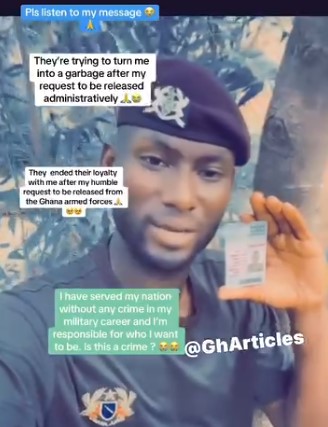
A man with the Ghana Armed Forces (GAF) has publicly criticized the organization for failing to facilitate his retirement despite his repeated requests.
In a viral video, Issah Kudus, revealed that he has served for several years and expressed a strong desire to exit the military.
According to him, despite submitting all required paperwork and appearing before relevant committees to explain his decision, he request is yet to be granted.
He stated that his decision to take a bow is personal, emphasizing that he alone understands the challenges he is currently facing.
He detailed his efforts, including submitting a formal request for compassionate release in March 2024.
A young Ghanaian army recruit experienced heartbreak when his girlfriend failed a loyalty test he arranged.
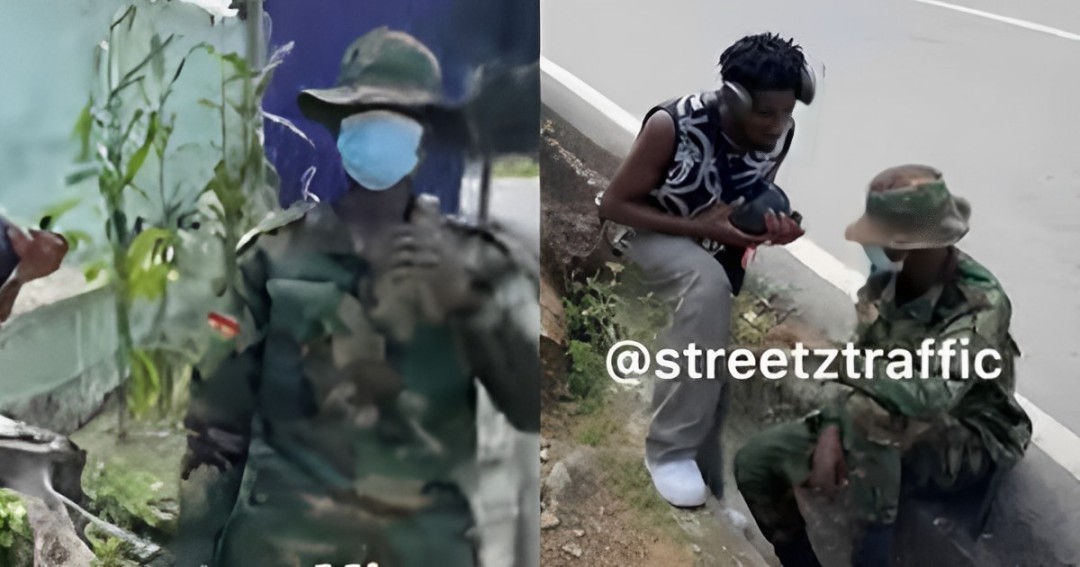
Dressed in his army uniform on his way home from work, the soldier was approached by Streetz Traffic, a content creator, to test his girlfriend’s fidelity.
Confident in his relationship, the soldier agreed to the test, asking his girlfriend, Tracy, over the phone to name her partner. Tracy mentioned another man, Sammy, instead of him.
This revelation devastated Ernest, leaving him angry and betrayed. He was unable to comprehend Tracy’s response, having left her at home in Breman, Ashanti Region, that morning.
Ernest’s distress was evident as he sat in anguish, expressing his emotions in an open gutter, despite attempts by Streetz Traffic to console him.
Opinions among Ghanaians varied upon viewing the video, with some dismissing it as staged.
In a separate incident, a young man demanded his ex-girlfriend return a television set he had bought her after she left him for another man. He expressed his frustration during a phone conversation with his ex-lover.
Ben Roberts-Smith, Australia’s most-decorated living soldier, has faced a historic defeat in a defamation case against three newspapers.
The publications had accused him of war crimes committed in Afghanistan, specifically the killing of unarmed prisoners.
This civil trial marked the first instance in which a court assessed allegations of war crimes by Australian forces. Judge Anthony Besanko ruled that four out of the six murder allegations, which Roberts-Smith vehemently denied, were substantially true.
However, the newspapers failed to prove additional claims of assault against a woman with whom he was involved and threats made to a junior colleague regarding falsifying field reports. Nevertheless, allegations of bullying were upheld.
It’s important to note that Roberts-Smith has not been charged or found guilty in a criminal court, where a higher burden of proof applies. Despite his decorated military career, including being awarded the Victoria Cross, his public image was tarnished by reports published in 2018 by The Sydney Morning Herald, The Age, and The Canberra Times, highlighting alleged misconduct between 2009 and 2012.
Roberts-Smith argued that five of the reported killings occurred legally during combat, while disputing the existence of the sixth. The ruling by Justice Besanko upheld the newspapers’ reporting on four murders but did not find evidence to support two of the allegations.
These included:
A handcuffed farmer the soldier had kicked off a cliff – a fall which knocked out the man’s teeth, before he was subsequently shot dead
A captured Taliban fighter who was shot at least 10 times in the back, before his prosthetic leg was taken as a trophy and later used by troops as a drinking vessel
Two murders which were ordered by Mr Roberts-Smith to initiate or “blood” rookie soldiers.
Outside court, the outlets called the judgement a “vindication” for their reporting.
Investigative reporter Nick McKenzie – who wrote the stories alongside Chris Masters and David Wroe – summed it up in one word: “justice”.
“It’s a day of justice for the brave men of the SAS who stood up and told the truth about who Ben Roberts-Smith is: a war criminal, a bully and a liar.”
“[And] today is a day of some small justice for the Afghan victims of Ben Roberts-Smith.”
The case was dubbed by some as “the trial of the century”, lasting 110 days and rumoured to have cost up to A$25m ($16.3m, £13.2m).
More than 40 witnesses – including Afghan villagers, a government minister and a string of pseudonymised current and former SAS soldiers – gave extraordinary and at times bizarre evidence about every facet of Mr Roberts-Smith’s life.
There was talk of laptops burned in backyards and classified information buried inside a child’s pink lunchbox, as well as damaging testimony from a private investigator, Mr Roberts-Smith’s ex-wife, and his ex-girlfriend.
But the case also exposed some of the inner workings of Australia’s top special forces. The trial heard from soldiers who said any potential misconduct was rarely reported due to a “code of silence” within the regiment, while others defended their actions as necessary.
Defence Minister Richard Marles declined to comment on the case, because it is a civil matter.
But war historian Peter Stanley told the BBC ahead of the judgement that the case was “a litmus test” for allegations of Australian wrongdoing in Afghanistan.
“The Ben Roberts-Smith episode is just a precursor to the major series of war crimes investigations, allegations, prosecutions, and possibly convictions that we’ll see over the next few years.”
A landmark report in 2020 found credible evidence that Australian forces had unlawfully killed 39 civilians and prisoners in Afghanistan from 2007 to 2013.
Three years on, local media has said that more than 40 soldiers are being investigated for their roles in alleged war crimes. But so far charges have only been laid against one, Oliver Schulz.