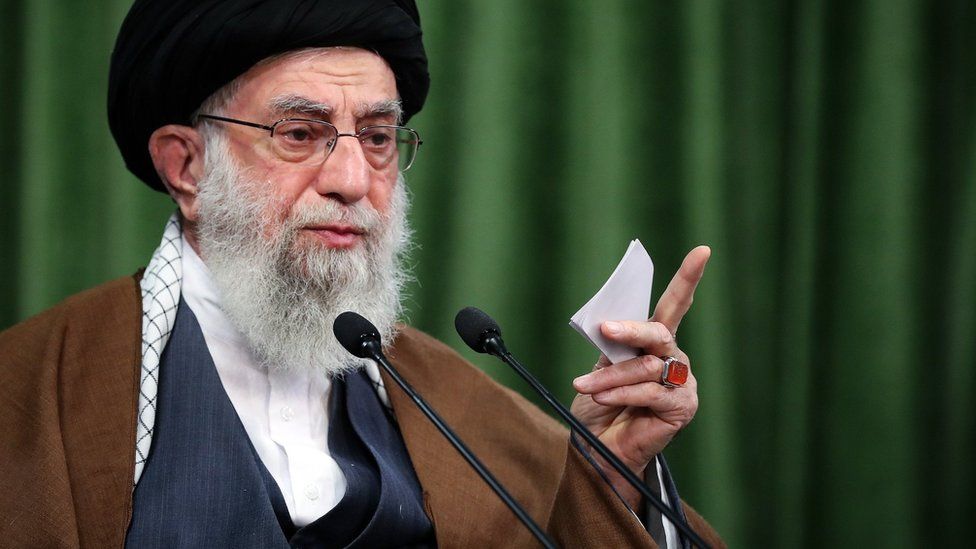
The supreme leader of Iran has commuted the sentences of “tens of thousands” of prisoners, including some who were detained during recent anti-government demonstrations, or pardoned them entirely.
According to information released in state media reports, the pardons approved on Sunday by Ayatollah Ali Khamenei had restrictions and would not apply to any of the numerous dual nationals detained in Iran.
According to state news agency IRNA, those charged with “corruption on earth,” a serious offense for which some protesters were tried and four of whom were put to death, would also not receive pardons.
Neither would it apply to those charged with “spying for foreign agencies” or those “affiliated with groups hostile to the Islamic Republic”.
Iran was swept up by protests following the death of a young Iranian Kurdish woman Mahsa Amini in the custody of the country’s morality police last September. The 22-year-old had been arrested for violating Islamic dress codes.
Iranians from all walks of life took part in the demonstrations, marking one of the boldest challenges to Iran’s government since the 1979 revolution.
‘Indoctrination and propaganda’
According to the Human Rights Activists News Agency, about 20,000 people have been arrested in connection with the protests, which the authorities accused Iran’s “foreign enemies” of fomenting.
Rights groups say more than 500 have been killed in the crackdown, including 70 minors. At least four people have been hanged, according to the Iranian judiciary. Iran has not offered a death toll for months.
In a letter to Khamenei requesting the pardon, judiciary head Gholam-Hossein Mohseni Ejei said: “During recent events, a number of people, especially young people, committed wrong actions and crimes as a result of the indoctrination and propaganda of the enemy.”
Protests have slowed considerably since the hangings began.
“Since the foreign enemies and anti-revolutionary currents’ plans have been foiled, many of these youth now regret their actions,” Ejei wrote.
Khamenei approved the pardons in honour of the anniversary of the 1979 Islamic revolution. Khamenei took on the post as the country’s political and religious leader in 1989.
Amnesty International has criticised Iranian authorities for what it called “sham trials designed to intimidate those participating in the popular uprising that has rocked Iran”.
According to the country’s judiciary,at least four prisoners were killed and 61 others were injured after a fire broke out overnight at Tehran’s Evin prison following a dispute between convicts, according to the official state news agency IRNA.IRNA reported smoke inhalation was the cause of the deaths, with 10 convicts hospitalized and four in “critical condition.”
The facility mostly holds political prisoners, including Iranians with dual nationality. Families of about two dozen political prisoners have called to say they are unharmed, according to their accounts on social media.
The prison has long been criticized by Western rights groups and was blacklisted by the United States government in 2018 for “serious human rights abuses”.
The incident took place as nationwide protests over the death in detention of Mahsa Amini, a 22-year-old Iranian woman, entered the fifth week.
The protests have posed one of the most serious challenges to the Iranian government since the 1979 revolution, with demonstrations spreading across the country and some people chanting slogans against Supreme Leader Ayatollah Ali Khamenei.
State TV on Sunday aired footage of the fire’s aftermath, showing scorched walls and ceilings in a room it said was the upper floor of a sewing workshop at the prison. Tehran prosecutor Ali Salehi said the prison unrest was not related to the nationwide protests and the situation was peaceful after the incident.
The fire started at about 10 pm (6.30 pm GMT), Al Jazeera’s Resul Sardar said, adding that it involved different units of the prison.
Damage caused by a fire inside the building of the Evin prison [IRNA via AFP]
“Officials here say there were clashes between prisoners and that some of those prisoners have set the fire in the warehouse, in the sewing workshop of the prison,” Sardar said, referring to a statement made earlier by Tehran Governor Mohsen Mansouri.
“However some witnesses are saying that some Molotov cocktails were thrown into the prison and that they started the fire. Right after that, we have seen security forces firing and also using tear gas to disperse people,” he added.
A witness contacted by the Reuters news agency said roads leading to Evin prison have been closed to traffic. “There are lots of ambulances here,” he said. Another witness said families of inmates gathered in front of the main prison entrance. “I can see fire and smoke. Lots of special forces,” the witness said.
A security official said calm had been restored at the prison, while IRNA reported that “the situation is currently completely under control”. But the first witness told Reuters that ambulance sirens could be heard and smoke still rose over the prison.
Early on Sunday, IRNA carried a video it said showed parts of the prison damaged by fire. Firefighters were seen dousing the debris with water, apparently to prevent the blaze from reigniting.
‘Numb with worry’
The detainees include French-Iranian academic Fariba Adelkhah and US citizen Siamak Namazi, whose family said he was taken back into custody this week after a temporary release.
Reacting to reports of the fire, Namazi’s family said in a statement to the AFP news agency sharedby their lawyer that they were “deeply concerned” and had not heard from him.
They urged Iran’s authorities to grant him “immediate” means to contact his family and to give him a furlough “as he clearly isn’t safe in Evin Prison”.
The sister of another US citizen held at Evin, businessman Emad Shargi, said in a Twitter post his family was “numb with worry”.
An unnamed Iranian official told the Tasnim news agency that none of the political prisoners was involved in Saturday’s unrest.
“No security prisoner was involved in today’s clash between prisoners, and basically the ward for security prisoners is separate and far from the wards for thieves and those convicted of financial crimes,” the official was quoted as saying.
Protests reported near #Evin Prison in Tehran after the prison became enflamed with sounds of gunshots and explosions. #Mahsa_Amini
Asked about the prison fire, US President Joe Biden told reporters during a campaign trip to Portland, Oregon: “The Iranian government is so oppressive.”
He said he was surprised by “the courage of people and women taking [to] the street” in the recent protests and had enormous respect for them. “It’s been really amazing,” he added. “They’re not a good group, in the government.”
US Department of State spokesman Ned Price tweeted, “We are following reports from Evin Prison with urgency. We are in contact with the Swiss as our protecting power. Iran is fully responsible for the safety of our wrongfully detained citizens, who should be released immediately.”
Human Rights Watch has accused the prison authorities of using threats of torture and indefinite imprisonment, as well as lengthy interrogations and denial of medical care for detainees.
Protests erupted after the September 16 death of Amini, who was arrested by Iran’s morality police for wearing an improper hijab. She died in custody. A coroner’s report said she did not suffer blows to the head or vital organs.
Amini’s family has refuted the official accounts that attributed the 22-year-old’s death to conditions arising after a brain tumour surgery at age eight.
Although the unrest does not appear close to toppling the government, the protests have widened into strikes that have closed shops and businesses, touched the vital energy sector, and inspired brazen acts of dissent against Iran’s religious rule.
On Saturday, protesters across Iran chanted in the streets and in universities against the country’s religious leaders.
A video posted by the Norway-based organisation Iran Human Rights purported to show protests in the northeastern city of Mashhad, Iran’s second-most populous city, with demonstrators chanting “Clerics, get lost”, and drivers honking their horns.
Videos posted by the group showed a strike by shopkeepers in the northwestern Kurdish city of Saqez – Amini’s hometown. Another video on social media showed female high school students chanting “Woman, Life, Freedom” on the streets of Sanandaj, the capital of Kurdistan province.
The authenticity of the videos could not be verified immediately.
The Iranian activist news agency HRANA said online that 240 protesters had been killed in the unrest, including 32 minors. It said 26 members of the security forces were killed, and nearly 8,000 people had been arrested in protests in 111 cities and towns and some 73 universities.
But the official death toll is much lower than estimated by rights groups and protesters.
Among the casualties have been teenage girls whose deaths have become a rallying cry for more demonstrations demanding the downfall of Iran’s government.
Protesters called on Saturday for demonstrations in the northwestern city of Ardabil over the death of Asra Panahi, a teenager from the Azeri ethnic minority who, activists alleged, was beaten to death by security forces.
Officials denied the report and news agencies close to the Islamic Revolutionary Guard Corps quoted her uncle as saying the high school student had died of a heart problem.
In his first public remarks on the unrest, Iran’s supreme leader blamed the US and Israelfor the anti-government rallies sweeping the nation.
Ayatollah Ali Khamenei claimed that Qurans had been destroyed and said that “riots” had been “manufactured” by Iran’s fiercest foes and friends.
Additionally, he urged security forces to be prepared to handle any future unrest.
The protests – the biggest challenge to his rule for a decade – were sparked by the death in custody of a woman.
Mahsa Amini, 22, fell into a comahours after being detained by morality police on 13 September in Tehran for allegedly breaking the strict law requiring women to cover their hair with a hijab, or headscarf. She died three days later.
Her family has alleged that officers beat her head with a baton and banged her head against one of their vehicles. The police have said there is no evidence of any mistreatment and that she suffered “sudden heart failure”.
Women have led the protests that began after Ms Amini’s funeral, waving their headscarves in the air or setting them on fire to chants of “Woman, life, freedom” and “Death to the dictator” – a reference to Ayatollah Khamenei.
After unrest at many universities, school protests are now spreading in Iran. In Shiraz, schoolgirls wave their head coverings in the air today chanting “death to the dictator” on day 18 of protests over the death of #MahsaAmini.#مهسا_امینیpic.twitter.com/rCIhihzR7U
Iranian schoolgirls remove their head coverings and chant “mullahs must go away” today, on day 18 of protests over the death of #MahsaAmini in morality police custody for “improper hijab” amid mass arrests of activists and an internet shutdown.#مهسا_امینیpic.twitter.com/a01ILrgOlS
Addressing a graduation ceremony of police and armed forces cadets on Monday, the supreme leader said Ms Amini’s death “broke our hearts”.
“But what is not normal is that some people, without proof or an investigation, have made the streets dangerous, burned the Quran, removed hijabs from veiled women and set fire to mosques and cars,” he added, without mentioning any specific incidents.
The ayatollah, who has the final say on all state matters, asserted that foreign powers had planned “rioting” because they could not tolerate Iran “attaining strength in all spheres”.
“I say clearly that these riots and the insecurity were engineered by America and the occupying, false Zionist regime [Israel], as well as their paid agents, with the help of some traitorous Iranians abroad.”
He also gave his full backing to the security forces, saying that they had faced “injustice” during the unrest.
Iran Human Rights, a Norway-based group, said on Sunday that at least 133 people had been killed by security forces so far. They include 41 protesters whom ethnic Baluch activists said had died in clashes in Zahedan on Friday.
Ayatollah Khamenei’s comments came a day after security forces violently cracked down on a protest by students at Iran’s most prestigious science and engineering university, reportedly arresting dozens.
The BBC’s Kasra Naji says the gunfire heard around the campus of Sharif University of Technology in Tehran on Sunday night spread fear among many Iranians that authorities had decided to make an example of the students.
Security forces tried to the enter the campus, but the students drove them back and closed all the entrance gates.
But, our correspondent adds, a siege developed and the students who tried to leave through an adjacent car park were picked up one by one and beaten, blindfolded and taken away.
In one video posted on social media, a large number of people are seen running inside a car park while being pursued by men on motorbikes.
Breaking: #Iran security forces have laid siege to #Sharif university of Tehran. Many students and professors have been beaten up, some students are entrapped inside. The security forces are rounding up students. Shots can be heard in these videos… #MahsaAminipic.twitter.com/gx9Bugu4ea
The siege was lifted later in the night following the intervention of professors and a government minister.
On Monday, students at the university announced that they would not go back to classes until all of their fellow students had been released from detention. The university meanwhile said it had moved classes online, citing “the need to protect students”.