Tag: bacteria

  • Study reveals that reusable bottles contains more toxins than toilet seats

    Study reveals that reusable bottles contains more toxins than toilet seats

    Research reveals exponential amount of germs present in reusable bottles.

    Making the sustainable decision to carry around and drink from reusable water bottles might not be the cleanest choice ever.

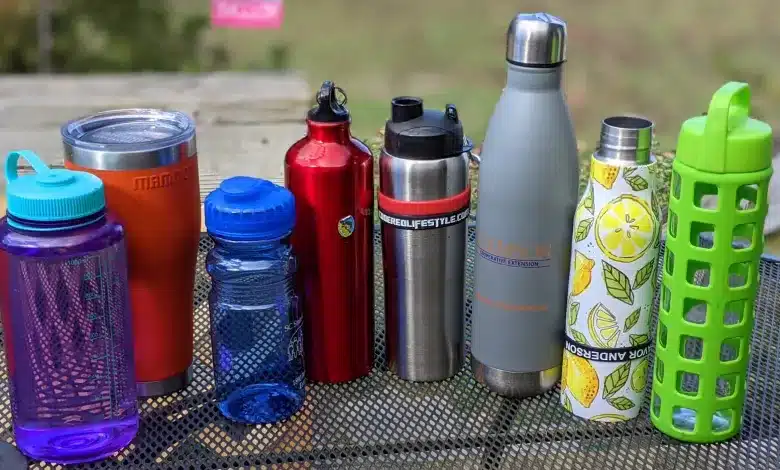
    Reusable water bottles hold 40,000 times more bacteria than do toilet seats, a recent study from WaterFilterGuru of Denver, Colorado, revealed.

    After swabbing several different reusable water bottles (and different parts of the bottles), researchers found two types of bacteria present — gram-negative rods and bacillus.

    Gram-negative rods are commonly associated with hospital-acquired infections and are increasingly becoming resistant to antibiotics, the study noted.

    Bacillus can potentially be helpful as a probiotic, but it can also be food-spoiling and disease-causing, and can lead to gastrointestinal issues.

    Reusable water bottles held an average of 20.8 million CFUs, or colony-forming units, which estimates the number of living microbes on a sample.

    Of all the water bottle types, those with spout-top and screw-top lids contained the most bacteria, with 30 million CFUs each, the study found.

    Researchers discovered the same number of CFUs after testing a tap water faucet as well.

    The research team at WaterFilterGuru, the organization says, “focuses on the latest in water quality, pollution and residential water treatment. The quality and safety of water varies widely by region, city and even neighborhood.”

    It adds on its website that it partners with “research institutions and other organizations” to increase Americans’ “awareness and understanding” of water quality.

    While comparing water bottles to sink taps, the group compared reusable bottles to other household items as well.

    Bacteria is one of four pollutants that may be present in water coming out of taps, the study reported, even though U.S. tap water is considered among the safest compared to tap water in the rest of the world.

    While comparing water bottles to sink taps, the group compared reusable bottles to other household items as well.

    This included toilet seats, which hold an average of 515 CFUs — that’s 40,000 times less bacteria than most water bottles were found to have.

    Specifically, squeeze-top water bottles had 6,000 times the bacteria of a toilet seat.

    On average, reusable water bottles had 14 times the bacteria of a pet water bowl and five times that found on a computer mouse.
  • Climate change: Melting glaciers could release massive amounts of bacteria

    Scientists have warned that as the world’s glaciers melt due to climate change, vast amounts of bacteria could be released.

    Thousands of microbes, including potentially harmful pathogens, could leak into rivers and lakes.

    Aberystwyth University researchers said their study emphasised the importance of acting quickly to reduce global warming.

    They looked at meltwater from eight glaciers in Europe and North America, as well as two in Greenland.

    Glaciers are massive ice masses that have formed over hundreds or thousands of years. They are melting at an alarming rate as the planet warms, causing sea levels to rise.

    The team at Aberystwyth University estimated the situation could result in more than a 100,000 tonnes of microbes, such as bacteria, being released into the environment over the next 80 years – a number comparable to all the cells in every human body on earth.

    Microbiologist Dr Arwyn Edwards said the study showed clearly for the first time the “vast scale” of micro-organisms living on the surface or locked inside Earth’s glaciers.

    “The number of microbes released depends closely on how quickly the glaciers melt, and therefore how much we continue to warm the planet,” he said.

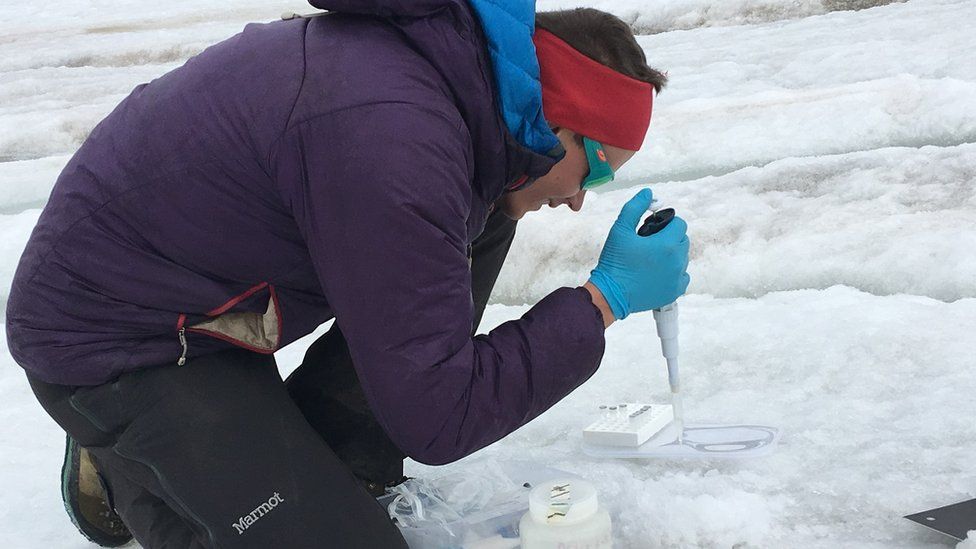
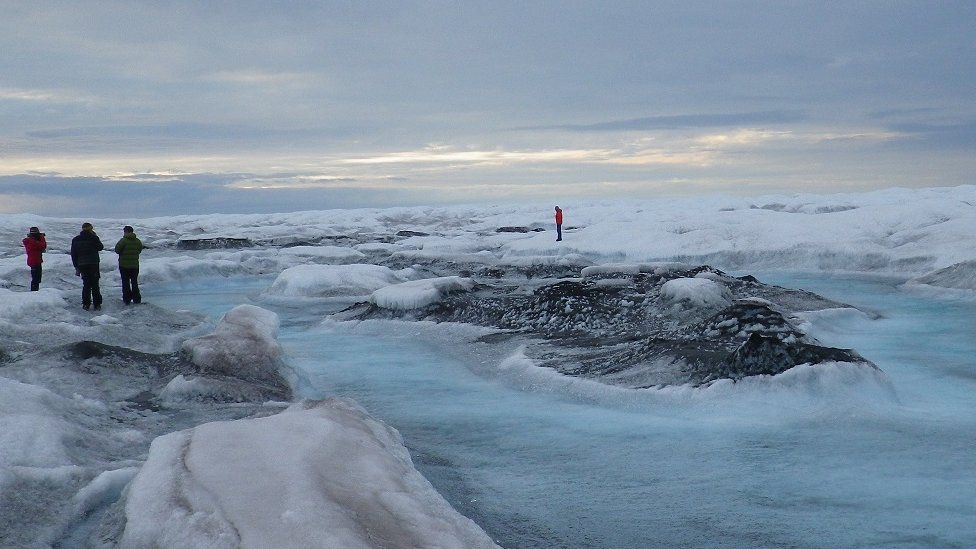
    Some of the research team in the Dark Zone on the western edge of the Greenland Ice Sheet.
    IMAGE SOURCE,ABERYSTWYTH UNIVERSITY Image caption, Researchers travelled to Greenland to study glacial meltwater

    The team’s calculations are based on a “moderate” warming scenario, as developed by the IPCC, an international panel of climate experts.

    This would see global temperatures rise by between 2C and 3C on average by 2100.

    As the flow of microbes into rivers, lakes, fjords and seas increases, there could be “significant” impacts for water quality, Dr Edwards explained.

    But this would be followed within decades by the microbe tap being turned off, as the glaciers disappear completely.

    He said: “Globally there are 200,000 catchments of note that are fed by glacial meltwater and some of these are very sensitive environments that are poorly developed in terms of organic carbon and nutrients.

    “In others there’s a lot of economic activity and billions of human beings whose livelihoods depend on water that ultimately comes from those glaciers.

    “We think of glaciers as a huge store of frozen water but the key lesson from this research is that they are also ecosystems in their own right.”

    Thousands of different micro-organisms are found growing on glaciers, or stored inside, he said, with some that may be harmful to humans.

    “The risk is probably very small, but it requires careful assessment.”

    Dr Ian Stevens preparing meltwater samples for transport prior to analysis
    IMAGE SOURCE,ABERYSTWYTH UNIVERSITY Image caption, The team of researchers studied glaciers in Europe, North America and Greenland

    Glaciologist Dr Tristram Irvine-Fynn said more research was needed: “Over the coming decades, the forecast ‘peak water’ from Earth’s mountain glaciers means we need to improve our understanding of the state and fate of (these) ecosystems.

    “With a better grasp of that picture, we could better predict the effects of climate change on glacial surfaces and catchment biogeochemistry.”

    The Aberystwyth academics’ findings are published in the journal Nature Communications Earth & Environment this month.

  • TikTok designer makes jewellery from bacteria

    On TikTok, a Scottish artist who uses her own bacteria to make jewellery has achieved renown.

    Tens of millions of people have watched Chloe Fitzpatrick’s before-and-after videos that she has uploaded on social media.

    Samples taken from her skin and plants develop into colours that can be used to dye jewelry made from resin.

    “Bacteria is stereotypically gross, but I’m trying to show its beauty,” Chloe, from Bo’ness, Falkirk, told BBC Scotland.

    The 21-year-old graduated from Duncan of Jordanstone College in Dundee with a first-class degree in design in the summer.

    Her final bacteria jewellery project won her the Sir James Black award, which recognises outstanding contributions to research and scholarship.

    Chloe shares her design journey with her 106,000 followers on TikTok and some of her videos have garnered more than 10 million views.

    “I think my videos have got a lot of views because it’s a strange idea,” she said.

    “A lot of people have followed along with the process since it takes time.

    “But I’m glad that people are seeing the fascinating side of bacteria and my videos are opening up a new perspective.”

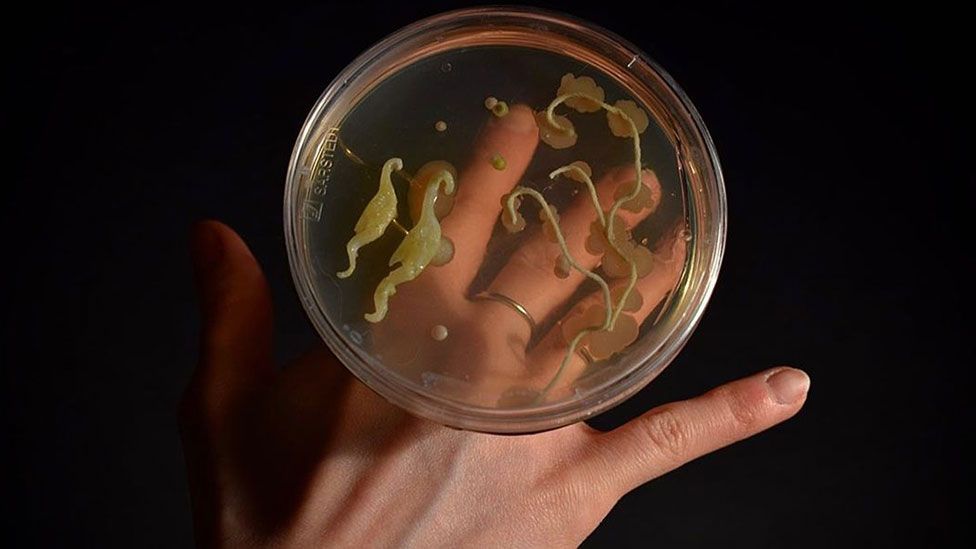
    "Knuckle-duster" ring made from petri dish containing bacteria
    IMAGE SOURCE,CHLOE FITZPATRICK Image caption, This “knuckle-duster” ring is made from a petri dish containing bacteria

    Chloe swabs parts of her body, or plants, and transfers the samples to petri dishes with a special growth medium inside called agar.

    The bacteria samples are covered and allowed to multiply into coloured colonies for about a week at room temperature.

    She then isolates particular colours in a new dish so they can multiply further.

    The colours can be used to dye materials like cotton clothing or resign jewellery sustainably.

    “When you press your hands and feet into the agar plates, you get lots of different reds, oranges, and yellows.

    “Everyone’s bacteria is so different and develops differently,” she said.

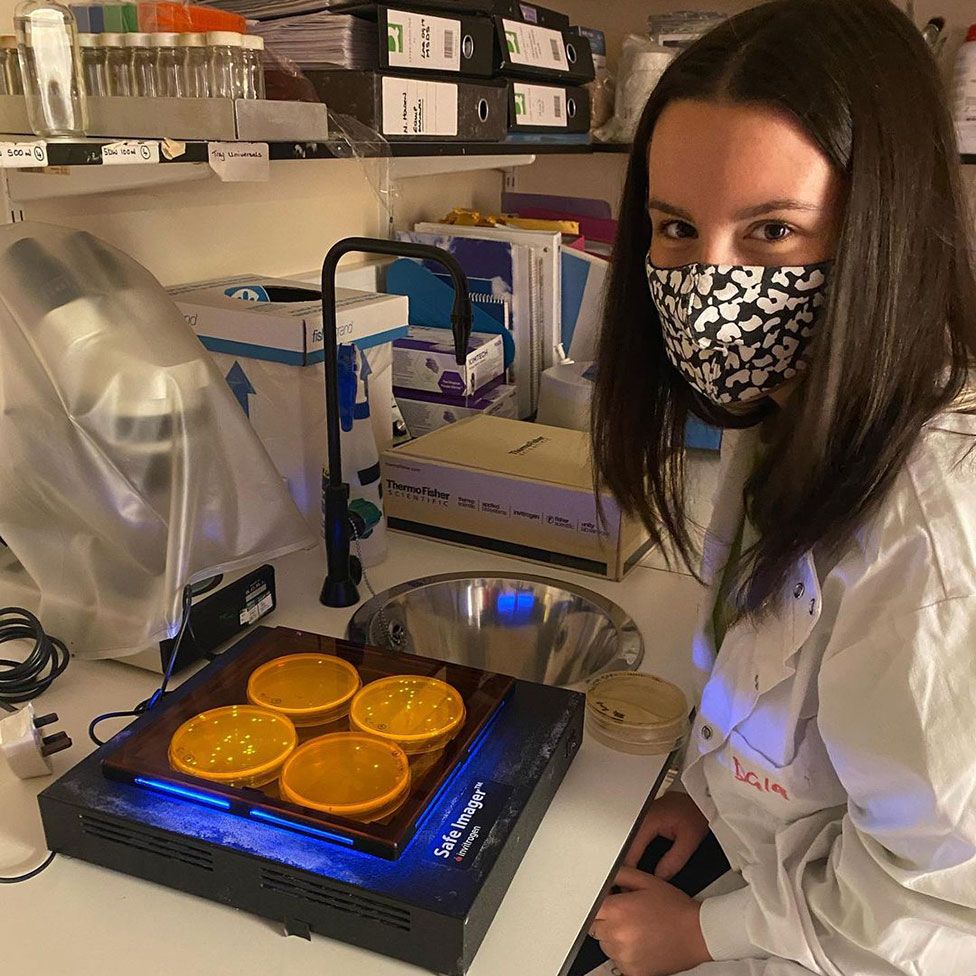
    Chloe Fitzpatrick
    IMAGE SOURCE,CHLOE FITZPATRICK Image caption, Chloe Fitzpatrick has worked with scientists at the University of Dundee on her bacteria project

    And she claims it is more environmentally friendly than traditional dying processes used in the textile industry.

    “They used a lot of harmful chemicals,” she said.

    “Using bacteria is an eco-friendly alternative, they multiply fast, and you get a good range of colours.”

    Chloe has mostly created rings and she has even used the bacteria dye to create resin “gemstones”.

    Each sample is a gamble, but she has noticed some patterns in how the bacteria develops.

    She said: “Human bacteria tend to have more colours, especially from the skin.

    “So humans tend to have a variety of pinks, reds, and yellows, and while plants can show the same colours, it is normally in a smaller amount.”

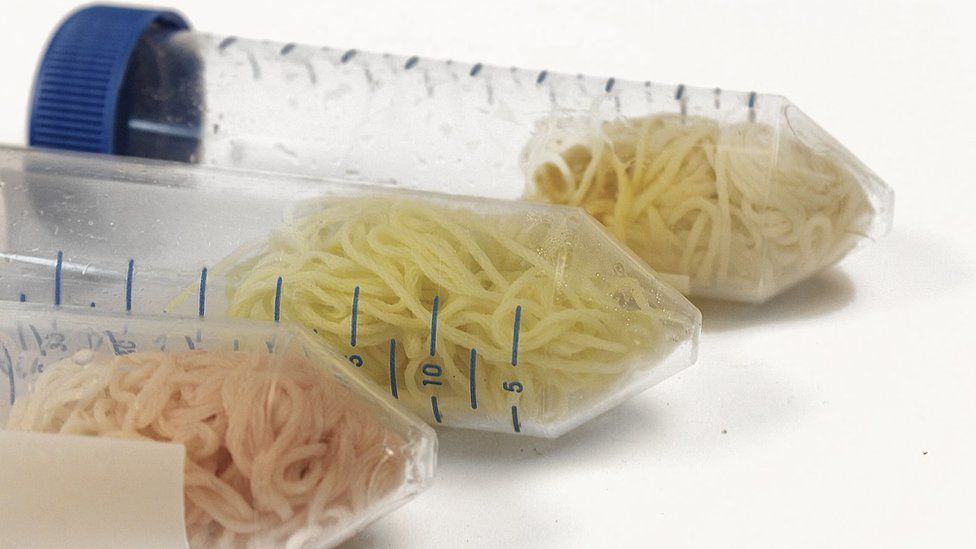
    strands of cotton dyed red, yellow and orange
    Image caption, Chloe dyed cotton strands using isolated colours from bacteria

    She has worked with scientists at the University of Dundee throughout the development of the process, to ensure the experiments are streamlined and safe.

    She said: “Everything is tested thoroughly to make sure the bacteria has been killed off.

    “I want to test the limits of this process as there’s so much I can do with it.

    “I wanted to be part of the BioArt movement, which is a collaboration of art and science.

    “I believe the art world is heading in that direction since there’s a lot of possibilities and it’s not been fully explored yet.”

    Examples of her work are currently on display in an exhibition of BioArt at Kulanshi Art Centre in Nur-Sultan, Kazakhstan

    And she has been commissioned by the University of Dundee to create a bacteria-inspired sculpture for the medical garden outside of the School of Life Sciences.