Tag: Balkans

  • Balkans slammed by severe storm that leaves six people dead and many injured

    Balkans slammed by severe storm that leaves six people dead and many injured

    During Europe’s oppressive summer, a storm that affected much of the Balkans claimed at least six lives and injured dozens of others.

    The region had experienced two strong storms in as many days, the most recent of which made landfall yesterday. The continent was experiencing an extremely hot and dry spell at the time.

    In Zagreb, the capital of Croatia, two men—ages 50 and 48—died after being struck by falling trees.

    Elsewhere, in the eastern town of Tovarnik, a firefighter died but no other details have been revealed about this.

    There is one other person known to have died in Croatia, another in Slovenia and one more in Bosnia.

    Meanwhile, a 36-year-old man in Zagreb was severely injured after a construction crane collapsed in the chaos.

    In the Serbian city of Novi Sad, a tree fell on a 12-year-old girl and she had to be taken to hospital.

    The country’s emergency services have had to put out 20 fires caused by thunder and lightning.

    Meteorologists have warned that more storms may hit over the next few days, before the next upcoming wave of hot weather they are expecting.

    It comes as there is no sign of Europe’s heatwave slowing down anytime soon, with temperatures set to climb even higher.

    After days of sweating through Cerberus, people in the south of the continent – with Greece, Italy and Spain bearing the brunt of the weather – have now begun to feel the effects of its equally scorching successor Charon.

    And it’s expected to peak in Italy, where temperatures of up to 47°C are expected to roast Sardinia on Wednesday, July 19.

    The unprecedented weather has had a dramatic effect, with holidaymakers evacuated from resorts in the area surrounding Athens after wildfires broke out – made worse by a cooling wind that provided some respite for locals and visitors.

    Reports have suggested the Charon heatwave – which has replaced the original Cerberus spell of hot weather – will stick around until at least the end of July.

    Experts from the UN agency have suggested the hot weather could even last for weeks, saying: ‘A further continuation into August is likely.’

    There may however be some respite for people in some parts of Spain and Italy – where things are about to become a little less stifling.

    Meanwhile, the BBC reports that red alerts will be removed from some cities in the north of Italy on Thursday – although other regions will continue to experience soaring temperatures.

    Sicily holds the record for Europe’s highest official temperature ever, after meteorologists measured 48.8°C in the town of Floridia in August 2021 – and the World said yesterday it is possible this record may be broken in the coming days.
  • Truss declares Macron a friend as pair forge working relationship

    At the first meeting of a new political club of nations, Prime Minister Liz Truss referred to Emmanuel Macron as a “friend” as they announced their intentions to partner.

    Throughout her leadership campaign, Ms. Truss had refrained from stating whether the French President was a “friend or foe.”

    The French President said he hoped for a “new phase” in post-Brexit relations.

    The pair agreed to step up cooperation on “ending” small boat crossings in the Channel and announced a summit in 2023.

    Leaders from the EU, the UK, Turkey, Norway, and the Balkans met at the first European Political Community in Prague on Thursday.

    They discussed energy, migration, and security, with a particular focus on the war in Ukraine. Ukrainian President Volodymyr Zelensky spoke via video link.

    The summit billed as a European Political Community beyond the EU has been championed by Mr Macron, who told reporters on Thursday it sent a “message of unity”.

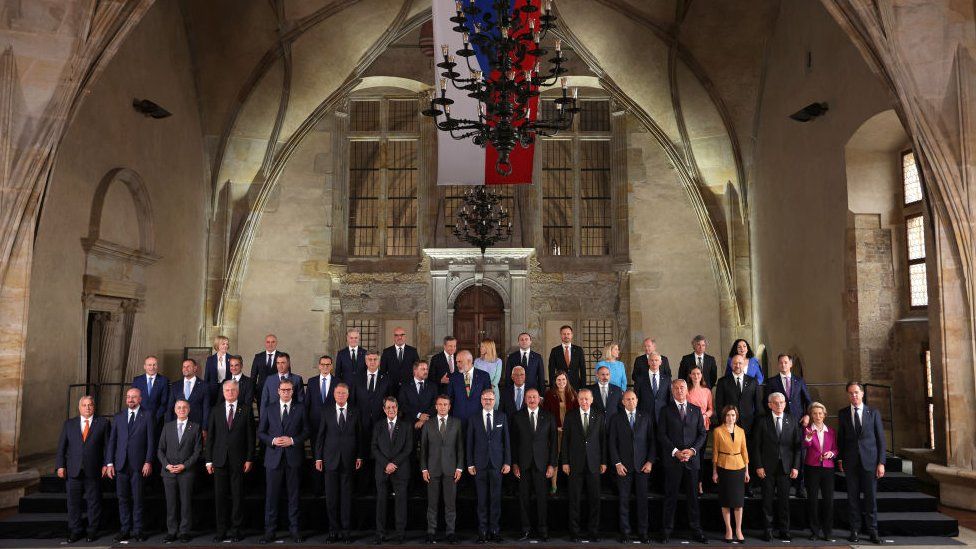
    Leaders of nations of the European Political Community (EPC) as well as the European Commission and the European Council pose for a photo during the inaugural meeting of the EPC at Prague Castle on October 06, 2022
    IMAGE SOURCE, SEAN GALLUP/GETTY IMAGES Image caption, Among the European leaders taking part were Liz Truss (top left) and Turkey’s Recep Tayyip Erdogan (bottom row, 7th from the right)

    The prime minister and Mr Macron released a joint statement promising an “ambitious” package of measures aimed at “ending” small boat crossings on the Channel.

    Mr Macron said: “We have values and history so I’m happy that we meet again.

    “This is an island, but this island didn’t move from the rest of the continent so we do have so many things in common.”

    The UK and France have clashed over several issues in recent years, including migrant boat crossings in the Channel, a military pact between Britain, the US, and Australia, and Brexit measures involving Northern Ireland.

    Standing up to Russia

    Ukraine’s president told the summit: “You and I are now in a strong position to direct all the possible might of Europe to end the war and guarantee long-term peace for Ukraine, for Europe, for the world.”

    Following the meetings, Ms Truss said: “Leaders leave this summit with a greater collective resolve to stand up to Russian aggression.

    “What we have seen in Prague is a forceful show of solidarity with Ukraine, and for the principles of freedom and democracy.”

    As well as the UK, non-EU members Switzerland, Turkey, Norway, Iceland, Georgia, Azerbaijan, and western Balkan countries took part in the first gathering of the EPC.

    Britain is now expected to host the fourth EPC meeting in 2024, with Moldova and Spain to hold the second and third respectively.

    What is the European Political Community?

    Critics see it as a vague regurgitation of old ideas. Its exact role is still evolving.

    When he proposed the plan this year, Mr Macron said it would “offer a platform for political co-ordination” for countries, both those in the EU and those not.

    Russia’s invasion of Ukraine gave new impetus for cooperation among nations beyond the EU’s 27 member states.

    But the EPC has no institutions or dedicated staff. That has led to questions about how any decisions would be implemented.

    If it proves to be a success, it may continue to take place up to twice a year. If it’s a failure, it could fizzle out.

    Centre for European Reform Director, Charles Grant said one of the measures of success will be “does it persuade Serbia, Azerbaijan, and Turkey to lean a bit more to the West and less towards Russia”.