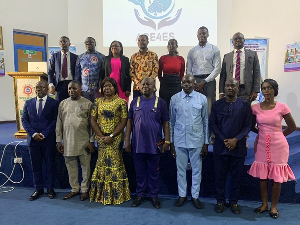
The Crops Research Institute (CRI) has launched an innovative project aimed at promoting eco-friendly and sustainable maize and rice cultivation in Ghana and three other African countries.
Dubbed the ‘Agroecology and Circular Economy for Ecosystem Services (ACE4ES)’, this project spans two years and targets the adverse impacts of inefficient agricultural practices on the environment in Ghana, Benin, Nigeria, and Tanzania.
The project consortium has pinpointed the overuse of agrochemicals such as inorganic fertilizers and the release of pollutants like methane and black carbon as key contributors to soil and environmental degradation.
Funded by the Clean Air Coalition (CCAC) under the United Nations Environment Programme (UNEP), ACE4ES aims to deploy agroecology and circular economy approaches to mitigate emissions from maize and rice cultivation.
The primary objective is to assess the efficacy of these methodologies in curbing short-lived climate pollutants emitted during agricultural operations.
Moreover, the initiative aims to mobilize policymakers, researchers, and stakeholders to advocate for the adoption of agroecology and circular economy practices and facilitate the formulation of policies supportive of sustainable agriculture.
Dr. Kwaku Onwona-Hwesofuo Asante, the Lead and Principal Investigator of ACE4ES, emphasized the project’s core objective of promoting environmentally friendly farming techniques, such as composting, among farmers.
These endeavors aim to boost yields while safeguarding environmental integrity.
“The use of fertilisers, pesticides, etc. makes agriculture risky. When we’re able to reduce the inputs and substitute with natural inputs like compost, rotational farming and other practices, it tends to protect the environment and give us the yield that we need,” Dr Asante explained.
Dr. Asante explained, “Reducing reliance on chemical inputs and integrating natural alternatives like compost and rotational farming not only preserves the environment but also ensures bountiful harvests.”
During the launch of ACE4ES, Madam Ophelia Mensah Hayford, Minister for Environment, Science, Technology, and Innovation, underscored the government’s commitment to environmental sustainability. She hailed initiatives like ACE4ES for their role in advancing climate-smart agriculture to meet environmental targets.
“Whenever Scientists research and bring up a project, it informs policy decision-making. Consequently, the government is eager to develop policies aimed at phasing out harmful chemicals and emissions that pose risks to human health,” she explained.
The minister voiced strong support for ACE4ES, recognizing its potential to mitigate the use of harmful chemicals in maize and rice cultivation, thereby benefitting both the environment and public health.
Additionally, she revealed the government’s efforts to develop policies aimed at phasing out hazardous chemicals and emissions, underscoring Ghana’s dedication to fostering a healthier and more sustainable future.
Dr. Asante, the Project Lead and Principal Investigator, noted that ACE4ES was conceived in response to the shortcomings of the current food system.
He stressed the adverse effects of excessive pesticide and fertilizer usage on pollinators, soil biodiversity, and aquatic ecosystems.
“I’ve observed with enthusiasm the many novel things the CSIR and its agencies are doing that lack publicity. The onus lies with us to talk about what we’re doing to create the needed platforms for partnerships, network and unlock private capital. We’re better positioned to tell our stories. Let’s therefore enhance communication and advocacy in the things we do within the scientific community.”
“Agriculture has been environmentally degradative, and we are hoping that we can adopt a new approach which is agroecology and include circular economy principles in agriculture to ensure that we not only produce food sustainably but also mitigate the effects of climate change.”
He also revealed plans to extend ACE4ES to other African nations beyond the initial two-year period, contingent on securing additional funding from international donors.