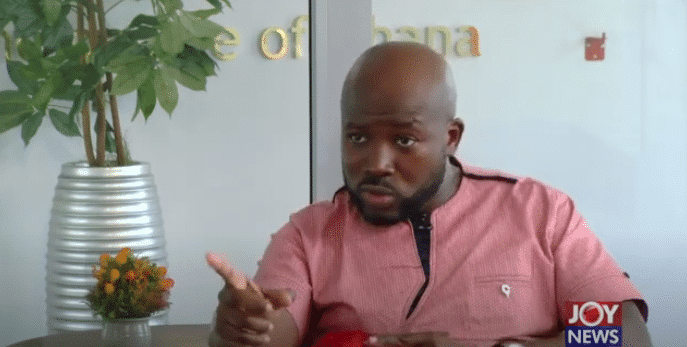
The Chairman of “The 1931 Club” and a dedicated beer enthusiast, Senyo Hosi, has taken to social media to express his apprehensions regarding the recent increase in sweetness observed in Club Beer produced by Accra Brewery Limited.
This concern arises amid growing worries about diabetes linked to excessive sugar consumption in Ghana.
In a Facebook post on Tuesday, February 13, 2024, Mr. Hosi, known for his fondness for Club Beer, stated, “The extra sweetness of your beer these days is totally not on.”
Highlighting that this additional sweetness contradicts the traditional characteristics of Club Beer, which has been in production since 1931, Mr. Hosi, as the Chairman of The 1931 Club, expressed discontent with the altered taste profile.
Giving Accra Brewery Limited a one-week ultimatum, he called for the rectification of the excessive sugar content in their product.
In a post on X platform Mr. Hosi urged, “Dear Accra Brewery Limited, our Club 1931 is not malt or shandy. The extra sweetness of your beer these days is totally not on. You have one week to repent and revert to the previous brew. Signed. Chairman, The 1931 Club.”
The plea for action has sparked discussions among beer enthusiasts, prompting them to share their opinions on various social media platforms.
As of now, Accra Brewery Limited has not responded to Senyo Hosi’s appeal, leaving consumers curious about the future taste of their beloved Club Beer.
Dear @AccraBrewery our Club 1931 no be malt or shandy. The extra sweetness of your beer these days is totally not on.
You have one week to repent and revert to the previous brew.
When it comes to indulging in a cold beer, moderation is often emphasized, but did you know that beyond being a refreshing beverage, beer can offer some surprising health benefits?
A Toast to Heart Health: Research suggests that moderate beer consumption may positively impact heart health. The alcohol and specific compounds, like flavonoids, in beer can enhance blood circulation and reduce inflammation, potentially lowering the risk of heart disease.
Building Stronger Bones: Beer contains dietary silicon, crucial for bone health. Moderate consumption could contribute to stronger bones, potentially minimizing the risk of osteoporosis.
Boosting Brain Health: Surprisingly, beer may have cognitive benefits. Studies indicate that moderate beer drinking could lower the risk of Alzheimer’s and cognitive impairments, thanks to silicon content that protects the brain from aluminum effects.
Kidney Care with Every Sip: Beer might be advantageous for your kidneys. A study found a link between beer consumption and a reduced risk of developing kidney stones, attributed to the high water content and diuretic effect helping prevent stone formation.
Fights Gum Disease: Hops, a key ingredient in beer, contains compounds with antibacterial properties. These properties can combat oral bacteria associated with tooth decay and gum disease, contributing to better oral health.
While these health benefits are intriguing, moderation remains crucial. Excessive alcohol consumption can lead to adverse health effects.
So, while you enjoy your beer, savor it within healthy limits to maximize these unexpected benefits.
Sipping on your favorite brew can be more than a leisure activity – it’s a toast to your health! Cheers to that!
You can choose from a wide variety of beverages to stay hydrated all day long.
Although plain, old water is an obvious choice, some people also turn to sports drinks and coconut water to keep their body hydrated.
Other drinks that many of us tend to consume on a daily basis, such as coffee and various types of alcohol.
These drinks tend to get us dehydrated rather than getting us hydrated. Here are 4 drinks are actually dehydrating your body:
Beer, wine, and cocktails
Consuming alcohol will leave you dehydrated, leading to symptoms like pounding headache, dry mouth, and low energy. In case of wine, the average person produces 350 ml of urine for every large (250 ml) glass drunk. This results in a net loss of a third of a liter for every bottle drunk.
So if you are planning to drink alcohol, make sure you hydrate yourself with water before, during and after drinking the alcohol. Added sugar in cocktails will make them more dehydrating.
High-protein smoothies
High protein content in your healthy smoothies, along with any added sugar in the form of sweeteners, flavored yogurts, or juices, will produce dehydrating effects. Dark-colored urine and unexplained fatigue are signs of dehydration to watch out for.
Coffee
Coffee is one of the most dehydrating drinks due to its caffeine content. However, one or two cups of copy will not leave you completely dehydrated. As per reports, you would need to drink nearly five cups of coffee per day to experience serious hydration impacts.
Soda
A study found that enjoying chilled carbonated beverages increased consumer perception of hydration. However, these refreshers actually dehydrate the consumer due to their diuretic effects because of the sugar and caffeine content.
The sale of alcohol is strictly controlled in Qatar, and it had to relax its restrictions to allow FIFA sponsor Budweiser to sell its products outside World Cup match venues and fan zones. Now, fans have been told they cannot buy beer at any games during the tournament.
World Cup fans in Qatar will not be allowed to buy alcohol at the tournament’s eight stadiums.
The U-turn comes 48 hours before the competition’s opening game between Qatar and Ecuadorat the Al Bayt stadium in Al Khor on Sunday.
Qatar had originally ordered Budweiser stands to be less prominent,but now alcohol won’t be sold at all at stadiums – with the exception of corporate spectators.
Those in corporate hospitality at stadiums will still be allowed to drink alcohol.
FIFA said: “Following discussions between host country authorities and FIFA, a decision has been made to focus the sale of alcoholic beverages on the FIFA Fan Festival, other fan destinations and licensed venues, removing sales points of beer from Qatar’s FIFA World Cup 2022 stadium perimeters.”
It added Bud Zero would still be available, and that it would “continue to ensure that the stadiums and surrounding areas provide an enjoyable, respectful and pleasant experience for all fans”.
A source briefed on the decision told Sky News: “These have been long-term discussions, and the overall feeling from everyone involved was that the stadiums need to be for everyone.
“This World Cup is different to others in that a larger number of fans are attending from across the Middle East and South Asia, where alcohol doesn’t play such a large role in the culture. The thinking was that, for many fans, the presence of alcohol would not create an enjoyable experience.
“The fan zones will be different in that some are clearly designated as alcohol-serving, while others are alcohol-free. Fans can decide where they want to go without feeling uncomfortable. At stadiums, this was previously not the case.”
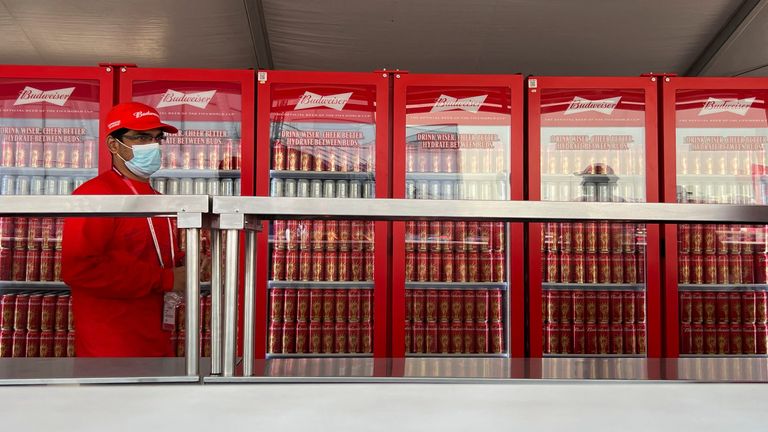
Image:A Budweiser beer bar at the FIFA Fan Festival in Doha, Qatar
The sale of alcohol is strictly controlled in Qatar, and is only allowed in the Muslim nation within hotel bars and restaurants away from street view.
It had to relax its alcohol restrictions to allow FIFA sponsor Budweiser to sell its products outside match venues and fan zones.
Now Qatar 2022 has gone even further – at the insistence of Qatar’s Al Thani royal family, it is understood.
As one of FIFA’s biggest sponsors, Budweiser has the exclusivity to sell beer at World Cup matches.
It reportedly pays more than £60m over four years to be a FIFA top-tier sponsor, and this late change is unlikely to have gone down well.
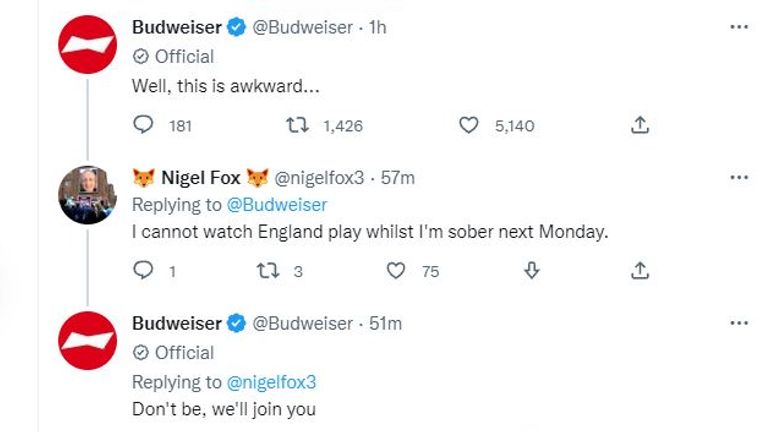
A tweet from the official Budweiser account on Friday morning, which was later deleted, simply said: “Well, this is awkward…”
One fan replied to the post, saying, “I cannot watch England play whilst I’m sober next Monday” – to which Budweiser responded: “Don’t be, we’ll join you.”
Image:Budweiser later deleted its ‘this is awkward’ tweet
It would have been the only alcoholic beverage available to fans.
The Football Supporters’ Association, for fans in England and Wales, criticised what it described as a “total lack of communication and clarity from the organising committee towards supporters”.
“Some fans like a beer at the match, and some don’t, but the real issue is the last minute U-turn which speaks to a wider problem,” it said in a statement.
“If they can change their minds on this at a moment’s notice, with no explanation, supporters will have understandable concerns about whether they will fulfil other promises relating to accommodation, transport or cultural issues.”
Qatar had initially told fans they would be able to buy beer outside the stadium bowl itself, within the perimeter for ticketholders, “three hours prior to kick-off when the gates open and one hour after the final whistle”.
Now, it is understood beer will only be available in alcohol-serving fan zones in Qatar after 6.30pm and drunk fans will be sent to special zones to sober up.
In response to the request to move its outlets, Budweiser owner AB InBev told Sky News: “AB InBev was informed on November 12 and are working with FIFA to relocate the concession outlets to locations as directed.
“We are working with FIFA to bring the best possible experience to the fans. Our focus is on delivering the best possible consumer experience under the new circumstances.”
Footage on social media in recent days shows red Budweiser tents being moved on wheels by staff.
Qatar World Cup organisers said “operational plans are being finalised” when asked about the change to the location of beer stations earlier this week.
The World Cup Supreme Committee told Sky News: “These plans include venue management teams enhancing overlay requirements for all competition venues. This has a direct impact on the location of certain fan areas.
“Pouring times and number of pouring destinations remains the same across all eight World Cup stadiums.”
The sale of beer around stadiums during the World Cup has been banned after talks between FIFA and Qatari tournament chiefs.
It was revealed on Friday by FIFA that alcohol would not be available as expected in the perimeter area of stadiums.
Budweiser is a major FIFA sponsor and sales of its product had been expected to be allowed close to the stadiums. However, only its alcohol-free variant will now be available.
The news was swiftly criticised, with England’s Football Supporters’ Association questioning whether such an apparent U-turn could be followed by more promises not being kept.
Ronan Evain, executive director of Football Supporters Europe (FSE), expressed similar concern, describing the news as an “extremely worrying” development.
FIFA said: “Following discussions between host country authorities and FIFA, a decision has been made to focus the sale of alcoholic beverages on the FIFA Fan Festival, other fan destinations and licensed venues, removing sales points of beer from Qatar’s FIFA World Cup 2022 stadium perimeters.
“Host country authorities and FIFA will continue to ensure that the stadiums and surrounding areas provide an enjoyable, respectful and pleasant experience for all fans.”
Referencing Budweiser’s parent company, FIFA added: “The tournament organisers appreciate AB InBev’s understanding and continuous support to our joint commitment to cater for everyone during the FIFA World Cup Qatar 2022.”
Reports said Budweiser posted on Twitter “Well, this is awkward”, before deleting the post.
The Football Supporters’ Association (FSA) said its concern was less about the beer decision but about the prospect of fans being affected by possible further unexpected decisions at the controversial mid-season World Cup.
The FSA said in a statement: “Some fans like a beer at the match, and some don’t, but the real issue is the last-minute U-turn which speaks to a wider problem – the total lack of communication and clarity from the organising committee towards supporters.”
It condemned the lack of explanation and said fans would have “understandable concerns about whether they will fulfil other promises relating to accommodation, transport or cultural issues”.