China has raised its tariffs on US goods to 84%, following the implementation of Donald Trump’s 104% duties on Chinese products earlier today.
The move comes after China’s foreign ministry strongly criticized the US, vowing to “fight to the end” against Trump’s new trade measures if necessary, and accused the White House of “bullying practices.”
Reacting to China’s decision, Trump addressed businesses, saying “now is a great time” to relocate to the United States.
At the same time, the European Union is getting ready to impose its own set of retaliatory tariffs.
These could include a 25% tax on American goods like motorcycles, luxury boats, and orange juice.
Stock prices for European pharmaceutical companies also dropped after Trump hinted at introducing a “major” tariff on all drug imports.
Before steeper tariffs on around 60 nations came into effect today, Trump said many countries were “dying” to negotiate deals. “I’m telling you these countries are calling us up, kissing my ass,” he said.
The Bank of England said Britain is well placed to weather the storm but warns of future risks as the UK government said it’s “confident” it will get a US trade deal.
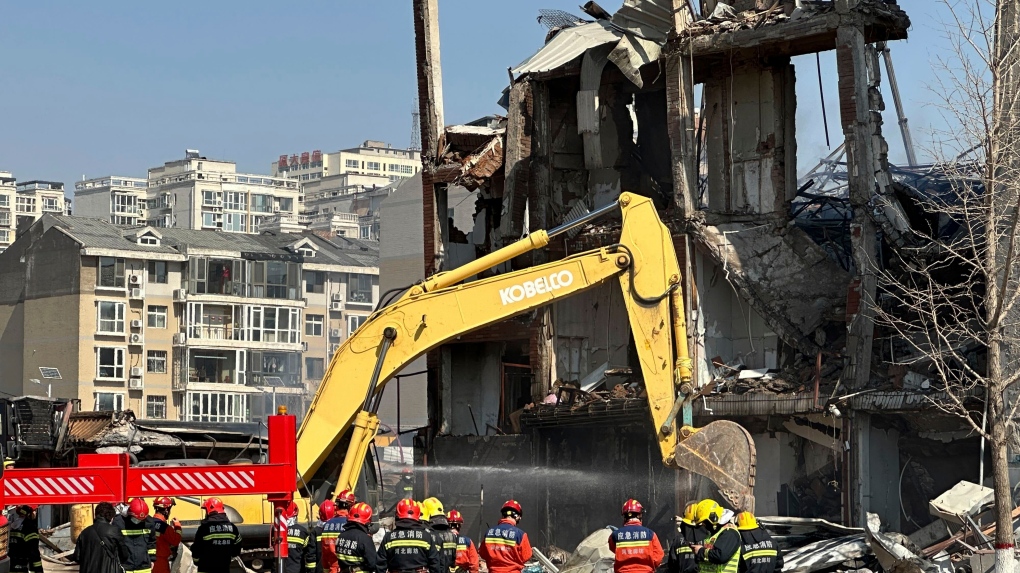
There was an explosion at a fried chicken store in Sanhe city early in the morning, the authorities said in a quick announcement. The city is about 63 kilometers (39 miles) to the east of Beijing.
The police closed off streets over half a mile around the explosion. They were telling people to stay away.
Fire trucks went to the place and a truck was taking away a burned car with no windows. The old building is mostly destroyed, only a small part of the structure is still standing on top of a pile of debris.
CCTV, the state’s TV station, said that 14 people were taken to the hospital. Two of them are very sick.
The family of someone who died said to a local news agency called Hongxing News that she owned a guesthouse in the building and that her husband hasn’t been found yet. The parents had just dropped off their 9-year-old at school when the explosion happened.
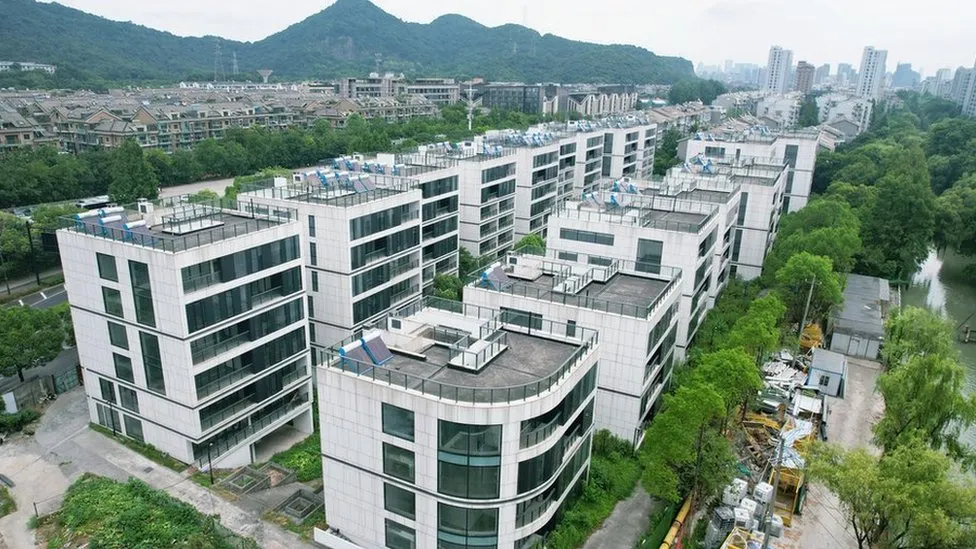
A big Chinese financial company has asked for legal protection because it can’t pay the money it owes.
A court in Beijing agreed to the request from Zhongzhi Enterprise Group, which has given lots of money to real estate companies.
Chinese officials started looking into “suspected illegal activities” by the company in November.
It was reported that ZEG declared it couldn’t pay its debts.
The group that is having a hard time told investors in a letter in November that it owes more money – up to $64 billion – than it actually has, which is about $38 billion.
On Friday, a court in Beijing wrote on the social media app WeChat that ZEG doesn’t have enough money to pay all its debts, and can’t pay them back completely.
ZEG is a big company in China that works in the shadow banking industry. Shadow banking is a system of lenders and brokers who are not part of the regular banking system.
Shadow banking is not regulated and doesn’t have the same rules and limitations as regular banks.
Informal lending has always been a part of China’s economy, but shadow banking started to become more popular after the 2008 global financial crisis when credit was hard to come by.
China’s unofficial banking industry is worth about $3 trillion. It often gives money to the country’s property market to help it survive. The industry that used to do really well is now in trouble because it doesn’t have enough money. Some of the biggest companies might not be able to stay in business.
At its best, ZEG’s asset management arm managed over a trillion yuan ($139 billion; £110 billion).
However, it was not protected from the bigger problem with property, and it had more problems in November when authorities said they had taken legal actions against “many suspects. ”
We still don’t know who they are and what they do in the company. The person who started the company, Xie Zhikun, passed away from a heart attack in 2021.
The latest news at ZEG has made people worried about more problems in the world’s second biggest economy. This comes after the company Evergrande failed and Country Garden had money troubles.
China’s real estate industry contributes to one third of its economy. This includes homes, renting and helping people find a place to live, and making building supplies and things that are used in apartments.
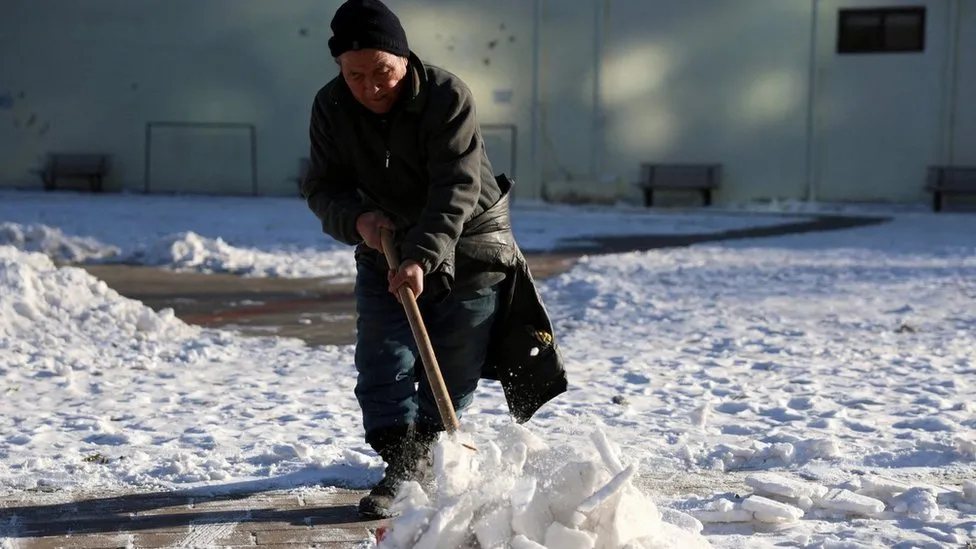
Beijing is undergoing its coldest December since records began in 1951, experiencing temperatures frequently dropping below -10C this month.
This follows a year of extremes, with Beijing registering its hottest ever June day just six months ago at over 40C.
China has encountered multiple waves of extremely cold weather this winter, with a Beijing weather observatory recording over 300 hours of below-freezing temperatures in under two weeks.
The cold snap has affected various provinces, leading to school closures and transportation challenges.
In Henan province, persistent cold weather has strained energy supplies, causing heating boilers to break down. Additionally, Beijing has grappled with significant snowfall.
Meanwhile, northern Japan has witnessed substantial snowfall, with alerts issued for heavy snow in some areas, including around a meter (39 inches) in Gifu and Hokkaido prefectures.
South Korea has experienced extreme temperature fluctuations, ranging from 16C to below -12C in recent weeks. The Korean Meteorological Administration (KMA) reported this variance.
The cause of the cold snap is attributed to a weakening Polar Vortex, allowing cold air to move further south than usual. There is ongoing debate among scientists about the role of climate change in this phenomenon.
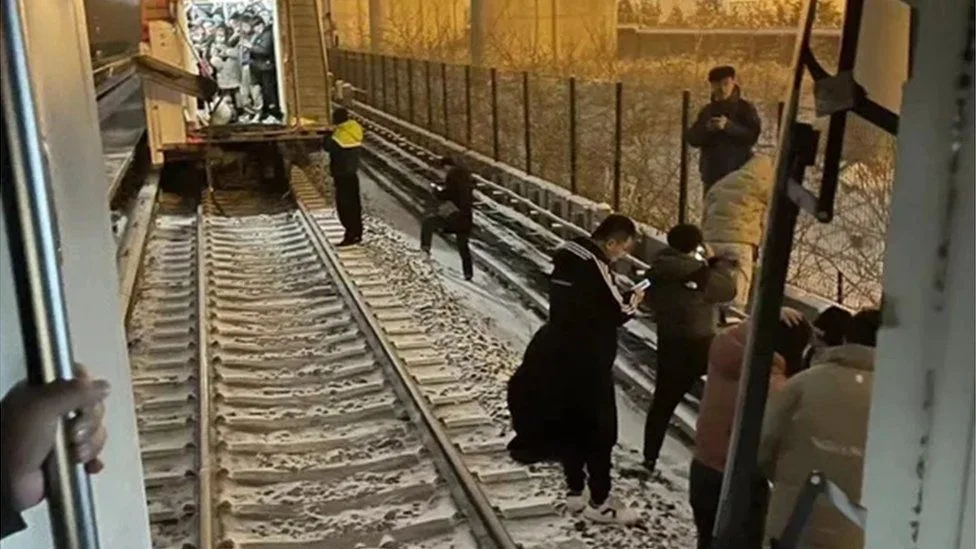
A crash between two subway trains during rush hour in Beijing hurt 102 people, according to Chinese state media.
Over 500 people went to the hospital after the accident happened around 7:00 pm local time (11:00 am GMT) on Thursday.
The trains crashed into each other while going downhill on the Changping subway line during a heavy snowstorm.
By Friday morning, 423 people have left the hospital.
While it doesn’t happen a lot, there were accidents on the Chinese capital’s transportation system because the tracks were slippery from snowstorms.
The train couldn’t stop on the icy tracks and crashed into the back of another train.
The impact made the last two carriages of one train come loose. We don’t know which train was uncoupled.
Pictures and videos on the internet show people crowded inside train cars, stuck in the dark because the power went out. Some people were using hammers to break windows to get some fresh air.
A video was posted on a Chinese social media app showing a woman who looks like she passed out, lying across some train seats.
67 people are still in the hospital getting treatment, and 25 are being watched closely by doctors. No one died.
The event made Chinese internet users very angry and they left strong comments about it. Some people were surprised by how many injuries there were, and others were upset about the trouble the accident caused.
“Does Beijing Subway not have anyone to fix things and check them regularly. ” “Are we not valuing the lives of hundreds of people enough. ” asked a Weibo user. Beijing Subway is run by the city government and has 27 subway and rail lines in the city.
Beijing Subway said sorry for the accident and promised to pay for the medical bills of the people who got hurt.
Because of the bad weather, the train operator wants the trains to be driven by a person and for there to be more space between each train. The part of the subway line where the incident happened, which includes three stations, was closed on Friday.
Snow in Beijing has made it hard for people to travel by road, train, and plane.
The weather will get very cold in northern China soon.
Weather experts said that it will be much colder in most areas of the country from Thursday to Sunday, with temperatures dropping by 8 to 12 degrees Celsius. This means it’s going to be very cold in Beijing this weekend, with temperatures dropping below -20C.
In a few cities, officials have closed schools and stopped train services.
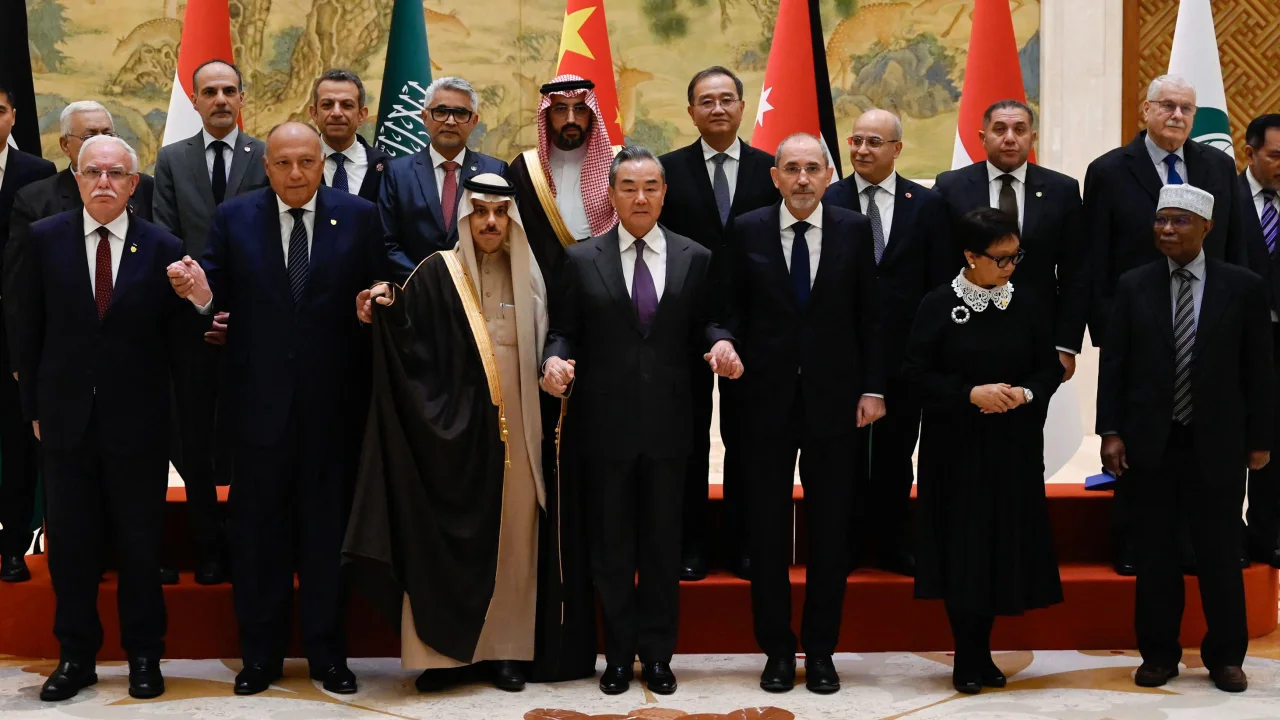
The Foreign Minister of China met with officials from Saudi Arabia, Jordan, Egypt, the Palestinian National Authority, Indonesia, and the head of the Organization of Islamic Cooperation in the capital on Monday.
Beijing said the visit is a chance for talking and working together to calm down the fighting between Palestinians and Israelis, protect people, and fairly solve the problem of Palestine.
The meeting is happening because the media has been told that there might be a deal soon to free some hostages held by Hamas. The United States, Israel, and Qatar have been talking to Hamas for weeks to try to make this deal happen.
Beijing and Washington, who are both strong in the region and friends with Israel, disagree on how to handle the conflict. Beijing did not support Israel’s actions and did not speak out against the group Hamas, making Israeli officials upset.
Israel has started bombing and sending troops into Gaza because a group called Hamas attacked Israel on October 7th. The Israel Defense Forces said that more than 200 people were taken as hostages in the attack.
China wants to help solve the conflict so it can become a stronger global power.
Last week, the UN made a decision about the fighting. They want all the people that Hamas is holding as prisoners to be set free right away. They also want to make sure that safe paths are available for people in the area so that they don’t get hurt. The US and the United Kingdom didn’t vote, because they didn’t agree with the resolution’s failure to criticize Hamas.
Chinese Ambassador Zhang Jun said that for reasons everyone knows, especially because a permanent member of the Council kept causing problems, this resolution can only be a first step for now, based on the minimum agreement. This seemed like a hidden criticism aimed at the US.
The conflict has allowed China to strengthen its relationships with many Arab countries and to become an important advocate for creating a separate Palestine and achieving lasting peace.
Chinese and visiting officials will talk about how to start the peace process again when they meet in Beijing on Monday and Tuesday.
China’s special envoy for the Middle East, Zhai Jun, visited Egypt, Qatar, the UAE, Saudi Arabia and Jordan last month. He talked about important issues during his 10-day tour. This included discussing the Qatar issue.
Last week, the representative visited Turkey and Bahrain to meet with officials. In addition, Zhai talked about the situation in the region with representatives from Singapore, the US and Europe at a conference.
Zhai hasn’t visited Israel, Palestine, or Iran, according to the information from China’s Foreign Ministry. Last month, Wang and Israeli Foreign Minister Eli Cohen talked on the phone. It’s not known if China has talked to Hamas leaders during the recent fighting.
This week, Palestinian Foreign Minister Riyad al-Maliki from the West Bank-based Palestinian National Authority is visiting officials in Beijing.
Earlier this month, China sent the leader of its Foreign Ministry’s department for West Asia and North Africa to Iran to talk about the conflict. This was mentioned in a post on the department’s WeChat social media account.
Iran has been supporting Hamas and Hezbollah for a long time.
Last week, Chinese leader Xi Jinping and US President Joe Biden had a long conversation in California. Biden asked Xi to use China’s influence with Iran to prevent a bigger conflict in the region. This was said by a top US official to the media.
In the meeting, Foreign Minister Wang Yi said they have already talked to the Iranians about the topic.
The US thinks Hamas is a terrorist group that has caused pain for Palestinian people. The US supports Israel in fighting against Hamas.
Beijing is talking about the conflict between Palestinians and Israelis, without mentioning Hamas.
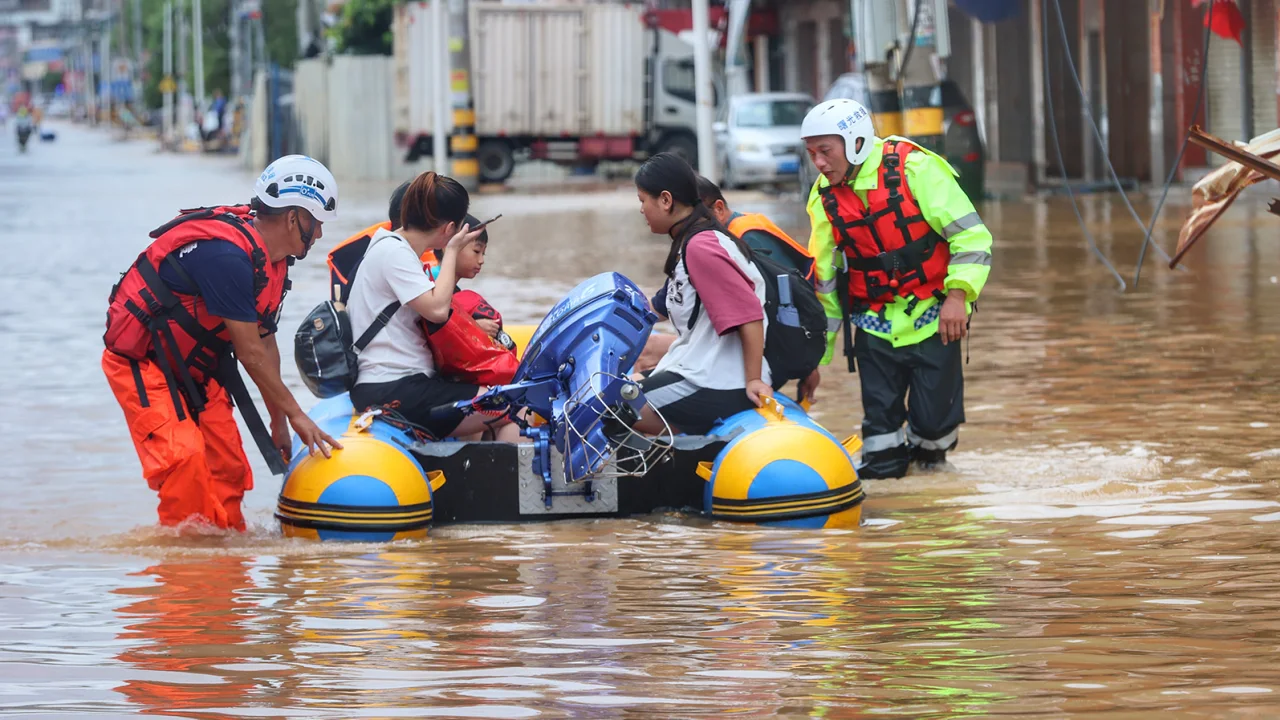
After Typhoon Doksuri, one of the strongest storms in years, dumped torrential rain throughout China and forecasters warned another storm with the intensity of a hurricane was on its way, tens of thousands of people evacuated their homes in Beijing.
Similar to much of the rest of the world, China is struggling with this summer’s harsh weather events. This year, heat waves seared China sooner than usual as global temperatures, ocean heat, and sea ice loss all broke records.
Doksuri ploughed into the coastal province of Fujian in the southeast late last week, weakening as it made its way north but dumping copious amounts of rain since Saturday on at least five northern Chinese provinces.
As of Sunday night, more than 31,000 individuals have left the Chinese capital, according to state television station CCTV. According to state news agency Xinhua, another 500,000 residents in the southern province of Fujian had to leave because of flooding.
According to CCTV, two people were killed by the storm and two more went missing while mushrooming in the northeastern Liaoning province.
According to the China Meteorological Administration on Monday, about 40 inches of rain are expected to fall on portions of the capital’s southwest and the nearby province of Hebei, perhaps breaking previous records for precipitation in Beijing.
Through Tuesday, there is a chance for more intense rain, raising worries of landslides and hazardous flooding.
In accordance with the country’s warning system, the weather signal was dropped to the second-highest level in some areas on Monday, but was at the highest level in nine Beijing districts. There were at least 95 other weather alerts issued nationwide.
Numerous railroads and highways in the capital were temporarily shut down as a result of the heavy rains, and residents were advised to stay inside.
According to CNN Weather, based on early data, Doksuri is the most potent typhoon to make landfall in China and the strongest storm to impact Fujian since Typhoon Saomi in 2006. Rita in 1972 was the storm that passed the closest and closest to Beijing.
At least 39 people were killed in the Philippines and sections of southern Taiwan before it made landfall in Fujian.
According to Xinhua, the flooding caused by the rains cost Fujian’s economy approximately $60 million ($428 million yuan) in direct economic losses. According to the state media agency, more than 151 hectares of crop failure occurred on more than 6,333 hectares of farmland in Fujian.
And the future holds little hope for relief. Authorities are getting ready for Khanun, the sixth typhoon predicted to hit China this year, as Doksuri winds down.
As Typhoon Khanun approaches, forecasters anticipate storm tides to affect Zhejiang’s coastal districts from Monday through Thursday. As a result, local authorities activated the lowest of four emergency reaction levels on Monday, according to Xinhua.
The Joint Typhoon Warning Centre has upgraded Khanun to a Category 3-equivalent typhoon as it intensifies in the Pacific Ocean. Over the next two days, it is expected to approach the southern Okinawa islands of Japan and start a lethargic trudge into the East China Sea.
From Monday through Wednesday, more than 200 domestic flights to and from Okinawa’s Naha, Miyako, and Ishigaki islands were cancelled, displacing approximately 30,000 people.
Asia, the largest and most populous continent in the world, is having to deal with the devastating consequences of summer’s harsh weather as its nations experience scorching heatwaves and monsoon rains that set records.
The neighbouring Korean peninsula is experiencing fatal heat waves while most of northeastern China is being swamped by rain.
According to data issued on Sunday by the Korea Disease Control and Prevention Agency (KDCA), at least 10 people have passed away as a result of illnesses brought on by the heat in South Korea, which is suffering from a heat wave that has caused several areas of the country to see their highest temperatures this year.
In South Korea, flash floods and landslides killed at least 41 people just two weeks earlier, including at least 13 from a flooded subway that trapped cars in the downpour.
A total of 1,015 persons experienced heat-related illnesses this past weekend, which the KDCA classifies as heat stroke, heat exhaustion, cramps from the heat, syncope from the heat, and heat edoema.
Around 20% of individuals impacted by the heat were between the ages of 50 and 59, while more than 25% of those affected were 65 years of age or older.
According to the research, more than 35% of the incidents involved people who were engaged in outdoor activity, and 14% involved farms.
The majority of the country has been under heat wave warnings since late July as temperatures soared over the weekend to between 33 and 39 degrees Celsius (about 91 to 102 degrees Fahrenheit).
Many cities recorded their warmest day temperatures of the year on Saturday. According to the Korea Meteorological Administration, temperatures in Gyeongju reached 36.8 degrees Celsius (98.24 degrees Fahrenheit) while in Jeongseon county reached 36.1 degrees Celsius (96.98 degrees Fahrenheit).
Temperatures in the affluent Gangnam neighbourhood of Seoul reached 35.7 degrees Celsius (about 96.2 degrees Fahrenheit), while temperatures in North Gyeongsang Province reached 38.1 degrees Celsius (100.58 degrees Fahrenheit).
On Monday, a heat wave warning is still in effect, indicating that daily maximum temperatures are predicted to be 35 degrees Celsius or higher for at least two days.
Deputy foreign minister of Russia, Andrei Rudenko, has been to Beijing to meet with Chinese officials to discuss “international” concerns.
Rudenko on Sunday exchanged views with China’s Foreign Minister Qin Gang in a meeting in the Chinese capital on Sunday on Sino-Russian relations as well as “international and regional issues of common concern”, China’s foreign ministry said in a one-line statement on its website.
It was unclear when Rudenko arrived in Beijing, or whether his visit to China, a key ally of Russia, was in response to the apparent rebellion by heavily armed mercenaries on Friday.
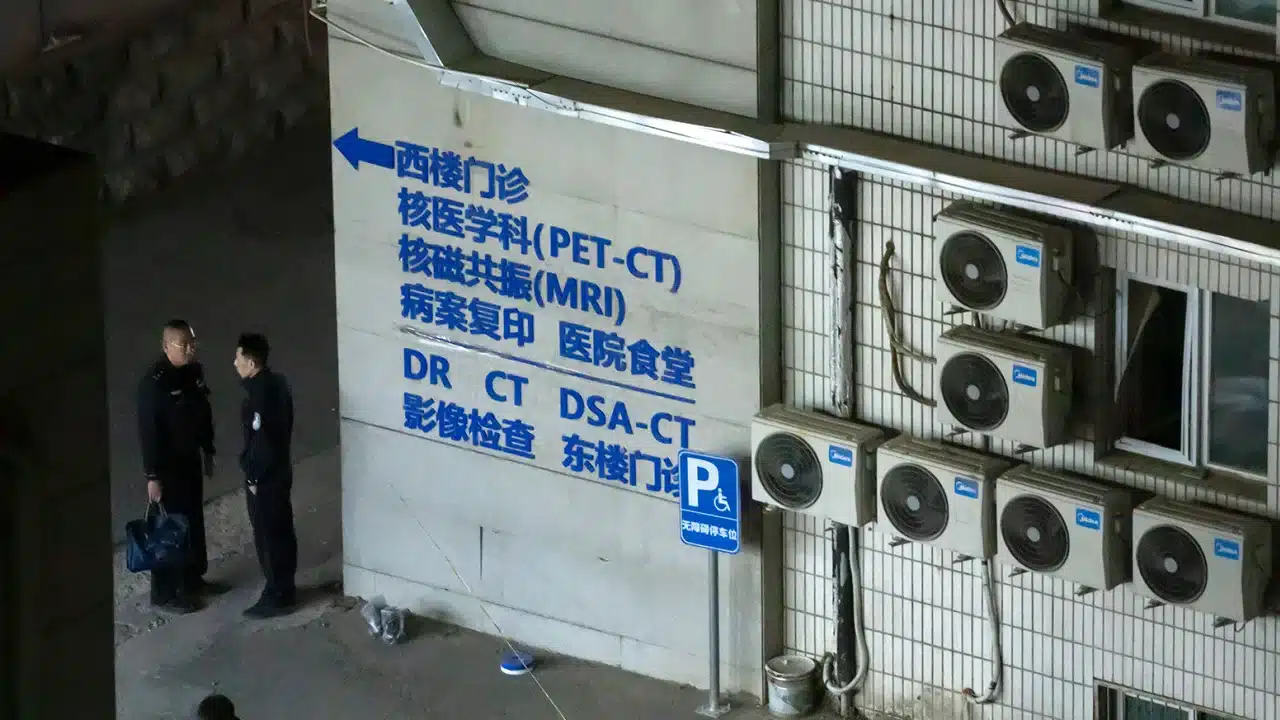
One of the deadliest fires in the Chinese capital in recent years claimed the lives of 29 people on Tuesday in a hospital fire in Beijing. Twelve people have been detained by Chinese authorities in connection with the incident.
According to Zhao Yang, a representative of Beijing’s fire service, the Changfeng Hospital’s inpatient building fire was started by restoration work being done inside of it, where sparks from the construction ignited combustible paint.
Among the victims, 26 were inpatients with an average age of 71. The oldest victim was 88 years old. A nurse, a care worker and a family also died in the fire, according to Li Zongrong, deputy head of the Fengtai district government.
A total of 142 people were evacuated, including 71 patients. As of Wednesday, 39 injured remain in hospital, with three in critical condition, said Li Ang, deputy director of the Beijing Municipal Heath Commission.
In videos shared on social media Tuesday, smoke could be seen billowing out of several hospital windows as people desperately attempted to escape the blaze. At least one person appeared to use a rope made from bedsheets to descend from a window onto a lower level terrace.
Others were seen either sitting on air conditioning units positioned on the exterior of the building, or trying to use the units to maneuver themselves from one level to the next. One person was seen jumping from one level of the building to the lower terrace.
The blaze is the most deadly in Beijing in recent years, surpassing the toll from a fire in 2017 that killed 19 in a cramped two-story building in Daxing district in the capital’s southern suburb.
That tragedy prompted authorities to demolish large swathes of buildings deemed illegal or unsafe in the neighborhood and forced thousands of migrant workers out of their homes and businesses.
According to state-run CCTV, a hospital fire in Beijing, China’s capital, claimed at least 21 lives on Tuesday.
In an effort to escape the fire, which started in what Chinese state media described as the inpatient ward of Changfeng Hospital at around 1 p.m. local time (1 a.m. ET), people are seen in amateur video hanging from the building’s façade.
According to CCTV, 21 persons had sadly passed away as of 6 p.m. local time (6 a.m. EST). 71 other patients had to be evacuated.
This fire has killed more people in Beijing in recent years than the one that claimed 19 lives in a crowded two-story building in Daxing district, a southern suburb of the city, in 2017.
That tragedy prompted authorities to demolish large swathes of buildings deemed illegal or unsafe in the neighborhood and forced thousands of migrant workers out of their homes and businesses.
In videos shared on social media Tuesday, smoke can be seen billowing out of several hospital windows as people attempt to escape the blaze. At least one person appears to use a rope made from bedsheets to descend from a window to a lower level terrace.
Others people are seen either sitting on air conditioning units positioned on the exterior of the building, or trying to use the units to maneuver from one level to the next. One person is seen jumping from one level of the building to the lower terrace.
It is unclear if all those seen outside the building escaped the fire or not.
At least two ladders are seen leaning against the building amid rescue efforts.
Several other clips that showed the exterior of the building and were posted on Weibo have since been removed.
CCTV state media reports that the cause of the fire is under investigation.
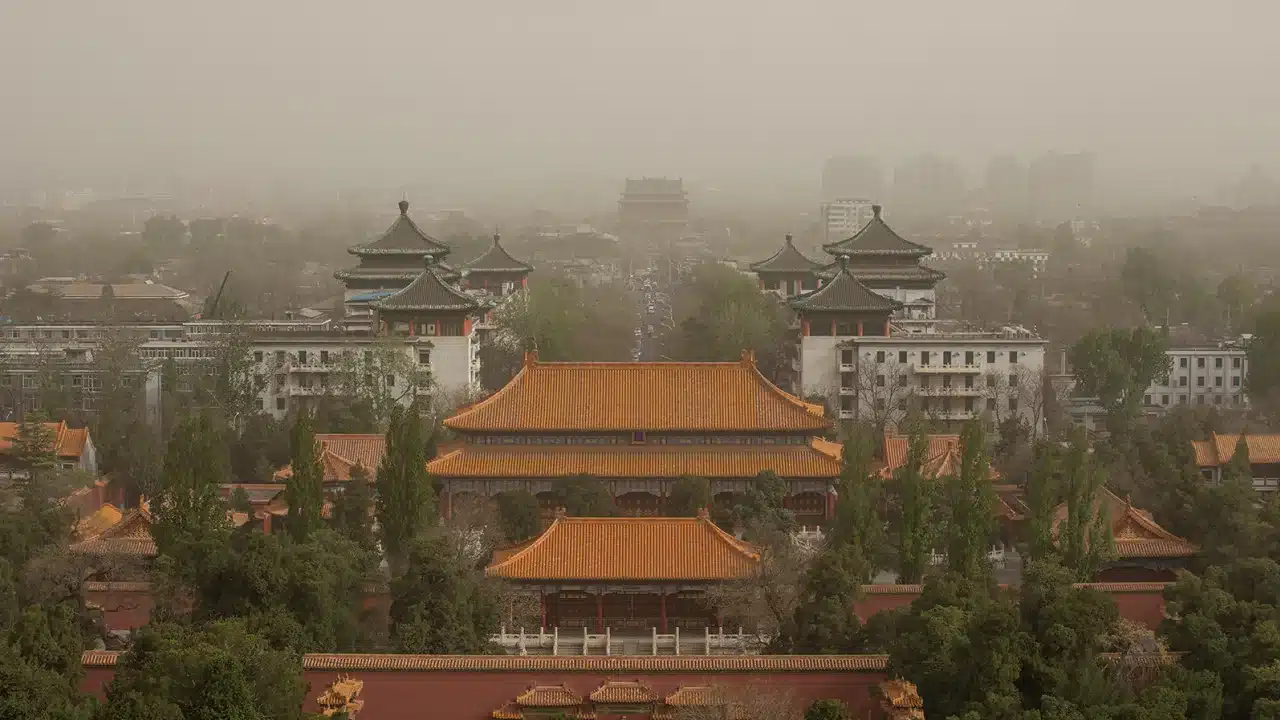
For the fourth time in a month, a strong sandstorm has covered Beijing and the northeastern parts of China, forcing some locals to stay inside to avoid the toxic air.
Pictures from Monday showed the Chinese capital covered in an orange haze that persisted into Tuesday, though the situation has started to improve.
Beijing authorities recommended healthy adults to refrain from outdoor exercise and told youngsters and the elderly to stay inside. Also, residents were urged to close their windows and put in face shields and masks.
On Monday, the air quality index soared to “severely polluted” levels, according to Beijing Municipal Ecological and Environmental Monitoring Center.
Concentrations of PM10 particles exceeded 1,321 micrograms per cubic meter at 9 p.m. on Monday, according to the center – almost 30 times the daily average guideline of 45 micrograms per cubic meter set by the World Health Organization.
PM10 are particles of pollution that are less than 10 micrometers in diameter and can irritate your eyes and nose and travel to your lungs.
Even smaller particles referred to as PM2.5 can travel deeper into your lungs and potentially enter your bloodstream. Levels of PM2.5 have been “hazardous” in Beijing for some of the past 48 hours, according to the Air Quality Index, which monitors real-time air quality in major cities worldwide.
Beijing is regularly hit with sandstorms in the spring with the smog made worse by rising industrial activity and rapid deforestation throughout northern China.
The latest sandstorm is the fourth to hit the country since March 10, and the eighth since the start of the year, state media reported.
The most severe sandstorm so far this year occurred on March 22, when PM10 particles hit 1,667 micrograms per cubic meter, according to the Beijing Municipal Ecological and Environmental Monitoring Center.
This time, the affected areas stretched as far south as Shanghai to parts of Heilongjiang, the country’s northernmost province, according to China’s Central Meteorological Observatory.
Other areas affected included Xinjiang, Inner Mongolia, Gansu, Ningxia, Shanxi, Hebei, Tianjin, Shandong, Henan, Jiangsu, Anhui and Hubei, according to the national observatory.
China’s National and Grassland Administration said sand and dust from the southern part of Mongolia and the western part of Inner Mongolia were carried southeast by air currents, triggering the present storm.
One Chinese internet user on Weibo, China’s heavily censored equivalent of Twitter, complained about the pungent smell.
“It smells very earthy,” she said.
Another user compared the storm to the sci-fi film “Blade Runner” and urged others to “just wear protection” when going out.
Hong Kong is dropping almost all its Covid restrictions this week, following a similar move by mainland China.
From Thursday, people arriving in the city – a special administrative region of China – will no longer have to do mandatory PCR tests.
The vaccine pass system will also be scrapped – but compulsory masks in public places will continue.
It is a dramatic move by the city, which once had some of the toughest restrictions in the world.
Also being scrapped from Thursday is the rule that limits the number of people allowed to gather outside to 12.
This was increased from four people in October as part of measures to begin reopening the city.
Hong Kong’s leader, John Lee, cited high vaccine rates as one of the reasons for lifting restrictions.
According to government figures, 93% of the population have had two vaccine does, while more than 83% have received three.
Unlike mainland China, which has developed its own vaccines, Hong Kong has also used mRNA vaccines – including the BioNTech jab made in Germany – that have been shown to be more effective.
“Hong Kong has a sufficient amount of medicine to fight Covid, and healthcare workers have gained rich experience in facing the pandemic,” Mr Lee said on Wednesday.
“The society has established a relatively extensive and overall anti-epidemic barrier.”
Mr Lee added that instead of the vaccine pass, which has limited access to public places for unvaccinated since it was introduced in February, the city would take “more targeted measures” – including promoting vaccination for the elderly and children.
More than 11,000 people have died with Covid in Hong Kong, according to official numbers, from more than 2.5m cases.
Since the pandemic began, the city has largely followed mainland China’s lead in efforts to tackle the virus, including attempts to eliminate it with a “zero-Covid” strategy.
This has been criticised by some residents and business owners – who said the policy damaged Hong Kong’s economy and international standing.
The scrapping of the Hong Kong’s Covid restrictions comes weeks after mainland China made a similar move following landmark protests against the strict controls.
On Monday and Tuesday, Beijing announced further plans to ease travel restrictions. Hong Kong has said that it will fully reopen its borders with the rest of China before mid-January.
The mainland is currently experiencing a surge in cases, with reports suggesting hospitals are overwhelmed and elderly people are dying.
Hong Kong is part of China and is governed by the “one country, two systems” principle, but Beijing has tightened control in recent years.
The US is considering imposing new Covid restrictions on Chinese arrivals, after Beijing announced it would reopen its borders next month.
American officials say this is due to a lack of transparency surrounding the virus in China, as cases surge.
Japan, Malaysia and Taiwan – worried at importing Covid cases – have already outlined tighter measures for Chinese travellers, including negative tests.
Beijing has said Covid rules should be brought in on a “scientific” basis.
India is also stepping up measures for Chinese arrivals, but this was announced before Beijing said it would relax its strict border policy.
Passport applications for Chinese citizens wishing to travel internationally will resume from 8 January, the country’s immigration authorities have said.
Travel sites have reported a spike in traffic, leaving some countries fearful over the potential spread of Covid.
“There are mounting concerns in the international community on the ongoing Covid-19 surges in China and the lack of transparent data, including viral genomic sequence data,” US officials said in a statement quoted by news agencies.
Wang Wenbin, China’s foreign minister spokesperson, subsequently accused Western countries and media of “hyping up” and “distorting China’s Covid policy adjustments”.
He said China believed all countries’ Covid responses should be “science-based and proportionate”, and should “not affect normal people-to-people exchange”.
Mr Wang called for “joint efforts to ensure safe cross-border travel, maintain stability of global industrial supply chains and promote economic recovery and growth”.
The true toll of daily cases and deaths in China is unknown because officials have stopped releasing this data. Reports say hospitals are overwhelmed and elderly people are dying.
Last week, Beijing reported about 4,000 new Covid infections each day and few deaths.
Before the relaxation of travel rules, people were strongly discouraged from travelling abroad. The sale of outbound group and package travel was banned, according to marketing solutions company Dragon Trail International.
Within half an hour of Monday’s notice that China’s borders would reopen, data from travel site Trip.com – cited in Chinese media – showed searches for popular destinations had increased ten-fold on last year.
Macau, Hong Kong, Japan, Thailand and South Korea were the most popular destinations.
Separately on Wednesday, Hong Kong’s leader John Lee announced that his city was scrapping the last of its Covid rules almost immediately – apart from the wearing of face masks, which will remain compulsory.
“The city has reached a relatively high vaccination rate which builds an anti-epidemic barrier,” Mr Lee told a media briefing.
The US still requires international travellers to show proof of being fully vaccinated against Covid on entering the country.
The website for the Centres for Disease Control and Prevention (CDC) also recommends that anyone travelling to the US gets a Covid test beforehand and has their result to hand – but this is not a legal obligation.
In their statement, the unnamed US officials added they were “following the science and advice of public health experts” and “consulting with partners”.
China’s loosening of travel measures – the last part of the country’s controversial zero-Covid policy – follows weeks of unrest which saw people take to the streets in rare protests against President Xi Jinping and his government.
Hong Kong‘s leader requests Beijing’s assistance in his attempt to prevent foreign lawyers from working on national security cases.
After the territory’s top court rejected the government’s attempt to prevent a British barrister from representing jailed media tycoon Jimmy Lai, Hong Kong’s leader John Lee has asked Beijing to rule on whether foreign lawyers can work on national security cases.
Lee said at a press conference on Tuesday that he expected China’s National People’s Congress Standing Committee (NPCSC) to rule on the case “as soon as possible,” but he did not say whether the decision would come before Lai’s trial began on Thursday.
His request for Beijing’s intervention will mark only the sixth instance of China’s top legislative body weighing into legal matters in Hong Kong, a former British colony that, under a “one country, two systems” arrangement, is supposed to have judicial independence from Beijing.
The Court of Final Appeal on Monday dismissed the government’s bid to block British barrister Timothy Owen from the trial and impose a “blanket ban” on foreign lawyers working on national security cases.
But Lee argued that Beijing’s intervention was necessary in part because a foreign lawyer might divulge state secrets or be compromised by a foreign government.
“There is no effective means to ensure that a counsel from overseas will not have a conflict of interest because of his nationality,” Lee told reporters on Monday. “And there is also no means to ensure he has not been coerced, compromised or in any way controlled by foreign governments, associations or persons.”
Beijing imposed the sweeping national security law on Hong Kong in June 2020 after sometimes-violent protests rocked the city for months the year before. The legislation — which punishes acts of secession, subversion, terrorism, and collusion with foreign forces with up to life in prison — has been widely condemned by Western governments and human rights groups.
National security cases
Lai, one of the most prominent Hong Kong critics of China’s Communist Party leadership, including Xi Jinping, faces two counts of conspiracy to commit collusion with foreign countries, as well as a sedition charge linked to his Apple Daily newspaper that was forced to close in June 2021 after a police raid and a freeze on its assets.
The 74-year-old, who was arrested in December 2020, is already serving a 20-month prison sentence for his role in unauthorised assemblies. He is also expecting a sentencing over his fraud conviction next month.
Owen is a London-based legal veteran who specialises in criminal and human rights law.
Hong Kong uses the same common law jurisdiction as the United Kingdom.
Some legal experts warned the appeal to Beijing would erode public confidence in Hong Kong’s judicial independence.
“What we’ve seen with interpretations is basically, ‘Heads I win, tails you lose,” Alvin Cheung, an assistant law professor at Queen’s University in Canada, told the Reuters news agency.
Cheung was part of a group that drafted a legal analysis in May, signed by Britain’s former Justice Secretary Robert Buckland and retired Australian high court judge Michael Kirby, that identified NPCSC interpretations as one of the main threats to Hong Kong’s rule of law.
“The NPCSC is a political (and undemocratic) body whose proceedings take place behind closed doors, with no participation from the parties at suit. Its decisions are actuated by political considerations rather than legal evaluation and contain little to no reasoning,” the legal opinion read.
Apart from having overseas judges in the city’s courts, lawyers from other common law jurisdictions are allowed to work within Hong Kong’s legal system, especially when their expertise is needed for some cases.
Last month, the lower court granted approval for Owen to represent Lai, saying it was in the public interest to have an eminent overseas specialist involved at the trial. And on Monday, the Court of Final Appeal gave a final ruling on the matter, rejecting the Department of Justice’s application on technical grounds.
The panel of three judges on the top court — Chief Justice Andrew Cheung, Roberto Ribeiro and Joseph Fok — in a written judgement, criticised the Department of Justice for “raising undefined and unsubstantiated issues said to involve national security which were not mentioned or explored in the Courts below”.
But they left open the overarching question of whether barristers from overseas should in principle be excluded from national security cases.
Legal experts and rights groups on Monday expressed concern over Lee’s decision to ask Beijing to intervene.
Lee’s move “is in practice making of a new rule rather than an interpretation of an existing law,” said Professor Johannes Chan Man-mun, the former dean of the Faculty of Law at the University of Hong Kong. “There are far-reaching implications in any such interpretation which may severely compromise Hong Kong as an international city,” he told the South China Morning Post.
Reporters Without Borders also criticised Lee’s move, urging Hong Kong’s government toallow Lai a representation of his own choosing.
Taiwan’s President Tsai Ing-wen has resigned as head of the governing Democratic People’s Party (DPP) after its poor showing in local elections.
The opposition Kuomintang (KMT) won several major races on Saturday, including in the capital Taipei.
The vote has drawn global attention as Taiwan becomes a bigger geopolitical flashpoint between China and the US.
President Tsai had framed the election as a vote for democracy amid rising tensions with China.
“The election results were not as expected… I should shoulder all the responsibility and I resign as DPP chairwoman immediately,” Ms Tsai, who will continue as president of the self-ruled island, told reporters.
The elections for local councils and city mayors theoretically have a domestic focus, covering issues such as crime, housing, and social welfare, and those elected will not have a direct say on Taiwan’s policy regarding China.
However, Ms Tsai and government officials urged voters to use the election to send a message about standing up for democracy, as Beijing increases pressure on the island.
Voters also rejected lowering the voting age from 20 to 18, in a referendum that was run alongside the local elections.
The Chinese government sees Taiwan as a breakaway province that will, eventually, be part of the country.
But many Taiwanese people consider their self-ruled island – with its own form of government and a democratic system – to be distinct.
Tensions reached a peak in August when Beijing staged huge military drills around Taiwan in a protest against US House Speaker Nancy Pelosi’s visit to the island.
The US has long walked a tightrope over Taiwan. Officially, it has no formal ties with Taiwan, but has also pledged to supply the island with defensive weapons and stressed that any attack by China would cause “grave concern”.
Two parties, two views
There are two main political parties in Taiwan and they have different approaches to China.
The Kuomintang (KMT), a party of conservative business champions, are traditionally seen as pro-China “doves”.
They have advocated economic engagement with China and have appeared to be in favour of unification, though they strongly deny being pro-China.
Their main rival is Ms Tsai’s governing Democratic People’s Party (DPP). Ms Tsai won by a landslide in the 2020 national election.
She has taken a strong stance towards China, saying Beijing needed to show Taiwan respect and that Taipei would not bow to pressure.
She was re-elected on a promise to stand up to Beijing. Locals told the BBC at the time that protests in Hong Kong and Beijing’s subsequent crackdown on civil rights had raised concerns in Taiwan.
Prior to his meeting with Xi, Biden is trying to be accommodative, but there has been a noticeable thawing of the relationship.
China faces an ongoing trade war with the US and a fresh attempt to deny China access to high-end American chip-making technology that, according to some commentators, is designed to slow China’s rise “at any price”.
Beijing argues that the chill is being driven by America’s desire to maintain its position as the pre-eminent world power.
President Joe Biden’s National Security Strategydefines Beijing as a bigger threat to the existing world order than Moscow. And Washington has begun to talk about a Chinese invasion of democratic Taiwan as an increasingly realistic prospect rather than a distant possibility.
This is a long way from the days when both US and Chinese leaders would declare that mutual enrichment would eventually outweigh ideological differences and tensions between an established superpower and a rising one.
Read more from the BBC’s John Sudworth here – Can the US live in Xi Jinping’s world?
China has slightly relaxed some of its Covid-19restrictions even as case numbers rise to their highest levels in months.
Quarantine for close contacts will be cut from seven days in a state facility to five days and three days at home.
Officials will also stop recording secondary contacts – meaning many people will avoid having to quarantine.
The slight easing comes weeks after Xi Jinping was re-instated as party leader for a historic third term.
Mr Xi held his first Covid meeting with his newly elected Standing Committee on Thursday.
China’s zero-Covid policy has saved lives in the country of 1.4 billion people but also dealt a punishing blow to the economy and ordinary people’s lives.
There is increasing public fatigue over lockdownsand travel restrictions.
Stories of suffering and desperation have also circulated on social media, fuelling many outbursts of civic anger.
China’s National Health Commission (NHC) insisted the changes did not amount to “relaxing prevention and control, let alone opening up”, but were instead designed to adapt to a changing Covid situation.
The NHC also said it would develop a plan to speed up vaccinations.
On Friday, the changes were announced even as the country grapples with its worst wave of Covid in months.
The cities of Beijing, Guangzhou and Zhengzhou are currently seeing record numbers.
On Thursday, China recorded over 10,500 new Covid cases – the highest daily total since April when China shut down its largest city Shanghai to combat a wave there.
Despite the small changes however, most restrictions still remain in place. Mr Xi has insisted on sticking to a stringent zero-Covid policy involving lockdowns even as the rest of the world has moved on.
That means in many cities residents have been subject to sudden restrictions on their movement and disruptions to work and schooling.
For example, this week in Guangzhou – the current epicentre of the Covid wave in China – locals in one district were barred from venturing outside and only one member of each household was allowed outside to grocery shop.
Public transport has been suspended while schools and workplaces are also shut down.
In Zhengzhou, another Covid centre at the moment, lockdowns there prompted many workers living at a vast factory owned by Taiwanese iPhone-maker Foxconn to flee the area on foot to escape restrictions.
The Chinese yuan fell to its lowest level in nearly 15 years on Tuesday as investors fled Chinese assets amid concerns about Xi Jinping’s dramatic move to consolidate power in a major reshuffle of Communist Party leaders.
On the tightly controlled domestic market, the yuan dropped sharply, hitting the weakest level since late 2007. It was lastdown 0.6% at around 7.3 per dollar. The currency has lost 15% against the US dollar this year.
In trading outside of mainland China, the yuan briefly plunged to around 7.36 per dollar early Tuesday, the lowest level on record, according to Refinitiv, which has data going back to 2010. It later pared losses, trading at 7.33 by 3:35 p.m. Hong Kong time (3.35 a.m. ET).
The currency was pegged at 8.28 to the US dollar for years until 2005 when China moved to a “managed floating exchange rate.” It then appreciated steadily, climbing to a peak of nearly 6.01 in 2014.
The declines came alongside a historic market rout for Chinese assets worldwide. On Monday, Chinese stocks plummeted in Hong Kong and New York, wiping out billions of dollars in market value. Hong Kong’s benchmark Hang Seng (HSI) Index closed down 6.4%.
The Nasdaq Golden Dragon China Index, which tracks many popular Chinese companies listed on Wall Street, dived more than 14%. On Tuesday, the Hang Seng (HSI) slipped further and was down 0.2% in afternoon trading.
The huge sell-offs came just days after the ruling Communist Party unveiled its new leadership for the next five years. In addition to securing an unprecedented third term as party chief, Xi packed key positions with staunch loyalists.
A number of senior officials who have backed market reforms and opening up the economy were missing from the new top team, stirring concerns about the future direction of the country and its relations with the United States.
International investors spooked by the outcome of the leadership reshuffle dumped Chinese assets despite the release of stronger-than-expectedChinese GDP data on Monday. They’re worried that Xi’s tightening grip on power will lead to the continuation of Beijing’s existing policies and further dent the economy, which despite the rebound last quarter is still growing way below the official 5.5% target for this year.
China’s ruling Communist Party is expected to hand a third five-year term to Xi Jinping, arguably the most powerful Chinese leader since Mao Zedong in the 1970s.
The decision – which comes after a two-term limit was abolished in 2018 – would further tighten his grip on China.
It is possible that Mr Xi, 69, will remain in power for the rest of his life.
The historic move is due at a Communist Party Congress in Beijing beginning on 16 October – one of the most important meetings in the party’s history.
Xi Jinping currently holds three top positions
As General Secretary, he is the chief of China’s Communist Party.
As president, he is China’s head of state.
As Chairman of China’s Central Military Commission, he commands the country’s armed forces.
He is also referred to as Paramount or Supreme leader.
Mr Xi is likely to retain the first two titles, party General Secretary and Central Military Commission chairman at the party congress – which takes place every five years – and the presidency at the annual National People’s Congress in Spring 2023.
What happens at the Congress?
Some 2,300 delegates will gather in Tiananmen Square’s Great Hall of the People for about a week.
About 200 of them will be selected to join the party’s central committee, plus around 170 alternate members.
The central committee will elect 25 people to the party’s Politburo.
And the Politburowill appoint the members of the Politburo standing committee.
These are the elite of the elite.
There are currently seven members, including the party’s General Secretary Xi Jinping.
They are all men.
Not all of the action takes place at the congress itself.
The central committee is expected to meet the day after the main congress ends.
Why is it important?
Mr Xi will lead the world’s second-largest economy and one of its biggest military forces.
Some analysts say he is likely to push China towards a more authoritarian political stance in a third five-year term.
“China under Mao was a totalitarian system. We’re not there yet, but we’re moving in that direction.”
Professor Tsang says the Congress could see changes to the party’s constitution, with “Xi Jinping thought” being further enshrined as the party’s guiding philosophy.
“Xi Jinping thought” is Mr Xi’s brand of Chinese socialism, an assertively nationalist philosophy that is highly sceptical of private business.
Under his leadership, the Chinese authorities have cracked down on powerful companies in several sectors of the economy.
“If that happens, they’ll effectively make him a dictator,” Prof Tsang says.
China’s top leadership team, to be unveiled at the congress, will set a huge range of policies.
Any hint of China’s future direction will be followed closely around the world, particularly on the key challenges: economic, political, diplomatic, and environmental.
China’s economic challenge
China’s economy has boomed in recent decades.
But it now faces serious economic disruption from Covid lockdowns, rising prices, and a major property crisis.
Growing fears of a global recession triggered by the war in Ukraine have also damaged confidence.
Economic growth under Mr Xi’s leadership is lower than under previous presidents Jiang Zemin and Hu Jintao.
Some analysts say the legitimacy of the communist government rests heavily on its ability to deliver higher incomes and good jobs for Chinese workers.
So bad economic performance in the next five years could spell serious political trouble for Mr Xi.
The congress will set the stage for a shake-up of key economic roles including central bank governor and premier.
Zero Covid
China’s zero Covid approaches to the pandemic is one of Xi’s landmark policies.
While much of the world has been returning to normal, China’s authorities have intensified their efforts to contain outbreaks, with strict lockdowns, mass testing, and lengthy quarantines.
Reports say that more than 70 cities including Shenzen and Chengdu have been under full or partial lockdown measures in recent weeks, with tens of millions of residents affected, huge numbers of businesses disrupted, and reports of public discontent.
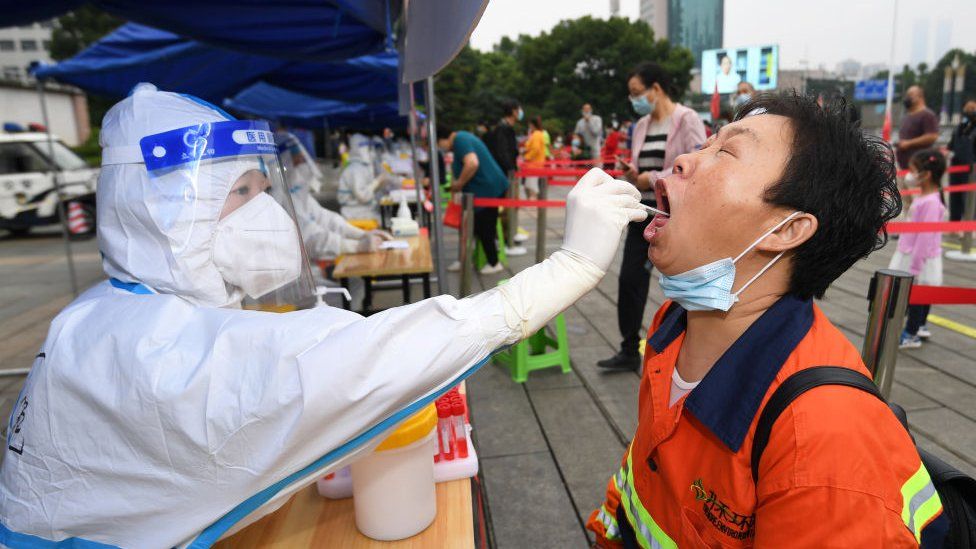
IMAGE SOURCE,GETTY IMAGES Image caption, Medical staff testing residents in Guiyang, Guizhou Province
Mr Xi has vowed to “resolutely fight against any words and acts that distort, doubt or deny” his Covid policy.
A major outbreak in the run-up to the Congress, or during the meeting itself, risks damaging Mr Xi’s image of competence.
Some observers say the party may use Congress to declare victory over the pandemic and end the zero Covid policy.
Alternatively, the party may argue that China – unlike other countries – values people’s lives more than the economy, in which case the policy will continue.
Taiwan and the West
Mr Xi has also favoured a hardline approach to relations with the West, particularly over Taiwan.
A visit to Taiwan by the Speaker of the US House of Representatives in August prompted China to launch military exercises, including live missile firing, around the island.
China sees Taiwan as a breakaway province that will eventually be under Beijing’s control. Taiwan sees itself as distinct from the mainland.
Mr Xi has said “reunification” with Taiwan “must be fulfilled” by 2049, the centenary of the People’s Republic – and has not ruled out the possible use of force to achieve this.
Taiwan is of huge strategic importance to the West, part of the so-called “first island chain”, which includes a list of territories that have been allied to the US for decades.
DISCLAIMER: Independentghana.com will not be liable for any inaccuracies contained in this article. The views expressed in the article are solely those of the author’s and do not reflect those of The Independent Ghana
After Tesla CEO Elon Muskstated that Taiwan should become a special administrative region of China, Beijing and Taipei expressed their disagreement.
The richest man in the world stated in an interview with the Financial Times that he thought the two countries could come to a “fairly agreeable” agreement.
Musk received praise from China’s ambassador to the US, while his Taiwanese colleague declared that freedom is “not for sale.”
Taiwan rules itself but Beijing claims it as part of its territory.
Last week, Mr Musk also drew criticism for posting a Twitter poll with his suggestions for ending the war between Russia and Ukraine, including Kyiv giving up territory to Moscow.
Mr Musk’s comments come as the electric car maker hit a monthly record for sales in China.
He weighed in on heightened China-Taiwan tensions in a wide-ranging interview with the UK business newspaper the Financial Times, which was published on Friday.
“My recommendation… would be to figure out a special administrative zone for Taiwan that is reasonably palatable, probably won’t make everyone happy,” he said.
“And it’s possible, and I think probably, in fact, that they could have an arrangement that’s more lenient than Hong Kong.”
I would like to thank @elonmusk for his call for peace across the Taiwan Strait and his idea about establishing a special administrative zone for Taiwan. Actually, Peaceful reunification and One Country, Two Systems are our basic principles for resolving the Taiwan question… https://t.co/KYH1Gsu3Um
On Saturday, China’s ambassador to the US Qin Gang welcomed Mr Musk’s suggestion to establish Taiwan as a special administrative zone.
He said on Twitter that “peaceful reunification” and the “one country two systems” model used in governing Hong Kong were China’s “basic principles for resolving the Taiwan question”.
“Provided that China’s sovereignty, security and development interests are guaranteed, after reunification Taiwan will enjoy a high degree of autonomy as a special administrative region, and a vast space for development,” he added.
In response, Hsiao Bi-khim, Taiwan’s de facto ambassador to Washington said on Twitter: “Taiwan sells many products, but our freedom and democracy are not for sale.”
“Any lasting proposal for our future must be determined peacefully, free from coercion, and respectful of the democratic wishes of the people of Taiwan,” Ms Hsiao added.
Shihoko Goto, director for geoeconomics and Indo-Pacific enterprise at the Wilson Center in Washington DC, told the BBC that Mr Musk’s suggestions could hurt his business interests.
“Let’s bear in mind that Elon Musk is supposedly on the brink of purchasing Twitter. Of course, Twitter is banned in China because free speech is not allowed in China,” Ms Goto said.
“So if he is investing in Twitter, his company will probably not be able to operate in Taiwan which is going to be under pressure or under the thumb of China. That would be a suicidal act on the part of Elon Musk,” she added.
China sees self-ruled Taiwan as a breakaway province that will eventually be under Beijing’s control.
Meanwhile, Tesla delivered 83,135 China-made electric vehicles in September, according to a report released on Sunday by the China Passenger Car Association.
That broke the previous record set by the company in June and marked a milestone for Tesla’s factory in Shanghai which has been trying to boost production.
Five teenagers have been sentenced to three years’ detention in Hong Kong for advocating overthrow of the Beijing government.
It is the first time the national security law has been used in court against under-18s in Hong Kong.
Beijing introduced the wide-ranging law – which made it easier to prosecute protesters – in the city in 2020.
Many who defy the Chinese government have since been jailed, removing much of the political opposition.
The court heard the defendants had used social media and street booths to advocate a “bloody revolution” to overthrow the Chinese state in the former British colony.
Judge Kwok Wai-kin said: “Even if one person is incited, Hong Kong’s stability and residents’ safety could have been greatly harmed.”
The teenagers – aged between 16 and 19 – were members of Returning Valiant, a pro-Hong Kong independence group.
Mr Wai-kin said he appreciated the defendants’ “age and immaturity”, which meant they were sentenced to a detention facility for young people – also known as a training centre – instead of going to prison.
The judge also capped the length of their sentence to three years. How long they remain in custody will remain at the discretion of authorities.
The case also involves two adults, who will be sentenced next month.
According to research published by ChinaFile in partnership with Georgetown University, at least 110 people have been arrested under the national security law. Those arrested include protesters, activists and former opposition lawmakers.
The collective outpouring of sadness, however, coincides with Beijing’s increasing hold over the country and tells as much about the present as it does the past.
In contrast to the more subdued responses observed in other former British colonies, the Admiralty section of the city witnessed lengthy lines and mountains of flowers and cards.
Hong Kong returned to Chinese rule under “one country, two systems”, which promised that the city’s way of life – including civil liberties unavailable in the mainland – would be kept for at least 50 years.
But a crackdown on protests, Beijing’s imposition of its national security law and only allowing “patriots” to govern are seen by many as reneging on that promise.
“There is a mix of complex emotions,” said Dr Li Mei Ting, a cultural and religious studies lecturer at the Chinese University of Hong Kong.
Outside the British consulate, mourners opened umbrellas to hide from the scorching sun while “God Save the Queen” played softly from a mobile phone.
Parents brought their children along, and one father even wrapped his seven-month-old daughter in a Union Jack flag.
“I don’t remember ever seeing Hong Kongers doing this to any leader who passed away,” Ted Hui, a former Hong Kong MP who now lives in Australia, told the BBC.
Nostalgia for a ‘golden age’
In the city, the Queen was affectionately called si tau por, which means “boss lady” in Cantonese.
Many in the queue were older people, among them Mr Lee, aged in his 60s, who had brought chrysanthemums. “I hadn’t bought any flowers before, not even when I was courting girls.”
Queen Elizabeth II visited Hong Kong twice during her reign. She is affectionately called “boss lady” in Cantonese
Hong Kong became a British colony after two Opium Wars in the 19th century and colonial rule lasted for 156 years. Meanwhile, mainland China was swept by political turmoil including the Great Famine and the Cultural Revolution.
“Hong Kong was peaceful during those days,” said Ms Fung, 75.
When Hong Kong people reminisce about the colonial era, they are often referring to the period from the mid-1970s to the 1990s, says Dr. Li.
“People who experienced this period see it as Hong Kong’s golden age,” she said.
The British colonial government changed its governance model as a response to deadly anti-colonial riots in 1967, which were sparked by a labour dispute and supported by Beijing. More public housing was built and free primary education was introduced, partly in a bid to ward off further social movements, Dr Li says.
But US-based activist Jeffrey Ngo says the last three decades of the colonial period do not give the full picture – and that the British empire had played a “very big role” in paving the way for the current situation.
Last week five speech therapists were convicted under the colonial-era sedition law, for publishing children’s books that portray the Chinese government as wolves and Hong Kongers as sheep. The judge said it was a “brainwashing exercise”, while critics say the sentence was a blow to freedom of speech.
The UK also did little to democratise the city for much of the colonial period, Mr Ngo said.
Current day discontent
For some, commemorating the Queen is a way to express their unhappiness at the Hong Kong government. Protest is no longer possible under Beijing’s sweeping national security law and stringent Covid rules.
Mr Tse, who brought his pet Corgi on a leash with a Union Jack, said the mourning was an “alternative form of political expression”.
Mr Tse says he is surprised by the number of people waiting outside the consulate
Flying that flag on another day could risk arrest or even prosecution under the national security law – but it is being tolerated for now because of the Queen’s death, he added.
Mr Chan came with his wife and two children. He said the family felt close to the Queen as all members were born at Queen Elizabeth Hospital, which was opened in 1963.
“We will pay tribute to whoever merits our respect. [Authorities] should not easily accuse people of collusion with foreign forces but not reflect on their own behaviour that causes so much unhappiness among Hong Kongers,” he said.
Some in the line were also planning to leave the city. Hong Kong’s population has shrunk by almost 200,000 in two years – and many of those leaving plan to settle in the UK.
“Hong Kongers are queuing under such heat. We share the same ideas and no words are needed to explain,” said Ms Lee, who came with her 21-year-old daughter.
“There is a huge contrast between the past and the present… Now we have lost what we had and many people I know are emigrating,” she added before confirming that they plan to leave too.
This father says he will teach his daughter about Hong Kong’s colonial history when she grows up
Hong Kong’s identity
Younger people without direct experience of the colonial era were also in the queue. Some said they were worried that Hong Kong’s colonial past would be buried under Beijing’s drive to reshape the city.
Law student Sam said his grandmother fled mainland China by swimming to the city. “Immigration officers said to my grandma that our si tau por was also a woman, so she would be taken care of in Hong Kong.”
Christopher, 15, said traces of Hong Kong’s colonial history are still visible – such as the old banknotes and street signs. “But it feels like they are fading.”
“No matter our criticism, the colonial period was part of our Hong Kong identity and history,” said Dr Li.
A Chinese research ship docked at a southern Sri Lankan port Beijing leases from the government on Tuesday, officials said, despite security concerns raised by India about the vessel’s presence in nearby waters.
Port workers at Hambantota gave an enthusiastic welcome to the Yuan Wang 5, waving Sri Lanka and China flags, while the ship displayed a large banner reading: “Hello Sri Lanka.”
However, the ship’s arrival appears to have aggravated tensions between New Delhi and Beijing, who have both spent billions of dollars on development and deals with Sri Lanka, an island of 22 million people that sits on a key trading route.
The Yuan Wang 5 had originally requested permission to dock at the port last week, but the visit was delayed after concerns were raised about the ship’s presence, though India denied putting any pressure on Colombo.
China says the ship is used for scientific research, but the US Defense Department says the ship is under the command of the People’s Liberation Army (PLA) and is capable of tracking satellites and missile launches.
On Saturday, Sri Lanka’s Foreign Ministry said the government had engaged in “extensive” consultations with “all parties concerned” with a “view to resolving the matter in a spirit of friendship, mutual trust and constructive dialogue.”
It said the ship had been given permission to dock on the condition that no scientific research was conducted in Sri Lankan waters.
Ms. Pelosi’s flight to Malaysia on a US air force plane has left Kuala Lumpur. The US Navy has simultaneously deployed four warships east of Taiwan, albeit it is unknown if Ms. Pelosi is on that aircraft.
Even though there has been no official announcement, local media in Taiwan has reported that Ms. Pelosi will arrive in Taipei on Tuesday.
The US airforce jet that Ms. Pelosi flew on to Malaysia has taken off from Kuala Lumpur – it is unclear if Ms. Pelosi is on the plane, but the US Navy has simultaneously deployed four warships east of Taiwan.
A US official called these “routine deployments”.
Prior to her arrival, China‘s foreign ministry confirmed there had been communication with the US, adding it wanted to be “clear about the gravity and sensitivity of this matter”.
Ms. Pelosi began a tour of four Asian countries on Monday, starting in Singapore. She arrived in Malaysia on Tuesday for the second leg, where she met lower house Speaker Azhar Azizan Harun in parliament and then Prime Minister Ismail Sabri Yaakob.
China has threatened retaliation ahead of the visit, driving concerns of a new crisis in the Taiwan Strait.
Beijing, which regards Taiwan as a renegade province to be annexed by force if necessary, has warned of repercussions, saying its military will “never sit idly by” if Ms. Pelosi pushes ahead with the visit.
The country views Taiwan as a part of its own territory and interprets diplomatic exchanges with the US as a call to formalize its long-standing de facto independence.
The visit would make her the highest-ranking elected US official to visit in more than 25 years.
On Monday, the White House hit back at Beijing’s rhetoric, and said the US has no interest in deepening tensions with China and “will not take the bait or engage in saber-rattling”.
The latest Covid-19 outbreak in Beijing has led to some swift changes in Chinese eating habits.
So far, 249 people in the capital have tested positive since an individual tested positive on 11 June.
State media believe that the virus was first detected on chopping boards used for imported salmon, and so media are highlighting that there has become widespread nervousness around eating seafood.
Popular website The Paper today interviews wholesalers who import seafood to China, who talk of the drastic fall in sales, with supermarkets and restaurants suddenly removing salmon from their shelves.
Medical specialists are also suddenly seeking to reassure the public that they will not catch Covid-19 from eating crisps after eight workers at a Beijing-based PepsiCo factory, which produces Lays crisps, tested positive over the weekend.
Medical specialist Feng Zijian says that the virus survival time is “very short†on dry food at room temperature
Disclaimer : “Opinions expressed in this article are the sole responsibility of the author(s) and do not in any way reflect those of backend.theindependentghana.com. Our outfit will hereby not be liable for any inaccuracies contained in this article.â€
Beijing on Monday vowed to shield a Chinese government institute and eight companies sanctioned by the US over alleged human rights violations in the restive Xinjiang region, where China is accused of mass repression of mostly Muslim minorities.
The US Department of Commerce announced the sanctions on Friday, saying they were triggered by human rights abuses against Uighurs and other minority groups in Xinjiang in China’s far northwest.
Beijing urged Washington to reverse the decision, saying the Commerce Department had “stretched the concept of national security” to “meddle in China’s affairs and harm China’s interests”.
“China will take all necessary measures to protect the legal rights and interests of Chinese companies,” foreign ministry spokesman Zhao Lijian said at a regular press briefing.
The Commerce Department said the nine parties were “complicit in human rights violations and abuses committed in China’s campaign of repression, mass arbitrary detention, forced labour and high-technology surveillance against Uighurs, ethnic Kazakhs” and other Muslim minority groups in Xinjiang.
All nine are now subject to restrictions on exports from the US, the department added.
Washington has been increasingly active in its criticism of China’s treatment of ethnic minorities in Xinjiang, and in October blacklisted 28 entities involved in alleged rights violation there.
The US House of Representatives and Senate are yet to reconcile similar acts approved last year that would seek sanctions on officials over abuses, and restrict exports of surveillance gear and other equipment seen as assisting in repression in Xinjiang.
An estimated one million mostly Muslim ethnic minorities are being held in internment camps in Xinjiang.
Uighur activists say China is conducting a massive brainwashing campaign aimed at eradicating their distinct culture and Islamic identity.
China describes the camps as vocational training sites intended to offer an alternative to Islamic extremism.
Tensions are also growing between the world’s two largest economies after President Donald Trump accused China of misleading the world on the origins of the coronavirus, which first emerged in the Chinese city of Wuhan.
Beijing has furiously denied the allegation, and its foreign minister Wang Yi said Sunday that Washington was pushing both sides to “the brink of a new Cold War”.
Tens of thousands of students returned to school in Shanghai and Beijing Monday after months of closures intended to curb the spread of the coronavirus, as China’s major cities gradually return to normality.
Shanghai students in their final year of middle and high school returned to classrooms, while only high-school seniors in Beijing were allowed back on campus to prepare for the all-important “gaokao” university entrance exam.
China has largely curbed the spread of the deadly disease, but is still on high alert with growing fears of imported cases and a second wave of domestic infections in the northeast.
Teenager Meng Xianghao said he was taking extra precautions on his first day back at Beijing’s Chenjinglun High School.
“I brought masks, garbage bags and disinfectant,” Meng, who had just taken the subway for the first time in months, told AFP as children in masks and uniform tracksuits filed past police and officials to enter the school.
“I’m glad, it’s been too long since I’ve seen my classmates,” said 18-year-old student Hang Huan. “I’ve missed them a lot.”
A tent set up at the entrance was staffed by a person in a white hazmat suit, while a man wearing a container of disinfectant on his back sprayed the ground by the school gates.
Across the country, schools that have been closed or online-only since January began gradually reopening last month, while virus epicentre Wuhan is set to reopen its high schools on May 6.
Students in the capital will have their temperatures measured at school gates and must show a “green” health code on a special app that calculates a person’s infection risk, according to China’s Ministry of Education.
The ministry said some schools in Beijing had rehearsed the reopening with mock “students” in advance.
Welcome speeches
Footage from the Communist Party-run Beijing Daily showed some of the city’s 49,000 high-school seniors in classrooms Monday, wearing masks at desks which were spaced evenly apart as teachers welcomed them back with speeches.
A screen at the front showed a photo of Chinese President Xi Jinping, as the teacher talked to the class about the significance of overcoming the COVID-19 pandemic.
In some cafeterias, students are assigned fixed seating spots spaced at least one metre apart.
Beijing still has strict measures in place to prevent a fresh outbreak, requiring visitors to the city to pass stringent testing requirements and complete lengthy quarantine periods.
In Shanghai, some schools have set aside special rooms for isolating students with “abnormal temperatures,” the ministry said.
Beijing student Xiao Shuhan told AFP he thought some form of social distancing would continue even as classmates and friends reunite.
“We’ll no longer put our arms around each other’s shoulders,” he said.
The long absence from classrooms has added to the pressure on final-year students preparing for the high-stakes “gaokao” exams, which is the only route to Chinese universities and notoriously difficult.
“At school there’s a certain atmosphere for learning and at home there is not,” said Wang Yuchen, a 17-year-old student.
China said in March that it would postpone the exams by one month to July this year.
Beijing’s notoriously bad air quality has improved in recent years and the Chinese capital is expected to drop out of a list of 200 most polluted cities in the world this year, a data provider said Thursday.
Beijing “is on track” to reduce PM2.5 — tiny particles that are the deadliest air pollutants — by nearly 20 percent this year compared to 2018, Swiss air purification technology company IQAir’s research arm AirVisual said.
The average hourly PM2.5 readings in the smog-choked Chinese capital fell to 42.6 micrograms per cubic metre of air in the first eight months of 2019, down from 52.8 for the same period last year.
“Compared to a decade earlier, the difference is even more striking,” the report said. “The PM2.5 concentration in the first eight months of 2019 was less than half that of the same period in 2009.”
The annual average PM2.5 concentration reached an eye-watering 104.0 in 2010. It began a steady decline in 2013.
But the current levels are still four times higher than those recommended by the World Health Organization.
The tiny particulate matter can lodge deep in the lungs and cause respiratory ailments, lung cancer and cardiovascular diseases.
Beijing was ranked 122 among the most polluted cities in the world in 2018, according to a March report by environmental group Greenpeace and AirVisual’s data.
The improvements in air quality were driven by the city’s strict push to trim coal consumption and shut down or relocate polluting plants, the Beijing municipal government said in a February statement.