Tag: bills

  • List of bills president Mahama has assented so far

    List of bills president Mahama has assented so far

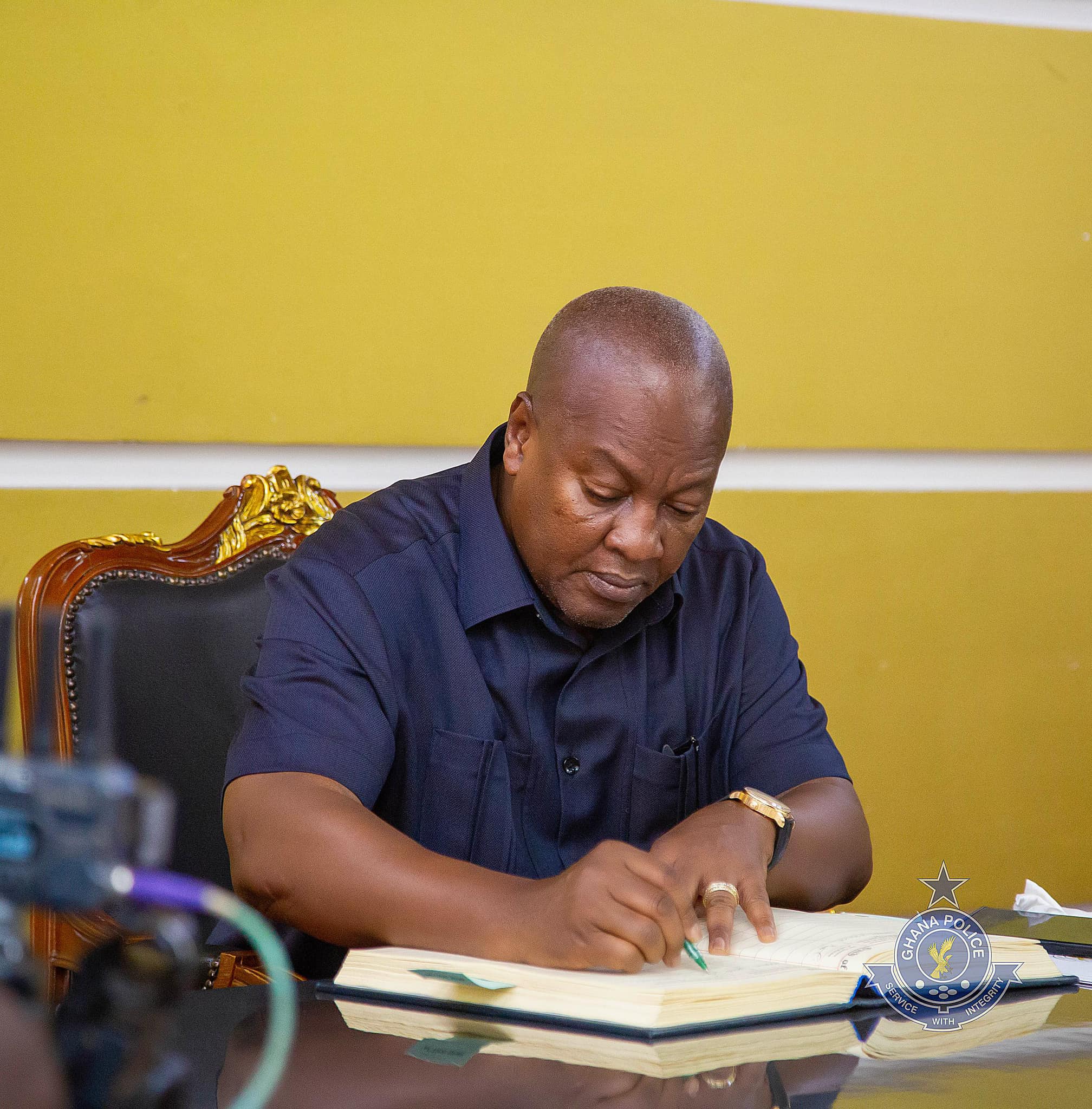
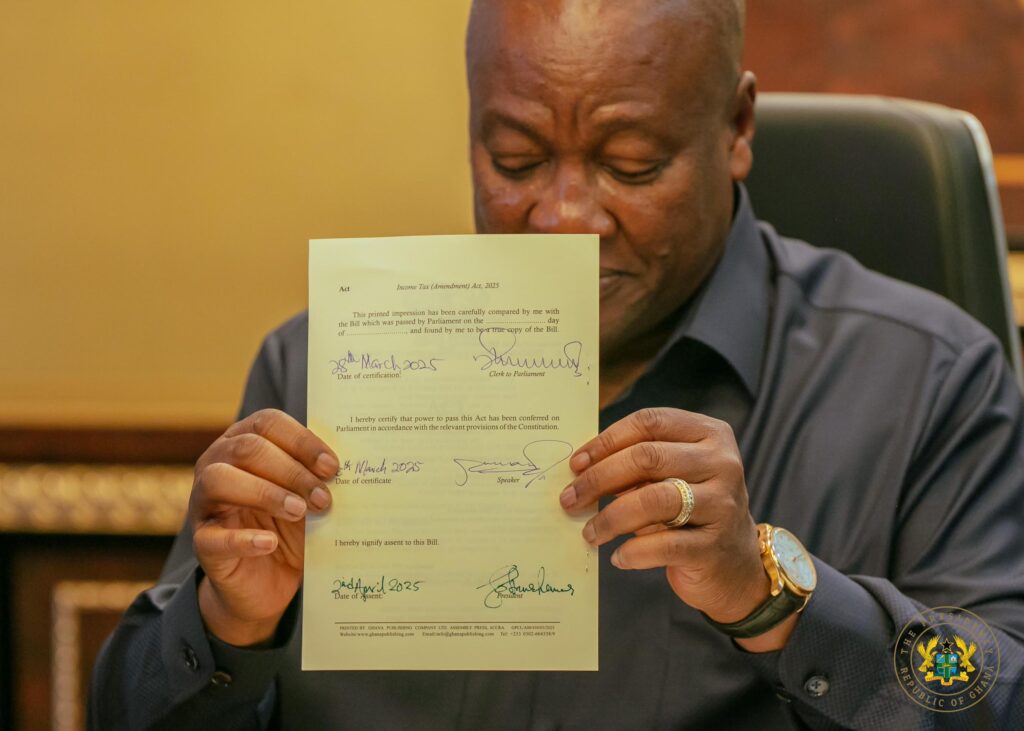
    President John Dramani Mahama has officially signed into law a comprehensive set of tax and financial reforms aimed at rejuvenating Ghana’s economy and enhancing fiscal management.

    These legislative changes represent a substantial shift in the country’s tax landscape, emphasizing the government’s commitment to tackling economic challenges and improving the financial well-being of its citizens.

    Among the notable reforms is the repeal of the Electronic Transfer Levy (E-Levy), a move that eliminates the contentious 1% tax on digital transactions, which has received widespread support from both the business community and the general public.

    Additionally, the Emissions Levy, which placed a financial burden on vehicle owners and industries, has been abolished.

    Further adjustments include changes to the Value Added Tax (VAT) system, designed to better align with the evolving market needs and promote economic growth.

    The Income Tax Amendment Bill of 2025 introduces changes to simplify tax compliance and provide much-needed relief to taxpayers.

    The management of petroleum revenues has also been revised through the Petroleum Revenue Management Amendment Bill, ensuring a more efficient allocation of resources.
    Other significant reforms include the Public Financial Management Amendment Bill, which aims to increase government transparency and fiscal responsibility, and the Earmarked Funds Capping and Realignment Bill, which seeks to optimize fiscal allocations for greater efficiency.

    Additionally, the Energy Sector Levy has been adjusted to encourage sustainable practices and investment in the sector, while the Gold Board Bill of 2025 introduces new regulations for managing the country’s gold production and revenue.

    Finally, the Growth and Sustainability Levy Act introduces measures that are expected to support long-term economic stability.

    The Finance Ministry has expressed optimism that these reforms will not only ease the tax burden on citizens but also stimulate economic activity and increase compliance with tax laws.

    Experts believe these changes will attract more investment and strengthen the nation’s fiscal stability.

    By signing these bills into law, President Mahama has reaffirmed his administration’s proactive stance in addressing Ghana’s economic needs and ensuring a more sustainable financial future.

  • Govt surpasses T-bills target with 9% oversubscription in December

    Govt surpasses T-bills target with 9% oversubscription in December

    The government has concluded 2024 with a notable 9% oversubscription in its final Treasury bills auction, indicating shifting investor sentiment in the wake of the general elections.

    According to data released by the Bank of Ghana, the auction raised GH¢4.6 billion, exceeding the targeted GH¢4.3 billion by GH¢383 million.

    The 91-day Treasury bill was the dominant performer, securing GH¢3.8 billion in bids. Meanwhile, the 182-day bill attracted GH¢628.16 million, contributing 13.5% to the overall bids, and the 364-day bill raised GH¢179.37 million, accounting for 3.36% of the total.

    Despite the oversubscription, the auction saw another round of interest rate increases. The rate on the 91-day bill climbed from 27.85% to 28.03%, while the 182-day bill saw a rise from 28.68% to 28.88%. The 364-day bill also witnessed a bump, with its rate moving from 29.97% to 30.07%.

    These results suggest a blend of cautious optimism among investors, as higher yields continue to attract demand despite the rising cost of borrowing.

    The auction’s outcome marks the conclusion of the government’s short-term debt strategy for 2024, setting the tone for the year ahead. Treasury bills have increasingly become the government’s go-to funding mechanism, particularly after losing access to international capital markets and experiencing a series of sovereign credit downgrades. This shift has been compounded by stagnation in the local debt market, exacerbated by the domestic debt exchange program initiated in December 2022.

    Looking ahead, Databank’s 2025 projections indicate a potential reduction in T-bill issuances by up to GH¢20 billion, which would bring the total stock to approximately GH¢200 billion, as alternative funding mechanisms are explored.

    In parallel, the incoming administration of President-elect John Mahama has reiterated its commitment to fiscal discipline, which could lead to a decline in demand and yields for short-term instruments, although it intends to abolish the E-levy and COVID-19 levy.

  • Govt records 19.75% over-subscription of T-Bills after election

    Govt records 19.75% over-subscription of T-Bills after election

    Government has experienced a significant 19.75% oversubscription of treasury bills just a week after President Mahama’s election victory.

    The increase in demand for these treasury bills, which typically reflect short-term borrowing, signals a positive shift in market sentiment, with investors showing renewed faith in the government’s fiscal policies and future outlook.

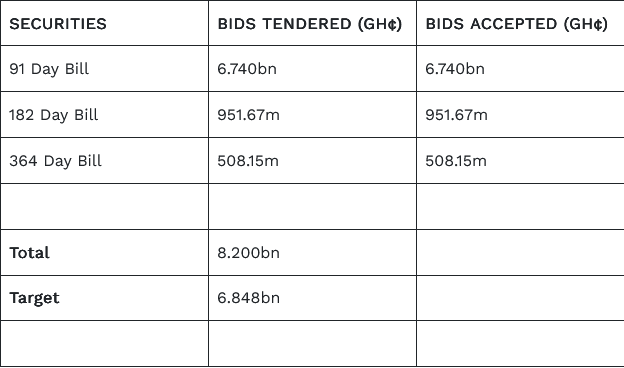
    According to the Bank of Ghana’s auction results, the sale of short-term government securities raised GH₵8.2 billion, with all bids accepted.

    The 91-day bills garnered the most interest, securing over GH₵6.74 billion, which accounted for 82.1% of the total bids. The 182-day bills raised GH₵951.67 million, and the 364-day bills brought in GH₵508.15 million.

    Interest rates also saw an increase, with the yield on the 91-day bill rising by 17 basis points to 27.77%.

    The yield for the 182-day bill climbed to 28.49% from 28.32% the previous week, while the 364-day bill yield rose by 3 basis points to 29.94%.

  • ECG to tackle over-billing issues by visiting homes to read meters

    ECG to tackle over-billing issues by visiting homes to read meters

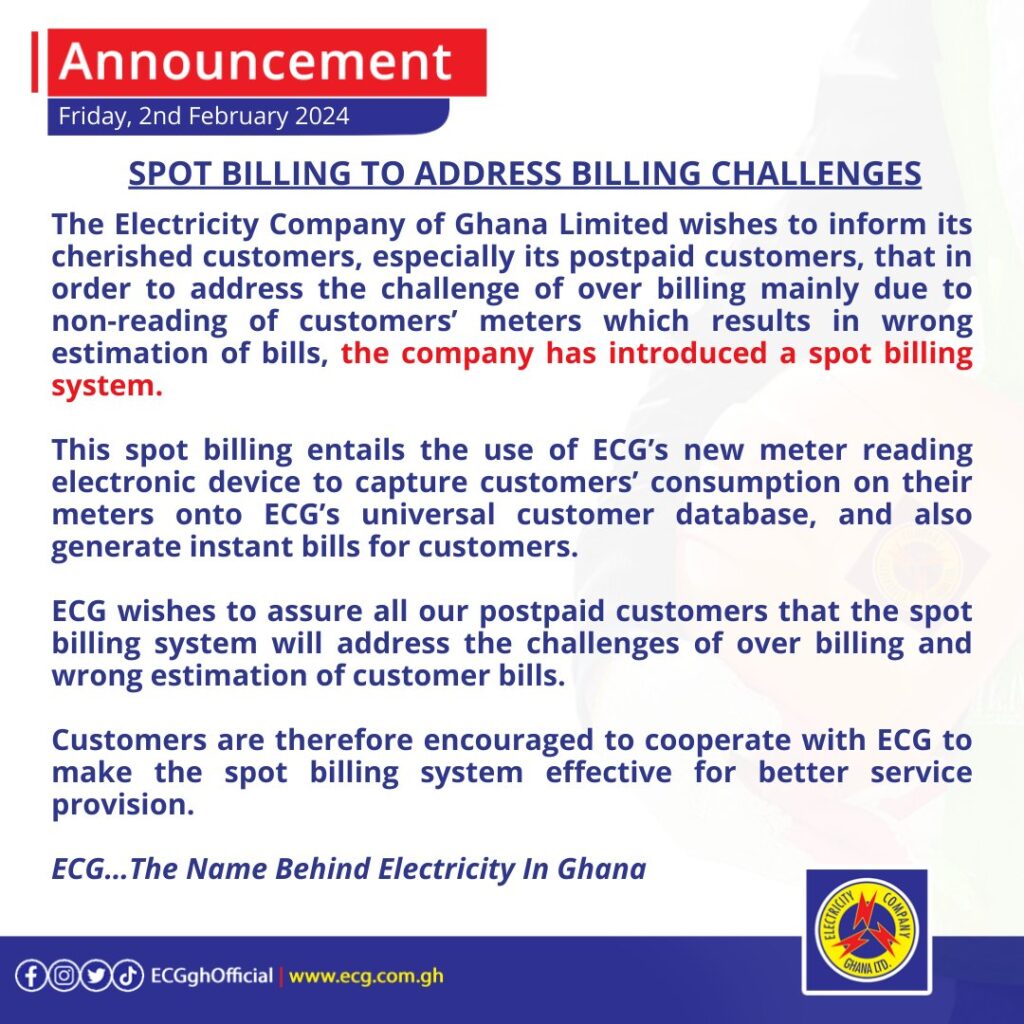
    The Electricity Company of Ghana (ECG) is set to implement a spot-billing system to tackle challenges related to over-billing caused by non-reading of customers’ bills, leading to inaccurate estimations.

    As per a press statement dated February 2, 2024, ECG outlined that the initiative involves the introduction of a new reading meter, capable of capturing customers’ electricity consumption and seamlessly integrating it into the central ECG database.

    This system aims to facilitate instantaneous billing, preventing errors and over payments.

    ECG reassured all customers that this approach will effectively address issues related to over billing and inaccurate bill estimations.

    Customers are encouraged to collaborate with this initiative to ensure the efficacy of the new system.

  • You are only exercising your veto power because the bills are from an MP, not you – Dr Srem Sai tells Akufo-Addo

    You are only exercising your veto power because the bills are from an MP, not you – Dr Srem Sai tells Akufo-Addo

    A Private Legal Practitioner, Dr. Justice Srem Sai, has criticized President Akufo-Addo for refusing to assent to some bills passed by Parliament.

    According to Dr. Justice Srem Sai, the power bestowed on the President by the constitution is not a blank cheque for him to use to settle political or personal scores.

    His comment follows statements from the Presidency explaining that the bills, sponsored by the NDC MP for Madina, Francis-Xavier Sosu, must come from the Executive and not as a Private Members Bill.

    The bills are the Criminal Offences (Amendment) Bill, 2023, Criminal Offences (Amendment) (No.2) Bill, 2023, and Armed Forces (Amendment) Bill, 2023.

    In July, Parliament passed the Armed Forces Bill, which seeks to amend sections of Act 29 and the Armed Forces Act, 1962 (Act 105) to replace the Death Penalty with life imprisonment.

    The Criminal Offences Amendment Bill 2023 also seeks to prohibit the act of declaring, accusing, naming, or labeling an individual as a witch, among other related matters. However, in a letter to the Speaker of Parliament, the President insisted that his government would soon present bills on the same subjects before Parliament.

    Reacting to this in a social media post, Dr. Srem Sai said “the President is not seeking to change or amend any provision of the bill.”

    He stressed that, the only reason for the President “exercising the veto power is that the bill came from an MP (Hon. Francis Sosu) and not from him (President Akufo Addo).”

    Below is the full statement by Justice Srem Sai

    A law passed by Parliament (a bill) is not a full law (an Act) until the President signs it. This means that the President has the power to sign or to refuse to sign a bill. When he signs, we say he has given his assent; when refuses, he has vetoed it.

    In August and in November this year, Parliament passed and presented some bills to the President to sign into Acts. Now, the President is claiming that he has vetoed the bills. The question is – is the President’s purported veto valid?

    The beginning point of the answer to this question is that the President’s veto power is not a blank cheque – he can’t do as he wishes or behave as he pleases with the power. For his veto to be valid, he must act in accordance with the Constitution.

    We know a few things: we know, for instance, that the President, in the exercise of the veto power, is limited (restricted) in at least 2 clear ways. He is limited in respect of TIME. He’s also limited in respect of the GROUNDS on which he may veto a bill.

    TIME: Generally, he has up to 21 days (from the day the Speaker of Parliament presents the bill to him) to exercise the veto power. First, he has 7 days to “signify” to the Speaker that he has vetoed the bill; then, an additional 14 days to provide the grounds for the veto.

    If the President defaults in satisfying any of these timelines – the 7 days, or the 14 days – the veto becomes invalid. In such a situation, he may be deemed to have assented to the bill notwithstanding that he has not actually signed it.

    On the facts, one of the bills in question was presented to the President in August. The other 2 were presented to him in November. No one heard from him in respect of the memorandum until December 12. Now, do the maths. That’s not all.

    REASON: The President’s veto power is exercisable only where he seeks a change or an amendment to “any SPECIFIC provisions of the bill”. This means that the President’s reasons for vetoing a bill is limited to the content of the bill.

    If the President has any other concerns over a bill, he (like any other citizen), would have to use other established mechanisms for enforcing the Constitution. The veto power, as I said, is not a blank cheque for him to use to settle political or personal scores.

    In this case, however, the President is not seeking to change or amend any provision of the bill. His only reason for exercising the veto power is that the bill came from an MP (Hon. Francis Sosu) and not from him (President Akufo Addo).

  • Parliament to address five financial bills on Tuesday

    Parliament to address five financial bills on Tuesday

    Parliament to deliberate on financial bills, including the Revenue Administration Regulations, 2023, as it resumes on Tuesday, June 6.

    The other Bills are the Customs (Amendment) Act, Income Tax (Amendment) Regulations, VAT (Amendment) Regulations, and the Insurance Regulations, 2023.

    These were revealed by the Member of Parliament for Nsawam Adoagyiri and Majority Chief Whip, Frank Annoh-Dompreh on his Twitter page.

    Members of Parliament will return to Parliament on June 6, 2023, after going on recess on March 31.

    The Speaker of Parliament, Alban Sumana Bagbin in a statement recalling the MPs for the Second Meeting of the Third Session of the Eighth Parliament said the House will commence proceedings at 10:00 am.

    Parliament adjourned sine die for the Easter festivities in March 2023 after passing the controversial three revenue bills presented to the House by the government seeking to boost domestic revenue mobilization.

  • NAPO assists ECG in collecting its debts

    NAPO assists ECG in collecting its debts

    The Energy Minister, Dr. Matthew Opoku Prempeh, has said that he fully endorses the Electricity Company of Ghana’s (ECG) efforts to recover every pesewa owing to the firm.

    According to him it is important the company remains viable to deliver efficient service to consumers.

    Dr. Prempeh made these assertions when he led the ECG’s revenue protection task force to two companies that owed the company various sums of money.

    The Minister during these two engagements bemoaned the situation where companies pile up bills for a very long time and refuse to pay.

    “As a country, we cannot continue to countenance the attitude of non-payment of bills, among other illegalities and expect optimal service delivery,” he said.

    He continued “The financial capacity of the generator, transmitter and distributor is very much anchored on prompt payment of bills, especially as we work to clamp down on all forms of losses and intra-sector debts.”

    “These 3 segments of the power value-chai are symbiotically dependent on each other, and therefore we must work together to clamp down on all forms of losses”.

    The Minister said, there is no excuse whatsoever for the non-payment of electricity bills and drew an analogy where one cannot negotiate with OMCs to get fuel into his or her car.

    “When you need fuel, you cannot but pay to get it, why can’t you do same for the electricity you consume,” he quizzed

    The Minister who is also the Manhyia South MP further said that the unbearable cost of fuel for generators incurred by Ghanaians during the ‘Dumsor’ era between 2013 and 2016 is indicative of the luxury of power supply currently, and therefore urged consumers to pay promptly for the value chain to function effectively.

    The ECG taskforce continues to mount operations to retrieve all debts owed by the company.

  • Mini-budget: The critical announcements from the chancellor at a glance

    The key announcements in Chancellor Kwasi Kwarteng’s mini-budget:  stamp duty, energy bills, and alcohol duty.

    Here are the key points from Chancellor Kwasi Kwarteng’s mini-budget statement to MPs:

    • The basic rate of income tax will be cut to 19p in the pound from April 2023. Will mean 31 million people will be better off by an average of £170 per year.

    • The 45% higher rate of income tax is to be abolished.

    • It was already announced that April’s National Insurance hike is to be reversed from 6 November – saving money for businesses and 28 million workers. The 1.25 percentage points increase was introduced under former chancellor Rishi Sunak.

    • Planned duty rises on beer, cider, wine, and spirits canceled

    Housing

    • Stamp duty to be cut from “today”. Nothing will be paid for the first £250,000 of the property’s value – double the current amount allowed. The threshold for first-time buyers is to be increased from £300,000 to £425,000. The value of the property on which first-time buyers can claim relief is to also go up from £500,000 to £625,000.

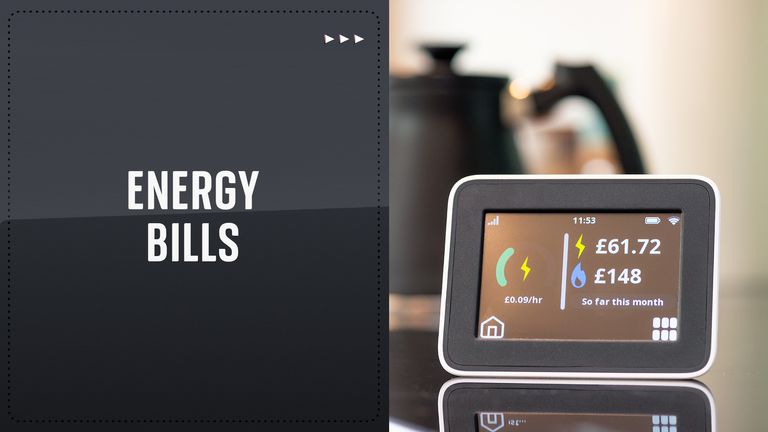
    Energy bills
    Image:Energy bills

    • Household bills to be cut by an expected £1,000 this year with aid from an energy price guarantee and a £400 grant. Millions of the most vulnerable households will receive additional payments, taking their total savings this year to £2,200.

    Economy
    Image: Economy

    • Total cost of energy package, including business support, over the next six months estimated at £60bn. It is “entirely appropriate for the government to use our borrowing powers to fund temporary measures to support families and businesses”.

    • Treasury estimates tax cut measures will cost nearly £45bn a year in 2026.

    • Independent forecasters expect the government’s energy plan “will reduce peak inflation by around five percentage points”.

    • Bank of England independence is “sacrosanct”.

    • Government to set out its fiscal approach more fully in the future and the Office for Budget Responsibility will publish an economic and fiscal forecast before the end of the year.

    Bankers' bonuses

    • The EU-inspired cap on bankers’ bonuses is to be scrapped as part of efforts to “reaffirm” the UK’s status as a financial services hub. “All the bonus cap did was to push up the basic salary to bankers or drive activity outside Europe”, the chancellor said.

    Business support

    • Planned rise in corporation tax to 25% next year is cancelled. “We will have the lowest rate of corporation tax in the G20. This will plough almost £19 billion a year back into the economy”, Mr Kwarteng said.

    • Will legislate to require trade unions to put pay offers to a member vote so strikes can only be called once negotiations have fully broken down.

    • To cut taxes for businesses in designated sites for 10 years to support investment, jobs, and growth. In talks with 38 local and mayoral combined authority areas in England about “investment zones”. Aims to roll out more widely across the UK.

    • New legislation will cut barriers and restrictions to building new roads, rail, and energy infrastructure.

    • Universal Credit Claimants who earn less than the equivalent of 15 hours a week at the National Living Wage, 120,000 people, will be required to meet regularly with their Work Coach and take active steps to increase their earnings or face having their benefits reduced. The aim is to reduce vacancies in the economy.

    • Will simplify IR35 rules – governing how temporary contractors are paid – by scrapping reforms in 2017 and 2021 that added “unnecessary complexity and cost” for many businesses.

    • Introducing VAT-free shopping for overseas visitors.

    • Changing regulations to increase investment by pension funds into UK assets, benefiting savers and boosting economic growth, and incentivizing investment into Britain’s science and tech companies.

    • Annual Investment Allowance – tax relief for businesses on plant and technology investment – to remain at £1m permanently, rather than letting it return to £200,000 in March 2023.

    Source: Sky news