Tag: birth

  • Woman with double uterus gives birth to miracle twins on consecutive days

    Woman with double uterus gives birth to miracle twins on consecutive days


    In an extraordinary medical event, a woman in the United States with the uncommon condition of having two uteruses gave birth on two consecutive days, marking a rare “one in a million” pregnancy that involved 20 hours of labor.

    Kelsey Hatcher, aged 32, experienced the unique joy of welcoming a daughter on Tuesday, followed by the birth of another daughter on Wednesday, both at the University of Alabama at Birmingham Hospital.

    Celebrating this remarkable occurrence, Ms. Hatcher took to social media to announce the birth of her “miracle babies,” praising the medical team for their outstanding work.

    The newborns are fraternal twins, uniquely born on different days, a rarity in itself.

    Following the unexpected but joyous events, Ms. Hatcher shared that her family had returned home, ready to celebrate the holiday season. Initially, she had anticipated a Christmas delivery.

    A UAB obstetrician spoke about the uniqueness of this case, noting that such events are so rare that many in the field may never encounter them in their entire careers.

    Diagnosed with a double uterus, known medically as uterus didelphys, at the age of 17, Ms. Hatcher was part of a small group, as this condition affects only 0.3% of women.

    Becoming pregnant in both uteruses simultaneously, known as a dicavitary pregnancy, is an even more extraordinary occurrence, with the UAB citing the odds as “one in a million.”

    Instances like these are exceedingly rare worldwide. In a similar case reported in 2019, a woman in Bangladesh gave birth to twins almost a month after having a premature baby, a story shared with the BBC by a local doctor.

    Prior to this remarkable pregnancy, Ms. Hatcher had three healthy pregnancies. This time, she initially believed she was pregnant in just one uterus until a routine ultrasound unexpectedly revealed a second baby in the other uterus.

    “I gasped… We just could not believe it,” she recalled.

    She went on to document her unusual journey on Instagram. One update at 38 weeks asked: “What the heck?! HOW have we made it this far?!”
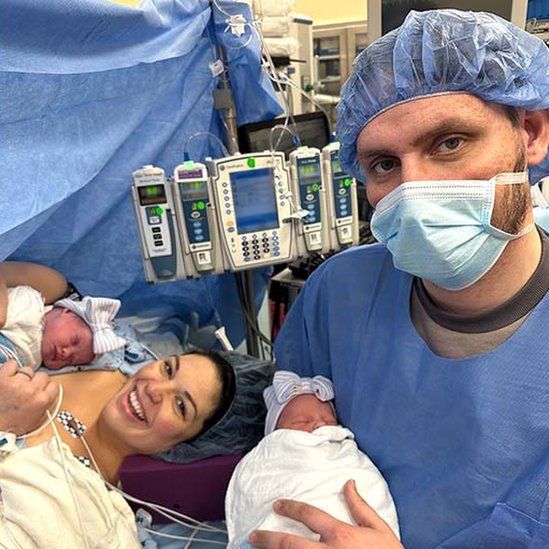
    Mother Kelsey hatcher, her two daughters and husband Caleb
    Image caption,Kelsey, pictured here with her newborns and husband Caleb, first thought she was pregnant in only one womb

    The University of Alabama at Birmingham (UAB) characterized Ms. Hatcher’s pregnancy as standard, despite its unique nature.

    Professor Richard Davis, who supervised the birth, noted that each infant benefited from having its own uterus, providing ample room for growth and development, a contrast to normal twin pregnancies.

    Ms. Hatcher’s labor, initiated at 39 weeks, necessitated heightened vigilance and documentation in the hospital, including increased staff involvement.

    Dr. Shweta Patel from UAB’s obstetrics and gynecology department remarked that this aspect was the most unconventional in Ms. Hatcher’s situation.

    According to Dr. Patel, the medical team had limited specific guidelines or data to reference, compelling them to rely on their general expertise in standard pregnancies.

    She confirmed that the babies truly possessed a “mind of their own” and were born using distinct techniques.

    On December 19, at approximately 19:45 local time, Roxi was born vaginally. Over ten hours later, Rebel, the second, arrived via C-section.

    According to Prof. Davis, the girls might be referred to as fraternal twins, a term that describes babies that are created from individual eggs that are fertilized by individual sperm.

    “At the end of the day, it was two babies in one belly at the same time,” he said. “They just had different apartments.”


  • Baby clings to mother who died giving birth

    Baby clings to mother who died giving birth

    The second pregnancy of Samantha Klopp proceeded according to plan. But as soon as she went into labor, medical professionals hurried her to the operating room so they could attempt to save her and the unborn child. Her spouse took an extraordinary action when there didn’t seem to be any hope left.

    Craig and Samantha were overjoyed upon learning they were expecting their second child after a year of trying. Their son, John, had eagerly anticipated having a younger brother. Opting to keep the baby’s gender a mystery, Samantha had the ultrasound results sealed and handed to a friend in charge of the gender-reveal gathering.

    Amidst a spread of sweets and a cake, the revelation unfolded. A chorus of joy erupted when purple and pink balloons descended, adhering to the apartment ceiling, signifying a girl. Among the delighted onlookers, none were more moved than Craig.

    The expectant father showered kisses on his wife and son, embracing the reality of his dream coming true. The anticipation and excitement for the arrival of his daughter were palpable, and as a devoted Red Sox fan, he couldn’t contain his enthusiasm, “I’m going to teach her to play baseball too,” which elicited laughter from everyone in the room.

    During their college years, Craig and Samantha’s paths crossed. Renowned for his hitting prowess and regional championship at 16, Craig secured admission to a prestigious university. Despite a career-limiting shoulder injury, he continued to play for the university, cherishing his best athletic moments during campus practice.

    It was during one of these practices that Craig caught sight of Samantha, a charming girl unfamiliar to him. After a powerful hit that sent the ball soaring into the sky, he noticed her in the company of a friend, marking the beginning of their love story.

    “That was the best hit of my life because it brought me you,” Craig told Samantha during their wedding vows in front of all the guests.

    “That was the best hit of my life because it brought me you,” Craig told Samantha during their wedding vows in front of all the guests.

    Samantha’s graduation ceremony, a year later, was a simple and elegant affair. Craig, having traded in his bat for a calculator, pursued a career as an engineer but remained an ardent baseball fan. The couple’s greatest joy, the birth of John, who was already showing a penchant for hitting balls at the tender age of three, brought immeasurable happiness. Craig and Samantha, though not expecting their son to be as athletically inclined as his father, reveled in the joy of family activities, from playing in the yard to attending Red Sox games together.

    As they anticipated the arrival of their daughter, the family seemed to be in perfect harmony. However, fate had a different plan.

    In the lead-up to Samantha’s due date, the couple prepared diligently for their impending arrival, decking out the baby’s room with a crib, colorful clothes, toys, and an abundance of diapers. The delivery date was set, and Samantha, having experienced childbirth before, felt a sense of calm. Little did she know, an unexpected twist awaited them in the penultimate week.

    Samantha awoke to mild contractions, seemingly inconsequential. With little concern, the couple headed to the hospital to ensure a smooth process. However, during the doctor’s appointment, the contractions intensified, and her water broke. What started as a routine visit took a distressing turn as Samantha, feeling dizzy and nauseated, struggled through the contractions, disrupting her breakfast.

    Unfamiliar with this experience from her first childbirth, Samantha assumed it was a minor hiccup. Unfortunately, she was mistaken, and a few minutes later, she passed out in front of the doctor, leaving Craig in a state of terror. Witnessing his wife in distress, Craig, despite his concentration as a baseball player, was unprepared for this alarming situation.

    “What’s going on?” “What does she have?” he’d ask in vain to a squad rattled by the unexpected event.

  • You don’t need a man to have a child – Media Personality tells women

    You don’t need a man to have a child – Media Personality tells women

    Media personality, Christiana Sweety Aborchie has said that women do not need men to give birth.

    According to her, women who have the perception that they cannot have children without the help of a man become limited in their ability to explore life.

    She said this on Prime Morning during a discussion about the topic, “Gender Bias Perception: Society’s Take on the Woman.”

    “I still think a woman decides what she wants to do with her life and how she wants to raise her child. If I decide to go get some artificial insemination as a single woman and have a kid, I can do that. I think it’s limiting to think that I need to have a man to have a child. You don’t need a man to have a child,” she said to Asieduwaa Akumia.

    She attributed her assertion to the fact that the world has advanced technologically, as there is easy access to information and other initiatives through the internet.

    Sweety Aborchie further indicated that it is not compulsory for women to respect men, admitting that it is reciprocal.

    She asserted that, “respect is not a gender thing. Women must not respect men at all costs. Respect is earned.”

    She noted that men who do things in the right manner gain the level of submission expected of their wives.

    To men who demand respect from women, she said, “They don’t know enough.”

    Meanwhile, Sweety Aborchie has urged divorced wives to examine themselves to know the reason behind the divorce, as they may be at fault.

    Source: Myjoyonline.com

  • Akatsi District Hospital records slightly more births

    The Akatsi District Hospital registered a slight increase in deliveries to 1,098 between January and October this year compared to 1,041 recorded for the same period in 2019.

    Mr Pascal Ayivor, the Hospitals Health Information Officer, said an increase of 57 babies was recorded over the period.

    There were 578 males and 520 females as of October this year compared with 541 males and 500 females in 2019.

    Mr Ayivor said there were 132 deliveries in March 2020, comprising 68 males and 64 females.

    He said in the previous year, the facility recorded 130 births, comprising 79 males and 51 females.

    On maternal deaths, Mr Ayivor said the Hospital did not record any maternal death for the past five years.

    Dr Karikari Bonsu, the Medical Superintendent of the Hospital, appealed to philanthropic groups and individuals to assist the hospital to deliver good healthcare to the public.

    The Akatsi District Hospital has an average daily attendance of between 120 and 130 at the out-patient department.

    Source: GNA

  • Woman gives birth in the middle of Dambai road

    The timely intervention of two public health officers saved the life of a woman in labour who gave birth in the middle of the road in Dambai in the Oti Region.

    Rita Wurapa and Rose Ayivor who were on a monitoring trip to Dambai and Nkwanta encountered a woman in labour on a motorbike in Dambai.

    Obviously in distress, the motor rider and husband who was conveying his distressed wife to a nearby health facility had no option but to stop in the middle of the road.

    A crowd started to gather around the screaming mother, first-time mother and helpless husband but no one could offer any help until the two health officer chanced on the incident.

    Woman in labour at Dambai

    With over 15 years of public health under her belt, Rita Wurapa and her colleague drew closer only to see a woman in labour.

    In the middle of the street, they delivered the woman of the baby after marshalling women standing by to form a screen with their clothing.

    The mother and the newly born baby were later sent to the hospital. Both of them are doing very well.

    Source: kingdomfmonline

  • Repeat Caesareans ‘often safer birth option’

    Planned Caesarean delivery can be the safest option for women who have had a Caesarean in the past, according to new research in PLoS Medicine.
    Attempting a vaginal birth was linked with a small but increased chance of complications for mother and baby compared with repeat Caesareans.

    The findings come from more than 74,000 births in Scotland.

    Experts say mums-to-be should be offered a choice of how to deliver – natural or Caesarean – when possible.

    A recent investigation by the BBC’s Victoria Derbyshire programme suggests this is not always happening, with many women requesting a Caesarean being denied one.

    What is a Caesarean birth?

    Caesarean sections are when a baby is delivered by making a surgical cut into the abdomen and womb.

    They can be:

    Elective or planned – at the mother’s request or for medical reasons, such as the baby is either in the wrong position or very large
    emergency – usually because of complications during labour

    More than one in four births in the UK are by Caesarean.

    Half of these are planned or elective and half are emergency.

    Which is safer – natural or Caesarean?

    Birthing carries risks whichever way it is done.

    The research carried out in Scotland compared the risks of a planned or elective Caesarean with vaginal delivery (in women who had had a Caesarean in the past) and found:

    45,579 women gave birth by planned Caesarean and 28,464 attempted vaginal birth

    28.4% of those attempting a vaginal birth went on to have an emergency Caesarean

    Attempting vaginal birth was associated with an increased risk of the mother having serious birth and post-birth related problems compared with electing for another Caesarean section

    ADTRH8 Cesarean Delivery

    1.8% of those attempting a vaginal birth and 0.8% of those having a planned Caesarean experienced serious maternal complications, such as womb rupture, bleeding or infection

    Complications for the baby occurred in 8% of the pregnancies with an attempted vaginal birth and 6.4% of the planned Caesareans

    According to the Royal College of Obstetricians and Gynaecologists, in most cases, women can safely be offered the choice of either because the associated risks will be low.

    Generally, after one Caesarean about three in four women who go into labour naturally give birth vaginally, while one in four ends up needing an emergency Caesarean.

    An emergency Caesarean has more risk than a planned one, which women need to be made aware of.

    Pros and cons

    Recovering from a Caesarean can take longer and there is a risk of infection and bleeding from the operation.

    More scar tissue occurs with each Caesarean, which increases the chance of the placenta growing into the scar during future pregnancies and causing complications.

    There are also small risks to the baby with Caesarean birth which include temporary breathing difficulties and being accidentally cut (which happens to around two in every 100 babies, but usually heals without further harm).

    A vaginal birth can mean a shorter hospital stay, a quicker recovery and return to everyday activities such as driving, and avoiding the risks of an operation.

    But it can sometimes lead to a tearing of the perineum – the skin between the vagina and anus.

    Additionally, for women who have had a previous Caesarean:

    a vaginal birth can put strain on the Caesarean scar, which may separate or rupture.

    This happens to around one in every 200 women
    serious risk to the baby, such as brain injury or stillbirth, is higher with vaginal delivery than for a planned Caesarean section

    A vaginal delivery is not advisable if a woman has had three or more previous Caesareans, say guidelines.

    Dr Pat O’Brien, consultant obstetrician and spokesperson for the Royal College of Obstetricians and Gynaecologists, said the new research provided useful data to inform women and clinicians when discussing and making decisions around birthing plans.

    He said: “Women can be assured that in most cases it is possible and safe to have a vaginal birth, or a planned repeat Caesarean birth, after a previous Caesarean birth.

    “A detailed conversation with a woman and her senior obstetrician should take place so she can make an informed choice about the safest way she can plan to give birth and be supported by a team of specialists.”

    Source: bbc.com