Tag: Blackout

  • Sierra Leone faces prolonged blackouts due to $48m unpaid electricity bills

    Sierra Leone faces prolonged blackouts due to $48m unpaid electricity bills

    For weeks, Sierra Leone’s capital, Freetown, and other urban centers have been shrouded in darkness owing to overdue electricity payments to power providers. This situation has severely disrupted daily life, leading to operational challenges even in major hospitals.

    Karpowership, the Turkish vessel that serves as the primary electricity supplier for Freetown, has effectively halted power distribution due to an outstanding bill of approximately $48 million (£38 million). Despite assurances from the finance minister to settle the debt, Karpowership has reduced electricity supply from 60 megawatts to just six megawatts, solely catering to essential services.

    Additionally, CLSG, an Ivorian power supplier, has substantially decreased its supply to southeastern cities such as Bo, Kenema, and Koidu due to unpaid arrears. Their supply has dwindled from 32 megawatts to 10, though the exact amount owed by the state remains unclear.

    The third major electricity source, the state-owned hydroelectric dam in Bumbuna, primarily serves the northern city of Makeni and adjacent areas. However, due to the dry season’s peak, water levels have plummeted, leading to a significant reduction in supply, currently standing at only six megawatts.

    Reports suggest that less than two megawatts from the hydro dam currently reaches Freetown, according to a source at the state-owned electricity distribution company (EDSA). However, Finance Minister Sheku Ahmed Fantamadi Bangura, who could provide further insights, is unavailable for comment as he is out of the country.

    Sierra Leoneans have vented their frustrations on social media, with many expressing anger over the persistent power outages. Joseph Kargbo, a resident in an eastern suburb of Freetown, lamented going without electricity for six days.

    Karpowership, a major player in floating power plant operations globally, has adopted a stringent stance against non-payment. In October last year, it cut power to Guinea-Bissau’s capital due to outstanding bills, plunging the city into darkness.

  • Dysfunctional blackout or dysfunctional judgment?

    Dysfunctional blackout or dysfunctional judgment?

    Blackout, blacklisting, demonstration, picketing are trappings of democracy allowed under the law

    On February 9, 2024, the Chairman of the National Media Commission (NMC), Yaw Boadu-Ayeboafoh, waded into the media blackout imposed by the Ghana Journalists Association (GJA) on two Members of Parliament (MPs), with a ‘bombshell’ that has caught fire in the Ghanaian media landscape.

    Boadu-Ayeboafoh had his say (which he is entitled to under the 1992 Constitution) but the overwhelming public backlash against his unpopular views is a loud call by media gatekeepers that he cannot have his way because the path he chose is not a thoroughfare.

    He may be a lone voice but cast as former Editor of the Daily Graphic, former Director of News of the Graphic Communications Group Limited, former Vice President of the GJA, former Executive Secretary of the NMC, current Chairman of the NMC (serving a second term as Chairman) and lawyer, he always possesses a deep, commanding voice that can influence opinion.

    Thus, although his unpopular views on the media blackout have been extensively addressed in the public space over the past week, it still begs more critiquing to iron out some salient issues in the interest of media freedom and for the benefit of posterity.

    Personal opinion

    After his unfair attacks on the media blackout, Boadu-Ayeboafoh claimed it was his personal opinion (which he is entitled to) and not the NMC’s (which he chairs).

    But it is important to put that ‘personal opinion’ claim in context for the sake of intellectual discourse.

    The GJA invited Boadu-Ayeboafoh in his capacity as Chairman of the NMC (the letter of invitation addressed him as such); on the programme for the workshop, he was designated as Chairman of the NMC, and before he spoke, he was introduced as Chairman of the NMC.

    Given all these acknowledgements, and with all due respect, Boadu-Ayeboafoh should have set the record straight by issuing a disclaimer to his acknowledgements and claiming personal ownership of his voice before delivering his speech; doing so after the speech is not apropos.

    Be that as it may, there is a discord between the voice of Boadu-Ayeboafoh as a private person and as the Chairman of the NMC in discussing a trending media-related issue.

    Indeed, that may raise a conflict of interest case against him, especially when the matter he speaks about, even if it is in his personal capacity, may land on his desk as NMC Chairman.

    The National Media Commission Act, 1993 (Act 449) establishes a Complaint Settlement Committee for the settlement of complaints by, or against, media operators.

    Section 12(2) of Act 449 provides: “The Settlement Committee shall consist of the Chairman of the Commission and six members of the Commission three of whom shall be persons not ordinarily employed or involved in the media industry”.

    Now, if any of the parties connected to the GJA media blackout decides to lodge a complaint at the NMC, how would Boadu-Ayeboafoh, who has delivered what I deem to be a ‘dysfunctional’ judgment on the same matter as a private person, entertain such complaint as Chairman of the Complaint Settlement Committee?

    Obviously, a question of conflict of interest may arise, and in the circumstances, either a party in the said complaint may object to his sitting on the Committee or he may recuse himself.

    Whichever way, and even if he is able to override any objections to his sitting on the complaint, his personal views expressed in the public square, may cause grievous damage to the trust and faith in the Commission.

    Unilateral or unanimous?

    Boadu-Ayeboafoh describes the GJA media blackout on the two MPs as “unilateral”, but he misfires because the government of the call was unanimous rather than unilateral.

    The GJA had consulted extensively with its media partners, key media houses and members, including its representatives on the NMC, before announcing the blackout.

    Thus, the overwhelming endorsement given to the call by the Private Newspapers and Online News Publishers Association of Ghana (PRINPAG), the Ghana Independent Broadcasters Association (GIBA), the Media Foundation for West Africa (MFWA) and many press freedom activists, as well as the round condemnation of his unpopular views on the matter, can only be described as unanimous, and not unilateral.

    Dysfunctional and impunity tags

    Boadu-Ayeboafoh also describes the media blackout as “dysfunctional”, admonishing that “We cannot fight impunity with impunity” and that “We must follow the law and due process”.

    Unfortunately, he does not establish any legal basis of how the blackout violates due process or the law.

    For the avoidance of doubt, blackout, blacklisting, demonstration, picketing and other similar actions are trappings of democracy allowed under the law.

    Even lawmakers (MPs) who are representatives of ‘We The People’ and paid by the taxpayer have been staging walkouts in Parliament, sometimes on issues one may be tempted to consider as very trivial.

    How could anyone then describe a call for media blackout to address life-threatening phenomenon against journalists as “dysfunctional” and “impunity”?

    Boadu-Ayeboafoh’s advice for the victims to report the assault cases to the Police and/or the NMC is completely moot because the cases were reported to the Police the very day they happened, and long before he made his unfair comments against the blackout.

    Perhaps, if he had been seized with the facts at the time of his comments (February 9, 2024) that the two assault cases had been reported to the Police on January 4, 2024 (in the case the Cape Coast assault) and January 27, 2024 (in the case of the Yendi assault), respectively, and that the Police had done nothing about the cases yet, he may have directed his salvo at the Police.

    In my humble opinion, the rule of law is not necessarily about going to court; it also includes taking other actions that are not unlawful to seek justice.

    In any case, Police investigation of a criminal matter is not a ‘bus stop’ to sit and wait for a means towards justice; indeed, Police investigation does not oust or freeze or estop any other cause(s) of action that one may deem necessary to seek redress for a grievance.

    That is why a civil case may be pursued without recourse to Police investigation on the same matter.

    For instance, in the Hajia Fati Case (an NPP activist who assaulted Ohemeaa Sakyiwaa of Adom FM at the NPP Headquarters in Accra on May 4, 2018), both the criminal and civil actions ran concurrently in court.

    That is different from instances where the law may be categorical in asking for the exhaustion of a particular forum before taking action in another forum, such as provided in Section 13(2) of the NMC establishment Act – Act 449:

    “A person who has lodged a complaint with the Commission shall unless he withdraws the complaint, exhaust all avenues available to settling the issue by the Commission before a recourse to the courts”.

    That is why in the run-up to the locus classicus contempt of court case – Republic vrs Mensa Bonsu & Others (ex parte Attorney-General), the late Chief Justice I. K. Abban, after lodging a complaint at the NMC against the respondents in that contempt case, had to withdraw the complaint before reporting the matter to the Police whereupon the then Deputy Attorney-General and Minister of Justice, Martin Amidu, filed the contempt motion in court.

    The NMC Chairman, who hallows the rule of law and frowns on impunity, should direct us to the law that says when the Police are investigating a criminal matter, a party to the case or any other body cannot take other action(s) in pursuit of justice.

    Blackout vrs. shutdown

    Recently, the NMC initiated steps to shut down Onua FM, an Accra-based radio station in the stable of Media General, in reaction to what the Commission believes to be infringement on broadcasting standards by the station.

    Media General went to court for an injunction to restrain the NMC from shutting down the station, claiming, inter alia, that the NMC had not given them hearing.

    The shutdown of Onua FM could have caused financial loss to advertisers (that is why the NMC duly informed them about its imminent action) and also led to job loss.

    I guess since Boadu-Ayeboafoh is the Chairman of the NMC, and he did not publicly denounce the action by the Commission, even in his personal capacity, he considers the shutdown moves to be in line with the rule of law, not dysfunctional and not an act of impunity to address impunity.

    But I ask: Between the call for a media blackout by the GJA and the steps taken by the NMC to shut down Onua FM, both with their surrounding circumstances, which of them is unilateral, or dysfunctional, or impunity, or violation of the rule of law?

    Middle East salvo

    Boadu-Ayeboafoh also takes a flight to the Middle East and lands with a submission that although many journalists have been killed in the Israel-Hamas War, and whilst the international media have called for respect for international laws on the safety of journalists, none has called for a blackout on, or boycott of, Israel or Hamas.

    Respectfully, that assumption is far-fetched, outlandish and hollow, especially when the circumstances are not the same.

    But even if they were, the fact that no one has called for blackout on, or boycott of, Israel or Hamas does not mean it will be sinful for anybody to make such a call.

    Also, as an editor in Ghana (we are also part of the international media), I SHALL NOT send a reporter to the Israel-Hamas War zone when I know the high risk involved; or, as a reporter, I SHALL NOT obey my editor if s/he assigns me to the war zone at the risk of my life.

    The presence of journalists in the Israel-Hamas War zone may be based on some life assurances they hold, and the absence of others there may also be based on some common sense they have.

    It is true that the primary mandate of journalists (and the media) is to serve the people; but the popular journalism maxims are also true: ‘A journalist must live to tell the story’ and ‘A journalist must bring the story and never be the story’.

    Interestingly, Boadu-Ayeboafoh cherishes these journalism maxims and proclaims same in his speech when advising journalists to use ingenuity in information gathering. I quote him:

    “That is why most international media organisations, when sending out their personnel on assignments to volatile regions, advise them to ensure that they bring in the news but never to become the news.”

    The journalists killed in the Israel-Hamas War are not able to tell their story about the war; they have become part of the story being told about the war.

    But the point really is that the particulars of the Israel-Hamas War and those of the assault against journalists in Ghana are like apples and oranges that should not be compared.

    Culture of media blackout

    Perhaps, what Boadu-Ayeboafoh fails to appreciate is that media blackout is a legitimate cause of action employed by the media across the world to address pertinent concerns.

    In July 2023, the National Association of Broadcasters (NAB) in Uganda threatened to boycott the coverage of all government events over a controversial decision by the government not to advertise in the private media.

    Also, the Guyana Press Association (GPA), in February 2018, called for a media blackout on the Guyana International Petroleum Business Summit because the GPA considered as “burdensome” the decision by the organisers of the summit to leave the opening ceremony for full media coverage but restrict other sessions to only photo coverage for the first 10 minutes.

    The Indian Newspaper Society (INS), in April 2008, threatened to boycott “the multi-million dollar” cricket league in protest against stringent media restrictions by the Indian Premier League.

    Consider the grounds for the media blackout in the three instances above and bear in mind that the GJA’s call is not based on ‘light-weight’ justifications that informed similar actions elsewhere; it is a call to protect life!

    In my humble view, any action to protect life can hardly be described as dysfunctional or impunity because life is non-negotiable in journalism.

    According to Boadu-Ayeboafoh, he had expressed the view “many years ago” that blackout or boycott is not the most productive means to address the problem of attacks against journalists.

    Since expressing that view “many years ago” and now, can he show how “the most productive” approach he believes in has helped to address the problem so we can beg for forgiveness of ‘sin’?

    Certainly, Boadu-Ayeboafoh has had his say as the 1992 Constitution entitles him, but in this particular matter, he cannot have his way!

    The writer is the General Secretary of the Ghana Journalists Association, Mr Kofi Yeboah 
  • South Africa fears blackout due to a winter alert

    South Africa fears blackout due to a winter alert

    South Africa is braced for a harsh winter after the state-owned power utility Eskom predicted widespread power outages.

    “With the winter season upon us, our power system will be even more constrained…weather forecasters are anticipating a much colder winter and these challenges will result in high electricity demand”, said Eskom chairperson Mpho Makwana on Thursday.

    The country is currently experiencing “stage 6” load shedding, where consumers go without electricity for up to 12 hours a day. With “stage 8” load shedding expected this winter, consumers will have up to 16 hours of no electricity every single day.

    Stage 8 power cuts would require up to 8,000MW to be shed from the national grid. This is likely to cause more businesses to shut down, further job losses and a high possibility of civil unrest.

    Even though officials insist that the risk of a blackout is low, many South Africans are worried that the worst case scenario is very likely.

  • ECG warns clients against harassing its employees

    ECG warns clients against harassing its employees

    The Electricity Company of Ghana (ECG) has sternly warned its consumers against attacking its employees.

    Some staff of the company have recently come under attack while executing the company’s ongoing revenue mobilisation programme to recover some GH¢5.7 billion owed by the consuming public.

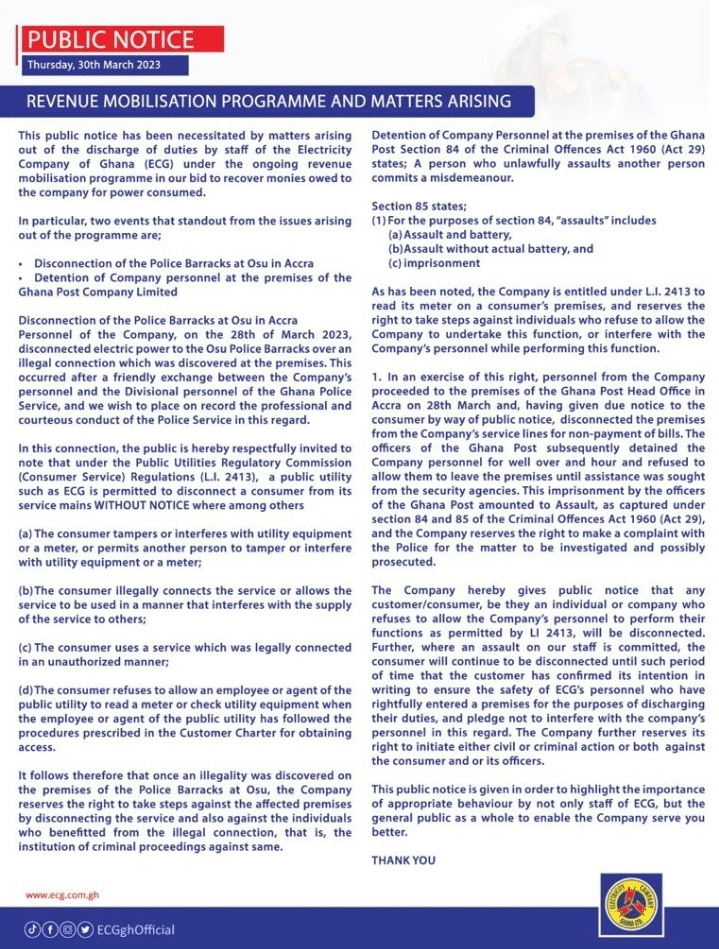
    ECG cited the detention of its personnel by the Ghana Post Company over a GH¢89,000 debt to buttress its caution.

    Some personnel of the Company were detained on March 28 by Ghana Post Company when they attempted to disconnect power over the GH¢89,000 debt.

    In a statement the ECG therefore, cautioned the general public against illegal connections and attacks on its personnel in the line of their duty which it said is a crime under Ll 2413.

    It said it will not countenance any attacks and hesitate to disconnect any customer that owes the Company or threatens its staff.

    “The Company hereby gives public notice that any customer/consumer, be they an Individual or company who refuses to allow the Company’s personnel to perform their functions as permitted by Ll 2413, will be disconnected. Further, where an assault on our staff is committed, the consumer will continue to be disconnected until such period of time that the customer has confirmed intention in writing to ensure the safety of ECG’s personnel who have rightfully entered the premises to discharge their duties and pledge not to interfere with the company’s personnel in this regard.

    “The Company further reserves its right to initiate either civil or criminal action or both against the consumer and or its officers.”

  • Ethiopia offers no date for end to blackout in Tigray region

    There is “no timeline” for restoring internet access to Ethiopia’s embattled Tigray region, a senior government official said Tuesday.

    The restoration of Tigray’s internet service will be carried alongside the resumption of its phone and electricity services, though no date has been set for those goals, Ethiopia’s Minister for Innovation and Technology Belete Molla said.

    He was speaking at the U.N.’s annual Internet Governance Forum being held this week in the Ethiopian capital Addis Ababa.

    “The government of Ethiopia is designing a package that is not only about internet resumption but the resumption of everything, because this is what we need as a people, as a government,” Belete said of the internet shutdown in Tigray. “There is no timeline.”

    Tigray, home to more than 5 million people, has been mostly without internet, telecommunications, and banking since war broke out between federal government troops and forces led by the Tigray People’s Liberation Front in November 2020.

    A ceasefire deal signed between the warring sides in South Africa earlier this month commits the government to restore Tigray’s basic services, but the communications blackout has not yet been lifted.

    Renewed fighting in August halted aid deliveries to Tigray, which is in the throes of a humanitarian crisis. Aid has now started reaching the region, but the World Food Program said last week that access to parts of Tigray remains “constrained.”

    With the Tigray blackout still in place, the U.N.’s decision to hold its flagship event on internet access in Ethiopia has drawn criticism.

    This year’s conference aims to build steps towards “universal, affordable, and meaningful connectivity,”, especially in Africa where 60% of the continent’s 3 billion people are offline.

    Ethiopia has shut down the internet at least 22 times since 2016, according to internet rights group Access Now. The blackout affecting Tigray “is the world’s longest uninterrupted shutdown,” said Brett Solomon, Access Now’s executive director.

    Aid workers and rights groups say the communications blackout has hampered the delivery of aid to Tigray and fueled human rights abuses by fostering a culture of impunity among armed actors. U.N. investigators have accused all sides of abuses, including killings, rape, and torture.

    Addressing the opening ceremony of the internet forum on Tuesday, Ethiopian Prime Minister Abiy Ahmed appeared to defend the shutdown in Tigray, saying the internet has “supported the spread of disinformation as Ethiopia dealt with an armed rebellion in the northern part of the country.”


    Source: African News

  • As Russia attacks, Ukrainians offer tips on survival, optimism

    People share wartime survival techniques as Russian missile attacks plunge the nation’s capital into darkness.

    If you have no electricity, but don’t want your frozen foods to melt, Anastasiya Zasyadko has a useful life hack for you.

    “Put a bottle of water in the freezer when the electricity is on,” the 79-year-old retiree told Al Jazeera.

    The ice will take many hours to melt – and keep the freezer, well, frozen.

    “The bottle has to be plastic because the glass will crack” when the water freezes, Zasyadko, a former physics teacher, said expertly.

    Her experience is first-hand.

    She lives in a two-bedroom apartment in a northern Kyiv district of drab concrete buildings surrounded by potholed roads, leafless trees and melting snow.

    It had no electricity for more than 24 hours after Wednesday’s shelling of the capital and other Ukrainian cities by Russian cruise missiles.

    A-Ukrainian-woman-buys-a-powerbank-in-Kyiv.jpg
    A Ukrainian woman buys a power bank in the capital, Kyiv [Mansur Mirovalev/Al Jazeera]

    Low-tech response

    But Zasyadko was ready – and saved several kilogrammes of frozen pork, minced meat and vareniki, the Ukrainian ravioli she cannot live without and made weeks earlier.

    On October 10, Russian President Vladimir Putin ordered a string of attacks to destroy power transmission and heating stations, and damage key infrastructure throughout Ukraine.

    Zasyadko was already used to the hours-long blackouts – she, her son and her daughter-in-law have plenty of batteries, two power banks, and flashlights you can attach to your head with elastic bands.

    “They make you look like a coal miner and ruin your hairdo,” she pouted.

    She also can advise you on how to extend the lifetime of a candle and make it heat your bedroom.

    Just put it in a glass jar and fill it with vegetable oil. The light will not die out for 12 hours – as long as you make sure that the jar doesn’t fall and start a fire.

    You can also combine the contraption with a “flower pot heater” – an ultimate, low-tech response to the lack of central heating.

    Take three ceramic flower pots of different sizes, connect them with a long steel bolt so there are a couple of centimetres between them, and put the structure above the burning candle.

    The candle-warmed air will not rise to the ceiling but will heat the pots and raise the temperature by several degrees.

    Most of the apartment buildings in Ukraine are heated by Soviet-era power stations that have been largely destroyed by the Russian shelling.

    A-bike-with-flashlights-on-at-a-Kyiv-mall.jpg
    A motorcycle is used as a flashlight at a Kyiv mall [Mansur Mirovalev/Al Jazeera]

    The cold has been debilitating.

    “I went to bed in a flannel gown, put the hood and two pairs of socks on,” Zasyadko said.

    Wednesday’s attack was especially devastating for Kyivans because it damaged the water supply in the entire capital and made people buy bottled water, ration it and collect porous snow.

    The lack of water is worse than any blackout, Zasyadko said, especially when your family members need to flush the toilet.

    Kyiv, howhow to extend the lifetime of a candleever, is already covered with several centimetres of snow, and her son Konstantin collected some in tin buckets and melted it on a gas stove.

    “Otherwise it will take hours to melt,” she said.

    ‘I weep every time’

    With the news reports about the deaths of civilians, including a newborn killed by a Russian missile in the eastern town of Vilniansk on Wednesday, Zasyadko has not been feeling well.

    That is why she took a seat on a bench in a shopping mall in northern Kyiv, waiting for her daughter-in-law to come back from a grocery shop.

    The daughter-in-law, Maryana, showed up with two heavy bags – and offered the ultimate advice on patience.

    “As long as everyone in our family is alive, we keep thanking God,” the 45-year-old cook said.

    “I weep every time I hear about those little kids killed by the bloody Rashists,” she said, using a derogatory term that combines “Russian” and “fascist”.

    Just a few metres away, a wartime generation of Ukrainian mall rats is glued to their mobile phone screens. The mall has its own power generator – and offers a chance to reload batteries free of charge.

    Dozens of people sit or stand next to power sockets – and many are teenagers with more than one gadget.

    Most of the sockets are in drafty, barely lit halls, but there are some in the warmer corridors leading to public toilets.

    Denys Kyrilenko, 19, was standing close to a ladies’ room, but paid no attention to the women passing by. The university student was typing a text message to his girlfriend who fled to Poland with her family in early March.

    He cannot join her because Ukrainian men aged 18 to 60 are not allowed to leave the country. But the eight-months-long separation only made their feelings stronger, he said.

    “War makes you see things better,” he said.

    Denys-Kyrilenko-texts-his-girlfriend-from-a-mall-in-Kyiv.jpg
    Denys Kyrilenko texts his girlfriend from a mall in Kyiv [Mansur Mirovalev/Al Jazeera]

    The mall is an oasis of carefree consumerism. And it offers things that have become essential and life-saving.

    A small crowd stood around a kiosk with power banks, connecting cables and USB-powered flashlights.

    The salesman, Andriy Shevchenko, patiently explained why even the largest power bank in his kiosk cannot be used to power a laptop.

    The customers, two women in their early 20s, nodded and bought one anyway – even though the price was almost $80.

    That’s not Shevshenko’s fault.

    “I hate when suppliers raise prices,” he said. “It ruins my reputation.”

    ‘We can withstand anything’

    Kyiv residents living in private houses with firewood-fuelled stoves feel safe and privileged.

    Many stockpiled hundreds of kilogrammes of firewood – and use the stoves to slow-cook their food in metal containers or pots.

    And one house owner shared his observation on the resilience of fellow Ukrainians around him.

    On Wednesday, Mykhailo Gorshenin, who lives in a two-storey house in northeastern Kyiv, saw how a Russian cruise missile hit a transmission station.

    “People came out of a store to take a look,” he said.

    Within seconds, another missile hit the same spot.

    “They started filming the fire and the smoke with their cell phones,” he said.

    Only after two more strikes, the crowd began to slowly disperse.

    “We are a unique nation. We can withstand anything,” he said with a laugh. “Pass it on to Putin.”

    Source: Aljazeera.com 


  • Malawi in total darkness caused by electricity tower vandals

    Officials from Electricity Supply Corporation of Malawi (ESCOM) say Wednesday evening’s national blackout was as a result of vandalism on one of its towers in Blantyre.

    Director of systems and market operations at the power utility company, Charles Kagona said the development has led to the loss of about 30 percent of its power supply.

    “We discovered that the fault was caused by vandalism in Blantyre on power towers that carry two power lines from Nkula to Blantyre and also from Tedzani Power Station to Blantyre,” disclosed Kagona.

    However he has assured that the situation will be resolved by saturday November 12, 2022.

    Meanwhile, emergency restoration works for Malawi’s main hydropower plant Kapichira will not meet the December 22 deadline as earlier projected.

    EGENCO’s Publicist, Moses Gwaza, disclosed this when the Natural Resources and Climate Change Committee of Parliament visited the plant on Thursday to appreciate the progress of the maintenance.

    “The rehabilitation works have now begun after being halted for some time due to issues pertaining to designs and others,” said Gwaza.

    Gwaza added he could not commit to new completion dates for the project saying EGENCO is waiting to hear from a World Bank Consultant and Contractor under the Shire Valley Irrigation Project.

    Kapichira power station which generates 129.6 megawatts stopped functioning in January this year due to damage it suffered as a result of Tropical Cyclone Ana.

    The station is under emergency rehabilitation using a $60 million World Bank credit facility.

    All rights reserved. This material, and other digital content on this website, may not be reproduced, published, broadcast, rewritten or redistributed in whole or in part without prior express written permission from News Central TV.


    Source: newscentral.africa