Tag: BoG

  • A dollar selling at GHS12.00 at forex, GHS11.00 on BoG interbank

    A dollar selling at GHS12.00 at forex, GHS11.00 on BoG interbank

    The Bank of Ghana’s interbank forex rates for today, May 30, 2023, show that the Ghana Cedi is trading against the dollar at a purchasing price of 10.9932 and a selling price of 11.0042.

    At a forex bureau in Accra, the dollar is being bought at a rate of 11.30 and sold at a rate of 12.00.

    Against the Pound Sterling, the Cedi is trading at a buying price of 13.5788 and a selling price of 13.5935.

    At a forex bureau in Accra, the pound sterling is being bought at a rate of 14.00 and sold at a rate of 15.00.

    The Euro is trading at a buying price of 11.7728 and a selling price of 11.7846.

    At a forex bureau in Accra, Euro is being bought at a rate of 12.00 and sold at a rate of 12.70.

    The South African Rand is trading at a buying price of 0.5594 and a selling price of 0.5599.

    At a forex bureau in Accra, South African Rand is being bought at a rate of 0.30 and sold at a rate of 0.90.

    The Nigerian Naira is trading at a buying price of 42.1277 and a selling price of 42.2441.

    At a forex bureau in Accra, Nigerian Naira is being bought at a rate of 12.00 Naira for every 1 Cedi and sold at a rate of 18.00.

    For the CFA, it is trading at a buying price of 55.6622 and a selling price of 55.7180.

    At a forex bureau in Accra, CFA is being bought at a rate of 17.00 CFA for every 1 Cedi and sold at a rate of 21.00 CFA for every 1 Cedi.

    Note that these rates may be different at a forex bureau near you. Our forex bureau rates are provided by Afriswap Bureau De Change in Osu, Accra.

    Our forex bureau rates are provided by Afriswap Bureau De Change in Osu, Accra.
  • Credit to the private sector is becoming more affordable – BoG

    Credit to the private sector is becoming more affordable – BoG

    Bank of Ghana (BoG), has indicated that the rate of increase in credit given to the private sector has slowed as a combination of factors, including a tight monetary policy stance, bank portfolio rebalancing, and a reduction in economic activity, have taken their toll.

    Private sector credit (PSC), in nominal terms, reached GH¢64.9billion at the end of April this year – a 19.74 percent increase over the GH¢54.2billion recorded at the same time in 2022. However, the growth rate was lower than the 26.5 percent recorded during same period of the previous year.

    A perusal of the data shows that, in nominal terms, the quantum of PSC stood at GH¢72.9billion, GH¢73.7billion and GH¢63.8billion in October, November and December of 2022. In the first quarter of this year, it reached GH¢67.6billion in January, GH¢65.5billion in February and GH¢65.7billion in March.

    The central bank’s data further revealed that, in real terms, PSC has contracted by 15.2 percent compared to 2.4 percent growth recorded during the same comparative period.

    “Private sector credit generally slowed in line with the tight monetary policy stance, banks’ portfolio rebalancing after the domestic debt exchange, and moderation in economic activity,” Governor Ernest Addison said during a press engagement at the conclusion of the most recent Monetary Policy Committee meeting.

    While average lending rates of banks have retreated marginally – at 31.66 percent in April 2023, it remains more than 1,000 basis points (bps) above the comparable period in 2022, when it was 21.61 percent; and banks have turned their attention to shorter-term Treasury instruments on account of the Domestic Debt Exchange Programme (DDEP) and elevated yields.

    Moreover, the apex bank has raised its key rate by a cumulative increase of 1,450 basis points since late 2021, even as the moderation in economic activity has played a role in the decline of PSC. The overall slowdown in economic growth has led to reduced demand for credit, as businesses become more cautious about borrowing and investing in such an environment.

    Already, Fitch Solutions in a commentary published in March this year predicted a slowdown in the banking industry as client loan growth is expected to ease to 18 percent in 2023 from 30.2 percent in 2022, citing the aforementioned factors.

    Fitch Solutions’ forecast suggests that while nominal client loan growth will still be in double digits this year, real client loan growth will be significantly weaker – anticipated to be -7.7 percent by end of the year.

    While Fitch anticipates excess liquidity in the system as deposits outstrip loans, it believes this will be channeled to low-risk businesses in sectors such as mining.

    “Households and firms are expected to face challenges in borrowing due to rising interest rates, but Fitch Solutions anticipates that corporate credit will grow at a faster pace than household credit. The transparency and follow-up from banks regarding firms’ performance contribute to their relatively stronger creditworthiness compared to households,” Fitch Solution noted.

  • Enhance stability fund to aid struggling banks – Dr Atuahene to govt and BoG

    Enhance stability fund to aid struggling banks – Dr Atuahene to govt and BoG

    An expert in banking and finance, Dr. Richard Atuahene, has asked the Bank of Ghana (BoG) and the government to boost the Ghana Financial Stability Fund in order to guarantee the survival of struggling local banks.

    During an appearance on The Big Issue on Citi TV and Citi FM, Dr. Atuahene emphasized that, in the wake of the domestic debt exchange programme, properly establishing the Ghana Financial Stability Fund would provide significant relief for struggling banks.

    “The way out is when the Ghana Financial Stability Fund is done perfectly…If you call on the shareholder to recapitalize these losses whereas the state which brought these losses does nothing, it worsens our fiscal situation.”

    Dr. Atuahene also cautioned against the government’s excessive borrowing, emphasizing that it could become costly for the country if the borrowed funds are not utilized productively.

    “The way we are borrowing out and not putting it to productive use, a time will come, we will have to pay through our nose.”

    The Ghana Financial Stability Fund was established with a target size of GH¢15 billion to be provided by the Government of Ghana and its development partners.

    The Fund is aimed at providing liquidity to financial institutions that participated fully in the Domestic Debt Exchange.

    All financial institutions (banks, SDIs, pension schemes, collective investment schemes, fund managers, broker/dealers, insurance firms) that fully participated in the Debt Exchange could access the GFSF for augmented liquidity support, with effect from the date of completion of the Debt Exchange.

    The Fund is managed by the Bank of Ghana under unique operational guidelines being developed by the Financial Stability Council.

  • BoG, Finance Ministry to sign MoU on $3bn IMF loan repayment

    BoG, Finance Ministry to sign MoU on $3bn IMF loan repayment

    A Memorandum of Understanding (MoU) will be signed between the Bank of Ghana and the Ministry of Finance to outline the repayment terms for the $3 billion loan from the International Monetary Fund (IMF).

    The loan agreement includes favorable terms such as a 0% interest rate, a grace period of 5.5 years, and a final maturity period of 10 years.

    This loan falls under the Extended Credit Facility (ECF) arrangement, which spans over a period of three years between Ghana and the IMF.

    As part of the program, Ghana aims to achieve a front-loaded fiscal adjustment equivalent to 5.1 percentage points of Gross Domestic Product (GDP) within the three-year period from 2023 to 2025. This adjustment will be achieved through the Primary Balance on a commitment basis and fiscal effort.

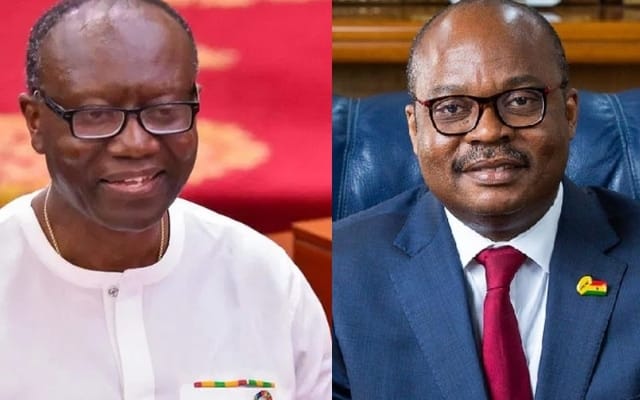
    Finance Minister Ken Ofori-Atta emphasized that the management of debt, both domestic and external, is crucial in restoring public debt to sustainable levels by 2028 while adhering to the two binding constraints.

    They are the Public Debt (in present value terms) to GDP ratio of 55% or less; and External Debt Service to Revenue ratio of 18% or less.

    The programme will be monitored and reviewed semi-annually.

    The Finance Minister emphasised that Ghana’s Post Covid-19 Programme for Economic Growth, which is the government’s blueprint for addressing the economic crisis and underpins the IMF Programme is aimed at restoring macroeconomic stability; bringing fiscal operations and public debt to sustainable levels, supporting structural reforms and promoting strong and inclusive growth while protecting the poor and vulnerable.

    The Staff Level Agreement (SLA) was secured in record time in December 2022, six months after Ghana applied for a Fund-supported Programme.

  • It will be difficult for Mahama to revive banks that were ‘unjustly’ collapsed – Financial Expert

    It will be difficult for Mahama to revive banks that were ‘unjustly’ collapsed – Financial Expert

    A financial analyst, Joe Jackson has opined that former President, John Dramani Mahama would face a difficult task in restoring the licenses of banks that, in his opinion, were unjustifiably collapsed during the Bank of Ghana (BoG) clean-up opeation.

    Speaking to the media on Monday, May 15, he “It is going to be a tough one”.

    However, he welcomed the promise by Mr Mahama to encourage more local participation in Ghana’s financial sector.

    Mr Jackson said Ghana really needs more of the indigenous people to have active participation in the sector.

    “There is something else that should excite a little about what he said. Some of us have in time past worried about the concentration of foreign ownership in our financial sector.

    “Unfortunately, the closure of [some of the local banks] meant that the concentration of foreign ownership became higher because our local institutions have had issues with governance.

    “[John Mahama] says they will be encouraged, that is a good one and I pray it happens because we definitely do need Ghanaians in the final institutions, we definitely need financial institutions that are sympathetic to the Ghanaian course but which will hold themselves to the highest standards of behaviour especially in governance,” he said while reacting to a promise by the newly-elected flagbearer of the National Democratic Congress to restore the license of the banks that unjustifiably collapsed.

    Delivering his formal acceptance speech at the University of Development Studies (UDS) on Monday, May 15 after his victory as flagbearer of the National Democratic Congress (NDC) on Saturday, May 13 he said “we shall promote robust, local participation in our banking and financial, telecommunication, tourism, mining and agric and manufacturing sectors to grow our economy and create sustainable employment for our youths.

    “We will restore indigenous Ghanaian investments in the finance and banking sector and we will create a tier banking system that will serve various segments of the market.

    “We will give the opportunity to experience banking hands who were laid off needlessly to secure their careers once more and move away from the menial jobs that they were compelled to take.

    “As far as practicable the banking licenses that were unjustly canceled by this government will be restored.”

    Some local banks collapsed when the central bank revised the minimum paid-up capital for existing banks and new entrants from GHS120 million to GHS400 million.

    According to the regulator, this was to test the viability of the banks.

    The banks that were unable to meet this new requirement were either merged or collapsed.

    Some nine local banks, 23 savings & loans companies, 347 microfinance institutions, 39 finance houses and 53 fund management companies closed down during the exercise.

    UniBank, The Sovereign Bank, The Beige Bank, Premium Bank, The Royal Bank, Heritage Bank, Construction Bank, UT Bank, Capital Bank all collapsed. Some analysts and observers criticized the BoG and the Finance Ministry over the collapse of the banks because in their views, these banks could have been saved to continue employing Ghanaians.

  • Reduce policy rate before calling banks to check lending rate – Prof Bokpin to BoG

    Reduce policy rate before calling banks to check lending rate – Prof Bokpin to BoG

    Prof. Godfred Bokpin, a finance lecturer at the University of Ghana Business School, believes that it might be premature for commercial banks in Ghana to lower their lending rates in direct response to the recent decline in inflation rates.

    Bokpin’s viewpoint comes after the Bank of Ghana urged commercial banks in the country to decrease their lending rates, given the ongoing decrease in inflation figures.

    While Bokpin acknowledges the positive nature of this call, he emphasizes the significance of the Bank of Ghana’s policy rate and how it may evolve in the upcoming months.

    According to Prof. Godfred Bokpin, if the central bank in Ghana is confident that the disinflation process has taken hold and will decline significantly, it should be reflected in the policy rate and treasury bill rate.

    Bokpin emphasized the importance of three key variables in Ghana’s reference rates: the policy rate, treasury bill rate, and interbank rate.

    He argues that if the lending rate set by the Bank of Ghana for commercial banks does not experience a significant reduction in line with the decrease in inflation, then the central bank lacks the moral authority to expect commercial banks to take greater actions than it is willing to undertake itself.

    “Generally we will say it is a good call but to the extent that it is coming from the Bank of Ghana is even more interesting. The question will be how will bank of Ghana’s policy rate respond in the next couple of months. Because if it is the considered view of the central bank that the process of disinflation has become entrenched and will come down sharply, then that should also reflect in the policy and treasury bill rate.”

    “There are three variables that are very important in the Ghana reference rates coming down. The policy rate, treasury bill rate and the interbank rate. So if the rate at which Bank of Ghana itself will be lending to the commercial banks does not come down drastically to reflect the reduction in inflation, it does not have the moral right to ask commercial banks to do more than it is willing to do.”

    Inflation has dropped to 41.2 percent for the month of April 2023.  This represents a 3.8 percentage point decrease from the 45.0 percent recorded in March 2023.

    This was captured in the Consumer Price Index (CPI) data released by the Ghana Statistical Service (GSS) on Wednesday, May 10, 2023.

    Per the data, food inflation also stood at 48.7 and Non- food inflation 35.4 %.

  • Banking sector still strong and liquid despite economic hiccups – BoG

    Banking sector still strong and liquid despite economic hiccups – BoG

    The banking industry’s stakeholders have been reassured by the Central Bank’s second deputy governor, Elsie Addo Awadzi, that the industry is still strong, liquid, and solvent despite the current economic challenges and debt restructuring measures.

    According to her, prior to the onset of the Coronavirus pandemic, banking sector clean-up exercise and recapitalisation of banks ensured that the industry had the required capital and liquidity to contain macroeconomic shocks.

    “Indeed, our banking sector remains solvent and liquid even after the pandemic, in the face of recent macroeconomic challenges, and in particular the Government debt restructuring efforts.

    It is worth mentioning that the banking sector clean-up and recapitalisation efforts before the onset of the pandemic, provided the industry with the necessary capital and liquidity buffers to withstand the pandemic and the recent macroeconomic challenges.”

    She made this known at an event to launch the ABSA SME Loan at 10% proposition to Small and Medium Enterprises operating in the country.

    Despite the ongoing challenges, the Second Deputy BoG Governor noted the banking sector must not become complacent and therefore called for stringent measures by banks aimed at rebuilding buffers to secure long-term resilience.

    She however maintained that SMEs in the country continue to play a vital role in the economic development which requires inclusive financial systems to support their growth and resilience.

    “While regulating and supervising banks to promote their safety and soundness, the Bank of Ghana expects banks to be more inclusive in their product and service offerings to ensure that all economic actors in Ghana are able to access much-needed finance to grow their businesses and contribute to the growth of our economy”

    “We also expect banks to deploy the funding available to them into more lending to the private sector especially to SMEs, within the framework of robust credit underwriting and risk management,” she concluded.

  • Ghana Cedi trading at GHS12.10 to $1, GH¢10.96 on BoG interbank as of May 11

    Ghana Cedi trading at GHS12.10 to $1, GH¢10.96 on BoG interbank as of May 11

    The Ghana Cedi is currently trading against the dollar at a purchasing price of 10.9543 and a selling price of 10.9653, according to the Bank of Ghana’s interbank exchange rates for Wednesday, May 11, 2023.

    At a forex bureau in Accra, the dollar is being bought at a rate of 11.60 and sold at a rate of 12.10.

    Against the Pound Sterling, the Cedi is trading at a buying price of 13.8298 and a selling price of 13.8448.

    At a forex bureau in Accra, the pound sterling is being bought at a rate of 14.30 and sold at a rate of 15.20.

    The Euro is trading at a buying price of 12.0207 and a selling price of 12.0316.

    At a forex bureau in Accra, Euro is being bought at a rate of 12.60 and sold at a rate of 13.30.

    The South African Rand is trading at a buying price of 0.5803 and a selling price of 0.5809.

    At a forex bureau in Accra, South African Rand is being bought at a rate of 0.30 and sold at a rate of 0.90.

    The Nigerian Naira is trading at a buying price of 54.5195 and a selling price of 54.5690.

    At a forex bureau in Accra, Nigerian Naira is being bought at a rate of 14.00 Naira for every 1 Cedi and sold at a rate of 19.00.

    For the CFA, it is trading at a buying price of 54.6217 and a selling price of 54.6713.

    At a forex bureau in Accra, CFA is being bought at a rate of 17.00 CFA for every 1 Cedi and sold at a rate of 21.00 CFA for every 1 Cedi.

    Note that these rates may be different at a forex bureau near you. Our forex bureau rates are provided by Afriswap Bureau De Change in Osu, Accra.
  • $1 selling at GHS12.00 by Bureaus, GHS10.96 on BoG interbank as of May 9

    $1 selling at GHS12.00 by Bureaus, GHS10.96 on BoG interbank as of May 9

    Take note that these rates could vary at a currency bureau close to you. Afriswap Bureau De Change in Osu, Accra, provides our exchange rates.

    The Interbank forex rates from the Bank of Ghana today, May 9, 2023, have shown that the Ghana Cedi is trading against the dollar at a buying price of 10.9493 and a selling price of 10.9603.

    At a forex bureau in Accra, the dollar is being bought at a rate of 11.50 and sold at a rate of 12.00.

    Against the Pound Sterling, the Cedi is trading at a buying price of 13.8378 and a selling price of 13.8527.

    At a forex bureau in Accra, the pound sterling is being bought at a rate of 14.30 and sold at a rate of 15.20.

    The Euro is trading at a buying price of 12.0738 and a selling price of 12.0847.

    At a forex bureau in Accra, Euro is being bought at a rate of 12.50 and sold at a rate of 13.20.

    The South African Rand is trading at a buying price of 0.5977 and a selling price of 0.5983.

    At a forex bureau in Accra, South African Rand is being bought at a rate of 0.30 and sold at a rate of 0.90.

    The Nigerian Naira is trading at a buying price of 42.2408 and a selling price of 42.3285.

    At a forex bureau in Accra, Nigerian Naira is being bought at a rate of 14.00 Naira for every 1 Cedi and sold at a rate of 19.00.

    For the CFA, it is trading at a buying price of 54.2800 and a selling price of 54.3290.

    At a forex bureau in Accra, CFA is being bought at a rate of 17.00 CFA for every 1 Cedi and sold at a rate of 21.00 CFA for every 1 Cedi.

  • Duffuor accuses NPP of collapsing his business

    Duffuor accuses NPP of collapsing his business

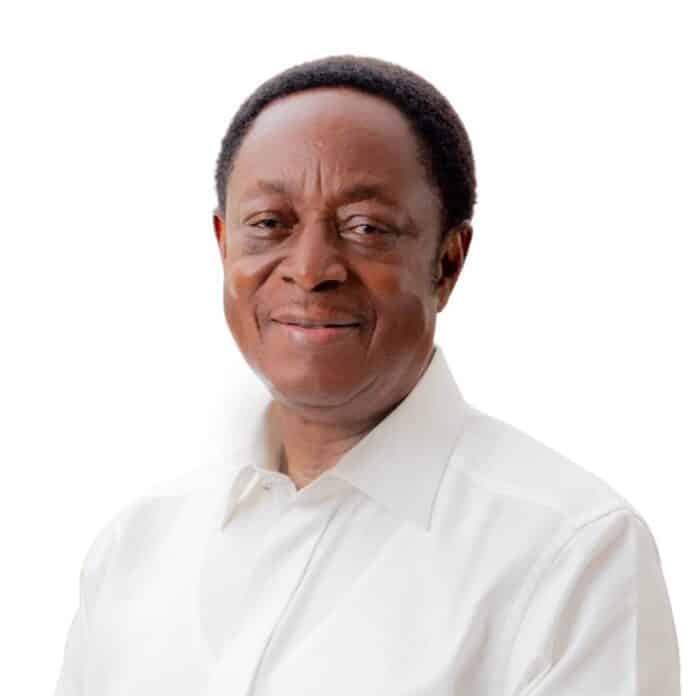
    The National Democratic Congress’ aspiring flag bearer, Dr. Kwabena Duffuor, has stated that he endured hardships under the ruling New Patriotic Party (NPP).

    This comes on the back of a skewed campaign by his opponents that he has received some form of sponsorship for his bid to lead the National Democratic Congress (NDC).

    However, the former Governor of the Bank of Ghana (BoG) has flatly denied the allegation.

    According to him, he has not received any sponsorship from the NPP to destroy the NDC which he contributed to building.

    He disclosed this when addressing the party’s delegates in Adansi Asokwa Constituency in the Ashanti region as part of his four days campaign in the Ashanti region.

    Dr. Duffuor however urged the party supporters particularly the delegates to disregard the destructive campaign his opponents are sharing to party members.

    “I funded the NDC so I’m NDC and nothing can change my love for NDC. The NPP destroyed my banks and tried to collapse every business under my control. I want to tell you that the NPP has hurt me more than any other member of the party. The NPP can never use me to destroy the NDC. My main aim is to return NDC to power to make Ghana better,” Dr. Duffuor reiterated.

    He pleaded with the party supporters to vote for him to lead the party into election 2024 on Saturday 13th May 2023 in the presidential election by thumb printing #3 on the ballot paper.

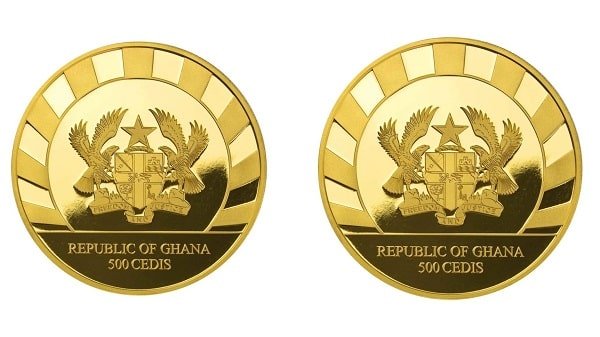
  • BoG debunks claims of introducing GH¢500 coin

    BoG debunks claims of introducing GH¢500 coin

    The Bank of Ghana (BoG) has advised Ghanaians to disregard speculations that the institution plans to soon make a GH500 coin the official unit of exchange in the country.

    Reports are rife on social media alleging that such a coin, with samples already viral, is in the works.

    But the apex bank said it has no such intentions.

    The Director for Currency Management at the Bank of Ghana, Dominic Owusu, dismissed the reports and described them as false.

    “When there is a currency issuance or change, the Bank of Ghana will come with an appropriate press release to inform the public. We saw on social media that the central bank will issue a GH¢500 note or coin, but the bank has not done any such thing. So it’s not true,“ Mr Owusu clarified.

    Mr. Owusu also responded to reports that the one pesewas coin is no longer legal tender.

    “The central bank has not demonetised the one pesewa coin,” he said in a Joy News interview.

    Mr. Owusu further urged Ghanaians to handle the cedi notes with care to prevent them from getting worn out easily.

    “We want the education out there for people to learn how to handle the cedi not to worn out. That’s why you journalists are here, and I want you to help the central bank in that quest. The bank is also doing its part and will make sure all is done to save the cedi”, Mr. Owusu stressed.

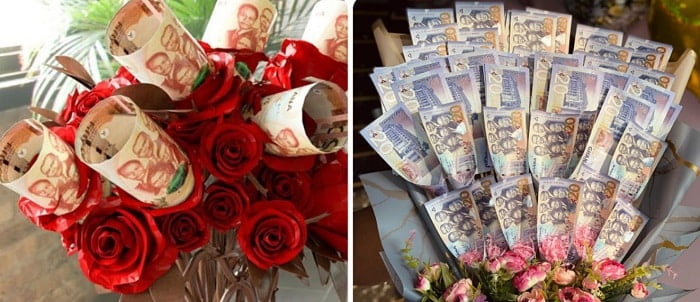
  • Money bouquet for birthday, wedding celebration is illegal – BoG

    Money bouquet for birthday, wedding celebration is illegal – BoG

    The Bank of Ghana has warned Ghanaians to refrain from sending gifts to others in the form of cedi bouquets and hampers.

    It said the currency was issued to be used as a medium of exchange for the purchase of goods and services.

    The Director of the Currency Department at the central bank, Mr. Dominic Owusu, told journalists today (Thursday, March 30, 2023) that any other use of the currency was illegal and subject to prosecution.

    He said the bank had noticed that some people were using the cedi notes as bouquets and hampers as gifts during weddings, birthdays and other celebrations, a practice he said must be stopped.

    He said beyond being illegal, such acts made it easier for the notes to spoil or get defaced.

    Given that spoilt and worn-out notes are replaced at a cost, he said such acts affected the operations of the central bank.

    Mr Owusu was speaking to journalists on how to preserve the currency as part of events marking Ghana month in March.

    He said the local currency was a great symbol of the country and efforts to preserve its quality and cleanliness must be prioritised by all.

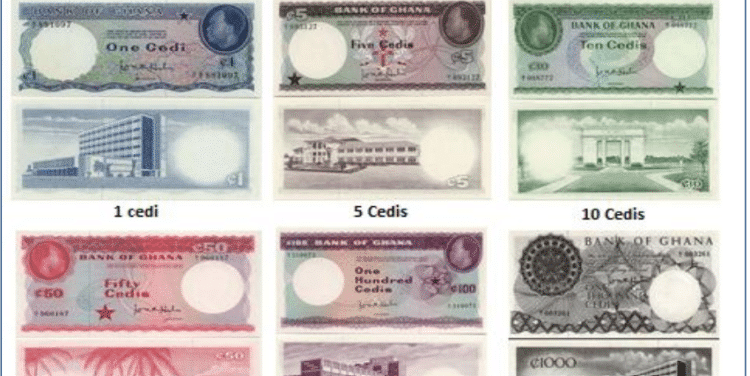
  • BoG provides a 66-year-old history of Ghana cedi

    BoG provides a 66-year-old history of Ghana cedi

    The Bank of Ghana has been given the history of the Ghanaian currency, the cedi, with just a few days to the celebration of Ghana’s 66th Independence Day.

    The Ghana Cedi, which was created by the Bank of Ghana to replace the West African Pound (£WA), was introduced on the eve of Ghana’s independence.

    The Cedi has since undergone many phases and enhancements.

    A major currency reform in 1965 saw a wide acceptance of the decimal system for the Cedi, a name derived from the Akan word, “sedie.”

    A third and fourth reforms in 1969 and 1972 respectively were undertaken after a military coup d’etat, reflecting the political and economic uncertainty during those periods.

    The Bank of Ghana issued a a press statement to detail the evolution of the Cedi to mark Ghana’s 66th Independence Day celebrations.

  • Banks directed to use COCOBOD’s deposits to pay retail customers

    Banks directed to use COCOBOD’s deposits to pay retail customers

    In order to serve retail consumers who might not want a rollover of their cocoa bills, the Ghana Cocoa Board (COCOBOD), the Bank of Ghana, and the commercial banks have reached an agreement that permits banks to utilise COCOBOD’s deposits/placements with the banks.

    This comes after the BoG first instructed banks not to reimburse customers for their maturing cocoa bills investments due to COCOBOD’s cash flow issues.

    The Central Bank stated in a statement that it anticipates the short-term cash flow issues COCOBOD is currently experiencing would be resolved quickly to allow the cocoa regulator to fulfill its investment responsibilities.

    “COCOBOD has assured us that the outlook for the 2023 crop season is good, and Cocoa purchasing are ahead of last year. We therefore expect that this short-term cash flow challenges facing Cocoa Board will be resolved soon to enable COCOBOD to meet its obligations to investors.”

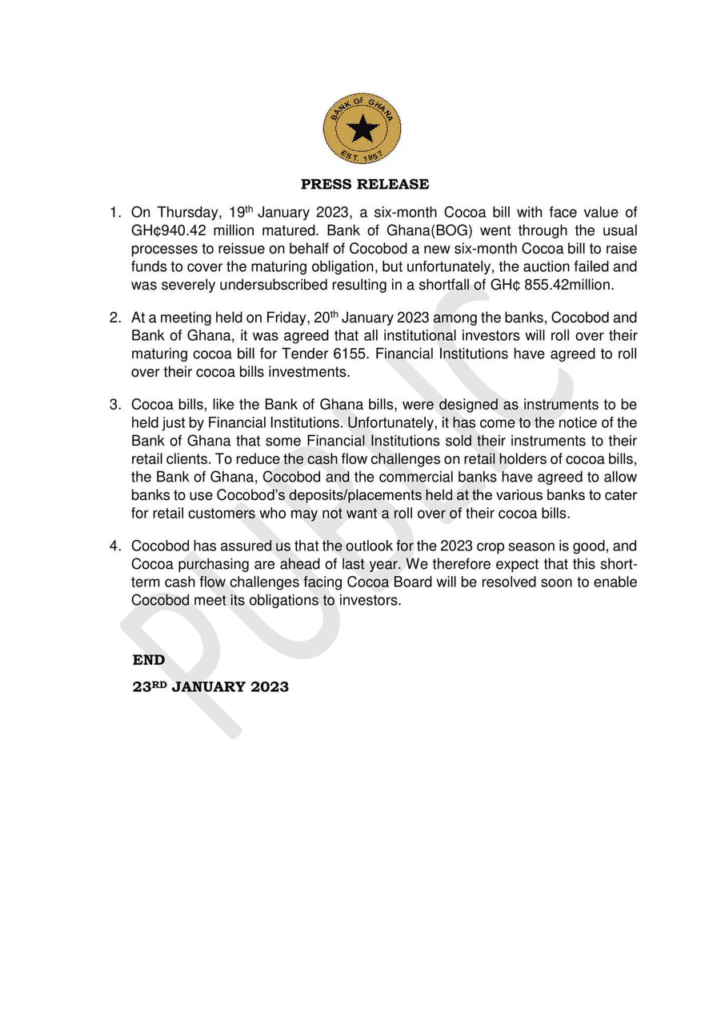
    On Thursday, January 19, 2023, a six-month Cocoa bill with face value of ¢940.42 million matured.

    The Central Bank said “BoG went through the usual processes to reissue on behalf of COCOBOD a new six-month Cocoa bill to raise funds to cover the maturing obligation, but unfortunately, the auction failed and was severely undersubscribed resulting in a shortfall of¢ 855.42million”.

    “At a meeting held on Friday, 20th January 2023 among the banks, COCOBOD and Bank of Ghana, it was agreed that all institutional investors will roll over their maturing cocoa bill for Tender 6155. Financial Institutions have agreed to roll over their cocoa bills investments”, it explained.

    It added that “cocoa bills, like the Bank of Ghana bills, were designed as instruments to be held just by financial institutions. Unfortunately, it has come to the notice of the Bank of Ghana that some Financial Institutions sold their instruments to their retail clients. To reduce the cash flow challenges on retail holders of cocoa bills, the Bank of Ghana, COCOBOD and the commercial banks have agreed to allow banks to use COCOBOD’s deposits/placements held at the various banks to cater for retail customers who may not want a rollover of their cocoa bills”.

  • Soldiers brutalize masquerader in Takoradi

    Some soldiers on guard at the Bank of Ghana (BoG) premises in Takoradi, in the Western Region on Tuesday, December 27, 2022, allegedly brutalized some innocent members of a masquerade group who were parading through the streets of the metropolis.

    Narrating the incident to Empire News’ Kwame Malcolm, the victim, Roberta Monkah said she has been left with wounds under her right eye following the assault.

    “We were in a procession and someone lighted firecrackers and rushed back to my fiancé and I. Out of nowhere three soldiers from the Bank of Ghana approached us and started assaulting my fiancé. So it was there I told them that he is not the one who lit it. But out of nowhere a soldier from behind kicked me and I fell and he hit my lower eye with the butt of his gun leaving blood gushing out,” she narrated.

    She was thus taken to the Ghana Ports and Harbours Hospital in Takoradi for medical attention.

    She however added that upon lodging a complaint at the Takoradi Central Police station, she was asked to bring a doctor’s report which she’s yet to obtain at a cost of GHc500.

    The Christmas period in the Sekondi Takoradi metropolis is marked by various masquerade groups parading and dancing to brass band music on the streets of the metropolis.

    Takoradi has earned the accolade as the preferred Christmas destination.

  • BoG issues fresh guidance to prevent the financing of terrorism

    New anti-money laundering/countering the financing of terrorism and proliferation of weapons of mass destruction (AML/CFT&P) regulations have been released by the Bank of Ghana.

    The new rules, according to the central bank, will aid in the creation of licensed institutions and the implementation of each one’s AML/CFT&P compliance regime.

    The anti-money laundering Act, 2020 (Act 1044) sections 52 and 61, as well as section 92(2)(a)(vii) of the banks and specialized deposit-taking institutions, Act 2016, were cited by the bank as justification for the new instruction (Act 930).

    The BoG said the enactment of the now repealed Acts: Anti-Money Laundering Act, 2008 (Act 749) and AntiMoney Laundering (Amendment) Act, 2014 (Act 874), together with the Anti-Terrorism Act, 2008 (Act 762), among others has intensified Ghana’s efforts towards the fight against money laundering, terrorism and proliferation financing (ML/TF&PF).

    According to the BoG, the purpose of Act 1044 will not be realised unless there is an effective implementation of the collaborative measures being adopted by the Bank of Ghana (BOG) and the Financial Intelligence Centre (FIC) as well as compliance by accountable institutions (AIs), adding, “It is against this background that the BoG and FIC have developed this Guideline for AIs”.

    The guideline has incorporated essential elements of Act 1044, Act 762 as amended and regulations, relevant Financial Action Task Force (FATF) Recommendations, the sound practices of the Basel Committee on Banking Supervision and other international best practices on AntiMoney Laundering and the Combating of the Financing of Terrorism and the Proliferation of Weapons of Mass Destruction (AML/CFT&P).

    The scope of unlawful activities includes counterfeiting currency, counterfeiting and piracy of products, environmental crime, participation in an organised criminal group, and racketeering and terrorism, including terrorist financing.

    The functions of the Bank of Ghana include adopting a risk-based approach in supervising and monitoring AIs; monitor and periodically assess the level of ML/TF&PF risk of the AIs; carry out an examination of AIs based on the Bank of Ghana risk-assessment framework, request production of, access to, the records, documents, or any other information relevant to the supervision and monitoring of AIs and develop guidelines, directives or notices to ensure compliance.

    Others are to provide feedback on compliance with obligations under the Act 1044 by AIs; approve the appointment of the AMLRO of AIs; and undertake any other activity necessary for assisting AIs to understand their obligations under Act 1044.

    Aside from these, the BoG would also cooperate and share information with any other competent authorities in the performance of functions and the exercise of powers under Act 1044.

    The bank shall initiate and act on a request from a foreign counterpart and notify FIC immediately; impose administrative penalties for non-compliance with Act 1044; issue Guidelines/Notices/Directives to ensure compliance with Act 1044; perform any other function as may be required to ensure compliance with Act 1044; among others.

  • BoG increases mobile money transaction limit

    The Bank of Ghana (BoG) has increased mobile money transaction and wallet limits.

    The Bank in a statement issued on December 22, 2022, noted the review is part of measures to facilitate more efficient payments, encourage the seamless transition to a cash-lite society as well as promote the use of non-cash models of payments.

    According to the release, “the aggregate monthly transaction limits will however remain unchanged.”

    Find below the new review:

    Daily transaction

    1. Minimum KYC Account which initially had a limit of ¢1,000 has been upgraded to ¢2,000.
    2. Medium KYC Account with a current limit of ¢5,000 has been increased to ¢10,000.
    3. Enhanced KYC Account with a ¢10,000 threshold has been reviewed to ¢15,000.

    Maximum account balance limit and monthly transaction limits are attached below:

    Source: MyJoyOnline.com

  • Government spending, arrears clearance within target – BoG

    Government spending and arrears clearance in the first nine months of 2022 was broadly within target.

    According to the Bank of Ghana, some key expenditure lines, however, recorded overruns.

    Total expenditures and arrears clearance, for the first nine months of 2022, summed mainly up to ¢99.570 billion (16.8% of Gross Domestic Product), below the target of ¢102.566 billion (17.3% of GDP).

    This outturn represented year-on-year growth of 30.1%. The outturn was also 97.1% of the target.

    Of the expenditures, Compensation of Employees (including wages and salaries, pensions & gratuities, and other wage related expenditure) was ¢27.14 billion, lower than the target of ¢27.94 billion.

    This outturn represented 97.1% of the target.

    In terms of fiscal flexibility, compensation of employees constituted 42.0% of domestic revenue mobilized, better than the 50.4% recorded in the corresponding period of 2021.

    Use of Goods and Services totalled ¢4.233 billion, lower than the expected target of ¢5.117 billion. The outturn was 17.3% below the target, but recorded a year-on-year growth of 25.9 percent.

    Total interest payments of ¢32.10 billion was higher than the projected target of ¢30.890 billion by 3.9%, and accounted for 32.2% of total expenditure.

    It also constituted 49.7% of domestic revenue, compared with 54.7% recorded in the corresponding period of 2021. Domestic interest payments accounted for 78.0% of the total interest payments during the period under review.

    Grants to other government units consisting of National Health Fund, Education Trust Fund (GET Fund), Road Fund, Energy Fund, District Assemblies Common Fund (DACF), Retention of IGFs, transfer to GNPC and other earmarked funds all summed up to ¢17.562 billion, above the envisioned target of ¢16.820 billion by 4.4%.

    It also recorded a year-on-year growth of 57.7%.

    Other expenditures made up of ESLA Transfers, Covid-19 related expenditures, and other critical spending, for the first nine months of 2022 was ¢7.093 billion.

    ESLA transfers of ¢3.816 billion was above the projected target of ¢3.319 billion by 15.0%.

    Source: Myjoyonline

  • Ghanaians berate Bank of Ghana after announcement of new GH¢1 coin with security upgrades

    A new version of the GH1 coin with improved security measures has been introduced, according to the Bank of Ghana (BoG).

    “The upgraded GH¢1 coin is bi-metallic with an outer gold and inner silver. The coin has a pronounced rough edge and incorporates a latent image, which appears in a rectangular form below the Scale of Justice at the back,” parts of a statement issued by the BoG read.

    Ordinary, this announcement should be welcomed news to Ghanaians because it will help prevent fraud and help ensure that the country’s currency is secured.

    But Ghanaians on social media are not taking the announcement of the new GH¢1 coin, which will be in circulation from Monday, December 12, 2022, well.

    Some Tweeps have been questioning the time of the move by the BoG and the amount it might have cost the country, given the current economic hardships.

    “Useless people, how much will this cost us huh? as for Nana Addo the least said about him the better,” one Twitter user wrote.

    Some also said that the BOG should focus on stabilising the value of the Ghana cedi rather than issuing new currencies.

    “Under Akufo Addo our currency has depreciated badly n he has introduced new denominations new features on our currency n wiping out some…what development paaa will this bring to the nation, of what benefit is this…Total waste,” another Ghanaian wrote.

  • Debt exchange plan will boost confidence in Ghana’s economy – Addison

    The Governor of the Bank of Ghana, Dr Ernest Addison, has expressed optimism that the proposed Debt Exchange Programme announced by the government will bring some confidence in the economy as well as enhance the efforts of the Central Bank in controlling inflation.

    He noted that the economic challenges which have affected many banks have led to the high cost of borrowing and doing business.

    Speaking at the Annual Dinner of the Chartered Institute of Bankers, Ghana, Dr Addison assured of the Central Bank’s support to financial institutions to provide them with additional liquidity during the exercise.

    “In addition to the near-term adoption of the IMF programme, we will provide a balance of payment support to help with financing gaps, boost investor confidence and restore stability.”

    The Government on Sunday announced a slash in interest payments for domestic bondholders to zero percent in 2023 and pegged 2024 interest payments at 5 percent.

    The government, however, said there will be no haircut on the principal of bonds, adding that individuals with government bonds will have their full investments upon maturity.

    In a public address on Sunday, December 4, on the current economic situation, the Finance Minister, Ken Ofori-Atta said the government will ensure that people’s investments are safe. He further announced that interest payments for domestic bondholders for 2024, will be pegged at only 5% adding that from 2025, the rate increases to 10%

    Meanwhile, the Finance Minister has admonished the media to be circumspect and disseminate the right information regarding the current economic crisis and the government’s debt exchange programme in order not to create unnecessary panic among investors.

    “This debt exchange provides an orderly way to put our economy back on track. These efforts will be complemented by fiscal measures to protect the neediest and most vulnerable in society. The Government expects overwhelming support for this exchange.

    “And in truth, the success of this necessary endeavour depends, of course, upon the public’s cooperation. That will also mean the media being helpful in disseminating the right information to economic actors. We are all in this together, and we intend to get out of this together,” Mr Ofori-Atta said.

    Source: Citinews

  • US partly to blame for Ghana’s economic strain – BoG

    The Central Bank has attributed some of Ghana’s current economic crisis to external factors that arose as a result of the United States of America’s (U.S.A.) efforts to stabilise their economy.

    This was stated in a report issued by the Bank of Ghana (BoG) following its 109th Monetary Policy Committee meeting on November 28.

    The BoG, in its report, made sure to emphasise the US’s role in escalating economic conditions for several countries around the world, including Ghana, while citing a number of factors that have contributed to Ghana’s current economic situation.

    According to the Central Bank, when the US Federal Reserve revised some of its policies, it resulted in “tight global financing conditions and a stronger US dollar against major international currencies.”

    In September 2022, the Federal Reserve raised its benchmark interest rate by 0.75 percentage points, the third increase in a row, bringing the Fed rate to 3%-3.25% By doing so, the US central bank, as part of efforts to check its inflation (8.2% as of September), increased demand for the dollar from foreign investors attracted by the higher returns available in the country.

    Since the US dollar is the existing currency for global trade, emerging markets faced a rise in the cost of imports.

    According to the Bank of Ghana, these external shocks have had severe consequences on the Ghanaian economy, reflected in high and rising inflation and depreciation of the local currency.

    “These developments have spilled over into currency pressures and imported inflation, complicated access to external capital markets, and resulted in acute capital outflows, especially in emerging markets and frontier economies,” the Central Bank added.

    Per the Bank’s report, the foreign exchange market witnessed increased volatility, with intense pressure on the local currency, especially in September and October 2022.

    Other external factors that led to the significant drop in the value of the cedi include; the sovereign downgrades, the de facto closure of the international capital market, portfolio reversals, and increased demand for foreign exchange amid supply constraints.

    As of November 24, 2022, the Ghana Cedi cumulatively depreciated by 54.2 percent against the US dollar.

    The local currency lost 48.9 percent and 49.9 percent of its value to the Pound and Euro, respectively.

    In comparison with the same period of last year, the Ghana Cedi was much stronger.

    It depreciated by 2.6 percent and 0.2 percent against the US dollar and the Pound, respectively, and appreciated by 6.6 percent against Euro.

    Since revising the interest rate, the US has seen its inflation rate drop to 7.7% as of October 2022.

  • BoG will ensure banks remain solvent – Dr Addison

    Dr. Ernest Addison, the governor of the Bank of Ghana (BoG), has expressed worry about the solvency of some Ghanaian banks.

    According to him, the Central Bank will put in measures to ensure that banks remain solvent. This, he said is the most important task of the Central Bank.

    The decision by the BoG comes as the government prepares to restructure its debt to pave way for an International Monetary Fund (IMF) bailout. This will include haircuts to bondholders.

    Dr. Ernest Addison explained at a media briefing that: “The good thing is that we think that there are adequate buffers. Nevertheless, the Central Bank will put in measures that will ensure that the banks remain solvent.”

    On the subject of Ghana’s galloping inflation, the Governor said, “The inflation forecast shows that inflation will likely peak in the first quarter of 2023 and settle around 25% by the end of 2023. This forecast is conditioned on the continued maintenance of the tight monetary policy stance and the deployment of tools to contain excess liquidity in the economy.”

    He noted that there are some risks associated with inflation such as additional pressures from the proposed VAT increase in the exchange rate have to be monitored.

    Dr Addison added that “to continue to anchor inflation expectations, the committee, therefore, decided to increase the policy rate by 250 basis points to 27%.”

  • BoG’s decision to halt forex support for import of rice and others is bad, says Kofi Bentil

    Kofi Bentil, the vice-president of IMANI Africa has described the decision by the Bank of Ghana (BoG) to halt forex support for imports for some eight items as a bad move, which will badly affect the poor.

    The items include rice, poultry, vegetable oil, toothpicks, pasta, fruit juice, bottled water, ceramic tiles and other non-critical goods.

    The move, according to the central bank, is in accordance with the president’s directive, issued in his recent address on the Ghanaian economy, made to the nation on Sunday 30 October 2022.

    An electronic message from the Bank of Ghana to banks in the country said: “In accordance with the president’s directive, issued in his recent address to the nation on the Ghanaian economy on Sunday 30 October 2022, the Bank of Ghana will no longer provide FX support for the imports of rice, poultry, vegetable oils, toothpicks, pasta, fruit juice, bottled water, ceramic tiles and other non-critical goods.”

    “Please be advised and act accordingly,” the Bank said.

    Reacting to the development on Facebook, Bentil said the policy will force importers to rely on the open market for forex, adding that it will drive up prices of goods.

    “Another round of policy incoherence has been unleashed. We will all suffer, especially the poor.

    “You support essentials whose price increase will affect the poor. Toothpicks, pasta, fruit juice, bottled water and ceramic tiles are NOT essential. You don’t need to support their imports.

    “If you withdraw support. You haven’t reduced demand, you’ve just created shortage, so The importers will buy FOREX from the open market and drive-up FOREX rates. And that will also drive-up prices of these essentials and everyone will suffer especially the poor,” Bentil posted.

  • Ghana Stabilisation Fund faces depletion – PIAC warns

    The Public Interest and Accountability Committee (PIAC) has hinted that the Ghana Stabilisation Fund (GSF) risks facing a devastating depletion.

    According to the PIAC, the Finance Minister’s decision to cap the GSF at $100 million and use excess funds from the Fund for other emergency purposes is putting a strain on the Fund.

    The objective of the Ghana Stabilization Fund is to cushion the impact on or sustain public expenditure capacity during periods of unanticipated petroleum revenue shortfalls.

    However, PIAC disclosed that the decision by Ken Ofori-Atta to cap the fund at $100 million is taking a heavy toll on the fund.

    Speaking to the media on the sidelines of the 2022 Semi-Annual Report on Petroleum Funds, the Chairman of the Public Affairs and Communications Sub-Committee at PIAC, Eric Defor, noted that if the country is hit with an unforeseen situation, there will be resources available to cushion the economy

    He further lamented that “the retention of the current cap of $100 million in the GSF for the year 2022 is not in accordance with the formula stipulated in L.I2381. A proper application of the formula would have returned a figure of US$460,633,074.02The Minister of Finance, in determining the cap on the GSF, should comply with the relevant provisions of L.I 2381.”

    “It appears that for the past three years the $100 million cap has remained, and should there be another emergency, there will be no resources available in the fund to support the budget, and this we find a challenge,” he added.

    Highlighting the impact of the cap, PIAC revealed that at the end of the first half of 2022, the fund generated only $373 million.

    Describing the development as a threat to the economy, the committee, called on parliament to review the Petroleum Revenue Management Act, which gives power to the Minister of Finance to use discretionary powers to set the cap.

    Source: The Independent Ghana

  • BoG overdraft necessary and apt, it helped to keep gov’t machinery running – Analyst

    A financial analyst, Dr Amos Anim has commended the Bank of Ghana for providing financing to keep the government machinery running.

    Dr Amos Anim indicated that the BoG overdraft will go a long to help the country as the government seeks a programme under the International Monetary Fund (IMF).

    “It is a fact that, but for the Bank of Ghana (BoG) overdraft to the Ministry of Finance, payments of salaries would have been difficult.

    Dr Anim further explained that because government is paying debts, it needs funds to ensure payment of salaries.

    In his view, even Members of Parliament would not have been able to receive their salaries but for the overdraft.

    “Without BOG overdraft nobody would have received salaries including parliament,” he said in an exclusive interview with 3news.com on Sunday.

    “You can imagine what will happen in this country if government workers aren’t paid their salaries.The BoG overdraft has ensured that no chaotic situation happens .Government machinery working smoothly.”

    “We are all  aware that the execution of the budget for the year has remained challenging. Revenue has not kept pace with projections and created financing challenges. In the absence of access to the international capital market and given the constrained domestic financing, central bank overdraft has helped to close the financing gap as reflected in the mid-year budget review,” he further said in a separate write up.

    He made these comments in reaction to a press engagement by the Member of Parliament for Bolgatanga Central, Isaac Adongo, who accused the Bank of Ghana for financing government.

    “Hon.Adongo is a member of the Finance Committee in Parliament. I don’t expect him to be making this statement. He knows and is aware of the current situation. As a member of the Finance Committee, he is  aware of the issues. ”

    “Hon. Adongo is aware that without BoG overdraft, he wouldn’t receive salary. ”

    “We expect our honourable MPs to be patriotic and support initiatives that will promote the good of the people of Ghana.  ”

    “ Parliament is  in session now. I am very sure the Ministry of Finance at the appropriate time  will engage Parliament  on the overdraft .”

  • ‘Stabilize the Ghana Cedi’ – Otumfuo urges BoG

    The Asantehene, Otumfuo Osei Tutu II, has appealed to the Bank of Ghana to take necessary steps to stabilize the forex market.

    In a speech read on his behalf at the 19th Ashanti Business Excellence Awards by Sewuahene, Nana Kwaku Sarkodie, the Asantehene expressed worry over the depreciation of the local currency against other foreign trading currencies.

    He urged the central bank to implement measures to bring predictability to Ghana`s export and import trade, as well as other international financial transactions.

    “I will like to make reference to the unsettling turbulence which has characterized Ghana’s foreign currency market, Since the beginning of the year, there has been an astronomical depreciation of the cedi against Ghana’s major foreign currencies, particularly the US Dollar.

    I have no doubt that the Bank of Ghana is doing its best to remedy the situation, but the central bank is doing its best to remedy the situation, but I must urge the central bank to urgently take all the requisite steps within its competence to return the foreign market to stability, in order to bring predictability to Ghana`s export and import trade, as well as other international financial transactions”, he said.

    The cedi ended last week with a marginal appreciation, but the cedi has depreciated again to GH¢14.20 to one dollar which is the average quote by the forex bureaus.

    According to the Bank of Ghana, however, the local currency is selling at GH¢13.014 on the interbank market. The cedi is also going for ¢15.60 and GH¢13.60 to one pound and one euro respectively.

    The free fall of the cedi coupled with the recent economic crisis in the country has triggered calls for immediate measures to be implemented by the government to resolve the situation.

    President Akufo Addo in his address on Sunday, October 30, announced some measures the government intends to put in place to address the fall of the cedi and the current economic crisis.

  • BoG denies colluding with illegal forex traders at Accra

    The Bank of Ghana (BoG) has strongly denied claims of collusion with illegal foreign exchange traders (forex) at the Central Business District in Accra to transfer funds offshore.

    The Central Bank in a statement on Tuesday, November 1, described the allegations by the Director of Research at the Trades Union Congress (TUC) Dr Kwabena Otoo as “reckless and unfortunate”.

    “It has come to the attention of the Bank of Ghana that Dr Kwabena Nyarko Otoo of the Trades Union Congress passed an unfortunate remark about the Central Bank on Newsfile on Joy News TV/Joy FM on Saturday, 29th October 2022.

    “Dr. Otoo, on the programme, said there is evidence or growing suspicion that Bank of Ghana is actively collaborating with some operatives at Cowlane in Accra to illegally transfer funds offshore. Bank of Ghana categorically denies the said allegations and also considers them extremely reckless. We would have expected that such strong allegations would have been supported by the requisite evidence, and not left at pure conjecture, mere suspicion or hearsay. This is especially so considering the quarters from which the allegations were made.”

    The BoG further advised the general public to completely disregard these comments and be assured that the Central Bank, is focused on price stability, and doing all within its power to reduce the rising general level of prices.

    Source: Citi News


  • We are not engaged in any illegal transfer of funds offshore – BoG refutes claims

    The Bank of Ghana has dismissed claims that it was actively collaborating with some operatives at Cowlane in Accra to illegally transfer funds offshore.

    This comes after the Director of Research at the Trades Congress (TUC), Dr. Kwabena Nyarko Otoo had alleged there was ‘evidence or growing suspicion’ of the said activity.

    Dr. Otoo made the claims while speaking on the October 29 edition of Newsfile on Joy News TV.

    But the Central Bank in a statement sighted by GhanaWeb categorically denied the allegations and also considered them as extremely reckless on the part of Dr. Kwabena Nyarko Otoo.

    “We would have expected that such strong allegations would have been supported by the requisite evidence, and not left at pure conjecture, mere suspicion or hearsay. This is especially so considering the quarters from which the allegations were made,” the statement said.

    “We advise the general public to completely disregard these comments and be assured that we, as a Central Bank, are focused on our mandate of price stability, and doing all within our power to reduce the rising general level of prices. We are doing this guided by our core values of accountability, professionalism and integrity, and in accordance with law,” the BoG added.

    The Bank of Ghana, therefore, urged the public to desist from making such unfounded allegations in the future.

    It further assured collaboration with relevant stakeholders including law enforcement agencies to discourage and penalize the activities of illegal foreign exchange operators in the country.


    Source: Ghanaweb

  • ‘We will soon overcome economic challenges’ – BoG

    The second Deputy Governor of the Bank of Ghana (BoG) has stated that even though economies around the world will face difficult times, Ghana will overcome its challenges as the right policies are put in place.

    Elsie Addo Awadzi citing the International Monetary Fund’s (IMF) prediction that there may be a global recession in 2023 noted that developing countries like Ghana are in a unique position to take advantage of the situation to accelerate economic development.

    She was speaking at the 21st annual Chief Executive Officers Conference for Rural and Community Banks in Ho, in the Volta Region.

    “Just yesterday, the IMF released its latest numbers on the global economy and the outlook for 2023 is a global recession. The whole world’s economy is in trouble”, she stressed.

    She added that the “large unusual threat from the Covid-19 pandemic, the Ukraine-Russia war, from the unprecedented levels of inflation.

    “Even in the advanced economies talking about 10%, 11% inflation which used to be a developing country’s phenomenon, today in the US, the EU, the UK are struggling with it and you see interest rates, as a result, rise very high, in their 20s”.

    She asserted that the development had resulted in the financing of emerging and developing economies as “almost non-existence”, adding that investors would pick developed economies such as America and Europe for businesses in quest of higher yields.

    Mrs Awadzi disclosed that her outfit is working with the Ministry of Finance and other key stakeholders to conclude discussions with the IMF towards a Reform Program that would help transform and restore the country’s economy.

    “We at the Bank of Ghana are confident about the outlook for our economy. The current high inflation and Cedi depreciation are temporary and we must avoid speculative behaviour that only works against attaining stability sooner,” she advised.

    She also entreated rural and community banks to leverage technology to improve service delivery as they remain essential players in the banking industry, and continue to provide critical financial services to micro, small and medium-sized enterprises and individuals.

    She detailed that to enhance operations of the rural and community banks, the Finance Ministry and the Bank of Ghana had decided to support the upgrade of the ARB Apex Bank’s e-banking platform and the modernization of the management information system of the rural and community banks.

    This, she said, forms part of the Financial Sector Development Project aimed at ensuring efficient service delivery to he ever-demanding customers.

    “Digitalisation comes along with its own complexities and risks, including cyber security risks, third and fourth party/outsourcing risk, data privacy breaches, technology failure risk, increased AML/CFT risks, and consumer protection risk among others. Needless to say, a lot is required by way of strong governance and risk management systems to help mitigate these risks, as financial institutions seek to exploit the benefits of digitalisation.

    RCBs will therefore need to augment their capital base as needed in order to deploy more sophisticated systems and structures in line with the Bank of Ghana’s 2018 Cyber and Information Security Directive. The Directive provides for the adoption of minimum technical, governance, data protection protocols, and transaction monitoring and fraud detection and mitigation tools, to help mitigate key risks from digitisation”, she said.

    Source: Myjoyonline

  • Ghana’s debt stock skyrockets to ¢402.4bn -BoG

    The October 2022 Bank of Ghana (BoG) Summary of Economic and Financial Data has revealed that Ghana’s public debt stock is now at ¢402.4 billion as of July 2022.

    This, according to the central bank, is equivalent to 68% of the Gross Domestic Product and is in sharp contrast to the projected 104.6% of debt to GDP ratio in 2022 by the World Bank.

    In dollar terms, the country’s debt dropped marginally to $53.2 billion in July 2022, from $54.4 billion in June 2022.

    Based on the data, the nation did not borrow fresh funds from the international market during the period. However, the debt level will go up going forward, follow- ing the $750 million Afrieximbank loan that came in August 2022.

    According to the data, the external debt remained largely unchanged at $28 billion, equivalent to 35.8% of GDP.

    The domestic debt however has been going up since January 2022 because of the significant bor- rowing by the government in the domestic financial market.

    The domestic debt stood at ¢190.3 billion in July 2022, from ¢190.1 billion in June 2022.

    Data available shows that the domestic debt began the year at ¢181.9 billion in January 2022 and then went up to ¢185.4 billion in February 2022 and ¢190.1 billion in March 2022. It subse- quently shot up to ¢189.2 in April 2022 and ¢188.5 billion in May 2022.

    On the other hand, the financial sector resolution bond fell by ¢100 million to ¢14.4 billion in July 2022. This is equivalent to 2.4% of GDP.

    The total public debt stock of the country dropped to ¢388.1 billion in April 2022, from ¢392.1 billion in March 2022. It later went up marginally to ¢389.2 billion in May 2022 and subsequently to ¢393.4 billion in June 2022.

    Meanwhile, the World Bank in its latest Africa Pulse Report classi- fied Ghana as a high debt distress country as it projects the nation’s debt to Gross Domestic Product (GDP) of 104.6% by the end of 2022.

    According to the report, debt is expected to jump significantly, from 76.6% a year earlier, amid a widened government deficit, mas- sive weakening of the cedi, and rising debt service costs.

    Source: gbcghanaonline.com

  • Loans to become more expensive as BoG hikes policy rate to 24.5%

    The Monetary Policy Committee (MPC) of the Bank of Ghana (BoG) has increased the Policy Rate by 250 basis point to 24.5%.

    This is the highest policy rate increase since 2017.

    The rate hike means it will become more expensive to borrow from the banks, a situation that will push the cost of living and doing business in the country further up.

    Addressing the media, the Governor of BoG, Dr Ernest Addison, explained that the committee reached the decision in order to check the rising rate of inflation as the country negotiates with the International Monetary Fund (IMF) for an economic programme.

    “Inflation remains elevated and the balance of risks is on the upside. Although the forecasts are for monthly inflation to continue to slow down, the risks are on the upside, emanating largely from pass-through effects of the currency depreciation, the recent upward adjustment in utility tariffs, and rising inflation expectations”.

    “The Committee remains committed to re-anchoring inflation expectations and returning to a disinflation path,” Dr Addison added.

    Interest rates surge

    The Bank of Ghana also said short-term interest rates on the money market have reflected recent developments, while medium-term to long-term rates have remained relatively behind the yield curve.

    For example, while the discount rate on the 91-day instrument has increased to 29.7% in September 2022 from 12.5% in September 2021, the coupon rates on the 7-year, 10-year, 15-year, and 20-year have remained unchanged at 18.1%, 19.8%, 20.0% and 20.2% respectively.

    The interbank market weighted average rate has increased to 22.05% in September 2022 from 12.61% in September 2021, consistent with the rise in the policy rate.

    Average lending rates of banks have also adjusted upwards to 29.81 per cent in September 2022 from 20.20 per cent recorded in the corresponding period of 2021.

    Policy rate gone up by 9.5% since March 2022

    Since the Bank of Ghana first increased the policy rate in March 2022, the interest policy rate has gone up by 9.5%.

    The Central Bank increased the policy rate by 2.5% on March 25, 2022, to 17%, and subsequently increased it on May 23, 2022, to 19%.

    It again adjusted it upwards by 300 basis points to 22% in August 2022.

    Source: Myjoyonline

  • Capping fuel prices wrong policy, says BoG

    Dr Ernest Addison, the Governor of the Bank of Ghana (BoG), has said capping fuel prices is a wrong policy.

    There have been calls for the government to intervene and cap the prices of fuel to cushion consumers.

    But speaking at the 108th MPC press briefing in Accra on Thursday (6 October), Addison said, “Capping fuel prices is not an innovation. In fact, it is a wrong policy. When you have fuel prices rising and you also have a budget deficit problem, who is going to pay for the difference of the cost of fuel?”

    “That will create further fiscal subsidies and worsen your fiscal deficit problem that we are all trying to resolve. So on the contrary, we should really be pushing towards full cost recovery to minimize the burden on the budget,” he added.

    Oil prices held near three-week highs on Thursday after OPEC+ agreed to tighten global crude supply with a deal to cut production targets by two million barrels per day (bpd), the largest reduction since 2020.

    Brent crude futures edged down 16 cents, or 0.2%, to US$93.21 per barrel by 1020 GMT after settling 1.7% up in the previous session.

    U.S. West Texas Intermediate (WTI) crude futures lost 14 cents, or 0.2%, to US$87.62 after closing 1.4% up on Wednesday.

  • BoG partners key players in financial sector to address challenges

    The Bank of Ghana has engaged players in the financial space to address possible threats to the sector in order to achieve a sound and safe financial system.

    To this end, the Central Bank, says it is committed in ensuring that its financial inclusion agenda is achieved in no time.

    Speaking at the maiden edition of the Regulatory Sandbox Engagement Forum, on behalf of the first Deputy Governor of the Bank of Ghana, Head of FinTech and Innovation Office, Kwame Oppong, underscored the importance of such engagements with financial sector players.

    “Let me underscore the importance of responsible innovation in this endeavor. Globally, sustainability has taken centre stage in all spheres of human activity. The need to assess the possible negative impact of our innovations on the present and future societies has become more critical than ever”.

    “Adoption of responsible innovation presents a unique national advantage with the potential to attract investments into our FinTech ecosystem for the creation of employment and wealth”.

    Mr. Oppong also addressed issues of privacy and confidentiality within the fintech space.

    “Let me address the fintechs regarding issues of privacy and confidentiality. Bank of Ghana as a regulator of financial service maintains the highest level of confidentiality and secrecy.”

    “We would like to assure you that every staff is committed to an oath of secrecy and under no circumstance will third party information be disclosed. A breach of the secrecy requirement attracts serious sanctions including dismissal”, he stressed.

    Source: Myjoyonline

  • BoG postpones routine MPC meeting over IMF team visit

    The Bank of Ghana’s (BoG) Monetary Policy Committee (MPC) will not be holding its routine quarterly meeting today, Monday, September 26, 2022, as scheduled.

    A statement from the Central Bank last Thursday said the rescheduled meeting will now coincide with Government’s next round of engagements with the International Monetary Fund (IMF).

    The Fund is scheduled to begin these rounds from September 26 to October 7, on Government’s policies and reforms that could be supported by its lending arrangement.

    The team, which will be led by its Mission Chief for Ghana, Stephane Roudet, is also expected to further engage with other stakeholders in the course of the visit.

    Following the development, the Monetary Policy Committee says it will announce the next monetary policies on October 7, the day the engagements with the IMF will be concluded.

    The last IMF mission to Ghana was between July 6 and July 13, 2022. The team used the opportunity to assess Ghana’s economic situation and discussed the broad lines of the government’s Enhanced Domestic Program that could be supported by an IMF lending arrangement.

    The IMF team met with Vice President Bawumia, Finance Minister Ofori-Atta, and the Governor of the Bank of Ghana.

    The team also met with the Parliament’s Finance Committee, civil society organizations, and development partners, including UNICEF and the World Bank, to engage on social spending.

    Ghana is currently looking to secure a $3 billion loan from the IMF.


  • Chamber of Mines to sell 125,000 ounces of gold to BoG

    Gold-producing member companies of the Ghana Chamber of Mines will, between now and December 2022, sell about 125,000 ounces of gold to the Bank of Ghana (BoG) under the central bank’s Domestic Gold Purchase Programme.

    The decision followed a meeting between Vice President Alhaji Dr Mahamudu Bawumia, some other members of the Economic Management Team, the Bank of Ghana, the Ministry of Lands and Natural Resources, Minerals Commission, PMMC as well as the leadership of the Chamber to consider the implementation of the BoG’s Gold Purchase Programme in the light of the country’s economic challenges.

    Ahead of that meeting, Newmont Ghana had already sold 3,500 ounces of gold to the Bank of Ghana as part of the programme.

    Vice President Dr. Bawumia noted after the meeting that “it was agreed that to help shore up the foreign exchange reserves of the Bank of Ghana, starting September 1st, the Bank of Ghana will purchase a portion of the output of the gold mining companies on a continuous basis at world market prices, but payment will be made in Ghana cedis”.

    This will represent a significant and sustainable addition to Ghana’s foreign exchange reserves over time and strengthen the country’s balance of payments position”, H.E. the Vice President added.

    President of the Chamber, Joshua Mortoti stated that “as good corporate citizens the Chamber supports the programme”. Noting that the Gold Purchase Programme will be mutually beneficial to all stakeholders.

    On his part, the Chief Executive Officer of the Chamber, Dr. Sulemanu Koney, stated that members of the Chamber would further engage the Central Bank to fast-track the implementation of the programme.

    Discussions on the Gold Purchase Programme started in 2020 between the BoG and gold-producing member companies of the Chamber to support Ghana’s foreign exchange reserves.

    The Ghana Chamber of Mines is the main minerals industry association in Ghana. The Chamber represents the collective interests of companies involved in mineral exploration, production and processing in Ghana.

  • Phasing out ¢1, ¢2 notes will further hike inflation – IEAEA Director of Research

    The Director of Research at the Institute of Economic Affairs, Dr. John Kwakye is warning of further hikes in inflation if the Bank of Ghana phases out the 1 and 2 notes as planned.

    In a tweet, he said the planned move will not only put pressure on the 5 note but will also trigger higher inflation.

    “Phasing out 1 and 2 cedi notes from the economy as planned by BoG will not only put pressure on the 5 cedi notes, but will also further fuel inflation”

    Dr. Kwakye who is an immediate past member of the Monetary Policy Committee of the Bank of Ghana explained further that the country may undertake a redenomination of the local currency again in the future if it does not address the rapid depreciation of the cedi and inflation.

    “If we don’t rein in inflation and cedi depBoGreciation, it won’t be long before we undertake another redenomination.”

    The country’s inflation is one of the highest on the continent so far this year.

    It hit 33.9% in August 2022, the highest in 21 years, data from the Ghana Statistical Service (GSS) revealed.

    This is expected to increase the cost of borrowing by raising interest rates further, and consequently trigger increase cost of living and doing business.

    Source: Myjoyonline

  • BoG to impose sanctions on banks that breach digital financial services guidelines

    The Bank of Ghana may impose on banks or Specialized Deposit-Taking Institutions, an administrative sanction of not more than 10,000 penalty units for breach of new guidelines on digital financial services.

    In the case of continuous breach, an additional penalty of not more 50 penalty units shall be imposed for each day the breach continues.

    This is in accordance with section 92 of Act 930.

    Again, in accordance with section 44 of the Non-Bank Financial Institutions Act, 2008 (Act 774), the Central Bank may impose on a non-bank financial institution, an administrative sanction of not more than 10,000 penalty units for breach of this directive.

    In the case of continuous breach, an additional penalty of not more 50 penalty units shall be imposed for each day the breach continues.

    The Disclosure and Transparency Directives for digital financial services and products is aimed at providing the minimum disclosure and transparency framework to guide providers of Digital Financial Services and Products.

    The objectives of the directive according to the Central Bank is to provide a framework to guide providers with regard to the disclosure of information pertaining to digital financial services and products in a manner that repose trust and confidence in consumers, protect consumers of digital financial services and products by ensuring that institutions that provide these services, do so in a transparent and fair manner by disclosing to the consumers and prospective consumers, among others.

    Delivery of information

    The report stated that providers (banks, SDIs) shall ensure that all materials provided to consumers, are clear, complete, accurate, understandable and not misleading regardless of the delivery channel.

    Again, they shall be liable for all information delivered to the consumer.

    Delivery Channels

    A provider shall ensure that delivery channels for DFS do not expose consumers to undue risk of scams and fraud.

    They shall ensure consistency in the style and delivery of information and consistency in the medium of communication.

    Channels to deliver transaction confirmation

    At a minimum, a provider shall deliver a transaction through a short messaging service (SMS) or electronic mail (email).


    Source: Myjoyonline

  • BoG commended for easing imports and exports bottlenecks

    Chief Executive Officer of the Ghana Shippers’ Authority (GSA), Ms Benonita Bismarck, the has commended the Bank of Ghana (BoG) for streamlining bottlenecks in exports and imports to shore up revenue for accelerated development.

    The measures, among others, include the need for repatriation of proceeds through the establishment of Letters of Commitment (LoC) to ease the challenges of export proceeds repatriation.

    Addressing a forum for exporters and importers in Cape Coast, Ms Bismarck said LoCs are aimed at achieving repatriation of export proceeds to enable the BoG to realize boost its foreign exchange reserves.

    The discussions largely centered on LoC requirements for the repatriation of export proceeds for importers, exporters, industry stakeholders, and other developments in the dynamic shipping environment.

    Also, exports to major trading countries are the backbone of the government’s revenues, therefore, the move will: be “Currency stability, job creation, and industrialization drive.

    “That will enhance the country’s foreign exchange reserves, support effort at building resilience in the economy, and stabilize the national currency and the overall macroeconomic stability.

    She underscored the significance of LoC requirements to ensure all revenues were fully repatriated into the country through the banking system to ensure that exports and associated earnings were effectively tracked and their repatriation was guaranteed.

    Ms Bismarck also mentioned some challenges with the implementation of the LoC, including inadequate time allocated for the repatriation of export proceeds and blocking of subsequent export transactions for non-repatriation of proceeds beyond 60 days.

    “The others are delays in accessing repatriated proceeds from commercial banks, low exchange rates offered by the banks, high commissions charged by commercial banks, and the unsuitability of the current form of the LOC for small-scale cross border trade.”

    She noted that most of the problems faced by exporters stemmed from non-compliance and inadequate knowledge of the procedures involved, hence the collaboration between the two organizations to remove these bottlenecks.

    Alhaji Musa Ali former Chairman of the Central Regional Imports and Exports Association commended GSA for allowing stakeholders to interact and stressed the need for compliance.

    He, among others, the stakeholders brought to the fore concerns such as inadequate time allocated for the repatriation of export proceeds and blocking of subsequent export transactions for non-repatriation of proceeds beyond three months.


    Source: peacefmonline

  • BoG illegally printing money for Government – Isaac Adongo alleges

    The Member of Parliament for Bolgatanga Central, Isaac Adongo, has accused the Bank of Ghana (BOG) of illegally printing money for Government.

    Mr Adongo stated that the central bank is printing new notes to enable the government to cover its expenditure since it is unable to receive funding from international institutions but has to pay high interest rates on loans it acquired.

    Speaking to the press on Monday, July 2022, Mr Adongo said “a man who cannot borrow in Ghana, a man who cannot borrow from abroad, his revenue are not performing, is able to get money to spend a lot of money. Only one thing is happening, the Bank of Ghana is printing money and throwing money at the government.”

    The Bolgatanga Central MP noted that the unapproved printing of notes is a breach of regulations of the Central Bank and other financial sector regulations.

    However, the Central Bank has the mandate to issue and redeem the currency notes and coins in order to keep interest rates low in the hope of driving economic growth.

    But the Bolgatanga Central MP is of the view that the supply of more currency in the economy will exacerbate the country’s inflation rate since more money would be chasing the limited number of goods.

    Mr Adongo further maintained that as more money is circulating within the economy, economic growth is more likely to occur, however, at the risk of price destabilization.

    He concluded that the NDC MPs will take every legal action to stop the illegal printing of money.

    “That is illegal, that is preposterous and we will do everything to get to the bottom of that matter.”

    Taking his turn, the Ranking Member on the Finance Committee of Parliament, Dr. Cassiel Ato Forson, also mounted the same allegation against the Bank of Ghana.

    He claimed that on page 97 of Appendix 2a of the Mid-year budget revealed that BoG printed an amount of GH¢22 billion between January and June 2022 without Parliamentary approval.

    Speaking to the media on the sideline after the presentation of the mid-year budget, Mr Ato Forson claimed BoG “ have printed GH¢22 billion fresh money without the knowledge of Parliament and without informing all of us.”

    “I am saddened, no wonder inflation is galloping, no wonder that our reserves position is dwindling. Because when you create new money out of the thin air, what happens is that inflation will go up and obviously because it is new money, you will end up losing your reserves because there would be new consumption.”

    The Ghana Statistical Service (GSS), has revealed that as of June 2022, the country’s inflation rate stood at 29.8%.

    This is said to be the highest rate recorded since January 2004.

    Source: The Independent Ghana

  • BoG report: Banks lose GH¢ 61m to fraud, 53% Of cases involve staff

    The banking sector in the country last year lost GH¢61 million through fraud and other banking malpractice. This represents a surge of 144 per cent losses due to fraud in the banking sector from GH¢25 million in 2020 to GHC61 million in 2021.

    In all, 53.46 per cent of the incidents of fraud reported last year involved staff of the financial institutions.

    The upsurge in losses recorded for the period was due to the increased use of online payment platforms for fraudulent transactions.

    This was contained in the Banking and Specialised Deposit-Taking Institutions (SDIs) and Electronic Money Issuers (EMIs) fraud report for 2021 issued by the Bank of Ghana.

    Statistics

    Statistics indicate that staff involvement in fraud cases increased to 278, as compared to 253 in 2020, representing an increase of 9.88 per cent year-on-year.

    Rural and Community Banks recorded the highest rate of staff involvement in fraud with a figure of 46.04 per cent, the Universal Banks accounted for 28.06 per cent, while the Savings and Loans companies accounted for 16.55 per cent.

    The report, however, recorded 2,347 attempted fraud cases, which represents a minimal decline of 12.09 per cent or 2,670 in 2020.

    Another significant fraud type was impersonation which recorded a loss of GH¢10 million. This loss was attributed to lack of due diligence on the part of bank staff and customers of financial institutions when carrying out transactions.

    Weak systems

    ATM card/POS related fraud also recorded the highest loss of GH¢22 million. This can be attributed to negligence of some customers and weak systems of some financial institutions.

    The significant fraud types that accounted for this figure included ATM card/POS fraud, impersonation, lending and credit fraud, forgery and manipulation of documents, cash suppression and E-money fraud.

    The increase in the usage of electronic and digital platforms in the financial sector resulted in an increase in ATM card/POS fraud.

    The EMI sector reported a significant number of mobile money (MOMO) fraud incidents and loss values in 2021.

    EMIs also recorded 12,350 mobile money-related fraud incidents in 2021. The total value of fraud reported by EMIs for the 2021 amounted to GH¢14.2 million.

    Rural banks

    Out of 144 licensed Rural and Community Banks, 111 of them, representing 77.08 per cent of the sector submitted fraud reports for the period under review.

    The rate of submissions in the Rural and Community Banking sector increased marginally from 105 institutions in 2020 to 111 institutions in 2021, representing an increase of 5.71 per cent in year-on-year terms.

    For the Microfinance Institutions, out of 180 licensed institutions, 34 of them submitted fraud reports for the year 2021, representing a submission rate of 18.88 per cent. In 2020, 35 MFI institutions submitted fraud reports for the sector.

    Out of the 25 licensed Savings and Loans Companies, 13 institutions submitted fraud reports for the period under review, representing a submission rate of 52 per cent, as compared to a submission rate of 48 per cent recorded in 2020.


    Source: Graphic Online


  • Registered internet banking customers see 4.7% decline in 2021 BoG

    The Payment Systems Oversight Annual Report of the Bank of Ghana has disclosed that the number of registered internet banking customers reduced by 4.77% to 970,435 in 2021, compared to 2020.

    The report also stated that registered mobile banking customers declined to 4.062 million in 2021, from 4.767 million in 2020.

    However, the value of internet banking transactions, however, went up significantly by 132.30% making GH¢56.24 billion in 2021.

    The value for mobile banking transactions was GH¢26.11 billion in 2021 against GH¢12.94 billion in 2020.

    This represents a growth rate of 101.78%.

    According to the report, the number of ATMs deployed by banks as of the end of December 2021 was 2,278 indicating an increase of 1.83% from what was recorded in 2020.

    POS terminals deployment witnessed a 20.54% increase to 12,643 in December 2021, from 10,489 in December 2020.

    The report also stated that the total number of debit cards issued by banks as of December 2021 was 4.936 million.

    This was an increase of 2.56% over the position in 2020 as international scheme cards at the end-December 2021, was 3,647,285.

    Source:ghanaweb.com


  • BoGs supply of dollars to BDCs drops from 85% to 21% CBOD

    The Ghana Chamber of Bulk Oil Distributors (CBOD), has called on other players in the foreign exchange supply market to step up their efforts to ensure the demand for US Dollars by Bulk Distributing Companies (BDCs) is met.

    This, according to the CEO of the Chamber, Senyo Hosi, is important as the quantum of US dollars supplied by the Bank of Ghana has dropped drastically.

    The Bulk Distributing Companies are licensed to import crude oil and finished products, store and distribute to oil marketing companies, among other functions.

    For a long time, the BDCs were struggling to get access to enough foreign exchange at affordable rates to procure their products, a situation that led to some level of uneasiness within the industry.

    In an attempt to resolve the issue of a lack of US dollars for the BDCs, whose work influences the final price of fuel at the pumps, the Bank of Ghana earlier this year, introduced a foreign exchange forward auction program for the BDCs.

    Despite the success of the intervention, the quantum of dollars supplied by the Central Bank, according to the CEO of the Chamber of Bulk Oil Distributors, Senyo Hosi, has been dropping alarmingly over the past few months.

    “The BoG has actually reduced the quantum of its intervention in real terms and also in ratio terms relative to requirements. When we started, [during] the first window, we got $114 million and another $100 million, bringing the amount we got from the BoG in April to $214 million. Then in the next month, the amount that was made available was $125 million and then in June we are seeing $100 million.”

    “Cumulatively, their intervention has been 40% of the requirements that have been submitted over the period. On a month-on-month basis however we have seen a very significant drop from 85% in April to 50% in May, and now we are seeing 21% in June,” he added.

    Mr. Hosi thus highlighted the need for other players in the open market to support the efforts of the Bank of Ghana in the supply of foreign exchange for players that need it in the local petrol sector.

    Source: citinewsroom

  • 3 unregulated investment schemes BoG, SEC have warned Ghanaians about

    In recent times, many people especially the youth and businessmen have lost huge sums of money to scammers. This is because they pumped their monies into unlicensed businesses in unlicensed institutions.

    These companies, although not legit, mostly use celebrities or well known individuals as ambassadors, thereby leading unsuspecting Ghanaians astray.

    With ponzi schemes, these fraudulent investment firms pay existing investors with funds collected from new investors. They usually lure people into the cycle by convincing them of earning more.

    On the other hand is cryptocurrency trading where these scammers work with their syndicate to dupe unsuspecting investors.

    Due to these emerging issues and more, the central bank has made it clear that cryptocurrencies are unapproved for trading in Ghana.

    Currently, the Bank of Ghana and the Security and Exchange Commission (SEC) have issued statements warning the public and investors to desist from trading with Tizaa Ghana Fund, Sidicoin, Freedom coin, among other cryptocurrencies.

    Inasmuch as cryptocurrencies [Bitcoin, Doge coin, Ethereum, Apecoin and so on] are widely used in forex trading, it remains unregulated in Ghana.

    Don’t do business with ‘Tizaa Ghana Fund’ – SEC warns investors, public

    The Securities and Exchange Commission (SEC) on January 15, 2022 cautioned investors and the general public against doing business with Tizaa Ghana Fund.

    A statement issued by the Commission said the Fund has not been licensed to perform any activities in the capital market.

    Prior to SEC’s caution, Tizaa Ghana Fund was offering a 50% return on investments to clients within 10 days.

    The minimum entry capital was GH¢100 and a maximum of GH¢300,000.

    According to reports, Tizaa Ghana had registered over 37,000 people in 3 weeks and operated on Telegram.

    BoG cautions against new cryptocurrency Sidicoin

    On April 27, 2022, the central bank issued a press statement to warn Ghanaians
    against a new cryptocurrency, Sidicoin which is set to be launched soon.

    It stated categorically that the investment scheme has not been licensed and given the greenlight to operate in Ghana.

    “Bank of Ghana has taken note of the impending launch of a cryptocurrency investment scheme named “SIDICOIN”. The public is hereby cautioned that neither this investment scheme nor the Promoters of the company have obtained the approval of Bank of Ghana, to operate in the banking and payment services sector,” part of the release read.

    ‘Freedom coin’ not licensed to operate in Ghana – BoG

    Just like the others stated above, Freedom coin was also shown as a red flag.

    A statement from the Bank of Ghana noted that it has not licensed the operations of any cryptocurrency under its laws.

    “The public is hereby cautioned that neither this cryptocurrency nor the promoting company has approval from Bank of Ghana to operate in the banking and payment sector,” the statement said.

    Source: www.ghanaweb.com

  • E-Cedi must be implemented to forestall disruptions in payment space BoG

    The Bank of Ghana (BoG) has noted that in recent years, the idea of issuing digital currencies by central banks has been topical around the globe.

    The BoG said it is one of the first few African central banks which declared its intention to pilot a Central Bank Digital Currency (CBDC) within the framework of its financial sector digitization program and the overall digitization agenda of the Government of Ghana.

    From the point of the CBDC classification, the BoG said, the digital Cedi (or the eCedi) is a retail token-based CBDC.

    This is a value-based approach that implies an eCedi that represents a token, or a digital value note. Payment is done by transferring the value note from one person to another.

    The concept is similar to cash payment transactions, where payment is done by transferring banknotes and/ or coins from person A to person B.is particularly important that the eCedi is implemented to forestall disruption to the existing payment space.

    For this reason, the eCedi will be integrated into the existing interbank payment systems and mobile money interoperability platform operated by the Ghana Interbank Payment and Settlement Systems Limited (GhIPSS).

    In its report titled “Design Paper of the digital cedi”, the BoG said “The eCedi has to be accessible to everyone and any part of the country. The absence of mobile data networks in the rural areas of Ghana should not serve as a barrier to the use of the eCedi. In other words, the eCedi should work effectively in both online and offline environments.

    “Speed of payment is very important from a consumer`s perspective. The transfer of funds from a payer to a payee should be near-instant, easy to confirm and traceable. Both the sender and receiver should receive a confirmation of a successful transaction. Similar to cash, an eCedi transaction will be free of charge to consumers.

    “By this approach, the eCedi would be a strong contender of cash, promote competition in the payment market and facilitate the provision of innovative value-added services to individuals and businesses by banks and payment service providers at affordable fees and charges.

    “It is particularly important that the eCedi is implemented to forestall disruption to the existing payment space. For this reason, the
    eCedi will be integrated into the existing interbank payment systems and mobile money interoperability platform operated by the Ghana Interbank Payment and Settlement Systems Limited (GhIPSS).

    “In the era of globalization, it is important that domestic CBDCs are designed with the prospects of adaptation for interoperability with CBDCs of other jurisdictions. Efforts to accelerate the integration of the economies of African economies, particularly under the African Continental Free Trade Area (AfCFTA) makes this a key consideration in the eCedi design. The eCedi takes into consideration CBDC standards, making it possible for Ghana to participate in international projects on cross border CBDCs.”

    Source: 3news.com

  • Global oil prices to stay within US$71 and US$79 bracket in 2022 BoG report

    Oil prices on the global market are projected to stay within the US$71 and US$79 per barrel bracket for most of 2022. 

    This is according to a January 2022 Monetary Policy Report released by the Bank of Ghana. 

    The report noted that due to impact of the coronavirus pandemic on economies, oil demand and supply chain disruptions on the global oil market, oil prices will be subjected to some uncertainties in 2022. 

    “The global oil market will be subject to significant uncertainties in 2022, notably due to the resurgence of the COVID-19 pandemic and its effects on economic growth, oil demand, and the production decisions of OPEC+.”

    “Restrictions imposed to mitigate the spread of COVID-19 before the emergence of the Omicron variant raises the possibility of a decline in global oil consumption, leading to downward pressures on oil prices. These factors, among others, could keep oil prices volatile between US$71 and $79 per barrel during the year,” the BoG report noted. 

    Meanwhile, on the global market, oil is currently selling above US$90 with consumers grappling to pay more for the commodity.

    Source: www.ghanaweb.com

  • Stop issuing dud cheques, you will be jailed for at least 3 years BoG cautions

    The Bank of Ghana has once again reminded the public and institutions against the issuance of dud checks.

    A statement issued on Tuesday providing financial literacy education on dud cheques reiterated that anyone who fails to comply with the directive will be jailed, or asked to pay a fine whilst their offence is reported to the credit reference bureau.

    For first timers, the central bank cautioned, “Your financial institution will place you under surveillance for a minimum period of three years when you issue a dud cheque for the first time.”

    “Again, if you issue a dud cheque for the second time within three years of the first offence, your financial institution will report your conduct to the Bank of Ghana,”, adding “your details and the breach shall be recorded in a dud cheque register maintained at the BoG,” it explained.

    But for third time offenders, the Bank of Ghana said consumers will be banned from issuing cheques within the country for a minimum period of three years.

    As part of the financial literacy education, the Bank of Ghana called on the public and institutions to ensure they had enough funds in their respective accounts prior to issuing a cheque.

    When found culpable for issuing dud cheques, the central bank said consumers will be banned from accessing new credit facilities from all financial institutions for a period of three years.

    It added that perpetrator’s names will be published in the national newspapers.

    Source: www.ghanaweb.com

  • Governor has no social media accounts – BoG cautions public

    The Governor of the Bank of Ghana, Dr. Ernest Addison, has no social media accounts, the central bank has said.

    In a photo notice from the bank, it stated that the Governor has no such accounts on any of the social media sites in his name and as such, any account purporting to be his is fraudulent and should be reported.

    “The Governor of the Bank of Ghana, Dr. Ernest Addison, does not have any personal social media account.

    “Any social media account using the name of the Governor is fake and an impersonation,” the notice stated.

    It further asked all who identify any such accounts on social media to report them.

    “Report all impersonations to the Cyber Security Unit of the Ghana Police Service of the Bank of Ghana,” it stated.

    The Bank of Ghana notice concluded with a caution to the public to be wary of such accounts, adding that any engagements with any such accounts will be at the risk of whoever engages with it.

    “Please note that any engagement with such accounts is at your own risk.”

    Source: www.ghanaweb.com

  • BoG affirms commitment to innovation, financial inclusion

    The Bank of Ghana has reaffirmed its commitment to addressing the financial inclusion needs of the unbanked and underserved persons and businesses.

    In a release following the launch of its regulatory and innovation sandbox pilot in collaboration with EMTECH Service LLC., the bank said it remains committed to evolving an enabling and inclusive regulatory environment that promotes FinTechs and supports innovation.

    Within the financial sector, a regulatory and innovation sandbox is a supportive and controlled policy environment that enables firms to test innovative products, services and business models under the supervision of a regulator.

    “Effectively, the regulatory and innovation sandbox will provide a forum for financial sector innovators to interact with the sector regulator to test digital financial service innovations while evolving an enabling regulatory environment,” the bank said.

    “In this regard, the bank and the innovator are able to assess the usefulness, viability and safety of innovations through shared understanding of their respective interests,” it added.

    The sandbox will be available to banks, specialised deposit-taking institutions and payment service providers, including dedicated electronic money issuers, as well as unregulated entities and persons that have innovations that meet the sandbox requirements.

    The central bank noted that innovations eligible for the sandbox environment will have to satisfy broad categories including new digital business models not currently covered explicitly or implicitly under any regulation; new and immature digital financial service technology; and innovative digital financial services products that have the potential of addressing a persistent financial inclusion challenge.

    Within these broad categories, the Bank of Ghana said it will give preference to products and services leveraging blockchain technology, remittance products, crowdfunding products and services, e-KYC (electronic know your customer) platforms, RegTech (regulatory technology), SupTech (supervisory technology), digital banking products and services targeting financial inclusion for women, and innovative merchant payment solutions for micro, small and medium enterprises (MSMEs).

    “Notably, the sandbox is of strategic importance in driving financial inclusion through innovative digital financial services, as it presents the opportunities to reduce time-to-market; allow regulators to learn about innovations faster; encourage innovators to formalise their business and incentivise incumbents to experiment with new ideas; reduce the cost of innovation for innovators; and provide valuable insight for regulators to evolve effective regulations,” the bank said.

    Source: thebusiness24.com.gh

  • We have enough reserves to keep cedi stable in 2021 BoG

    Governor of the Bank of Ghana, Dr. Ernest Addison, has said measures have been put in place to ensure the stability of the cedi in 2021.

    The cedis ended in 2020 with a depreciation of 3.8 percent against the dollar.

    As of the beginning of 2020, the Ghana cedi was trading at GH¢5.54 to a dollar but it closed the year trading at GH¢5.76 to the US currency.

    Speaking on the prospects of the cedi this year, Dr. Addison said the central bank remains resolute in keeping the currency stable throughout the year.

    “We were looking at building reserves to the tune of $300 million. The question is whether the $300 million is sufficient to enable us to guarantee a stable exchange rate in 2021. Obviously, it will help, but it will not be the only solution. As you know, the government has indicated its intention of going back to the capital market in 2021, so all of that will help us to keep the cedi stable,” he said.

    Dr. Addison mentioned that although most first quarters witness an increase in demand for foreign exchange, he is confident the reserves of the central bank will address the seasonal demand.

    “Our currency goes through a seasonal pattern in the first quarter of every year. We see quite a peak demand in the first quarter of every year. We are hoping that the reserves that we have built can help us mitigate that seasonal demand.”

    Analysts have attributed the cedi stability to the government’s ability to secure a US$3 billion dollar Eurobond facility last year before the full impact of the COVID-19 pandemic.

    The coming in of the US$1 billion dollar IMF RCF facility was cited as a factor that ensured the availability of foreign exchange on the market and the eventual stability of the local currency in 2020.

    Source: www.ghanaweb.com

  • First and Second Deputy BoG Governors inducted as CIB honorary fellows

    The First and Second Deputy Governors of the Bank of Ghana have been inducted as Honorary Fellows of the Chartered Institute of Bankers (CIB) at the annual governors dinner held in Accra.

    According to the Chartered Institute of Bankers Ghana, the conferment of Honorary Fellow on the Deputy Governors, Dr. Maxwell Opoku-Afari and Mrs. Elsie Addo Awadzi is in recognition of their “significant contributions to the growth and development of the financial sector in Ghana as well as the structures, processes and systems put in place to create financial stability and strengthen Corporate Governance to ensure equitable socio-economic development”.

    The Deputy Governors of the central bank will now be entitled to use the letters FCIB (HON.) against their names.

    The Chartered Institute of Bankers serves as a professional body for banks and other financial institutions with the aim of establishing ethical standards and providing stimulus for the development of competent and more qualified human resources that will enable the banks to offer efficient and competitive services to meet or exceed the constantly changing customer needs.

    Source: www.ghanaweb.com