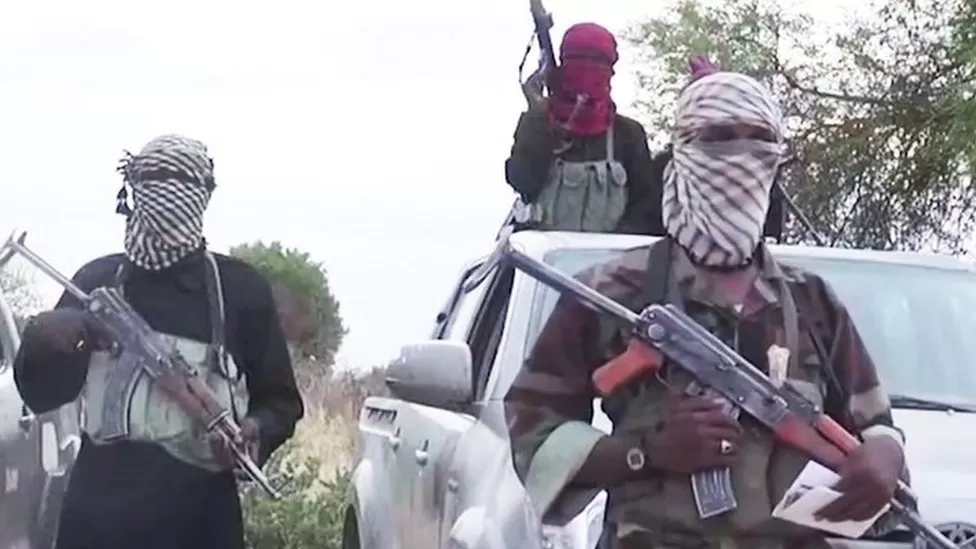
The Nigerian military has rescued numerous individuals, including women and children, who had been kidnapped by Boko Haram in Nigeria.They were kept in the forest for a long time.
The extremist group held 350 people captive in the Sambisa Forest. The group started fighting in 2009. GeneralKen Chigbu, a high-ranking officer in the Nigerian army, said on Monday that he handed over the people to the authorities in Borno, where the forest is located.
209 kids, 135 ladies, and six men looked tired in their old clothes. Some girls had babies from forced marriages or being raped while in captivity by the militants.
One of the hostages had seven kids and said they couldn’t get away because of their children.
Hajara Umara said, “I always wanted to leave, but I couldn’t because of my children. ” She and her children were rescued. “If they found out you tried to run away, they would hurt you and keep you locked up forever. ”
The army saved the hostages after a long operation in Sambisa Forest. The forest used to be a busy place but now it’s where Boko Haram and its groups attack people and security forces in nearby countries.
The people who were released were taken in trucks to the Borno state government house. The government will take care of them until they can go back home.
The army said that some extremists were killed during the rescue and their temporary houses were destroyed.
Boko Haram, a group of rebels in Nigeria, started a war in 2009 to make Islamic Shariah law the law of the land. At least 35,000 people have died and 2.1 million people had to leave their homes because of violent extremists in Nigeria, as per the UN.
Since the kidnapping of 276 schoolgirls in 2014, Boko Haram militants have taken at least 1,400 students from Nigerian schools. Recently, many kidnappings have been happening in the northwestern and central parts of the country, where armed groups often take villagers and travelers and ask for money to release them.
Tag: Boko Haram
-

Hundreds of hostages rescued from Boko Haram extremists in Nigeria
-
Mourners attending funeral of Boko Haram victims killed by terrorist group
Police in northeastern Nigeria have reported that a militant Islamist group, Boko Haram, has killed 20 individuals who were returning from the burial of victims of a prior attack by the insurgents.
This tragic incident occurred in Yobe state when a vehicle carrying mourners detonated an explosive device planted by the insurgents.
Just the day before, the militants launched an attack on Gurokayeya village, resulting in the death of 17 people. According to the police, Boko Haram orchestrated these attacks in response to the villagers’ refusal to pay a so-called “harvest tax.”
Boko Haram militants have been repeatedly accused of extorting payments from residents in northeastern Nigeria, using the funds to sustain their operations and exert control over local communities.
“This is one of the most horrific attacks by Boko Haram in recent times. For a burial group to be attacked shortly after the loss of their loved ones is beyond horrific,” resident Idris Geidam told the Associated Press news agency.
Yobe police spokesman Dungus Abdulkarim said that 10 members of the burial group died on the spot while another 10 died at a health centre where they were rushed to for treatment.
The incident occurred on Tuesday – a day after the deadly raid on Gurokayeya village.
The attacks are the first major assault that Boko Haram has waged in Yobe in more than a year.
State authorities said they suspected that the militants had arrived from neighbouring Borno state, where Boko Haram has carried out several attacks against civilians this year.
Much of Borno, the birthplace of Boko Haram, is still considered too dangerous to travel by road.
The group launched its insurgency in 2009, with aid agencies reporting that more than two million people have been displaced in the conflict.
The militant group has also extended its reach into neighbouring Niger, Chad and Cameroon, with government forces failing to defeat the group.
Boko Haram means “Western education is forbidden”, and it has repeatedly targeted secular schools as part of its attempts to establish its version of Islamic rule in the region.
The group gained notoriety internationally when it kidnapped more than 200 school girls from the north-eastern town of Chibok in 2014.
-
Nigerian rights commission to investigate army over alleged abortions
In its campaign against Boko Haram in northeast Nigeria, the military reportedly used a covert abortion programme, according to a December report from Reuters.
A special panel appointed by Nigeria’s human rights commission has been tasked with looking into a Reuters report alleging that the military used a covert abortion programme to fight armed groups in the northeast.
The government-appointed National Human Rights Commission (NHRC) announced on its website on Tuesday that it would introduce the special panel in Abuja the following week.
“The National Human Rights Commission will on Tuesday (7th February 2023) inaugurate a Special Independent Investigative Panel on human rights violations in the implementation of counterinsurgency operations in the northeast,” NHRC said.
“The panel will, among other things, focus on investigating Reuters report which alleged that Nigerian Military was involved in abortion of many pregnancies in the North East in the last 10 years,” NHRC said.
The seven-member panel will be chaired by retired Supreme Court Judge Abdu Aboki and includes a retired major general, a representative from the Nigerian Bar Association and an expert in obstetrics and gynaecology, NHRC said.
It was not immediately clear how long the investigation would last and what the panel would do with its findings. NHCR has no powers to prosecute human rights violators but can recommend prosecution for offenders.
An NHRC spokesperson did not respond to calls and messages sent to their mobile phone seeking further details.
Reuters reported in December, based on dozens of witness accounts and documentation, that the military abortion programme involved terminating at least 10,000 pregnancies among women and girls, many of whom had been kidnapped and raped by rebel fighters.
The Nigerian military said it would not carry out an investigation because the report was not true.
-

Boko Haram: Nigeria army captures dozens of rebels
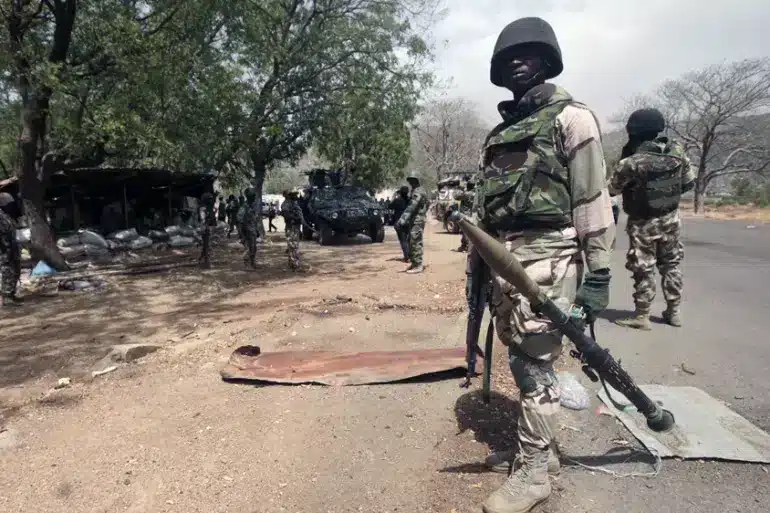
During the weekend, Operation Hadin Kai troops in the northeastern Nigerian state of Borno were able to capture at least 100 Boko Haram terrorists.
On January 23, 2023, in Damboa, Borno state, troops from the 25th Task Force Brigade nullified a number of ISWAP terrorists as part of Operation Hadin Kai.
Along the road from Damboa to Maiduguri, the terrorists attempted to ambush the soldiers who were on fighting patrol in Komala village.
One Guntruck, MRAP, and three motorcycles were confiscated from the terrorists. ISWAP terrorists have continued to suffer strings of humiliating defeats at the hands of Nigerian troops. On January 13, the troops eliminated several of the terrorists and destroyed their MRAPs when they attacked their own troops in Azir.
In early January, Boko Haram took control of the operational bases of the Islamic State West Africa Province, ISWAP, forcing 11 leaders and militant clerics to flee.
The terrorist organisation’s captured bases are in the Abadam Local Council. Yesterday in Maiduguri, Zagazola Makama, a counter-insurgency expert in the Lake Chad region, revealed that the seizure of the ISWAP bases prompted 11 leaders, along with ISWAP leader Abu Moussab al-Barnawi, to flee.
-
Nigeria military aborts over 10,000 pregnancies of impregnated women by Boko Haram terrorists
Since at least 2013, when it conducted a secret, illegal abduction programme for women and girls in the northeast, the Nigerian military has aborted at least 10,000 pregnancies.
According to Reuters, many of the women and girls were abducted and raped by Islamist militants.
Fati recounted her ordeal after being kidnapped by terrorists and later rescued by the military.
During an insurgent attack on Monguno, she lost contact with her family one night. She was later kidnapped by terrorists and thrown into one of two pickup trucks with the other women, she claimed. They drove through the night to the vast Lake Chad’s shores, where fighters loaded the women into canoes.
Captives were hauled out to the lake’s numerous islands as the sun rose.
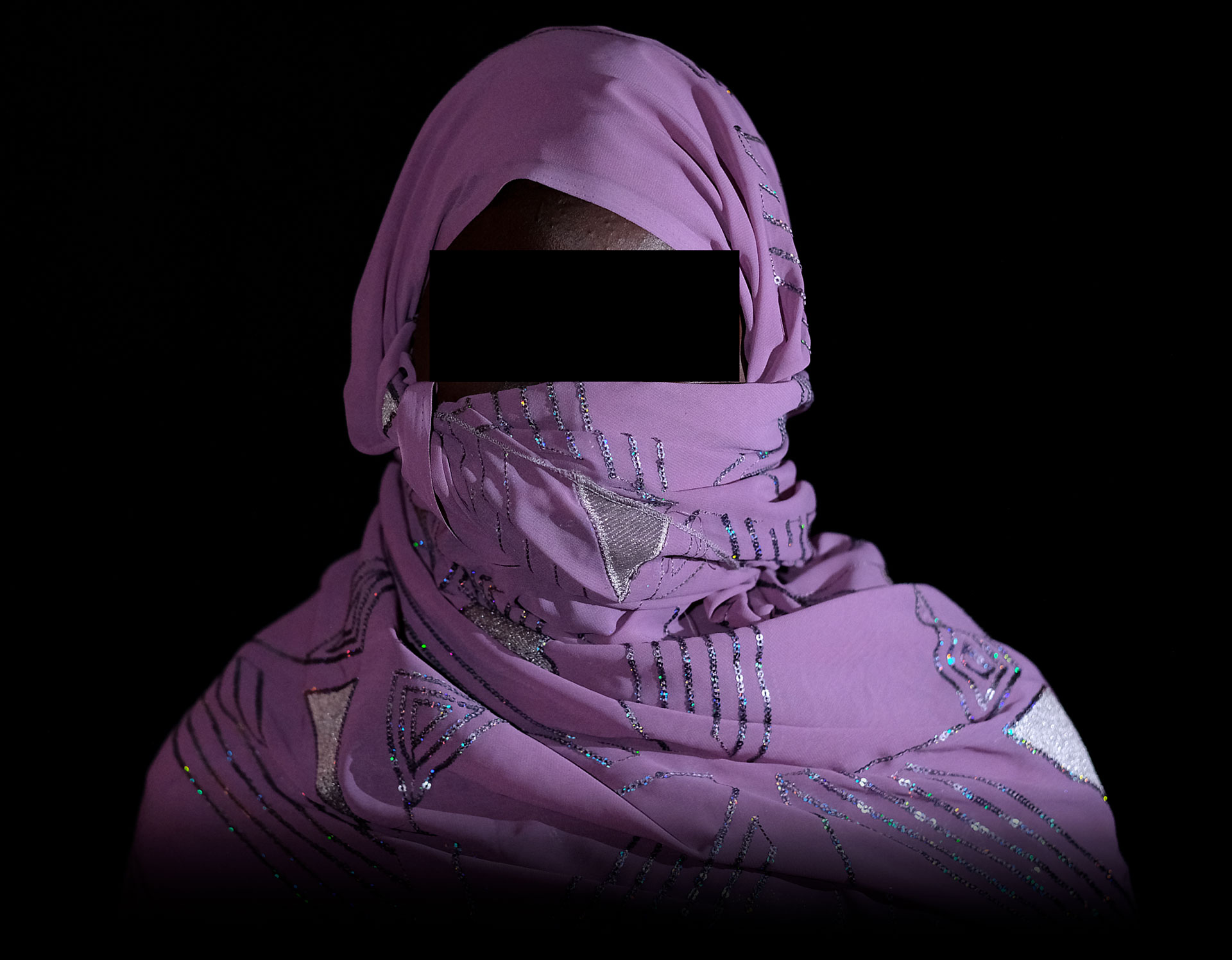
Fati was four months pregnant when liberated from the insurgents. Soon after, she says, soldiers medically aborted the pregnancy without telling her. And she was warned: “If you share this with anyone, you will be seriously beaten.” Fati said she was married off three times, forced to take a new husband whenever the previous one didn’t return from the war. The third, who impregnated her, “was the worst out of all of them,” she said. “He would hit me with the butt of his gun … He would beat me until I was sick.”
When the Nigerian soldiers came that day about three years ago, she welcomed them.
Now in her 20s, Fati said shortly after being rescued with four months of pregnancy, uniformed men gave her and five other women mysterious injections and pills in a dim room at a military barracks in Maiduguri, the Borno state capital.
After about four hours, Fati, who said she was about four months pregnant, felt a searing pain in her stomach and black blood seeped out of her. The other women were bleeding as well, and writhing on the floor. “The soldiers want to kill us,” she thought.
According to her, the soldiers aborted the pregnancies without telling them. And she was warned: “If you share this with anyone, you will be seriously beaten.”
The abortions mostly were carried out without the person’s consent – and often without their prior knowledge, according to the witness accounts. The women and girls ranged from a few weeks to eight months pregnant, and some were as young as 12 years old, interviews and records showed.
This investigation is based on interviews with 33 women and girls who say they underwent abortions while in the custody of the Nigerian Army. Just one said she freely gave consent. Reporters also interviewed five civilian healthcare workers and nine security personnel involved in the programme, including soldiers and other government employees such as armed guards engaged in escorting pregnant women to abortion sites. In addition, Reuters reviewed copies of military documents and civilian hospital records describing or tallying thousands of abortion procedures.
Three soldiers and a guard said they commonly assured women, who often were debilitated from captivity in the bush, that the pills and injections given to them were to restore their health and fight diseases such as malaria. In some instances, women who resisted were beaten, caned, held at gunpoint or drugged into compliance. Others were tied or pinned down, as abortion drugs were inserted inside them, said a guard and a health worker.
Bintu Ibrahim, now in her late 20s, recounted how soldiers gave her two injections without her consent after picking her up with a group of other women who fled the insurgents about three years ago. When the blood came, and the terrifying pain, she knew she and the others had undergone abortions. The women protested and demanded to know why, she said, until the soldiers threatened to kill them.
“If they had left me with the baby, I would have wanted it,” said Ibrahim, whose account was confirmed by a fellow former captive, Yagana Bukar.
At military facilities and in the field, some abortions proved fatal. Although Reuters could not determine the full scope of the deaths in nearly 10 years of the programme, four soldiers and two security officers said they witnessed women die from abortions, or saw their corpses afterward.
Ibrahim said she also witnessed a woman die after an injection at the time of her own abortion near a small village in the bush – an event corroborated by her companion Bukar.
“That woman was more pregnant than the rest of us, almost six or seven months,” Ibrahim said. “She was crying, yelling, rolling around, and at long last she stopped rolling and shouting. She became so weak and traumatised, and then she stopped breathing.
“They just dug a hole, and they put sand over it and buried her.”
Reuters was unable to establish who created the abortion programme or determine who in the military or government ran it.
Nigerian military leaders denied the programme has ever existed and said Reuters reporting was part of a foreign effort to undermine the country’s fight against the insurgents.
“Not in Nigeria, not in Nigeria,” said Major General Christopher Musa, who heads the military’s counterinsurgency campaign in the northeast, in a November 24 interview with Reuters that addressed the abortion programme.
“Everybody respects life. We respect families. We respect women and children. We respect every living soul.”
General Lucky Irabor, Nigeria’s chief of defence staff, did not respond to requests for comment from Reuters. On December 2, a week after Reuters sought an interview with Irabor and shared detailed findings and questions with his office, the military’s director of defence information released a five-page statement to reporters, and later posted it on Facebook and Twitter. Major General Jimmy Akpor said Reuters was motivated by “wickedness” and a “bullying” mentality, according to the statement.
“The fictitious series of stories actually constitute a body of insults on the Nigerian peoples and culture,” Akpor added. “Nigerian military personnel have been raised, bred and further trained to protect lives, even at their own risk, especially when it concerns the lives of children, women and the elderly.”
Central to the abortion programme is a notion widely held within the military and among some civilians in the northeast: that the children of insurgents are predestined, by the blood in their veins, to one day take up arms against the Nigerian government and society. Four soldiers and one guard said they were told by superiors that the programme was needed to destroy insurgent fighters before they could be born.
“It’s just like sanitising the society,” said a civilian health worker, one of seven people who acknowledged performing abortions under army orders.
Four of the health workers interviewed by Reuters also said that the programme was for the good of the women and any children they might bear, who would face the stigma of being associated with an insurgent father.
The army-run abortion programme has been in place since at least 2013, and procedures were being performed through at least November of last year, according to accounts from soldiers.
The procedures have occurred in at least five military facilities and five civilian hospitals in the region, according to witness accounts and documentation reviewed by Reuters. Many occurred in Maiduguri, the largest city in Nigeria’s northeast and the command centre of the government’s war on Islamist extremists.
The Maiduguri sites include the detention centre at Giwa Barracks, where Fati said she was forced to have an abortion. Other sites include the Maimalari Barracks, which is the city’s main military base, and two civilian hospitals – State Specialist and Umaru Shehu. The two hospitals did not comment on this story.
Forced abortions may amount to war crimes and crimes against humanity, according to four legal experts briefed by Reuters on its findings. Although forced abortions are not specifically criminalised under the Rome Statute of the International Criminal Court, the experts said, they could be construed as torture or other inhumane treatment and be prosecuted as such.
The International Criminal Court’s prosecutor found in 2020 that grounds existed to investigate possible war crimes and crimes against humanity by both Nigerian security forces and insurgents. But the court has not opened a probe.
The ICC’s Office of the Prosecutor declined to comment on Reuters’ findings.
SaharaReporters had reported how in April 2014, Boko Haram terrorists kidnapped 276 schoolgirls in Chibok town in Borno, prompting the #BringBackOurGirls campaign. About 98 of the kidnapped girls are still missing.
Two young women, Felerin and Aisha, described undergoing abortions after being taken into custody by the Nigerian military.
Other women interviewed by Reuters offered similar accounts of captivity and rescue – including being raped by insurgents and escaping with the help of soldiers who took them into custody and transported them under armed guard to military facilities or civilian hospitals. Many said they were made to give urine or blood samples before receiving unspecified injections and pills.
Nigerian facilities often used misoprostol, which helps induce labour or contractions, according to the documentation reviewed by Reuters. The drug is also used to treat ulcers and post-partum hemorrhaging, and is widely available in Nigerian cities, including through unofficial abortion-drug distribution networks. Women sometimes were also given the progesterone-blocker called mifepristone, which in many countries is used in conjunction with misoprostol in medication abortions.
Also given was the drug oxytocin, which is widely used during labour to stimulate contractions and safe to use when under medical supervision. Though experts say it is not recommended for abortions, it was sometimes given at military bases to trigger terminations, said two soldiers who performed the procedures.
Using oxytocin to induce abortion is dangerous, several international medical experts told Reuters, particularly if it is injected intramuscularly, as soldiers involved in the Nigerian programme said it was. If the drug is administered too quickly, the results can be fatal, the experts said.
The medications misoprostol and mifepristone are considered safe for abortions when the standard medical protocol is used, according to the World Health Organization and other authorities.
Among those forced to undergo an abortion was a girl named Hafsat.
She arrived at an army base in March 2019, a skinny teen of 14 or 15, clad in a turquoise dress and covered in mosquito bites, according to a soldier present that day.
The soldier said he and other troops injected Hafsat and three others with oxytocin while they lay on the ground outside the army clinic.
Within an hour, the soldier said, he heard cries and turned to see Hafsat bleeding heavily from between her legs. He grabbed her a cloth to stanch the blood.
Hafsat began crying out for a man named Ali, and for her mother. “Half an hour later, maybe, she just went quiet,” he said. “She died.”
The soldier said he and his comrades wrapped her in her turquoise dress and buried her. The memory haunts him.
“I can’t forget her name,” he said.
The details of the soldier’s account were corroborated by a second soldier at the base, who said he also witnessed the girl’s abortion and death.
In all, eight sources, including four soldiers, said they witnessed deaths or saw corpses of women who died from abortions performed at military barracks or administered in the field.
-
Nigeria: 90% of die-hard Boko Haram fighters dead, govt declares
The Borno State Government said yesterday that 90% of die-hard Boko Haram insurgents were dead, and it attributed the sect’s mass surrender to the death of their leader, Ibrahim Shakau, as well as military operations.
This comes as military authorities announced yesterday that 1,952 terror suspects were being investigated in the North-east, with 900 of them set to go on trial in January.
But taking journalists round the Hajj Camp in Maiduguri, which housed 14,804 repentant insurgents and families, Special Adviser on Security to the Borno State government, Brig.Gen Abdulrasaq Ishaq (rtd), said about 90 per cent of die-hard Boko Haram insurgents had died.
He equally explained that of the number housed in the three camps, married males were 3,472, single males 1,773, spouses, 4,438, male children, 2,691 and female children 2,497, noting that 5000 fighters and their families were living in the three camps as well.
On his part, the Theatre Commander, Operation Hadin Kai, Maj Gen Christopher Musa, while speaking in Maiduguri, said 82,237 insurgents and their families had surrendered so far, out of which 16,577 were active male fighters, 52,44 men, women and 96 children.
He stated that of the 276 kidnapped Chibok girls, 57 escaped, 117 were released while 11 were rescued this year.
Eleven of the Chibok girls, who recently escaped captivity now have 25 children, adding that, in all, 180 girls were out of captivity while 96 remained in captivity.
Addressing newsmen too at the Joint Investigation Center, Operation Hadin Kai, Captain Adeniyi Oluwagbenga, said 1,952 combatants were in detention, including 23 females and 11 children.
He affirmed that 900 Boko Haram members would go on trial in Niger State while 323 were sent to Operation Safe Corridor in Gombe State for rehabilitation.
He further explained that the trial of the suspects was moved to Niger State following the difficulty in accessing witnesses while some lawyers refused to go to Maiduguri for the trial.
“Most suspects are awaiting prosecution. The Attorney-General of the Federation (AGF), has assured that by January, more than 900 of them will be moved to Niger State for prosecution. Some lawyers refused to come to Maiduguri for trial hence it can’t be held in Maiduguri,” he said.
In a separate interview, the Borno State Commissioner for Women Affairs, Zoyara Gambo, said the 11 Chibok Girls, who recently escaped captivity had 25 children, adding that government was already taking care of the young mothers.
In a chat with some of them, the young mothers expressed their desire to return to school like some of their colleagues.
“We want to go back to school like others. We are not happy,” they said.
-
Ekpe Ogbu: Gunmen kidnap commissioner for Housing in Northcentral Nigeria
Ekpe Ogbu, the state of Benue’s housing and urban development commissioner, has been kidnapped.
The Commissioner was kidnapped around 4 p.m. on Sunday at the notorious Adankari Junction on the Otukpo-Ado Road.On Sunday night, Colonel Paul Hemba, Governor Samuel Ortom’s security advisor, confirmed the incident to reporters.
Governor Samuel Ortom He said that while rescue efforts have started and the police in Otukpo have found the Hilux van the victim was riding in, no contact has been made with the kidnappers.
With at least three instances of kidnappings there, the Adankari Junction has turned into a hotspot for kidnapping activity.
At the intersection on different days in the past, a priest, a professor from Benue State University, and an elected official from Otobi were all abducted.
After being freed, the victims said the abductors were armed herdsmen terrorising the area’s residents and commuters.
Meanwhile, Troops of Operation Whirl-Stroke (OPWS) covering Benue, Nasarawa and Taraba states respectively Sunday proclaimed the arrest of two notorious kidnappers who have been terrorising residents of Zaki-Biam in Ukum Local Government Area of Benue State and rescued some kidnapped victims.
-
Train service in Nigeria set to reopen months after attack
An essential train link between Nigeria’s capital, Abuja, and the northern city of Kaduna is set to reopen on Monday, nine months after it was shut down.
Last March, gunmen mined the track, forcing a train carrying over 360 passengers to come to a stop.
At least eight passengers were killed, and dozens more were abducted.
The link was popular with passengers who were afraid of travelling by road.
The Nigeria Railway Corporation is introducing new security measures, including surveillance devices to monitor the tracks and the trains.
Passengers will also have to provide their national identification number.
The government said the train attack was carried out by the Islamist militant group Boko Haram.
-
Nigerians are struggling after the government closes camps and reduces aid
Human rights organizations say that authorities are “harming hundreds of thousands… to advance a dubious government development agenda.”
According to Human Rights Watch, more than 200,000 Nigerians displaced by long-running violence are struggling for food and shelter after authorities in the northeast closed some of the camps they were living in and stopped aid.
Borno state, the epicenter of the Boko Haram conflict, announced in October 2021 that it would close all camps housing thousands of internally displaced people and return some of them to their communities. It cited increased security and the need to wean displaced people off humanitarian aid.
In a report released on Wednesday, Human Rights Watch said people removed from the camps were struggling to meet their most basic needs, including food and shelter, in the places where they had returned or resettled.
More than 140,000 people had been removed from eight camps in Borno while food aid to two more camps had been stopped as of August this year, Human Rights Watch said. Those two camps hold more than 74,000 people and will close this year.
“The Borno state government is harming hundreds of thousands of displaced people already living in precarious conditions to advance a dubious government development agenda to wean people off humanitarian aid,” Anietie Ewang, Nigeria researcher at Human Rights Watch, said in the report.
“By forcing people from camps without creating viable alternatives for support, the government is worsening their suffering and deepening their vulnerability,” she said.
Borno state commissioner for information Babakura Abba Jato told Reuters he could not immediately comment on the report.
The state government says some areas formerly occupied by Boko Haram fighters are now safe for citizens to return to, and it has rebuilt some communities although aid groups say they remain vulnerable to attacks.
Some of the camps and settlements for displaced people have been hit by a cholera outbreak, and children have been the worst hit.
Last month, about 2,000 people started moving into a new residential complex in Ngarannam that had been rebuilt by the United Nations and the state government.
Ngarannam, 50km (31 miles) south of Borno’s capital, Maiduguri, was overrun by Boko Haram in 2015.
-
Boko Haram suspect, 2 others arrested in Ghana
A joint security made up of military, police, and immigration officers have arrested a suspected Boko Haram fighter in the Upper East Region of Ghana.
According to a Joynews report, the suspect, identified as Hassan Hussein, was traced by the joint security force to his hideout in the region’s capital; Bolgatanga where he was arrested on Sunday, October 30, 2022.
Preliminary investigations reveal that; the suspect has links with Nigerian Jihadist group; Boko Haram. Security sources say the suspect was found with a wound suspected to be from a gunshot.
The report also indicated that the suspect’s arrest comes after an earlier arrest of two individuals by immigration personnel stationed around Nasia barrier in the Mamprusi West Municipality of the North East Region, had mentioned Hassan Hussein as their leader.
Police have since begun investigations whereas the other two suspects have been asked to be brought to Accra for further investigations.
-
Nigeria Boko Haram crisis: The women walking miles to save their children’s lives
Fati Usman’s son lies on a hospital bed in north-eastern Nigeria, looking almost lifeless.
He has difficulty breathing and looks extremely emaciated. A fly perches on his gaunt cheek.
From his size, you would think he is about two years old. But his mother says he is actually five.
He is just one of several million people caught up in a massive humanitarian crisis that an Islamist-led insurgency has caused in north-east Nigeria, leaving families in desperate need of food and medical care.
Dwindling funds are to blame for people’s hunger, say aid workers, as Nigeria’s government relies on support from aid agencies and the UN who in turn are more focused on crises in Ukraine and elsewhere.
Camps for internally displaced people (IDPs) are a last resort for millions of vulnerable Nigerians, yet Borno state, one of the worst affected, decided to close all such camps last year – labelling them slums and paying $200 (£175) to each family forced to leave.
And when it comes to government funding in the wider north-east, the malnutrition crisis comes second to fighting the region’s insurgents.
Aid workers predict that an estimated 1.74 million children under the age of five could suffer from acute malnutrition in north-east Nigeria in 2022 – a 20% increase from the previous year – and 5,000 could die in the next two months.
Ms Usman says her son caught measles, followed by diarrhoea.
“I got some medicines to give to him, but his condition didn’t improve. For 37 days he has been having diarrhoea.”
As his health deteriorated, she rushed him to the hospital in Damaturu, the main city in Yobe state in north-eastern Nigeria.
“I brought him here two days ago,” she says.
Five of her children had already died before this crisis – he is one of four who are still alive.
The 34-year-old mother is worn out and traumatised.
She fled attacks by militant Islamist group Boko Haram in the small town of Maino in Yobe, and moved into a camp for internally displaced people (IDP) five years ago.
“We couldn’t even take our belongings, not even food,” Ms Usman says.
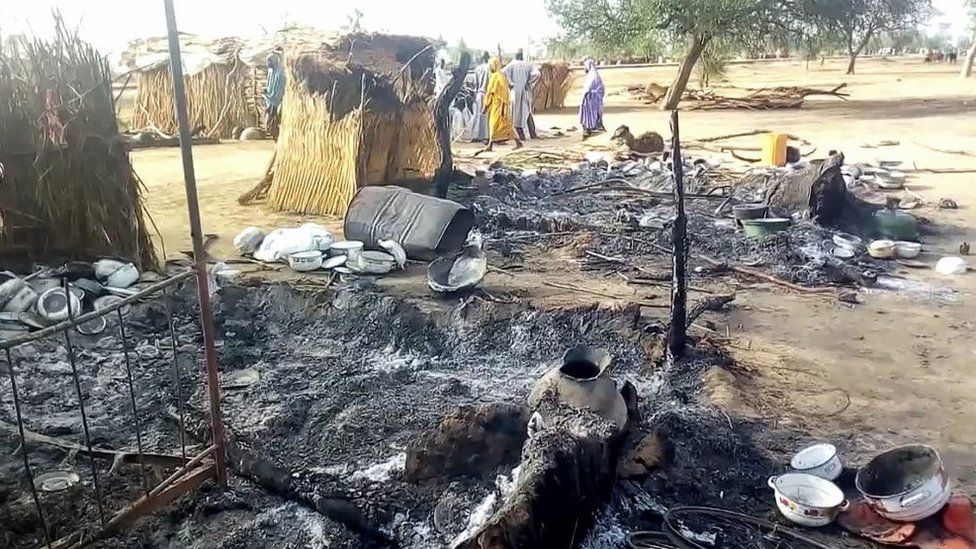
Image source, Getty Images Image caption, The security forces have failed to end the insurgency The spike in malnutrition has been worsened by outbreaks of disease including cholera, and disruption to farming because of attacks by militants.
Ms Usman’s husband works as a Muslim cleric, but he does not live with the family.
She tries to earn a living by sometimes helping neighbours sew their torn clothes in exchange for food. But the neighbours are also victims of the insurgency and have fled their homes, depending mainly on handouts from aid agencies and the government.
With plenty of mouths to feed, there are not enough food supplies to sustain the children and many become sick.
“This is the epicentre, so most of the cases that come here are severe ones,” Dr Japhet Udokwu, the coordinator of the centre, tells the BBC.
Like many doctors and humanitarians, he fears a disaster. Dr Udokwu is working around the clock, admitting at least 40 severely malnourished children every week for treatment.
According to him, some families travelled more than 100km (62 miles) from remote communities where there was no access to medical care. Many of them had lived in IDP camps in Borno state’s capital, Maiduguri, which have closed and are now unable to get enough food for their children, because they could not farm for fear of attacks.
Now is a critical moment, because the lean harvesting season is at its peak and there has been an uptick in the number of children brought in since the start of the year. As a result this facility – and others like it – are overwhelmed.
Dr Udokwu tells me his team has just finished administering treatment to a child who was rushed in a few hours earlier.
“The child is unconscious as a result of several days of passing loose stool, so we had to resuscitate him,” he says.
“We actually have a lot of severe cases coming with hypoglycaemia, shock, and the like in this facility.”
The facility is one of the few stabilisation centres that the BBC gained access to in some of the hard-to-reach locations in the north-east, where aid workers are battling to save the lives of hundreds of children.
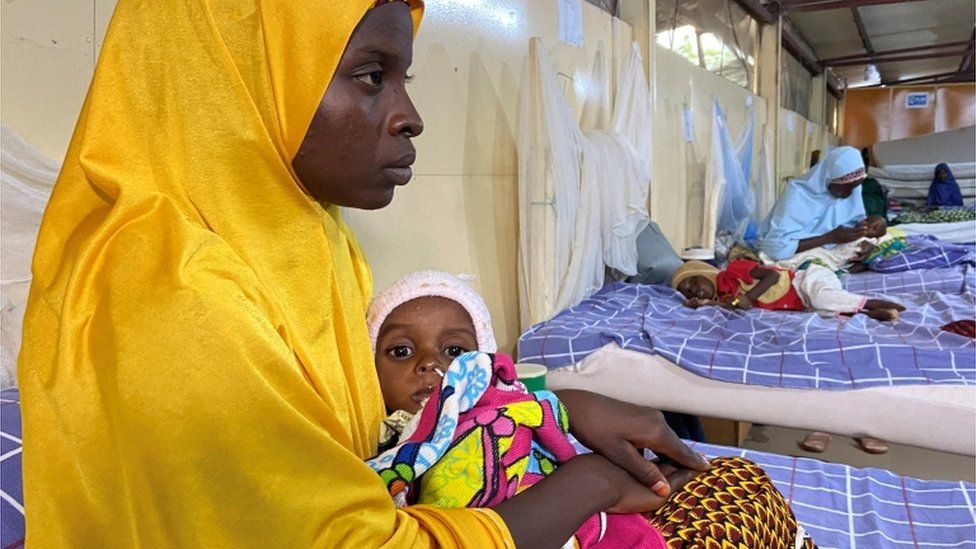
Image source, Reuters Image caption, Aid workers fear that thousands of children could die In another stabilisation facility in the commercial hub of Bama in Borno state, healthcare workers are also racing against time to cope with the mounting number of cases of children suffering severe acute malnutrition.
There, 25-year-old Fatima Bukar says she lost three children to malnutrition and walked 30km, carrying her two remaining children to the camp.
The children are among 22 patients in a 16-bed ward at the health centre in Bama.
Her four-year-old daughter, who lies on her side with swollen cheeks, cries intermittently whenever her mother turns to care for the one-year-old, emaciated-looking child in her arms.
Opposite Ms Bukar, another child cries as her mother tries to turn her around and make her lie on her back. Most of her skin looks burnt, all the way up to her face.
This is the result of what medics call grade three oedema and dermatosis. It starts when there is severe swelling in the body. When the swelling starts to subside the skin cracks, making it look like burns.
Dr Ibrahim Muhammad, who is in charge of the centre, says this is one of the effects of severe acute malnutrition.
“We see a huge influx of children with severe acute malnutrition every day. Many of them live in the Bama camp,” he adds.
Aid worker John Mukisa says that without a rapid increase in food aid, many children will die or be left disabled.
Since taking office in 2015, President Muhammadu Buhari’s government has repeatedly promised to tackle the security and humanitarian disaster, but it has largely failed to do so.
Yet it defends its record, claiming to have made significant success in the fight against Islamist militants, including the voluntarily surrender of thousands of militants in the north-east.
This comes as little comfort to the communities that have been devastated across this region.
Ms Usman says she fears that the worst could be still to come.
“Since our village was attacked, we have been visited with lots of tragedies. Our children have been dying of diseases and they may continue unless there’s intervention to save our lives.”
Source: BBC
-
Nigeria enrols Boko Haram child victims to school
Nigeria‘s north-eastern Borno state government has launched an ambitious school enrolment programme for thousands of children displaced by the Boko Haram jihadist insurgency.
The state governor, Babagana Zulum, launched the initiative in Monguno town where victims of the conflict have been staying in camps after being displaced from their communities.
Some 7,000 children were registered to primary and junior secondary schools in the first phase of the programme on Sunday and Monday, his spokesman told the BBC.
The authorities say many of the beneficiaries are children orphaned by the violence. They say the project is targeting more than 20,000 children across the state.
The insurgency, which began in 2009, has killed tens of thousands of people and displaced millions of others in north-eastern Nigeria and several neighbouring countries.
It forced many children to abandon schools and others could not be enrolled at all. Learning institutions have also been destroyed.
The authorities however say they are making efforts to ensure children are back to class by building new schools and sponsoring their education.
Source: BBC
-
Disregard allegations of Boko Haram in Ghana ; we are safe – Interior Minister
Interior Minister, Ambrose Dery, has urged Ghanaians to ignore report circulating on social media that terrorist and jihadist groups, including Boko Haram, has reached the shores of Ghana.
According to the minister, no part of the country has been attacked by a terrorist organisation as purported in the viral video on social media.
Dery added that although neighbouring countries have been attacked, the security apparatus in Ghana are on top of their jobs and are leaving no stone unturned in their effort to ensure that the country does not see any terrorist attacks.
“We live in a region which is volatile and prone to extremist activities. Our neighbours have been attacked variously. But let me make it clear that those footages that are on video and on platforms that extremists have attacked any part of Ghana are false. They are false and should be disregarded,†the minister said in a video shared by Ghana Broadcasting Corporation on social media.
Recently, there have been allegations that Boko Haram has attacked communities in the Northern Regional capital, Tamale.
The viral video showed people dressed in military apparel alleged to be personnel of the Ghana Armed Forces with all kinds of military equipment, including vehicles and a helicopter, patrolling an area that was said to have been attacked by terrorists in Tamale.
Watch the minister speaking at the event in the video below:
Source:ghanaweb.com
-
Terrorism: Ghana must stay alert and not lose guard – Kwesi Pratt
Seasoned Journalist, Kwesi Pratt Jnr., has outlined some measures to prevent terrorism from happening in Ghana as neighbouring countries have been hit by insurgent attacks.
Countries such as Togo, Burkina Faso and Cote d’Ivoire among others have had terrorists infiltrating them and causing havoc to the citizenry.
Ghana’s closest neighbour, Nigeria, has also been fighting Boko Haram, an Islamic insurgent group, that’s engaged in a series of mass murders.
The acts of terrorism in the sub-region are a cause for alarm and there are predictions that Ghana may be a target if nothing is done to combat it.
Speaking on Peace FM’s “Kokrokoo”, Kwesi Pratt Jnr. called for a strong security force along the borders of the country to avert any possible terrorist threats.
He proposed to the government to well-equip the Ghana Navy and Armed Forces.
Dwelling on the Ghana Navy, he said; “It is important to beef up the navy, its equipment and so on…Let’s make a good budget and equip the Navy properly in order for them to protest us…It will get worse if we allow these terrorists to have their way.”
Mr. Pratt also called for an end to ethnic conflicts stating such conflicts could potentially fuel terrorism.
“We should be vigilant about the ethnic conflicts, especially along our borders, so that it will not provide fertile grounds for these Islamic insurgents who are battling in the West African sub-region,” he stated.
He cautioned the nation not to lose guard, thinking these terrorist acts are far from occurring in Ghana, but also rather called for concerted efforts in the West African sub-region against the Islamic insurgents.
Source: Ghanaweb via Peacefm online
-
Back from the dead: Five times Boko Haram leader Shekau refused to die
Whiles local media outlets have reported the death of Boko Haram leader Abubakar Shekau, a cross section of Nigerians are taking the news with heavy skepticism.
The reason being Shekau has been the most killed terrorist leader in the last decade with an average of one death rumour in every two years.
Death reports have gone as high up as the Nigerian military making the claims as was the case in the era of immediate past army chief Yusuf Buratai.
The army in 2016 said Shekau had been fatally wounded in an attack but will years on raid his Sambisa forest hideout with Shekau escaping after disguising himself as a woman.
The federal government and the army have yet to make any pronouncements on the development.
Here are five times Shekau has been ‘killed’ in the media
1. The first time he was reported dead was in 2009, at the time he was a senior comander in the group. Security forces launched an operation against the group, killing hundreds of its fighters.
Shekau was said to have died in the exchanges but he re-appeared in a video posted online and was later named new leader of the group
2. In August 2013, the Nigerian army reported fatally injuring Shekau during a raid on the group’s base in the Sambisa forest.
The folowing month, Shekau appeared in a video and in usual fashion mocked the authorities over their claims to have eliminated him.
3. Five years later, in 2014. The Nigerian army claimed to have killed Shekau in a battle for Kodunga, a key town located in the then restive Borno State.
The faceoff lated between September 12 to 14th. The Cameroonian military – who are in a regional joint force against Boko Haram backed the claim of the Nigerian army with photos purported to be that of dead Shekau.
Shekau popped up yet again in a video to dispel the rumours and throw jibes at the armies.
4. In 2015, Foremr President of Chad Idriss Deby claimed the group had collapsed and another leader had taken over from Shekau but unlike in previous times, Shekau released a video to refute Deby’s claims.
5. In 2016, the Nigerian Airforce announced having fatally injured Shekau and killing top Boko Haram commanders in an airstrike on Taye village on August 19 2016.
It was not long before a YouTube video of Shekau popped up and in typical fashion he mocked government and the army stressing that his life and death rested in the hands of God.
It was in the same 2016, that the group splintered with the original Boko Haram faction pledging allegiance to Al-Qaeda whiles the breakaway faction pivoted to the Islamic State.
The latter broke away from IS to form the Islamic State in West Africa Province, ISWAP.
Source: www.ghanaweb.com
-
Boko Haram claims school kidnapping in northern Nigeria
Terror group Boko Haram on Tuesday claimed responsibility for abducting over 300 students in Nigeria’s northwestern state of Katsina.
A total of 333 students from the Government Science Secondary School remain missing after the Friday night attack by gunmen on the boys’ school. In an audio message, a man identifying himself as Boko Haram leader Abubakar Shekau claimed that the group is “behind what happened in Katsina,” local media reported.
Katsina State Governor Aminu Masari on Monday confirmed that government negotiators are already in touch with the kidnappers, but he refused to disclose details of the negotiations as the authorities were trying to protect the victims and secure their release.
In response, the national union of Nigerian teachers on Tuesday threatened to down tools over recent attacks on schools.
Such incidents “are sad reminders of previous ugly events in Chibok and Dapchi, where Boko Haram terrorists had attacked and abducted students, creating a monumental disruption of school activities and impeding our nation’s educational growth and advancement while subjecting family members and relatives to unimaginable trauma,” the union said in a statement.
Source: GNA
-
At least 27 persons killed in Boko Haram attack
At least 27 people have been killed in an attack in southeast Niger, local officials have gathered.
Other people were wounded and some reported missing on Saturday evening in the village of Toumour in the Diffa region, said a senior local official.
Witnesses and other officials confirmed the attack, which came hours before municipal and regional elections went ahead across the country on Sunday.
“Some victims were killed or wounded by bullets, others were burnt inside their houses, consumed by the flames of an enormous fire set by the attackers,” said the official.
Between 800 and 1,000 houses, the central market, and numerous vehicles were also destroyed in the fire, he added.
Roughly 70 attackers arrived at Toumour at around 1745 GMT on foot, having swum across Lake Chad, said the official. The attack itself lasted three hours.
“They first attacked the residence of the traditional chief, who only just managed to escape,” he said.
“It was an attack of unprecedented savagery,” said a local elected official who asked not to be named. “Nearly 60 percent of the village has been destroyed.”
Diffa a region located on the border with Nigeria has been frequently attacked by Boko Haram since February 2015.
Source: africanews.com
-
Thousands missing in Africa due to conflict and migration
The International Committee of the Red Cross (ICRC) says more than 40,000 people across Africa are registered as missing as a result of conflict, migration and climate shocks.
It says almost half of them are children.
Conflicts in Ethiopia, Somalia, the Democratic Republic of Congo, Libya and Cameroon are having a big impact.
But the situation is most severe in north-east Nigeria and the coronavirus pandemic has made the job of finding missing relatives even harder.
In north-eastern Nigeria, the ICRC says more than 20,000 people are registered as missing.
Its teams are also searching for more than 5,000 people in South Sudan – they are trying to help mothers like Juma Kedai Korok whose son was abducted by an armed group four years ago. She hasn’t heard from him since.
The ICRC says there’s been an increase in the number of people whose relatives are missing in Libya – most of them young men who entered the country on the migration route to Europe.
The ICRC says more than 20,000 people are registered as missing in north-eastern Nigeria
Source: bbc.com
-
Nigerian troops kill 20 terrorists in Borno
Nigerian Army troops on Sunday killed 20 Boko Haram and Islamic State of West African Province, (ISWAP) terrorists at the north west of Baga town in Borno.
Maj.-Gen. John Enenche, the Coordinator of Defence Media Operations, Defence Headquarters, disclosed this in a statement on Monday in Abuja.
Enenche said the troops of 130 Battalion with the support of the Army Super Camp, Baga, recorded the success in a decisive intercept offensive operation.
He disclosed that the terrorists, who were armed with mortars, rocket propelled grenades and small arms were heading to attack villages surrounding Baga when the troops attacked their convoy with overwhelming firepower.
According to him, the troops captured six AK 47 Rifles, 520 rounds of 7.62mm special ammunition and five 36 hand grenades.
“However, nine of our gallant soldiers were wounded in action with no loss of life.
“The wounded were evacuated to Sector 3 hospital for treatment.
“The Chief of Army Staff, Lt.-Gen. Tukur Buratai, commends the gallant troops for their professionalism and directs them to remain resolute toward eradicating the criminals from the North East,†he said.
Source: Pulse Nigeria Â
-
Boko Haram suspects ‘die of poison’ in Chad jail
Forty-four suspected Boko Haram militants in Chad have died in detention from apparent poisoning, the country’s public prosecutor says.
The men were part of a group of 58 suspects captured during a recent major army operation against the Islamist group around Lake Chad.
An investigation has been launched after four autopsies showed a lethal substance had led to their deaths.
The justice minister told AFP the prisoners had not been ill treated.
Djimet Arabi was responding to allegations that the prisoners were placed in a single cell and given no food or water after their transfer to the capital, N’Djamena, on Tuesday.
The military offensive was launched after jihadists killed nearly 100 Chadian troops on 23 March during a seven-hour attack on an island base in Lake Chad.
It was the deadliest attack on the Chad’s army by Boko Haram since their insurgency spread across the border from Nigeria several years ago.
The prisoners, who were being held as part of an anti-terrorism investigation, had been found dead on Thursday morning, public prosecutor Youssouf Tom said.
“Forty of them were buried and the other four were taken to a pathologist, whose report revealed that a lethal substance was consumed, leading to heart problems in some and severe asphyxiation amongst others,” he announced on state television on Saturday.
Mr Arabi confirmed to the AFP news agency that investigations were ongoing: “Was it collective suicide or something else? We’re still looking for answers.”
One detainee, who was taken to hospital on Thursday, had recovered and rejoined the other 13 prisoners who were “still alive and doing very well”, the justice minister added.
The army has said its eight-day operation to flush out militants from hideouts on the islands of Lake Chad was successful.
An army spokesman was quoted as saying that more than 1,000 jihadists were killed in the vast marshy area, which is surrounded by Chad, Nigeria, Niger and Cameroon.
The Boko Haram insurgency began in north-eastern Nigeria more than a decade ago – and the violence has spread to neighbouring countries, killing more than 30,000 people and forcing two million from their homes, according to the UN.
Despite regional efforts to end Boko Haram’s campaign of violence, the group has stepped up its attacks in recent months.
Source: bbc.com
-
Nigerian soldier kills himself and four colleagues
A formal investigation has been launched in Nigeria after a solider shot dead four colleagues on Wednesday before taking his own life, the army says.
Two other soldiers were injured in the incident at a military base in Borno state and were taken to a military hospital in Maiduguri for treatment, army spokesman Sagir Musa added.
Borno state is one of the areas worst affected by the decade-long insurgency waged by Islamist insurgents in north-eastern Nigeria.
Last year, a retired officer, who now specialises in mental health, said many soldiers fighting Boko Haram militants were “suffering mental illness in silence”.
Source: bbc.com
-
Boko Haram’s threat against Buhari empty boast – Military
The military at the weekend dismissed the threat issued against President Muhammadu Buhari by the leader of Boko Haram insurgents, Abubakar Shekau, not to visit the North-east.
Director of Defence Information (DDI), Brigadier-General Onyema Nwachukwu, told THISDAY that Buhari was free to visit any part of the North-east at any time as troops are on the ground all the time in the region to ensure his safety along with that of other Nigerians.
This is as the president yesterday condemned the insurgents’ attacks on Garkida in Adamawa State at the weekend, and sympathised with the families of the victims.
The military also urged the international community to curb proliferation of arms and block the sources of funding for terrorists, saying that 75 per cent of illegal arms in Africa are in Nigeria, Congo, Central African Republic, Mali and Sudan.
Shekau, in a nine-minute video released last week, had mocked Buhari after his recent visit to Borno and warned him not to visit Maiduguri again or risked being attacked.
He also threatened the Minister of Communication and Digital Economy, Dr. Isa Patami, for vowing to block the communication facilities of the insurgents.
Besides, he asked the Chief of Army Staff, Lt. General Tukur Buratai, whether he had become weary of leading the war against insurgency.
Buratai had in a letter to war commanders in the North-east at the weekend, congratulated them for their gallantry, stating that with their renewed vigour, the war would be won in a matter of days.
However, just about the time Buratai wrote the letter to the troops, the insurgents launched fresh attacks on Adamawa, burning police barracks, churches and the home of Buhari’s classmate, Major-General Paul Tarfa (rtd).
However, Nwachukwu described Shekau as a rat moving from one hole to another.
He said: “Our president is free to go to anywhere in the North-east whenever he feels like. Our troops are dominating the ground.
“I have told you the major terrorist strategy is hit and run; target women, soft targets and take off. That was why I called Shekau a rat. He is running about, hiding himself in holes. He does not have what it takes to confront the armed forces of Nigeria.”
He explained that Shekau and his terror group had become factionalised, depleted and defeated, adding that the armed forces cannot be cowed by terrorists’ ranting.
“The Armed Forces of Nigeria cannot be brought to their knees. That’s the truth. Boko Haram, having been defeated, I have told you why you must agree with me that Boko Haram has been depleted before they started fresh efforts to self-regenerate by embarking on recruitment drive.
“Between 2015, 2017 and 2018, Boko Haram was completely depleted; the leadership was in turmoil. That was why they were factionalised; that’s why Shekau lost grip on the group and that was why Albanawi took over.
“That’s why he was endorsed because Shekau couldn’t deliver. Why was Albanawi deposed? It is simply because, he couldn’t deliver. Why was Mamman Nuhu eliminated? He was eliminated because he was not delivering and as a matter of fact, he was even compromising.
“But the fact is that they could not meet the force of the armed forces of Nigeria,” he added.
Nwachukwu said the group’s ultimate ambition was to have a caliphate in Nigeria but the military frustrated the dream.
“Nigeria is not a ground for any terrorist caliphate. It’s not happening. That’s why we keep telling you that these guys are not holding any territory in Nigeria,” he stated.
The defence spokesman also gave an insight into the location of Shekau and his gang.
“Where they are is in the Lake Chad Basin where they have surrounded themselves with Improvised Explosive Devices (IEDs) and mines. What they do is hit and run.
“They hit soft targets to project themselves as being virile and potent. The strategy is to make themselves unreachable. We can conduct ground offensives to dislodge them and take over the place of course but what will be the outcome, there would be a lot of fatalities.
“They keep running in and out of the place, running across the border and running back. It is a hit-and-run kind of a thing. That was why I called Shekau a rat. He is running about, hiding himself in holes. He does not have what it takes to confront the armed forces of Nigeria,” he said.
He also queried the sources of funding for terrorists, saying that the international community must as a matter of urgency interrogate terror financing.
He stated that West Africa must not allow global terrorism to take root in the sub-region.
“There is a turn of events in the North-east. We must not allow it as a nation. For global terrorism to come and project itself, to have a grip on our land, we must never allow it.
“As a sub-region, we must not allow global terrorism to come and establish its roots here. It must never be allowed. The international community must address the issue of arms proliferation.
“How can we cope with the fact that three quarters of illegal arms are in Africa? They are in Mali, Sudan and Nigeria. They are in Central African Republic; they are in Congo.
“These are issues that should be interrogated. We are talking about funding. Who is funding global terrorism? Who are those behind it? I told you that the situation in the North-east has taken a new turn because of the efforts of ISIS to save the face of global terrorism by coming to establish a root in West African sub-region,” he said.
He called on the international community to pay urgent attention to the situation.
He added: “We need to look at these issues. When we look at the international level, efforts must be made to checkmate arms proliferation.
“We have made great efforts from the strategic perspective of our country, border closure, intensification of border monitoring and surveillance but what is the international community doing to prevent illegal acquisition, manufacturing and sales of weapons, light and small weapons and firearms?”
Buhari Condemns Attacks on Adamawa, Vows to Rout Boko Haram Soonest
Meanwhile, President Buhari at the weekend condemned Boko Haram attacks on Garkida in Adamawa State and sympathised with the families of the victims.
The president also vowed that “in the coming weeks, Nigerians would witness an aggressive campaign to rout Boko Haram once and for all.”
Buhari, who said the federal government would not abandon any part of Nigeria to their fate, also claimed that Boko Haram’s attacks on soft targets now are mere expressions of its frustrations.
A statement by presidential spokesman, Malam Garba Shehu, last night, said the president commended what he described as the gallantry of the members of the armed forces whom he said went after the insurgents and repelled the attacks.
The president also said the frequent attacks by the terrorists on innocent civilians in recent times were a mere ploy to portray themselves as strong and fool the public.
“These attacks on soft targets by the terrorists are obvious signs of frustration because my administration has significantly weakened Boko Haram’s military capability to invade and hold Nigerian territory unchallenged.
“Our gallant forces deserve our appreciation for repelling the attackers but they must go beyond this point. They have our full support to go after the terrorists and have them pay a huge price. I want to assure the country that terrorists will continue to face the combined power of our military until they give up their mistaken ways.
“These occasional and episodic attacks on poor civilians by the terrorists are mere propaganda efforts to portray them as strong in order to fool the public into believing that they haven’t been militarily weakened by our gallant troops,” he said.
The president argued that since the advent of his administration, Boko Haram’s plan to occupy Nigerian territories and hoist their flags had been frustrated.
He promised adequate funding for security and appealed to Nigerians to give required support to the military in its battles against insecurity.
“Security will continue to be well funded despite the competing needs of social services. I appeal to Nigerians to continue to support our troops in their gallant efforts to protect the citizens and secure the country,” Buhari added.
Source: allafrica.com
-
Amnesty for Boko Haram repentant insurgents is unfortunate PANDEF, Monarch
The Pan Niger Delta Forum, PANDEF, has described deliberations by the Nigeria Senate on a bill that seeks to establish an agency that would see to the rehabilitation, de-radicalisation and integration of repentant insurgents in the country as unfortunate.
The bill sponsored by the lawmaker representing Yobe East senatorial district, Senator Ibrahim Gaidam, was read for the first time on the floor of the Senate last Thursday.
Reacting to the bill yesterday, PANDEF national chairman, AVM Idongesit Nkanga (Retd) while questioning the rationale for the establishment of the agency, warned that the federal government is treating members of the Boko Haram insurgents with kid gloves.
His advice is coming just as the Ovie of Oghara kingdom in Ethiope West local government area of Delta State, HRM Noble Eshimitan, Orefe III, called for the appraisal of amnesty for Niger Delta agitators and same for repentant Boko Haram insurgents whom he said are fighting for the removal of western education and installation of an Islamic system in Nigeria.
“If this is really the cause of the insurgents then it is a complex problem in my mind that will be very difficult to solve,†he stated.
On his part, a former member of the House of Representatives and immediate Chief of Staff to Governor Ifeanyi Okowa, Tam Brisibe, warned against the use of adhoc agencies to deal with issues bedevilling the country.
He said: “I do not think an agency for repentant Boko Haram insurgents is what is needed. We should stop doing things on a quota bases. Because the amnesty program was done for the Niger Delta people, somebody from that area feels that they should also have that kind of programme for these people who are destroying the lives of people in that environment.”
“We cannot legislate every single thing in the country and cannot create more Adhoc agencies to deal with things that as a country we should have a system of dealing with and government should be able to address the needs of the people.†AVM Nkanga ON HIS PART, SAID: “It is unfortunate that we are treating the issue of Boko Haram insurgents with kid gloves. There is nowhere in the world that you will go and be begging them the way we are begging.”
“In other countries, you do not negotiate with them (terrorists), but in our case, tomorrow you will see a governor standing with bandits and taking picture after which they will give them money.”
“At some point, the government said they are foreigners, are we de-radicalizing foreigners to keep them in Nigeria to do what?”
“Besides, what is the point in wanting to establish this agency now when the Boko Haram war is still ongoing? If it was at the end of the war when you know you have put in more foundation and them never going back as bandits with the issue not arising again is a different thing, but doing it now, you will just be founding them and that is what we are doing.â€
Source: vanguardngr.com
-
Nigeria needs 100,000 more soldiers to crush Boko Haram – Borno Governor
Borno State Governor, Prof. Babagana Zulum, Wednesday said that Nigeria would require about 100,000 more soldiers to win the war against Boko Haram.
He, however, suggested at least 50,000 of the recruits should come from Borno, irrespective of whether or not they have western education, to prosecute the ongoing war against terror.
The governor urged President Muhammadu Buhari and the military to revisit the strategy used in 2016/2017 when Nigerians were almost celebrating the demise of Boko Haram so that the insurgents would be defeated once and for all.
Zulum spoke yesterday in Maiduguri while playing host to the House of Representatives’ Committee on Defence led by its Chairman, Hon. Babajimi Benson.
Also yesterday, the governor, in a broadcast, declared Monday a day for statewide fasting and prayers against Boko Haram insurgents.
He said the war against insurgents could not be successfully won without manpower, technology and proper funding.
He said: “Take my words, they (the military) don’t have the manpower; they don’t have the equipment. Kindly advise the speaker and the Senate president to tell Mr. President to approve the massive recruitment of soldiers. We need about 100,000 more to be recruited into the Nigerian Army. They should come and employ the locals whether they have western education or not.
“We need to recruit nothing less than 50,000 men from Borno; we have able-bodied men that can join the Nigerian Armed Forces on an ad-hoc basis.”
Zulum expressed doubt about Nigeria’s readiness to win the ongoing war against insurgency, saying that “you cannot fight this war without manpower, technology and proper funding.”
The governor added that he will always admit the fact that the Buhari administration did so much to degrade Boko Haram when it came to power in 2015, but the situation has already degenerated with the renewed attacks on the state.
He said: “I have always admitted that the federal government has done well under the watch of President Muhammadu Buhari. At a time, about 20 local government areas were displaced but after May 29, 2015, almost all the roads were opened and the local government retrieved.
“But notwithstanding the gains that we had, between March 2019 till date, we have experienced horrific and simultaneous attacks throughout the state. As I told the Theatre Commander, we are experiencing the attacks in quick geometrical ratio.
“I therefore plead with Mr. President and as well as the Nigerian military to revisit the strategy used during 2016/2017 that we were almost celebrating the demise of Boko Haram so that we can deal with the insurgents once and for all.
“One important thing that we have to do is to take the fight into their enclaves. The whereabouts of the Boko Haram is known to all of us. It is known to the people of Borno State; it is known to the military. It is known to all of us.
“Another important thing that I raised is the issue of commercial activities. There is nexus between peace, security and development. There is nexus between poverty, unemployment and insecurity and in order to address causes of insurgency, we need to address our major challenges. And one thing I plead with the Nigerian military is to allow for free flow of commercial activities in Borno. This will reduce recruitment, fortunately enough the chief of army staff has lifted the ban on sales of fish and fish farming in Borno State, we have conveyed the message to the fish farmers.
“Then coming down to the challenges of the Nigerian military, I think the theatre commander can inform you better, but to the best of my knowledge, their major deficiency is manpower. They lack manpower. Borno State has a large landmass and therefore they need manpower; they need technological warfare; they need logistics. You cannot fight this insurgency to an end without technology and without manpower and without funding, this is very germane.
“Take my words, they don’t have manpower. They don’t have equipment.”
According to the governor, military operation has to use stabilisation mechanism, which ensures stabilisation effort on ground during a military operation.
He added that to ensure this, the military needs manpower to hold a place as “without manpower, you cannot hold a place; without people going about their normal activities, going to their farms peace cannot reign.
“We have over 500,000 IDPs in Monguno, 120,000 IDPs in the Republic of Niger, we have 68,000 IDPs in the Republic of Cameroon that are eager to come back home and even in Dikwa how many IDPs do we have that have limited access to their farms. This issue will not stop until people have access to their farms.
“And honestly speaking, we need to increase the firepower of the police to augment the military as well as the Civil Defence Corps because of their importance.”
He noted that the paramilitary, police and others have to be allowed to carry sophisticated arms.
“I think there is the need to allow for certain guns to be used by the paramilitary for certain period of time. After the insurgency is over, you can now go back to the old position,” he stated.
Meanwhile, Zulum has declared Monday, a day of statewide fasting and prayers against Boko Haram insurgents.
The governor, in a six-minute broadcast to the people of the state, however, said there would be no public holiday on Monday.
The governor after enumerating ongoing collaboration with the military, including calls for mass recruitment, equipping and deployment of thousands of volunteers in the Civilian JTF, hunters and vigilantes, said his call for prayers was strange but a necessary decision made based on popular wish of the people of the state.
“Even though this decision is based on the popular demand of our people, some observers may rightly argue that it is a strange call. But then, Borno has been befallen with a strange evil since 2009; and sometimes, strange ailments require strange approaches.
“As your governor, I hereby declare Monday the 24th of February 2020 as a day of devotion to pray for the return of peace in Borno. I intend to fast on that day and I appeal to every one of us in Borno, who can, to join in that simple, but pricelessly rewarding spiritual endeavour. I also appeal for the sacrifices of all other well-meaning friends and associates of Borno who can, to join us in fasting on Monday, insha’Allah, for the restoration of peace in Borno State and rest of Nigeria,” he explained.
Source: allafrica.com